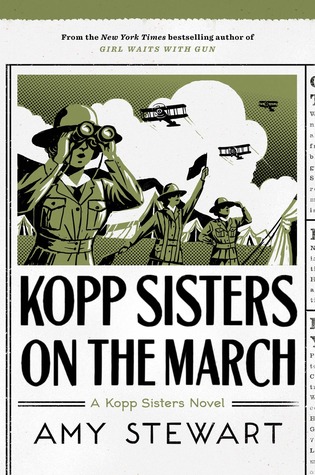
Aubiobook Review: Kopp Sisters on the March by Amy Stewart


In the fifth installment of Amy Stewart’s clever and original Kopp Sisters series, the sisters learn some military discipline—whether they’re ready or not—as the U.S. prepares to enter World War I.

It’s the spring of 1917 and change is in the air. American women have done something remarkable: they’ve banded together to create military-style training camps for women who want to serve. These so-called National Service Schools prove irresistible to the Kopp sisters, who leave their farm in New Jersey to join up.

When an accident befalls the matron, Constance reluctantly agrees to oversee the camp—much to the alarm of the Kopps’ tent-mate, the real-life Beulah Binford, who is seeking refuge from her own scandalous past under the cover of a false identity. Will she be denied a second chance? And after notoriety, can a woman’s life ever be her own again?

In Kopp Sisters on the March, the women of Camp Chevy Chase face down the skepticism of the War Department, the double standards of a scornful public, and the very real perils of war. Once again, Amy Stewart has brilliantly brought a little-known moment in history to light with her fearless and funny Kopp sisters novels.

My Thoughts:

Long live the Kopp sisters! This brilliant series continues strong, as fearless Constance Kopp and her sisters Norma and Fleurette leave behind their New Jersey farm to attend a women’s training camp. The US is on the verge of joining the war in Europe. Young women, mostly of privileged families, sign up to attend a National Service School to learn military bed-making, bandage-rolling, and some basics about marching in formation and understanding signalling.

For most of these women, it’s not particularly serious. Most will go back home to mommy and daddy afterward — but for some, it’s a stepping stone to sailing for France, where they hope to join the war effort in whatever way they can. And for one woman in Kopp Sisters on the March, the camp and France represent an escape from her intolerable, scandal-ridden life.

When the Kopp sisters arrive at camp, it’s the year after Constance has lost her job as a sheriff’s deputy, after the election of a new sheriff who has no interest in or tolerance for women in law enforcement. Constance is adrift and rather hopeless, until she ends up being put in charge of the camp after the camp matron is injured. Under Constance’s direction, the camp takes on a more disciplined and focused feel, and she even introduces secret hand-to-hand combat and shooting lessons for the small group of women who are determined to be taken seriously and prepare themselves for the war.

The narrative is split between Constance and her sisters and the historical figure Beulah Binford. As the author explains in her notes, there’s no record of the real-life Beulah attending such a camp, but it seems like a great fit for her to place her in this story. Beulah was the “other woman” in a highly publicized murder case, and while she was never charged with a crime, she was dragged through the papers and became one of the most notorious women of the time, forcing her to live under assumed identities and live in hiding. I didn’t realize until I got to the end of the book and read the notes that Beulah was a real person — this made her parts of the story all the more fascinating and tragic, seeing how an uneducated, resourceless woman could end up having her life so thoroughly ruined.

It’s a bit jarring to have the action in a Kopp sisters book move away from law enforcement and local police work to a military setting, but it tracks with the timeline of the real Kopp sisters, and seems like a natural choice for them in the context of the US’s war preparations. As always, Constance is a strong character who doesn’t back down and who is determined to improve the lives of the women around her. I’m less fond of her sisters — Fleurette is flighty as always, and Norma and her pigeon-obsession are a bit much to take — but their family dynamics are always fun.

As with the previous four books, I listened to the audiobook version, becuase the narrator is so gifted when it comes to portraying the sisters and the various other characters. As I mentioned in my reviews of the other audiobooks, she makes each character come alive, and as a listener, I really got the essence of each character’s personality through Chrsitina Moore’s presentation.

The author’s notes at the end of the book are essential reading (as they are in all of the Kopp Sisters books). Amy Stewart provides the historical context, explains her research, and makes clear which parts of her story are from the record and which are her invention. It’s fascinating to see how she so skillfully weaves together fact and fiction, and really remarkable to learn just how much of these women’s lives actually happened.

And as I’ve said in each review I’ve written for the books in this series:

If you haven’t had the pleasure of reading the Kopp Sisters books yet, start with Girl Waits With Gun, and then keep going!

_________________________________________

The details:

Title: Kopp Sisters on the March
Author: Amy Stewart
Narrator: Christina Moore
Publisher: Houghton Mifflin Harcourt
Publication date: September 17, 2019
Audiobook length: 10 hours, 26 minutes
Printed book length: 355 pages
Genre: Historical fiction
Source: Audible download (purchased); ARC from the author

**Save

Save

Save

Save

Save

Save

Save

Take A Peek Book Review: An Unorthodox Match by Naomi Ragen

“Take a Peek” book reviews are short and (possibly) sweet, keeping the commentary brief and providing a little peek at what the book’s about and what I thought.

Synopsis:

(via Goodreads)

California girl Lola has her life all set up: business degree, handsome fiancé, fast track career, when suddenly, without warning, everything tragically implodes. After years fruitlessly searching for love, marriage, and children, she decides to take the radical step of seeking spirituality and meaning far outside the parameters of modern life in the insular, ultraorthodox enclave of Boro Park, Brooklyn. There, fate brings her to the dysfunctional home of newly-widowed Jacob, a devout Torah scholar, whose life is also in turmoil, and whose small children are aching for the kindness of a womanly touch.

While her mother direly predicts she is ruining her life, enslaving herself to a community that is a misogynistic religious cult, Lola’s heart tells her something far more complicated. But it is the shocking and unexpected messages of her new community itself which will finally force her into a deeper understanding of the real choices she now faces and which will ultimately decide her fate.

An Unorthodox March is a powerful and moving novel of faith, love, and acceptance, from Naomi Ragen, the international bestselling author of The Devil in Jerusalem.

My Thoughts:

An Unorthodox Match is set in the ultra-orthodox community of Boro Park, Brooklyn, and is told through the points of view of several characters. Leah (Lola) is Jewish by birth, but was raised by a mother who wants nothing to do with the religion of her own upbringing. Leah only discovers faith and deeper meaning as a college student, and eventually pursues religious studies in her path back to observant, orthodox Judaism. Yaakov, a widower with five children mourning for his late wife, is a prize sought after by a slew of matchmakers, all looking to make a marriage involving his prestigious family. Yaakov’s mother-in-law Fruma Esther wants what’s best for Yaakov and his children, but not at the risk of their family’s reputation. And getting involved with someone newly returned to religion is a sure way to get gossip flowing, possibly endangering the future standing of the next generation.

This book is a deep dive into the community and its social constructs, and does a good job of explaining why a modern, educated woman might turn to a world that outsiders view as repressive and misogynistic. Leah is an interesting character, and the author does a good job at letting us see why Leah might find a fresh meaning and purpose through religion, faith, and tradition.

I’d tried everything the secular world had to offer and still felt empty. I wanted something else, something that would give meaning to my life. In your world, I found so many of the things I’d longed for all my life: safety, order, rules, limitations, real community, deep values. But I have to be absolutely honest with you… I’ve also discovered some things I wasn’t prepared for.

The family dynamics are well-drawn and touching, and I felt quite sorry for Yakov, his late wife (whose postnatal depression is only revealed late in the book, although there are certainly plenty of hints), and the children whose lives fall apart, until Leah steps in to provide love and order in their home once more.

Of course, as a 21st century feminist, I have a huge problem with religious rules that force women into “modest” clothing, declare them unclean when they have their periods, and require the rabbi’s okay for a woman to stop having babies when she’s clearly suffering and in severe distress. Through Leah’s perspective, the dress requirements are freeing, keeping her body private and preventing men from seeing her as a sexual object — but that only goes so far. Leah (or the author) seems to be a bit fixated on weight, and we keep hearing about how Leah has gained weight since giving up running (which she can’t do as a religious woman, since the clothing and/or activity would be immodest). The issues around body image and looks got in my way quite a bit, as did some of the characters’ attitudes around race and difference.

That’s not to say that An Unorthodox Match isn’t a good read — it is. I was caught up in the story and invested in the characters… but I definitely was challenged by needing to put my own opinions aside in order to accept Leah’s values and hopes. [Side note: For contrast, check out the memoir Unorthodox, which tells the story of a woman’s struggle to leave the Orthodox Jewish community she grew up in.]

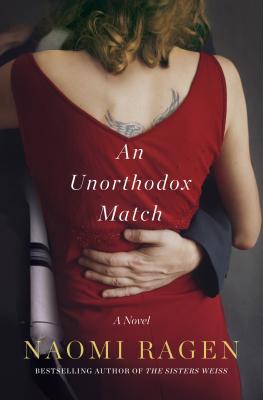
A word on the cover: It’s a striking cover image for sure, but totally misleading. At no point in the story does Leah wear a skimpy little red dress, nor do she and Yaakov ever embrace or touch each other. And she does not have a back tattoo. (Okay, she has a small tattoo on her wrist, which is quite the scandal until it miraculously (?) goes away after she spills scalding water on her hands.)

_________________________________________

The details:

Title: An Unorthodox Match
Author: Naomi Ragen
Publisher: St. Martin’s Press
Publication date: September 24, 2019
Length: 336 pages
Genre: Contemporary fiction
Source: Review copy courtesy of the publisher via NetGalley

**Save

Save

Save

Save

Save

Save

Save

Book Review: The Testaments by Margaret Atwood


In this brilliant sequel to The Handmaid’s Tale, acclaimed author Margaret Atwood answers the questions that have tantalized readers for decades.

When the van door slammed on Offred’s future at the end of The Handmaid’s Tale, readers had no way of telling what lay ahead for her–freedom, prison or death.

With The Testaments, the wait is over.

Margaret Atwood’s sequel picks up the story more than fifteen years after Offred stepped into the unknown, with the explosive testaments of three female narrators from Gilead.

“Dear Readers: Everything you’ve ever asked me about Gilead and its inner workings is the inspiration for this book. Well, almost everything! The other inspiration is the world we’ve been living in.” –Margaret Atwood

Note: Spoilers for The Handmaid’s Tale book and Hulu TV series are mentioned in this review, although not in great detail. It feels impossible to talk about The Testaments without referencing both.

When The Handmaid’s Tale was published in 1985, it was both revolutionary and revelatory. In it, Margaret Atwood imagined the nation of Gilead, an autocratic theocracy created through the violent overthrow of the United States government. In a world in which fertility rates had fallen drastically, one of Gilead’s prime commandments was procreation by whatever means necessary, including the forced servitude of fertile women as Handmaids, women forced to conceive and carry babies that they’d have no claim to. Through ritualized rape, Handmaids endured their roles as vessels and chattel belonging to the Commanders and their wives — or faced gruesome punishments, including mutilation and death.

Gilead was not much kinder to the Commanders’ wives, who were expected to know their places and stay there. Women’s rights were gone absolutely — no ownership, no money, no independence. No reading! Reading was considered such a sin for women that all public signs were replaced with pictures — a drawing of food to denote a store, rather than letters spelling out words.

In The Testaments, years have passed since the end of The Handmaid’s Tale. Gilead continues on, still in power, still subjecting its women to its caste system and degradations, at war with Canada and battling to take down the resistance group Mayday. In this new novel, the story is told through three different narrators’ first-person story.

First, and probably most familiar to both readers and viewers of the TV series, is Aunt Lydia. We’ve known her up to now as one of the system’s enforcers, one of the Aunts whose job it is to train Handmaids and keep them in line through whatever means necessary. Here, we hear Aunt Lydia telling her own story, and we see a much more complex take on who she is and how she came to be this way. Her backstory is fascinating — and, it’s worth noting, substantially different than that of the Aunt Lydia character in the Hulu version. Prior to Gilead, Aunt Lydia was a well-respected and well-established judge. When the forces of Gilead came to power, Aunt Lydia and her colleagues were rounded up, imprisoned, and tortured, until they either agreed to work for Gilead or were executed.

Lydia opted for self-preservation — although it’s left ambiguous as to what her true motivation is. Is she only about her own survival? Or is she playing a very long game, establishing her own power base in her own domain with the goal of bringing down Gilead from within? And if the latter is true, how could she stomach all that she had to do to gain and retain her power? She’s a perplexing character, clearly able to be quite cruel and manipulative and deadly… yet she does save girls from terrible situations as well, and finds her own sly and subtle ways to get back at the Commanders who wrong her and other women.

The second narrator is Agnes Jemima, whom we first meet as a young school girl. Agnes is the privileged daughter of a Commander and his wife Tabitha, and while Agnes’s relationship with her father is formal and distant, she and Tabitha have a loving, tightly bonded connection. Tabitha entertains Agnes with stories, including a fantastical story of rescuing Agnes from a castle and running away with her through the woods. This rings true to Agnes — she has a very vague memory of running through a forest.

Meanwhile Agnes attends school for girls and learns appropriately girlish subjects. But when Tabitha dies, Agnes’s life changes dramatically, from learning that she was actually born to a Handmaid to gaining a new stepmother. And the stepmother can’t wait to be rid of Agnes, pushing for her to marry (at age 13!) so the family can secure a connection to another powerful man. Agnes’s wishes matter not at all.

Third, we meet Daisy, a 16-year-old Canadian girl living with kind but overprotective parents, ready to become politically active despite her parents’ wishes. When tragedy strikes, Daisy learns the truth about her own life. She’s actually Baby Nicole, Gilead’s internationally famous poster child, who was smuggled out of Gilead by her Handmaid mother as an infant and who’s become the symbol of righteous struggle (for Gilead) and the battle to overthrow Gilead (for the opposition). Daisy’s protectors come up with a crazy scheme to smuggle Daisy back into Gilead, to become a resistance courier and retrieve a cache of documents so powerful they could lead to Gilead’s demise.

Insane as it seems, Daisy agrees to the plan, and returns to Gilead in the guise of a convert seeking to become a novitiate Aunt. Here, the three main characters’ paths intersect and become tightly woven together.

It’s an intricate plot, full of the social commentary and political intrigue we’d expect in the sequel to The Handmaid’s Tale — but the book’s success hinges on the three main characters. We have to believe in them, understand them, and invest in their quests… and for me, at least, I absolutely did.

It’s a fascinating journey, although I couldn’t separate myself from the TV series while reading the book. Although it’s never stated explicitly, it’s plain that Agnes is the child taken from Offred (June) in The Handmaid’s Tale. It’s absolutely heart-wrenching to see that she has no memory whatsoever of her mother. We also understand that Baby Nicole is Offred’s second child, born during her time as a Handmaid. Baby Nicole’s birth and escape to Canada feature very prominently in seasons 2 and 3 of the TV series, although events seem to have unfolded in the world of The Testaments in a different manner. For those who haven’t watched the series, I wonder how long it would take for the connection between Agnes and Nicole to become clear.

By having these two young women telling their stories, we gain a very different perspective on Gilead from that shown via Offred in The Handmaid’s Tale. For Agnes, growing up in Gilead is just normal. She doesn’t miss reading, because it was never part of her life. She accepts the social structure as the way things are supposed to be, because that’s all she’s known, and being from a Commander’s family, she’s grown up with privileges and in as much safety as any female in Gilead could have. Through Nicole’s experience, we get to see how weird it would be to be thrust into this situation, to learn to hide by pretending to be obedient and meek, and to meet face to face with girls her own age who are completely alien to her.

Finally, through Lydia’s version of the tale, we see yet another view of the founding of Gilead and its power structure, and see how survival is both a choice and a price. Lydia is fascinating. I’m so eager to hear other readers’ interpretations of her character as portrayed in The Testaments.

The Testaments is a powerful, engrossing read, and absolutely a worthy sequel to The Handmaid’s Tale. Very thought-provoking, and very much worth reading.

_________________________________________

The details:

Title: The Testaments
Author: Margaret Atwood
Publisher: Nan A. Talese
Publication date: September 10, 2019
Length: 422 pages
Genre: Dystopian fiction
Source: Purchased
Save

Save

Save

Save

Save

Save

Save

Save

Save

Take A Peek Book Review: Pumpkinheads by Rainbow Rowell and Faith Erin Hicks

“Take a Peek” book reviews are short and (possibly) sweet, keeping the commentary brief and providing a little peek at what the book’s about and what I thought. This week’s “take a peek” book:

Synopsis:

(via Goodreads)

Deja and Josiah are seasonal best friends.

Every autumn, all through high school, they’ve worked together at the best pumpkin patch in the whole wide world. (Not many people know that the best pumpkin patch in the whole wide world is in Omaha, Nebraska, but it definitely is.) They say good-bye every Halloween, and they’re reunited every September 1.

But this Halloween is different—Josiah and Deja are finally seniors, and this is their last season at the pumpkin patch. Their last shift together. Their last good-bye.

Josiah’s ready to spend the whole night feeling melancholy about it. Deja isn’t ready to let him. She’s got a plan: What if—instead of moping and the usual slinging lima beans down at the Succotash Hut—they went out with a bang? They could see all the sights! Taste all the snacks! And Josiah could finally talk to that cute girl he’s been mooning over for three years . . .

What if their last shift was an adventure?

My Thoughts:

What fun! In this charming YA graphic novel, Deja and Josie both are completely nuts over how much they love working at the pumpkin patch. And really, if my town had a pumpkin patch even half as amazing as theirs, I think I’d be nuts about it too. It’s huge, it’s utterly corny (with super-punny signs), and it’s the place that Deja and Josie feel most at home. But their last night ever working at the patch leaves Deja determined to eke out every last experience, and she drives the reluctant Josie to run from attraction to attraction, food stand (Frito pie!) to food stand (kettle corn!) in search of the elusive girl of his dreams. Josie is a by-the-rules nice guy who believes in fate and just letting things happen, while Deja is a free spirit who believes in grabbing life and experiences and making your own luck.

The story in Pumpkinheads is sweet and endearing, but never cloying. I love the characters, their humor, their connection, and their easy acceptance of differences, as well as their essential good natures. The artwork is tons of fun, with the characters easily exhibiting a wide range of emotions through their faces and body language, and leaving plenty of room for humor via visual delights, rambunctious children, and one super-aggressive runaway goat.

Naturally, coming from the talented minds and pens of Rainbow Rowell and Faith Erin Hicks, Pumpkinheads is enjoyable start to finish. Highly recommended!

_________________________________________

The details:

Title: Pumpkinheads
Author: Rainbow Rowell
Illustrator: Faith Erin Hicks
Publisher: First Second
Publication date: August 27, 2019
Length: 209 pages
Genre: Young adult graphic novel
Source: Library

Book Review: The Ten Thousand Doors of January by Alix E. Harrow

In the early 1900s, a young woman embarks on a fantastical journey of self-discovery after finding a mysterious book in this captivating and lyrical debut.

In a sprawling mansion filled with peculiar treasures, January Scaller is a curiosity herself. As the ward of the wealthy Mr. Locke, she feels little different from the artifacts that decorate the halls: carefully maintained, largely ignored, and utterly out of place.

Then she finds a strange book. A book that carries the scent of other worlds, and tells a tale of secret doors, of love, adventure and danger. Each page turn reveals impossible truths about the world and January discovers a story increasingly entwined with her own.

Lush and richly imagined, a tale of impossible journeys, unforgettable love, and the enduring power of stories awaits in Alix E. Harrow’s spellbinding debut–step inside and discover its magic.

First, let’s pause to admire the sheer gorgeousness of this book cover. There. Now we’ve had our daily dose of beauty.

In The Ten Thousand Doors of January, a young woman learns that the world is not entirely as it appears, and that she herself isn’t quite who she thought she was.

January’s father is employed by the fabulously wealthy Mr. Locke to travel the world and seek out rare and exotic artifacts. Because his journeys take him away for months at a time, January lives in Mr. Locke’s mansion, pampered but isolated, feeling abandoned by her father and unsure of her place in the world.

When a battered book called The Ten Thousand Doors comes into her possession, January begins to learn about Doors — secret portals that bridge the thin connection between worlds. According to the book, Doors are real, and people who know how to look and find can access their pathways. And yet, there are those who would see these doors destroyed, viewing them as dangerous to the world we know.

The more January reads, the more she learns about the secrets of her own life and why she lives as she does. She also begins to learn about her own hidden powers, and realizes that her life with Mr. Locke is built on control and lies. But freedom comes at a steep cost with great danger, and as January struggles to get away, she becomes hunted by very powerful people who want her stopped.

The writing in this book is lovely, capturing the magic of books as well as the beauty of the natural world and the mysteries all around us. For book-lovers, there are special little passages that touch our hearts:

Those of you who are more than casually familiar with books — those of you who spend your free afternoons in fusty bookshops, who offer furtive, kindly strokes along the spines of familiar titles — understand that page-riffling is an essential element in the process of introducing oneself to a new book.

It’s like the author has been spying on me! How did she know that I feel the need to touch the spines of my favorite books when I see them at the library or a bookstore, and maybe whisper a quiet “hello” while I’m there?

The book’s imagery and use of unusual words also delighted me:

Time went strange. The hour-dragons stalked and circled. I heard their belly scales susurrating against the tile in my sleep.

January is a wonderful lead character, brave but not without fear, curious, open-minded, and desperate for both belonging and the truth. She risks herself over and over again to fight for freedom, and remains utterly loyal to the important people in her life. I don’t want to give anything away, but suffice it to say that the truth about her family is its own story-within-a-story, and is beautiful as well.

Once we have agree that true love exists, we may consider its nature. It is not, as many misguided poets would have you believe, an event in and of itself; it is not something that happens, but something that simply is and always has been. One does not fall in love; one discovers it.

The only thing that keeps this from being a 5-star read for me is that it really starts off slowly. I had to reach the 25% mark before I truly started to feel invested in January and the other characters. Of course, later I was so involved that I didn’t want to pause even to sleep, so I’m absolutely glad to have stayed with it. Still, I had enough doubts early on that it took me a while to overcome my reluctance and really plunge in.

A final note: As I read the excerpts from The Ten Thousand Doors (the book that January finds), I found myself struggling a bit with the footnotes and missed quite a few. They’re worth reading, but in Kindle format, they weren’t always easy to access and are actually embedded at the end of the book (at least in my copy), and the back and forth was a bit irritating. Small annoyance, but I thought I’d mention it.

I won’t say any more about the plot, but it’s best experienced fresh and without foreknowledge. I highly recommend The Ten Thousand Doors of January. It’s both an enchanting fantasy story and a very human story as well, with memorable characters and filled with emotion and passion. What a lovely read!

_________________________________________

The details:

Title: The Ten Thousand Doors of January
Author: Alix E. Harrow
Publisher: Redhook
Publication date: September 10, 2019
Length: 384 pages
Genre: Fantasy
Source: Won in a Goodreads giveaway!

Save

Save

Save

Save

Save

Save

Save

Save

Save

Audiobook Review: Reticence by Gail Carriger (The Custard Protocol, #4)

Dueling covers: US version


Bookish and proper Percival Tunstell finds himself out of his depth when floating cities, spirited plumbing, and soggy biscuits collide in this delightful conclusion to NYT bestselling author Gail Carriger’s The Custard Protocol series.

Percival Tunstell loves that his sister and her best friend are building themselves a family of misfits aboard their airship, The Spotted Custard. Of course, he’d never admit that he belongs among them. He’s always been on the outside — dispassionate, aloof, and hatless. But accidental spies, a trip to Japan, and one smart and beautiful doctor may have him renegotiating his whole philosophy on life.

Except hats. He’s done with hats. Thank you very much.

Reticence is a fun, enjoyable wrap-up to a delicious series. The Custard Protocol is four books of fluffy good times, as an odd crew of misfits and eccentrics set sail through the aether on their giant spotted dirigible, seeking danger and adventure all around the globe.

In Reticence, the last remaining unmatched member of the Spotted Custard’s officers finally meets his true love in the form of Dr. Arsenic Ruthven, a Scottish doctor whose no-nonsense approach and absolute devotion to learning and libraries secures her a spot in Percy’s antisocial little heart.

As Arsenic learns to love the crew and vice versa, they set off on a trip first to Egypt and then to Japan, seeking out more supernatural shapeshifters and a missing spy, and discovering all sorts of new and exciting mysteries to solve. With plenty of explosions, tea, and parasols along the way.

As the conclusion to both the Custard Protocol series and, it would appear, the Parasol-verse at large, Reticence features cameos by a who’s who of characters from all of the related books (including the Parasol Protectorate and Finishing School series). Because really, how could we possibly leave this amazing world without one more check-in with Alexia, Conall, Ivy, Lord Akeldama, not to mention Sophronia, Lady Kingair, and more?

Dueling covers: UK version

The adventure itself is fun, and seeing Percy lose his heart in the most awkward way possible is highly entertaining. With Percy at center stage, I did miss spending time with Rue and Quesnel, who are much more my favorites, and the wonderful character Tasherit spends most of this book literally asleep.

Once again, the audiobook is a total delight — so much so that I can’t imagine enjoying this series quite so much on the printed page. Narrator Moira Quirk is outstanding, giving each character a unique voice, capturing the silliness to perfection, and keeping the action sequences exciting and easy to follow.

I’m sorry to see the series come to a close. I know there are more related novellas in the works, but I do hope the esteemed Ms. Carriger decides to treat us to yet more full-length books (or, dare I suggest, four-book series?) set in this oh-so-special world. The Custard Protocol is a treat. Highly recommended.

_________________________________________

The details:

Title: Reticence (The Custard Protocol, #4)
Author: Gail Carriger
Narrator: Moira Quirk
Publisher: Orbit
Publication date: August 6, 2019
Length (print): 339 pages
Length (audiobook): 12 hours, 21 minutes
Genre: Fantasy/steampunk
Source: Purchased

Save

Save

Save

Save

Book Review: The Unkindest Tide (October Daye, book 13) by Seanan McGuire

I am beyond thrilled to have received an ARC of the newest book in the amazing October Daye urban fantasy series. Thank you, NetGalley and DAW Books! I love this series just as much now, 13 books into it, as I did many books ago… maybe even more! October herself continues to grow and change as a character, and the big-picture story arcs continue to evolve in a way that moves Toby’s world in new, exciting directions, all the while keeping us in touch with the huge cast of characters and letting us see their ever-changing roles and lives.

Hundreds of years ago, the Selkies made a deal with the sea witch: they would have the sea for as long as she allowed it, and when the time came, she would call in all their debts at once. Many people assumed that day would never come. Those people were wrong.

When the Luidaeg—October “Toby” Daye’s oldest and most dangerous ally—tells her the time has come for the Selkies to fulfill their side of the bargain, and that Toby must be a part of the process, Toby can’t refuse. Literally. The Selkies aren’t the only ones in debt to the Luidaeg, and Toby has to pay what she owes like anyone else. They will travel to the fabled Duchy of Ships and call a convocation of the Selkies, telling them to come and meet the Luidaeg’s price…or face the consequences.

Of course, nothing is that simple. When Dianda Lorden’s brother appears to arrest Dianda for treason against the Undersea, when a Selkie woman is stripped of her skin and then murdered, when everything is falling apart, that’s when Toby will have to answer the real question of the hour.

Is she going to sink? Or is she going to swim?

This book! This story! Toby… Tybalt… the Luidaeg… Gillian…

Ugh, someone stop me before I become a totally incoherent, mumbling nincompoop.

I just love them all so much!

The Unkindest Tide is EXCELLENT. I love the plot and the character development. I really don’t want to give anything away here, so…

In this newest book, Toby is called upon to pay her debts to the Luidaeg by using her magic to fulfill the Luidaeg’s vow to the Selkies, to force the Selkies to answer for their ancestors’ long-ago crimes. The backstory of the Selkies and the Luidaeg’s relationship to them never fails to make me want to cry. The Luidaeg has been portrayed throughout the series as the scariest thing around, but over the course of these thirteen books, we’ve been able to also see her heart and her pain, and I love her to absolute pieces.

In terms of the plot, the gang gets together to travel to the Duchy of Ships, a sort of floating kingdom where the Selkies gather to learn of their fate. But there are other political forces at play, involving violence and intrigue and murder, and Toby has a limited amount of time to fix it all, save the day (yet again), and be back in time to carry out the Luidaeg’s plans.

The end result of all this is the beginning of a new chapter in the world of the fae. I absolutely can’t wait to see what happens next!

And yes, I really did love everything about this book, other than my ongoing annoyance with Gillian, who needs to stop being such a brat and start appreciating her mother. But hey, what kind of dramatic tension would we have if everyone got along perfectly?

I’ll wrap things up with a quote from the book, without providing any context, just because I love the writing and dialogue in this series so, so much.

Whatever. I’ve been mocked by better than a few octopus people…

A final note:

The Unkindest Tide includes a bonus novella, Hope is Swift, with Tybalt’s nephew Raj as the main character. It’s fun and affecting, and a nice bit of entertainment after the more intense subject matter of the main novel.

And, okay, a word from Raj, just for fun:

I don’t have my Uncle Tybalt’s skill with flowery, archaic declarations of love, a fact for which I’m genuinely grateful — sometime listening to him is like listening to the audio version of some dreadful period romance, the sort of thing where the men are constantly losing their shirts and all the women keep swooning at the shameful sight of their exposed pectorals.

_________________________________________

The details:

Title: The Unkindest Tide (October Daye, #13)
Author: Seanan McGuire
Publisher: DAW Books
Publication date: September 3, 2019
Length: 368 pages
Genre: Urban fantasy
Source: Review copy courtesy of the publisher via NetGalley

Save

Save

Save

Save

Save

Save

Save

Save

Save

Word Puppets: A collection of short stories by Mary Robinette Kowal


Celebrated as the author of five acclaimed historical fantasy novels in the Glamourist series, Mary Robinette Kowal is also well known as an award-winning author of short science fiction and fantasy. Her stories encompass a wide range of themes, a covey of indelible characters, and settings that span from Earth’s past to its near and far futures as well as even farther futures beyond. Alternative history, fairy tales, adventure, fables, science fiction (both hard and soft), fantasy (both epic and cozy)—nothing is beyond the reach of her unique talent. WORD PUPPETS—the first comprehensive collection of Kowal’s extraordinary fiction-includes her two Hugo-winning stories, a Hugo nominee, an original story set in the world of “The Lady Astronaut of Mars,” and fourteen other show-stopping tales.

Talk about a fascinating author! Mary Robinette Kowal is the author of the Hugo-winning novel The Calculating Stars (one of my all-time faves) as well as other works. She’s also a highly gifted audiobook narrator (narrating, among other books, the October Daye series and other works by Seanan McGuire). And on top of all that, she’s a professional puppeteer! Yes, a puppeteer. So yeah, given her eclectic talents and interests, I’m not at all surprised that this collection of short stories is varied, unusual, and very, very entertaining.

Eighteen of the nineteen stories in Word Puppets were originally published elsewhere and featured in various anthologies and other publications, with one story (set in the Lady Astronaut world) original to this collection. The publication dates for the stories range between 2005 and 2015.

Overall, I really enjoyed this collection (which is shocking for me, since I usually have an aversion to short stories). Of the stories included in Word Puppets, I strongly preferred the ones leaning more toward science fiction and speculative fiction rather than the stories I’d classify as fantasy.

My particular favorites:

Chrysalis: About an alien race for whom adulthood means the end of serious study, as they metamorphose from larvae to beautiful winged creatures, but leave their scholarship and ambitions in the past.

Rampion: A short but powerful take on the Rapunzel story.

Clockwork Chickadee: About some devious and tricky mechanical animals.

Body Language: A really clever kidnapping/heist story, in which an expert puppeteer works with a gifted AI to save the day. (So awesome!)

Waiting for Rain: A vineyard owner in India deals with family obligations and honor while trying to cope with the financial struggles of having to subscribe to controllable weather.

First Flight: A 105-year-old woman is assigned a time travel task, and uses it to change history.

Evil Robot Monkey: Very short, very good, very surprising.

For Solo Cello, op 12: Wow, this one was great! About a concert cellist, an awful injury, and the even more awful way he might be able to heal.

The White Phoenix Feather: Talk about adventures in dining! This is an action story about a woman who provides dangerous dining experiences to those who can pay. Full of flying dinner knives and hurled soup and flaming baguettes.

Finally, the last three stories are all set within the world of The Calculating Stars:

We Interrupt This Broadcast: This story offers a possible explanation for the events in The Calculating Stars, and it’s frankly creepy. I’m choosing to interpret this story as an early version of events that the author eventually decided didn’t work in the context of the larger series, because otherwise I find it too upsetting.

Rockets Red: A fun interlude on Mars!

The Lady Astronaut of Mars: The story that started it all! I read this story when it was first published on the Tor website in 2013, and absolutely loved it — which is why I was thrilled to death when the author ended up expanding this world into the Lady Astronaut series. This story works as a stand-alone, set decades after the events of The Calculating Stars, and provides a different take on Elma and Nathaniel and the space program. (Fun note: This story was originally written as part of the audiobook collection Rip-off!, in which an assortment of sci-fi authors wrote new stories using the first lines of classic books as a starting point. The Lady Astronaut of Mars begins with the opening line of The Wizard of Oz: Dorothy lived in the midst of the great Kansas prairies, with Uncle Henry, who was a farmer, and Aunt Em, who was the farmer’s wife.)

All of the stories in Word Puppets are great, in my humble opinion! If you enjoy Mary Robinette Kowal’s writing, or even if you’ve never read her before, give this collection a try. The stories all stand on their own, so if you’re like me and are generally reluctant to commit to reading a book of short stories start to finish, Word Puppets is a nice choice to keep on your nightstand and dip in and out of whenever you feel like reading a story in 15 minutes or less!

_________________________________________

The details:

Title: Word Puppets
Authors: Mary Robinette Kowal
Publisher: Prime Books
Publication date: November 19, 2015
Length: 319 pages
Genre: Short stories/Science fiction/Fantasy
Source: Purchased

Take A Peek Book Review: The Warehouse by Rob Hart

“Take a Peek” book reviews are short and (possibly) sweet, keeping the commentary brief and providing a little peek at what the book’s about and what I thought.


Synopsis:

(via Goodreads)

Paxton never thought he’d be working for Cloud, the giant tech company that’s eaten much of the American economy. Much less that he’d be moving into one of the company’s sprawling live-work facilities.

But compared to what’s left outside, Cloud’s bland chainstore life of gleaming entertainment halls, open-plan offices, and vast warehouses…well, it doesn’t seem so bad. It’s more than anyone else is offering.

Zinnia never thought she’d be infiltrating Cloud. But now she’s undercover, inside the walls, risking it all to ferret out the company’s darkest secrets. And Paxton, with his ordinary little hopes and fears? He just might make the perfect pawn. If she can bear to sacrifice him.

As the truth about Cloud unfolds, Zinnia must gamble everything on a desperate scheme—one that risks both their lives, even as it forces Paxton to question everything about the world he’s so carefully assembled here.

Together, they’ll learn just how far the company will go…to make the world a better place.

Set in the confines of a corporate panopticon that’s at once brilliantly imagined and terrifyingly real, The Warehouse is a near-future thriller about what happens when Big Brother meets Big Business–and who will pay the ultimate price.

My Thoughts:

Hmm. The synopsis gives the impression that this is a much darker read than it really is. I experienced The Warehouse as a more of a satire than a thriller, for the most part. In The Warehouse, Cloud is everything, and has basically taken over much of what we might consider normal life, including privatizing government agencies such as the FAA and creating their own energy sources. No matter what you want, Cloud can provide, and Cloud seems to be the only source of steady employment left in the US — providing not only a paycheck, but also housing, access to material goods, and even to rare commodities such as hamburgers.

Of course, there’s a price, like a total lack of privacy, having every move tracked, having performance rated in real-time, and having no say over work assignments —  not to mention an economic set-up that’s like a throw-back to the days when workers owed their souls to the company store.

We get to know Cloud through the experiences of Paxton and Zinnia, two new employees learning the ropes, each with their own agenda, as well as through the blog entries of Gibson Wells, Cloud’s multi-billionaire founder and CEO, now ailing and attempting to create a record of his legacy before his death.

The plot moves along quickly, but I didn’t altogether connect with the book as a whole. I wasn’t particularly interested in Paxton or Zinnia as individuals, and while the inner workings of Cloud were interesting and disturbing, the book’s uneven tone (is it dark? is it dark humor? is it a thriller?) left me mostly unengaged. I should probably mention that a particular reveal made me want to hurl… but hey, maybe you have a stronger stomach than I do!

Overall, The Warehouse is an entertaining read, but without the solid impact I’d been expecting.

_________________________________________

The details:

Title: The Warehouse
Author: Rob Hart
Publisher: Crown
Publication date: August 20, 2019
Length: 368 pages
Genre: Science fiction
Source: Review copy courtesy of the publisher via NetGalley

**Save

Save

Save

Save

Save

Save

Save

Terrifying two-fer: Our War and Wanderers, two all-too-believable versions of our world (and its future)

Over the past two weeks, I read two gripping, enthralling, un-put-downable books that scared the pants off me. These two books are quite different, but each presents a vision of our world that’s utterly terrifying because it’s so utterly possible.

Title: Our War
Author: Craig DiLouie
Publisher: Orbit
Publication date: August 20, 2019
Length: 400 pages
Genre: Speculative fiction
Source: Review copy courtesy of the publisher 

A prescient and gripping novel of a second American civil war, and the children caught in the conflict, forced to fight.

When the president of the United States is impeached, but refuses to leave office, the country erupts into civil war.

10-year-old Hannah Miller, an orphan living in besieged Indianapolis, has joined a citizen’s militia. She had nowhere else to go. And after seeing the firsthand horrors of war, she’s determined to fight with the Free Women militia.

Hannah’s older brother, Alex, is a soldier too. But he’s loyal to the other side. After being separated from Hannah, he finds a home in a group calling themselves The Liberty Tree militia.

When a UNICEF worker and a reporter discover that both sides are using child soldiers, they set out to shine a light on something they thought could never happen in the United States. But it may be too late because even the most gentle children can find that they’re capable of horrific acts.

Where to even start describing this powerful and upsetting book? It feels all too real, as an increasingly factionalized and radicalized America is plunged into a brutal civil war. Sides are drawn — and armed. It’s deadly serious, and as is sadly the norm in armed conflicts, children are the ones who are caught in the middle, starving, orphaned, witnessing death and brutality that no child should have to see,

Hannah is one of several POV characters; others include a hard-charging journalist pursuing her next great story, an inexperienced but determined UNICEF representative, the militia leader who takes in Hannah’s bother Alex, and Alex himself. Each shares their unique viewpoint on the war and its impact, and through each, we see the futility of the armed conflict and the seeming hopelessness of any attempt to find a resolution.

The political situation in Our War is, honestly, not so far different from our own current situation. It’s scarily easy to imagine these events evolving from where we stand today.

As a reporter, Aubrey had always been shocked by the right wing’s war on facts. They regularly vilified anybody in fact-based professions, from scientists to doctors. They generated and consumed propaganda and called anything else fake. For them, reality wasn’t as interesting as a good simple narrative that had them righteously and perpetually enraged.

At first, I found it confusing to keep track of which side was which, but I think that’s part of the point. After all, your view of whether someone is a patriot or a rebel may depend very much on which side of the line you yourself are standing on.

The writing here is raw and shocking and immediate, and makes for a completely gripping read. Above all, the children caught in the middle are the ultimate victims here, and seeing the war through Hannah’s eyes is truly gut-wrenching.

Title: Wanderers
Author: Chuck Wendig
Publisher: Del Rey Books
Publication date: July 9, 2019
Length: 800 pages
Genre: Speculative fiction
Source: Purchased

A decadent rock star. A deeply religious radio host. A disgraced scientist. And a teenage girl who may be the world’s last hope. In the tradition of The Stand and Station Eleven comes a gripping saga that weaves an epic tapestry of humanity into an astonishing tale of survival.

Shana wakes up one morning to discover her little sister in the grip of a strange malady. She appears to be sleepwalking. She cannot talk and cannot be woken up. And she is heading with inexorable determination to a destination that only she knows. But Shana and are sister are not alone. Soon they are joined by a flock of sleepwalkers from across America, on the same mysterious journey. And like Shana, there are other “shepherds” who follow the flock to protect their friends and family on the long dark road ahead.

For on their journey, they will discover an America convulsed with terror and violence, where this apocalyptic epidemic proves less dangerous than the fear of it. As the rest of society collapses all around them–and an ultraviolent militia threatens to exterminate them–the fate of the sleepwalkers depends on unraveling the mystery behind the epidemic. The terrifying secret will either tear the nation apart–or bring the survivors together to remake a shattered world.

This massive, 800 page book seemed like a huge reading undertaking… but once I started, I savored every word, paragraph, and chapter. Did it need to be this huge? Why, yes. Yes, it did.

Wanderers is truly epic in scope. What starts as a weird local event — a sleepwalking girl who can’t be woken or stopped — turns into something huge and eerie (and to some, horribly frightening) as Nessie is joined by more and more sleepwalkers in her journey across America. Escorted by family members and friends who look after them, the flock moves endlessly forward. Meanwhile, the CDC scrambles to find out why, and right-wing militiamen, politicians, and conservative rabblerousers see the flock as a harbinger of end-times, and use their existence as an excuse to ramp up their hateful, violent rhetoric, whipping their public into a frenzy.

Just what is causing the sleepwalking phenomenon is revealed over time, as is the connection to a money-hungry tycoon’s mysterious death. The weirdness of the sleepwalking is leavened by the beauty of the human interactions and interconnectedness as we get to know the various shepherds, their motivations and fears, and their own sense of running out of time.

Parts of this book are terrifying. Strangely (or not), I was much more disturbed by the human evil and hate-mongering than by the pandemic threat to all of humanity. Nature, science, possible extinction — these just are, without good or evil. Instead, it’s the people of Wanderers who inspire admiration for their bravery, sacrifice, and wisdom, as well as despair over the cruelty that people display toward one another.

This book takes our current crises related to climate change, increasingly drug-resistant bacteria and viruses, and hate-filled politics, and spins these into a tale that feels prophetic, cautionary, and disturbingly real. Wanderers forces the reader to ask “what if”… and then see how the scenario plays out in full, grisly, technicolor detail.

I suppose I should add, if not already clear, that this book contains violence and cruelty and should be approached cautiously (or not at all) by anyone who may find themselves triggered.

That said, I just loved so many of the characters, felt completely invested in their journeys and ordeals, and could not stop reading. At the risk of sounding incredibly corny, reading Wanderers made me feel like I’d been on a journey too. A terrific read.

I want to note that Craig DiLouie and Chuck Wendig are both new-to-me authors, although they’ve been on my radar for a while now thanks to friends’ recommendations. Having read these two books, I definitely want more! Please let me know if you have suggestions for me!

Side note: I have so much more I’d love to say about both of these books, but with my arm and hand in a cast for several more weeks, typing is a challenge — so I’m keeping this on the short side. Bottom line: Both of these books are 5-star reads for me. I can’t recommend them highly enough!