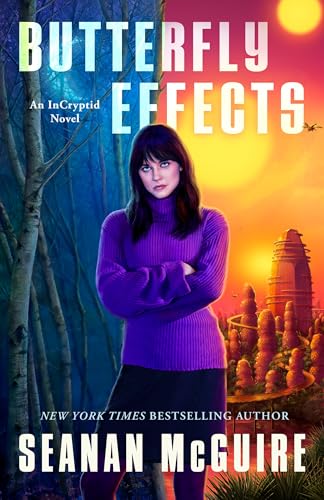
Title: Butterfly Effects
Series: Incryptid, #15
Author: Seanan McGuire
Publisher: Tor Books
Publication date: March 10, 2026
Length: 432 pages
Genre: Urban fantasy
Source: Review copy courtesy of the publisher via NetGalley
Rating:
Seanan McGuire’s New York Times-bestselling and Hugo Award-nominated InCryptid series continues with the fifteenth book following the Price family, cryptozoologists who study and protect the creatures living in secret all around us.
Chaos, noun:
1. The inherent unpredictability in the behavior of a complex natural system.Chaos theory, noun:
1. A branch of mathematical and physical theory that deals with the nature and consequences of chaos and chaotic systems.
2. The study of unpredictable systems.
3. See also “impossible math.”Sarah Zellaby is a Johrlac, a member of a species of psychic ambush predators colloquially referred to as “cuckoos.” Eight years ago, she survived the difficult, painful process of becoming a cuckoo queen…although not without costs. In the wake of her transformation, the man she loved was entirely erased from his own mind, forcing her to reconstruct him from the memories of the people who knew and loved him.
Sarah has been struggling to come to terms with her actions ever since. But there’s no one else on the planet with the power to hold her accountable―until the Johrlac authorities show up. It’s time for her to stand trial for what she’s done, something which can only happen on Johrlar, home world of her species, where the population is controlled by a system of unyielding hiveminds and crime is punishable by erasure.
With Sarah’s life on the line, her family will need to find a way to cross dimensional borders and survive a hostile, telepathic world in order to get her back―before the Sarah they know ceases to exist.
But no matter what happens, actions have consequences… and Sarah Zellaby is about to learn that lesson the hard way.
Fifteen books in, the Incryptid series remains wildly inventive, with a stunningly huge array of characters and nonhuman species to keep track of. The Price-Healy family remains at the center of it all, but the details and mythology at this point are so complex that it feels next to impossible to talk about this book specifically in any sort of way that makes sense.
But I’ll try.
Butterfly Effects is the 3rd book in the series to focus on Sarah Zellaby as the main character, which is tricky. Despite appearances, Sarah is not human — she’s what’s known as a “cuckoo”, a descendent of a group of Johrlacs exiled generations earlier from their home dimension Johrlar. Johrlacs are telepathic, and cuckoos are considered ambush predators here on Earth. Through the power of their minds, they can take over anyone else’s thoughts and rewrite them — so a cuckoo child, for example, can convince a new family that they’re loved, that they belong, and that they’ve always belonged. And that’s among the least harmful examples. When a cuckoo wants to influence someone, the person being influenced has no defenses and won’t even know it’s happening.
The Price family has been studying and interacting with cryptids — non-humans — for generations, and is uniquely suited to providing Sarah with a home. Sarah is the adopted daughter of one of the family matriarchs, and has been raised to use her abilities responsibly. What’s more, Sarah was raised with love — she’s part of the family. But eight years before the events in Butterfly Effects, she evolved into a cuckoo “queen”, and her powers essentially exploded beyond her control, causing damage that she never intended. Now, years later, Sarah has been forcibly extracted back to Johrlar, supposedly to be held accountable for her actions… but more sinister motivations are at play.
When Sarah is taken, her family springs into action — including her cousin Antimony, Antimony’s boyfriend Sam, and her grandparents Alice and Thomas who — for… reasons — appear to be no older than their grandchildren. This team of fighters and sorcerers heads off on a rescue mission, but once on Johrlar, finds themselves in grave danger as well.
Like I said, it’s complicated. Fortunately, this book has Sarah share the narration, so while she’s the main POV character, there are sections where Antimony takes the lead. Honestly, it’s a relief. Not to be all speciesist… but Antimony’s human mind is a much less headache-inducing place to be than Sarah’s. Sarah thinks in math and equations, and her telepathy and worldview can be insanely twisty and hard to relate to.
I do love this series as a whole, but it’s so wide-ranging that it can be hard to keep track of. With books focusing on so many different characters, I constantly need a refresher on where we left off, where the major players are, and whose lives are dealing with which crises. (Books #13 and #14 were told from the perspective of the family’s ghost babysitter… to give you an idea of just how strange a series this is!)
Maybe it’s just because they were introduced first, but the core Price family siblings and their immediate families remain my favorites, and when they’re off-page for too long (or for entire books, except for brief drop-bys) I miss them. Butterfly Effects seems to provide a definitive wrap-up to most of Sarah’s ongoing issues (at least, for now), so I’m hoping the next books in the series will move back to focusing elsewhere within the family.
Butterfly Effects took a while to draw me in. Eventually, I was hooked on the latest adventure and started feeling like I was reading a page-turner… but there were definitely moments where I felt like I was reading this one more out of obligation than enjoyment. Still, Seanan McGuire is a terrific storyteller, and overall, I’m sticking with the series, even though I didn’t connect with this particular book quite as much as with some of the earlier installments.
Once again, I’ll point out the obvious: This is not a book to start with! The Incryptid series is so complicated by now that it can only be appreciated by starting at the beginning — which I recommend! It’s a truly creative series with lots of entertainment value, interesting plot twists, and deeper emotional beats. And for those devoted to this world, there are countless spin-off/prequel stories available via the author’s Patreon and elsewhere, so you’ll never run out of Price-Healy family history to explore.
So, while book #15 wasn’t actually my favorite… I’ll certainly be back for #16, and can’t wait to find out whose story we’ll be getting next!

As with other books in the Incryptid series, this one includes a novella at the end, We Sing It Anyway. This story is really more of an epilogue to the main book, although with a different character in the lead role, who deals with the immediate aftermath of the events of Butterfly Effects. It’s a sweet conclusion, and provides both closure and healing to Sarah’s story’s impact on other family members.
Purchase links: Amazon – Audible – Bookshop.org – Libro.fm
Disclaimer: When you make a purchase through one of these affiliate links, I may earn a small commission, at no additional cost to you.