Top Ten Tuesday: Books On My Summer 2020 TBR

Top Ten Tuesday is a meme hosted by That Artsy Reader Girl, featuring a different top 10 theme each week. This week’s topic is Books On My Summer 2020 TBR.

Some of these are new releases, some are books that I already own and just need to make a priority this summer. And I’m embarrassed to say that one of these books was on my summer 2019 TBR list, and I just never got to it.

  1. Peace Talks (Dresden Files, #16) by Jim Butcher
  2. The Unkindest Tide (October Day, #13)  by Seanan McGuire (a reread, but hey– I need to be ready for #14 in September!)
  3. Time After Time by Lisa Grunwald (my book group’s pick for July)
  4. The Relentless Moon (Lady Astronaut, #3) by Mary Robinette Kowal
  5. Blood of Elves (The Witcher series) by Andrzej Sapkowski
  6. Shades of Milk and Honey (The Glamourist Histories, #1) by Mary Robinette Kowal
  7. Midnight Sun by Stephenie Meyer (I know, I know…)
  8. Alice by Christina Henry
  9. Hollow Kingdom by Kira Jane Buxton
  10. Bookish & the Beast by Ashley Poston

What are you planning to read this summer? Please share your links!
Save

Save

Save

Save

The Monday Check-In ~ 6/15/2020

cooltext1850356879 My Monday tradition, including a look back and a look ahead — what I read last week, what new books came my way, and what books are keeping me busy right now. Plus a smattering of other stuff too.

Life.

Although school already ended and my son got his diploma the previous week, this past week we had the virtual graduation. So now it’s doubly official — my baby is a high school graduate!

What did I read during the last week?

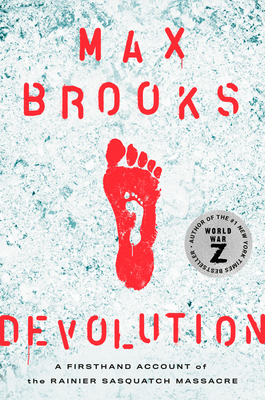
Devolution by Max Brooks: Terrific horror from the author of World War Z. My review is here.

The Ghosts of Sherwood by Carrie Vaughn: A fun, entertaining novella about Robin Hood and Marian’s children. A terrific read! Part 2 of the story will be released in August.

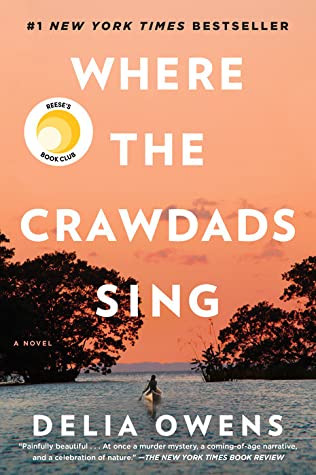
Where the Crawdads Sing by Delia Owens: Just finished this lovely audiobook, right in time for my book group’s discussion this week. My review is here.

Pop culture & TV:

More Jane the Virgin! I’ve just started season 5 — the final season — and I’m already getting a little weepy at the idea of the story coming to an end.

Fresh Catch:

No new books this week. But I did treat myself to a few new jigsaw puzzles! And hey, here’s a tip for my fellow puzzlers out there: While prices are very jacked up on Amazon right now, Barnes & Noble has a good selection at normal, pre-pandemic prices. Score!

What will I be reading during the coming week?

Currently in my hands:

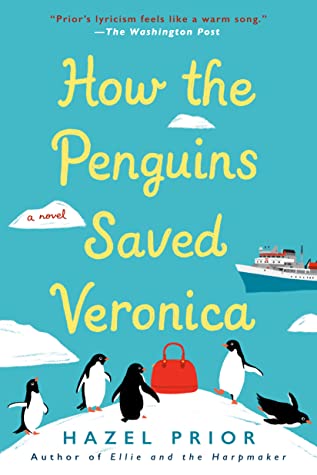
How the Penguins Saved Veronica by Hazel Prior: I adored this author’s debut novel, Ellie and the Harpmaker, so I couldn’t wait to get my hands on her new book, which releases this week! I’ve read about half. It’s adorable!

Now playing via audiobook:

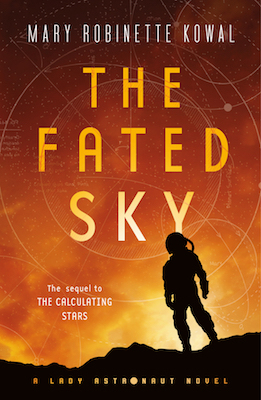
The Fated Sky (Lady Astronaut, #2) by Mary Robinette Kowal: This is a re-read for me, although my first time on audio. The author narrates these books, and is wonderful. (She narrates many of Seanan McGuire’s audiobooks too — very talented!). Book #3 in the Lady Astronaut series (The Relentless Moon) comes out next month, and I needed a refresher.

Ongoing reads:

Who’s ready for a re-read? Starting this week, Outlander Book Club is doing a group read of Outlander, reading and discussing one chapter per week. Interested in joining in? Let me know, and I’ll share the details.

So many books, so little time…

boy1

Audiobook Review: Where the Crawdads Sing by Delia Owens

Title: Where the Crawdads Sing
Author: Delia Owens
Narrator: Cassandra Campbell
Publisher: Viking
Publication date: August 14, 2018
Print length: 384 pages
Audio length: 12 hours, 12 minutes
Genre: Contemporary fiction
Source: Purchased
Rating:

Rating: 4.5 out of 5.

For years, rumors of the “Marsh Girl” have haunted Barkley Cove, a quiet town on the North Carolina coast. So in late 1969, when handsome Chase Andrews is found dead, the locals immediately suspect Kya Clark, the so-called Marsh Girl. But Kya is not what they say. Sensitive and intelligent, she has survived for years alone in the marsh that she calls home, finding friends in the gulls and lessons in the sand. Then the time comes when she yearns to be touched and loved. When two young men from town become intrigued by her wild beauty, Kya opens herself to a new life–until the unthinkable happens.

Perfect for fans of Barbara Kingsolver and Karen Russell, Where the Crawdads Sing is at once an exquisite ode to the natural world, a heartbreaking coming-of-age story, and a surprising tale of possible murder. Owens reminds us that we are forever shaped by the children we once were, and that we are all subject to the beautiful and violent secrets that nature keeps.

Where the Crawdads Sing has been on bestseller lists for at least a year now, as far as I can tell. And the fact that this was a Reese’s book club pick doesn’t hurt at all when it comes to creating buzz. So is it worth all the hype?

Now that I’ve read it, I can give an answer: Definitely yes.

Where the Crawdads Sing is lovely, rich, sad, and powerful. It tells the story of Kya Clark, a girl who is abandoned at a very young age and yet manages to raise herself in the North Carolina marsh she calls home.

Kya’s family lives in a shack in the marsh, scrabbling for daily sustenance and terrorized by their abusive, unreliable father. Kya’s older siblings have already left, and as the story opens, Kya is six years old, watching her mother walk away, never to return. Kya is left behind with her father and older brother, but even her brother doesn’t stay long. Soon, it’s just Kya and her father, and he disappears for days on end, or shows up drunk or angry, and simply can’t or won’t care for his child.

And so, from the age of six, Kya raises herself. She loves her home and the marsh and the birds and wildlife that are her truest friends. She scrapes by on the pennies her father provides. Eventually, even he leaves, and she is completely alone, surviving by digging mussels and selling them to the local sundry store owner, a warm and caring man named Jumpin’ who comes to love Kya as a daughter.

Despite the love and support of Jumpin’ and his wife Mabel, Kya is alone. When a truant officer comes to take her to school, Kya only lasts one day, feeling embarassed and tormented by the town kids who call her “Marsh Girl” and make fun of her. From then on, it’s just Kya in the marsh.

She does have one friend, a boy named Tate who once upon a time was friends with her brother. Tate is fascinated by Kya and takes it upon himself to teach her to read, opening up the world of science and biology and learning to her. Kya embarks on her lifelong passion to know and understand the marsh, collecting specimens and documenting them through writing and painting, turning her old shack into a personal natural history museum of sorts.

The story alternates between chapters following Kya’s life from early childhood onward and chapters set later, in 1969, when a local young man is found dead under suspicious circumstances. Chase Andrews had a history with the Marsh Girl, and although there doesn’t seem to be any evidence, she becomes a person of interest in the case, fueled by years of the townspeople’s harsh opinions and suspicions and gossip about her.

While I was less interested in the murder plot for most of the book, by the last third, the two story elements come together as the plot centers around the court case and resolution.

Where the Crawdads Sing is a moving and lyrical reading experience. I loved the descriptions of the marsh and the way the natural world is so much a part of who Kya is and how she looks at life. Kya’s life is horribly sad, yet also beautiful in its own lonely way. It’s incredible to think that a child could survive like that on her own all those years, yet she does. Between her natural intelligence and her lifelong study of her natural surroundings, Kya adapts and manages to thrive, despite her loneliness and sorrow throughout the years.

The audiobook narrator does a very good job of breathing life into the characters, especially Kya, using her voice to show her maturing over the years yet maintaining the core of who she is.

My one issue with the audiobook is that I feel I missed out a bit on certain written passages. Kya is passionate about poetry, and the poems she recites throughout the book are worth spending time on and contemplating a bit, but because I listened to the audiobook, they passed by a little too quickly for actual reflection. I think I’ll need to borrow a print edition so I can page through and spend more time on certain passages.

I won’t get into spoilers, so I can’t say more about the ending than that I was mostly satisfied and that the ending worked out pretty much as I expected despite a few red herrings — although there was at least one loose thread that I would have liked an answer to.

Overall though, the murder/mystery elements are not the most essential part of this book, in my mind. Yes, it was interesting, and yes, I felt that the ending made sense. But the biggest impact for me was the emotional resonance of Kya’s life, her loves, her relationships, and her incredible personal and professional achievements.

Kya is a woman to admire, one who overcomes extreme adversity to carve out a life for herself that’s meaningful and joyful.

Where the Crawdads Sing is a powerful and beautiful book. Highly recommended.

Book Review: Devolution by Max Brooks

Title: Devolution: A Firsthand Account of the Rainier Sasquatch Massacre
Author: Max Brooks
Publisher: Del Rey Books
Publication date: June 16, 2020
Print length: 320 pages
Genre: Horror
Source: Review copy courtesy of the publisher via NetGalley
Rating:

Rating: 4 out of 5.

The #1 bestselling author of World War Z takes on the Bigfoot legend with a tale that blurs the lines between human and beast–and asks what we are capable of in the face of the unimaginable.

As the ash and chaos from Mount Rainier’s eruption swirled and finally settled, the story of the Greenloop massacre has passed unnoticed, unexamined . . . until now.

But the journals of resident Kate Holland, recovered from the town’s bloody wreckage, capture a tale too harrowing–and too earth-shattering in its implications–to be forgotten.

In these pages, Max Brooks brings Kate’s extraordinary account to light for the first time, faithfully reproducing her words alongside his own extensive investigations into the massacre and the legendary beasts behind it.

Kate’s is a tale of unexpected strength and resilience, of humanity’s defiance in the face of a terrible predator’s gaze, and inevitably, of savagery and death.

Yet it is also far more than that.

Because if what Kate Holland saw in those days is real, then we must accept the impossible. We must accept that the creature known as Bigfoot walks among us–and that it is a beast of terrible strength and ferocity.

Part survival narrative, part bloody horror tale, part scientific journey into the boundaries between truth and fiction, this is a Bigfoot story as only Max Brooks could chronicle it–and like none you’ve ever read before. 

Quick, what do you think of when you hear the word “Sasquatch”?

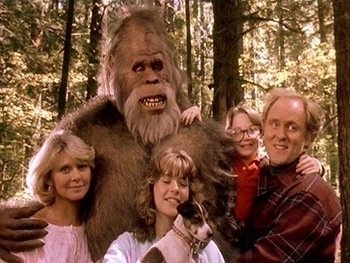
If it’s this:

… you’re going to be in for one hell of a rude awakening when you read Devolution.

In Devolution, Sasquatches are real. And they’re very, very mean.

Author Max Brooks brings us the story of a Sasquatch massacre (not a spoiler — it’s right there in the subtitle) through the journals of a woman named Kate Holland, as well as through interviews and articles that shed light on the mystery of what happened to the community of Greenloop.

Kate and her husband Dan have just joined Greenloop at the start of the story. Greenloop is a high-tech, high-efficiency community formed of six families who’ve settled (in luxury homes) in the wilderness near Mt. Rainier. But it’s not really a back-to-nature, living-off-the-land arrangement. Greenloop is a quick 90-minute drive to Seattle, and while the settlement believes wholeheartedly in composting and living green, they’re not self-sustaining. Supplies and groceries are delivered weekly via drones, so there’s really no need to worry too much about the food supply or emergency backups. Everything is taken care of!

Well, of course, the peace and perfection of Greenloop don’t last. When Mt. Rainier erupts, Greenloop finds itself cut off from the outside world, its one road in or out completely blocked by the mud and lava flows and now impassible. But not to worry — the majority of the community members are sure that help will come soon, and that this is just a glitch in their happy little utopia.

Only Mostar, a war survivor who makes fabulous artwork but whose outlook is decidedly grim, realizes that they’re all in trouble. She recruits Kate and Dan to her survival project, planting a food garden, inventorying the calorie count of all items in their kitchens, and planning for worst case scenarios.

At first, Kate goes along with it all mainly to humor Mostar and have something to do. But then, strange things start to happen. She feels like something is watching, perhaps chasing her, when she’s out walking in the woods. A mountain lion encroaches into the settlement, but it seems more like it’s running away from something than running toward the people. And then there’s the smell — an awful stench of rot and garbage that becomes more and more overpowering.

Until finally, something comes out of the woods — a sasquatch. They’ve all heard the stories over the years. and most try to find other explanations for what they’re experiencing. But eventually, there’s no hiding from the truth: There’s a pack of sasquatches in the woods, and they’re strong, smart, hungry, and organized.

Mixed in with Kate’s journal entries about the looming danger and the threats and attacks that mount from day to day are snippets of articles about primate behavior, which highlight that primates in the wild are not the gentle giants that people would like to believe them to be. There’s plenty of evidence of primates’ ability to stalk, hunt, and carry out organized attacks, as well as documentation of their consumption of meat, including the flesh of other primates.

And yes, the humans of Greenloop sure look tasty to a group of invading, starving sasquatches.

I probably should have said this right from the start… this book has blood and guts and gore. The scenes of violence are disturbing and graphic and gross, so be warned — don’t pick up this book if you can’t stomach scenes that are… well… stomach-turning.

That said, Devolution is exciting and compelling, and I just couldn’t stop reading. I had to know what would happen next, and next, and after that, even while shaking my head and thinking to myself — no, it can’t really be working out this way. The author wouldn’t really do that, would he?

(Answer: Yes. He would, and he does.)

Max Brooks is the author of World War Z, which was an amazing read. Devolution lacks the global reach of World War Z, the sense of real life events unfolding via news coverage and interviews with survivors. The storyline in Devolution all takes place within the confines of Greenloop, creating (intentionally) a very claustrophobic feel. The people of Greenloop are trapped, and as a reader, I could practically feel the walls closing in around me, and the despair that the characters must be feeling knowing that there is no escape and no last-minute rescue on the way. If they have a chance of being saved, they’ll have to do it themselves.

Kate is a good main character, and I liked the changing nature of her relationship with Dan as they move from a disaffected and alienated married couple on their last legs to people with a mission, rising to the occasion. Mostar is vivid and heroic, but the other characters don’t stand out all that much. The founding couple of Greenloop is supposed to be charismatic and inspiring, but I didn’t feel like I got to see them in action enough for them to make an impact.

I did wish for a little more exposition at the start. I would have liked a bit more backstory on the founding of Greenloop, and more to pinpoint its location and setting. I didn’t get a true sense of the community’s isolation and dependence on a single access road until later in the story, and the eruption of Mt. Rainier itself, which triggers the main plot points, is rather muted and distant. I think a better sense of the geography of Greenloop relative to Rainier and Seattle would have been helpful.

But other than that, I was totally engrossed in Devolution. It’s horrifying but oddly compelling. If I’ve ever thought about Sasquatch mythology, it’s been simply of the supposed images caught on film of hairy men-creatures living in isolation in the woods. Devolution treats us to Sasquatch as a competing species of primate — and the question is, who really is the top of the food chain?

Don’t read this book in a cabin in the woods or on a camping trip… but if you’re safely located in a busy city far from the wilds, definitely dig in and enjoy!

Shelf Control #220: The Last Astronaut by David Wellington

Shelves final

Welcome to Shelf Control — an original feature created and hosted by Bookshelf Fantasies.

Shelf Control is a weekly celebration of the unread books on our shelves. Pick a book you own but haven’t read, write a post about it (suggestions: include what it’s about, why you want to read it, and when you got it), and link up! For more info on what Shelf Control is all about, check out my introductory post, here.

Want to join in? Shelf Control posts go up every Wednesday. See the guidelines at the bottom of the post, and jump on board!

cropped-flourish-31609_1280-e1421474289435.png

Title: The Last Astronaut
Author: David Wellington
Published: 2019
Length: 400 pages

What it’s about (synopsis via Goodreads):

Mission Commander Sally Jansen is Earth’s last astronaut–and last hope–in this gripping near-future thriller where a mission to make first contact becomes a terrifying struggle for survival in the depths of space.

Sally Jansen was NASA’s leading astronaut, until a mission to Mars ended in disaster. Haunted by her failure, she lives in quiet anonymity, convinced her days in space are over.

She’s wrong.

A large alien object has entered the solar system on a straight course toward Earth. It has made no attempt to communicate and is ignoring all incoming transmissions.

Out of time and out of options, NASA turns to Jansen. For all the dangers of the mission, it’s the shot at redemption she always longed for.

But as the object slowly begins to reveal its secrets, one thing becomes horribly clear: the future of humanity lies in Jansen’s hands.

How and when I got it:

I received an ARC from Orbit last summer.

Why I want to read it:

I always love a good space adventure — and throw in women astronauts, especially one trying to save the world — and it all just sounds too perfect for me. My only excuse for not having read this already is that I’ve just had too much else to read, and never got around to it.

What do you think? Would you read this book? 

Please share your thoughts!


__________________________________

Want to participate in Shelf Control? Here’s how:

  • Write a blog post about a book that you own that you haven’t read yet.
  • Add your link in the comments!
  • If you’d be so kind, I’d appreciate a link back from your own post.
  • Check out other posts, and…

Have fun!

Top Ten Tuesday: Doesn’t ring a bell… 10 books I’ve added to my TBR, but can’t remember why.

Top Ten Tuesday is a meme hosted by That Artsy Reader Girl, featuring a different top 10 theme each week. This week’s topic is Books I’ve Added to my TBR and Forgotten Why.

I’d say about 50% of my TBR shelf qualifies! Here are 10 that jump out of me — books marked as TBR in Goodreads, but have no idea what made me add them (and in some cases, have no memory of adding them in the first place).

  1. My Oxford Year by Julia Whelan
  2. The Wise and the Wicked by Rebecca Podos
  3. Yellow Jessamine by Caitlin Starling
  4. Too Like the Lightning by Ada Palmer
  5. We Contain Multitudes by Sarah Henstra
  6. The Nobody People by Joe Proehl
  7. The Brideship Wife by Leslie Howard
  8. The Dark Tide by Alicia Jasinska
  9. Love in Mid Air by Kim Wright
  10. The Stone in the Skull by Elizabeth Bear

Have you read any of these? Are there any here that you’d particularly recommend?

If you wrote a TTT post, please share your link with me!

Save

Save

Save

Save

The Monday Check-In ~ 6/8/2020

cooltext1850356879 My Monday tradition, including a look back and a look ahead — what I read last week, what new books came my way, and what books are keeping me busy right now. Plus a smattering of other stuff too.

Life.

In these disturbing times, it’s nice to find a ray of sunshine at home. Without ceremony of any sort, my son finished high school! There’s supposed to be a virtual graduation taking place later this week, although we don’t know any specifics yet. Meanwhile, the school year ended and he was able to pick up his diploma, so it’s official!

What did I read during the last week?

The Ballad of Songbirds and Snakes by Suzanne Collins: I ended up loving this new prequel to the Hunger Games trilogy. My review is here.

Laughter at the Academy by Seanan McGuire: An excellent short story collection from an author who always makes me happy. My review is here.

500 Miles From You by Jenny Colgan: A sweet romance with a Scottish setting from one of my go-to authors! My review is here.

Pop culture & TV:

Continuing my Jane the Virgin binge! I’m on season 4 now — still loving it.

Fresh Catch:

No new books this week.

What will I be reading during the coming week?

Currently in my hands:

Devolution by Max Brooks: The newest from the author of World War Z. I’m just getting started, but I’m already hooked.

Now playing via audiobook:

Where the Crawdads Sing by Delia Owens: Amazing! I’m at 80% — hope to finish in the next couple of days.

Ongoing reads:

None at the moment. But next week, Outlander Book Club is starting a group re-read of the book that started it all! We’ll be reading and discussing one chapter of Outlander per week. Interested in joining in? Let me know, and I’ll share the details.

So many books, so little time…

boy1

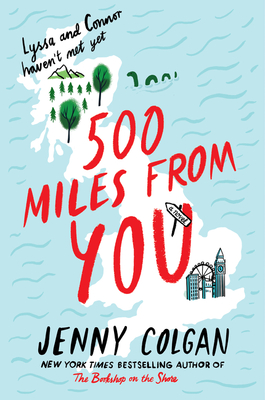
Book Review: 500 Miles From You by Jenny Colgan

Title: 500 Miles From You
Author: Jenny Colgan
Publisher: William Morrow
Publication date: June 9, 2020
Print length: 432 pages
Genre: Contemporary fiction
Source: Review copy courtesy of the publisher via NetGalley
Rating:

Rating: 3.5 out of 5.

New York Times bestselling author Jenny Colgan returns to the beloved Scottish Highland town of Kirrinfief, which readers first met in The Bookshop on the Shore, and adds a dash of London’s bustling urban landscape. 

Lissie, is a nurse in a gritty, hectic London neighborhood. Always terribly competent and good at keeping it all together, she’s been suffering quietly with PTSD after helping to save the victim of a shocking crime. Her supervisor quietly arranges for Lissie to spend a few months doing a much less demanding job in the little town of Kirrinfeif in Scottish Highlands, hoping that the change of scenery will help her heal. Lissie will be swapping places with Cormack, an Army veteran who’s Kirrinfeif’s easygoing nurse/paramedic/all-purpose medical man. Lissie’s never experienced small-town life, and Cormack’s never spent more than a day in a big city, but it seems like a swap that would do them both some good.

In London, the gentle Cormack is a fish out of the water; in Kirrinfief, the dynamic Lissie finds it hard to adjust to the quiet. But these two strangers are now in constant contact, taking over each other’s patients, endlessly emailing about anything and everything. Lissie and Cormack discover a new depth of feeling…for their profession and for each other.

But what will happen when Lissie and Cormack finally meet…?

Jenny Colgan is an absolute favorite of mine, so of course I was thrilled to receive an ARC of her new book, 500 Miles From You. This author’s books always make me smile, and her books set in the Scottish Highlands give me a major case of wanderlust each and every time.

In 500 Miles From You, we start by meeting Lissa, a nurse who specializes in follow-up care, spending her days driving around London from patient to patient to make sure they’re following doctor’s orders, taking their medications, and getting the treatment they need. As the story opens, Lissa witnesses a terrible hit and run that’s a deliberate attack, leaving a 15-year-old boy dying on the street.

Side note: The synopsis above, from Goodreads, refers to Lissie and Cormack. In the book, it’s Lissa and Cormac. Just FYI — I don’t want you to think I’m getting the characters’ names wrong!

Lissa is unable to shake off the horror, and finally, her hospital’s HR team strongly urges her to participate in a professional exchange program. She’ll be sent to a rural area to use her skills in a different environment, and a nurse from that area will come take her place in London to gain experience in urban medicine.

It doesn’t seem like an offer Lissa can refuse, and between her new assignment and her required ongoing therapy sessions, the exhange may be her only opportunity to heal and recover before her PTSD completely derails her career and her life.

Meanwhile, Cormac will leave his beloved town of Kirrinfief in the Scottish Highlands — where literally everyone knows your name — to live in Lissa’s nursing quarters in London and take over her set of patients. The two never meet, but they exchange patient notes, and over time, develop an email and text rapport beyond the professional requirements.

In my opinion. Lissa gets the much better end of the deal! As always, Jenny Colgan has me falling in love all over again with her depiction of life in the Highlands — the peace and quiet, the quaint small town, the local busybodies, the sense of connection. And frankly, while Cormac eventually finds reasons to like London, the descriptions of the noise, the dirt, the unfriendliness, the bustle all make it clear why Cormac yearns for home.

Lissa’s PTSD is portrayed sensitively. As a medical professional, she intellectually understands her reactions, but that doesn’t mean that she can instantly deal with it. Her progress is slow, and we see how her London habits keep her from fitting in or being accepted when she arrives in Kirrinfief. Eventually, of course, she opens up to her surroundings and to the way of life in a small village, and finds more than she could have thought possible.

Cormac, a former army medic, carries around with him the memories of Fallujah that eventually make him seek a civilian career. While he can relate to Lissa’s trauma, his own past still remains mostly undisclosed. I finished the book wishing we’d learned a little more about Cormac’s army experiences.

The back and forth between Cormac and Lissa is quite cute, and the book ends with all sorts of mishaps that turn their intended first in-person meetings into a series of catastrophic missed chances. But yes, there’s a happy ending — how could there not be?

The texts and emails between Lissa and Cormac are funny and sweet, and the story is a nice twist on the “two strangers fall in love without ever meeting” trope. Somehow, though, I was left wanting more. I felt that their connection needed more time to grow, and wasn’t given quite enough room to develop and breathe — and I was left wanting to see more of them together once they finally connected, rather than ending with their meeting.

This is the 3rd of Jenny Colgan’s loosely connected stories set in Kirrinfief. Characters from both The Bookshop on the Corner and The Bookshop on the Shore show up here (and become friends with Lissa). It’s lovely to see them all — I just wish they’d actually had bigger roles to play, since I enjoy those characters so much.

Overall, this is another winning romantic tale from a terrific author, balancing tough situations and emotions with lighter, more joyous moments and memorable characters.

And how could I not love a book where this happens:

He was wearing an open-necked white shirt made of heavy cotton and a pale green-and-gray kilt. […]

“Stop there, ” said Lissa, smiling and taking out her phone camera. “I want a pic. You look like you’re in Outlander.”

500 Miles From You can work as a stand-alone, but I’d recommend starting with The Bookshop on the Corner, which is a wonderful introduction to Kirrinfief and its quirky characters. Either way, don’t miss these lovely stories!

Book Review: Laughter at the Academy by Seanan McGuire

Title: Laughter at the Academy
Author: Seanan McGuire
Publisher: Subterranean Press
Publication date: October 31, 2019
Length: 376 pages
Genre: Horror/fantasy (short story collection)
Source: Purchased
Rating:

Rating: 5 out of 5.

From fairy tale forest to gloomy gothic moor, from gleaming epidemiologist’s lab to the sandy shores of Neverland, Seanan McGuire’s short fiction has been surprising, delighting, confusing, and transporting her readers since 2009. Now, for the first time, that fiction has been gathered together in one place, ready to be enjoyed one twisting, tangled tale at a time. Her work crosses genres and subverts expectations.

Meet the mad scientists of “Laughter at the Academy” and “The Tolling of Pavlov’s Bells.” Glory in the potential of a Halloween that never ends. Follow two very different alphabets in “Frontier ABCs” and “From A to Z in the Book of Changes.” Get “Lost,” dress yourself “In Skeleton Leaves,” and remember how to fly. All this and more is waiting for you within the pages of this decade-spanning collection, including several pieces that have never before been reprinted. Stories about mermaids, robots, dolls, and Deep Ones are all here, ready for you to dive in.

This is a box of strange surprises dredged up from the depths of the sea, each one polished and prepared for your enjoyment. So take a chance, and allow yourself to be surprised.

There are two things I think I’ve established by now over the course of many years of writing book reviews: 1 – I love Seanan McGuire. 2 – I’m not a big fan of short stories.

So when Seanan McGuire releases a collection of stories, what’s a fan to do? Buy it immediately, then stick it on the shelf and delay, delay, delay…

Well, I’m here to say I’m an idiot. Because OF COURSE I ended up loving this book once I finally sat myself down and gave it a try. It’s Seanan McGuire! What’s not to love?

This collection brings together stories from 2009 through 2017, and as the author makes clear in her introduction, all stories take place outside of her “pre-existing universes” — so you won’t find October Daye or the Incryptid’s Price family members anywhere in these pages. All stories appeared in other publications and anthologies over the years, and it’s a treat to have so many available in one glorious collection.

Quick aside: I purchased the pretty hardcover special edition from Subterranean Press as a splurge, but it’s also available in e-book format for a much more reasonable price.

These 22 stories cover a wide range of themes, topics, and tones. Some are funny, some are sad, some are terrifying, and some are just downright creepy. Absolutely none are boring or skippable! One of the things I loved about this book was the mix — from story to story, it’s always something new, and so many surprises!

I’ll share just a few highlights about my favorites of the bunch:

The title story, “Laughter at the Academy”, is all sorts of awesome about mad scientists and a condition called “Schizotypal Creative Genius Personality Disorder”. It’s brutal and fun and, well, mad.

“Lost” is creepy and disturbing and sad, as is any story about children all over the world acting strangely at the same time. It made me think of Torchwood and Childhood’s End, although it isn’t really much like either one.

Seanan McGuire is excellent at unleashing hell on the world, so a story about viruses ravaging humankind is scary and perhaps too timely right now, but I loved “The Tolling of Pavlov’s Bells” all the same. Super frightening. And prescient — this is from her introduction to the story:

I also believe that the modern world’s disdain for quarantine and willingness to support structures which encourage its violation is going to do a great deal of damage one day… and that with the new diseases emerging regularly from a variety of sources, that day may not be particularly far in the future.

And as the story itself describes:

If they were to stay home, avoid the company of strangers, and wait for a vaccine, they might stand a chance. But no one listens to the doctors, or to the newspaper headlines begging them to stay indoors.

One of the coolest stories in the collection — so weird and unexpected — is “Uncle Sam”. Ever wonder why women go to the bathroom together? Read this and find out.

There’s also a story about Valkyries, a western sci-fi story…

Cherry’s first to the cattle call, her guns low and easy on her hips, her hair braided like an admonition against untidiness.

… military mermaids, a steampunk invasion of carnivorous plant-based aliens…

“A… diplomat?” Arthur blinked at me as our carriage rattled to a stop, presumably in front of our destination. “But the first thing you did was eat my sister’s maid.”

… a Peter Pan story, a Twitter-based ghost story, more end-of-the-world/end-of-humankind scenarios, a GoFundMe for bringing on eternal Halloween…

… and the story that’s given me nightmares ever since, “We Are All Misfit Toys in the Aftermath of the Velveteen War”. There are dolls. And they’re scary as hell. This is creepy and brilliant, and if I ever get over my first reading of this story, I’ll come back and read it again!

Seanan McGuire’s writing is as amazing as always, and this collection shows her range and ability to try on any genre or style and make it work.

Obviously, I loved this book, and I’m so glad I got over my reluctance to read short story collections. Laughter at the Academy is a must-read for Seanan McGuire fans, but you don’t have to have previous experience with her work to appreciate the funny, scary, and strange worlds presented here.

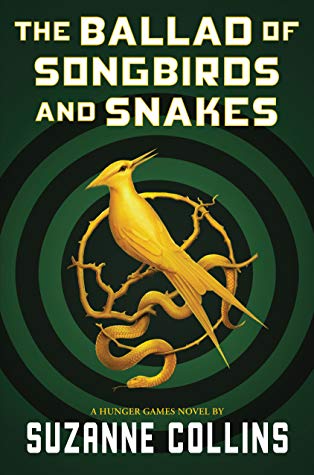
Book Review: The Ballad of Songbirds and Snakes by Suzanne Collins

Title: The Ballad of Songbirds and Snakes
Author: Suzanne Collins
Publisher: Scholastic
Publication date: May 19, 2020
Length: 540 pages
Genre: Young adult
Source: Purchased
Rating:

Rating: 4.5 out of 5.

AMBITION WILL FUEL HIM.

COMPETITION WILL DRIVE HIM.

BUT POWER HAS ITS PRICE.

It is the morning of the reaping that will kick off the tenth annual Hunger Games. In the Capital, eighteen-year-old Coriolanus Snow is preparing for his one shot at glory as a mentor in the Games. The once-mighty house of Snow has fallen on hard times, its fate hanging on the slender chance that Coriolanus will be able to outcharm, outwit, and outmaneuver his fellow students to mentor the winning tribute.

The odds are against him. He’s been given the humiliating assignment of mentoring the female tribute from District 12, the lowest of the low. Their fates are now completely intertwined — every choice Coriolanus makes could lead to favor or failure, triumph or ruin. Inside the arena, it will be a fight to the death. Outside the arena, Coriolanus starts to feel for his doomed tribute… and must weigh his need to follow the rules against his desire to survive no matter what it takes. 

When the news first came out that a new Hunger Games book was on the way, 10 years after the release of Mockingjay, I knew I’d have to read it. And then, as the first synopses and excerpts starting coming out, I was probably as confused and nervous as all the other Hunger Games fans.

A book about President Snow? Really?

Did we really need this particular character’s backstory? And given what a horrible person he is, would a novel about his early years manage to satisfy readers or make us care?

Fortunately, Ballad (sorry, I’m just not going to keep typing out the full LONG title) exceeds expectations and shows that the talent of Suzanne Collins can make a man we all despise into a compelling lead character.

Coriolanus Snow is 18 years old when we meet him at the start of Ballad. It’s been ten years since the war ended, and he lives in his family’s luxurious home in the Capital. Or at least, it was luxurious once upon a time, when the Snow fortune was thriving and Coriolanus’s parents were still alive.

The war was brutal and cruel, and the streets of the Capital are still filled with the rubble left behind. The Snow family’s home is falling apart at the seams, and when District 13 was bombed into oblivion, ending the war, the Snow industries located there were also obliterated, leaving the once wealthy family destitute. Now, years later, Coriolanus lives in the shabby home with his elderly grandmother (referred to as the Grandma’am) and his cousin Tigris, where they subsist most days on cabbage soup.

Fortunately for Coriolanus, he’s a stellar student at the Academy, where his uniforms are provided and he’s guaranteed hot meals during the school day. He hides his poverty and hunger from everyone around him, determined to continue to portray himself and his family as upper crust, top tier, best of the bunch. After all, as he and Tigris reassure one another:

Snow lands on top.

This year, for the first time, Academy students are going to be given an exciting new assignment: Each of the top year students will be assigned as a mentor to a tribute in the Hunger Games. This is a chance for Coriolanus to shine. If he’s successful, if his tribute does well, he’s more likely to get the prizes and recognition that will get him a University scholarship. And his dreams definitely include University — the education and access will be necessary for his goal of restoring the Snow family to power, maybe all the way to the Presidency someday.

But first, he has to make sure his tribute does well. And it’s not looking so good. He’s assigned the girl tribute from District 12, the least prestigious assignment possible. And she’s an odd one — a girl dressed in poofy rainbow skirts with a beautiful voice and a magnetic presence, but clearly not a threat in any sort of way. Still, Coriolanus will have to work with what he’s given, and he begins to scheme and plan for how to push Lucy Gray Baird into the spotlight and into the public’s affection.

That’s a lot of synopsis, and there’s so much more to say, but I’ll stop here and talk about the pieces that really stood out for me in this book.

First, it’s truly fascinating to see life in the Capitol in the post-war years. In The Hunger Games trilogy, we only see the Capitol through Katniss’s eyes. It’s a cruel, spoiled place, full of pampered, shallow people, a place where other people’s suffering is entertainment for the masses.

Here in Ballad, the Capitol is a shelled, damaged city trying to rebuild and reestablish its absolute control. The black market is thriving, old families are starving and fading away, and social standing is the only possible avenue to regain what was lost.

The Hunger Games, ten years after their creation, are just one facet of the Capitol’s attempt to dominate the districts, and they’re pretty meager at that. The Games are held in a bombed-out sports arena, where the tributes are basically just dumped with a pile of weapons and left to kill one another. No high-tech tricks or elaborate sets, no cannons or anthems, not even any removal of bodies. The dead lie there until it’s all over, and it never does take very long.

What’s more, the tributes of these early Hunger Games don’t get any of the special preparation or luxury guest accommodations that Katniss experiences all those years later. They’re transported to the Capitol in cattle cars and housed at a cage at the zoo, given neither food nor water. It’s Coriolanus who draws attention to them, realizing that his tribute will benefit from having the public love her, finding ways to create interest and encouraging people to bring food to the caged tributes, who might otherwise starve to death before they ever enter the arena.

One of the truly fascinating aspects of this book is seeing the hated President Snow as a vulnerable teen. He’s not hateful when we meet him. He’s a young man who has to put on a good show while his private world falls apart, every single day. He’s driven and determined, but loves his family, and isn’t terrible at his core.

It’s his ambition that drives him forward, and he does have people he cares about. He also struggles with the morality of the Hunger Games, although as he views Panem’s actions from the perspective of a Capitol family, he has no sympathy for the rebels who caused such devastation in his home. Under the tutelage of the Academy professors, he hones his thinking on control and the social structure of Panem, and finds ways to push aside any personal disgust or moral ambivalence when it gets in the way of his goal to ensure the survival and triumph of the Snow family legacy.

Lucy Gray is a wonderful character, as is Sejanus, Coriolanus’s school friend who is decent to the core. Sejanus’s family is from District 2, but moved to the Capitol thanks to their enormous wealth — but no one lets Sejanus forget that he’s District, and he himself can’t seem to fully accept the Capitol’s approach to ruling the Districts. Sejanus’s morality is both a guidepost and an irritant to Coriolanus, and their contrasting journeys over the course of Ballad is a key part of what makes this novel so compelling.

(If I had more of an education in the classics, here’s where I’d go into the symbolism of the characters’ names… but alas, all I can do is say that looking up Coriolanus and Sejanus on Wikipedia was very interesting!)

As a side note, I know people were commenting/complaining about the lengthy title of this book. And yes, I’ve opted to just call it Ballad instead of typing it out over and over again. That said, ballads and snakes and songbirds are all significant within the book and factor strongly into certain plot points, so it’s definitely not an arbitrary title!

There’s so much more to say about Ballad, so much food for discussion, but I’ll stop going into details and just encourage you to discover it for yourself! I could not put this book down. The author does an amazing job of taking an established villain and showing us the nuances and all the shades of gray in his development. Coriolanus wasn’t always the man we know in the Hunger Games trilogy; Ballad illustrates who he once was and how he became the person he ended up.

A terrific read. Don’t miss it!