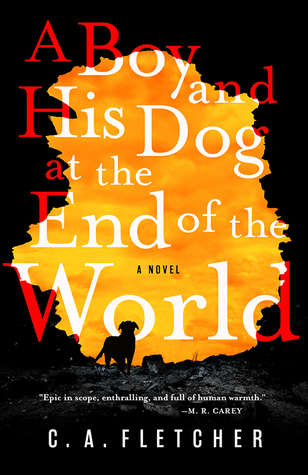
Take A Peek Book Review: A Boy and His Dog at the End of the World by C. A. Fletcher

“Take a Peek” book reviews are short and (possibly) sweet, keeping the commentary brief and providing a little peek at what the book’s about and what I thought.


Synopsis:

(via Goodreads)

When a beloved family dog is stolen, her owner sets out on a life-changing journey through the ruins of our world to bring her back in this fiercely compelling tale of survival, courage, and hope. Perfect for readers of Station Eleven and The Girl With All the Gifts.

My name’s Griz. My childhood wasn’t like yours. I’ve never had friends, and in my whole life I’ve not met enough people to play a game of football.

My parents told me how crowded the world used to be, but we were never lonely on our remote island. We had each other, and our dogs.

Then the thief came.

There may be no law left except what you make of it. But if you steal my dog, you can at least expect me to come after you.

Because if we aren’t loyal to the things we love, what’s the point?

My Thoughts:

A man stole my dog.

I went after him.

Bad things happened.

I can never go home.

I’ll keep this short and to the point, because it would be way too easy to veer into spoilery territory, and this book is best experienced fresh and free from a whole lot of expectations. It’s a wonderful story about love and loyalty, centered around a quest to retrieve a beloved dog, and filled with danger, unexpected alliances and moments of grace, bravery, and defiance. And yes, a little sadness too.

The title says a lot about the basics of the book. The key point is that this is a world of after — nothing is as we know it. And it’s not because of a world war or other doomsday scenario. Instead, the world basically went infertile, except for a very small percentage of people who didn’t. There was a last generation, and once they died out, the people who remained — about 7,000 worldwide — were left to live on in whatever fashion suited them. The world we know was essentially dead. Nothing new was made or created, and people survived through farming and scavenging (or, as Griz’s family calls it, “viking” — they’d go “a-viking” to see what they could find to reuse and repurpose on their own little isolated island).

Told through Griz’s first-person narration, the story takes us along Griz’s journey, across the sea and through an abandoned and alien mainland… because a stolen dog cannot be forgotten. I loved the writing, both plain and unembellished, yet full of fun word play and cadences:

And then the thing that happened happened and what happened was really three things and they all happened at once.

I really truly loved this book. It’s sad and frightening, but also lovely and inspiring. Griz is a terrific, memorable main character. The story wraps up well, neatly enough to leave me satisfied, but I still wish I could learn more about this world and the people left in it.

Highly recommended. What a treat!

_________________________________________

The details:

Title: A Boy and His Dog at the End of the World
Author: C. A. Fletcher
Publisher: Orbit
Publication date: April 23, 2019
Length: 384 pages
Genre: Speculative/post-apocalyptic fiction
Source: Review copy courtesy of the publisher via NetGalley

**Save

Save

Save

Save

Save

Save

Save

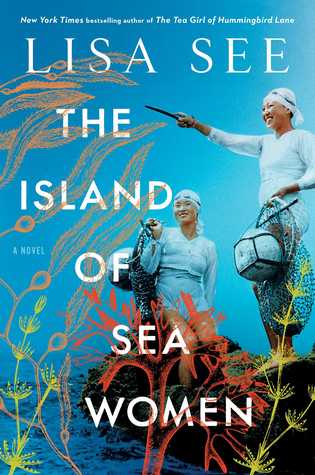
Book Review: The Island of Sea Women by Lisa See

Mi-ja and Young-sook, two girls living on the Korean island of Jeju, are best friends that come from very different backgrounds. When they are old enough, they begin working in the sea with their village’s all-female diving collective, led by Young-sook’s mother. As the girls take up their positions as baby divers, they know they are beginning a life of excitement and responsibility but also danger.

Despite their love for each other, Mi-ja and Young-sook’s differences are impossible to ignore. The Island of Sea Women is an epoch set over many decades, beginning during a period of Japanese colonialism in the 1930s and 1940s, followed by World War II, the Korean War and its aftermath, through the era of cell phones and wet suits for the women divers. Throughout this time, the residents of Jeju find themselves caught between warring empires. Mi-ja is the daughter of a Japanese collaborator, and she will forever be marked by this association. Young-sook was born into a long line of haenyeo and will inherit her mother’s position leading the divers in their village. Little do the two friends know that after surviving hundreds of dives and developing the closest of bonds, forces outside their control will push their friendship to the breaking point.

This beautiful, thoughtful novel illuminates a world turned upside down, one where the women are in charge, engaging in dangerous physical work, and the men take care of the children. A classic Lisa See story—one of women’s friendships and the larger forces that shape them—The Island of Sea Women introduces readers to the fierce and unforgettable female divers of Jeju Island and the dramatic history that shaped their lives.

The Island of Sea Women is a gorgeous, though-provoking, emotionally powerful read. We first meet Young-sook as an old woman on the beach in Jeju in 2008, thinking back on her life and feeling somewhat amused by the tourists who now flock to her island, viewing the elders of the haenyeo diving women as a living piece of history and a novelty. When she is approached by a visiting family who seem to know who she is, Young-sook is thrust back into her long-ago memories.

We’re reintroduced to Young-sook as a 15-year-old in 1938, about to embark on her first real dive with the haenyeo collective led by her mother. In Jeju, women support their families through their diving, while the men tend the children and the home. It’s an unusual matriarchy that suits the lives of the islanders. The women are strong physically and mentally, worrying about providing for their families, and gossiping about needing to care for their men and children. The diving offers sustenance and independence, but also presents very real dangers to the women, as Young-sook learns on her very first day.

Danger also comes from the Japanese colonial presence and the constant threat that hangs over the Korean population. The end of the war brings new sorts of danger, as the division of Korea results in danger from the military rulers and right-wing government.

Meanwhile, Young-sook and her best friend Mi-ja grow up together, close as sisters, until their adult lives as married women and mothers starts forcing them apart. Something terrible happens to cause a permanent rift, but we don’t discover the awful events until about midway through the book.

I really don’t want to disclose too many of the plot points, so I’ll leave my remarks pretty brief. This book was fascinating. I knew very little about Korean history before reading The Island of Sea Women, and I certainly had never heard about the haenyeo. The culture of the haenyeo is so amazing to learn about — even without the captivating characters and their stories, the story of the divers and their lives kept me completely engrossed.

Add to that a powerful story of friendship, family, love, obligation, and betrayal, as well as sharply drawn depictions of people who feel real, and you have a book that’s absolutely worth reading, and very, very memorable.

I highly recommend The Island of Sea Women, both for fans of historical fiction as well as anyone who enjoys poignant, emotionally rich stories about remarkable people. And if you’re not familiar with the haenyeo of Jeju, or want to learn more about them, check out this video for starters:


_________________________________________

The details:

Title: The Island of Sea Women
Author: Lisa See
Publisher: Scribner
Publication date: March 5, 2019
Length: 374 pages
Genre: Historical fiction
Source: Review copy courtesy of the publisher via NetGalley

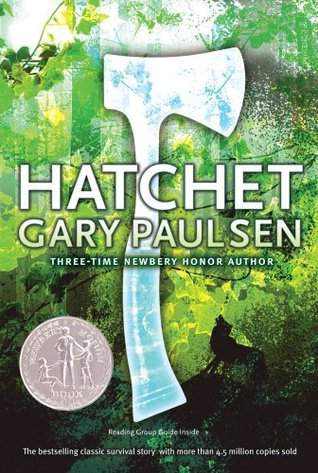
Great American Read challenge update: Hatchet by Gary Paulsen

Reason five billion and eleven (approximately) to love my book group: Because this year, we’re doing a reading challenge based on PBS’s Great American Read — and I’m loving the books I’ve read for it.

For our challenge, we each put together a list of five books (from the list of 100) that we hadn’t read yet, and committed to reading them (or possibly alternates) during 2019. It’s a choose-your-own approach to a reading challenge, and while I don’t usually jump on the challenge bandwagon, this one is low-key enough (and with enough options and room for mind-changing) that I decided to go for it.

My newest read — finished in one sitting on a long flight — is…


Hatchet by Gary Paulsen
Published 1986

Synopsis:

Brian is on his way to Canada to visit his estranged father when the pilot of his small prop plane suffers a heart attack. Brian is forced to crash-land the plane in a lake–and finds himself stranded in the remote Canadian wilderness with only his clothing and the hatchet his mother gave him as a present before his departure.

Brian had been distraught over his parents’ impending divorce and the secret he carries about his mother, but now he is truly desolate and alone. Exhausted, terrified, and hungry, Brian struggles to find food and make a shelter for himself. He has no special knowledge of the woods, and he must find a new kind of awareness and patience as he meets each day’s challenges. Is the water safe to drink? Are the berries he finds poisonous?

Slowly, Brian learns to turn adversity to his advantage–an invading porcupine unexpectedly shows him how to make fire, a devastating tornado shows him how to retrieve supplies from the submerged airplane. Most of all, Brian leaves behind the self-pity he has felt about his predicament as he summons the courage to stay alive.

A story of survival and of transformation, this riveting book has sparked many a reader’s interest in venturing into the wild.

I do love a good survival story, and this one is terrific. Brian is a 13-year-old dealing with his anger and sadness over his parents’ divorce. He may think he’s dealt with traumatic events, but those are nothing compared to what he faces when his plane crashes and he’s forced to face the reality of being alone in the wilderness. He has no idea where he is, although he suspects that the plane veered off-course when the pilot’s heart attack struck. Brian realizes that rescue teams wouldn’t know where to search, and that he may be on his own for quite some time. He can give up, or he can find a way to survive.

Based on his own inner strength, as well as lessons learned from his parents, his reading, and his teachers, Brian finds a way to dig deep, face the immediate dangers of his situation, and find a way to live. With only the clothes on his back and his hatchet, Brian teaches himself to observe, learn, and use the resources around him to get food, make a shelter, and live through each day.

I really enjoyed reading Hatchet. I’d bought a copy several years ago, hoping the subject matter would inspire my son to pick up a book. It didn’t — but it was great to find the copy and finally read it myself.

After finishing the book, I went on Goodreads to learn more, and saw that there are four more books about Brian. Hatchet feels like a standalone (and was probably written that way originally), but I’m curious about the sequels. Have you read any of the other books about Brian? If so, do you recommend them?

**********************************************

As for my Great American Read challenge, so far I’ve read:

  1. Anne of Green Gables by L. M. Montgomery
  2. Where the Red Fern Grows by Wilson Rawls
  3. Hatchet by Gary Paulsen

(My reaction to the first two books: here)

From my original target list of five, I’ve yet to read:

  1. The Grapes of Wrath by John Steinbeck
  2. Foundation by Isaac Asimov

This is fun! I’m having a blast discovering books I probably should have read years ago… and it’s nice to have these books to weave into my reading life, in between all the new books and ARCs staring me in the face constantly.

Have you read many of the Great American Read books? Which do you consider must-reads?

Please share your thoughts!

What not to read before flying! Three shorts about airplane travel

It’s really not that bad…

I’m getting on a plane today, flying home from East Coast to West — so what did I read yesterday? Why, just three different short stories about air travel. And why did I choose to do that on the day before a flight? No idea, really… because they were there?

In any case, they didn’t all freak me out. They’re not all scary, but still — an odd choice, given the timing.

Here’s what I read:


Wingspan by Chris Bohjalian: This is a one-act play by an author who’s always terrific. The action centers on two flight attendants, one young and inexperienced, one closer to middle age and with enough years of flying and life to be both practical and somewhat jaded. As they prepare for takeoff, the younger woman’s fear of flying is obvious, and as they talk, she begins to reveal her long-held secrets that led her to this point. The dialogue is sharp and clever, showing the slow development of trust and support between the two characters. Wingspan is not frightening from a flying perspective, but it is disturbing in terms of what is revealed and what the younger woman has experienced. This is a great short read (32 pages), available as an e-book standlone. Definitely recommended.


Next, two shorts by the amazing Seanan McGuire, both originally Patreon stories:

Carry On: Published on Patreon in 2016, available to read online at Nightmare Magazine (https://www.nightmare-magazine.com/fiction/carry-on/):

A creepy tale that’s not too implausible. Airlines charge for legroom, carry-on bags, food, earlier boarding, the privilege of choosing seats… what’s next? Carry On takes that question to an answer that’s not all that far-fetched. Instead of making larger people buy two seats while having skinnier folks get to sit in comfort by virtue of their smaller size, why not charge by total weight? You buy a ticket based on the combined weight of you and your carry-ons — and you’d better hope you pass the pre-flight weigh-in!

Emergency Landing: Seanan McGuire’s newest Patreon story (not available elsewhere at this point):

Wow, this is one creepy story! It’s not terrifying from the flying perspective — nothing bad happens to the engines or the rest of the plane. But what happens when you’re in the air on a routine flight and learn that the rest of the world has maybe just been wiped out? This story is horrifying and disturbing in all the best ways.

So, really, nothing to put me off flying too badly, and all great reads!

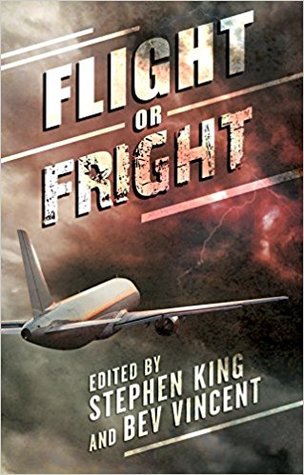
And hey, at least I didn’t dive into this collection, which keeps showing up in my recommendations list:

A collection of 17 horror stories about… yes… flying, edited by Stephen King, with this tasty hint in the description:

All the ways your trip into the friendly skies can turn into a nightmare, including some we’ll bet you’ve never thought of before… but now you will the next time you walk down the jetway and place your fate in the hands of a total stranger.

I actually wouldn’t mind reading this — but not today, thanks!

Save

Save

Save

Save

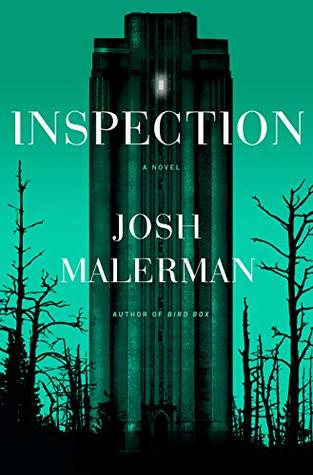
Take A Peek Book Review: Inspection by Josh Malerman

“Take a Peek” book reviews are short and (possibly) sweet, keeping the commentary brief and providing a little peek at what the book’s about and what I thought.


Synopsis:

(via Goodreads)

J is a student at a school deep in a forest far away from the rest of the world.

J is one of only twenty-six students, all of whom think of the school’s enigmatic founder as their father. J’s peers are the only family he has ever had. The students are being trained to be prodigies of art, science, and athletics, and their life at the school is all they know—and all they are allowed to know.

But J suspects that there is something out there, beyond the pines, that the founder does not want him to see, and he’s beginning to ask questions. What is the real purpose of this place? Why can the students never leave? And what secrets is their father hiding from them?

Meanwhile, on the other side of the forest, in a school very much like J’s, a girl named K is asking the same questions. J has never seen a girl, and K has never seen a boy. As K and J work to investigate the secrets of their two strange schools, they come to discover something even more mysterious: each other.

My Thoughts:

Okay, wow, this book is weird. At first, I even thought it might be TOO weird for me, which is rather hard for a book to achieve. But eventually, I got sucked in by the weirdness and became completely hooked on the story.

So, deep in a remote forest, a group of 26 boys — the Alphabet Boys — have been raised from birth through age 12 in an all-male environment, never even knowing that females exist. It’s all part of a grand experiment by the man they call D.A.D., attempting to prove that without the distraction of the opposite sex, true genius is possible. Crazy, right?

“Ever wonder how you came into being?”

“No,” J said. “We come from the Orchard. The Living Trees.”

The boys are subject to daily Inspections, which they think is a test to see if they’ve been infected with imaginary diseases (such at Vees and Rotts) that they believe are real. The most horrible outcome is for a boy to be declared “spoiled rotten”, which leads to being sent to the Corner — and boys who go to the Corner do not come back. In reality, the Inspections are a way for D.A.D. and the Inspectors to monitor the boys’ every thought and action, alert to hints that they might have stumbled across some sign of the dreaded female. Words like girl, woman, she, and her have no meaning for the Alphabet Boys.

Meanwhile across the forest, a mirror image tower full of girls — the Letter Girls — is engaged in the exact same experiment in reverse. It’s so insane. Eventually, of course, the boys and girls have first contact behind the adults’ backs, and from there, the carefully orchestrated life in the towers spirals quickly out of control.

I ended up fascinating by this story. After somewhat ambivalent feelings early on, I got very caught up. The story really takes off once the girls are introduced at about the halfway point. The ending really went to some wild places. Whoa.

I won’t say more or give anything else away, although I may go comment in a spoiler-y way in my Goodreads review. I really have no idea how to categorize this book. It’s not sci-fi exactly. It’s not futuristic or dystopian — it’s clearly set in our world, just in a remote location controlled by some loony people. It’s a little bit horror in some ways, and has some psychological terror/thriller elements, and quick a bit of mind-fuckery. So yeah, I don’t quite know what to call this book — but I do know that I had a great time reading it!

_________________________________________

The details:

Title: Inspection
Author: Josh Malerman
Publisher: Del Rey
Publication date: March 19, 2019
Length: 400 pages
Genre: I actually have no idea how to categorize this…
Source: Review copy courtesy of the publisher via NetGalley

**Save

Save

Save

Save

Save

Save

Save

Audiobook Review: Only Child by Rhiannon Navin

Readers of Jodi Picoult and Liane Moriarty will also like this tenderhearted debut about healing and family, narrated by an unforgettable six-year-old boy who reminds us that sometimes the littlest bodies hold the biggest hearts and the quietest voices speak the loudest.

Squeezed into a coat closet with his classmates and teacher, first grader Zach Taylor can hear gunshots ringing through the halls of his school. A gunman has entered the building, taking nineteen lives and irrevocably changing the very fabric of this close-knit community. While Zach’s mother pursues a quest for justice against the shooter’s parents, holding them responsible for their son’s actions, Zach retreats into his super-secret hideout and loses himself in a world of books and art. Armed with his newfound understanding, and with the optimism and stubbornness only a child could have, Zach sets out on a captivating journey towards healing and forgiveness, determined to help the adults in his life rediscover the universal truths of love and compassion needed to pull them through their darkest hours.

Be careful reading Only Child. There’s a good chance it’ll rip your heart out.

As Only Child opens, six-year-old Zach is crammed into a closet in his classroom, listening to popping sounds from somewhere outside the door his teacher is desperately holding closed. When the police finally move in and escort the children to safety in a nearby church, Zach can see that there are some people lying on the floor in the school hallway, and he sees splashes of red, even though the police officer keeps telling the kids to keep their eyes forward and not look around. When Zach’s mother arrives at the church to get him, we hear the terror in her voice as she asks Zach where his brother is. At that moment, the world begins to fall apart for Zach and his parents.

Zach’s older brother Andy is one of nineteen fatalities in a horrific school shooting, along with many of Andy’s classmates and the school principal. The shooter is the mentally ill adult son of the school’s long-time security guard Charlie — a man who has cared for the children of McKinley Elementary for 30 years.

How do we learn about these events? Through Zach. Only Child is narrated throughout by Zach Taylor, so we see all events unfold from this six-year-old’s perspective. We’re with Zach as he undergoes confusion, discomfort, misunderstanding, and terror. Zach’s first-person narration lets us into his thoughts, as he sorts through his feelings about Andy, who wasn’t always the kindest of brothers. We also can feel Zach’s terror at thoughts of returning to school, his boundless loneliness in his house, and his need for parents who are so wrapped up in their own grief and horror that they can’t always see what’s going on with Zach.

Look, this book is heart-breaking, no two ways about it. At the same time, I found it hard to spend the entire book looking at the world through Zach’s eyes. I had a similar response to Room. It’s a powerful story, but the limitations caused by having a child narrator can be frustrating. We never know more than Zach knows. We can only participate in conversations that Zach’s present for, so even though he does a fair bit of lurking in hallways to hear what his parents are talking about, we only ever get bits and pieces.

I had a hard time too suspending my disbelief in places where Zach recounts what he’s heard on TV or comments made by adults he’s overheard. His inner thoughts are a little precious on occasion, and maybe a bit more sophisticated for his age than is truly believable. My other complaint (sorry, I realize I’m being a curmudgeon): As you might expect in a story told by a six-year-old, I think I heard more than enough about pee, poop, snot, and puke. Oh my, little boys can be gross. (Sorry, truly.)

Still, I was very engaged by the story and the characters throughout. I had the unusual experience while reading this book of trying to analyze why I felt certain ways about characters, and forcing myself to embrace empathy even when I was having a visceral reaction against a particular person. For example, Zach’s mother comes across as pretty awful for much of Only Child, when viewed through the lens of Zach’s fears and unmet emotional needs. She’s unable to see past her own fury and loss to truly see Zach’s suffering, consumed by the need to get revenge on the parents of the shooter, pursuing TV interviews and making  lots of noise about their role and their responsibility for the children’s deaths.

Meanwhile, I typically have little sympathy for unfaithful spouses in novels, but despite the fact that we learn that Zach’s dad was having an affair prior to Andy’s death, he comes across as the supportive, loving, gentle parent who’s present for Zach and who attempts to find a way toward healing. I ended up liking the father much more than the mother, and had to continually remind myself that there’s no wrong way to grieve. She was not being a good mother to Zach following the shooting, but who among us can say how we’d behave in that unimaginable, terrifying type of situation? As much as I wished for better for Zach — like for his parents to be on the same page long enough to get him counseling — I couldn’t hate the mother for being swallowed up by her pain and grief.

Kudos to the talented young narrator of the audiobook, Kivlighan de Montebello, who does a terrific job with Zach’s voice, really giving life to Zach’s emotions. The audiobook is an immersive listening experience, and in places the raw emotions of the characters are almost too painful to hear.

I’m thankful to my book group, as always, for choosing terrific books to read and discuss. I finished Only Child right in time for our discussion, and can’t wait to share impressions and thoughts with my bookish friends. Only Child is a powerful, timely, deeply affecting book, and I strongly recommend it.

_________________________________________

The details:

Title: Only Child
Author: Rhiannon Navin
Narrator: Kivlighan de Montebello
Publisher: Knopf Publishing
Publication date: February 6, 2018
Print length: 304 pages
Audiobook length: 9 hours, 10 mintues
Genre: Contemporary fiction
Source: Library

Book Review: A Dangerous Collaboration (Veronica Speedwell, #4) by Deanna Raybourn

Victorian adventuress Veronica Speedwell is whisked off to a remote island off the tip of Cornwall when her natural historian colleague Stoker’s brother calls in a favor. On the pretext of wanting a companion to accompany him to Lord Malcolm Romilly’s house party, Tiberius persuades Veronica to pose as his fiancée–much to Stoker’s chagrin. But upon arriving, it becomes clear that the party is not as innocent as it had seemed. Every invited guest has a connection to Romilly’s wife, Rosamund, who disappeared on her wedding day three years ago, and a dramatic dinner proves she is very much on her husband’s mind.

As spectral figures, ghostly music, and mysterious threats begin to plague the partygoers, Veronica enlists Stoker’s help to discover the host’s true motivations. And as they investigate, it becomes clear that there are numerous mysteries surrounding the Romilly estate, and every person present has a motive to kill Rosamund…

The house party with a twist is such a trope in old-timey feeling mysteries… and with good reason. Take a remote location, preferably in a house with some grandeur or mystique, add in a motley assortment of house guests, all invited for a variety of reasons, most of which end up being pretenses, maybe mix in some gothic family secrets… and bam! You’re all set up for a slightly claustrophobic, atmospheric whodunnit.

In the case of A Dangerous Collaboration, while the set-up is reminiscent of Agatha Christie, with perhaps a hint of Rebecca too, it’s a trope that works extremely well. We pick up with our plucky heroine Veronica Speedwell, already a world-famous lepidopterist despite being only in her mid-20s, and her dark and dangerous colleague Revelstoke Templeton-Vane, known as Stoker. The two have chemistry galore. When we last saw them in A Treacherous Curse, Veronice and Stoker had just solved a mystery involving plundered Egyptian tombs and Stoker’s notorious past… and were on the verge of a long-awaited lip-lock and possible confession of feelings, when they were interrupted by Stoker’s older brother, the Viscount Tiberius Templeton-Vane.

In A Dangerous Collaboration, we continue mere moments later. Tiberius arrives with a proposition for Veronica — to accompany him to a gathering at his friend Malcolm’s Cornish island castle, where she’ll be able to collect specimens of a rare butterfly previously thought extinct. Naturally, Veronica jumps at the chance, despite Stoker’s objections. So also naturally, Stoker shows up at the island too, where the two brothers and Veronica join Malcolm, his spinster sister, his widowed sister-in-law, and his nephew for a social gathering. At which point Malcolm informs them all that he needs their help — he wants to learn the truth of what really happened to Rosamund on their wedding day. Did she flee? Did she die? Was she murdered? There are some dark and disturbing possibilities, and all of the assembled guests, apart from Veronica and Stoker, seem to have much more at stake than is initially apparent.

The Veronica Speedwell books are utterly delightful, with their arch humor, constant sense of adventure, and layered mysteries to solve, all of which are enhanced a thousand times over by the sparks continually flying between Veronica and Stoker. While A Dangerous Collaboration felt at first a little tamer than the previous three books, probably because Veronica and Stoker did not appear themselves to be in mortal peril this time around, soon the danger grows and before long they’re once again risking life and limb to learn the truth.

Along the way, we get to know Tiberius better and understand what makes him tick, as well as gaining insight on the highly charged relationship between the brothers. For me, the most delicious part of the reading experience was the mounting tension between Veronica and Stoker, as they creep closer and closer to the point where they’ll just have to finally admit their feelings and declare their intentions toward one another. Like I said, these two — chemistry, sparks, fire, passion… you name it. (But no, there’s no graphic physical stuff, just tension and attraction galore.)

As always, the language and dialogue in these books is so much fun. A little sampling:

“What in the name of seven hells do you mean you want to ‘borrow’ Miss Speedwell? She not an umbrella, for God’s sake.”

Her doglike devotion was appalling; any woman with spirit or strength could only feel revulsion at the notion of offering oneself up like a sacrificial lamb to the slaughter of one’s own independent thought and feeling.

Men were a joy to sample, but a mate would be a complication I could not abide.

“Does this mean you will stop torturing me by displaying yourself in various states of undress?’

“Not a chance.”


At the end of A Dangerous Collaboration, we get a hint about what Veronica and Stoker’s next adventure will be in book #5. And now I’m jumping out of my skin, dying to read it NOW. This is really a terrific series, and I encourage everyone to start at the beginning and dive in!

Want to know more? Check out my reviews of the previous books in the Veronica Speedwell series:
A Curious Beginning
A Perilous Undertaking
A Treacherous Curse
_________________________________________

The details:

Title: A Dangerous Collaboration (Veronica Speedwell, #4)
Author: Deanna Raybourn
Publisher: Berkley
Publication date: March 12, 2019
Length: 336 pages
Genre: Historical fiction/mystery
Source: Review copy courtesy of the publisher via NetGalley

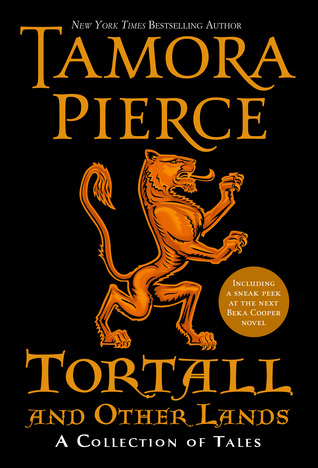
Tortall and Other Lands: A Collection of Tales by Tamora Pierce

My journey through Tortall continues! For the uninitiated, Tortall is the fantasy kingdom created by Tamora Pierce and explored through her terrific series, all of which focus on strong, determined young women who find a way to make their own mark in the world. I’ve been reading my way through Pierce’s Tortall books since the middle of last year, and now find myself approaching the end. *sniff*

Continuing onward by publication date, I now come to Tortall and Other Lands, a collection of stories set in and around Tortall. Actually, most are “around” rather than “in”, but that’s okay. In this set of eleven stories, we explore different times and places related to the world Pierce created in the Tortall books — and also get to read two contemporary stories, which really surprised me. More on that later.

Most of the stories in this collection have been published in other anthologies, with publication dates from 1986 up to 2011. I ended up listening to the audiobook, which was fun. The audiobook has different narrators for each story, with the final story read by Tamora Pierce herself, always a treat.

So what’s inside? Here’s a little overview of the stories in Tortall and Other Lands:

Student of Ostriches: A girl from a desert tribe learns to become a warrior by observing the animals in the wilderness surrounding her village and emulating their fighting styles. While the characters and places in this story are new, there’s an appearance by a Shang warrior, which is a nice connection to the Song of the Lioness books.

Elder Brother: A strange but moving story that connects to the Immortals books. This story shows the aftermath of a particular spell cast in The Immortals, and what happens to the unintended victim of that spell — a tree who is forced to become human.

The Hidden Girl: The Hidden Girl connects with Elder Brother, following up on the events in that story by showing what happens next to a girl located in the same strictly religious community, as she and her father begin to work against the traditions that keep women apart and uneducated.

Nawat: Weirdly enough, I really liked this story, even though it relates to my least favorite books in the Tortall universe, Trickster’s Choice and Trickster’s Queen. In those, a human girl falls in love with a crow-turned-man (weird, I know). Here, we find out what happens after the HEA. Nawat is the crow/man, whose human wife has now given birth to triplets. Nawat has to figure out how to be a father, how to remain connected to his crow flock, and when he must go against the crow way for the sake of his wife and babies. I didn’t expect to care all that much — but I really, really did.

The Dragon’s Tale: Oh, I loved this story! The dragon in The Dragon’s Tale is Kitten, the baby dragon (now more like an adolescent dragon) adopted by Daine and Numair in the Immortals series. Here, Kitten has accompanied her humans to travel through the land of Carthak, visiting different towns and villages with the Carthaki emperor, getting to know the locals and studying the magic they encounter. Because Kitten is bored, she sets out on her own to explore, and ends up discovering a woman with secrets and much, much more. It’s so much fun to see the world through Kitten’s eyes, and extra enjoyable because Daine and Numair feature in the story.

Lost: In the Aly books (the Trickster books, mentioned earlier), the most unusual of Aly’s spies and helpers are the Darkings, small creatures who are more or less animated inkblots that can connect telepathically with each other, change shape, grow and shrink at will, and act as sources of information and assistance to the people they interact with. They’re also awfully darn cute, and their voices in the audiobooks are adorable. Lost, in this story, is a darking who befriends a lonely young woman, Adria. Adria has a brilliant mind for mathematics, but she’s bullied by her father and demeaned by a new teacher. When she meets Lost, new worlds open up to her, including the chance to meet and study with an unusual woman working as an engineer in her town.

Time of Proving: A relatively short work, Again, a young woman meets an unusual creature and finds the door opening on a fresh new adventure.

Plain Magic: A girl whose village is ready to sacrifice her to a dragon, and the outsider who provides a new way of thinking about both dragons and girls.

Mimic: Ah, another really fun one! A girl who guards the sheep flocks of her village finds a strange injured reptile and nurses it back to health, against her family’s wishes. As the creature — called Mimic — grows, it exhibits all sorts of talents and magical gifts, and turns into something very unexpected.

Huntress: A mystical story set in contemporary New York — what a change of pace for a Tamora Pierce tale! In Huntress, a girl descended from a family of goddess-worshipping women gets the opportunity to attend a prestigious private school on scholarship. What she thinks is acceptance into an elite group of athletes becomes an initiation rite where she ends up at the mercy of a pack intent on hunting her. The story is entertaining, although it feels like it could be something out of Buffy or Charmed or any of a handful of other teen-centric supernatural tales. Still, a good listen/read.

Testing: The only non-fantasy story in the collection, Testing is the story of girls living in a group home, who manage to scare away every new housemother assigned to them — until finally one comes along who seems to be able to withstand the girls’ need to test her. On the audiobook, this story is read by Tamora Pierce, and there’s an introduction in which she talks about her own time working as a housemother in a group home. Really interesting — this is a good story, although it’s weird to read a Pierce story without the slightest shred of magic in it!

Tortall and Other Lands is a great read for fans of Tamora Pierce’s Tortall works. I think many of these stories would work on their own as well, for readers who aren’t familiar with Tortall… but if you want a taste of Tamora Pierce, I’d strongly suggest starting with the Song of the Lioness books. And if those grab you, keep going!

_________________________________________

The details:

Title: Tortall and Other Lands: A Collection of Tales
Author: Tamora Pierce
Publisher: Random House
Publication date: February 22, 2011
Length: 369 pages
Genre: Fantasy
Source: Purchased

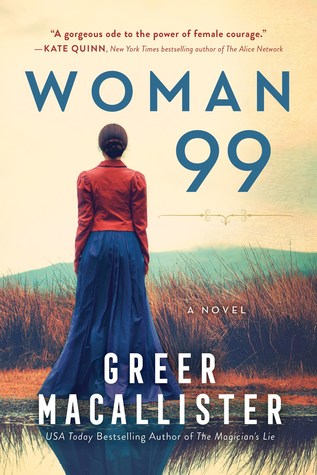
Book Review: Woman 99 by Greer Macallister

She’s only a number now.

When Charlotte Smith’s wealthy parents commit her beloved sister Phoebe to the infamous Goldengrove Asylum, Charlotte knows there’s more to the story than madness. She risks everything and follows her sister inside, surrendering her real identity as a privileged young lady of San Francisco society to become a nameless inmate, Woman 99.

The longer she stays, the more she realizes that many of the women of Goldengrove aren’t insane, merely inconvenient — and that her search for the truth threatens to dig up secrets that some very powerful people would do anything to kep.

A historical thriller rich in detail, deception, and revelation, Woman 99 honors the fierce women of the past, born into a world that denied them power but underestimated their strength.

What a read! In Woman 99, we first meet Charlotte Smith as the pampered daughter of a social-climbing family living in 1880s San Francisco. Daughters are trained from childhood in etiquette and comportment so they can eventually serve their purpose — helping their families climb higher through an advantageous marriage. Charlotte is proper and well-behaved and subservient to her mother’s wishes…

That was what all my education had been leading to. All the lessons and lectures. We were trained into ideal wives. Daughters were assets to be traded, like indigo, like hemp.

… but Charlotte’s sister Phoebe, according to their mother, is “unmarriageable”, the family disgrace.

While the term may not have been in use at the time, from the descriptions of Phoebe, she’s clearly bipolar. She has manic episodes, full of outrageous social behavior and flights of artistic fancy, then periods of dark depression during which she’s barely functional. In between the extremes, she has periods of near “normalcy”, and no matter what, Charlotte is devoted to her older sister, whom she loves with all her heart.

When Phoebe finally goes too far (and it’s not until later that we learn what this episode was about), she’s committed to Goldengrove, the Napa Valley asylum owned by the wealthy neighbors of the Smith family. Known as a “Progressive Home for the Curable Insane”, Goldengrove is promoted through glossy brochures and the social cachet of the Sidwell family. Still, Charlotte is terrified for Phoebe and her loss of freedom, and is determined to find a way to rescue her.

Charlotte concocts a scheme to get admitted to Goldengrove under an assumed identity, anticipating that she’ll quickly find Phoebe, announce who she is and that they’re going home, and that will be that. Needless to say, things don’t go as planned. Charlotte is unprepared for the emotional and physical trials of being institutionalized, and is horrified to discover that finding Phoebe and getting back out again will not be as simple as she planned. Meanwhile, as Charlotte spends weeks in the asylum, she gets to know the other women of her ward, and learns some shocking truths — the advanced treatment methods that Goldengrove is so well known for have been replaced by cruelty and starvation, and many of the women there are perfectly sane… just problematic for their families or husbands or society in general.

It had claimed to be a place of healing, but instead, it had been a convenient holding place for inconvenient women, serving only the people outside it, never the ones within.

Woman 99 is powerful, upsetting, and incredibly descriptive, showing us through Charlotte’s struggles the restricted roles available to women, the way certain women could be so easily discarded by society, and the shocking lack of value a woman was deemed to have if she dared step outside society’s norms. It’s not at all surprising to see how terrible the conditions inside Goldengrove are. Treatment of mental health at the time varied widely from physician to physician and asylum to asylum, and while some of the treatment concepts may seem worthwhile, such as outdoor hikes or music, there are also terrible methods such as a “water cure” and restraints and isolation, not to mention rumors of women having their teeth removed because poor dental health was considered linked to madness.

Over the course of the book, I really came to care about Charlotte, and appreciated how much she risks for her sister and the other women she meets inside Goldengrove. Charlotte’s initial act of rebellion is spurred on by her love for her sister, but she really has no idea what she’s getting herself into or how much danger she’ll be in. She gains strength and determination through her ideal, and emerges as a woman who’s no longer willing to meekly accept her mother’s plans for her future.

I highly recommend Woman 99. It’s a terrific, inspiring, moving read. And hey, bonus points for the San Francisco setting!

_________________________________________

The details:

Title: Woman 99
Author: Greer Macallister
Publisher: Sourcebooks Landmark
Publication date: March 5, 2019
Length: 368 pages
Genre: Historical fiction
Source: Review copy courtesy of the publisher via NetGalley

Put this on your nightstand: Gmorning, Gnight! by Lin-Manuel Miranda, illustrated by Jonny Sun

From the creator and star of Hamilton, with beautiful illustrations by Jonny Sun, comes a book of affirmations to inspire readers at the beginning and end of each day.

Good morning. Do NOT get stuck in the comments section of life today. Make, do, create the things. Let others tussle it out. Vamos!

Before he inspired the world with Hamilton and was catapulted to international fame, Lin-Manuel Miranda was inspiring his Twitter followers with words of encouragement at the beginning and end of each day. He wrote these original sayings, aphorisms, and poetry for himself as much as for others. But as Miranda’s audience grew, these messages took on a life on their own. Now, at the request of countless fans, Miranda has gathered the best of his daily greetings into a beautiful collection illustrated by acclaimed artist (and fellow Twitter favorite) Jonny Sun. Full of comfort and motivation, Gmorning, Gnight! is a touchstone for anyone looking for a lift.

Sometimes it’s nice to give yourself a little treat… and so I did! I bought myself a copy of Gmorning, Gnight! a few months ago, and finally cracked the cover and started reading it.

And was totally charmed.

Lin-Manuel Miranda’s introduction explains the genesis of this sweet book:

I’m really quite hooked on the Twitter,
They should take my phone out and lock it.
The biggest distraction for someone like me?
An audience up in my pocket.

So I start the day with a greeting.
And end with a night variation.
It safeguards my evenings and weekends at home,
To sign off, a mini-vacation.

Each double-page spread features a good morning wish and a corresponding good night wish. Sometimes these are variations on the same thing, sometimes they’re basically the same with only a few words tweaked for getting up and going to bed.

The simple black-and-white line drawings highlight each set of wishes and adds a little visual treat to go with the words.

This is a fun, sweet book with a positive message throughout. It feels like it would be too much if read straight through. That’s why I consider this a great nightstand book. Leave it handy for a few weeks, pick it up and read one or two pages at a time, or maybe just grab it and open at random when you need a little pick-me-up.

I got a bit of a Shel Silverstein vibe from the layout and presentation — the line drawings, the simple rhymes, the overall cheery, you-can-do-it attitude.

Really, this book is just full of smiles waiting to happen, and it would make a great feel-good gift (for yourself, or for someone else!)

Save

_________________________________________

The details:

Title: Gmorning, Gnight! Little Pep Talks for Me & You
Author: Lin-Manuel Miranda
Illustrator: Jonny Sun
Publisher: Random House
Publication date: October 16, 2018
Length: 207 pages
Genre: Advice/Affirmations
Source: PurchasedSave

Save

Save

Save