The Monday Check-In ~ 1/20/2020

cooltext1850356879 My Monday tradition, including a look back and a look ahead — what I read last week, what new books came my way, and what books are keeping me busy right now. Plus a smattering of other stuff too.

Life.

I’ve been home recovering from my minor medical procedure, and I can’t say that being stuck home with piles of books is too awful a way to spend a week! I did end up “working from home” about half the time, since work emails and work crises wait for no woman, apparently. Still, I was able to rest, stay cozy, and read, read, read quite a bit, and I’m feeling good!

Back to work this week. Sigh.

What did I read during the last week?

Such a Fun Age by Kiley Reid: Thought-provoking and engaging. My review is here.

The Toll by Neal Shusterman: The final book in the Arc of a Scythe trilogy. My review is here.

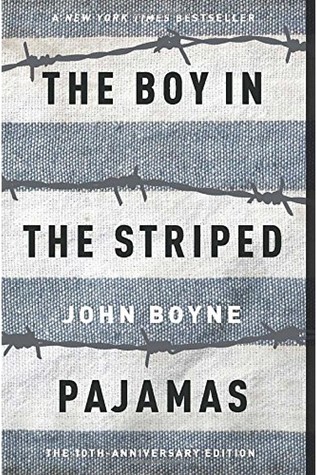
The Boy in the Striped Pajamas by John Boyne: I’d love to hear thoughts from anyone who’s read this book. My review is here.

The Vanished Birds by Simon Jimenez: Surprisingly beautiful science fiction. My review is here.

Pop culture:

What I’m watching:

Grace & Frankie is back! Season 6 dropped this week, and while I haven’t made it through all the episodes quite yet, I’m loving hanging out with these amazing women once again.

Reading a couple of excellent posts from Megabunny Reads recently reminded me that I’d been meaning to give Anne with an E a try. I’ve just watched the first episode, and loved it! I’ll definitely be continuing.

And on HBO, I’ve watched the creepy first episode of The Outsider. I loved the (highly disturbing) book, and have high hopes for this adaptation!

Fresh Catch:

I mean, yes, I still have two books in the series to read before I’ll be ready for Persepolis Rising (The Expanse, #7)… but my Amazon fingers got itchy and I couldn’t help myself.

And, as per usual, three of my library requests came in all at once. Which to read first?

General reading plans:

Despite my best intentions, I find myself suddenly buried in ARCs! I have 22 ARCs for books coming out between February – May, with a whopping 12 in March alone! I try my best to read and review ARCs around their release dates, but this feels really daunting and challenging at the moment.

I’m thinking I’ll try to space these out, starting now, by reading at least one ARC per week. I’ve never scheduled reviews before, but I think I’m going to have to make an attempt to write reviews as I go along and then hold them for posting until the release date is closer.

I know most publishers prefer that reviews not be posted more than two weeks before a book’s publication date. I’m curious how others handle this: Do you stick to the two-week rule, and if so, do you find yourself scheduling reviews and/or writing them in advance and then holding them for a later date to post?

If I don’t find myself a system, I’m going to end up really frustrated, really quickly. And I swore I would focus more on reading what I feel like this year, versus going by a schedule.

What will I be reading during the coming week?

Currently in my hands:

The Beekeeper of Aleppo by Christy Lefteri: My book group book for January! Racing to finish before discussion starts this week.

Now playing via audiobook:

The Book of Dust (La Belle Sauvage) by Philip Pullman: I’m picking this back up after a couple of weeks without audiobooks. It’s nice to be back!

Ongoing reads:

Tortilla Flat by John Steinbeck: My book group’s classic read! We’re reading and discussing two chapters per week. Getting close to the end!

So many books, so little time…

boy1

Book Review: The Vanished Birds by Simon Jimenez

Title: The Vanished Birds
Author: Simon Jimenez
Publisher: Del Rey Books
Publication date: January 14, 2020
Length: 400 pages
Genre: Science fiction
Source: Review copy courtesy of the publisher via NetGalley

Rating: 4 out of 5.

A mysterious child lands in the care of a solitary woman, changing both of their lives forever in this captivating debut of connection across space and time.

“This is when your life begins.”

Nia Imani is a woman out of place and outside of time. Decades of travel through the stars are condensed into mere months for her, though the years continue to march steadily onward for everyone she has ever known. Her friends and lovers have aged past her; all she has left is work. Alone and adrift, she lives only for the next paycheck, until the day she meets a mysterious boy, fallen from the sky.

A boy, broken by his past.

The scarred child does not speak, his only form of communication the beautiful and haunting music he plays on an old wooden flute. Captured by his songs and their strange, immediate connection, Nia decides to take the boy in. And over years of starlit travel, these two outsiders discover in each other the things they lack. For him, a home, a place of love and safety. For her, an anchor to the world outside of herself.

For both of them, a family.

But Nia is not the only one who wants the boy. The past hungers for him, and when it catches up, it threatens to tear this makeshift family apart. 

The Vanished Birds is both lovely and perplexing, a science fiction story about space travel and corporate domination that’s also a deeply personal story about love, identity, and home.

The book opens on what we come to learn is a Resource World owned by the ubiquitous Umbai corporation. At first glance, we’ve arrived in a rural, agricultural community that seems quaint and unsophisticated. The people of the village work in the dhuba fields; their crop is collected once every 15 years by the space travelling ships that carry out trade across the galaxy.

A boy in the village, Kaeda, is seven years old when he sees the ships arrive for the first time, and he’s immediately captivated by their beauty as well as by the mysterious allure of Nia Imani, the ship’s captain.

The trick here, though, is that ships travel through Pocket Space, secret folds through time that allow them to travel faster than the time passing on the planets. The fifteen years in between visits to Kaeda’s world take only eight months on Nia’s ship. The beautiful first chapter of The Vanished Birds traces the strange relationship between Kaeda and Nia, as each of her visits reintroduces her to Kaeda at a different point in his life, from boyhood to youth to adult to elder.

Later, a strange boy arrives in Kaeda’s world, seemingly out of nowhere. Mute, naked, and scarred, he’s taken in by Kaeda, but because it’s clear that he’s from elsewhere, he’s then given into Nia’s care.

The story shifts to Nia and her crew as they travel with the boy, trying to unravel his secrets and keep him safe. From here, the plot expands outward. We meet Fumiko Nakajima, the brilliant scientist who leaves behind her strange upbringing on a dying Earth to become the creator of the interplanetary systems of travel that fuel the next thousand years. And we learn more about the end of Earth, the expansion of Umbai and their tight control, and the different concepts of space travel.

But what really is essential here is the language and the people. The writing in The Vanished Birds is almost poetic at times, filled with unusual imagery and looping writing. The characters are complex, as are their relationships with time and memory.

While we see the unspeakable cruelty of Umbai and the degradation of the lives considered lesser, the exploitation of the Resource Worlds, and the easy dismissal of the value of life, most of science fiction elements are in soft focus. We learn about the methods of travel, the research institutes and their obscene experimentation, but very little of it is explained in great detail. This book is less hard science fiction and much more a meditation on the meaning of it all.

While beautifully written, at times The Vanished Birds frustrated me, as I do tend to gravitate toward a more literal science fiction approach, and occasionally wanted more straight-forward answers and explanations.

Still, this book overall is an unusual and emotionally powerful read. I think it’ll be on my mind for quite some time, from the almost folkloric beginning to the tragic but inevitable end.

Highly recommended.

For more on The Vanished Birds, check out:

Review – The Captain’s Quarters
The Big Idea – from John Scalzi’s Whatever blog
Review – AV Club
Review – Locus Magazine
Review – Tor.com

Book Review: The Boy in the Striped Pajamas by John Boyne

Title: The Boy in the Striped Pajamas
Author: John Boyne
Publisher: David Fickling Books
Publication date: 2006
Length: 215 pages
Genre: Middle grade fiction
Source: Purchased

Rating: 3 out of 5.

Berlin, 1942: When Bruno returns home from school one day, he discovers that his belongings are being packed in crates. His father has received a promotion and the family must move to a new house far, far away, where there is no one to play with and nothing to do. A tall fence stretches as far as the eye can see and cuts him off from the strange people in the distance.

But Bruno longs to be an explorer and decides that there must be more to this desolate new place than meets the eye. While exploring his new environment, he meets another boy whose life and circumstances are very different from his own, and their meeting results in a friendship that has devastating consequences.

Oh, I have such mixed feelings about this book!

Published in 2006, the book originally came with all sorts of disclaimers urging people not to give away the story, but to allow all readers to experience this book without knowing what it was about. All these years later, the subject matter is no longer a secret: This is Holocaust fiction, telling the story of two young boys who meet through the fence at Auschwitz, and despite their vastly different circumstances, form a deep friendship.

We see the story unfold through 9-year-old Bruno’s eyes. Bruno’s father is a rising Nazi officer, favored by Hitler himself (whose name Bruno hears as “the Fury” rather than “the Fuhrer”). The father is promoted to Kommandant of Auschwitz, and when we first meet Bruno, he’s expressing his unhappiness at having his happy life in Berlin uprooted, as the family will be moving because of his father’s new job.

Bruno is remarkabley clueless (more on that later). They arrive at their new home, which is nowhere near as grand as his house in Berlin. There’s nothing to do, and no one to play with. From the upstairs window, Bruno has a view of strange people on the other side of a barbed wire fence, all wearing striped pajamas. He wonders who these people are and what they’re doing, and even feels some envy at what appears to be a large group of people who are all together while he is so very alone.

As Bruno goes exploring along the forbidden fence, he finds a strange boy sitting near it on the other side, a skinny, gray-faced boy wearing the striped pajamas. They start to talk, and Bruno and Shmuel begin to get to know one another. Soon, Bruno considers Shmuel his best friend, although he’s frustrated that they can never play together, and somehow knows enough never to mention Shmuel in his house.

On its surface, The Boy in the Striped Pajamas is a moving story. And yet, I can understand why it was controversial upon its release.

For starters, there are some story issues that make the book hard to digest. Bruno is 9 years old and lived in the heart of Berlin, in a house led by a Nazi officer and where soldiers and other important people constantly come and go… and yet he appears to never have heard of Jews until his sister tells him, much later, that that’s who those people on the other side of the fence are.

And why are there so many children at Auschwitz, when we know that the majority would have been murdered upon arrival? How is Shmuel able to sneak away for hours, day after day, with no one noticing?

And is Bruno’s language mix-ups (such as “the Fury” and his belief that they live at “Out-With”) supposed to be cute? Frankly, he presents as much younger than nine.

In the book’s favor, the title page clearly calls this story “a fable”. No, these are not historical events. No, this depiction of life at Auschwitz isn’t meant to be historically accurate.

And yet, what’s concerning is that apparently this book is often used in schools as an introduction to Holocaust fiction. In fact, the back of my paperback edition includes a blurb from USA Today that calls this book “as memorable an introduction to the subject as The Diary of Anne Frank”.

Um, no. That comparison is absurd. And it disturbs me to think that there are students whose first encounter with the horrors of Auschwitz might be through this “fable”, where nothing seems all that terrible at first, where the nightmarish reality is presented as a distant curiosity, and where a reader who doesn’t know the factual history might not even get what was going on.

As a companion book, or a different lens on known events, sure, this would be effective. But as the sole introduction, it’s sorely lacking in context and facts, and I’m afraid that the melodrama and Bruno’s limited worldview are pretty close to sugar-coating.

Now, I’ll add that I haven’t seen the movie, so I can’t comment on whether that version is more or less effective at conveying the full picture of Auschwitz. I actually picked up this book this week because my son saw the movie at school and came home to tell me how good it was. I think I should give it a chance, and see if I feel any differently about the story afterward.

I was eager to read this book not only because of my son’s recommendation, but because I just recently read my very first book by John Boyne, The Heart’s Invisible Furies, and thought it was brilliant.

As I was reading The Boy in the Striped Pajamas, I just couldn’t stop and ended up reading it straight through. It was only once I’d closed the covers and stopped to think that the various elements above started to bother me.

I’d be really curious to hear from others who’ve read this book and see if our responses and reactions are at all aligned.

Meanwhile, I’ve been looking up reviews from when the book was published, and have found more than a few pieces that discuss why this book had such a mixed and controversial response:

(Note: Some of these links may contain spoilers. Proceed with caution!)

Review – New York Times
Review – Jewish Book Council
Analysis – Holocaust Exhibition & Learning Centre
Movie review – Time Magazine
Book Review – Aish.com

Book Review: The Toll (Arc of a Scythe, #3) by Neal Shusterman

Title: The Toll (Arc of a Scythe, #3)
Author: Neal Shusterman
Publisher: Simon & Schuster Books for Young Readers
Publication date: November 5, 2019
Length: 625 pages
Genre: Young adult fiction
Source: Purchased
Rating:

Rating: 3.5 out of 5.

It’s been three years since Rowan and Citra disappeared; since Scythe Goddard came into power; since the Thunderhead closed itself off to everyone but Grayson Tolliver.

In this pulse-pounding conclusion to New York Times bestselling author Neal Shusterman’s Arc of a Scythe trilogy, constitutions are tested and old friends are brought back from the dead.


The Toll wraps up the futuristic story begun in 2016’s Scythe and continued in 2018’s Thunderhead. In these books, author Neal Shusterman presents a post-mortal world, where an all-knowing AI has become sentient and has solved all of the world’s problems, from starvation to disease to crime to poverty. Humankind is essentially immortal.

To preserve the fine balance of resources and needs, the only authority left in the world is the scythedom — people given the authority and responsibility to “glean” a certain percentage of the world’s population in order to make sure that the perfect world can continue to support everyone who’s left. And it works, for the most part… except that it’s still true that absolute power corrupts absolutely, and there are those among the scythedom who revel in their own power and the thrill of the kill, rather than seeing themselves as servants of the greater good.

In The Toll, the world is, basically, going to hell in a handbasket. The reasonable and responsible old-guard scythes have mostly all been eliminated, and the most corrupt and power-hungry scythe of all has taken over, with the goal of nothing less than world domination.

In this scary world, there are still scythes on the fringes, working to evade or undermine this new order, as well as a group hand-picked by the Thunderhead to create a mysterious settlement in an unknown tropical location. Meanwhile, the oddball religious cult known as Tonists have a new prophet, and their popularity and power seems to be on the rise as well.

At 625 pages, The Toll is longer than either of the preceding books, and while I get that there’s a lot to wrap up, it’s also overstuffed and often meandering. What I really loved about Scythe, in addition to the fascinating world created in its pages, are the characters and their moral dilemmas, as well as their personalities and their relationships.

Much of that is sacrificed in The Toll for the sake of plot, plot, and more plot. We spend very little time with the young heroes from the previous two books. Instead, the cast of characters is even broader than before, and we jump around the globe constantly. On the one hand, it’s pretty remarkable how the author keeps so many plot strands in play and connected; on the other hand, this book feels much less personal and much more action-driven.

Also, for a YA trilogy, this final installment spends a lot more time with its adult characters than with its younger, teen/young adult people, which is perhaps an odd choice.

Did I enjoy The Toll? Yes, for the most part. I’m actually quite satisfied with the wrap-up to the trilogy and the clever solutions and outcomes. However… there were lots of moments within the book where the length just made me downright tired. I think a lot could have been trimmed, and I would have preferred a more intimate scale rather than trying to encompass the entire world.

Still, the trilogy as a whole is mesmerizing, presenting a flawed utopia and showing how a society can only be as perfect as its most imperfect members. I loved the concept and the world-building, and have no hesitation about recommending these books.

And now, for those who have already read the books, here are my lingering questions and quibbles.

WARNING: HERE BE SPOILERS!

Just a few of the little fiddly bits that continue to bug me after reading the book:

  • The Thunderhead is not able to break the laws that govern its interactions. Who created those laws?
  • Did the founding scythes program the Thunderhead so it would have no contact with the scythedom? Or did the Thunderhead institute the scythedom and then create the separation itself?
  • How did the founding scythes first form and settle upon their purpose? Again, were they created by the Thunderhead?
  • We only know that the Thunderhead can’t break the law because it repeatedly says so. Can the Thunderhead change its own programming? Could someone else change it?
  • How did the founding scythes create the scythe diamonds in the first place? We know that scythe technology is way behind what the Thunderhead can do, and that without the Thunderhead, technology just isn’t particularly reliable.
  • Why wouldn’t people rise up in protest against the scythes and their mass gleanings long before the events in The Toll?

Okay, those are just my initial random thoughts and questions immediately after finishing the book. If you’ve read these and have thoughts on any of these (or anything else related to the story!), please add your comments!

Shelf Control #200: Still Life by Louise Penny

Shelves final

Welcome to Shelf Control — an original feature created and hosted by Bookshelf Fantasies.

Shelf Control is a weekly celebration of the unread books on our shelves. Pick a book you own but haven’t read, write a post about it (suggestions: include what it’s about, why you want to read it, and when you got it), and link up! For more info on what Shelf Control is all about, check out my introductory post, here.

Want to join in? Shelf Control posts go up every Wednesday. See the guidelines at the bottom of the post, and jump on board!

cropped-flourish-31609_1280-e1421474289435.png

Title: Still Life (Chief Inspector Gamache, #1)
Author: Louise Penny
Published: 2005
Length: 321 pages

What it’s about (synopsis via Goodreads):

As the early morning mist clears on Thanksgiving Sunday, the homes of Three Pines come to life – all except one…

To locals, the village is a safe haven. So they are bewildered when a well-loved member of the community is found lying dead in the maple woods. Surely it was an accident – a hunter’s arrow gone astray. Who could want Jane Neal dead?

In a long and distinguished career with the Sûreté du Quebec, Chief Inspector Armand Gamache has learned to look for snakes in Eden. Gamache knows something dark is lurking behind the white picket fences, and if he watches closely enough, Three Pines will begin to give up its secrets…

How and when I got it:

Picked up at a library book sale, sometime within the last few years.

Why I want to read it:

Talk about being late to the party. EVERYONE seems to love this series, and I can’t even tell you how many people have pushed this book on me over the years. And while I’m not a huge mystery fan, the small-town, remote setting absolutely appeals to me, and I’ve heard nothing but good things. In fact, the main reason I still haven’t started this book is the fact that the series is up to 15 books so far! I’m afraid that I’ll like it TOO much, will want to continue, and will end up with a new obsession. Call me crazy. I know I’m missing out, and just have to convince myself to dive in!

What do you think? Have you read this book? Have you read the whole series? And if I start, will I be able to stop?

Please share your thoughts!

__________________________________

Want to participate in Shelf Control? Here’s how:

  • Write a blog post about a book that you own that you haven’t read yet.
  • Add your link in the comments!
  • If you’d be so kind, I’d appreciate a link back from your own post.
  • Check out other posts, and…

Have fun!

Book Review: Such a Fun Age by Kiley Reid

Title: Such a Fun Age
Author: Kiley Reid
Publisher: G. P. Putnam’s Sons
Publication date: December 31, 2019
Length: 320 pages
Genre: Contemporary fiction
Source: Review copy courtesy of the publisher via NetGalley
Rating:

Rating: 4 out of 5.

A striking and surprising debut novel from an exhilarating new voice, Such a Fun Age is a page-turning and big-hearted story about race and privilege, set around a young black babysitter, her well-intentioned employer, and a surprising connection that threatens to undo them both.

Alix Chamberlain is a woman who gets what she wants and has made a living showing other women how to do the same. A mother to two small girls, she started out as a blogger and has quickly built herself into a confidence-driven brand. So she is shocked when her babysitter, Emira Tucker, is confronted while watching the Chamberlains’ toddler one night. Seeing a young black woman out late with a white child, a security guard at their local high-end supermarket accuses Emira of kidnapping two-year-old Briar. A small crowd gathers, a bystander films everything, and Emira is furious and humiliated. Alix resolves to make it right.

But Emira herself is aimless, broke, and wary of Alix’s desire to help. At twenty-five, she is about to lose her health insurance and has no idea what to do with her life. When the video of Emira unearths someone from Alix’s past, both women find themselves on a crash course that will upend everything they think they know about themselves, and each other.

With empathy and piercing social commentary, Such a Fun Age explores the stickiness of transactional relationships, what it means to make someone “family,” the complicated reality of being a grown up, and the consequences of doing the right thing for the wrong reason.

Such a Fun Age? Such a good book!

I’ve been seeing glowing reviews for this book on all sorts of book blogs over the last few weeks, and the hype has only intensified now that Such a Fun Age has been chosen as the newest Reese Witherspoon book club pick.

Debut author Kiley Reid highlights a complex web of issues surrounding race, income inequality, social power, and more in this intriguing look at the intersections of family and privilege.

25-year-old Emira is a college grad who’s at loose ends, never having found her passion or true calling. She makes ends meet — barely — by working as a part-time typist and babysitting three days per week for a precious little almost-three-year-old named Briar.

Briar’s parents, Alix and Peter, are recent transplants from New York to Philadelphia. Alix is a social media influencer who has somehow parlayed her talent for getting corporations to send her free stuff in exchange for media coverage into a career as an inspirational speaker and advocate for women’s voices. She lives for the attention and perceived power, loves the image of herself as an influential, visionary women’s leader, and doesn’t particularly have the attention or patience for a small child.

Alix and Peter are white and affluent; Emira is African American and living payday to payday, relying on her more successful friends’ generosity and worrying about her upcoming 26th birthday when she’ll lose her health insurance coverage as her parents’ dependent.

Emira and Briar have an amazing bond. It’s not that Emira loves kids — she just gets Briar and adores her, and the feeling is mutual.

The action starts as Emira is out partying with friends and gets a frantic call from Alix. There’s an emergency at the house, and they need Emira to come take Briar out for a bit. Yes, it’s 10 pm, but this is truly urgent. Emira agrees, and takes Briar to a favorite location, the snooty upper-class (and very white) neighborhood market, where Briar loves to look at the bins of nuts and teas.

Things go wrong, and quickly. Another shopper is suspicious of the young black girl in the party dress toting around a small blonde child. Security intervenes, and things get ugly, and the incident is captured on video by a do-gooder bystander. The incident is awful and upsetting, and Emira just wants to put it behind her once it’s over.

At the same time, Alix develops an odd fascination with Emira, who is unfailingly polite but not particularly interested in Alix. Alix sees herself in a saviour role, wanting to help Emira, bond with her, enrich her life, and become her bestie. She’d love to convince herself and all her friends that Emira is part of the family. But why this growing obsession? What’s behind her need to know and be involved?

As the story progresses, things get more and more complicated. The point of view shifts between Alix and Emira, so we get very different reads on the same situations. And when an unexpected connection between Alix and Emira’s new boyfriend is revealed, complication escalate even further.

It’s a fascinating story. The characters are multi-faceted and often surprising. Honestly, it’s really difficult to like Alix even a little bit, even understanding some of the pain and difficulty in her background. Emira’s boyfriend Kelley also has issues, and despite seeming like a mostly stand-up guy, there are certainly some questions about his interpretation of events, his motivations, and his choices.

Emira is very much a woman of the times, 20-something, economically unsteady, wanting more but not sure what or how to move forward, torn between practicality, her own interests, and what everyone else seems to think is best for her.

The author captures so much about the chasms in today’s society in terms of race and social status and affluence. She shows the privilege that pervades self-identified liberals’ attitudes and the (perhaps) unwitting arrogance that makes a person of wealth and influence feel that they know how best to help someone with less.

I loved the writing and the zippy dialogue, as well as the plot that races through the story without short-changing the characters and their conflicts. It’s fascinating to see how different characters’ memories and interpretations of the same events can be so wildly different.

I’m not surprised to see this book being picked up as a book group choice both by mega-star clubs like Reese’s and by casual groups too. In fact, that’s my one complaint — where’s a book group when I need it?

It’s maddening to have no one to talk about this book with. There’s so much to discuss and pull apart and argue over! This is a book that I’ll definitely be pushing into the hands of as many of my bookish friends as possible.

Top Ten Tuesday: New-to-Me Authors I Read In 2019

snowy10

Top Ten Tuesday is a meme hosted by That Artsy Reader Girl, featuring a different top 10 theme each week. This week’s topic is Bookish Discoveries I Made In 2019. For this week’s list, I thought I’d use a favorite annual topic, focusing on new-to-me authors I had the pleasure of “discovering” during the past year.

Here are some of the great books I read in 2019 that are by authors I’d never read before:

1) John Boyne — Now that I’ve read The Heart’s Invisible Furies, I must read more of his work.

2) Craig DiLouie — I loved the two powerful and disturbing novels by this author that I read in 2019: One of Us and Our War.

3) L. M. Montgomery – I finally read the Anne of Green Gables series — all eight books! In this new year, I hope to read some of her other works as well.

4) Christina Henry – I loved The Girl in Red and The Mermaid. Now I need to read everything else she’s written.

5) Leigh Bardugo — I really enjoyed the complicated, creepy Ninth House. I’m not sure that I’m interested in reading her YA books, but I certainly want a sequel to Ninth House!

6) Theodora GossThe Thorn and the Blossom was beautiful, and I got a huge kick out of The Strange Case of the Alchemist’s Daughter. I’ll be continuing that series shortly, I hope.

7) Kelli EstesToday We Go Home is a powerful dual-timeline narrative focusing on women at war. Now that I’ve read it, I need to read her earlier novel which I missed when it was one of my book group’s picks. Talented writer!

8) T. KingfisherThe Twisted Ones was perfectly creepy (and has great humor and a great dog). I’ll be wanting to read more by this author too!

9) Alix E. Harrow — Her debut novel The Ten Thousand Doors of January was brilliant. Can’t wait to see what she does next!

10) Lindy West — I don’t read a lot of non-fiction, but I’m so glad I made time for Shrill. This author has a lot to say, and knows how to say it.

Are you a fan of any of these new-to-me authors? Are there any of their works that you’d particularly recommend?

What bookish discoveries did you make in 2019? Please share your TTT links!

Save

Save

Save

Save

The Monday Check-In ~ 1/13/2020

cooltext1850356879 My Monday tradition, including a look back and a look ahead — what I read last week, what new books came my way, and what books are keeping me busy right now. Plus a smattering of other stuff too.

Life.

Well, once again — and for completely different reasons — this was a surgery week for me! Weird, right? I’d been on a waiting list for an elective procedure for almost two years, and right at the end of December got a call that my doctor had a cancellation coming up, and did I want it? I said YES and didn’t allow myself to do any second-guessing… and here I am, almost a week post-procedure, feeling fine and taking some time off work to rest and heal.

And hey, we all know that “time off” to “rest and heal” really just equates to more time to read!

What did I read during the last week?

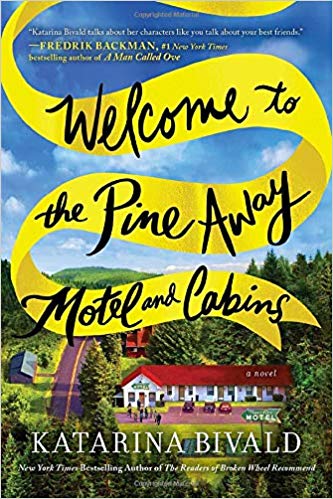
Welcome to the Pine Away Motel and Cabins by Katarina Bivald: Sad to say, I didn’t end up loving this slice-of-life novel, which was a big disappointment to me, since I loved the author’s first book. Ah well, can’t win ’em all! My review is here.

Cibola Burn by James S. A. Corey: Ooh boy, I went a little Expanse-crazy this week, finishing not only this massive book (#4 in the series), but also 4 shorter works and a graphic novel. My review of Cibola Burn is here. The other stuff I read:

And also this week, after my Expanse binge:

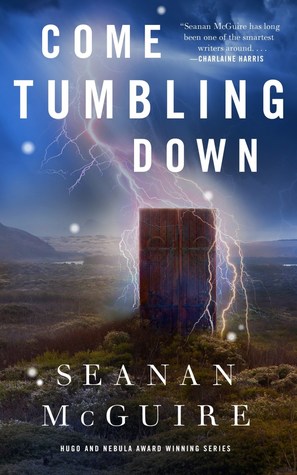
Come Tumbling Down by Seanan McGuire: The newest installment in the excellent Wayward Children series. I loved it! My review is here.

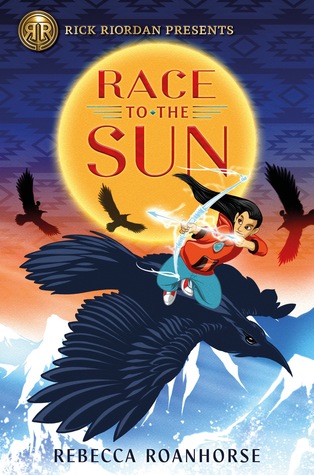
Race to the Sun by Rebecca Roanhorse: A fun middle grade adventure grounded in Navajo mythology. My review is here.

Pop culture:

Somewhat against my first instincts, I ended up watching The Witcher. After two episodes, I was convinced it was pure cheese, but then the story started growing on me, as did certain characters (especially Yennefer.) (And I’m kind of fascinated by the bard, too.) I’m on the fence about whether I actually recommend this show, but it did keep my interest. And I may even have to give the books a try. And yeah, I’m sure I’ll be back whenever season 2 comes around.

Oh, and in case you’re as obsessed with the bard’s song “Toss A Coin To Your Witcher” as the rest of the world seems to be, here’s a Twitter thread with versions of the song in twelve different languages: https://twitter.com/_lemonowa_/status/1210171703432765442

Fresh Catch:

One new book this week — Come Tumbling Down (above), already devoured! Yum yum.

What will I be reading during the coming week?

Currently in my hands:

Ooh, debating which of these two to start next!

They both sound great!

Now playing via audiobook:

The Book of Dust (La Belle Sauvage) by Philip Pullman: I just didn’t make much progress this week, considering I was out of commission for most of it. I’m hoping to get back into a daily walking routine this week, and if I do, it’ll be with this book plugged into my ears!

Ongoing reads:

Tortilla Flat by John Steinbeck: My book group’s classic read! We’re reading and discussing two chapters per week. Really a fun book!

So many books, so little time…

boy1

Book Review: Race to the Sun by Rebecca Roanhorse

Title: Race to the Sun
Author: Rebecca Roanhorse
Publisher: Disney Book Group / Rick Riordan Presents
Publication date: January 14, 2020
Length: 256 pages
Genre: Middle grade fiction
Source: Review copy courtesy of the publisher via NetGalley
Rating:

Rating: 4 out of 5.

Lately, seventh grader Nizhoni Begay has been able to detect monsters, like that man in the fancy suit who was in the bleachers at her basketball game. Turns out he’s Mr. Charles, her dad’s new boss at the oil and gas company, and he’s alarmingly interested in Nizhoni and her brother, Mac, their Navajo heritage, and the legend of the Hero Twins. Nizhoni knows he’s a threat, but her father won’t believe her.

When Dad disappears the next day, leaving behind a message that says “Run!”, the siblings and Nizhoni’s best friend, Davery, are thrust into a rescue mission that can only be accomplished with the help of Diné Holy People, all disguised as quirky characters. Their aid will come at a price: the kids must pass a series of trials in which it seems like nature itself is out to kill them. If Nizhoni, Mac, and Davery can reach the House of the Sun, they will be outfitted with what they need to defeat the ancient monsters Mr. Charles has unleashed. But it will take more than weapons for Nizhoni to become the hero she was destined to be . . .

Timeless themes such as the importance of family and respect for the land resonate in this funny, fast-paced, and exciting quest adventure set in the American Southwest. 

What fun! Race to the Sun is the middle grade children’s adventure novel that we absolutely needed!

Written by the talented Rebecca Roanhorse, Race to the Sun uses Navajo mythology in an epic quest full of danger and trials. Main characer Nizhoni, a 7th grader who wants to be special, finds herself able to sense monsters — a gift which becomes crucial when her father goes missing.

Accompanied by younger brother Mac and best friend Davery, these three tweens must navigate the American Southwest through landmarks both real and fantastical, facing down monsters and accepting assistance from legendary characters such as Spider Woman, Yellow Corn Girl, and the Sun himself.

Along the way, the children learn lessons about bravery, sacrifice, loyalty, and the importance of their roots and their connection to their people’s past.

(It’s also an understated but quite effective premise to have the bad guy being the head of an oil company that wants to exploit ancestral clan powers to help his frakking business!)

The adventure skips along quickly, with moments of scary breathlessness as well more humorous interludes and moments of sadness and loss. All are woven together into a quest story that never flags, throwing in unexpected twists and turns as well as moments of grace and insight.

Race to the Sun is part of Disney’s Rick Riordan Presents imprint, described on Rick Riordan’s website as:

Our goal is to publish great middle grade authors from underrepresented cultures and backgrounds, to let them tell their own stories inspired by the mythology and folklore of their own heritage. Over the years, I’ve gotten many questions from my fans about whether I might write about various world mythologies, but in most cases I knew I wasn’t the best person to write those books. Much better, I thought, to use my experience and my platform at Disney to put the spotlight on other great writers who are actually from those cultures and know the mythologies better than I do. Let them tell their own stories, and I would do whatever I could to help those books find a wide audience!

This is a fitting home for Race to the Sun, as I can see this book absolutely being a hit for kids who’ve read and loved the Percy Jackson books and are eager for more tales of heroes and legends and the ordinary kids who find hidden gifts inside themselves.

I also think it’s important that both Native and non-Native young readers have the opportunity to be exposed to mythologies beyond the Greek and Roman that are taught in school. Race to the Sun does this in an engaging, authentic way without ever making it feel like being force-fed something educational.

Highly recommended for middle grade readers and their parents, teachers, and anyone else who appreciates seeing well-written, engrossing stories with multicultural perspectives end up in the hands of excited readers!

Book Review: Come Tumbling Down (Wayward Children, #5) by Seanan McGuire

Title: Come Tumbling Down (Wayward Children, #5)
Author: Seanan McGuire
Publisher: Tor
Publication date: January 7, 2020
Length: 206 pages
Genre: Fantasy
Source: Purchased
Rating:

Rating: 5 out of 5.

The fifth installment in Seanan McGuire’s award-winning, bestselling Wayward Children series, Come Tumbling Down picks up the threads left dangling by Every Heart a Doorway and Down Among the Sticks and Bones

When Jack left Eleanor West’s School for Wayward Children she was carrying the body of her deliciously deranged sister–whom she had recently murdered in a fit of righteous justice–back to their home on the Moors.

But death in their adopted world isn’t always as permanent as it is here, and when Jack is herself carried back into the school, it becomes clear that something has happened to her. Something terrible. Something of which only the maddest of scientists could conceive. Something only her friends are equipped to help her overcome.

Eleanor West’s “No Quests” rule is about to be broken.

I adore Seanan McGuire. I adore everything she writes. I adore the Wayward Children series.

So is it any surprise when I say that I loved Come Tumbling Down?

In this, the 5th installment in what I hope will be a long, ongoing series of fantasy novellas, we return to the events of book #2, Down Among the Sticks and Bones, and finally find out what happened next.

Which, right off the bat, tickles me pink, because Down Among the Sticks and Bones is — no question about it — my favorite in the entire series. So I was thrilled to return to the world of the Moors, the war between mad scientists and vampires, and the struggle to resurrect and reanimate that which has been lost.

For those new to this series, the basic idea is this: Eleanor West runs a boarding school for children who’ve returned to their parents’ homes after an absence which has left them strange and unmanageable. What the parents don’t understand, but Eleanor West certainly does, is that these missing children found doors to other worlds — world of logic or nonsense, worlds of virtue or wickedness, and all sorts of points on the compass between extremes**. Whether kicked out or voluntarily returned, the children no longer fit in their mundane lives, but find solace and shelter with the other misfits like themselves at the home for wayward children.

In Down Among the Sticks and Bones, we learned about twins Jack and Jill and their time spent on the Moors. We pick up their story in Come Tumbling Down as one of the twins returns to the school – but which one?

Oh, I really don’t want to give anything away! This book, like all the others, is filled to the brim with fantasy and danger and challenges, but rooted deeply by its unique and memorable characters. There’s Sumi, a nonsense girl who knows her destiny lies in the world of Confection; Cora, a mermaid who longs to return to the sea; Kade, a Goblin prince who accepts that his chosen world may not choose him any longer; and Christopher, who dreams of life in the land of Mariposa with his true love, the Skeleton Girl.

When the missing twin returns and needs help with her life-or-death quest, the friends are quick to stand by her and venture through the door to the Moors, risking their own lives in an attempt to right the balance so crucial in that world.

As in all of the Wayward Children books, Seanan McGuire’s writing is lyrical and magical, infusing every moment with otherworldly flavors and fantastical elements, some menacing, some magical, some downright funny.

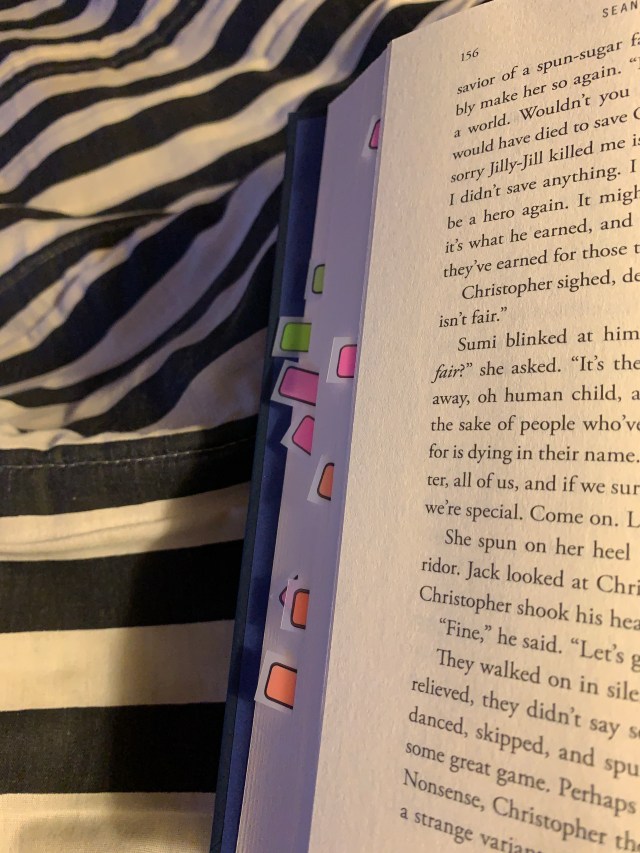
I’ll share some chosen selections here, although narrowing it down to just a few is hard. Here’s what my book looked like by the time I got close to the end:

 Sometimes Christopher thought any chance he’d had of falling for a girl with ordinary things like “skin” and “muscle tissue” and “a pulse” had ended with the soft, moist sound of Jack driving a pair of scisors through her sister’s horrible heart.

“My parents,” she said. “They were like Nancy’s but the other way around, chasing monochrome instead of spectrums. They didn’t understand. Thought if they threw enough gray and gray and gray at me, I’d forget I’d seen rainbows and learn how to be their little sparrow-girl again. She died in Confection and I rose from her ashes, a pretty pastry phoenix.

Sumi looked up and smiled serenely. “Look at the moon,” she said. “It’s like the sugared cherry on the biggest murder sundae in the whole world.”

Indoor lightning storms, resurrected girls, and giant, bloody moons were terrifying enough without throwing in headless corpses, vampire lords, and something called a “Drowned God.”

And another from Sumi, because she’s awesome and so are her sundae analogies:

“This is terrible,” said Sumi brightly. “I mean, we knew it was going to be terrible when we followed a mad scientist and her dead girlfriend to a horrifying murder world, but this is bonus terrible. This is the awful sprinkles on the sundae of doom.”

Ah, I’ll stop here. I loved this book, and I love this series wholeheartedly. Each of the books is lovely on its own, and Come Tumbling Down is a worthy, enthralling addition to the series.

Beautiful, haunting writing, a creep-tastic setting, mad scientists and Drowned Gods, and the bestest friends squad you’d ever want at your back. What more could we ask for?

A note of advice: If the events of Down Among the Sticks and Bones aren’t fresh in your mind, then definitely pause for a re-read (or enjoy the excellent audiobook version) before diving in to Come Tumbling Down.

**Want to know more about the worlds of the Wayward Children books? Check out this excellent guide!

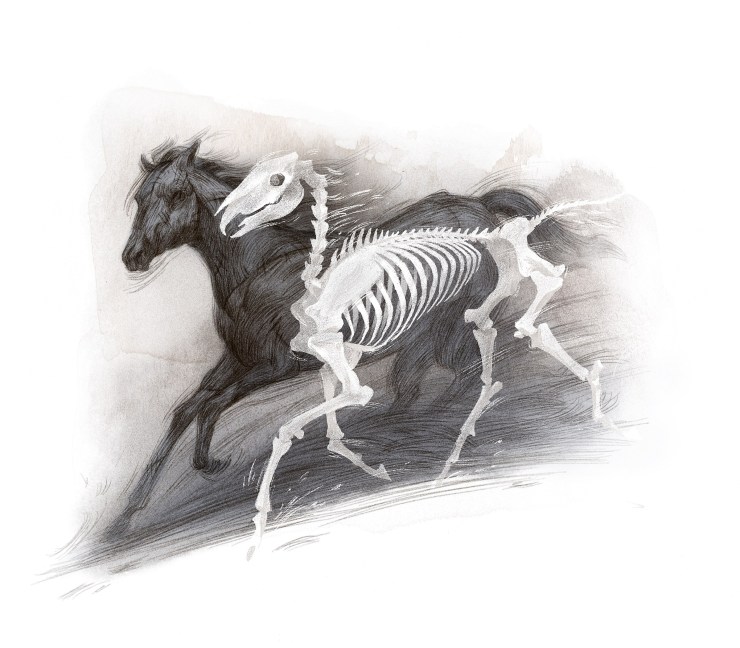
Illustration by Rovina Cai from Come Tumbling Down.
You will love these two horses. Promise.