Shelf Control #156: The Reminders by Val Emmich

Shelves final

Welcome to Shelf Control — an original feature created and hosted by Bookshelf Fantasies.

Shelf Control is a weekly celebration of the unread books on our shelves. Pick a book you own but haven’t read, write a post about it (suggestions: include what it’s about, why you want to read it, and when you got it), and link up! For more info on what Shelf Control is all about, check out my introductory post, here.

Want to join in? Shelf Control posts go up every Wednesday. See the guidelines at the bottom of the post, and jump on board!

cropped-flourish-31609_1280-e1421474289435.png

A little note for 2019: For the next short while, I think I’ll focus specifically on books I’ve picked up at our library’s fabulous annual sales. With all books $3 or less, it’s so hard to resist! And yet, they pile up, year after year, so it’s a good idea to remind myself that these books are living on my shelves.

cropped-flourish-31609_1280-e1421474289435.png

Title: The Reminders
Author: Val Emmich
Published: 2017
Length: 320 pages

What it’s about (synopsis via Goodreads):

Grief-stricken over his partner’s death, Gavin sets fire to every physical reminder in the couple’s home. A neighbor captures the ordeal on video, turning this unsung TV actor into a household name. Now, Gavin is fleeing the hysteria of Los Angeles for New Jersey, hoping to find peace with the family of an old friend. Instead, he finds Joan.

Joan, the family’s ten-year-old daughter, was born with the rare ability to recall every day of her life in cinematic detail. In seconds, she can tell you how many times her mother has uttered the phrase “it never fails” in the last six months (27) or what she was wearing when her grandfather took her fishing on a particular Sunday in June years ago (fox socks). Joan has never met Gavin until now, but she did know his partner, Sydney, and waiting inside her uncanny mind are half a dozen startlingly vivid memories to prove it.

Gavin strikes a deal with Joan: in return for sharing all her memories of Sydney, Gavin will help Joan win a local songwriting contest she’s convinced could make her unforgettable. The unlikely duo sets off on their quest until Joan reveals unexpected details about Sydney’s final months, forcing Gavin to question not only the purity of his past with Sydney but the course of his own immediate future.

Told in the alternating voices of these two irresistible characters, The Reminders is a hilarious and tender exploration of loss, memory, friendship and renewal.

How and when I got it:

LIBRARY SALE!

Why I want to read it:

I really didn’t know anything about this book before picking it up, but the bright cover caught my eye and I remembered hearing about it from a blogger friend. Turns out, the synopsis makes The Reminders sound like a great read for me — it sounds funny, quirky, but also with emotional impact. I like the description of the two main characters and the unusual plot set-up, so now that I’ve reminded myself that I own a copy, I’m eager to read it.

What do you think? Would you read this book?

__________________________________

Want to participate in Shelf Control? Here’s how:

  • Write a blog post about a book that you own that you haven’t read yet.
  • Add your link in the comments!
  • If you’d be so kind, I’d appreciate a link back from your own post.
  • Check out other posts, and…

Have fun!
Save

Save

Save

Save

Save

Save

Save

Save

Save

Save

Save

Save

Save

Book Review: Pachinko by Min Jin Lee

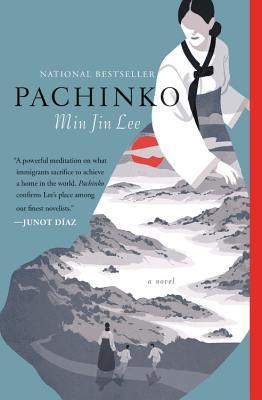
In the early 1900s, teenaged Sunja, the adored daughter of a crippled fisherman, falls for a wealthy stranger at the seashore near her home in Korea. He promises her the world, but when she discovers she is pregnant–and that her lover is married–she refuses to be bought. Instead, she accepts an offer of marriage from a gentle, sickly minister passing through on his way to Japan. But her decision to abandon her home, and to reject her son’s powerful father, sets off a dramatic saga that will echo down through the generations.

Richly told and profoundly moving, Pachinko is a story of love, sacrifice, ambition, and loyalty. From bustling street markets to the halls of Japan’s finest universities to the pachinko parlors of the criminal underworld, Lee’s complex and passionate characters–strong, stubborn women, devoted sisters and sons, fathers shaken by moral crisis–survive and thrive against the indifferent arc of history.

Pachinko is a multi-generational family saga which starts with Sunja, the teen-aged daughter of two poor but loving parents who instill in Sunja a love of family and the value of hard work and sacrifice for the sake of those you love. Over the course of this 500-page novel, we follow Sunja from Korea to Japan, and then follow her descendants through two more generations, as her children and her grandchildren struggle to find their place living in Japan but never able to shed their otherness as Koreans.

The early sections of the book focus on Sunja herself, as she finds herself pregnant by an older man who offers to set her up with a comfortable life as his Korean wife, despite never being able to marry her since he’s already married in Japan. When Sunja rejects his offer, she faces a life of shame until a kind but ill minister decides to devote himself to her and provide a life for Sunja and the baby in Osaka.

Life in Japan is hard, as the Koreans live in a squalid ghetto-like neighborhood and struggle to survive. As the second World War progresses, the family faces greater and greater dangers, and yet Sunja’s family grows through her two sons as well as the extended family she finds in her brother- and sister-in-law.

Over the years, Sunja’s children grow into young men, and each faces his own set of obstacles and challenges. While post-war Japan offers greater opportunities in some ways, the Korean immigrants and their Japanese-born children are continually treated as inferior, looked upon as dirty and undesirable and criminal. The discrimination, portrayed in this book through the 1980s, is unrelenting and very disturbing.

The plot covers about 50 years, and during these decades the focus shifts away from Sunja and toward the younger generation and their friends, relationships, and their own struggles. While my attention was mostly held throughout, by the last third of the book I started to feel that the story was becoming a little too dispersed. Not only were there chapters about Sunja’s children and grandchildren, but there was also a chapter focused on the wife of Sunja’s son’s best friend and other on the girlfriend of one of her sons. As more and more characters are introduced and given backstories, the main characters tend to slip into the background. Why should Sunja’s story become less interesting as she ages? She’s little more than a supporting character by the final sections of the book, although the final chapters wrap up her story very well and bring the various plot points back together.

Still, there’s plenty to enjoy and discuss in Pachinko. I knew little about Korean history or the status of Koreans living in Japan prior to reading this book, so it was quite eye-opening for me. The intricate relationships and tensions between the characters are informed by the social status of the Koreans and how they view themselves and their roles in Japan, sometimes in really destructive ways.

Pachinko is an ambitious novel that covers a woman’s life from girlhood to old age, showing her loves and commitments and determination, as well as the legacy she leaves for her children. With memorable characters and heart-breaking events, Pachinko would make a great book group choice, as there’s plenty of food for thought and discussion.

_________________________________________

The details:

Title: Pachinko
Author: Min Jin Lee
Publisher: Grand Central Publishing
Publication date: February 7, 2017
Length: 502 pages
Genre: Historical fiction
Source: Purchased

The Monday Check-In ~ 2/25/2019

cooltext1850356879 My Monday tradition, including a look back and a look ahead — what I read last week, what new books came my way, and what books are keeping me busy right now. Plus a smattering of other stuff too.

Life.

So my son (very dedicated to his anti-book stance), now a high school student, casually dropped at dinner this week: “Hey, mom, that author was at school this week. You know, the guy that wrote that Scythe book.” Me: *freaking out* *freaking out* *freaking out*

He mentions this to me days after the fact! And said (grudgingly) that the talk was interesting. And that he (Neal Shusterman) talked for about an hour. And talked about writing Challenger Deep, which I really need to read.

I swear, school is wasted on the young! I wish I could have transported my consciousness into the body of one of the students for the day so I could have been in the audience. Sigh.

What did I read during the last week?

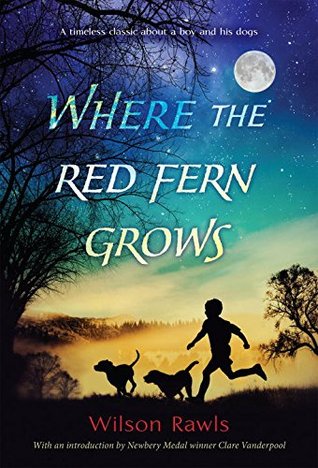
Where the Red Fern Grows by Wilson Rawls: I wrote about reading this children’s classic (as well as Anne of Green Gables) here.

Pachinko by Min Jin Lee: A powerful, multi-generational family drama set in Korea and Japan. This 500-page book took up most of my reading time this week! I’ll post a review in the next few days, I hope.

Fresh Catch:

Nada! No book purchases this week.

What will I be reading during the coming week?

Currently in my hands:

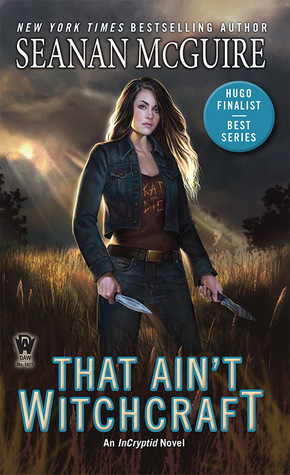
That Ain’t Witchraft (InCryptid, #8) by Seanan McGuire: I’d intended to start this last week, but then got side-tracked by Pachinko and ran out of time. I’m so excited to be starting this book! I love the series so far.

Now playing via audiobook:

Mastiff (Beka Cooper, #3) by Tamora Pierce: The trouble with listening to a great book is getting close to the end, dying to know what happens, but not having enough listening time to actually finish. I’m at 83%, and I’m so tempted to switch to print so I can race through the big finale! But nope… I’m going to practice a little self-restraint and stick to the audio. For now.

Ongoing reads:

Two ongoing reads with my book group, plus one more on my own just for kicks:

  • A Plague of Zombies by Diana Gabaldon: Continuing our journey through all of the Lord John books and stories.
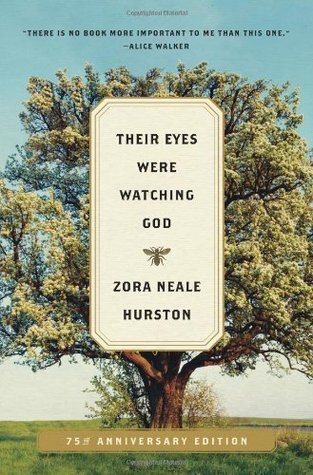
  • Their Eyes Were Watching God by Zora Neale Hurston: Our group classic read. The writing is so beautiful.
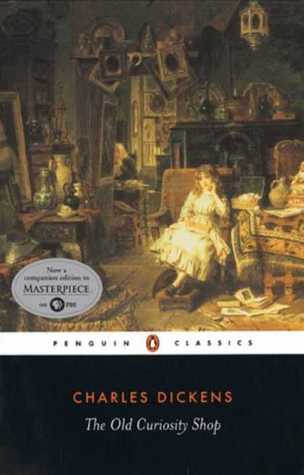
  • The Old Curiosity Shop by Charles Dickens: I’m reading this classic via the Serial Reader app, and love it so far. I’m at about 25%.

So many books, so little time…

boy1

A children’s classics two-fer: Celebrating Anne (with an E) and the glory of great dogs

We all have gaps in our reading. Classics we never were exposed to, great works that didn’t appeal, kids’ books that just didn’t come our way as children. And while I know reading EVERYTHING is an impossible dream, there are definitely children’s classics that it seems like everyone has read but me.

Of the two I finally read, one had been on my radar for years, and one was a more recent addition to my TBR. This year, my book group decided to do a reading challenge inspired by PBS’s Great American Read, where we each put together a list of five books (from the list of 100) that we hadn’t read yet, and committed to reading them (or possibly alternates) during 2019. A pretty low-pressure challenge — which is my kind of challenge!

My list of five that I committed to in January:

  1. Anne of Green Gables by L. M. Montgomery
  2. Where the Red Fern Grows by Wilson Rawls
  3. The Grapes of Wrath by John Steinbeck
  4. Foundation by Isaac Asimov
  5. Hatchet by Gary Paulsen

As of this week, I’ve read two of my five! So I thought I’d share some thoughts and reactions.

First off, I read Anne of Green Gables (originally published 1908) earlier this month… and adored it.

As soon as Anne Shirley arrives at the snug white farmhouse called Green Gables, she is sure she wants to stay forever . . . but will the Cuthberts send her back to to the orphanage? Anne knows she’s not what they expected—a skinny girl with fiery red hair and a temper to match. If only she can convince them to let her stay, she’ll try very hard not to keep rushing headlong into scrapes and blurting out the first thing that comes to her mind. Anne is not like anyone else, the Cuthberts agree; she is special—a girl with an enormous imagination. This orphan girl dreams of the day when she can call herself Anne of Green Gables.

Finally, I understand why so many people are passionately devoted to Anne! What a lovely, entertaining, charming story. Anne herself is a delightful character, full of curiosity, imagination, and a gift for inspiring those around her. I loved this journey from 11-year-old girl to a more mature young woman at the start of her teaching career. The writing is absolutely winning, especially Anne’s long monologues and flights of fancy.

A few choice (brief) bits:

“Will you ever have any sense, Anne?” groaned Marilla. “Oh, yes, I think I will, Marilla,” returned Anne optimistically. A good cry, indulged in the grateful solitude of the east gable, had soothed her nerves and restored her to her wonted cheerfulness. “I think my prospects of becoming sensible are brighter now than ever.”


“Don’t be very frightened, Marilla. I was walking the ridgepole and I fell off. I expect I have sprained my ankle. But, Marilla, I might have broken my neck. Let us look on the bright side of things.”


“I’m so glad I live in a world where there are Octobers. It would be terrible if we just skipped from September to November, wouldn’t it?”

Consider me a new-found fan! I will definitely be continuing with the Anne series. I’m hooked!

Next, I read Where the Red Fern Grows (originally published 1961).

For fans of Old Yeller and Shiloh, Where the Red Fern Grows is a beloved classic that captures the powerful bond between man and man’s best friend.

Billy has long dreamt of owning not one, but two dogs. So when he’s finally able to save up enough money for two pups to call his own—Old Dan and Little Ann—he’s ecstatic. It’s true that times are tough, but together they’ll roam the hills of the Ozarks.

Soon Billy and his hounds become the finest hunting team in the valley. Stories of their great achievements spread throughout the region, and the combination of Old Dan’s brawn, Little Ann’s brains, and Billy’s sheer will seems unbeatable. But tragedy awaits these determined hunters—now friends—and Billy learns that hope can grow out of despair.

This is a sweet story about a boy and his dogs — which, granted, probably would not be published without controversy today, but given its time and place, is a powerful and often uplifting read.

There’s an emphasis on loyalty and devotion to family, and Billy and his family epitomize a commitment to living a good life despite harsh times and limited means. Billy works for everything he gets, including his beloved dogs, and his family supports him every step of the way. Little Ann and Old Dan are the quintessential good dogs, perfectly devoted to one another and to Billy.

Yes, I could have done without the hunting for sure. And yes, that’s a big part of the story. But I can’t get too hung up on it either. I appreciate this book for what it is, focusing on the love between Billy and the dogs. It’s quite lovely in parts, and there’s something very quaint and moving about seeing the world through Billy’s innocent eyes.

(There’s also more religion and prayer than I’d normally appreciate — but again, this is part of Billy’s character and belief system, so ultimately I’m okay with it.)

I wonder whether today’s generation of kids would find anything here to relate to. Much as the Little House books are still loved despite their more problematic aspects, I’d imagine that there’s still a place in children’s literature for books like Where the Red Fern Grows. I’m glad I read it! Despite the pieces of the subject matter that don’t appeal to me as a person, I really did love the beauty of seeing the world from Billy’s perspective and the beauty of the relationships between the family members and between the people and animals.

I’m so glad I read both of these books! And while I’m overloaded with new and upcoming releases at the moment, I’m really excited about reading more from my challenge list as well.

Shelf Control #155: The Thackery T. Lambshead Pocket Guide to Eccentric & Discredited Diseases (edited by Jeff Vandermeer & Mark Roberts)

Shelves final

Welcome to Shelf Control — an original feature created and hosted by Bookshelf Fantasies.

Shelf Control is a weekly celebration of the unread books on our shelves. Pick a book you own but haven’t read, write a post about it (suggestions: include what it’s about, why you want to read it, and when you got it), and link up! For more info on what Shelf Control is all about, check out my introductory post, here.

Want to join in? Shelf Control posts go up every Wednesday. See the guidelines at the bottom of the post, and jump on board!

cropped-flourish-31609_1280-e1421474289435.png

A little note for 2019: For the next short while, I think I’ll focus specifically on books I’ve picked up at our library’s fabulous annual sales. With all books $3 or less, it’s so hard to resist! And yet, they pile up, year after year, so it’s a good idea to remind myself that these books are living on my shelves.

cropped-flourish-31609_1280-e1421474289435.png

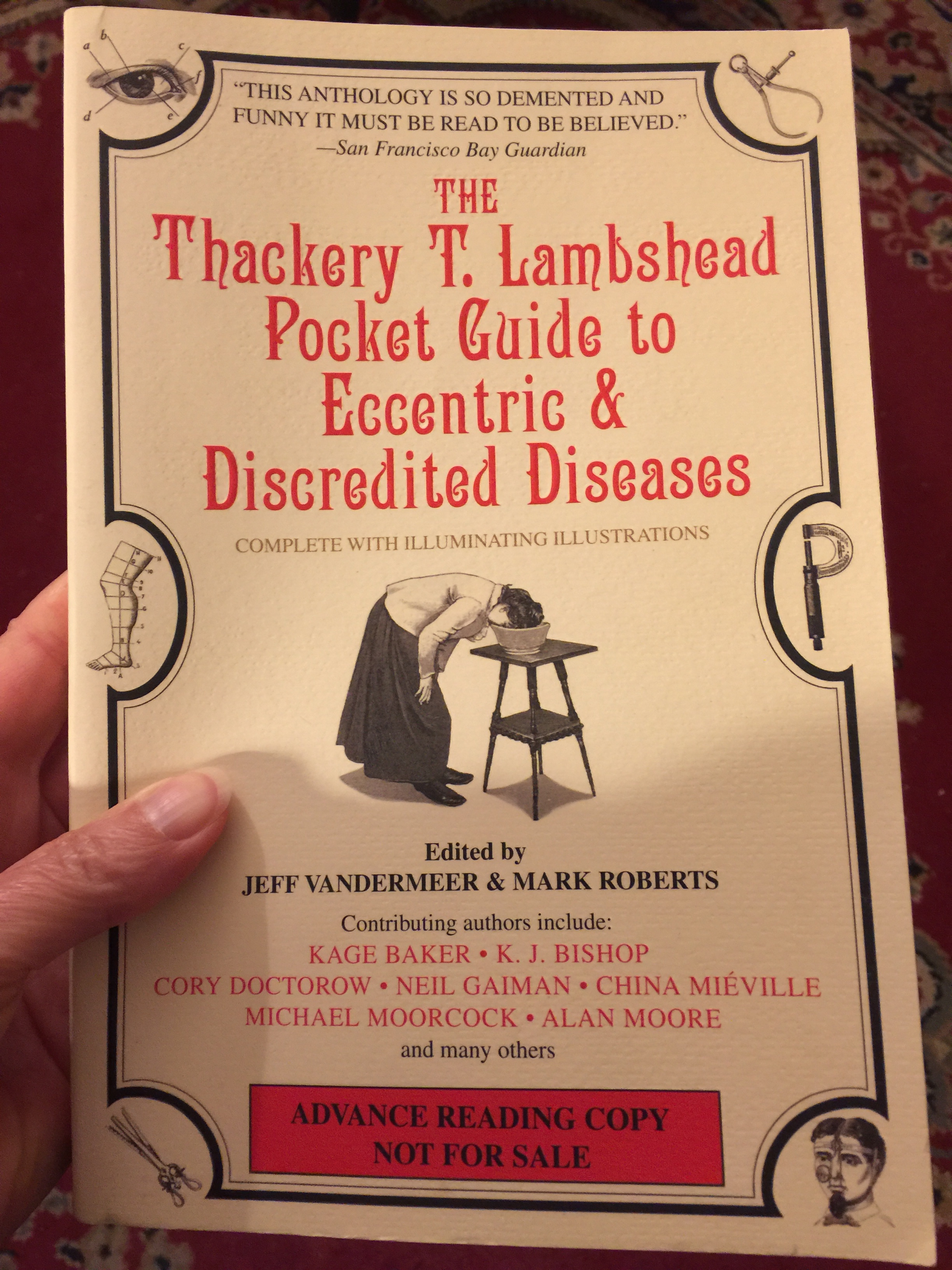
Title: The Thackery T. Lambshead Pocket Guide to Eccentric & Discredited Diseases
Author: Jeff Vandermeer & Mark Roberts
Published: 2003
Length: 298 pages

What it’s about (synopsis via Goodreads):

“Imagine if Monty Python wrote the Mayo Clinic Family Health Book, and you sort of get the idea. Afraid you’re afflicted with an unknown malady? Finally you have a place to turn!” —Book Sense

You hold in your hands the most complete and official guide to imaginary ailments ever assembled—each disease carefully documented by the most stellar collection of speculative fiction writers ever to play doctor. Detailed within for your reading and diagnostic pleasure are the frightening, ridiculous, and downright absurdly hilarious symptoms, histories, and possible cures to all the ills human flesh isn’t heir to, including Ballistic Organ Disease, Delusions of Universal Grandeur, and Reverse Pinocchio Syndrome.

Lavishly illustrated with cunning examples of everything that can’t go wrong with you, the Lambshead Guide provides a healthy dose of good humor and relief for hypochondriacs, pessimists, and lovers of imaginative fiction everywhere. Even if you don’t have Pentzler’s Lubriciousness or Tian Shan-Gobi Assimilation, the cure for whatever seriousness may ail you is in this remarkable collection.

How and when I got it:

LIBRARY SALE!

Why I want to read it:

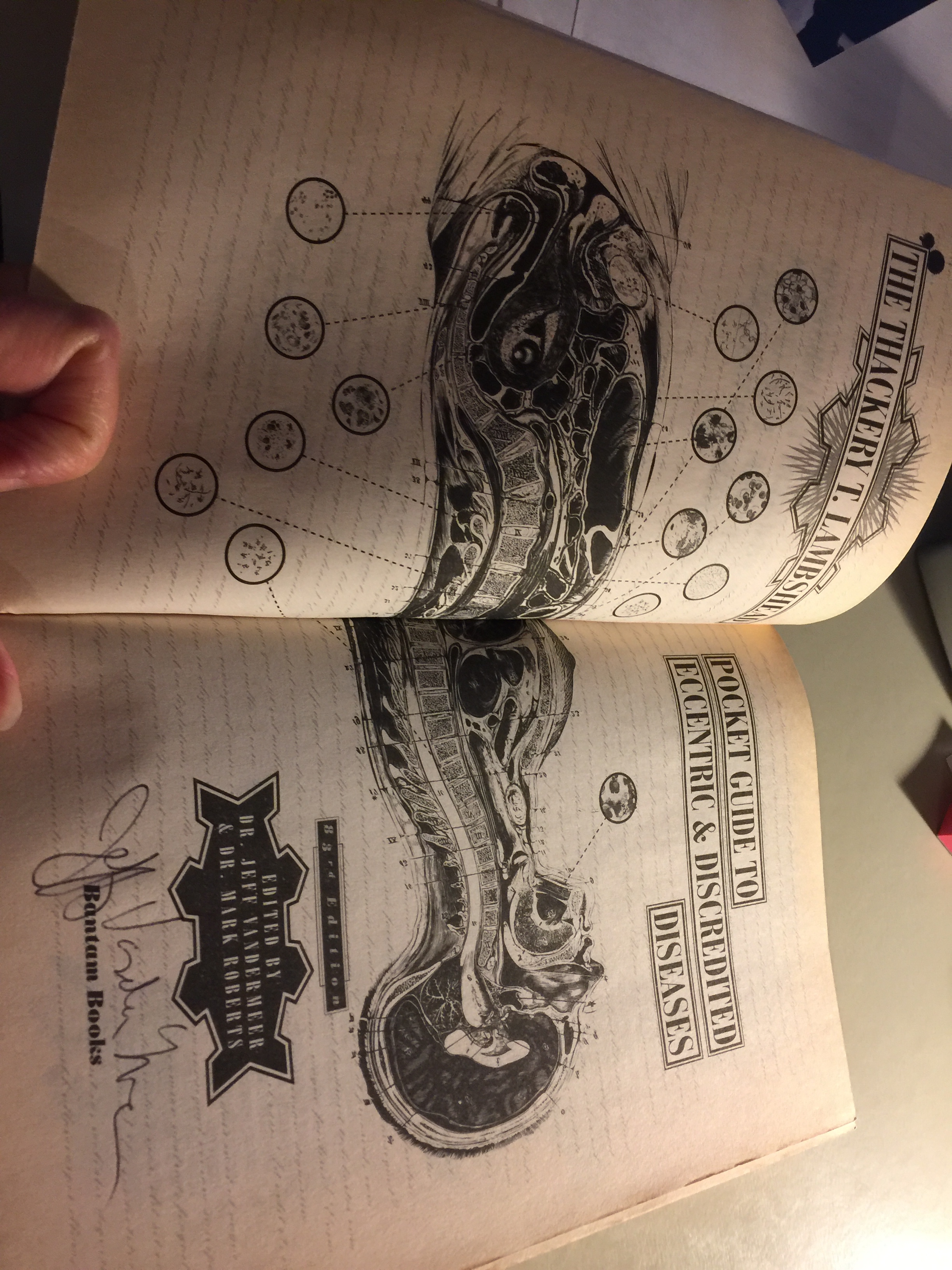
This looks so incredibly silly and inspired. And look, somehow or another I ended up with a signed copy! Thank you, public library sale’s $1 table!

This guide to diseases includes such little known conditions as Flora Metamorphosis Syndrome, Pathological Instrumentation Disorder, The Wuhan Flu, and Internalized Tattooing Disease. Fascinating stuff! Here’s a little peek at the table of contents:

What do you think? Would you read this book?

__________________________________

Want to participate in Shelf Control? Here’s how:

  • Write a blog post about a book that you own that you haven’t read yet.
  • Add your link in the comments!
  • If you’d be so kind, I’d appreciate a link back from your own post.
  • Check out other posts, and…

Have fun!
Save

Save

Save

Save

Save

Save

Save

Save

Save

Save

Save

Save

Save

Top Ten Tuesday: Books I LOVED with Fewer than 2,000 Ratings on Goodreads

snowy10

Top Ten Tuesday is a meme hosted by That Artsy Reader Girl, featuring a different top 10 theme each week. This week’s topic is Books I LOVED with Fewer than 2,000 Ratings on Goodreads.

It’s nice to be able to give some love to stellar books that not enough people know about! Here are some of my top-rated reads, all with fewer than 2,000 ratings on Goodreads. Where available, I’m including links to my reviews, so check ’em out if you’re interested!

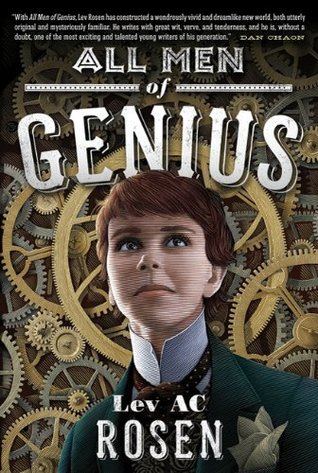
1) All Men of Genius by Lev AC Rosen (1,463 ratings): A super-charming steampunk adventure, with nods to Shakespeare and Oscar Wilde. I think I’m due for a re-read!

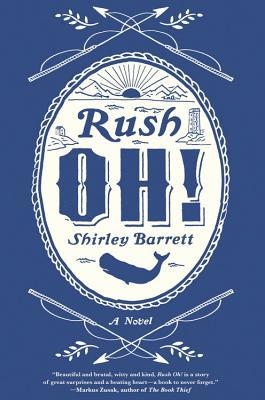
2) Rush Oh! by Shirley Barrett (1,292 ratings): An Austen-esque novel about a whaling community in Australia in the early 1900s. Such a great read! (my review)

3) Extreme Makeover by Dan Wells (943 ratings): The end of the world, as brought about by a cosmetics company. Scary yet kind of funny in a bizarre sort of way. (my review)

4) Pride and Prometheus by John Kessel (358 ratings): Why haven’t more people read this book?? I rave about this book whenever I get a chance — a mash-up of Frankenstein and Pride and Prejudice that works perfectly. (my review)

5) Alive in Necropolis by Doug Dorst (933 ratings): I read this book years ago, but remember being charmed by the shenanigans of the ghosts in a California cemetery.

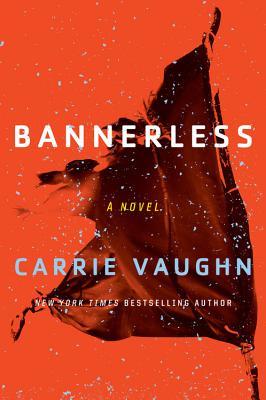
6) Bannerless by Carrie Vaughn (1,468 ratings): I can’t for the life of me figure out why more people haven’t read this terrific book and its sequel, The Wild Dead. The world-building and storytelling are amazing. (my review)

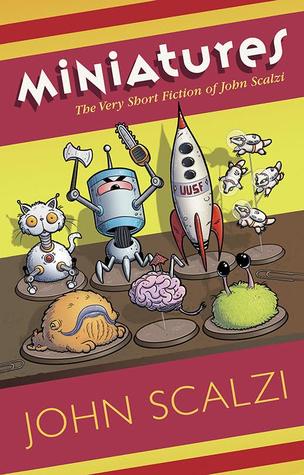
7) Miniatures by John Scalzi (1,808 ratings): This collection of short fiction is adorable and highly entertaining. (my review)

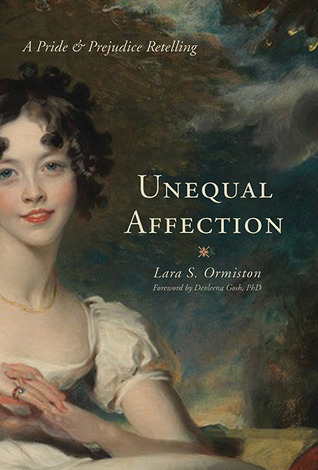
8) Unequal Affection by Lara S. Ormiston (1,857 ratings): Yet another Austen-influenced book! This is one of the best riffs off of Pride and Prejudice that I’ve encountered — not a retelling exactly, but a continuation with an alternate ending. What if Elizabeth had accepted Mr. Darcy’s first proposal? This book explores what might have happened, and is a wonderful read. (my review)

9) All the Winters After by Sere Prince Halverson (1,534 ratings): A beautiful story about love, second chances, and survival, set in one of my very favorite places, Alaska. (my review)

10) The Only Harmless Great Thing by Brooke Bolander (1,591 ratings): As I wrote on Goodreads: Weird, wonderful, beautiful, tragic. If you’re wondering how elephants could possibly fit into a story about the “radium girls” tragedy, check out this inventive, powerful novella. (my review)

Have you read any of these? What are your top underrated books?

If you wrote a TTT post this week, please share your link so I can check out your list!

The Monday Check-In ~ 2/18/2019

cooltext1850356879 My Monday tradition, including a look back and a look ahead — what I read last week, what new books came my way, and what books are keeping me busy right now. Plus a smattering of other stuff too.

What did I read during the last week?

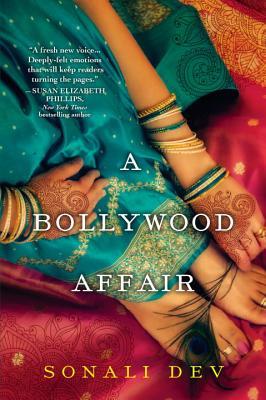
A Bollywood Affair by Sonali Dev: My book group’s February pick. My review is here.

The Secret of Clouds by Alyson Richman: A new release for this week. My review is here.

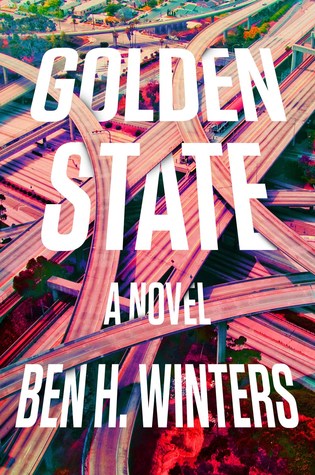
Golden State by Ben H. Winters: Weird and wonderful. Finished late Sunday. My mini-review is here.

Fresh Catch:

I treated myself to the newest book by Charlie Jane Anders. Looks amazing!

What will I be reading during the coming week?

Currently in my hands:

I have two books on the go right now:

Where the Red Fern Grows by Wilson Rawls: Filling in yet another gap from my childhood reading.

That Ain’t Witchraft (InCryptid, #8) by Seanan McGuire: Love, love, love this series (and pretty much everything written ever by Seanan McGuire). I’m so excited to be starting the newest InCryptid adventure!

Now playing via audiobook:

Mastiff (Beka Cooper, #3) by Tamora Pierce: The third and final Beka Cooper book… and I’m loving it!

Ongoing reads:

Two ongoing reads with my book group, plus one more on my own just for kicks:

  • A Plague of Zombies by Diana Gabaldon: Continuing our journey through all of the Lord John books and stories.
  • Their Eyes Were Watching God by Zora Neale Hurston: Our group classic read. The audiobook version is fantastic.
  • The Old Curiosity Shop by Charles Dickens: It’s been a while since I’ve used my Serial Reader app (which is awesome — see here for more info). I’ve been wanting more Dickens in my life, and figure that 10 – 12 minutes a day is a reasonable investment!

So many books, so little time…

boy1

Take A Peek Book Review: Golden State by Ben H. Winters

“Take a Peek” book reviews are short and (possibly) sweet, keeping the commentary brief and providing a little peek at what the book’s about and what I thought. My newest “take a peek” book:

Synopsis:

(via Goodreads)

A shocking vision of our future that is one part Minority Report and one part Chinatown.

Lazlo Ratesic is 54, a 19-year veteran of the Speculative Service, from a family of law enforcement and in a strange alternate society that values law and truth above all else. This is how Laz must, by law, introduce himself, lest he fail to disclose his true purpose or nature, and by doing so, be guilty of a lie.

Laz is a resident of The Golden State, a nation resembling California, where like-minded Americans retreated after the erosion of truth and the spread of lies made public life, and governance, increasingly impossible. There, surrounded by the high walls of compulsory truth-telling, knowingly contradicting the truth–the Objectively So–is the greatest possible crime. Stopping those crimes, punishing them, is Laz’s job. In its service, he is one of the few individuals permitted to harbor untruths–to “speculate” on what might have happened in the commission of a crime.

But the Golden State is far less a paradise than its name might suggest. To monitor, verify, and enforce the Objectively So requires a veritable panopticon of surveillance, recording, and record-keeping. And when those in control of the truth twist it for nefarious means, the Speculators may be the only ones with the power to fight back.

My Thoughts:

Golden State is a weird mind-f*ck of a novel, and that’s what makes it so wonderful. In a society where adherence to the Objectively So is the primary goal, the crime of telling a lie can lead to lengthy imprisonment or even exile, a fate assumed to be equivalent to death. Law enforcement agents like Lazlo can feel when a lie has been told, and their ability to sense anomalies leads them in pursuit of those who attempt to subvert the State with their untruths. People greet each other on the street by stating absolute facts (“A cow has four stomachs.” “A person has one.”), and the ringing of clock bells leads to streams of statements about the time, hour after hour.

I loved the explanations for the rules and moral certainties of the Golden State, which we’re led to believe has been in existence for several generations already as of the start of this story:

You go back far enough in history, ancient history, and you find a time when people were never taught to grow out of it, when every adult lied all the time, when people lied for no reason or for the most selfish possible reasons, for political effect or personal gain. They lied and they didn’t just lie; they built around themselves whole carapaces of lies. They built realities and sheltered inside them. This is how it was, this is how it is known to have been, and all the details of that old dead world are known to us in our bones but hidden from view, true and permanent but not accessible, not part of our vernacular.

It was this world but it was another world and it’s gone. We are what’s left. The calamity of the past is not true, because it is unknown. There could only be hypotheses, and hypotheses are not the truth. So we leave it blank. Nothing happened. Something happened. It is gone.

Golden State is a book that I’ll need to revisit, probably a few times. The writing is spot-on, conveying the strange realities of its world from an insider’s perspective, immersing the reader in the weird double-speak of Speculators and Small Infelicities and Acknowledged Experts — it’s strange and alien, yet we inhabit it through the characters for whom it’s all just part of the normal lives they lead.

Reading Golden State is a treat. I wanted to stop to highlight passages practically everywhere — there’s so much clever wordplay and inversion of our understanding of what things mean. It’s a great read, highly recommended. Now I need to get back to the other books on my shelves by this author, because I’m pretty sure I’m going to love them.

_________________________________________

The details:

Title: Golden State
Author: Ben H. Winters
Publisher: Mulholland Books
Publication date: January 22, 2019
Length: 319 pages
Genre: Speculative fiction
Source: Review copy courtesy of the publisher via NetGalley

Book Review: The Secret of Clouds by Alyson Richman

Katya, a rising ballerina, and Sasha, a graduate student, are young and in love when an unexpected tragedy befalls their native Kiev. Years later, after the couple has safely emigrated to America the consequences of this incident cause their son, Yuri, to be born with a rare health condition that isolates him from other children. Maggie, a passionate and dedicated teacher agrees to tutor Yuri at his home, even though she is haunted by her own painful childhood memories. As the two forge a deep and soulful connection, Yuri’s boundless curiosity and unique wisdom inspires Maggie to make difficult changes in her own life. And she’ll never realize just how strong Yuri has made her — until she needs that strength the most…

A novel that will make readers examine what it means to live life with a full heart.

The Secret of Clouds is about a young teacher, Maggie, whose enthusiasm for her middle school students and her passion for introducing them to the joys of reading and writing seems limitless. Maggie is asked to take on an additional role, tutoring a 12-year-old boy named Yuri who is unable to come to school because of a health condition. Hesitantly, Maggie agrees, but soon is completely charmed by this lonely boy and becomes determined to help him regain an interest in the world around him.

Bonding through his love of baseball, Maggie slowly draws Yuri out of his shell of apathy, and soon has him engaging with her and the worlds of literature she’s introduced him to with real interest and insight. As she begins to earn Yuri’s trust, Maggie also learns more about his parents, Katya and Sasha, and their desperate love for their ill son.

Katya and Sasha lived in Kiev at the time of the Chernobyl disaster, and while they themselves suffered no adverse effects, like so many others, their offspring suffered birth defects — in this case, a rare heart ailment — due to their own radiation exposure.

Meanwhile, as Maggie witnesses Yuri’s struggles to live his limited life to the fullest, she reassesses her own life and relationships, seeing where her true happiness lies and making the changes needed to live life to her best ability.

The Secret of Clouds is touching and appealing in many ways, yet something about the writing style let me down. It’s the old “show, don’t tell” issue: I felt like Maggie was sharing a summary of her experiences, rather than drawing me in enough to see the events myself. The writing kept me at a distance throughout, as entire months or sometimes years went by in the span of a few paragraphs. There was no sense of immediacy; I rarely felt as though I had entered into a scene or had a genuine moment of emotional connection. For example, when Maggie meets and falls in love with a new man in her life, it’s very nice for her, yet I’d be hard pressed to tell you a thing about him other than that he’s a musician and seems to be a really great guy. Granted, their love story was not the main point of this book, but he feels like a cipher to me.

From the synopsis, I expected Katya and Sasha to have equal time in this novel alongside Maggie, but that’s not the case. While we see their lives in Kiev in the early chapters, once it’s been established that they were exposed to fallout from Chernobyl, the story shifts entirely to its 1999/2000 setting, focusing on Maggie and Yuri. Katya and Sasha become supporting characters, in the background as Yuri’s parents, but not central point-of-view characters.

The Secret of Clouds is a fine read with an interesting story to tell, but unfortunately the writing style kept me from feeling truly emotionally invested. I will say, though, that if every student had a teacher as committed, idealistic, and compassionate as Maggie, the world would be a much, much better place!

_________________________________________

The details:

Title: The Secret of Clouds
Author: Alyson Richman
Publisher: Berkley
Publication date: February 19, 2019
Length: 384 pages
Genre: Contemporary fiction
Source: Review copy courtesy of the publisher via NetGalley

A Reader’s Reality: Let’s give the “Get To” approach a try!

It’s the age-old lament of book lovers everywhere: So many books. So little time. What’s a reader to do?

Sometimes when I contemplate my huge stacks of books waiting to be read, I feel all mopey and lost. I dream of a day when I can do nothing but read.

But since I live in the real world — one filled with bills and taxes and work and responsibilities — my dream of reading 24/7 will have to wait.

And that means that I have to prioritize. And like so many bookworms, I keep telling myself that I need to focus on the books I already own. Stop buying new books! Stop requesting books from the library! Stop picking up even more library books on a whim! And the biggie for book bloggers;

Stop requesting so many ARCs!

Because ARCs are simply dominating my Kindle right now, and with the ARCs comes a sense of obligation, or even worse, the guilt that hangs over our heads when we just don’t get around to reading them.

The direction my house is heading in…

Now excuse me for a second while I take a detour…

While staying at a relative’s house this past week, I happened to be in a room where the TV was on most of the day, and one day, the group there was watching some morning talk show. No idea which. In any case, the host and the guest were talking about either a book or maybe the guest’s motivational speaking topic (?) — I didn’t catch all of it. But what did strike me in that moment was the approach the guest was promoting, using a reframing of language to change the way we think about things.

Two examples stuck in my mind:

Rather than talking about “going through a hard time”, substitute the word “growing”: I’m growing through a hard time right now.

Um. No. Not for me. Way too hokey, although if it works for some people, more power to them.

But this one I kind of liked:

Instead of “have to”, try “get to”. Rather than “I have to go to work today”, try “I get to go to work today”. I like this! Kind of puts a more positive spin on things we think of as obligations or objects of dread.

Which brings me back to ARCs. Ah, the long, long list of ARCs. Look, I totally believe that getting ARCs to read is a privilege, and one that I really and truly appreciate. That said, I do get way, way ahead of myself and end up with so many ARCs that they take over my reading life, which leaves me feeling frustrated when I have to ignore all my other books in order to read the ARCs in a somewhat close proximity to their publications dates.

I realize that I’ll probably never tame my impulse to request ARCs, and that’s okay. Because I’m trying my new positive spin!

So no more saying: I have to read so many ARCs this spring.

Instead, I’m celebrating! Because…

I get to read so many ARCs this spring!

What do you think? Does shifting the language also shift the attitude? I’m ready to give it a try. And here I’ll be, reading away to my heart’s contect, relishing my ARCs as well as my other books… all the wonderful stories I get to read!