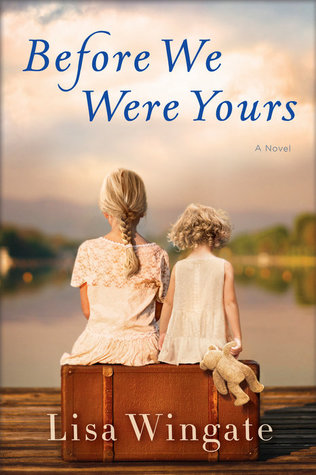
Book Review: Before We Were Yours by Lisa Wingate


Two families, generations apart, are forever changed by a heartbreaking injustice in this poignant novel, inspired by a true story, for readers of Orphan Train and The Nightingale.

Memphis, 1939. Twelve-year-old Rill Foss and her four younger siblings live a magical life aboard their family’s Mississippi River shantyboat. But when their father must rush their mother to the hospital one stormy night, Rill is left in charge—until strangers arrive in force. Wrenched from all that is familiar and thrown into a Tennessee Children’s Home Society orphanage, the Foss children are assured that they will soon be returned to their parents—but they quickly realize that the truth is much darker. At the mercy of the facility’s cruel director, Rill fights to keep her sisters and brother together—in a world of danger and uncertainty.

Aiken, South Carolina, present day. Born into wealth and privilege, Avery Stafford seems to have it all: a successful career as a federal prosecutor, a handsome fiancé, and a lavish wedding on the horizon. But when Avery returns home to help her father weather a health crisis, a chance encounter leaves her with uncomfortable questions—and compels her to take a journey through her family’s long-hidden history, on a path that will ultimately lead either to devastation or redemption.

Based on one of America’s most notorious real-life scandals—in which Georgia Tann, director of a Memphis-based adoption organization, kidnapped and sold poor children to wealthy families all over the country—Wingate’s riveting, wrenching, and ultimately uplifting tale reminds us how, even though the paths we take can lead to many places, the heart never forgets where we belong.

The story of Before We Were Yours is all the more shocking and heart-breaking when you realize that while the main characters are fictional, the tragedy depicted is all too real.

In this powerful work of historical fiction, we follow the story of 12-year-old Rill, a girl growing up poor but happy on a riverboat with her parents and four younger siblings. But when the children become separated from their parents due to complications of labor and an emergency trip to the hospital, their lives become dark and dangerous. Stolen away by the notorious Georgia Tann, the children are taken to a children’s home, where they’re starved, neglected, and abused before ultimately being adopted out, one by one, to wealthy families who are willing to pay.

In alternating chapters, we follow a modern-day story, as Avery Stafford comes home to South Carolina to support her ill father, a politician from a powerful family. Avery stumbles upon a woman in a nursing home, May Crandall, who seems to have some sort of connection to Avery’s family. What starts as a curiosity for Avery turns into a quest to unravel the mystery of May’s strange tie to Avery’s grandmother, now suffering early stages of dementia. As Avery digs deeper, she begins to see that her family’s hidden past may have intersected with the schemes of Georgia Tann, and Avery must decide if it’s wiser to uncover the truth or let the past stay in the past.

While Avery’s search for answers is interesting, it’s the story of Rill and her sisters and brother that’s truly stunning. The children grow up free and open to adventure, never minding that they’re looked down upon as “river rats”. On board their boat and with their parents, they live in a kingdom of their own. Reading about how this family is torn apart is shocking — it’s amazing how much cruelty was inflicted upon these young children, especially as the story drives home the fact that this happened to thousands of chlidren over a period of more than 20 years.

The mystery of how Avery’s grandmother is connect to May is not revealed until close to the end of the book, and while there are hints along the way, the answer isn’t entirely obvious. Meanwhile, while we see how Rill grew up and changed from the river girl to a woman with a family of her own and a new life, the journey she makes isn’t easy and is no fairy tale. Not all the loose ends are tied up, which is fitting, given that in the historical records of the Georgia Tann scandal, many families never did find their missing children, and many hundreds are believed to have died under the “care” of this awful, twisted adoption industry.

Before We Were Yours is a compelling read, although I was less engaged during the contemporary chapters, particularly when the focus shifted from Avery’s search into family history to dwell more upon Avery’s romantic life and her career choices. Other than that, I found it a quick, fascinating, and terribly sad read.

This was a book group pick, and I’m so glad it was! As with all of my book group’s books, I can’t wait to hear from my bookish friends and to exchange reactions, ideas, and questions.

If you’ve read Before We Were Yours, I’d love to hear your thoughts too!

_________________________________________

The details:

Title: Before We Were Yours
Author: Lisa Wingate
Publisher: Ballantine
Publication date: June 6, 2017
Length: 342 pages
Genre: Historical fiction
Source: Library
**Save

Save

Save

Save

Save

Save

Save

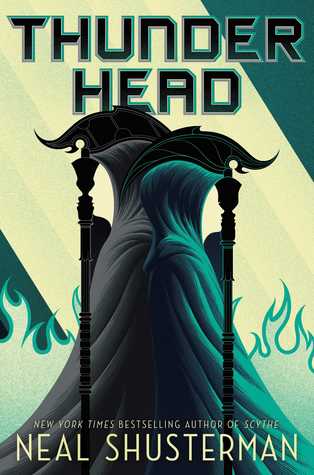
Book Review: Thunderhead (Arc of a Scythe, #2) by Neal Shusterman


Rowan and Citra take opposite stances on the morality of the Scythedom, putting them at odds, in the chilling sequel to the Printz Honor Book Scythe from New York Times bestseller Neal Shusterman, author of the Unwind dystology.

The Thunderhead cannot interfere in the affairs of the Scythedom. All it can do is observe—it does not like what it sees.

A year has passed since Rowan had gone off grid. Since then, he has become an urban legend, a vigilante snuffing out corrupt scythes in a trial by fire. His story is told in whispers across the continent.

As Scythe Anastasia, Citra gleans with compassion and openly challenges the ideals of the “new order.” But when her life is threatened and her methods questioned, it becomes clear that not everyone is open to the change.

Will the Thunderhead intervene?

Or will it simply watch as this perfect world begins to unravel?

I absolutely loved Scythe, the first book in the Arc of a Scythe series. So it should be no surprise that I found myself swept away by Thunderhead, book #2, simply unable to put it down once I started.

Note: This review may be a bit spoilery, since it’s for the 2nd in a series. Look away now if you want to be spoiler-free!

Scythe ended on a suspenseful note. Apprentice Scythes Citra and Rowan make it to their final rite of passage, and while Citra is ordained, taking the name Scythe Anastasia, Rowan is not accepted into the scythedom. By rules of their apprenticeship, Citra should now “glean” (kill, permanently, with no revival) Rowan, but instead, she makes sure he gets a year’s immunity from gleaning and he escapes. By the end of the book, we know that Rowan has gone rogue, illegally donning the robes of a scythe and making it his mission to eliminate the worst of the scythes — those who kill for pleasure rather than as a means of keeping balance in the world.

Thunderhead picks right up with the action, as Citra/Anastasia carries out her scythe duties with thoughtfulness and purpose. Scythes are necessary tools in a world in which death has been banished. Without scythes, overpopulation and starvation would result, killing off humanity just as surely as war and disease did back in the mortal age. Anastasia treats those to be gleaned with respect and compassion, and while her task is still grim, she gives it a dignity that “new order” scythes find ridiculous, boring, and unnecessarily serious.

Things become deadly when Anastasia and her mentor Scythe Curie are almost killed in a bombing attack. Everything in the world is governed by the Thunderhead, the sentient intelligence that evolved from cloud computing. The Thunderhead is all-knowing, and has as its mission the preservation of life on the planet to the best of its ability. The one area removed from Thunderhead control is the scythedom — a rule created by the Thunderhead to ensure that humans could make the decisions necessary for their own species’ survival without undue interference. But over the course of the book, the Thunderhead realizes that the things it doesn’t know and doesn’t see, thanks to this separation, may spell doom rather than salvation for humanity.

Scattered throughout the book are pages narrated by the Thunderhead itself, and these are truly fascinating. The Thunderhead knows everything, and knows everyone. It understands what each person needs, and it understands how things must change in order for the world to endure. It knows every probable outcome and the statistical likelihood of every occurrence. And yet, the Thunderhead isn’t some evil computer overlord. It has what it considers the best interest of all things as its focus, and if it can be said to feel, we’d be likely to interpret its musings on human beings as a form of love. Still, there is perhaps something a little creepy about a world in which the illusion of complete choice is deliberately provided by the Thunderhead in certain situations in order for people to feel free, and in which a class of people known as “unsavories” are permitted (and even encouraged) so that those who need a sense of rebellion can get that satisfaction.

I won’t give away too much more, other than to say that the ending is a TREMENDOUS CLIFFHANGER,  with a lead-up that left me gasping. I mean, I could not believe what I was reading, was utterly horrified, kept waiting for things not to be as bad as they seemed (but they were), and could not look away. Really, the ending is a stunner.

Note: Pretty big spoiler here for anyone who’s familiar with classic opera:

At the end, I couldn’t help but chuckle sadly once I realized what exquisite foreshadowing the author used by having characters attend a performance of Aida.

Sorry, I couldn’t not say that.

End of spoilers!

I could rave about this book (and Scythe) a whole lot more, but I think you get the point! I just wish I had someone in my life to discuss this with! I’m trying to push the books on a few bookish friends, and hope to have some success soon. These are books that just NEED to be talked about!

Really, read Scythe and Thunderhead! You’ll thank me, I promise.

And now we wait for #3, coming (I hope) sometime in 2019.

_________________________________________

The details:

Title: Thunderhead (Arc of a Scythe, #2)
Author: Neal Shusterman
Publisher: Simon & Schuster Books for Young Readers
Publication date: January 9, 2018
Length: 504 pages
Genre: Young adult fiction
Source: Library

**Save

Save

Save

Save

Save

Save

Save

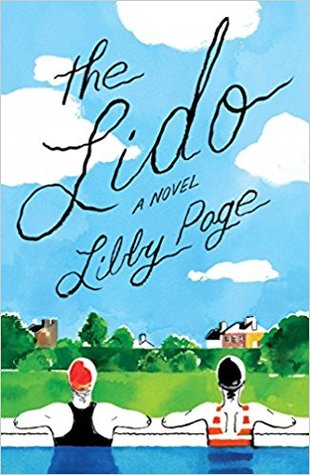
Book Review: The Lido by Libby Page


We’re never too old to make new friends—or to make a difference.

Rosemary Peterson has lived in Brixton, London, all her life but everything is changing.

The library where she used to work has closed. The family grocery store has become a trendy bar. And now the lido, an outdoor pool where she’s swam daily since its opening, is threatened with closure by a local housing developer. It was at the lido that Rosemary escaped the devastation of World War II; here she fell in love with her husband, George; here she found community during her marriage and since George’s death.

Twenty-something Kate Matthews has moved to Brixton and feels desperately alone. A once promising writer, she now covers forgettable stories for her local paper. That is, until she’s assigned to write about the lido’s closing. Soon Kate’s portrait of the pool focuses on a singular woman: Rosemary. And as Rosemary slowly opens up to Kate, both women are nourished and transformed in ways they never thought possible.

In the tradition of Fredrik Backman, The Lido is a charming, feel-good novel that captures the heart and spirit of a community across generations—an irresistible tale of love, loss, aging, and friendship.

What a lovely, lovely book!

A lido, for the benefit of my fellow Americans who’ve never encountered the word before (other than via references to the Lido Deck on The Love Boat re-runs), is an outdoor pool. And in The Lido, it’s so much more than simply a place to swim. For the Brixton neighborhood, the lido is a fixture dating back to pre-World War II, a place where members of the community of all walks of life come together to exercise, to raise children, to chat with friends, to interact with neighbors. But as with so much in this day and age, a community gathering center that doesn’t bring in big bucks has a hard time lasting, so when a development company wants to buy the property and turn it into upscale housing and tennis courts — well, of course that’s a tempting offer for a cash-strapped local council.

And yet, there are people like 86-year-old Rosemary, who has had the lido as a centerpiece of her life for more years than she can count. Her memories of her late husband — and really, their entire love story — are inseparable from the memories of the moments they spent together at the lido. The lido remains the true constant in Rosemary’s life, and in the lives of countless of her neighbors. The potential loss of the lido is like one more death for Rosemary, and seems to represent the final, shattering blow for a woman who’s lived through so much and has already lost the love of her life.

George is in the way the mist sits on the water in the morning, he is in the wet decking and the brightly colored lockers and in the sharp intake of breath when she steps into the water, reminding her that she is still alive. Reminding her to stay alive.

For Kate, the lido starts off as merely a newspaper assignment, but as she comes to know Rosemary, Kate begins to connect with the community that’s sprung up around the lido, and even rediscovers her own joy of swimming, something lost to her as an adult who is often overwhelmed by anxiety and panic. Kate becomes invested personally in saving the lido, and through her deepening friendship with Rosemary, finally finds a community that she belongs to.

But there was something about Kate that made Rosemary think she was in great need of a swim.

Rosemary and Kate are both wonderful characters. Rosemary is strong and wise, but still mourning her beloved George. Kate is a vulnerable young adult who has had the confidence drained out of her over the years — but Rosemary and the lido seem to give her a new purpose and a new sense of self, enabling her to emerge from her shell and truly connect.

I loved the chapters filled with Rosemary’s memories of her courtship, romance, and early years with George — and also the memories of their more mature years, such as the time they snuck into the lido late one night for a midnight swim and then couldn’t get back over the fence to sneak away. The depiction of the fire brigade rescuing this 70-something-year-old couple is priceless.

The story is told through multiple viewpoints, not just those of Rosemary and Kate, but also nameless characters such as a pregnant woman and a teenage boy who each find meaning in their lido swims. We even see certain events through the eyes of a fox — and crazy as that might sound, it absolutely works.

Most of all, the friendship between Rosemary and Kate is simply beautiful. The two women are separated by sixty years of life, but they’re brought together by their loneliness, and find in one another someone to listen, to care, to be there for, and to laugh with.

Kate thinks of the first time she swam with Rosemary, how the old woman seemed to become young in the water, and how she, Kate, felt the unsteadier one. She had felt then that Rosemary’s strength was tucked away beneath her dry-land clothes, a hidden power unleashed not by a cape but by a navy blue swimsuit.

I really can’t say enough good things about this book! The Lido paints a gorgeous picture of the power of community, the importance of connections, and how great a gift friendship can be, not matter how surprising the package it comes in.

_________________________________________

The details:

Title: The Lido
Author: Libby Page
Publisher: Simon & Schuster
Publication date: July 10, 2018
Length: 320 pages
Genre: Contemporary fiction
Source: Review copy courtesy of the publisher via NetGalley

**Save

Save

Save

Save

Save

Save

Save

Take A Peek Book Review: Hope Never Dies by Andrew Shaffer

“Take a Peek” book reviews are short and (possibly) sweet, keeping the commentary brief and providing a little peek at what the book’s about and what I thought.


Synopsis:

(via Goodreads)

This mystery thriller reunites Vice President Joe Biden and President Barack Obama for a political mashup full of suspense, intrigue, and laugh out loud bromance.

Vice President Joe Biden is fresh out of the Obama White House and feeling adrift when his favorite railroad conductor dies in a suspicious accident, leaving behind an ailing wife and a trail of clues. To unravel the mystery, “Amtrak Joe” re-teams with the only man he’s ever fully trusted—the 44th president of the United States. Together they’ll plumb the darkest corners of Delaware, traveling from cheap motels to biker bars and beyond, as they uncover the sinister forces advancing America’s opioid epidemic.

Part noir thriller and part bromance novel, Hope Never Dies is essentially the first published work of Obama/Biden fanfiction—and a cathartic read for anyone distressed by the current state of affairs.

My Thoughts:

For everyone who laughed through their tears while scrolling through all those countless Biden/Obama memes…

This one’s for you.

Hope Never Dies is a noir detective story that just happens to feature our favorite presidential bromantic couple as the lead action heroes. In this funny, warm-hearted satire, retired Joe Biden is still a good guy, but one with enough time on his hands to build up a great big load of resentment over former bestie Barack’s never-ending parade of fun celebrity outings… while Joe just waits for a simple call or a text. But when the Amtrak conductor who’d been a part of Joe’s commute for decades turns up dead under suspicious circumstances, Joe and Barack are thrown together into a crime investigation that features drugs, bikers, shady cops, and plenty of stops for fast food.

“Son of a buttermilk biscuit” I said, grimacing. “We got bamboozled.”

This book is charming AF and oh-so-silly, and makes me feel all warm and fuzzy thinking about the good old days when these two were in the White House. Their fictional counterparts are adorable, and their ongoing friendship and devotion brought the teeniest little lump to my throat. The author has a knack for keeping the story moving while weaving in little snippets of dialogue and actions that bring our former POTUS and VPOTUS to life on the page.

Hope Never Dies is a surprisingly fun read, and the detective elements are actually pretty clever and engaging too. But really, read it for the Biden-isms and cool-as-hell Obama appearances. It’s like a little ray of sunshine in book form.

_________________________________________

The details:

Title: Hope Never Dies
Author: Andrew Shaffer
Publisher: Quirk Books
Publication date: July 10, 2018
Length: 304 pages
Genre: Satire
Source: Review copy courtesy of the publisher via NetGalley

**Save

Save

Save

Save

Save

Save

Save

Book Review: Scythe by Neal Shusterman


Thou shalt kill.

A world with no hunger, no disease, no war, no misery. Humanity has conquered all those things, and has even conquered death. Now scythes are the only ones who can end life—and they are commanded to do so, in order to keep the size of the population under control.

Citra and Rowan are chosen to apprentice to a scythe—a role that neither wants. These teens must master the “art” of taking life, knowing that the consequence of failure could mean losing their own.

What a fascinating story! I hadn’t heard of Scythe until my son’s high school picked it for their school-wide summer reading book. Once I picked up a copy (ostensibly for my son), I just had to read it. Utterly compelling and impossible to put down.

In the world of Scythe, modern history dates back to the year 2042:

It’s a year that every schoolchild knows. It was the year when computational power became infinite — or so close to infinite that is could no longer be measured. It was the year we knew… everything. “The cloud” evolved into “the Thunderhead,” and now all there is to know about everything resides in the near-infinite memory of the Thunderhead for anyone who wants to access it.

With the coming of the Thunderhead and infinite knowledge, humankind had the answers to everything — disease, hunger, death. People became immortal, and thus, the need for scythes emerged. Generations later, scythes have rockstar status (there are even trading cards), but are also feared and treated as outside normal society. Scythes bring death as they “glean” people, some with thoughtful process and compassion, others with showy spectacle. Yes, people still have accidents and can be “deadish”, but everyone who dies in any manner can be revived, apart from those who have been gleaned. Gleanings are final, and irrevocable.

As Citra and Rowan have their lives transformed, from humdrum teen life to the world of apprenticeship, they’re thrust into a secret society of laws and infighting and a morality all its own. And as the year of apprentice progresses, they learn that some scythes have embraced a more corrupt, corrosive form of scythedom, and that these scythes seem poised to take over completely.

I was utterly absorbed while reading this book. There are some truly deep notions that I can only imagine would make for fabulous discussions. In Scythe, we learn that with infinite knowledge comes a lack of true meaning. Everything that can be known is already known. All accomplishments have been accomplished. Life stretches on forever, and when a person’s body reaches a more advanced age than desired, he or she can simply “turn a corner” and reset back to an earlier age. Without the fear of death or the sense of a limited time to make one’s mark, life is persistent and pleasant, but there’s no sense of urgency. Art suffers — there are no heights of passion or suffering to scale. Everything is nice… but it kind of sounds like a pretty boring way to live forever.

The power plays of the scythes is scary and upsetting to read about. Scythes are untouchable and answer only to their own governing body — so when corrupt scythes who tow the line of the letter of the law while committing horrific acts start climbing to dominance, there’s no balancing force to keep scythedom pure.

I really just can’t say enough good things about this book! I was completely hooked, and can’t wait to start the sequel, Thunderhead.

_________________________________________

The details:

Title: Scythe
Author: Neal Shusterman
Publisher: Simon & Schuster Books for Young Readers
Publication date: November 22, 2016
Length: 435 pages
Genre: Young adult fiction
Source: Purchased

**Save

Save

Save

Save

Save

Save

Save

Book Review: Robots vs Fairies – edited by Dominik Parisien & Navah Wolfe


A unique anthology of all-new stories that challenges authors to throw down the gauntlet in an epic genre battle and demands an answer to the age-old question: Who is more awesome—robots or fairies?

Rampaging robots! Tricksy fairies! Facing off for the first time in an epic genre death match!

People love pitting two awesome things against each other. Robots vs. Fairies is an anthology that pitches genre against genre, science fiction against fantasy, through an epic battle of two icons.

On one side, robots continue to be the classic sci-fi phenomenon in literature and media, from Asimov to WALL-E, from Philip K. Dick to Terminator. On the other, fairies are the beloved icons and unquestionable rulers of fantastic fiction, from Tinkerbell to Tam Lin, from True Blood to Once Upon a Time. Both have proven to be infinitely fun, flexible, and challenging. But when you pit them against each other, which side will triumph as the greatest genre symbol of all time?

There can only be one…or can there?

This awesome story collection has a premise spelled out in the introduction by the editors:

“I, for one, welcome our __________ overlords.”

Assuming the mechanical and/or magical revolution has already taken place by the time you read this, we, the editors, always knew you would come out on top. Yes, you.

We knew this day would come. We tried to warn the others. It was obvious either the sharp rate of our technological advancement would lead to the robot singularity claiming lordship over all, or that the fairies would finally grow tired of our reckless destruction of the natural world and take it back from us.

And so, we have prepared a guide to assist our fellow humans in embracing their inevitable overlords. (If you are reading this and you are human, we are so pleased you found this book in time to ready yourself for the impending/current robot/fairy apocalypse. You are quite welcome.)

Robots vs Fairies is an anthology of stories by an impressive assortment of sci-fi and fantasy writers, each focusing on either robots or fairies (or in a few cases, both). There are eighteen stories in all, ranging from silly to darkly serious. In each case, right after the story, the author declares him/herself “team robot” or “team fairy”, and explains why — and these little pieces are just as entertaining as the stories themselves, in my humble opinion.

As I’ve said in many a review, I’m really not a short story reader, so the fact that I made it all the way through this book is somewhat of an achievement. I did end up skipping 2 or 3 stories that just didn’t call to me, but otherwise read them all, even the ones that left me puzzled or disengaged or with a mighty shoulder shrug.

Still, the stories that I enjoyed, I really, really enjoyed. Best of the batch for me were:

Build Me a Wonderland by Seanan McGuire: Well, of course I loved the Seanan McGuire story! I’m been on a roll with Seanan McGuire books all year, so there’s really zero chance that I wouldn’t love what she wrote. In this story, we see behind the scenes at a theme park with really magical magical effects. Hint: They’re not CGI. The story is clever and intricate and very much fun.

Quality Time by Ken Liu: Ooh, a disturbing robot story! All about a young tech worker looking for the next big breakthrough, whose inventions have unintended consequences.

Murmured Under the Moon by Tim Pratt: About a human librarian given responsibility for fairy archives. Creative and magical and just a wee bit threatening — and hey, it’s about a library! What’s not to love?

The Blue Fairy’s Manifesto by Annalee Newitz: Not a fairy story! It’s a robotic version of Pinocchio, and asks all sorts of great questions about what it is to be real, and what it means to have choices.

Bread and Milk and Salt by Sarah Gailey: I loved Sarah Gailey’s American Hippo novellas, so was really excited to see her included in this collection. Bread and Milk and Salt is probably the creepiest story of the bunch, about a fairy captured by a sadistic human and how she turns things around. Dark and disturbing and delicious.

And perhaps my favorite, because I love John Scalzi and his humor, and this story left me rolling on the floor:

Three Robots Experience Objects Left Behind From the Era of Humans For the First Time: Oh my. This story is exactly what the title says it is — a dialogue between robots trying to figure out the purpose and functionality of human objects such as a ball, a sandwich, and a cat. Just amazing. And in case you’re wondering about our future overlords, it would seem clear that it’s cats for the win.

There are plenty more stories, some I found captivating, some weird, all original and entertaining and often perplexing too. It’s really a strong collection, and I could see enjoying it either as a book to read straight through, or as a collection to leave on the nightstand and pick up from time to time to read just one story here or or there, whenever the mood strikes.

As a side note, I had purchased an earlier collection from these editors, featuring some of the same authors plus several others whose works I love. The Starlit Wood: New Fairy Tales was published in 2016, and I have yet to open it. Maybe it’s time for it to come down off the shelf and sit on my nightstand, close at hand for when I need a story or two.

_________________________________________

The details:

Title: Robots vs Fairies
Authors: Dominik Parisien & Navah Wolfe
Publisher: Saga Press
Publication date: January 9, 2018
Length: 373 pages
Genre: Science fiction/fantasy anthology
Source: Purchased

**Save

Save

Save

Save

Save

Save

Save

Book Review: Dear Mrs. Bird by AJ Pearce


A charming, irresistible debut novel set in London during World War II about an adventurous young woman who becomes a secret advice columnist—a warm, funny, and enormously moving story for fans of The Guernsey Literary and Potato Peel Pie Society and Lilac Girls.

London 1940, bombs are falling. Emmy Lake is Doing Her Bit for the war effort, volunteering as a telephone operator with the Auxiliary Fire Services. When Emmy sees an advertisement for a job at the London Evening Chronicle, her dreams of becoming a Lady War Correspondent seem suddenly achievable. But the job turns out to be typist to the fierce and renowned advice columnist, Henrietta Bird. Emmy is disappointed, but gamely bucks up and buckles down.

Mrs Bird is very clear: Any letters containing Unpleasantness—must go straight in the bin. But when Emmy reads poignant letters from women who are lonely, may have Gone Too Far with the wrong men and found themselves in trouble, or who can’t bear to let their children be evacuated, she is unable to resist responding. As the German planes make their nightly raids, and London picks up the smoldering pieces each morning, Emmy secretly begins to write letters back to the women of all ages who have spilled out their troubles.

Prepare to fall head over heels with Emmy and her best friend, Bunty, who are spirited and gutsy, even in the face of events that bring a terrible blow. As the bombs continue to fall, the irrepressible Emmy keeps writing, and readers are transformed by AJ Pearce’s hilarious, heartwarming, and enormously moving tale of friendship, the kindness of strangers, and ordinary people in extraordinary times.

Dear Mrs. Bird is the story of plucky heroine Emmaline Lake, who dreams of becoming a war correspondent but mistakenly ends up with a job as a typist for a women’s magazine — a magazine which tends to feature pieces on cooking, sewing, and romantic fiction. Part of Emmy’s job is to sort the incoming letters addressed to Mrs. Bird, the fiercely old-fashioned “editress” who won’t tolerate letters on forbidden topics (such as love, marriage, or intimacy), and whose main advice to readers seems to be to buck up and stop feeling sorry for oneself.

Emmy feels compassion for the writers of these ignored letters, and despite being young and inexperienced herself, decides that these women clearly need someone to respond and encourage them. She begins secretly corresponding with the letter writers, sending them letters back offering warmth and practical guidance, and even dares to sneak a few of the Unpleasant letters and her responses into the printed magazine, knowing that Mrs. Bird never reads the finished product.

Meanwhile, Emmy works as a volunteer for the fire service, answering the desperate phone calls that come in reporting fires during each air raid, and is determined that she must make a meaningful contribution to the war effort. Despite the horror of the bombings, Emmy manages to enjoy life as well, living with her best friend Bunty, celebrating Bunty’s engagement, and even meeting a charming young man of her own.

Things go wrong, of course. Emmy’s life is thrown completely off course by one particularly horrific air raid… and as expected, her secret life as an advice columnist can’t stay secret forever.

I really enjoyed Dear Mrs. Bird for its breezy, “keep calm and carry on”, chin-up tone, blending a sense of fun with the knowledge that the war is ever-present and ready to steal away one’s home and friends and family. Emmy is an engaging main character, a little naive but always well-intentioned. She doesn’t always make the best choices, but her heart is in the right place, and she’s completely devoted to her friends and to her country. It’s lovely to see Emmy’s compassion for the sad, worried letter-writers — she understands that they write to “Mrs. Bird” because they have no place else to turn, and she takes it upon herself to make sure that they’re heard and given some measure of practical guidance and hope.

The bombing of the Café de Paris, a key turning point in the story, is a true event, and that makes it even more powerful in the context of the book. It’s but one horrific incident in the London Blitz, but it serves to illuminate the personal tragedies and the immediacy of the destruction experienced by the people of London during that awful time. In Dear Mrs. Bird, the author shows the uncertainty of living daily life, going to work and going out with friends, knowing that on any night when the skies are clear, the world may come crashing down around you.

I did wish for a little more at the end of the book. I would have liked to know what happened next, and how the remainder of the war years went for Emmy, Bunty, and their circle of friends. Likewise, while there’s a resolution for the plot about Emmy’s secret letter writing, I wanted more — how did it work out? What happened next? I guess that’s a pretty good sign that the book captured my interest!

The other element I wished for a bit more of was the letters themselves. There are several featured throughout the book, but I think the storyline and Emmy’s input would have benefited from even more — more letters, more of Emmy’s responses. The author’s note at the end of the book is fascinating, as she discusses being inspired by the advice columns from women’s magazines of the era. It’s hard to imagine, sitting here in our relatively peaceful times, that columns such as “Dear Abby” would be filled with letters not just about romance and dating, but about the difficulty of falling in love and raising children while bombs are falling and one’s loved ones are off on the front lines.

Dear Mrs. Bird strikes a balance between plucky optimism and can-do spirit and the sorrow and worry of life on the homefront while a war rages on. It’s a tough tone to maintain, but author AJ Pearce pulls it off beautifully. I was engaged by the plot and the characters, and thoroughly enjoyed my time with Emmy. It’s a quick read, and highly recommended!

_________________________________________

The details:

Title: Dear Mrs. Bird
Author: AJ Pearce
Publisher: Scribner
Publication date: July 3, 2018
Length: 288 pages
Genre: Historical fiction
Source: Review copy courtesy of the publisher via NetGalley

**Save

Save

Save

Save

Save

Save

Save

Travel reading wrap-up (summer 2018): A big batch of mini-reviews — bread, tea, roller derby, and more!

As I mentioned in my post-vacation blog post, I’m home again after three weeks away. And yes, as always, my reading time was an essential part of my fun! (But try explaining that to my 16-year-old son, who is most adamantly not a believer in recreational reading…)

Here’s a quick wrap-up of what I read while I was away. Definitely an odd assortment of topics and genres, which is just how I like it!


The Tea Girl of Hummingbird Lane by Lisa See: A haunting, beautiful story of a young woman’s life in a remote village in the Yunnan province of China, growing up as part of the Akha ethnic minority with their unique blend of rituals, traditions, and superstitions. Li-yan’s family depends upon the rare tea trees they nurture for their income, but as the outside world discovers their valuable tea, their entire way of life is changed by their collision with the modern world. Meanwhile, Li-yan’s personal life leads her into sorrow and redemption, and we span the globe as we follow Li-yan and her family members through this touching saga. Fascinating and lovely, The Tea Girl of Hummingbird Lane is a provocative look at a culture I knew nothing about previously. Above all, it’s a moving story of a woman whose life changes dramatically and the power of family bonds and traditions.


Sourdough by Robin Sloan: Sourdough takes the prize for my weirdest read of the year. I bought it on a whim at the airport, despite having a fully loaded Kindle in my backpack. Well worth it — I “devoured” Sourdough in a day. (Mmmm, sourdough.) This is such an odd book. It’s the story of a young woman who comes to San Francisco for a tech job that sucks the soul out of her, until her life turns around thanks to a strange pair of brothers who gift her with their mysterious sourdough starter. As Lois learns to nurture the starter, she is slowly introduced into a (literally) underground world of foodies who attempt to reinvent peoples’ relationships with food and eating. Meanwhile, the sourdough starter has an uncanny tendency to display odd lights and make strange sounds… and oh yeah, the bread loaves baked from the special starter have faces etched into the finished crusts. The writing is funny and quirky, and I just loved it. I think I’m the only person on earth who hasn’t read Mr. Penumbra’s 24-Hour Bookstore (by the same author), and I know I need to fix that pronto.


The Merry Spinster: Tales of Everyday Horror by Mallory Ortberg: This collection of retellings is a mixed bag, which includes some truly creepy fairy tale retellings, and some stories that simply failed to make an impression. I particularly loved The Daughter Cells (a retelling of The Little Mermaid) and The Six Boy-Coffins (a retelling mash-up of the Grimm stories The Six Swans and The Twelve Brothers). For sheer creepiness, you can’t beat The Rabbit, a retelling of The Velveteen Rabbit that’s just awfully bloodthirsty and disturbing and wonderful. As a whole, the collection is worth reading, especially if you’re familiar with the original stories. I’m really not much of a short story reader, and some of the stories here left me cold — but the ones I liked, I really liked.


Harry Potter and the Cursed Child by J. K. Rowling, John Tiffany, and Jack Thorne: This was a re-read for me — I read the book when it was first released two years ago, but after seeing the show on Broadway, I just had to read it again. The visuals and presentation of the live show are stunning, and having experienced it, I was able to much more fully enjoy reading the book. (I’ve since learned that the show will be coming to San Francisco in 2019, and I definitely want to see it again!)


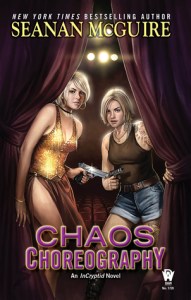
InCryptids! Books #5, 6, 7 in the delightful series by Seanan McGuire: Saving the super awesomeness for last! I couldn’t help myself — I binged my way through the remaining 3 books in the InCryptid series, and now I’m stuck waiting for the next new book, which doesn’t come out until 2019. Sob. This series is just so much fun. Chaos Choreography goes back to the original lead character, Verity Price, who battles snake-god-summoning idiots while competing in a reality TV dance competition. Weird, wonderful, absolutely delicious. In books 6 and 7 (Magic for Nothing and Tricks for Free), the focus shifts to Verity’s younger sister Antimony, who ends up joining a carnival and later, working at a Florida theme park that’s almost (but not quite) Disney World. The magic at this kingdom is not particularly friendly, mayhem ensues… and there’s plenty of trapeze work and roller skating too. Oh, and an awesome boyfriend who has quite a few secrets of his own. The InCryptid series, about a family of cryptozoologists who battle evil in order to keep the world safe for all sentient creatures, is silly and funny and totally hilarious — but also contains moments of real emotion and pathos. And hey — talking mice!


And that’s what I read while I was away! No matter how busy we were, I always managed to sneak away here and there for a bit of reading in the sun. Bliss!

Save

Save

Save

Save

Book Review: A Civil Contract by Georgette Heyer


Can the wrong bride become the perfect wife?

Adam Deveril, the new Viscount Lynton, is madly in love with the beautiful Julia Oversley. But he has returned from the Peninsular War to find his family on the brink of ruin and his ancestral home mortgaged to the hilt. He has little choice when he is introduced to Mr. Jonathan Chawleigh, a City man of apparently unlimited wealth and no social ambitions for himself-but with his eyes firmly fixed on a suitable match for his only daughter, the quiet and decidedly plain Jenny Chawleigh.

Another great addition to my Georgette Heyer library! Considering that I only read this amazing author for the first time last year, I’ve quickly become a fan.

A Civil Contract is quite fun. Poor Adam, whose father the Fifth Viscount was a gambler and a flagrant spender, is left to deal with overpowering debts upon his father’s death. The family faces financial ruin, including the lost of their beloved country home. What’s more, there is no possible way for Adam to marry his beloved Julia, as he has no means to support her, and even if she claims to be ready to live with Adam in poverty, would never be allowed by her parents to do so.

For a titled gentleman with money problems, there’s really just one acceptable solution: He must marry an heiress. Jenny Chawleigh is the respectable daughter of a very rich merchant whose only aim in life is to see his beloved girl elevated into the upper crust of society. Mr. Chawleigh is able to settle the Lynton debts, and Adam is able to provide Jenny with a title. They’re a mismatched pair, but Jenny’s sweetness and calm competence pave the way for the two of them to begin their married life together.

Of course, Adam never quite gets over his passion for Julia, but Jenny is clever enough to be able to take the drama out of the foiled romance, and she and Adam settle into a pleasant and companionable relationship. It takes the course of the novel for Adam and Jenny to truly develop into a strong couple, but it’s oodles of fun to see them getting there.

The novel contrasts the drama of young, ardent love with the steadiness and support of more mature married affection, and comes down decidedly on the side of the latter. While it irked me that Adam never actually contradicts Jenny when she says she’s not pretty, he treats her with respect, with appreciation, and with affection. Over time, it’s their shared interests, their little jokes, and their alignment in the important things that show that they’re actually well suited after all.

There are plenty of funny moments, especially all the scenes of Adam and Mr. Chawleigh butting heads. Jenny’s father is crass and blunt, but he’s mad about his daughter, and shows his love by buying her the best of everything, even when the best is gaudy, over the top, and simply not what truly elegant people would do. Adam is dignified, born and bred to the upper crust, and it’s constantly amusing to see his reactions to Mr. Chawleigh’s effusiveness. (The bathtub he installs for Jenny is hilarious — I won’t say more than that, but you really need to read about it to appreciate it.)

I love Heyer’s Regency romances, with their depictions of the social classes and the minutiae involved in playing the games of the nobility and gentry. The only downside for me in A Civil Contract were the overlong descriptions of the war against Napoleon — yes, the war is very much on Adam’s mind and has an impact on his fortunes, but I had a hard time keeping my mind from wandering whenever we strayed back into politics and war news.

Of course, if you’ve read and enjoyed other books by Georgette Heyer, this is another excellent one to pick up. It’s sweet and entertaining, and I found it refreshing to read a Heyer book with such a simple and unpretentious heroine.

_________________________________________

The details:

Title: A Civil Contract
Author: Georgette Heyer
Publisher: Sourcebooks Casablanca
Publication date: 1961
Length: 422 pages
Genre: Historical fiction
Source: Purchased

**Save

Save

Save

Save

Save

Save

Save

Laughing too hard to actually write a review of Texts From Jane Eyre


Hilariously imagined text conversations—the passive aggressive, the clever, and the strange—from classic and modern literary figures, from Scarlett O’Hara to Jessica Wakefield.

Mallory Ortberg, the co-creator of the cult-favorite website The Toast, presents this whimsical collection of hysterical text conversations from your favorite literary characters. Everyone knows that if Scarlett O’Hara had an unlimited text-and-data plan, she’d constantly try to tempt Ashley away from Melanie with suggestive messages. If Mr. Rochester could text Jane Eyre, his ardent missives would obviously be in all-caps. And Daisy Buchanan would not only text while driving, she’d text you to pick her up after she totaled her car. Based on the popular web-feature, Texts from Jane Eyre is a witty, irreverent mashup that brings the characters from your favorite books into the twenty-first century.

Ha ha ha.

Man.

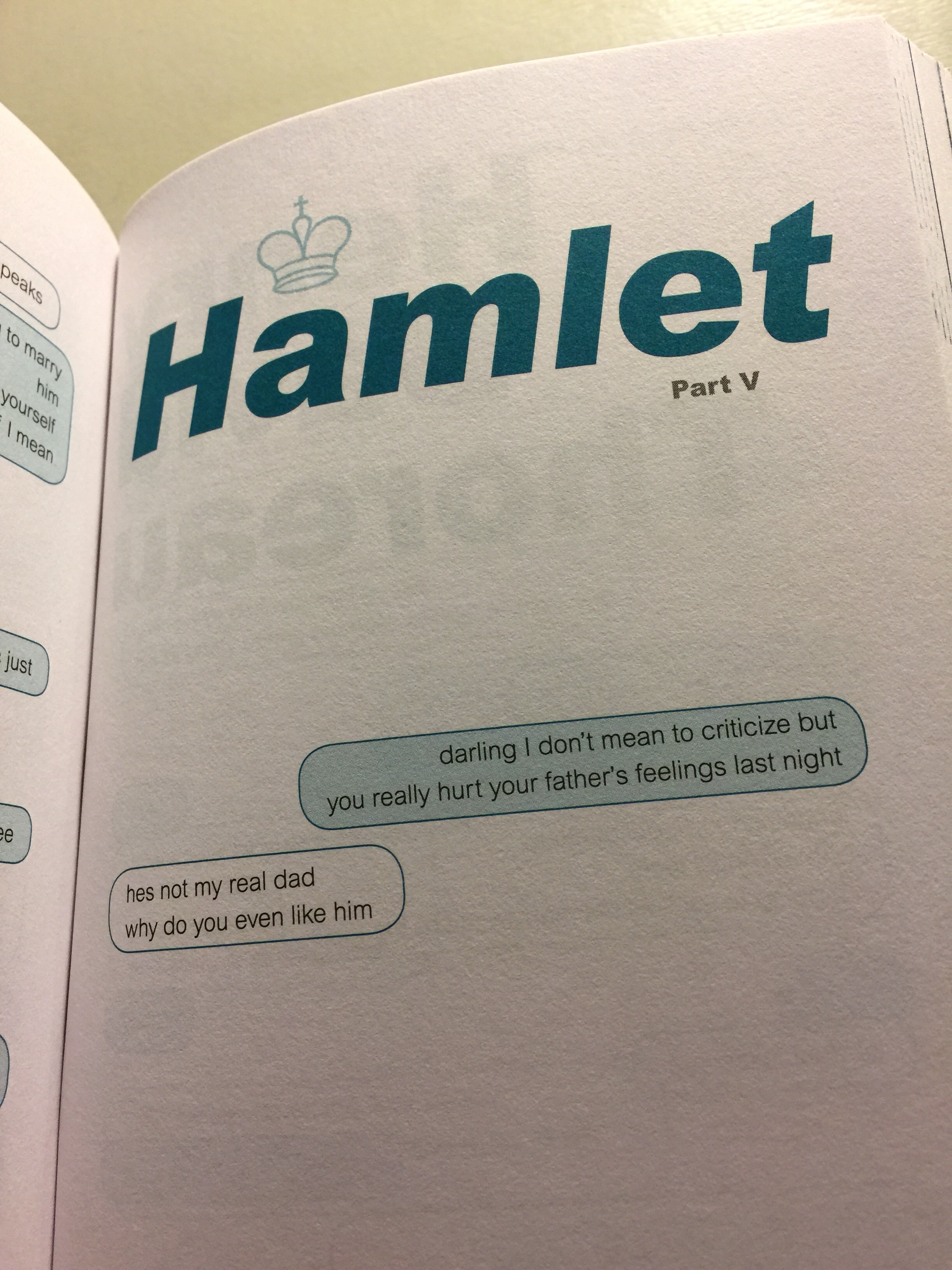
This book is just so much fun. Author Mallory Ortberg has reimagined classics of all ages, from Medea and Gilgamesh to Harry Potter and The Hunger Games, and has put them together in a book that’s almost too great to read in one sitting (but I did it anyway). 

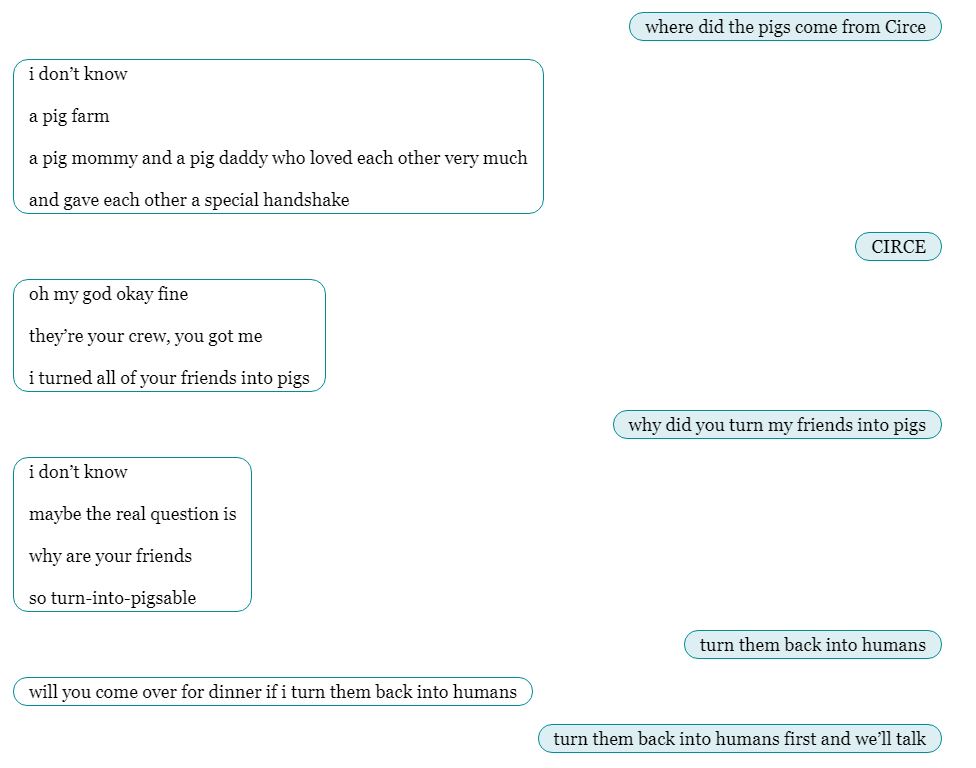
From Circe defending certain poor choices she’s made:

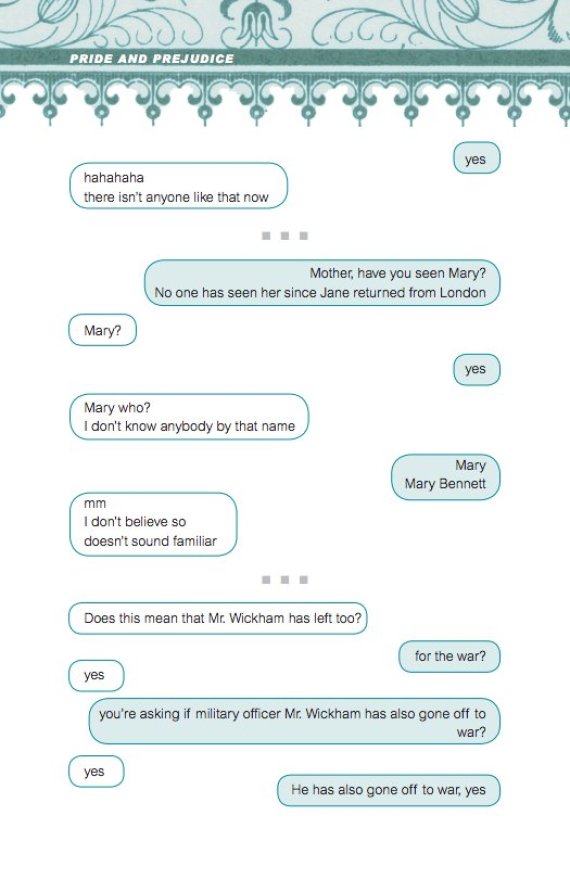
… to Mrs. Bennet being very Mrs. Bennet-ish:

… this book captures the heart and soul of the stories it includes, and makes then just too damned hilarious.


What’s really amazing is that the author clearly knows her stuff, because she absolutely nails the key elements of the stories and the characters, the things that make them unique and recognizable. The texts are clever and so well done — I just couldn’t get enough.

Sure, some of the bits on certain classics went right over my head, since I don’t know the originals, but that didn’t take away any of the enjoyment. This will be one of those books to keep handy and just open up at random once in a while, especially when I need something to brighten up my day.

_________________________________________

The details:

Title: Texts From Jane Eyre
Authors: Mallory Ortberg
Publisher: Henry Holt and Co.
Publication date: November 4, 2014
Length: 226 pages
Genre: Humor
Source: Purchased

**Save

Save

Save

Save

Save

Save

Save