
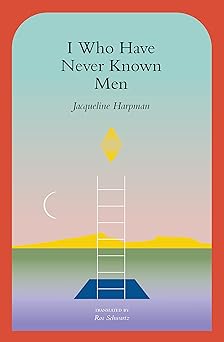
Title: I Who Have Never Known Men
Author: Jacqueline Harpman
Publisher: Transit Books
Publication date: 1995
Length: 173 pages
Genre: Speculative fiction
Source: Purchased
Rating:
Deep underground, forty women live imprisoned in a cage. Watched over by guards, the women have no memory of how they got there, no notion of time, and only a vague recollection of their lives before.
As the burn of electric light merges day into night and numberless years pass, a young girl—the fortieth prisoner—sits alone and outcast in the corner. Soon she will show herself to be the key to the others’ escape and survival in the strange world that awaits them above ground.
Jacqueline Harpman was born in Etterbeek, Belgium, in 1929, and fled to Casablanca with her family during WWII. Informed by her background as a psychoanalyst and her youth in exile, I Who Have Never Known Men is a haunting, heartbreaking post-apocalyptic novel of female friendship and intimacy, and the lengths people will go to maintain their humanity in the face of devastation. Back in print for the first time since 1997, Harpman’s modern classic is an important addition to the growing canon of feminist speculative literature.
Published in 1995, I Who Have Never Known Men came roaring back in recent years as a BookTok sensation. After hearing the buzz from so many sources, I finally decided to check it out for myself.
In this strange, moving, puzzling work of speculative fiction, our unnamed narrator introduces us to a harsh new world. As the story opens, she is one of forty women locked in a cage in an underground bunker, watched constantly by a rotating set of male guards who patrol outside the cage, armed with whips. They do not interact with the prisoners, using the whips to threaten if the women break rules, such as touching, hiding, or expressing strong emotions. The women have been there for years, and have only vague memories of a life before or how they ended up in the cage.
But our narrator is different. Caged as a child, she knows nothing of any other life. The women share stories of families, husbands, homes… but she has no understanding of what these concepts are. As she enters her teen years, she holds herself apart, but eventually learns to count her heartbeats as a way of making sense of the unknowable passage of time. When the routine finally breaks and the guards flee, she’s able to secure the key that will allow them out of the bunker… but the world they find above is not what they expect.
The women are finally free, but for what? They find themselves on a vast plain, with no other people anywhere within sight. Out in the open, but with no direction or answers, they must fend for themselves and find a way to survive yet another type of existence they have no understanding of.
She wondered when it had dawned on us that we were as much prisoners out in the open as we had been behind bars.
The narrator tells the women’s stories through her own unique voice, mostly devoid of emotion, keen to find sense in the vast nothingness, connected to but never quite understanding her companions. As years and then decades pass, the women forge a community together, surviving their isolated existence in a world devoid of other living beings.
What has happened to lead to this point? Where are they? What became of all the other people? Why are there no animals or seasons? Why are there so many bunkers and cages identical to the one they escaped? And why are these bunkers the only buildings they’ve ever found in all their years of wandering?
If you pick up I Who Have Never Known Men expecting answers… well, this isn’t that sort of book. The narrator makes it clear early on that she’s lived a long, strange life, that she’s the last one left, and that she’ll never truly know what happened to the world that came before. This is the only life she knows or remembers. Readers go along with her and the other women as they journey over the course of many years. The narrator’s inner thoughts provide an odd sort of focus, centering this existence through the perspective of someone who begins as a clean slate and finds purpose, skills, and perseverance through sheer stubbornness and an innate sense of curiosity, a desire to learn and understand.
While described as a work of feminist speculative fiction, I don’t know that I’d stick with that label completely. The story’s focus is about the women, first as prisoners and then through the experiences they have once they achieve freedom. And yet, this doesn’t fit the mold of many works of dystopian fiction, in which women are oppressed by a misogynistic, authoritarian society. We really have no idea why the women are in a cage — but as we learn later, the cages aren’t exclusively for women. As this group of women travel and find bunker after bunker, they find many that had once held forty men as prisoners as well. (The cages always hold forty people. Why forty? Yet another unknown.) The reason for the bunkers isn’t necessarily related to misogyny — we get the impression that there was a total collapse of civilization, perhaps war or some other sort of disaster. But I suppose the fact that what we focus on is how this group of women survivors chooses to live and move forward is where the feminist fiction categorization applies. I don’t have a problem with that — it’s just that the book was definitely not what I expected it to be.
That’s a good thing, actually. It’s nice to have expectations turned upside down. Starting a book with no real idea of where it will go and feeling totally immersed along the way is one of the joys of reading, after all. I Who Have Never Known Men is a short book — under 200 pages — that contains powerful language and imagery on every page.
A note on the reading experience: There are no chapter breaks, or even section breaks. This is one long unbroken narrative, as the narrator — approaching the end of her life — thinks back on the earliest days she remembers, already in the cage, and tells the story of everything she’s experienced since then. Being inside her head is a unique, unsettling experience. Yes, I prefer my books to have chapters! But once I got into the rhythm of this story, it moved so quickly that I was willing to just go with it.
I recommend checking out I Who Have Never Known Men. It’s definitely not like anything else I’ve read lately. Thought-provoking and disquieting, this is a book that will stay with you long after reading the final pages.

For more about this book, check out this essay from The New Yorker and this article from The Guardian. More about the book’s resurgence thanks to social media buzz:
Medium
The Cut
Purchase links: Amazon – Audible audiobook – Bookshop.org – Libro.fm
Disclaimer: When you make a purchase through one of these affiliate links, I may earn a small commission, at no additional cost to you.



















 Bookshelf Fantasies