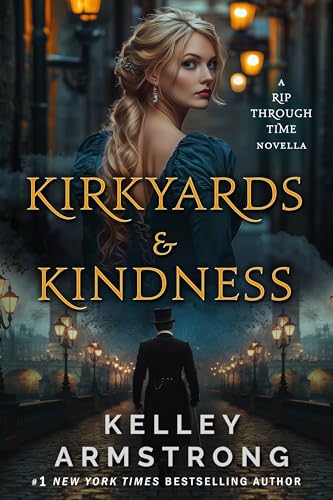
Title: Kirkyards & Kindness Series: A Rip Through Time, #4.5 Author: Kelley Armstrong Publisher: KLA Fricke Inc Publication date: December 2, 2025 Length: 158 pages Genre: Historical fiction / mystery Source: Purchased Rating:
⭐⭐⭐⭐
Rating: 4 out of 5.
Mallory Mitchell and Dr. Duncan Gray take a break from investigating murder to find the most famous dog in Victorian Scotland.
A year ago, twenty-first-century detective Mallory found herself in 1869 Edinburgh, in the body of Catriona Mitchell, a housemade working for Dr. Duncan Gray, pioneer in forensic science. Shortly after she arrived, she made the unfortunate acquaintence of Catriona’s former criminal mentor, Davina, an entanglement that nearly got Mallory killed. Now she’s about to meet Davina again.
Greyfriars Bobby has disappeared. The little terrier is already a legend, and Davina has made a tidy living showing him off on graveyard tours…while picking the pockets of her guests. When the elderly dog vanishes, Davina calls in a favor from her old student. Mallory agrees to help find Bobby in return for the one thing she’s been unable to get from Davina—the mysterious Catriona’s life story.
Kirkyards & Kindness is a sweet little novella that allows readers to spend time in the world of the A Rip Through Time series — without the heavy doses of murder and mayhem that take place in the full-length novels.
Quick explanation of the series: 21st century detective Mallory ends up falling through time into Victorian Edinburgh, where she inhabits the body of a beautiful but nasty housemaid. There, she works with her employer, undertaker/scientist Duncan Gray, to solve crimes while also adapting to life in this very different era and attempting to introduce forensics to Victorian crime scenes.
In Kirkyards & Kindness, Mallory and Duncan are called upon to find a missing dog — the famous Greyfriars Bobby, beloved by locals and tourists alike. The person who hires them is an old associate of the person whose body Mallory inhabits. In exchange for finding Bobby, Mallory will finally have a chance to learn important information about Catriona’s unknown past.
The mystery has a rather jaunty tone, as Mallory and Duncan traverse Edinburgh in search of witnesses and clues. While a crime is discovered and addressed, there are also some rather sweet moments, and it all comes together with a satisfyingly happy resolution.
The novellas in the series are by necessity “extras”, in that they don’t resolve any of the central storylines of the overarching series. Mallory’s future, some abiding unresolved questions, her future with Duncan — all remain to be addressed in the main books of the series. But for reader of the A Rip Through Time books, these novellas are a nice little treat that bridges the waiting time between novels, and it’s always enjoyable to spend time with these characters and enjoy their unique predicaments.
Greyfriars Bobby was a real dog! Bobby was the beloved companion of a police constable in the 1850s. After the death of his owner, Bobby refused to leave his grave, and became a permanent, much loved resident of the Greyfriars Kirkyard. A statue in Bobby’s memory was erected in 1873, and is a popular tourist photo op in Edinburgh to this day.
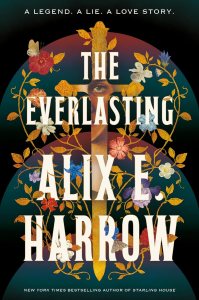
Title: The Everlasting Author: Alix E. Harrow Publisher: Tor Publication date: October 28, 2025 Length: 320 pages Genre: Fantasy Source: Review copy courtesy of the publisher via NetGalley Rating:
⭐⭐⭐⭐⭐
Rating: 5 out of 5.
From Alix E. Harrow, the New York Times bestselling author of Starling House, comes a moving and genre-defying quest about the lady-knight whose legend built a nation, and the cowardly historian sent back through time to make sure she plays her part–even if it breaks his heart.
Sir Una Everlasting was Dominion’s greatest hero: the orphaned girl who became a knight, who died for queen and country. Her legend lives on in songs and stories, in children’s books and recruiting posters―but her life as it truly happened has been forgotten.
Centuries later, Owen Mallory―failed soldier, struggling scholar―falls in love with the tale of Una Everlasting. Her story takes him to war, to the archives―and then into the past itself. Una and Owen are tangled together in time, bound to retell the same story over and over again, no matter what it costs.
But that story always ends the same way. If they want to rewrite Una’s legend―if they want to tell a different story–they’ll have to rewrite history itself.
The Everlasting by Alix E. Harrow is a beautifully written, slow-burn heartbreaker, with time twists that are truly mind-boggling. After finishing the book a few days ago, I’m still trying to put all the pieces together, but I’m also just basking in the overall feel of the story.
The story of Dominion had many villains over the years, shifting along with the borders of her empire, and many storytellers. But it only ever had one hero, and her name was Una Everlasting.
The country of Dominion has a long, bloody history of war and conquest. Generations of soldiers return home damaged mentally and physically, if they return home at all. Historian Owen Mallory is one of these, suffering recurring trauma and carrying scars from his time at the front. Now, he devotes his time to research the foundational national mythology of Dominion — the story of Sir Una Everlasting, the greatest knight the country has ever known.
“In order to have a future worth fighting for, you must have a past worth remembering.”
Everyone knows the story of Una, a young orphan who found greatness after pulling a legendary sword from a tree, then pledging herself to find for her queen and country. Hers is a tale of strength, courage, and devotion. From her battles to her seemingly impossible quests to her tragic death, the tale of Sir Una Everlasting has motivated and inspired the people of Dominion for centuries.
When a mysterious book arrives on Owen’s desk, it seems to hold the answers to his obsessive research: It’s impossible… but it appears to be the story of Una, written in her own time. Such a thing has never been found before, or even rumored to exist. The arrival of the book plunges Owen into a journey through time, as he ends up transported back into Una’s lifetime — where he discovers that there is more to the story than he ever could have imagined.
The intricate storytelling is best experienced without too much information in advance, as seeing it unfold is part of the book’s power. I went into The Everlasting knowing nothing more than what was in the book’s cover blurbs… and found myself both shocked and entranced as the story unfolded.
The Everlasting conveys several powerful themes; among the most fascinating is the power of shared legends to shape history. Countries experience a sense of shared pride in their foundational stories. But what happens when those stories have holes in them, or when the glorious past is perhaps not so glorious after all? The Everlasting shows the power of these stories to motivate, but also to be used to manipulate. In the hands of corrupt, power-seeking leaders, tales of sacrifice and nobility can be the excuse needed to conquer, kill, and engage in endless wars.
The Everlasting is also a love story, which isn’t obvious at the beginning. There’s a slow awakening, a sense of devotion and yearning that builds over time, and ultimately, a gorgeous connection that’s a meeting of hearts, souls, and bodies. And yet, a sense of tragedy hangs over the love story. By the time the love between the characters fully blossoms, we already know that there can be no happy endings for these two.
I love you by then, or would soon, or always had.
In terms of the reading experience, I found the opening chapters a bit slow, but once the book arrives and Owen gets drawn into Una’s story, it’s un-put-down-able. A few oddities make the reading experience challenging but worthwhile: Large chunks of the story are written in the second person, but in places, the person telling the story changes. I had to stop at several points to remind myself of who was narrating a particular section and who the “you” was.
The main challenging aspect is the time factor. Time loops in all sorts of interesting ways, and the weaving and changing of history becomes more and more complicated as the story progresses. I couldn’t always quite make the “how” of it all make sense… but I also couldn’t look away. The puzzle pieces do fit, but at some point, I stopped trying to apply logic to certain elements and just let myself be swept away by the lush, gorgeous writing.
I highly recommend The Everlasting. It’s a remarkable piece of writing, with powerful messages about power, propaganda, and corruption, told through the vehicle of an achingly beautiful love story. This is a story that will stick with me for a long time to come.
Purchase links: Amazon – Audible audiobook – Bookshop.org – Libro.fm Disclaimer: When you make a purchase through one of these affiliate links, I may earn a small commission, at no additional cost to you.
Somewhat accidentally — I really didn’t plan for this to happen! — I ended up reading two light, cute, Austen-inspired romances during my recent vacation. Both were lots of fun. Let’s dive in!
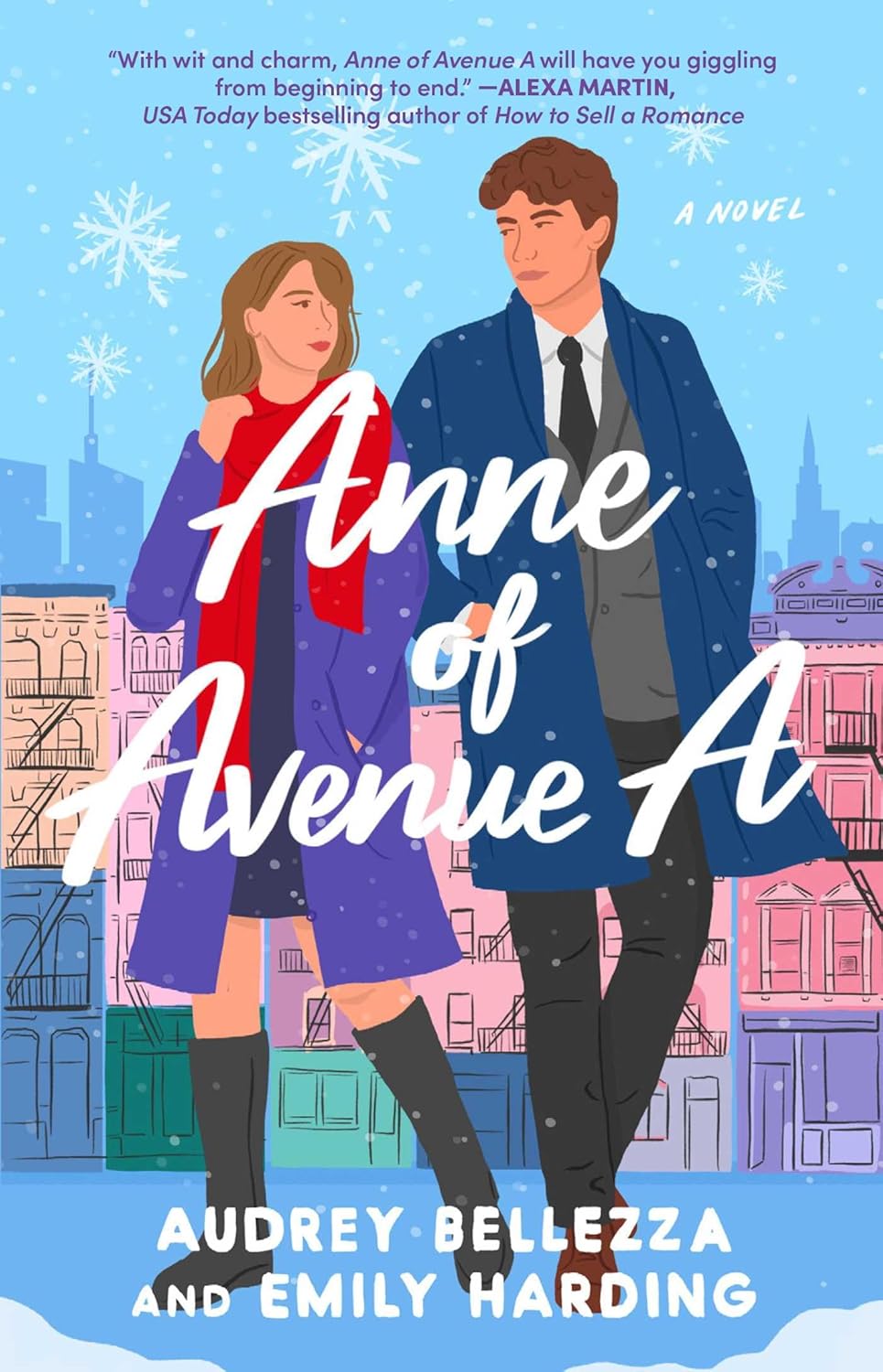
Title:Emma of 83rd Street Series: For the Love of Austen, #1 Authors: Audrey Bellezza and Emily Harding Narrators: Brittany Pressley and Teddy Hamilton Publisher: Gallery Books Publication date: May 23, 2023 Print length: 384 pages Audio length: 10 hours 40 minutes Genre: Contemporary romance Source: Library Rating:
⭐⭐⭐⭐
Rating: 3.5 out of 5.
In this witty and romantic debut novel, Jane Austen’s Emma meets the misadventures of Manhattan’s modern dating scene as two lifelong friends discover that, in the search for love, you sometimes don’t have to look any further than your own backyard.
Beautiful, clever, and rich, Emma Woodhouse has lived twenty-three years in her tight-knit Upper East Side neighborhood with very little to distress or vex her…that is, until her budding matchmaking hobby results in her sister’s marriage—and subsequent move downtown. Now, with her sister gone and all her friends traveling abroad, Emma must start her final year of grad school grappling with an entirely new emotion: boredom. So when she meets Nadine, a wide-eyed Ohio transplant with a heart of gold and drugstore blonde highlights to match, Emma not only sees a potential new friend but a new project. If only her overbearing neighbor George Knightley would get out of her way.
Handsome, smart, and successful, the only thing that frustrates Knightley more than a corked whiskey is his childhood friend, Emma. Whether it’s her shopping sprees between classes or her revolving door of ill-conceived hobbies, he is only too happy to lecture her on all the finer points of adulthood she’s so hell-bent on ignoring. But despite his gripes—and much to his own chagrin—Knightley can’t help but notice that the girl next door is a woman now…one who he suddenly can’t get out of his head.
As Emma’s best laid plans collide with everyone from hipster baristas to meddling family members to flaky playboy millionaires, these two friends slowly realize their need to always be right has been usurped by a new need entirely, and it’s not long before they discover that even the most familiar stories still have some surprises.
Not all contemporary Austen retellings work — the emphasis on marriage can be jarring in a supposedly modern-day setting. And yet, Emma of 83rd Street manages to tell a familiar tale in a way that’s amusing and nicely tailored to today’s world of online dating, high-pressure jobs, and dressing to impress.
The Upper East Side is a natural location for rich, spoiled Emma Woodhouse. Sure, the designer name-dropping gets a bit tedious — but that’s Emma’s world, and feels right for who she is. She’s flighty and meddlesome, thinks she knows what’s best for everyone, and seems to be pursuing a master’s degree in art history mainly for the fun of it… but underneath that shallow exterior, we get to see Emma’s kind heart and her devotion to her friends and family.
I liked that the original cast of characters from Austen are repurposed here in ways that fit the story, given new names and occupations, but remaining true enough to certain essentials to make them recognizable (and fun to spot).
The Knightly relationship has a bit less of an age difference here… and yes, he can be overbearing, but the chemistry with Emma works well, and the progression to romance feels mostly organic. (We see it coming well before either of the characters do.)
A running complaint I have with contemporary Austen retellings is that it can be jarring to see well-loved characters — even modern-day versions of them — hopping into bed together, and that’s true here as well. I could have used a bit less of the details! She may be wearing today’s couture, but she’s still Emma Woodhouse! Closed door would have been better, is all I’m saying.
Overall, Emma of 83rd Street is quite a lot of fun, and the audiobook version’s narrators bring the characters and dialogues to life.
This is apparently the first in a series. I’m on the fence right now about continuing — the wealthy New York setting could get old after a while, I’m afraid. We’ll see; for now, these are on my TBR:
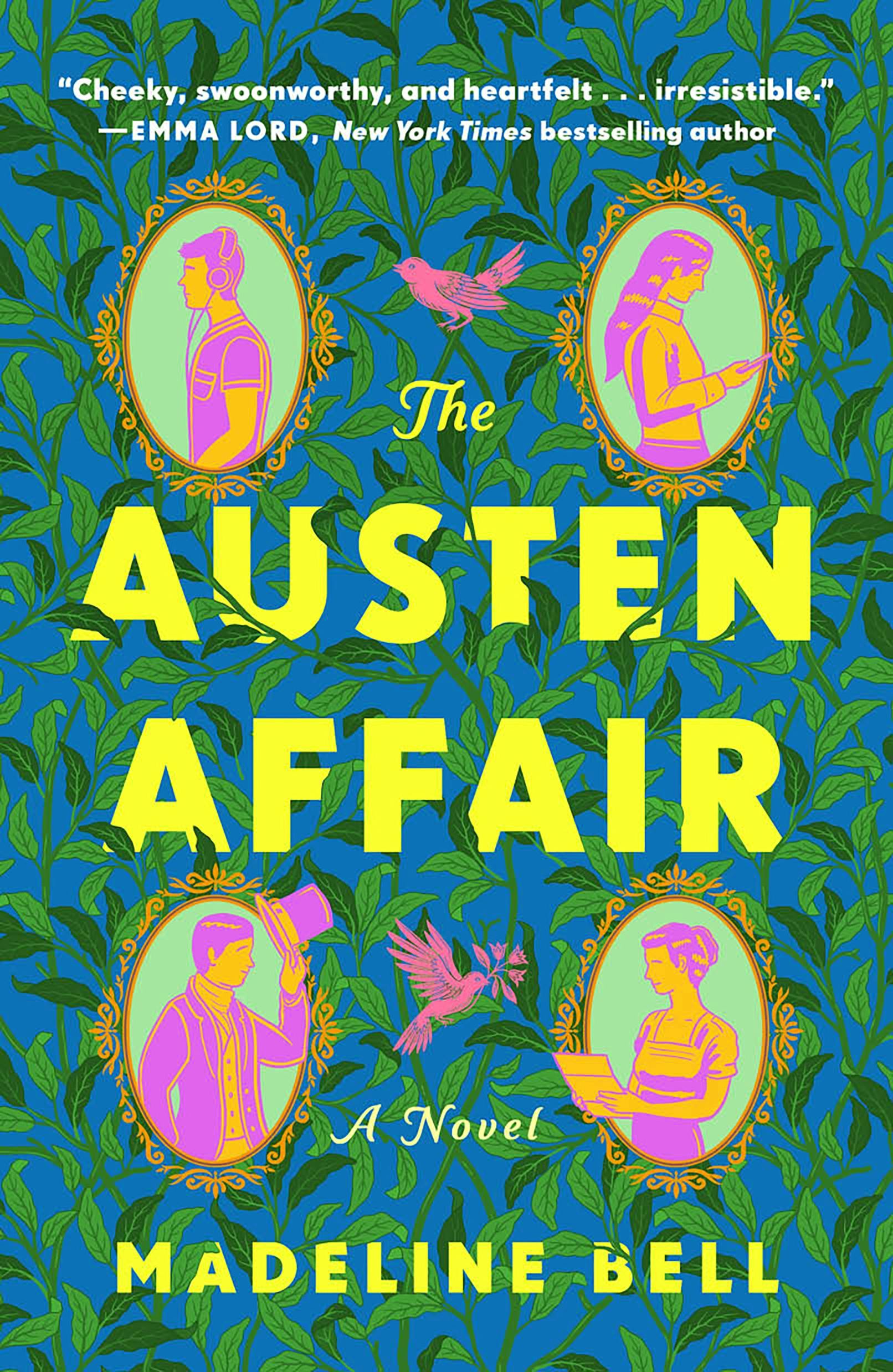
Title:The Austen Affair Author: Madeline Bell Publisher: St. Martin’s Griffin Publication date: September 16, 2025 Length: 336 pages Genre: Contemporary romance Source: Library Rating:
⭐⭐⭐⭐
Rating: 4 out of 5.
Two feuding co-stars in a Jane Austen film adaptation accidentally travel back in time to the Regency Era in this delightfully clever and riotously funny debut
Tess Bright just scored her dream role starring in an adaptation of Jane Austen’s NorthangerAbbey. It’s not just the role of a lifetime, but it’s also her last chance to prove herself as a serious actress (no easy feat after being fired from her last TV gig) and more importantly, it’s her opportunity to honor her mom, who was the biggest fan of Jane Austen ever. But one thing is standing in Tess’s way—well, one very tall, annoyingly handsome person, actually: Hugh Balfour.
A serious British method actor, Hugh wants nothing to do with Tess (whose Teen Choice Awards somehow don’t quite compare to his BAFTA nominations). Hugh is a type-A, no-nonsense, Royal Academy prodigy, whereas Tess is big-hearted, a little reckless, and admittedly, kind of a mess. But the film needs chemistry—and Tess’s career depends on it.
Sparks fly, but not in the way Tess hoped, when an electrical accident sends the two feuding co-stars back in time to Jane Austen’s era. 200 years in the past with only each other to rely on, Tess and Hugh need to ad-lib their way through the Regency period in order to make it back home, and hopefully not screw up history along the way. But if a certain someone looks particularly dashing in those 19th century breeches…well, Tess won’t be complaining.
A wickedly funny, delightfully charming story, The Austen Affair is a tribute to Jane Austen, second chances, and love across the space-time continuum.
The cover of The Austen Affair is what first caught my eye… and then I read the synopsis, and had to laugh out loud. An Austen retelling with time travel?? Yes, please!
In this entertaining story, Tess Bright is in England for the filming of Northanger Abbey. Playing Catherine Morland is her dream role, and also a tribute to her late mother, whose love of Jane Austen was a constant for Tess throughout her childhood. Mired in grief, Tess has all but tanked her career, and this film may be her very last chance to prove to herself (and all the vicious naysayers) that she’s worth taking seriously.
Filming does not get off to a good start, thanks to tension (and not the good kind!) with her costar, Hugh Balfour. Hugh is an uptight, classically trained Method actor who thinks Tess is flighty and chaotic, and doesn’t believe she knows her Austen from her elbow. When a freak electrical accident flings them back in time 200 years, Hugh and Tess are forced to rely on one another as they attempt to fit in in their new setting, convince Hugh’s ancestors that they’re who they say they are, and figure out how to get back to their real lives.
Tess and Hugh seem ill-suited at first, but as they adapt to their new circumstances, their animosity peels away. Each is revealed to have more depth than the other originally perceived, and their forced proximity turns into friendship, understanding, and a sense of support and respect.
The time travel conundrums are quite fun, as is Tess’s delight at finding herself living out her Regency-era dreams, down to the bonnets and gloves and games of whist. While there’s a lot of silliness on the surface, we see how Tess’s grief is a constant for her, and how living in Austen’s world helps her find joy in remembering her mother.
I didn’t necessarily buy everything in this story, especially Tess’s insistence that the universe and/or her mother intentionally caused the time travel… but overall, the romance, the family complications, and the focus on Jane Austen really work well.
The Austen Affair is a sweet, engaging, funny book with a warm heart. Sure, the time travel mechanics are worthy of a few eye-rolls… but this is romantic fiction, not sci-fi. Suspend your disbelief, and just go along for the ride!
Save
Purchase links: Disclaimer: When you make a purchase through one of these affiliate links, I may earn a small commission, at no additional cost to you.
Top Ten Tuesday is a meme hosted by That Artsy Reader Girl, featuring a different top 10 theme each week. This week’s topic is a Genre freebie, with the prompt: Pick any genre you’d like and build a list around it. You can even narrow the topic if you’d like, such as: thrillers with unreliable narrators, fantasy romance with fae characters, or historical romance with suspense elements.
I considered and discarded a bunch of options before settling on time travel as my theme for the week. I’m sure I must have covered this topic before — many times!! — but it’s just such a good one, and there are always more books to add.
Here are some favorite, beloved time travel books*… plus a smaller handful that I read but didn’t love, although in most cases, there were at least a few elements to appreciate.
*Technically, these aren’t all exactly time travel. Some just have time-related weirdness (such as extraordinarily long lives) that make me include them in this category!
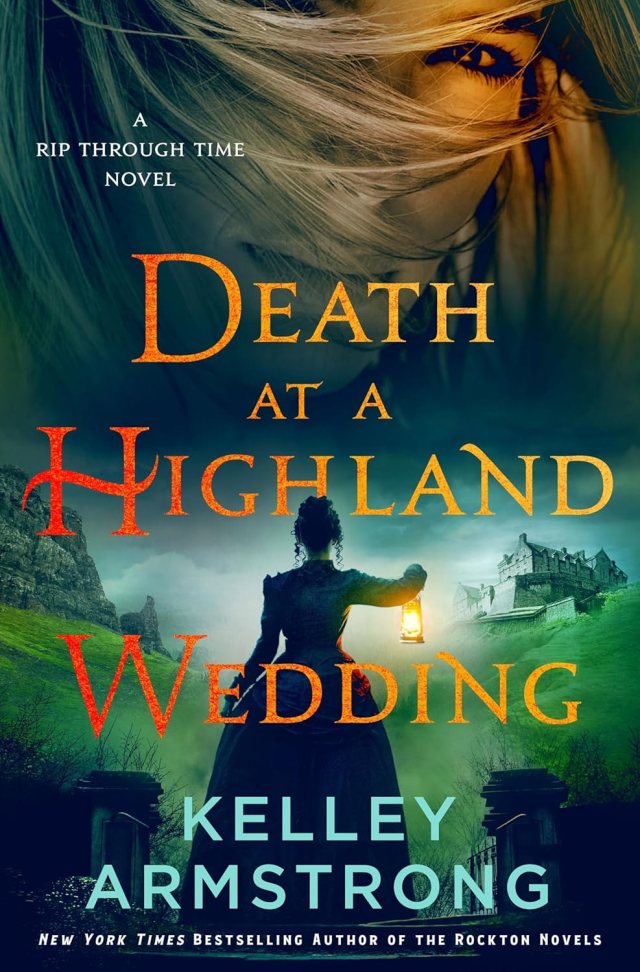
Title: Death at a Highland Wedding Series: A Rip Through Time, #4 Author: Kelley Armstrong Publisher: Minotaur Books Publication date: May 20, 2025 Length: 336 pages Genre: Historical fiction/mystery Source: Review copy courtesy of the publisher via Netgalley Rating:
⭐⭐⭐⭐⭐
Rating: 4.5 out of 5.
Death at a Highland Wedding is the fourth installment in New York Times bestselling author Kelley Armstrong’s gripping Rip Through Time Novels.
After slipping 150 years into the past, modern-day homicide detective Mallory Atkinson has embraced her new life in Victorian Scotland as housemaid Catriona Mitchel. Although it isn’t what she expected, she’s developed real, meaningful relationships with the people around her and has come to love her role as assistant to undertaker Dr. Duncan Gray and Detective Hugh McCreadie.
Mallory, Gray, and McCreadie are on their way to the Scottish Highlands for McCreadie’s younger sister’s wedding. The McCreadies and the groom’s family, the Cranstons, have a complicated history which has made the weekend quite uncomfortable. But the Cranston estate is beautiful so Gray and Mallory decide to escape the stifling company and set off to explore the castle and surrounding wilderness. They discover that the groom, Archie Cranston, a slightly pompous and prickly man, has set up deadly traps in the woods for the endangered Scottish wildcats, and they soon come across a cat who’s been caught and severely injured. Oddly, Mallory notices the cat’s injuries don’t match up with the intricacies of the trap. These strange irregularities, combined with the secretive and erratic behavior of the groom, put Mallory and Duncan on edge. And then when one of the guests is murdered, they must work fast to uncover the murderer before another life is lost.
New York Times bestselling author Kelley Armstrong’s unique time travel mystery series continues to entertain as Mallory adjusts to life in the 1870s.
How to talk about the 4th book in a series? I’m tempted to simply say: Read this. It’s good! But no, I’ll attempt to explain why its so good, and why this is a must-read series.
Death at a Highland Wedding is the 4th full-length novel in Kelley Armstrong’s excellent A Rip Through Time series. (There are also a few novellas that serve as little side treats in between the main books).
In this series, Mallory Atkinson, 21st century homicide detective, accidentally crosses through a time anomaly and finds herself in Victorian Era Edinburgh, inhabiting the body of a beautiful but deceitful young housemaid. Four books into the series, the housemaid’s employer has accepted the weird-but-true fact that the person who looks like his maid is actually a highly trained, highly independent detective from 150 years in the future. Mallory has been “promoted” to assistant to her employer, Duncan Grey, an undertaker, trained physician, and lover of science and scientific inquiry. Because Duncan assists his best friend Hugh McCreadie with police investigations, Mallory is able to be of service — and introduces them to all sorts of 21st century forensic procedures not even dreamed of in Victorian times.
As Death at a Highland Wedding opens, Mallory has been living in this time period for about a year, and the household, along with Hugh, is taking a vacation of sorts. An old friend of Duncan and Hugh’s is getting married at his Highlands estate, and this is an opportunity for Mallory to experience yet another aspect of her new life.
At the estate, however, things quickly go off the rails. First, there’s an unpleasant groundskeeper who sets wickedly dangerous traps all over the property. There’s also some tension amongst the party attending the wedding, as former lovers and friends and connections intertwine in uncomfortable ways. The entire wedding is on the verge of cancellation once a dead body is discovered — it’s the best man, killed while out at night wearing the groom’s coat. Who was the true intended victim, what was the motive, and who could have carried out the violent act?
Hugh, Duncan, and Mallory seem like the obvious team to solve the mystery, but the young, inexperienced local constable has jurisdiction, and doesn’t want outside interference. When he bungles the process — badly — our trio undertake their own investigation on the down-low, trying to solve the murder while not letting the constable know what they’re up to.
In a house full of potential suspects and plenty of motives, Mallory et al have almost too many trails to follow. There are red herrings galore, and plenty of scandals to unearth — and naturally, the closer they get to the truth, the more they themselves are in danger.
Ah, this book is such delicious fun! First, the mystery itself is surprisingly twisted. What at first seems like a classic country house murder mystery is revealed to be that, but dialed up to eleven. I loved the fact that my guesses continually turned out to be wrong! Every time I was sure I knew who was particularly shady or dishonest or underhanded, something else popped up to steer me in a different direction. It’s a treat to read a mystery and not see the big reveals coming.
Second, and for me, the absolute best, is the ongoing delight of seeing Mallory navigate her new world. In previous books, it seemed that she’d have an option to return to her own time, but here, she’s fully convinced that she’s where she needs to be. There’s a slow-burn romance with Duncan, which is complicated for many reasons, and they’re both thoughtful enough to avoid bad decisions or letting their emotions cloud their judgment.
Then there’s the fun of Mallory using her 21st century police tactics in this setting — for example, explaining how (and why) to cordon off a crime scene or doing a rudimentary version of taking fingerprints. Seeing the cultures collide and the sharing of tactics and knowledge keeps the storytelling funny in dark moments, and gives Mallory a chance to shine and be appreciated for who she is.
As you can see, I love this series! As I’ve said in all of my reviews so far, you really must start at the beginning! Yes, this one might work as a stand-alone if you’re only interested in the murder mystery itself, but I honestly don’t think the book as a whole would make a ton of sense. The series is just so good — so dive into book #1, and keep going!
Now that I’ve finished Death at a Highland Wedding, I’ll be eagerly awaiting the next installment in the series. Highly recommended!
Purchase links: Amazon – Bookshop.org – Libro.fm Disclaimer: When you make a purchase through one of these affiliate links, I may earn a small commission, at no additional cost to you.
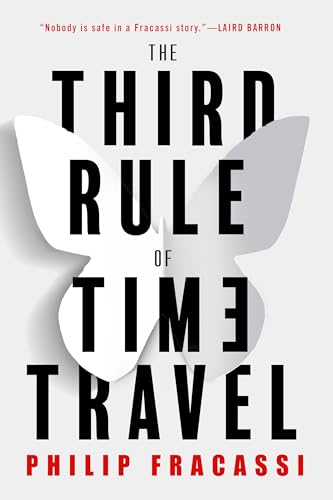
Title: The Third Rule of Time Travel Author: Philip Fracassi Publisher: Orbit Publication date: March 18, 2025 Length: 325 pages Genre: Science fiction Source: Review copy courtesy of the publisher via NetGalley Rating:
⭐⭐⭐⭐
Rating: 3.5 out of 5.
Rule One: Travel can only occur to a point within your lifetime. Rule Two: You can only travel for ninety seconds. Rule Three: You can only observe. The rules cannot be broken.
In this riveting science fiction novel from acclaimed author Philip Fracassi, a scientist has unlocked the mysteries of time travel. This is not the story you think you know. And the rules are only the beginning.
Scientist Beth Darlow has discovered the unimaginable. She’s built a machine that allows human consciousness to travel through time—to any point in the traveler’s lifetime—and relive moments of their life. An impossible breakthrough, but it’s not perfect: the traveler has no way to interact with the past. They can only observe.
After Beth’s husband, Colson, the co-creator of the machine, dies in a tragic car accident, Beth is left to raise Isabella—their only daughter—and continue the work they started. Mired in grief and threatened by her ruthless CEO, Beth pushes herself to the limit to prove the value of her technology.
Then the impossible happens. Simply viewing personal history should not alter the present, but with each new observation she makes, her own timeline begins to warp.
As her reality constantly shifts, Beth must solve the puzzles of her past, even if it means forsaking her future.
The Third Rule of Time Travel is a fast-paced, compelling story about (obviously) time travel, altered realities, consequences, and corporate greed. You won’t want to stop once you start… but when you do take the inevitable pause, there’s room enough for some doubts and quibbles to slide in.
Beth Darlow and her late husband Colson have done the seemingly impossible. They’ve created a time travel machine, but it’s not like something out of H. G. Wells or Doctor Who. The “traveler” doesn’t actually — physically — go anywhere at all. Instead, using negative energy, the traveler’s consciousness is sent through a wormhole into their own past. The destination can’t be set in advance; the machine targets a random point in the traveler’s life, where they relive the event they’ve already experienced. It’s like they become a visitor to themselves — they see what’s going on from behind their own eyes, but they’re a second consciousness present in the moment.
The traveling has absolute rules — the traveler is powerless to actually change anything or interact with the moment they’re visiting, and they can only visit for 90 seconds, which is all the machine can sustain. What would happen if they’re not pulled back within 90 seconds? Beth’s not really sure… but the guess is, it would be disastrous for the traveler, and could result in their consciousness never returning to their body.
Years earlier, Beth and Colson sold their machine to the Langan Corporation in order to get the funding investment needed to continue their work. Jim Langan, the CEO, treats them like his prize pet scientists and keeps the money flowing — but something seems to be going wrong at Langan. Fewer and fewer cars are in the employee parking lot, security is even tighter than ever, and long-time colleagues seem to be disappearing as projects are cancelled and departments close. When Jim starts pressuring Beth to move faster and to show the machine to a hand-picked reporter, Beth balks at the idea, but she really has no choice. Forced to travel more often than is safe, Beth’s experiences leave her emotionally battered… and worse, seem to have had consequences that no one expected.
The action in The Third Rule of Time Travel is nonstop, making for a propulsive reading experience. The story is fascinating, and the author does a great job of weaving together Beth’s professional and personal lives. She’s a hard-charging, brilliant scientist, but she’s also devoted to her young daughter and is a loving mother, although getting home from the lab in time for dinner and bedtime with Isabella is a challenge.
As the continued traveling starts to unravel Beth’s life, causing her emotional distress, physical exhaustion, and questions about pieces that seem to have gone missing, the stakes get higher and higher. Traveling via the machine is supposed to be purely observational… but after each round of travel, Beth feels as though something isn’t right. Could the machine have done something unimaginable — could visiting the past have changed Beth’s present?
I mostly enjoyed this book, and really couldn’t stand having to put it down and take breaks for, you know, life and stuff. Still, I had some quibbles, especially later in the book, that make me drop my star rating a bit:
The purpose of the machine doesn’t really make sense. Maybe as a first step toward achieving actual time travel, but I fail to see the point of witnessing random past moments for 90 seconds. Call me a skeptic — I didn’t buy how the machine is treated as the most significant scientific achievement of all time.
When I read books like this, at some point the science-y bits go over my head and I just have to accept that things like negative energy and quantum entanglement and wormholes make sense as depicted. Even so, the book’s approach to altered realities, with a hint of higher powers and cosmic woo-woo, rang a bit false. Some elements just don’t quite fit together.
Certain characters play a role and are never mentioned again; some scenes aren’t quite explained.
The CEO, the clear villain of the piece, is so mustache-twirlingly evil by the end that it’s a bit comical. He even gets to do some villain monologuing, and it feels quite over the top.
I didn’t buy the ending. Can’t say why, without getting into spoilers, but it all felt a bit neat and convenient..
Okay, that’s a whole bunch of quibbles; hence my 3.5 stars. I enjoyed myself while reading The Third Rule of Time Travel, but my doubts about some of the plot elements kept me at a distance, and the final third or so of the book felt less credible the further along it went.
Still, as someone who’s read a lot of variations on the time travel theme, I was interested in this different approach, and felt invested in the characters’ lives and dilemmas — and couldn’t peel my eyes away once the unintended consequences started to pile up. Readers who enjoy speculative sci-fi — and the brain twistiness of thinking about alternate realities — will likely find plenty to puzzle over and savor with The Third Rule of Time Travel.
Purchase links: Amazon – Bookshop.org This post contains affiliate links. If you click and buy, we may earn a small commission at no extra cost to you.
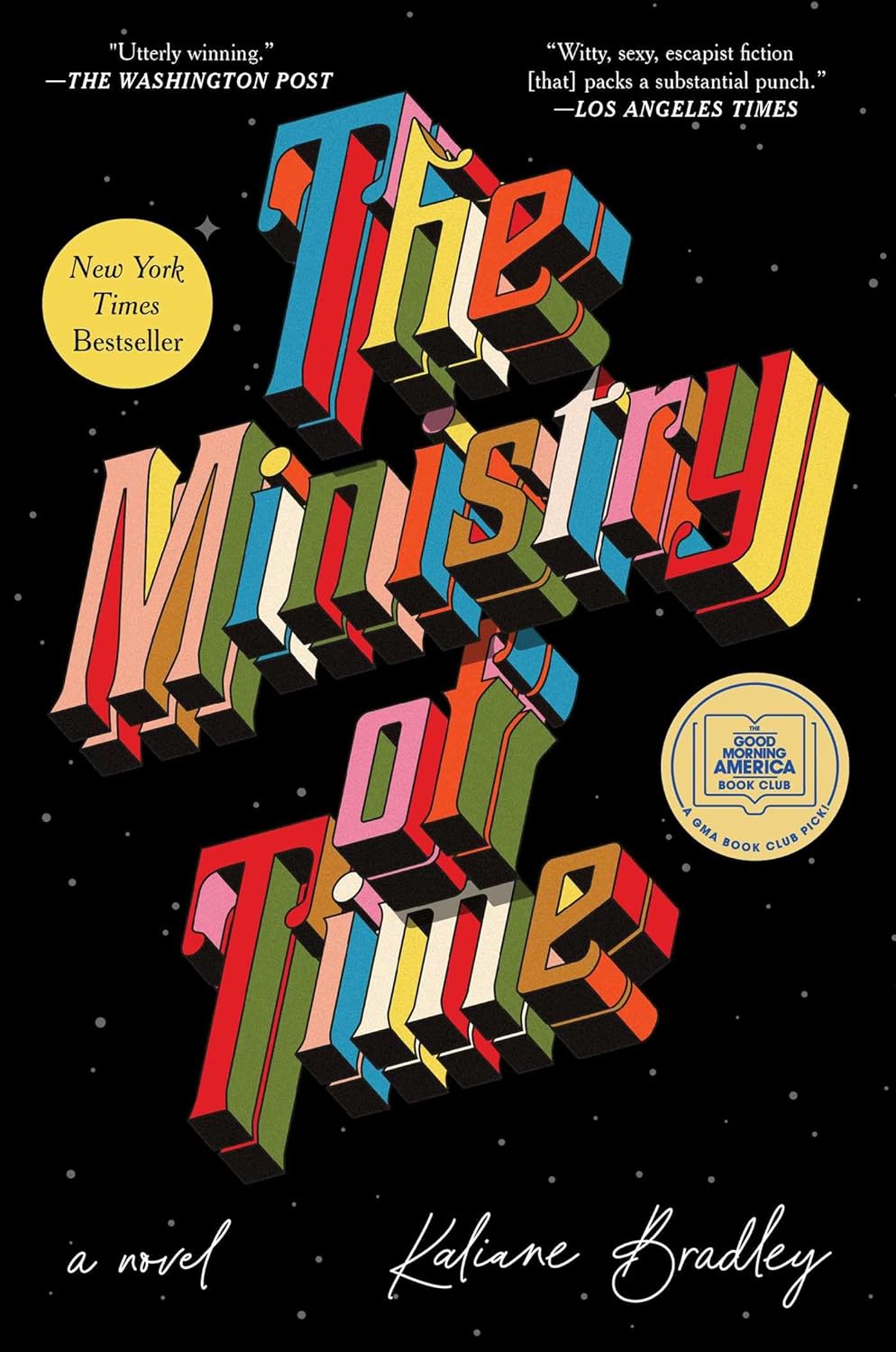
Title: The Ministry of Time Author: Kaliane Bradley Publisher: Simon & Schuster Publication date: May 7, 2024 Length: 352 pages Genre: Science fiction Source: Purchased Rating:
⭐⭐⭐
Rating: 3 out of 5.
A time travel romance, a spy thriller, a workplace comedy, and an ingenious exploration of the nature of power and the potential for love to change it all:
In the near future, a civil servant is offered the salary of her dreams and is, shortly afterward, told what project she’ll be working on. A recently established government ministry is gathering “expats” from across history to establish whether time travel is feasible—for the body, but also for the fabric of space-time.
She is tasked with working as a “bridge”: living with, assisting, and monitoring the expat known as “1847” or Commander Graham Gore. As far as history is concerned, Commander Gore died on Sir John Franklin’s doomed 1845 expedition to the Arctic, so he’s a little disoriented to be living with an unmarried woman who regularly shows her calves, surrounded by outlandish concepts such as “washing machines,” “Spotify,” and “the collapse of the British Empire.” But with an appetite for discovery, a seven-a-day cigarette habit, and the support of a charming and chaotic cast of fellow expats, he soon adjusts.
Over the next year, what the bridge initially thought would be, at best, a horrifically uncomfortable roommate dynamic, evolves into something much deeper. By the time the true shape of the Ministry’s project comes to light, the bridge has fallen haphazardly, fervently in love, with consequences she never could have imagined. Forced to confront the choices that brought them together, the bridge must finally reckon with how—and whether she believes—what she does next can change the future.
In The Ministry of Time, five people are yanked out of their lives in past centuries and pulled into 21st century England, to live as “expats” — term the Ministry deems most acceptable for describing these people forced to live in a time not their own.
The 21st century world is similar to our present day, but perhaps a few more decades farther down the road, if the cataclysmic weather events and political strife are indicators. The expats — from the 15th, 18th, 19th, and 20th centuries — are each assigned “bridges”: Ministry agents who live with their assigned expat and help them assimilate into their new worlds.
There’s much at stake: Those who fail to adjust and somehow get a grip on “hereness” — belonging where they are — are likely to get rejected by the current time, almost like an infection being rejected by a body’s antibodies. For the unnamed main character, a woman who jumps at the job offer mainly because of the large salary that goes with it, the task is frustrating and daunting. Her assignment is Graham Gore, a member of the doomed Franklin expedition of the mid-1800s, who’s pulled from the Arctic through a time door, leaving behind the men under his command. Gore is disoriented and belligerent, but with the help of his bridge, begins to learn more about the maddening world he now inhabits.
The Ministry of Time covers interesting ground, with an approach I haven’t seen before in time travel fiction. The book isn’t particularly concerned with the technology of it all. There’s a time door and a device that enables the time travel, but don’t look for explanations — this isn’t that sort of book.
Despite the science fiction trappings, this is instead a work of literary fiction exploring the implications of moving through time, changing the past and the future, and the experiences of belonging, being a refugee, and looking for a home.
As someone who doesn’t normally gravitate toward literary fiction, I must admit that I often found the writing style annoyingly opaque.
Quentin treated me with an impatient familiarity, as if we were both sticky and were leaving streaks on each other.
Throughout the book, I’d come across phrases and passages that made me stop and wonder — is it me, or does this not make any sense? There are words put together in interesting ways, yet I could not find meaning in them.
He blushed with his face on mute.
While sections of the the book felt like a slog, at times I became more invested, particularly in the latter half of the book, when both danger and emotions are heightened and the overall stakes are much more intense. And yet, I couldn’t entirely grasp the implications of the ending, and large chunks of the plot felt a bit half-baked to me. Perhaps this is the non-sci-fi factor: As a fan of science fiction, I expect a certain level of detail — the sci-fi elements need to have enough grounding to feel possible or at least make sense in the context of the world being described. In The Ministry of Time, the time travel is just a fact, the central device that drives the story, and the lack of specificity annoyed me.
By and large, though, it comes back to the writing, which generally did not work for me:
She looked like her organs had been removed and placed in cold storage; worse, like it had happened when she was on her way to what she thought was a birthday party.
There are examples upon examples of descriptions that probably are meant to be clever, but which feel meaningless to me. I read the sentence above multiple times — I still have no idea what the person being described might actually look like in this instance.
The Ministry of Time was one of my more eagerly anticipated reads for winter. Now that I’ve read it, I can’t help feeling let down. I expected something very different than what I got. Overall, while I enjoyed certain elements of the story and was very interested in some of the characters, the storytelling style kept me from truly engaging.
I know this book generated a lot of buzz when it came out and has oodles of fans. I don’t regret reading it, but it won’t be on any of my “best of” lists for 2024.
Title: Before the Coffee Gets Cold Author: Toshikazu Kawaguchi Publisher: Picador Publication date: September 19, 2019 Length: 213 pages Genre: Contemporary fiction Source: Purchased Rating:
⭐⭐⭐⭐⭐
Rating: 4.5 out of 5.
What would you change if you could go back in time?
In a small back alley in Tokyo, there is a café which has been serving carefully brewed coffee for more than one hundred years. But this coffee shop offers its customers a unique experience: the chance to travel back in time.
In Before the Coffee Gets Cold, we meet four visitors, each of whom is hoping to make use of the café’s time-travelling offer, in order to: confront the man who left them, receive a letter from their husband whose memory has been taken by early onset Alzheimer’s, to see their sister one last time, and to meet the daughter they never got the chance to know.
But the journey into the past does not come without risks: customers must sit in a particular seat, they cannot leave the café, and finally, they must return to the present before the coffee gets cold . . .
Toshikazu Kawaguchi’s beautiful, moving story explores the age-old question: what would you change if you could travel back in time? More importantly, who would you want to meet, maybe for one last time?
I’ve been hearing about Before the Coffee Gets Cold for years now, and finally made the time to sit and enjoy this cozy, sweet tale.
The setup is simple: A tiny basement cafe in Tokyo has only three tables plus a counter, has three clocks on the wall that show different times (although no one knows why), and is the focus of an urban legend that just happens to be true:
If you sit in a particular chair and focus on a time you want to visit, you can travel to the past — but you can’t leave that chair, nothing you do actually changes the future, and you have to finish your coffee before it gets cold, at which point you return to the present.
For many people, the rules are deal-breakers. What’s the point of going back in time if you can’t actually change anything? But as we see through the four chapters of this slim book, each of which highlights a different person’s reason for time traveling, there’s much to be gained with an open heart and open mind.
At just over 200 pages, Before the Coffee Gets Cold is a fast read, and it felt easy and natural to read it pretty much straight through. The storyline is very calm — there’s little action here; rather, it’s a book about connections, emotions, and getting the chance to say the things we wish we’d said in the first place.
Without going into details about the characters and their particular stories, I’ll just say that the cafe staff and its regular visitors have simple yet strong connections, and as their stories unfold, the emotional impact builds as well.
Before the Coffee Gets Cold is a lovely, sweet reading experience — a warm hug of a book that I recommend enjoying on a day when you especially need something bright and uplifting.
Since Before the Coffee Gets Cold was published, four more books have been added to the series. Before the Coffee Gets Cold feels very complete on its own, so while I’d like to eventually read more of these books — assuming the rest will be as lovely as the first! — I feel like I can take my time and pick up the next book on a whim, on a day when I need it.
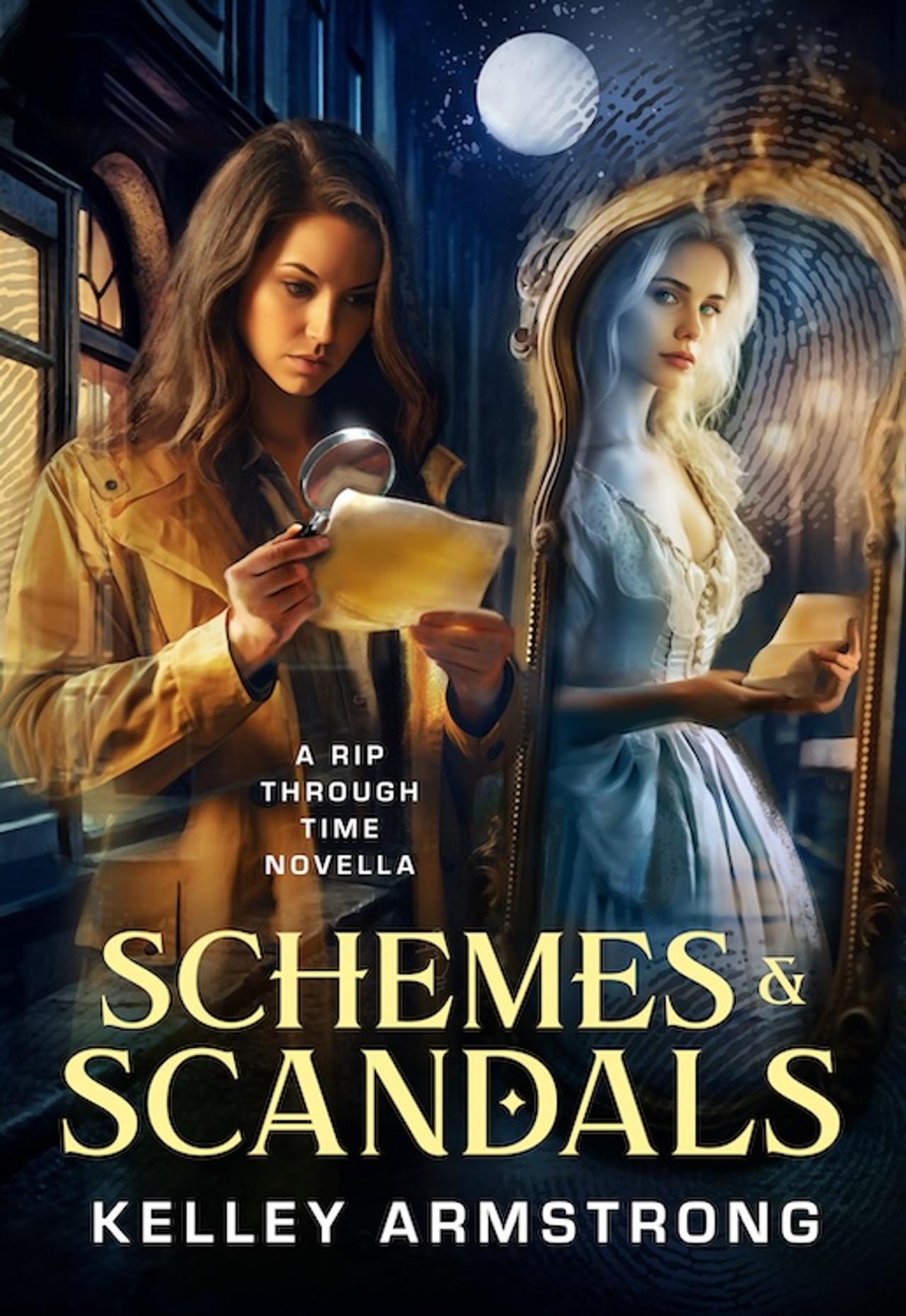
Title: Schemes & Scandals Series: A Rip Through Time, #3.5 Author: Kelley Armstrong Publisher: Subterranean Press Publication date: October 31, 2024 Length: 176 pages Genre: Historical fiction / mystery Source: Review copy courtesy of the publisher via NetGalley Rating:
⭐⭐⭐⭐⭐
Rating: 4.5 out of 5.
It’s Mallory Atkinson’s first Christmas in Scotland. Victorian Scotland, that is. Also, as the twenty-first-century detective learns, Christmas really isn’t a thing in Victorian Scotland. It’s all about Hogmanay. But her boss, Dr. Duncan Gray, treats her to an early gift of tickets to the event of the season: a Charles Dickens reading. There, they bump into Lady Inglis—the lovely widow who has sent Gray sexy letters trying to entice him back to her bed.
Lady Inglis introduces Mallory to Dickens—the meeting of a lifetime—but in return she wants their help. She’s being blackmailed. Someone stole letters she wrote to another lover and is threatening to publish them.
Mallory isn’t sure what to make of Lady Inglis, but no woman deserves that, so she insists on taking the case with or without Gray’s help. Growing tension between them soon tells Mallory that Gray is hiding a secret of his own. She has until Hogmanay to uncover the blackmailer…and, hopefully, to put things right with Gray so they can enjoy the holiday together.
Schemes & Scandals is a holiday treat that ties in perfectly with the A Rip Through Time series. In the series, 21st century detective Mallory ends up falling through time into Victorian Edinburgh, where she inhabits the body of a beautiful but nasty housemaid. (Trust me, it makes sense if you read the series from the beginning).
Here, following the 3rd full novel in the series, Mallory is well-established within the Gray household, working as an assistant to undertaker/scientist Duncan Gray, who has a side gig consulting with the police force. Duncan and his sister Isla know the truth about Mallory, and value her modern knowledge of forensics and police procedures as they apply science to Victorian crime scenes.
In Schemes & Scandals, Mallory and Duncan agree to help thwart a blackmailer who threatens a former lover of Duncan’s. The case is clever, and provides plenty of opportunities for Mallory to explore new aspects of Edinburgh society.
As a novella, Schemes & Scandals must fit a full detective story into a condensed amount of pages, and it succeeds admirably. The mystery/crime story is lots of fun — and since this novella is holiday-themed, the mood stays mostly upbeat, without endangering our heroes or involving them in anything too sinister.
The Christmas and Hogmanay elements are nice touches, and the encounter with Charles Dickens is a highlight — especially seeing Mallory’s expectations bumping up against the reality of a sold-out Victorian-era author appearance.
I am treated — if that’s the word — to the most gonzo reading a A Christmas Carol ever.
Schemes & Scandals is a great addition to a terrific series. I suppose someone could pick up this novella as a stand-alone and enjoy it, but they’d be missing a ton of context and character development. My recommendation? Start at the very beginning, with A Rip Through Time. Trust me — you won’t want to stop.
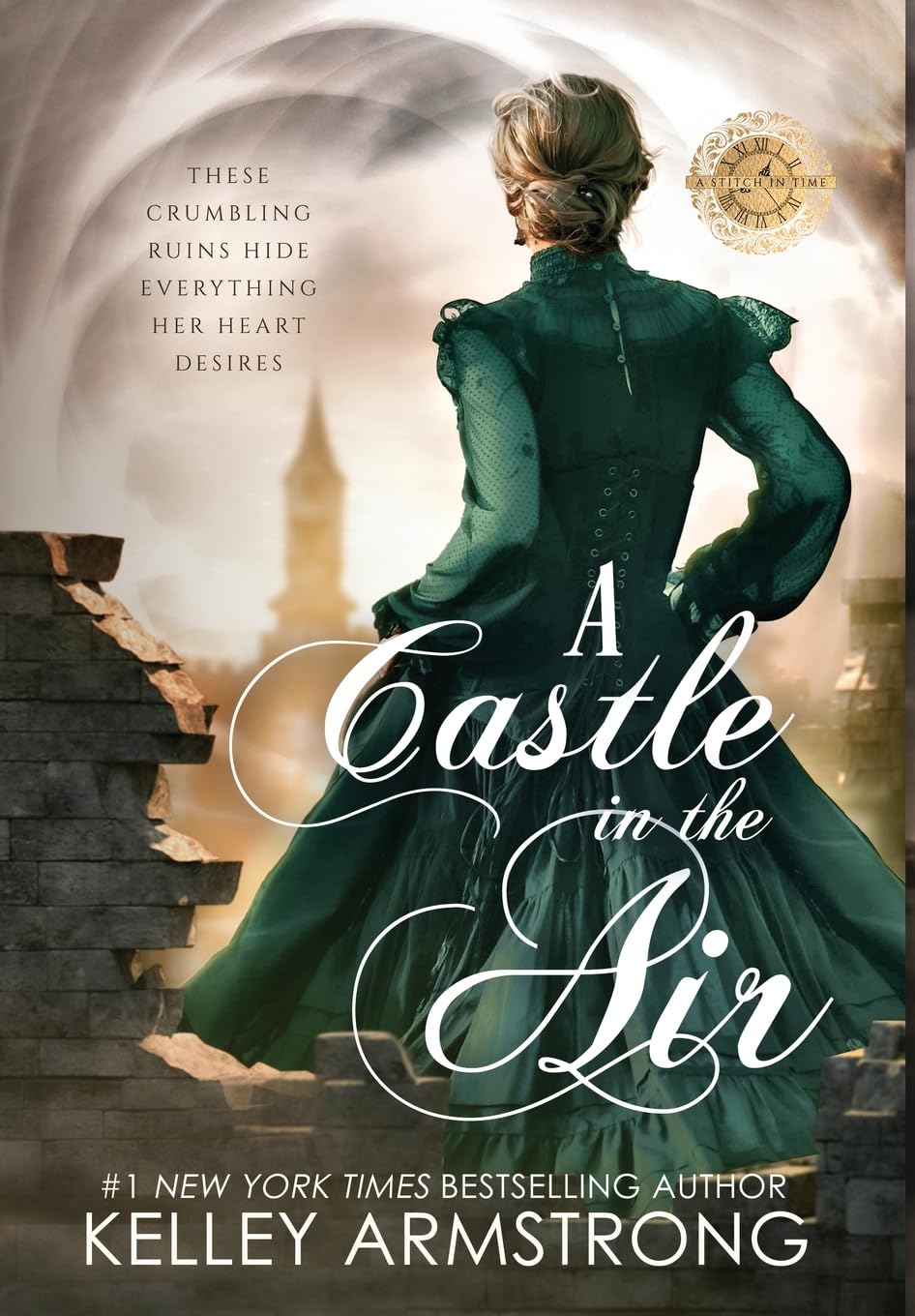
Title: A Castle in the Air Series: A Stitch in Time, #4 Author: Kelley Armstrong Publisher: Kla Fricke Inc Publication date: October 31, 2023 Length: 306 pages Genre: Time slip/ghost story Source: Purchased Rating:
⭐⭐⭐⭐
Rating: 4 out of 5.
Portia Hastings has spent her life rescuing her younger sister from one scrape or another. Now, she has to step through time to do it, following Miranda from the nineteenth century to the eighteenth. Almost immediately, Portia is beset by highwaymen, which might be the most exciting thing to happen to her in a long time, even if she’d never admit it.
When one of the highwaymen is injured, Portia makes the inexcusable mistake of helping him-she is trained as a doctor after all. Her travel companions abandon her, and she’s left at the mercy of a highwayman who demands she continue tending to his compatriot’s wounds.
Portia soon finds herself at a crumbling castle inhabited by the destitute Earl of Ravensford. Benedict Sterling is in desperate need of money, and his solution is a ball, where a wealthy bride will win the title of countess, even if it does come with one thunderously ill-tempered earl.
Portia agrees to a scheme to help Benedict look like a slightly more appealing bridegroom, while she continues to search for Miranda. Then there’s the small matter of the castle, complete with a ghost intent on driving her out. But once Portia sets her mind on something, she’s not going anywhere.
There should be a word for the feeling of being satisfied and happy, yet also experiencing a parallel sense of heartbreak. Because isn’t that all of us at the end of a great book series?
As far as I can tell, A Castle in the Air concludes the 4-book series A Stitch in Time. And I don’t want it to be over! But truly, this has been a terrific reading experience, so I suppose I’ll just have to suck it up and embrace the Seuss motto:
OK, I’m done moping. Let’s talk about A Castle in the Air!
As an introduction, for those unfamiliar with the story so far, the Stitch in Time books comprise a timeslip/romance series, in which a lonely manor house on the Yorkshire moors contains a “stitch” that connects across time. In the first book, we see an unsuspecting 21st century woman cross through the stitch into the Victorian era, with all sorts of romantic and ghostly adventures in store for her.
(And yes, in addition to the timeslip element, these books are also ghost stories! A love story is at the heart of each book, but also… time travel and hauntings!)
The first book also introduces a mystery about a missing woman, Rosalind, who becomes the main character in the second book. Rosalind’s two sisters then take center stage for books three and four.
Which brings us to A Castle in the Air, starring Portia Hastings, the middle sister — unmarried, responsible, and devoted to her profession. She’s a trained physician in everything but title — Victorian women are not permitted to enter medical school, but she’s worked and learned alongside her doctor father all her life, and she’s skilled and knowledgeable in her field. To camouflage herself, she dresses plainly, hides her beauty, and tries to provide care to her patients without attracting too much notice from people who might cause trouble.
As A Castle in the Air opens, Portia’s younger sister Miranda has not returned as scheduled from a time travel quest, and Portia decides to go after her — even though Portia is the only one of the three sisters who’s never crossed through the stitch until this point. She hasn’t even been tempted — her life is just fine without time stitches to complicate things — but worry for Miranda drives her to cross over.
Upon arrival, Portia finds herself one hundred years in her past, and before long, ends up confronted by a pair of highwaymen — who are not quite what they seem. Called upon for her medical skills, she ends up at the falling-to-ruins castle of Ravensford, caring for the earl’s injured brother… and trying not to notice the beautiful eyes of the brusque, moody earl himself.
As you can imagine, underneath the broody exterior there’s a heart of gold, and before long, Portia and Benedict are much more than just reluctant companions. The plot isn’t only about the romance, however: The area is suffering through a terrible drought, dire debts threaten Benedict’s ability to keep his family’s lands intact and protect his tenants, greedy neighboring landowners threaten to swoop in, and a ghostly presence haunts the keep, posing a real threat to Portia’s safety.
Portia and Benedict have terrific chemistry, and the mystery of the ghost is a good one — plus there’s a ball to find Benedict a wealthy wife (yes, really), which is complicated by Portia’s presence, and there’s still the puzzle of the highwaymen to solve.
I loved how the plot ties together so many elements, incorporating Portia’s displacement through time with the adventure story happening in Benedict’s world. It all works very, very well, giving the characters a chance to shine while also keeping the action buzzing along.
As a wrap-up to the series, A Castle in the Air is quite satisfying (although I wish Bronwyn and Rosalind, the leads from books 1 and 2, had made an appearance). It really is bittersweet to finish this book and have no more to look forward to! Still, I’ve enjoyed each and every book in the series, and whole-heartedly recommend them all.
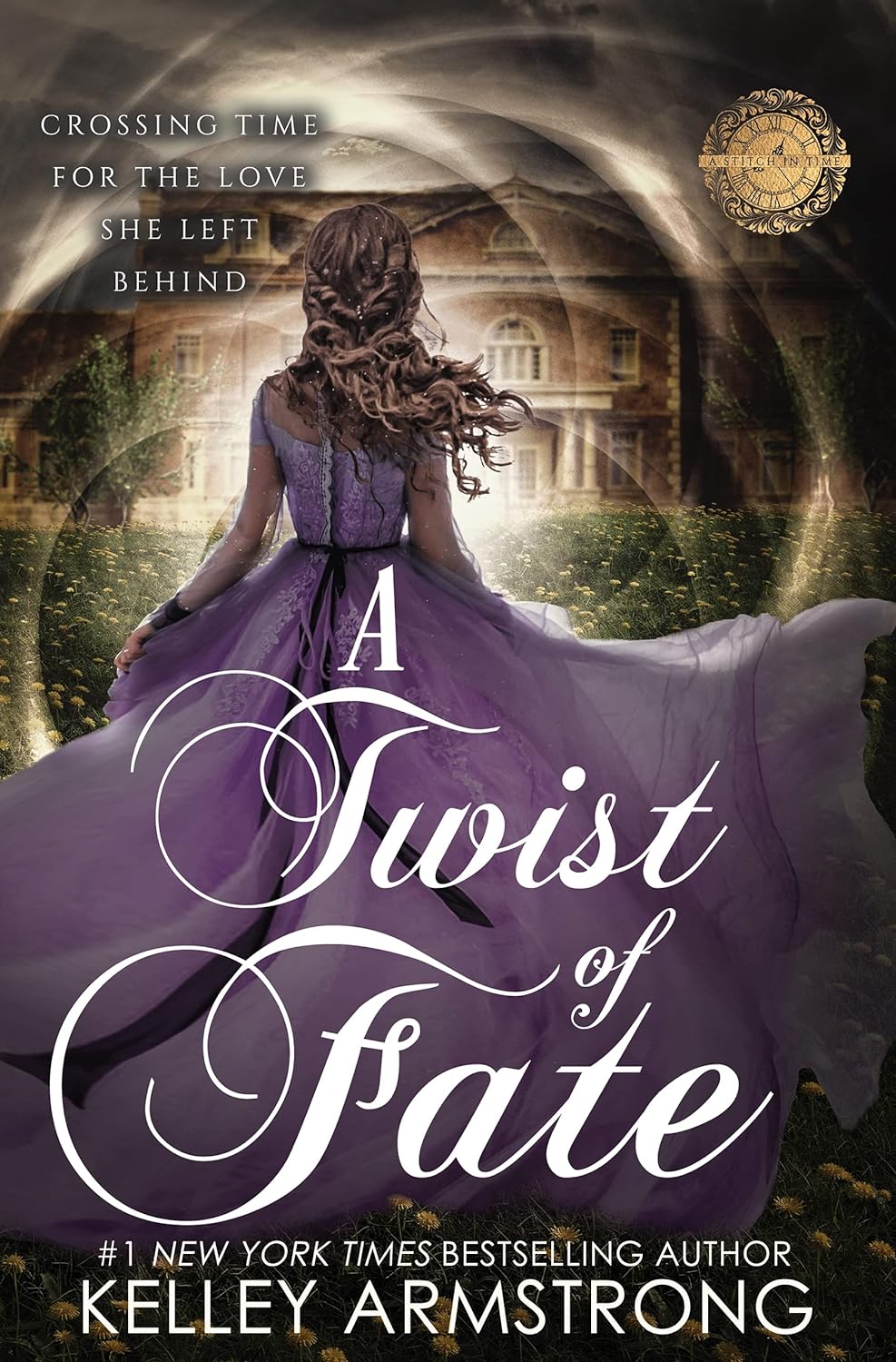
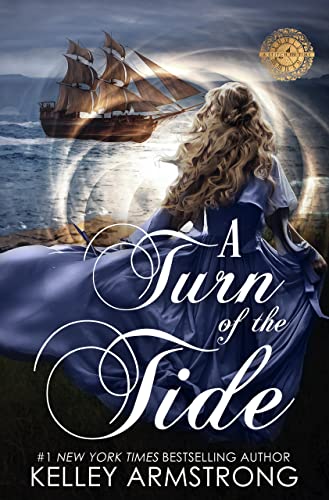
Interested in this series? Check out my reviews of the earlier books:

















 Bookshelf Fantasies