Book Review: Hella by David Gerrold

Title: Hella
Author: David Gerrold
Publisher: DAW
Publication date: June 16, 2020
Print length: 448 pages
Genre: Science fiction
Source: Review copy courtesy of the publisher via NetGalley
Rating:

Rating: 3.5 out of 5.

A master of science fiction introduces a world where everything is large and the problems of survival even larger in this exciting new novel.

Hella is a planet where everything is oversized—especially the ambitions of the colonists.

The trees are mile-high, the dinosaur herds are huge, and the weather is extreme—so extreme, the colonists have to migrate twice a year to escape the blistering heat of summer and the atmosphere-freezing cold of winter.

Kyle is a neuro-atypical young man, emotionally challenged, but with an implant that gives him real-time access to the colony’s computer network, making him a very misunderstood savant. When an overburdened starship arrives, he becomes the link between the established colonists and the refugees from a ravaged Earth.

The Hella colony is barely self-sufficient. Can it stand the strain of a thousand new arrivals, bringing with them the same kinds of problems they thought they were fleeing?

Despite the dangers to himself and his family, Kyle is in the middle of everything—in possession of the most dangerous secret of all. Will he be caught in a growing political conspiracy? Will his reawakened emotions overwhelm his rationality? Or will he be able to use his unique ability to prevent disaster?

Hella is a hella big place. It’s a large planet where, due to lower gravity as compared to Earth, living things grow to crazy huge size. And there are dinosaurs. And they’re HELLA gigantic. Herbivorous leviathans migrate across the plains, slowly stomping over everything in their path, and hungry carnosaurs attack them in groups, feasting for days on the huge carcasses that they manage to bring down.

Hella is not the most hospitable environment for humans, but these few thousand colonists are there to make it home. It’s already been a hundred years since the First Hundred made landfall, and since then, additional migrations of humans have helped the colony to grow and expand.

Caution is the highest priority. Everything is studied and planned for, because it’s crucial that the human population avoid cross-contamination with the Hella natural world. All food is grown within the enclosed colonies, and care is taken never to allow human-produced microbes or plants out into the planet’s own natural environment.

We get to know the world of Hella through main character Kyle, a neuro-atypical teen (roughly 13 years old in Earth years, or 5 years old in Hella years). Kyle is smart and detail-oriented, devoted to his family, but has challenges understanding nuance and reading other people’s emotions, doesn’t like to be touched, and is unable to leave a topic until he’s shared everything (and I do mean EVERYTHING) he knows about it. He’s gifted and his talents can benefit the colony, but there are some who view Kyle as a freak and treat him that way.

While the colony seems to function on the principle of communal service toward the greater good, there are those who thirst for power, just like in any human society. When the chief power-hungry representative gets an opportunity to seize control, he takes it.

Hella is an interesting book, although I have some issues with it. At the beginning, the focus is on getting to know the planet and the colony. Kyle goes out on an expedition for the first time, and through his experiences, we get to see the plants, trees, strange creatures, and huge dinosaurs that roam the land.

We’re also introduced to the daily routines, the concept of work that’s at the foundation of this human society, and the myriad factors that go into maintaining safety and self-sufficiency.

We learn more about how human society has changed and evolved over the years since our own time as well. For example, gender is fluid and easily changeable. Kyle’s mother was born biologically male, but changed to female so she could experience pregnancy (which is in itself a fairly unusually choice, as many people prefer to have their babies bottle-grown rather than womb-grown). Kyle himself was born biologically female, but decided to change when his older brother did, largely because he too wanted to be able to pee standing up. Changing doesn’t have to be permanent; later in the book, Kyle has cause to rethink his decision and considers changing again in order to please his boyfriend (which is a frustrating reason to change, but fortunately, his boyfriend sees it that way too.)

By the second half of the book, the emphasis is less on the natural world outside the human habitats and much more on the political maneuvering within the human colony. There’s a conspiracy afoot, and Kyle and his friends may be in the best position to try to stop it. There’s plenty of danger and excitement as they chase through tunnels, hack networks, and try to avoid or defeat the bad guys.

My feelings about Hella are mixed. First off — cool planet! I really liked learning about this world, its dangers and its beauty, and what it takes for humans to adapt and survive there.

But, there’s just so much time spent with Kyle on the details! Granted, this is a piece of who Kyle is, but his need to go down the rabbit hole chasing every detail doesn’t always make for great reading, and I felt that the plot tended to bog down in detours.

At almost 450 pages, this book is longer than it needs to be. I think if 50-75 pages had been trimmed, the pacing might have improved, keeping the plot more on track and letting momentum build. As is, I didn’t truly feel caught up or swept along by the story until the 2nd half, and that’s too bad, as there are elements of a great story here.

As I said, I did really enjoy the (literal) world-building the author accomplishes in introducing us to the human society in this large and frightening world, and explaining how they find ways to improve their resources bit by bit, even while always protecting themselves from the dangers just outside their fences.

I was a bit startled looking at the author’s Goodreads profile when I realized that some of the characters in Hella appear in his earlier works. This made me wonder how much I was missing and whether a familiarity with other books would enhance the reading experience.

This is me being persnickety, but the author’s writing style got on my nerve in places. He has a tendency to throw commas into sentences to connect clauses. Random example:

Outside, the northeast slope was a rumpled landscape, hundreds of layers of lava flows had hardened here.

Just a little pet peeve of mine. Use a period! Separate your sentences! Or, you know, give semicolons a try!

Hella has a conclusion that ties up the major action of the story, but there’s certainly room for more storytelling about the colony, its people, and its politics — plus, it would be fun to get to see what happens next for Kyle, his family, and his friends.

I do recommend Hella, but wished that it was just a little tighter and faster overall. Still, it’s a fun and engaging story set in a really fascinating world, and I’m glad I read it.

Shelf Control #221: What If by Randall Munroe

Shelves final

Welcome to Shelf Control — an original feature created and hosted by Bookshelf Fantasies.

Shelf Control is a weekly celebration of the unread books on our shelves. Pick a book you own but haven’t read, write a post about it (suggestions: include what it’s about, why you want to read it, and when you got it), and link up! For more info on what Shelf Control is all about, check out my introductory post, here.

Want to join in? Shelf Control posts go up every Wednesday. See the guidelines at the bottom of the post, and jump on board!

cropped-flourish-31609_1280-e1421474289435.png

Title: What If? Serious Scientific Answers to Absurd Hypothetical Questions
Author: Randall Munroe
Published: 2014
Length: 303 pages

What it’s about (synopsis via Goodreads):

Randall Munroe left NASA in 2005 to start up his hugely popular site XKCD ‘a web comic of romance, sarcasm, math and language’ which offers a witty take on the world of science and geeks. It now has 600,000 to a million page hits daily. Every now and then, Munroe would get emails asking him to arbitrate a science debate. ‘My friend and I were arguing about what would happen if a bullet got struck by lightning, and we agreed that you should resolve it . . . ‘ He liked these questions so much that he started up What If.

If your cells suddenly lost the power to divide, how long would you survive?

How dangerous is it, really, to be in a swimming pool in a thunderstorm?

If we hooked turbines to people exercising in gyms, how much power could we produce?

What if everyone only had one soulmate?

When (if ever) did the sun go down on the British empire?

How fast can you hit a speed bump while driving and live?

What would happen if the moon went away?

In pursuit of answers, Munroe runs computer simulations, pores over stacks of declassified military research memos, solves differential equations, and consults with nuclear reactor operators. His responses are masterpieces of clarity and hilarity, studded with memorable cartoons and infographics. They often predict the complete annihilation of humankind, or at least a really big explosion. Far more than a book for geeks, WHAT IF: Serious Scientific Answers to Absurd Hypothetical Questions explains the laws of science in operation in a way that every intelligent reader will enjoy and feel much the smarter for having read.

How and when I got it:

I bought a copy as a gift for my husband a couple of years ago.

Why I want to read it:

My husband usually likes weird science facts, but for whatever reason, he just hasn’t felt like actually reading this book. Meanwhile, I think it looks amazing. I also love weird science, and just reading the questions listed in this book makes me laugh. I’ve heard the audiobook is amazing, and I’ve read some excerpts from this book online, so I know I’ll love it once I actually dig in.

What do you think? Would you read this book? 

Please share your thoughts!


__________________________________

Want to participate in Shelf Control? Here’s how:

  • Write a blog post about a book that you own that you haven’t read yet.
  • Add your link in the comments!
  • If you’d be so kind, I’d appreciate a link back from your own post.
  • Check out other posts, and…

Have fun!

Shelf Control #220: The Last Astronaut by David Wellington

Shelves final

Welcome to Shelf Control — an original feature created and hosted by Bookshelf Fantasies.

Shelf Control is a weekly celebration of the unread books on our shelves. Pick a book you own but haven’t read, write a post about it (suggestions: include what it’s about, why you want to read it, and when you got it), and link up! For more info on what Shelf Control is all about, check out my introductory post, here.

Want to join in? Shelf Control posts go up every Wednesday. See the guidelines at the bottom of the post, and jump on board!

cropped-flourish-31609_1280-e1421474289435.png

Title: The Last Astronaut
Author: David Wellington
Published: 2019
Length: 400 pages

What it’s about (synopsis via Goodreads):

Mission Commander Sally Jansen is Earth’s last astronaut–and last hope–in this gripping near-future thriller where a mission to make first contact becomes a terrifying struggle for survival in the depths of space.

Sally Jansen was NASA’s leading astronaut, until a mission to Mars ended in disaster. Haunted by her failure, she lives in quiet anonymity, convinced her days in space are over.

She’s wrong.

A large alien object has entered the solar system on a straight course toward Earth. It has made no attempt to communicate and is ignoring all incoming transmissions.

Out of time and out of options, NASA turns to Jansen. For all the dangers of the mission, it’s the shot at redemption she always longed for.

But as the object slowly begins to reveal its secrets, one thing becomes horribly clear: the future of humanity lies in Jansen’s hands.

How and when I got it:

I received an ARC from Orbit last summer.

Why I want to read it:

I always love a good space adventure — and throw in women astronauts, especially one trying to save the world — and it all just sounds too perfect for me. My only excuse for not having read this already is that I’ve just had too much else to read, and never got around to it.

What do you think? Would you read this book? 

Please share your thoughts!


__________________________________

Want to participate in Shelf Control? Here’s how:

  • Write a blog post about a book that you own that you haven’t read yet.
  • Add your link in the comments!
  • If you’d be so kind, I’d appreciate a link back from your own post.
  • Check out other posts, and…

Have fun!

Book Review: Laughter at the Academy by Seanan McGuire

Title: Laughter at the Academy
Author: Seanan McGuire
Publisher: Subterranean Press
Publication date: October 31, 2019
Length: 376 pages
Genre: Horror/fantasy (short story collection)
Source: Purchased
Rating:

Rating: 5 out of 5.

From fairy tale forest to gloomy gothic moor, from gleaming epidemiologist’s lab to the sandy shores of Neverland, Seanan McGuire’s short fiction has been surprising, delighting, confusing, and transporting her readers since 2009. Now, for the first time, that fiction has been gathered together in one place, ready to be enjoyed one twisting, tangled tale at a time. Her work crosses genres and subverts expectations.

Meet the mad scientists of “Laughter at the Academy” and “The Tolling of Pavlov’s Bells.” Glory in the potential of a Halloween that never ends. Follow two very different alphabets in “Frontier ABCs” and “From A to Z in the Book of Changes.” Get “Lost,” dress yourself “In Skeleton Leaves,” and remember how to fly. All this and more is waiting for you within the pages of this decade-spanning collection, including several pieces that have never before been reprinted. Stories about mermaids, robots, dolls, and Deep Ones are all here, ready for you to dive in.

This is a box of strange surprises dredged up from the depths of the sea, each one polished and prepared for your enjoyment. So take a chance, and allow yourself to be surprised.

There are two things I think I’ve established by now over the course of many years of writing book reviews: 1 – I love Seanan McGuire. 2 – I’m not a big fan of short stories.

So when Seanan McGuire releases a collection of stories, what’s a fan to do? Buy it immediately, then stick it on the shelf and delay, delay, delay…

Well, I’m here to say I’m an idiot. Because OF COURSE I ended up loving this book once I finally sat myself down and gave it a try. It’s Seanan McGuire! What’s not to love?

This collection brings together stories from 2009 through 2017, and as the author makes clear in her introduction, all stories take place outside of her “pre-existing universes” — so you won’t find October Daye or the Incryptid’s Price family members anywhere in these pages. All stories appeared in other publications and anthologies over the years, and it’s a treat to have so many available in one glorious collection.

Quick aside: I purchased the pretty hardcover special edition from Subterranean Press as a splurge, but it’s also available in e-book format for a much more reasonable price.

These 22 stories cover a wide range of themes, topics, and tones. Some are funny, some are sad, some are terrifying, and some are just downright creepy. Absolutely none are boring or skippable! One of the things I loved about this book was the mix — from story to story, it’s always something new, and so many surprises!

I’ll share just a few highlights about my favorites of the bunch:

The title story, “Laughter at the Academy”, is all sorts of awesome about mad scientists and a condition called “Schizotypal Creative Genius Personality Disorder”. It’s brutal and fun and, well, mad.

“Lost” is creepy and disturbing and sad, as is any story about children all over the world acting strangely at the same time. It made me think of Torchwood and Childhood’s End, although it isn’t really much like either one.

Seanan McGuire is excellent at unleashing hell on the world, so a story about viruses ravaging humankind is scary and perhaps too timely right now, but I loved “The Tolling of Pavlov’s Bells” all the same. Super frightening. And prescient — this is from her introduction to the story:

I also believe that the modern world’s disdain for quarantine and willingness to support structures which encourage its violation is going to do a great deal of damage one day… and that with the new diseases emerging regularly from a variety of sources, that day may not be particularly far in the future.

And as the story itself describes:

If they were to stay home, avoid the company of strangers, and wait for a vaccine, they might stand a chance. But no one listens to the doctors, or to the newspaper headlines begging them to stay indoors.

One of the coolest stories in the collection — so weird and unexpected — is “Uncle Sam”. Ever wonder why women go to the bathroom together? Read this and find out.

There’s also a story about Valkyries, a western sci-fi story…

Cherry’s first to the cattle call, her guns low and easy on her hips, her hair braided like an admonition against untidiness.

… military mermaids, a steampunk invasion of carnivorous plant-based aliens…

“A… diplomat?” Arthur blinked at me as our carriage rattled to a stop, presumably in front of our destination. “But the first thing you did was eat my sister’s maid.”

… a Peter Pan story, a Twitter-based ghost story, more end-of-the-world/end-of-humankind scenarios, a GoFundMe for bringing on eternal Halloween…

… and the story that’s given me nightmares ever since, “We Are All Misfit Toys in the Aftermath of the Velveteen War”. There are dolls. And they’re scary as hell. This is creepy and brilliant, and if I ever get over my first reading of this story, I’ll come back and read it again!

Seanan McGuire’s writing is as amazing as always, and this collection shows her range and ability to try on any genre or style and make it work.

Obviously, I loved this book, and I’m so glad I got over my reluctance to read short story collections. Laughter at the Academy is a must-read for Seanan McGuire fans, but you don’t have to have previous experience with her work to appreciate the funny, scary, and strange worlds presented here.

Top Ten Tuesday: Books with summery titles that aren’t really summer books at all

Top Ten Tuesday is a meme hosted by That Artsy Reader Girl, featuring a different top 10 theme each week. This week’s topic is  Books that Give Off Summer Vibes.

Since I just did a Top 5 Tuesday post about summer books a few weeks ago, I thought I’d switch it up a bit and instead talk about books whose titles sounds full of summer themes… even though the books themselves aren’t exactly light, beachy reads.

  1. On the Beach by Nevil Shute: On the beach? Excellent! Except not, because it’s the aftermath of a nuclear holocaust and radiation is coming to wipe out the last remaining survivors.
  2. Dune by Frank Herbert: Glorious rolling sand dunes along a beautiful beach? Sorry, nope. It’s sci-fi on a desolate world. With killer sand worms.
  3. The Sandcastle Girls by Chris Bohjalian: Little girls playing in the sand with their parents on a sunny day? No. This one is set during and after the Armenian genocide.
  4. Summer of My German Soldier by Bette Green: An epic summer romance about star-crossed lovers? Not at all. It’s about a lonely American girl and a German POW.
  5. The Last Summer at Chelsea Beach by Pam Jenoff: Yes, there’s a beach! But it’s really a wartime love story with lots of sadness and loss.
  6. Sunshine by Robin McKinley: A bright sunshiny day? Ha ha. No. This is one of my very favorite vampire stories, very dark and creepy.
  7. Firefly: Big Damn Heroes by Nancy Holder: Chasing lightning bugs on a summer lawn as evening falls? Nope. A super fun sci-fi space western, but nothing to do with actual fireflies. (Or summer.)
  8. Summer Knight by Jim Butcher: A chivalric tale about knights and ladies and a summer joust, perhaps? No, it’s all about Chicago wizard Harry Dresden and the dangerous, deceptive faerie courts.
  9. The Ocean at the End of the Lane by Neil Gaiman: A little beach town, with a country lane leading to the shore? Sorry again. This is a terrific fantasy… but it’s not about a beach vacation.
  10. In the Lake of the Woods by Tim O’Brien: Ooh, a country get-away by a romantic lake? Well, there’s a lake, but it’s not peaceful or romantic. This is really disturbing suspense, without a hint of summer fun and relaxation.

Can you think of more books with summer-themed titles that just aren’t summery at all?

If you wrote a TTT post, please share your link with me! Tell me about your favorite books with summer vibes!

Save

Save

Save

Save

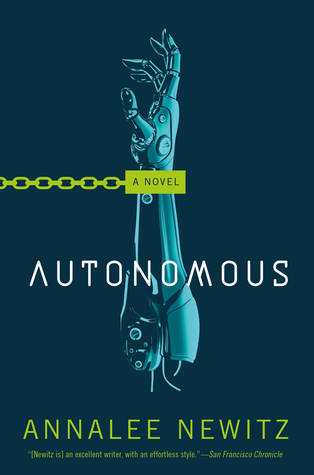
Shelf Control #215: Autonomous by Annalee Newitz

Shelves final

Welcome to Shelf Control — an original feature created and hosted by Bookshelf Fantasies.

Shelf Control is a weekly celebration of the unread books on our shelves. Pick a book you own but haven’t read, write a post about it (suggestions: include what it’s about, why you want to read it, and when you got it), and link up! For more info on what Shelf Control is all about, check out my introductory post, here.

Want to join in? Shelf Control posts go up every Wednesday. See the guidelines at the bottom of the post, and jump on board!

cropped-flourish-31609_1280-e1421474289435.pngTitle: Autonomous
Author: Annalee Newitz
Published: 2017
Length: 303 pages

What it’s about (synopsis via Goodreads):

Autonomous features a rakish female pharmaceutical pirate named Jack who traverses the world in her own submarine. A notorious anti-patent scientist who has styled herself as a Robin Hood heroine fighting to bring cheap drugs to the poor, Jack’s latest drug is leaving a trail of lethal overdoses across what used to be North America—a drug that compels people to become addicted to their work.

On Jack’s trail are an unlikely pair: an emotionally shut-down military agent and his partner, Paladin, a young military robot, who fall in love against all expectations. Autonomous alternates between the activities of Jack and her co-conspirators, and Elias and Paladin, as they all race to stop a bizarre drug epidemic that is tearing apart lives, causing trains to crash, and flooding New York City.
 

How and when I got it:

I bought myself a copy over a year ago, when I had an Amazon gift card burning a hole in my pocket.

Why I want to read it:

I mean… it just sounds amazing, right? A pharmaceutical pirate traveling in a submarine? A military robot who falls in love? A mystery drug epidemic? And whoa, a drug that “compels people to become addicted to their work”? *shudder*

This book sounds quirky and exciting and so much fun! I need to make it a priority!

What do you think? Would you read this book? 

Please share your thoughts!

__________________________________

Want to participate in Shelf Control? Here’s how:

  • Write a blog post about a book that you own that you haven’t read yet.
  • Add your link in the comments!
  • If you’d be so kind, I’d appreciate a link back from your own post.
  • Check out other posts, and…

Have fun!

Book Review: The Last Emperox by John Scalzi

Title: The Last Emperox (The Interdependency, #3)
Author: John Scalzi
Publisher: Tor
Publication date: April 16, 2020
Length: 336 pages
Genre: Science fiction
Source: Purchased
Rating:

Rating: 4 out of 5.

The collapse of The Flow, the interstellar pathway between the planets of the Interdependency, has accelerated. Entire star systems—and billions of people—are becoming cut off from the rest of human civilization. This collapse was foretold through scientific prediction… and yet, even as the evidence is obvious and insurmountable, many still try to rationalize, delay and profit from, these final days of one of the greatest empires humanity has ever known.

Emperox Grayland II has finally wrested control of her empire from those who oppose her and who deny the reality of this collapse. But “control” is a slippery thing, and even as Grayland strives to save as many of her people from impoverished isolation, the forces opposing her rule will make a final, desperate push to topple her from her throne and power, by any means necessary. Grayland and her thinning list of allies must use every tool at their disposal to save themselves, and all of humanity. And yet it may not be enough.

Will Grayland become the savior of her civilization… or the last emperox to wear the crown?

Bravo to John Scalzi for this masterful conclusion to an entertaining and exciting sci-fi trilogy! Not every trilogy sticks the landing, but The Last Emperox absolutely does.

The story picks up right after the end of The Consuming Fire, as the Interdependency’s existence is threatened by the collapse of the Flow, the impossible-to-explain time/space stream that connects the various star systems of the empire. The Flow is what allows humankind to survive, since the empire was designed specifically to make each settlement and star system not self-sustaining, but dependent on all the others. As the Flow starts to disappear, the worlds of the Inderdependency will find themselves cut off and lacking vital resources, and unless a solution is found, the people there will be doomed to a slow, inevitable extinction.

As if that weren’t enough to deal with, Emperox Grayland II, the supreme leader of the Interdependency, has already survived a couple of assassination attempts and failed coups, and her future’s not looking too great either. Despite the threat to their very existence, the noble houses can’t seem to stop their endless backstabbing and manipulation, each attempting to grab as much power as possible for themselves, without worrying too much about the fate of the billions of commoners whose lives are at stake.

As always, John Scalzi’s writing is full of snark and snappy dialogue, as well as complex political machinations and intricate science fiction scenarios to drool over. Also, I just get such a kick out of his unique names for characters, including two of my favorites, Senia Fundapellonan and Nadashe Nohamapetan.

(To be clear, Nadashe Nohamapetan is a terrible person. I just love her name.)

My favorite character (although it’s hard to choose) would have to be Kiva Lagos, who is super smart, totally kick-ass, and never met a sentence that wouldn’t be better with a few f-bombs. I love this interchange between her and Senia (who’s speaking first here):

“It’s not a great idea to be too in love with your own cleverness.”

“What are you, my mother?”

“If I were your mother, I’d use the word ‘fuck’ more often.”

“It’s a perfectly good word.”

“Sure,” Senia said. “Maybe not as every other word that comes out of your mouth, though.”

“I don’t even hear myself saying it, half the fucking time.”

Senia patted Kiva. “I know that. You’d hear it if I used it as much as you did.”

“No I wouldn’t.”

“Fucking yes you fucking absolutely fucking would.”

“Now you’re just exaggerating.”

“Not by much.”

I won’t go into plot developments, because I don’t want to ruin anyone’s fun. I will say, though, that the ending goes in a way I never would have imagined, and it totally threw me for a loop! It’s cool, though, and makes sense, and even though the story comes to a satisfying close, I’d love to get an update on these characters and this world down the road and find out how it all worked out for them in the long run.

The Interdependency is, plain and simple, a great, funny, exciting, intricate sci-fi space opera. I had a blast reading these books. Read all three!

Interested in The Interdependency? Check out my reviews of books 1 & 2:
The Collapsing Empire
The Consuming Fire

Book Review: The Consuming Fire by John Scalzi

Title: The Consuming Fire (The Interdependency, #2)
Author: John Scalzi
Publisher: Tor
Publication date: October 16, 2018
Length: 336 pages
Genre: Science fiction
Source: Purchased
Rating:

Rating: 4 out of 5.

The Consuming Fire―the sequel to the 2018 Hugo Award Best Novel finalist and 2018 Locus Award-winning The Collapsing Empire―an epic space-opera novel in the bestselling Interdependency series, from New York Times bestselling author John Scalzi

The Interdependency―humanity’s interstellar empire―is on the verge of collapse. The extra-dimensional conduit that makes travel between the stars possible is disappearing, leaving entire systems and human civilizations stranded.

Emperox Grayland II of the Interdependency is ready to take desperate measures to help ensure the survival of billions. But arrayed before her are those who believe the collapse of the Flow is a myth―or at the very least an opportunity to an ascension to power.

While Grayland prepares for disaster, others are preparing for a civil war. A war that will take place in the halls of power, the markets of business and the altars of worship as much as it will between spaceships and battlefields.

The Emperox and her allies are smart and resourceful, as are her enemies. Nothing about this will be easy… and all of humanity will be caught in its consuming fire.

If you like scheming and backstabbing, interplanetary exploration, geeky scientists, and kick-ass women, have I got a book for you!

The Consuming Fire is the second book in John Scalzi’s Interdependency trilogy, and it goes ten thousand miles per minute from start to finish. No middle-book doldrums here!

We pick up where we left off at the end of The Collapsing Empire. The Flow is collapsing, meaning that the shortcuts through space-time that allow interplanetary travel are starting to disappear without warning. Planets find themselves completely cut off from the rest of human settlement, and any ships in transit who are unfortunate enough to be caught in a Flow stream when it collapses don’t simply float off into space — they basically just blink out of existence.

How does the Flow work? It’s like a river, except it’s nothing like a river, as the story’s Flow physicists continually remind other characters. So, for mere humans like us (I’m assuming you and I are in this together), just accept the fact that SCIENCE. We wouldn’t understand.

Meanwhile, the people of the Interdependency are crafty and clever and absolutely not to be trusted. Most would (and maybe already have tried to) sell their own grandmothers for a chance at greater power. The leader of the Interdependency, Emperox Grayland II, is a smart, savvy, deceptively calm leader who refuses to bow to the nasty, murderous families who want to unseat her.

There’s plotting and faked deaths and bank fraud, prison assassination attempts (toothbrush and spoon shivs are involved) and space battles, previously undiscovered civilizations, and lots of random hook-ups. The characters are classic Scalzi, smart and full of smart-ass commentary and loads and loads of fun .

The 3rd book in the trilogy, The Last Emperox, was just released, and I’m eagerly waiting for my copy to arrive.

If you enjoy sci-fi with plenty of action and a great sense of humor, then you should absolutely check out this trilogy.

Book Review: The Book of Koli by M. R. Carey

Title: The Book of Koli
Author: M. R. Carey
Publisher: Orbit
Publication date: April 14, 2020
Length: 416 pages
Genre: Science fiction
Source: Review copy courtesy of the publisher via NetGalley
Rating:

Rating: 5 out of 5.

Beyond the walls of the small village of Mythen Rood lies an unrecognizable world. A world where overgrown forests are filled with choker trees and deadly vines and seeds that will kill you where you stand. And if they don’t get you, one of the dangerous shunned men will.

Koli has lived in Mythen Rood his entire life. He knows the first rule of survival is that you don’t venture beyond the walls.

What he doesn’t know is – what happens when you aren’t given a choice?

The first in a gripping new trilogy, The Book of Koli charts the journey of one unforgettable young boy struggling to find his place in a chilling post-apocalyptic world. Perfect for readers of Station Eleven and Annihilation

I got a story to tell you. I’ve been meaning to make a start for a long while now, and this is me doing it, but I’m warning you it might be a bumpy road. I never done nothing like this before, so I got no map, as it were, and I can’t figure how much of what happened to me is worth telling.

Meet Koli. Koli lives in the village of Mythen Rood, a town of 200 people — which to Koli, is a “terrible big place”, located in “a place called Ingland”. Mythen Rood is surrounded by walls, because everything in the outside world can kill. Koli is the youngest child of the town’s woodsmith — and in a world where trees are deadly, this is indeed a dangerous job.

Everything that lives hates us, it sometimes seems. Or at least they come after us like they hate us. Things we want to eat fight back, hard as they can, and oftentimes win. Thing that want to eat us is thousands strong, so many of them that we only got names for the ones that live closest to us. And the trees got their own ways to hurt us, blunt or subtle according to their several natures.

The world of Mythen Rood is protected by Ramparts, people who have a special connection to old-world tech, and use the tech to fight off the dangerous elements — like wild animals, deadly drones, and killer trees — that threaten the town. According to the town’s rituals, fifteen-year-olds enter a year of seclusion called Waiting, then undergo a test to become a Rampart. If the tech wakes when they touch it, then they become a Rampart too. But in Mythen Rood, it seems that one family in particular has the gift of waking tech, so despite Koli’s dreams of becoming a Rampart, it’s a long shot.

And when Koli learns a secret that might upend the world of Mythen Rood and threaten the power of the dominant family, he faces punishment and exile, and is cast out into the harsh world to fend for himself… or die.

Koli’s story fits the pattern of the hero’s journey, and the new world in which the story takes places is absolutely fascinating. The setting is centuries into the future, when old cities have all died, tech is something people view as practically magical, human settlements are scattered and isolated, and the natural world is deadly. The idea of trees being able to move, hunt, and kill is simply terrifying. People only venture into the forest to hunt for food and catch wood for lumber when it’s cloudy, because the trees wake up and become active when the sun shines, and if you’re caught out in the forest when it’s sunny, you’re most likely not coming back.

The interweaving of technology and mythology is so well done. Because of course, to people who have no access to technology and the knowledge of how it works, such things would appear to be magic, and the people able to use them must be favored with great powers.

Koli himself is a terrific characters, smart but illiterate, aware of his own flaws and honest about them. Koli’s life changes when he comes into contact with an old Sony music player powered by AI. The Dreamsleeve is programmed with the voice of a Japanese pop star from the old days, whose voice is perky and full of Tokyo party slang and attitude. Monono becomes the central focus of Koli’s life, and his interactions with her are what propels his story out of the safety of village life and into the unknown.

I can’t say enough good things about this book! I’ve heard that some readers find Koli’s voice irritating. I didn’t experience it that way. The author has created a unique personality in Koli, and his speech patterns let us know right away how different his world is from ours.

The Book of Koli is the first book in a trilogy, with the second book, The Trials of Koli, due out later this year. I will absolutely be reading #2 the second I can get my hands on it!

Book Review: Hearts of Oak by Eddie Robson

Title: Hearts of Oak
Author: Eddie Robson
Publisher: Tor
Publication date: March 17, 2020
Length: 272 pages
Genre: Science fiction
Source: Review copy courtesy of the publisher via NetGalley
Rating:

Rating: 5 out of 5.

The buildings grow.

And the city expands.

And the people of the land are starting to behave abnormally.

Or perhaps they’ve always behaved that way, and it’s normality that’s at fault.

And the king of the land confers with his best friend, who happens to be his closest advisor, who also happens to be a talking cat. But that’s all perfectly natural and not at all weird.

And when chief architect Iona wakes from a long period of blindly accepting the status quo, she realizes there’s a mystery to be solved. A strange, somewhat bizarre mystery, to be sure, but no less dangerous for its improbability.

And the cat is almost certainly involved!

How does a book featuring a king with a talking cat turn into science fiction?

I’m not telling!

But I will say this: Hearts of Oak is all sorts of awesome, and was exactly the sort of punchy, engaging read I needed this week.

The setting is weird and perplexing. We’re in a city where everything seems to be made of wood, and the entire focus of the city is building. Architects are practically rock stars, and the only city functions that seem to matter are building and planning.

And then there’s the king (and his cat Clarence), who observe the growth of the city from their window in the king’s tower, reading daily reports and signing off on plans, but really not doing much of anything else.

Everything seems to change when chief architect Iona is approached by a woman asking to be tutored in architecture. Something about Alyssa seems off, and her presence starts to bring forward words and images that Iona associates with her odd, recurring dreams.

And I’m not going to say what happens next! There are plenty of cool twists, and I actually laughed out loud over certain developments — like, OH, so THAT’s where this is going!

Seriously, this book just needs to be read! It’s great fun, full of surprises and really amazing and inventive elements, and I just could not put it down. I can see returning to Hearts of Oak and reading it again from time to time — it’s that good!

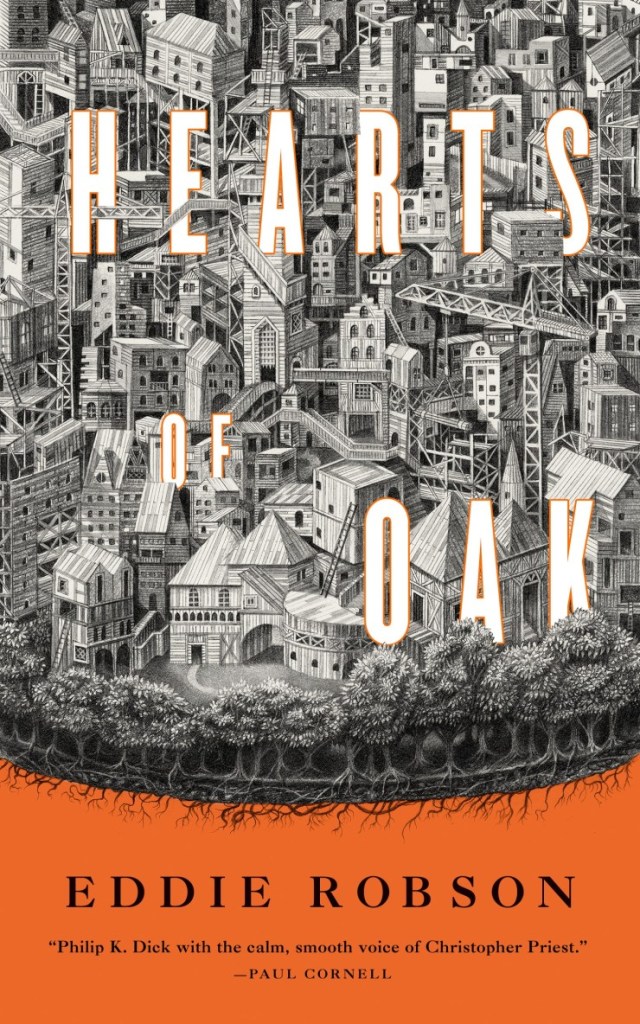
And a final great thing — it’s worth taking a closer look at the cover! I love the detail!