Book Review: The Holiday Trap by Roan Parrish

Title: The Holiday Trap
Author: Roan Parrish
Publisher: Sourcebooks Casablanca
Publication date: September 6, 2022
Length: 442 pages
Genre: Contemporary romance
Source: Purchased
Rating:

Rating: 3 out of 5.

For fans of Alexandria Bellefleur and Alexis Hall comes a charming, hilarious, and heartwarming LGBTQIA+ romcom about two separate couples finding love over the holidays from acclaimed author Roan Parrish!

Greta Russakoff loves her tight-knit family and tiny Maine hometown, even if they don’t always understand what it’s like to be a lesbian living in such a small world. She desperately needs space to figure out who she is.

Truman Belvedere has just had his heart crushed into a million pieces when he learned that his boyfriend of almost a year has a secret life that includes a husband and a daughter. Reeling from this discovery, all he wants is a place to lick his wounds far, far away from New Orleans.

Enter Greta and Truman’s mutual friend, Ramona, who facilitates a month-long house swap. Over the winter holidays, each of them will have a chance to try on a new life…and maybe fall in love with the perfect partner of their dreams. But all holidays must come to an end, and eventually Greta and Truman will have to decide whether the love they each found so far from home is worth fighting for.

The Holiday Trap has some cute moments, but is far too long and has way too many implausible plot points and annoying characters moments to rise above a 3-star read.

Our two main characters, Greta and Truman, are stuck in lives that clearly aren’t working for them. Greta’s large family is smothering and overly involved and controlling, and living on an island in Maine, there’s really no escaping their endless interference. Truman thinks his life in New Orleans is going well, until he discovers that his boyfriend of one year actually has a family, and Truman is just the bit on the side.

When a mutual friend suggests that they swap places for the holidays, Greta and Truman both agree — because really, it couldn’t be any worse than their current situations. And of course, in their new locations, they each find exactly what they’re looking for — love, community, and purpose.

Greta falls immediately in love with an outspoken, quirky woman who demands honesty and teaches Greta about stating one’s own needs and listening to others. She also finds meaning through a local gardening club, and becomes involved with a community garden and the beekeepers she meets.

Truman arrives on the island with low expectations, but soon discovers that his very favorite author may once have lived there, and then stumbles across the man of his dreams at the local florist shop.

For both, true love seems to arrive within approximately three weeks, so that before their brief swap agreement is even over, they’ve both resolved to make it permanent and start their lives over in their new locations. They’ve also changed themselves in significant ways, learning to speak up and pay attention to what they really want and what makes them happy.

Also (and annoyingly) in this brief time, they find themselves overflowing with amazing new ideas for how to improve their friends’ business ventures, which the friends seem to appreciate and embrace. (If I were in any of the friends’ shoes, I would find this intrusive and presumptuous AF, but hey, maybe that’s just me).

There are sweet interludes and funny moments, but overall, this romance drags on, has too many personal epiphanies crammed into such a short amount of time, and takes its perfect romances far over the edge into not-at-all-believable territory. And the fact that Greta and Truman seem to always have the perfect idea that perfectly solves other people’s challenges… so incredibly annoying.

I’m not sure why this is called The Holiday Trap. It’s not especially about the holidays, other than taking place during December when holidays are happening, and I have no idea what “trap” has to do with anything. Nobody ends up trapped in their new locations or relationships. May The Holiday Swap was already taken?

In terms of steaminess, this book’s sex scenes are graphic, so be aware of that if you prefer understated steam rather than outright step-by-step descriptions of intimate encounters.

Overall, the plot really doesn’t hold up particularly well. Truman is an endearing character and Greta is okay, but their huge personal awakenings and finding of soulmates just don’t feel plausible. The Holiday Trap is good entertainment, but I’ve read a lot better.

Audiobook Review: Record of a Spaceborn Few (Wayfarers, #3) by Becky Chambers

Title: Record of a Spaceborn Few
Series: Wayfarers, #3
Author: Becky Chambers
Narrator:  Rachel Dulude
Publisher: Harper Voyager
Publication date: July 24, 2018
Print length: 368 pages
Audio length: 11 hours, 36 minutes
Genre: Science fiction
Source: Library
Rating:

Rating: 5 out of 5.

Brimming with Chambers’ signature blend of heart-warming character relationships and dazzling adventure, Record of a Spaceborn few is the third standalone installment of the Wayfarers series, set in the sprawling universe of the Galactic Commons, and following a new motley crew on a journey to another corner corner of the cosmos—one often mentioned, but not yet explored.

Return to the sprawling universe of the Galactic Commons, as humans, artificial intelligence, aliens, and some beings yet undiscovered explore what it means to be a community in this exciting third adventure in the acclaimed and multi-award-nominated science fiction Wayfarers series, brimming with heartwarming characters and dazzling space adventure.

Hundreds of years ago, the last humans on Earth boarded the Exodus Fleet in search of a new home among the stars. After centuries spent wandering empty space, their descendants were eventually accepted by the well-established species that govern the Milky Way.

But that was long ago. Today, the Exodus Fleet is a living relic, the birthplace of many, yet a place few outsiders have ever visited. While the Exodans take great pride in their original community and traditions, their culture has been influenced by others beyond their bulkheads. As many Exodans leave for alien cities or terrestrial colonies, those who remain are left to ponder their own lives and futures: What is the purpose of a ship that has reached its destination? Why remain in space when there are habitable worlds available to live? What is the price of sustaining their carefully balanced way of life—and is it worth saving at all?

A young apprentice, a lifelong spacer with young children, a planet-raised traveler, an alien academic, a caretaker for the dead, and an Archivist whose mission is to ensure no one’s story is forgotten, wrestle with these profound universal questions. The answers may seem small on the galactic scale, but to these individuals, it could mean everything.

Argh… again with a misleading synopsis blurb! Why does whoever writes things keep coming back to a “motley crew”? That is SO not what this book is about! Anyway…

Record of a Spaceborn Few is the 3rd installment in the fabulous Wayfarers series, and it leaves me in absolute awe of author Becky Chambers and her vision of this sprawling fictional world. Here, she moves the story to a place we’ve heard about but not seen — the Exodan Fleet.

Many generations earlier, humans left Earth as it became uninhabitable, creating a fleet of homesteader ships that headed out into the galaxy with no idea of an endpoint or destination. Eventually, the human fleet encountered other sapient species, much more advanced in technology and in the social complexities of cross-species relations. After some time, the humans were accepted into the Galactic Commons (kind of like a UN for alien species), and many of the humans of the fleet sought out new homes on already established worlds or set out to colonize new human habitations on unsettled planets.

Not all, though. Many remained with the fleet, where their ancestors had lived already for centuries. Among the ships of the fleet, a shared community of sustainability, common interest, respect for the past, and well-ordered social expectations had been built over time. For the Exodans who stayed with the fleet, they were no longer on a journey — the fleet was home.

Within this setting, we follow the lives of several very different characters — some lifelong residents of the Asteria homesteader ship, some newcomers, some alien visitors. Through each, we learn more about Exodan life, their rituals, their beliefs, and the reality of their day-to-day.

The action starts with an unprecedented tragedy — one of the Exodan ships is destroyed in a freak accident. For the rest of the fleet, this is not only a human tragedy with countless deaths, but also a stark reminder of the potential danger and precariousness of their own homes. As the story moves forward, we see the ripple effect on the different characters, some of whom question their commitment to the fleet and wonder about other options, and some of whom reinvest in making sure that the fleet society has a future.

It’s all quite fascinating. In some ways, life in the fleet reminds me of a traditional kibbutz — communal life, with all jobs valued, each giving back to the community through labor, with shared communal living spaces balanced with family spaces, and a shared responsibility for daily tasks such as cooking, cleaning, and childcare. I was also intrigued by the deeply ingrained ethos of reusing and repurposing. When resources are scarce and the world is a closed system, everything serves a purpose, and nothing can be wasted.

The characters themselves are unique individuals, each with their own interesting lives and sets of joys and worries. These include an archivist, who tends the collective memories of the fleet; a newcomer seeking new meaning after growing up planetside and without connections; a caregiver whose job is to lovingly tend the dead through carefully established rituals; an alien sociologist spending time on the Asteria to study this example of human society, and a teen who isn’t sure where he’s meant to be or what his purpose is. They’re all wonderful, and I can’t say there was any one storyline I preferred over the others.

Record of a Spaceborn Few is loosely connected to the first book in the series, The Long Way to a Small, Angry Planet, as one of the characters is the sibling of the ship captain from the 1st book. Otherwise, this is a stand-alone story within a shared universe. I love how each book in the series opens up a new aspect of life within this fictional universe, broadening our understanding of what life is like for these future humans — among the stars, on a planet, or on a homesteader ship.

While these books are science fiction, there are no raging space battles or chases or high-tech weaponry. The series is about a society, about what it’s like to live in a galaxy where one’s own species is both a novelty and a minority, dependent on the tolerance and generosity of others species. The characters we meet, the choices they make and the dilemmas they face, are far more important to the overall tone and themes of the books than the details of water recycling, propulsion system, or the mechanics of keeping a spaceship working for centuries.

It’s all fascinating, and a remarkable creation. I’ve been listening to the audiobooks — narrator Rachel Delude gives an incredible performance, voicing so many different characters, keeping them distinct and identifiable, and bringing emotion and humor whenever needed. It’s been a terrific listening experience.

I can’t recommend this series strongly enough! Each book is a delight, and each one adds new dimensions to our understanding of the world of the series.

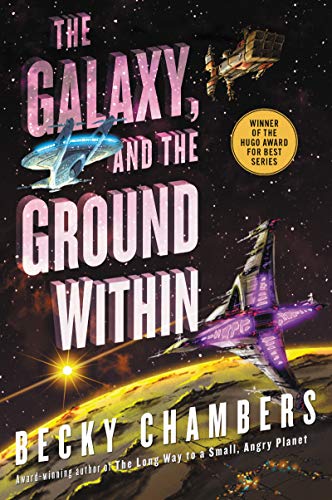
Next in the series: The Galaxy, and the Ground Within

I have one book left in the series — The Galaxy, and the Ground Within — and can’t wait to keep going (although I’ll be sad to finish). After hearing about this series for so long, I’m so glad that I finally made it a point to dig in! I’m just sorry that it took me so long.

Book Review: O Pioneers! by Willa Cather (Classics Club Spin #32)

Title: O Pioneers!
Author: Willa Cather
Publication date: 1913
Length: 159 pages (Kindle edition)
Rating:

Rating: 4.5 out of 5.

Synopsis (Goodreads):

O Pioneers! (1913) was Willa Cather’s first great novel, and to many it remains her unchallenged masterpiece. No other work of fiction so faithfully conveys both the sharp physical realities and the mythic sweep of the transformation of the American frontier—and the transformation of the people who settled it. Cather’s heroine is Alexandra Bergson, who arrives on the wind-blasted prairie of Hanover, Nebraska, as a girl and grows up to make it a prosperous farm. But this archetypal success story is darkened by loss, and Alexandra’s devotion to the land may come at the cost of love itself.

At once a sophisticated pastoral and a prototype for later feminist novels, O Pioneers! is a work in which triumph is inextricably enmeshed with tragedy, a story of people who do not claim a land so much as they submit to it and, in the process, become greater than they were.

And from Wikipedia:

O Pioneers! is a 1913 novel by American author Willa Cather, written while she was living in New York. It was her second published novel. The title is a reference to a poem by Walt Whitman entitled “Pioneers! O Pioneers!” from Leaves of Grass (1855).

O Pioneers! tells the story of the Bergsons, a family of Swedish-American immigrants in the farm country near the fictional town of Hanover, Nebraska, at the turn of the 20th century. The main character, Alexandra Bergson, inherits the family farmland when her father dies, and she devotes her life to making the farm a viable enterprise at a time when many other immigrant families are giving up and leaving the prairie. The novel is also concerned with two romantic relationships, one between Alexandra and family friend Carl Linstrum and the other between Alexandra’s brother Emil and the married Marie Shabata.

O Pioneers! is my most recent Classics Club Spin book, and once again, it’s been a great experience getting that little push to read a book that I might have missed out on otherwise.

Prior to O Pioneers!, the only work of Willa Cather’s that I’ve read was My Antonia, which I read once during high school and again more recently when I came across a copy at a library sale. I loved Cather’s writing style and the sense of beauty that comes through her descriptive passages, and I’ve always meant to seek out more of her books.

O Pioneers! centers on Alexandra Bergson, whom we first meet as a young woman. From the earliest chapters, we understand that she’s the backbone of her family. Her parents arrived on the Nebraska plains years earlier as immigrants, struggling to establish a home and a livelihood in harsh conditions. As the book opens, Alexandra’s father is dying. While she has three brothers — two teens and five-year-old Emil — her father’s dying instructions are clear:

“Boys,” said the father wearily, “I want you to keep the land together and to be guided by your sister… I want no quarrels among my children, and so long as there is one house there must be one head. Alexandra is the oldest, and she knows my wishes. She will do the best she can. If she makes mistakes, she will not make so many as I have made.”

As the book continues, we see Alexandra doing what no one else in the family can. She keeps the farm going, but not only that — she’s determined to do more than scratch by. She learns, thinks, and grows, and despite her brothers’ objection to what they see as risky ventures, Alexandra uses her wits and strategic planning to acquire more land, invest, and ultimately succeed in becoming one of the best established farmers and landowners in the region.

Of course, the older brothers aren’t always content to abide by Alexandra’s decisions. Rather dull-minded and resentful of hard work, they still uphold the manly tradition of being sexist jerks when it comes to their sister:

Oscar reinforced his brother, his mind fixed on the one point he could see. “The property of a family belongs to the men of the family, because they are held responsible, and because they do the work.” Alexandra looked from one to the other, her eyes full of indignation. She had been impatient before, but now she was beginning to feel angry. “And what about my work?” she asked in an unsteady voice.

[…]

Lou turned to Oscar. “That’s the woman of it; if she tells you to put in a crop, she thinks she’s put it in. It makes women conceited to meddle in business.”

Success takes a toll, as Alexandra remains largely alone. She has friends and neighbors and community, and while she seems content with her life, she’s never pursued romantic love of any sort. As she moves through her adult years, she’s devoted to Emil, now a young man, envisioning herself making a future and inheritance for him. Emil, though, like many young people raised on the plains, doesn’t necessarily want a life as a farmer — he attends college, travels, and seems to have a myriad of options available to him. Ultimately, though, a passionate love affair threatens his and Alexandra’s dreams for his future.

O Pioneers! covers about 20 years of the family’s lives, and we see how time changes them all. Through it all, Alexandra remains the steady, devoted head of the family and keeper of the land, and it’s only a tragedy near the end of the story that forces more extreme change upon her.

The writing in O Pioneers! is simply lovely. Willa Cather’s words are spare, but evocative. From her descriptions of the land itself to her illustration of the characters’ lives and thoughts, the words she uses bring the people and place to life.

ONE JANUARY DAY, thirty years ago, the little town of Hanover, anchored on a windy Nebraska tableland, was trying not to be blown away.

But this land was an enigma. It was like a horse that no one knows how to break to harness, that runs wild and kicks things to pieces.

He best expressed his preference for his wild homestead by saying that his Bible seemed truer to him there. If one stood in the doorway of his cave, and looked off at the rough land, the smiling sky, the curly grass white in the hot sunlight; if one listened to the rapturous song of the lark, the drumming of the quail, the burr of the locust against that vast silence, one understood what Ivar meant.

A pioneer should have imagination, should be able to enjoy the idea of things more than the things themselves.

But off there in the cities there are thousands of rolling stones like me. We are all alike; we have no ties, we know nobody, we own nothing. When one of us dies, they scarcely know where to bury him. Our landlady and the delicatessen man are our mourners, and we leave nothing behind us but a frock-coat and a fiddle, or an easel, or a typewriter, or whatever tool we got our living by. All we have ever managed to do is to pay our rent, the exorbitant rent that one has to pay for a few square feet of space near the heart of things. We have no house, no place, no people of our own. We live in the streets, in the parks, in the theatres. We sit in restaurants and concert halls and look about at the hundreds of our own kind and shudder.

The dawn in the east looked like the light from some great fire that was burning under the edge of the world.

One could easily believe that in that dead landscape the germs of life and fruitfulness were extinct forever.

Other versions of O Pioneers!:

As far as I could discover, there’s been just one O Pioneers! film adaptation — a 1992 made-for-TV movie starring Jessica Lange and David Strathairn. I have no idea if it’s easily available, but I’d love to check it out!

Wrapping it all up:

I’m so happy to have finally read this beautiful, powerful book. Many thanks to the Classics Club for inspiring me to read O Pioneers! and other classics!

Can’t wait for the next CCSpin!

Book Review: Lost in the Moment and Found (Wayward Children, #8) by Seanan McGuire

Title: Lost in the Moment and Found
Series: Wayward Children, #8
Author: Seanan McGuire
Publisher: Tor
Publication date: January 10, 2023
Length: 160 pages
Genre: Fantasy
Source: Review copy courtesy of the publisher

Rating: 4.5 out of 5.

A young girl discovers an infinite variety of worlds in this standalone tale in the Hugo and Nebula Award-winning Wayward Children series from Seanan McGuire, Lost in the Moment and Found.

Welcome to the Shop Where the Lost Things Go.

If you ever lost a sock, you’ll find it here.
If you ever wondered about favorite toy from childhood… it’s probably sitting on a shelf in the back.
And the headphones that you swore that this time you’d keep safe? You guessed it….

Antoinette has lost her father. Metaphorically. He’s not in the shop, and she’ll never see him again. But when Antsy finds herself lost (literally, this time), she finds that however many doors open for her, leaving the Shop for good might not be as simple as it sounds.

And stepping through those doors exacts a price.

Lost in the Moment and Found tells us that childhood and innocence, once lost, can never be found.

You might wonder whether, by the 8th book in a series, an author might run out of fresh stories to tell.

If the author is Seanan McGuire, then the answer is — not a chance! In Lost in the Moment and Found, she puts a fresh spin on the ongoing Wayward Children series, once again moving the focus to a completely new character in a completely new circumstance.

While all the Wayward Children books feature children who’ve had lousy childhoods in one way or another, the circumstances here are particularly awful — enough so that the author includes a note prior to the opening of the story:

While all the Wayward Children books have dealt with heavy themes and childhood traumas, this one addresses an all-too-familiar monster: the one that lives in your own home. Themes of grooming and adult gaslighting are present in the early text. As a survivor of something very similar, I would not want to be surprised by these elements where I didn’t expect them.

I just want to offer you this reassurance: Antsy runs. Before anything can actually happen, Antsy runs.

I have to say, I very much appreciated the warning. While the sense of dread builds in the early part of the book, at least I could proceed without fearing the absolute worst. And as the author promises, the main character, Antsy, does in fact run. When her fear and sense of isolation and lack of support gets to the point that she can no longer stand it, she finds a way out and escapes.

… as she got older, she would come to think that the ability to cry was the third thing she’d lost in a single day.

Antsy, at age six, a year after a terrible loss, gains a stepfather whom she never wanted, but she hopes her mother’s happiness will allow her to feel happy too. It doesn’t work that way. Her sense of wrongness and unease whenever she’s around her stepfather only continues to grow. He’s insidious, undermining Antsy in small ways through lies and contradictions, so that Antsy knows that if she goes to her mother with her big worries, she won’t be believed. It’s utterly heartbreaking.

When Antsy finally does reach her breaking point and runs away, she ends up at a strange little thrift shop that she never noticed before, with the words “Be Sure” written over the door frame. Once inside, the door she entered through disappears, and Antsy finds herself in a new home with an odd elderly woman and a talking magpie as companions.

As she stays in this store, she discovers new doors leading to new worlds, where she meets all sorts of strange and fascinating people and brings back more goods for the infinite shelves of the store she lives in. And for a long time, she forgets that there’s anything else out there and doesn’t think to question certain very odd occurrences…

Eventually, Antsy realizes that there’s a steep price to be paid for all the miraculous new worlds she visits — and that she may run out of options sooner than expected. The ending is moving and fitting, very sad, but with a small sliver of hope too.

Yes, I’m being vague!

As in all the Wayward Children books, the writing is simply gorgeous. These stories are never just straight-forward action — there’s a sense of mythic scope embedded in the descriptions of sad, lost children, and loss permeates so much of the storytelling.

The toll of childhood trauma becomes literal here: Antsy’s loss of safety and innocence leads to her new reality in the strange world of endless doors and lost things:

She should have had a childhood, ice cream and matinees and sunshine and cookies, not working in a dusty shop while she grew up faster than she should have been able to, rocketing toward adulthood, spending hours she’d never be able to recover! She should have had time. It was hers, and she had never agreed to give it away.

Antsy’s story is particularly tragic — obviously, no small child should ever have to doubt whether the one person they count on will actually believe them when they speak up. We can cheer Antsy on as she saves herself, but still, we can’t avoid mourning her shattered childhood and sense of faith in family and love.

The Wayward Children books include beautiful drawings by the very talented Rovina Cai. See more at https://www.rovinacai.com/portfolio/wayward-children-series/

As a whole, the Wayward Children series is beautiful, sad, emotional, and full of heartache and redemption. There’s hope and joy to offset the sorrow, but an undercurrent of sadness never quite leaves the stories or their characters.

I love the series, and I’m so happy that Lost in the Moment and Found lives up to my (very high) expectations. Please do start from the beginning if you haven’t read any of these yet! Each book is novella -length, but don’t rush through them — the lovely writing should be savored.

Audiobook Review: Beyond the Wand: The Magic & Mayhem of Growing Up a Wizard by Tom Felton

Title: Beyond the Wand: The Magic & Mayhem of Growing Up a Wizard
Author: Tom Felton
Narrator: Tom Felton
Publisher: Grand Central Publishing
Publication date: October 18, 2022
Print length: 286 pages
Audio length: 6 hours, 36 minutes
Genre: Memoir
Source: Library
Rating:

Rating: 4.5 out of 5.

They called for a break, and Gambon magicked up a cigarette from out of his beard. He and I were often to be found outside the stage door, having ‘a breath of fresh air’, as we referred to it. There would be painters and plasterers and chippies and sparks, and among them all would be me and Dumbledore having a crafty cigarette.

From Borrower to wizard, Tom Felton’s adolescence was anything but ordinary. His early rise to fame saw him catapulted into the limelight aged just twelve when he landed the iconic role of Draco Malfoy in the Harry Potter films.

Speaking with candour and his own trademark humour, Tom shares his experience of growing up on screen and as part of the wizarding world for the very first time. He tells all about his big break, what filming was really like and the lasting friendships he made during ten years as part of the franchise, as well as the highs and lows of fame and the reality of navigating adult life after filming finished.

Prepare to meet a real-life wizard.

Draco speaks!

In Beyond the Wand, actor Tom Felton shares stories from his early childhood, the Potter years, and beyond. Unlike some of the seriously dire and disturbing celebrity memoirs of the past year, Beyond the Wand is a mostly upbeat, light-hearted romp through the life of an actor whose professional work will forever be defined by the sneering Slytherin he portrayed so well.

Significantly younger than his three older brothers, Tom grew up with a healthy dose of love and fun, but also humility — his brothers were always happy to cut him down to size before celebrity could go to his head. After roles in two smaller films, Tom’s life changed forever when he was cast as Draco Malfoy… without ever having read the Harry Potter books. (His description of the audition scene, where he had to fake knowledge of the story — and failed — is very funny).

His descriptions of the early years of filming are sweet, humorous, and eye-opening. There’s nothing scandalous here, don’t worry! Tom shares stories of on-set experiences, filming challenges, and lots of fun little stories — for example, his grandfather, acting as Tom’s required on-set chaperone, had such an impressive white beard that director Chris Columbus ended up casting him as a Hogwarts professor!

Because Draco was a lower-profile character than the big three of Harry, Hermione, and Ron, Tom’s profile as a star was somewhat lower-key as well. And because he had fewer scenes over all, he was able to continue attending his Muggle school in between filming, which he credits with enabling him to have a semi-normal childhood. Yes, he had a lead role in one of the biggest movie franchises ever, but he also had regular school, friends, and older brothers to keep him grounded (and occasionally get him into trouble as well).

The tone of Beyond the Wand is light and funny. Listening to the audiobook is a pleasure — he narrates his own story, and speaks it all as if he were hanging out with you and telling stories. It feels accessible and personal, and he injects a sense of fun into it all.

One of the elements I really appreciated in Beyond the Wand was Tom’s depiction of the older cast of Harry Potter and their influence on him and his child co-stars. As he describes, walking onto set as a 12-year-old, he had no idea of the stature of the adult cast members. And yet, over time, he came to realize just how fortunate he was to act alongside actors such as Richard Harris, Maggie Smith, and Alan Rickman. He shares plenty of lovely anecdotes about their interactions with the children, their influence, and their generosity, and he also pays loving tribute to the cast members no longer with us, which is quite touching.

It’s only in the last couple of chapters that we get to anything darker, as he describes his post-Potter Hollywood years, his sense of loss of direction, a brief period of alcohol abuse, and struggles with mental health. The focus is mostly on the positive, though — on the importance of being able to get help without shame, and the value he’s found in seeking treatment when needed.

Other than those chapters, the tone is very fun and full of larks, and overall, Beyond the Wand is a really enjoyable listen. Even for huge Potter fans, there are plenty of behind-the-scenes tidbits shared here that will be new and fresh. (Nothing scandalous — it’s all good fun, with a sense of Tom’s enjoyment at being a bit of a rascal.)

This would be a great gift for any adult who grew up on Potter. Tom Felton presents his story with humor and modesty, as well as deep appreciation for the experiences he’s had and the people he’s worked with. He comes across as very human and not overly impressed with his own celebrity — it’s a friendly, chummy memoir about a boy who ended up following a very unusual path. Lots of fun — definitely recommended.

Book Review: Poster Girl by Veronica Roth

Title: Poster Girl
Author: Veronica Roth
Publisher: William Morrow
Publication date: October 18, 2022
Length: 288 pages
Genre: Science fiction/dystopian
Source: Library
Rating:

Rating: 4 out of 5.

WHAT’S RIGHT IS RIGHT.

Sonya Kantor knows this slogan–she lived by it for most of her life. For decades, everyone in the Seattle-Portland megalopolis lived under it, as well as constant surveillance in the form of the Insight, an ocular implant that tracked every word and every action, rewarding or punishing by a rigid moral code set forth by the Delegation.

Then there was a revolution. The Delegation fell. Its most valuable members were locked in the Aperture, a prison on the outskirts of the city. And everyone else, now free from the Insight’s monitoring, went on with their lives.

Sonya, former poster girl for the Delegation, has been imprisoned for ten years when an old enemy comes to her with a deal: find a missing girl who was stolen from her parents by the old regime, and earn her freedom. The path Sonya takes to find the child will lead her through an unfamiliar, crooked post-Delegation world where she finds herself digging deeper into the past–and her family’s dark secrets–than she ever wanted to.

With razor sharp prose, Poster Girl is a haunting dystopian mystery that explores the expanding role of surveillance on society–an inescapable reality that we welcome all too easily.

Most of the YA dystopian novels I’ve read follow a similar story arc. We learn about the society and all the ways in which it’s awful, we follow a plucky hero as they work to overthrow the government, and we end with a victory.

But what happens after the victory? When the bad guys are toppled from power, what takes their place? And what happens to the many people who lived under the old regime — not major evil-doers, but those who, one way or another, ended up on the wrong side of history?

In Poster Girl, marketed as an adult novel rather than YA, author Veronica Roth shows us one particular post-dystopian world. We meet Sonya Kantor, daughter of an influential figure within the Delegation, the toppled autocratic government. Sonya herself was deemed “mediocre” by the Delegation and never did anything considered particularly important… until her father asked her if she’d like to be featured on an official Delegation poster. Ten years after the Delegation’s demise, Sonya is still known as Poster Girl — and nobody means that as a good thing anymore.

Sonya is imprisoned in the Aperture, a former block of apartment buildings heading slowly toward decay, now a prison for people associated with the Delegation (but not having done anything quite heinous enough to get sent to a more formal prison, or worse). The outside world seems content to let the residents of the Aperture fade away, in shoddy living conditions and inadequate food, and absolutely no hope of anything other than remaining there until they eventually die.

But when a new policy comes into effect by which Children of the Delegation — those imprisoned while minors — can be freed, Sonya remains just the wrong side of the age cut-off. Initially imprisoned at seventeen, she’s now 27 and just a teeny bit too old to qualify for release… until a former acquaintance offers her a too-good-to-be-true deal: Find a long-missing child on behalf of the Triumvirate, the new governing body, and she’ll earn her freedom at last.

As Poster Girl moves forward, we see Sonya navigate the changed city outside the Aperture’s walls, learning what has changed (and what hasn’t) in the years of her incarceration. It’s hard to hope, but harder to walk away, even though the idea of freedom doesn’t necessarily offer her any promise of happiness. With no family or friends on the outside, what could possibly await her?

I found Sonya’s challenge to be quite intriguing. She’s not a straight-forward hero. She’s done some lousy things in her past, blithely went along with the Delegation’s rules, victimized others for her own benefit. And yet, the prospect of a hopeless life within the Aperture makes Sonya sympathetic. Despite her past, she’s clearly trying to help others in her present, and her complicated mix of guilt and remorse make her an interesting character, morally grey, but trying and hoping to be better.

For me, this look into a post-dystopian world presented a unique take on a disjointed imagined future. As I mentioned earlier, I’m used to dystopian fiction that ends right after the victory. Hurray, the evil government has been overthrown! But the question of what comes next presents more nuanced questions to consider. Is the replacement government truly better? What’s life like for average people in the new society? Are people better off? Who determines which people end up on the right side of history?

Poster Girl features fascinating characters in a thought-provoking situation. While some of the action and investigation sequences felt a little unrealistic, overall, I thought the storyline was well written. Fast-paced and never dull, Poster Girl is well worth the read!

Audiobook Review: A Closed and Common Orbit (Wayfarers, #2) by Becky Chambers

Title: A Closed and Common Orbit
Series: Wayfarers, #2
Author: Becky Chambers
Narrator:  Rachel Dulude
Publisher: Harper Voyager
Publication date: October 20, 2016
Print length: 365 pages
Audio length: 11 hours, 29 minutes
Genre: Science fiction
Source: Library
Rating:

Rating: 4 out of 5.

Embark on an exciting, adventurous, and dangerous journey through the galaxy with the motley crew of the spaceship Wayfarer in this fun and heart-warming space opera—the sequel to the acclaimed The Long Way to a Small, Angry Planet.

Lovelace was once merely a ship’s artificial intelligence. When she wakes up in a new body, following a total system shut-down and reboot, she has no memory of what came before. As Lovelace learns to negotiate the universe and discover who she is, she makes friends with Pepper, an excitable engineer, who’s determined to help her learn and grow.

Together, Pepper and Lovey will discover that no matter how vast space is, two people can fill it together.

The Long Way to a Small, Angry Planet introduced readers to the incredible world of Rosemary Harper, a young woman with a restless soul and secrets to keep. When she joined the crew of the Wayfarer, an intergalactic ship, she got more than she bargained for—and learned to live with, and love, her rag-tag collection of crewmates.

A Closed and Common Orbit is the stand-alone sequel to that beloved debut novel, and is perfect for fans of Firefly, Joss Whedon, Mass Effect, and Star Wars.

Beware the misleading synopsis… this book is definitely not a “journey through the galaxy with the motley crew of the spaceship Wayfarer”. In fact, A Closed and Common Orbit has almost nothing to do with the Wayfarer spaceship or its crew, except as a point of origin and connection for its characters. But that caveat aside, let’s talk about what this book actually is.

A Closed and Common Orbit picks up after the events of The Long Way to a Small, Angry Planet. Spoiler for those who haven’t read book #1 — the Wayfarer’s sentient AI, Lovelace, ends the first book by being transferred to an illegal body kit by the mechanic Pepper, and the two of them depart on their own adventure.

Book #2 picks up soon afterward, as Pepper, her companion Blue, and Lovelace travel back to Pepper’s home in Port Coriol, where Lovelace faces the daunting task of trying to act like a “normal” human. Inhabiting a high-quality artificial body that appears real, Lovelace adopts a new name, Sidra, and settles into life with Pepper and Blue. But Sidra misses the expanded senses and awareness of being a ship’s AI, and despite the unexpected ways she finds to explore and enjoy using her physical senses, she feels out of place and harshly limited by only being able to experience the world using the “kit” (as she refers to her physical manifestation).

In alternating chapters, we also get Pepper’s backstory. Now a tech wizard who can fix just about anything, Pepper got her start as a child slave in a factory policed by robotic “mothers”, a girl whose entire life consisted of sorting scrap on a planet mainly used as a junkyard. After escaping the factory at age 10, Pepper (then known as Jane) survived by finding shelter in an abandoned shuttlecraft, thanks to the guidance and nurturing of that ship’s AI, Owl. Over nine long years, Jane scavenged the nearby junkheaps and slowly repaired the shuttle until it was finally ready to take flight and escape.

For both Sidra and Jane, learning to be a person presents a huge challenge, as each has been denied human companionship and experiences in key ways. Though their sitations are very different, each must learn how to navigate their new realities and to rely on their own sense of self for survival, and each must ultimately figure out their own purpose in the new worlds in which they end up.

When I started this book, I was a little disappointed that the characters from book #1 wouldn’t be part of the story, but ultimately, I did get very caught up in Pepper/Jane and Sidra’s stories. I loved how some of their experiences paralleled one another, and found their explorations of their respective worlds really fascinating.

While the synopsis describes this book as a stand-alone, I wouldn’t recommend reading it without having first read book #1. The worldbuilding is too complex to fully appreciate without the grounding provided by the first book — there are planets and government entities and alien species to sort out and become familiar with, all of which are introduced in The Long Way to a Small, Angry Planet. That said, this feels in some ways more like a bottle episode of a TV show — set in a familiar world, but with a narrow focus on just a few characters. Like good bottle episodes, this story illuminates more intricacies of the Wayfarers universe than previously seen, and at the same time provides a deep and meaningful interlude in the lives of the characters it focuses on.

I’m curious to see where the series goes next, and plan to continue just as soon as my library hold for the next audiobook comes in. (Side now: As I mentioned in my review of the first book, the narrator here is excellent!)

I’m so glad that I finally got around to starting this series — which has been on my TBR for way too many years. Well worth the wait, and highly recommended.

Next in the series: Record of a Spaceborn Few

Book Review: The Spare Man by Mary Robinette Kowal

Title: The Spare Man
Author: Mary Robinette Kowal
Publisher: Tor Books
Publication date: October 11, 2022
Length: 384 pages
Genre: Science fiction
Source: Purchased
Rating:

Rating: 5 out of 5.

Tesla Crane, a brilliant inventor and an heiress, is on her honeymoon on an interplanetary space liner, cruising between the Moon and Mars. She’s traveling incognito and is reveling in her anonymity. Then someone is murdered and the festering chowderheads who run security have the audacity to arrest her spouse. Armed with banter, martinis and her small service dog, Tesla is determined to solve the crime so that the newlyweds can get back to canoodling—and keep the real killer from striking again.

It’s always a treat when a favorite author releases a new book, and even more so when it turns out to be exactly the book I needed!

While I treated myself to a signed copy of The Spare Man (and the assorted goodies that came with it) AND watched an excellent online author talk, both several months ago, it wasn’t until this quiet week between Christmas and New Year that I finally dedicated some time to cuddle up and enjoy the book.

My book and goodies!

I’m happy to say that (a) it was well worth the wait! and (b) the mix of humor, a cute dog, a tricksy murder plot, space travel, and cocktail was just what I needed.

A brief aside: The fate of fictional doggos can be really stressful for readers, so let me just start by saying that GIMLET IS THE BEST and that Gimlet is perfectly fine from start to finish. No dog trauma to worry about!!

Back to the book:

The plot centers around Tesla Crane and her new husband Shal Steward, two madly-in-love newlyweds who just want to canoodle in their luxury suite aboard the ISS Lindgren on their cruise to Mars. Tesla is a world-famous, insanely rich inventor/roboticist, and Shal is a retired detective who’s mad about his spouse.

The couple is accompanied by Gimlet, the world’s cutest Westie. Gimlet is not only supremely adorable, but also key to Tesla’s ability to cope and function: Tesla is dealing with severe pain and physical challenges stemming from a terrible accident that left her with spinal injuries and PTSD, and Gimlet is her magnificent service dog. (Yes, I’m raving a lot about Gimlet — you will too, once you meet her!)

Even on-duty, Gimlet was fully aware that she was, indeed, the most adorable and worthy creature ever assembled by nature or laboratory. Her tail was generating its own electrical current of delight.

Unfortunately, Tesla and Shal’s romantic adventure is interrupted almost immediately by a murder. Inconveniently for the continuation of their honeymoon bliss, being first on the scene at a stabbing also makes them prime subjects. Soon, the couple is caught up in nasty handling by the ship’s security team, forced isolation, ongoing suspicion, and (gasp) interference with their expensive luxury gin of choice.

When Shal is detained as a prime suspect, what’s Tesla to do but start an investigation of her own? With complications such as look-alike bartenders, high-profile magicians, competing robotics entrepreneurs, and more, the quest to uncover the truth and exonerate Shal takes nonstop twists and turns, complicated by the strange effects of space travel, centrifugal force, lagged communications, and more.

The plot is complicated, but the heavier moments focusing on Tesla’s past trauma and her ongoing pain and flashbacks are lightened by healthy doses of banter and doggo cuteness. Each chapter starts with a cocktail recipe — some classics, some invented just for this book — all of which make me want to take up mixology as a hobby.

The Spare Man handles gender, racial, and ability diversity very well, never in a preachy way, but with a matter-of-fact approach that keeps the focus on the story while also portraying a future in which inclusion is just a given.

There’s quite a bit of humor in the book, from Tesla’s long-distance, time-lagged calls with her crochet-loving, insult-spraying lawyer to her descriptions of various characters (my favorite being the huge security officer described as the “wall of Bob”).

Tesla and Shal have terrific chemistry — love and passion, intellectual sparring, deep connection, and unmatchable cleverness. I did wish we’d learned more about their background as a couple — how they met, fell in love, got married — but even without that background, it’s easy to love seeing them together and enjoy the hell out of their interactions.

The murder-mystery plot is convoluted but lots of fun, with plenty of red herrings and distractions, quirky characters and suspects, and some bonkers complications that arise from setting what is essentially a closed-circle mystery onboard an interplanetary cruise ship.

(Note: For more on some key types of mysteries, see this reference or this explanation of the difference between a locked-room mystery and a closed-circle mystery.)

I’ve heard the author (and others) refer to this book as “The Thin Man in space”. Never having read the Thin Man books or seen any of the movies, this comparison doesn’t do a whole lot for me — but after checking out a few quick video clips, I can see how people who appreciate The Thin Man might really find The Spare Man a hoot. But even without this element, the book absolutely worked for me.

All in all, I adored The Spare Man. Murder, quippy dialogue, space travel, and an amazing dog — who could ask for more?

Book Review: Carrie Soto Is Back by Taylor Jenkins Reid

Title: Carrie Soto Is Back
Author: Taylor Jenkins Reid
Publisher: Ballantine Books
Publication date: August 30, 2022
Length: 384 pages
Genre: Historical fiction
Source: Purchased
Rating:

Rating: 4 out of 5.

In this powerful novel about the cost of greatness, a legendary athlete attempts a comeback when the world considers her past her prime—from the New York Times bestselling author of Malibu Rising.

Carrie Soto is fierce, and her determination to win at any cost has not made her popular. But by the time she retires from tennis, she is the best player the world has ever seen. She has shattered every record and claimed twenty Grand Slam titles. And if you ask Carrie, she is entitled to every one. She sacrificed nearly everything to become the best, with her father, Javier, as her coach. A former champion himself, Javier has trained her since the age of two.

But six years after her retirement, Carrie finds herself sitting in the stands of the 1994 US Open, watching her record be taken from her by a brutal, stunning player named Nicki Chan.

At thirty-seven years old, Carrie makes the monumental decision to come out of retirement and be coached by her father for one last year in an attempt to reclaim her record. Even if the sports media says that they never liked “the Battle-Axe” anyway. Even if her body doesn’t move as fast as it did. And even if it means swallowing her pride to train with a man she once almost opened her heart to: Bowe Huntley. Like her, he has something to prove before he gives up the game forever.

In spite of it all, Carrie Soto is back, for one epic final season. In this riveting and unforgettable novel, Taylor Jenkins Reid tells her most vulnerable, emotional story yet.

I’ve read all of Taylor Jenkins Reid’s books by now, have loved most, and at a minimum, have really liked even the ones that didn’t quite rise to 5-star levels for me. But I hesitated — a LOT — about reading Carrie Soto Is Back. A book about a tennis player? How could that possibly be relevant to me?

I should have had more faith! In the hands of Taylor Jenkins Reid, even a book on a subject I didn’t expect to care about managed to pull me in and hook me until the end.

Carrie Soto was born to be a tennis star. Daughter of a man who was himself a tennis phenomenon, she’s been on courts since she was a toddler. Under the coaching of her father Javier, Carrie’s entire existence has been focused on one thing only: being the best. Period.

The first section of the book is about Carrie’s rise to the top. From her childhood training sessions to the all-consuming process of going pro, to finally becoming the woman who set record after record by winning the most Grand Slam titles in history, Carrie is untouchable in her success. She also has earned the nickname of “The Battle-Axe” (and worse things) — she’s ruthless and unabashedly (some might say cruelly) competitive. She doesn’t pretend to be polite or nice. She wants to destroy her opponents on the court, and she does, tournament after tournament. She’s the most well-known woman athlete of her time… but no one actually likes her.

The story really heats up in the mid-90s, when Carrie, several years after retirement, sees her Grand Slam record broken by a younger player, Nicki Chan. Carrie feels as though her entire existence is being called into question. At the “old” age of 37, Carrie decides to win back her record. And despite exactly no one in the world of tennis thinking she can do it, Carrie and Javier set out to prove — one more time — what she’s capable of.

Carrie is a hard character to like, which is entirely intentional. She’s driven and focused — nothing but tennis and being the best matter to her. She has no use for flattery or friendship. She’s not here to make nice. She’s here to win. Yet as we spend time with Carrie, we get to see more of what drives her, and finally start to see the chinks in her armor give way, just a tiny bit, as she admits to herself that she does actually need people in her life.

I’ll admit that I had a hard time with parts of this book. I mean, I really have no experience with tennis, so reading shot-by-shot descriptions of each match felt a little much at times. Still, once I got into the rhythm of the book, I did find myself absorbed by Carrie and Javier’s meticulousness in their strategy and gameplay. If you’d asked me before I read Carrie Soto Is Back, I’d have said that tennis is just two people hitting a ball back and forth until one misses. But now, I have a much greater appreciation for the minutiae of shot planning and match strategy, and have a little bit more understanding of the complexity of what actually happens on the court.

As for the emotional impact, it’s slow to hit, but eventually, I felt very invested in Carrie’s comeback, especially as we spend so much time on her inner world and get to see how it aligns (or doesn’t) with what the rest of the world sees. Carrie is difficult and prickly, but there’s an inner core that a few people manage to reach, and when we see Carrie’s connection with certain people, it’s quite lovely.

As a book set in the world of professional tennis in the 80s and 90s, there are depictions of the casual sexism of the time that are just astonishing. Not that our own time is free of this, but we have definitely come a long way. The cruelty of the sports commentators and media coverage, as shown through transcripts throughout the book, is just infuriating — and made me root for Carrie all the more.

Overall, I’m glad that I finally picked up Carrie Soto Is Back. It’s a fast, engrossing read about an unusual, powerful woman. Despite my initial hesitation, this book is a winner.

Audiobook Review: Well Traveled (Well Met, #4) by Jen DeLuca

Title: Well Traveled
Series: Well Met, #4
Author: Jen DeLuca
Narrator: Brittany Pressley
Publisher: Berkley
Publication date: December 6, 2022
Print length: 304 pages
Audiobook length: 9 hours, 29 minutes
Genre: Contemporary romance
Source: Purchased (audiobook); e-ARC via NetGalley
Rating:

Rating: 4.5 out of 5.

The Renaissance Faire is on the move, and Lulu and Dex are along for the ride, in the next utterly charming rom-com from Jen DeLuca.

A high-powered attorney from a success-oriented family, Louisa “Lulu” Malone lives to work, and everything seems to be going right, until the day she realizes it’s all wrong. Lulu’s cousin Mitch introduced her to the world of Renaissance Faires, and when she spies one at a time just when she needs an escape, she leaps into the welcoming environment of turkey legs, taverns, and tarot readers. The only drawback? Dex MacLean: a guitarist with a killer smile, the Casanova of the Faire… and her traveling companion for the summer.

Dex has never had to work for much in his life, and why should he? Touring with his brothers as The Dueling Kilts is going great, and he always finds a woman at every Faire. But when Lulu proves indifferent to his many plaid charms and a shake-up threatens the fate of the band, Dex must confront something he never has before: his future.

Forced to spend days and nights together on the road, Lulu’s interest in the kilted bad boy grows as he shows her a side of himself no one else has seen. The stresses of her old lifestyle fade away as she learns to trust her intuition and follow her heart instead of her head. But when her time on the road is over, will Lulu go with her gut, or are she and Dex destined for separate paths?

Four books in, Jen DeLuca’s Well Met series is going strong, consistently hitting the sweet spot of mixing unexpected romantic pairing with a super fun setting — the world of Renaissance Faires.

In Well Traveled, the focus shifts to Louisa “Lulu” Malone, whom we met in book #3 (where she was introduced as the cousin of the male romanctic lead). Here, Lulu takes center stage, and she’s a great character to tag along with.

Raised in a high-achieving, highly competitive family, Lulu is an intensely driven attorney working her butt off for partner status… but getting passed over year after year with promises that it’ll be different next time. Out of town on a pointless assignment, Lulu decides to unwind by visiting the nearby RenFaire (which she associates with her beloved cousin Mitch), but even in her few moments of relaxation, the demands of work keep her cell phone ringing and buzzing the entire time. Finally pushed too far, Lulu quits in dramatic and memorable style, but then doesn’t quite know what to do with herself.

Fortunately, the nearby performing group all know Mitch, and with his encouragement, invite Lulu to tag along with them for the next few stops on the Faire circuit, which will eventually lead to Mitch’s hometown, a place of refuge for her. With nothing else on the horizon, Lulu accepts the offer, and soon finds herself on the road and camping out with the Dueling Kilts — whose guitar-playing singer Dex is hot and charming, but has the reputation of being the ultimate player and king of the pick-up and hook-up.

Lulu and Dex become friendly, and Lulu also starts to find herself in this new world of Faire life. She learns how to put on a bodice and skirt and wander the lanes of Faire, making herself useful by serving turkey legs or passing the tip basket after Dueling Kilts performances. When she comes across a trio of fortune tellers who draw huge crowds that they can never quite accommodate, Lulu realizes that they need her help, and soon becomes their de facto “office manager”, organizing their schedules, taking appointments, and along the way, shedding her own skepticism and learning more about tarot, gems, and crystals.

The central storyline has two main points of focus — Lulu’s search for purpose, and her growing attraction to Dex. Lulu does not want to return to the old-boys-club world of corporate law, but she does still love her profession, and wants to figure out how to practice law without selling her soul. Meanwhile, as they travel together and share a small camper in very close quarters, Lulu’s connection to Dex deepens, and she begins to see that there’s more to him than the flirty, sexy guy who supposedly has a woman at every Faire.

What can I say? This book is sweet and loads of fun, and makes me want to chuck it all and run away with the Renaissance Faire! Lulu’s search for meaning is touching and relatable, and I enjoyed seeing her struggle not just with her romantic life, but with embracing her need for emotional fulfillment and recognizing that success doesn’t have to mean making work the only focus of her life.

I did get annoyed toward the end of the book, when miscommunications and assumptions seem to derail her relationship with Dex and threaten to permanently separate them. Of course, this is a romance, so a happily-ever-after is guaranteed. Yes, of course there has to be an obstacle before the HEA resolution, but the obstacles here seemed a little short-sighted and silly for such a smart woman to see as insurmountable.

All in all, this is yet another super enjoyable installment in a terrific series. I haven’t seen any promises of a 5th book yet, but I certainly hope there’s another on the way! I always enjoy these visits to the RenFaire. Let’s lift a tankard of mead and give a big huzzah to the world of Well Met!