Book Review: While We Were Dating by Jasmine Guillory

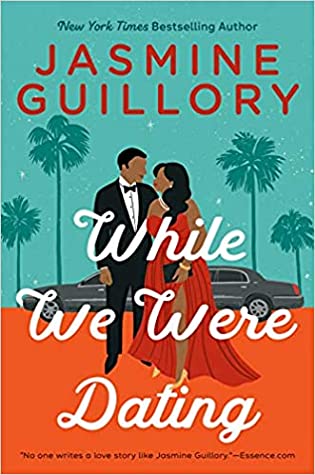
Title: While We Were Dating (The Wedding Date, #6)
Author: Jasmine Guillory
Publisher: Berkley
Publication date: July 13, 2021
Length: 336 pages
Genre: Contemporary romance
Source: Review copy courtesy of the publisher via Netgalley
Rating:

Rating: 3.5 out of 5.

Two people realize that it’s no longer an act when they veer off-script in this sizzling romantic comedy by New York Times bestselling author Jasmine Guillory.

Ben Stephens has never bothered with serious relationships. He has plenty of casual dates to keep him busy, family drama he’s trying to ignore and his advertising job to focus on. When Ben lands a huge ad campaign featuring movie star Anna Gardiner, however, it’s hard to keep it purely professional. Anna is not just gorgeous and sexy, she’s also down to earth and considerate, and he can’t help flirting a little…

Anna Gardiner is on a mission: to make herself a household name, and this ad campaign will be a great distraction while she waits to hear if she’s booked her next movie. However, she didn’t expect Ben Stephens to be her biggest distraction. She knows mixing business with pleasure never works out, but why not indulge in a harmless flirtation?

But their lighthearted banter takes a turn for the serious when Ben helps Anna in a family emergency, and they reveal truths about themselves to each other, truths they’ve barely shared with those closest to them.

When the opportunity comes to turn their real-life fling into something more for the Hollywood spotlight, will Ben be content to play the background role in Anna’s life and leave when the cameras stop rolling? Or could he be the leading man she needs to craft their own Hollywood ending?

Jasmine Guillory’s books are reliably romantic, intimate, and full of unusual characters, and While We Were Dating is no exception.

Our two main characters are Ben, an up-and-coming advertising executive (who, BTW, used to be a backup dancer — hot!), and Anna, an Oscar-nominated actress who needs her next movie to be the big breakthrough that will take her back to the Oscars and send her home with the prize.

When Anna agrees to star in the ad campaign Ben is leading, they’re immediately drawn to one another and develop an easy rapport. But it’s not until Ben offers to drive her all night to reach her family at a Southern California emergency room that they truly connect, spending the long car ride sharing secrets and dreams. Their intimacy becomes physical, and they’re both wildly attracted to one another — but neither imagines that this can be anything but a fling.

Later, Anna’s manager comes up with a plan: In order for the studios to see Anna as a big enough box-office draw to land that next crucial movie contract, she needs to be more in the public eye. He convinces her to go public in a fake relationship with Ben, making sure the paparazzi are on hand to capture their every private-but-public flirtation. Soon, they’re featured in People magazine and are walking the red carpet together, but Ben knows that once the premieres have ended, so will this relationship.

I enjoyed a lot about While We Were Dating. Anna and Ben are both well-developed, flawed people. Sure, they’re super hot, but they’re also vulnerable, each dealing with his or her memories and past painful experiences, cautious about who they trust and who they allow into their lives. They have an easy chemistry together, and their banter is adorable and flirtatious and very down-to-earth.

This author also tends to go outside the societal norms of beauty when it comes to her heroines, and Anna is depicted as both stunningly gorgeous and plus-sized. And honestly, I love that about her.

I’m not a huge fan of “Stars! They’re Just Like Us!” kind of stories, so the Hollywood magic is, if anything, a minus for me when it comes to books featuring glamorous stars and their love lives. Here, though, we see Anna’s family and her roots, her struggle to adjust to her new reality, the invasiveness of the paparazzi, the need to always be “on”, and it makes her feel relatable, even if the day-to-day of her life — with stylists and gowns and borrowed jewels — feels like something from another world.

The books in The Wedding Date series are all loosely connected, but don’t worry if you haven’t read the others. Familiar characters show up, and you’ll be happy to see them if you know who they are, but it’s not at all crucial to know their backstories in order to enjoy While We Were Dating (or any of the other book in the series.) Each book focuses on a new romantic pairing and can stand on its own just fine.

If you’re a fan of Jasmine Guillory’s books, you’ll definitely want to read this one as well. Even if you’re new to this author, this would make a great pick for beach or poolside reading.

**********

Through affiliate programs, I may earn commissions from purchases made when you click through these links, at no cost to you.

Buy now at AmazonBook DepositoryBookshop.org

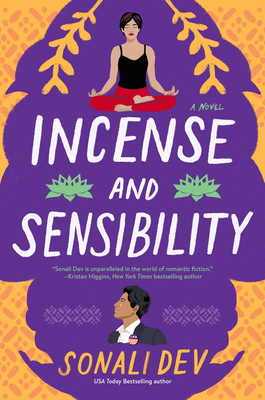
Book Review: Incense and Sensibility by Sonali Dev

Title: Incense and Sensibility
Author: Sonali Dev
Publisher: William Morrow
Publication date: July 6, 2021
Length: 400 pages
Genre: Contemporary fiction
Source: Review copy courtesy of the publisher via Netgalley
Rating:

Rating: 4.5 out of 5.

Yash Raje, California’s first serious Indian gubernatorial candidate, has always known exactly what he wants—and how to use his privileged background to get it. He attributes his success to a simple mantra: control your feelings and you can control the world.

But when a hate-fueled incident at a rally critically injures his friend, Yash’s easy life suddenly feels like a lie, his control an illusion. When he tries to get back on the campaign trail, he blacks out with panic.

Desperate to keep Yash’s condition from leaking to the media, his family turns to the one person they trust—his sister’s best friend, India Dashwood, California’s foremost stress management coach. Raised by a family of yoga teachers, India has helped San Francisco’s high strung overachievers for a decade without so much as altering her breath. But this man—with his boundless ambition, simmering intensity, and absolute faith in his political beliefs—is like no other. Yash has spent a lifetime repressing everything to succeed.

Including their one magical night ten years ago—a too brief, too bright passion that if rekindled threatens the life he’s crafted for himself. Exposing the secrets might be the only way to save him but it’s also guaranteed to destroy the dream he’s willingly shouldered for his family and community . . . until now.

As you might guess from the title — but not from the synopsis — Incense and Sensibility is a modern-day retelling of Jane Austen’s Sense and Sensibility. It’s also a moving, well-written, and engaging contemporary novel about love, pain, and healing.

I&S continues the loosely connected story of the Rajes, a wealthy Indian-American family living in the Bay Area. Previous books have focused on Yash’s sister Trisha (Pride, Prejudice, and Other Flavors) and his cousin Ashna (Recipe For Persuasion). In both of those books, Yash is a background character — the successful, driven brother who can achieve anything he wants. He’s the golden child, the one everyone believes will do great things.

He’s also haunted by trauma, although he doesn’t even realize this until events kick off in I&S. As the book opens, Yash is running a competitive race for governor of California, and his chances look good. He’s a man devoted to public service, who truly believes that he’s called to make life better for those who are suffering. While popular with many voters, Yash also encounters the racism you’d unfortunately not be surprised by due to his skin color and ethnicity. An attempted shooting at a rally leaves Yash lightly wounded, but puts his trusted friend and bodyguard Abdul into a coma that he isn’t expected to wake from.

Suddenly, Yash’s world is turned upside down. He feels tremendous guilt about Abdul’s sacrifice, and is overwhelmed by an anxiety attack when he attempts to go onstage at his next rally. With only months to go until the election, and with a growing lead in the polls, his family is desperate to “fix” him. And so they turn to a friend of Ashna and Trisha’s, India Dashwood, a yoga instructor and Reiki healer.

India lives with her mother Tara and her highly emotional sister China in the apartment above their yoga studio. They’re not well off, but they’re getting by, until Tara falls ill and India realizes they may not be able to cover her necessary medical treatments. On top of that, China is head-over-heels in love with a Korean pop star, but the woman she loves is deeply closeted and insists on secrecy. China sees a rosy future, but India is afraid that China will be hurt badly.

When Yash reenters India’s life, it’s ten years after they spent a magical, romantic night together in which they fell in love, but then parted and never reunited. India has never quite recovered from the pain of Yash’s disappearance from her life, but she also can’t turn him away when he’s obviously in such pain and in need of help. As she works with him on healing from trauma, old wounds reemerge and are finally confronted, and Yash and India’s feeling for one another resurface as well. But with the election his to lose, Yash has to make some big decisions about telling the truth and taking a stand, and India must decide whether she’s willing to risk the peace she’s found for the man she’s never gotten over.

Incense and Sensibility may look light and possibly even funny from the cover, but it’s really not. While there are some lighter moments, the book deals with very real trauma and pain, and the author isn’t afraid to show how the characters are affected by their pasts in damaging ways. At the same time, the characters really are lovely and sympathetic, and I loved getting to know the new characters introduced in this addition to the Rajes series, especially India, who is just wonderful.

As an Austen retelling, I found I&S to be very successful. Contemporary retellings of Austen novels are hard to pull off. With the classics’ focus on marriage, their themes can be hard to translate to a modern setting, and many of the retellings I’ve read feel like they’re trying too hard to shoehorn Austen’s storylines into a setting where they just don’t work.

Not so in I&S. Sonali Dev doesn’t hit us over the head with the Jane Austen references and plot points. While they’re there, they work organically, so the story would make sense and be appealing even without knowledge of the original. And while some characters’ storylines are a bit more obvious — for example, China as the Marianne stand-in is destined to have her heart broken — I was still taken by surprise by some of the twists and turns of the story, and that’s a good thing. Also, for what it’s worth, it took me a really long time to figure out who the Colonel Brandon character would be, even though it should have been obvious (I won’t say why, because spoilers!).

Incense and Sensibility is a terrific read, both as a standalone contemporary love story and as an Austen retelling. I can’t wait to find out which Austen novel the author will tackle next! I’m so enjoying the characters and their lives, and look forward to the next book so I can stay in their world.

And as a side note — India’s yoga practice and her approach to life have finally convinced me that I need to find a good yoga class!

**********

Through affiliate programs, I may earn commissions from purchases made when you click through these links, at no cost to you.

Buy now at AmazonBook DepositoryBookshop.org

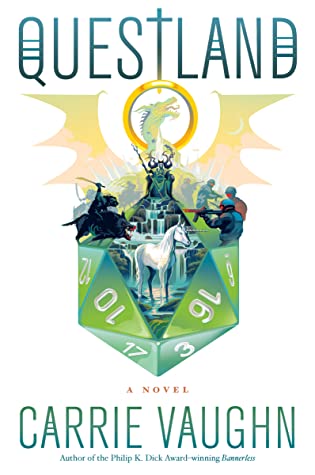
Book Review: Questland by Carrie Vaughn

Title: Questland
Author: Carrie Vaughn
Publisher: John Joseph Adams/Mariner Books
Publication date: June 22, 2021
Length: 304 pages
Genre: Contemporary fiction/fantasy
Source: Review copy courtesy of the publisher via Netgalley
Rating:

Rating: 3.5 out of 5.

YOU FIND YOURSELF IN A MAZE FULL OF TWISTY PASSAGES…


Literature professor Dr. Addie Cox is living a happy, if sheltered, life in her ivory tower when Harris Lang, the famously eccentric billionaire tech genius, offers her an unusual job. He wants her to guide a mercenary strike team sent to infiltrate his island retreat off the northwest coast of the United States. Addie is puzzled by her role on the mission until she understands what Lang has built:  Insula Mirabilis, an isolated resort where tourists will one day pay big bucks for a convincing, high-tech-powered fantasy-world experience, complete with dragons, unicorns, and, yes, magic.


Unfortunately, one of the island’s employees has gone rogue and activated an invisible force shield that has cut off all outside communication. A Coast Guard cutter attempting to pass through the shield has been destroyed. Suspicion rests on Dominic Brand, the project’s head designer— and Addie Cox’s ex-boyfriend. Lang has tasked Addie and the mercenary team with taking back control of the island at any cost.


But Addie is wrestling demons of her own—and not the fantastical kind. Now, she must navigate the deadly traps of Insula Mirabilis as well as her own past trauma. And no d20, however lucky, can help Addie make this saving throw.

To understand the basic premise of Questland, it’s helpful to refer back to Arthur C. Clarke’s famous statement, explicitly referred to in this book:

“Any sufficiently advanced technology is indistinguishable from magic.”

Questland is contemporary fiction, but with technology and fantasy as its underlying themes. In Questland, Professor Addie Cox, an expert in comparative literature with a focus on mythology and fantasy, is approached by tech billionaire Harris Lang with a proposition: Help him reclaim control of his top-secret project, which has been hijacked (supposedly) by his underlings.

The project is a fantasy island in the truest sense of the words: Think Jurassic Park, but instead of T-Rex and velociraptors, insert wizards, goblins, elves, and archers. Insula Mirabilis is conceived of as a fantasy vacation resort, where hardcore gamers and fantasy geeks can immerse themselves in a world in which magic appears to be real. Thanks, of course, to the sufficiently advanced technology to pull it all off.

But Insula Mirabilis seems to have cut off all access and communication with the outside world, and Lang wants it back. Addie is sent to infiltrate the island along with a small band of mercenaries. Addie’s gaming/fantasy brain immediately recognizes her role in all this — their group may have a Cleric and a Ranger, but she’s clearly the Bard.

Her unique knowledge and experience in fantasy worlds quickly becomes important, as the team encounters a Sphinx, a maze, and all sorts of dangerous riddles and traps. Worryingly, the fail-safes for the fantasy elements seem to be turned off — so yes, those arrows and stunners and spider claws can do real damage, and worse.

Addie also carries with her very significant baggage. As a teen, she survived a school shooting, but watched her two closest friends die. Fantasy worlds and gaming became a sort of refuge for Addie:

All I’d ever wanted to do was escape. No, that wasn’t true. All I wanted was for what happened to mean something. Stories meant something, and real life… didn’t.

The plotline of Questland follows Addie and her team’s journey across the island, from the realms of dwarves to the magical and beautiful realm of elves, with random weird encounters with animal villages, Robin Hood and his Merry Men, unicorns, wargs, and more. It’s all so real — but Addie knows it’s not.

My feelings on Questland are mixed. First, delight — who wouldn’t want to inhabit a real-feeling world that incorporates every fantasy element you could possibly desire? It sounds too good to be true, and of course, none of it really is true. For all the mead and antlers and fairy lights, there’s a backroom filled with computers and controllers and transmitters. It may feel like entering a fantasy world, but the ancient stone castle is 3D-printed.

Beyond the delight of the concept, I was often frustrated by the quest itself. The overarching plotline about the corporate takeover veers between being overly complicated and just not very rational. So one faction seizes control of the island — and then everyone there just stays there, wearing costumes and acting as if they live inside the fantasy? To what end, ultimately? If Addie’s team hadn’t arrived, how long would this have gone on?

Still, it’s fun to see Addie use her wits and her geek sensibilities to outsmart the traps and puzzles of the island, getting to be heroic while those around her want to view her as a damsel to be shielded. I wish Addie’s backstory had been even more fleshed out — the pieces dealing with her PTSD and the lingering trauma of her past are sensitively depicted and quite moving.

Never having played D&D or other fantasy-based games or RPGs myself, perhaps I wasn’t quite primed to be the perfect audience for Questland, although I did appreciate how seriously Addie and the island characters take Harry Potter, the Tolkien masterpieces, Narnia, Labyrinth, and more. These aren’t presented in the wink-wink pop culture cool way of many contemporary novels that want to show their characters’ geek cred — instead, in Questland, knowledge of modern fantasy epics is as foundational as a knowledge of Gilgamesh and the Odyssey.

Overall, I enjoyed Questland, but got bored at points with the quest elements. And yet, it’s never a bad thing to see geek culture front and center, being celebrated for all its complexity and wonder. As Addie explains:

I’m not sure any of them really understand — it’s not the stuff. It’s not the magic, the unicorns, the rings. All that’s just things. Fantasy is about what you can’t patent. Honor and heroism and… and… hope.

And as the author says in the end notes:

It’s not just about the sufficiently advanced technology that appears to make magic possible. It’s about a culture hungry for worlds and stories filled with magic. That embraces a sense of wonder instead of being suspicious of it.

If you’re a fan of magical worlds, and especially if you’ve grown up immersing yourself in games and movies that transport you into those worlds, do check out Questland.

**********

Through affiliate programs, I may earn commissions from purchases made when you click through these links, at no cost to you.

Buy now at AmazonBook DepositoryBookshop.org

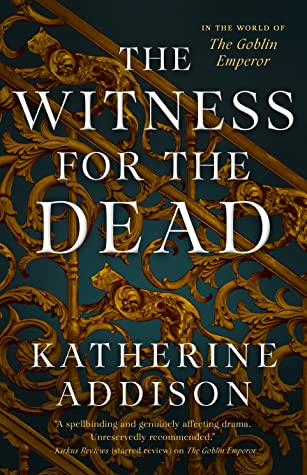
Book Review: The Witness for the Dead by Katherine Addison

Title: The Witness for the Dead
Author: Katherine Addison
Publisher: Tor Books
Publication date: June 22, 2021
Length: 240 pages
Genre: Fantasy
Source: Purchased
Rating:

Rating: 5 out of 5.

Katherine Addison returns to the glittering world she created for her beloved novel, The Goblin Emperor, in this stand-alone sequel.

When the young half-goblin emperor Maia sought to learn who had set the bombs that killed his father and half-brothers, he turned to an obscure resident of his father’s Court, a Prelate of Ulis and a Witness for the Dead. Thara Celehar found the truth, though it did him no good to discover it. He lost his place as a retainer of his cousin the former Empress, and made far too many enemies among the many factions vying for power in the new Court. The favor of the Emperor is a dangerous coin.

Now Celehar lives in the city of Amalo, far from the Court though not exactly in exile. He has not escaped from politics, but his position gives him the ability to serve the common people of the city, which is his preference. He lives modestly, but his decency and fundamental honestly will not permit him to live quietly. As a Witness for the Dead, he can, sometimes, speak to the recently dead: see the last thing they saw, know the last thought they had, experience the last thing they felt. It is his duty use that ability to resolve disputes, to ascertain the intent of the dead, to find the killers of the murdered.

Now Celehar’s skills lead him out of the quiet and into a morass of treachery, murder, and injustice. No matter his own background with the imperial house, Celehar will stand with the commoners, and possibly find a light in the darkness.

Katherine Addison has created a fantastic world for these books – wide and deep and true.

Thara Celehar is the Witness for the Dead of this book’s title. He’s gifted with the ability to find out the truth of a death by making contact with the deceased’s body. He says a prayer of compassion, then asks the dead to answer questions. Sometimes, it’s too late, and there’s no one left in the body to answer the query. But sometimes, he’s able to get answers or at least an impression of the person’s last moments. He then bears witness for the dead person, testifying to what he’s learned in order to solve a mystery or resolve a dispute. His basic goodness allows him to carry out his duties with dignity.

However, despite being located in a smaller city far from the capitol, Thara is not completely shielded from the backbiting and political striving that characterizes the prelacy of Amalo. There are some who are jealous of Thara’s connection to the emperor; others fear that he might gain power and seek to tear him down. No matter how he tries to stay outside the fray, he’s drawn in repeatedly.

As the book opens, Thara becomes involved in several unsolved cases. In one, a family needs him to discover who their patriarch’s intended heir is, as the will is in dispute. In another, sadder case, a brother seeks his sister’s body, believing that the man she eloped with may have done her harm. And in the story that becomes the overarching plotline of the book, a beautiful young woman’s body is pulled from the canal — was her death an accident, or was she killed? And if it was murder, who did it?

As he investigates, he becomes drawn into the worlds of the opera, the rich patrons, the seedier bars and teahouses, the gambling establishments, and the law enforcement of Amalo. He persists in pursuing the truth, even when his own life and reputation are at stake. Despite his fears and doubts, Thara is always true to his calling, and his intelligence and bravery enable him to see his inquiries through until he can find the truth on behalf of the dead.

The world of The Witness for the Dead is the world of The Goblin Emperor… and I can’t even begin to describe or explain how much I love this world. Author Katherine Addison has meticulously crafted a world with a finely developed culture, religious underpinnings, class stratifications, nobility and commoners, courtiers and princes. There’s a strange beauty to the descriptions of the people and the society, and I am particularly head over heels in love with the language of The Goblin Emperor‘s world.

In her books, the author creates a vocabulary and grammar that is dizzyingly strange and difficult, making the books seem almost impenetrable at first — but if we stick with it (as I encourage everyone to do), the names of the people and places and institutions, as well as the forms of address and the contrasting formal and informal speech patterns, all create a sort of linguistic magic. As I re-read The Goblin Emperor via audiobook, I was enthralled all over again, not just by the story, but by the very sound of it all. Truly an incredible experience.

Back to The Witness for the Dead: I loved this story. It was fascinating seeing Thara Celehar about his work. We see him in action in The Goblin Emperor through his interactions with the Emperor, but here, we’re privy to more of his inner life and learn more about what sort of person he is and what drives him. It’s an engrossing character study, enhanced by clever mysteries for Thara to solve.

I suppose my only complaint about The Witness for the Dead isn’t really about this book at all: I just missed Maia (Emperor Edrehasivar VII) so, so much. I would gladly read a multiple-volume history covering the reign of the emperor… but I’d also happily settle for just one more novel!

I can’t imagine reading The Witness for the Dead without having read The Goblin Emperor. I do know at least one person who’s planning to do just that, and I’ll be interested to hear her thoughts. I don’t think this book would work as a stand-alone, since I can’t see how someone could truly make sense of the world (not to mention all those names!!) without having read the previous novel. But, I’d be happy to be proven wrong!

I highly recommend The Witness for the Dead, but please do yourself a favor and read The Goblin Emperor first. I hope you’ll love it as much as I do!

Note: As part of a preorder sales promotion, I also received a digital copy of a new short story called Lora Selezh. It’s a compact story about Thara witnessing on behalf of a petitioner, and I really liked it. I don’t know if it’s available elsewhere, but if so, don’t miss it.

**********

Through affiliate programs, I may earn commissions from purchases made when you click through these links, at no cost to you.

Buy now at AmazonBook DepositoryBookshop.org

Top Ten Tuesday: Most Anticipated Releases of the Second Half of 2021

Top Ten Tuesday is a meme hosted by That Artsy Reader Girl, featuring a different top 10 theme each week. This week’s topic is Most Anticipated Releases of the Second Half of 2021. I just recently did a top 10 list of my summer TBR, which included mostly new releases, so I’ll attempt not to repeat myself!

July

Any Way the Wind Blows by Rainbow Rowell – the 3rd Simon Snow book! (July 6)

The Book of Accidents by Chuck Wendig (July 20 )

August

My Heart is a Chainsaw by Stephen Graham Jones (August 31)

September

When Sorrows Come by Seanan McGuire — the 15th October Daye book! (September 14)

Under the Whispering Door by TJ Klune (September 21)

October

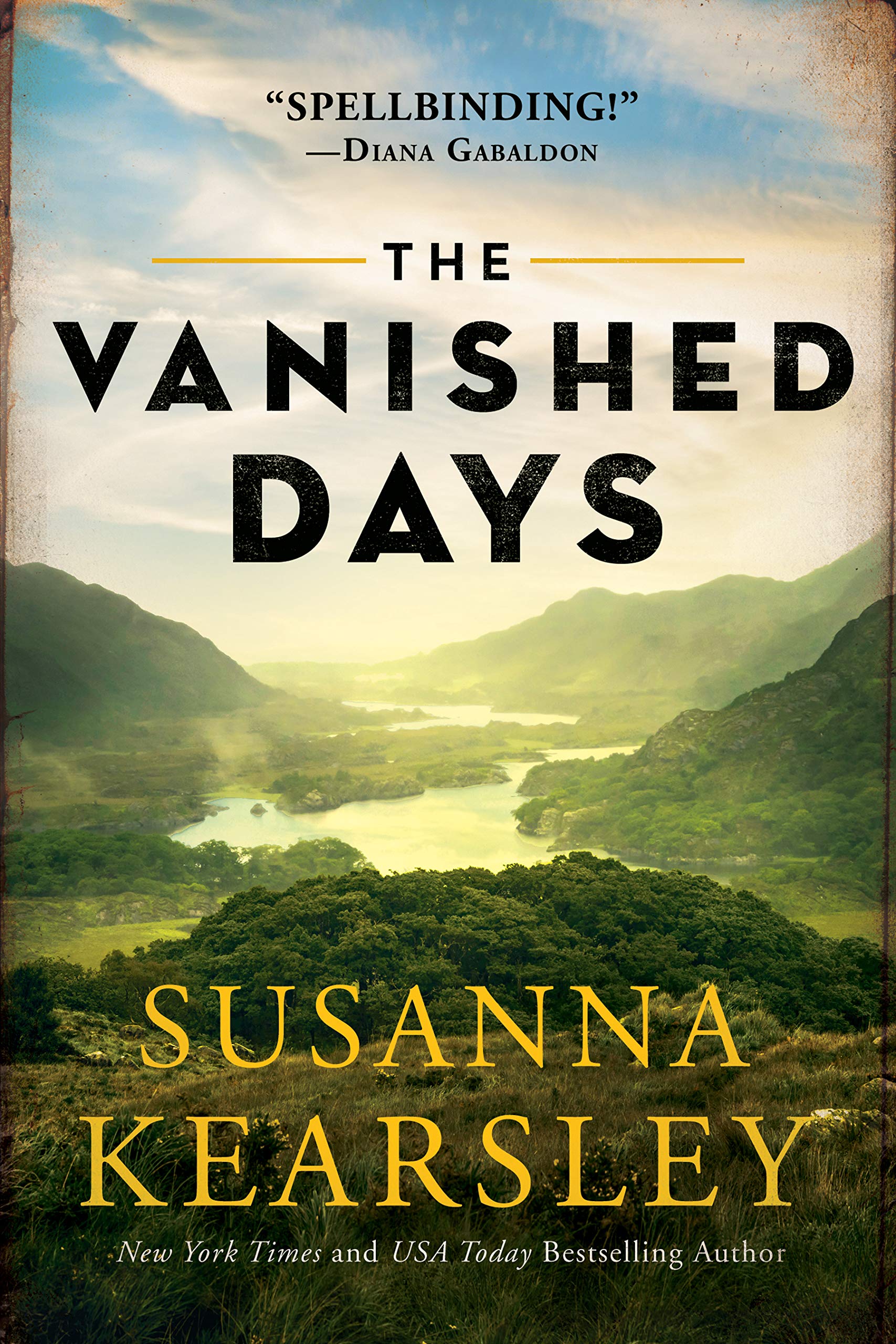
The Vanished Days by Susanna Kearsley — I will ALWAYS read a new novel by this author! (October 5)

A Spindle Splintered by Alix E. Harrow (October 5)

Well Matched by Jen DeLuca — the 3rd book in the series. These books are so cute! (October 19)

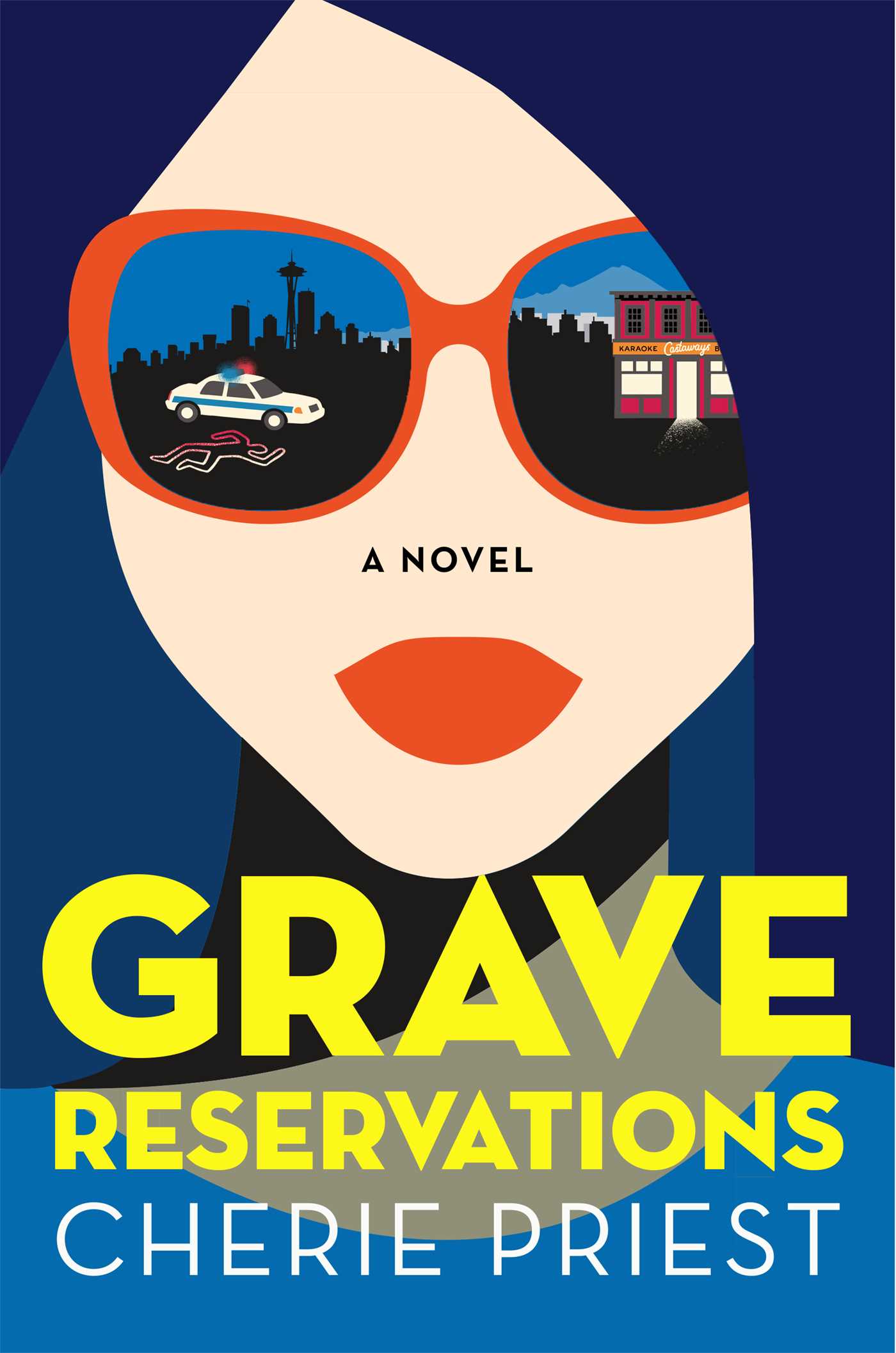
Grave Reservations by Cherie Priest (October 26)

November

Go Tell the Bees That I Am Gone by Diana Gabaldon — It’s the new Outlander book!! After a 7 year wait! (November 23)

What are your most anticipated new releases for the 2nd half of 2021? Do we have any in common?

Please share your links!

Save

Save

Save

Save

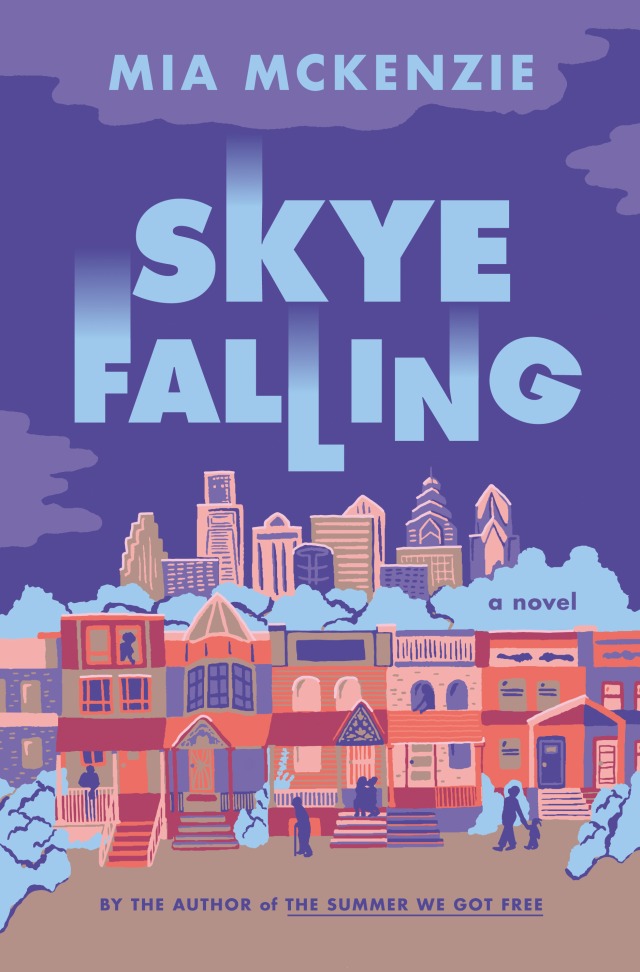
Book Review: Skye Falling by Mia McKenzie

Title: Skye Falling
Author: Mia McKenzie
Publisher: Random House
Publication date: June 22, 2021
Length: 320 pages
Genre: Contemporary fiction
Source: Review copy courtesy of the publisher via NetGalley
Rating:

Rating: 3.5 out of 5.

A woman who’s used to going solo discovers that there’s one relationship she can’t run away from in this buoyant novel from the Lambda Literary Award-winning author of The Summer We Got Free

Twenty-six and broke, Skye didn’t think twice before selling her eggs and happily pocketing the cash. Now approaching forty, Skye moves through life entirely–and unrepentantly–on her own terms, living out of a suitcase and avoiding all manner of serious relationships. Her personal life might be a mess, and no one would be surprised if she died alone in a hotel room, but at least she’s free to do as she pleases. But then a twelve-year-old girl shows up during one of Skye’s brief visits to her hometown of Philadelphia, and tells Skye that she’s “her egg.” Skye’s life is thrown into sharp relief and she decides that it might be time to actually try to have a meaningful relationship with another human being. Spoiler alert: It’s not easy.

Things gets even more complicated when Skye realizes that the woman she tried and failed to pick up the other day is the girl’s aunt and now it’s awkward. All the while, her brother is trying to get in touch, her problematic mother is being bewilderingly kind, and the West Philly pool halls and hoagie shops of her youth have been replaced by hipster cafes.

Told in a fresh, lively voice, this novel is a relentlessly clever, deeply moving portrait of a woman and the relationships she thought she could live without.

Main character Skye is definitely an acquired taste in this funny yet touching novel set in West Philadelphia. Skye is a loner by choice, always fleeing before friendships, relationships, or family can make too many demands on her. She’s abrasive and off-putting, and has basically one friend left who puts up with her selfishness and unreliability.

Skye runs a tour company that specializes in international experiences for Black travelers, and she’s wildly successful. It not coincidental that leading tours around the globe pretty much nonstop means she never has to stay put for very long in any one place. Her life is filled with adventure and one night stands, and she prefers to keep it that way.

All this changes when 12-year-old Vicky shows up in Skye’s life and reminds her of that time way back when, when Skye donated eggs to Cynthia, a former friend from summers at camp. Cynthia has recently passed, Vicky is being raised by her aunt Faye, and guess what? She’s Skye’s egg. Initially, Skye’s reaction to this news is to both vomit and then try to climb out a window to escape (seriously), but she starts to come around to the idea that maybe it wouldn’t be so bad to have a connection to someone — someone who’ll maybe take care of her in her own age. (Once again, Skye’s selfishness is front and center — it’s about her, not about Vicky.)

For once, Skye decides to stay put in Philly and get to know Vicky, and as she does, a new bond starts to grow between the two. And staying put, Skye is forced to start dealing with the trauma and bad memories of her youth, rather than always running away at the first hint of having to be serious.

Complicating matters too is Skye’s growing attraction to Faye, which may or may not be reciprocated, her long-ignored relationships with her mother and brother, and confronting memories of past rejections that may not be as clear-cut as Skye would like to think.

It’s really hard to like Skye, and at first, I absolutely didn’t. She’s mean to people, irresponsible, and doesn’t seem to care about anything or anyone. Gradually, though, we get to see how much of her personality and her actions are defense mechanisms based on escaping her past, and as Skye starts to (finally) mature, she slowly starts to become a person who gets involved and actually cares.

Vicky is a terrific character, and she’s not all sweetness and light. She’s dealing with her own set of traumas, including losing her mother, having a stepmother she hates, and living in a gentrifying neighborhood where the newly arrived white neighbors feel the need to call the cops on the long-term Black residents over so-called noise infractions. While the book focuses on the personal relationships, it also pays great attention to the world around the characters,

Overall, Skye Falling was a quick read, and I while I always felt at a bit of a distance from Skye, I did enjoy the relationships and getting to know the characters and the neighborhood.

**********

Through affiliate programs, I may earn commissions from purchases made when you click through these links, at no cost to you.

Buy now at AmazonBook DepositoryBookshop.org

Book Review: The World Gives Way by Marissa Levien

Title: The World Gives Way
Author: Marissa Levien
Publisher: Redhook
Publication date: June 15, 2021
Length: 380 pages
Genre: Science fiction
Source: Review copy courtesy of the publisher
Rating:

Rating: 3.5 out of 5.

In a near-future world on the brink of collapse, a young woman born into servitude must seize her own freedom in this glittering debut with a brilliant twist; perfect for fans of Station Eleven, Karen Thompson Walker, and Naomi Alderman.

In fifty years, Myrra will be free.

Until then, she’s a contract worker. Ever since she was five, her life and labor have belonged to the highest bidder on her contract–butchers, laundries, and now the powerful, secretive Carlyles.

But when one night finds the Carlyles dead, Myrra is suddenly free a lot sooner than she anticipated–and at a cost she never could have imagined. Burdened with the Carlyles’ orphaned daughter and the terrible secret they died to escape, she runs. With time running out, Myrra must come face to face with the truth about her world–and embrace what’s left before it’s too late.

A sweeping novel with a darkly glimmering heart, The World Gives Way is an unforgettable portrait of a world in freefall, and the fierce drive to live even at the end of it all.

Based on the synopsis, I expected a dystopian world of class wars and enforced servitude. And yes, that is what’s going on here, but also…

[SPOILER ALERT FOR BIG REVEAL AT END OF FIRST CHAPTER]

[BUT IS IT REALLY A SPOILER IF YOU FIND OUT IN THE FIRST CHAPTER???]

Here’s the spoiler…

The world is a spaceship.

Yup. This is a science fiction novel, and I had no idea before I picked it up!!

Now that that’s out of the way…

Myrra Dal is indentured to the Carlyle family, thanks to a contract signed by her great-grandmother. It’s a work contract that’s binding for not just the original contract signer, but for generations to follow. Myrra is the last in the chain. There are fifty years left on her contract, and then she’ll be free. Of course, this isn’t really a comfort to Myrra: A woman in her 20s, she doesn’t relish the idea of being old by the time she’s released from the contract, but she has no options. Contracts are completely binding and are enforced by the government’s security bureau, which tracks down those who try to escape. Rumor has it that there are executions, but no one really knows for sure.

And back to that spaceship thing: The world of the The World Gives Way is a huge space ship (which the book refers to as “the world the ship” and people just think of as the world). It’s been traveling for centuries, and is expected to reach their planetary destination within fifty years. It’s implied that the Earth was on its way to becoming uninhabitable when the ship was built and launched, and finding a home on board sounds like it was something available to the privileged and wealthy, plus all the workers needed to support a comfortable lifestyle during the lengthy journey.

When I say that the ship is huge, I really mean it. It’s described as being about the size of Switzerland! Which (I looked up for comparison) is equivalent to about Vermont and New Hampshire combined, or closer to home for me, about the size of the Bay Area. (I absolutely couldn’t grasp the size until I had something more familiar to compare it to.)

The world of the ship includes large cities, resort getaways, mountains, deserts, and seas. It really is a world unto itself. For those who can afford it, there are luxuries and extravagances. For everyone else, there’s work and a daily drudge.

As the novel opens, Myrra’s employer, Imogene Carlyle, summons Myrra to the roof of their penthouse. Imogene intends to jump, and wants Myrra to promise to care for her baby, Charlotte. She tells Myrra a huge secret, known only to the top tier of politicians (such as her husband) and government scientists — there’s a breach in the outer hull of the ship, and despite months of study and efforts, there’s no way to repair it. The ship is doomed, expected to breach completely within the next few months. Imogene and Marcus have decided to end their lives now, leaving Charlotte in Myrra’s care. And then she jumps.

Myrra can’t quite believe what’s happened or what she’s just heard, but after searching Marcus’s office, she’s convinced. Taking money from the Carlyle’s safe, she escapes with Charlotte, heading out on the run in search of temporary freedom, alone with the knowledge of the inescapable end of the world.

From here, we also meet Tobias, a rookie cop with a burdened family history who’s assigned the Myrra Dal runaway case as his big opportunity to prove himself. Since no one knows why the Carlyles committed suicide, or if it might even be murder, Myrra is not only an escaped contract worker but also a suspect in their deaths and the kidnapping of their daughter. Tobias and his older partner are hot on Myrra’s trail, following leads that take them to Palmer, an underwater domed city, and onward from there.

Meanwhile, the world begins to show signs of doom. There are more and more frequent “earthquakes”, causing damage, then city-ending destruction, and other strange phenomena as well. Buildings collapse and people are killed, and finally, the government has no choice but to share the horrible news.

But what good does knowing do when there’s no escape? The world the ship is alone is space, years away from any known destination or safe harbor. As the end nears, all Myrra can do is continue her journey, trying to find some sort of solution for Charlotte, and almost inadvertently looking for a semblance of peace for herself.

The World Gives Way has a sense of inevitability about it. As interspersed chapters tell us, the end is indeed coming. These small interludes, in between the chapters focusing on Myrra and Tobias, show us how different parts of the world experience the end and what happens to the people there. It’s awful, because we know all along that there’s only one way the story can end — the world does in fact give way.

That said, Myrra and Tobias’s parallel and then joined journeys are fascinating and moving to read. Their experiences combine elements of an adventure story — daring escapes, near misses, constant danger, clever ruses — with introspective moments about their lives, their pasts, and their hopes, now shown to be out of reach.

As with other books about the end of the world, it can be a very melancholy read, as we know that no matter how much we might wish otherwise, all the characters we meet are doomed. Still, their journey is powerful and and I was very caught up in seeing how their experiences would change them. Would they find peace? Would they make new discoveries? Would they find a way out for Charlotte? I won’t tell here, but I found the ending sad, satisfying, and oddly right, in its own way.

I will say that my brain could never quite grasp the enormity of the world the ship. How can there be a space ship the size of Switzerland? There are only brief descriptions of the overall shape and design of the container of the world — the ship’s hulls, its cylindrical shape, its rotational access — but my mind just never quite got how there could be an entire world, with geographical features like seas and mountains, inside a ship. (That said, I was fine with reading Discworld, in which the entire world travels through space on the back of a giant turtle… but hey, that’s fantasy!)

Despite not being able to come to terms with the size and features of the ship itself, I did enjoy the attempt to picture it all, and couldn’t help but admire the author’s inventiveness in creating such a strange, weird world. Besides the physical aspects of the world, I thought it was also very clever to create such a stratified society, with the ultra-privileged wealthy few dominating the lives of so many contract workers and free working class people. It’s literally an entire world created to support the privilege of those able to afford a new life on a new planet, and the social structure really is fascinating.

The World Gives Way is a little inconsistent in tone, with its ups and downs of action and emotion, but I did like it very much. It wasn’t what I expected, but it ends up really delivering an engrossing and thought-provoking reading experience.

**********

Through affiliate programs, I may earn commissions from purchases made when you click through these links, at no cost to you.

Buy now at AmazonBook DepositoryBookshop.org

Book Review: Rabbits by Terry Miles

Title: Rabbits
Author: Terry Miles
Publisher: Del Rey
Publication date: June 8, 2021
Length: 448 pages
Genre: Science fiction
Source: Review copy courtesy of the publisher via NetGalley
Rating:

Rating: 2.5 out of 5.

Conspiracies abound in this surreal and yet all-too-real technothriller in which a deadly underground alternate reality game might just be altering reality itself, set in the same world as the popular Rabbits podcast.

It’s an average work day. You’ve been wrapped up in a task, and you check the clock when you come up for air–4:44 pm. You go to check your email, and 44 unread messages have built up. With a shock, you realize it is April 4th–4/4. And when you get in your car to drive home, your odometer reads 44,444. Coincidence? Or have you just seen the edge of a rabbit hole?

Rabbits is a mysterious alternate reality game so vast it uses our global reality as its canvas. Since the game first started in 1959, ten iterations have appeared and nine winners have been declared. Their identities are unknown. So is their reward, which is whispered to be NSA or CIA recruitment, vast wealth, immortality, or perhaps even the key to unlocking the secrets of the universe itself. But the deeper you get, the more deadly the game becomes. Players have died in the past–and the body count is rising.

And now the eleventh round is about to begin. Enter K–a Rabbits obsessive who has been trying to find a way into the game for years. That path opens when K is approached by billionaire Alan Scarpio, the alleged winner of the sixth iteration. Scarpio says that something has gone wrong with the game and that K needs to fix it before Eleven starts or the whole world will pay the price.

Five days later, Scarpio is declared missing. Two weeks after that, K blows the deadline and Eleven begins. And suddenly, the fate of the entire universe is at stake.

I’m not sure I’m actually up to the task of righting a Rabbits review, but I’ll give it a shot!

Rabbits is both the name of this novel and the name of the game within the novel. Rabbits — the game — is secretive and mysterious. No one knows for sure if it actually exists, who created it, how you play, who has played, or how you win. Yet there are countless online discussion groups devoted to Rabbits, as well as countless die-hard gamers who live and breathe for the opportunity to find out more and maybe even get to play.

K, the main character of the book, holds regular workshops on Rabbits in a Seattle arcade, where he reveals rare recordings and shares the lore of the game. It’s all based on rumors and hearsay and dark web conspiracies, but K is more successful than most. Gifted since birth with the ability to see and recognize patterns and connections, he’s highly skilled when it comes to recognizing the anomalies and seeming coincidences that are so crucial to Rabbits.

K also presents as being somewhat imbalanced, losing time, having strange freakouts, and becoming so obsessed with clues and the game that he forgets to eat or sleep. As the book opens, K receives a strange warning from a tech billionaire rumored to be a winner of an earlier iteration of the game. He states that there’s something wrong with the game, that it’s up to K to fix it, and that if he doesn’t, the world may be doomed. No pressure though!

We follow K and his maybe-girlfriend Chloe through a baffling series of symbols, puzzles, and patterns as they work to solve the riddle of Rabbits and, hopefully, to keep the multiverse from imploding. Reading Rabbits, I couldn’t help thinking that it’s sort of a Da Vinci Code kind of mystery wrapped up in gamer-speak, with a techno-thriller pace and edge to it all.

Rabbits is incredibly confusing, and to be honest, I don’t think I could actually tell you what Rabbits — the game — actually is or how someone wins. The book is convoluted as heck, although I can’t say it doesn’t have enjoyable moments. The mindfuckery is leavened by funny dialogue and pop culture references — in between all the parts that left me scratching my head and utterly bewildered. More often than not, I found myself incredibly impatient with all the twists and turns, and I just couldn’t suspend disbelief enough to buy into the idea that these hidden clues could actually make sense to a real person.

I think maybe I’m just not the right audience for Rabbits. The book is long, and while there are some fun passages and escapades, overall it didn’t make a whole lot of sense to me. I will say, though, that it’s made me hypersensitive right now to patterns and coincidences… like why do I always happen to be glancing at a clock when it’s 9:20?

Maybe it’s the game. Maybe I’m playing and I don’t even know it!

Final note: Rabbits is also the name of a podcast created by the novel’s author, Terry Miles. I haven’t listened to it, and understand from the book’s marketing that it’s not necessary to have listened to the podcast to read the book — but it’s also about the game Rabbits. The podcast can be found at: https://www.rabbitspodcast.com/

**********

Through affiliate programs, I may earn commissions from purchases made when you click through these links, at no cost to you.

Buy now at AmazonBook DepositoryBookshop.org

Top Ten Tuesday: Books On My Summer 2021 TBR

Top Ten Tuesday is a meme hosted by That Artsy Reader Girl, featuring a different top 10 theme each week. This week’s topic is Books On My Summer 2021 TBR.

This is really just scratching the surface — so many books to read! Here are 10 of my upcoming reads, all being released in June, July or August. Six out of ten are sequels or continuations of series, and four are new stand-alones. They all sound amazing!

  1. Instructions for Dancing by Nicola Yoon
  2. The Witness for the Dead by Katherine Addison (set in the world of The Goblin Emperor)
  3. The Book of Accidents by Chuck Wendig
  4. While We Were Dating by Jasmine Guillory
  5. The Final Girl Support Group by Grady Hendrix
  6. Any Way the Wind Blows by Rainbow Rowell (the 3rd Simon Snow book)
  7. Incense and Sensibility by Sonali Dev (fun series of Jane Austen retellings)
  8. Velvet Was the Night by Silvia Moreno-Garcia
  9. Feral Creatures by Kira Jane Buxton (sequel to Hollow Kingdom)
  10. Sunrise By the Sea by Jenny Colgan (another book in the Little Beach Street Bakery series!)

What are you planning to read this summer? Please share your links!

Save

Save

Save

Save

Book Review: I Don’t Forgive You by Aggie Blum Thompson

Title: I Don’t Forgive You
Author: Aggie Blum Thompson
Publisher: Forge
Publication date: June 8, 2021
Length: 384 pages
Genre: Thriller
Source: Review copy courtesy of the publisher via NetGalley
Rating:

Rating: 3 out of 5.

An accomplished photographer and the devoted mom of an adorable little boy, Allie Ross has just moved to an upscale DC suburb, the kind of place where parenting feels like a competitive sport. Allie’s desperate to make a good first impression. Then she’s framed for murder.

It all starts at a neighborhood party when a local dad corners Allie and calls her by an old, forgotten nickname from her dark past. The next day, he is found dead.

Soon, the police are knocking at her door, grilling her about a supposed Tinder relationship with the man, and pulling up texts between them. She learns quickly that she’s been hacked and someone is impersonating her online. Her reputation–socially and professionally–is at stake; even her husband starts to doubt her. As the killer closes in, Allie must reach back into a past she vowed to forget in order to learn the shocking truth of who is destroying her life.

Allie is new to the close-knit, overly involved neighborhood when she attends a party that changes everything. The community is full of successful, highly ambitious people whose children all attend the same school. Everyone knows everything about everybody, and it’s cliquey and overwhelming to outsider Allie. After some mild flirting over a glass of wine, Allie finds herself cornered and assaulted in the bathroom, and leaves feeling shaken up and terribly worried about her future in the neighborhood.

Among the neighborhood women, she has few allies, and when she decides to share her terrible experience with her closest neighbor, the word spreads that she’s accused the (now dead) man of assault. The crisis escalates as Allie discovers fake Tinder and Facebook accounts pretending to be her, causing horrible damage to her reputation, and soon leading even her husband to mistrust her.

Meanwhile, an old secret from Allie’s troubled past seems to be resurfacing, and to make matters worse, her mother and sister are entangled in problems as well. As the police start to zero in on Allie as a murder suspect, her panic worsens — there’s no one she can trust, and no one seems to believe that she’s been set up.

I Don’t Forgive You is a fast read, setting up the key conflict quickly and then piling up clues and suspicions left and right. There are lots of possible solutions to the question of who’s setting Allie up and why, and the plot intentionally plays up all the potential misdirections before finally revealing the answers.

The book kept my interest, although I’m not a huge fan of these types of suburban, gossipy neighbor thrillers. I couldn’t feel overly invested in the PTA drama, the judging women treating Allie horribly, or Allie’s own poor decision-making in times of crisis.

My big takeaway from this book is — stay off the internet! It’s like an object lesson in the dangers of identity theft and the value of cyber security. I think Allie’s awareness of online security protocols is probably pretty typical of most people — we assume passwords and firewalls are enough to keep us safe, and we tend to be blind to all the many, many ways people with bad intentions can mess with us.

I Don’t Forgive You is a good entertaining read. It didn’t particularly rise above average for me, but take that with a grain of salt, since thrillers in general aren’t usually my preferred genre. This would make a good summer read, a fun choice for reading in a beach chair or by the pool!

**********

Through affiliate programs, I may earn commissions from purchases made when you click through these links, at no cost to you.

Buy now at AmazonBook DepositoryBookshop.org