Thursday Quotables: The Museum of Extraordinary Things

quotation-marks4

Welcome back to Thursday Quotables! This weekly feature is the place to highlight a great quote, line, or passage discovered during your reading each week.  Whether it’s something funny, startling, gut-wrenching, or just really beautifully written, Thursday Quotables is where my favorite lines of the week will be, and you’re invited to join in!

The Museum of Extraordinary Things

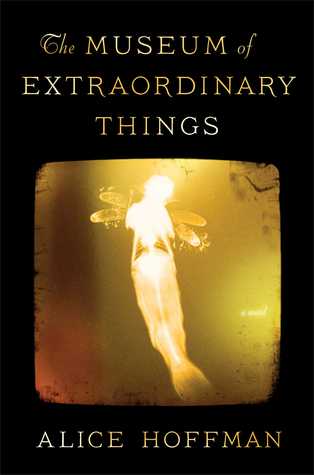
The Museum of Extraordinary Things by Alice Hoffman
(Released February 18, 2014)

Eddie had come to understand that what a man saw and what actually existed in the natural world often were contradictory. The human eye was not capable of true sight, for it was constrained by its own humanness, clouded by regret, and opinion, and faith. Whatever was witnessed in the real world was unknowable in real time. It was the eye of the camera that captured the world as it truly was.

What lines made you laugh, cry, or gasp this week? Do tell!

If you’d like to participate in Thursday Quotables, it’s really simple:

  • Write a Thursday Quotables post on your blog. Try to pick something from whatever you’re reading now. And please be sure to include a link back to Bookshelf Fantasies in your post (http://www.bookshelffantasies.com), if you’d be so kind!
  • Leave your link in the comments — or, if you have a quote to share but not a blog post, you can leave your quote in the comments too!
  • Visit other linked blogs to view their Thursday Quotables, and have fun!

Thursday Quotables: The Geography of You and Me

quotation-marks4

Welcome back to Thursday Quotables! This weekly feature is the place to highlight a great quote, line, or passage discovered during your reading each week.  Whether it’s something funny, startling, gut-wrenching, or just really beautifully written, Thursday Quotables is where my favorite lines of the week will be, and you’re invited to join in!

The Geography of You and Me

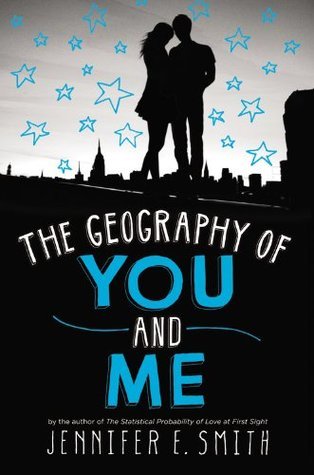
The Geography of You and Me by Jennifer E. Smith
(Released April 10, 2014)

I love this description of a busy family, always heading in different directions:

And how many times had they all been stuffed in here together? Dad, with his newspaper folded under his arm, always standing near the door, ready to bolt; Mom, wearing a thin smile, seesawing between amusement and impatience with the rest of them; the twins, grinning as they elbowed each other; and Lucy, the youngest, tucked in a corner, always trailing behind the rest of the family like an ellipsis at the end of a sentence.

As someone who grew up the youngest in the family, I can attest to how perfect the comparison to an ellipsis at the end of a sentence is!

What lines made you laugh, cry, or gasp this week? Do tell!

If you’d like to participate in Thursday Quotables, it’s really simple:

  • Write a Thursday Quotables post on your blog. Try to pick something from whatever you’re reading now. And please be sure to include a link back to Bookshelf Fantasies in your post (http://www.bookshelffantasies.com), if you’d be so kind!
  • Leave your link in the comments — or, if you have a quote to share but not a blog post, you can leave your quote in the comments too!
  • Visit other linked blogs to view their Thursday Quotables, and have fun!

Book Review: The Geography of You and Me by Jennifer E. Smith

The Geography of You and MeMeeting cute doesn’t get much cuter than this: Two Manhattan teen-aged loners get stuck in an elevator together during a city-wide blackout. Perfect, right?

For Lucy and Owen, the stuck elevator is just the beginning of a magical night. Once freed, they roam the streets and their building with no parents, no electricity, and no interference from normal daily life. They go up to the roof and watch the stars, they talk, and they dream. And the next day, it’s all over — but each is permanently marked by their brief time together.

Meanwhile, Lucy and Owen each have some real life drama as well. Lucy is the youngest child of busy, successful, jet-setting parents, who seem to think nothing of leaving her home alone while they travel the world, sending postcards from every perfect tourist destination they visit. Owen and his father have been drifting for months since Owen’s mother died in a car accident, and the sadness of their lives is overwhelming.

Lucy and Owen are deeply lonely people, and the connection they feel is sudden and strong. But their family ties pull them apart almost immediately, and though they keep up a connection via goofy “wish you were here” postcards, their paths seem to take them further and further away from one another. Was their connection a fluke? Is it just an illusion? Should they forget about it and move on along their new paths, or is the chemistry between them something worth trying to recapture?

The Geography of You and Me is a light and charming young adult romance, but it doesn’t skimp on real dilemmas and honest conflicts. Family loyalty is explored, and the parent-child relationships here are complex and sad. Lucy and Owen both have imperfect parents in their lives, and each has to step up in ways that might seem unfair, yet they love their parents and want more than anything to make their family lives work out. Both characters dream of each other, yet each is also determined to move forward, to find happiness, and to find a place to fit in.

I liked both main characters quite a bit. They’re smart and devoted, wise for their years yet not above being silly and spontaneous. Over the course of the novel, we see them grow and change, and their trajectories feel real. The storyline never sags, and despite spending most of the story apart, the connection between Lucy and Owen is always present between the lines.

My only quibble with this book is less about the book itself and more about overall trends. Perhaps this book might have grabbed me a little bit more or felt fresher if I hadn’t read Gayle Forman’s Just One Day and Just One Year recently. The Geography of You and Me treads familiar ground, focusing as it does on two characters who seem destined to get together, but spend most of the story apart, struggling to reconnect. As with the Forman books, it’s the journey that counts, and the ending scenario is remarkably similar. I feel like the trend of keeping characters apart and ending with a reunion is becoming more prevalent in contemporary young adult fiction, and unfortunately, that means that even when there’s one that succeeds, it may not feel entirely new or different.

That doesn’t mean that The Geography of You and Me isn’t worth reading; it certainly is. It’s fun, sweet, and even touching, and it’s quite a fast read as well, so you’ll be tempted to read it straight through to keep the storyline flowing along. This tale of connection and belonging is entertaining and never sappy. If you enjoy teen love stories with a hip, urban feel, this is definitely a book to check out.

Want to know about another Jennifer E. Smith book? Here’s my review of This Is What Happy Looks Like.

_________________________________________

The details:

Title: The Geography of You and Me
Author: Jennifer E. Smith
Publisher: Poppy/Little, Brown and Company
Publication date: April 15, 2014
Length: 337 pages
Genre: Young adult fiction
Source: Library


Book Review: Henna House by Nomi Eve

Henna HouseHenna House tells the tale of the little-known world of the Jews of Yemen in the early 20th century, taking place largely during the tumultuous years of the 1920s and 1930s. As seen through the eyes of Adela Damari, whom we meet for the first time at age five, the Jewish community of the village of Qaraah is small and isolated, steeped in a tradition and a simple way of life that seems at odds with the modernity of the time period.

The Jewish community of Yemen at that time was by law an underclass, kept subservient and oppressed through a string of harsh restrictions and edicts, none more feared than the Orphan Decree. According to the Orphan Decree, an unmarried Jewish child left orphaned would be confiscated by local authorities, adopted by a Muslim family, and permanently removed from his or her relatives, community, and faith. Families lived in fear of confiscation, taking the preventive measure of betrothing children at birth so that hasty marriages could be enacted when needed.

Adela first enounters the Confiscator when she is five years old, and is terrified. This official routinely visits her father’s marketplace stall, observing her father’s illness, and practically counting the days until his death so that Adela can be taken. Despite having a very  large family, Adela is at risk, as all of her potential betrothals have come to naught. One day, however, her young cousin Asaf comes to live in Qaraah, and the two children become fast friends — and more. Despite their young age, they form a deep bond, and it’s only natural that their betrothal is announced.

Other arrivals in Qaraah further change Adela’s life. Her uncle Barhun moves to the village with his wife Rahel, a skilled henna artist, and their daughter Hani, who quickly becomes Adela’s closest friend and confidante. Adela is introduced to the women’s henna rituals, in which symbols and patterns are painstakingly painted onto the skin to celebrate happy occasions, commemorate significant events, and represent a secret language full of mystical power and meaning.

That first night I was a novitiate. Soon, like the others, I would learn about the stars in the heavens by reading the astronomical tables they inscribed on my feet, shins, and fingers. Soon, I would grow to believe that I myself was an actual text, and that my skin without henna was like a holy book without words — a shameful, almost blasphemous, thing. Without henna, I wouldn’t know how to read myself. With henna, I was as sacred as a sanctified Torah. With henna, I was the carrier of ancient tales — a living girl-scroll replete with tales of sorrow, joy, and salvation.

The story of Henna House moves from the small mountain village of Adela’s birth to the city of Aden, through the anti-Jewish riots of the 1940s to the rescue of the Yemenite Jews by the newly declared nation of Israel. The story of Adela is at once large in scope, covering the significant events in the global Jewish community during the devastating years during and after the Holocaust, and at the same time, is a deeply personal tale.

Adela herself is a girl and then a young woman finding her way through an ever shifting series of homes and relations, experiencing both joy and love as well as terror and grief. She values the traditions of her people and the rituals of the henna house, yet also finds an inner strength that sees her through horrible loss and betrayals.

I was incredibly moved by this lovingly crafted story. The writing is often poetic, rich with tradition and symbolism, yet the pace never slackens or drags. The forward momentum of the story is engaging while also allowing the emotions of the characters room to breathe.

I was quite taken with the use of traditional rituals and foods to highlight the lives of the Jewish families, and found the depiction of their lives in Yemen completely fascinating.

Henna House is an intimate look at a time, a place, and a people, at a by-gone world with rich yet mysterious traditions. As historical fiction, it’s deeply affecting as well as informative and revealing. And as a novel, Henna House succeeds in telling a story full of love, wonder, loss, and excitement.

_________________________________________

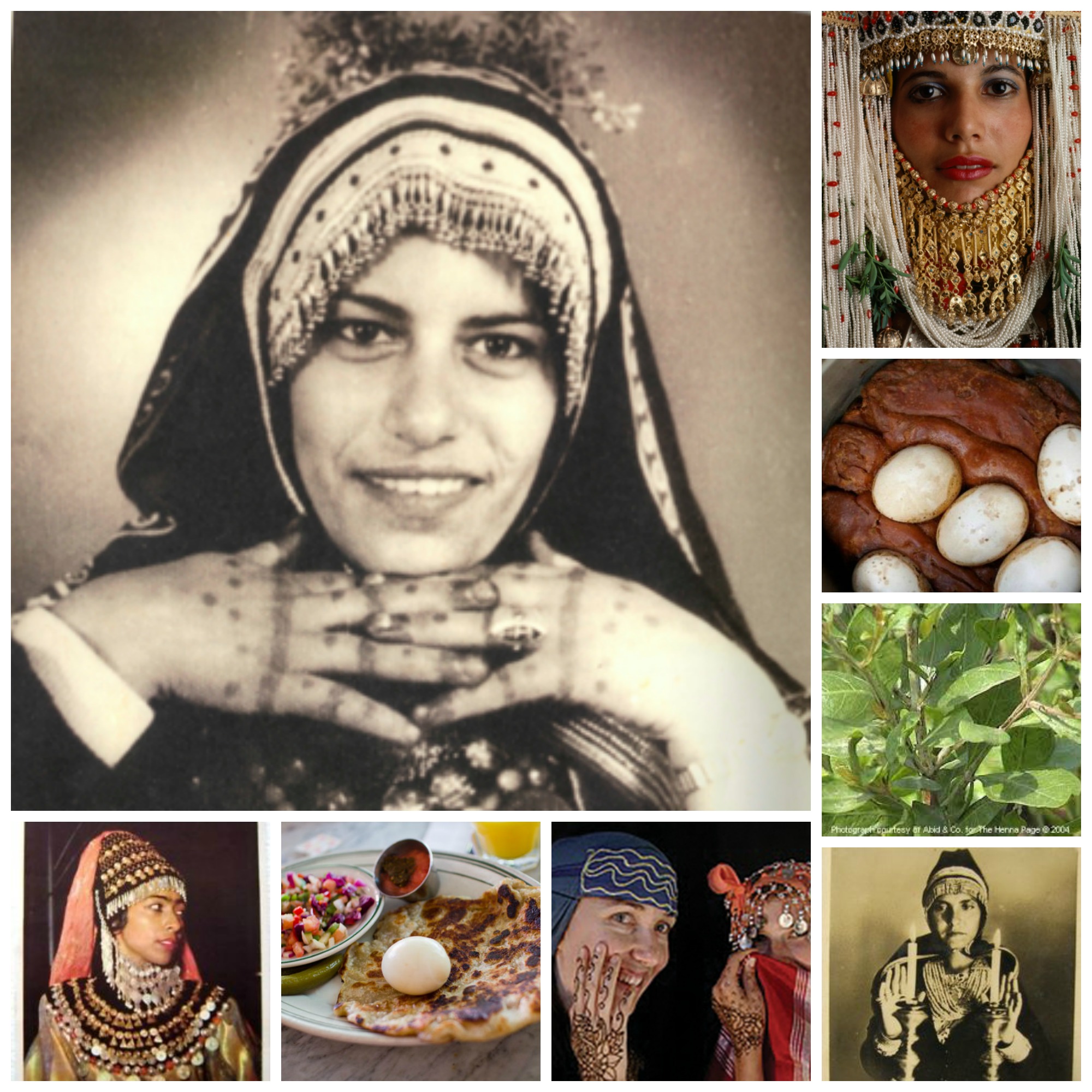
I leave you with a collage of images (scavenged from Pinterest, thank you very much…) which bring to mind some of the people and food mentioned in Henna House.

HH collage

_________________________________________

The details:

Title: Henna House
Author: Nomi Eve
Publisher: Scribner
Publication date: August 12, 2014
Length: 320 pages
Genre: Historical fiction
Source: Review copy courtesy of Scribner via NetGalley

Thursday Quotables: Henna House

quotation-marks4

Welcome back to Thursday Quotables! This weekly feature is the place to highlight a great quote, line, or passage discovered during your reading each week.  Whether it’s something funny, startling, gut-wrenching, or just really beautifully written, Thursday Quotables is where my favorite lines of the week will be, and you’re invited to join in!

Henna House

Henna House by Nomi Eve
(Released August 12, 2014)

As for my story? Where should I begin? Should I ask my reader to extend an open palm so that I can inscribe my words in the warm gully of a branching life line, and our fates may mingle? Or should I ask her to recline on jasmine-scented pillows and let me begin with the tender soles of the feet, so that my story accompanies her wherever she goes, pressed into the earth, like footprints for posterity? Or should I demand my reader reveal her bosom, so that I may write these words upon her heart?

I’m very close to the end of this lovely book about henna artists in early 20th century Yemen. According to the synopsis: Henna House is a rich, spirited, and sensuous tale of love, loss, betrayal, forgiveness, and the dyes that adorn the skin and pierce the heart. The writing is as beautiful as the designs the narrator describes, and the story itself is unusual and evocative. Watch for my review later this week!

What lines made you laugh, cry, or gasp this week? Do tell!

If you’d like to participate in Thursday Quotables, it’s really simple:

  • Write a Thursday Quotables post on your blog. Try to pick something from whatever you’re reading now. And please be sure to include a link back to Bookshelf Fantasies in your post (http://www.bookshelffantasies.com), if you’d be so kind!
  • Leave your link in the comments — or, if you have a quote to share but not a blog post, you can leave your quote in the comments too!
  • Visit other linked blogs to view their Thursday Quotables, and have fun!

Book Review: Since You’ve Been Gone by Anouska Knight

Since You've Been GoneIn this romance, a young widow learns to start enjoying life again two years after the tragic death of her husband, when she falls in love with the handsome man who unexpectedly swoops into her life. And it doesn’t hurt that he has oodles of money, lives in a mansion, and drives a flashy sports car.

To be fair, Holly is emphatically not interested in Ciaran when he first appears, and she is so not impressed by his millions or by his allegedly playboyish love life. Holly just wants to live a quiet life in the unfinished cottage she and the late Charlie had moved into, where she can be left alone with her troubled dreams of her lost husband and with a big slobbery dog for company. But when Holly’s bakery (deliciously named Cake) is commissioned to make and deliver a specialty item to Ciaran’s father (a loud, often drunk man prone to inappropriate displays of what’s beneath his kilt), she meets and then can’t stop running into lovely Ciaran — and Ciaran is smitten enough to woo Holly despite her rather rude attempts to make him go away.

Since You’ve Been Gone doesn’t hold much in the way of surprises, but for a straight-forward romance, it veers just enough from the expected formula to keep it interesting. Holly herself is a well-drawn character, clearly suffering when we meet her and not ready to let go of her loss and grief. Yes, the money angle is a little obnoxious and obvious, but Holly makes clear that she falls for Ciaran despite the status and glamour, not because of it.

I enjoyed the emphasis on the natural settings, Holly’s love of nature and the outdoors, and the tenderness Ciaran displays in honoring Charlie’s memory. There are some stock characters, to be sure, including the gold-digging personal assistant who is icy-beautiful and constantly needles and undermines Holly — but the rest of the supporting cast, including the lonely older woman next door and Holly’s hugely pregnant and over-involved sister, are off-beat enough to keep the story lively.

Yes, in some respects this is a by-the-numbers romance novel, and anyone who’s not a fan of the genre might want to steer clear. I’m not much of a romance reader ordinarily, but I was drawn to Since You’ve Been Gone by the adorable cover as well as by the synopsis, which made it sound not very run-of-the-mill — and I’m pleased that I gave it a try.

Since You’ve Been Gone is a fast, light read, with some nice emotional moments (and some super-steamy sex) to keep things moving along. It’s an enjoyable book about finding love again, and is a perfectly entertaining way to spend a summer day.

_________________________________________

The details:

Title: Since You’ve Been Gone
Author: Anouska Knight
Publisher: Harlequin HQN
Publication date: July 29, 2014
Length: 320 pages
Genre: Romance
Source: Review courtesy of Harlequin via NetGalley

Book Review: Just Like the Movies by Kelly Fiore

Just Like the MoviesYou know how some young adult novels really resonate with adult readers as well? This isn’t one of them… at least, not for this adult reader.

In Just Like the Movies, two girls bond over their love of rom-com movies and decide to use romantic movie strategies to win the boys of their dreams. For track star Marijke, that means going all Say Anything in her boyfriend’s backyard, blasting Peter Gabriel from an IPod dock. (Unfortunately, he’s not home at the time, but his parents are.) For Lily, it means borrowing a page from Drew Barrymore in Never Been Kissed (kinda) and declaring her interest to the boy she likes.

Meanwhile, we have these two girls, high school seniors, becoming insta-besties within the space of two weeks, learning to see past their differences, and transforming their lives. And yes, there’s a makeover involved, and even some eyebrow tweezing. Plus, an awful lot of talk and fixation on prom proposals — the more elaborate the better — which I didn’t even know was a thing, but apparently it is. At least in this book. And if it’s a thing in real life, then may the gods have mercy on the teens of today. *shudder*

Near the end, there are some minor moments of awakening, as the girls realize that they’re strong and that maybe their lives shouldn’t revolve around the boys they like — at which point, they end up getting the boys anyway.

I was tempted to describe this book as harmless fluff, but I actually can’t. It’s light and fluffy, all right, but I’m not sure that I’d call it harmless. What’s the message here? We have two smart, high achieving girls with horrible esteem and trust issues. Marijke spends most of the book flying into jealous fits because her boyfriend isn’t doing what she wants when she wants. Lily is like every movie shy girl or brainy girl, always working behind the scenes and super good at all her classes, but she’s not one of the popular girls and never gets noticed. (A trip to Marijke’s closet and make-up bag fix that, of course.)

So on the one hand, the books seems to be saying that living one’s life for a boyfriend is a mistake. But on the other hand, once the girls realize that, they still end up getting the perfect romance, complete with prom, that they’ve always wanted. So, you don’t need a boy to be happy… but wait, you kind of do?

Meanwhile, the timeline is bizarrely compacted, with all this drama happening over the space of a few short weeks. It’s just not believable, and not in a charming, rom-com sort of fairy tale way. The movie theme is inconsistent, the messages are muddled, and the girl power just fizzles.

Maybe teen girls will like Just Like the Movies and will swoon over the prom proposals and hunky guys. But I’m guessing not.

_________________________________________

The details:

Title: Just Like the Movies
Author: Kelly Fiore
Publisher: Bloomsbury USA Children’s Books
Publication date: July 2, 2014
Length: 300 pages
Genre: Young adult fiction
Source: Review copy courtesy of Bloomsbury via NetGalley

Book Review: Landline by Rainbow Rowell

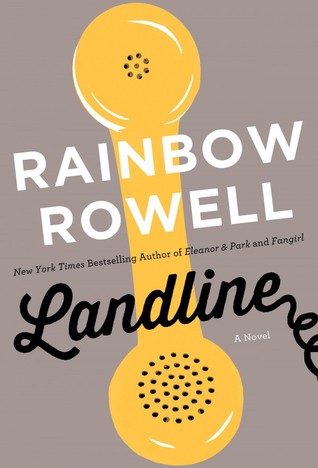
LandlineMarriage, happiness, and a family’s future are on the line in Rainbow Rowell’s newest novel, Landline.

I’ll preface this review by pointing out that Landline is not a young adult novel. Rainbow Rowell exploded with her first YA novel, the excellent and tear-inducing Eleanor & Park, and solidified her place in the YA pantheon with Fangirl — but she also writes terrific grown-up fiction, including 2011’s Attachments and brand-new Landline.

In Landline, we meet Georgie McCool, a thirty-something comedy writer (who happens to love the TV show thirtysomething). Georgie has a stay-at-home husband, two adorable daughters, and a life that’s falling apart. Neal is always unhappy with her, to the point where she’s practically forgotten what it feels like to see him happy at all. Georgie and her best friend-slash-writing partner having been toiling for almost 20 years in the writers’ rooms of LA TV, waiting for the chance to finally make “their” show. And when that chance seems to be within reach, the timing couldn’t be worse: Georgie is supposed to be heading toward Omaha with Neal and the kids for Christmas — but the scripts have to be done that week or the deal is off.

When Georgie decides to stay in LA, she’s blown away that Neal still leaves for Omaha — and is left in a complete tizzy, wondering if they’re merely spending Christmas apart, or if Neal has actually left her.

Things get decidedly weird when a dead cell phone battery and a night spent in her childhood bedroom cause Georgie to resort to digging out the old dial telephone in the back of the closet in an effort to reach Neal in Omaha. Neal, at this point, is very pointedly not answering his cell phone, and Georgie is getting frantic. Lo and behold, when Georgie uses the landline, Neal answers… but it’s Neal in 1998, the almost-but-not-quite adult version of Neal who may be breaking up with Georgie. As the two begin a string of nightly phone conversations, Georgie is understandably weirded out at first, but comes to realize that something approaching miraculous may be happening. Through her conversations with younger Neal, Georgie gains a new understanding of where they’ve lost their way, but the question remains: Is there any chance that Georgie and Neal will find their way back to one another?

Georgie is a fun, funny character, quick-witted and quick with a quip. Her goal in life is to make people laugh, despite ending up with a husband who can barely bring himself to smile. Landline uses the device of the phone calls to take us back through Georgie and Neal’s romance, showing us their history and how two such different people found themselves head over heels in love. Their relationship feels real, and it’s easy to see how a couple with good intentions and full of love could still find themselves teetering on the brink of failure.

Georgie’s not without her faults, of course. She is pretty clueless about Neal’s unhappiness, and she is quite selfish when it comes to putting her career goals ahead of her family life. At the same time, she is the sole financial support of the family, and she works in a demanding field. If the shoe was on the other foot and the husband was the one working late and missing family vacation, would it feel any less unfair or inconsiderate?

I liked the device of the mysterious telephone connection (which Georgie can’t quite believe, and which she refers to sarcastically as her “magic” phone). There’s no explanation offered, so if you  like your mystical objects to have a rational basis, you’ll be out of luck here. Landline is, essentially, a story about the magic of love, and the phone is just one more whimsical plot element that helps the characters move forward and find their way.

As always, Rainbow Rowell’s dialogue is snappy and snarky, and the humor keeps the story from ever feeling too heavy, even when it appears that the marriage is doomed. This is a light-hearted novel — not light as in inconsequential, but light as in filled with sunshine, focused on the quest for happiness, and containing the essence of a modern-day fairy tale. We come to care about the characters and want them to be happy, and by the end, can’t help but cheering as the the novel attains a movie-esque momentum worthy of a rom-com’s will-she-get-there-in-time action sequence.

Landline is a great choice for readers who enjoy well-written contemporary fiction with heaping doses of laughter. While not avoiding the heavier subject matter of a marriage about to implode, Landline keeps the story moving along at a brisk pace and never plunges into despair. It’s a great love story — a story not about falling in love, but about the much harder work of staying in love.

Rainbow Rowell has been firmly on my must-read-everything list ever since Eleanor & Park, and I haven’t been let down yet. Landline made me happy… and I can’t wait to hear about the author’s next project, whatever it might be.

Favorite lines and passages:

“Kids are perceptive, Georgie. They’re like dogs” — she offered a meatball from her own fork to the pug heaped in her lap — “they know when their people are unhappy.”

“I think you may have just reverse-anthropomorphized your own grandchildren.”

___________________

Georgie was extra. She was the fourth wheel. (On something that only needed three wheels. The fourth wheel on a tricycle.)

___________________

“Upper body strength isn’t everything; I have wiles.”

“Not really.”

“Yes, I do. I’m a woman. Women have wiles.”

“Some women. It’s not like every woman is born wily.”

“If I don’t have wiles,” she said, “how come I can get you to do almost anything I want?”

“You don’t get me to do anything. I just do things. Because I love you.”


Want more Rainbow Rowell? See my reviews of her other novels:
Eleanor & Park
Attachments
Fangirl

_________________________________________

The details:

Title: Landline
Author: Rainbow Rowell
Publisher: St. Martin’s Press
Publication date: July 8, 2014
Length: 310 pages
Genre: Adult contemporary fiction
Source: Purchased


Book Review: The Book of Life by Deborah Harkness

The Book of Life (All Souls Trilogy, #3)Deborah Harkness’s wildly popular All Souls trilogy wraps up with The Book of Life, published earlier this month and debuting at #1 on the New York Times bestseller list.

For anyone who has read the first two books in the series, A Discovery of Witches and Shadow of Night, it’s a given that The Book of Life is a must-read.

My quick thoughts on this book:

First of all, it’s long. That may sound like a stupid thing to point out, but not only is the book 561 pages — you really feel all of those pages while you’re reading. Or at least, I certainly did.

I’m a fast reader, and spending over a week on a book is unusual for me. The Book of Life was a 10-day push. Granted, it was a busy couple of weeks for me, but still: If I was loving this book, I would have found the time to read more. I’d say that it wasn’t until I got to about the half-way mark that I started to get that great swept-away feeling; up to that point, it felt more like work.

The opening section of the book is crammed full of genealogy, vampire law, and oodles of characters from all over the previous books converging on main characters Diana and Matthew. Re-reading the first two books — or finding a good detailed synopsis — is essential in order to enjoy The Book of Life. In fact, by the time I got to page 70, I realized that I needed a refresher, so I spent a couple of days looking up odds and ends, then restarted The Book of Life from the beginning. Luckily, it made a lot more sense with the details sharper in my mind.

There’s nothing particularly wrong with The Book of Life. It’s a wrap-up book, and it does what it needs to do: Ties up all the story threads, builds to a climax, and provides a conclusion to the trilogy that seems fitting. What it doesn’t have is the depth of characters and emotions that we’ve seen in previous books. In A Discovery of Witches, we fall in love with Diana and Matthew and their world. It’s new and enchanting; we feel mesmerized by the romance and danger. In Shadow of Night, it’s easy to get swept up in the historical setting and the challenges it poses for our beloved characters.

But in The Book of Life, it’s go time, all the time. People are constantly coming and going. There’s a lot of stamping about and angry confrontations, there are science lab set pieces and Congregation meetings, chases and rescues, and even some pregnancy drama.

Like I said, it’s not a bad book. Not at all. But I didn’t feel it the way I felt the other two, if that makes sense. I opened the book wanting to know what ends up happening to Matthew and Diana, and I closed the book having found out. The ending was exciting, and by the last quarter of the book, I really couldn’t put it down. I was happy to see more of the secondary characters who make the series so special. (Bonjour, Ysabeau! Hiya, Gallowglass!) The search for Ashmole 782 comes to an end, and there are answers about Diana’s powers and the family history.

What went missing for me was the emotional engagement. We see Matthew and Diana’s marriage and life, but not the dramatic chemistry and attraction that created their connection. Perhaps it’s just the fact of how far along the story is at this point; The Book of Life is the most plot-driven of the three books, and I missed the deeper personal elements that made the first two books so special.

I did end up enjoying The Book of Life, and I was satisfied with the ending. I just wish it had made me feel it all a bit more.

Note: If you’re interested in the All Souls Trilogy, you can check out my review of Shadow of Night here.

_________________________________________

The details:

Title: The Book of Life
Author: Deborah Harkness
Publisher: Viking
Publication date: July 15, 2014
Length: 561 pages
Genre: Adult fiction
Source: Purchased

Fields & Fantasies presents… The Fever by Megan Abbott

Welcome to the first Fields & Fantasies book club feature. Each month, in collaboration with my wonderful co-host Diana of Strahbary’s Fields, we’ll pick one book to read and discuss. Our inaugural pick is Megan Abbott’s The Fever:
The FeverThe panic unleashed by a mysterious contagion threatens the bonds of family and community in a seemingly idyllic suburban community.

The Nash family is close-knit. Tom is a popular teacher, father of two teens: Eli, a hockey star and girl magnet, and his sister Deenie, a diligent student. Their seeming stability, however, is thrown into chaos when Deenie’s best friend is struck by a terrifying, unexplained seizure in class. Rumors of a hazardous outbreak spread through the family, school and community.

As hysteria and contagion swell, a series of tightly held secrets emerges, threatening to unravel friendships, families and the town’s fragile idea of security.

Something is happening to teen girls, and it’s very, very bad.

First it’s Deenie’s best friend, Lise, who suffers some sort of seizure in the middle of class — and whose greatest worry is whether everyone saw. (They did). Next, Deenie’s almost-best-friend Gabby has a spell of some sort in the midst of an orchestra performance. And then more, and more, and more. Is it an epidemic? Is it mass hysteria?

In The Fever, there are many questions, but not so many answers.

Reminiscent both of The Crucible and Mean Girls, The Fever shows the damage done to girls as they enter and transition through the perilous teen years. For Deenie and her friends, the change from unformed, bright innocents to girls who attract boys’ eyes and know it is fraught with physical and emotional dangers.

They revel in the changes in their own bodies, but are undermined by the food provided by family. They delight in their power, but can be brought low by the looks or oversights of boys. They hunger for attention, but don’t know what to do with it once they get it.

And as we see through the eyes of Deenie’s brother Eli, the girls become a mass of indistinguishable sexualized beings. Eli is a protective big brother, cherishing his younger sister and defending even her friends from predatory eyes — and yet Eli is a total hound toward every other girl in school, having no qualms about inviting adoring girls (he’s a big hottie) over for late-night booty calls and then sending them on their way. The girls are faceless and interchangeable to Eli and his friends: They’re sexy, they’re available, and they’re easily forgotten.

The girls in The Fever are all damaged, one way or the other. Of the characters we meet, all have deficiencies in their home lives — bitterly divorced parents, no parents, irresponsible guardians, even a mother who survived a vicious assault by the father and bears horrific scars as a constant reminder. The environment, too, is literally toxic — the lake is an unnatural emerald green and was declared unsafe for swimming years earlier. The school itself is later found to have all sorts of deadly and dangerous substances in its walls and its grounds.

So what’s making the girls sick? Perhaps everything. Hysterical parents initially blame the mysterious outbreak on the HPV vaccine that was administered to all girls the previous year — but when that proves to be a red herring, other scapegoats must be found. Suspicious eyes turn to Deenie, one of the few who isn’t sick. Does that mean she’s a carrier? Is she the local version of Typhoid Mary?

Deenie is devastated, not just by her friends’ illnesses, but by the shock of discovering the secrets lurking behind the scenes in the life she thought she knew.

I found The Fever to be a compelling read, but I couldn’t quite decide how I really felt about it. In parts, it felt like a mystery to be solved, sifting through clues, unraveling stories that do and don’t make sense. On the other hand, it’s very much an atmospheric piece. There’s a sense of doom and misery throughout the book. None of these girls are happy, and they all suffer, one way or another. It’s all quite dismal, and at times, it’s practically suffocating.

And yet, I couldn’t look away. Perhaps it’s the book version of a car crash on the highway. You know bad things are happening, and yet you stretch to get a glimpse just the same. Towards the end, as the lies and secrets unravel, the story becomes more straightforward and I found myself enjoying it more. The narrative in most of the book weaves between different points of view, but eventually, plot seems to matter more, and I could not wait to get answers.

So yes, by the end, there is a solution of sorts — but not everything is easily explained. The girls of the town may be recovering, but they’ll never recapture the innocence of assuming oneself to be safe. As a study of what it means to be a teen girl in America, The Fever is very frightening indeed.

___________________________________

For another view, check out Diana’s review here.

And now, for a change of pace, a Q&A between Diana and me. Warning: SPOILERS from this point forward. Proceed at your own risk!

Lisa: So many of the girls in this books seem like a “type”. Which, if any, felt more original or unusual to you?

Diana: They didn’t really feel original to me. It was the cliche good girl caught in the middle, the meanest of the mean girls and the girl that wanted to be liked. Then for the mothers it felt like you had the absentee, the clueless one and the overprotective one. Nothing all that original.

Lisa: I agree [with what you said in your review] that Tom was a decent character. What do you think about the book’s portrayal of parents in general?

Diana: Overall I think that the parents were clueless as to what was going on in their kids lives. Perhaps from a teens’ perspective they are but I would think that the parents would have some idea. Do you think that there was anything that the parents could have done to be more involved with their children?

Lisa: I thought Tom was as involved as possible for a parent of high school teens, which just goes to show that even great parents probably have no idea what’s really going on their kids’ lives and inside their kids’ heads. I mean, his son is bringing girls home for sex right under his nose, and he just says hi as they walk by! The other parents all seem very caught up in their own nonsense. Everybody wants to be a good parent, I thought, but nobody really succeeds.

Lisa: Did you buy the explanation for the epidemic? Do you find a mass event like this credible?

Diana: Absolutely. Looking back through history there are a number of cases like this happening throughout the world to teenage girls. My favorite happening in 2006 in Portugal. It was dubbed the Strawberries with Sugar Virus. A number of adolescent girls became sick, their symptoms couldn’t be explained. As it turns out, there was a very popular show called Strawberries with Sugar and there was a girl on the show that had an illness with those symptoms. Portuguese officials later determined it was a case of mass hysteria based on the television show. My only problem with the premise is the guilty party at the beginning of everything being a victim of mass hysteria.  What do you think?

Lisa: Yeah, I hadn’t thought of it in those terms, but you’re right. It’s like she couldn’t deal with her own guilt, so she followed in the victim’s footsteps, and then the whole thing blew up from there. It seemed to be saying that each of these girls had such problems in their lives that becoming a victim of the epidemic was a way out for them. Maybe a way to get the attention they’d been missing? Or a way to physically embody all the turmoil and stress of their lives?

Diana: I like the attention train of thought. It could be one of those cases where a lie just takes on a life of it own…

Lisa: What did you think of the role of social media, cell phones, and other plugged-in technologies in this story?

Diana: It was very relevant. I know I am addicted to my electronics and so many teens are social media obsessed. I think that part felt the most realistic to me.

Lisa: I agree. It made me realize how much harder it must be to be in high school right now than when I was that age. In my day, if you did something embarrassing, people might talk and ridicule, but then it would blow over. With this culture of selfies and everything always being shared, your worst moments can live forever. In The Fever, the girls who had seizures not only broke down in school — they then had to live with knowing that their awful moments would be seen all over YouTube.

Diana: Oh God, I can only imagine the trauma I would have had to deal with if my fellow high school students had social media. There are some things in life that are just best left forgotten.

Lisa: Did the high school setting in The Fever feel realistic to you? 

Diana: There were moments that it felt realistic.  Like with the day to day school stuff. But some of it felt “Saved by the Bell”-esque. Like would the sports star also be in the school band? How many of the cool kids did you know who played in band?

Lisa: True. But I did think the shifting alliances among the girls was pretty true to life — the fact that Deenie thought Gabby was her best friend and that Skye was just an annoyance hanging around, not seeing that Gabby and Skye had a much stronger connection or what the truth of her friendship with Gabby was all about.

Lisa: Is there anything the author could have done differently that would have made this book work better for you?

Diana: Better characters for sure. I so wanted this to be my dirty little indulgent book of the summer. I think if she dug deeper and went beyond the clichés it would have been so much better.

Lisa: It’s been fun talking books with you! Sounds to me like The Fever was not a huge success for either of us (although I liked it more than you did), but it still did give us some things to think about!

Diana: I have really enjoyed our discussion as well! Yeah, I can’t say Fever was my favorite read of the year so far but it has created some great discussion. I have already started reading our book for August: The Museum of Extraordinary Things.

_________________________________________

Updated to add:

Fascinating article by Megan Abbott on the real-life case that inspired The Fever: http://www.huffingtonpost.com/megan-abbott-/dont-look-now-social-medi_b_5534200.html

Next for Fields & Fantasies:

Join us for our August book, The Museum of Extraordinary Things by Alice Hoffman

_________________________________________

The details:

Title: The Fever
Author: Megan Abbott
Publisher: Little, Brown and Company
Publication date: June 17, 2014
Length: 320 pages
Genre: Contemporary fiction
Source: Review copy courtesy of Little, Brown and Company via NetGalley