Audiobook Review: Well Met by Jen DeLuca

Title: Well Met
Author: Jen DeLuca
Narrator: Brittany Pressley
Publisher: Berkley
Publication date: September 3, 2019
Print length: 336 pages
Audio length: 9 hours, 45 minutes
Genre: Contemporary romance
Source: Library
Rating:

Rating: 4 out of 5.

All’s faire in love and war for two sworn enemies who indulge in a harmless flirtation in a laugh-out-loud rom-com from debut author, Jen DeLuca.

Emily knew there would be strings attached when she relocated to the small town of Willow Creek, Maryland, for the summer to help her sister recover from an accident, but who could anticipate getting roped into volunteering for the local Renaissance Faire alongside her teenaged niece? Or that the irritating and inscrutable schoolteacher in charge of the volunteers would be so annoying that she finds it impossible to stop thinking about him?

The faire is Simon’s family legacy and from the start he makes clear he doesn’t have time for Emily’s lighthearted approach to life, her oddball Shakespeare conspiracy theories, or her endless suggestions for new acts to shake things up. Yet on the faire grounds he becomes a different person, flirting freely with Emily when she’s in her revealing wench’s costume. But is this attraction real, or just part of the characters they’re portraying?

This summer was only ever supposed to be a pit stop on the way to somewhere else for Emily, but soon she can’t seem to shake the fantasy of establishing something more with Simon, or a permanent home of her own in Willow Creek. 

Okay, show of hands: Who among us hasn’t ever wanted to lace up a corset, grab a turkey leg, and head to ye olde Renaissance Faire for some old-timey fun? Not just me, right?
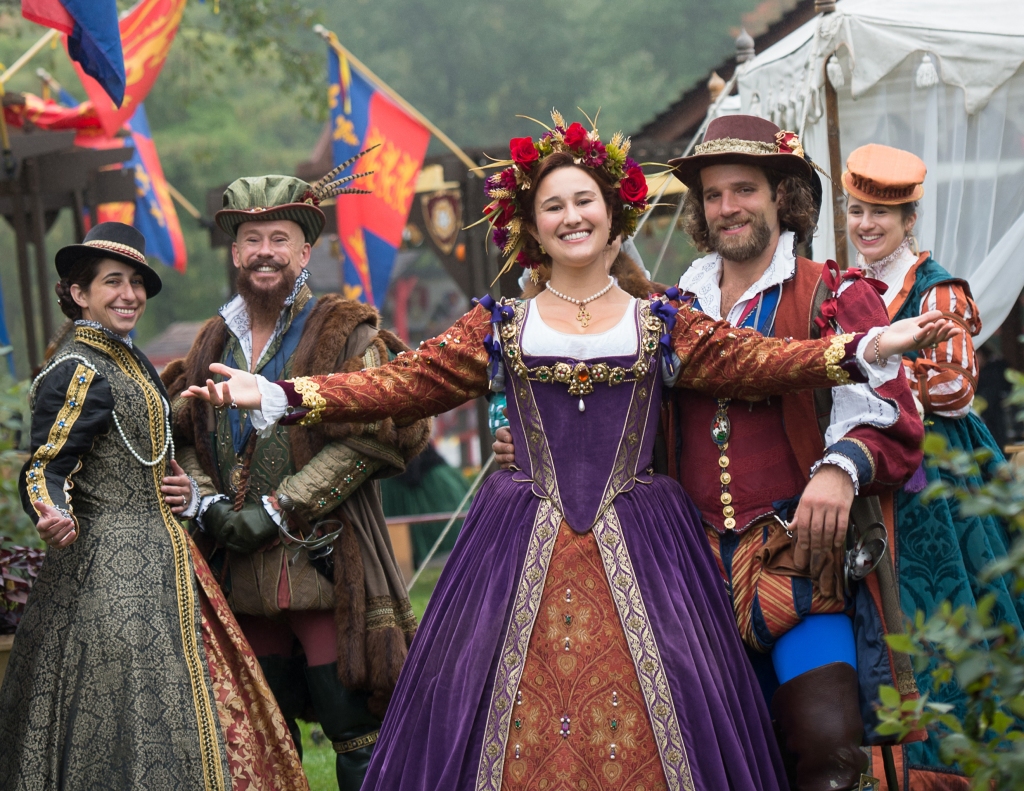
In Well Met, Emily Parker is 24, unemployed, and temporarily living in small-town Willow Creek while helping her older sister April recover from a serious car accident. Part of this help is ferrying around her 14-year-old niece, Caitlin, including taking her to sign up as a volunteer cast member for the upcoming summer’s Renaissance Faire. The catch, however, is that minors can’t volunteer unless they have a responsible adult volunteering with them, so Emily reluctantly finds herself roped into volunteering as a tavern wench for the summer.

Emily takes an immediate dislike to the Faire’s organizer Simon, who seems rigid and overly obsessed with filling out forms correctly. He causes further offense by accusing Emily of not taking Faire seriously — which, granted, she’s only half-heartedly doing, at least at first.

But as rehearsals warm up and the big event approaches, Emily is more and more drawn into the excitement, the pretend world of Faire, and the real world of Willow Creek. She’s had a hard few years, but is finally starting to feel like she might have found a place to put down roots and create a life for herself.

It doesn’t hurt that she and Simon seem to be developing some real chemistry — especially when they’re in their Faire personae of tavern wench and swaggering pirate.

Well Met is so much adorable fun! First off, the Faire goings-on are amazing and made me want to be there! Jousting, troubadors, Queen Elizabeth, ladies in waiting, kilted men… there’s just so much to love! And it’s so cute to see how into it everyone is, from giddy high school students to long-time Faire veterans.

I enjoyed Emily’s character,and there are plenty of great supporting characters too — such as April, Caitlyn, Emily’s new-found bestie Stacy, local bookstore owner Chris, and more.

Emily and Simon both have painful baggage, and their histories hold them back from fully exploring what they want and what they need to find happiness. When they do finally get together, it’s not all smooth sailing, as they both put up their defenses, misinterpret each others’ communications, and just generally mess things up quite a bit.

One of my standard romance complaints comes into play, which is that if people would only talk to each other rather than jumping to conclusions, life would be a whole lot easier! Of course, then the story would have less drama, but still. Emily spends a week worrying that she’s being fired from her job and that Simon played a part in it — but a), that’s a ridiculous assumption that’s really not based on anything concrete, and b) she could have asked one simple questions and clearly up her confusion instantly.

Still, what’s a romance novel without stumbling blocks? It would have all wrapped up much too quickly if Emily and Simon got together when they did and then remained blissfully happy until the end. So yes, we get the requisite drama, fight, and break-up, but hey, it’s a romance, so of course there’s going to be an HEA to end the story!

My one lingering complaint about Well Met is that there’s a storyline thread I would have loved to see get tied up. Part of Emily’s backstory is that she dropped out of college about a year short of an English degree in order to support her (awful) ex-boyfriend through law school. While Emily is happily employed and fulfilled by the end of the book, I would have loved for her to decide to go back to school and finish the education that clearly meant so much to her. Well, hopefully we’ll find out that that’s exactly what she did by the time the sequel comes out!

A note on the audiobook: I originally picked up a print version of this book, but I’m so happy I ended up going the audio route instead! I really enjoyed the narration. The dialogue is crisp and funny, and the narrator did a great job showing us the characters putting on their fake accents for the Faire personae and getting into the spirit of it all.

Well Met is the first in a trilogy of novels centered around Faire, each one focusing on a different couple’s love story. Book #2, Well Played, due out this coming September. And yes, I absolutely want to read it!

Well Met is good, romantic fun, and a great choice for a summer read.

Huzzah!
Book Review: Mexican Gothic by Silvia Moreno-Garcia

Title: Mexican Gothic
Author: Silvia Moreno-Garcia
Publisher: Del Rey
Publication date: June 30, 2020
Print length: 352 pages
Genre: Horror
Source: Review copy courtesy of the publisher via NetGalley
Rating:

Rating: 4.5 out of 5.

An isolated mansion. A chillingly charismatic artistocrat. And a brave socialite drawn to expose their treacherous secrets. . . .

From the author of Gods of Jade and Shadow comes “a terrifying twist on classic gothic horror” (Kirkus Reviews) set in glamorous 1950s Mexico—“fans of classic novels like Jane Eyre and Rebecca are in for a suspenseful treat” (PopSugar).

After receiving a frantic letter from her newly-wed cousin begging for someone to save her from a mysterious doom, Noemí Taboada heads to High Place, a distant house in the Mexican countryside. She’s not sure what she will find—her cousin’s husband, a handsome Englishman, is a stranger, and Noemí knows little about the region.

Noemí is also an unlikely rescuer: She’s a glamorous debutante, and her chic gowns and perfect red lipstick are more suited for cocktail parties than amateur sleuthing. But she’s also tough and smart, with an indomitable will, and she is not afraid: Not of her cousin’s new husband, who is both menacing and alluring; not of his father, the ancient patriarch who seems to be fascinated by Noemí; and not even of the house itself, which begins to invade Noemi’s dreams with visions of blood and doom.

Her only ally in this inhospitable abode is the family’s youngest son. Shy and gentle, he seems to want to help Noemí, but might also be hiding dark knowledge of his family’s past. For there are many secrets behind the walls of High Place. The family’s once colossal wealth and faded mining empire kept them from prying eyes, but as Noemí digs deeper she unearths stories of violence and madness.

And Noemí, mesmerized by the terrifying yet seductive world of High Place, may soon find it impossible to ever leave this enigmatic house behind.

This creepy, disturbing gothic novel lives up to all the rave reviews!

Mexican Gothic takes place in 1950s Mexico. We first meet Noemi Taboada coming home from a fancy party. She’s the pampered, pretty daughter of a wealthy family, at odds with her parents who want her to marry well (and soon), while what she really wants is to enroll in university to pursue a masters degree.

As the story starts, Noemi’s father shares with her a disturbing letter from her beloved older cousin Catalina. Catalina recently married a man she’d only known briefly and moved with him to his family’s isolated mountain estate. In her letter, Catalina seems to be rambling and incoherent, talking about hearing things in the walls and begging for help. Catalina’s husband explains her ravings away as a side effect of tuberculosis, and insists that she’s getting good medical care. But Mr. Taboada is worried enough that he decides to send Noemi as his ambassador to check up on Catalina’s well-being and nurse her back to health — or bring her back to Mexico City, if needed.

Noemi’s arrival at the Doyle estate is shocking. High up an isolated, treacherous mountain road, the mansion, High Place, is shambling and neglected, shrouded in mist and in a state of disrepair. Noemi is greeted by Florence, cousin to Catalina’s husband Virgil, a domineering, strict woman who asserts herself in charge not only of the house’s routines, but of Catalina’s care as well.

The house is dismal, and so are its occupants. There’s a no-talking rule at dinner, Noemi is forbidden from smoking, there’s no electricity and cool baths are encouraged, and the place is altogether repressive and awful. The only bright spot is Florence’s son Francis, a young man about Noemi’s age, who appears to be sympathetic and supportive, eager to help Noemi and keep her company.

Noemi’s visits with Catalina are severely restricted, and Catalina seems to be kept drugged most of the time. The doctor who sees her once a week doesn’t think anything is wrong, and the family is dismissive of Noemi’s prodding to call in a psychiatric specialist or to get another opinion.

I don’t want to say too much about the plot, because man, is it good! The atmosphere is grim and creepy in all the best ways. Strange insular family? Check. Decrepit old house? Check. Windows that don’t open and mold on the walls? Check and check.

Like in any good gothic novel, the setting is mysterious and threatening, and our brave heroine has no easy means of escape as she’s drawn further and further into the sick and twisted family secrets that have entrapped her cousin and now seem to be pulling her in as well.

And those secrets? Well, gross and disturbing and menacing don’t even quite encompass what’s going on in that terrible house. I love the growing sense of terror, the sickness at the heart of the family history, the interplay between these wealthy English landowners and the people of the surrounding areas, and the desperation that drives Noemi as she comes closer and closer to finally seeing the truth.

The moodiness of the book put me in mind of Wuthering Heights, Jane Eyre, and even Angels & Insects by A. S. Byatt. If you’re a fan of creaky old houses with terrible secrets, this book should be right up your alley. It’s not blood and guts horror exactly — more of the quietly creeping chill that turns into growing terror as more and more awful things happen.

Mexican Gothic is so well written, so dramatic and well-plotted. I loved it, even thought it completely creeped me out and kept me turning the pages in a non-stop anxious frenzy. I can’t wait to read more by this author!

Book Review: Party of Two by Jasmine Guillory

Title: Party of Two
Author: Jasmine Guillory
Publisher: Berkley
Publication date: June 23, 2020
Print length: 320 pages
Genre: Contemporary romance
Source: Review copy courtesy of the publisher via NetGalley
Rating:

Rating: 4 out of 5.

A chance meeting with a handsome stranger turns into a whirlwind affair that gets everyone talking.

Dating is the last thing on Olivia Monroe’s mind when she moves to LA to start her own law firm. But when she meets a gorgeous man at a hotel bar and they spend the entire night flirting, she discovers too late that he is none other than hotshot junior senator Max Powell. Olivia has zero interest in dating a politician, but when a cake arrives at her office with the cutest message, she can’t resist–it is chocolate cake, after all.

Olivia is surprised to find that Max is sweet, funny, and noble–not just some privileged white politician she assumed him to be. Because of Max’s high-profile job, they start seeing each other secretly, which leads to clandestine dates and silly disguises. But when they finally go public, the intense media scrutiny means people are now digging up her rocky past and criticizing her job, even her suitability as a trophy girlfriend. Olivia knows what she has with Max is something special, but is it strong enough to survive the heat of the spotlight?

Jasmine Guillory has quickly become one of my go-to authors for when I want a light, upbeat romance, for so many reasons. Her women are strong, determined, and professional; the relationships are relationships among equals; her cast of characters is always diverse and well grounded; and hey, the books are just fun!

Party of Two takes place in the author’s established world, first introduced in The Wedding Date. This is the 5th book in the series, although I use the term “series” loosely. Yes, characters from earlier books show up, and the characters are all connected — but on the other hand, the books absolutely work as stand-alones. You can read Party of Two on its own and enjoy it fully.

So… Party of Two.

This is the story of Olivia Monroe, a super-smart lawyer who’s left the corporate law environment to strike out on her own, opening a boutique law firm in LA with her friend and colleague Ellie. In her first week in LA, Olivia meets an attractive guy in her hotel’s bar, where they share a good conversation about cake, among other things — but this is LA, and Olivia assumes a guy this good-looking must be an actor, and she just isn’t interested in dating actors, thank you very much.

Imagine Olivia’s surprise when she later turns on the news and realizes the hot guy from the bar is actually an up-and-coming United States Senator, Max Powell. Obviously not for her. Can’t trust a politician, after all, and Olivia has no desire for a public spotlight.

Still, when they run into each other at a fundraising event a few weeks later, their connection is still there — and Max finds that he’s just as smitten with Olivia as he was when they first met. After courtship via baked goods, the two cautiously begin a cross-country romance, which soon blossoms into much more than the fling that Olivia was expecting.

The writing in Party of Two is funny, emotional, and on point. Olivia has some scathing views of the men she typically meets:

“I was in too many relationships in my late twenties and early thirties with men who got mad at me for how much I was working, or required so much of my time to, I don’t know, sympathize with them about their mean lady boss or tuck them into bed when they had a man cold or whatever.”

Man cold. Snicker.

She’s a very self-aware, determined woman who doesn’t compromise her integrity and doesn’t give in easily to big gestures, and yet…

“… I still get that fucking gooey look on my face when he texts me! I can tell I get it! I try not to get it! But the goo just spreads over my face and I can’t make it stop!”

One of the things I love about these characters (besides their chemistry and adorableness together) is that they’re socially aware and committed individuals who want to do good in the world. Max’s key goal in the Senate is to push through a justice reform bill, and he spends time learning and listening to people who’ve suffered from a broken system. Likewise, Olivia devotes herself to volunteer work in a food pantry, and is passionate about food insecurity and offering hope and resources to underprivileged and disenfranchised youth.

One of the key stumbling blocks between Max and Olivia is his tendency to rush forward without full consideration of risks. As a wealthy white man who has never truly known adversity, Max expects the world to work out for him. But as Olivia points out:

“… you just leap in to something without thinking about the implications, say the first thing comes to your mind, and smile and charm your way out of every hole you dig yourself in. I can’t do things like that. I’m a black woman, I don’t ever get the benefit of the doubt in the way someone like you does. I can’t afford to make split-second decisions and assume they’ll work out.”

Not that this is a heavy book in any way. The romance is sweet and sexy, and clearly, these two crazy kids are meant for each other. It’s totally engaging to see how they handle heavy-duty professional lives (which in Max’s case, comes with a lack of privacy and an ever-present spotlight) and balance these with their need for intimacy and space, and the ability to carve out time alone together to nurture and grow their relationship.

Party of Two is delightful, romantic summer reading, but with a grounding in the real world that makes it feel relevant. It delivers a message without pounding readers over the head, but consistently enough to keep the social justice theme prominent throughout the love story aspects of the plot.

As I mentioned, this book absolutely works on its own, but if you want to place it within the context of Jasmine Guillory’s other books, Olivia is the older sister of Alexa, the lead character in The Wedding Date.

Highly recommended!

Audiobook Review: The Fated Sky (Lady Astronaut, #2) by Mary Robinette Kowal

Title: The Fated Sky (Lady Astronaut, #2)
Author: Mary Robinette Kowal
Narrator: Mary Robinette Kowal
Publisher: Tor
Publication date: August 21, 2018
Print length: 384 pages
Audio length: 10 hours, 14 minutes
Genre: Science fiction
Source: Purchased
Rating:

Rating: 4.5 out of 5.

The Fated Sky continued the grand sweep of alternate history begun in The Calculating Stars. It is 1961, and the International Aerospace Coalition has established a colony on the moon. Elma York, the noted Lady Astronaut, is working on rotation, flying shuttles on the moon and returning regularly to Earth.

But humanity must get a foothold on Mars. The first exploratory mission is being planned, and none of the women astronauts is on the crew list. The International Aerospace Coalition has grave reservations about sending their “Lady Astronauts” on such a dangerous mission. The problem with that is the need for midjourney navigation calculations. The new electronic computation machines are not reliable and not easily programmed. It might be okay for a backup, but there will have to be a human computer on board. And all the computers are women.

I read The Fated Sky a year ago, but apparently didn’t write a review at the time. Don’t ask me why! But in any case, I’ve just completed a re-read via audiobook, and loved it all over again… so I think it’s about time to share my thoughts.

The Fated Sky is the follow-up to The Calculating Stars, which I love, love, love, love, love. A second book in a series is never quite as breathtaking as the first, in my humble opinion, because there’s already a familiarity with the world presented in the book. And so, while The Fated Sky didn’t blow me away the way The Calculating Stars did, it did keep me engaged in new and different ways, and was an altogether satisfying return to the world of the Lady Astronaut.

To get anyone new to this series caught up, here’s what you really need to know: It’s been about 10 years since a devastating meteor struck Earth, resulting in global catastrophe. The planet faces accelerating climate change, which will eventually become so extreme that human life on Earth will no longer be possible. In these dire circumstances, the international community comes together to pursue space exploration. After all, if people can’t live on Earth, they’ll have to live off Earth.

In book 1, we met Dr. Elma York, brilliant mathemetician and physicist, as well as a top-notch pilot who flew with the WASPs during WWII. Elma is married to Dr. Nathaniel York, an equally brilliant engineer. As the space program gets underway, Nathaniel becomes one of the lead engineers, while Elma pursues her dream of becoming an astronaut. It’s simply fascinating, and I urge you to read the book if you haven’t yet!

In The Fated Sky, we pick up in the early 1960s. Humans have established a colony on the moon, and the next target is Mars. The first Mars mission is about 18 months away — but not all on Earth are happy about the space program.

Earth Firsters are angry — they believe that space travel and colonization will end up being a privilege for the elite. How are the people left behind supposed to survive? With poorer areas still suffering the aftermath of the meteor’s destruction, with food, housing, and medical shortages, they feel that the country’s resources are being unfairly allocated to the space program. The protesters are becoming more outspoken, to the point of violence, in expressing their dissatisfaction.

Elma gained fame in book #1 as “the Lady Astronaut”, and when the IAC (International Aerospace Coalition) assigns her to the Mars mission, it’s clearly with an eye on public relations. But with this assignment, Elma replaces a dear friend who’d already been training for the mission, so she’s not only behind in her training but also facing resentment and hostility from the other crew members who see her as an interloper taking someone else’s place.

The Fated Sky takes place during the preparation for the Mars expedition, as well as the months of the actual journey to Mars. And while the science is absolutely fascinating, it’s Elma’s personal struggles and challenges that make it all so real and so deeply affecting.

Elma is a brilliant scientist. She’s also a devoted wife, a Southern Jew, a woman in a man’s world, and a white woman who’s not always as aware of her privilege as she should be. In the world of the Lady Astronaut books, the social unrest and upheavals of the real-world 1960s has largely been moved forward a decade along with the scientific advancements. We see women struggling for opportunity, even while being expected to maintain traditional standards of femininity (like always having their hair and makeup done before public appearances and deferring to their male counterparts even when they have superior knowledge or technical expertise. Not to mention that the female astronauts seem to be the only ones assigned laundry duty on their space mission. Argh.)

Racial inequality and civil rights feature much more prominently in The Fated Sky than they did in The Calculating Stars. There’s suspicion of the Black astronauts and whether they’re conspiring with Earth Firsters. Mission Control assigns them less prestigious assignments during the Mars expedition than their white colleagues, even when they’re clearly the better choice, which leads to disastrous results. And in myriad other, more subtle ways, the matter of race permeates the crew relations, so that even someone as well-intentioned as Elma ends up causing offense, until she’s finally told point-blank:

“One thing: Don’t explain my experience to me. It’s annoying as hell.”

On top of all this, one of the expedition crew members is a white South African, and remember, this is the early 1960’s — he’s so full of apartheid-era hate that it’s incredible that he was actually allowed to participate in the mission, and if not for international pressure related to South Africa’s financial backing of the IAC, he probably would not have been. By showing the Earth protests, the more subtle racial profiling and preferences on board the ship, and the blatant racism of this one particular astronaut. the author evokes a time of change and volatility — and sadly, exposes issues that still permeate society today.

Elma struggles too with her mental health. She’s suffered from anxiety for most of her life, which she’s worked hard to control. Her coping mechanisms are put to the test during the mission in response to the ongoing hostility she experiences from her fellow astronauts early on, especially as she realizes that she’s the only crew member who doesn’t really fit in and isn’t completely trusted.

I think maybe one of the reasons I had time loving this book the first time I read it had to do with how entangled my feelings were with Elma’s experiences. I felt so awful reading about Elma’s struggles and personal pain and how terrible she often felt. So it’s not that the book isn’t excellent — just maybe that I become overly invested in Elma as a person and didn’t like seeing her feel bad!

Anyhoo… the audiobook is such a treat! Author Mary Robinette Kowal is the narrator, and she’s a total pro. (She also narrates Seanan McGuire’s October Daye audiobooks, and does an amazing job with them.) She clearly knows these characters and what makes them tick, and I could feel Elma’s personality, as well as many of the other characters’, coming through so clearly. Fabulous.

I love the world of the Lady Astronaut, which the author first introduced in her short story, The Lady Astronaut of Mars (which actually takes place many years after the events of the books, but provides some additional context — you can read the story for free here.)

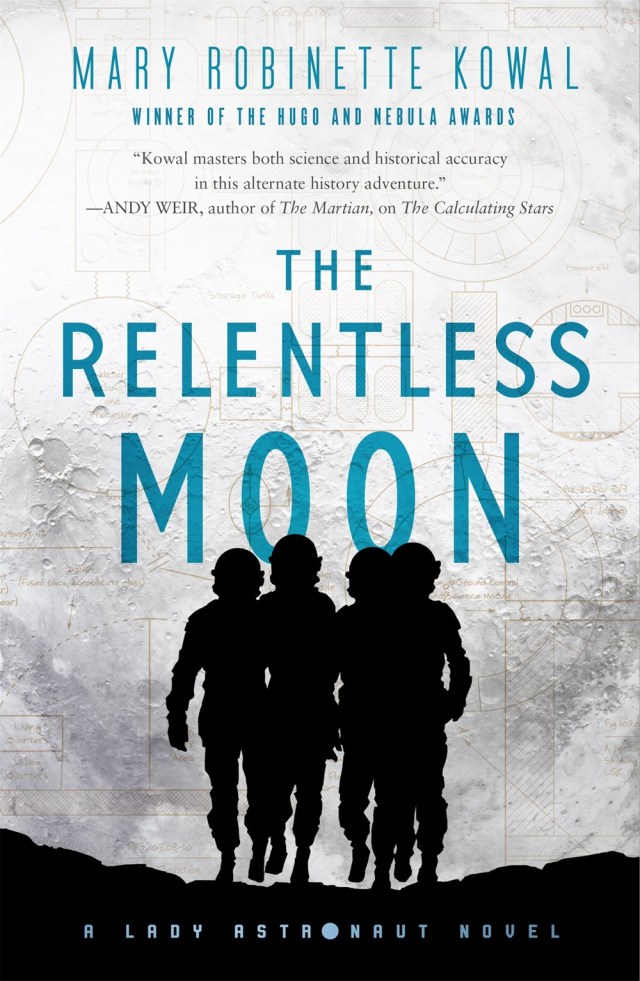
Listening to the audiobook was a perfect way for me to revisit the story of The Fated Sky. The 3rd book in the series, The Relentless Moon, will be released in July, and I absolutely can’t wait to read it!

The Earth is coming to the boiling point as the climate disaster of the Meteor strike becomes more and more clear, but the political situation is already overheated. Riots and sabotage plague the space program. The IAC’s goal of getting as many people as possible off Earth before it becomes uninhabitable is being threatened.

Elma York is on her way to Mars, but the Moon colony is still being established. Her friend and fellow Lady Astronaut Nicole Wargin is thrilled to be one of those pioneer settlers, using her considerable flight and political skills to keep the program on track. But she is less happy that her husband, the Governor of Kansas, is considering a run for President.

Book Review: Hella by David Gerrold

Title: Hella
Author: David Gerrold
Publisher: DAW
Publication date: June 16, 2020
Print length: 448 pages
Genre: Science fiction
Source: Review copy courtesy of the publisher via NetGalley
Rating:

Rating: 3.5 out of 5.

A master of science fiction introduces a world where everything is large and the problems of survival even larger in this exciting new novel.

Hella is a planet where everything is oversized—especially the ambitions of the colonists.

The trees are mile-high, the dinosaur herds are huge, and the weather is extreme—so extreme, the colonists have to migrate twice a year to escape the blistering heat of summer and the atmosphere-freezing cold of winter.

Kyle is a neuro-atypical young man, emotionally challenged, but with an implant that gives him real-time access to the colony’s computer network, making him a very misunderstood savant. When an overburdened starship arrives, he becomes the link between the established colonists and the refugees from a ravaged Earth.

The Hella colony is barely self-sufficient. Can it stand the strain of a thousand new arrivals, bringing with them the same kinds of problems they thought they were fleeing?

Despite the dangers to himself and his family, Kyle is in the middle of everything—in possession of the most dangerous secret of all. Will he be caught in a growing political conspiracy? Will his reawakened emotions overwhelm his rationality? Or will he be able to use his unique ability to prevent disaster?

Hella is a hella big place. It’s a large planet where, due to lower gravity as compared to Earth, living things grow to crazy huge size. And there are dinosaurs. And they’re HELLA gigantic. Herbivorous leviathans migrate across the plains, slowly stomping over everything in their path, and hungry carnosaurs attack them in groups, feasting for days on the huge carcasses that they manage to bring down.

Hella is not the most hospitable environment for humans, but these few thousand colonists are there to make it home. It’s already been a hundred years since the First Hundred made landfall, and since then, additional migrations of humans have helped the colony to grow and expand.

Caution is the highest priority. Everything is studied and planned for, because it’s crucial that the human population avoid cross-contamination with the Hella natural world. All food is grown within the enclosed colonies, and care is taken never to allow human-produced microbes or plants out into the planet’s own natural environment.

We get to know the world of Hella through main character Kyle, a neuro-atypical teen (roughly 13 years old in Earth years, or 5 years old in Hella years). Kyle is smart and detail-oriented, devoted to his family, but has challenges understanding nuance and reading other people’s emotions, doesn’t like to be touched, and is unable to leave a topic until he’s shared everything (and I do mean EVERYTHING) he knows about it. He’s gifted and his talents can benefit the colony, but there are some who view Kyle as a freak and treat him that way.

While the colony seems to function on the principle of communal service toward the greater good, there are those who thirst for power, just like in any human society. When the chief power-hungry representative gets an opportunity to seize control, he takes it.

Hella is an interesting book, although I have some issues with it. At the beginning, the focus is on getting to know the planet and the colony. Kyle goes out on an expedition for the first time, and through his experiences, we get to see the plants, trees, strange creatures, and huge dinosaurs that roam the land.

We’re also introduced to the daily routines, the concept of work that’s at the foundation of this human society, and the myriad factors that go into maintaining safety and self-sufficiency.

We learn more about how human society has changed and evolved over the years since our own time as well. For example, gender is fluid and easily changeable. Kyle’s mother was born biologically male, but changed to female so she could experience pregnancy (which is in itself a fairly unusually choice, as many people prefer to have their babies bottle-grown rather than womb-grown). Kyle himself was born biologically female, but decided to change when his older brother did, largely because he too wanted to be able to pee standing up. Changing doesn’t have to be permanent; later in the book, Kyle has cause to rethink his decision and considers changing again in order to please his boyfriend (which is a frustrating reason to change, but fortunately, his boyfriend sees it that way too.)

By the second half of the book, the emphasis is less on the natural world outside the human habitats and much more on the political maneuvering within the human colony. There’s a conspiracy afoot, and Kyle and his friends may be in the best position to try to stop it. There’s plenty of danger and excitement as they chase through tunnels, hack networks, and try to avoid or defeat the bad guys.

My feelings about Hella are mixed. First off — cool planet! I really liked learning about this world, its dangers and its beauty, and what it takes for humans to adapt and survive there.

But, there’s just so much time spent with Kyle on the details! Granted, this is a piece of who Kyle is, but his need to go down the rabbit hole chasing every detail doesn’t always make for great reading, and I felt that the plot tended to bog down in detours.

At almost 450 pages, this book is longer than it needs to be. I think if 50-75 pages had been trimmed, the pacing might have improved, keeping the plot more on track and letting momentum build. As is, I didn’t truly feel caught up or swept along by the story until the 2nd half, and that’s too bad, as there are elements of a great story here.

As I said, I did really enjoy the (literal) world-building the author accomplishes in introducing us to the human society in this large and frightening world, and explaining how they find ways to improve their resources bit by bit, even while always protecting themselves from the dangers just outside their fences.

I was a bit startled looking at the author’s Goodreads profile when I realized that some of the characters in Hella appear in his earlier works. This made me wonder how much I was missing and whether a familiarity with other books would enhance the reading experience.

This is me being persnickety, but the author’s writing style got on my nerve in places. He has a tendency to throw commas into sentences to connect clauses. Random example:

Outside, the northeast slope was a rumpled landscape, hundreds of layers of lava flows had hardened here.

Just a little pet peeve of mine. Use a period! Separate your sentences! Or, you know, give semicolons a try!

Hella has a conclusion that ties up the major action of the story, but there’s certainly room for more storytelling about the colony, its people, and its politics — plus, it would be fun to get to see what happens next for Kyle, his family, and his friends.

I do recommend Hella, but wished that it was just a little tighter and faster overall. Still, it’s a fun and engaging story set in a really fascinating world, and I’m glad I read it.

Book Review: How the Penguins Saved Veronica by Hazel Prior

Title: How the Penguins Saved Veronica
Author: Hazel Prior
Publisher: Berkley
Publication date: June 16, 2020
Print length: 368 pages
Genre: Contemporary fiction
Source: Review copy courtesy of the publisher via NetGalley
Rating:

Rating: 4.5 out of 5.

A curmudgeonly but charming old woman, her estranged grandson, and a colony of penguins proves it’s never too late to be the person you want to be in this rich, heartwarming story from the acclaimed author of Ellie and the Harpmaker.

Eighty-five-year-old Veronica McCreedy is estranged from her family and wants to find a worthwhile cause to leave her fortune to. When she sees a documentary about penguins being studied in Antarctica, she tells the scientists she’s coming to visit—and won’t take no for an answer. Shortly after arriving, she convinces the reluctant team to rescue an orphaned baby penguin. He becomes part of life at the base, and Veronica’s closed heart starts to open.

Her grandson, Patrick, comes to Antarctica to make one last attempt to get to know his grandmother. Together, Veronica, Patrick, and even the scientists learn what family, love, and connection are all about.

You guys. This book is so delicious!

Hazel Prior’s debut novel, Ellie and the Harpmaker, was one of my favorite reads of 2019. And now she’s back with a brand new book, and magic strikes again!

Veronica McCreedy is a fussy, unfriendly, skeptical 85-year-old woman, living in her huge house in Scotland. She likes to be left alone, is sure that her memory is perfect (it’s not), and is, in general, fed up with the world, her housekeeper Eileen, and the hand life has dealt her.

While watching a nature program one evening, she stumbles across a documentary series focusing on penguins, and is instantly smitten. At the same time, Veronica’s memories of her ancient past are reawoken when Eileen finds a dusty old padlocked chest in a storage room — reminding Veronica of the secrets she herself has kept locked away for so many years.

High on the list of secrets is the fact that she once had a child, and now decides to find out if she might in fact have any living relatives. With Eileen helping navigate the internet and the outside world, Veronica discovers a 20-something grandson, but meeting Patrick turns into a disappointing experience.

Needing meaning in her life, Veronica turns back to the penguins, becoming especially enamored of Adelie penguins and fascinated by the team of scientists researching these penguins on Locket Island in Antarctica.

Well, what’s a stubborn 85-year-old to do? Veronica sends an email to the research station announcing her imminent arrival, and off she goes! The 3-person research team is dismayed by their unwanted visitor, who flatly refuses to turn around and go home. And when she missed the chance to leave by the same boat that brought her, they have no choice but to adapt to Veronica and keep her comfortable and safe for the three weeks until the next boat arrives.

Meanwhile, Veronica is enthralled by the flock of penguins and insists on rescuing an orphaned penguin chick. While she isn’t a huge fan of the rudimentary living style or the abruptness of one of the scientists, all in all, she’s determined to stay, enjoy, and make a difference.

There’s so much more, but I’ll let you discover the rest on your own! A key piece that I haven’t discussed is that over the course of the novel, Patrick gets the opportunity to read diaries written by Veronica at age 15, which explain so much about her own past as well as his. Through the diaries, and later, through time spent together with the penguins, Patrick and Veronica finally manage to forge a relationship and a possible future as a family.

Ah, this was such a lovely, cheery, delight of a book! Veronica is as crusty and grumbly as you’d expect, and it’s no surprise really that her tough exterior hides a (difficult, quirky, demanding) heart of gold. As we read Veronica’s diaries with Patrick, we learn about the heartbreak and sorrow that she’s lived with all her life, and it’s impossible not to ache for her and the tragic experiences she’s endured.

Of course, one of the delights of the book is the penguins! Through Veronica’s eyes, we get to learn about penguin conservation, the research project, and what mischief baby penguins get up to. Really, they are utterly adorable. I loved the setting so much, and the scientists are sweet and smart, obsessed, and quite adorable too.

How the Penquins Saved Veronica is just the uplifting sort of read I needed this week. It’s sweet and touching — don’t miss it!

Audiobook Review: Where the Crawdads Sing by Delia Owens

Title: Where the Crawdads Sing
Author: Delia Owens
Narrator: Cassandra Campbell
Publisher: Viking
Publication date: August 14, 2018
Print length: 384 pages
Audio length: 12 hours, 12 minutes
Genre: Contemporary fiction
Source: Purchased
Rating:

Rating: 4.5 out of 5.

For years, rumors of the “Marsh Girl” have haunted Barkley Cove, a quiet town on the North Carolina coast. So in late 1969, when handsome Chase Andrews is found dead, the locals immediately suspect Kya Clark, the so-called Marsh Girl. But Kya is not what they say. Sensitive and intelligent, she has survived for years alone in the marsh that she calls home, finding friends in the gulls and lessons in the sand. Then the time comes when she yearns to be touched and loved. When two young men from town become intrigued by her wild beauty, Kya opens herself to a new life–until the unthinkable happens.

Perfect for fans of Barbara Kingsolver and Karen Russell, Where the Crawdads Sing is at once an exquisite ode to the natural world, a heartbreaking coming-of-age story, and a surprising tale of possible murder. Owens reminds us that we are forever shaped by the children we once were, and that we are all subject to the beautiful and violent secrets that nature keeps.

Where the Crawdads Sing has been on bestseller lists for at least a year now, as far as I can tell. And the fact that this was a Reese’s book club pick doesn’t hurt at all when it comes to creating buzz. So is it worth all the hype?

Now that I’ve read it, I can give an answer: Definitely yes.

Where the Crawdads Sing is lovely, rich, sad, and powerful. It tells the story of Kya Clark, a girl who is abandoned at a very young age and yet manages to raise herself in the North Carolina marsh she calls home.

Kya’s family lives in a shack in the marsh, scrabbling for daily sustenance and terrorized by their abusive, unreliable father. Kya’s older siblings have already left, and as the story opens, Kya is six years old, watching her mother walk away, never to return. Kya is left behind with her father and older brother, but even her brother doesn’t stay long. Soon, it’s just Kya and her father, and he disappears for days on end, or shows up drunk or angry, and simply can’t or won’t care for his child.

And so, from the age of six, Kya raises herself. She loves her home and the marsh and the birds and wildlife that are her truest friends. She scrapes by on the pennies her father provides. Eventually, even he leaves, and she is completely alone, surviving by digging mussels and selling them to the local sundry store owner, a warm and caring man named Jumpin’ who comes to love Kya as a daughter.

Despite the love and support of Jumpin’ and his wife Mabel, Kya is alone. When a truant officer comes to take her to school, Kya only lasts one day, feeling embarassed and tormented by the town kids who call her “Marsh Girl” and make fun of her. From then on, it’s just Kya in the marsh.

She does have one friend, a boy named Tate who once upon a time was friends with her brother. Tate is fascinated by Kya and takes it upon himself to teach her to read, opening up the world of science and biology and learning to her. Kya embarks on her lifelong passion to know and understand the marsh, collecting specimens and documenting them through writing and painting, turning her old shack into a personal natural history museum of sorts.

The story alternates between chapters following Kya’s life from early childhood onward and chapters set later, in 1969, when a local young man is found dead under suspicious circumstances. Chase Andrews had a history with the Marsh Girl, and although there doesn’t seem to be any evidence, she becomes a person of interest in the case, fueled by years of the townspeople’s harsh opinions and suspicions and gossip about her.

While I was less interested in the murder plot for most of the book, by the last third, the two story elements come together as the plot centers around the court case and resolution.

Where the Crawdads Sing is a moving and lyrical reading experience. I loved the descriptions of the marsh and the way the natural world is so much a part of who Kya is and how she looks at life. Kya’s life is horribly sad, yet also beautiful in its own lonely way. It’s incredible to think that a child could survive like that on her own all those years, yet she does. Between her natural intelligence and her lifelong study of her natural surroundings, Kya adapts and manages to thrive, despite her loneliness and sorrow throughout the years.

The audiobook narrator does a very good job of breathing life into the characters, especially Kya, using her voice to show her maturing over the years yet maintaining the core of who she is.

My one issue with the audiobook is that I feel I missed out a bit on certain written passages. Kya is passionate about poetry, and the poems she recites throughout the book are worth spending time on and contemplating a bit, but because I listened to the audiobook, they passed by a little too quickly for actual reflection. I think I’ll need to borrow a print edition so I can page through and spend more time on certain passages.

I won’t get into spoilers, so I can’t say more about the ending than that I was mostly satisfied and that the ending worked out pretty much as I expected despite a few red herrings — although there was at least one loose thread that I would have liked an answer to.

Overall though, the murder/mystery elements are not the most essential part of this book, in my mind. Yes, it was interesting, and yes, I felt that the ending made sense. But the biggest impact for me was the emotional resonance of Kya’s life, her loves, her relationships, and her incredible personal and professional achievements.

Kya is a woman to admire, one who overcomes extreme adversity to carve out a life for herself that’s meaningful and joyful.

Where the Crawdads Sing is a powerful and beautiful book. Highly recommended.

Book Review: Devolution by Max Brooks

Title: Devolution: A Firsthand Account of the Rainier Sasquatch Massacre
Author: Max Brooks
Publisher: Del Rey Books
Publication date: June 16, 2020
Print length: 320 pages
Genre: Horror
Source: Review copy courtesy of the publisher via NetGalley
Rating:

Rating: 4 out of 5.

The #1 bestselling author of World War Z takes on the Bigfoot legend with a tale that blurs the lines between human and beast–and asks what we are capable of in the face of the unimaginable.

As the ash and chaos from Mount Rainier’s eruption swirled and finally settled, the story of the Greenloop massacre has passed unnoticed, unexamined . . . until now.

But the journals of resident Kate Holland, recovered from the town’s bloody wreckage, capture a tale too harrowing–and too earth-shattering in its implications–to be forgotten.

In these pages, Max Brooks brings Kate’s extraordinary account to light for the first time, faithfully reproducing her words alongside his own extensive investigations into the massacre and the legendary beasts behind it.

Kate’s is a tale of unexpected strength and resilience, of humanity’s defiance in the face of a terrible predator’s gaze, and inevitably, of savagery and death.

Yet it is also far more than that.

Because if what Kate Holland saw in those days is real, then we must accept the impossible. We must accept that the creature known as Bigfoot walks among us–and that it is a beast of terrible strength and ferocity.

Part survival narrative, part bloody horror tale, part scientific journey into the boundaries between truth and fiction, this is a Bigfoot story as only Max Brooks could chronicle it–and like none you’ve ever read before. 

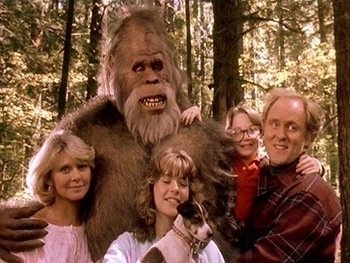
Quick, what do you think of when you hear the word “Sasquatch”?

If it’s this:

… you’re going to be in for one hell of a rude awakening when you read Devolution.

In Devolution, Sasquatches are real. And they’re very, very mean.

Author Max Brooks brings us the story of a Sasquatch massacre (not a spoiler — it’s right there in the subtitle) through the journals of a woman named Kate Holland, as well as through interviews and articles that shed light on the mystery of what happened to the community of Greenloop.

Kate and her husband Dan have just joined Greenloop at the start of the story. Greenloop is a high-tech, high-efficiency community formed of six families who’ve settled (in luxury homes) in the wilderness near Mt. Rainier. But it’s not really a back-to-nature, living-off-the-land arrangement. Greenloop is a quick 90-minute drive to Seattle, and while the settlement believes wholeheartedly in composting and living green, they’re not self-sustaining. Supplies and groceries are delivered weekly via drones, so there’s really no need to worry too much about the food supply or emergency backups. Everything is taken care of!

Well, of course, the peace and perfection of Greenloop don’t last. When Mt. Rainier erupts, Greenloop finds itself cut off from the outside world, its one road in or out completely blocked by the mud and lava flows and now impassible. But not to worry — the majority of the community members are sure that help will come soon, and that this is just a glitch in their happy little utopia.

Only Mostar, a war survivor who makes fabulous artwork but whose outlook is decidedly grim, realizes that they’re all in trouble. She recruits Kate and Dan to her survival project, planting a food garden, inventorying the calorie count of all items in their kitchens, and planning for worst case scenarios.

At first, Kate goes along with it all mainly to humor Mostar and have something to do. But then, strange things start to happen. She feels like something is watching, perhaps chasing her, when she’s out walking in the woods. A mountain lion encroaches into the settlement, but it seems more like it’s running away from something than running toward the people. And then there’s the smell — an awful stench of rot and garbage that becomes more and more overpowering.

Until finally, something comes out of the woods — a sasquatch. They’ve all heard the stories over the years. and most try to find other explanations for what they’re experiencing. But eventually, there’s no hiding from the truth: There’s a pack of sasquatches in the woods, and they’re strong, smart, hungry, and organized.

Mixed in with Kate’s journal entries about the looming danger and the threats and attacks that mount from day to day are snippets of articles about primate behavior, which highlight that primates in the wild are not the gentle giants that people would like to believe them to be. There’s plenty of evidence of primates’ ability to stalk, hunt, and carry out organized attacks, as well as documentation of their consumption of meat, including the flesh of other primates.

And yes, the humans of Greenloop sure look tasty to a group of invading, starving sasquatches.

I probably should have said this right from the start… this book has blood and guts and gore. The scenes of violence are disturbing and graphic and gross, so be warned — don’t pick up this book if you can’t stomach scenes that are… well… stomach-turning.

That said, Devolution is exciting and compelling, and I just couldn’t stop reading. I had to know what would happen next, and next, and after that, even while shaking my head and thinking to myself — no, it can’t really be working out this way. The author wouldn’t really do that, would he?

(Answer: Yes. He would, and he does.)

Max Brooks is the author of World War Z, which was an amazing read. Devolution lacks the global reach of World War Z, the sense of real life events unfolding via news coverage and interviews with survivors. The storyline in Devolution all takes place within the confines of Greenloop, creating (intentionally) a very claustrophobic feel. The people of Greenloop are trapped, and as a reader, I could practically feel the walls closing in around me, and the despair that the characters must be feeling knowing that there is no escape and no last-minute rescue on the way. If they have a chance of being saved, they’ll have to do it themselves.

Kate is a good main character, and I liked the changing nature of her relationship with Dan as they move from a disaffected and alienated married couple on their last legs to people with a mission, rising to the occasion. Mostar is vivid and heroic, but the other characters don’t stand out all that much. The founding couple of Greenloop is supposed to be charismatic and inspiring, but I didn’t feel like I got to see them in action enough for them to make an impact.

I did wish for a little more exposition at the start. I would have liked a bit more backstory on the founding of Greenloop, and more to pinpoint its location and setting. I didn’t get a true sense of the community’s isolation and dependence on a single access road until later in the story, and the eruption of Mt. Rainier itself, which triggers the main plot points, is rather muted and distant. I think a better sense of the geography of Greenloop relative to Rainier and Seattle would have been helpful.

But other than that, I was totally engrossed in Devolution. It’s horrifying but oddly compelling. If I’ve ever thought about Sasquatch mythology, it’s been simply of the supposed images caught on film of hairy men-creatures living in isolation in the woods. Devolution treats us to Sasquatch as a competing species of primate — and the question is, who really is the top of the food chain?

Don’t read this book in a cabin in the woods or on a camping trip… but if you’re safely located in a busy city far from the wilds, definitely dig in and enjoy!

Book Review: 500 Miles From You by Jenny Colgan

Title: 500 Miles From You
Author: Jenny Colgan
Publisher: William Morrow
Publication date: June 9, 2020
Print length: 432 pages
Genre: Contemporary fiction
Source: Review copy courtesy of the publisher via NetGalley
Rating:

Rating: 3.5 out of 5.

New York Times bestselling author Jenny Colgan returns to the beloved Scottish Highland town of Kirrinfief, which readers first met in The Bookshop on the Shore, and adds a dash of London’s bustling urban landscape. 

Lissie, is a nurse in a gritty, hectic London neighborhood. Always terribly competent and good at keeping it all together, she’s been suffering quietly with PTSD after helping to save the victim of a shocking crime. Her supervisor quietly arranges for Lissie to spend a few months doing a much less demanding job in the little town of Kirrinfeif in Scottish Highlands, hoping that the change of scenery will help her heal. Lissie will be swapping places with Cormack, an Army veteran who’s Kirrinfeif’s easygoing nurse/paramedic/all-purpose medical man. Lissie’s never experienced small-town life, and Cormack’s never spent more than a day in a big city, but it seems like a swap that would do them both some good.

In London, the gentle Cormack is a fish out of the water; in Kirrinfief, the dynamic Lissie finds it hard to adjust to the quiet. But these two strangers are now in constant contact, taking over each other’s patients, endlessly emailing about anything and everything. Lissie and Cormack discover a new depth of feeling…for their profession and for each other.

But what will happen when Lissie and Cormack finally meet…?

Jenny Colgan is an absolute favorite of mine, so of course I was thrilled to receive an ARC of her new book, 500 Miles From You. This author’s books always make me smile, and her books set in the Scottish Highlands give me a major case of wanderlust each and every time.

In 500 Miles From You, we start by meeting Lissa, a nurse who specializes in follow-up care, spending her days driving around London from patient to patient to make sure they’re following doctor’s orders, taking their medications, and getting the treatment they need. As the story opens, Lissa witnesses a terrible hit and run that’s a deliberate attack, leaving a 15-year-old boy dying on the street.

Side note: The synopsis above, from Goodreads, refers to Lissie and Cormack. In the book, it’s Lissa and Cormac. Just FYI — I don’t want you to think I’m getting the characters’ names wrong!

Lissa is unable to shake off the horror, and finally, her hospital’s HR team strongly urges her to participate in a professional exchange program. She’ll be sent to a rural area to use her skills in a different environment, and a nurse from that area will come take her place in London to gain experience in urban medicine.

It doesn’t seem like an offer Lissa can refuse, and between her new assignment and her required ongoing therapy sessions, the exhange may be her only opportunity to heal and recover before her PTSD completely derails her career and her life.

Meanwhile, Cormac will leave his beloved town of Kirrinfief in the Scottish Highlands — where literally everyone knows your name — to live in Lissa’s nursing quarters in London and take over her set of patients. The two never meet, but they exchange patient notes, and over time, develop an email and text rapport beyond the professional requirements.

In my opinion. Lissa gets the much better end of the deal! As always, Jenny Colgan has me falling in love all over again with her depiction of life in the Highlands — the peace and quiet, the quaint small town, the local busybodies, the sense of connection. And frankly, while Cormac eventually finds reasons to like London, the descriptions of the noise, the dirt, the unfriendliness, the bustle all make it clear why Cormac yearns for home.

Lissa’s PTSD is portrayed sensitively. As a medical professional, she intellectually understands her reactions, but that doesn’t mean that she can instantly deal with it. Her progress is slow, and we see how her London habits keep her from fitting in or being accepted when she arrives in Kirrinfief. Eventually, of course, she opens up to her surroundings and to the way of life in a small village, and finds more than she could have thought possible.

Cormac, a former army medic, carries around with him the memories of Fallujah that eventually make him seek a civilian career. While he can relate to Lissa’s trauma, his own past still remains mostly undisclosed. I finished the book wishing we’d learned a little more about Cormac’s army experiences.

The back and forth between Cormac and Lissa is quite cute, and the book ends with all sorts of mishaps that turn their intended first in-person meetings into a series of catastrophic missed chances. But yes, there’s a happy ending — how could there not be?

The texts and emails between Lissa and Cormac are funny and sweet, and the story is a nice twist on the “two strangers fall in love without ever meeting” trope. Somehow, though, I was left wanting more. I felt that their connection needed more time to grow, and wasn’t given quite enough room to develop and breathe — and I was left wanting to see more of them together once they finally connected, rather than ending with their meeting.

This is the 3rd of Jenny Colgan’s loosely connected stories set in Kirrinfief. Characters from both The Bookshop on the Corner and The Bookshop on the Shore show up here (and become friends with Lissa). It’s lovely to see them all — I just wish they’d actually had bigger roles to play, since I enjoy those characters so much.

Overall, this is another winning romantic tale from a terrific author, balancing tough situations and emotions with lighter, more joyous moments and memorable characters.

And how could I not love a book where this happens:

He was wearing an open-necked white shirt made of heavy cotton and a pale green-and-gray kilt. […]

“Stop there, ” said Lissa, smiling and taking out her phone camera. “I want a pic. You look like you’re in Outlander.”

500 Miles From You can work as a stand-alone, but I’d recommend starting with The Bookshop on the Corner, which is a wonderful introduction to Kirrinfief and its quirky characters. Either way, don’t miss these lovely stories!

Book Review: Laughter at the Academy by Seanan McGuire

Title: Laughter at the Academy
Author: Seanan McGuire
Publisher: Subterranean Press
Publication date: October 31, 2019
Length: 376 pages
Genre: Horror/fantasy (short story collection)
Source: Purchased
Rating:

Rating: 5 out of 5.

From fairy tale forest to gloomy gothic moor, from gleaming epidemiologist’s lab to the sandy shores of Neverland, Seanan McGuire’s short fiction has been surprising, delighting, confusing, and transporting her readers since 2009. Now, for the first time, that fiction has been gathered together in one place, ready to be enjoyed one twisting, tangled tale at a time. Her work crosses genres and subverts expectations.

Meet the mad scientists of “Laughter at the Academy” and “The Tolling of Pavlov’s Bells.” Glory in the potential of a Halloween that never ends. Follow two very different alphabets in “Frontier ABCs” and “From A to Z in the Book of Changes.” Get “Lost,” dress yourself “In Skeleton Leaves,” and remember how to fly. All this and more is waiting for you within the pages of this decade-spanning collection, including several pieces that have never before been reprinted. Stories about mermaids, robots, dolls, and Deep Ones are all here, ready for you to dive in.

This is a box of strange surprises dredged up from the depths of the sea, each one polished and prepared for your enjoyment. So take a chance, and allow yourself to be surprised.

There are two things I think I’ve established by now over the course of many years of writing book reviews: 1 – I love Seanan McGuire. 2 – I’m not a big fan of short stories.

So when Seanan McGuire releases a collection of stories, what’s a fan to do? Buy it immediately, then stick it on the shelf and delay, delay, delay…

Well, I’m here to say I’m an idiot. Because OF COURSE I ended up loving this book once I finally sat myself down and gave it a try. It’s Seanan McGuire! What’s not to love?

This collection brings together stories from 2009 through 2017, and as the author makes clear in her introduction, all stories take place outside of her “pre-existing universes” — so you won’t find October Daye or the Incryptid’s Price family members anywhere in these pages. All stories appeared in other publications and anthologies over the years, and it’s a treat to have so many available in one glorious collection.

Quick aside: I purchased the pretty hardcover special edition from Subterranean Press as a splurge, but it’s also available in e-book format for a much more reasonable price.

These 22 stories cover a wide range of themes, topics, and tones. Some are funny, some are sad, some are terrifying, and some are just downright creepy. Absolutely none are boring or skippable! One of the things I loved about this book was the mix — from story to story, it’s always something new, and so many surprises!

I’ll share just a few highlights about my favorites of the bunch:

The title story, “Laughter at the Academy”, is all sorts of awesome about mad scientists and a condition called “Schizotypal Creative Genius Personality Disorder”. It’s brutal and fun and, well, mad.

“Lost” is creepy and disturbing and sad, as is any story about children all over the world acting strangely at the same time. It made me think of Torchwood and Childhood’s End, although it isn’t really much like either one.

Seanan McGuire is excellent at unleashing hell on the world, so a story about viruses ravaging humankind is scary and perhaps too timely right now, but I loved “The Tolling of Pavlov’s Bells” all the same. Super frightening. And prescient — this is from her introduction to the story:

I also believe that the modern world’s disdain for quarantine and willingness to support structures which encourage its violation is going to do a great deal of damage one day… and that with the new diseases emerging regularly from a variety of sources, that day may not be particularly far in the future.

And as the story itself describes:

If they were to stay home, avoid the company of strangers, and wait for a vaccine, they might stand a chance. But no one listens to the doctors, or to the newspaper headlines begging them to stay indoors.

One of the coolest stories in the collection — so weird and unexpected — is “Uncle Sam”. Ever wonder why women go to the bathroom together? Read this and find out.

There’s also a story about Valkyries, a western sci-fi story…

Cherry’s first to the cattle call, her guns low and easy on her hips, her hair braided like an admonition against untidiness.

… military mermaids, a steampunk invasion of carnivorous plant-based aliens…

“A… diplomat?” Arthur blinked at me as our carriage rattled to a stop, presumably in front of our destination. “But the first thing you did was eat my sister’s maid.”

… a Peter Pan story, a Twitter-based ghost story, more end-of-the-world/end-of-humankind scenarios, a GoFundMe for bringing on eternal Halloween…

… and the story that’s given me nightmares ever since, “We Are All Misfit Toys in the Aftermath of the Velveteen War”. There are dolls. And they’re scary as hell. This is creepy and brilliant, and if I ever get over my first reading of this story, I’ll come back and read it again!

Seanan McGuire’s writing is as amazing as always, and this collection shows her range and ability to try on any genre or style and make it work.

Obviously, I loved this book, and I’m so glad I got over my reluctance to read short story collections. Laughter at the Academy is a must-read for Seanan McGuire fans, but you don’t have to have previous experience with her work to appreciate the funny, scary, and strange worlds presented here.