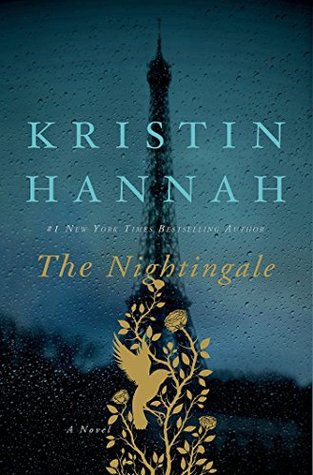
Book Review: The Nightingale by Kristin Hannah

Title: The Nightingale
Author: Kristin Hannah
Publisher: St. Martin’s Press
Publication date: January 29, 2015
Length: 593 pages
Genre: Historical fiction
Source: Purchased
Rating:

Rating: 5 out of 5.

FRANCE, 1939

In the quiet village of Carriveau, Vianne Mauriac says goodbye to her husband, Antoine, as he heads for the Front. She doesn’t believe that the Nazis will invade France…but invade they do, in droves of marching soldiers, in caravans of trucks and tanks, in planes that fill the skies and drop bombs upon the innocent. When a German captain requisitions Vianne’s home, she and her daughter must live with the enemy or lose everything. Without food or money or hope, as danger escalates all around them, she is forced to make one impossible choice after another to keep her family alive.

Vianne’s sister, Isabelle, is a rebellious eighteen-year-old girl, searching for purpose with all the reckless passion of youth. While thousands of Parisians march into the unknown terrors of war, she meets Gäetan, a partisan who believes the French can fight the Nazis from within France, and she falls in love as only the young can…completely. But when he betrays her, Isabelle joins the Resistance and never looks back, risking her life time and again to save others.

With courage, grace and powerful insight, bestselling author Kristin Hannah captures the epic panorama of WWII and illuminates an intimate part of history seldom seen: the women’s war. The Nightingale tells the stories of two sisters, separated by years and experience, by ideals, passion and circumstance, each embarking on her own dangerous path toward survival, love, and freedom in German-occupied, war-torn France–a heartbreakingly beautiful novel that celebrates the resilience of the human spirit and the durability of women. It is a novel for everyone, a novel for a lifetime.

Author Kristin Hannah has written several powerful works of historical fiction over the past few years, all of which I’ve loved and felt transported by. Somehow I’d missed reading The Nightingale until now. Finally, ten years after its original publication, I’ve now made a point of reading this compelling story.

The Nightingale takes place in France during World War II, following the timeline of the Nazi occupation to show the lives of two sisters and their divergent experiences during the war.

Vianne and Isabelle are ten years apart in age and miles apart in terms of their relationship as the book opens. Vianne is a wife and mother living in Carriveau, a small country village. She’s blissfully in love with her husband Antoine, and takes joy in her eight-year-old daughter Sophie, a miracle child born after a string of miscarriages. Meanwhile, Isabelle is an impetuous and hot-headed teen, constantly in trouble, always either escaping from or getting kicked out of her latest boarding school.

As children, after their mother’s death, they were essentially abandoned by their grieving, alcoholic father. But Vianne, caught up in her own grief and then struggling with the loss of pregnancy after pregnancy, didn’t have space in heart to love her little sister. The bond between the two seemed irreparably broken.

When the Nazi occupation of France begins, the sisters’ lives change dramatically. Antoine is called to military service and Vianne is left alone to tend to their home and their daughter. Isabelle is sent to take shelter with Vianne, but she yearns for purpose and adventure, not life on a farm. When Isabelle connects with an underground network fighting to carry out secret operations against the Nazis, her life changes yet again. While Vianne believes Isabelle has run off for some ill-advised, irresponsible love affair, Isabelle is actually setting out on a course of heroism and sacrifice, risking her own life over and over again to fight for freedom and justice.

Without going too much more deeply into the plot, I’ll just summarize by saying that The Nightingale balances the sisters’ stories by showing each of their struggles, triumphs, and losses during the war. It’s a devastating look at an awful period, and while many of us have read stories of this time before, this book’s focus on women’s lives under Nazi occupation — and the sacrifices they make in order to not only survive, but to save others as well — conveys an intimacy and fresh perspective that stand out.

It was interesting for me to note how my own sympathies and interests change over the course of the book. Perhaps because we meet Vianne first, I assumed she was our main POV character. When Isabelle first appears, we largely see her through Vianne’s eyes — young, reckless, self-centered. It was easy to feel annoyed by her, and to feel that her impetuous decisions put Vianne’s family at risk. As the book progresses, however, Isabelle takes on a much larger role, sharing the spotlight and growing into the person she always wanted to be. Isabelle throws herself into danger repeatedly, but her devotion and bravery are real. While she and Vianne are sometimes adversaries — even with life and death consequences — we know enough about each woman to understand her action and motivations, even when they don’t actually understand one another.

Kristin Hannah has clearly done a huge amount of research for this book, which I understand represents a major turning point in her writing career — her pivot into historical fiction. It was fasacinating to read her notes at the end and to learn about some of the historical figures who served as inspiration for her, including Andrée de Jongh, a Belgian resistance fighter during WWII who is credited with saving hundreds of downed airmen and other Allied soldiers by smuggling them across the Pyrenees from France into Spain.

The Nightingale is beautifully written and powerfully told, depicting the absolute horrors that the characters lived through, but also showing the beauty of their love for each other, their families, and even the strangers they save. It’s not an easy read, but it’s important and has a deep impact that I know will last.

The Nightingale was originally published in 2015. Earlier this year, the publisher released a 10th anniversary special hardcover edition, which is lovely. The Nightingale is also available in paperback, e-book, and audiobook formats.
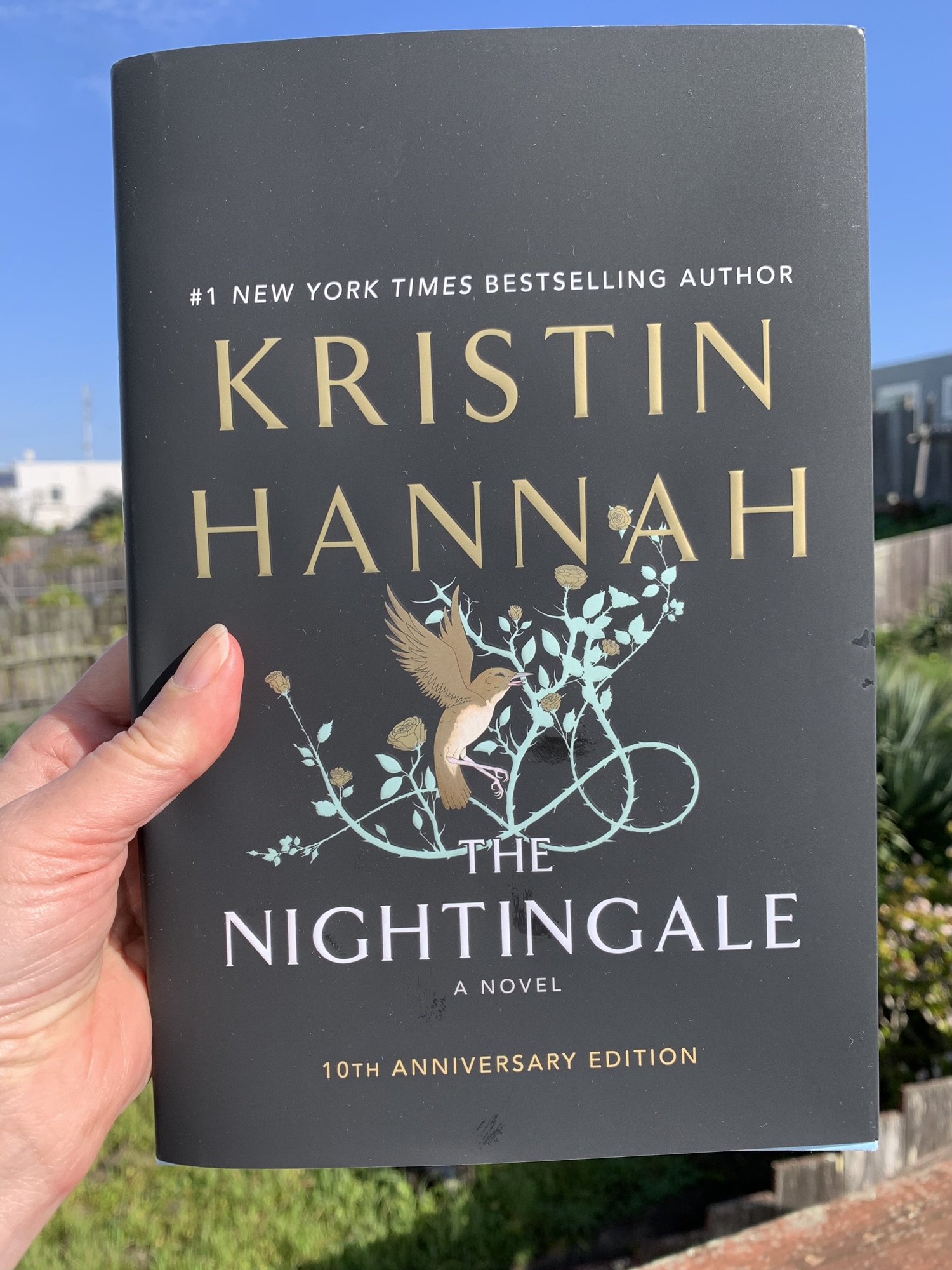
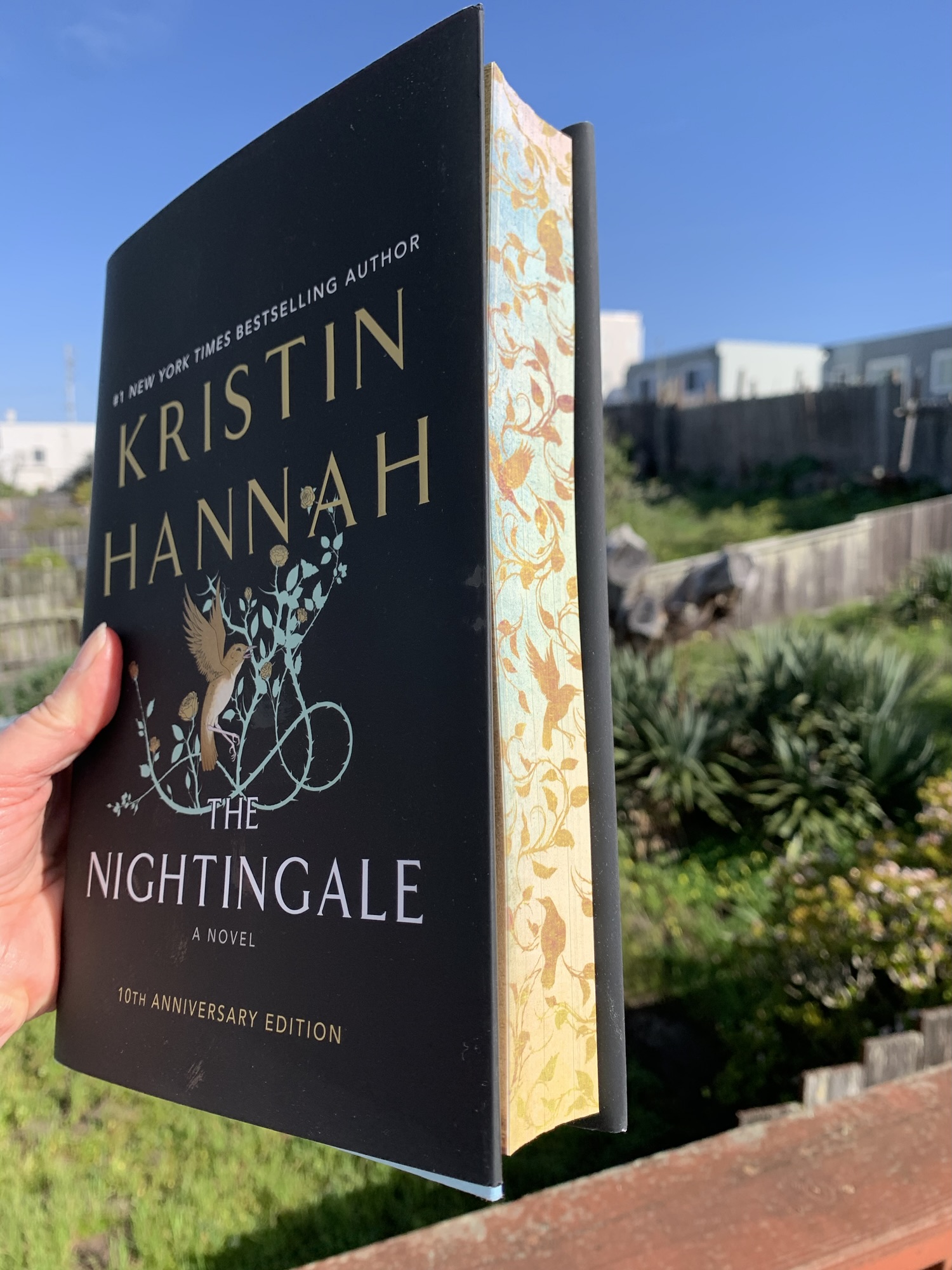
A look at the 10th anniversary edition of The Nightingale

Purchase linksAmazon – Bookshop.orgLibro.fm
Disclaimer: When you make a purchase through one of these affiliate links, I may earn a small commission, at no additional cost to you.

For more by this author, check out my reviews:

I have not yet read any of Kristin Hannah’s earlier works. If you have recommendations, please let me know!
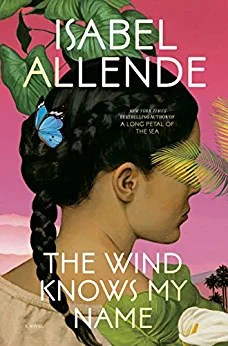
Book Review: The Wind Knows My Name by Isabel Allende

Title: The Wind Knows My Name
Author: Isabel Allende
Publisher: Ballantine Books
Publication date: June 6, 2023
Length: 253 pages
Genre: Historical/contemporary fiction
Source: Purchased
Rating:

Rating: 4 out of 5.

This powerful and moving novel from the New York Times bestselling author of A Long Petal of the Sea weaves together past and present, tracing the ripple effects of war and immigration on one child in Europe in 1938 and another in the United States in 2019.

Vienna, 1938. Samuel Adler was six years old when his father disappeared during Kristallnacht—the night their family lost everything. Samuel’s mother secured a spot for him on the last Kindertransport train out of Nazi-occupied Austria to the United Kingdom, which he boarded alone, carrying nothing but a change of clothes and his violin.

Arizona, 2019. Eight decades later, Anita Diaz, a blind seven-year-old girl, and her mother board another train, fleeing looming danger in El Salvador and seeking refuge in the United States. However, their arrival coincides with the new family separation policy, and Anita finds herself alone at a camp in Nogales. She escapes through her trips to Azabahar, a magical world of the imagination she created with her sister back home.

Anita’s case is assigned to Selena Duran, a young social worker who enlists the help of a promising lawyer from one of San Francisco’s top law firms. Together they discover that Anita has another family member in the United States: Leticia Cordero, who is employed at the home of now eighty-six-year-old Samuel Adler, linking these two lives.

Spanning time and place, The Wind Knows My Name is both a testament to the sacrifices that parents make and a love letter to the children who survive the most unfathomable dangers—and never stop dreaming.

The Wind Knows My Name is a compact but powerful story about lost children, sorrow, and resilience. It’s also quite political, which I didn’t have a problem with, but some may readers may wish to know that the author is very up front in her thoughts on a certain former President and the current, ongoing immigration crisis.

But beyond the politics and the highly charged topics, The Wind Knows My Name is deeply affecting because of the individual characters, their painful childhood experiences, and the way unexpected connections help them forge new paths forward.

The book opens in Vienna, 1938, as the horrors of Kristallnacht unfold. For young Samuel Adler, it’s the night his whole world falls apart. Eventually, to save his life, Samuel’s mother sends him off to England on a train filled with other Jewish children — and while Samuel does go on to live a long and fulfilling life, the early trauma never leaves him.

Later, we meet Leticia, a Salvadoran girl whose father crosses the border into the US with her after their entire family is murdered in the massacre of their small village.

And still later, closer to the present day, we meet Anita — also from El Salvador, cruelly separated from her mother at the border as they seek asylum from extreme danger back home.

As these three people come together, with assistance from Selena, a social worker, and Frank, the ambitious lawyer who finds his true calling in pro bono work helping undocumented children, their complicated pasts offer reflections of commons experiences, even while each has suffered in their own unique and unforgettable way.

At less than 300 pages, The Wind Knows My Name is a fast read, especially as it’s so compelling that it’s difficult to pause and come up for air once you start. Each character’s story is absorbing and tragic, and yet, there are rays of hope in each of their stories as well — even more so as they come together in an unusual but lovely found family.

My main quibble with this book has to do with the storytelling itself. Isabel Allende is a masterful writer and has a beautiful way with words, and she’s highly gifted when it comes to evoking her characters’ inner lives, dreams, and nightmares. However, the writing in this book relies too often on telling rather than showing. Especially in the later chapters, new interludes open with a recitation of what the characters have been doing. We don’t see these events unfold; we hear about them after the fact.

The story itself and what the characters experience is never uninteresting, but there’s a distance because of this narrative approach that left me feeling the emotional impact a little less than I’d expected.

I also felt disappointed that Samuel’s adult life is largely skipped and told in summary after the fact, when we meet up with him again in his 80s. I couldn’t help but feel that there was so much more to see and understand. Given the length of the book, perhaps there wasn’t room to go deeper into the characters’ lives, except in terms of how they all connect, but I wished for more, for Samuel and the others. The Wind Knows My Name might have been more satisfying if it had expanded further on all of the characters and let us go deeper into their worlds.

Overall, however, the events and experiences contained within The Wind Knows My Name are deeply moving, and I came to care deeply about all of its people and the relationships they create and nurture.

Highly recommended.

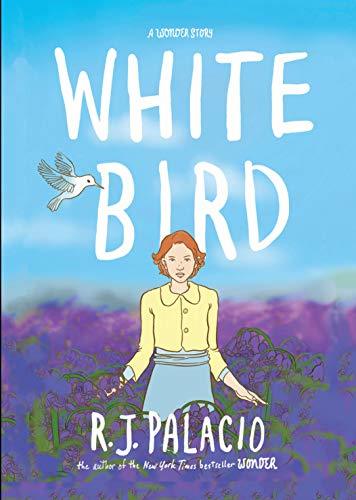
Book Review: White Bird by R. J. Palacio

Title: White Bird
Author: R. J. Palacio
Publisher: Knopf Books for Young Readers
Publication date: 2019
Length: 224 pages
Genre: Middle grade
Source: Library
Rating:

Rating: 4.5 out of 5.

Soon to be a major motion picture, starring Helen Mirren and Gillian Anderson!

Inspired by her blockbuster phenomenon Wonder, R. J. Palacio makes her graphic novel debut with an unforgettable, Sydney Taylor Book Award-winning story of the power of kindness and unrelenting courage in a time of war.

In R. J. Palacio’s bestselling collection of stories Auggie & Me, which expands on characters in Wonder, readers were introduced to Julian’s grandmother, Grandmère. Here, Palacio makes her graphic novel debut with Grandmère’s heartrending story: how she, a young Jewish girl, was hidden by a family in a Nazi-occupied French village during World War II; how the boy she and her classmates once shunned became her savior and best friend.

Sara’s harrowing experience movingly demonstrates the power of kindness to change hearts, build bridges, and even save lives. As Grandmère tells Julian, It always takes courage to be kind, but in those days, such kindness could cost you everything. With poignant symbolism and gorgeous artwork that brings Sara’s story out of the past and cements it firmly in this moment in history, White Bird is sure to captivate anyone who was moved by the book Wonder or the blockbuster movie adaptation and its message.

I’ve never read Wonder (am I the only person left who hasn’t?), and hadn’t heard of White Bird before either, until I went to a movie theater over the weekend and saw a trailer for the film adaptation of White Bird… and just had to know more about it. Luckily, my library had a copy available to borrow immediately, and I read the whole book over the course of a day.

White Bird is a middle-grade graphic novel, with the bulk of the story set in occupied France during the Holocaust. The framing device is a contemporary story about a boy named Julian (who apparently is a character from Wonder). Julian’s grandmother speaks to him about kindness and helping others, and shares her own story with him for the first time.

In the tale within a tale, Sara is a young girl living a charmed life with her parents in a small town in France, where she attends a lovely school, has good friends, and is very happy. The family is Jewish, but doesn’t fear for their own safety at first, even as the Nazis invade France. They live in the free zone, and feel secure knowing that they are French citizens. Even as Jews are restricted in their movements and forced to wear yellow stars, Sara’s parents don’t feel a need to escape, until suddenly it is too late.

At school, Sara sits in her assigned seat beside a boy called by the nickname Torteau in all her classes. Having survived polio, the boy is mocked and treated cruelly by their classmates due to his twisted legs and reliance on crutches. While not actively mean to Torteau, Sara isn’t friendly either — she mostly ignores him, until one day she drops her sketchbook and the boy returns it to her.

When Nazis arrive at school one day and order all the Jewish children to come with them, Sara hides instead, and it’s only a matter of time until she’s discovered — but Torteau finds her first, shows her a secret tunnel out of the school, and brings her to hide in his family’s barn. The boy’s name is actually Julien, and he and his parents become Sara’s protectors for years to come, keeping her hidden, safe, and cared for while the world falls apart around them.

I won’t say more about the plot, but it’s powerful, heartbreaking, and lovely. The graphic novel’s art style is simple but affecting, and mixes in Sara’s sketches and dreams with her day-to-day experiences in a way that lends a magical feel to key scenes.

The author includes a great deal of historical notes at the end that are informative and yet easy to digest, and this section seems like it would be very accessible and helpful for younger readers who are new to reading about the Holocaust.

Themes of love, loyalty, friendship, taking a stand when witnessing wrong-doing, and helping those in need are strongly depicted without being preachy or heavy-handed.

White Bird is a powerful, moving reading experience that actually brought me to tears at certain points — not something I typically expect when I pick up a graphic novel.

I highly recommend this book, and plan to check out the movie version when it’s released. Meanwhile, having finally tasted this author’s storytelling, I hope to read Wonder in the near future as well.

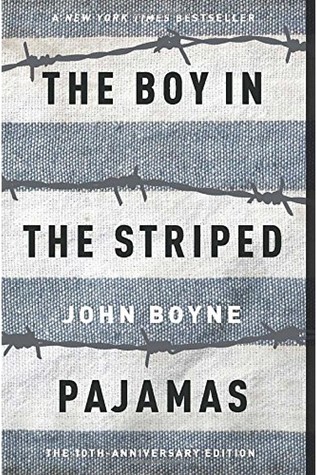
Book Review: The Boy in the Striped Pajamas by John Boyne

Title: The Boy in the Striped Pajamas
Author: John Boyne
Publisher: David Fickling Books
Publication date: 2006
Length: 215 pages
Genre: Middle grade fiction
Source: Purchased

Rating: 3 out of 5.

Berlin, 1942: When Bruno returns home from school one day, he discovers that his belongings are being packed in crates. His father has received a promotion and the family must move to a new house far, far away, where there is no one to play with and nothing to do. A tall fence stretches as far as the eye can see and cuts him off from the strange people in the distance.

But Bruno longs to be an explorer and decides that there must be more to this desolate new place than meets the eye. While exploring his new environment, he meets another boy whose life and circumstances are very different from his own, and their meeting results in a friendship that has devastating consequences.

Oh, I have such mixed feelings about this book!

Published in 2006, the book originally came with all sorts of disclaimers urging people not to give away the story, but to allow all readers to experience this book without knowing what it was about. All these years later, the subject matter is no longer a secret: This is Holocaust fiction, telling the story of two young boys who meet through the fence at Auschwitz, and despite their vastly different circumstances, form a deep friendship.

We see the story unfold through 9-year-old Bruno’s eyes. Bruno’s father is a rising Nazi officer, favored by Hitler himself (whose name Bruno hears as “the Fury” rather than “the Fuhrer”). The father is promoted to Kommandant of Auschwitz, and when we first meet Bruno, he’s expressing his unhappiness at having his happy life in Berlin uprooted, as the family will be moving because of his father’s new job.

Bruno is remarkabley clueless (more on that later). They arrive at their new home, which is nowhere near as grand as his house in Berlin. There’s nothing to do, and no one to play with. From the upstairs window, Bruno has a view of strange people on the other side of a barbed wire fence, all wearing striped pajamas. He wonders who these people are and what they’re doing, and even feels some envy at what appears to be a large group of people who are all together while he is so very alone.

As Bruno goes exploring along the forbidden fence, he finds a strange boy sitting near it on the other side, a skinny, gray-faced boy wearing the striped pajamas. They start to talk, and Bruno and Shmuel begin to get to know one another. Soon, Bruno considers Shmuel his best friend, although he’s frustrated that they can never play together, and somehow knows enough never to mention Shmuel in his house.

On its surface, The Boy in the Striped Pajamas is a moving story. And yet, I can understand why it was controversial upon its release.

For starters, there are some story issues that make the book hard to digest. Bruno is 9 years old and lived in the heart of Berlin, in a house led by a Nazi officer and where soldiers and other important people constantly come and go… and yet he appears to never have heard of Jews until his sister tells him, much later, that that’s who those people on the other side of the fence are.

And why are there so many children at Auschwitz, when we know that the majority would have been murdered upon arrival? How is Shmuel able to sneak away for hours, day after day, with no one noticing?

And is Bruno’s language mix-ups (such as “the Fury” and his belief that they live at “Out-With”) supposed to be cute? Frankly, he presents as much younger than nine.

In the book’s favor, the title page clearly calls this story “a fable”. No, these are not historical events. No, this depiction of life at Auschwitz isn’t meant to be historically accurate.

And yet, what’s concerning is that apparently this book is often used in schools as an introduction to Holocaust fiction. In fact, the back of my paperback edition includes a blurb from USA Today that calls this book “as memorable an introduction to the subject as The Diary of Anne Frank”.

Um, no. That comparison is absurd. And it disturbs me to think that there are students whose first encounter with the horrors of Auschwitz might be through this “fable”, where nothing seems all that terrible at first, where the nightmarish reality is presented as a distant curiosity, and where a reader who doesn’t know the factual history might not even get what was going on.

As a companion book, or a different lens on known events, sure, this would be effective. But as the sole introduction, it’s sorely lacking in context and facts, and I’m afraid that the melodrama and Bruno’s limited worldview are pretty close to sugar-coating.

Now, I’ll add that I haven’t seen the movie, so I can’t comment on whether that version is more or less effective at conveying the full picture of Auschwitz. I actually picked up this book this week because my son saw the movie at school and came home to tell me how good it was. I think I should give it a chance, and see if I feel any differently about the story afterward.

I was eager to read this book not only because of my son’s recommendation, but because I just recently read my very first book by John Boyne, The Heart’s Invisible Furies, and thought it was brilliant.

As I was reading The Boy in the Striped Pajamas, I just couldn’t stop and ended up reading it straight through. It was only once I’d closed the covers and stopped to think that the various elements above started to bother me.

I’d be really curious to hear from others who’ve read this book and see if our responses and reactions are at all aligned.

Meanwhile, I’ve been looking up reviews from when the book was published, and have found more than a few pieces that discuss why this book had such a mixed and controversial response:

(Note: Some of these links may contain spoilers. Proceed with caution!)

Review – New York Times
Review – Jewish Book Council
Analysis – Holocaust Exhibition & Learning Centre
Movie review – Time Magazine
Book Review – Aish.com

Middle Grade Book Review: Broken Strings by Eric Walters and Kathy Kacer

Synopsis:

A violin and a middle-school musical unleash a dark family secret in this moving story by an award-winning author duo. For fans of The Devil’s Arithmetic and Hana’s Suitcase.

It’s 2002. In the aftermath of the twin towers — and the death of her beloved grandmother — Shirli Berman is intent on moving forward. The best singer in her junior high, she auditions for the lead role in Fiddler on the Roof, but is crushed to learn that she’s been given the part of the old Jewish mother in the musical rather than the coveted part of the sister. But there is an upside: her “husband” is none other than Ben Morgan, the cutest and most popular boy in the school.

Deciding to throw herself into the role, she rummages in her grandfather’s attic for some props. There, she discovers an old violin in the corner — strange, since her Zayde has never seemed to like music, never even going to any of her recitals. Showing it to her grandfather unleashes an anger in him she has never seen before, and while she is frightened of what it might mean, Shirli keeps trying to connect with her Zayde and discover the awful reason behind his anger. A long-kept family secret spills out, and Shirli learns the true power of music, both terrible and wonderful.

My thoughts:

Broken Strings is a layered, thoughtful, and ultimately uplifting book about the power of family, memory, and music. Set only months after the terrible events of 9/11, the story follows Shirli and her middle school classmates, all of whom experienced some of the horror of living through 9/11, whether through images on TV, or seeing the towers fall from across the Hudson River, or having lost friends or family in the attacks.

Now, six months later, the school readies for its spring musical production, Fiddler on the Roof. Shirli is initially disappointed not to get the flashier role of Hodel, the daughter in the musical with the best solo, but she grows to appreciate her role as Golde, especially since it means spending hours working with the adorable Ben, who has the star role of Tevye, Golde’s husband.

Shirli knows from her parents that her grandfather’s parents’ families were originally from Eastern Europe and lived through some of the pogroms that took place in the time period of Fiddler, so she begins to ask him questions in hopes of better understanding the characters. And although she’s aware that Zayde survived the Holocaust and bears a concentration camp tattoo on his arm, he’s never spoken of his experiences to her or to anyone else in the family. But as she visits Zayde, little by little he begins to share the story of what happened to his family during the Holocaust, and why he has never played his violin or even listened to music in all the years since.

There’s so much to love about Broken Strings. First, it’s a sweet story about middle school friendship and crushes, about talent and hard work and ambition, and about dedication to one’s passions. At the same time, it’s about family, the power of love, and the devastation of loss and memories too painful to bring into the light of day. And finally, it’s about the healing power of sharing oneself and one’s stories, about making connections, and about rising above hatred to find common ground in even unlikely places.

The characters are all well-drawn and realistic, and it’s beautiful to see how Zayde influences those around him by reaching across divides and making friends. Shirli is a lovely main character, and I appreciated how well the authors show both her insecurities and her devotion to her friends and family.

Broken Strings is really a special book. Highly recommended for middle grade readers as well as the adults in their lives.

With special thanks to Jill of Jill’s Book Blog, whose wonderful review first brought this book to my attention. Check it out, here.

_________________________________________

The details:

Title: Broken Strings
Authors: Eric Walters and Kathy Kacer
Publisher: Puffin Books
Publication date: September 10, 2019
Length: 288 pages
Genre: Middle grade fiction
Source: Library

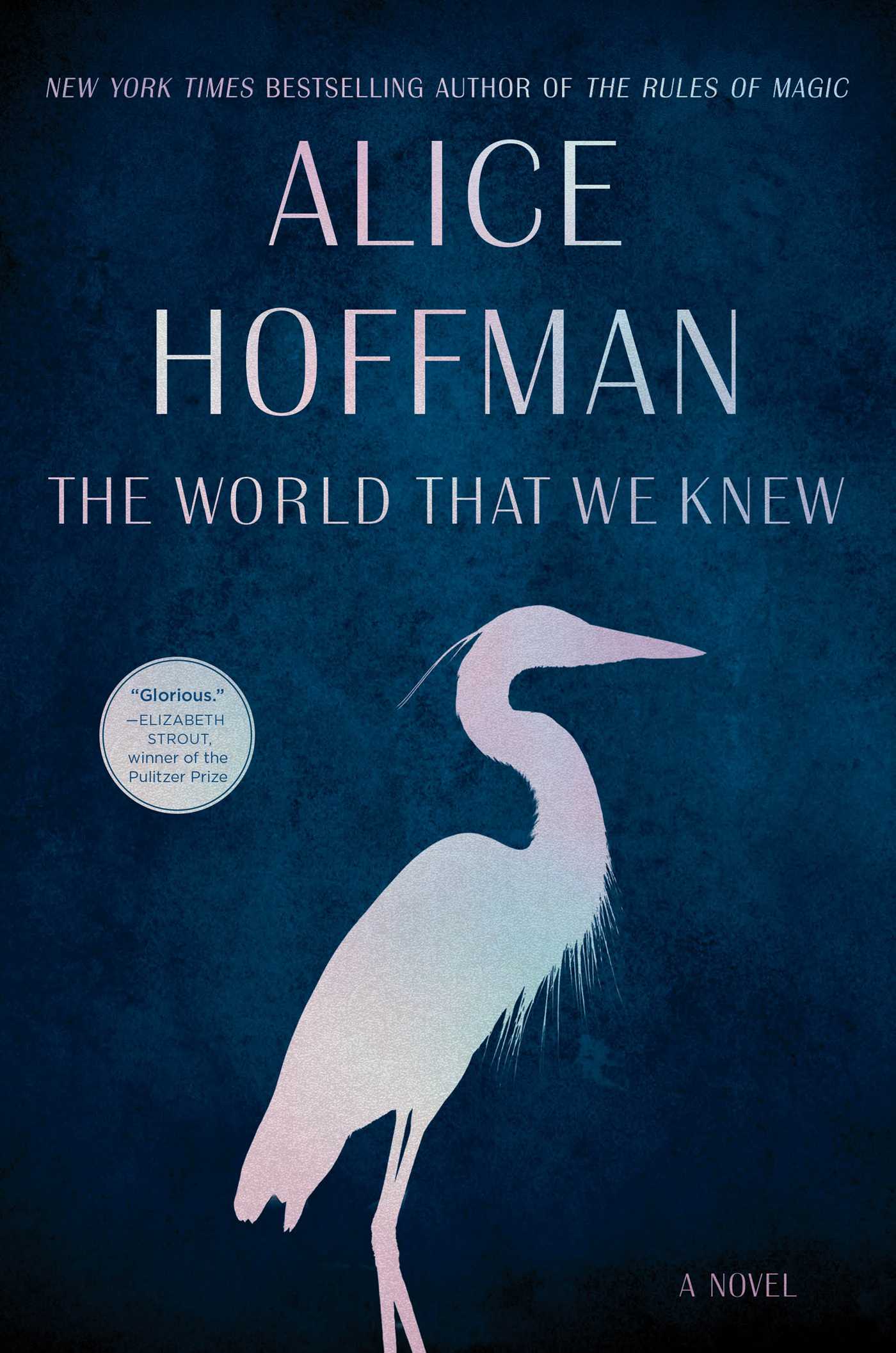
Book Review: The World That We Knew by Alice Hoffman


In 1941, during humanity’s darkest hour, three unforgettable young women must act with courage and love to survive, from the New York Times bestselling author of The Dovekeepers and The Marriage of Opposites Alice Hoffman. 

In Berlin, at the time when the world changed, Hanni Kohn knows she must send her twelve-year-old daughter away to save her from the Nazi regime. She finds her way to a renowned rabbi, but it’s his daughter, Ettie, who offers hope of salvation when she creates a mystical Jewish creature, a rare and unusual golem, who is sworn to protect Lea. Once Ava is brought to life, she and Lea and Ettie become eternally entwined, their paths fated to cross, their fortunes linked.

Lea and Ava travel from Paris, where Lea meets her soulmate, to a convent in western France known for its silver roses; from a school in a mountaintop village where three thousand Jews were saved. Meanwhile, Ettie is in hiding, waiting to become the fighter she’s destined to be.

What does it mean to lose your mother? How much can one person sacrifice for love? In a world where evil can be found at every turn, we meet remarkable characters that take us on a stunning journey of loss and resistance, the fantastical and the mortal, in a place where all roads lead past the Angel of Death and love is never ending.

In The World That We Knew, author Alice Hoffman brings her unique infusion of magic and nature to a store of survival during the worst of times. Starting in Berlin in 1941, the story introduces us to Hanni and her young daughter Lea. Hanni knows it’s only a matter of time until they’re captured and sent to a death camp like the rest of the Jews around them. Desperate to save Lea, Hanni begs for a miracle from the rabbi known to have mystical abilities, but instead, his daughter Ettie offers help in exchange for an escape opportunity for her and her younger sister.

Etti, having listened outside her father’s door for years, has herself grown wise in the art of Jewish mysticism, and uses her knowledge to create a golem — a powerful creature made from clay shaped into human form and brought to life through secret rituals, whose entire purpose is to protect Lea. Hanni can’t escape with her elderly, disabled mother, nor can she leave her behind, so she sends Lea away in care of Ava the golem, to seek what safety might be available to them in France.

France isn’t exactly safe for Jews either. Finding refuge with the Levi family, and joined by Etti, Lea and Ava are still at risk, and finally make their escape before their new shelter is raided by Nazis — but first, Lea forms a connection with the young son of the Levi family, Julien. Lea and Julien make only one demand of one another: stay alive.

From here, the story spirals out in multiple directions. We follow Lea and Ava from one temporary haven to another, including a remote convent where the nuns shelter the children who come to them, at risk of their own lives. We follow Etti into the forests as she seeks and then finds the resistance, desiring only vengeance. We follow Julien on his own path toward escape, refuge, and meaning. For each, and for the other characters we meet, there are dangers around every corner — and yet, there is also the opportunity to help others, to find meaning even in the middle of horror and tragedy.

Once upon a time something happened that you never could have imagined, a spell was broken a girl was saved, a rose grew out of a tooth buried deep in the ground, love was everywhere, and people who had been taken away continued to walk with you, in dreams and in the waking world.

The writing in The World That We Knew is just gorgeous. The author evokes the glory of the natural world, even as the people in it carry out horrific deeds and leave destruction in their wake. There’s magic all around, both in the form of Ava, the golem who starts as a mere bodyguard but finds her own personhood as time goes on, and in the flowers, bees, and birds that surround our characters and interact with them in unexpected ways.

Every now and then a crow would soar past with a gold ring or coat button in its beak, a shiny souvenir of murder.

The characters are lovely and memorable. I especially loved Ava, but it’s also wonderful and awful to see Lea grow up during war, having lost eveyrthing, but still clinging to her mother’s love and her connection to Julien. But really, I can’t just single these two out. There are side characters who come into the story briefly, whose stories we come to know before they exit once more, and their stories have power as well. In some ways, it feels as though the author has painted a picture through her writing of all the lost potential represented by the millions murdered during this terrible time.

And yet, the book is not without hope. Despite the tragedies, there’s still goodness, the possibility of a future, and the possibility of meaning:

What had been created was alive. Ettie did not see clay before her, but rather a woman who had been made by women, brought to life by their blood and needs and desires.

I don’t think I can really do justice to how special and beautiful this book is. The writing is superb, and the story leaves an indelible impression. Highly recommended.

_________________________________________

The details:

Title: The World That We Knew
Author: Alice Hoffman
Publisher: Simon & Schuster
Publication date: September 24, 2019
Length: 384 pages
Genre: HIstorical fiction
Source: Review copy courtesy of the publisher via NetGalley

Save

Save

Save

Save

Save

Save

Save

Save

Save

Book Review: Promised Land by Martin Fletcher


Promised Land is the sweeping saga of two brothers and the woman they love, a devastating love triangle set against the tumultuous founding of Israel.

The story begins when fourteen-year-old Peter is sent west to America to escape the growing horror of Nazi Germany. But his younger brother Arie and their entire family are sent east to the death camps. Only Arie survives.

The brothers reunite in the nascent Jewish state, where Arie becomes a businessman and one of the richest men in Israel while Peter becomes a top Mossad agent heading some of Israel’s most vital espionage operations. One brother builds Israel, the other protects it.

But they also fall in love with the same woman, Tamara, a lonely Jewish refugee from Cairo. And over the next two decades, as their new homeland faces extraordinary obstacles that could destroy it, the brothers’ intrigues and jealousies threaten to tear their new lives apart.

Promised Land is at once the gripping tale of a struggling family and an epic about a struggling nation.

Promised Land is an ambitious novel about family and love, set in the aftermath of the Holocaust and tracking two brothers’ lives during the early years following Israel’s independence.

As the book opens, Peter and Arie are young boys living with their family in Germany as war looms. Their parents are able to send Peter to America, but the rest of the family can’t avoid the Nazi terror, ultimately being sent to concentration camps.

Peter spends his teens with a kind American family before fighting in WWII, then ultimately moving to the new state of Israel and joining its intelligence service. Arie survives Auschwitz, but the rest of the family perishes, and Arie too ends up in Israel, where the brothers are reunited. A meeting with an Egyptian Jewish refugee, Tamara, changes both brothers’ lives. Peter and Tamara have an instant connection and a moment of passion, but Peter is sent on a mission with no communication possible for months. Meanwhile, Arie woos Tamara, and by the time Peter returns home, Arie and Tamara are married and expecting a child.

Promised Land takes place over a roughly 20-year period, from Israel’s birth in 1948 through the Six Day War in 1967. As the brothers and their families build their lives, we see the country also build and develop. Peter rises in the ranks of the Mossad, known for his operational expertise and sense of honor, while Arie becomes an astute businessman, always ahead of the curve in seeing opportunities for making money and profiting from the growth of the nation. Peter marries a lovely woman, a fellow agent, and has a good life with her; Arie and Tamara, while becoming fabulously wealthy, have a rocky marriage due to Arie’s excesses and infidelities.

Eventually, the love triangle between Peter, Arie, and Tamara explodes, which isn’t surprising… the only surprising element is how long it takes to reach that point.

In terms of my reaction to the book, I was hooked from start to finish, but at the same, I felt that the emotional set-up of the relationships in the story was somewhat flimsy and not well-developed. Arie is a terrible husband, no two ways about it, and just isn’t a particularly good guy. Why Tamara chose to stay with him really makes no sense, and neither does his reaction to learning the truth about Tamara and Peter, other than demonstrating Arie’s possessiveness and selfishness.

Peter really is a good person, a devoted family man and brother, and he acts in Arie’s best interest even when Arie is engaging in shady, criminal behavior. He is a good loving husband to his first wife, and (spoiler alert) after her untimely death, denies  his love for  Tamara well past the point when there was a reason for either of them to think that her marriage was worth saving.

What this book does very well, and what makes it a deeper read than a typical love triangle story, is the positioning of these characters at such a distinct and eventful moment in history.  The author, a former news correspondent, uses his well-researched knowledge of the events of the time to paint a portrait of a people’s psychology.

We come to understand the underlying needs, fears, and guilt of a Holocaust survivor. While despising much of Arie’s actions, I could also sympathize with his pain and understand why he acts the way he acts and what drives him to pursue wealth, power, and admiration.

We also learn about the psychology of the early Israelis, coming from the horrors of genocide, knowing that their new homeland may not be a safe place, and wanting desperately to find the security so long denied. The author does not sugarcoat the more unpleasant aspects of Israel’s creation, but does show a context and depth of understanding that’s often missing in today’s narratives.

At the same time, as the characters live through Israel’s cycles of war, we get a more in-depth look at the political machinations behind the scenes, thanks to Peter’s role in the intelligence service. It’s fascinating to read about the hidden reasons for Israel’s actions, the lingering impact of Nazi scientists on Middle Eastern politics, and the ways in which Cold War politics play into Israel’s strategies.

Overall, I found myself immersed in the story, fascinated both by the historical setting and the characters’ lives. Yes, I found the characterizations a little formulaic (good brother, bad brother, exotic love interest), but the story progresses in a way that kept me engaged and made me care about these people and their lives.

I did find the ending somewhat abrupt. The story seems to just end. I think even one more chapter, perhaps an epilogue, might have helped to create a better sense of completion and satisfaction.**

**While doing a final proofread of this review, I popped over to Martin Fletcher’s author page in Goodreads and discovered that this book is the first in a trilogy! I guess that explains why it ends when and how it does, and why I was left feeling that there was more of the story to be told.

Despite a few drawbacks that got in my way here and there, I’m glad to have read Promised Land. For anyone interested in Israel’s early years, this is a fresh take on the history of the time, and the characters in the story are memorable and relatable – you won’t soon forget them or their struggles.

_________________________________________

The details:

Title: Promised Land
Author: Martin Fletcher
Publisher: Thomas Dunne Books
Publication date: September 4, 2018
Length: 416 pages
Genre: Historical fiction
Source: Review copy courtesy of the publisher via NetGalley

**Save

Save

Save

Save

Save

Save

Save

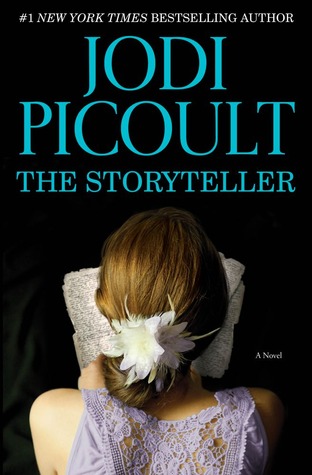
Book Review: The Storyteller by Jodi Picoult

The Storyteller

(Goodreads): Sage Singer befriends an old man who’s particularly beloved in her community. Josef Weber is everyone’s favorite retired teacher and Little League coach. They strike up a friendship at the bakery where Sage works. One day he asks Sage for a favor: to kill him. Shocked, Sage refuses… and then he confesses his darkest secret—he deserves to die, because he was a Nazi SS guard. Complicating the matter? Sage’s grandmother is a Holocaust survivor.

What do you do when evil lives next door? Can someone who’s committed a truly heinous act ever atone for it with subsequent good behavior? Should you offer forgiveness to someone if you aren’t the party who was wronged? And most of all—if Sage even considers his request—is it murder, or justice?

How do I even begin to describe a book as powerful and devastating as The Storyteller? While I knew the basic premise, I had no idea what I was in for when I first started reading it.

At the outset, we meet Sage, a reclusive young woman bearing scars of a tragic accident that cost her her parents. Sage lives alone in a small town in New Hampshire, where she works nights — again, alone — baking a miraculous, marvelous assortment of breads for the small bakery that employs her. Baking is both Sage’s passion and an escape, providing her with distraction and a focus, as well as a good excuse to avoid almost everyone.

It’s silly to anthropomorphize bread, but I love the fact that it needs to sit quietly, to retreat from touch and noise and drama, in order to evolve.

I have to admit, I often feel that way myself.

Sage is forced out of her comfort zone only when she attends a grief support group, where she meets and befriends a newer member, Josef, a sweet old man in his 90s who seems to be just as lonely as Sage. Gradually, the two connect and begin to share bits and pieces of their lives, but Sage’s pleasure in the friendship grinds to a crashing halt when Josef confesses his Nazi past to Sage and asks her to help him die.

Sage is aware that her beloved grandmother Minka is a Holocaust survivor, and remembers catching a brief glimpse of the tattoo on her arm. But Minka has never said a word about her experiences and refuses to answer questions. Sage doesn’t know where to turn. Josef is a well-respected member of the community, a man known as an excellent teacher, kind to all, a man who always did his best to help the town. How can he be a Nazi? In desperation and disgust, Sage tries to connect with law enforcement, and is finally directed to the Federal agency which investigates alleged war criminals, where an agent named Leo Stein takes Sage’s call. Leo encourages Sage to get more information. It’s not enough to know that Josef has claimed to be a former SS agent. In order to take any action, they’ll need to be able to tie him to the historical records through facts, witness reports, or other details that can’t be fabricated.

Why is this book called The Storyteller? Within the novel, we get story upon story. The book opens with a scene that seems like something out of a different world — a tale with a folkloric flavor set in a small Polish village, in which the main character is the baker’s daughter, who feels a growing attraction to a strange young man who’s just arrived in the town, which is also beset by strange animal attacks. It’s not obvious, at first, how this tale, which weaves in between chapters of the contemporary story, actually fits into the main narrative, but it does, and is worth paying attention to.

After the initial section of the book sets up the story of Sage and Josef, we move into the heart of the book, which consists of two more sets of stories. First, we hear from Josef, who tells Sage that he is not Josef Weber after all, but Reiner Hartmann, an SS officer whom Leo is able to find in the historical record. Josef relates the story of his life to Sage, from his childhood in a typical German family to his growing success in Hitler Youth, to enrolling in the SS and becoming a part of the death machine that rolled through Poland. His story includes unflinching looks at the horrors in which he participated, slaughtering men, women, and children in village after village, and finally becoming a lead officer at Auschwitz, overseeing all female prisoners.

Josef’s confession to Sage isn’t enough, though. In order for Leo to take legal action and start the long process that could lead to extradition, deportation, and facing trial for his crimes, they need to be able to tie Josef’s story to something contained in the secret files on Reiner Hartmann, something that couldn’t have been gleaned from the public record. And at this point, Sage takes Leo to meet Minka — and Minka breaks her decades of silence by relating the terrible story of her girlhood, the fate of her family, and her own experiences in Auschwitz.

Minka’s story is the true center of the book, and Minka herself most aptly fits the role of the title, The Storyteller. Minka’s tale is lengthy, detailed, heartbreaking, and horrific. This is the longest section of the book, and is simply devastating to read. I won’t go into detail here; on the one hand, anyone who’s read the stories of Holocaust survivors will recognize some of the common elements here, yet on the other hand, Minka’s narrative is so personal and closely-observed that each loss and each degree of suffering feels like it happened to people we know. Within Minka’s narrative of what she lived through are more bits and pieces of the village tale that’s sprinkled throughout The Storyteller, and we finally discover the link between the book’s characters and the events of the tale.

The central question in The Storyteller is one of forgiveness and atonement. Can someone truly be forgiven for past crimes? Whose job, and whose right, is it to forgive? Can someone who’s committed evil acts ever make up for them? Do 50 years of helping others erase a heinous past? Does it make sense to prosecute a 95-year-old man for the crimes he committed almost seventy years earlier?

I don’t know what this person did you you, and I am not sure I want to. But forgiving isn’t something you do for someone else. It’s something you do for yourself. It’s saying, You’re not important enough to have a stranglehold on me. It’s saying, You don’t get to trap me in the past. I am worthy of a future.

There are no easy answers here. Sage does what she feels to be the right thing by bringing in Leo and cooperating in the investigation, yet she feels a moral obligation toward Josef too. When she looks at him, she sees the horrors he committed, but at the same time she see a lonely, frail old man who loves his dog and mourns his wife of fifty years. Can she feel sorry for him even while feeling repulsed by all she knows? And how does hearing her grandmother’s story affect her ability to listen to the request Josef continues to make of her?

While painting a vivid portrait of a period of history that must not be forgotten, the author is also making an important statement about the power of stories:

Fiction comes in all shapes and sizes. Secrets, lies, stories. We all tell them. Sometimes, because we hope to entertain. Sometimes, because we need to distract.

And sometimes, because we have to.

Jodi Picoult’s fiction tends not to come with easy answers. Of the four or five of her books which I’ve read, all include moral quandaries — people put in difficult or almost impossible positions, where the path forward is murky and ethical questions abound. The same is true of The Storyteller. There’s much food for thought here, and no matter what you think of Josef himself, his request, and Sage’s actions, you’ll definitely find yourself replaying scenes in your mind over and over. I’d imagine that the ending will be controversial for many, and there are certainly plenty of arguments to be made as to why it is or isn’t the right ending, or what the characters should or should not have done.

Ultimately, The Storyteller is a tale of pain and loss, but at the same time, it inspires hope simply by allowing the reader to bear witness to the courage and sacrifice that accompany all the horrors which Minka shares through her story. The Storyteller is not a light or easy read, but it’s an important one, and I applaud the author for creating a work of fiction that explores such a horrible piece of history with grace and honesty.

_________________________________________

The details:

Title: The Storyteller
Author: Jodi Picoult
Publisher: Atria
Publication date: February 26, 2013
Length: 460 pages
Genre: Contemporary fiction
Source: Purchased