
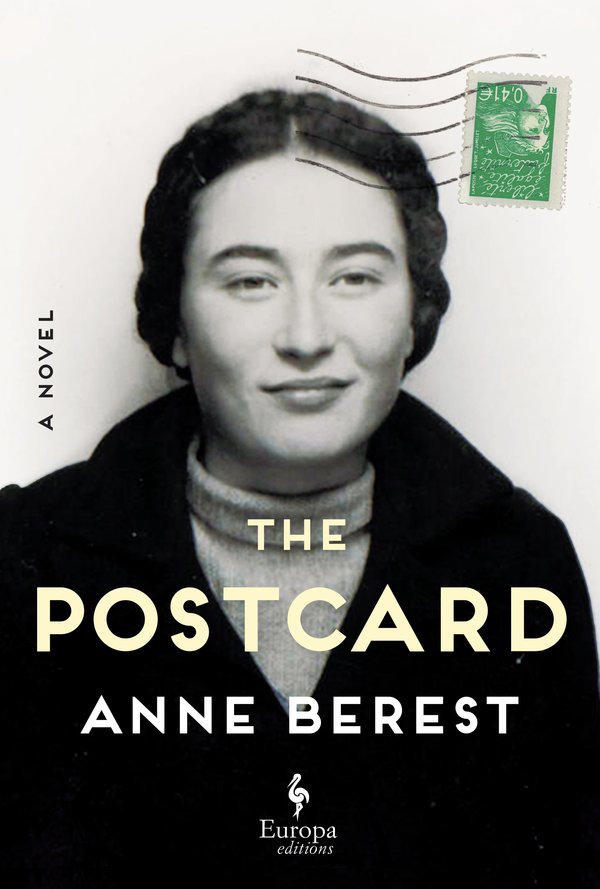
Title: The Postcard
Author: Anne Berest
Publisher: Europa Editions
Publication date: May 16, 2023 (English translation; first published in France in 2021)
Length: 489 pages
Genre: Autobiographical fiction
Source: Purchased
Rating:
Winner of the Choix Goncourt Prize, Anne Berest’s The Postcard is a vivid portrait of twentieth-century Parisian intellectual and artistic life, an enthralling investigation into family secrets, and poignant tale of a Jewish family devastated by the Holocaust and partly restored through the power of storytelling.
January, 2003. Together with the usual holiday cards, an anonymous postcard is delivered to the Berest family home. On the front, a photo of the Opéra Garnier in Paris. On the back, the names of Anne Berest’s maternal great-grandparents, Ephraïm and Emma, and their children, Noémie and Jacques—all killed at Auschwitz.
Fifteen years after the postcard is delivered, Anne, the heroine of this novel, is moved to discover who sent it and why. Aided by her chain-smoking mother, family members, friends, associates, a private detective, a graphologist, and many others, she embarks on a journey to discover the fate of the Rabinovitch family: their flight from Russia following the revolution, their journey to Latvia, Palestine, and Paris. What emerges is a moving saga that shatters long-held certainties about Anne’s family, her country, and herself.
The Postcard delivers an unforgettable, deeply impactful history of a family, told through the lens of a book described as “autobiographical fiction”. Written by French author Anne Berest, translated to English by Tina Kover, the book explores the author’s family history and their experiences before, during, and after the Holocaust. Anne Berest herself is a character in the book, as we follow her attempts to unravel a mystery related to the arrival of an anonymously sent postcard.
The postcard is slightly old, featuring a Paris landmark, and has only four words written on it: the names of Anne’s great-grandparents and great aunt and uncle, all of whom were murdered at Auschwitz following their deportation from France during the Nazi occupation. While the postcard is delivered to Anne’s mother’s address in 2003, it’s not until sixteen years later, spurred by an antisemitic incident at her daughter’s school, that Anne becomes consumed by the need to understand who might have sent the postcard, and why.
As she investigates, Anne is driven by questions surrounding her Jewish identity. She does not attend synagogue, knows practically nothing about Jewish holidays or rituals, and has no grounding in organized religion. And yet, she feels deeply that she is Jewish, and that being Jewish is essential to understanding herself and her family. Questioned by a woman she meets at a Passover seder, she has to consider whether her Jewish identity is something she claims only when it suits her, or if not, what does it actually mean in her life?
While the investigation into the postcard provides the framing of this novel, the family’s story provides the most compelling and devastating sections of the book as a whole. The Rabinovitch family’s journey, from Russia to Latvia to Palestine to France, is one of seeking a home and a place representing hope for the future. Anne’s great-grandfather Ephraim’s ultimate goal is French citizenship. As he settles in France with his wife and children, he files for patents and establishes a thriving business. His illusion of belonging is shattered by the advent of the Nazis, and the family’s sense of security is destroyed as edict after edict strips them of rights, freedoms, financial means, and safety.
The stories of Ephraim’s three children — Myriam, Noémie, and Jacques — are particularly powerful. All quite young at the time — in their late teens and early twenties — and what happens to each of them is tragic in different ways. As the sole survivor, Myriam could be considered fortunate, yet we see through the story of her life following the war all the ways in which she’s irrevocably altered and damaged by her experiences and her terrible losses.
I puzzled over this book being called a novel, and only stumbled across the “autobiographical fiction” label (which I’d never heard of before) after the fact. What I came to understand, after doing a bit more reading about the author and her research, is that while she’s portraying her family’s story based on archival documents and intensive research, she’s created scenes between characters to fill in the blanks and bring interactions to life, especially in cases where no living participants or witnesses remain to provide details. She’s also altered certain names of people and villages in France, in order to protect the privacy of descendants of those whose actions or inactions allowed atrocities to occur.
The Postcard never left my thoughts during the week I spent reading it, and even now, days later, it’s hard to shake the thoughts and images associated with this book. The first 40% or so is especially devastating. Yes, we’ve all read about this terrible, unimaginable time, but there’s something about the specificity of the details here that make it all seem new and fresh. Statistics tell us how many Jews were deported from France and ultimately killed; by focusing in one family, the author brings us into the personal nature of the experiences and makes us feel the nightmare they found themselves trapped in.
I’m not sure I have the words to do justice to this important, powerful, haunting book. I’ll close by sharing links to reviews and background pieces related to The Postcard:
New York Times: Opinion: What It Means To Be A Witness Three Generations Later
New York Time: Review: The Postcard
The Guardian: Review: The Postcard

Purchase links: Amazon – Bookshop.org – Libro.fm
Disclaimer: When you make a purchase through one of these affiliate links, I may earn a small commission, at no additional cost to you.


