Book Review: Ties That Tether by Jane Igharo

Title: Ties That Tether
Author: Jane Igharo
Publisher: Berkley
Publication date: September 29, 2020
Length: 336 pages
Genre: Contemporary romance
Source: Review copy courtesy of the publisher via NetGalley
Rating:

Rating: 4.5 out of 5.

When a Nigerian woman falls for a man she knows will break her mother’s heart, she must choose between love and her family.

At twelve years old, Azere promised her dying father she would marry a Nigerian man and preserve her culture even after emigrating to Canada. Her mother has been vigilant about helping–forcing–her to stay well within the Nigerian dating pool ever since. But when another match-made-by-mom goes wrong, Azere ends up at a bar, enjoying the company and later sharing the bed of Rafael Castellano, a man who is tall, handsome, and white.

When their one-night stand unexpectedly evolves into something serious, Azere is caught between her growing feelings for Rafael and the compulsive need to please her mother who will never accept a relationship that threatens to dilute Azere’s Nigerian heritage.

Azere can’t help wondering if loving Rafael makes her any less of a Nigerian. Can she be with him without compromising her identity? The answer will either cause Azere to be audacious and fight for her happiness or continue as the compliant daughter.

At first glance, Ties That Tether might seem to be just another contemporary romance. But really, it’s so much more.

Right off the bat, we know that Azere has done something completely out of character. After a terrible first date with yet another mom-approved man, Azere decides to cool off by having a drink in the hotel bar… where an attractive stranger strikes up a conversation with her. After talking for hours, they end up in bed and have a fantastic night together — but Azere leaves quietly the next morning, never intending to see him again.

Azere is Nigerian Canadian, born and raised in a village that she remembers fondly, until her father’s death when she was 12 years old led the family to immigrate to Canada under the protection of her paternal uncle. While Azere and her sister Efe learned to become Canadian, Azere’s mother holds the girls to their heritage, and most of all, she holds Azere to the promise she made to her father on his deathbed: To marry a Nigerian Edo man.

Azere feels guilt over her one-night stand, because she’s never been with a non-Nigerian man before, but intends to move on and be a dutiful daughter once again, until the man in question, Rafael, shows up in her office as a new hire with whom she’ll be working closely. Rafael is white, of Spanish decent, and is nothing like the type of man her mother would approve of. But there’s an undeniable chemistry between the two of them — and then something complicates matters further (no spoilers from me!) in a way that guarantees that Azere and Rafael will have to deal with their feelings for one another.

Besides the terrific connection between Azere and Rafael, this book really shines when it comes to exploring the immigrant experience, spotlighting the pressure to be loyal to one’s heritage while at the same time trying to establish a new life in a new world.

I’ve been compromising for thirteen years, rearranging things so I can exist in two different worlds. Now, he wants me to exist in a third — his. I can’t do that. And maybe I’m being unreasonable and even selfish, but I’m terrified — terrified that adopting Rafael’s culture will put me at great risk of losing mine. After all, my mother warned me of the possibility.

Azere is a wonderful character. She adores romantic movies, which I find incredibly endearing. She can pull out rom-com quotes or comparisons for seemingly any occasion, and it’s just so cute.

Our bodies are in perfect sync, complementing the band’s tempo. I’ve somehow been transported into the movie Dirty Dancing. I’m Baby and Rafael is Johnny.

Azere tries so hard to be the good daughter her mother expects, but her mother leaves her no room for anything but the way she thinks she should be, going so far as to threaten to disown Azere if she persists in a relationship with Rafael. It’s a terrible situation, and the author lets us see the awful pain Azere experiences, being forced to choose her family or the man she loves, with no middle ground available.

The book does a very convincing job of showing the challenges of being an outsider in a new country — particularly for children, who are expected to live up to family expectations and keep traditions alive, yet whose day-to-day existence can be brutal at an age where differences can mean exclusion. Only by adjusting their clothing, food, and other outward signs of their culture can Azere and Efe finally make friends and fit in as young girls.

The writing is lovely, letting us inside Azere’s head (and occasionally Rafael’s), showing the heightened emotions of falling in love without going too far over the top… and sometimes, surprising with how powerful simple words can be.

From Azere:

Whenever he kisses me, no matter how brief, reason eludes me, and I forget I’m kissing lying lips.

And from Rafael:

This is my rescue mission. Though, unlike the fairy-tale-themed movies she once made me watch, there are no dragons to slay or evil queens to overthrow. In this case, the damsel stands as her own obstacle. So rather than using a sword or a life-restoring kiss, I use words, hoping to wake her from the obligation-induced trance she’s been in for years.

The course of true love never did run smooth, so of course there are all sorts of issues beyond the cultural differences that stand between Azere and Rafael. Still, given the nature of romances, there’s never any doubt that these two will end up together — it’s just a question of how, and how long it will take.

The author, like Azere, immigrated from Nigeria to Canada at age 12, and it’s obvious that she knows what’s she’s talking about. Azere’s struggles and experiences feel authentic and realistically portrayed. She’s a wonderful main character, and I loved seeing the care and thoughtfulness she devotes to fulfilling her own romantic destiny while not discarding her family heritage.

I really enjoyed this book, start to finish. It’s a quick and captivating read that pulled me in right from the start. The romance itself is terrific, full of steam and attraction, as well as true emotion and vulnerability. If anything, Rafael is maybe a shade too perfect (and even though Azere has cause to distrust him, we readers know perfectly well that he’s hiding bits of his past for valid reasons and can guess what those reasons are). As a couple, Rafael and Azere are easy to root for — they’re just so right for each other.

Ties That Tether is a delight. Don’t miss it!
Book Review: Fools and Mortals by Bernard Cornwell

Title: Fools and Mortals
Author: Bernard Cornwell
Publisher: Harper Collins
Publication date: October 19, 2017
Length: 384 pages
Genre: Historical fiction
Source: Library
Rating:

Rating: 5 out of 5.

New York Times bestselling author Bernard Cornwell makes a dramatic departure with this enthralling, action-packed standalone novel that tells the story of the first production of A Midsummer’s Night Dream—as related by William Shakespeare’s estranged younger brother

Lord, what fools these mortals be . . .

In the heart of Elizabethan England, Richard Shakespeare dreams of a glittering career in one of the London playhouses, a world dominated by his older brother, William. But he is a penniless actor, making ends meet through a combination of a beautiful face, petty theft and a silver tongue. As William’s star rises, Richard’s onetime gratitude is souring and he is sorely tempted to abandon family loyalty.

So when a priceless manuscript goes missing, suspicion falls upon Richard, forcing him onto a perilous path through a bawdy and frequently brutal London. Entangled in a high-stakes game of duplicity and betrayal which threatens not only his career and potential fortune, but also the lives of his fellow players, Richard has to call on all he has now learned from the brightest stages and the darkest alleyways of the city. To avoid the gallows, he must play the part of a lifetime . . . .

Showcasing the superb storytelling skill that has won Bernard Cornwell international renown, Fools and Mortals is a richly portrayed tour de force that brings to life a vivid world of intricate stagecraft, fierce competition, and consuming ambition. 

Don’t you just love when a book takes you by surprise and ends up becoming a favorite?

Fools and Mortals is my book group’s pick for September, and I just wasn’t feeling enthusiastic about reading it. My impression was that it would be a dry read that I’d have to work to get into, and I just wasn’t in the mood. But, being a responsible book club member (ha!), I decided to give it a go.

As you can tell from the 5-star rating, I loved it. Once I started, I just couldn’t put it down. So let me tell you more about it.

Fools and Mortals is a story about William Shakespeare’s acting troupe at the Theatre in London, told through the perspective of his younger brother Richard. Richard ran away from home in Stratford as a young teen to escape a cruel apprenticeship, but his brother isn’t exactly warm and welcoming.

A very lovely-looking young man, by age 21 Richard has spent years as a player at the Theatre, although not a full member (Sharer) with a stake in the earnings. When he performs, he earns money. When there’s no part for him, or when there are no performances due to bad weather, he gets nothing. Richard lives in a dingy boarding house, constantly threatened with being thrown out if he can’t pay his back rent, and resorts to petty thievery to keep from starving.

On stage, he specializes in women’s parts, but he wants to be taken seriously. He yearns to be allowed to grow up, cut his hair, grow a beard, and take on the significant male roles that will allow him greater status as an actor. But Will doesn’t seem to have any interest in his brother’s goals, and when he finally promises him a man’s role, there’s still a trick involved that means Richard will end up playing a woman once again.

Meanwhile, there’s intrigue and action afoot. Will has earned a commission to write a play to be performed at the wedding of the Lord Chamberlain’s daughter — the play that will become A Midsummer Night’s Dream. Will is also working on an Italian play, which will be Romeo and Juliet.

But rival companies are also building huge theaters, and original scripts are invaluable in the theater world. If another company can get their hands on one of Will’s plays, they’ll be able to perform it and Will will have no way to get it back or claim it.

So when the new scripts go missing, there’s plenty of suspicion, and Richard is one of those accused of stealing the scripts in order to make some needed money. It’s up to Richard to get them back, but doing so is likely the most dangerous thing he’s ever done.

I won’t go further into the plot itself, but trust me — it’s fascinating! I loved the characters and the behind the scenes look at how a play like A Midsummer Night’s Dream came into being. Through Fools and Mortals, we get to see the complicated business of patronage and protection, the terrifying power of the Persuivants (known as Percies) — the vehemently Puritanical force who have the power to arrest and convict anyone suspected of heresy — as they threaten the players, and the deadly serious competition and scheming related to gaining and keeping players and scripts.

William Shakespeare himself comes off as cold and heartless when it comes to his brother, but of course, we do get to see his brilliance as well. I was enthralled by the descriptions of how the players learn their parts, figure out the staging, interact with their audiences, and more.

Fools and Mortals reminded me of the (sadly) short-lived TV series Will that was on TNT a few years ago. Will was a little over-the-top at times, but the parts that focused on the players and the productions were terrific, and having seen the show, I was better able to visualize some of what was going on in Fools and Mortals.

This book was such a treat! So thank you, once again, to my book group, for getting me to read a book that I probably would have completely missed otherwise.

If you enjoy Shakespeare, historical fiction, the Elizabethan era, theatrical history, or really, just plain good writing, check out Fools and Mortals!

Book Review: The Trials of Koli by M. R. Carey

Title: The Trials of Koli (Ramparts trilogy, #2)
Author: M. R. Carey
Publisher: Orbit
Publication date: September 17, 2020
Length: 445 pages
Genre: Science fiction
Source: Review copy courtesy of the publisher
Rating:

Rating: 4.5 out of 5.

The journey through M. R. Carey’s “immersive, impeccably rendered world” (Kirkus) — a world in which nature has turned against us — continues in The Trials of Koli, book two of the Rampart Trilogy.

The earth wants to swallow us whole… Koli has been cast out from Mythen Rood. Behind him are his family and the safety of the known. Ahead, the embrace of the deadly forests awaits.

But Koli heard a story, once. A story about lost London, where the tech of old times was so plentiful it was just lying on the streets. And if he can safely lead Ursula, Cup and Monono to this sparkling city, maybe he can save the rest of humanity, too.

In a world where a journey of two miles is an odyssey, he’s going to walk two hundred. But the city is not what it once was…and around him, Ingland is facing something it hasn’t seen in three centuries: war.

Middle books in trilogies rarely are as great as first books or as satisfying as third books, but I’m happy to report that The Trials of Koli is a terrific 2nd book, and more than lives up to the promise of the start of the trilogy.

The first book, The Book of Koli, introduces us to a far-future world, long past the days of the Unfinished War. Main characer Koli lives in the village of Mythen Rood, population about 200, where survival is a daily struggle — especially since everything outside the walls, including the trees, wants to kill people.

In The Trials of Koli, we pick up where we left off , with Koli in exile from Mythen Rood, making his way with the healer Ursala, their prisoner Cup, Ursala’s tech — a surviving piece of long-ago technology that includes advanced medical equipment — and Monono, the artificial intelligence persona who lives inside Koli’s own piece of tech, a sort of IPod with a mind of its own.

The Trials of Koli also introduces a 2nd point of view, the young woman named Spinner whom Koli loved back in the village, but who married another boy in hopes of joining his influential family. In alternating sections, we follows Koli’s journey with Ursala and Cup through a harsh, unforgiving world, as well as Spinner’s experiences in Mythen Rood, where she gains access to forbidden knowledge and tech herself.

The Trials of Koli takes us across the dangerous terrain of Ingland, past killer trees and up against warrior bands from other villages, at the same time digging deeper into the inner workings of Koli’s home village, its people and their politics.

This book is exciting and strange. The author keeps Koli’s distinctive voice alive, full of odd word choices and attitudes, very much evocative of a different world than our own. Spinner’s voice is unique as well, a little more refined and with access to more education and knowledge than Koli has. Both characters are compelling, and I never really wanted to leave whichever character I was reading about to return to the other.

I can’t wait for the 3rd and final book, The Fall of Koli, due out in 2021. Meanwhile, now’s your chance to read books 1 & 2! Don’t miss out on this terrific saga of survival and community in a post-apocalyptic world.

Audiobook Review: Glamour in Glass by Mary Robinette Kowal

Title: Glamour in Glass (Glamourist Histories, #2)
Author: Mary Robinette Kowal
Narrator:  Mary Robinette Kowal
Publisher: Tor Books
Publication date: April 10, 2012
Print length: 334 pages
Audio length: 8 hours, 8 minutes
Genre: Fantasy
Source: Purchased
Rating:

Rating: 4.5 out of 5.

 Mary Robinette Kowal stunned readers with her charming first novel Shades of Milk and Honey, a loving tribute to the works of Jane Austen in a world where magic is an everyday occurrence.

This magic comes in the form of glamour, which allows talented users to form practically any illusion they can imagine. Shades debuted to great acclaim and left readers eagerly awaiting its sequel.

Glamour in Glass follows the lives of beloved main characters Jane and Vincent, with a much deeper vein of drama and intrigue.

In the tumultuous months after Napoleon abdicates his throne, Jane and Vincent go to Belgium for their honeymoon. While there, the deposed emperor escapes his exile in Elba, throwing the continent into turmoil. With no easy way back to England, Jane and Vincent’s concerns turn from enjoying their honeymoon…to escaping it.

Left with no outward salvation, Jane must persevere over her trying personal circumstances and use her glamour to rescue her husband from prison…and hopefully prevent her newly built marriage from getting stranded on the shoals of another country’s war. 

It’s official: I’m in love.

The Glamourist Histories is a series that’s been on my to-read shelf for far too long, and now that I’m two books in, I’m just mad I waited this long!

The first book, Shades of Milk and Honey, is a gentle comedy of manners a la Jane Austen, if only Austen’s heroines had magic at their fingertips. In book #2, Glamour in Glass, lead character Jane is newly wed to her beloved Vincent, and the two are blissfully happy living and working together, blending their lives and their glamour into a harmonious whole.

When Vincent’s old friend has a breakthrough in developing a new glamour technique, he and Jane set off for a honeymoon on the Continent, heading to Belgium to rest, relax, and further perfect their artistic talents. But Napoleon’s army is on the move, and as the situation becomes more tense, Jane and Vincent become caught up in an increasingly dangerous situation.

The mood in Glamour in Glass is quite different than in the first book, which was all about romance and courtship. Here, the focus is on what happens after the wooing. Austen’s books stop at the wedding — here, we get to see the happy couple as they begin their married life together.

Jane and Vincent are quite lovely as a couple (I swoon a little every time Vincent refers to Jane as “Muse”), and I love that their talents complement one another so well. Vincent at no time is inclined to relegate Jane to the usual wifely pursuits — they are full partners in their art, even when Jane’s presence raises eyebrows.

For brief sections in the middle, I was a little bored by the politics, but once Napoleon is on the march, the action picks up and the story regains its excitement. And if I thought Jane was awesome before, seeing her in full-on hero mode is just glorious.

Once again, I listened to the audiobook — narrated by the author — and thought it was wonderful. In the first book, her accent was a little uneven, but here, she sticks to her more natural speech patterns for the narrative and only puts on accents for the characters’ dialogue, and it works a lot better.

What more can I say? I’m hooked! I’d thought to take a break and listen to a few other books before continuing with the series, but now I don’t want to.

Two books down, three to go! I can’t wait to start the next one!

Book Review: The Remaking by Clay McLeod Chapman

Title: The Remaking
Author: Clay McLeod Chapman
Publisher: Quirk
Publication date: October 8, 2019 (paperback publication 9/15/2020)
Length: 320 pages
Genre: Horror
Source: Review copy courtesy of the publisher via NetGalley
Rating:

Rating: 4 out of 5.

Inspired by a true story, this supernatural thriller for fans of horror and true crime follows a tale as it evolves every twenty years—with terrifying results.

Ella Louise has lived in the woods surrounding Pilot’s Creek, Virginia, for nearly a decade. Publicly, she and her daughter Jessica are shunned by their upper-crust family and the Pilot’s Creek residents. Privately, desperate townspeople visit her apothecary for a cure to what ails them—until Ella Louise is blamed for the death of a prominent customer. Accused of witchcraft, both mother and daughter are burned at the stake in the middle of the night. Ella Louise’s burial site is never found, but the little girl has the most famous grave in the South: a steel-reinforced coffin surrounded by a fence of interconnected white crosses.

Their story will take the shape of an urban legend as it’s told around a campfire by a man forever marked by his boyhood encounters with Jessica. Decades later, a boy at that campfire will cast Amber Pendleton as Jessica in a ’70s horror movie inspired by the Witch Girl of Pilot’s Creek. Amber’s experiences on that set and its meta-remake in the ’90s will ripple through pop culture, ruining her life and career after she becomes the target of a witch hunt. Amber’s best chance to break the cycle of horror comes when a true-crime investigator tracks her down to interview her for his popular podcast. But will this final act of storytelling redeem her—or will it bring the story full circle, ready to be told once again? And again. And again…

Are you ready for a ghost story? How about a ghost story within a ghost story within a ghost story?

Welcome to the weird and chilling world of The Remaking, now out in paperback, in which an urban legend refuses to die, no matter how many times the story is retold.

In 1931 in the lumber-rich town of Pilot’s Creek, Virginia, a mother and her nine-year-old daughter are burned at the stake by vengeful townspeople (men, of course). For years, it’s been an open secret that Ella Louise Ford can cure what ails you, and her young daughter Jessica appears to be even more gifted. But witches living in the woods can only be tolerated for so long, and when Ella Louise’s treatments are suspected of causing a tragedy, the men of the town want the witches to pay.

In 1951, an old man tells ghost stories around a campfire, always coming back to the story of Jessica Ford, the Little Witch Girl. Ella Louise was buried in an unmarked grave somewhere deep in the woods, but little Jessica was buried in hallowed ground, in a reinforced coffin with cement filling in the grave and a fence of crucifixes to keep her in. Now, legend has it that the Little Witch Girl wants out, and she just needs someone to help her find her mother.

In 1971, a man who heard the ghost story as a child is determined to make a movie about Jessica — a shlocky horror film called Don’t Tread on Jessica’s Grave, filled with standard horror movie tropes, and starring an eerily perfect young actress named Amber. But something happens on set, and it’s the legend behind the movie that makes this a story that becomes a horror cult classic.

In 1995, Amber is a drug-dependent has-been who never had a career after her early disaster, but who instead has found fame of sorts on the horror convention circuit. When an up-and-coming director decides to make a remake of Jessica’s story, Amber seems like the perfect choice to play Ella Louise — until on-set tragedy strikes again.

And finally, in 2016, a podcaster who debunks urban legends decides to tackle the story of the Little Witch Girl and prove it’s a hoax once and for all… but is he ready for what he’ll find in the woods?

I realize I’ve just outlined the entire book, but trust me, you have to read it to get the full creepy experience. The story of Ella Louise and Jessica starts with tragedy. Ella Louise is different, a disgrace to her society parents, and it’s implied but never explained that she became pregnant with Jessica as the result of a sexual assault on the night of her debutante ball. But rather than being supported as a crime victim, she’s shunned by her parents and the town, and makes a new life for herself and her daughter, out in the woods where no one can harm them.

I had a hard time getting over the origin story of Ella Louise and Jessica, because it’s so harrowing and awful. But from there, we see how the tale takes on a life of its own… and how something that may be just a story has doomed the town and everyone connected with it. Is it truly a witch’s curse, or is it the story that haunts the town and brings destruction to everyone who encounters it?

Amber’s tale is chilling in very different ways. Forced into pursuing her big break by a mother who never realized her own dream of stardom, Amber is way too young to be able to handle the horror of shooting Don’t Tread on Jessica’s Grave. From the movie’s storyline to seeing herself transformed through makeup and prosthetics into a burned corpse, this is clearly something that will scar her forever — and that’s before she has a nearly deadly encounter in the woods.

Jessica had become a cinematic ouroboros. A serpent devouring its own tail, coiling round and round for an eternity. The longer I imagined that snake infinitely spinning, the more its scales slowly took on the shape of celluloid frames. The sprocket holes along either side of the film strip formed scales. When this snake shed its skin, the translucent husk would be fed through the projector. The images trapped within each scale caught the projector’s light and made their way to the big screen. Jessica filled that vast canvas, reaching her hand out to me.

This film would never end. It continued to play on its own endless loop. Jessica’s story would be told over and over, forever now. She found a new audience.

Fresh blood.

That was exactly what Jessica wanted.

To find new blood.

A ghost story, a consideration of urban legends, a look at the need to endlessly remake movies into something new for each generation — The Remaking provides so much to think about, even while being a chilling, creepy, intensely haunting read.

Much like the endless remakings and retellings of Jessica’s story, The Remaking will be sticking with me for a long time!

And now, if only someone would make a movie version of The Remaking, so Jessica’s story could live on…

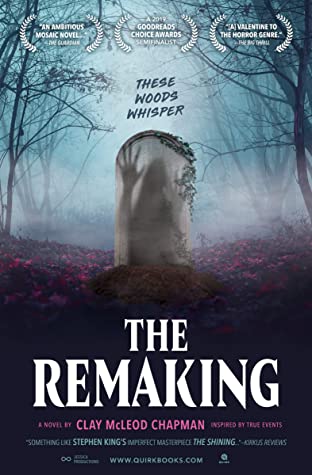
The Remaking was released in paperback this week. Check out this perfect cover:

Also, be sure to listen to this interview with the author for insights into the origin of the Little Witch Girl:

NPR: The Remaking interview

Book Review: Anxious People by Fredrik Backman

Title: Anxious People
Author: Fredrik Backman
Publisher: Atria
Publication date: September 8, 2020
Length: 352 pages
Genre: Contemporary fiction
Source: Review copy courtesy of the publisher via NetGalley
Rating:

Rating: 3 out of 5.

This is a poignant comedy about a crime that never took place, a would-be bank robber who disappears into thin air, and eight extremely anxious strangers who find they have more in common than they ever imagined.

Viewing an apartment normally doesn’t turn into a life-or-death situation, but this particular open house becomes just that when a failed bank robber bursts in and takes everyone in the apartment hostage. As the pressure mounts, the eight strangers slowly begin opening up to one another and reveal long-hidden truths.

As police surround the premises and television channels broadcast the hostage situation live, the tension mounts and even deeper secrets are slowly revealed. Before long, the robber must decide which is the more terrifying prospect: going out to face the police, or staying in the apartment with this group of impossible people.

In Anxious People, an ill-prepared and not very talented bank robber inadvertently seeks shelter in an apartment that’s open for viewing, turning a failed robbery into a hostage situation. For the people at the apartment viewing, being held hostage (by a robber none view as particularly dangerous) is the least of their worries.

The eight people present at the apartment all have stories to share, which we learn over the course of the book. How and why they all end up at this apartment on New Year’s Eve is complicated, and as they open up to one another, we see common threads of worry over relationships, living up to expectations, family drama, success, and finding meaning in life.

The narrative jumps around in time, taking us back 10 years to a suicide that occurred on a bridge visible from the apartment balcony, through the events of the day of the viewing, plus the police interviews that take place after the hostages are released.

We also get to know two police officers in this small Swedish town, Jim and Jack, father and son, whose professional interactions are more than a little influenced by their sometimes difficult personal relationship and their shared losses and fears. The deeper they delve into the witness statements, the more the bank robber’s motivations and actions become clear, but that doesn’t answer the fundamental question of what happened once the hostages were released.

Naturally, Jim did his best to act like he definitely had experience, seeing as dads like teaching their sons things, because the moment we can no longer do that is when they stop being our responsibility and we become theirs.

This was a quick, captivating read, and yet the level of whimsy in the storytelling is set very, very high. Your tolerance for this kind of quirky, whimsical storytelling will determine whether you’ll enjoy this book. For me, it was mixed. I’ve loved some of Fredrik Backman’s books in the past, yet there’s at least one (My Grandmother Asked Me To Tell You She’s Sorry) where I couldn’t get past the first few chapters because of the whimsy factor. It was just too much.

He presses his thumbs hard against his eyebrows, as if he hopes they’re two buttons, and if he keeps them pressed at the same time for ten seconds he’ll be able to restore life to its factory settings.

Here, the quirky storytelling leads to some very funny observations and comments, yet it’s all a bit much as a whole. The writing veers toward the precious at times, which tried my patience. A lot. I often enjoy quirky writing, but the sheer volume of it throughout Anxious People made it tough for me to enjoy.

Overall, I really liked the strange bunch of characters who find unexpected common ground through this one weird experience, an experience that teaches them all about how lives becomes mingled and how random occurrences can lead to profound change.

The truth? The truth about all this? The truth is that this was a story about many different things, but most of all about idiots. Because we’re doing the best we can, we really are. We’re trying to be grown-up and love each other and understand how the hell you’re supposed ot insert USB-leads. We’re looking for something to cling onto, something to fight for, something to look forward to. We’re doing all we can to teach out children how to swim. We have all of this in common, yet most of us remain strangers, we never know what we do to each other, how your life is affected by mine.

This wasn’t my favorite Backman book (I’d have to go with A Man Called Ove or Beartown), but I do look forward to continue reading his books, and have at least two from his backlist that I still need to read.

Anxious People is recommended for readers who enjoy character studies and quirkiness, with a smattering of deeper life lessons threaded throughout.

Book Review: The White Coat Diaries by Madi Sinha

Title: The White Coat Diaries
Author: Madi Sinha
Publisher: Berkley
Publication date: September 15, 2020
Print length: 304 pages
Genre: Contemporary fiction
Source: Review copy courtesy of the publisher via NetGalley
Rating:

Rating: 3.5 out of 5.

Grey’s Anatomy meets Scrubs in this brilliant debut novel about a young doctor’s struggle to survive residency, love, and life.

Having spent the last twenty-something years with her nose in a textbook, brilliant and driven Norah Kapadia has just landed the medical residency of her dreams. But after a disastrous first day, she’s ready to quit. Disgruntled patients, sleep deprivation, and her duty to be the “perfect Indian daughter” have her questioning her future as a doctor.

Enter chief resident Ethan Cantor. He’s everything Norah aspires to be: respected by the attendings, calm during emergencies, and charismatic with the patients. As he morphs from Norah’s mentor to something more, it seems her luck is finally changing.

When a fatal medical mistake is made, pulling Norah into a cover-up, she must decide how far she’s willing to go to protect the secret. What if “doing no harm” means risking her career and the future for which she’s worked so hard?

In this debut novel, written by a physician, we get a close-up-and-personal view of the life of a medical intern through the eyes and experiences of Norah Kapadia.

Norah is just starting out as an intern at the prestigious Philadelphia General Hospital, hoping to live up to her personal dream of becoming a doctor that her late father would be proud of. Internship, as we all know, is one of the roughest years in a young doctor’s professional development. Insane hours, lack of experience, lack of sleep — all contribute to the frenetic pace and intense pressure on Norah and the other interns in her cohort. Not all will make it through the year.

In addition to the professional challenges, Norah is also dealing with a demanding family who basically want her to quit, take a boring lab job, and devote herself to her hypochondriac mother’s 24/7 care. Nothing she does is good enough, despite her huge achievements thus far.

As an intern, Norah learns that her stellar book learning and years of studying to the exclusion of having a life have not truly prepared her for the real work of treating patients in a hospital. She makes some big mistakes, but so do the others, and their supervising residents vary between supportive and absolutely demeaning.

The tone of the book is very mixed. From the synopsis above, with its comparison to Scrubs, you might expect this book to be comedic in tone, and while there are some humorous episodes, it’s really not a funny book overall. In fact, it’s pretty dire at times, and the situations facing Norah and the other interns can be distressing and disturbing.

We’ve all heard about interns’ crazy hours and lack of sleep. Here, in The White Coat Diaries, we see how it feels to be an intern, and it’s not pretty. The mistakes can be devastating, and I found the lack of compassion and true caring about patients pretty upsetting. There’s one patient who gets passed from department to department and is known by the hospital staff as “Fat Dan”, and honestly, if that’s based on a real life experience, that’s just a really sad commentary on the state of medical practice today.

I wanted to like Norah, but she makes some very questionable decisions in her personal life that really affected my view of her. And then there’s the major ethical crisis stemming from a critical medical mistake (mentioned in the synopsis), which is horribly handled and left me feeling that none of the characters, including Norah, had any integrity whatsoever. From that point onward, it was very difficult to care about Norah or any of the characters in the slightest.

I also felt that Norah’s home life and family should have been explored further. We get snippets of her background and how her Indian-American upbringing affect her career choices and work ethic, but I wished it had been a little more fleshed out and developed.

Overall, The White Coat Diaries is a fast and absorbing read, but definitely isn’t as light or cheerful as the cover and description might make it seem. If The White Coat Diaries is a somewhat accurate depiction of the intern experience, then we should all be very worried about the future of the medical profession in the US.

Book Review: The Ghost Tree by Christina Henry

Title: The Ghost Tree
Author: Christina Henry
Publisher: Berkley
Publication date: September 8, 2020
Print length: 432 pages
Genre: Horror
Source: Review copy courtesy of the publisher via NetGalley
Rating:

Rating: 5 out of 5.

When people go missing in the sleepy town of Smith’s Hollow, the only clue to their fate comes when a teenager starts having terrifying visions, in a chilling horror novel from national bestselling author Christina Henry.

When the bodies of two girls are found torn apart in the town of Smiths Hollow, Lauren is surprised, but she also expects that the police won’t find the killer. After all, the year before her father’s body was found with his heart missing, and since then everyone has moved on. Even her best friend, Miranda, has become more interested in boys than in spending time at the old ghost tree, the way they used to when they were kids.

So when Lauren has a vision of a monster dragging the remains of the girls through the woods, she knows she can’t just do nothing. Not like the rest of her town. But as she draws closer to answers, she realizes that the foundation of her seemingly normal town might be rotten at the center. And that if nobody else stands for the missing, she will.

Now THAT’s how you write horror.

The Ghost Tree is chilling and disturbing, fascinating and unforgettable. I could not put this book down.

Set in a small idyllic Midwestern town, The Ghost Tree reveals the darkness that lies underneath the town’s peaceful, prosperous surface.

14-year-old Lauren is our main character. It’s the summer of 1985, and Lauren is looking forward to starting high school, even though she and her best friend Miranda have been growing apart. Lauren wants to keep playing in the woods and riding bikes, but Miranda is more interested in reading Cosmo and flirting with the older boys who drive cool cars.

Lauren is also dealing with her father’s death during the previous year, and her ongoing battles with her critical mother. Fortunately, her 4-year-old brother David is the bright spot in her life.

As the story starts, the awful, racist woman down the street discovers the dismembered bodies of two girls in her back yard. The girls are clearly outsiders, perhaps runaways passing through. But after the initial shock, these gruesome deaths don’t seem to make much of an impact on the town or its small police force, and it’s only through great effort that newcomer Officer Lopez can remember that there’s something odd that he should look into.

Told through multiple points of view, we get to see how the various townspeople have strange perceptions and faulty memories of the events that happen in Smith’s Hollow, and nothing seems to alter the pleasant lives of the town’s residents.

When Lauren’s grandmother shares a disturbing tale with her, Lauren is shocked and angry that her Nana would say such terrible things and expect her to believe them… but little by little, she comes to realize that there’s a dark truth lurking in the town’s memories, and that she and David might be the keys to preventing further bloodshed.

The Ghost Tree is so creepy and SO GOOD. The author does such a great job of letting us into Lauren’s mind, showing the uncertainties that a girl her age feels about all the changes in her life, but also showing her taking a stand and starting to own her opinions and take a stand.

The more we get to know about the town history and the secrets that everyone seems to have forgotten, the creepier and more disturbing the story becomes. And yes, there’s gore and bloodshed, but for me anyway, the scariest parts have to do with the mind control that the town seems to be under, and how inescapable its dark secrets seem to be.

I’ve read other books by Christina Henry, and already knew how talented she is. The Ghost Tree proves that she’s just as amazing at horror as she is at more fantasy-heavy stories.

I think I’m going to be thinking about this story for days. This is a story that sticks with you. Check it out!

Audiobook Review: Shades of Milk and Honey by Mary Robinette Kowal

Title: Shades of Milk and Honey (Glamourist Histories, #1)
Author: Mary Robinette Kowal
Narrator:  Mary Robinette Kowal
Publisher: Tor Books
Publication date: July 26, 2010
Print length: 306 pages
Audio length: 7 hours, 32 minutes
Genre: Fantasy
Source: Purchased
Rating:

Rating: 4.5 out of 5.

Shades of Milk and Honey is an intimate portrait of Jane Ellsworth, a woman ahead of her time in a world where the manipulation of glamour is considered an essential skill for a lady of quality. But despite the prevalence of magic in everyday life, other aspects of Dorchester’s society are not that different: Jane and her sister Melody’s lives still revolve around vying for the attentions of eligible men. 

Jane resists this fate, and rightly so: while her skill with glamour is remarkable, it is her sister who is fair of face, and therefore wins the lion’s share of the attention. At the ripe old age of twenty-eight, Jane has resigned herself to being invisible forever. But when her family’s honor is threatened, she finds that she must push her skills to the limit in order to set things right–and, in the process, accidentally wanders into a love story of her own.

This debut novel from an award-winning talent scratches a literary itch you never knew you had. Like wandering onto a secret picnic attended by Pride and Prejudice and Jonathan Strange & Mr NorrellShades of Milk and Honey is precisely the sort of tale we would expect from Jane Austen…if only she had been a fantasy writer.  

What a delight! Just like the synopsis promises, Shades of Milk and Honey is Austen-inspired fiction, set in a world just like Austen’s — except magic is real, and is a highly coveted art form.

Men in search of a worthy wife look for someone who can create a warm and lovely home, and someone skilled in the art of glamour can turn a bare room into something beautiful, or can create music and light that enhance any gathering.

At age 28, Jane expects to remain an old maid. Her best chance for a fulfilled life is likely dependent on her younger sister marrying well, then bringing Jane into her household as companion.

Melody, ten years younger, is beautiful and flighty, without any real patience for the careful study and effort needed to reach heights of glamour similar to Jane’s talents. Melody comes across as a mix of Lydia Bennet and Marianne Dashwood, delighting in emotion, eager to flirt and captivate, and not above resorting to a little conniving to make sure every eligible man’s attention is fixed on her.

When the famous glamourist Mr. Vincent is commissioned by a wealthy neighbor to create a glamural for her home, Jane finds herself in the gruff artist’s company more than feels comfortable. At the same time, she pines for the upright Mr. Dunkirk, whose younger sister she befriends, but she fears that his attention is far more focused on Melody than on her.

The story is charming and enchanting, mixing Austen-esque society and manners with clever magical artistry and talent. Jane is a wonderful main character, gifted yet lacking the passion to lift her illusions from technical skill to true art. While she’s brutal in her self-reflection, considering herself plain at best, she’s warm-hearted and generous with the people she cares about, and ends up caught in the snares of polite society etiquette and keeping confidences.

I listened to the audiobook of Shades of Milk and Honey, which is a very entertaining way to enjoy this story. The pacing and style work really well in audio format, and the clever dialogue and social niceties come across as both polite and very funny.

Author Mary Robinette Kowal is a talented audiobook narrator, and it’s fun to listen to her narrate her own story. (She narrates Seanan McGuire’s October Daye audiobooks, which are amazing.). My only complaint about the narration is that the accent used comes across as fake from time to time, but on the whole, I was swept up enough in the story not to mind it too much.

I’m happy that this book is the first in a series. While it seems like a full and complete story, I’m looking forward to exploring more of this world in the four books that follow.

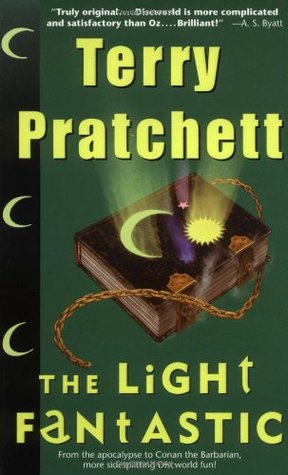
Discworld, #2, The Light Fantastic

The Light Fantastic
Published 1986
293 pages

My Discworld Challenge:

Over the summer, I committed to reading the Discworld series! I’m starting a new Discworld book on the 1st of each month, going in order of publication date.

Synopsis for The Light Fantastic:

In The Light Fantastic only one individual can save the world from a disastrous collision. Unfortunately, the hero happens to be the singularly inept wizard Rincewind, who was last seen falling off the edge of the world…

My rating:

Rating: 2 out of 5.

My reaction:

The Light Fantastic proves that you can dislike a book’s plot and still enjoy the writing.

I’m not sure I can even describe what happens in this book. The failed wizard Rincewind has further difficulties because of the powerful spell hidden in his brain, there’s a comet that threatens to collide with Discworld and destroy it, there are helpful trolls, an elderly warrior named Cohen the Barbarian, dastardly conspiracies, and of course, the tourist Twoflowers and his amazing Luggage.

It was all just kind of one random scene after another, sometimes ridiculous, sometimes funny, but none of it felt like a compelling narrative that made any sense at all. My eyes were glazed over for at least half of this book! And it drives me crazy that there are no chapters, just one long story.

At the same time, I do appreciate Terry Pratchett’s cleverness and awesome use of words, so even though this Discworld book’s plot left me unengaged and even bored at times, I loved so many passages. I’ll wrap up by sharing a few random samples:

He felt that the darkness was full of unimaginable horrors—and the trouble with unimaginable horrors was that they were only too easy to imagine . . .

They had dined on horse meat, horse cheese, horse black pudding, horse d’oeuvres and a thin beer that Rincewind didn’t want to speculate about.

Horse d’oevres! I had an uncle who would have loved that joke (and/or said it himself.)

It wasn’t that he was particularly wise. Every wizard considered himself a fairly hot property, wisewise; it went with the job.

Another voice, dry as tinder, hissed, “You would do well to remember where you are.” It should be impossible to hiss a sentence with no sibilants in it, but the voice made a very good attempt.

It was not a grin to inspire confidence. More horrible grins had probably been seen, but only on the sort of grinner that is orange with black stripes, has a long tail and hangs around in jungles looking for victims to grin at.

“… Rincewind, all the shops have been smashed open, there was a whole bunch of people across the street helping themselves to musical instruments, can you believe that?”

“Yeah,” said Rincewind, picking up a knife and testing its blade thoughtfully. “Luters, I expect.” 

I’m not giving up on Discworld! I’d heard from the start that the first few books aren’t great, so I’m hanging in there. Next month’s book looks good, and I’m dying (ha! see what I did there?) to get to #4, Mort.

Up next:

October 2020: Equal Rites