Book Review: Lady of Ashes by Christine Trent

Book Review: Lady of Ashes By Christine Trent

Lady of Ashes

Violet Morgan is a respectable wife in Victorian London, who also happens to be London’s only female undertaker. Married to a puzzling man who inherited his family’s business, Violet is the one who truly has a passion for making sure the deceased are treated with honor, that their families are supported and guided, and that each funeral is arranged and managed in accordance with the deceased’s station in society. Mustn’t skimp on funeral plumes, glass carriages, or professional mourners!

As the Civil War erupts across the pond, the ripples extend to the United Kingdom as political interests and financial scheming impact all levels of London society, from Windsor Palace all the way to Morgan Undertaking. Violet’s husband and brother-in-law become entangled in seemingly nefarious dealings, and as her husband starts to come unhinged, Violet must find a way to maintain her dignity and her business reputation despite the disintegration of her marriage.

Lady of Ashes is crammed full of plot, so much so that it feels a bit overstuffed. In and of itself, Violet’s establishment in the male-dominated undertaking profession would have been quite interesting. However, the books constantly shifts focus, bringing in US and British politics, the foibles of the monarchy, an orphaned waif, a romantic plot line, and a murder mystery. Ultimately, it’s really just too much.

Which is a shame, as there is much to enjoy in Lady of Ashes. Violet is an interesting character, strong and assertive and committed to her profession at a time when society — and the Queen — made clear that a woman’s place is in the home. Seeing Violet navigate her way against the current, stand up for herself, and carry out her undertaking duties with compassion and grace is quite compelling, and if that had remained the chief focus of the book, I think it would have worked much better.

Instead, a great deal of space is devoted to the politic maneuvering of the US ambassadors to the court of Queen Victoria, the high seas dramas involving blockade runners and naval ships, and the marriage of Victoria and Albert. Even Violet’s story is not smooth, as we jump from her marital woes to a train wreck to her adoption of an orphan without much in the way of transition, and each new development in the narrative feels like an abrupt change in the point of the storyline.

Still, I did come away from Lady of Ashes with some interesting new tidbits of historical data. For example, who knew that embalming became more widely practiced in the US during the Civil War, when the bodies of battlefield casualties had to be preserved for their long train journeys home for burial? I also learned a great deal about royal funeral rites, societal rules regarding mourning fashion, and plumbing and foundation problems in Victorian London. The author has clearly done a ton of research for this book, and provides a comprehensive bibliography of historical sources for further reading.

Do I recommend Lady of Ashes? Yes, but with reservations. Violet is a terrific character, and the portrayal of funerary rites in Victorian England is morbidly intriguing. Much of Lady of Ashes is quite fascinating, but overall, I believe it would have been a better book with a tighter focus. As it is, there’s just too much crammed into the plot for it to feel cohesive, and sadly, the end result is that the story feels scattered.


Book Review: Down The Mysterly River by Bill Willingham

Book Review: Down The Mysterly River by Bill Willingham; illustrated by Mark Buckingham

Down the Mysterly River is the first children’s book written by storyteller extraordinaire Bill Willingham, the man we can thank for the beyond-words-awesomeness of the Fables comic book series. Joined by illustrator Mark Buckingham, Bill Willingham has created an adventure story that’s also meta-fiction about the world of story creators, their creations, and the naysayers who try to make creative works conform to “modern” ideas of what’s in and what’s out, what’s fashionable in fiction, and what’s too old-school to be tolerated.

The story begins with Max the Wolf:

Max the Wolf was a wolf in exactly the same way that foothills are made up of real feet and a tiger shark is part tiger, which is to say, not at all.

Max is a twelve-year-old Boy Scout of the Wolf Patrol pack, who is always prepared… but is still discombobulated when he wakes up in a strange land with no idea how he got there. Besides his Boy Scout skills, Max is a gifted detective, and so he sets about solving the mystery of where he is, and more importantly, why he’s there in the first place. Max soon encounters three strange traveling companions: Banderbrock the warrior badger, Walden the brown bear, and McTavish the Monster, who is not an actual monster but rather a fiercely feral barn cat. Strangest of all is the fact that these animals can talk to Max. None of them can explain it, and none of them has any memory of how they landed in this particular place.

There’s no time to ponder, because the chase is on! A mysterious group of cloaked fighters, known as the Blue Cutters, is on their tail, and this menacing bunch means business. Their goal is to catch any and all new arrivals and to “cut” them with their powerful blue swords, so as to give them a more pleasing and appropriate shape. Once cut, the new version is unrecognizable to all, and in fact, believes him or herself to always have been as he or she is now. Naturally, Max and his gang want to avoid the Blue Cutters at all costs, and so set out to seek shelter far down the Mysterly River, where they’ve heard a sanctuary for their kind can be found.

Because I’m a Fables fan, I had to grab this book and give it a try. I originally thought it would be a fun read-aloud to share with my 10-year-old, but after reading it in fits and starts, he lost interest and *cough* gave me permission to finish it on my own. As a result, my reaction to this book has two parts:

First, as a book for children, I’m  not sure that I’d consider it a total success. The adventure scenes are exciting and sometimes even frightening, and the writing is funny and engaging. My son liked a lot of it — but the overarching “meta” context eventually became too much for my son, who gave me a blank stare and a big “huh” whenever we came across clues about this aspect of the book. I think he might have ended up liking it quite a bit if he’d stuck with it, but in point of fact, he just got tired of it after a while. I think Down the Mysterly River might be a better choice for slightly older kids. While it’s listed as recommended for ages 10 and up, I think older and more experienced readers might get the bigger story more easily and appreciate it at the higher level, not just as an adventure tale.

My second reaction, though, is that for me, I had a great time reading this book. The cleverness of the dialogue, the funny twists of phrasing, the unique characters — all combine to make a story that’s fun to read, and smart enough to engage adult readers who enjoy fantasy settings, wide brushstrokes of the improbable, and a sly commentary on writers, editors, critics, and the book world at large.

Q&A with the kiddo: A kid’s-eye view of Stranded by Jeff Probst

Book Review: Stranded by Jeff Probst and Chris Tebbetts

From Amazon:

A family vacation becomes a game of survival!
It was supposed to be a vacation–and a chance to get to know each other better. But when a massive storm sets in without warning, four kids are shipwrecked alone on a rocky jungle island in the middle of the South Pacific. No adults. No instructions. Nobody to rely on but themselves. Can they make it home alive?

A week ago, the biggest challenge Vanessa, Buzz, Carter, and Jane had was learning to live as a new blended family. Now the four siblings must find a way to work together if they’re going to make it off the island. But first they’ve got to learn to survive one another.

Proudly presenting Q&A with the kiddo, courtesy of my 10-year-old son, in which I ask my kiddo to describe a book he’s enjoyed recently and he gives his opinions, more or less unfiltered by mom.

Without further ado:

Q: What book do you want to talk about?

A: Stranded

Q: What was it about?

A: It’s about these kids who get stranded on an island. They were on a boat and there was a boat wreck. The adults were gone, so there were just four kids on an island surviving for themselves.

Q: Who was your favorite character?

A: Carter and Jane. They’re the most adventurous and outdoorsy and fun and not scared.

Q: What was the best part?

A: My favorite part is when they get sucked in [by strong currents in] the water. They’re in the water and they finally pop out and Carter catches Jane and they swim back to shore.

Q: Would you recommend this book?

A: Yes. I’d recommend it for adventurous kids and kids who like stories with cliffhangers.

Q: Do you want to read the rest of the series?

A: Yes! I want to read the next book when it comes out.

Q: Do you have anything else to say about this book?

A: It’s funny, it’s fun to read. You should read it or it’s your loss.

Mom’s two cents:

My kiddo and I are big fans of Survivor on TV, and so when I heard that Survivor host Jeff Probst was writing a book series for kids, I knew we had to get it! My son read Stranded on his own, and thought the reading level was perfect. He like the book so much that he pretty much insisted that I read it as soon as he finished. Stranded is really a lot of fun, with a good solid lesson in there as well (although without any preachiness or heavy-handedness). The four children in the book are step-siblings who are being treated to a sailing adventure while their parents are on their honeymoon. While my son mostly focused on the adventure aspects of the story, I liked the portrayal of two sets of brothers and sisters forced to figure out how to redefine their family and accept one another’s quirks, talents, and weaknesses. When the two adults on board are separated from the kids during a sudden storm at sea, they have to rely on themselves, their bonds, and their skills and knowledge to figure out how to survive — and hopefully, how to get themselves rescued.

The blended family aspect provides a nice layer of complication to the high-adrenaline disaster and adventure story. Stranded is the first in a trilogy, and ends — as my son mentions — with a big cliffhanger. We’ll both be back for the next installment!

Stranded is a good choice for middle grade readers, especially those just gaining comfort with reading chapter books on their own. It’s not very long, but it’s certainly engaging and exciting. Any time my kiddo asks for “5 more minutes!!” while he’s reading, I know we have a hit on our hands.

My only complaint? Nowhere in the book does anyone say, “The tribe has spoken.” Maybe in the next book? One can only hope.

Stranded 2: Trial By Fire will be released in June.


Book Review: The Uninvited Guests by Sadie Jones

Book Review: The Uninvited Guests by Sadie Jones

To say that The Uninvited Guests was not what I expected is an understatement. Based on the cover (gorgeous, right?) and the four pages of blurbs at the front of the books, six of which compare the book to Downton Abbey, I thought I’d be reading a comedy of manners or a genteel but gently critical view of the Upstairs, Downstairs dynamics of early 20th century classism. Instead, what I experienced was a bizarre tale of a wealthy family on the brink of financial disaster that — BOOM — suddenly became a ghost story full of decay, mad hauntings and vengeful spirits, and a house that literally falls to pieces overnight.

At the heart of The Uninvited Guests is the Torrington family, about to celebrate daughter Emerald’s 20th birthday. (Think of Emerald as the Mary Crawley of the piece, if you will). Mother Charlotte is remarried to the reliable, loving Edward Swift, who in turn is resented by Emerald and her brother Clovis. Alas, the manor house bought decades earlier by their late father Horace is on the verge of financial collapse, and so Edward travels away from home for a night in a last-ditch effort to save the family estate by securing a loan from an unpleasant business acquaintance.

Invited guests — a wealthy neighbor and some dear friends — come to Sterne for the birthday celebration, but unfortunately, so do quite a few uninvited guests, victims of a train derailment somewhere nearby, now stranded and in need of shelter until the railroad can make other arrangements. As the family attempts to carry on with the birthday feast, they neglect their unwanted guests until guilt and unanticipated chaos further disrupt the evening. As events spiral out of control, baser, crueler natures emerge. As the night turns wilder and wilder, the house itself is slowly destroyed from the inside, as filth, rot, rain, and mud overtake it inch by inch, and the family must come together to defeat the elements, both natural and supernatural.

I suppose you could read The Uninvited Guests as an allegory for the rot at the heart of the class system, or an indictment of the type of stiff-upper-lip social demands that keep children at arm’s length from parents and demand propriety at the expense of feeling. I see all that in this book, and yet it just doesn’t work for me. The characters are not sympathetic or even particularly well-defined, the events veer all over the place, and the supernatural elements come and go in ways that feel forced and out place. The weirdly cheerful and sunshine-filled ending was quite dissonant with the rest of the story, and I didn’t feel like this awkward, cold family earned the easy resolution that came their way.

The Uninvited Guests is full of interesting language choices and passages of quite lovely writing. Still, I found the whole to be disjointed and rather unsatisfying.

Ending thoughts: I will acknowledge that perhaps it’s me, not the book. The endless blurbs for this book are completely glowing, and my city’s public library system has chosen The Uninvited Guests as its city-wide read this month. Perhaps I missed something that everyone else saw in it. In any case, all I can offer is my own opinion: While I was never bored, and was even intrigued by certain developments, on the whole, this book just did not work for me.

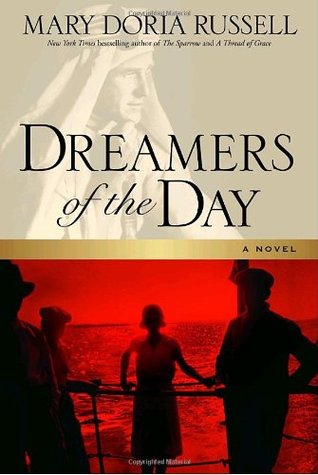
Book Review: Dreamers of the Day by Mary Doria Russell

Book Review: Dreamers of the Day by Mary Doria Russell

Dreamers of the Day

All men dream: but not equally. Those who dream by night in the dusty recesses of their minds wake in the day to find that it was vanity: but the dreamers of the day are dangerous men, for they may act their dreams with open eyes, to make it possible. This I did. – T. E. Lawrence, Seven Pillars of Wisdom

In Mary Doria Russell’s superb Dreamers of the Day, we meet T. E. Lawrence (that would be Lawrence of Arabia — yes, think Peter O’Toole in swirling white robes) and Winston Churchill in Cairo of 1921, as they and other movers and shakers carve up the post-Ottoman Empire Middle East into the geography we know today. But these luminaries are not the protagonists of Dreamers of the Day. Instead, this quiet and lovely novel centers on plain-Jane Agnes Shanklin, a 40-ish spinster from Cleveland who sets out on her life’s one grand adventure and meets the the men who changed — and made — history.

Agnes is quite alone in the world following the loss of her entire family — including her beloved sister Lily —  to a deadly influenza epidemic. Finding herself an heiress and finally free from her mother’s criticisms and repressive expectations, Agnes decides to set sail for the lands in which her sister Lily had worked as a missionary. Accompanied only by her beloved dachshund Rosie, and bedecked in brand-new finery courtesy of a hip young shopgirl, Agnes embarks on a first-class vacation to Cairo.

After reading this book, I have an uncontrollable urge to watch this movie. Now.

After reading this book, I have an uncontrollable urge to watch this movie. Now.

By happenstance, she is booked at the luxury hotel where Lawrence, Churchill, and the rest of the 1921 Cairo Conference are meeting, and is soon drawn into their circle of dinner guests and acquaintances, her path eased by Lawrence’s high regard for the deceased Lily. At the same time, Agnes is wooed by the enigmatic but attractive Karl, an attentive German man who showers Agnes with attention — but is he really interested in Agnes’s charms, or is there something else he’s after?

In a way, Dreamers of the Day is two intriguing stories in one. First, it’s a history lesson wrapped up in fiction. I learned so much from this book about how the modern Middle East came into being and how so many problems can be traced back to decisions made by men with very particular agendas. Second, it’s the story of a woman who goes from wallflower to a woman of strength and purpose. Agnes is a marvelous lead character. She has a refreshingly honest view of the world around her and her place in it, and as she gains the courage to take charge of her own life and start ignoring the forces keeping her down, it’s lovely to see her blossom.

I should know by now to trust Mary Doria Russell, author of the incomparable The Sparrow and the devastating A Thread of Grace. When her most recent novel, Doc, was released, I thought I’d pass it by. After all, what interest do I have in Westerns? I finally read it, a year after its publication, and was blown away by the beauty of the writing, the honor and nobility of the main character, and the clarity and vividness of this window into a world that I really knew next to nothing about. Likewise for Dreamers of the Day: I initially held off on reading this, not feeling all that compelled by a book that I’d heard was about a dusty old meeting in Cairo. And here I am, having read the book, feeling inspired, uplifted, and educated by it. Dreamers of the Day has a subtle, peaceful aura; the storyline is not filled with pulse-pounding chase scenes or explosions; lives are not immediately at risk. And yet, Agnes’s growing confidence as she interacts with that era’s political rock stars is fascinating reading, and I never once grew bored or impatient.

I’m so pleased to have finally read Dreamers of the Day. First of all, I can now say that I’m a Mary Doria Russell “completist”, having read all of her published works (and eagerly awaiting the next)! But most of all, I’m happy to have experienced Dreamers of the Day in its own right. This fascinating look at history and the people who shape it is well worth reading, and I absolutely recommend it.

Finally, I can’t help but include a couple of choice quotes from Dreamers of the Day:

Maybe that’s the way to tell the dangerous men from the good ones. A dreamer of the day is dangerous when he believes that others are less: less than their own best selves and certainly less than he is. They exist to follow and flatter him, and to serve his purposes.

A true prophet, I suppose, is like a good parent. A true prophet see others, not himself. He helps them define their own half-formed dreams, and puts himself at their service. He is not diminished as they become more. He offers courage in one hand and generosity in the other.

And some words of wisdom that I just adore:

When it comes down to it, I don’t have much in the way of advice to offer you, but here it is:

Read to children.

Vote.

And never buy anything from a man who’s selling fear.

Save

Book Review: That Time I Joined The Circus by J. J. Howard

Book Review: That Time I Joined The Circus by J. J. Howard

That Time I Joined the Circus

I’m a New Yorker; smugness is my birthright.

Lexi is most assuredly an avid New Yorker, so when calamity strikes and she’s forced to set out in search of her long-gone mother, a random hick town in Florida is probably the last place she wants to end up. And yet there she is, with no money and nowhere to turn, seeking out her mother’s last known employer — who happens to be the owner of a traveling circus. Lexi’s mom has come and gone already, and left no forwarding address, but the circus folk are willing to take Lexi in if she can work and if she’ll commit to staying through the end of the season.

From New York prep school student to shoveler of elephant manure and midway salesgirl — to say that Lexi’s life has been turned upside down is an understatement.  Back in her upscale school, Lexi never quite fit in among all the pampered Barbie-like rich girls. With her best friends Eli and Bailey, she had a small but dependable trio, until Eli and Bailey became romantically involved and Lexi was left out in the cold. Bad decisions and bad luck lead to Lexi’s flight from New York, and as she settles into her new life in the circus, Lexi is forced to confront her own role in her recent disasters. With new friends and some newly discovered talents, Lexi starts to finally understand some key things about herself, about friendship, and about the different shapes and sizes of family.

Author J. J. Howard has a good ear for teen dialogue and sentiment, and makes nice use of pop-culture and social media references as well:

Okay, so I stopped posting status updates on Facebook a long time ago. I noticed that whenever someone posts something completely mundane and stupid, like Sushi 2nite! seventeen people have to comment on that. I Y Sushi! and Spicy Tuna 4 meee! But if you ever try to actually say something serious about your feelings or, like, your life, every one of your 386 “friends” is suddenly mute. So there you have it: My life is a post with no comments. Less interesting than spicy tuna.

Lexi herself is an dynamic, engaging character, not perfect by a long shot, but well-intentioned, self-aware, and trying to finally do right and do good. Many of the supporting characters, including the circus crowd and Lexi’s parents, are well-drawn as well, with quirks, charm, and depth.

The circus scenes are a lot of fun, with behind-the-scenes glimpses of the daily life of a show and its various social strata, finicky personalities, and immense amounts of work to be done each day.

While overall an entertaining read, I do have a couple of quibbles:

– The love interests and love triangle in this story feel a little two-dimensional. Neither of the boys in Lexi’s life are given enough individual personality. In particular, I felt that the older boy who Lexi meets in Florida was never much more than a cardboard character, and didn’t truly buy Lexi’s interest in him.

– The solution to Lexi’s problems — join the circus! — seemed too rushed and easy. Maybe she didn’t have a whole lot of other options, but being given shelter by the circus and then forming such deep connections to the circus family just didn’t strike me as entirely realistic. I understood why this would feel like a solution to Lexi, but didn’t necessarily understand why the circus owner and his family would take Lexi into their lives so enthusiastically and so quickly. Not that Lexi’s not a great person! But I didn’t feel that the other characters would have had enough to go on to reach that assessment in quite so short a time.

That Time I Joined The Circus is not a very long book, and in some ways that’s a problem. The premise and the storyline are really quite good, but I would have liked to see more of everything — more circus scenes, more time spent on Lexi’s developing friendships within the circus world so that these friendships would feel a bit more true, and more character development for some of the people who come into Lexi’s life over the course of the book.

Lexi herself is a nicely described and fleshed-out character, and I think the author is at her strongest in giving Lexi a clear, authentic voice. Good use of song quotes both fit the narrative and help illustrate Lexi’s mindset at any given point in the story. The plot unfolds through alternating chapters set in Lexi’s “before” life in New York and her current life with the circus, and this narrative choice keeps the momentum moving nicely as we readers must piece together what we know in order to understand why Lexi has ended up with no choices and no one to turn to for help.

That Time I Joined The Circus should appeal to teen readers who enjoy romance, family drama, unlikely friendships, and a hip, urban tone. It’s fun, it’s got great characters and snappy dialogue, and the circus setting is certainly different and unusual. Definitely not your typical high school drama!

Review copy courtesy of Scholastic via Netgalley.

Book Review: Eleanor & Park by Rainbow Rowell

Book Review: Eleanor & Park by Rainbow Rowell

There are some books that are bad choices for staying up past midnight to finish… simply because they are so powerful that they haunt your dreams when you finally go to sleep. Eleanor & Park is one of these. It will take me quite a while to get this lovely, sad story and its unforgettable characters out of my head.

Main characters Eleanor and Park are sixteen, growing up in the Flats, an undesirable Omaha neighborhood where keeping your head down might be your best strategy for getting through high school. It’s worked so far for Park, the only Asian kid around, son of an American army vet who married the girl he fell in love with during his service in Korea. Park listens to punk music, reads comic books, is a mostly obedient son, and tries hard not to attract attention from the loud and obnoxious crowd at the back of the bus.

Everything changes on the day that new girl Eleanor shows up on the school bus. Park — and everyone else — can’t help but notice her:

The new girl took a deep breath and stepped farther down the aisle. Nobody would look at her. Park tried not to, but it was kind of a train wreck/eclipse situation.

The girl just looked like exactly the sort of person this would happen to.

Not just new — but big and awkward. With crazy hair, bright red on top of curly. And she was dressed like… like she wanted people to look at her. Or maybe like she didn’t get what a mess she was. She had on a plaid shirt, a man’s shirt, with half a dozen weird necklaces hanging around her neck and scarves wrapped around her wrists. She reminded Park of a scarecrow or one of the trouble dolls his mom kept on her dresser. Like something that wouldn’t survive in the wild.

Eleanor takes the only vacant seat available to her, next to Park, who desperately wants to be left alone. If Eleanor pays any mind to Park at all, it’s only as the “stupid Asian kid” that she has to endure twice a day. But gradually, their silent daily bus rides turn into a kind of silent communion. Park notices Eleanor reading his comic books from her seat next to him, and soon starts bringing in a supply for her every day. Before much time passes, the daily rides turn into intense conversations about comics, then music, then life in general. The bond between Eleanor and Park is sudden and all-encompassing, and soon they both realize that their connection is soul-deep and earth-shattering. But is it enough?

Eleanor lives in a tiny, falling-down house with her four younger siblings, her fragile, abused mother, and her mother’s new husband, who is, quite frankly, scary and deeply creepy. The bathroom has no door, so Eleanor has to rush home each day if she has any hope of taking a bath before the awful stepfather gets home. She has only the clothes her mother can scrounge from Goodwill, and washes her hair with whatever soap she can find in the house on any given day. There simply is no one on Eleanor’s side. Her mother is too broken down to even protect herself, let alone Eleanor. On top of her horrible home life, Eleanor — as a new girl who doesn’t fit the mold — is teased and tormented at school. My heart broke again and again for this strong, difficult girl, who is too fearful of the consequences to go to her guidance counselor for salvation from her family life — but thinks that maybe she could at least ask her for a toothbrush.

Eleanor is a prickly character, who pushes Park away every time he gets too close. She lives in fear and shame, and can’t fully accept that someone as wonderful as Park would want to know her. Park is Eleanor’s ray of sunshine, someone who cares, who wants to protect her and to love her, but even Park can’t save her from the nightmarish home she’s forced to return to each day. Park, for his part, and much to his surprise, falls deeply and passionately in love with Eleanor.

The descriptions of Eleanor and Park’s experiences with first love and passion are just beautiful. For example, their first time holding hands on the bus is electric:

Holding Eleanor’s hand was like holding a butterfly. Or a heartbeat. Like holding something complete, and completely alive.

If someone had been watching, what would they have seen? Park couldn’t imagine what his face had looked like when he touched Eleanor. Like somebody taking the first drink in a Diet Pepsi commercial. Over-the-top bliss.

And from Eleanor’s perspective:

All through first and second and third hours, Eleanor rubbed her palm.

Nothing happened.

How could it be possible that there were that many nerve endings all in one place?

And were they always there, or did they just flip on whenever they felt like it? Because, if they were always there, how did she manage to turn doorknobs without fainting?

The trajectory of Eleanor and Park’s relationship is fast and sharp. Soon, their entire worlds revolve around each other. But an inevitable sense of disaster lurks above and around them constantly. Eleanor’s volatile home life is always on the verge of exploding — and when it finally does, the repercussions are devastating and heartbreaking.

I found myself holding my breath through the final chapters of Eleanor & Park, on edge, scared, and trying to hold back the tears. No spoilers here — not what happens, nor what happens after that. Suffice it to say that it was clear from the start that the odds of a happy ending were slim to none. And yet, there is a beauty and a truth in this love story that make it so worth reading. At the risk of sounding sappy, I’d describe Eleanor and Park as having a purity to their relationship, not in the usual context of sex, but in terms of the absolutely pure emotions they feel toward one another — love, caring, and a selflessness toward one another that is completely believable even while recognizing how rare such a thing is in any relationship, much less a teen relationship.

On a final note, I just loved Rainbow Rowell’s writing. It’s emotional and expressive, but not at all overdone or trite. The conversations between Eleanor and Park are funny, smart, and snappy, and I never felt that I was reading adult dialogue via a teen mouth, as I’ve occasionally experienced in other young adult novels. Throughout the book, we get alternating point-of-view sections, so that we’re often able to see the same event through both Eleanor and Park’s eyes — for example, these two views of their first intense kiss:

Eleanor looked at Park’s face so full of something she couldn’t quite place. His chin hung forward, like his mouth didn’t want to pull away from her, and his eyes were so green, they could turn carbon dioxide into oxygen.

He was touching her all the places she was afraid to be touched…

Eleanor tried one last time to be embarrassed.

He relaxed against the door.

He felt Eleanor’s hand on this throat, on his chest, then took her other hand and pressed it to his face. He made a noise like he was hurt and decided to feel self-conscious about it later.

If he was shy now, he wouldn’t get anything that he wanted.

Two loners, ready but scared, each making conscious decisions to let the other person in and, for once, to stop worrying about how they might look or what others might think. Eleanor and Park are two stand-out characters in the world of YA fiction. I loved everything about Eleanor & Park, and have no hesitation in recommending it to anyone who enjoys good fiction, period.

Spike — A Dark Place: Comfort Food for the Buffy-phile

Mini-review: Buffy the Vampire Slayer: Spike — A Dark Place by Victor Gischler, Paul Lee, Jo Chen et. al.
(Release date: June 18, 2013)

The world has been a darker, lonelier, and far less quippy place since the TV series Buffy the Vampire Slayer went off the air almost ten years ago, in May of 2003. (Bow your heads for a moment of silence, please. Thank you). But the devoted fans of the Buffy-verse had not heard the last of the Slayer and the Scoobies. In 2007, Dark Horse Comics began publication of Buffy the Vampire Slayer: Season 8 — in comic book format! Legions of fans cheered! Currently up to season 9 and going strong, the comics are written under the imprimatur of Buffy creator and geek god Joss Whedon, and are considered “canon”, for those who care about such distinctions. The comic follows Buffy and the gang forward from the end of the TV series, and it’s a wonder to behold.

Coming in June 2013, Spike – A Dark Place is somewhat of a sidebar to the main storyline of season 9, picking up right after the events of On Your Own (season 9, volume 2), and focusing on everyone’s favorite bad-boy-vampire-with-a-soul (and amazing cheekbones), our dearly beloved Spike. Spike’s going through some stuff and has fallen into a deep depression, and even his trusty team of adoring spaceship-flying bugs (it’s a long story) can’t quite get him to snap out of it. Of course, bad guys pop in, as bad guys do, and Spike is caught up in the action once again.

I realize that none of the above (bugs! who fly spaceships!) will make sense to anyone who hasn’t kept up with seasons 8 and 9. Which raises the question: What are you waiting for? If you watched the TV show, then good gods — get thee to a comic book store at once! Of course, if you never watched Buffy at all… well, first of all, I’m not sure that we have anything left to say to one another (kidding!), and second of all — drop whatever else you’re doing and get yourself some Buffy DVDs! And don’t stop until you’ve watched all seven seasons of Buffy, five seasons of Angel, and you’re ready to read some amazing comics!

Okay, so this supposedly-a-book-review has devolved into a fan rant. Sorry ’bout that.

But check out the comics. The new Spike book features terrific artwork, especially Jo Chen’s magnificent covers, which represent Spike actor James Marsters in all his Buffy-era glory. The storyline is funny, action-packed, and quite faithful to the Spike character that we know and love. Once I picked up Spike – A Dark Place, I couldn’t put it down, and I’m eager for more, more, more — more Spike, more Buffy, more of the entire wonderful Buffy-verse! Please, Dark Horse, don’t ever stop! I’d happily continue reading the Buffy comics and spin-offs for years — decades — to come.

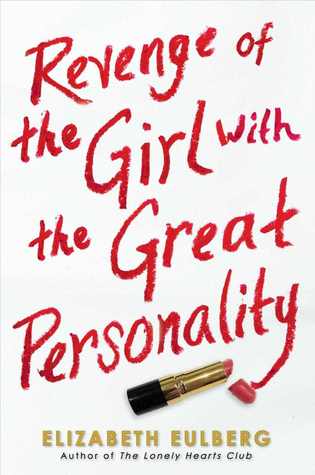
Book Review: Revenge Of The Girl With The Great Personality by Elizabeth Eulberg

Book Review: Revenge Of The Girl With The Great Personality by Elizabeth Eulberg

16-year-old Lexi has had it up to here. She spends every weekend acting as lackey to her younger sister Mackenzie at beauty pageant after beauty pageant. She works a part-time job to pay for basics while her mother spends thousands of dollars they don’t have on endless gowns and “necessities” for Mac. Her sister is turning into the world’s biggest spoiled brat. And to top it all off, she’s sixteen and has never had a date. She may be considered a Girl With A Great Personality, but is it too much to hope that a cute boy will take notice one of these days?

In this charming, engaging young adult novel, main character Lexi isn’t exactly unpopular — everyone likes her well enough —  but she’s not one of the Beautiful People at school by a long shot:

“In other words, I’m the girl that all the guys go to because, well, I’m the cool chick who they can talk to about the girl they really like.”

Lexi had it drummed into her head long ago that her sister got the looks in the family, so she has basically just stopped trying. She’s great at making people laugh, but her daily look at school is jeans, baggy T-shirt, ponytail, and no make-up. Ironically, Lexi’s dream in life is to study fashion in New York and pursue a career as a designer. She’s got a gift for clothes and wardrobe, but uses it to help everyone but herself.

Finally, on a dare from her best friend, Lexi decides to give glamor a whirl. She gets hair and make-up tips from an expert on the pageant circuit, puts on a dress, and voila! Suddenly, she’s turning heads, getting noticed, and getting boys. While Lexi basks in the glow of her new-found social success, she’s uncomfortable as well. The question remains: Should she have to be a different person in order to get people (boys) to like her? And if a boy who never gave her the time of day is now falling all over her, should she be flattered — or insulted?

Revenge is not just a book about a makeover. Lexi has it pretty tough in her home life. Her parents split up soon after Mac was born, and her mother’s emotional neediness has led her to unhealthy overeating, morbid obesity, horrible money management, and an obsession with pageants. Lexi’s dad is a benign absence; he means well, but just isn’t around. Lexi watches in growing dismay as her mother ignores past-due bills in order to buy new tooth covers (called “flippers” in pageant lingo) so that 7-year-old Mackenzie can have a smile just as perfect as all the other wanna-be beauty princesses.

It would have been easy, I think, for an author to take a preachy approach to this subject matter — beauty is only skin deep, beauty is in the eye of the beholder, blah blah blah. That’s all well and good, but that doesn’t help a teen girl who feels invisible every single day of her life. In Revenge, author Elizabeth Eulberg gives the reader (and Lexi) food for thought, but there are no pat, easy answers. Lexi really does feel better when she likes the way she looks. She really does have more confidence when she goes into school and people notice that she’s pretty. She seems to get a new burst of energy once she starts dressing herself with the same care that she puts into advising others on their fashion choices. And yet, she’s very much aware that the boy of her dreams never once saw her as a love interest until she changed her beauty routine, and that the party invitations only started coming her way once she changed who she was on the outside.

So should she have to change to be liked? Where’s the limit between making yourself feel good and remaking yourself to please others? If people only let you into their inner circles if they approve of your looks, is that circle really worth entering?

Lexi is a terrifically likeable main character. She’s smart, she’s funny, she’s a good friend, and she tries her best to make her mother see reason. Her home life is a disaster, and I couldn’t help but feel horribly sad for her. Lexi has to shoulder a burden that’s simply unfair for a girl her age, and she struggles through admirably, trying to find a balance between duty and protecting her own wants and needs. When a final disaster pushes her over the edge, Lexi decides to take a stand once and for all, and to say that there are fireworks is an understatement.

Revenge of the Girl With the Great Personality zips along, with plenty of quirk and humor to offset the sadness and pain that Lexi experiences. The writing is fast-paced and never dull, and the characters feels relatable and true to life. The biggest take-away message from Revenge seems to be that dressed up or dressed down, you have to be able to live with yourself and the choices you make. It’s not wrong to make changes to try to fit in better, if that’s what you want. The point is to be true to your own happiness, to your friends, and to your own sense of what quality of person you want to be. As Lexi puts it so winningly, as she confronts the school queen of mean:

“I have tried to be like you guys, to be liked by you. And say what you want, but I did it. You all didn’t have time for a loser like me unless I was entertaining you or doing something for you. So I guess deep down, we’re all losers who have something we want to cover up… We’re all the same. So you’re not better than me… You just like to pretend that you are. Why? To make you feel better about yourself.

So I can take off the makeup, but I’m still a good person… But there’s no such thing as bitch remover.”

Oh, snap! Lexi is on fire!

I truly enjoyed Revenge of the Girl With the Great Personality. Great characters, convincingly told truths, and a plot with tons of zing — what’s not to love? Highly recommended for teen girls… and their moms, too.

Review copy courtesy of Scholastic via Netgalley.

Book Review: The Best of All Possible Worlds by Karen Lord

Book Review: The Best of All Possible Worlds by Karen Lord

The Best of All Possible WorldsThe Best of All Possible Worlds opens with catastrophe. The planet of Sadira has been destroyed by a poison gas attack that leaves the planet uninhabitable and exterminates most of the Sadiri people. The only survivors are those who were off planet at the time of the attack. This near-genocide will result in the extinction of the Sadiri people, unless those who survive establish new settlements and find a way to perpetuate their genetic line.

With that as the background, The Best of All Possible Worlds takes off into a study of culture clashes and cooperation. The Sadiri are a people known for their unparalleled mastery of the “mental disciplines” — telepathy, the ability to control emotions, the ability to travel with their minds, and more. When a contingent of Sadiri diplomats and scientists arrive on Cynus Beta, their goals are twofold: One, establish homesteads and rebuild a community, and two, seek out taSadiri communities — people descended from long-ago emigrants from Sadira, who share physical and possibly mental traits with the dwindling Sadiri population, in hopes of establishing marriages resulting in a resurgence of the Sadiri people. Initially viewing the Sadiri representatives as objects of pity, the Cygnians are eager to assist, and assign a team of cultural and scientific experts to set out with the Sadiri contingent on a mission to travel their world and explore the far-flung communities who may bear taSadiri genetic markers.

Key members of this mission are our two main characters: Grace Delarua is a Cygnian biotechnician who is smart, tough, wise-cracking, prone to laughter and chatter, and with unexplored empathic talents.  Dllenahkh is the Sadiri Councillor heading up the mission, who is stoic, in complete control of his emotions, and a master of the mental disciplines. These two opposites seem to fit, despite their differences, and over the course of the book, we see their partnership deepen into a connection that explores both the Sadiri mental abilities and Grace’s tendency toward emotionalism and expression. Opposites attract, although these two are a long time in realizing what’s obvious to everyone else.

Not to say that The Best of All Possible Worlds is a love story (although it is). The book presents a deep and thoughtful look at cross-cultural misunderstandings, the imperative to survive, the many ways that friendship and respect can grow and develop, and the varieties of love and relationships that are possible. Along the way, the details of the different communities encountered during the mission are fascinating, each representing a branch on the Sadiri family tree. In these far-flung communities, each has chosen its own path toward adaptation and evolution, emphasizing different traits and values. In some communities, the mental disciplines allow all members to communicate telepathically throughout the settlement. In others, the inhabitants are sharply Sadiri in appearance but generations past have abandoned all study of the mental disciplines. In each, Dllenahkh and his team must recommend whether to encourage the community to send members to the new Sadiri homestead — in essence, determining whether they’d make good breeding stock for the continuation of the Sadiri race.

Let me get this part out of the way: I loved this book. The writing is at once zippy, clever, and achingly sad, depending on the perspective and the circumstances. Grace is a wonderful heroine. She’s not flawless — she can be insecure, she has demons from her past to overcome, and she does tend to babble a bit, but at the same time, she cares deeply about her friends and family, she’s willing to put herself at risk and even sacrifice her career to right wrongs, and she’s open to the wonders and joys of exploring new worlds, new thoughts, and new possibilities. Dllenahkh is seemingly unreachable at first, masked by his tight control and walled off by his people’s tragedy, yet he too manages to reach out and explore, and demonstrates his ability to feel even when making emotional declarations in completely non-emotional, rational terms. A favorite interaction of mine shows just how different, yet how well-suited, Grace and Dllenahkh are:

“I have identified you as the most appropriate mate, probably through an unconscious assessment of pheromones, mental capacity, and, of course, social compatibility.”

“So, you’re saying you like how I smell, you like how I think, and you like to hang out with me?”

I read The Best of All Possible Worlds on my Kindle, for which I found a new appreciation as I started highlighting lines and paragraphs that I found especially moving, entertaining, or generally noteworthy. By the end of the book, my highlights were everywhere. This book is rich in detail, and I was consistently impressed with the author’s ability to capture and portray the distinct voices of so many different characters, representing so many different cultures.

Curiously, one of the dominant populations on Cygnus Beta is the Terran community, which seems to consist of descendants of our Earth. There are references to watching old holovids of classic Terran movies such as Indiana Jones, E.T., and Casablanca. Various origin myths exist, among them that a mysterious group called The Caretakers brought representatives from different planets to Cygnus Beta in order to give them the best chance of survival. Are The Caretakers gods? Scientists? Simply a myth? Did the Caretakers bring the Terrans of Cygnus Beta from our Earth before the Terran planet became unreachable? There are no answers, and fortunately the story doesn’t bog down in exploring this mystery, but simply presents it as one key to understanding the world as it exists on Cygnus Beta and its universe.

I did have one “WTF” moment in reading The Best of All Possible Worlds, when there suddenly appeared a chapter called “The Faerie Queen”, in which the mission arrives at a community ruled by, yes, a Faerie Queen. The people consider themselves the Seelie Court, and live in a treetop world almost identical to the forests of Lothlorien in Lord of the Rings. Coincidence? Hardly, given the popularity of Terran classic movies. Right when I was exclaiming, “Wait! This is supposed to be science fiction! Why are there faeries??”, we get what I thought was an ingenious answer: In this community’s earlier history, two separate tribes were battling over whose traditions should dominate. Peace was achieved when the people decided to instead follow a new, created path that both tribes could embrace as a new beginning, and so they chose to consider their mental gifts as faerie traits and to model their faerie kingdom on cultural myths and legends that they could adapt to their lives.

The Best of All Possible Worlds has a very episodic rhythm to its narrative. Each chapter is a new stage in the progress of the mission, and while the events build one upon the other, each does have a feel of sitting down with a master storyteller to hear a new bit of the yarn. The writing is fresh and funny, and Grace is an engaging and honest narrator. At the same time, the author, via Grace’s descriptions, does not shy away from confronting the harshness and cruelty witnessed by the mission team in various new settlements or the painful family secrets both Grace and Dllenahkh confront over the course of the novel.

Simply put, I was swept away by the world created by Karen Lord in this masterful, moving story. The characters are unforgettable, and some are immensely lovable as well. The world of Cygnus Beta and beyond is a fascinating study of developing cultures, the impact of contact on isolated populations, and the role of creativity and compromise in a people’s drive to survive. On top of all this, the “mental disciplines” and other aspects of Cygnian science and technology are quite fun to imagine, but never to the extent that they distract from the human focus of this excellent story.

I highly recommend The Best of All Possible Worlds. Not just for science fiction fans, this book should appeal to any reader who appreciates good storytelling, strong characters, deeply-felt emotions, and moments of laughter as well.

Review copy courtesy of Random House Publishing Group – Del Rey Spectra via NetGalley.