
Mini-review: NOS4A2 by Joe Hill. Plus, a photo opp!

In which I write about NOS4A2 by Joe Hill… and about going to Joe Hill’s book signing in San Francisco this week!

NOS4A2

So yeah, I’m not necessarily going to write a thoughtful, carefully worded book review here. I’m still feeling too giddy — the effect that all good book events have on me. I adore going to author appearances. I love hearing authors read from their books. I love when they answer questions (even the kinda dumb ones). And I especially love when they write stuff in my book! Like, with my name, and maybe some other words, and maybe a gold or silver marker or something.

So yeah, first things first:
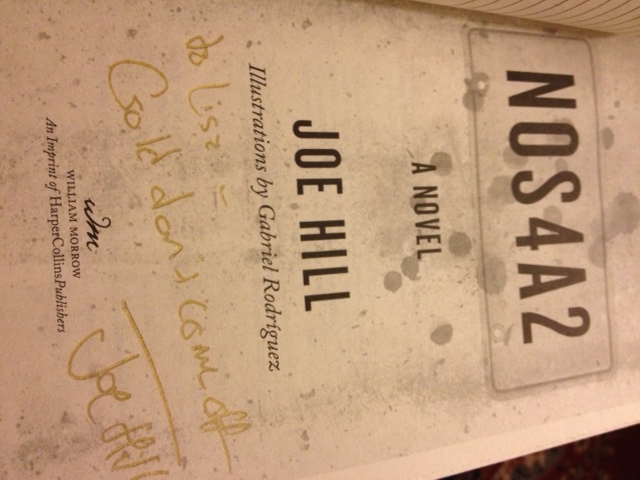
joehill

My book! It’s signed! In gold pen!

Joe Hill signed my book! It was a terrific event. I’d guess about 50 – 60 people attended, at a great indie book store in the Haight. Joe was funny and friendly, answered lots of questions, did a great reading of the prologue, and was just nice and humble and an all-around decent person. Plus, he did this before he was officially introduced:
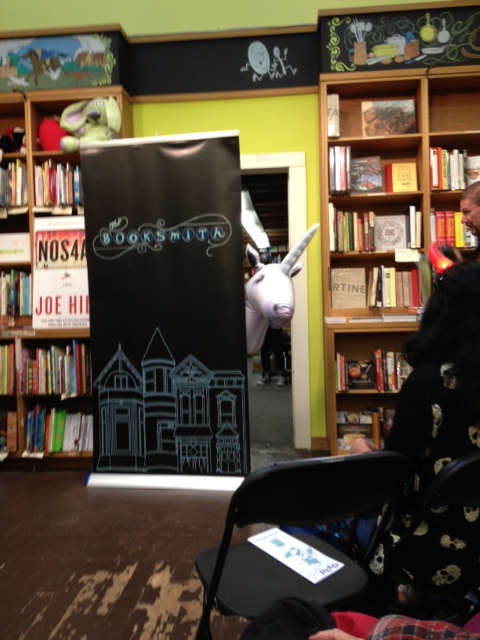
photo 2… which was all kinds of adorable.

So, onward to the review section of this love-fest.

NOS4A2 is the story of Victoria (Vic) McQueen, one tough survivor of a woman, who has been through all sorts of hell in her life and still managed to hang on, sometimes just by the skin of her teeth. Vic has a talent, first discovered during childhood, for finding lost objects — by traveling, impossibly, across a dilapidated covered bridge that exists only in her mind to the places where the lost objects await her. Charlie Manx is Vic’s worst nightmare. Charlie is an indescribably old man, a killer and a kidnapper, a vampirish soul-sucker, who has spent countless decades stealing children away from their parents and transporting them in his classic Rolls Royce to Christmasland. Vic and Charlie cross paths, fatefully, during Vic’s teen years, and then again years later, when Vic is a tenuously stable mother to 12-year-old Wayne. When Charlie reenters Vic’s life, she has to risk everything to get her son back by whatever means possible.

And that’s all I’ll say about the plot, a) because it’s incredibly difficult to describe and b) because you really have to experience this book for yourself, with the fewest preconceived notions as possible.

NOS4A2 is, hands-down, the creepiest, most twisted thing I’ve read in years. At almost 700 pages, this big book is full of gasp- and twinge-inducing moments. There’s a lot of yuckiness. There’s a lot of ickiness. There are all sorts of shades of evil and menace. Bad things happen to good people.

Through it all, Joe Hill’s writing soars. His phrasing is funny, idiomatic, descriptive, and even poetic… if you can be poetic while describing maniacal vehicles and gasmask-wearing sadistic serial killers. Never underestimate the scary power of a simple Christmas carol — if it’s playing at the wrong time and in the wrong circumstances:

The radio popped on, playing “Jingle Bell Rock” at top volume — so loud it hurt his ears — a song that had no business playing in the spring. At the sound of it, Demeter’s whole body went rough and cold with chickenflesh. He poked the OFF switch, but his capacity for surprise was running thin, and he felt no special amazement when it wouldn’t turn off. He punched buttons to change the station, but no matter where the tuner leaped, it was “Jingle Bell Rock” on every channel.

The Rolls Royce itself (a 1938 Rolls Royce Wraith, to be precise) is a character on its own, part and parcel of Charlie Manx and practically his familiar. It’s an ominous black hearse of a car, which should attract an outrageous amount of attention on the road — but doesn’t. In one of the book’s rather humorous turns of phrase, Charlie explains:

It is like what they are always saying about Las Vegas: What happens in the Wraith stays in the Wraith.

Vic is a wonderful main character, spiky and difficult and full of fierce love. Her sometimes partner and father of her child is Lou Carmody, who I love insanely. Lou is terribly overweight and not very healthy, but has a heart of gold, the soul of a hero, and is a geeky fanboy through and through, as well as one hell of a mechanic. Lou’s devotion to Vic and to Wayne is all sorts of beautiful.

Joe Hill is — as is well known by now — the very talented son of Stephen King, and in NOS4A2, he pays tribute to his dad’s monumental achievements in ways both subtle and overt. A car that’s a vessel of evil, an enormous St. Bernard dog (although not rabid, thank the gods), nods to Derry and Pennywise the Clown — all add to the depth of the horror without detracting in the slightest from Joe Hill’s own incredible gift for storytelling.

I realize I’m gushing, so I’ll stop. NOS4A2 is a big, scary, un-put-down-able book. Read it!
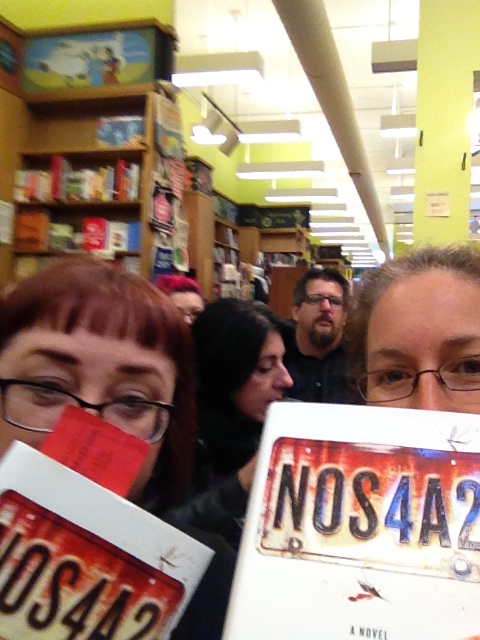
photo 3

Read this. Wear your seatbelt.

Oh, and make sure you read every single page in the book. Including after the story ends. You’ll thank me later.

Q&A with the kiddo: A kid’s-eye view of The Magician’s Nephew by C. S. Lewis

Book Review: The Magician’s Nephew by C. S. Lewis

The Magician's Nephew (The Chronicles of Narnia, #6)

Proudly presenting Q&A with the kiddo, courtesy of my 10-year-old son, in which I ask my kiddo to describe a book he’s enjoyed recently and he gives his opinions, more or less unfiltered by mom.

Without further ado:

Q: What book do you want to talk about?

A: The Magician’s Nephew

Q: What was it about?

A: It was about these kids . They were friends, and the boy’s uncle was a magician, and they got sent to another world. They went into two different worlds. In one there was an evil queen who took over and then tried to take over Earth. Then they teleported into soon-to-be Narnia. There was a lion that was singing and made Narnia. His name was Aslan. Everything they buried turned into a tree. He gave speech to the chosen animals and the especially chosen of the chosen animals were in the high council. The boy and the girl eventually get back to their own world.

Q: Who was your favorite character?

A: Fledge, who is basically a Pegasus, a horse with wings. And King Frank, because his name is weird.

Q: What was the best part?

A: My favorite part was when they planted toffee candy and it grew into a toffee tree. I wonder if you dropped a part of a refrigerator on the ground, would there be a refrigerator tree?

Q: Would you recommend this book?

A: Yes. I’d recommend it for people who like Harry Potter, adventure stories, and talking animals.

Q: Do you want to read the rest of the series?

A: Yes! I want to read the rest of the  Narnia books.

Mom’s two cents:

Somehow, I made it through childhood without ever reading any of the Narnia books. Even as an adult — and a big fan of fantasy writing — I never got around to Narnia until my daughter was old enough for The Lion, The Witch, and The Wardrobe, which we read together many years ago. Neither of us ended up pursuing the rest of the series, and it wasn’t until last month when my son came up with the idea of checking out Narnia that I came back to these books.*

*Although there have been several Narnia movies released in the last few years, neither of us has seen them, so we approached reading the books from scratch.

I decided that we should read the books not in publication order, but in the order which author C. S. Lewis later said was his preferred reading chronology — which meant starting with The Magician’s Nephew.

So what did I think? This rather slight book was actually quite fun. The story is rather simple: Neighbors Polly and Digory, looking for adventure, stumble upon the secret room of Digory’s uncle Alexander, who has been working to become a skilled magician all his life. Through Alexander, the children come into possession of magical rings which transport them from their own world into other worlds. They have the misfortune of awakening an evil witch, who follows them home to London for starters, then onward to a brand new planet just in time to see the mighty lion Aslan create all life in this beautiful new world. Digory is responsible for bringing evil into this new world, via the witch, and so must make amends by performing a special quest for Aslan in order to prove his worth.

It’s all quite lovely, with bits of humor and silly adventure, as well as much heavier moments of pondering the nature of good and evil. I liked very much how the story lays the foundation for The Lion, The Witch, and The Wardrobe. I think one of the reasons I avoided reading the Narnia series all these years is because of the religious allegory woven into the story. For The Magician’s Nephew, at least, I chose to willfully ignore those parts (the creation myth, the Garden of Eden, the fruit of the tree of knowledge, etc) and just focus on the fantasy — in essence, try to read it from the same perspective as my son.

As a book to read together, The Magician’s Nephew worked very well, and we both enjoyed the story quite a bit. We laughed at the funnier parts, we peeked ahead when a chapter ended with a cliffhanger. I asked my son whether he would have wanted to read this one on his own. His response was that while he liked the story quite a bit, he didn’t think he would have wanted to deal with the “old-fashioned” words that he was unfamiliar with throughout the story (“hansom-cab”, “frockcoat”, and the exclamation, “Well don’t keep on gassing about it!”, for example).

We’re moving right into The Lion, The Witch, and The Wardrobe. Narnia, ho!


Book Review: The Theory of Everything by J. J. Johnson

Book Review: The Theory of Everything by J. J. Johnson

I stumbled across this sweet, sad young adult novel at my library, quite by chance, and just happened to take a peek inside. Once I saw the Venn diagrams, I was hooked!

The Theory of Everything is narrated by 15-year-old Sarah Jones, a typical teenager in many ways but one: Eight months earlier, her BFF Jamie was killed in a freak accident in the gym at school. Sarah, the only witness, was powerless to help or to save Jamie. Now, months later, it seems as though everyone’s patience with Sarah has worn thin. Shouldn’t she be over it by now? Sarah is lost, consumed by guilt and grief, and has been taken over, as she puts it, by the “snark box” that speaks for her, even when she knows snarkiness will only get her further into trouble.

Sarah’s parents are at wits’ end, her brother thinks she’s a freak, and her boyfriend, sweet and supportive Stenn, just wants her to open up and talk — but that’s the last thing Sarah wants to do. Instead, she skips classes, talks back, makes out with Stenn, and immerses herself in her nerdly pursuit of endless rewatchings of Star Wars and Battlestar Galactica. Sarah’s only true comfort comes from her loyal dog Ruby, but if Sarah doesn’t shape up soon, even Ruby may be taken away from her as her desperate parents search for some sort of leverage.

It may sound rather grim, but Sarah’s voice is honest and clear, and while she’s been through an awful tragedy, it’s hard not to feel a bit cheered by Sarah’s inner dialogue. Her snark box may be fully functional, but so is her wit, and Sarah’s approach to figuring out how to move forward often comes down to charts and diagrams, liberally scattered throughout the book.  We get plotted graphs of “Things Said To Parents & Likely Outcomes” (with outcomes ranging from stink-eye to counseling to jail), a pie chart on “Possibility that ghosts exist”, and a Venn diagram of “Things I Understand” (which includes chaos theory) and “Things I’ll Never Understand” (which includes “why Jamie died”).

photo a

The Theory of Everything does not offer easy solutions, and that’s only fitting. Sarah has a long journey ahead of her, and while she’s making progress, there is no magic wand that will make her all better. What we see in this book is a girl in transition, coping with one of the most awful and unfair situations imaginable, and yet having to find a way to deal, simply because not dealing is not an option.

It’s interesting to me to think about how different readers might be affected by this book in different ways. I would imagine that a teen would completely side with Sarah, and would agree with her that her parents are being pushy and unreasonable. I could sympathize with Sarah and understand why she would feel this way. At the same time, as a parent myself, I can only imagine how terribly helpless Sarah’s parents must feel, watching their daughter go through such horrible turmoil and feeling desperate to reach her at any cost. It’s a tribute to the author’s gifted storytelling that both perspectives feel realistic. A tragedy like this would of course have ripple effects that spread and continue. The Theory of Everything lets us see one girl’s struggle to understand her loss and to find a way to continue a life that’s missing its center.

Book Review: The Shadowy Horses by Susann Kearsley

Book Review: The Shadowy Horses by Susanna Kearsley

The Shadowy HorsesVerity Grey is a 29-year-old freelance archaeologist, newly resigned from the British Museum and ready for a new assignment. When invited to interview for a secret new project in the Scottish Borderlands, Verity is intrigued… and intrigue turns to shock when she finds out the purpose of the dig. Peter Quinnell, considered by many to have detoured from the straight path of sanity in the wake of personal tragedies, is on the hunt for the fabled Ninth Roman Legion, which disappeared without a trace centuries earlier somewhere in the Northern British Isles. Peter thinks he’s found the Ninth at last, and he wants Verity on his team. His evidence? The say-so of a psychic 8-year-old boy, who reports seeing the ghostly figure of “The Sentinel”, a lonely Roman soldier who wanders the moors, beckoning young Robbie to discover his secrets.

Naturally, Verity joins the dig, and we are quickly wrapped up in both the archaeological explorations and the interpersonal dramas of the team. Verity has never put much stock in the supernatural, but she can’t shrug off the strange sounds she hears at night, the unexplained cold breezes that she encounters in warm rooms, or the uncanny ability that Robbie displays in reading her thoughts and predicting events. Also drawing Verity in is local boy turned archaeologist David Fortune, whose brawny good looks and easy charm are awfully hard to ignore. Just wait until that man puts on a kilt!

The premise sounded quite interesting to me, but unfortunately, I have to say that the book as a whole didn’t quite work for me the way I’d hoped. It should have been fascinating: I’ve always been interested in the story of the Ninth Roman Legion, and expected to get much deeper into their story in The Shadowy Horses. Disappointingly, that wasn’t the case. While the fate of the Ninth is explored, the discoveries at the dig didn’t strike me as earth-shattering or definitive, and I wish there had been more time spent on the character of the Sentinel.

Likewise, the relationships among the members of the team, while interesting, didn’t feel particularly high-stakes to me. By the time the climax of the book rolled around, with a dramatic turn of events and a potential calamity, I never really felt that the main characters were truly in peril, and the revelations of secrets and betrayals were not at all surprising.

Still, The Shadowy Horses does have a lot going for it. First of all, Susanna Kearsley is a gorgeous writer, and she is a master when it comes to conveying the mysteries of the British Isles, evoking the wildness of the landscapes and the beauty of the moors and coasts. I also enjoyed the insider’s peek into the world of archaeological digs, learning about the tools and methodologies of the scientists involved and seeing how a project of this nature might unfold. The characters are nicely developed, and I was interested in getting to know them — and truly wished them all their happy endings.

The Shadowy Horses is the fourth book I’ve read by Susanna Kearsley, and while good, I just didn’t feel that it measures up to her other books. Perhaps I simply missed the “time-slip” elements for which she is known, which lend her books their heightened urgency and intense romance. Susanna Kearsley has a new book due out in June — The Firebird — which I understand includes characters from both The Shadowy Horses and her beautiful novel The Winter Sea. While The Shadowy Horses fell a bit flat for me, that does not at all mean that I won’t be checking out this author’s future writing. I really look forward to reading The Firebird as soon as it becomes available in the US — and if you’ve never read anything by this gifted author, I’d suggest starting with The Winter Sea or Marianna.

Book Review: Ask the Passengers by A. S. King

Book Review: Ask the Passengers by  A. S. King

Astrid Jones is a smart, funny girl who you can easily imagine having an amazing life in New York, hanging out in the Village perhaps, exploring the city with quirky and artsy friends. Unfortunately for Astrid, she does not live in the city. Born a New Yorker, Astrid and her family moved to Unity Valley, Pennsylvania — quintessential small-town USA — when she was 10 years old, and has been stuck in a rut ever since.

In Unity Valley, and in Astrid’s own family, the only way to fit in is to fit — no rough edges, nothing to make you stand out, no unusual traits. And if you’re the member of a minority group? Well, may the gods of uniformity help you then. The small-minded gossip of the town regularly calls out the ethnic minorities, the eccentrics, and the generally suspect, and there is no mercy when it comes to the rumor mill and the shunning and humiliations that can result.

Astrid, at age 17, mostly keeps her head down and gets by. She hides a vital secret for her two best friends, Kristina and Justin, the high school’s golden couple, but Astrid has a major secret of her own. On the weekends at her part-time job, Astrid’s friendship with Dee has moved from casual comfort to hot-and-heavy make-out sessions, and Astrid likes it quite a bit. But is she gay? She’s not sure, and she’s tired of all the pressure — pressure from her parents to fit in, pressure from Dee to take a stand and come out, pressure from the high school in-crowd to just be normal, have a boyfriend, and not be so weird.

To clear her head, Astrid has the unusual habit of going out into her backyard, lying down on the picnic table, and watching the airplanes fly overhead. As each one passes, Astrid focuses on sending her love to the passengers — not just to say hi, but to send her own love away from her to a place where it might be safe. Astrid can’t share anything with her controlling parents or her too-perfect sister; she can’t open up to her best friend; and she can’t share her doubts and confusion with Dee without Dee taking it as a statement on their relationship. So Astrid sends her love to the passengers overhead, the only people she can love freely and without consequence, and for a while, it helps her.

The rest of the time, the table just sits here with nothing to do. So I lie on it and I look at the sky. I see shapes in the clouds by day and shooting stars by night. And I send love to the passengers inside the airplanes… [But] it feels good to love a thing and not expect anything back. It feels good to not get an argument or any pushiness or any rumors or any bullshit. It’s love without strings. It’s ideal.

Astrid gets by for a while, but things do reach a crisis point eventually, and finally Astrid is pushed far enough that she has to take big risks and take a stand. When she blows up, she does so rather spectacularly, and it’s particularly wonderful to see the fall-out of her explosion.

Ask the Passengers is a quick-paced story, told in the first-person from Astrid’s perspective, so that we see inside her thoughts and fears, and really get a chance to see a smart girl try to take control of her life and at the same time do the right thing. Astrid is willing to come out when it feels right — but how does she know if she’s really gay? Maybe she doesn’t like girls in general, just Dee? And if she’s not sure, is it cowardice to remain hidden, or is it bravery to be committed to speaking nothing but the truth? Is the pressure from Dee to come out any different from the pressure from Astrid’s family to be “normal”? There are some important questions asked here about tolerance and acceptance. At one point, the high school has a mandatory Tolerance Day, complete with pep rally and inspirational speakers — but the day is so clearly aimed at Astrid and her friends that it really just serves to isolate them even more.

Interspersed throughout Astrid’s tale is snippets from different airplane flights. As Astrid sends her love to the passengers overhead, we get small segments throughout the book of different passengers on different planes, who make life-changing decisions, face up to hard truths, or simply find some inner strength to face their problems. The implication is that Astrid’s love has reached them and affected them in some way. Magical thinking, perhaps, but it’s a nice idea — or perhaps it’s only coincidence, and the magic is simply in drawing lines from one person in crisis to another, so that the author is showing the reader that none of us are alone, that everyone has risks to take and decisions to make, and that owning up to our own thoughts and feelings may be the bravest step a person can take.

I had not heard of Ask the Passengers until last week, when it was announced that this book was the winner of the 2012 Los Angeles Times Book Prize for Young Adult Literature. A well-deserved piece of recognition, in my opinion. Ask the Passengers is an important book that doesn’t feel preachy, with valuable messages for teens struggling to figure out who they are and where they fit in — and an important lesson as well for the adults in teens’ lives about the incalculable value of support and love without judgement or conditions.

Book Review: A Spear of Summer Grass by Deanna Raybourn

Book Review: A Spear of Summer Grass by Deanna Raybourn

Is this an awesome cover or what? I know, I know, don’t judge a book by its… but hey, this really is lovely. I love the white flapper dress, the image of a woman outside of her natural element, and the gorgeous African landscape. Aren’t you just dying to know what it’s all about? This is definitely what I would consider a successful cover — it draws you in, piques your interest, and makes you want to know more.

A Spear of Summer Grass opens in Paris, 1923, with a young woman in a great deal of trouble. Delilah Drummond thrives on scandal. The quintessential flapper, she’s the life of the party, basking in male attention, always the center of the action, never known to turn down a drink, a cigarette, or a lover. But when the latest uproar refuses to die down and Delilah’s escapades threaten to embarrass not just her hard-partying mother but her moneybags grandfather, drastic action is needed, and Delilah is packed off to her stepfather’s Kenyan estate to cool her heels and wait for the media vultures to move on to the new scandal du jour.

Delilah is not one to go quietly — anywhere — and as she settles into life in Africa, she makes waves among the colonial government officials as well as among the upper class white settlers in her social mix. Yet at the same time, Delilah is charmed by the wildness and danger of her African surroundings and throws herself into the responsibilities of being mistress of an estate, treating the Kikuyu and Masai tribespeople with friendship and dignity.

Not that Delilah has abandoned her wild ways. She attracts the eyes of every adult male in the vicinity, and proceeds to wrap each and every one around her little finger, keeping them as objects of flirtation and sometimes more, but never letting anyone close enough to actually touch her heart. Only one man, enigmatic hunter Ryder White, seems immune to her wiles, and it’s this man who both captivates Delilah and is perhaps an equal for her strong-willed nature.

Delilah and Ryder have a bit of a Scarlett and Rhett vibe going for them. She’s used to being the belle of the ball, accustomed to having every man fall all over her to please and pamper her, hoping for just a bit of her attention and favor. Ryder is somewhat of a scoundrel; he’s respectable enough, but he goes his own way, society’s opinion be damned. They attract, repel, and frustrate each other. The physical attraction is certainly strong, and Ryder is perhaps the one man who can hold his own against Delilah. The outcome of the will-they, won’t-they dynamic is never really in question — it’s clear that these two are made for one another — but the getting there is tumultuous, to say the least.

There’s a lot to really like about A Spear of Summer Grass. The African landscapes and wildlife are described in lush detail. You can practically hear the wind through the savannah and smell the wildness in the air. It’s easy to see how the various characters, often against their will, get caught up in their lives in Kenya and can’t pull themselves away. I enjoyed Delilah’s transformation from spoiled party princess to something more, a woman of character. Delilah’s past is hinted at from the start, but over the course of the book we come to understand the suffering she endured as a result of world war, the losses that caused her to wall off her heart from any hint of vulnerability, and the slow evolution she undergoes as she starts, finally, to live and feel once again.

Ryder is, of course, a typical manly man with a heart of gold, quick to punish wrongdoers but dedicated to protecting the weak, whether people or animals, and righting wrongs wherever he sees them. Of course, he’s incredibly handsome in a rugged, Indiana Jones-ish way, and that doesn’t hurt in the least.

The author does a skillful job of portraying the flavor of expatriate life in colonial Kenya, showcasing the decadent lifestyle of the rich, white settlers, their loose morality, and their unwise indifference to the non-white majority of the country. The scandals, gossip, drinking, and sexual looseness all work perfectly to create a sense of a society adrift and out of touch with the world around them. Visually, there are some remarkable small moments, such as Delilah’s fine silks and delicate shoes falling victim to the blood and dust of Africa — details that convey deliciously the feeling of life lived on the edge of the wild.

What worked less well for me was the inevitability of the romance between Delilah and Ryder. The battle of wills notwithstanding, it’s obvious from the start that Delilah and Ryder are going to end up together, and there was nothing about their developing relationship that didn’t feel like something I’ve seen before. In fact — although this might be contrary to how these things usually go in popular fiction — I think A Spear of Summer Grass might have been a stronger story without the romantic subplot. In and of herself, Delilah is an interesting, strong-willed, trouble-making heroine, and I would have been perfectly content reading a novel that focused on her personal journey without the complication of her lovers and admirers.

That said, I did absolutely enjoy reading A Spear of Summer Grass, so much so that I stayed up past midnight to finish it and had dreams full of safaris and African skies. After finishing this book, I discovered that the author has also published a prequel, Far in the Wilds, as an ebook, and yes, of course I’m going to read it!

Review copy courtesy of Harlequin MIRA via Netgalley.

A Monster Calls: Review and reflection

Book Review: A Monster Calls by Patrick Ness

What can I say about a book like this? Beautiful and awful are two words that come to mind, but neither do justice to the power of A Monster Calls.

A Monster Calls is the story of Conor O’Malley, a 13-year-old so isolated by suffering that he’s become practically invisible to the world around him. Conor’s mother has cancer, and despite her cheery reassurances, the latest round of chemo does not seem to be going well. Conor’s father departed years ago for a new life with a new wife and baby in America, and Conor lives alone with his mother in a small English town, where he attends school in a fog of despair and loneliness.

At night, though, the nightmares start. Until one night, Conor is visited by a monster — a giant creature formed from the yew tree that Conor can see from his bedroom window. The monster seems like a creature from hell, bent on destruction and threatening to eat Conor — but what it wants is a story. The monster tells Conor its conditions: The monster will tell Conor three different stories, and then it will be Conor’s turn to tell the monster a story, but it must be the truth. Conor knows which story the monster wants from him, and it’s the one thing he absolutely does not want to give voice to.

The monster isn’t all that it seems, and as the story-telling proceeds, the monster becomes the voice of reason and honesty for Conor. Through the monster, Conor is forced to confront his own rage and sorrow, the fact that belief in something — anything — matters, and the subjective nature of terms like “good” and “evil”.

The illustrations in A Monster Calls are stark and glorious. Jim Kay’s black and white inks are stunning — scary and bleak, portraying the monster as otherworldly and frightening, yet also as something natural that seems to belong in the mundane world of garden sheds, grandfather clocks, and schoolyards.

I don’t know that I can really articulate my feelings about this book without going off on a personal tangent. I know that I have certain emotional triggers in books, and A Monster Calls hits all of  the most powerful ones for me.

When I was eleven, my mother was diagnosed with breast cancer. After four years of struggle, illness, and suffering, she died at the young age of forty-four. I was fifteen at the time, and although many years have passed and for the most part I don’t actively think about those years any longer, the emotions still lurk below the surface, never far away. Reading A Monster Calls brought my experiences from those years right back to me.

Conor is overwhelmed by rage — a rage that literally destroys whatever is in its path. All-consuming too is his guilt, a guilt that fuels his nightmares and drives him further and further from the people around him. He goes through the motions of a normal kid’s life, but it’s as if he’s an alien in the midst of humans. His experiences and inner life are so separate, so “other”, that it’s no wonder the kids at his school seem to see right through him. He’s scared for his mother, but he’s also scared for himself. He wants to keep her with him, but he wants her to stop suffering. He’s angry, he’s sad, and he just has no idea what to do with all of the emotions that threaten to engulf him at any second.

I get it. The scariness of watching the parent you count on turn into someone who needs protection. The helplessness of seeing a good and kind person suffer — and seeing that person worry more about her child’s well-being than her own. Being on the receiving end of well-intentioned reassurances that cannot possibly come true. It’s awful and it’s painful and it’s a reminder, especially to a child, of just how little in life can be controlled.

So yes, I read A Monster Calls and could barely breathe by the end. Reading Conor’s story was an instant and visceral reminder of my own experiences during the terrible years of my mother’s illness. The book feels real and true. It’s not a soapy melodrama, but an honest look at the messy emotions that are bundled up in loss and grief.

In spare but lovely prose, Patrick Ness captures all of this and more, and the illustrations are stunningly perfect. A Monster Calls is an award winning children’s book, geared for ages 12 and up, but it’s certainly something that adults should seek out as well.

My 10-year-old, having seen me absorbed by this book all week, has asked if I’d read it to him when I finished. I think he’s mostly fascinated by the artwork — understandably so. I hate to turn down a request for a book. As someone who always read “up” (grabbing whatever books my older sister was reading whenever she wasn’t looking), I don’t usually pay too much attention to recommended age ranges for reading materials. And yet, I don’t think my kiddo is really ready for something like this yet. It’s one thing to read about loss and grief in a fantasy setting such as Harry Potter — quite another to read about a boy going through a horrible loss in a real, recognizable world. I do think I’d like him to read A Monster Calls eventually — but perhaps in a few years, when he’s ready to read it on his own and really be prepared to think and reflect about Conor’s experiences.

According to the Author’s Note, the characters and premise of this story were created by the author Siobhan Dowd, who herself died from cancer before she was able to bring the concept to fruition. Patrick Ness was asked to take her initial concepts and turn them into a book, and he has done so in way that feels like both a beautiful achievement on its own and a lovely tribute to Siobhan Dowd. A Monster Calls is quite an accomplishment on so many levels, and all I can say is that it shouldn’t be missed.

Book Review: Attachments by Rainbow Rowell

Book Review: Attachments by Rainbow Rowell

Attachments is a love story, albeit one that’s a bit outside the usual boy-meets-girl mold. In this version of 20th century love, boy doesn’t meet girl, exactly — he snoops through her email files instead.

Lincoln is a midwestern loner in his late twenties, so badly burned by getting dumped by his first love during their freshman year of college that he’s just never tried again. Lincoln lives with his mom, works the graveyard shift in the IT department of a newspaper, and has a social life that consists primarily of Saturday night Dungeons & Dragons sessions. When Lincoln is assigned to work internet security, his job mainly entails reviewing emails flagged for violating company policy and sending warning memos to the offenders. But mostly, he sits around with not much to do, killing time in his lonely workspace and having dinner in the break room with Doris, the 60-something-year-old vending machine lady — who, incidentally, has a better love life than Lincoln does.

But as soon as Lincoln reads the first flagged email between Beth, a movie reviewer, and Jennifer, a copy editor, he’s captivated. He knows he should warn them and move on, but instead, he gets caught up in their daily chit-chat, their ruminations on life, their ongoing relationship woes, and most of all, their easy yet deep friendship. At some point, there’s no return: There’s no way for Lincoln to suddenly tell them to stop sending personal emails without revealing that he’s been reading their emails for months, and so it goes on. On the one hand, Lincoln gets more and more deeply involved and begins to really fall for Beth — but on the other hand, Lincoln starts to really despise himself for what he can no longer consider anything but creepy snooping.

There are surprises in store. We hear about Lincoln only from his own perspective, and he really does not think well of himself. So when Beth starts emailing Jennifer about the cute guy at work, it takes a few beats to realize that they’re discussing Lincoln. Wait, he’s cute? He’s big and handsome, kind of like the Brawny paper towel guy? You’d never know it, considering how little Lincoln thinks of himself.

Beth’s got self-image issues too. She’s been involved with a gorgeous guitar player for years — but most of the time, he barely knows she’s there. She wants to get married, but mostly he just wants to perform and listen to music. Beth’s sisters are married, her friends seem to all be married or on their way to the altar, she thinks her upper arms are hideous, and she has a sad collection of bridesmaids dresses that taunt her from the closet.

This is, ultimately, a very romantic book, and so it’s clear early on that Beth and Lincoln are destined to finally connect. How they get there and what they go through is where all the fun lies. Attachments is a quick, quirky read. The Beth-and-Jennifer parts of the story are told via their emails, and really, these two women are people you’d just love to hang out with. They’re funny, they’re snarky, and they’re really there for each other, with an honesty that only best friends can truly afford. Lincoln’s chapters are the meat of the book, and their narrative flow is both sad and humorous. You can’t help but root for Lincoln as he takes baby steps toward manning up and moving forward — look, he went out to a bar! Look, he arranged a weekend outing! Look, he started going to the gym and bought some new clothes!

Attachments starts out in late 1999, with the world starting to seriously worry about Y2K and whether technology will grind to a halt. There ‘s a charm to the millenial internet jargon, the coding frenzies, the gradual introduction of email privacy (or lack thereof). This book was written in 2011, and I’m not entirely sure that I think the nostalgic look back at 1999/2000 is really necessary to the storyline — although I suppose things couldn’t happen this way today, with our firewalls, spam filters, and tech-savvy social media obsessions. There’s a certain sweet innocence to the emails between Beth and Jennifer, blithely talking about their personal lives with no thoughts about anyone reading their words, forwarding their emails, or posting embarrassing quotes on their Facebook walls.

Office settings are rare in contemporary fiction as anything but backdrop — the places the main characters go when they’re not on stage in their homes or other more action-packed or glamorous settings. In Attachments, the office is a bit of a social melting pot, where Lincoln is finally dragged out of his cocoon and forced to acknowledge himself as a person who needs and wants other people.

I decided to read Attachments after reading Eleanor & Park, the new (and amazing) young adult novel by Rainbow Rowell. I loved the author’s voice and approach to her characters so much that I decided to seek out anything else she’d written, and as it turned out, Attachments was her first and only other novel. If not for Eleanor & Park, I doubt I would have come across Attachments… but I’m so glad that I did.

Attachments is sweet, romantic, funny, and warm-hearted, and surprised me by being much more affecting than I’d anticipated. It’s a great love story, well-suited to a lonely world in which people connect best via their devices and screens. At its heart, Attachments is about real, live, human connection — how rare it is to find it, and how special it can be. Check it out! It’s a quick, satisfying read that’ll leave you with a smile on your face.

Rainbow Rowell has a new book, Fangirl, due out in the fall. You can bet I’ll read it!

If you liked this post, please consider following Bookshelf Fantasies!

Book Review: The River of No Return by Bee Ridgway

Book Review: The River of No Return by Bee Ridgway

Lord Nicholas Falcott, Marquess of Blackdown, facing certain death on the the battlefield, suddenly and inexplicably jumps from his own time in 1815 into the future — 2003, to be precise. There, he is greeted and inducted into the Guild, a society whose purpose is to assist time jumpers like Nicholas with adapting to their new worlds. The Guild has only four rules:

There Is No Return.
There Is No Return.
Tell No One.
Uphold the Rules.

Yes, that is, in fact, four different rules. Number one refers to time, and number two refers to location. After spending a year in “future school”, during which Nick learns the basics of 21st century life, catches up on decades’ worth of TV viewing, learns to speak a more modern version of English, and has the sharp edges of his upper-crust snobbery sanded down, he is packed off to life in America, never to return to the United Kingdom and the land of his ancestors. And for ten years, that’s pretty much okay. Bankrolled by the Guild, Nick settles into a life as a wealthy playboy in New York with a little Vermont getaway for when he wants peace and quiet.

But when the Guild recalls Nick to London for a meeting, it turns out that rules are made to be broken — at least, if you’re in the inner circle and in the know. For ten years, Nick took it as a given that it was impossible to travel back through time. Turns out — well, not so much. Time travel is possible, if you know how, and Nick is taught the biggest lesson of all: Time is a river, and trained members of the Guild can use the currents of the river to travel to precise points in the past and future. The mission of the Guild is to protect the river, and Nick has been brought into the inner circle to learn a well-guarded secret: A splinter group called the Ofan are trying to tamper with time, and must be stopped. The Guild needs Nick to go back to his original time, infiltrate the Ofan, and do whatever it takes to prevent catastrophe.

Nick has a secret too: He’s never quite forgotten the dark-eyed girl from his youth who once comforted him in a moment of sorrow. Thrust back into his own past, Nick once again encounters the beautiful, tragic Julia Percy, now grown up and in need of his help. Nick cannot deny the growing passion and deep-seated love he feels for Julia, but events and secrets threaten to keep them apart. And Julia has secrets of her own, secrets that may rock Nick’s world if he can manage to unravel the clues.

Enough with the synopsis, don’t you think? I certainly don’t want to reveal too much and ruin the fun. And fun it is! I loved The River of No Return. From the first pages, I couldn’t wait to find out more. Who is Nick Falcott? Who is Julia Percy? What does the Guild want from them? Is there more to the secrets of time manipulation than they’ve been told? And how can they get at the truth? With each new chapter, more pieces of the puzzle are assembled, but the plot twists and turns in so many deliciously unpredictable ways that when the big reveals finally come, they’re still a complete surprise.

Nicholas and Julia are well-defined, sympathetic, strong characters. Nick is handsome, rugged, a soldier, an aristocrat — but also quite happy to put on his 21st century jeans, kick back, and enjoy the freedoms of the modern era, particularly the lack of social constraints based on gender and class. Julia is an orphaned girl raised in relative isolation by a doting grandfather, but this seemingly meek woman has a backbone and a will of her own, and when she finally starts to realize her own strengths and gifts, she’s a force to be reckoned with. Together, Nick and Julia are magical. Their passion is intense and smoldering, and you can feel from their very first kiss that their connection will not be denied.

The River of No Return has so many elements that really make a book sing for me. It’s part historical fiction, part time travel fantasy, with heaping doses of mystery and romance as well. I was reminded in tone, though not really in content, of Deborah Harkness’s books, A Discovery of Witches and Shadow of Night — not that The River of No Return has supernatural characters, but rather because of the well-researched historical detail intertwined with a modern love story and mystery, the drama of two lovers having to struggle against sinister forces that they don’t fully understand, and the passionate link between two people who probably have no business being in each other’s lives at all.

The writing in The River of No Return is both elegant and fast-paced. As the characters inhabit different eras, their language and surroundings change as well, and it’s vastly entertaining to see them adjust and readjust to the customs, manners, and dress of each world. I loved, too, the characters’ obvious delight in the various sights and smells of the the different times. Nick has a visceral, overpowering reaction to his reentry into the 19th century:

Before opening his eyes he breathed, and immediately he was weeping. The air was sweet, sweeter than any air he had breathed in ten years, and it smelled so powerfully of home that Nick began to sink to his knees.

In less dramatic moments, it’s a treat to see the time travelers and the Naturals (basically, the Muggles of the time-travel world) react with pleasure or confusion as they encounter anachronistic artifacts and articles, such as a photograph, a Rubik’s cube, and a jacket with a zipper — all in the wrong place and the wrong time. It’s all put together with skill and flair, so that the story elements never feel too far-fetched or fantastical. Instead, in The River of No Return, the author creates a world that feels very much like our own, in which there are secret forces at play that affect everything but remain undetected by all but a chosen few.

My only quibble — and it’s a product of how much I enjoyed this book — is that by the time I got to within 100 pages of the end of The River of No Return, I started to have that sinking feeling I get when I realize that there’s no possible way to fully wrap up this story in the pages that remain. And sadly, that turned out to be the case here. While there’s no mention of a sequel on the book jacket or on the author’s website, there are loose ends and further conflicts that remain unresolved at the end of the book. Not to say that The River of No Return ends badly; on the contrary, I loved the ending, and especially loved the promise of what must come next in the characters’ lives. Still, I’d also love to know that there will, in fact, be a sequel. I’m hooked, and I want more!

Do I recommend The River of No Return? Absolutely. Fans of Deborah Harkness and Diana Gabaldon should definitely pick up this terrific novel — and really, so should just about anyone who appreciates good writing, an engrossing plot, and sharply developed characters. Be warned: I lost sleep over The River of No Return, and you probably will as well. Once you start, it’s hard to walk away. I enjoyed this centuries-spanning novel of romance, intrigue, and time travel, and would love to see it become a big success.

Check it out! And then stop by again and let me know what you think. Let’s discuss!

Review copy courtesy of Dutton Publishing.

Book Review: The Love Song of Jonny Valentine by Teddy Wayne

Book Review: The Love Song of Jonny Valentine by Teddy Wayne

Sound familiar? Child pop star soars to insane levels of fame after being discovered on YouTube. Paparazzi follow him wherever he goes. His hair style has its own name. Tween girls sigh and scream over him, and he just loves his fans SO much.

Welcome to the world of Jonny Valentine, the 11-year-old sensation at the heart of The Love Song of Jonny Valentine. Jonny catapulted to Bieber-like levels of celebrity after breaking onto the tween pop scene two years earlier. Now on his second tour, album sales are flat and the gate is unpredictable, the label execs are noncommittal, and manager/mom Jane is coming undone. Amidst all the chaos, Jonny eagerly awaits puberty, searches for the father that abandoned him years earlier, and relies on tutors and bodyguards for any semblance of normalcy and connection.

If it weren’t all so sad, it would be laughable to hear an 11-year-old spouting lines like this:

It was easy for her to say I should try to fall asleep when she wasn’t the one who’d just performed for two hours in front of a capacity crowd of 17,157 fans and had to take a meeting with the label tomorrow back in L.A., who was probably going to voice their concerns that the new album hadn’t meaningfully charted yet, which meant it never would, since sales momentum rarely reverses at this stage in the game unless there’s a major publicity coup.

Jonny is clearly a boy with talent, but is mega-stardom the way to go? He’s got a clear, sweet singing voice with dynamic range and some killer dance moves. Could he take a slower, more reasoned path to success? Study his craft, take lessons, continue with school, hang out with friends? Well, sure, but in today’s celebrity-obsessed culture, quicker and bigger is better, and Jane isn’t satisfied unless Jonny is absolutely tops.

Teddy Wayne’s skewering of pop idol mania is spot-on. Jonny knows to pick a chubby girl to bring up on stage, because if he picks a “hot” girl, all the not-so-hot girls will feel marginalized. He goes on a staged “date” with another tween star at the suggestion of his label, during which they pose for a candid “gotcha” photo by a pre-arranged cameraman. Jonny’s lyrics are bland paeans to the girl of his dreams, which can safely appeal to every girl without making him seem unavailable. When a back-up dancer misses a beat, Jane is ready to fire him for distracting Jonny in a concert, resulting in the pathetic sight of a grown-up pleading for his job with a child — while the child sits in his bean bag chair with his video game controller in his hand, both a powerful executive and a kid who can’t deal with adult problems.

The Love Song of Jonny Valentine is both a funny, pointed critique of the culture of fame and a sad narrative of a lost childhood. Told in the first person by Jonny, the narrative veers from a boy’s eye-view of video games and snacks to a hyper-aware discussion of fan bases, market penetration, carb counts, and media saturation. It’s hard not to feel sorry for Jonny, who really might be happier going to school and having friends his own age. Yes, he’s already made enough money to last a lifetime and his face appears on T-shirts, backpacks, and cell phone cases — but he’s also an isolated little man-child, sleeping alone in hotel room after hotel room, sneaking into his mother’s sleeping pill stash, worrying about the “chub” around his waist, and relying on his security chief for companionship and some semblance of responsible adult influence.

I found this book both highly entertaining and quite disturbing in its ability to capture the essence of a society obsessed with fame and all its trappings. Jonny has a rare off-script moment in an interview when he’s caught off-guard. Instead of his perpetually positive and inoffensive answers, he responds to a question about why people are so eager to read about celebrity scandals:

“[But] when things go bad for us, it really makes them happier about their own lives,” I said. “And when they make fun of my mother, it makes them feel better about how they raise their own normal kids. So even when they think they love you for not being like a normal person, underneath it they actually hate you, because that’s the part that hates themselves for not being special, and for knowing they couldn’t handle the pressure of being famous anyway.”

By the end, Jonny seems determined to play the game. Maybe he can’t have a normal life, but he’s determined to control the weird, hyper-public life that is his own. Will his star power last, or will he be another soon-forgotten overnight sensation known years later as a punchline to a joke? Only time will tell.

Check out The Love Song of Jonny Valentine. It’s sharp, funny, heart-breakingly pathetic, and eminently readable. And next time you read about the newest teen pop sensation, stop and wonder: What’s the price of fame? And who is really responsible for the cult of personality and paparazzi? Beneath the witty writing and fast-paced narrative, there’s real food for thought here.