Book Review: Fairy Tales From The Brothers Grimm by Philip Pullman

Book Review: Fairy Tales From The Brothers Grimm by Philip Pullman
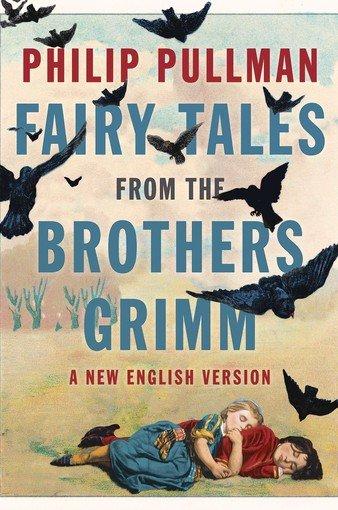
First of all, for those of you who have been following my struggles: I did it! I actually finished a book of short stories! I’ve mentioned a few times now that I have a big problem with story collections, and generally avoid them like the plague. I made an exception, however, for Fairy Tales From The Brothers Grimm by Philip Pullman, because a) fairy tales! and b) Philip Pullman!

And now that that’s out of the way… what can I tell you about this collection? We all — or at least, those of us above a certain age — grew up with the color-themed fairy books, right? I was a bit obsessed with these as a child, and read whichever volumes were available on my library’s shelves at any given book-bingeing visit. It’s been years since I’ve revisited fairy tales in the written form, as opposed to all the Disnified versions that I’ve watched countless times with my kids.

In Fairy Tales From The Brothers Grimm (let’s just call if FTFTBG for now, okay?), Philip Pullman presents fifty Grimm tales which he’s rewritten in modern, simple English. The language is straightforward and pure, without archaisms that abound in more “traditional” Grimm collections. At the conclusion of each story, the author includes source information as well as his own comments on the story itself and any changes he may have made from the original narratives. He is quite faithful to Grimm, identifying which edition of the Grimm stories he’s pulled from, and only deviates from the source material when he feels that the story is missing a connection or a conclusion.

Pullman’s comments vary from factual — stating source and context — to highly opinionated, and it’s these latter types of comments that are the most entertaining. When the author has something to say, he really says it. Here’s one of my favorites:

However, the tale itself is disgusting. The most repellent aspect is the cowardice of the miller, which goes quite unpunished. The tone of never-shaken piety is nauseating, and the restoration of the poor woman’s hands simply preposterous… Instead of being struck by wonder, here we laugh. It’s ridiculous. This tale and others like it must have spoken very deeply to many audiences, though, for it to spread so widely, or perhaps a great many people like stories of maiming, cruelty and sentimental piety. (Comments on story #21, “The Girl With No Hands”)

The introduction to FTFTBG is wonderful, outlining the history of the Brothers Grimm and their efforts to record and retell folk tales. Philip Pullman gives a very useful overview of common characteristics of fairy tales, among them the immediacy of the characters and narrative: The characters tend to have no backstory, and often lack names other than “the miller”, “the tailor”, “the youngest son”, etc. The stories are tales of actions and consequences, with little to no time spent on descriptions of settings or the natural world, character motivations, or personal growth or development:

There is no psychology in a fairy tale. The characters have little interior life; their motives are clear and obvious. If people are good, they are good, and if bad, they’re bad… The tremors and mysteries of human awareness, the whispers of memory, the promptings of half-understood regret or doubt or desire that are so much part of the subject matter of the modern novel are absent entirely.

I am not an academic; I have no fancy degrees in folklore, ethnography, or comparative literature. I can’t compare Philip Pullman’s retellings to other versions, reinterpretations, or new translations. What I can assess is how this particular collection of stories worked for me as a reader — and the answer is, it worked very well indeed!

I truly enjoyed this collection, which includes both familiar tales (“Cinderella”, “Rapunzel”, “Snow White”, “Little Red Riding Hood”) as well as tales (with wonderful titles!) that I’d never heard of, such as “Hans-my-Hedgehog”, “The Mouse, the Bird and the Sausage”, and “The Singing, Springing Lark”. Even for the most familiar tales, I was surprised to realize how far my own memory of the stories had strayed from the Grimm version into the land of Disney princesses and happily-ever-afters. There’s something oddly appealing — at least to me, with my appreciation for the dark and off-beat — in realizing that even a story that ends with kisses and marriage (such as “Cinderella”) also includes self-mutilation, horrific cruelty, and shoes filled with blood. In real Grimm stories, fairy tales are definitely not soothing stories to lull children into peaceful dreams!

Some of the stories which were new to me were quirky and funny, such as “The Boy Who Left Home to Find Out About The Shivers” and “Lazy Heinz”. Then again, there are plenty of truly disturbing stories. “Thousandfurs”, for me, is the most disturbing in the collection, not specifically because of Pullman’s retelling, but because “Thousandfurs”  is one of the origin stories for the brilliant yet wildly upsetting novel Deerskin by Robin McKinley.

And perhaps that’s the point and the beauty of reading such a well-written and thoughtful collection of traditional fairy tales: We’ve all encountered these stories in so many ways, with so many different interpretations. In reading them anew, we’re instantly reminded of all the associations we’ve developed with these stories, from reinterpretations in modern novels to our grandparents’ versions of fairy tales as bed-time stories to cautionary tales about greed and duplicity. What’s most interesting to me is that the stories resonate so deeply and so widely; your Rapunzel and my Rapunzel may be very different, but the bottom line is that fairy tales like these give us a common language and cultural points of reference. On my bookshelf, I have a wonderful collection of short fiction by women writers entitled We Are The Stories We Tell. Given the depth of experiences we all share thanks to fairy tales such as those in FTFTBG, I’d say that we are also the stories we read.

Book Review: Frost Burned by Patricia Briggs

Book Review: Frost Burned by Patricia Briggs

Frost Burned (Mercy Thompson, #7)

Mercy is back! Mercy is back! Mercy is back!

Clearly, my babbling inner fangirl is dominant at the moment, as I get practically giddy over the return of my favorite urban fantasy heroine and her pack of strong, conflicted, devoted werewolves.

Frost Burned is book #7 in the outstanding Mercy Thompson series by Patricia Briggs. Fingers crossed — here’s hoping there are many more stories set in Mercy’s world yet to come. Brief spoiler alert: While I won’t give away too much from Frost Burned, from this point forward you may encounter spoilers for some of the earlier books. You have been warned!

For the uninitiated, Mercy Thompson is a talented VW mechanic living in the Tri-Cities region of Washington, who also happens to be a shapeshifter. Thanks to her Native American lineage, Mercy can shift at will into coyote form and has certain other magical predispositions as well. At the outset of the series, Mercy lived in a trailer adjacent to the property of werewolf pack Alpha Adam Hauptmann, which gave Mercy all sorts of childish pleasure as she found new and creative ways to annoy the bejeesus out of Adam.

Flash forward to book #7, and Mercy and Adam are happily married, completely in love, and enjoying life surrounded by their pack and their friends. When Adam and the pack are attacked and kidnapped, Mercy has to use all the power at her disposal and call in some significant favors in order to find the wolves and rescue them before disaster strikes.

That’s the two-second version of the plot, and I won’t go further. If you’re a Mercy fan, you’ll want to read this book at the first possible second. And if you’re not already a Mercy fan — what are you waiting for? Go get book #1 (Moon Called) immediately, and don’t stop reading until you get through Frost Burned!

I don’t often gush so enthusiastically, but I have to say that these books are really special. The characters are unique and unforgettable. By this point in the series, I’m in love with at least half of the pack, and would want the rest at my side in any dark alley imaginable.

What I really love about these books is the wonderful world that Patricia Briggs has built, especially when it comes to creating a fully-formed werewolf social structure. The pack dynamics echo those of wolf packs in the wild. Dominance is a key theme, and each werewolf in Adam’s pack knows exactly where he stands in the pack rankings. There’s a magic involved as well — Adam can call on the strength of the pack when he needs an extra boost, or he can send his power to a wolf who’s in trouble. Likewise, the mate bond between Adam and Mercy isn’t just about love. They have a connection that they can use to reach one another, to strengthen one another, and rather surprisingly, to physically save one another when in danger.

The author’s depictions of dominance struggles among the wolves is fascinating. Even in human form, the pack members know better than to look the Alpha in the eye. When in a crowded or unfamiliar location, it’s difficult for the dominant wolves to relax, as their instinctive need to control their surroundings and protect those packmembers who are weaker can push them toward a violence that always lurks below the surface. As we learn in Frost Burned, even a simple card game used to pass the time can end in bloodshed when two dominant wolves are involved, and it’s a bad idea to get too close to a wounded werewolf, when his aversion to showing vulnerability might just trigger an attack.

Mercy herself is a wonderful hero. She’s physically strong and capable, and even stronger willed. She’s driven to protect her loved ones, even when doing so puts her own life on the line. Mercy dives in and takes action. She never waits to be rescued; she’s the rescuer. Of course, she suffers for it, too — over the course of the series, very bad things have happened to Mercy, and they do leave scars, both emotional and physical. Unlike some lead females in ongoing paranormal series, Mercy doesn’t get bogged down in her beauty routines or other silliness. She works hard, she takes care of her family, she pays attention to her pack… and she pretty much never has a dull moment.

I suppose you could complain that the books are so action-packed that the characters never have a quiet moment to breathe. Well, that’s true, but that’s not necessarily a bad thing. The plots in the Mercy Thompson books are hyper-fueled by danger, threats, conspiracies, and various and sundry super-scary bad guys. While there are tender, domestic moments built in, I suppose we just have to imagine that in the months that go by in Mercy’s life in between the books in the series, she and Adam and their wolfy gang are able to catch up on their sleep, enjoy their families, go out on runs, and play intense rounds of video games.

By now, I’m sure that it’s clear that I adore the Mercy Thompson series, and I’m wild about the spin-off Alpha & Omega series as well. My chief unhappiness at the moment? Having read the book the absolute second I got my hands on it, I have no more Mercy adventures to read! I understand that at least nine Mercy books are planned, and that #8 is due out in 2014. I don’t want to wait!

Seriously, read these books. You can thank me later.

Book Review: Spellbinding by Maya Gold

Book Review: Spellbinding by Maya Gold

Sixteen-year-old Abby is used to fading into the woodwork, lurking in shadows, never being noticed. Whether at home or at school, Abby is one of those girls who’s always in the background, not especially scorned, not surrounded by friends — just kind of there. She’s used to her lot in life and more or less knows her place, although she can’t help sighing over golden boy Travis, her life-long crush ever since he showed her kindness on the playground years ago when they were both small. Travis is dating perfect-but-mean Megan, and Abby can only watch from the sidelines and blush whenever anyone takes notice of her. Sensitive and shy, Abby is the quintessential high school wallflower:

Maybe this is the flip side of being invisible: Nobody sees me, but I notice everything.

Abby’s life takes a dramatic turn when a teacher assigns the class a genealogy research project: Trace your family back from the current generation to the family member who first set foot in America. Abby knew her late mother’s side of the family arrived centuries earlier, but is startled to discover a connection to Salem in the 1600s — the Salem of the witch hunts and trials, located just a short distance from Abby’s home town.

As Abby digs further, she seems to awaken her own magical powers and a deep connection to the dimpled, adorable Rem, a mysterious boy who seems to know a lot more than he’s willing to admit. Will Abby embrace the power promised by her newly discovered abilities? Can she change her life by using magic? Should she?

Even without her magical awakening, Abby was already facing a slew of mundane problems. Since her mother’s death years earlier, Abby feels overlooked by her father, who focuses instead on her soccer-star younger brother. As her father begins dating, Abby – the household cook –  is full of resentment towards the woman she sees usurping her role in the kitchen and, not incidentally, in her father’s heart. Abby’s best friend moved away the summer before, leaving Abby without the security of a BFF. Abby is smart and has talents, but not the kind to make her admired or sought after at school. This is a girl with enough to deal with — and now she has to figure out if she’s crazy or if she’s a witch, and if she’s a witch, what should she do about it?

Abby’s inner struggles are what make this book particularly interesting. She clearly has a gift, but she’s also keenly aware of a sense of right and wrong. When Abby uses a love spell to get her crush to notice her, she does it as a lark, to see if she can. But once she realizes that her magic works, she’s not so sure that she wants it. Is it satisfying to have your dream boy suddenly devoted to you, when you know that you forced it to happen? How can you be happy in a relationship if you know, deep-down, that it’s not real?

A nice twist in Abby’s growing power is that it clearly doesn’t have all the answers. Abby gains greater confidence and starts letting her hair down — literally — no longer  afraid to be noticed. But she quickly finds that the notice she gets isn’t what she wanted, as the school mean girls subject her to a campaign of gossip, bullying, and Internet abuse, all of which escalate as Abby gets her guy and becomes golden boy’s new girlfriend. Greater visibility is no protection against ridicule and scorn.

Author Maya Gold has a way with words, using surprise twists and references in ways that made me sit up and pay attention as I read. A few prime examples:

It’s as if the morning is posing for June on a calendar.

There aren’t evil earth witches who look like Keith Richards with blood in their eyes.

If I’m having some kind of schizophrenic breakdown, the voices inside my head sound like Gandalf the Grey.

What I especially liked about Spellbinding is how real Abby’s inner life seems. Given the mean girls and their nastiness, having Abby consider using magic as revenge doesn’t seem like power gone mad — more like a reasonable response to intolerable circumstances. When you’re backed into a corner, who wouldn’t use their secret strength to get back into control?

Another noteworthy aspect of Spellbinding — and one that really differentiates it from the plethora of supernatural-tinged YA novels saturating the market these days — is that “normal” life is clearly the better choice. Yes, magic exists and is tempting, but it’s made clear that if Abby journeys down the path toward embracing her witchiness, she’ll be forever giving up an everyday life of family, friends, achievements, and true connections. Despite the temptations, Abby has a good head on her shoulders, and quickly comes to realize that power is no substitute for relationships that come from the heart.

Spellbinding does a great job of weaving magical elements into the broader story of a girl trying to find her way, come out of her shell, and find her place in the world. It’s not Abby’s witch heritage that really matters in the end; it’s the connections she’s made that give her strength and enable her to look forward toward a brighter and happier future. I’m very glad to have read Spellbinding. It’s a quick read, but one that should resonate with teen girls (and their moms!). The combination of romance, suspense, magic, and girl power is quite fun and full of (ahem) charm.

Review copy courtesy of Scholastic via Netgalley

Book Review: The Imposter Bride by Nancy Richler

Book Review: The Imposter Bride by Nancy Richler

Nancy Richler The Imposter Bride

In the wake of World War II, the world was filled with refugees, some seeking shelter, some seeking new homes, some seeking forgiveness, some seeking peace. In Nancy Richler’s The Imposter Bride, one determined young woman arrives in Montreal seeking a new life, and more importantly, a new self. But can a person really reinvent herself? And what happens when her old life catches up to her?

Lily Azerov arrives by train in Montreal as a mail-order bride for Sol Kramer, whose family had settled in Canada one generation earlier and is now established within the Jewish community there. But for whatever reason, Sol sees Lily at the train station and changes his mind, leaving Lily without a plan or a future until Sol’s brother Nathan steps in and marries Lily instead. Nathan is drawn to Lily’s fierceness and determination, and falls for her almost instantly. And what does Lily feel for Nathan? Is he more than just a solution to a problem?

The Imposter Bride is layered throughout with mysteries. Lily, we quickly discover, is not who she says she is. We don’t know who she was exactly, but this stranger in a strange land has picked up the name and history of another girl. The original Lily and her entire family, like so may others, lie dead in Europe, leaving no trace behind. The new Lily does not have long to hide behind her new self, as the original Lily’s cousin also lives in Montreal and is quick to sniff out the deception.

After a dramatic first chapter, in which the point of view shifts radically from character to character, so that we see events through the eyes of Lily, Nathan, Sol, and others, we learn in the second chapter that the new Lily is long gone. Lily stuck around only long enough to give birth to a baby girl, and then left suddenly one day, never to return. From this point forward, we hear parts of the story through the words of Ruth, Lily and Nathan’s daughter, who narrates a life lived amongst a large, loving family and yet with a key piece of her own identity permanently denied her.

Throughout the remainder of the story, Ruth and other family members pour out their thoughts and emotions as they recount their experiences with faux Lily as well as the paths their lives have taken after her departure. The shifting points of view are quite effective in places, as we hear, one after the other, radically different interpretations of the same set of events.

The author skillfully creates distinct voices for the characters, each easily recognizable and with his or her own story to tell. The older generation recounts their stories of losses and loves; we see Ruth growing up from early childhood through middle age; we even get brief moments of Lily’s thoughts and experiences.

Sadly, for me at least, the pieces never really gel into a whole that’s greater than the sum of its parts. Key elements of the central mystery are left unresolved — or are finally revealed in such a brief overview that I couldn’t relate to the events at all. What happened to the original Lily? What was her connection to the faux/new Lily? Why did new Lily choose to start over in Canada, despite knowing she’d have little chance of maintaining her charade? Who, really, was new Lily before she found her new name and new life? And why did she feel that she had to leave her husband and baby girl? There are answers provided, mostly, but I found them unsatisfying and not entirely convincing.

On the positive side, The Imposter Bride is richly detailed, and the author’s language is heartfelt and lovingly crafted. Through the words of the characters, the deep sense of loss so central to the Jewish community in the wake of the Holocaust is finely portrayed, as each of the characters are impacted in different ways by the horrors and suffering of that time.

A central theme that emerges is the pain of not knowing. Many of the characters simply do not know what has become of the families they left behind in Europe. While the pain and questioning may become less acute over time, the absence never really goes away. So too is the case with Ruth, who has lost her mother, but spends most of her life not knowing how or why. Finding a way to keep going, to create a life for oneself, and to find joy despite deprivation and pain is a challenge for all of the characters in The Imposter Bride. Both Ruth and her missing mother are forced by their losses to redefine themselves and figure out just what kind of new identities they can forge. Do they let themselves be defined by the events that have happened to them? Or do they decide for themselves who they want to be and how they want to live, and find a way forward?

Overall, reading The Imposter Bride was a mixed experience for me. The details are wonderful, the characters feel real, and yet the narrative itself fails to coalesce into a powerful whole, so that the novel felt to me more like a collection of moving stories and vignettes rather than a solid work of fiction with a begininng, middle, and end. I’m glad to have read it, but unfortunately, I didn’t enjoy The Imposter Bride or feel its impact nearly as much as I’d hoped to. Still, Nancy Richler is clearly a gifted and sensitive writer, and I’m sure I’ll seek out her works in the future.

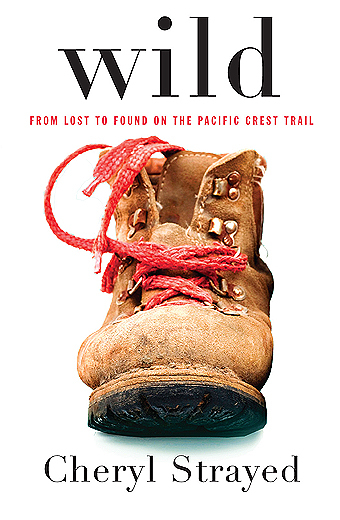
Book Review: Wild by Cheryl Strayed

Book Review: Wild: From Lost to Found On The Pacific Crest Trail by Cheryl Strayed

Why on earth would a 26-year-old woman with no backpacking experience whatsoever set out on a grueling solo trek of over 1,000 miles? The answer lies in the powerful memoir Wild: From Lost To Found On The Pacific Crest Trail by Cheryl Strayed.

The Pacific Crest Trail is a nationally designated hiking route stretching from the California border with Mexico all the way north to Washington’s border with Canada. Along the way, the PCT traverses formidable mountain ranges including the Sierra Nevada and the Cascade, as well as the Mojave Desert and points in between that most of us have never even heard of. Each year, people travel from around the globe to hike all or part of the PCT. For many, tackling the PCT is the fulfillment of a lifelong dream.

And yet Cheryl Strayed, with practically no preparation, sets out on the PCT for a three month journey, a mere seven months after first hearing of the PCT. For Cheryl, it must have sounded rather like a last grab at a lifeline. Four years after her mother’s wrenching death from cancer, the author found herself in a downward spiral. Her remaining family had scattered; she’d let her young marriage to a good man disintegrate as she herself fell apart, pursuing infidelities, bad decisions, and even a brief involvement with heroin in an attempt to detach and shield herself from the grief she’d never fully dealt with.

When Cheryl picked up the PCT trail guide in a check-out line, it was purely on a whim, but something drew her back. And thus, a few short months later, she began the extraordinary adventure with a tremendously over-stuffed backpack (nicknamed “Monster”) weighing her down so greatly that she was unable to even stand upright… and yet somehow, she set out on the trail, one foot in front of the other, to escape her woes and to find something — anything — to give her reason to keep going.

The story of Cheryl’s journey and transformation is remarkable. As she accumulates the miles, pushing her body beyond any limits she could have imagined, she slowly finds an inner strength and manages to come to terms with her personal demons.

At the outset, I could only shake my head in wonder. Despite her guidebooks and helpful advice from the staff at her local REI, the author really had no idea what she was doing and had no business doing it. Her mistakes were enormous, and easily could have gotten her killed. Her first day on the trail was her first day of backpacking, ever. She had only the smallest cash reserves for the trip, and so time after time found herself stumbling into the next resupply location after days on the trail with only 60 cents (or less) in her pockets. The extent to which she basically let herself jump without a safety net is rather scary to read about. We know because we’re reading a memoir that the author survived her incredible journey, but in chapter after chapter in Wild, we can see that Cheryl’s survival had a lot to do with good fortune. At any one of at least a dozen points, events could have taken a different turn, resulting in injury at the least or perhaps even a tragic fatality. A more spiritual person might even say that someone or something must have been watching over her, because there’s no way that a person so completely unprepared should expect to come out of the experience in one piece.

Despite my disbelief — verging on disapproval — for the shaky decision-making that the author applied toward her trek, I could only end up in admiration of her courage and fortitude. How many of us would have the nerve to take such a giant leap into the unknown? Granted, perhaps the fact that Cheryl had hit bottom helped propel her forward. There really was nothing left for her in her old life, so a dramatic departure was pretty much required. As the book progressed, I was increasingly impressed both by her physical stamina, despite unimaginable pain (she lost half her toenails along the PCT!) and her mental determination to see this quest through, no matter how many obstacles she encountered. Her gradual acceptance of the good and bad in her own life and her growing belief in her ability to change, move forward, and make a new start is quite beautiful to witness.

Along the PCT, Cheryl meets a number of fellow hikers who for a wide variety of reasons have also decided to make the journey. It’s lovely to encounter these strangers and see the instant bonds that form, as these individuals who perhaps overlap in their treks for only a few days form a community that stretches the length of the trail.

The book wraps up at the conclusion of Cheryl’s trek, and I wasn’t ready for it to end. Having come that far with her, I wanted to know what happened next — how did she manage to start a new life? Did it go the way she’d hoped? How did she readjust to civilization? I actually have tickets to hear the author speak in April, and I’m so looking forward to learning a bit more about her thoughts along the trail and the challenges she faced afterward.

The only minor detail in the book that still bothers me — but I’m not a long-distance hiker, so perhaps I simply cannot understand — is Cheryl’s approach toward reading along the PCT. She read throughout her journey, usually alone in her tent at night, and each day before setting out again she’d burn the pages that she’d just read so as to continually lighten her load. I’m sorry, but the idea of burning book pages for any reason gives me the shivers. At each resupply location, people would leave unwanted items in a “free” box for other hikers. Couldn’t she have kept the books intact and simply left them for another person to read? I know, it’s probably petty for me to focus on this, but as someone who practically cries over dog-eared pages or a dented book cover, this felt fairly horrifying. But that’s a very small complaint.

Overall, I’m very glad to have read Wild… although I did come away from it with the probably completely wrong idea that if she could do it, as poorly prepared as she was, then so could I. Not that I would. But, you know, I could! (Ha! Yeah, right…)

Wild is the story of one woman’s journey away from grief and loss and toward a new personal strength and a future of hope. I recommend it highly.

Q&A with the kiddo: A kid’s-eye view of Here Be Monsters! by Alan Snow

Book Review: Here Be Monsters! by Alan Snow

https://i0.wp.com/upload.wikimedia.org/wikipedia/en/c/cf/HereBeMonstersCover.jpg

From Goodreads:

Welcome to Ratbridge. But beware — for there is skulduggery afoot. Young Arthur has fallen foul of the appalling outlaw, Snatcher, and is trapped alone in the town with every way home sealed. Meanwhile Snatcher and his men are working tirelessly in secret on a fiendish and dastardly plan to take over — and destroy — the entire town. With the help of Willbury Nibble, QC; some friendly boxtrolls and cabbageheads; Marjorie the frustrated inventor; and the rats and pirates from the Ratbridge Nautical Laundry, can Arthur thwart Snatcher’s evil plans — and find his way home?

Proudly presenting Q&A with the kiddo, courtesy of my 10-year-old son, in which I ask my kiddo to describe a book he’s enjoyed recently and he gives his opinions, more or less unfiltered by mom.

Without further ado:

Q: What book do you want to talk about?
A: Here Be Monsters!

Q: What was it about?

A: [Mom’s note: This is apparently a dumb question, answered only by an eye-roll.]

Q: Who are the main characters?

A: Arthur, Willbury, Fish, Egg, Titus, Tom, Kipper, Grandfather, and Herbert. Arthur is this kid that lives underground and has to come up to steal food every night for him and his grandfather. At the beginning, Arthur comes out of his tunnel to steal food but he gets caught by Snatcher. Willbury helps Arthur.

Q: Wait, who’s Snatcher?

A: Snatcher is an evil guy who wants to take over Ratbridge and then the world

Q: Okay, so what’s Ratbridge?

A: It’s the city where the story takes place. It’s a normal town but with lots of fashion and inventions and evil people and monsters.

Q: What kind of monsters are there?

A: Boxtrolls (trolls that are in boxes) that fix stuff. There are cabbageheads — who have cabbages on their heads. There are trotting badgers that are really vicious. Fresh-water seacows. Also, rabbit women who are really human women who live in rabbit tunnels and knit a lot. There are running cheeses who live in the woods who look like giant marshmallows with legs. There’s also a giant rat.

Q: What else can you tell me about the book?

A: This is an adventure and action story. I liked the whole thing. It was suspenseful and there were tons of cliffhangers. The pictures of the monsters and Ratbridge were really cool.

Q: Who do you think would like the book?

A: I recommend the book for anybody who likes monsters, funny stuff, action, and adventure.

Q: Final words of advice?

A:  It is really funny. Good for all ages.

Mom’s two cents: Here Be Monsters! was another successful read-aloud. The kiddo and I both found it funny and hard to put down. I’d say that it was perhaps a tad confusing at the beginning, as the story just jumps right in with a kid with mechanical wings, a bizarrely run-down town with mean townsfolk, and a group of mysterious men on pretend horses hunting wild cheeses in the woods.  Before long, though, we were hooked. The story is a bit weird and verges on steampunk in some ways, with a strong focus on scientific inventions and contraptions. In the world of Here Be Monsters!, some of the biggest “monsters” are people (such as the evil members of the Cheese Guild), and talking rats — who are also pirates — who also run a “nautical laundry”  — can be heroes. This books is illustrated throughout with amazingly detailed — and often very funny — black-and-white drawings, which add to the fun and were definitely a big draw for my kiddo.  All in all, we both give Here Be Monsters! a big thunbs up and recommend it for kids and parents alike. A sense of humor is required, and a willingness to believe in trolls who wear cardboard boxes definitely helps.

Final word of note: Right when we got to the 75% finished mark, I happened to read that a movie version of this book — working title The Boxtrolls — is being planned. From what I’ve read, the movie makes some key alterations to the plot, but I hope the film will retain the book’s quirky humor and smarts. It’ll be interesting to see how this complicated adventure translates to the big screen. You can read more about the movie here.

So there you have it. We’ll be back with more book opinions from my kiddo, whenever I can get him to talk books again.

Book Review: Y: The Last Man by Brian K. Vaughan

Book Review: Y: The Last Man (graphic novel series) by Brian K. Vaughan

ylastman

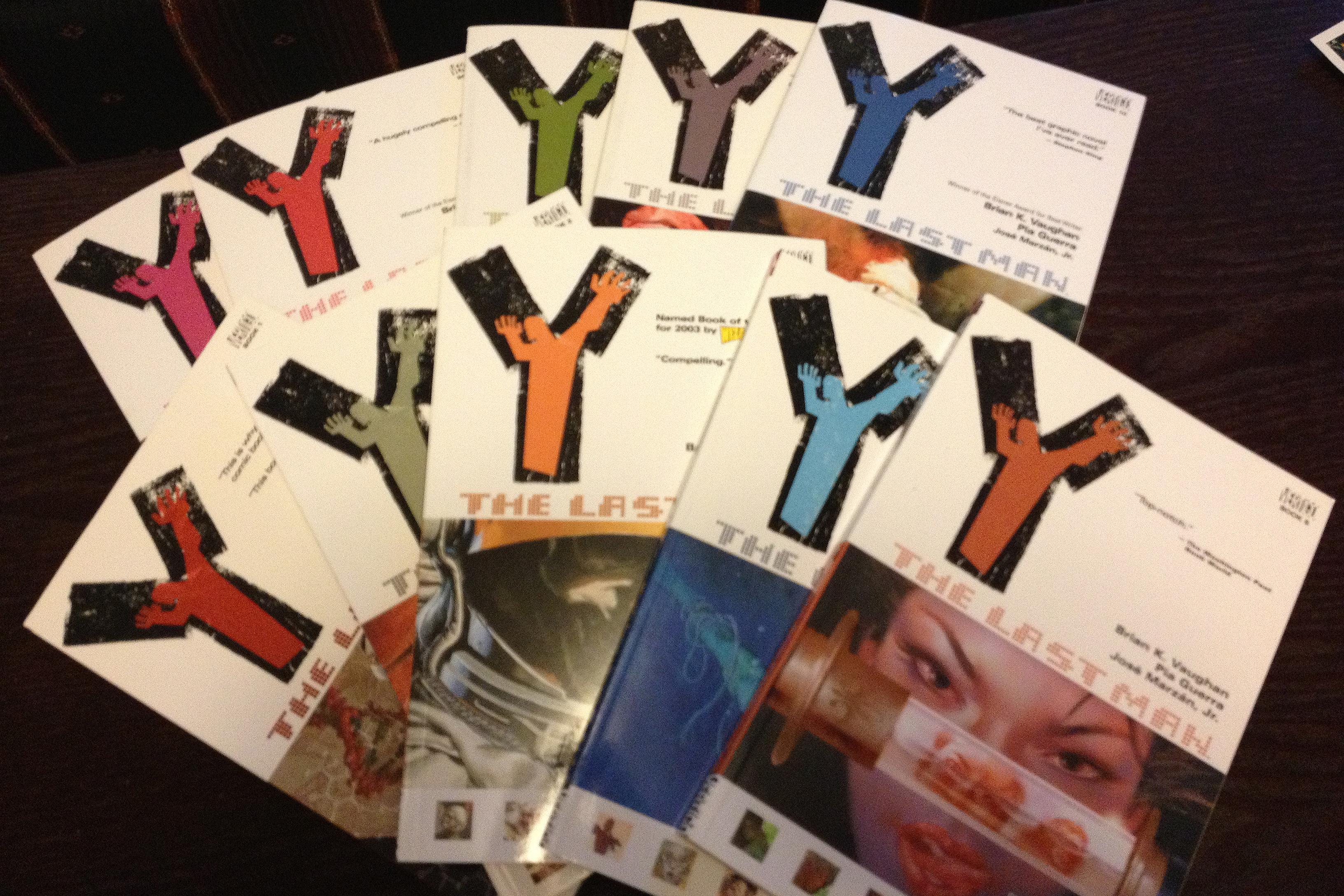
You may debate whether a series of graphic novels should be counted as “books”, but there’s no question that Y: The Last Man is a gripping, inventive, character-rich story, with layers of intrigue, masterful plotting, unexpected laughs and sorrows, and plenty of thought-provoking propositions.

Originally issued as a comic book series beginning in 2002, Y: The Last Man is also available as a series of ten trade paperback collections or as five hardcover “deluxe” editions. In whatever format you choose to read these, read them you should. I read the ten TPB volumes over the course of the past week, and it was very difficult to stop for little annoyances like sleeping and eating.

Y: The Last Man begins in the year 2002, when a mass “gendercide” occurs. For no apparent reason, all male mammals on the planet die suddenly and bloodily one afternoon in July. All, that is, except for 22-year-old unemployed English major Yorick Brown and his pet capuchin monkey Ampersand. Why has Yorick survived? And what does it really mean to be the last man on earth? While any answers to the “why” are long in coming, Yorick realizes very quickly that being the sole male is not everything an adolescent’s fantasy might imagine it to be.

For starters, the world as we know it comes crashing to a halt. The majority of airplane pilots, factory workers, nuclear power plant engineers, and politicians are all male, as are most of the farmers, truckers, and others who keep the world fed and powered. Highways are impassible, due to all the crashed vehicles from the time of the big wipe-out. In Washington DC, the small minority of female Congresswomen are left holding the reins of government, but opposition is brewing — and armed. While most armies of the world are now defunct, the Israeli army, with its trained female soldiers, is not taking this sudden change in the world power structure lying down.

Meanwhile, Yorick begins a pilgrimage to reunite with his girlfriend Beth — in the Australian outback at the time of the disaster — and to help find a way for human beings to avoid extinction. Along with way, he is joined by secret agent 355 and super-scientist Dr. Allison Mann, and between these three, they just might be able to figure out what happened and what they can do about it. But not if the bad guys (yes, there are always bad guys, even if they’re no longer “guys”) get to them first.

Social commentary is threaded throughout the series. For those who think a world without men would be all peace, love, and kumbaya, think again. Arrow-wielding feminists calling themselves “Daughters of the Amazon” believe the gendercide is Mother Earth’s way of shaking off infection, and in their zeal to cleanse the world, make it their mission to incinerate all sperm banks to ensure that males never come into being again. A group of Arizona militia women cut off all trade through their state and, armed to the teeth, shoot anything that might threaten their autonomy. The religious are sure that the rapture has arrived — and left them behind. A new sex trade arises, as women desperate for a man’s touch seek out the next best thing in the arms of women who don fake facial hair and lower vocal registers. And radicals around the world sit up and take notice when rumors of a surviving male start to circulate.

The adventure is non-stop, and the action spans the globe with a large, varied cast of characters. The tension is high, but Yorick is a funny guy, even in this most awful of situations, and so Y: The Last Man crackles with snappy dialogue and moments of humor and joy, along with heaping doses of anger, sorrow and pain.

An explanation for the catastrophe is ultimately provided, although I’m not sure that all readers will find the answers convincing or satisfying enough. Still, the “why” isn’t necessarily what matters. It’s what happens next — to Yorick, to his friends, and to the rest of the world — that drives this story forward. Y: The Last Man is excellent entertainment and an incredibly compelling tale. As far as end-of-the-world scenarios go, this one is fresh, provocative, and full of endless possibilities. Final verdict? Check it out. I’m definitely glad that I did.

Book Review: Etiquette & Espionage by Gail Carriger

Book Review: Etiquette & Espionage by Gail Carriger

https://bookshelffantasies.com/wp-content/uploads/2013/02/etiquette2526espionage.jpg?w=200Steampunk authoress extraordinaire Gail Carriger, who made the reading world a better place by introducing us to the wonderful world of The Parasol Protectorate, now steams ahead with a new young adult series, The Finishing School.
“Book The First” in the new series is Etiquette & Espionage, in which we meet 14-year-old Sophronia Timminnick, the somewhat unruly and definitely unfinished daughter of a large country-dwelling family. Sophronia is prone to mischief and misadventure, largely due to an unbridled curiosity and an unwillingness to let fashion and manners dictate her every move. Within the first chapter, Sophronia is recruited into Mademoiselle Geraldine’s Finishing Academy for Young Ladies of Quality, which takes a very select few girls for “finishing”.

And what a finishing school it is! Housed in a huge dirigible which floats over the moors, Mademoiselle Geraldine’s teaches girls not only how to curtsy and flutter eyelashes, but the finer points of misdirection, covert operations, knife and poison skills, and all the other necessary knowledge of a first-rate intelligencer.

There’s action galore amidst the comedy of manners, as well as an array of mechanical wonders including clockwork maids and butlers that run on tracks and a rather adorable little dachshund-like mechanical dog (a “mechanimal”) named Bumbersnoot. Much of the plot revolves around Sophronia chasing around after a secret prototype that’s drawn the attention of a variety of baddies out to steal it, in between which Sophronia explores the out-of-bounds areas of the school, makes unlikely friends, and learns to appreciate the finer nuances of appropriate dress and accessories.

It’s all quite clever and tongue-in-cheek, with much the same spirit as the Parasol Protectorate books. The Finishing School series is set in the same world as The Parasol Protectorate — a steampunk-ish version of England, in which vampires and werewolves are a part of society and the pursuit of scientific knowledge is often cause for nefarious crimes and plots. The Finishing School takes place about 25 years before the events in The Parasol Protectorate, but still, a nice variety of familiar faces pop up in Etiquette & Espionage, and I’m hoping that a certain burly, ill-tempered werewolf will make an appearance in one of the future volumes.

Gail Carriger shows her usual flair with character names, which in this book include Mrs. Barnaclegoose, Dimity Ann Plumleigh-Teignmott, Agatha Woosmoss, and the roguish Lord Dingleproops.

Overall, while cute and entertaining, I wasn’t enthralled by Etiquette & Espionage, which disappoints me as I’d had this one on preorder for months, based on loving Soulless and the rest of the Parasol Protectorate books so very much. The tone of E&E struck me as a bit juvenile, more middle grade than young adult. The opening chapter’s set piece is Sophronia’s misadventure in a dumbwaiter, ending badly with a trifle flying through the air and landing on an indignant woman’s hat. From there, the book continues with a great number of adventures and mischief, but I never felt that there was much at stake, despite what are intended to be a few menacing sorts trying to cause trouble.

While The Finishing School is marketed as a young adult series, Sophronia, at age 14, seems a big young and green to anchor a series whose intended audience is teens. I’m assuming that Sophronia will grow up during the ensuing volumes of the series (perhaps à la Harry Potter and his seven years at Hogwarts). I’m hoping that as Sophronia ages during the remaining three books in The Finishing School, the maturity level of the storyline will age with her.

That said, I’m sure Etiquette & Espionage will be a big hit with Gail Carriger’s goggle-and-top-hat-wearing fans. I’ll be curious to see how it fares with the young adult audience, who most likely are not familiar with the quirky delights of the world featured in the adult Parasol Protectorate books. Etiquette & Espionage is a promising beginning, but to hold my attention, I’d like to see the next book take on a little more depth and move beyond E&E‘s flavor of madcap adventure into something with a bit more substance.

Book Review: Nick & Norah’s Infinite Playlist by David Levithan & Rachel Cohn

Book Review: Nick & Norah’s Infinite Playlist by Rachel Cohn and David Levithan

I love being proved wrong about a book, and Nick & Norah’s Infinite Playlist is a good example of a happy surprise for me.

It’s possible that I just picked the wrong time of day to start this book. Perhaps I was simply too tired to give it a chance. I read about 50 pages and jotted down some quick notes before heading off to bed. My notes included phrases such as “no point of entry”, “exclusionary feel”, “impenetrable”, and “can’t relate”. Not a very auspicious beginning, to say the least.

And yet… when I continued the next day, I found my attitude toward this book completely turned around. So how and why did that happen?

For starters, a brief synopsis:

Nick is the 18-year-old bass player in a teen “queercore” punk band, who feels music — and life — deeply and passionately. Nick has been dumped recently by his girlfriend, and when she shows up at his gig, he impulsively asks the flannel-wearing girl at the bar to be his fake girlfriend for five minutes. The flannel-clad girl is Norah, who has just turned down Brown University in order to follow her on-again, off-again boyfriend to a “kibbutz” in South Africa for a year, and who is starting to realize that everything in her life may be a big mistake. Nick and Norah fake-kiss… but boy, it feels good, and thus starts a night of music, clubs, city streets, drunken friends, cab rides, Oreos, and dancing in the rain.

The book is written in alternating chapters, switching between Nick’s narration (written by David Levithan) and Norah’s (written by Rachel Cohn). The pace is quick and sharp, with dialogue that is witty, vulgar, and in-your-face. Nick and Norah are a couple of angst-ridden, deeply introspective teens, who think deeply about life, love, music, friendship, and finding meaning in the world. The beauty of this book is in the inner workings of Nick and Norah’s minds and in seeing the interplay from one chapter to the next, as Nick and Norah reinterpret each other’s actions and words, and we see the chasms of misunderstanding that must be bridged over the course of one night.

I’m always fascinated by the single-night story — they meet, they share an intense moment… but will they part forever when the sun comes up? Of course, the best example, in my mind, is Before Sunrise, a movie I could watch again and again. Nick & Norah ends up fitting nicely into this mode, showing how a chance encounter blossoms into an unexpectedly delicious and slightly dangerous, extremely intense connection. The rising sun feels like a deadline, and the only question is whether to say good-bye or face a new day together. I won’t say which happens here; in Nick & Norah’s Infinite Playlist, it’s the journey that matters.

So why the about-face for me regarding this book? Again, perhaps it was just a matter of starting the book at the wrong time, but I found the early chapters somewhat off-putting due to their setting in the Lower Manhattan punk-rock scene. The club, the people, and the musicians — all seemed to be flashing the words “not for you” at me in big neon letters. I read a lot of young adult fiction. I am definitely not a young adult myself. But as I’ve said many times, the best YA fiction is just good fiction, period. You shouldn’t need to be a teen or twenty-something to read a book about people in that demographic, so long as it’s a good book with well-drawn characters. At the beginning of Nick & Norah, I felt that age would be a barrier to my enjoyment. As the story progressed, however, I began to really enjoy Nick and Norah’s explorations not just of each other but of their own fears and hopes. The more deeply the characters journeyed, the more I came to appreciate the passion and emotion expressed by the gorgeous, full-frontal, no-holds-barred writing.

I was originally drawn to this book after having read the authors’ two other collaborative efforts, Dash & Lily’s Book of Dares and Naomi & Ely’s No Kiss List. Both were lovely, and both featured the pattern of alternating voices that work so well in Nick & Norah. As an added attraction, all three books read as love letters to New York, and it’s great fun to revel in this glorified, gritty version of the city, its people, and its hidden treasures.

A note: I have not seen the movie version of Nick & Norah’s Infinite Playlist, and I’m not sure that I’d want to. For me, the glory of the book is in getting inside the characters’ heads, and I can’t imagine that translating well to the big screen. Plus, from the movie stills I’ve seen, the casting does not at all match the pictures in my head, and I don’t want to replace “my” Nick and Norah with the Hollywood version. (But if you’ve read the book and seen the movie, please do share your thoughts! How do they compare?)

All in all, I’m very glad that I stuck with this book long enough to get past my initial turned-off phase, as I ended up enjoying it very much. This is a short, quick, intense read, but one which really held my interest and touched my emotions as well.

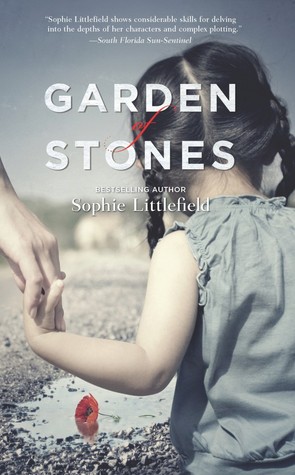
Book Review: Garden of Stones by Sophie Littlefield

Book Review: Garden of Stones by Sophie Littlefield

gardenIn December 1941, 14-year-old Lucy Takeda is the cherished daughter of a well-to-do Japanese-American couple living in Los Angeles. Lucy’s father is a successful businessman. Her mother is an enigmatic beauty who turns heads whenever she walks down the street. Lucy lives a happy life with close friends, a good school, and a bright future, until the Japanese attack on Pearl Harbor spells the end of life as she once knew it.

Before long, Lucy’s father is dead of a heart attack, and she and her mother, as well as all of their friends and neighbors, are forced from their homes as a result of President Roosevelt’s executive order of 1942, which designated the entire Pacific coast as an exclusion zone and forced thousands of Japanese-Americans into internment camps. Lucy and her mother Miyako are sent to Manzanar, the roughly built camp in the Sierra foothills of California, where they are assigned a flimsy wooden barrack in which to live and where their world becomes restricted to one square mile crammed full of their fellow internees.

Compounding the difficulty for Lucy is her mother’s instability. While in today’s world, Miyako might have been treated and medicated, at Manzanar in those times, Miyako was simply viewed as difficult or unlikeable, rather than having her bipolar disorder recognized or accommodated. Miyako’s beauty, however, does not go unnoticed, and she is soon the recipient of unwelcome but unavoidable attention from the powerful men who run the camp. Events soon spiral out of control, and despite their efforts to protect one another, Lucy and Miyako’s time at Manzanar can only end in tragedy for both.

Garden of Stones is a story within a story, framed by events in 1978 in which Lucy’s daughter Patty seeks answers when Lucy’s long-secret past resurfaces unexpectedly. As Patty starts to dig through clues and finally gets her mother to open up, we see the events from the 1940s from Lucy’s perspective, providing an interesting contrast between Lucy’s outlook as a teen and as a middle-aged adult. Lucy’s life has not been easy, and although she has raised Patty to the best of her ability, by keeping her past a secret she has kept her daughter from ever truly knowing who she is and what she’s experienced.

I found myself quite moved by the tragedy of Lucy’s story, in which we witness a life shattered by war and prejudice, a young girl who had everything she cherished ripped away from her, and yet who somehow manages to survive into adulthood and provide a safe and loving home for her child. Garden of Stones presents two very different mother-daughter relationships, and poses some interesting questions: What does it mean for a mother to protect her daughter? Are extreme measures justifiable if taken out of love? Is pain inflicted out of love preferable to pain inflicted through cruelty? How does one survive after enduring loss after loss?

Author Sophie Littlefield explores this shameful chapter from America’s past with an unflinching eye. We see the devastation from Lucy’s perspective, as a child born and raised in the United States, who speaks not a word of Japanese, is suddenly branded as “other”. We witness the terror of the Japanese-American community in the days following Pearl Harbor, as families frantically burn any Japanese goods or relics in their homes so as not to be seen as sympathizers — or worse, as spies or conspirators. We see friends and neighbors close their doors, turn their backs, and otherwise abandon the people they’d lived alongside, as the Japanese-Americans are forced to sell off their belongings for a pittance before being exiled to the internment camps.

But the larger, historical context is not the only source of sorrow and terror in Lucy’s life, and it is her more personal story that truly gives Garden of Stones its emotional richness. Despite the hardships and privations at Manzanar, Lucy seeks out happiness and friendship, but the circumstances of camp life and her mother’s role in Manzanar serve again and again to bring Lucy pain and suffering.

While some of the more dramatic events of the story are fairly well signaled ahead of time, there are several very surprising turns of events that made me go back through the book and reread certain passages with a fresh eye. I found the Manzanar timeline much more compelling than the 1970s storyline, and yet Patty’s exploration of the past served as a very effective means of slowing unearthing the secrets of Lucy’s life and understanding how these secrets continue having an impact even into the next generation.

Sophie Littlefield has crafted a well-written, emotionally intense tale, full of rich detail and with several well-placed, shocking plot twists. Garden of Stones is a moving story of love between mothers and daughters, of the search for meaning despite the cruelties inflicted during a hard life, and of the many different roads toward hope and survival.

Review copy courtesy of Harlequin via Netgalley