The Monday Check-In ~ 9/10/2018

cooltext1850356879 My Monday tradition, including a look back and a look ahead — what I read last week, what new books came my way, and what books are keeping me busy right now. Plus a smattering of other stuff too.

Life.

Wishing all who celebrate a sweet and happy new year! I’m traveling for a few days, visiting family for the holidays, so this post (and all others) may be a bit choppier than usual. But, as always when I have lots of hours on airplanes, I’ve been reading my head off!

What did I read during the last week?

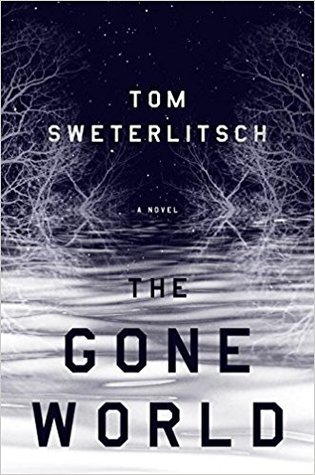
The Gone World by Tom Sweterlitsch: Creepy sci-fi with lots of timey-wimey twists. Confusing, sometimes horrifying, pretty great read.

Promised Land by Martin  Fletcher: Powerful historical fiction. My review is here.

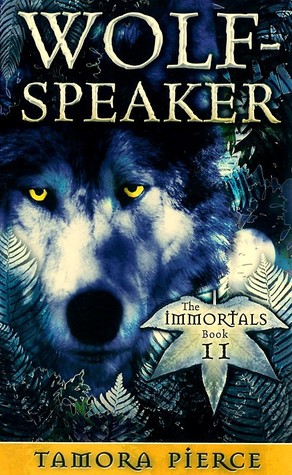
Wolf-Speaker by Tamora Pierce: Book #2 in The Immortals series. This series gets better and better!

Fresh Catch:

No new books this week. Well, no new physical books. I’m incapable of resisting when I see a good Kindle price drop.

What will I be reading during the coming week?

Currently in my hands:

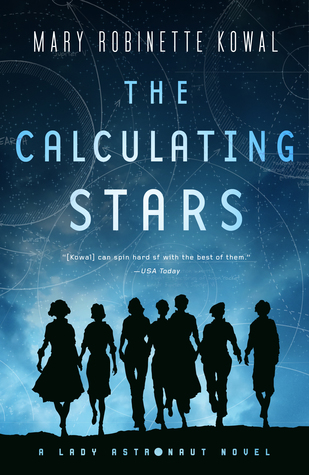
The Calculating Stars by Mary Robinette Kowal: A little bit Hidden Figures, a little bit Deep Impact (remember that movie?), even a little bit Interstellar — a whole lot of awesome. Loving this book.

Now playing via audiobook:

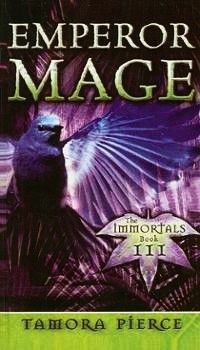
Emperor Mage (The Immortals, #3) by Tamora Pierce: I really love these characters. Totally enjoying the audiobook! I should be wrapping up by mid-week, and want to continue straight on with #4.

Ongoing reads:

Book group reads:

  • Classic read: My book group’s current classic read is Middlemarch by George Eliot.  We’re reading and discussing two chapters per week. Slow but steady!
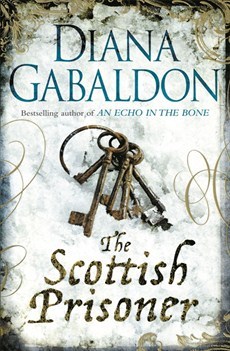
  • The Scottish Prisoner by Diana Gabaldon. Continuing our group read of the Lord John works, it’s lovely to revisit The Scottish Prisoner, which stars Lord John Grey and everyone’s favorite Scottish laird, Jamie Fraser. Want to join in? Ask me how!

So many books, so little time…

boy1Save

Save

Save

Save

Save

Save

Save

Save

Save

Save

Save

Save

Save

Save

Save

Save

Save

Save

Save

Save

Save

Save

Save

Save

Save

Save

Save

Save

Save

Save

Save

Save

Save

Save

Save

Save

Save

Save

Save

Save

Save

Save

Save

Save

Save

Save

Save

Save

Save

Save

Save

Save

Save

Save

Save

Save

Save

Save

Save

Save

Save

Save

Save

Save

Save

Save

Save

Save

Save

Save

Save

Save

Save

Save

Save

Save

Save

Save

Save

Save

Save

Save

Save

Save

Save

Save

Save

Save

Save

Save

Save

Save

Save

Save

Save

Save

Save

Save

Save

Save

Save

Save

Save

Save

Save

Save

Save

Save

Save

Save

Save

Save

Save

Murderbot is back! Rogue Protocol – book #3

Murderbot returns for a 3rd adventure!

Thank you, Tor Books, for the review copy of Rogue Protocol!

The Murderbot Diaries
Book #3 – Rogue Protocol

(160 pages, published August 7, 2018 by Tor)

SciFi’s favorite antisocial A.I. is again on a mission. The case against the too-big-to-fail GrayCris Corporation is floundering, and more importantly, authorities are beginning to ask more questions about where Dr. Mensah’s SecUnit is.

And Murderbot would rather those questions went away. For good.

My thoughts:

What’s not to love about a cantankerous SecUnit who’d really rather just be left alone? Too bad for Murderbot that those darn softy, squishy humans keep getting in its way and requiring its protection. So what’s an exasperated AI to do? In Rogue Protocol, Murderbot once again sneaks its way onto a transport filled with humans on a secret mission, this time looking for evidence against the nefarious GrayCris Corporation. But of course, nothing goes as planned, since the humans involved end up needing looking after, even though they’re not technically Murderbot’s to worry about.

I’ll be honest and say that the action feels a little opaque to me. Lots of hatches and corridors and whatnot… lots of energy blasters and armor and drones… It’s all quite energetic and high-speed, but the technical mumbo-jumbo tends to make my eyes glaze over.

Still, what redeems these novellas for me is the fabulous voice of Murderbot itself, who is just as fed up as always. Why can’t the poor AI just enjoy its media feeds in peace?

I’ll leave you with a few choice snippets of Murderbot ruminations:

This was going to be even more annoying than I had anticipated, and I had anticipated a pretty high level of annoyance, maybe as high as 85 percent. Now I was looking at 90 percent, possibly 95 percent.

Who knew being a heartless killing machine would present so many moral dilemmas.

(Yes, that was sarcasm.)

Right, so the only smart way out of this was to kill all of them. I was going to have to take the dumb way out of this.

If you’re a sci-fi fan and haven’t yet experienced Murderbot, definitely give these novellas a try! Now is a great time to jump in — the 4th (and final?) book is due out in October.

**Save

Save

Save

Save

Save

Save

Save

Book Review: Robots vs Fairies – edited by Dominik Parisien & Navah Wolfe


A unique anthology of all-new stories that challenges authors to throw down the gauntlet in an epic genre battle and demands an answer to the age-old question: Who is more awesome—robots or fairies?

Rampaging robots! Tricksy fairies! Facing off for the first time in an epic genre death match!

People love pitting two awesome things against each other. Robots vs. Fairies is an anthology that pitches genre against genre, science fiction against fantasy, through an epic battle of two icons.

On one side, robots continue to be the classic sci-fi phenomenon in literature and media, from Asimov to WALL-E, from Philip K. Dick to Terminator. On the other, fairies are the beloved icons and unquestionable rulers of fantastic fiction, from Tinkerbell to Tam Lin, from True Blood to Once Upon a Time. Both have proven to be infinitely fun, flexible, and challenging. But when you pit them against each other, which side will triumph as the greatest genre symbol of all time?

There can only be one…or can there?

This awesome story collection has a premise spelled out in the introduction by the editors:

“I, for one, welcome our __________ overlords.”

Assuming the mechanical and/or magical revolution has already taken place by the time you read this, we, the editors, always knew you would come out on top. Yes, you.

We knew this day would come. We tried to warn the others. It was obvious either the sharp rate of our technological advancement would lead to the robot singularity claiming lordship over all, or that the fairies would finally grow tired of our reckless destruction of the natural world and take it back from us.

And so, we have prepared a guide to assist our fellow humans in embracing their inevitable overlords. (If you are reading this and you are human, we are so pleased you found this book in time to ready yourself for the impending/current robot/fairy apocalypse. You are quite welcome.)

Robots vs Fairies is an anthology of stories by an impressive assortment of sci-fi and fantasy writers, each focusing on either robots or fairies (or in a few cases, both). There are eighteen stories in all, ranging from silly to darkly serious. In each case, right after the story, the author declares him/herself “team robot” or “team fairy”, and explains why — and these little pieces are just as entertaining as the stories themselves, in my humble opinion.

As I’ve said in many a review, I’m really not a short story reader, so the fact that I made it all the way through this book is somewhat of an achievement. I did end up skipping 2 or 3 stories that just didn’t call to me, but otherwise read them all, even the ones that left me puzzled or disengaged or with a mighty shoulder shrug.

Still, the stories that I enjoyed, I really, really enjoyed. Best of the batch for me were:

Build Me a Wonderland by Seanan McGuire: Well, of course I loved the Seanan McGuire story! I’m been on a roll with Seanan McGuire books all year, so there’s really zero chance that I wouldn’t love what she wrote. In this story, we see behind the scenes at a theme park with really magical magical effects. Hint: They’re not CGI. The story is clever and intricate and very much fun.

Quality Time by Ken Liu: Ooh, a disturbing robot story! All about a young tech worker looking for the next big breakthrough, whose inventions have unintended consequences.

Murmured Under the Moon by Tim Pratt: About a human librarian given responsibility for fairy archives. Creative and magical and just a wee bit threatening — and hey, it’s about a library! What’s not to love?

The Blue Fairy’s Manifesto by Annalee Newitz: Not a fairy story! It’s a robotic version of Pinocchio, and asks all sorts of great questions about what it is to be real, and what it means to have choices.

Bread and Milk and Salt by Sarah Gailey: I loved Sarah Gailey’s American Hippo novellas, so was really excited to see her included in this collection. Bread and Milk and Salt is probably the creepiest story of the bunch, about a fairy captured by a sadistic human and how she turns things around. Dark and disturbing and delicious.

And perhaps my favorite, because I love John Scalzi and his humor, and this story left me rolling on the floor:

Three Robots Experience Objects Left Behind From the Era of Humans For the First Time: Oh my. This story is exactly what the title says it is — a dialogue between robots trying to figure out the purpose and functionality of human objects such as a ball, a sandwich, and a cat. Just amazing. And in case you’re wondering about our future overlords, it would seem clear that it’s cats for the win.

There are plenty more stories, some I found captivating, some weird, all original and entertaining and often perplexing too. It’s really a strong collection, and I could see enjoying it either as a book to read straight through, or as a collection to leave on the nightstand and pick up from time to time to read just one story here or or there, whenever the mood strikes.

As a side note, I had purchased an earlier collection from these editors, featuring some of the same authors plus several others whose works I love. The Starlit Wood: New Fairy Tales was published in 2016, and I have yet to open it. Maybe it’s time for it to come down off the shelf and sit on my nightstand, close at hand for when I need a story or two.

_________________________________________

The details:

Title: Robots vs Fairies
Authors: Dominik Parisien & Navah Wolfe
Publisher: Saga Press
Publication date: January 9, 2018
Length: 373 pages
Genre: Science fiction/fantasy anthology
Source: Purchased

**Save

Save

Save

Save

Save

Save

Save

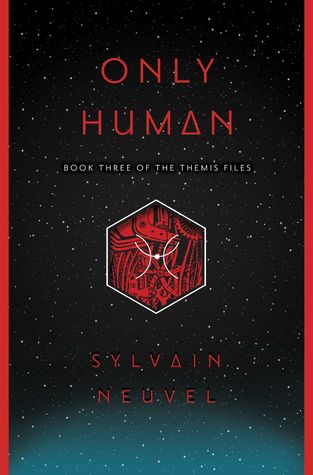
Audiobook Review: Only Human by Sylvain Neuvel (The Themis Files, #3)


In her childhood, Rose Franklin accidentally discovered a giant metal hand buried beneath the ground outside Deadwood, South Dakota. As an adult, Dr. Rose Franklin led the team that uncovered the rest of the body parts which together form Themis: a powerful robot of mysterious alien origin. She, along with linguist Vincent, pilot Kara, and the unnamed Interviewer, protected the Earth from geopolitical conflict and alien invasion alike. Now, after nearly ten years on another world, Rose returns to find her old alliances forfeit and the planet in shambles. And she must pick up the pieces of the Earth Defense Corps as her own friends turn against each other.

I have loved The Themis Files books since day one, so it’s probably no surprise that I really and truly loved this concluding volume as well. In the first two Themis Files books, we see the discovery of a giant robot, which is in truth an alien artifact, leading to an alien invasion that threatens the survival of all humankind. Here, in Only Human, we find out how it all works out.

The previous book, Waking Gods, ends on a cliffhanger. With the immediate threat removed, Vincent, Rose, and Eva are celebrating their victory, when they suddenly realize they’re not on Earth any longer. As Only Human opens, we learn that our Earthlings have been transported to the alien home planet, which finally gets a name – Esat Ekt. And there they stay, learning the Ekt language, culture, and sense of morality, with no means of going home.

The Ekt’s principal code of morality is non-interference. They will not allow themselves to alter the course of any other species’ progress, development, or evolution. If a species is meant to go extinct, the Ekt will not interfere. And if a species, such as the human race, develops in a way that they should not have because of Ekt interference in the past, then all signs of that interference must be eliminated. Of course, the Ekt didn’t mean to commit mass murder, as they did in book #2, and here in book #3, the people of Esat Ekt are deeply embroiled in a reexamination of their non-interference policy after realizing their responsibility for the deaths of tens of millions on Earth.

Meanwhile, back on Earth, in the years following the great battle which concluded in the previous book, human interactions have changed dramatically. One of the giant robots ended up left behind, then seized as property of the United States, which then used it to rewrite the geopolitical lines of the planet. When Rose, Vincent, and Eva return almost a decade later aboard Themis, the Russians want the robot — badly — and will do just about anything to get it and its pilots under their control, in an effort to reshape the world’s balance of power.

As with the earlier books, Only Human is told via interview transcripts and journal entries, with the entries from the humans on Esat Ekt interwoven with the entries from Earth upon the gang’s arrival back on their home planet all those years later. Through these entries, we learn about life on Esat Ekt — the politics, the participatory democracy, the casual bigotry, and the way a free society can have hidden biases and injustices. Meanwhile, we see the ongoing complicated dynamics between the main characters. The highlight is the relationship between Vincent and his daughter Eva. Only 10  years old when they were whisked off to an alien planet, by the start of the action in this book Eva is a 19-year-old young woman who is strong-willed and ready to jump into action to pursue justice, never mind her own safety. Naturally, she and Vincent are on a collision course, and when their conflict finally comes to a head, it’s spectucular.

There are so many memorable characters in these books. An old favorite, Mr. Burns, returns in Only Human, and I also was really fascinated by the American-raised Russian agent Katherine, whose Americanisms and snark hide a truly terrifying ruthless streak.

The audiobook version is amazing, performed by a full cast. In fact, while I had the e-book ARC for some time before the official release date, I chose to wait until the Audible edition became available because I really wanted to experience the story in that way, as I did with the first two books. The voice actors are terrific. I love Vincent, with his French-Canadian accent and excitable nature; Rose’s calm demeanor, Mr. Burns’s humor, and — big treat here — the Ekt characters as well, speaking both a mangled sort of English as well as their own native language. My only complaint is that Eva’s accent has completely changed from the previous book, and it was weird and distracting at first. Oh well. I got over it. As a whole, the audiobook experience is a delight.

Let’s pause here to admire author Sylvain Neuvel’s fantastic use of his linguistics background to create a language for the Ekt that’s weird and alien and sounds just awesome to listen to. I loved the words and phrases, and very much enjoyed learning a yokits swear word in Ekt.

Needless to say, I highly recommend the Themis Files series. If you enjoy audiobooks, absolutely listen to these! The production is top-notch and really added to my enjoyment. But even without the audio, it’s an incredible story, so well written, full of sci-fi adventure and surprises — but even more so, full of human emotion and heart, which are what truly makes this story work.

I really do hope that the author will choose to write more in the Themis-verse… but if not, I’ll still want to read whatever he writes next.

_________________________________________

The details:

Title: Only Human (The Themis Files, #3)
Author: Sylvain Neuvel
Narrator: Full cast production
Publisher: Del Rey
Publication date: May 1, 2018
Length (print): 336 pages
Length (audiobook): 8 hours, 43 minutes
Genre: Science fiction
Source: E-book review copy courtesy of the publisher via NetGalley; audiobook downloaded via Audible

Save

Save

Save

Save

Murderbot! Books 1 & 2 of Martha Wells’s amazing sci-fi adventure series.

For sci-fi lovers looking for something fresh, new, and quick, the Murderbot Diaries novellas are sure to rock your world!

Thank you, Tor Books, for the review copy of Artificial Condition!

Book #1 – All Systems Red
(144 pages, published May 17, 2017 by Tor)

In a corporate-dominated spacefaring future, planetary missions must be approved and supplied by the Company. Exploratory teams are accompanied by Company-supplied security androids, for their own safety.

But in a society where contracts are awarded to the lowest bidder, safety isn’t a primary concern.

On a distant planet, a team of scientists are conducting surface tests, shadowed by their Company-supplied ‘droid — a self-aware SecUnit that has hacked its own governor module, and refers to itself (though never out loud) as “Murderbot.” Scornful of humans, all it really wants is to be left alone long enough to figure out who it is.

But when a neighboring mission goes dark, it’s up to the scientists and their Murderbot to get to the truth.

My thoughts:

This novella is fast, fun, and engaging, with plenty of action and lots of humor to go with it. First of all, what makes this a great read is the first-person narration by Murderbot itself (or SecUnit, as the rest of the team refer to it). Murderbot, having hacked the module that forces it to blindly follow orders, really just wants to be left to its own devices — mainly so it can focus on watching all the serialized entertainment feeds that it’s downloaded.

As Murderbot and the crew of the expedition find themselves in unexpected danger from an unknown enemy, Murderbot — uncomfortably and unwillingly — ends up caring much more than it intends to about its group of humans. Its attempts to protect the humans earns it their trust and friendship, and that’s almost too weird for it to be able to deal with.

I really love the Murderbot character and the many funny moments focused on its reactions to social settings and interactions. While some of the action is a bit hard to follow, it doesn’t really matter all that much. It’s a good, well-drawn, fast-paced adventure, with ups and downs and high drama. The ending makes clear that there’s much more to come and much more to know about Murderbot, which leads us to…

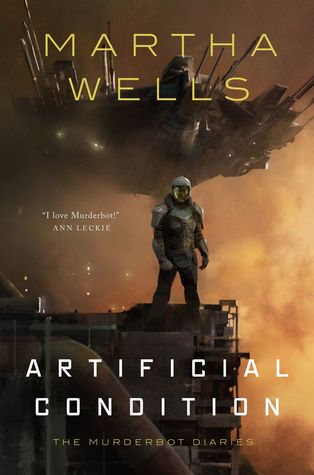
Book #2 – Artificial Condition
(159 pages, published May 8, 2018 by Tor)

It has a dark past – one in which a number of humans were killed. A past that caused it to christen itself “Murderbot”.

But it has only vague memories of the massacre that spawned that title, and it wants to know more.

Teaming up with a Research Transport vessel named ART (you don’t want to know what the “A” stands for), Murderbot heads to the mining facility where it went rogue.

What it discovers will forever change the way it thinks…

My thoughts:

Artificial Condition picks up where All Systems Red leaves off, and it’s just as awesome this time around to accompany Murderbot on its quest for the truth about its own past. Murderbot’s partnership with ART starts off with annoyance, but before long they’re watching the serials together on their feeds and doing some truly masterful hacking of pretty much every security system they find.

Murderbot gets the answers it’s looking for, and meanwhile gets involved with yet another group of vulnerable humans who desperately need its protection. Of course, it can’t help feeling responsible for them, and takes care of them and resolves their crisis in the most Murderbot-ish way possible.

I absolutely adore being in Murderbot’s head. I will never get tired of how it thinks, especially how it thinks about humans.

Part of my job as a SecUnit was to give clients advice when they asked for it, as I was theoretically the one with all the information on security. Not that a lot of them had asked for it, or had listened to me. Not that I’m bitter about that, or anything.

I felt this would be the point where a human would sigh, so I sighed.

“Tlacey bought us passage on a public shuttle,” Rami told me. “That could be a good sign, right?”

“Sure,” I said. It was a terrible sign.

A self-aware, self-determining robot with a sense of humor and an unquenchable thirst for watching TV will never get old for me. The Murderbot books are a blast. Can’t wait for #3, coming in August.

**Save

Save

Save

Save

Save

Save

Save

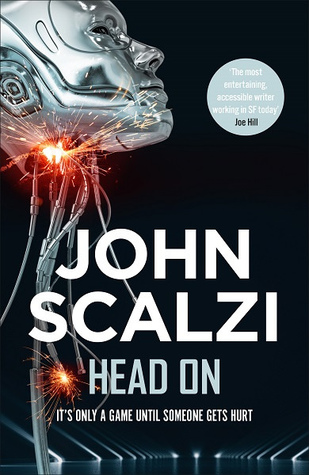
Book Review: Head On by John Scalzi


John Scalzi returns with Head On, the standalone follow-up to the New York Times bestselling and critically acclaimed Lock In. Chilling near-future SF with the thrills of a gritty cop procedural, Head On brings Scalzi’s trademark snappy dialogue and technological speculation to the future world of sports.

Hilketa is a frenetic and violent pastime where players attack each other with swords and hammers. The main goal of the game: obtain your opponent’s head and carry it through the goalposts. With flesh and bone bodies, a sport like this would be impossible. But all the players are “threeps,” robot-like bodies controlled by people with Haden’s Syndrome, so anything goes. No one gets hurt, but the brutality is real and the crowds love it.

Until a star athlete drops dead on the playing field.

Is it an accident or murder? FBI Agents and Haden-related crime investigators, Chris Shane and Leslie Vann, are called in to uncover the truth―and in doing so travel to the darker side of the fast-growing sport of Hilketa, where fortunes are made or lost, and where players and owners do whatever it takes to win, on and off the field.


I loved Lock In (review), John Scalzi’s novel that introduced us to the world of Hadens and threeps as experienced through the eyes of new FBI agent Chris Shane. And when I heard that there would be another story set in the same world… well, excited isn’t even the word for it.

Here’s a quick refresher for those unfamiliar with the premise. Some 25 years in the past, a new strain of flu ravaged the globe, killing millions, and leaving a percentage of survivors “locked in” — fully aware, yet unable to carry out any voluntary bodily functions. Those in this locked-in state became known as Hadens, in honor of the syndrome’s most famous early patient, the wife of then-President Haden. As Haden’s Syndrome ravaged populations world-wide, enormous funds and resources were devoted to treatment, and the most significant innovations were the development of neural nets — basically, networking implanted in the brains of Hadens — and threeps — personal transport devices into which Hadens transport their consciousness, allowing them to move, interact, have jobs, and live in the world, all while their actual bodies are safely at home supported by life-support systems and caregivers.

Agent Shane is a Haden, who at one point was incredibly famous by virtue of his basketball star father’s enormous influence, popularity, and wealth. Now, Shane just wants a life of his own, out of the spotlight, pursuing a meaningful career and being a contributing member of society.

Okay, those are the basics of this sci-fi world.

As for Head On, I can safely say that this book lives up to the thrill-level of Lock In, presenting a whole new facet of Haden existence one year after the events of that book. In Head On, the narrative kicks off with a death on a sports field. But this isn’t football — this is the brave new world of professional Hilketa leagues, played by Hadens in threeps in a game that feels like a mash-up of rugby and gladiator combat. And just think about the weirdness of it all: While the players are superstar athletes with multi-million dollar endorsements, they’re also physically in their immobilized bodies at the same time they’re experiencing glory on the field. Hilketa players feel pain (league rules require them to keep their pain settings at a minimal level), but the physical damage — like having limbs or even heads ripped off — happens only to the threep itself.

The description of the game is both ridiculous and captivating — kind of like reading about Quidditch for the first time!

When a player dies after sustaining damage on the field, it quickly becomes apparent that there’s more going on then just an unfortunate sports-related death. The FBI is responsible for investigating Haden-related crimes, so it’s Agents Shane and Vann on the job once again. The agents’ chemistry is just as entertaining as in the first book, full of quips and banter, as well as an astonishingly effective good cop, bad copy routine that never gets old.

The mystery of the death and the implied scandal and corruption within the Hilketa league are intriguing. The clues and schemes are pretty mind-boggling, and I’ll admit that by the time the story starts unraveling financial misconduct and corporate fraud, I did get a bit lost in some of the details. No matter. The important connections are built up piece by piece, so that by the end, it all fits together in a way that makes sense and gives us the satisfaction of seeing the bad guys get what’s coming to them.

Despite the murders and mayhem, there’s plenty of fun along the way, especially when it comes to seeing Shane with his Hadens roommates and all their goofy dynamics. Oh, and did I mention the cat? There’s a cat. And the cat becomes a crucial bit of evidence in a way that’s cute and clever and made me laugh.

A word about gender:

You may have noticed that I refer to Agent Shane as “he”… and that’s just not entirely accurate. Both Lock In and Head On are written in the first person, with Chris Shane as narrator.

And, I’m ashamed to say, it absolutely never occurred to me that the author never actually specifies Chris’s gender. I suppose I assumed that Chris was short for Christopher, back when I first started Lock In, and I pictured Chris as a male throughout my read of the first book. It wasn’t until I encountered this article prior to the publication of Head On that I even realized that I’d jumped to conclusions.

Again, John Scalzi NEVER SAYS whether Chris is male or female. Both are possible. And what’s really cool is that two versions of the audiobook are available, one narrated by Wil Wheaton and one by Amber Benson. I downloaded the Wil Wheaton version back when I got Lock In, and wasn’t aware that there was any other version.

So now, as I was reading Head On, I couldn’t help hearing Wheaton’s voice in my head and consequently continued picturing of Chris as a male — but at least now, I stopped to think and reconsider certain scenes. Would the dynamic of Shane and Vann’s banter come across differently if it was between two females agents, rather than male and female? Is there an element of sexual politics implicit in the male/female working partnership that would have struck me differently if the gender differential was removed?

I can only imagine that the tone of certain parts of the story would feel very different to me if I’d been picturing a female lead character all along. So I’ve decided to put it to the test. Not right now, but sometime soon, I plan to revisit Head On by listening to the audiobook, and this time around, I’ll choose the Amber Benson version. Should be fascinating! And if I find that it’s a really different experience of the same story, I’ll be sure to report back.

Enough of my rambles…

Back to the review: I can definitely recommend Head On for anyone who enjoys science fiction with a touch of humor. While Head On doesn’t feel quite as revelatory as Lock In, in which the author had to build a whole new reality, it’s still quite an enjoyable, attention-grabbing read. John Scalzi is an amazing writer, and I hope he’ll continue to explore this world in future books.

_________________________________________

The details:

Title: Head On
Author: John Scalzi
Publisher: Tor Books
Publication date: April 17, 2018
Length: 335 pages
Genre: Science fiction
Source: Purchased

**Save

Save

Save

Save

Save

Save

Save

Novella: The Only Harmless Great Thing by Brooke Bolander


In the early years of the 20th century, a group of female factory workers in Newark, New Jersey slowly died of radiation poisoning. Around the same time, an Indian elephant was deliberately put to death by electricity in Coney Island.

These are the facts.

Now these two tragedies are intertwined in a dark alternate history of rage, radioactivity, and injustice crying out to be righted. Prepare yourself for a wrenching journey that crosses eras, chronicling histories of cruelty both grand and petty in search of meaning and justice.

The Only Harmless Great Thing is weird and wonderful, cruel and beautiful. Can you possibly believe that two awful chapters from history — the “radium girls” and an electrocuted elephant — would fit together in one story? Author Brooke Bolander pulls off this seemingly impossible task in a new novella that almost defies description — you just need to experience it.

The narration shifts between elephant and human characters, in language that’s often hauntingly strange and beautiful.

At night, when the moon shuffles off behind the mountain and the land darkens like wetted skin, they glow. There is a story behind this. No matter how far you march, O best beloved mooncalf, the past will always drag around your ankle, a snapped shackle time cannot pry loose.

The human parts of the story are heart-breaking and outrage-inducing… but so are the elephants’ sections. As I read, the story of the radium factory workers’ treatment left me feeling furious. The involvement of elephants in the radium story is startling but makes sense in this alternate world in which humans and elephants converse via sign language, and the elephant language (Proboscidian) is taught in universities.

Then came the Atomic Elephant Hypothesis.

The Only Harmless Great Thing is a quick but powerful read, unusual and a little crazy and definitely something that will stick in my mind for quite some time. It made me angry and sad, and also made me think. Highly recommended.

But chains can be snapped, O best beloved mooncalf. Sticks can be knocked out of a Man’s clever hands. And one chain snapping may cause all the rest to trumpet and stomp and shake the trees like a rain-wind coming down the mountain, washing the gully muddy with bright lightning tusks and thunderous song.

PS – The story of Topsy, the elephant electrocuted at Coney Island, is changed and reinvented here in this novella — but yes, there was a real Topsy, and she really was put to death in 1903 by being electrocuted in front of a crowd as part of a public spectacle. It’s a horrible story that seems too outrageous to be true, but sadly, it really happened. You can read more about Topsy’s awful fate here.

PPS – Reading this novella reminded me that I picked up a copy of the non-fiction book The Radium Girls (winner of the 2017 Goodreads Choice Award for history and biography), and really need to read it!

_________________________________________

The details:

Title: The Only Harmless Great Thing
Author: Brooke Bolander
Publisher: Tor
Publication date: January 23, 2018
Length: 96 pages
Genre: Alternate history
Source: Purchased

Save

Save

Save

Save

Save

Save

Save

Save

Save

Save

Save

Take A Peek Book Review: Future Home of the Living God by Louise Erdrich

“Take a Peek” book reviews are short and (possibly) sweet, keeping the commentary brief and providing a little peek at what the book’s about and what I thought.


Synopsis:

(via Goodreads)

The world as we know it is ending. Evolution has reversed itself, affecting every living creature on earth. Science cannot stop the world from running backwards, as woman after woman gives birth to infants that appear to be primitive species of humans. Thirty-two-year-old Cedar Hawk Songmaker, adopted daughter of a pair of big-hearted, open-minded Minneapolis liberals, is as disturbed and uncertain as the rest of America around her. But for Cedar, this change is profound and deeply personal. She is four months pregnant.

Though she wants to tell the adoptive parents who raised her from infancy, Cedar first feels compelled to find her birth mother, Mary Potts, an Ojibwe living on the reservation, to understand both her and her baby’s origins. As Cedar goes back to her own biological beginnings, society around her begins to disintegrate, fueled by a swelling panic about the end of humanity.

There are rumors of martial law, of Congress confining pregnant women. Of a registry, and rewards for those who turn these wanted women in. Flickering through the chaos are signs of increasing repression: a shaken Cedar witnesses a family wrenched apart when police violently drag a mother from her husband and child in a parking lot. The streets of her neighborhood have been renamed with Bible verses. A stranger answers the phone when she calls her adoptive parents, who have vanished without a trace. It will take all Cedar has to avoid the prying eyes of potential informants and keep her baby safe.

A chilling dystopian novel both provocative and prescient, Future Home of the Living God is a startlingly original work from one of our most acclaimed writers: a moving meditation on female agency, self-determination, biology, and natural rights that speaks to the troubling changes of our time.

My Thoughts:

While often disturbing, this book doesn’t flesh out its dystopian vision well enough to make a true impact. The concept of evolution running backwards isn’t really explored or explained. True, the story is told through the eyes of its main character, Cedar, and she can only tell what she herself knows — but that narrow viewpoint limits the reader’s ability to grasp the outside events and understand how the world could change so dramatically in so short a time. Within mere months, pregnant women are hunted, tracked, and imprisoned, forced into reproductive centers with no choice but to bear and then lose children.

Meanwhile, Cedar’s exploration of family, roots, and faith meander and lack coherence. The book is at its best during its most harrowing sections, when Cedar is on the run or in the midst of an elaborate escape plot. Her inner monologues and writings on religion take away from the building tension.

It’s a shame, because the big-picture concept could be intriguing if we had more information on why it’s happening, or really, a better view of what actually is happening. Instead, it’s a little bit Handmaid’s Tale but without the urgency or connection of that classic. Overall, I walked away disappointed by a book I’d been so eager to read.

_________________________________________

The details:

Title: Future Home of the Living God
Author: Louise Erdrich
Publisher: Harper
Publication date: November 14, 2017
Length: 267 pages
Genre: Speculative/science fiction
Source: Purchased

**Save

Save

Save

Save

Save

Save

Save
Book Review: Artemis by Andy Weir

Jazz Bashara is a criminal.

Well, sort of. Life on Artemis, the first and only city on the moon, is tough if you’re not a rich tourist or an eccentric billionaire. So smuggling in the occasional harmless bit of contraband barely counts, right? Not when you’ve got debts to pay and your job as a porter barely covers the rent.

Everything changes when Jazz sees the chance to commit the perfect crime, with a reward too lucrative to turn down. But pulling off the impossible is just the start of her problems, as she learns that she’s stepped square into a conspiracy for control of Artemis itself—and that now, her only chance at survival lies in a gambit even riskier than the first.


I suppose I should acknowledge up front that it was practically impossible that Andy Weir’s second novel would measure up to his hugely successful first novel, The Martian. I mean, The Martian was amazing, plain and simple. It was fresh, it was new, it was smart, and it was highly entertaining.

So how does an author follow up such a tremendous hit?

Well, in this case, with a book that’s fun and light, but feels a little too familiar to really leave much of a mark.

In Artemis, Jazz (short for Jasmine) is a criminal-lite — she smuggles contraband while working as a porter, plans to become a wealthy EVA (extravehicular activity) tour guide, and meanwhile works odd jobs that are not quite legit in order to pay for her coffin-like bed chamber. (Calling it an apartment would be way overselling it.) Jazz seems to be well-connected, and while avoiding getting on the bad side of what passes for the law in Artemis, she drinks, avoids her observant Muslim father, and is something of a wise-ass.

When a mega-rich tycoon offers her a million slugs (moon currency) to carry out a dangerous, shady bit of sabotage, she sees a way to finally pay off some long-standing debts and improve her standard of living, but of course, nothing goes as planned. And when that escapade turns into a fiasco, she’s pulled into a worsening situation that involves murder, organized crime, and even more dangerous missions. If Jazz is caught, she’ll face deportation back to Earth, which would absolutely suck for her, since she’s lived on the moon since age six and wouldn’t be able to handle Earth’s gravity.

That’s the plot in a nutshell. Jazz is a survivor, and she manages to get on people’s bad sides constantly, and yet charms them into helping her anyway. She comes up with some clever plans, but naturally what ever can go wrong, does go wrong.

The book reads like a moon-based heist caper, like Ocean’s Eleven in a space bubble. We’ve got a scrappy gang applying their various skills to pull off one big job, making millions, disrupting a bunch of bad guys, and making sure that their little world ends up better than it started. Sure, there’s science and space involved — instead of robbing a casino, for example, here they’re trying to blow up a smelting plant, but it’s the same basic idea.

It all feels familiar somehow. As a science fiction reader, I’ve read other books about life on other planets with humans living in biospheres. I’ve seen plenty of caper flicks. So yes, putting those elements together is fun, and Artemis is definitely entertaining, but it doesn’t have that outrageous spark that powered The Martian.

Jazz herself is a bit problematic, verging on tokenism. Kudos for putting a Muslim woman in the main character role, and certainly her relationship with her father and the conflict between his beliefs and her approach to life are interesting — but she seems very cookie cutter to me. I didn’t get a feel for who she is beneath the surface facts — independent, mid-twenties, rebellious, daring… but when, for example, she ends up kissing one of the male characters toward the end of the book, it was completely out of the blue. I had no idea she had any interest in him, but it’s just that kind of story where you know the main character has to have a love interest, and the only question is which of the available characters will be it.

I enjoyed the time spent reading Artemis, but at the same time, it’s not a book that will stick with me now that I’m done. Still, I like Andy Weir’s writing and use of science to tell a story, and look forward to seeing what he does next.

_________________________________________

The details:

Title: Artemis
Author: Andy Weir
Publisher: Crown Publishing Group
Publication date: October 3, 2017
Length: 384 pages
Genre: Science fiction
Source: Review copy courtesy of the publisher via NetGalley

Save

Save

Save

Save

Save

Save

Save

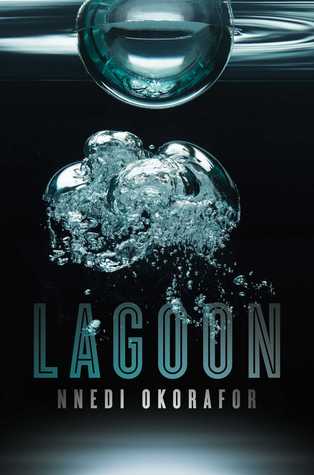
Take A Peek Book Review: Lagoon by Nnedi Okorafor

“Take a Peek” book reviews are short and (possibly) sweet, keeping the commentary brief and providing a little peek at what the book’s about and what I thought.


Synopsis:

(via Goodreads)

It’s up to a famous rapper, a biologist, and a rogue soldier to handle humanity’s first contact with an alien ambassador—and prevent mass extinction—in this novel that blends magical realism with high-stakes action.

After word gets out on the Internet that aliens have landed in the waters outside of the world’s fifth most populous city, chaos ensues. Soon the military, religious leaders, thieves, and crackpots are trying to control the message on YouTube and on the streets. Meanwhile, the earth’s political superpowers are considering a preemptive nuclear launch to eradicate the intruders. All that stands between 17 million anarchic residents and death is an alien ambassador, a biologist, a rapper, a soldier, and a myth that may be the size of a giant spider, or a god revealed.

My Thoughts:

The synopsis above doesn’t quite give the full picture, although it does hint at the craziness and unpredictability of Lagoon. In Lagoon, aliens land in the harbor of Lagos, Nigeria. We see the ensuing action unfold through the viewpoints of the main characters, as well as bystanders, lost children, preachers, prostitutes, and even spiders, bats, and a swordfish. The author’s descriptive, vibrant writing evokes the sounds, sights, and smells of Lagos, and immediately pulls the readers into the vibe of this chaotic city.

At the same time, the plot gets more and more complicated as the story moves forward, which is both an immersive experience and something of a headache. The powers of the aliens and the native gods come into play as they both make indelible changes to the lives of the humans in Lagos — but the interwoven plot points, the unusual magical and alien elements, and the strange experiences of the characters often are a real challenge when it comes to making sense of what’s happening.

Still, I really enjoyed getting to know the characters, seeing the social dynamics at play in Lagos both before and after the alien arrival, and experiencing the extreme oddness of certain scenes. Let’s put it this way — we have characters turning into sea creatures, and that’s not the weirdest thing that happens.

I’ve been wanting to read more of Nnedi Okarafor’s fiction ever since reading Binti earlier this year. She’s a remarkably gifted writer, and I think it’s pretty eye-opening for American readers to see contemporary science fiction set in Africa — quite unusual, and definitely a hugely positive addition to the genre!

_________________________________________

The details:

Title: Lagoon
Author: Nnedi Okorafor
Publisher: Saga Press
Publication date: April 10, 2014
Length: 304 pages
Genre: Science fiction
Source: LibrarySave

Save

Save