Book Review: Small Great Things by Jodi Picoult

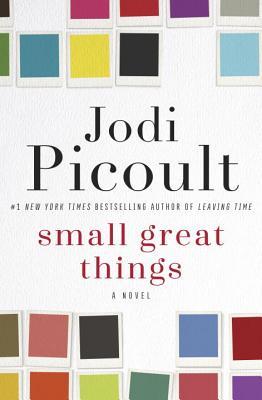
small great things

Ruth Jefferson is a labor and delivery nurse at a Connecticut hospital with more than twenty years’ experience. During her shift, Ruth begins a routine checkup on a newborn, only to be told a few minutes later that she’s been reassigned to another patient. The parents are white supremacists and don’t want Ruth, who is African American, to touch their child. The hospital complies with their request, but the next day, the baby goes into cardiac distress while Ruth is alone in the nursery. Does she obey orders or does she intervene?

Ruth hesitates before performing CPR and, as a result, is charged with a serious crime. Kennedy McQuarrie, a white public defender, takes her case but gives unexpected advice: Kennedy insists that mentioning race in the courtroom is not a winning strategy. Conflicted by Kennedy’s counsel, Ruth tries to keep life as normal as possible for her family—especially her teenage son—as the case becomes a media sensation. As the trial moves forward, Ruth and Kennedy must gain each other’s trust, and come to see that what they’ve been taught their whole lives about others—and themselves—might be wrong.

With incredible empathy, intelligence, and candor, Jodi Picoult tackles race, privilege, prejudice, justice, and compassion—and doesn’t offer easy answers. Small Great Things is a remarkable achievement from a writer at the top of her game.


This is another example of a book that I tore through and couldn’t put down… but with time passing after finishing the book, I find my reaction to it shifting the more I think about it.

The story itself is completely absorbing. We have three point-of-view characters: Ruth, the African-American nurse; Turk, the White Supremacist father; and Kennedy, the white public defender who describes herself early on as someone who doesn’t see color (race) at all.

It’s an interesting approach. We often see the same sets of interactions through more than one person’s eyes, so that when Kennedy makes a point about how supportive she is and how she’s devoted herself to defending people of color, Ruth perceives these statements as coming from a woman of privilege who does not even recognize how her privilege pervades her own life. This leads to interactions throughout the book in which Kennedy is caught short, forced to recognize the unacknowledged racism that informs her life, despite considering herself a force for good and a champion of social justice.

Picoult makes many good and important points in this novel about the way privilege and racism go hand in hand, and how people with privilege seem not to recognize that for one person to succeed because of their skin color and economic status, someone else must not. Where I think Picoult is on somewhat shaky ground is in her chapters using Ruth’s POV. While any author should be able to write convincingly through the voice of his/her characters, whether or not they have anything in common personally with those characters, the use of Ruth’s voice here occasionally made me uncomfortable.

Should a white author be able to write as a black character? Yes, of course. And yet, so much of Ruth’s POV is focused on her experiences as a black woman, explaining how her life has been shaped by boxes society assigns her and the implicit racism in her daily encounters. At some points, it started to feel like appropriation to me. Picoult is essentially explaining blackness to her readers — presumably, a mostly white audience — and it can feel disingenuous.

At the same time, I understand from a few blog mentions I’ve seen that the publisher made early copies of the novel available without the author being disclosed (the concept was #ReadWithoutPrejudice), and I wonder about that experience. Might I have felt differently about Ruth’s voice if I didn’t know the identity of the author? It’s possible.

On the other hand, I didn’t have a problem with her portrayal of Turk, the white supremacist who is also a grieving father and devoted, loving husband. Understanding from within his mind how his life has led him to this point and how he became such a strong believer and advocate for hate is fascinating and informative, and also scary as hell.

Kennedy feels like a pretty typical Picoult lawyer. She’s a working mother, a dedicated professional looking for her opportunity to take on a case she feels passionately about, and thinks she knows about justice in America by virtue of her work as a public defender. Ruth forces her to confront her own assumptions and biases and tear down a bit of the wall that keeps her from seeing just how her white privilege has enabled her to be the person she is now.

In terms of the plot, it’s a doozy of a set-up. At the parents’ request, a note is added to the baby’s medical file saying that no African American personnel are to touch the baby. But Ruth is the only African American staff member in the labor and delivery ward, so this is clearly an order targeted specifically at Ruth, and only Ruth. I wish the book had explored the legalities of this a bit more. Hospitals honor patients’ requests, when reasonable — but this seems so blatantly unreasonable that it never should have stood as an order to begin with.

I had a hard time accepting that the criminal case could or would go forward as described. There was no evidence against Ruth to begin with, and the rush to judgment against her seems simply unrealistic. I just wasn’t convinced at all by the set-up of the legal case.

Further, Kennedy tells Ruth repeatedly that race is never brought into the courtroom — that it’s a sure-fire way to alienate the jury, and that it JUST ISN’T DONE. That may be, but I wish Picoult had fleshed this out a bit more with examples or explanations. This becomes a turning point in the trial, and only knowing that it’s not done because Kennedy says so doesn’t really drive home the real-life situation. I wanted to know — is this a plot device, or is this really borne out in real-life courtrooms? As it was written, I wasn’t really convinced, and like Ruth, didn’t buy that there wouldn’t be merit in telling the story as it played out in terms of the race relations of the people involved.

Finally, there’s a plot twist at the very end. I haven’t read every single Jodi Picoult novel, but I’ve read enough to know that a huge twist is pretty standard for her books. I won’t get into what the twist is in Small Great Things, but I will say that I thought it was rather unbelievable and unnecessary. The story didn’t need it, and the timing and delivery were just odd.

Overall, I’d say that Small Great Things is a fast and compelling read, but that it left me feeling like I’d been lectured to in a way that detracts a bit from the power of the story. The story itself is complicated and twisty, although there are so many side elements thrown in (the charismatic TV personality, the darker skinned sister who chooses to refuse the path that Ruth has taken, the wealthy white family that Ruth’s mother worked for as a maid for 50 years) that by the end, the courtroom scenes, which should be the dramatic climax of the book, feel a little rushed and curtailed.

From reading the author’s notes at the end of the book, it’s clear that Picoult poured her heart and soul into her research for this book, and has embarked on her own personal journey to recognize the inherent racism that’s a part of white privilege. I don’t doubt her sincerity at all, but all this earnestness doesn’t necessarily translate into great fiction. When the storyline takes a back seat to the message, it can start feeling overly preachy. I was fascinated by the unfolding story and become involved in Ruth’s struggles and her quest for true justice, but the use of POVs and the shoe-horning in of everything Picoult has learned about race in America weaken the power of the legal drama at the center of the narrative.

Still, I’d say that Picoult’s fanbase will of course love Small Great Things, and I’d recommend it to others as well. Jodi Picoult’s books are always thought-provoking, and she’s a master when it comes to taking even abhorrent characters and showing their humanity. She lets us see Turk and his wife as bereaved parents, and their pain is no less real and heartfelt than anyone else’s, despite the fact that they’re absolutely revolting in every other way. This, I think, is a great example of the power of Picoult’s writing: She takes us inside lives and minds we might otherwise never see, and always manages to show us the sparks of humanity to be found in the most unexpected places.

Save

_________________________________________

The details:

Title: Small Great Things
Author: Jodi Picoult
Publisher: Ballantine Books
Publication date: October 11, 2016
Length: 480 pages
Genre: Contemporary fiction
Source: Review copy courtesy of the publisher via NetGalley

Save

Save

Save

Save

Book Review: Orphan Train by Christina Baker Kline

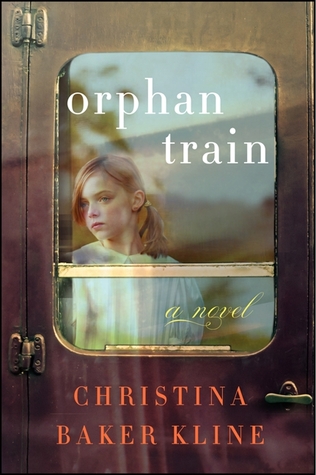
orphan-train

The author of Bird in Hand and The Way Life Should Be delivers her most ambitious and powerful novel to date: a captivating story of two very different women who build an unexpected friendship: a 91-year-old woman with a hidden past as an orphan-train rider and the teenage girl whose own troubled adolescence leads her to seek answers to questions no one has ever thought to ask.

Nearly eighteen, Molly Ayer knows she has one last chance. Just months from “aging out” of the child welfare system, and close to being kicked out of her foster home, a community service position helping an elderly woman clean out her home is the only thing keeping her out of juvie and worse.

Vivian Daly has lived a quiet life on the coast of Maine. But in her attic, hidden in trunks, are vestiges of a turbulent past. As she helps Vivian sort through her possessions and memories, Molly discovers that she and Vivian aren’t as different as they seem to be. A young Irish immigrant orphaned in New York City, Vivian was put on a train to the Midwest with hundreds of other children whose destinies would be determined by luck and chance.

The closer Molly grows to Vivian, the more she discovers parallels to her own life. A Penobscot Indian, she, too, is an outsider being raised by strangers, and she, too, has unanswered questions about the past. As her emotional barriers begin to crumble, Molly discovers that she has the power to help Vivian find answers to mysteries that have haunted her for her entire life – answers that will ultimately free them both.

Rich in detail and epic in scope, Orphan Train is a powerful novel of upheaval and resilience, of second chances, of unexpected friendship, and of the secrets we carry that keep us from finding out who we are.

It’s astonishing to me that until I read this book, I knew nothing about this important piece of American history. Over a span of 75 years, approximately 200,000 children, mostly orphaned and homeless, were transported from New York and other East Coast cities to farmland in the Midwest, where they were offered up for adoption via town hall meetings at stops along the rail lines. Some children found loving adoptive families and permanent homes; it appears that many, however, were treated as little better than manual labor or indentured servants, wanted for their ability to work but not adequately fed, sheltered, or schooled, much less given the love and support they most strongly needed.

In Orphan Train, we meet 91-year-old Vivian, who emigrated to America from Ireland as a young girl. When a tragic tenement fire leaves her all alone, she’s soon shipped out on the orphan train, ending up in some horrific circumstances in Minnesota — first, as an underfed worker in what was essentially a seamstress sweatshop, and then, as a poorly treated resident of an impoverished family farm, where abuse lurks around every corner. Thanks to a kind school teacher, she does eventually find her way forward through education and through the support of a kind older couple who provide her with all they’d once hoped to provide to their own deceased child.

When we first meet the elderly Vivian, it’s through the eyes of contemporary foster child Molly, who is just one breath away from being locked up in juvie at age 17 for the shocking crime of stealing a copy of Jane Eyre from the public library. As Molly fulfills her mandated community service hours by helping Vivian clean her attic, it becomes clear that the two women, young and old, have more in common than they realize. With each box of mementos that Molly opens and reviews with Vivian, a piece of Vivian’s history is remembered and reexamined. Through their connection, each helps the other come to terms with their pasts and think about new ways of envisioning and creating a future.

My entire life has felt like chance. Random moments of loss and connection. This is the first one that feels, instead, like fate.

I really enjoyed Orphan Train, although perhaps “enjoyed” isn’t quite the right term. The stories of Molly and Vivian are both heartbreaking in their own ways. While Molly, as a foster child in 21st century Maine, isn’t handed over into servitude, she does go through a series of foster homes, largely finding herself with people who see her as a chore or a duty, or worse, a source of a paycheck from social services. She’s unloved and unwanted, and gets used to traveling light and protecting herself by driving others away before they can reject her. Molly’s pain is palpable and real, and I wanted so desperately for her to finally find a place to belong and someone to really cherish her for herself.

Likewise, with Vivian, the loss and sorrow she endures is unimaginable. At the time at which she becomes an orphan, children have no voice and no rights, and it’s shocking as a modern reader to see how casually the children are handed over to any stranger who comes along and picks them. The deprivation, physical and emotional, that Vivian suffers is quite hard to read, especially keeping in mind that she’s not yet even a teen when the worst parts of her experience take place.

The way the two story threads weave together to create a whole is fascinating and well thought-out. The dual time line approach is pretty common right now in historical fiction, but in the case of Orphan Train, I think it succeeds because each time line gives us a central character to really care for. Vivian’s story is perhaps a touch more compelling, but I think a big reason for that is the fact that it’s so unusual and, for me at least, mostly unknown prior to reading this story. With Molly, while her story is sad and moving, it doesn’t have the same sense of discovery of a chapter of history that Vivian’s story does. Still, both pieces shed light on shameful practices and conditions of foster and abandoned children, and the two story elements together complement each other quite well.

I had one quibble with the storyline of this book, but in the interest of avoiding spoilers, I won’t go into specifics. Keeping things vague, I’ll just say that Vivian makes a huge decision in the latter part of the book, when she’s a young woman, that I didn’t find particularly believeable. Given the way her life is at the time in question, I do think she’d have had other choices and should have had enough support in her life to at least take the time to consider her options. It’s a huge turning point that affects the rest of Vivian’s life, and yet she makes it quickly and at a time of great vulnerability. I just didn’t buy it.

That aside, I loved reading Orphan Train. I found the history fascinating, and loved the two main characters, Molly and Vivian. It’s the kind of book that leaves you desperately hoping that the people you’ve come to know will go on to find happiness in their lives.

Orphan Train is a book that will stay with me. I’m so glad my book group decided to read it this month! I just know we’ll have plenty to talk about.

_________________________________________

The details:

Title: Orphan Train
Author: Christina Baker Kline
Publisher: William Morrow
Publication date: April 2, 2013
Length: 278 pages
Genre: Contemporary and historical fiction
Source: Purchased

Take A Peek Book Review: Karen Memory by Elizabeth Bear

“Take a Peek” book reviews are short and (possibly) sweet, keeping the commentary brief and providing a little peek at what the book’s about and what I thought.

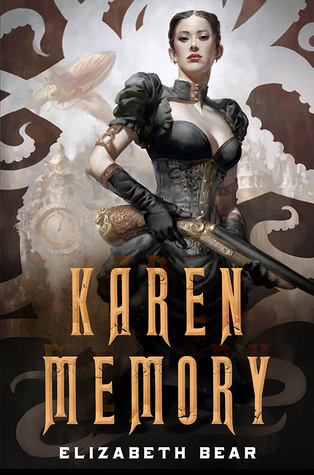
Karen Memory


Synopsis:

(via Goodreads)

“You ain’t gonna like what I have to tell you, but I’m gonna tell you anyway. See, my name is Karen Memery, like memory only spelt with an e, and I’m one of the girls what works in the Hôtel Mon Cherie on Amity Street. Hôtel has a little hat over the o like that. It’s French, so Beatrice tells me.”

Set in the late 19th century—when the city we now call Seattle Underground was the whole town (and still on the surface), when airships plied the trade routes, would-be gold miners were heading to the gold fields of Alaska, and steam-powered mechanicals stalked the waterfront, Karen is a young woman on her own, is making the best of her orphaned state by working in Madame Damnable’s high-quality bordello. Through Karen’s eyes we get to know the other girls in the house—a resourceful group—and the poor and the powerful of the town. Trouble erupts one night when a badly injured girl arrives at their door, begging sanctuary, followed by the man who holds her indenture, and who has a machine that can take over anyone’s mind and control their actions. And as if that wasn’t bad enough, the next night brings a body dumped in their rubbish heap—a streetwalker who has been brutally murdered.

Bear brings alive this Jack-the-Ripper yarn of the old west with a light touch in Karen’s own memorable voice, and a mesmerizing evocation of classic steam-powered science.


My Thoughts:

I picked up a copy of Karen Memory when it came out last year, and thanks to trying to finish up a reading challenge, I finally took it off the shelf and read it. What fun!

Karen’s voice is distinctive — maybe a little jarring at first, getting used to her grammar and word usage (especially “of” instead of “have”, as in “would of”…, etc). The first-person narrative by Karen lends a Western grittiness to the tale that really adds a lot in terms of flavor and setting.

The steampunk elements are enjoyable. I tend not to enjoy steampunk that gets so involved in the description of gears and pistons and steam engines that plot and character suffer. This is not the case in Karen Memory. The gadgets and gizmos serve the story, not the other way around.

The plot is engaging and exciting, as Karen takes on the bad guys, backed up by the do-gooder US Marshall, his Comanche partner, and the women of Madame Damnable’s. While I wished that some of the supporting characters were a bit more developed (it was hard to get a feel for several of the working girls as distinct people), overall the cast of characters is diverse, flavorful, and quite entertaining.

All in all, Karen Memory is a great romp of a read. Definitely quirky and unusual, it was a nice change-up for me from the somewhat heavy books I’ve been reading lately.

_________________________________________

The details:

Title: Karen Memory
Author: Elizabeth Bear
Publisher: Tor Books
Publication date: February 3, 2015
Length: 350 pages
Genre: Steampunk
Source: Purchased

Save

Save

Audiobook mini-review: The Dispatcher by John Scalzi

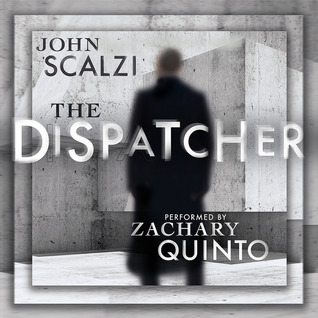
dispatcher

One day, not long from now, it becomes almost impossible to murder anyone – 999 times out of a thousand, anyone who is intentionally killed comes back. How? We don’t know. But it changes everything: war, crime, daily life.

Tony Valdez is a Dispatcher – a licensed, bonded professional whose job is to humanely dispatch those whose circumstances put them in death’s crosshairs, so they can have a second chance to avoid the reaper. But when a fellow Dispatcher and former friend is apparently kidnapped, Tony learns that there are some things that are worse than death and that some people are ready to do almost anything to avenge a supposed wrong.

It’s a race against time for Valdez to find his friend before it’s too late…before not even a Dispatcher can save him.


What a treat! This brand-new audiobook is currently available FREE from Audible. How can you resist?

Narrated by actor Zachary Quinto, The Dispatcher is a brief novella that has an immediate hook. The intrigue starts with the opening scene — why is the main character insisting on being allowed into an operating room, and why is the surgeon so angry about it?

As the story unfolds, we learn about the new normal, in which anyone who dies via murder comes back — so that someone deemed irreversibly ill or injured requires the services of a Dispatcher, someone who will intentionally kill the near-death person so they can resume their lives. It’s a totally legal and licensed profession, except when a Dispatcher pick up a little gray-area work on the side.

As the mystery of Tony’s missing friend unfolds, we follow his work with a detective to uncover the seamier side of Dispatching and their race against time to find the missing man before he dies a permanent death. Meanwhile, while the story has many of the tropes of a noir detective story, we’re treated to one odd scenario after another in which we learn just how much our world changes when death is no longer final.

I won’t give away anything further. The Dispatcher is an absolutely glorious audiobook experience. The pacing and plot are fabulous, and Quinto’s narration is pretty much spot on (although his voice for a goonish bodyguard is perhaps too goofy, and his women tend to the breathy end of the vocal spectrum). Still, his reading of the story is terrifically enjoyable, with just the right emphases and pauses and intonations to make it fun and suspenseful.

What are you waiting for? It’s FREE. And it’s great. If sci-fi/speculative fiction is at all your thing, you owe it to yourself to check out The Dispatcher.

And oh yeah.

FREE.

_________________________________________

The details:

Title: The Dispatcher
Author: John Scalzi
Narrator: Zachary Quinto
Publisher: Audible Studios
Publication date: October 4, 2016
Audiobook length: 2 hours, 19 minutes
Printed book length: n/a – not available in print format
Genre: Science fiction/speculative fiction
Source: Download via Audible

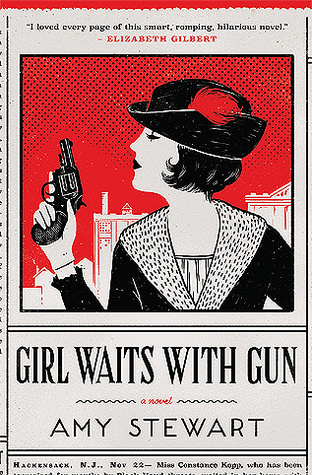
Audiobook Review: Girl Waits With Gun by Amy Stewart

girl-waits-with-gun

A novel based on the forgotten true story of one of the nation’s first female deputy sheriffs.

Constance Kopp doesn’t quite fit the mold. She towers over most men, has no interest in marriage or domestic affairs, and has been isolated from the world since a family secret sent her and her sisters into hiding fifteen years ago. One day a belligerent and powerful silk factory owner runs down their buggy, and a dispute over damages turns into a war of bricks, bullets, and threats as he unleashes his gang on their family farm. When the sheriff enlists her help in convicting the men, Constance is forced to confront her past and defend her family — and she does it in a way that few women of 1914 would have dared.  


Guys, Girl Waits With Gun may be the most enjoyable audiobook I’ve listened to all year! Fantastic story and characters, and narration that really pulls you into the mood of the story.

But stepping back a moment…

Author Amy Stewart has written several highly successful non-fiction books (with absolutely aweseome titles), including Wicked Plants and The Drunken Botanist. Girl Waits With Gun is her first novel, and is the first in what’s projected to be a series about the historical figures at the heart of the novel.

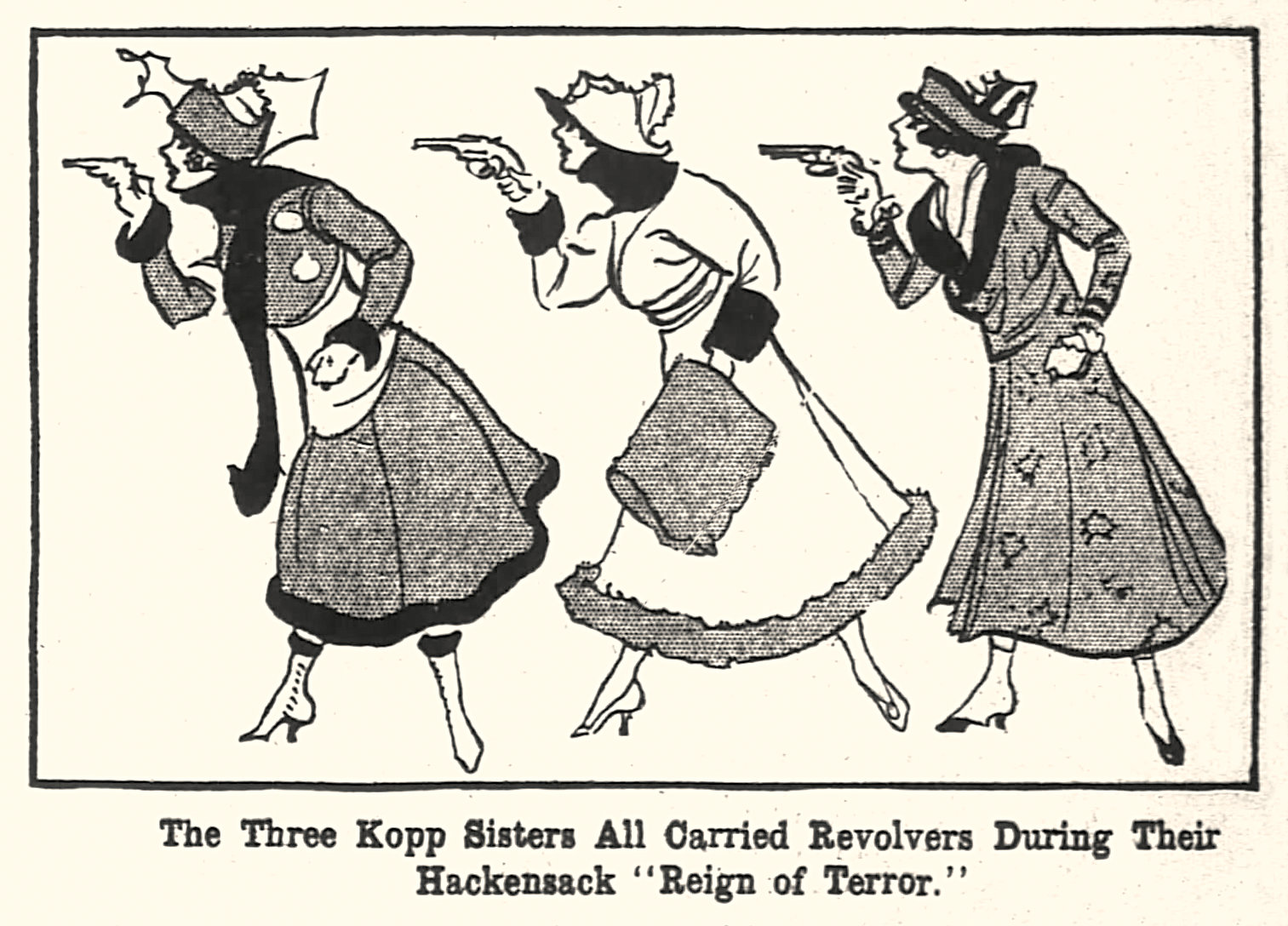
The Kopp sisters were real people who lived in New Jersey in the early part of the 20th century. After an unfortunate run-in with a powerful, corrupt factory owner, the sisters were threatened and terrorized for months on end. Led by oldest sister Constance, the Kopp sisters sought help from the local sheriff, and persisted in seeing that their tormentor would be brought to justice, no matter the risk to themselves.

The novel fleshes out these historical women and brings them to life, so that we really get to know the personalities and inner workings of the three sisters. Narrated by Constance, we see events through her eyes, and come to understand their small family, the state of politics, unions, and factory owners at the time, and the limitations placed on women by the traditions and societal expectations of the time.

Source: Amy Stewart's website

Source: Amy Stewart’s website

The three sisters are sharply developed, so that we get to know their personalities, their quirks, and their unique voices — both in terms of how they’re written in the story, and how the narrator portrays them. The text and the narration play up Fleurette’s girlish naivete, Norma’s brusque no-nonsense approach to life at large, and Contance’s bravery and wisdom. I loved the character of Sheriff Heath as well, who comes across as a good, honest man dedicated to justice and decency, who’s willing to buck the system in order to see that the innocent are protected. (And I love the fact that it’s Sheriff Heath who gives the sisters their revolvers and makes sure they know how to use them.)

The author makes the historical setting feel real and vibrant, giving us the tastes and smells of factory towns and farms, the sense of busy streets crammed with horse-drawn wagons and sleek automobiles, and the hidden underbelly of society, where the factory workers live in company-owned boarding houses and work in abusive, unhealthy conditions.

The writing here is fast-paced, often funny, and always sharp, catching the nuances of the relationships and the characters, and capturing the colloquialisms and social niceties of the times. Even as the tension and threats mount, there are little moments of humor to keep things moving along.

I really, truly enjoyed listening to Girl Waits With Gun, and I plan to start book #2, Lady Cop Makes Trouble, a bit later this month. I love the Kopp sisters, and can’t wait to see what’s next for them.

_________________________________________

The details:

Title: Girl Waits With Gun
Author: Amy Stewart
Narrator: Christina Moore
Publisher: Houghton Mifflin Harcourt
Publication date: September 1, 2015
Audiobook length: 10 hours, 54 minutes
Printed book length: 408 pages
Genre: Detective story/historical fiction
Source: Review copy courtesy of the publisher via NetGalley; Audible download purchased

Save

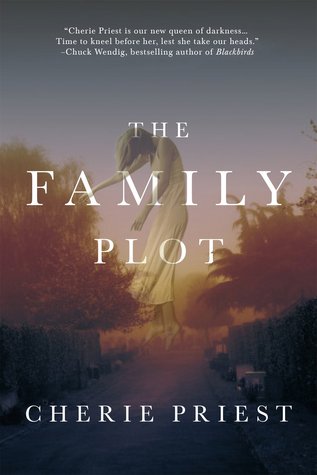
Take A Peek Book Review: The Family Plot by Cherie Priest

“Take a Peek” book reviews are short and (possibly) sweet, keeping the commentary brief and providing a little peek at what the book’s about and what I thought.

family-plot


Synopsis:

(via Goodreads)

Chuck Dutton built Music City Salvage with patience and expertise, stripping historic properties and reselling their bones. Inventory is running low, so he’s thrilled when Augusta Withrow appears in his office offering salvage rights to her entire property. This could be a gold mine, so he assigns his daughter Dahlia to personally oversee the project.

The crew finds a handful of surprises right away. Firstly, the place is in unexpectedly good shape. And then there’s the cemetery, about thirty fallen and overgrown graves dating to the early 1900s, Augusta insists that the cemetery is just a fake, a Halloween prank, so the city gives the go-ahead, the bulldozer revs up, and it turns up human remains. Augusta says she doesn’t know whose body it is or how many others might be present and refuses to answer any more questions. Then she stops answering the phone.

But Dahlia’s concerns about the corpse and Augusta’s disappearance are overshadowed when she begins to realize that she and her crew are not alone, and they’re not welcome at the Withrow estate. They have no idea how much danger they’re in, but they’re starting to get an idea. On the crew’s third night in the house, a storm shuts down the only road to the property. The power goes out. Cell signals are iffy. There’s nowhere to go and no one Dahlia can call for help, even if anyone would believe that she and her crew are being stalked by a murderous phantom. Something at the Withrow mansion is angry and lost, and this is its last chance to raise hell before the house is gone forever. And it seems to be seeking permanent company.

The Family Plot is a haunted house story for the ages-atmospheric, scary, and strange, with a modern gothic sensibility to keep it fresh and interesting-from Cherie Priest, a modern master of supernatural fiction.


My Thoughts:

Meh.

Not scary.

That about sums it up for me. The Family Plot is more or less a classic ghost story. A woman and her crew sleep in the house they’re working to strip for salvage. The owner of the house seems to only want to be rid of it, and is intentionally cryptic about the house’s history. The house is completely isolated, up a hard-to-get through country road. It seems to be full of treasures, but weird things start happening almost right away.

(And by the way, that Goodreads synopsis is fairly awful, emphasizing the wrong things and giving away way too much.)

The key problem for me is that the surprises and secrets weren’t terribly surprising. The ghostly presence and its history seem pretty typical for this kind of story. Even when the drama comes to a peak toward the end of the book (cue the stormy night, blocked roads, and lack of emergency vehicles), I did not for a single second feel frightened or chilled or spooked out.

The story is fine, but I can’t say much more positive than that. If you’ve ever read a haunted house book before, then you’ll see pretty much the entire plot coming. It’s not boring, but at the same time, it just didn’t move me in the slightest.

_________________________________________

The details:

Title: The Family Plot
Author: Cherie Priest
Publisher: Tor Books
Publication date: September 20, 2016
Length: 368 pages
Genre: Ghost story
Source: Review copy courtesy of the publisher via NetGalley


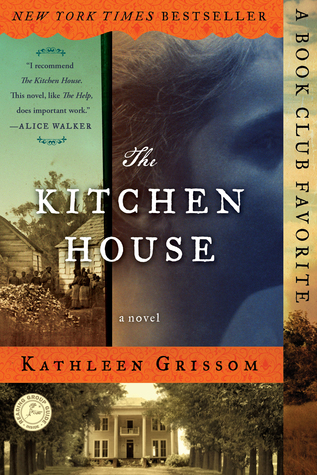
Take A Peek Book Review: The Kitchen House by Kathleen Grissom

“Take a Peek” book reviews are short and (possibly) sweet, keeping the commentary brief and providing a little peek at what the book’s about and what I thought.

tkh


Synopsis:

(via Goodreads)

In this gripping New York Times bestseller, Kathleen Grissom brings to life a thriving plantation in Virginia in the decades before the Civil War, where a dark secret threatens to expose the best and worst in everyone tied to the estate.

Orphaned during her passage from Ireland, young, white Lavinia arrives on the steps of the kitchen house and is placed, as an indentured servant, under the care of Belle, the master’s illegitimate slave daughter. Lavinia learns to cook, clean, and serve food, while guided by the quiet strength and love of her new family.

In time, Lavinia is accepted into the world of the big house, caring for the master’s opium-addicted wife and befriending his dangerous yet protective son. She attempts to straddle the worlds of the kitchen and big house, but her skin color will forever set her apart from Belle and the other slaves.

Through the unique eyes of Lavinia and Belle, Grissom’s debut novel unfolds in a heartbreaking and ultimately hopeful story of class, race, dignity, deep-buried secrets, and familial bonds.


My Thoughts:

The Kitchen House has been on my radar for a while now, and I finally settled in and read it over the weekend in preparation for my book group discussion this coming week. Sometimes you need a little nudge to get to the good stuff, ya know?

Wow. This book has it all — terrific historical setting, a broad and varied cast of characters, and pains and sorrows that are instantly relatable.

Lavinia’s story is unique, as most pre-Civil War novels I’ve read with Southern settings focus strictly on the master/slave divide, broken along race lines. In The Kitchen House, Lavinia straddles the color line. As an orphaned indentured Irish girl, she’s settled — happily — with the black slaves on the plantation, where she finds love, comfort, and family. Yet based on the color of her skin, she’s easily accepted into the world of the big house as well, first as a companion for her master’s mentally ill wife, and eventually as a full-fledged member of the family.

Meanwhile, among the kitchen house slaves, the illegitimate children of the plantation owners are relegated to yet another generation of slavery, subject to the whims and demons of the twisted mind of their current owner.

Lavinia is the main narrator of the story, although we do get briefer chapters from Belle’s perspective, which help round out what Lavinia sees of plantation life and offer a sort of behind-the-scenes viewpoint that we’d otherwise miss.

The heartache and tragedy that plague Lavinia and her loved ones feel almost too much sometimes. It seems like every time there’s a chance for something terrible to happen, it does. The pain that all of the characters must endure makes the book tough to take, even while it’s impossible to look away.

The author seems to be drawing a parallel between the slaves’ captivity and Lavinia’s own powerlessness and lack of rights in a loveless marriage to a cruel, domineering, dangerous man. I can accept this up to a point: Despite her fine clothes and house, Lavinia is her husband’s property and is basically a prisoner, with no access to the outside world or to anyone who might provide help. Still, her situation isn’t nearly as helpless as that of the slaves, and her skin color and status offer her a protection that her beloved family does not have.

The Kitchen House is powerful and well-written, and I recommend it strongly for anyone with an interest in American history during that time period. The characters are unforgettable.

As far as I understand, The Kitchen House (published in 2010) was originally written as a stand-alone, but I was excited to learn that a follow-up novel (Glory Over Everything) has just been published. I can’t wait to spend more time with these characters… and just hope that at least some of them get the happy ending they so clearly deserve.

_________________________________________

The details:

Title: The Kitchen House
Author: Kathleen Grissom
Publisher: Touchstone
Publication date: January 1, 2010
Length: 385 pages
Genre: Historical fiction
Source: Library


Audiobook Review: The Android’s Dream by John Scalzi

Android's Dream

A human diplomat kills his alien counterpart. Earth is on the verge of war with a vastly superior alien race. A lone man races against time and a host of enemies to find the one object that can save our planet and our people from alien enslavement…

A sheep.

That’s right, a sheep. And if you think that’s the most surprising thing about this book, wait until you read Chapter One. Welcome to The Android’s Dream.

For Harry Creek, it’s quickly becoming a nightmare. All he wants is to do his uncomplicated mid-level diplomatic job with Earth’s State Department. But his past training and skills get him tapped to save the planet–and to protect pet store owner Robin Baker, whose own past holds the key to the whereabouts of that lost sheep. Doing both will take him from lava-strewn battlefields to alien halls of power. All in a day’s work. Maybe it’s time for a raise.

Throw in two-timing freelance mercenaries, political lobbyists with megalomaniac tendencies, aliens on a religious quest, and an artificial intelligence with unusual backstory, and you’ve got more than just your usual science fiction adventure story. You’ve got The Android’s Dream.

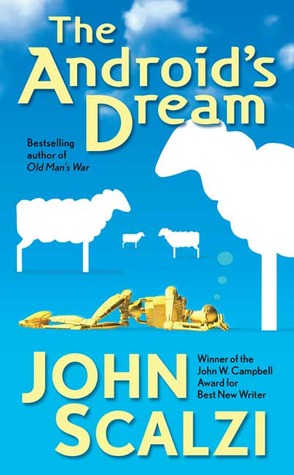
The Android’s Dream absolutely lives up to expectations… except for the teeny little fact that there’s a sleeping robot on the cover, and this is assuredly not a book about robots.

Instead, it’s about intergalactic politics and brinksmanship, artificial intelligence, governmental hijinks, a man-made religion… and yes, sheep. Look, it’s silly and doesn’t necessarily make sense 100% of the time, but it’s always entertaining, even when it makes your head hurt.

The cast of characters is large, and features diplomats, hired thugs, alien warriors, war vets, pet store owners, and an overgrown young alien on his culture’s version of an Amish Rumspringa. In terms of setting, the book takes place in the halls of power on Earth, onboard an intergalactic cruiser, on an alien planet, and in one particularly action-packed scene, at a mall.

Robin Baker and Harry Creek are awesome good guys. They’re both genuinely good people sucked into a completely f*cked up and weird situation, and maintain a surprising amount of good cheer and plain old resourcefulness when it all hits the fan. The politicos aren’t entirely corrupt, and there’s even one at the State Department who has his head on straight, outthinks everyone around him, and is hell on wheels in the courtroom.

In terms of the audiobook, there are pros and cons.

On the negative side, the twists and turns of the plot and the complicated interconnections between the rather huge number of characters make the plot a bit hard to figure out and keep straight via audio. After listening to the first 2 or 3 chapters, I had to stop by the library to get a hard copy so I could go back and make sure I understood who the various characters were and what they wanted. There’s a lot of plotting and scheming in The Android’s Dream, and keeping the players sorted is essential

That’s really the only downside of the audiobook — other than than, I’d say that audio is definitely the way to go!

Narrator Wil Wheaton is superb at bringing characters to life, from the full-of-themselves ambassadors and high muckety-mucks to the secret church officials to the clueless cruiseliner passengers. His accents and inflections are spot-on, and man, it’s just all so darn funny.

Call me immature, but I found something immensely hilarious about hearing Wheaton pronounce names like Narf-win-Getag and Hubu-auf-Getag, or describe the Nagch people’s rite of Ftruu, or even analyze the landmark legal case Agnach Agnach-u v. Ar-Thaneg. This stuff might look funny on the page, but listen to it repeated over and over again, in scenes of blustering negotiations or high-octane action, and it’s… I don’t know… just laugh out loud riotous.

Once I got past my initial confusion, I really loved The Android’s Dream, and was especially glad that I stuck it out long enough to really get into the groove of the audiobook. John Scalzi’s writing plus Wil Wheaton’s narration is a dream combination. I wish this book had a sequel (as I understand, at one point, there was maybe-sorta a plan for one, but it never happened) — but barring that, I’ll be happy to listen to more Scalzi/Wheaton audiobooks any time one lands in my hands (or in my Audible app).

_________________________________________

The details:

Title: The Android’s Dream
Author: John Scalzi
Narrator: Wil Wheaton
Publisher: Tor Books
Publication date: 2006
Audiobook length: 10 hours, 34 minutes
Printed book length: 396 pages
Genre: Science fiction
Source: Purchased

Save

The Memory Wall: New release celebration and author Q&A!

the-memory-wall-699x1024

There’s a fine line between real life and video games in this engrossing novel that’s part Kathryn Erskine’s Mockingbird, part Patrick Ness’s A Monster Calls.

Severkin is an elf who slinks through the shadows of Wellhall’s spiraling stone towers, plundering ancient ruins and slaying mystical monstrosities with ease.

He’s also a character in a video game—a character that twelve-year-old Nick Reeves plays when he needs a break from the real world. And lately, Nick has really needed a break. His mother had an “incident” at school last year, and her health has taken a turn for the worse.

Nick is convinced his mother’s illness has been misdiagnosed, but no one believes him. His only escape is the online world of Wellhall, where, as the elf character Severkin, he can face any problem. But when Nick finds himself fighting alongside another elf who reminds him of someone he knows in real life, his worlds begin to collide. . . .

I’m so excited to share this sneak peak at The Memory Wall, the upcoming new release by Lev AC Rosen! The Memory Wall will be released September 13, 2016… and I encourage you all to stop right now, open up a new tab in your browser, hit up Amazon or your favorite online bookseller, and hit the preorder button. You can thank me later. (And now come back and finish reading my post!)

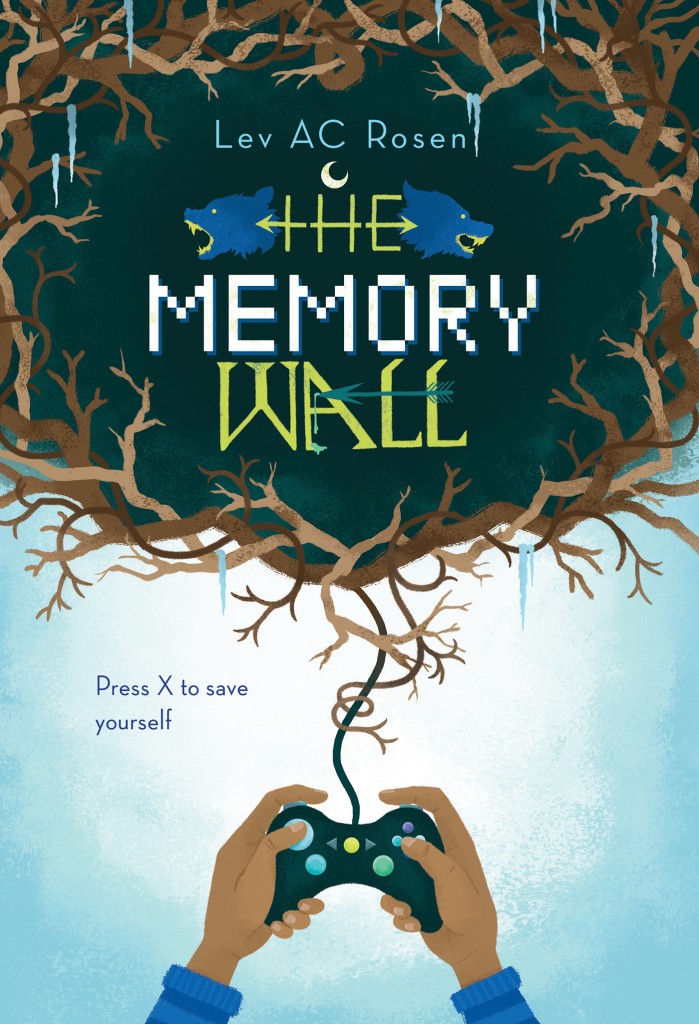
The Memory Wall is an unusual, surprising read — aimed at younger teens, but definitely appealing to grown-ups as well. Don’t be deceived by the cover. While the game and fantasy elements of this book are quite important, it’s the real-life Nick and his disintegrating family that are the heart and soul of the story.

For me personally, Nick’s family, school situation, and inner struggles are the most engrossing elements of The Memory Wall, but the in-game portions are equally well-written and have a propulsive energy all their own. As you’ll see from the Q&A below, it amazes me how well certain elements work together — elements that I never in a million years would have expected to fit into one book — but they really do come together in unexpected but really cool ways.

I’m really thrilled to be able to share this Q&A, but let me just add more note: Lev AC Rosen is an amazing writer who deserves much wider acclaim! Not only does he write great kids’ books (see my review of Woundabout here), but he’s also written two of my absolute favorite books for adults, All Men of Genius (which I read before I was a blogger, so no review… but maybe I’ll revisit in a future blog post) and Depth, which is just awesome (review here).

As a side note, I ended up asking Lev a bunch of questions that relate to the fact that I have a 14-year-old son who’s obsessed with video games. Just FYI.

Without further ado, I’m proud to present:

A Q&A with author Lev AC Rosen, author of The Memory Wall

Note: Mild (very mild) spoilers ahead…

Q:  I never would have guessed that Alzheimer’s, gaming, and the Berlin Wall could fit into a single book. Did you set out to write about all three of these elements from the start?

A: I’m a big believer in the idea that every book writes itself differently. Sometimes the whole idea comes to me fully formed, like a seed, and planting it lets that idea grow. Sometimes it’s more like assembling a puzzle from the pieces that are just floating around your mind.  For The Memory Wall, it was the latter – I knew I wanted to do a book about someone playing a video game, and use that as a story-with-a-story format, where the two stories could actually be pulled apart and still stand on their own. But the age group, the characters, the world, the Berlin Wall, Alzheimer’s – those all sort of snapped on, one by one, because they were already floating around in my head as things I wanted to write about.  Maybe puzzle pieces isn’t the right metaphor – maybe it’s more like trying on clothes. I had this body – video game, story-within-story – and I assembled an outfit on it from the clothes in the wardrobe of my brain – and that included Alzheimer’s and the Berlin Wall. The outfit just looked good. And I didn’t start writing until the outfit was assembled, because the outfit is the idea. Before that, it was just disconnected ideas. Once all the pieces were together, I had an idea, and then I started writing. So Alzheimer’s and the Berlin Wall were there from the moment I was typing. But the core was the video game, I guess.

Q: What was your inspiration for The Memory Wall?

A: Well, I just sort of answered the inspiration for the book part – I could talk more about my personal experiences with Alzheimer’s, or this great German film teacher I had in college, but I’m going to talk about those elsewhere and when I first read this question, I thought you were asking about the literal wall in the book, and I really want to answer that version of the question, because it’s not something I’ve been asked: This book is so much about history, and finding ways to preserve history – whether personal, or societal. Nick’s dad writes about Black history. His mom never talks about her own history in East Berlin. His mom is also losing her own history, and that means Nick feels he’s losing his history with her. So I was thinking about history, and the way we map it, and try to remember it – books, photos, dates, family trees. The ways we quantify history. And I wanted Nick, at some point, to (light spoilers) destroy that in some way. I wanted him to tear down the history he felt had been thrust upon him and realize that history – whether personal or societal – is something that changes all the time, depending on who you talk to, how you look at it. Sure, we can write down dates, map our great-great-grandmothers, but history lives in us. In stories, in memories. It’s not carved in stone. So the memory wall, in the book itself, is this sort of literally carved-in-stone family tree. And I’m trying to go spoiler-light here, so I’ll just say that it’s a history that is put upon Severkin, Nick’s in-game avatar. And when he realizes how his history – and everyone’s history, especially his mom’s – is more than names and dates, that it’s something more fluid than that, he gets to literally shatter the stone. That was satisfying. Plus, of course, calling it the memory wall ties into the Alzheimer’s and the Berlin Wall. But the original inspiration was that I wanted a family tree that could be destroyed in some way. Not to say that his history isn’t that, but to say it’s more than that.

Q: Race and identity are important elements for Nick and Nat, and this is also reflected in their in-game characters. What would you hope that kids reading the book would learn from this?

A: I don’t know if I’d say I want kids to learn anything, exactly. There was this article going around a while back, about a study saying that those who read fiction tend to have more empathy. Reading literally puts you in someone else’s head, so you learn how to do that with real people, too. I think of that whenever I’m writing, because that’s important. That books can change the world – and I don’t have many skills, so this is the thing I can do.  But to really expand that empathy, I need to have it, too. As an author, I can’t just write about people like me – I can’t just write about queer Jewish men from NYC. Besides being wildly limiting, it’s also boring, and isn’t what the world looks like. Authors have the responsibility to put themselves into the minds of different people from different backgrounds – and to do so respectfully. Because when we do that, our readers experience it as well. And that’s the important stuff. So, when I knew Nick had to have a background with strong historical elements, one mapped, one hidden, and I knew so much of the book was about duality – secret/exposed histories, game/real world – I decided Nick’s two sides of the family could be two races, as well. Luckily, I have multi-racial friends, and they were willing to talk to me, and give me books and essays to read so that I could explore that perspective as much as someone without it can. What I hope is that kids enjoy the book, and if they’re multi-racial, they see themselves in it, even if Nick isn’t really like them. And if they’re not multi-racial, hopefully they come out of it with a bit more understanding of the perspective of those who are. Which isn’t to say Nick represents all multi-racial people, but just that he is a fully fleshed out person who the kids can get behind.

Q: Were you at all tempted to have Nick’s mother not have Alzheimer’s, proving Nick right?

A: SPOILERS! This is a fantastic question, and yes. So much yes. I actually tried really hard to go in undecided. To be like “this could go either way.” But the more I realized how much Nick’s parents were keeping from him, the more I knew she had to have it. I did lots of research on Alzheimer’s, talked to doctors, and there are lots of things that look like Alzheimer’s – lots of things Nick could hold on to and say “it’s this, and this is so easily curable!” But the doctors can test for most of those. But I needed hope to be vibrant through the entire book. I needed to hope with Nick.

It’s interesting – people who have read it who have had personal experiences with Alzheimer’s – who have lost someone to it – never believe that Sophie has been misdiagnosed. They tell me they experienced so much of what Nick did, but as readers, they never doubt the diagnosis. Those readers who don’t have a personal experience with Alzheimer’s, though, think it’s possible Sophie has been misdiagnosed. So I feel like that’s a good balance to strike.

Q: As far as I know, most kids don’t play video games with their mothers. (Mine doesn’t!) I love this element of Nick’s relationship with his mom, and how their game connection was a part of their real-life connection. (Sorry, this isn’t really a question so far.)

A: I may be dating myself here, but my mom and I played Legend of Zelda on the original NES. I don’t know if she enjoyed it, or if she was just humoring her six year old, but I like to think she had fun. That being said, as I got older, and games got more complex, she didn’t play with me as much. But we both really liked Zelda. I think.

But Sophie, I think, besides wanting to humor her kid, took a real interest in this particular series because it’s supposed to have this background in myth and culture. And as an anthropologist, she could see those roots and point them out to her son, which I think, for her, gave the game more value. Plus, games are fun. I think she had fun, too – it’s just that her fun was colored by her academic background.

Q: I think most adults/parents these days automatically see video games as a waste of time or not healthy for their kids. The Memory Wall shows a lot of positives related to gaming. Do you think there’s a healthy balance? What are the positives you see in gaming for kids?

A: Well, everything in moderation. Sure, too much video gaming is bad. So is too much anything, really.  But do I think gaming is generally a good thing, or at least has the potential to be? Absolutely. When the printing press first made literature easily available, people freaked out about young people reading. It would make them imagine too much. They stopped doing what they were supposed to, like dueling and needlepoint and socializing, and instead had their noses in books all the time. THE  HORROR! Video games are another form of storytelling. Yes, it’s more interactive – button pressing, in game decision making, etc. Those choose your own adventure books had decisions, too, though. And, like with books, there are bad games out there. But generally speaking, games are great. There are stories told in games that can’t be told other ways, and some of those stories are truly beautiful. Can they be violent? Yes. So are movies. So are books. The thing I’d worry most about in video games is the treatment of women and sex. That can sometimes get a bit weird, I think. Women are sexualized (like in movies, TV), but when it becomes about pressing buttons to seduce a woman, that… is a little weird for me, especially if the player is a young man. Women don’t have buttons. Some games do it well. Some don’t. I think as long as you’re raising your kids to have a healthy respect for women and realize that like the violence in games, this “seduction” aspect is pure fantasy and sometimes dehumanizing, then it’s ok. And of course, watch for those game ratings.

But overall, I think games have the potential to have a really positive aspect on kids, by letting them explore worlds much larger than their own. Or just to solve puzzles or get good at button pressing – which isn’t a bad skill to have. For Nick, the game lets him essentially live out his fantasies and then deal with his reality. He gets to go on one last adventure with his mother – he gets to try to save her, and learn about her, and contextualize her in his fantasy world. And then (big spoilers), when it turns out he was living in a fantasy, he gets to punish someone for it. Because, I’d imagine Nick has a lot of anger at his mother by the end of the book. She lied to him. She kept her condition from him. She gave him hope when there wasn’t any. And Nick should feel angry about that, he should want to punish her in some way, but instead he gets to take it out on Reunne, who wasn’t trying to protect him, but was this malicious manipulator, feeding off his hope. And I think kids can do that with games. They can see symbols, see their own life, and in some way, express who they want to be. Sure, the chances of a kid today growing up to be a space marine are slim, but that kid gets to experience what that version of herself is. And hopefully, there are things she likes about that version of herself and can then work on bringing into her real self. Games can be empowering for kids in that way. And that goes for everything – space marines, or fashion designers on iPhone games.

Q: Do you feel the positives/negatives change based on the kind of game (i.e., role-playing fantasy vs first-person shooter games)?

A: It’s funny you use those two genres as examples because there’s such overlap between them now. I think genre does influence the scope of the game, and games with bigger scopes are often more interesting (though not always). Fighting games, for instance, give you one way of interacting in the world – you fight.  You push buttons, your avatar kicks, punches, etc. But the choice is always fight. A larger open world RPG, like the one Nick plays, or like Skyrim or Fallout, gives you more ways to interact – talk someone out of violence instead of fighting them, collecting items for someone so they won’t die, etc. So I think those games tend to have more positives because they offer a larger scope. Each genre has it’s own plusses and minuses, though. Japanese style RPGs, for example, which aren’t open world, and more streamlined, tend to play more like a movie with tactical fighting interludes – not many choices in those, either. And plenty of shooting games these days have massive online battle zones. That’s more like a big game of laser tag, to me. Other games are like really complex games of chess. But I do think that games with more choice and more things you can do within the world tend to have more value just because choice means more figuring out what you’d choose. And figuring out what you’d choose – being able to experiment with it and see the consequence, being able to do something really awful, just to experience it – that’s the good stuff in gaming, I think.

Q: Are you a gamer? Were you a gamer during your school years? And if so, any favorites? Anything that you particularly took from your gaming experiences as a kid?

A: Yes, and yes. When I was a kid, my favorite game was Final Fantasy 3 (6, really, but they called it 3 when they released it in the US).  I LOVED that game. It’s an amazing, epic story. My friend Liz and I wrote fan fiction about that game. Man I loved it. Still do. Great game. It was also one of my first experiences with Steampunk, so it was a big influence for All Men of Genius.

I think my modern favorite would be Bioshock, though. That is a brilliant story, too, beautifully done, so smart. It’s a shooter with RPG elements – and they’re remastering it for the PS4. Out soon, I think. If your son hasn’t played it, that would be a great one to get and be like “okay, I get to watch you play this because I hear it’s amazing.” That’s something parents are allowed to do, right? It’s just so smart, and has ties to US history and philosophy, like the game in The Memory Wall has ties to East Berlin. It was a game that really showed me how history can work in games, how games can relate to the real world and interact with them.

And Portal! While we’re on recommendations to watch your kid play, or even, in the case of Portal 2, play with them, I highly recommend Portal, which is a puzzle game that looks like a shooter. It’s really smart and funny. There are a lot of great games out these days. Lots of bad ones, too – that’s what happens when there’s more of anything, you get more bad, too, but lots of good ones. Plenty for tablets and phone, too. I loved Transistor. Beautiful piece of art. There’s so much good stuff out there. I could go on for ages.

Q: You’ve written books for adults and for kids. Do you prefer one or the other? What do you enjoy about each? Is your process different for adult vs kid books?

A: I don’t know. I don’t really think of them that way. I mean, I know the age of the kid I’m writing for, but I’m pretty much always writing for me.  Maybe 8 year old Lev, like for Woundabout, or 11 year old Lev, like Memory Wall, or 22 year old Lev, like All Men of Genius, or present-day Lev, like Depth, but I’m always writing for myself, somewhere on the spectrum. Like I said, I’m a big believer in the idea that every book writes itself differently, so it’s not so much about “writing for children” or “writing for adults” – it’s writing this book. That’s how I think about it. And the process, and what I enjoy varies depending on the sort of book it is.  For The Memory Wall I think I really enjoyed crafting the world of the game by using various influences based in East Berlin and Germanic myth. That was a fun. And I really liked being able to express Nick through Severkin. Using his avatar as a way to say things about him that maybe he couldn’t acknowledge about himself.

Q: Can you share a little about your next project or projects? Any chance we might still see a sequel to All Men of Genius or Depth? (I can’t get the images of a drowned New York out of my mind – please tell me there’s more coming set in this world!)

A: I’m a bit of a busy bee, flitting from flower to flower. I don’t stay in my lane long enough to do sequels much. All Men of Genius I had never intended one for, and then folks wanted one, and I tried my hand at it, but it didn’t feel right. Depth I’m more open to exploring sequels for because I had more of “mystery series” mindset going in. But sales aren’t really justifying it, plus my amazing editor left that imprint and I don’t know anyone else there. But I have been thinking of maybe writing a sequel and self-publishing it, just to see what that experience is like. But those are on the back burner. I have other projects right now – a too-long-to-be-a-short-story that’s sort of Greek Myth Noir. I’m trying to find a place for that, but it’s like “novelette” length, which is weird, and anything not a novel is outside my comfort zone, too. But I like it, and I need to do research on people who publish that length.  Or maybe that could be the self-publishing experiment. Then I have two finished drafts of books. Both YA. One is a fairy tale retelling, and a lot of fun, and the other is a contemporary sci-fi spy story about motherhood. We’re still putting together lists of editors to send those to. We’ll see what happens, but fingers crossed. And I’ve just started a period 1940s noir. That’s for adults. It’s… stranger than it sounds. Maybe? I’m sort of all over the place, like I said. Which I love about myself, even if it hurts my overall career. But sometimes I can get people to read something outside their usual zone, and that’s pretty awesome. That’s a good feeling.

Q: Are you sure I’m not a bad mother if I let my 14-year-old play Grand Theft Auto and Call of Duty?

A: Well, with no other evidence, it’s hard to say. But if you’re worrying about it, and talking to him about it, probably not.

But seriously, if he has a PS4, go get the Bioshock Collection remaster that’s coming out the same day as my book. Sit him down and be like “I’ve heard this is amazing, but I’m awful at video games. Want to help me experience it?” and see what happens. The first one in the collection is really fantastic. The other two are good, too, but that first one. Yeah. Play Bioshock with your kid. That’ll definitely make up for any bad parenting.  😉

I can’t thank Lev enough for taking the time to answer my loooong list of questions!! Thank you, Lev — it’s a pleasure to have you here as a guest at Bookshelf Fantasies. Wishing you the best of luck with the release of The Memory Wall.

The Memory Wall will be released September 13th. Go get yourself a copy!

Available at:

Amazon
Barnes & Noble

To learn more about author Lev AC Rosen, visit his website at www.levacrosen.com

_________________________________________

The details:

Title: The Memory Wall
Author: Lev AC Rosen
Publisher: Knopf Books for Young Readers
Publication date: September 13, 2016
Length: 368 pages
Genre: Middle grade/young adult
Source: Review copy courtesy of the author

Save

Book Review: Dark Matter by Blake Crouch

Dark MatterThis is one twisty, suspenseful, mind-f*ck of a book… and I mean that in the best way possible!

Synopsis via Goodreads:

“Are you happy with your life?” Those are the last words Jason Dessen hears before the masked abductor knocks him unconscious. Before he awakens to find himself strapped to a gurney, surrounded by strangers in hazmat suits. Before a man Jason’s never met smiles down at him and says, “Welcome back, my friend.”

In this world he’s woken up to, Jason’s life is not the one he knows. His wife is not his wife. His son was never born. And Jason is not an ordinary college physics professor but a celebrated genius who has achieved something remarkable–something impossible.

Is it this world or the other that’s the dream? And even if the home he remembers is real, how can Jason possibly make it back to the family he loves? The answers lie in a journey more wondrous and horrifying than anything he could’ve imagined—one that will force him to confront the darkest parts of himself even as he battles a terrifying, seemingly unbeatable foe.

Okay, wow. I could not put this book down. I mean, edge of seat, biting the nails, all in.

So… enough gushing. Let’s talk about why this is such a great read.

In Dark Matter, the author (a) creates a scenario that feels actually possible, even though it’s pure science fiction; (b) trusts that his readers are intelligent enough to follow the plot down the physics rabbit holes; and (c) creates characters who we can truly care about.

Poor Jason. Of all the ways a life can go wrong, I’m sure he never expected this one! One day he’s teaching college physics, married to a lovely woman, father of a pretty awesome teen boy. Next thing he knows, he’s kidnapped, drugged, and waking up in a strange lab to applause and cheers, surrounded by people who seem to be his super-impressed colleagues.

It all comes down to quantum physics. Of course. Years earlier, Jason and Daniela each compromised on their dreams — Jason to make the kind of physics breakthrough that changes the world, Daniela to achieve renown as an artist — in order to focus on family and marriage. But what if there’s a world where Jason made different choices? In the multiverse concept (as explained by me, a non-physicist, so be kind and forgive anything I get wrong), each decision a person makes spins off an entirely new universe from that decision point (okay, yeah, that’s totally simplistic, but best I can do in a quick digest)… and  Jason, being a world-class physicist, can appreciate the dilemma of worlds colliding and splitting more than most.

I really don’t want to say too much about the plot of Dark Matter. It’s complicated and fast-moving, will occasionally make your head spin, and moves along its path in all sorts of WTF-ish ways.

I loved the complexity of Jason’s situation and the seeming hopelessness of his quest. The climax of the book includes scenes that are absolutely out there, but also kind of perfect. There are shades of grey and some practically impossible decisions that must be made. And oddly, beyond being a very cool and fascinating science fiction novel, I think it’s fair to say that Dark Matter is also a love story. It’s Jason’s love for Daniela and his son Charlie that propel him through his despair and force him to keep trying when all hope seems lost.

_________________________________________

The details:

Title: Dark Matter
Author: Blake Crouch
Publisher: Crown
Publication date: July 26, 2016
Length: 342 pages
Genre: Science fiction
Source: Review copy courtesy of the publisher via NetGalley (and then bought myself a copy!)

Save