
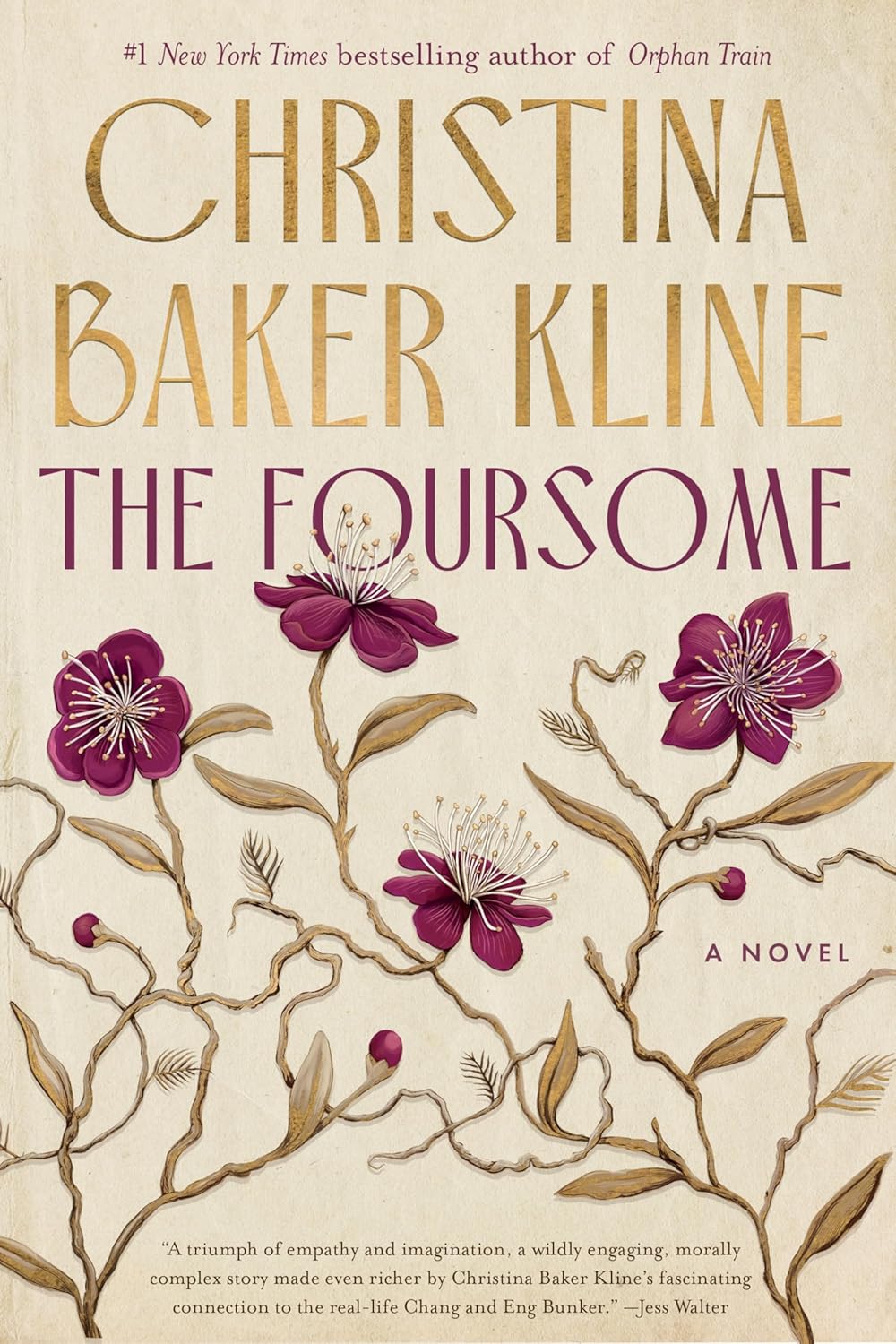
Book Review: The Foursome by Christina Baker Kline

Title: The Foursome
Author: Christina Baker Kline
Publisher: Mariner Books
Publication date: May 12, 2026
Length: 384 pages
Genre: Historical fiction
Source: Review copy courtesy of the publisher via NetGalley
Rating:

Rating: 4.5 out of 5.

From #1 New York Times bestselling author Christina Baker Kline comes a boldly original reimagining of an astonishing true story of two sisters in nineteenth-century North Carolina—Kline’s own distant relatives—who married world-famous conjoined twins from Siam.

When Chang and Eng Bunker arrive in Wilkes County in 1839, they’re not just a curiosity—they’re a sensation. Everyone is eager to learn whether the salacious rumors about them are true. Within months, the twins have opened a general store, bought land, and begun building a plantation. Now, word has it, they’re looking for wives—and in a place that thrives on gossip and legacy, their ambitions set the community on edge.

Sarah and Adelaide Yates, daughters of a once-prominent local family brought low by scandal, are drawn into their orbit. Bold, beautiful Addie sees in the twins’ fame a chance to reclaim her future. Sallie, quiet and observant, isn’t so sure. When the twins’ lives become entangled with theirs, they must navigate loyalty, longing, and identity in a world where everything—including race, class, and gender—is rigidly defined.

Spanning five decades and unfolding against the backdrop of a fractured nation hurtling toward war, The Foursome is both intimate and a story of love and constraint, identity and reinvention. With piercing insight and emotional precision, Kline brings to life a forgotten chapter of American history and the complex, boundary-defying marriages at its center.

In this fascinating work of historical fiction, author Christina Baker Kline shines a spotlight on the conjoined twins for whom the term “Siamese twins” was coined, by showing their lives through the eyes of one of the sisters who married them.

Most of us take for granted that, at the very least, we come into this world alone and die our own deaths But this was not true for my husband and his brother. They could not escape each other.

The Foursome is narrated by Sarah “Sallie” Yates, a young woman with a damaged reputation as the novel opens in the 1840s. After a family scandal, she and her younger sister Adelaide face limited prospects. When the famous conjoined twins Chang and Eng Bunker (the “Siamese Double Boys”) settle in their North Carolina community, the sisters are as curious as everyone else, but when curiosity turns to courtship, it’s Addie who leads the way, seeing the twins as a way out of their difficulties and a route to a secure future.
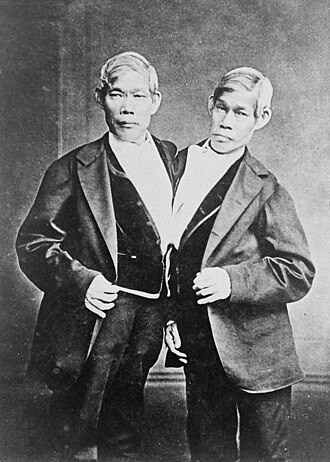
The engagement and marriage is, of couse, scandalous. Chang and Eng are joined by a band of flesh at the base of their chests. They’re active, healthy, educated men who pride themselves on living as gentlemen, but to the people of North Carolina, they’re seen as foreigners and as freaks. When the brothers marry the Yates sisters, the gossip is intense and personal.

As Sallie shares with readers, navigating a marriage to a man who can never leave his brother’s side presents complex challenges, from the embarrassment of figuring out sleeping (and sexual) arrangements to sharing a household with her sister to never once being able to have a truly private conversation with her husband. Sallie’s marriage to Eng does eventually turn into one of love and compatibility, but the unavoidable presence of Addie and Chang is a constant source of tension.
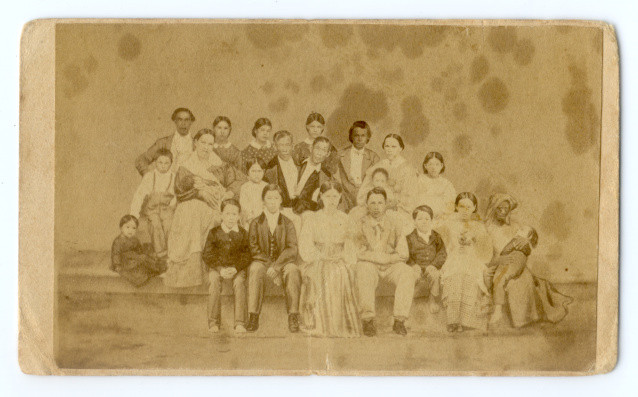
Still, something must work. Between them, the two couples have a total of twenty-one children over the years! The sisters eventually demand separate homes, but even so, the rigid scheduling and presence of a husband’s brother mean that the families can never truly be separate.

I saw how they leaned on each other — how their bond became a kind of fortress, both shelter and prison. How, sometimes, it shut out even those who loved them.

Beyond the domestic, The Foursome explores the lives of the Bunker husbands and wives in the context of the looming Civil War. Chang and Eng are landowners — and in the North Carolina of the 1800s, that means that they’ve slave owners. Sallie accepts that enslaved workers are simply a fact of life, but over time, her eyes are opened to what this actually means for the people who raise her children and care for her needs. As their community is drawn into war, and as sons of both households go off to fight, Sallie increasingly finds herself at odds with Addie and their husbands about the Confederacy’s ideals and what it is that they’re fighting to preserve.

Sallie’s voice in The Foursome is open and revealing. She shares the joyful moments, especially as she gives birth to child after child, as well as the discomfort of being married to a man who’ll always belong more to someone else. The descriptions of the family’s adaptation to the brothers’ conjoined nature offer a fascinating look into a situation that seems practically beyond belief.
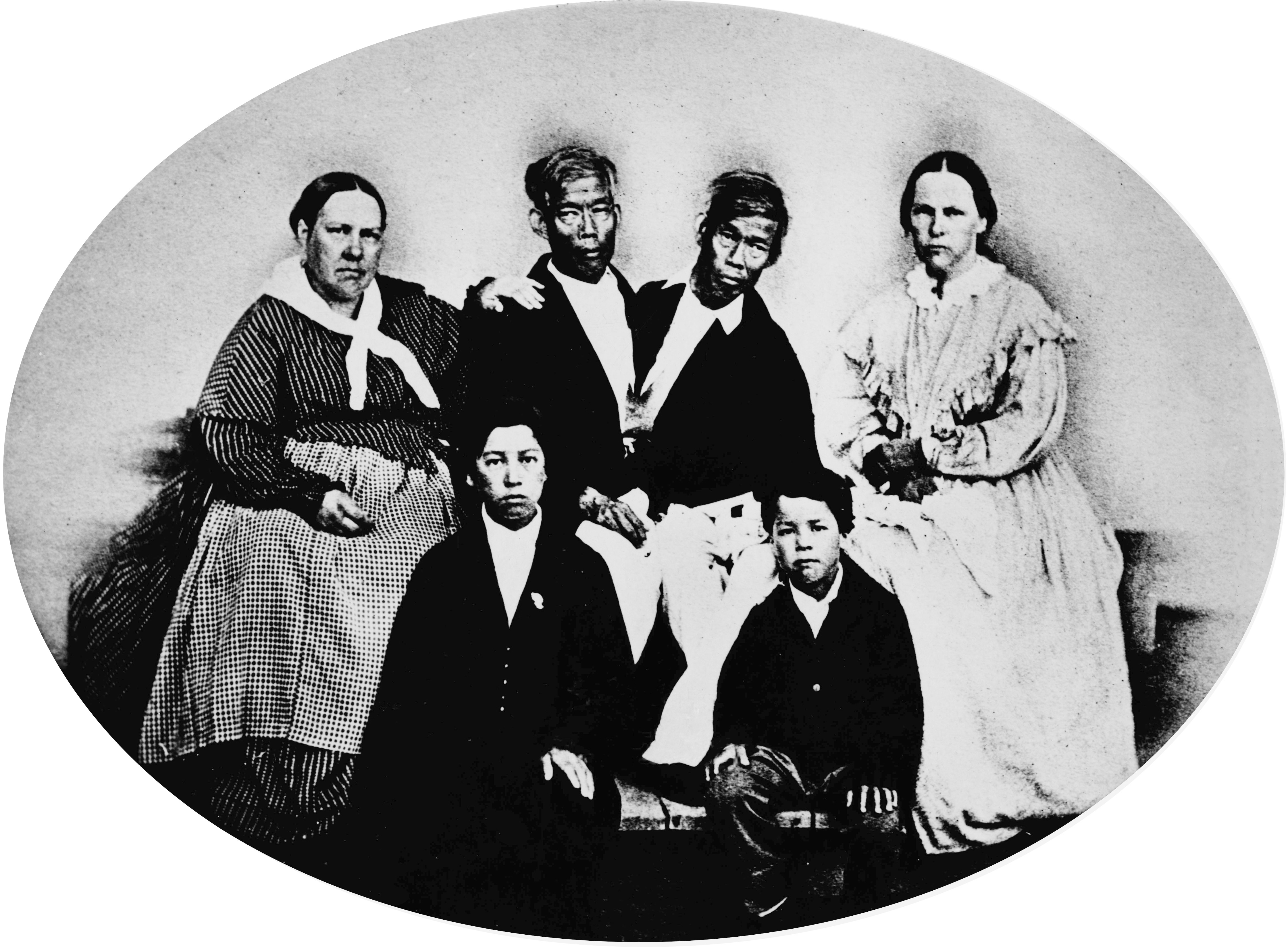
(L–R) Sarah, her son Patrick Henry, Eng, Chang, his son Albert, Adelaide

I did wish that Sallie’s awakening to the evils of slavery came sooner. I couldn’t help but feel that some of her change in perspective was driven by the purely personal, in terms of how slavery affected her rather than out of a sense of compassion and justice for the enslaved. She can’t make up for the past, but she eventually attempts her own version of reparation by offering new beginnings and opportunities to those she’d wronged.

There are sins of action and sins of inaction. I cannot forgive myself for the times I saw wrong and turned away.

Because the story is told through Sallie’s point of view, we only understand Addie through her eyes. This is understandable, yet sometimes frustrating. Addie is the catalyst for the marriage — I would have liked a deeper understanding of Addie’s inner life and why she felt so strongly that the choice to marry the brothers was their best (and only) option.

The Foursome is actually the second novel I’ve read about these historical figures. Chang and Eng by Darin Strauss, published in 2000, is a fictionalized account of their lives as told by Eng. I don’t remember a lot of the details at this point, but I do remember how interesting I found it. Reading The Foursome, I was reminded of many of the biographical details, and was entirely drawn in by this new approach and perspective on their lives.

The Foursome is a powerful, compelling read about remarkable lives, set against the backdrop of one of the most devastating and consequential periods in American history. Sallie’s voice is memorable, and the experiences she describes paint a picture of a particular family’s life that might seem unbelievable if it weren’t actually based on historical events. Highly recommended.

Purchase linksAmazon – AudibleBookshop.orgLibro.fm
Disclaimer: When you make a purchase through one of these affiliate links, I may earn a small commission, at no additional cost to you.
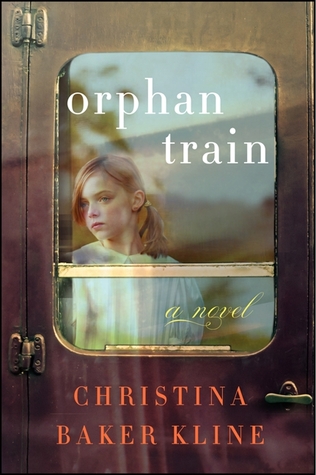
Book Review: Orphan Train by Christina Baker Kline

orphan-train

The author of Bird in Hand and The Way Life Should Be delivers her most ambitious and powerful novel to date: a captivating story of two very different women who build an unexpected friendship: a 91-year-old woman with a hidden past as an orphan-train rider and the teenage girl whose own troubled adolescence leads her to seek answers to questions no one has ever thought to ask.

Nearly eighteen, Molly Ayer knows she has one last chance. Just months from “aging out” of the child welfare system, and close to being kicked out of her foster home, a community service position helping an elderly woman clean out her home is the only thing keeping her out of juvie and worse.

Vivian Daly has lived a quiet life on the coast of Maine. But in her attic, hidden in trunks, are vestiges of a turbulent past. As she helps Vivian sort through her possessions and memories, Molly discovers that she and Vivian aren’t as different as they seem to be. A young Irish immigrant orphaned in New York City, Vivian was put on a train to the Midwest with hundreds of other children whose destinies would be determined by luck and chance.

The closer Molly grows to Vivian, the more she discovers parallels to her own life. A Penobscot Indian, she, too, is an outsider being raised by strangers, and she, too, has unanswered questions about the past. As her emotional barriers begin to crumble, Molly discovers that she has the power to help Vivian find answers to mysteries that have haunted her for her entire life – answers that will ultimately free them both.

Rich in detail and epic in scope, Orphan Train is a powerful novel of upheaval and resilience, of second chances, of unexpected friendship, and of the secrets we carry that keep us from finding out who we are.

It’s astonishing to me that until I read this book, I knew nothing about this important piece of American history. Over a span of 75 years, approximately 200,000 children, mostly orphaned and homeless, were transported from New York and other East Coast cities to farmland in the Midwest, where they were offered up for adoption via town hall meetings at stops along the rail lines. Some children found loving adoptive families and permanent homes; it appears that many, however, were treated as little better than manual labor or indentured servants, wanted for their ability to work but not adequately fed, sheltered, or schooled, much less given the love and support they most strongly needed.

In Orphan Train, we meet 91-year-old Vivian, who emigrated to America from Ireland as a young girl. When a tragic tenement fire leaves her all alone, she’s soon shipped out on the orphan train, ending up in some horrific circumstances in Minnesota — first, as an underfed worker in what was essentially a seamstress sweatshop, and then, as a poorly treated resident of an impoverished family farm, where abuse lurks around every corner. Thanks to a kind school teacher, she does eventually find her way forward through education and through the support of a kind older couple who provide her with all they’d once hoped to provide to their own deceased child.

When we first meet the elderly Vivian, it’s through the eyes of contemporary foster child Molly, who is just one breath away from being locked up in juvie at age 17 for the shocking crime of stealing a copy of Jane Eyre from the public library. As Molly fulfills her mandated community service hours by helping Vivian clean her attic, it becomes clear that the two women, young and old, have more in common than they realize. With each box of mementos that Molly opens and reviews with Vivian, a piece of Vivian’s history is remembered and reexamined. Through their connection, each helps the other come to terms with their pasts and think about new ways of envisioning and creating a future.

My entire life has felt like chance. Random moments of loss and connection. This is the first one that feels, instead, like fate.

I really enjoyed Orphan Train, although perhaps “enjoyed” isn’t quite the right term. The stories of Molly and Vivian are both heartbreaking in their own ways. While Molly, as a foster child in 21st century Maine, isn’t handed over into servitude, she does go through a series of foster homes, largely finding herself with people who see her as a chore or a duty, or worse, a source of a paycheck from social services. She’s unloved and unwanted, and gets used to traveling light and protecting herself by driving others away before they can reject her. Molly’s pain is palpable and real, and I wanted so desperately for her to finally find a place to belong and someone to really cherish her for herself.

Likewise, with Vivian, the loss and sorrow she endures is unimaginable. At the time at which she becomes an orphan, children have no voice and no rights, and it’s shocking as a modern reader to see how casually the children are handed over to any stranger who comes along and picks them. The deprivation, physical and emotional, that Vivian suffers is quite hard to read, especially keeping in mind that she’s not yet even a teen when the worst parts of her experience take place.

The way the two story threads weave together to create a whole is fascinating and well thought-out. The dual time line approach is pretty common right now in historical fiction, but in the case of Orphan Train, I think it succeeds because each time line gives us a central character to really care for. Vivian’s story is perhaps a touch more compelling, but I think a big reason for that is the fact that it’s so unusual and, for me at least, mostly unknown prior to reading this story. With Molly, while her story is sad and moving, it doesn’t have the same sense of discovery of a chapter of history that Vivian’s story does. Still, both pieces shed light on shameful practices and conditions of foster and abandoned children, and the two story elements together complement each other quite well.

I had one quibble with the storyline of this book, but in the interest of avoiding spoilers, I won’t go into specifics. Keeping things vague, I’ll just say that Vivian makes a huge decision in the latter part of the book, when she’s a young woman, that I didn’t find particularly believeable. Given the way her life is at the time in question, I do think she’d have had other choices and should have had enough support in her life to at least take the time to consider her options. It’s a huge turning point that affects the rest of Vivian’s life, and yet she makes it quickly and at a time of great vulnerability. I just didn’t buy it.

That aside, I loved reading Orphan Train. I found the history fascinating, and loved the two main characters, Molly and Vivian. It’s the kind of book that leaves you desperately hoping that the people you’ve come to know will go on to find happiness in their lives.

Orphan Train is a book that will stay with me. I’m so glad my book group decided to read it this month! I just know we’ll have plenty to talk about.

_________________________________________

The details:

Title: Orphan Train
Author: Christina Baker Kline
Publisher: William Morrow
Publication date: April 2, 2013
Length: 278 pages
Genre: Contemporary and historical fiction
Source: Purchased