Audiobook Review: Well Met by Jen DeLuca

Title: Well Met
Author: Jen DeLuca
Narrator: Brittany Pressley
Publisher: Berkley
Publication date: September 3, 2019
Print length: 336 pages
Audio length: 9 hours, 45 minutes
Genre: Contemporary romance
Source: Library
Rating:

Rating: 4 out of 5.

All’s faire in love and war for two sworn enemies who indulge in a harmless flirtation in a laugh-out-loud rom-com from debut author, Jen DeLuca.

Emily knew there would be strings attached when she relocated to the small town of Willow Creek, Maryland, for the summer to help her sister recover from an accident, but who could anticipate getting roped into volunteering for the local Renaissance Faire alongside her teenaged niece? Or that the irritating and inscrutable schoolteacher in charge of the volunteers would be so annoying that she finds it impossible to stop thinking about him?

The faire is Simon’s family legacy and from the start he makes clear he doesn’t have time for Emily’s lighthearted approach to life, her oddball Shakespeare conspiracy theories, or her endless suggestions for new acts to shake things up. Yet on the faire grounds he becomes a different person, flirting freely with Emily when she’s in her revealing wench’s costume. But is this attraction real, or just part of the characters they’re portraying?

This summer was only ever supposed to be a pit stop on the way to somewhere else for Emily, but soon she can’t seem to shake the fantasy of establishing something more with Simon, or a permanent home of her own in Willow Creek. 

Okay, show of hands: Who among us hasn’t ever wanted to lace up a corset, grab a turkey leg, and head to ye olde Renaissance Faire for some old-timey fun? Not just me, right?
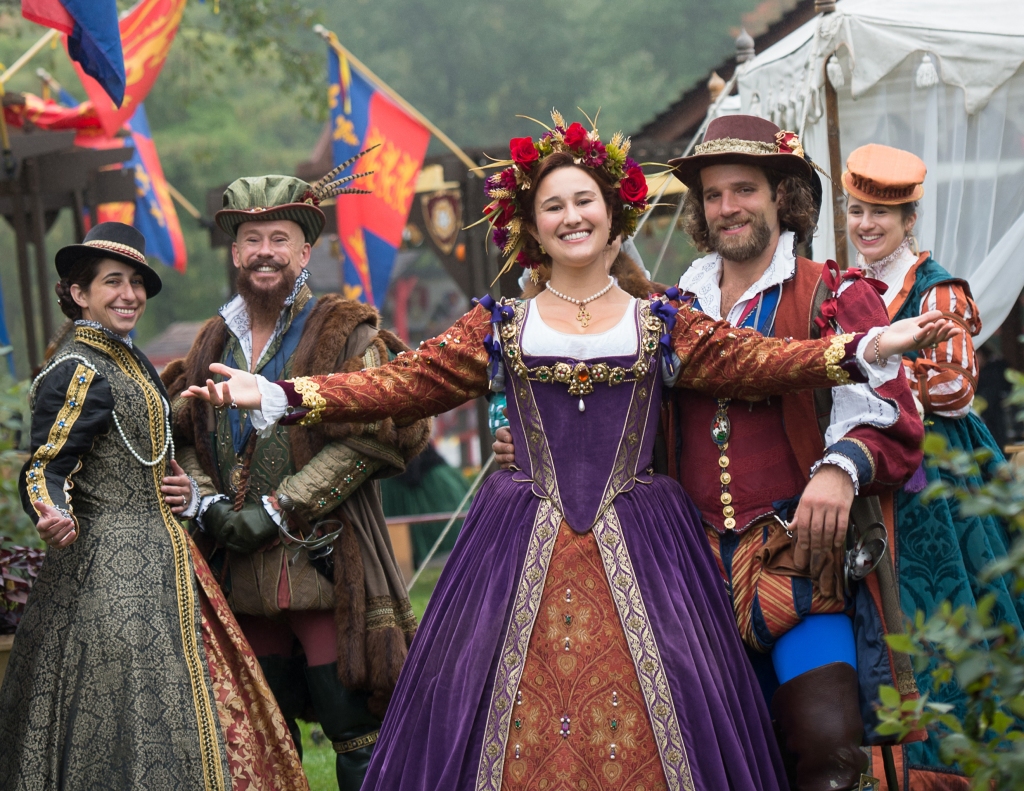
In Well Met, Emily Parker is 24, unemployed, and temporarily living in small-town Willow Creek while helping her older sister April recover from a serious car accident. Part of this help is ferrying around her 14-year-old niece, Caitlin, including taking her to sign up as a volunteer cast member for the upcoming summer’s Renaissance Faire. The catch, however, is that minors can’t volunteer unless they have a responsible adult volunteering with them, so Emily reluctantly finds herself roped into volunteering as a tavern wench for the summer.

Emily takes an immediate dislike to the Faire’s organizer Simon, who seems rigid and overly obsessed with filling out forms correctly. He causes further offense by accusing Emily of not taking Faire seriously — which, granted, she’s only half-heartedly doing, at least at first.

But as rehearsals warm up and the big event approaches, Emily is more and more drawn into the excitement, the pretend world of Faire, and the real world of Willow Creek. She’s had a hard few years, but is finally starting to feel like she might have found a place to put down roots and create a life for herself.

It doesn’t hurt that she and Simon seem to be developing some real chemistry — especially when they’re in their Faire personae of tavern wench and swaggering pirate.

Well Met is so much adorable fun! First off, the Faire goings-on are amazing and made me want to be there! Jousting, troubadors, Queen Elizabeth, ladies in waiting, kilted men… there’s just so much to love! And it’s so cute to see how into it everyone is, from giddy high school students to long-time Faire veterans.

I enjoyed Emily’s character,and there are plenty of great supporting characters too — such as April, Caitlyn, Emily’s new-found bestie Stacy, local bookstore owner Chris, and more.

Emily and Simon both have painful baggage, and their histories hold them back from fully exploring what they want and what they need to find happiness. When they do finally get together, it’s not all smooth sailing, as they both put up their defenses, misinterpret each others’ communications, and just generally mess things up quite a bit.

One of my standard romance complaints comes into play, which is that if people would only talk to each other rather than jumping to conclusions, life would be a whole lot easier! Of course, then the story would have less drama, but still. Emily spends a week worrying that she’s being fired from her job and that Simon played a part in it — but a), that’s a ridiculous assumption that’s really not based on anything concrete, and b) she could have asked one simple questions and clearly up her confusion instantly.

Still, what’s a romance novel without stumbling blocks? It would have all wrapped up much too quickly if Emily and Simon got together when they did and then remained blissfully happy until the end. So yes, we get the requisite drama, fight, and break-up, but hey, it’s a romance, so of course there’s going to be an HEA to end the story!

My one lingering complaint about Well Met is that there’s a storyline thread I would have loved to see get tied up. Part of Emily’s backstory is that she dropped out of college about a year short of an English degree in order to support her (awful) ex-boyfriend through law school. While Emily is happily employed and fulfilled by the end of the book, I would have loved for her to decide to go back to school and finish the education that clearly meant so much to her. Well, hopefully we’ll find out that that’s exactly what she did by the time the sequel comes out!

A note on the audiobook: I originally picked up a print version of this book, but I’m so happy I ended up going the audio route instead! I really enjoyed the narration. The dialogue is crisp and funny, and the narrator did a great job showing us the characters putting on their fake accents for the Faire personae and getting into the spirit of it all.

Well Met is the first in a trilogy of novels centered around Faire, each one focusing on a different couple’s love story. Book #2, Well Played, due out this coming September. And yes, I absolutely want to read it!

Well Met is good, romantic fun, and a great choice for a summer read.

Huzzah!
Audiobook Review: The Fated Sky (Lady Astronaut, #2) by Mary Robinette Kowal

Title: The Fated Sky (Lady Astronaut, #2)
Author: Mary Robinette Kowal
Narrator: Mary Robinette Kowal
Publisher: Tor
Publication date: August 21, 2018
Print length: 384 pages
Audio length: 10 hours, 14 minutes
Genre: Science fiction
Source: Purchased
Rating:

Rating: 4.5 out of 5.

The Fated Sky continued the grand sweep of alternate history begun in The Calculating Stars. It is 1961, and the International Aerospace Coalition has established a colony on the moon. Elma York, the noted Lady Astronaut, is working on rotation, flying shuttles on the moon and returning regularly to Earth.

But humanity must get a foothold on Mars. The first exploratory mission is being planned, and none of the women astronauts is on the crew list. The International Aerospace Coalition has grave reservations about sending their “Lady Astronauts” on such a dangerous mission. The problem with that is the need for midjourney navigation calculations. The new electronic computation machines are not reliable and not easily programmed. It might be okay for a backup, but there will have to be a human computer on board. And all the computers are women.

I read The Fated Sky a year ago, but apparently didn’t write a review at the time. Don’t ask me why! But in any case, I’ve just completed a re-read via audiobook, and loved it all over again… so I think it’s about time to share my thoughts.

The Fated Sky is the follow-up to The Calculating Stars, which I love, love, love, love, love. A second book in a series is never quite as breathtaking as the first, in my humble opinion, because there’s already a familiarity with the world presented in the book. And so, while The Fated Sky didn’t blow me away the way The Calculating Stars did, it did keep me engaged in new and different ways, and was an altogether satisfying return to the world of the Lady Astronaut.

To get anyone new to this series caught up, here’s what you really need to know: It’s been about 10 years since a devastating meteor struck Earth, resulting in global catastrophe. The planet faces accelerating climate change, which will eventually become so extreme that human life on Earth will no longer be possible. In these dire circumstances, the international community comes together to pursue space exploration. After all, if people can’t live on Earth, they’ll have to live off Earth.

In book 1, we met Dr. Elma York, brilliant mathemetician and physicist, as well as a top-notch pilot who flew with the WASPs during WWII. Elma is married to Dr. Nathaniel York, an equally brilliant engineer. As the space program gets underway, Nathaniel becomes one of the lead engineers, while Elma pursues her dream of becoming an astronaut. It’s simply fascinating, and I urge you to read the book if you haven’t yet!

In The Fated Sky, we pick up in the early 1960s. Humans have established a colony on the moon, and the next target is Mars. The first Mars mission is about 18 months away — but not all on Earth are happy about the space program.

Earth Firsters are angry — they believe that space travel and colonization will end up being a privilege for the elite. How are the people left behind supposed to survive? With poorer areas still suffering the aftermath of the meteor’s destruction, with food, housing, and medical shortages, they feel that the country’s resources are being unfairly allocated to the space program. The protesters are becoming more outspoken, to the point of violence, in expressing their dissatisfaction.

Elma gained fame in book #1 as “the Lady Astronaut”, and when the IAC (International Aerospace Coalition) assigns her to the Mars mission, it’s clearly with an eye on public relations. But with this assignment, Elma replaces a dear friend who’d already been training for the mission, so she’s not only behind in her training but also facing resentment and hostility from the other crew members who see her as an interloper taking someone else’s place.

The Fated Sky takes place during the preparation for the Mars expedition, as well as the months of the actual journey to Mars. And while the science is absolutely fascinating, it’s Elma’s personal struggles and challenges that make it all so real and so deeply affecting.

Elma is a brilliant scientist. She’s also a devoted wife, a Southern Jew, a woman in a man’s world, and a white woman who’s not always as aware of her privilege as she should be. In the world of the Lady Astronaut books, the social unrest and upheavals of the real-world 1960s has largely been moved forward a decade along with the scientific advancements. We see women struggling for opportunity, even while being expected to maintain traditional standards of femininity (like always having their hair and makeup done before public appearances and deferring to their male counterparts even when they have superior knowledge or technical expertise. Not to mention that the female astronauts seem to be the only ones assigned laundry duty on their space mission. Argh.)

Racial inequality and civil rights feature much more prominently in The Fated Sky than they did in The Calculating Stars. There’s suspicion of the Black astronauts and whether they’re conspiring with Earth Firsters. Mission Control assigns them less prestigious assignments during the Mars expedition than their white colleagues, even when they’re clearly the better choice, which leads to disastrous results. And in myriad other, more subtle ways, the matter of race permeates the crew relations, so that even someone as well-intentioned as Elma ends up causing offense, until she’s finally told point-blank:

“One thing: Don’t explain my experience to me. It’s annoying as hell.”

On top of all this, one of the expedition crew members is a white South African, and remember, this is the early 1960’s — he’s so full of apartheid-era hate that it’s incredible that he was actually allowed to participate in the mission, and if not for international pressure related to South Africa’s financial backing of the IAC, he probably would not have been. By showing the Earth protests, the more subtle racial profiling and preferences on board the ship, and the blatant racism of this one particular astronaut. the author evokes a time of change and volatility — and sadly, exposes issues that still permeate society today.

Elma struggles too with her mental health. She’s suffered from anxiety for most of her life, which she’s worked hard to control. Her coping mechanisms are put to the test during the mission in response to the ongoing hostility she experiences from her fellow astronauts early on, especially as she realizes that she’s the only crew member who doesn’t really fit in and isn’t completely trusted.

I think maybe one of the reasons I had time loving this book the first time I read it had to do with how entangled my feelings were with Elma’s experiences. I felt so awful reading about Elma’s struggles and personal pain and how terrible she often felt. So it’s not that the book isn’t excellent — just maybe that I become overly invested in Elma as a person and didn’t like seeing her feel bad!

Anyhoo… the audiobook is such a treat! Author Mary Robinette Kowal is the narrator, and she’s a total pro. (She also narrates Seanan McGuire’s October Daye audiobooks, and does an amazing job with them.) She clearly knows these characters and what makes them tick, and I could feel Elma’s personality, as well as many of the other characters’, coming through so clearly. Fabulous.

I love the world of the Lady Astronaut, which the author first introduced in her short story, The Lady Astronaut of Mars (which actually takes place many years after the events of the books, but provides some additional context — you can read the story for free here.)

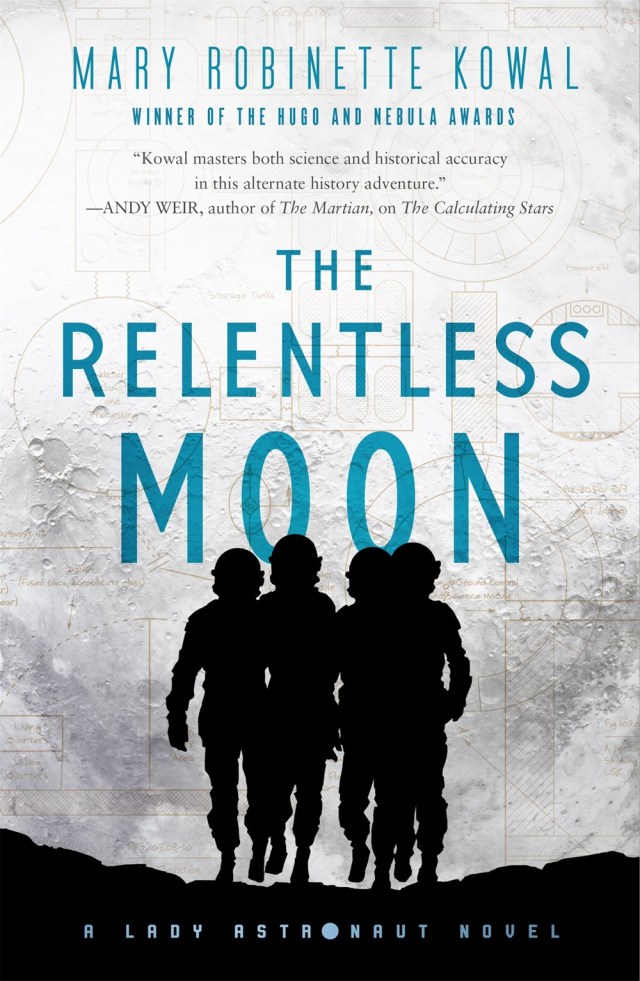
Listening to the audiobook was a perfect way for me to revisit the story of The Fated Sky. The 3rd book in the series, The Relentless Moon, will be released in July, and I absolutely can’t wait to read it!

The Earth is coming to the boiling point as the climate disaster of the Meteor strike becomes more and more clear, but the political situation is already overheated. Riots and sabotage plague the space program. The IAC’s goal of getting as many people as possible off Earth before it becomes uninhabitable is being threatened.

Elma York is on her way to Mars, but the Moon colony is still being established. Her friend and fellow Lady Astronaut Nicole Wargin is thrilled to be one of those pioneer settlers, using her considerable flight and political skills to keep the program on track. But she is less happy that her husband, the Governor of Kansas, is considering a run for President.

Book Review: Laughter at the Academy by Seanan McGuire

Title: Laughter at the Academy
Author: Seanan McGuire
Publisher: Subterranean Press
Publication date: October 31, 2019
Length: 376 pages
Genre: Horror/fantasy (short story collection)
Source: Purchased
Rating:

Rating: 5 out of 5.

From fairy tale forest to gloomy gothic moor, from gleaming epidemiologist’s lab to the sandy shores of Neverland, Seanan McGuire’s short fiction has been surprising, delighting, confusing, and transporting her readers since 2009. Now, for the first time, that fiction has been gathered together in one place, ready to be enjoyed one twisting, tangled tale at a time. Her work crosses genres and subverts expectations.

Meet the mad scientists of “Laughter at the Academy” and “The Tolling of Pavlov’s Bells.” Glory in the potential of a Halloween that never ends. Follow two very different alphabets in “Frontier ABCs” and “From A to Z in the Book of Changes.” Get “Lost,” dress yourself “In Skeleton Leaves,” and remember how to fly. All this and more is waiting for you within the pages of this decade-spanning collection, including several pieces that have never before been reprinted. Stories about mermaids, robots, dolls, and Deep Ones are all here, ready for you to dive in.

This is a box of strange surprises dredged up from the depths of the sea, each one polished and prepared for your enjoyment. So take a chance, and allow yourself to be surprised.

There are two things I think I’ve established by now over the course of many years of writing book reviews: 1 – I love Seanan McGuire. 2 – I’m not a big fan of short stories.

So when Seanan McGuire releases a collection of stories, what’s a fan to do? Buy it immediately, then stick it on the shelf and delay, delay, delay…

Well, I’m here to say I’m an idiot. Because OF COURSE I ended up loving this book once I finally sat myself down and gave it a try. It’s Seanan McGuire! What’s not to love?

This collection brings together stories from 2009 through 2017, and as the author makes clear in her introduction, all stories take place outside of her “pre-existing universes” — so you won’t find October Daye or the Incryptid’s Price family members anywhere in these pages. All stories appeared in other publications and anthologies over the years, and it’s a treat to have so many available in one glorious collection.

Quick aside: I purchased the pretty hardcover special edition from Subterranean Press as a splurge, but it’s also available in e-book format for a much more reasonable price.

These 22 stories cover a wide range of themes, topics, and tones. Some are funny, some are sad, some are terrifying, and some are just downright creepy. Absolutely none are boring or skippable! One of the things I loved about this book was the mix — from story to story, it’s always something new, and so many surprises!

I’ll share just a few highlights about my favorites of the bunch:

The title story, “Laughter at the Academy”, is all sorts of awesome about mad scientists and a condition called “Schizotypal Creative Genius Personality Disorder”. It’s brutal and fun and, well, mad.

“Lost” is creepy and disturbing and sad, as is any story about children all over the world acting strangely at the same time. It made me think of Torchwood and Childhood’s End, although it isn’t really much like either one.

Seanan McGuire is excellent at unleashing hell on the world, so a story about viruses ravaging humankind is scary and perhaps too timely right now, but I loved “The Tolling of Pavlov’s Bells” all the same. Super frightening. And prescient — this is from her introduction to the story:

I also believe that the modern world’s disdain for quarantine and willingness to support structures which encourage its violation is going to do a great deal of damage one day… and that with the new diseases emerging regularly from a variety of sources, that day may not be particularly far in the future.

And as the story itself describes:

If they were to stay home, avoid the company of strangers, and wait for a vaccine, they might stand a chance. But no one listens to the doctors, or to the newspaper headlines begging them to stay indoors.

One of the coolest stories in the collection — so weird and unexpected — is “Uncle Sam”. Ever wonder why women go to the bathroom together? Read this and find out.

There’s also a story about Valkyries, a western sci-fi story…

Cherry’s first to the cattle call, her guns low and easy on her hips, her hair braided like an admonition against untidiness.

… military mermaids, a steampunk invasion of carnivorous plant-based aliens…

“A… diplomat?” Arthur blinked at me as our carriage rattled to a stop, presumably in front of our destination. “But the first thing you did was eat my sister’s maid.”

… a Peter Pan story, a Twitter-based ghost story, more end-of-the-world/end-of-humankind scenarios, a GoFundMe for bringing on eternal Halloween…

… and the story that’s given me nightmares ever since, “We Are All Misfit Toys in the Aftermath of the Velveteen War”. There are dolls. And they’re scary as hell. This is creepy and brilliant, and if I ever get over my first reading of this story, I’ll come back and read it again!

Seanan McGuire’s writing is as amazing as always, and this collection shows her range and ability to try on any genre or style and make it work.

Obviously, I loved this book, and I’m so glad I got over my reluctance to read short story collections. Laughter at the Academy is a must-read for Seanan McGuire fans, but you don’t have to have previous experience with her work to appreciate the funny, scary, and strange worlds presented here.

Book Review: Ask Again, Yes by Mary Beth Keane

Title: Ask Again, Yes
Author: Mary Beth Keane
Publisher: Scribner
Publication date: May 28,2019
Length: 390 pages
Genre: Contemporary fiction
Source: Purchased
Rating:

Rating: 3 out of 5.

How much can a family forgive?

A profoundly moving novel about two neighboring families in a suburban town, the bond between their children, a tragedy that reverberates over four decades, the daily intimacies of marriage, and the power of forgiveness.

Francis Gleeson and Brian Stanhope, two rookie cops in the NYPD, live next door to each other outside the city. What happens behind closed doors in both houses—the loneliness of Francis’s wife, Lena, and the instability of Brian’s wife, Anne—sets the stage for the explosive events to come.

Ask Again, Yes is a deeply affecting exploration of the lifelong friendship and love that blossoms between Francis and Lena’s daughter, Kate, and Brian and Anne’s son, Peter. Luminous, heartbreaking, and redemptive, Ask Again, Yes reveals the way childhood memories change when viewed from the distance of adulthood—villains lose their menace and those who appeared innocent seem less so. Kate and Peter’s love story, while tested by echoes from the past, is marked by tenderness, generosity, and grace.

In Ask Again, Yes, we follow the trajectories of two families over the years, seeing how their connections follow them and affect their entire lives.

Kate and Peter, born within months of each other, grow up as next door neighbors and best friends. Their fathers served on the police force together, and the families’ background are entwined in shared history and parallel origins. For Kate and Peter, they have no memory of life without the other. But a tragic, violent incident when they’re fourteen shatters both families’ lives, and cuts short the romantic relationship just starting to bloom between Kate and Peter.

Ask Again, Yes traces the roots of the family dynamics at play, and then follows Kate and Peter as their lives diverge and then come back together.

There’s a lot to unpack here — themes of mental illness, alcoholism and addiction, infidelity, parenthood and abandonment, the ups and downs of a long marriage — and yet, the story for the most part left me cold.

This story of family and suburban drama covers a lot of years, but feels diffuse somehow. The POV shifts between characters, so we view events through Kate and Peter’s eyes, but also through the experiences of their parents and others. Perhaps as a result, we often don’t stick with one character long enough to see an event through, and there seem to be some odd choices in terms of which events we experience in detail and which only get referred to in passing or in summary.

There are certainly some tragic occurrences, and places where tragedy could possibly have been avoided if appropriate mental health resources had either been available or sought out. I never really bought into the central love story between Kate and Peter, and the troubles they experience later in their marriage felt sort of shoe-horned in for me.

I read Ask Again, Yes as a book group read, and I’m thinking that I probably wouldn’t have picked this one up on my own. That said, the relationships are complex and thought-provoking — it’s simply not my preferred subject matter, and the writing didn’t engage or move me.

Still, I look forward to the book group discussion later this week. Maybe I’ll find more to appreciate once I hear what my book friends have to say about it!

Book Review: The Printed Letter Bookshop by Katherine Reay

Title:The Printed Letter Bookshop
Author: Katherine Reay
Publisher: Thomas Nelson
Publication date: May 14, 2019
Length: 324 pages
Genre: Contemporary fiction
Source: Purchased
Rating:

Rating: 3.5 out of 5.

Love, friendship, and family find a home at the Printed Letter Bookshop

One of Madeline Cullen’s happiest childhood memories is of working with her Aunt Maddie in the quaint and cozy Printed Letter Bookshop. But by the time Madeline inherits the shop nearly twenty years later, family troubles and her own bitter losses have hardened Madeline’s heart toward her once-treasured aunt—and the now struggling bookshop left in her care.

While Madeline intends to sell the shop as quickly as possible, the Printed Letter’s two employees have other ideas. Reeling from a recent divorce, Janet finds sanctuary within the books and within the decadent window displays she creates. Claire, though quieter than the acerbic Janet, feels equally drawn to the daily rhythms of the shop and its loyal clientele, finding a renewed purpose within its walls. When Madeline’s professional life takes an unexpected turn, and when a handsome gardener upends all her preconceived notions, she questions her plans and her heart. She begins to envision a new path for herself and for her aunt’s beloved shop—provided the women’s best combined efforts are not too little, too late.

The Printed Letter Bookshop is a captivating story of good books, a testament to the beauty of new beginnings, and a sweet reminder of the power of friendship.

What a difference a year makes!

And reading moods certainly make a difference too.

Last year, I received an ARC of The Printed Letter Bookshop via NetGalley. And I was excited to read it, because I’ve enjoyed several of this author’s books previously. But according to my Goodreads post, I DNFd this book at about 25%, saying that I just wasn’t interested and couldn’t get into it.

This could probably be an entirely different post about reading according to a schedule (I was trying to read ARCs on or before publication date) and feeling obligated when choosing what to read… but suffice it to say, for whatever reason, this just wasn’t the right book for me at that particular time.

So here I am, a year later, and I received an ARC of Katherine Reay’s soon-to-be-released newest book (Of Literature and Lattes) — and as I started reading it, I realized (a) it’s set in the same town as The Printed Letter Bookshop, and (b) while it appears to be focusing on different characters, there’s definitely crossover. And even though I was already five chapters in, and enjoying it, I decided it was time to go back to The Printed Letter Bookshop and give it another try.

Whew. All that is just context for the actual review! So here goes…

The Printed Letter Bookshop is charming! It’s a look at women’s friendship, centered around a bookshop located in small-town Winsome, Illinois, just an hour’s drive from Chicago, but worlds away in terms of the cozy, quaint, close-knit nature of the community.

When the store owner Maddie dies, her two colleagues and close friends Janet and Claire are devastated by her loss, and then immediately have to begin worrying about their future of their beloved store. Maddie leaves all her belongings, including her house and the bookshop, to her niece Madeline, a hard-charging young lawyer who hasn’t visited Maddie in years.

Madeline doesn’t want the store or any permanent link to Maddie. While they used to be close, some rift between Maddie and Madeline’s parents years in the past caused horribly hurt feelings, and Madeline has never forgiven Maddie. Now, though, Maddie’s holdings are her responsibility, and they come at a time when Madeline’s professional life has taken a sudden detour.

Madeline’s plan is to get in, get the store’s finances in shape, and sell. But life seems to have other plans.

Once she begins to get involved at The Printed Letter Bookshop, Madeline starts to understand how much it means to Janet, Claire, and the town. She also gains fresh insight into Maddie as a person, how badly she misunderstood her parents’ estrangement from Maddie, and just how much she herself needs a fresh perspective on her own life.

Janet and Claire are also POV characters. Each has her own reason for being drawn to Maddie, who gave them purpose and connection by welcoming them into the bookshop. They each have troubled home lives, but through their work at the bookshop, they reinvent themselves and start to understand where their lives’ turning points were, and how to choose different directions.

Although the book opens with Maddie’s funeral, she’s a large presence throughout the story. She’s a warm, lovely person who truly understands the way books can transform lives. She has the knack of finding the right book for each person who enters The Printed Letter Bookshop, and as her parting gift to Madeline, Janet, and Claire, leaves each a list of books to read — no explanation, just a list. And for each woman, the book list helps her grow and change.

The Printed Letter Bookshop is a lovely book. I’ve seen it shelved as Christian fiction (publisher Thomas Nelson specializes in Christian content) — but if I hadn’t known that, I don’t think I’d classify this book that way. (Full disclosure: I am not Christian, and would not normally read books classified at Christian fiction. I’m glad I didn’t see a “label” before picking up this book!)

There are discussions about faith and God in the book, but I never felt like those discussions dominated the novel or that I was being hit over the head with religion. Instead, these themes are a part of the women’s journeys, as they think about their lives, their families, their relationships, and the meaning of it all. While their beliefs don’t align with my own, I was actually quite moved by some of their inner processes and how they decide, each in their own way, to make important changes in their lives.

There’s also a love story for Madeline, but that’s probably the part that I cared about least in this book. I mean, it was nice, but I didn’t get a good feel for the relationship or how it grew, and didn’t feel all that invested in that piece of the plot.

All in all, I’m really glad I decided to give this book another chance! It’s a quick, engaging read, with heart, emotions, and LOTS OF BOOKS. (The author helpfully includes a list of all the books mentioned or referred to in the story at the back of the book… and we all know how awesome books about books can be!)

And now, I feel ready for Of Literature and Lattes.

Sometimes, it’s all about the timing.

Book Review: The Last List of Miss Judith Kratt by Andrea Bobotis

Title: The Last List of Miss Judith Kratt
Author: Andrea Bobotis
Publisher: Sourcebooks Landmark
Publication date: July 9, 2019
Length: 311 pages
Genre: Historical fiction
Source: Purchased
Rating:

Rating: 4 out of 5.

Some bury their secrets close to home. Others scatter them to the wind and hope they land somewhere far away.

Judith Kratt inherited all the Kratt family had to offer—the pie safe, the copper clock, the murder no one talks about. She knows it’s high time to make an inventory of her household and its valuables, but she finds that cataloging the family belongings—as well as their misfortunes—won’t contain her family’s secrets, not when her wayward sister suddenly returns, determined to expose skeletons the Kratts had hoped to take to their graves.

Interweaving the present with chilling flashbacks from one fateful evening in 1929, Judith pieces together the influence of her family on their small South Carolina cotton town, learning that the devastating effects of dark family secrets can last a lifetime and beyond. 

Miss Judith Kratt has lived in the imposing family home in Bound, South Carolina all her life. Now in her mid-70s, she lives contentedly with Olva — an African American woman who seems to be both servant and companion, the two women having spent their entire lives together. Judith has the idea to start an inventory of the house’s objects, all of which seem to hold a piece of the family history.

The Kratt family rose from nothing with Judith’s father, a bully of a man who strong-armed and cheated his way into a fortune in the cotton and mercantile business. He ruled his family and his town with an iron fist, inspiring fear and obedience whever he went.

In alternating chapters, we visit Judith’s memories of her teen years, going back to the fateful year of 1929 when her family’s fortunes changed dramatically.

Meanwhile, in the present of 1989, a local man and his six-year-old daughter take shelter in the Kratt home after being pursued by the grandson of Daddy Kratt’s former business partner. We see the cycles of hate and violence being carried through the generations, as the descendants of the grown-ups from Judith’s childhood still carry their forefathers’ handed-down grudges.

Judith seems odd and standoffish at first, but the more we learn about her childhood, the more her strange life starts to make sense. There are powerful family secrets buried in her and Olva’s pasts, and these secrets are still weighty enough to change lives all these years later.

As Judith makes her inventory, we come to understand the meaning of all the difference objects in her house, and how they relate to the family tragedy. It’s a clever and strangely moving approach to showing the weight of memories, and how those can add up to an entire life defined by the past.

The Last List of Miss Judith Kratt isn’t exactly what I expected, especially based on the book cover (which was what originally caught my eye). The image made me expect a work of historical fiction, maybe 1950s era or thereabouts, about Southern belles and their families. That’s not this book at all, though.

Instead, The Last List of Miss Judith Kratt is about a 15-year-old girl and the older woman she becomes, and the family secrets that shadow her entire life. This book is my book group’s pick for March, and I can wait to hear what everyone else thought and to pick apart the tangled web of secrets with them. Definitely a recommended read!

Book Review: The Secret Commonwealth (The Book of Dust, #2) by Philip Pullman

Title: The Secret Commonwealth (The Book of Dust, #2)
Author: Philip Pullman
Publisher: Knopf Books for Young Readers
Publication date: October 3, 2019
Length: 641 pages
Genre: Young adult fantasy
Source: Purchased

Rating: 3 out of 5.

It is twenty years since the events of La Belle Sauvage: The Book of Dust Volume One unfolded and saw the baby Lyra Belacqua begin her life-changing journey.

It is seven years since readers left Lyra and the love of her young life, Will Parry, on a park bench in Oxford’s Botanic Gardens at the end of the ground-breaking, bestselling His Dark Materials sequence.

Now, in The Secret Commonwealth, we meet Lyra Silvertongue. And she is no longer a child . . .

The second volume of Sir Philip Pullman’s The Book of Dust sees Lyra, now twenty years old, and her daemon Pantalaimon, forced to navigate their relationship in a way they could never have imagined, and drawn into the complex and dangerous factions of a world that they had no idea existed.

Pulled along on his own journey too is Malcolm; once a boy with a boat and a mission to save a baby from the flood, now a man with a strong sense of duty and a desire to do what is right.

Theirs is a world at once familiar and extraordinary, and they must travel far beyond the edges of Oxford, across Europe and into Asia, in search for what is lost – a city haunted by daemons, a secret at the heart of a desert, and the mystery of the elusive Dust.

How to describe this long, strange book, set in the world of His Dark Materials?

The Secret Commonwealth is very much a middle book. It’s packed with details and characters, most of whom are people on a journey or quest. There’s a lot of travel from here to there… but we leave off before anyone actually arrives at their destinations.

In La Belle Sauvage, the installment in The Book of Dust that precedes The Secret Commonwealth, we see Lyra as an infant. She’s the object of hot pursuit by nefarious agents of the Magisterium, the ruling religious entity, and a person to be protected by an assortment of good guys and heroes, chief among them young Malcolm Polstead, an 11-year-old boy with unflinching bravery and a very steady canoe.

Here, we re-meet Lyra at age 20. She’s a student at St. Sophia’s, and still lives at Jordan College, the Oxford college where she’s been sheltered under rules of scholastic sanctuary since infancy. Lyra’s life is difficult as the story opens. Her comfortable home at Jordan is no longer a safe place for her, the money supporting her has run out, and shady characters are once again intent on tracking her down.

Closer to home, Lyra and her beloved daemon Pantalaimon are not getting along, which is a huge deal, considering that daemons are the external representation of a person’s soul. Daemon and human are two halves of one whole; neither is complete without the other. It’s almost beyond imagining that Lyra and Pan should be so estranged. Pan believes that Lyra has come too deeply under the influence of literary and scholarly works that prize only what’s real and can be seen, discounting completely the value or even existence of subtlety, imagination, and unseen forces and worlds.

Meanwhile, there’s a movement behind the scenes within the Magisterium to consolidate power even further, pushing toward total religious authoritarianism, leading to fear, civil unrest, and a growing flood of refugees throughout Europe. There’s also a quest by the Magisterium to root out a particular type of rose oil that’s believed to have certain properties that are considered threatening and heretical, and the efforts to wipe out all roses is being conducted by force.

As Lyra is forced into a quest across Europe and into the Eastern lands, she faces incredible danger and constant pursuit, meeting some allies and encountering enemies of all sorts. We also see events through Pan’s perspective, as well as accompanying Malcolm and others on their own strange and dangerous journeys.

It’s a little hard to figure out just who the intended audience of this book is. It’s clearly a youth-oriented book, based on the publisher and where it fits into the greater world of His Dark Materials, but this book is different. For starters, it’s the first novel in either series with no children as characters. Lyra, at age 20, is the youngest, and she’s truly a young woman and not a girl any longer.

More than that, though, is the tone and feel of the book. This book is DARK. Really bad things happen. This rarely feels like fantasy-level danger, with mystical forces or supernatural threats. The danger in The Secret Commonwealth is from people, and it’s awful. Lyra suffers through terrible ordeals, and so do many of the other characters in the book.

The pieces that are revealed about human/daemon connections and certain things that can happen (being deliberately vague here) are pretty horrible too, and are really startling in the context of the series as a whole.

Finally, the Lyra/Pan relationship and where it is in The Secret Commonwealth is heartbreaking and demoralizing. There’s really no ray of sunshine in this book whatsoever.

I suppose that the bleakness of the story is appropriate to the political conditions of Lyra’s world, but it makes for a pretty dismal reading experience. Philip Pullman is masterful as always, and I do love the world he’s created.

However, The Secret Commonwealth is so unrelentingly dark and full of misery that it’s hard to consider it an enjoyable read at all. After 600+ pages, it ends more or less on a cliffhanger, with all threads still to be resolved. The book is building toward something, and I hope the final book in the trilogy is successful in tying it all together and, hopefully, bringing back a little of Lyra’s fire and optimism.

I will absolutely want to read the 3rd and final book in The Book of Dust, and hope the conclusion will make all the suffering of the 2nd book worthwhile. Meanwhile, The Secret Commonwealth has left me feeling sad, upset, and worried about Lyra, and that’s not a fun way to be left hanging.

Book Review: The Beekeeper of Aleppo by Christy Lefteri

Title: The Beekeeper of Aleppo
Author: Christy Lefteri
Publisher: Ballantine
Publication date: May 2, 2019
Length: 317 pages
Genre: Contemporary fiction
Source: Purchased

Rating: 3.5 out of 5.

The unforgettable love story of a mother blinded by loss and her husband who insists on their survival as they undertake the Syrian refugee trail to Europe.

Nuri is a beekeeper; his wife, Afra, an artist. They live a simple life, rich in family and friends, in the beautiful Syrian city of Aleppo–until the unthinkable happens. When all they care for is destroyed by war, they are forced to escape. But what Afra has seen is so terrible she has gone blind, and so they must embark on a perilous journey through Turkey and Greece towards an uncertain future in Britain. On the way, Nuri is sustained by the knowledge that waiting for them is Mustafa, his cousin and business partner, who has started an apiary and is teaching fellow refugees in Yorkshire to keep bees.

As Nuri and Afra travel through a broken world, they must confront not only the pain of their own unspeakable loss, but dangers that would overwhelm the bravest of souls. Above all, they must journey to find each other again.

Moving, powerful, compassionate, and beautifully written, The Beekeeper of Aleppo is a testament to the triumph of the human spirit. It is the kind of book that reminds us of the power of storytelling. 

The Beekeeper of Aleppo is a harrowing story, following a refugee couple who flee the Syrian civil war and then endure the dangers and harsh conditions facing the refugee population in Europe.

The synopsis is a tiny bit misleading — the main character here is Nuri. And while his wife Afra is a key part of the story, the entire novel takes place through Nuri’s eyes and perspectives.

The storyline jumps back and forth quite a bit along Nuri and Afra’s timeline. We meet them at a B&B in England, where they reside with other refugees awaiting their asylum hearings. From here, we go back in Nuri’s memories to the family’s peaceful life in beautiful Aleppo, where he finds pleasure every day in the apiary he shares with his cousin Mustafa.

But when war breaks out, their happy lives are completely shattered, as is the city itself. They live amidst the rubble of their lives until the danger and tragedy escalates to the point where they either need to flee or die.

Nuri and Afra undertake the perilous journey from Syria across the border into Turkey by means of hired smugglers, but safety is still a long way off. From dirty, decrepit shelters to life-threatening sea crossings to living in a park with only a blanket to call home, the experience is terrifying and soul-deadening, on top of which the couple is dealing with the loss of their beloved son and everything they’ve ever valued in their lives.

Author Christy Lefteri’s depiction of the refugee experience is informed by her years volunteering with refugee relief organizations, where she witnessed first-hand the horrors that follow refugees into their new lives. The story is unflinching, and Nuri and Afra’s journey often seems too much to bear.

In terms of minor quibbles, once Nuri and Afra make the decision to leave Syria, they seem to be able to do it relatively quickly and easily. They connect with a smuggler and make it across the border right away. I had to wonder how realistic that is — could this couple, at this advanced stage of the war, really have gotten out like that? Also, working in Nuri and Afra’s favor is the fact that they have plenty of money, so being able to pay smugglers never seems to be an issue. Again, I wonder how realistic this is, and how their journey might have gone differently if they didn’t have the financial resources to make it happen.

As an illustration of the terrors of the refugee experience, The Beekeeper of Aleppo is highly effective and quite powerfully moving. I did somehow feel that the emotional connection to Nuri and Afra was off — while I felt horror while reading of their losses and suffering, I didn’t necessarily feel connected to them as people, especially Afra, who we really only get to know through Nuri’s eyes, not as an individual on her own.

We’ve all seen the news coverage for years now about the terrible conditions that refugees endure. And while the people on the news are real people, not fictional, it’s through fiction like The Beekeeper of Aleppo that we can get a more internal view of individual pain and hope and loss.

The Beekeeper of Aleppo is an important read. The subject matter is often difficult to take, yet it’s important that we see these lives and not look away. I’m very glad that my book group chose this book for our January read — I’m really looking forward to the discussion, and definitely recommend the book for others looking for a thought-provoking novel on a very current and weighty subject.

Book Review: The Toll (Arc of a Scythe, #3) by Neal Shusterman

Title: The Toll (Arc of a Scythe, #3)
Author: Neal Shusterman
Publisher: Simon & Schuster Books for Young Readers
Publication date: November 5, 2019
Length: 625 pages
Genre: Young adult fiction
Source: Purchased
Rating:

Rating: 3.5 out of 5.

It’s been three years since Rowan and Citra disappeared; since Scythe Goddard came into power; since the Thunderhead closed itself off to everyone but Grayson Tolliver.

In this pulse-pounding conclusion to New York Times bestselling author Neal Shusterman’s Arc of a Scythe trilogy, constitutions are tested and old friends are brought back from the dead.


The Toll wraps up the futuristic story begun in 2016’s Scythe and continued in 2018’s Thunderhead. In these books, author Neal Shusterman presents a post-mortal world, where an all-knowing AI has become sentient and has solved all of the world’s problems, from starvation to disease to crime to poverty. Humankind is essentially immortal.

To preserve the fine balance of resources and needs, the only authority left in the world is the scythedom — people given the authority and responsibility to “glean” a certain percentage of the world’s population in order to make sure that the perfect world can continue to support everyone who’s left. And it works, for the most part… except that it’s still true that absolute power corrupts absolutely, and there are those among the scythedom who revel in their own power and the thrill of the kill, rather than seeing themselves as servants of the greater good.

In The Toll, the world is, basically, going to hell in a handbasket. The reasonable and responsible old-guard scythes have mostly all been eliminated, and the most corrupt and power-hungry scythe of all has taken over, with the goal of nothing less than world domination.

In this scary world, there are still scythes on the fringes, working to evade or undermine this new order, as well as a group hand-picked by the Thunderhead to create a mysterious settlement in an unknown tropical location. Meanwhile, the oddball religious cult known as Tonists have a new prophet, and their popularity and power seems to be on the rise as well.

At 625 pages, The Toll is longer than either of the preceding books, and while I get that there’s a lot to wrap up, it’s also overstuffed and often meandering. What I really loved about Scythe, in addition to the fascinating world created in its pages, are the characters and their moral dilemmas, as well as their personalities and their relationships.

Much of that is sacrificed in The Toll for the sake of plot, plot, and more plot. We spend very little time with the young heroes from the previous two books. Instead, the cast of characters is even broader than before, and we jump around the globe constantly. On the one hand, it’s pretty remarkable how the author keeps so many plot strands in play and connected; on the other hand, this book feels much less personal and much more action-driven.

Also, for a YA trilogy, this final installment spends a lot more time with its adult characters than with its younger, teen/young adult people, which is perhaps an odd choice.

Did I enjoy The Toll? Yes, for the most part. I’m actually quite satisfied with the wrap-up to the trilogy and the clever solutions and outcomes. However… there were lots of moments within the book where the length just made me downright tired. I think a lot could have been trimmed, and I would have preferred a more intimate scale rather than trying to encompass the entire world.

Still, the trilogy as a whole is mesmerizing, presenting a flawed utopia and showing how a society can only be as perfect as its most imperfect members. I loved the concept and the world-building, and have no hesitation about recommending these books.

And now, for those who have already read the books, here are my lingering questions and quibbles.

WARNING: HERE BE SPOILERS!

Just a few of the little fiddly bits that continue to bug me after reading the book:

  • The Thunderhead is not able to break the laws that govern its interactions. Who created those laws?
  • Did the founding scythes program the Thunderhead so it would have no contact with the scythedom? Or did the Thunderhead institute the scythedom and then create the separation itself?
  • How did the founding scythes first form and settle upon their purpose? Again, were they created by the Thunderhead?
  • We only know that the Thunderhead can’t break the law because it repeatedly says so. Can the Thunderhead change its own programming? Could someone else change it?
  • How did the founding scythes create the scythe diamonds in the first place? We know that scythe technology is way behind what the Thunderhead can do, and that without the Thunderhead, technology just isn’t particularly reliable.
  • Why wouldn’t people rise up in protest against the scythes and their mass gleanings long before the events in The Toll?

Okay, those are just my initial random thoughts and questions immediately after finishing the book. If you’ve read these and have thoughts on any of these (or anything else related to the story!), please add your comments!

Book Review: Such a Fun Age by Kiley Reid

Title: Such a Fun Age
Author: Kiley Reid
Publisher: G. P. Putnam’s Sons
Publication date: December 31, 2019
Length: 320 pages
Genre: Contemporary fiction
Source: Review copy courtesy of the publisher via NetGalley
Rating:

Rating: 4 out of 5.

A striking and surprising debut novel from an exhilarating new voice, Such a Fun Age is a page-turning and big-hearted story about race and privilege, set around a young black babysitter, her well-intentioned employer, and a surprising connection that threatens to undo them both.

Alix Chamberlain is a woman who gets what she wants and has made a living showing other women how to do the same. A mother to two small girls, she started out as a blogger and has quickly built herself into a confidence-driven brand. So she is shocked when her babysitter, Emira Tucker, is confronted while watching the Chamberlains’ toddler one night. Seeing a young black woman out late with a white child, a security guard at their local high-end supermarket accuses Emira of kidnapping two-year-old Briar. A small crowd gathers, a bystander films everything, and Emira is furious and humiliated. Alix resolves to make it right.

But Emira herself is aimless, broke, and wary of Alix’s desire to help. At twenty-five, she is about to lose her health insurance and has no idea what to do with her life. When the video of Emira unearths someone from Alix’s past, both women find themselves on a crash course that will upend everything they think they know about themselves, and each other.

With empathy and piercing social commentary, Such a Fun Age explores the stickiness of transactional relationships, what it means to make someone “family,” the complicated reality of being a grown up, and the consequences of doing the right thing for the wrong reason.

Such a Fun Age? Such a good book!

I’ve been seeing glowing reviews for this book on all sorts of book blogs over the last few weeks, and the hype has only intensified now that Such a Fun Age has been chosen as the newest Reese Witherspoon book club pick.

Debut author Kiley Reid highlights a complex web of issues surrounding race, income inequality, social power, and more in this intriguing look at the intersections of family and privilege.

25-year-old Emira is a college grad who’s at loose ends, never having found her passion or true calling. She makes ends meet — barely — by working as a part-time typist and babysitting three days per week for a precious little almost-three-year-old named Briar.

Briar’s parents, Alix and Peter, are recent transplants from New York to Philadelphia. Alix is a social media influencer who has somehow parlayed her talent for getting corporations to send her free stuff in exchange for media coverage into a career as an inspirational speaker and advocate for women’s voices. She lives for the attention and perceived power, loves the image of herself as an influential, visionary women’s leader, and doesn’t particularly have the attention or patience for a small child.

Alix and Peter are white and affluent; Emira is African American and living payday to payday, relying on her more successful friends’ generosity and worrying about her upcoming 26th birthday when she’ll lose her health insurance coverage as her parents’ dependent.

Emira and Briar have an amazing bond. It’s not that Emira loves kids — she just gets Briar and adores her, and the feeling is mutual.

The action starts as Emira is out partying with friends and gets a frantic call from Alix. There’s an emergency at the house, and they need Emira to come take Briar out for a bit. Yes, it’s 10 pm, but this is truly urgent. Emira agrees, and takes Briar to a favorite location, the snooty upper-class (and very white) neighborhood market, where Briar loves to look at the bins of nuts and teas.

Things go wrong, and quickly. Another shopper is suspicious of the young black girl in the party dress toting around a small blonde child. Security intervenes, and things get ugly, and the incident is captured on video by a do-gooder bystander. The incident is awful and upsetting, and Emira just wants to put it behind her once it’s over.

At the same time, Alix develops an odd fascination with Emira, who is unfailingly polite but not particularly interested in Alix. Alix sees herself in a saviour role, wanting to help Emira, bond with her, enrich her life, and become her bestie. She’d love to convince herself and all her friends that Emira is part of the family. But why this growing obsession? What’s behind her need to know and be involved?

As the story progresses, things get more and more complicated. The point of view shifts between Alix and Emira, so we get very different reads on the same situations. And when an unexpected connection between Alix and Emira’s new boyfriend is revealed, complication escalate even further.

It’s a fascinating story. The characters are multi-faceted and often surprising. Honestly, it’s really difficult to like Alix even a little bit, even understanding some of the pain and difficulty in her background. Emira’s boyfriend Kelley also has issues, and despite seeming like a mostly stand-up guy, there are certainly some questions about his interpretation of events, his motivations, and his choices.

Emira is very much a woman of the times, 20-something, economically unsteady, wanting more but not sure what or how to move forward, torn between practicality, her own interests, and what everyone else seems to think is best for her.

The author captures so much about the chasms in today’s society in terms of race and social status and affluence. She shows the privilege that pervades self-identified liberals’ attitudes and the (perhaps) unwitting arrogance that makes a person of wealth and influence feel that they know how best to help someone with less.

I loved the writing and the zippy dialogue, as well as the plot that races through the story without short-changing the characters and their conflicts. It’s fascinating to see how different characters’ memories and interpretations of the same events can be so wildly different.

I’m not surprised to see this book being picked up as a book group choice both by mega-star clubs like Reese’s and by casual groups too. In fact, that’s my one complaint — where’s a book group when I need it?

It’s maddening to have no one to talk about this book with. There’s so much to discuss and pull apart and argue over! This is a book that I’ll definitely be pushing into the hands of as many of my bookish friends as possible.