Insta-Reaction: Outlander, Season 2, Episode 3

s2 poster

Season 2 has begun! My intention is to write an “Insta-Reaction” post for each episode right after viewing, to share some initial thoughts, questions, reactions — you name it.

Warning:

Spoilers

I may be talking about events from this episode, other episodes, and/or the book series… so if you’d rather not know, now’s your chance to walk away!

Outlander, episode 203: “Useful Occupations and Deceptions”

The official synopsis (via Starz):

Jamie’s days and nights are dominated by political machinations, while Claire finds solace in her healing skills. As their plan to stop Culloden progresses, the past threatens to derail their forward momentum.

My take:

Major plot points:

  • Jamie is busy morning, noon, and night running around drinking and hanging out in brothels with Charles Stuart, trying to get close to the Bonnie Prince in order to learn his plans and perhaps find a way to stop them. And when he’s not doing that, he’s over at Versailles playing chess with the French finance minister.
  • Poor little Mary Hawkins! Sex seems terrifying (and disgusting) to her, but luckily Claire is there for some sex ed.
  • Claire realizes where she’s heard Mary Hawkins’s name before — according to Frank’s family bible, Mary Hawkins married Jonathan Randall (BJR) and is one of Frank’s direct ancestors.
  • Murtagh manages to have a little fun with Suzette the housemaid.
  • At the advice of Master Raymond, Claire begins volunteering at L’Hôpital des Anges, where she encounters Mother Hildegard (played by the fabulous Frances de la Tour), a nun whose musical talent comes in handy later on.
  • Jamie’s new plan to undermine Charles involves intercepting his mail to read all of his secret correspondence and find out where his support is coming from — so he hires a young pickpocket to work for him. Fergus is adorable.
  • Jamie and Claire finally have (probable) proof that the Duke of Sandringham is involved with the Jacobite cause, perhaps playing both sides.
  • Claire has not told Jamie that BJR is still alive, and when she shares this information with Murtagh, he cautions her not to tell Jamie — but by the end of the episode, it seems that he must be told in order to avoid him finding out by accident. Claire has the opportunity, but for once Jamie is looking happy, and she can’t bring herself to tell him such awful news.

Insta-reaction:

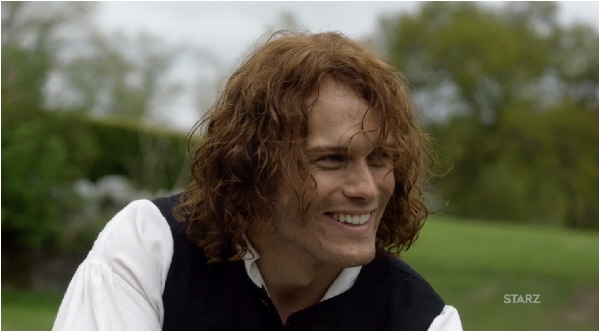
Fergus! I love wee Fergus. It’s funny trying to picture this little cutie as a suave grown-up with a hook for a hand… but we don’t have to worry about that for several years yet.

Fergus

Jamie and Claire have only been in Paris for a few months, but they seem completely comfortable now acting like lord and lady of the manor, dropping things for the servants to pick up and bossing people around. And do they trust Jared’s servants so completely that they feel free to discuss their plotting against Charles Stuart in front of them? Seems sloppy to me.

Trouble in paradise — Jamie and Claire are at odds for much of this episode. Claire feels useless doing nothing but dressing up and going to tea, but Jamie is pissed when Claire’s not home waiting for him once she does find something to do. Still, by the episode’s end, Jamie has grudgingly admitted that having Claire assist at the hospital is useful as well.

Claire’s visit to Master Raymond, while triggering her return to the medical field, also contains some random dialogue about herbs and their uses. But is it random? Claire questions why Raymond has a particular poison in his shop, and he responds that he lets his customers think they’re buying poison, while in fact he’s selling them non-lethal bitter cascara, which produces a dramatic and immediate effect — thus satisfying the poisoner’s need for vengeance, but letting the intended victim survive. Book readers may recall that this is put to use down the road… let’s see if the same is true in the TV production.

And as Suzette points out, rather saucily, to Murtagh, there’s nothing going on in the bedroom between Jamie and Claire. Jamie is still tormented by his nightmares and flashbacks, it would seem. Meanwhile, Murtagh is getting some! Good for Murtagh, and good for Claire for providing birth control.

The BJR issue is a thorny one. Early on, Murtagh advises Claire not to tell Jamie that BJR is still alive. If Jamie knew, Murtagh says, he’d head straight back to Scotland to try to get revenge, and would most likely end up imprisoned and then hanged. But once they realize that the Duke of Sandringham is involved and that they’ll need to try to get further information from him, Murtagh encourages Claire to tell Jamie the truth. If he encounters the Duke’s secretary, Alexander Randall, it’ll only be a matter of time before Jamie learns the news, so it’s better that he hears it from Claire and Murtagh.

It’s finally occurred to Claire that since BJR is supposed to wed and have a child in 1746, according to the historical documents, then Frank’s existence is in jeopardy if Jamie kills BJR before he can marry Mary Hawkins. If BJR dies without having children, then Frank will never be born 200 years later.

Another episode of great costuming. Claire’s yellow hooded cloak is so rich and expensive looking. She sticks out like a sore thumb out on the streets.
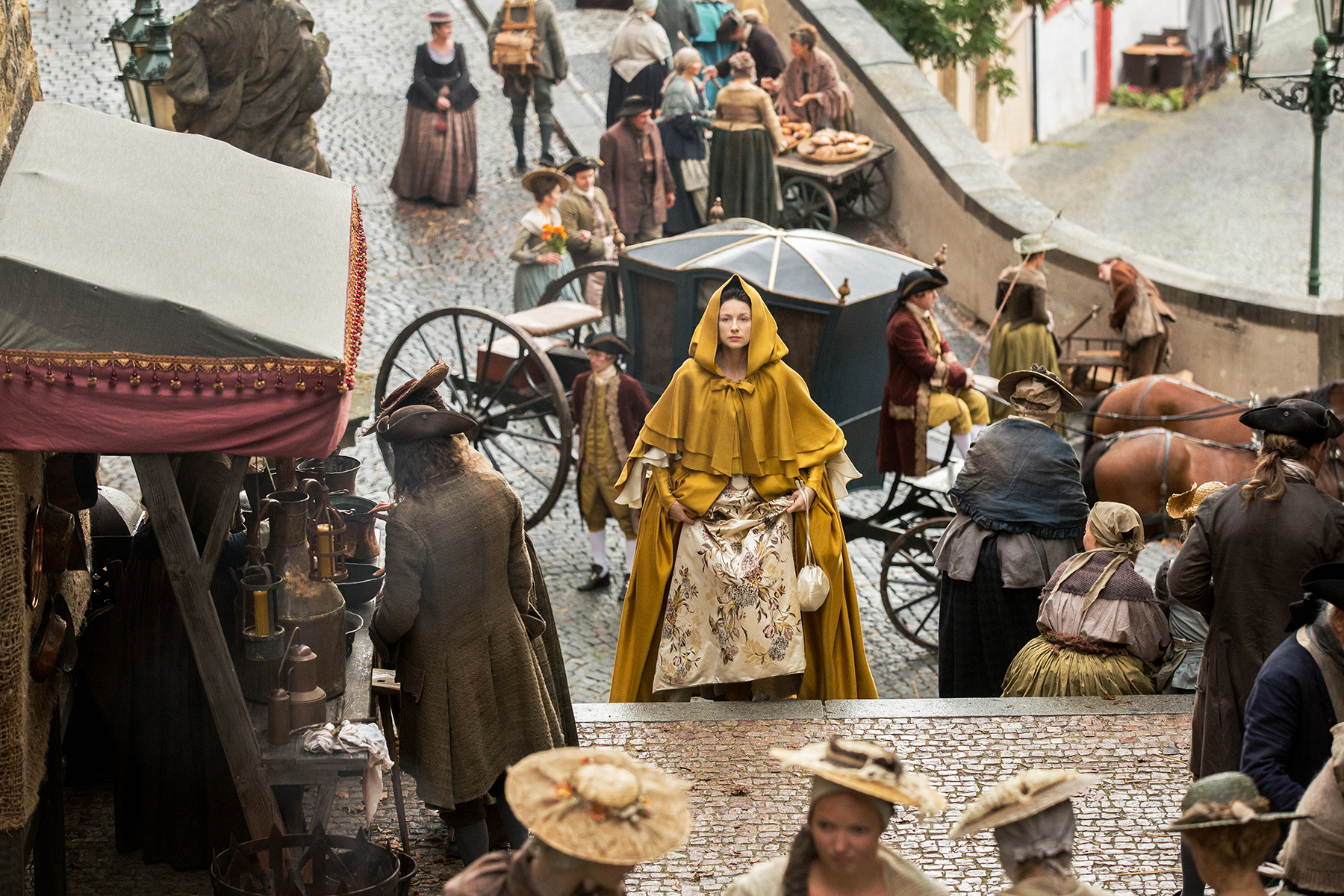
Outlander Season 2 2016

It’s great to see her back in the hospital later on, wearing a nurse’s apron and back to the business of dealing with yucky stuff. It’s funny to see how excited she is about having spent a day lancing boils and tasting urine. Oh, and the baby bump is finally making an appearance, if only briefly visible in a scene where Claire is in her shift for about half a second.

c6

And then there’s Bouton! So even the animal members of the cast have to be ridiculously adorable.

bouton

Insta-reaction wrap-up:

In some ways, this episode was fairly uneventful. There were no big dramatic moments, no stunning visual surprises, no major reveals. The chess game played by Jamie and Duverney is perhaps a good metaphor — the pieces were shuffled on the board in this episode, with strategy and countermoves — but chess itself isn’t all that thrilling from the spectator’s point of view (at least, it isn’t to me).

I’d be more interested in seeing more of the dynamic between Claire and Jamie and the state of their marriage (see below), given all of the pressure and tension, but this episode was mostly about the politics.

That doesn’t mean that I didn’t enjoy the episode. I did. But while various bits were set into motion, not all that much new or different really happened.

Still, sometimes a bridge episode is necessary to get from one big moment to another. There’s a lot of maneuvering that still needs to happen. And there’s still the big secret hanging over Claire and Murtagh for now — whether or not to tell Jamie that BJR is still alive. Until that bit of information is out in the open, I don’t see how Claire will truly be able to face Jamie and be his partner.

And furthermore…

If I didn’t know better, I’d truly be worried for the state of Claire and Jamie’s relationship.

Claire and Jamie are both deeply unhappy in Paris, for different reasons. Claire feels useless as a society woman, life revolving around social visits, tea, and card games, until she gets back to using her medical skills. Jamie comes off like a bit of a jerk at first with his reaction to Claire’s volunteering — but after some thought, I have to admit that he has a point.

Jamie is a man who values honor and honesty above all, yet here he’s been forced into a life where his every moment is spent on deception and betrayal. He’s not a natural-born spy, and he feels degraded by the life he’s living. Yes, he and Claire chose this path for the greater good, to save Scotland and the Highlands from the terrible destruction that Culloden will bring. But knowing there’s a higher purpose does nothing to alleviate the dirt Jamie feels clinging to him on a daily basis as he lies, steals, spies, and hangs out in brothels — all things that Jamie would never do if he were able to be true to himself.

So when he slams Claire for being all giddy about working in the hospital, he’s not wrong. Jamie asks Claire, “When do I get to feel good?” And he’s right. They’re in this together, but Claire seems to have forgotten that Jamie is suffering from his actions just as much as she is suffering from boredom and inaction.

I’m not saying that she’s not doing good by working at the hospital. Clearly, she’s helping people. But she seems to have lost sight of Jamie’s struggle to carry out their mission and what it’s doing to his soul.

Add to that Jamie’s ongoing PTSD, their lack of sexual intimacy, and the looming hell that will break loose when Jamie discovers the huge secret that Claire has been keeping from him, and there’s definite cause for concern about the Frasers’ marriage.

But hey! Let’s end this insta-reaction on a happy note! How much did you love the scene between Jamie and Fergus? Probably not as much as I did!
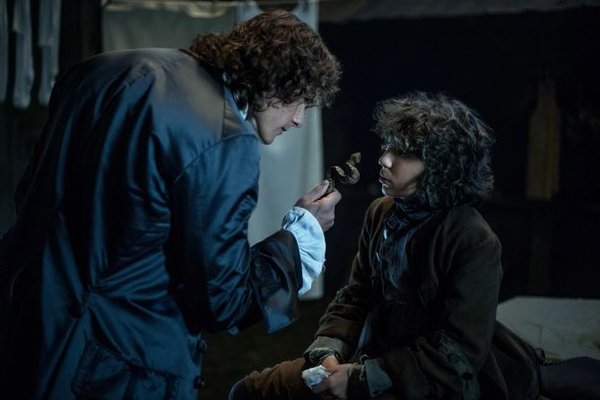
ferg2

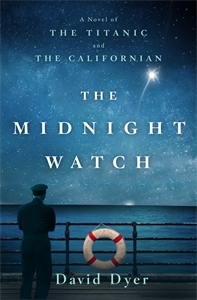
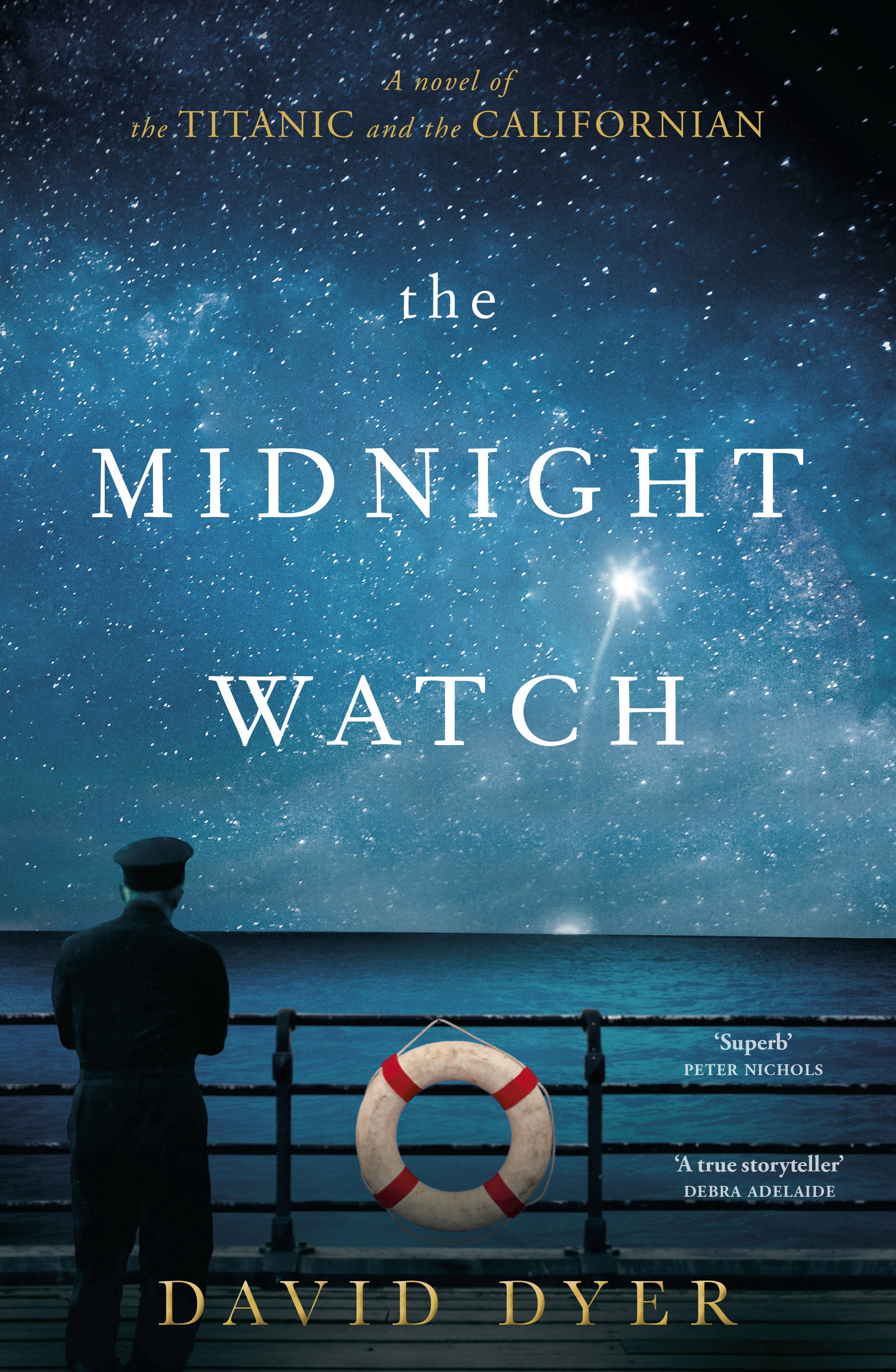
Book Review: The Midnight Watch by David Dyer

midnight watch2Synopsis:

(via Goodreads):

As the Titanic and her passengers sank slowly into the Atlantic Ocean after striking an iceberg late in the evening of April 14, 1912, a nearby ship looked on. Second Officer Herbert Stone, in charge of the midnight watch on the SS Californian sitting idly a few miles north, saw the distress rockets that the Titanic fired. He alerted the captain, Stanley Lord, who was sleeping in the chartroom below, but Lord did not come to the bridge. Eight rockets were fired during the dark hours of the midnight watch, and eight rockets were ignored. The next morning, the Titanic was at the bottom of the sea and more than 1,500 people were dead. When they learned of the extent of the tragedy, Lord and Stone did everything they could to hide their role in the disaster, but pursued by newspapermen, lawyers, and political leaders in America and England, their terrible secret was eventually revealed. The Midnight Watch is a fictional telling of what may have occurred that night on the SS Californian, and the resulting desperation of Officer Stone and Captain Lord in the aftermath of their inaction.

Told not only from the perspective of the SS Californian crew, but also through the eyes of a family of third-class passengers who perished in the disaster, the narrative is drawn together by Steadman, a tenacious Boston journalist who does not rest until the truth is found. The Midnight Watch is a powerful and dramatic debut novel–the result of many years of research in Liverpool, London, New York, and Boston, and informed by the author’s own experiences as a ship’s officer and a lawyer.

My thoughts:

The Midnight Watch is a strong debut novel built on meticulous research of the historical records. Prior to reading this book, I’d never even heard of the Californian, but a quick Google search shows just how real this nightmare story is. The Californian was nearby at the time that the Titanic was sinking, close enough to potentially have been able to save most or even all of those lost in the tragedy, and yet the ship did nothing in response to the Titanic’s distress signals.

The author does a painstaking job of recreating the events of that terrible night. In alternating chapters, we see events unfold through the eyes of the men onboard the Californian, especially Herbert Stone, and then learn of the Titanic and the possible involvement of the Californian through the perspective of John Steadman, a journalist who specializes in giving voice to those who’ve died in tragic circumstances.

It’s shocking to read that the officer of the watch saw the rockets, understood them to be distress signals, and then contacted the captain, only to do nothing once his captain chose to do nothing. The subsequent sets of lies and cover-ups and self-deceptions are equally disturbing and confusing. Why didn’t the Californian respond? How could Captain Lord live with himself afterward? Why didn’t the second officer do more if he truly believed he was witnessing a ship that needed help?

While The Midnight Watch lays out the events and presents a fictionalized accounting of what may have been going through the minds of the men involved, of course we’ll never actually know the truth or why this terrible inaction transpired while people were dying nearby.

The book is well-written and the character of John Steadman is appealingly flawed — a man who pursues the truth, even while drinking himself into oblivion and at the risk of his job. Captain Lord remains a haughty enigma. It’s impossible to truly understand his role in the Titanic’s sinking, but the portrayal of him here is certainly unflattering.

The piece of The Midnight Watch that carries the greatest emotional power comes toward the end, as the book includes the (fictional) account written by Steadman, called “Eight White Rockets”. Steadman’s piece describes events on the Californian that night, intercut with his recreation of the final hours spent on board the Titanic by a family of eleven — a mother, father, and their nine children — who all perished in the sinking. (This family, the Sage family, were real people who died in the disaster; the author has imagined what their experience might have been and why none survived.)

So many years later, the tragedy of the Titanic continues to fascinate us. The Midnight Watch describes a less well-known aspect of that terrible event, bringing to light facts and people that most with a casual interest in the Titanic today are probably unfamiliar with. The Midnight Watch blends historical details with a fictional story of journalistic research to create a compelling and moving tale. If you enjoy historical fiction and want to know more about the Titanic disaster, be sure to check this book out.

_________________________________________

The details:

Title: The Midnight Watch
Author: David Dyer
Publisher: St. Martin’s Press
Publication date: April 5, 2016
Length: 323 pages
Genre: Historical fiction
Source: Review copy courtesy of the publisher via NetGalley

A Mini-Review for a Mini-Book: Blockade Billy by Stephen King

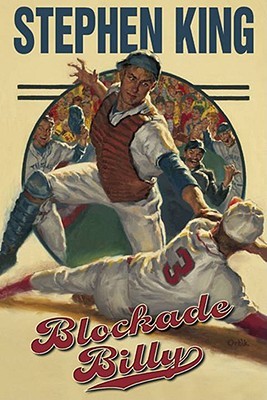
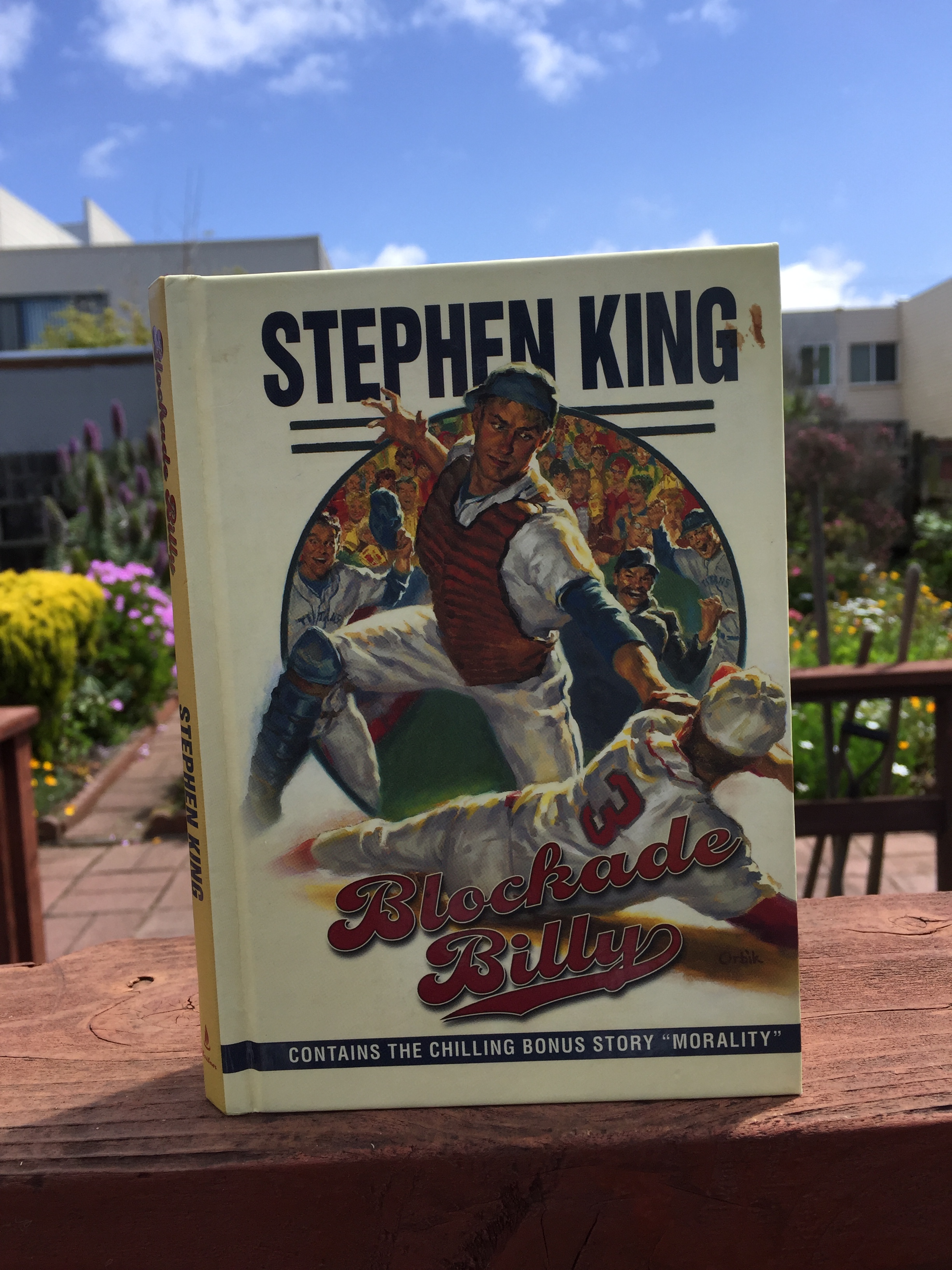
Blockade BillyI picked up this small book for a dollar at my library’s big book sale last month. Awesome find, right? I’ve been going to the library sales for years, and it seems that I come home from each one with at least one new Stephen King book to add to my collection.

Blockade Billy is a slim hardcover containing two novellas, the title story plus another called Morality. The whole thing was a quick read, so from that perspective you could call it light reading, although the subject matter is definitely lacking in rainbows and kitties.

The first story, Blockade Billy, is (obviously, based on the cover) a baseball story. Not being much of a baseball fan, I didn’t expect to like it — but I did. The story is told in the first person by an old man who once coached a not-very-good major league baseball team. As the man tells the story to his listener, Mr. King (!), we enter the world of 1950s-era baseball. A young catcher joins the team to fill in for an injured player, and surprises everyone by being a fantastic player, even though he seems a little off in the head. After a glorious start to the season, Billy’s achievements and the team’s winning streak were struck from the record books. Why? Read the story to find out!

In Morality, we meet Chad and Nora, a couple in their 30s with mounting bills and little chance of paying them. When the elderly stroke patient in Nora’s care makes her an offer to earn a big pile of cash, the couple faces a moral dilemma. Shades of Indecent Proposal? Kind of. It’s disturbing to find out what the old man wants, and to see how and why Chad and Nora agree to his plan, as well as how they deal with the aftermath.

image

My copy… enjoying the sunny weather.

I ended up enjoying both stories, probably Morality more than Blockade Billy. Is enjoying even the appropriate word? Probably not, as both stories are disturbing. What’s great (again, not really the appropriate word) about both is that they’re not horror stories. The bad things that happen are driven by human nature, desires, and impulses. It’s people doing evil, not evil beings inflicting pain on ordinary people. There’s something sad and fascinating about watching the drama unfold in both of these stories — and of course, Stephen King is the master of keeping the reader guessing as a story builds. We may not have all the details until the end, but we’re hooked from start to finish.

If you’re a King fan and you haven’t read Blockade Billy, pick up a copy when you’re looking for a bite-sized book to pass the time with.

Note: As I finished writing this post, I found out that both of these stories are included in Stephen King’s new book of short stories, The Bazaar of Bad Dreams, published in November 2015. And while I’m not usually a short story reader, I’m thinking I might need to make an exception for this collection.

_________________________________________

The details:

Title: Blockade Billy
Author: Stephen King
Publisher: Scribner
Publication date: May 25, 2010
Length: 132 pages
Genre: Adult fiction
Source: Purchased

Thursday Quotables: Wink Poppy Midnight

quotation-marks4

Welcome back to Thursday Quotables! This weekly feature is the place to highlight a great quote, line, or passage discovered during your reading each week.  Whether it’s something funny, startling, gut-wrenching, or just really beautifully written, Thursday Quotables is where my favorite lines of the week will be, and you’re invited to join in!

NEW! Thursday Quotables is now using a Linky tool! Be sure to add your link if you have a Thursday Quotables post to share.

Wink

Wink Poppy Midnight by April Genevieve Tucholke
(published 2016)

This puzzling book left me scratching my head as I tried to figure out the meaning behind all the plot twists… but still, I very much enjoyed the writing:

The tenth time I kissed Leaf, he kissed me back. We were in the meadow behind the Bell farm and his thin lips were tender and arrogant, exactly, exactly how I thought they would be, exactly how I wanted them to be, he pulled away and groaned against my cheek and that dark, empty part in my chest where my heart had never been, it started beating, beating, beating and I felt joy, red and dripping. He picked me up and turned me over so my back pressed into the grass and the bright little wildflowers, and my fresh new heart faced the sky.

What lines made you laugh, cry, or gasp this week? Do tell!

If you’d like to participate in Thursday Quotables, it’s really simple:

  • Write a Thursday Quotables post on your blog. Try to pick something from whatever you’re reading now. And please be sure to include a link back to Bookshelf Fantasies in your post (http://www.bookshelffantasies.com), if you’d be so kind!
  • Click on the linky button (look for the cute froggie face) below to add your link.
  • After you link up, I’d love it if you’d leave a comment about my quote for this week.
  • Be sure to visit other linked blogs to view their Thursday Quotables, and have fun!

Shelf Control #32: Sense and Sensibility and Sea Monsters

Shelves final

Welcome to the newest weekly feature here at Bookshelf Fantasies… Shelf Control!

Shelf Control is all about the books we want to read — and already own! Consider this a variation of a Wishing & Waiting post… but looking at books already available, and in most cases, sitting right there on our shelves and e-readers.

Want to join in? See the guidelines and linky at the bottom of the post, and jump on board! Let’s take control of our shelves!

cropped-flourish-31609_1280-e1421474289435.png

My Shelf Control pick this week is:

S&S&SMTitle: Sense and Sensibility and Sea Monsters
Author: Jane Austen and Ben H. Winters
Published: 2009
Length: 340 pages

What it’s about (synopsis via Goodreads):

From the publisher of Pride and Prejudice and Zombies comes a new tale of romance, heartbreak, and tentacled mayhem.

Sense and Sensibility and Sea Monsters expands the original text of the beloved Jane Austen novel with all-new scenes of giant lobsters, rampaging octopi, two-headed sea serpents, and other biological monstrosities. As our story opens, the Dashwood sisters are evicted from their childhood home and sent to live on a mysterious island full of savage creatures and dark secrets. While sensible Elinor falls in love with Edward Ferrars, her romantic sister Marianne is courted by both the handsome Willoughby and the hideous man-monster Colonel Brandon. Can the Dashwood sisters triumph over meddlesome matriarchs and unscrupulous rogues to find true love? Or will they fall prey to the tentacles that are forever snapping at their heels? This masterful portrait of Regency England blends Jane Austen’s biting social commentary with ultraviolent depictions of sea monsters biting. It’s survival of the fittest—and only the swiftest swimmers will find true love!

How I got it:

My daughter gave me this book as a gift a couple of years ago (after she saw me reading Pride & Prejudice & Zombies).

When I got it:

It’s been a few years…

Why I want to read it:

What kind of mother would I be if I didn’t read a gift from my daughter??? Anyhoo… I think the classic mash-up genre has been done to death by now, but this one actually does appeal to me. I mean, come on! It’s got ultraviolent sea monsters in a “masterful portrait of Regency England”. What’s not to love?

__________________________________

Want to participate in Shelf Control? Here’s how:

  • Write a blog post about a book that you own that you haven’t read yet.
  • Add your link below!
  • And if you’d be so kind, I’d appreciate a link back from your own post.
  • Check out other posts, and have fun!


For more on why I’ve started Shelf Control, check out my introductory post here, or read all about my out-of-control book inventory, here.

And if you’d like to post a Shelf Control button on your own blog, here’s an image to download (with my gratitude, of course!):

Shelf Control

The Monday Check-In ~ 4/18/2016

cooltext1850356879 My Monday tradition, including a look back and a look ahead — what I read last week, what new books came my way, and what books are keeping me busy right now. Plus a smattering of other stuff too.

In real life:

It’s been a crazy week! My husband had a medical procedure (he’s fine, thanks!) and I took a few days off work so I could be home for things like fetching ice packs and plumping up pillows. He’s a reader too, so besides hanging out with hubby, there was lots of book time!

What did I read last week?

SonBeauty Queen of JerusalemWink

Son by Lois Lowry: The final book in The Giver Quartet — and I’m so glad I finally revisited this series! I’d read The Giver ages ago, but re-read it this year when my kiddo had to read it for school. I really enjoyed all four books, and thought the final one, Son, was particularly strong, except for a particular plot element that felt more fairy-tale-ish than the rest of the story. Still, a great wrap-up with some memorable characters and events. If you haven’t finished the series, I really recommend it!

The Beauty Queen of Jerusalem by Sarit Yishai-Levi: Done! My review is here.

Wink Poppy Midnight by April Genevieve Tucholke: Done! My review is here.

Spool of Blue Thread

My book group’s discussion of A Spool of Blue Thread by Anne Tyler is coming up this week, and I managed to read the book over the weekend (surprised by how quickly it went). What a terrific read! My review is here.

Miss Peregrine

In audiobooks, I finished listening to Miss Peregrine’s Home for Peculiar Children — a totally fun way to revisit the book before continuing the series. The audiobook narration was quite good, but I’m glad I had a hard copy available as well for looking at all the pictures as the story moved along.

Outlander update!

202email

Season 2 rocks! Here’s my reaction post for the 2nd episode, “Not In Scotland Anymore”:

Insta-Reaction: Outlander, Season 2, Episode 2

Elsewhere on the blog:

I wrote a TV Time post about binge-watching the new Starz series, The Girlfriend Experience. It was quite an… um… experience.

Fresh Catch:

I received a review copy of a book I can’t wait to read!

My Best Friends Exorcism

Seriously, it looks amazing!

What will I be reading during the coming week?

Currently in my hands:
The midnight watch

Next up, I have an ARC of The Midnight Watch by David Dyer. I’m a sucker for anything to do with the Titanic, and the first few pages have already sucked me in.

Now playing via audiobook:

HP1 audio

I love Harry Potter to bits and pieces (who doesn’t?) — and decided that it’s about time that I finally listen to the audiobooks! I’m about 6 chapters into book 1, and the audio is delightful. Of course.

Ongoing reads:

MOBYemma

My book group is reading and discussing two chapter per week of both Written in My Own Heart’s Blood by Diana Gabaldon and Emma by Jane Austen. This is an online group, and anyone is welcome to join us — so if you’re interested, just ask me how!

So many books, so little time…

boy1

Book Review: A Spool of Blue Thread by Anne Tyler

Spool of Blue ThreadSynopsis:

(via Goodreads)

A freshly observed, joyful and wrenching, funny and true new novel from Anne Tyler

“It was a beautiful, breezy, yellow-and-green afternoon.” This is how Abby Whitshank always begins the story of how she fell in love with Red that day in July 1959. The Whitshanks are one of those families that radiate togetherness: an indefinable, enviable kind of specialness. But they are also like all families, in that the stories they tell themselves reveal only part of the picture. Abby and Red and their four grown children have accumulated not only tender moments, laughter, and celebrations, but also jealousies, disappointments, and carefully guarded secrets. from Red’s father and mother, newly-arrived in Baltimore in the 1920s, to Abby and Red’s grandchildren carrying the family legacy boisterously into the twenty-first century, here are four generations of Whitshanks, their lives unfolding in and around the sprawling, lovingly worn Baltimore house that has always been their anchor.

Brimming with all the insight, humour, and generosity of spirit that are the hallmarks of Anne Tyler’s work, A Spool of Blue Thread tells a poignant yet unsentimental story in praise of family in all its emotional complexity. It is a novel to cherish.

My thoughts:

It’s been years since I’ve last read an Anne Tyler novel — and picking up A Spool of Blue Thread is like cozying up with a comfy old blanket and curling up in a favorite chair. It’s homey and warm and familiar, but the familiarity doesn’t take away at all from the sheer pleasure of spending time with it.

In A Spool of Blue Thread, we meet the Whitshanks, a big, sprawling family whose lives seem centered around their beautiful family home with the big front porch, the home that’s been in the family for three generations and was in fact built by the first of the Whitshanks to live in it. The first characters introduced are Abby and Red, a married couple in their seventies who’ve raised four children, have a good, well-worn marriage, and seem to enjoy their lives.

Their children and grandchildren are a source of non-stop discussion and worry, particularly Denny, the black sheep of the family who can always be depended upon to be undependable. Denny disappears for months or years at a time, only to show up or call with an odd or worrying or unexpected announcement that throws the family into a tizzy.

As Abby and Red age, their children become increasingly worried about their ability to live on their own in their big house, and so various children and their children move in to provide care, manage things, and try to sort out the little rivalries and resentments that have built up over the years.

As the story unfolds, early hints about family history are unpacked for the reader. The family may never know much about Junior and Linnie Mae, the original Whitshanks to live in the family home, but late in the book, we finally get their story, and it’s not what it seemed. Likewise, when we finally hear Abby’s version of how she and Red met, it’s surprising and touching all at once.

A Spool of Blue Thread is a quintessential character-driven book. There’s not much plot to speak of — no big drama or mystery or climax. Instead, it’s a study of family and individuals, their desires and frustrations and misunderstandings and dynamics. It’s lovely to see a family unfold to reveal its heart and soul. The Whitshanks have had their share of disappointments and tensions, but they’re still there, together, figuring things out. Beyond a profile of a family, it’s also a moving depiction of the worries of aging parents, from both the parents’ viewpoint as well as the adult children who have to balance their own lives with the complications required by figuring out how to help parents who may or may not be able to function on their own any longer.

As I mentioned, it’s been quite a while since I’ve read anything by this author, although there was a time when I read all of her new books as soon as they came out. I think I’d reached my saturation point somewhere along the line, and I might not have picked up A Spool of Blue Thread if it hadn’t been my book club’s pick for April.

So, yet another reason to proclaim that I love my book club! A Spool of Blue Thread is a perfect domestic novel that’s touching, funny, and beautifully written. I’m so glad to have read it — and it makes me want to go figure out what other Anne Tyler books I’ve missed over the years.

_________________________________________

The details:

Title: A Spool of Blue Thread
Author: Anne Tyler
Publisher: Bond Street Books
Publication date: February 20, 2015
Length: 358 pages
Genre: Adult fiction
Source: Library

Insta-Reaction: Outlander, Season 2, Episode 2

s2 poster

Season 2 has begun! My intention is to write an “Insta-Reaction” post for each episode right after viewing, to share some initial thoughts, questions, reactions — you name it.

Warning:

Spoilers

I may be talking about events from this episode, other episodes, and/or the book series… so if you’d rather not know, now’s your chance to walk away!

Outlander, episode 202: “Not In Scotland Anymore”

The official synopsis (via Starz):

Life in Paris is not without its trials as Jamie struggles to triumph over his past. A fortunate meeting with Prince Charles present opportunities, while the Duke of Sandringham’s presence brings complications.

My take:

Major plot points:

  • Jamie seems to be suffering some serious PTSD. It’s implied that he and Claire have not been able to make love, since he’s tormented by nightmares and visions of his abuse by Black Jack Randall.
  • Jamie and Claire seem to be fitting in pretty well in their new life in Paris, wearing fine clothes and rubbing shoulders with the upper class.
  • Murtagh is stuck like glue to Jamie’s side, but yearns for Scotland.
  • Jamie meets Bonnie Prince Charlie (Charles Stuart), and tries to convince him that the time isn’t right for an uprising. Charles makes clear that it’s God’s will that he reclaim Scotland for his father. Money will be the key to his success or failure.
  • Claire has a new friend, Louise, who provides entry to the French court at Versailles.
  • The Duke of Sandringham is in Paris, along with his secretary, Alexander Randall, younger brother of BJR. The Duke is nasty and slimy, and reveals to Claire that BJR is very much alive.

Insta-reaction:

Another great episode! This Paris-centric hour is in many ways setting the stage for what’s to come, introducing a few key new faces and throwing in some lighter (okay, hilarious) moments to break the tension.

Charles Stuart comes across as a light-weight buffoon who thinks he’s fulfilling a higher purpose, but knows nothing about the practicality of life in Scotland, having never set foot there.

Outlander Season 2 2016

Master Raymond gets a brief scene here, but we’ll be seeing more of him. He’s pretty much exactly as I pictured him! I loved his shop, especially the taxidermy crocodile hanging from the ceiling.

OUTLANDER SEASON 2

Louis de Rohan is a treat. There’s no explanation of how Claire came to be friends with her so quickly, but she’s quite a hoot and it’s good for Claire to have a female friend who’s not secretly psycho (miss you, Geillis!). Mary Hawkins is just as gawky and timid as she’s portrayed in the book, and as for Alexander Randall, it’s too soon to tell. He doesn’t look as much like BJR as he does in the book, but that’s okay. It looks like this plot point will work itself out just fine.

outlander-louise-mary

This episode is our first full-on vision of the Paris look for the show, and it’s a stunner. Once again, Terry Dresbach has done a fabulous job with the costumes — including two key costumes that are iconic for book readers, the red dress:

caitriona-balfe-outlander-02

and the swan dress (aka, the nipple dress):

king

Neither one disappoints. Beyond those, Claire’s look is just perfect, from her shopping outfit to her robe (I want one), and even her oddly stiff get-up with the tie around her neck.

Okay, let’s talk about the scene that really cracked me up — the waxing scene! Louise was hilarious. I loved how she hit the waxing dude every time he pulled off another strip. Claire’s reaction was priceless — but so was Jamie’s later on when he realized what Claire had been up to. His astonishment was too cute.

And speaking of Jamie’s reaction — how great was the look on his face when he first saw Claire in the red dress?

j&m

Just the perfect combination of being completely wowed by his wife and utterly scandalized by how revealing her dress is. She’ll need a bigger fan, indeed.

It’s terribly sad, of course, to see how much Jamie is suffering, and how he can’t rid himself of the horrible memories that plague him whenever he and Claire become intimate. Have to wonder whether they’ve made love at all since Wentworth. Kudos to Sam Heughan for his portrayal of Jamie’s pain. Even in little gestures, such as Jamie’s absent-minded stroking and cradling of his damaged hand, we see his vulnerability and the constant reminder of the damage done.

Finally, it’s great to see so much quality time between Jamie and Murtagh. Murtagh has shown us, over and over again, that his sole purpose is keeping Jamie safe. It’s a lovely relationship, and it was nice to see them having their equivalent of play-time, working on building up Jamie’s strength with a little friendly sword work. Looks like Jamie enjoyed it too!

j2

Insta-reaction wrap-up:

This episode was a visual treat, and it’s fun to see the main characters all prettied up and adapting to their new setting (although in Murtagh’s case, not adapting very willingly — really, dirty knees at Versailles!). While there are lighter moments, the political intrigue has the potential for real danger, the nastiness of the Duke lets us know that the scheming may truly hurt Claire and Jamie, and the reveal that BJR is still alive is devastating.

Claire is left with the burden of knowledge about BJR, and we’re left to wonder what she’ll do next. Should she tell Jamie, knowing that this can only worsen his trauma and nightmares? How much more damage can Jamie’s psyche take? But can Claire hide this from Jamie, and does she have the right to do so? And what will it do to their relationship if she doesn’t tell Jamie, but he finds out that she knew?

On a different note — Claire should be about four months pregnant at this point. I’d imagine that we’ll start seeing a little baby bump in the next episode or so, but the pregnancy didn’t seem to factor into this episode at all.

I enjoyed the episode, and thought the acting and production were both terrific… but like Murtagh, I miss Scotland! If I had to guess, based on the episode titles, I’d say that we won’t get back to Scotland until episode 8. Don’t get me wrong, I’m finding Paris interesting and well-done, but the heart of the show is really in Scotland.

And further…

Last week at this time, the new version of the opening credits were nowhere to found online, but now they’re here! Alors, the Skye Boat Song, with a wee bit en français. Et voila!


Book Review: The Beauty Queen of Jerusalem by Sarit Yishai-Levi

Beauty Queen of JerusalemFour generations of family traditions and doomed marriages form the heart of The Beauty Queen of Jerusalem, a family saga that takes place in the decades before, during, and after Israel’s war for independence.

Gabriela Siton is the youngest in a line of women belonging to the Ermosa family, a large Sephardic family — Jews of Spanish descent — living in Jerusalem, dealing with family secrets and turbulence during a time of war and upheaval in Israel itself.

The story opens with Gabriela’s mother’s death. Luna dies at a relatively young age from a deadly and fast-moving cancer, and Gabriela’s resulting grief is heavily laden with guilt. She and Luna had a fraught, difficult relationship all of Gabriela’s life, and she doesn’t quite know what to do with all of her emotions and the confusion she’s left with.

Bit by bit, over the course of the story, we hear more about the history of the Ermosa women. There’s the matriarch of the family, Mercada, who marries her beloved son off to a poverty-stricken orphan as punishment for his near-betrayal of his family. Mercada’s daughter-in-law, Rosa, faces life with a husband who doesn’t love her, a beloved brother who gets involved in the deadly underground movement leading up to independence, and three daughters — the oldest of whom is Luna. Luna is gorgeous, the most beautiful girl in Jerusalem, but with a selfish and combative personality. She’s prickly and self-centered, and she and Rosa never find a way to bond.

Later on, Gabriela is told that the curse of the Ermosa women is to marry men who don’t really love them, and that seems to be true in the three preceding generations. Each man is madly in love with a woman who isn’t appropriate or acceptable, and so marries out of obligation, leading to bitterness, lack of passion, and lack of respect.

In some ways, The Beauty Queen of Jerusalem reminded me of Isabel Allende’s masterpiece, The House of the Spirits. Like The House of the Spirits, the blessings and curses of each generation seems to be passed along to the next, as each set of relationships is influenced by, or damaged by, the ones that came before. Likewise, The Beauty Queen of Jersusalem, while telling the tale of a particular family, is set against a backdrop of a significant historical era. The history of pre-state Israel and its struggle for independence form a big piece of the picture here, as the Ermosa family is caught up in the violence and upheavals that surround them.

The title of this book is a misnomer, and a pretty unfortunate one at that. Luna is known for her remarkable beauty, and is referred to as the beauty queen of Jerusalem — although not, as you might expect, because she actually competed in pageants or won competitions or anything. She’s just a woman who was known for her beauty and style. What’s more, the book isn’t exclusively, or even mainly about Luna — it’s about all of the women of her family. In fact, Luna is a mostly unlikeable character who’s a terrible mother and is mostly portrayed as being awful to her own mother. Things happen later in the book that make her a slightly more sympathetic character, but the bottom line is that she isn’t solely what the book is about, and it took me a while to get past the preconception that I had from the title in order to see the breadth of the story.

On the plus side, there are many vignettes in this sweeping story that are completely enchanting. Rosa’s story is fabulous, and you can’t help but feel compassion for a woman who’s struggled all her life and gotten little in return. The story of Rosa’s three daughters (including Luna) and how they each met the men they’d end up marrying is varied and textured. The Sephardic heritage of the family is described through their rituals, their use of Ladino phrases, and the little details about food and customs that bring a sense of vitality to their daily lives.

The Jerusalem setting is wonderful, with the city forming a vibrant stage for the family drama. The historical elements are skillfully woven into the story, so that the loves and struggles within the family are set against their worries about English police, bombings in the streets, sieges and rationing, and men serving at the front.

While overall I enjoyed the book, I did hit a few stumbling blocks. The biggest issue for me was the language, which often felt a bit clunky. The book is an English translation from the Hebrew, and I’m afraid that something truly was lost in translation. The writing just doesn’t always flow, and the dialogue and use of Ladino and Spanish phrases seem a bit jammed in, not organic. I have a feeling this issue might not be an issue if the book were read in the original Hebrew.

The other element that might be problematic for American readers is the assumption of familiarity with details of Israeli history. The book was written and published in Israel in 2013, released in English in the United States for the first time this year. It occasionally feels a bit like “inside baseball” — the book is written for an Israeli audience, and there’s an assumption of a common culture and background. For me, having spent time there and understanding the history and culture, it wasn’t an issue, but I can imagine that some readers will have a harder time understanding the context or getting the full picture of the historical elements woven into the story, or even being able to identify some of the names, politicians, and organization that are referred to throughout the book.

The perspective and organization of the book is somewhat puzzling. We begin with Gabriela’s first-person narration, but the storytelling shifts. Sometimes, it’s another family member telling Gabriela about incidents from the past, set out as a dialogue with Gabriela, with the story appearing in quotation marks. But at other times, it’s a third-person narrative, filling in the gaps and telling other pieces of the family story. The narrative jumps from one character’s perspective to anothers, and it can be jarring to sometimes see the world according to a character who hasn’t had a POV before. Time-wise, it’s confusing as well, as we get a description from Gabriela early on about her mother’s death, but as the story jumps back and forth for most of the book, it’s jarring when the last few chapters jump back to an adult Gabriela and how she reconciles her grief and anger.

At its core, The Beauty Queen of Jerusalem is a moving story of a complicated and messed-up family. I really enjoyed parts of the story, especially those pieces that delve more deeply into the complicated emotions and wounds of the many family members. Unfortunately, the awkward writing/translation and the narrative inconsistency make this book more difficult than it needs to be, and overall I think the plot could have used a bit more focus. Still, it’s worth reading for the intergenerational conflicts and dynamics, and I enjoyed the nuggets of history that form the backbone of the story.

_________________________________________

The details:

Title: The Beauty Queen of Jerusalem
Author: Sarit Yishai-Levi
Publisher: Thomas Dunne
Publication date: April 5, 2016
Length: 384 pages
Genre: Historical fiction
Source: Review copy courtesy of the publisher via NetGalley

TV Time: The Girlfriend Experience

TGE

Well, that was weird.

But in a pretty good kind of way.

I just binge-watched the new Starz series (I think “anthology” is the term they’re using). Thirteen episodes in 3 days is a lot to take in, even though — fortunately — each episode is only 30 minutes.

So what’s it all about?

Christine Reade is a law student who’s just landed an internship with a prestigious law firm. She’s dedicated and ambitious, and scrimping by on limited funds. She is also, the opening episode makes clear, completely unemotional and uninhibited when it comes to sex. She picks up a guy in a bar, completely calls the shots when it comes to their sexual encounter, and then gets dressed and leaves, despite being asked to spend the night. She doesn’t need his number, and she doesn’t need chit-chat. She got what she wanted, and she’s out.

When Christine’s law school buddy Avery fills her in on how she acquires such fabulous clothes, jewelry, and toys (hint: rich man with lavish spending habits), Christine is cautiously interested in learning more.

And learn she does. Avery introduces her to the world of “girlfriend experience” escorting — basically, charging insane amounts of money to wealthy men who want more than just sex. For a price, they get a gorgeous woman dedicated to making them happy, willing to give them her undivided attention, listen to their hopes, dreams, and worries… and yes, indulge whatever sexual fantasies they have as well.

Christine assumes the name Chelsea, sets up a website, makes a deal with a broker/madam, and quickly starts raking in the cash. Her double life becomes increasingly difficult to maintain, as her escorting business is going so well that she misses class, and an ill-advised workplace sexual entanglement threatens to spiral out of control.

It’s interesting to watch Christine’s transformation, all the more so because it’s impossible to tell what she’s thinking or why she does what she does.

TGE5

Money appears to be an issue, but she’s not desperate or in especially bad straits. She seems to be devoted to her law career, and to have the single-minded dedication to succeed, but gives it all up fairly easily when it no longer suits her. Christine is adept at manipulating and maneuvering, turning seemingly catastrophic situations to her own advantage.

She seems to be all about control and pretense. Christine’s ability to adapt, find a way to give another what they want, and come out with what she wants is evident from the start. As we watch her interview for internships, we get a first glimpse of Christine’s innate talent for understanding the best way to please and present herself as the most desirable. This serves her well later on, of course, as she quickly becomes the perfect girlfriend for pay. She never says no. She’s never in a bad mood. When a client asks her if she’d like something, whether a particular sex act or to go on a trip with him or to spend a whole lot more time together, the answer isn’t just “yes” — it’s “I’d love that”.

TGE3

But is she actually enjoying any of this? What is she getting from her business that she needs? Is it just about financial security, glamor, admiration? Christine/Chelsea apparently enjoys sex A LOT, but is any of it genuine? She puts on a great act and is always enthusiastically responsive, but it also appears that perhaps the only sex acts she’s truly enjoying are the ones when she’s alone.

She appears to enjoy the company of the men she’s with, but does she? Most of them — the kind with the ability to spend $1,000 per hour for her companionship — seem like spoiled rich jerks who’d rather buy a relationship than work for one. The exception here is an older man, a widower who cares for Christine in a way that seems genuine — and I couldn’t help believing that he touched her heart in a way none of the others did.

Even when Christine’s worlds collide and it seems like she’ll be buried by catastrophic scandal, she manages to pull herself together and figure out exactly what she needs to come out of the disaster not just in one piece, but at a profit. There’s a tremendous piece of acting in here, as Christine is forced to do a walk of shame through the office, holding onto a wall of filing cabinets for support, before having a complete and utter meltdown at her desk. But does she really have a meltdown? Right before the walk, we see Christine first prep herself around the corner, taking deep breaths, before coming out all weak-kneed and devastated. Christine has learned never to show weakness, and if she appears weak here, it’s because she intends to.

By the end of the season, Christine is working independently, consulting financial advisers, living in a fabulous apartment, and in total control of her own life. Is she happy? No idea. But she is successful and seems to be completely calling her own shots.

TGE2

Christine is played by Riley Keough**, whose looks transform easily from conservative law intern to super-hot working girl. Her face is a picture of absolute stillness much of the time, and it’s impossible to tell what’s going on behind the surface beauty.

**Daughter of Lisa Marie, grand-daughter of Priscilla and Elvis Presley — and yes, the resemblance is mind-blowing and occasionally distracting.

The look of the show is cool, elegant, and clean-edged. The hotel rooms where the action takes place are all large and uncluttered, with huge windows. Seriously, this series has more rooms with floor-to-ceiling windows than I’ve ever seen. The colors are mostly muted and understated, and everything seems removed from real life and real messiness in a way that fits completely with Christina’s detached, controlled affect.

In the early episodes, we see Christine laughing unguardedly in a casual moment. I can’t remember seeing her laugh at all by the later episodes — but if she does, it’s because that’s what the situation calls for. Like her clothing and her apartment, everything is planned and delivered for maximum effect.

TGE6

It hardly seems necessary, but I suppose I should point that anyone thinking of trying this series should be aware that it includes adult content, language, nudity, and sexual situations. The sex scenes are explicit without being graphic — no genitalia on display or anything, but you pretty much see everything but.

I did wish that the show found a way to make plainer how much time had elapses between episodes. Because Starz released all 13 episodes right from the start, binge-watching seems like the way to go, but it wasn’t until I finally listened to one of the “behind the scenes” pieces at the end of an episode that I realized that months had supposedly gone by. Having a better understanding of the time frame of the events would help put Christine’s evolving self into better context.

I did find The Girlfriend Experience pretty fascinating on the whole, even though Christine’s inner life was intentionally concealed and enigmatic. Still, it’s mesmerizing to see a young woman taking such utter control by using her looks, sexuality, and ability to please to gain power in her life.

Meanwhile, I did a bit more Googling about the show, and it sounds as though the use of “anthology” here means that there will be another (or more) seasons of The Girlfriend Experience, but about a completely different set of characters. Um, okay? I got pretty hooked pretty fast on Christine’s weird life, but considering the quality and thought that went into this production, I’d be up for seeing whatever the next chapter ends up being about.