Audiobook quick takes: An Austen retelling and some less-than-perfect “getaways”

With a trip coming up and limited time this week, I decided to listen to a bunch of Audible’s free short stories rather than start a full-length audiobook. It was a mixed bag overall — here’s what I listened to and what I thought:

Imagine if you made one little mistake when you were young and were punished for it for the rest of your life. Well, that’s what happened to Lydia (yes, that Lydia, the youngest Bennet sister from Pride and Prejudice), and she’s here to set the record straight. Hold on to your teacups and get ready for sophisticated (and a little bit naughty) hot takes and witty banter that’ll make you laugh—and think.

We meet Lydia just as she is denounced by her family, exiled miles from home, and married to the rogue George Wickham, who seems to love all women…except his own wife. She must learn to summon great bravery to carve out a place for herself in the society that has brutally rejected her.

Lydia isn’t the traditional Austen heroine, and this isn’t a traditional, polite period drama. Lydia is a badass. A trailblazer. She’s fierce and fiercely funny. And she might inhabit the Regency period, but she’s fighting the same battle many of us are today—having to defend the decisions she’s made and the person she chooses to love, to shut out the “trolls” and gossips, to hold her head high in a world that will judge her for any mistake she makes.

Starring Academy Award nominee Jessie Buckley (Fargo, The Lost Daughter) and Johnny Flynn (Lovesick, Stardust), this hilarious and timely listen is for fans of classics with a twist. Writer and creator playwright Sarah Page says that she wrote Mrs. Wickham to “entertain people with a romantic, optimistic, and seductive comedy,” but that there’s also a “message held at its heart to treat each other with kindness.”If you binged Bridgerton, this one’s for you.

I’m always up for a Pride and Prejudice spin-off, and was intrigued by the idea of following Lydia after her marriage. I’m not sure that this story actually needed Lydia Bennet, though — it’s a cute gimmick, but really, this could be the story of any woman surviving scandal and finding redemption (and somehow, even falling in love with her own husband). I didn’t realize in advance that this would be a full-cast audio play, rather than narrators reading an audiobook. The cast as a whole is entertaining and funny, but some of the production elements are decidedly weird (loud rock music in bar scenes, for examples) or icky (hearing Lydia vomit after a bout of ill-advised drinking). Overall, I was entertained enough to finish, but that’s about it.

Audible Original: 2 hours, 3 minutes
Rating:

Rating: 3 out of 5.

Three more from Amazon’s Getaway collection — six short stories described as:

Perfect vacations or last resorts? In this collection of short psychological thrillers, bestselling authors bring trouble to paradise. Today’s itinerary: surfing, sailing, hiking, facing your worst fears . . . Most dream vacations never live up to expectations—but few cause this many nightmares.

Of the six, I picked stories by authors I already was familiar with:

On the New England coast, an irresistible vacation rental draws a woman into the sinister secrets of her past in a cunning short mystery with a gothic twist by a New York Times bestselling author.

Clea McAllister returns to the Newport haven of her childhood, a gilded mansion by the sea once owned by her beloved grandmother. Now she is a paying guest at her own ancestral home, and Clea’s vacation hides a darker intention: to confront the estate lawyer who stole her rightful inheritance. But wicked games are still being played at Belle Mer, and Clea uncovers more than she ever intended.

Quick entertainment — this is a suspense story about a stolen inheritance, a fight to regain control of the family mansion, loyal servants, a missing lawyer… There’s a lot going on here, and it all comes together well by the end. This is a fast listen, and the author uses the short story format to quickly build tension and intrigue before a sudden shock at the end.

Audible Original; 1 hour, 21 minutes
Rating:

Rating: 3.5 out of 5.

An extravagant anniversary trip turns into a desperate scramble for survival in an unsettling short story about desire, manipulation, and revenge by a New York Times bestselling author.

Psychiatrist Olivia Cole is a shell of herself after only two years with her tyrannical husband, the outwardly perfect Sebastian. On their two-year anniversary, she’s subjected to one power move too many when Sebastian whisks her away on a surprise trip—first to the charming capital of Sweden, then to an unexpected final destination. Miles from home and help, the only way for Olivia to wrest back control of her life is to give Sebastian an even bigger, shocking surprise.

Ummm, not sure what to make of this one. It’s suspenseful and creepy, but overall, it’s such a disturbing look at a woman whose lost all semblance of self-determination to her cruel, controlling husband that it’s impossible to actually enjoy listening to the story. Then again, I’m not particularly a fan of thrillers in general, so this may have been just a step too far for me in a genre I’m not always comfortable with. Your mileage may vary, but I found the plot details too awful to actually consider it entertainment.

Audible Original: 1 hours, 11 minutes
Rating:

Rating: 2.5 out of 5.

“Speak your truth.” An icebreaker leads to unintended consequences for two strangers aboard a luxury yacht in this seductively twisty short story by the New York Times bestselling author of The Good Sister.

When Ella boards a sumptuous charter off the coast of Australia, she feels…dread. Her husband, Mac, the social butterfly who makes these wellness retreats so much easier to navigate, is stuck at work, leaving her exposed to the other passengers. Luckily, she forms an instant bond with the charismatic Chloe, a newly single woman salving a broken heart. But as the friendship grows, Ella discovers they share more than the need for an escape, and their devastating connection has the power to forever alter their lives.

Sally Hepworth is so terrific at creating interpersonal dynamics that are something other than what they initially appear to be. In this short story, the main character’s sea voyage takes a dramatically different direction when she meets another passenger whose story has just a few too many familiar elements to it. The psychological drama and tension build throughout, although I was expecting a much darker resolution to it all. I wasn’t entirely comfortable once I realized that infidelity would be a major theme — that’s not something I particularly enjoy or look for in fiction, but given that the Getaway collection seems to be squarely in the thriller/suspense genre, I suppose I shouldn’t have been surprised. Overall, this quick listen held my attention and was well performed — not a bad piece of entertainment, for what it is.

Side note: I would absolutely hate to go on this wellness sea voyage! Only eight passengers, too many touchy-feely sharing sessions, intrusive challenges… so not my idea of a fun vacation!

Audible Original: 1 hours, 44 minutes
Rating:

Rating: 3 out of 5.

As I’ve said many, many times on this blog, I am not a big fan of short stories. I deliberately chose to listen to shorter works this week, but I’m not particularly surprised that none of them actually wowed me. Still, they passed the time and held my interest! Who knows? Other readers may really enjoy these, especially (with the Getaway stories) for those who love suspenseful fiction.

Audiobook Review: Rules at the School by the Sea (Maggie Adair, #2) by Jenny Colgan

Title: Rules at the School by the Sea
Series: Maggie Adair / Little School by the Sea
Author: Jenny Colgan
Narrator: Jilly Bond
Publisher: Avon
Publication date: Originally published 2010; reissued 2022
Print length: 288 pages
Audio length: 7 hours, 32 minutes
Genre: Contemporary fiction
Source: Purchased
Rating:

Rating: 3.5 out of 5.

It’s summer, but school is in session in the delightful second book of New York Times bestselling author Jenny Colgan’s utterly charming School by the Sea series, set at a girls’ boarding school in Cornwall.

For the second year at Downey House, it’s getting harder and harder to stick to the rules . . .

Maggie Adair’s first year as a teacher at Downey House was a surprising success. After making the leap from an inner-city school in Glasgow, she’s learned to appreciate the mellower pace of the girls’ boarding school by the sea.

Now engaged to her longtime boyfriend, sweet and steady Stan, Maggie’s just got to stop thinking about David McDonald, her colleague at the boys’ school down the road. Well, hasn’t she? Can Maggie take a leaf out of the Well Behaved Teacher’s exercise book and stick to her plan for a small but elegant wedding and settled life of matrimony?

Even as Maggie tries to stay within the lines, rules are being broken all around her. Maggie’s boss, headmistress Veronica Deveral, has more to lose than anyone. When Daniel Stapleton joins the faculty, Veronica finds herself forced to confront a scandalous secret she thought she’d carefully buried forever. How long will she be able to keep her past under wraps?

What does a new year of classes, rules, and camaraderie hold for the students and faculty at Downey House?

After listening to the first book in the Little School series, Welcome to the School by the Sea, I thought I’d wait a bit and enjoy the anticipation before listening to the second… but in the end, I just had to see what happens next!

In Rules at the School by the Sea, we start a new school year alongside teacher Maggie, headmistress Veronica, and the rambunctious group of girls — Simone, Fliss, and Alice — we got to know in the first book.

Maggie is much more settled into her life at Downey House. She’s more confident in her teaching abilities, and plans to grab her girls’ attention by focusing on romantic poetry from the World War I era during English lessons. Maggie and her long-time boyfriend Stan have recently become engaged, but Maggie seems to be in a bit of denial: She doesn’t really have any interest in wedding plans, and despite Stan’s urging, really doesn’t want to leave Downey House and look for a teaching job in Glasgow.

For Veronica, she’s both thrilled to have her biological son teaching at the nearby boys’ school, but also worried about whether news of her having once given up a baby for adoption will create a scandal among her staff and the parents. Meanwhile, she and Daniel are cautiously beginning to get to know one another, but Veronica is finding it almost impossible to balance her growing love for her son and his family with her deeply ingrained need for privacy.

And the girls — well, what can we say about a bunch of 14 (almost 15) -year-old girls in all their glorious confusion of hormones and growing up and still being so very young in so many ways? A new girl, Zelda — the daughter of a US army officer temporarily stationed in the UK — shakes up the group of friends with her brashness and American approach to school, while Fliss and Alice fall out over a boy and Simone takes Zelda up on her offer of a total image makeover. There are arguments and rule-breaking and hilarity, and it’s quite fun to see the girls’ petty squabbles as well as their friendship and commitment to one another.

Rules is quite a lot of fun, capturing the excitement of the school year from the perspective of the students as well as that of the teachers. Overall, I quite enjoyed this 2nd book, but I did feel particularly frustrated by Maggie’s romance story line.

Maggie has been with Stan for ages and cares for him, but she’s so clearly in love with (and better suited for) David, the English teacher from the boys’ school. Maggie spends the entire book trying to convince herself that her crush on David is just a passing phase, and that she really does want to marry Stan — but it’s entirely obvious that she and Stan have grown apart and want very different things out of their lives. It seemed as though there were plenty of opportunities for Maggie to face the truth and take responsibility for breaking off the engagement with Stan, but each time, she backtracks and recommits, even though she isn’t actually happy.

I know this back-and-forth love triangle stuff is supposed to add drama and tension, but after a while, it just makes it seem as though Maggie is emotionally unaware, and that doesn’t feel true to her character. There’s a bit of a cliffhanger ending in the final chapter, but it does appear that Maggie has finally had an epiphany and is on the verge of taking action… and I hope that’s really the case! (This is why I’ll probably grab the 3rd book the very first second that I can — I need to know what happens next!!)

On a more serious note, the problematic focus on Simone’s weight from book #1 continues here. Again, there’s nothing wrong with Simone making an effort to adopt healthy eating habits if that’s what feels right to her, but the over-emphasis on being slim in order to gain popularity and attract boys leads to an eating disorder for another of the girls in the group. On the one hand, I’m glad that the darker aspects of this focus on dieting are shown, but there’s still something very uncomfortable about how much weight and appearance matter in the girls’ lives. (Perhaps this is an aftereffect of the fact that this book was originally published in 2010 — if it were written today, I’d hope that the fat-shaming and focus on a specific standard for acceptable bodies would be addressed or eliminated altogether).

My frustration with the romance and the weight/dieting storylines aside, I did find Rules a sweet, entertaining, engaging read. I love how the storyline bounces between the adults and students, and how we get to see each sides’ attitudes and perceptions about the other. The characters are all quite endearing — even the obnoxious spoiled girls have something going for them — and the story as a whole is just such a yummy treat in the way it presents a somewhat idealized yet still modern-day version of life at a lovely boarding school.

This is the 2nd book in a series that was originally published over 10 years ago under a pseudonym, now being reissued with spiffed-up covers, titles, and the actual author’s name! The third reissue, Lessons at the School by the Sea, will be released in March 2023 — although since I have a paperback of the original version, I may have to read it much sooner. (Apparently, I am terrible at waiting.)

The audiobook is very enjoyable — I really liked the narrator’s approach to voicing the different characters. She does a very good job of capturing their personalities, although I found her version of an American/Texan accent for Zelda incredibly grating and overdone. Otherwise, though, it’s a charming listening experience.

And finally, one lovely bit is that the audiobook ends with a collection of Maggie’s poems — the poetry she teaches her class over the course of the school year. It was a sweet treat to get to hear all of these after the main story had concluded, and even though pieces of some of these are included earlier in the story, it was lovely to get to listen to them in their entirety. (My favorite of these is Phenomenal Woman by Maya Angelou — see the full text here).

Another nice little bit at the end — after finishing the audiobook, I picked up my paperback edition and discovered that the final piece included is step-by-step instructions for some of the dances that the girls learn, including The Dashing White Sergeant, Strip the Willow, and Eightsome Reel. (I can’t actually visualize the dances from reading the instructions, but seeing these pages is motivating me to go look for dance videos online.)

Wrapping it all up…

I love when a first book’s promise is delivered on in the second book, and that’s definitely the case with Rules at the School by the Sea. There’s much still unresolved plot-wise, but it’s wonderful to see these likable characters continue to learn and grow, and I can’t wait to see what’s next for all of them!

Book #3, to be released March 2023

Book Review: Lute by Jennifer Thorne

Title: Lute
Author: Jennifer Thorne
Publisher: Tor Nightfire
Publication date: October 4, 2022
Length: 288 pages
Genre: Horror/fantasy/thriller
Source: Review copy courtesy of the publisher via NetGalley
Rating:

Rating: 5 out of 5.

On the idyllic island of Lute, every seventh summer, seven people die. No more, no less.

Lute and its inhabitants are blessed, year after year, with good weather, good health, and good fortune. They live a happy, superior life, untouched by the war that rages all around them. So it’s only fair that every seven years, on the day of the tithe, the island’s gift is honored.

Nina Treadway is new to The Day. A Florida girl by birth, she became a Lady through her marriage to Lord Treadway, whose family has long protected the island. Nina’s heard about The Day, of course. Heard about the horrific tragedies, the lives lost, but she doesn’t believe in it. It’s all superstitious nonsense. Stories told to keep newcomers at bay and youngsters in line.

Then The Day begins. And it’s a day of nightmares, of grief, of reckoning. But it is also a day of community. Of survival and strength. Of love, at its most pure and untamed. When The Day ends, Nina―and Lute―will never be the same. 

In the world of Lute, the residents of this peaceful place truly live in an island paradise. Lute is located in the Bristol Channel, a small place with one little village, a grove of trees, some goats, gorgeous views, and a manor house that’s been occupied by the Treadway family for centuries.

Lute is also a haven from a war-torn world. We’re never told exactly when this story is taking place, but it’s set at some indefinite point in the future when the entire world is engulfed in a devastating war… the entire world except for Lute, that is. While many of Lute’s residents have been drafted or volunteered to serve, the war itself has never touched the island — no invasions, no air raids. All is peaceful.

Nina Treadway, the main character, has lived on Lute for almost seven years, after meeting the son of Lord Treadway on an ocean voyage and then returning to the island with him after his father’s sudden death. After all her years on Lute with her husband and two children, Nina feels settled, but not truly a part of the island community. She doesn’t quite fit in with the townsfolk, and she accepts as quaint tradition the island lore about The Day.

What is The Day? Going back thousands of years, the islanders believe they live under the blessings of the old gods. In exchange for seven deaths on midsummer every seventh year, the island enjoys good weather, good fortune, and mostly importantly, peace. Nina scoffs at the stories, and really doesn’t believe that the good people of Lute actually believe in these stories that they tell.

But this is the seventh year, and as The Day approaches, the mood shifts to one of anticipation and dread. It can’t really be true… can it? These people can’t truly think that seven deaths are inevitable… can they?

Told in chapters that creep forward from three days before, to two days before, all the way through to The Day, which then unfolds pretty much hour by hour, Lute carries a growing feeling of anxiety and fear that’s hard to describe, but so impossible not to feel.

I wouldn’t describe Lute as a horror story — there’s very little in the way of gore or jump scares, and there’s no big bad lurking in corners. Still, I haven’t been this terrified reading a book in quite some time. The quiet creeping dread that builds and builds had my stomach in knots — and while part of me just absolutely did not want to know what was coming, another part simply couldn’t look away.

Lute is a fairly short book, and I think it’s probably best enjoyed in one big marathon read. I wish I’d been able to do that. By having to break up my reading time, it would take me a few beats before feeling immersed again, and that’s not at all the fault of the writing. This is a haunting, absorbing story that I think is best read by just diving in and staying with it to the end.

I’m not sure that I loved the wrap-up in the epilogue, although it does work. I also really did want to know more about the war and what was happening in the wider world… but then that would be a very different book. Those are my only quibbles, really.

All in all, I simply loved this book. The writing is beautiful and evocative and sets such an eerie, otherworldly tone. I loved getting to know the people of Lute, the history of the island, the origin of their legends, and the way the very rocks, waves, and trees seem to bring the mythology of the place to life. The beauty and isolation of Lute is presented as a blessing that comes with a price, and over the course of the book, we come to understand why the people of Lute are willing to pay that price, despite the pain and sorrows that come with it.

Lute is a very special reading experience. I highly recommend it.

Audiobook Review: I’m Glad My Mom Died by Jennette McCurdy

Title: I’m Glad My Mom Died
Author: Jennette McCurdy
Narrator: Jennette McCurdy
Publisher: Simon & Schuster
Publication date: August 9, 2022
Print length: 320 pages
Audio length: 6 hours, 26 minutes
Genre: Memoir
Source: Library
Rating:

Rating: 4.5 out of 5.

A heartbreaking and hilarious memoir by Jennette McCurdy about her struggles as a former child actor—including eating disorders, addiction, and a complicated relationship with her overbearing mother—and how she retook control of her life.

Jennette McCurdy was six years old when she had her first acting audition. Her mother’s dream was for her only daughter to become a star, and Jennette would do anything to make her mother happy. So she went along with what Mom called “calorie restriction,” eating little and weighing herself five times a day. She endured extensive at-home makeovers while Mom chided, “Your eyelashes are invisible, okay? You think Dakota Fanning doesn’t tint hers?” She was even showered by Mom until age sixteen while sharing her diaries, email, and all her income.

In I’m Glad My Mom Died, Jennette recounts all this in unflinching detail—just as she chronicles what happens when the dream finally comes true. Cast in a new Nickelodeon series called iCarly, she is thrust into fame. Though Mom is ecstatic, emailing fan club moderators and getting on a first-name basis with the paparazzi (“Hi Gale!”), Jennette is riddled with anxiety, shame, and self-loathing, which manifest into eating disorders, addiction, and a series of unhealthy relationships. These issues only get worse when, soon after taking the lead in the iCarly spinoff Sam & Cat alongside Ariana Grande, her mother dies of cancer. Finally, after discovering therapy and quitting acting, Jennette embarks on recovery and decides for the first time in her life what she really wants.

Told with refreshing candor and dark humor, I’m Glad My Mom Died is an inspiring story of resilience, independence, and the joy of shampooing your own hair. 

My kids and I spent countless hours watching iCarly, and we always loved that crazy Sam character, with her wild antics and silly schemes and out-there sense of humor. But now, having read Jennette McCurdy’s painful, raw memoir, I don’t think I could ever watch iCarly in quite the same way again.

The Goodreads synopsis (above) doesn’t really do justice to this book — if anything, it goes light on the depths of abuse and trauma portrayed through Jennette’s story. There’s very little here I’d describe as “hilarious” — and the “joy of shampooing your own hair”? Please. As we find out in the book, she was not allowed to shower on her own until late in her teens. There’s nothing joyful about it.

From an absurdly young age, Jennette was conditioned to make her mother’s happiness the absolute focus of her life. From the annual family ritual of watching an old video of her mother’s dying message to her kids (from an earlier bout with cancer, which she survived for another 20 years or so) to her mother’s emotional meltdowns if Jennette voiced her desire to quit acting, the mother’s narcissism and need to be in control was the dominant influence in the family’s lives.

As she describes so meticulously and painfully, every aspect of her life and career was dictated by her mother’s wishes and need for the spotlight, even if only available vicariously through her daughter. Jennette’s preferences didn’t matter. She was forced into auditions, acting classes, hours of dance lessons per week, and the pursuit of any other skill that casting directors might want. In one anecdote, she relates that after not getting cast for a part that required bouncing on a pogo stick, her mother immediately bought a pogo stick and forced her to practice on it in their backyard until she could get to a bazillion bounces in a row. Anything in pursuit of fame and success.

Much more dire than the endless lessons and “beauty” treatments is the eating disorder. As she began developing breasts on the cusp of puberty, Jennette’s mother offered to help her stay childlike (and therefore, more castable) by teaching her about “calorie restriction”. Essentially, the mother taught her own child how to be anorexic.

In addition to the severely unhealthy mother-daughter relationship, further trauma was inflicted by the toxic working conditions on the Nickelodeon set, in particular in regard to the man referred to in the book as “The Creator”, whose behavior paints him as creepy, emotionally abusive, and invasive — as well as being the person who gave the very young actress her first taste of alcohol.

I listened to the audiobook, narrated by the author, and I have to be honest, it’s a very tough listen. Jennette McCurdy’s delivery is full of personality, and she certainly knows how to use her voice to evoke and portray emotion — but the story she tells is so gut-wrenching that it can be really hard to hear. Somehow, listening to her voice her own story makes it that much more painful — it feels very personal and real.

I’m Glad My Mom Died has a provocative and controversial title, but I think her point is very well articulated through her writing. She examines how there’s a whole culture built up around putting mothers on pedestals, and how incredibly difficult it can be for someone with an abusive mother to understand that she wasn’t perfect, and that she was in fact responsible for so much of the trauma in her child’s life.

As I’ve said, this book is not easy. While there are some funny moments, and the actress’s trademark deadpan delivery can be really offbeat and startle a laugh out of the listener, it’s overall quite serious and heartbreaking. As well as the emotional, mental, and physical abuse, there are very frank discussions of eating disorders and addiction, so readers for whom those topics are triggering may want to consider whether this is the right choice for them.

Overall, I’m Glad My Mom Died is a strong, deeply sad memoir, told with honestly and blistering forthrightness. It’s uplifting to learn how far the author has come in her personal growth and recovery, but that doesn’t change the harrowing truths about her childhood, adolescence, and young adulthood. Jennette McCurdy bravely shares her truth in this book and makes a lasting impression.

Book Review: Lavender House by Lev AC Rosen

Title: Lavender House
Author: Lev AC Rosen
Publisher: Forge Books
Publication date: October 18, 2022
Length: 288 pages
Genre: Historical fiction/mystery
Source: Review copy courtesy of the publisher via NetGalley
Rating:

Rating: 5 out of 5.

A delicious story from a new voice in suspense, Lev AC Rosen’s Lavender House is Knives Out with a queer historical twist.

Lavender House, 1952: the family seat of recently deceased matriarch Irene Lamontaine, head of the famous Lamontaine soap empire. Irene’s recipes for her signature scents are a well guarded secret—but it’s not the only one behind these gates. This estate offers a unique freedom, where none of the residents or staff hide who they are. But to keep their secret, they’ve needed to keep others out. And now they’re worried they’re keeping a murderer in.

Irene’s widow hires Evander Mills to uncover the truth behind her mysterious death. Andy, recently fired from the San Francisco police after being caught in a raid on a gay bar, is happy to accept—his calendar is wide open. And his secret is the kind of secret the Lamontaines understand.

Andy had never imagined a world like Lavender House. He’s seduced by the safety and freedom found behind its gates, where a queer family lives honestly and openly. But that honesty doesn’t extend to everything, and he quickly finds himself a pawn in a family game of old money, subterfuge, and jealousy—and Irene’s death is only the beginning.

When your existence is a crime, everything you do is criminal, and the gates of Lavender House can’t lock out the real world forever. Running a soap empire can be a dirty business.

Lavender House opens with a desperate man in a bar having one last drink while contemplating suicide — before a broad in bright colors walks in.

She has a deep, sharp voice, and it cuts through the fog of drunkenness in my mind. She’s right out of a movie — she could ask me to kill her husband any second now.

In this noir-tinged murder mystery set in 1950s San Francisco, there’s no place to hide if you’re queer, and that’s especially true if you’re a cop. Our main character, Andy Mills, has just been fired from the SFPD after being caught in the act during a police sweep of gay bars. Broken, beaten, and with no hope, he’s having one last drink while considering throwing himself into the Bay, when Pearl walks into the bar.

Pearl is a classy older woman with an aura of money, and as Andy listens to her pitch, he learns something truly shocking: Pearl refers to her long-time companion Irene as her “wife”. How can two women possibly live a domestic, committed life together without persecution? Soon, Andy learns much more: Irene is the head of the Lamontaine family, who own a fabulously successful soap company known for its lush floral scents and secret formulations. With the Lamontaine money, Irene and Pearl are able to live a rich, free life within their secluded, gated estate in Marin, along with their son Henry, Henry’s partner Cliff (who poses publicly as Henry’s secretary), Henry’s wife Margo (again, a public-facing role), and Margo’s lover Elsie, who runs one of the most successful queer clubs in San Francisco, sheltered by generous payoffs to the police.

Henry turns and kisses him on the forehead. And everyone acts like it’s the most natural thing in the world. No one even seems to notice it happen. I’ve seen affection like that in the clubs before, sure. But here, in morning light, at a breakfast table, it’s like they’re so bright it makes my eyes hurt.

The Lamontaine’s idyllic life is devastated, however, by the event that’s brought Pearl to Andy: Irene is dead, and Pearl suspects murder. While the rest of the household believe the death was an unfortunate accident, Pearl thinks there’s something more sinister at play, and she invites Andy back to the mansion to investigate. As he takes up residence in a guest room and gets to know the family, Andy uncovers many secrets, but also sees both the freedoms and limitations of the family’s isolated lives, and considers whether he might ever find a way to live a freer, truer life himself.

There’s so much to love about Lavender House! First, the murder mystery itself is well developed, with an intriguing set-up, plenty of clues and red herrings, and a cast of characters who all seem like good people, until we’re forced to see other sides of them and wonder what lies beneath the friendly surfaces. This is a manor house mystery — an isolated, grand house, with each resident a suspect, and a detective in their midst, who may end up in grave danger himself. It’s quite deliciously built, as we get to know and like the various characters — but like Andy, we need to also look beyond the smiles and sympathetic conversations and to hold ourselves at a bit of a distance while we assess which of these people is a murderer.

Beyond the mystery itself, there’s also the historical setting and the depiction of gay life in the 1950s. The era shines through via the author’s descriptions of the bars and alleys and criminal life, as well as the music, clothing, and cars. But it’s the narration of Andy’s inner turmoil, the constant threat of discovery and the very real danger of beatings and abuse that give this book such a gritty, sad, realistic feel.

Even amidst the seemingly open life of the Lamontaine house, Andy is constantly aware of the redwood trees that line the drives, looking like prison bars, and the heavy gates that must be kept locked to keep the world out — and by extension, to keep the family locked within their private haven, unable to leave without putting on masks to shield them from the world.

As long as the world out there stays the same, a paradise like this keeps you in as much as it keeps you safe.

There’s so much sorrow in Andy’s experiences of living a secret life, his attempts to keep himself safe and his shame at not having done more to help others like him, his knowledge that the camaraderie he once experienced on the police force was erased in an instant the moment his true self was exposed, and the physical danger he faces simply by being spotted by someone who might recognize him. Through Andy’s investigation, we also learn more about the backgrounds of the various other inhabitants of Lavender House, and it’s a sad litany of secrets, shame, family disgrace, and abuse.

The murder is, of course, tied up neatly by the end of the book, and I thought the resolution was quite clever and not at all obvious. Andy’s life seems on the verge of a new beginning, and it’s wonderful to be able to leave him with a sense of hope. Life in the 1950s hasn’t magically changed, but he at least has options and a vision for how his life might be better. It felt as though the ending might be leaving the door open for additional mysteries starring Andy, and that would be amazing! Here’s hoping this is just the first in a continuing series.

I’m not at all surprised that I ended up loving this book. The author, Lev AC Rosen, has written some fabulous books already, including two gems that I think deserved much more attention than they got (All Men of Genius and Depth — go look them up and check them out!!). I haven’t read his YA novels yet, but they’re on my TBR list. In any case, Lavender House seems to be generating lots of buzz and is getting a big, splashy release, so I hope this is the book that will finally provide this talented author with a much bigger audience.

Lavender House is a fast-paced, intriguing mystery with a deep inner core of emotional impact and sensitivity, and I loved the sharp way the characters’ experiences enhanced the murder genre aspects of the story. This is a terrific new release for October — don’t miss it!

Audiobook Review: Welcome to the School by the Sea (Maggie Adair, #1) by Jenny Colgan

Title: Welcome to the School by the Sea
Series: Maggie Adair / Little School by the Sea
Author: Jenny Colgan
Narrator: Jilly Bond
Publisher: Avon
Publication date: January 1, 2008 (reissued March 29, 2022)
Print length: 304 pages
Audio length: 7 hours, 54 minutes
Genre: Contemporary fiction
Source: Library (audiobook)
Rating:

Rating: 4 out of 5.

The first book of Jenny Colgan’s delightful new four-part series, set at a charming English boarding school on the sea.

Maggie went to the window and opened it wide, inhaling the lovely salt air off the sea. Why had she never lived by the sea before? Why had she always looked out on housing estates and not the little white hulls of trawlers bobbing off in the distance?

It’s gloriously sunny in Cornwall as the school year starts at the little boarding school by the sea. Maggie, the newest teacher at Downey House, is determined to make her mark. She’s delighted by her new teaching job, but will it come at the expense of her relationship with her safe, dependable boyfriend Stan?

Simone is excited and nervous: she’s won a scholarship to the prestigious boarding school and wants to make her parents proud. Forced to share a room with the glossy, posh girls of Downey House, she needs to find a friend, fast.

Fliss is furious. She’s never wanted to go to boarding school and hates being sent away from her home. As Simone tries desperately to fit in, Fliss tries desperately to get out.

Over the course of one year, friendships will bloom and lives will be changed forever. Life at the Little School by the Sea is never dull…

Jenny Colgan books are always a treat, and this one was an especially nice surprise! Originally published under the pseudonym Jane Beaton starting in 2008, the three books in this series were hard to find in the US, and I finally landed copies of the UK editions (titled Class, Rules, and Lessons) by ordering via EBay.

The series is now being reissued by Avon, with books 1 and 2 available, and #3 coming in early 2023. Although I’ve had my paperbacks for several years, seeing the new editions made me realize that it was finally time to give this series a try!

The books are set at an English boarding school, Downey House, located in a beautiful old manor house on the shores of Cornwall. While there are several point-of-view characters, our lead character is Maggie Adair, a young teacher from Glasgow who applies to Downey House on a whim. Maggie cares deeply about education and providing opportunities for youth, but she’s frustrated by her early years of teaching in an underfunded school where the headmaster doesn’t even bother learning new teachers’ names, since he’s sure they won’t last. Maggie spends her days on discipline and making sure her students are safe and have food, rather than being able to actually teach her beloved literature.

The job offer at Downey is a surprise to Maggie, as well as to her long-term boyfriend Stan, a good-natured guy who just wants life to continue as it’s been, with pub quizzes and a non-changing status quo. But Maggie sees Downey as an opportunity to truly stretch herself and grow as a teacher, and hopes to one day bring what she’s learned there back to Glasgow and its lackluster schools.

Downey House is run by the stern but impressive headmistress Veronica Deveral, who has secrets of her own. It’s an all-girls school, with a partner boys’ school just down the road. Students enter at age 13 and continue on for six years. Most are from hyper-privileged families, with money (oodles of it), fancy homes and vacations, and the clear impression that the world is theirs. Not all, though — there are the occasional scholarship students, and one of these is Simone (originally with the last name Kardashian, but changed for the new editions to Pribetich).

Simone is from a working-class Armenian-British family, a brilliant girl who’s shy and insecure after years of bullying in her local school. Downey is a chance for her to shine, but even there, she’s ostracized by her classmates from day one because of her looks, her background, and her embarassing family.

Then there’s Fliss, the younger daughter of a very popular older student (she’s a prefect!), who absolutely doesn’t want to leave her friends back home and go to a stupid posh school. Fliss is determined to get kicked out, so she breaks rules, has a nasty attitude, and teams up with one of the worst girls there to cause trouble and act up.

Maggie has a hard time fitting in at first, and the girls are obnoxious as hell about her Scottish accent. Still, she’s clearly a gifted teacher, if a bit headstrong, and begins to make a difference, and she finds a friend in the glamorous French teacher (who smokes contraband cigarettes out the window) and the dashing English teacher from the boys’ school.

Jenny Colgan writes in her author’s note that she grew up loving boarding school books, but not being able to find any for grown-ups, she decided to write some! Reading this book, it occurs to me that everything I know about English boarding schools basically comes from Harry Potter! I mean, prior to HP, I’d never heard of school houses or prefects or any of the other terms and concepts of this type of school — but reading Welcome to the School by the Sea, I had fun seeing how pieces I assumed were Hogwarts-specific are actually just elements of a boarding school (sans magic).

At Downey, the girls are divided into four houses (Wessex, Plantagenet, York, and Tudor), and live in house dorms with their classmates. There are school uniforms, mandatory sports sessions, classes and exams, and annoying teachers to gossip about. There are also pranks, holidays, performances, and competitions, as you’d expect in this kind of story.

I really enjoyed the interplay between the characters, and appreciated that the characters we spend the most time with (Maggie, Veronica, Fliss, and Simone) are each given well-developed backstories and their own sets of challenges and adventures.

Maggie’s romantic life quickly develops into a love triangle. Stan is not supportive of her new position and gives her a very hard time about it for most of the book. He’s a lovable doofus, and Maggie has been with him since they were teens — but clearly, he’s not the right guy for her. Underneath his mocking and lack of support, he does truly care for Maggie, but even though they stay together, we know this won’t last. Meanwhile, David from the boys’ school is surprising, fun, and very much in tune with Maggie in terms of dedication to education, and they seem to work. The triangle is left hanging by the end of the book, but it seems pretty obvious that the Maggie/David pairing is end-game for this series.

A few bits seem dated, or perhaps don’t quite fit with current sensitivities. For me, the most annoying was the emphasis on Simone’s weight. When she arrives at Downey, she’s quite heavy. It’s clear that she’s been overindulged with sweets by her doting mother, and due to the bullying she grew up with, has found refuge in food and has always tried to avoid further ridicule by shying away from physical activity. That’s all fine, as far as backstory goes, but she continues to be referred to as chubby or fat throughout the book, and after a while, it starts to feel like too much. The fact is, at Downey, she discovers that she’s a gifted field hockey goalie and starts to eat a healthier diet away from her mother’s influence, so whether or not she’s still plus-sized, she’s definitely getting healthy, and that should be applauded.

Other than that, there’s some mean girl business that’s a bit too obvious, but I was happy to see unexpected friendships formed by the end of the first year, and assume we’ll see these characters and their relationships continue to grow in the next books.

The audiobook is quite fun to listen to (although the audiobook uses Simone’s original last name, so it’s a little inconsistent when compared to print editions). At the start, I found the audiobook hard to follow, as we’re introduced to so many characters right away, each with their own POV sections. After a while, it becomes clearer, and I appreciated the narrator’s ability to give the various characters their own distinct voices.

Overall, this is a fun, engaging listen, and I can’t wait for more! Book #2 (Rules at the School by the Sea) is now available, so I’m already in the queue for it at the library, and I hope to listen to the 3rd as soon as it’s released. As for additional books, the synopsis (above) refers to this as a four-book series, although in the author’s notes, she mentions intending to write six books… but as of this moment, I don’t see anything specific online about books beyond the current three.

If you’ve visited my blog over the past few years, you may have noticed that I’m a Jenny Colgan fan. It’s true!! Her books are sweet, good-humored, and full of engaging, funny characters, and she excels at building a fictional community around key lovable, memorable characters. I can’t get enough, and I’m always excited for her new releases. Bring on Rules… and keep ’em coming!

Book Review: A Connecticut Yankee in King Arthur’s Court by Mark Twain (Classics Club Spin #31)

Title: A Connecticut Yankee in King Arthur’s Court
Author: Mark Twain
Publication date: 1889
Rating:

Rating: 4.5 out of 5.

Synopsis (Goodreads):

One of the greatest satires in American literature, Mark Twain’s ‘A Connecticut Yankee in King Arthur’s Court’ begins when Hank Morgan, a skilled mechanic in a nineteenth-century New England arms factory, is struck on the head during a quarrel and awakens to find himself among the knights and magicians of King Arthur’s Camelot. The ‘Yankee’ vows brashly to “boss the whole country inside of three weeks” and embarks on an ambitious plan to modernize Camelot with 19th c. industrial inventions like electricity and gunfire. It isn’t long before all hell breaks loose!

Written in 1889, ‘A Connecticut Yankee in King Arthur’s Court’ is one of literature’s first genre mash-ups and one of the first works to feature time travel. It is one of the best known Twain stories, and also one of his most unique. Twain uses the work to launch a social commentary on contemporary society, a thinly veiled critique of the contemporary times despite the Old World setting.

While the dark pessimism that would fully blossom in Twain’s later works can be discerned in ‘A Connecticut Yankee in King Arthur’s Court, ‘ the novel will nevertheless be remembered primarily for its wild leaps of imagination, brilliant wit, and entertaining storytelling.

And from Wikipedia:

A Connecticut Yankee in King Arthur’s Court is an 1889 novel by American humorist and writer Mark Twain. The book was originally titled A Yankee in King Arthur’s Court. Some early editions are titled A Yankee at the Court of King Arthur.

In the book, a Yankee engineer from Connecticut named Hank Morgan receives a severe blow to the head and is somehow transported in time and space to England during the reign of King Arthur. After some initial confusion and his capture by one of Arthur’s knights, Hank realizes that he is actually in the past, and he uses his knowledge to make people believe that he is a powerful magician. He attempts to modernize the past in order to make people’s lives better, but in the end he is unable to prevent the death of Arthur and an interdict against him by the Catholic Church of the time, which grows fearful of his power.

Twain wrote the book as a burlesque of Romantic notions of chivalry after being inspired by a dream in which he was a knight himself, severely inconvenienced by the weight and cumbersome nature of his armor. It is a satire of feudalism and monarchy that also celebrates homespun ingenuity and democratic values while questioning the ideals of capitalism and outcomes of the Industrial Revolution. It is among several works by Twain and his contemporaries that mark the transition from the Gilded Age to the Progressive Era of socioeconomic discourse. It is often cited as a formative example of the time travel genre.

A Connecticut Yankee in King Arthur’s Court is my fall 2022 Classics Club Spin book, and once again, I’m delighted that the CCSpin has given me reason to finally read a classic that I might never have considered otherwise.

Way back in my middle school days, Tom Sawyer and Huck Finn were both required reading, and that was about it in terms of my experience with Mark Twain. Still, I’d been more or less familiar with the general plot of this book as well as The Prince and the Pauper, which have both been adapted and retold in countless formats over the years.

1889 frontispiece by Daniel Carter Beard, restored

In Connecticut Yankee, a “modern” man of the 1880s finds himself transported back in time to the world of King Arthur. Being a proud Yankee, our narrator isn’t content to just find a way to fit in and survive, but instead decides to bring 19th century civilization to life a full thirteen centuries early.

First, seeing the power that Merlin holds over King Arthur and his court, the narrator proclaims himself to be an even greater magician, and uses his 19th century scientific knowledge to create supposed miracles — for example, using dynamite and fireworks — to astound and frighten everyone there. Quickly, he is given the title of “the Boss”, second only to Arthur himself in power and authority.

From there, the Boss begins a plan to introduce modern technology to the kingdom, instituting factories, newspapers, electricity, schools, currency, and more. Determined to improve health and sanitation, he introduces soap, then has the knights roam the countryside carrying advertising shingles to promote it! Of course, obstacles arise, and the Boss finds himself challenged and inconvenienced many times throughout his adventures, but his knowledge of unknown mechanics, science, and communication techniques help him triumph, again and again.

The writing in Connecticut Yankee is sly, sardonic, and often outright funny. From the earliest chapters, I was charmed and entertained, as in this encounter with a young boy as the narrator enters the court at Camelot:

He arrived, looked me over with a smiling and impudent curiosity; said he had come for me, and informed me that he was a page.

“Go ‘long,” I said, “you ain’t more than a paragraph.”

Mark Twain satirizes and skewers concepts of class throughout the book, as the main character — while appreciative of Arthur himself — is determined to do away with nobility, chivalry, and all the inherent injustices of a societal order that holds some people to be better than others.

Intellectual ‘work’ is misnamed; it is a pleasure, a dissipation, and is its own highest reward. The poorest paid architect, engineer, general, author, sculptor, painter, lecturer, advocate, legislator, actor, preacher, singer, is constructively in heaven when he is at work; and as for the magician with the fiddle-bow in his hand, who sits in the midst of a great orchestra with the ebbing and flowing tides of divine sound washing over him – why, certainly he is at work, if you wish to call it that, but lord, it’s a sarcasm just the same. The law of work does seem utterly unfair – but there it is, and nothing can change it: the higher the pay in enjoyment the worker gets out of it, the higher shall be his pay in cash also.

The application of justice, as portrayed in this book, is particularly brutal, and there’s one especially heartbreaking scene of a young desperate mother’s punishment that’s truly haunting.

Still, even during scenes of great violence or inhumanity, Twain’s humor shines through. Even the more serious situations are lightened by his skill with words, and I couldn’t help laughing at so many of the small little lines and comments that are thrown in throughout the story.

His head was an hour-glass; it could stow an idea, but it had to do it a grain at a time, not the whole idea at once.

A Connecticut Yankee in King Arthur’s Court is an early example of a time-travel novel, and while the genre has certainly changed over the years, it’s a fun look at the concept. Mark Twain does it well, showing both the influence of the 19th century on Arthurian times and offering a solid set of circumstances to explain why history continue on as expected.

There have been many, many movie and TV adaptations of this story over the years, including a musical version from 1949 starring Bing Crosby, a 1989 TV movie starring Keshia Knight-Pulliam, and a really strange-looking 1995 movie called A Young Connecticut Yankee in King Arthur’s Court, starring Michael York as Merlin and featuring a guitar-playing teen in the lead role.

I’d decided to read Connecticut Yankee via the Serial Reader app — which I did — but instead of sticking to just one 10-minute installment per day, I got caught up in the story and finished well ahead of the October 30th deadline. I expected to be interested in the story, but I didn’t realize just how entertaining it would turn out to be.

I’m really glad to have read A Connecticut Yankee in King Arthur’s Court. I’m not sure that I’d pick up more Mark Twain immediately, but I think at some point, I’ll want to read more of his works, perhaps venturing into some of his non-fiction writing.

Are you a Mark Twain fan? Which of his books would you recommend?

Once again, I’m so happy that I decided to participate in the Classics Club Spin! Looking forward to the next one!

Travel reading wrap-up (fall 2022): A batch of mini-reviews — all sorts of love!

I’m back from a one-week trip, which was fabulous… and while I read quite a bit, I don’t have energy just yet to write full-length reviews. So… here’s a quick look at what I read while I was away. Lots of love stories — some dramatic, one that’s utterly silly, and one charmer that includes love, friendship, and pure delight. Read on if you want to know more!


Drunk on Love by Jasmine Guillory: A steamy story of workplace romance, set amidst the wineries of Napa Valley. Margot Noble, co-owner of a family winery, has a one-night stand with a hot guy she meets at a bar, only to discover the next day that he’s her new employee. The book explores the intense connection and chemistry between Margot and Luke, but also delves into family dynamics, career frustrations and expectations, and issues around honesty and self-awareness. The romance is steamy but also sweet, and I loved the dynamics between Margot and Luke.

Rating:

Rating: 4 out of 5.

Heading Over the Hill by Judy Leigh: I’ve been seeing other bloggers’ rave reviews for Judy Leigh’s books for quite a while now, and finally had the chance to experience one for myself! Pure delight — this is the story of Dawnie and Billy, a married couple in their early seventies, who decide to move to a new town and focus on starting over again, just the two of them. Between his Harley and her colorful wigs, they’re a shock to their conservative neighbors, but soon end up making a huge, positive impact on everyone they encounter. The story is engaging, funny, but also quite heartfelt — there are elements that explores the characters’ sorrows as well as joys, and at one point, it even brought me to tears. Overall, I loved it — and I just wish I had a Dawnie in my life!!

Rating:

Rating: 4.5 out of 5.


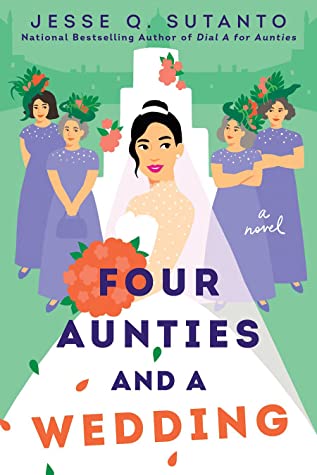
Dial A for Aunties by Jesse Q. Sutanto: After having this paperback on my shelf for about a year, I finally picked it up — and I have to say, this is quintessential vacation reading! Super silly, not at all intellectually challenging, and just oodles of fun. When Meddy and her meddlesome aunties get involved in an over-the-top Chinese-Indonesian wedding, they also find themselves dealing with an inconvenient corpse, stolen jewels, and the reappearance of Meddy’s college boyfriend — her one true love and the one who got away. The escapades here are preposterous and outrageously unbelievable… but so much fun to read and laugh over! I will definitely be picking up the next book in the series, Four Aunties and a Wedding.

Rating:

Rating: 4 out of 5.

Where We End & Begin by Jane Igharo: This is the most dramatic and serious of my batch of vacation books — the story of Dunni and Obinna, high school sweethearts with an intense bond who were cruelly separated by their families, as they reunite at a friends’ wedding in Nigeria twelve years later. With alternating timelines showing their present reconnection and the traumatic events of their past, the book gives us a deep understanding of how these two characters ended up where they are. I loved the exploration of the class differences in their society and how their families’ histories influenced how they were treated, as well as the insights into their individual decision-making and struggles. There are some truly painful revelations, as well as lovely moments of connection and understanding. This is a beautiful, sad, complicated story, well worth checking out.

Rating:

Rating: 4.5 out of 5.

What a week! I enjoyed every book I read… now comes the hard part — deciding what to read next!

Save

Save

Save

Save

Book Review: Fairy Tale by Stephen King

Title: Fairy Tale
Author: Stephen King
Publisher: Scribner
Publication date: September 6, 2022
Length: 608 pages
Genre: Fantasy
Source: Purchased
Rating:

Rating: 4.5 out of 5.

Legendary storyteller Stephen King goes deep into the well of his imagination in this spellbinding novel about a seventeen-year-old boy who inherits the keys to a parallel world where good and evil are at war, and the stakes could not be higher—for their world or ours.

Charlie Reade looks like a regular high school kid, great at baseball and football, a decent student. But he carries a heavy load. His mom was killed in a hit-and-run accident when he was ten, and grief drove his dad to drink. Charlie learned how to take care of himself—and his dad. Then, when Charlie is seventeen, he meets Howard Bowditch, a recluse with a big dog in a big house at the top of a big hill. In the backyard is a locked shed from which strange sounds emerge, as if some creature is trying to escape. When Mr. Bowditch dies, he leaves Charlie the house, a massive amount of gold, a cassette tape telling a story that is impossible to believe, and a responsibility far too massive for a boy to shoulder.

Because within the shed is a portal to another world—one whose denizens are in peril and whose monstrous leaders may destroy their own world, and ours. In this parallel universe, where two moons race across the sky, and the grand towers of a sprawling palace pierce the clouds, there are exiled princesses and princes who suffer horrific punishments; there are dungeons; there are games in which men and women must fight each other to the death for the amusement of the “Fair One.” And there is a magic sundial that can turn back time.

A story as old as myth, and as startling and iconic as the rest of King’s work, Fairy Tale is about an ordinary guy forced into the hero’s role by circumstance, and it is both spectacularly suspenseful and satisfying.

In Fairy Tale, master author Stephen King takes a kind-hearted 17-year-old and sends him on an epic quest to battle forces of evil and save a kingdom.

Also, there’s a very good dog. And because I know this is important for many readers to know up front: The dog will be fine! (Stories that treat book doggos badly can be a deal-breakers for many readers, so now you can rest easy and proceed).

Charlie is a strong, self-reliant boy who loves his father, but he’s also had to shoulder far too heavy a burden in his short life. After his mother’s tragic death, his father became lost to alcoholism, and Charlie had to care for himself and his father through the dark years until his father finally found sobriety. For all that, Charlie is remarkably well-adjusted, but he does think back with regret on the mean-spirited pranks and cruel behaviors he indulged in during the worst of days.

When he hears a dog barking from behind the large, spooky house on the hill, he intends to just move on, until he hears a faint voice crying for help. Charlie discovers Mr. Bowditch, the old man who lives alone in the house, severely injured in the backyard. He calls for help, then makes a decision that this perhaps is his opportunity to atone for the bad behavior in his past, and becomes completely devoted to Mr. Bowditch and his elderly dog Radar.

While Mr. Bowditch is hospitalized, Charlie takes on caring for Radar, and begins work on cleaning and repairing the house. After Mr. Bowditch is released, it’s Charlie who takes on the responsibility of daily care, going far above and beyond would might be expected of a teenager (or even most adults). Through their time together, the two become very close, but Mr. Bowditch holds onto his secrets tightly — although he does tell Charlie how to access his safe and the bucket full of gold pellets stored within, and how to exchange the pellets for the money needed to pay the hospital bills.

When Mr. Bowditch suffers a fatal heart attack some months later, Charlie and his father are shocked to learn that Charlie has inherited the house, the property, and everything it contains. Even more shocking is the cassette tape Mr. Bowditch has left, telling Charlie a strange tale about a journey to a hidden world and the magical device there that allows one to regain youth and health. With Radar in sharp decline, Charlie realizes that following the instructions on the tape might be his only option for saving Radar’s life. And so the quest begins.

Fairy Tale in many ways embodies the traditional Hero’s Journey, with Charlie receiving a call to action, setting out on a quest, gaining allies along the way, sinking to darkest depths (in this case, spending weeks/months (?) in a literal dungeon), before finding redemption and reemergence. It’s brilliantly constructed — we can see the framework and understand what King is doing, while still becoming totally immersed in the magical and dangerous world that Charlie enters.

At the same time, Charlie himself recognizes the influence of stories and how they seep through worlds into realities. Rumpelstiltskin, the Goose Girl, the Little Mermaid, Jack and the Beanstalk — all are present in some variation here, not as literal retellings but as universal tropes that inform the reality that Charlie now finds himself in.

Based on the synopsis, I’d expected the portal elements to kick in pretty early in the story, but in fact, it’s not until around 30% that Charlie first ventures through the passage to the alternate world. The first third of the story is devoted to Charlie’s family’s backstory and his growing relationship with Mr. Bowditch (and Radar!). This is really effective, as it grounds everything that follows in a realistic beginning in our own world, and gives a solid basis for why Charlie acts as he does, both his devotion to providing care to Mr. Bowditch and his actions on his portal adventure.

The flow does seem to lag for a bit in the middle of the story. As I mentioned, there’s a dungeon involved, and Charlie’s time imprisoned there drags on long enough that my interest flagged. Likewise, the sections about Charlie and his fellow prisoners being forced to train for and then compete in a Hunger Games-like tournament to the death felt overly long and drawn out.

Those elements aside, the plot is mostly fast-paced, full of surprises, odd-ball and quirky characters, memorable settings, and a superbly crafted sense of wonder and menace that hangs over every step of Charlie’s journey. Charlie himself is wonderful — smart, caring, and sensitive, but flawed enough that he’s not too good to be true.

Fairy Tale is a big, thick book, but absolutely worth the time and attention. I was captivated, often scared on behalf of the characters, and fully invested in the outcome and the stakes. The world Charlie visits is fascinating, and I would have loved to have spent even more time exploring it at the conclusion of the quest.

Wrapping this up… I highly recommend Fairy Tale! It’s a treat for King fans, but also an easily accessible entry point for those who haven’t read his books before or who feel that his books are too terrifying for them! Yes, there are some frights and scary beings, and as I said, plenty of menace, but this book doesn’t have the absolute terror of, say, Pet Sematary or It.

Fairy Tale is both a coming-of-age story and a tale of a mythical, magical adventure, and it’s a wonderfully engaging read, start to finish. Don’t miss it!

Audiobook Review: Travel by Bullet (The Dispatcher, #3) by John Scalzi

Title: Travel by Bullet
Series: The Dispatcher, #3
Author: John Scalzi
Narrator:  Zachary Quinto
Publisher: Audible Originals
Publication date: September 1, 2022
Print length: n/a
Audio length: 3 hours, 43 minutes
Genre: Science fiction
Source: Purchased
Rating:

Rating: 4.5 out of 5.

The Audible and New York Times best-selling “Dispatcher” series returns with a brand-new mystery, performed by Zachary Quinto.

The world has changed. Now, when someone is murdered, they almost always come back to life—and there are professionals, called “dispatchers,” who kill in order to save lives, to give those near the end a second chance. Tony Valdez is a dispatcher, and he has never been busier.

But for as much as the world has changed, some things have stayed the same. Greed, corruption and avarice are still in full swing. When Tony is called to a Chicago emergency room by an old friend and fellow dispatcher, he is suddenly and unwillingly thrown into a whirlpool of schemes and plots involving billions of dollars, with vast caches of wealth ranging from real estate to cryptocurrency up for grabs.

All Tony wants to do is keep his friend safe. But it’s hard to do when friends keep secrets, enemies offer seductive deals, and nothing is ever what it seems. The world has changed… but the stakes are still life and death.

I hadn’t been aware that a third Dispatcher audiobook was on the way, so I was surprised in the best way to see it available on Audible this month!

In the sci-fi/speculative world of the Dispatcher series, death has become much more optional. Death by natural causes is still death, but if someone is murdered, in 999 cases out of 1,000, the murdered person pops back into life with a “reset”, waking up someplace they feel safe — usually their own home — back in the condition they were in several hours earlier.

In this brave new world, professional Dispatchers are trained and licensed to turn natural deaths into murders, all for the sake of saving lives. A person on the verge of death from cardiac arrest, for example, gets a professionally administered bullet to their brain, and (unless they’re that 1 in 1,000 exception), they end up totally fine. I mean, they should probably go see a doctor ASAP for that heart condition, but they’re alive and have a chance to remain that way.

In Travel by Bullet, things have changed yet again in all sorts of interesting ways. The role of Dispatchers has been around for about 10 years at this point, and our main character, Tony Valdez, is tired. The world has been going through the pandemic for the past couple of years, and new laws have been instituted that give families the right to demand a dispatch for their dying relatives, meaning that Dispatchers are now employed full time in hospitals and are kept incredibly busy.

The problem is, for someone on a ventilator approaching death, a reset by dispatch isn’t really going to fix things. The patient will wake up in their own bed in a condition from a few hours earlier, but as in all dispatches, they travel without anything but their bodies — no clothes, and most importantly in these cases, no equipment. Often, desperate families who demand a dispatch are dooming their relatives to pain and confusion and inevitable death, but without the benefit of hospital staff to ease the journey. Tony spends much of his time trying to talk families out of using his services, but at the end of the day, he is required by law to perform if that’s what the family wants.

His daily grind is interrupted when a friend and fellow dispatcher is brought into the ER, on the verge of death and asking specifically for Tony. Tony knows that this person has been involved in the shadier side of dispatching, and the circumstances of the accident that brought him to the hospital are very sketchy.

Tony reluctantly gets drawn into his friend’s mess, and ends up at the center of a conspiracy that draws in the Chicago PD, the FBI, mobsters, VC billionaires, and assorted hoodlums. Tony becomes increasingly threatened as he struggles to keep his friend safe while not alienating other allies or putting his life and livelihood into grave danger.

It’s all very quick-paced and complicated, with crypto-wallets changing hands, billionaires behaving horrendously, and Dispatchers being used in some truly awful business settings (as well as providing the “travel by bullet” concept that gives this story its name).

In my review of the 2nd book, Murder by Other Means, I wrote:

At just barely 3 hours, this audiobook is perfect for a quick entertainment. The action is fast-paced, and the narration is terrific. The vibe is noir, but with enough weird elements to let you know you’re living in a Scalzi world. I had to keep reminding myself that this wasn’t a Dresden book (minus the magic) — it’s that kind of smart, quick urban storytelling.

The same is absolutely true here! (Sorry, I don’t usually quote myself…)

Travel by Bullet is slightly longer, but still under 4 hours. Actor Zachary Quinto is marvelous when it comes to voicing Tony and handling the storytelling. His narration absolutely nails the noir vibe of the entire story, and it all just works.

I would recommend starting with the first book in this series, The Dispatcher, in order to get a good feel for the world of dispatching and its rules and quirks — but since they’re all relatively short, you’ll speed through them in no time!

Note: Travel by Bullet is an Audible exclusive as of now. The first two books in the series were also originally Audible-only, but were later released in print format too, so I’d assume that eventually, this one will be as well. For now, though, if you want to experience Travel by Bullet, Audible is the only option.