
Book Review: Sky Jumpers by Peggy Eddleman

Book Review: Sky Jumpers by Peggy Eddleman

Sky Jumpers (Sky Jumpers, #1)If you’re looking for a middle grade novel with a strong female character and lots of action and adventure, look no further! Sky Jumpers absolutely fits the bill.

In Sky Jumpers, we meet 12-year-old Hope Toriella, a spunky, fearless girl living a surprisingly happy life in White Rock, Nebraska. Surprisingly happy — because this book is set some 40 years after World War III, during which the world was destroyed by “green bombs”, which are basically a more environmentally-friendly version of nukes. People were killed by the millions, cities were destroyed, general devastation resulted — and yet Earth itself is still inhabitable, for those lucky enough to survive the initial bombing.

White Rock is a town located in a deep valley formed by a massive bomb crater, surrounded on all sides by huge mountains. Its limited access — only one tunnel in or out of town — gives it an  ideal defensible position. And safest of all, the upper skies over White Rock, and indeed, over the entire Earth, have a layer of mutated air known as Bomb’s Breath — thicker than normal air, instantly deadly when inhaled, yet invisible to the naked eye. The Bomb’s Breath sits over White Rock like a cork along the mountain tops, ensuring that no invaders will ever attempt to invade by crossing the mountains.

But… Hope and her friends have invented a thrilling game, carefully hidden from their parents, that involves holding their breath, climbing up above the Bomb’s Breath layer, and then jumping back through it. As the dense air cushions their fall, they are able to do amazing acrobatics, and dare one another to try riskier and riskier moves. Hope is the absolute best at sky jumping, and finally manages to nail a double somersault as the book opens.

In White Rock, the most valued skill of all is the ability to invent. The green bombs changed not only the air but also the nature of certain metals, so that the survivors have to find new ways to make what they need with the materials readily available — largely wood, water, stone, and the products of their fields. Each year, the townspeople show off their new inventions during a big festival, and everyone from age four upwards is expected to participate. And Hope, to put it bluntly, sucks at inventing. Nothing she makes ever comes off the way she intends, leaving her feeling like the town laughingstock.

The action really revs up when White Rock is invaded by a group of armed bandits, intent on stealing the town’s supply of a rare and valuable antibiotic, and willing to kill in order to get it. However, if the town hands over its supply, it won’t be able to make more until the next spring, by which point a recurring disease may kill off a good portion of the town. All seems lost — but Hope is nothing if not a daredevil, and she knows a secret way out of town. Risking everything, she and her friends set off to get help — but will they get there in time? Can children really save the day?

I won’t say whether Hope’s quest is successful — it’s too much fun to find out on your own! Hope is a brave, strong girl, intensely loyal to her parents, her friends, and her community. Everyone around her can see her strength and her leadership qualities, but it takes this threat to the town for Hope to fully realize that her lack of inventing skills doesn’t mean that she has nothing to contribute.

It’s lovely to see a girl take the lead in a physically grueling plan to escape and rescue her town. Hope is a smart girl who knows the risks she’s taking, but also realizes that if she doesn’t try, the town is doomed. Between her courage and her agility, Hope has pretty much the only chance of success, and you can’t help but root for her as she faces challenge after challenge, thinking ahead, taking chances, and pushing forward even when the odds seem insurmountable.

Start to finish, Sky Jumpers is fast-paced and exciting. The world-building is quite good, portraying a post-apocalyptic Earth that’s different and startling, but not too bleak or depressing for the intended audience. This new world feels like a frontier full of challenge, and even though there are bad guys out there, life itself doesn’t seem particularly awful — just different. Characters are nicely defined — not just Hope, but her parents, teachers, and friends are all distinct personalities with talents, ideas, and inner lives that make them feel like real invidividuals and not just faces in a crowd.

Sky Jumpers is a book I’d have no qualms about handing to a boy or girl in the target age range — in fact, although I read this book both for my own enjoyment and for the purpose of reviewing it here, I’d love to have my 11-year-old son read it next. I think it would be right up his alley.

Well-written, with a dynamic story arc, lots of excitement and adventure, a high-stakes climax full of heroic daring — I’d consider Sky Jumpers a terrific choice for kids in the 8 – 13 age range. And who knows? Perhaps this one will even entice my reluctant reader to read past his bedtime.

Final note: According to the author’s website, Sky Jumpers #2 will be out in Fall 2014. But have no fear! Even though this is apparently an ongoing series, Sky Jumpers is a fully realized story, with a beginning, middle, and end, and stands on its own just fine. But I’ll happily check out book #2 — I’m sure there are great adventures ahead for Hope and for White Rock, and I’d love to see what happens next!

Okay, really the final note: I see from the author’s blog that she’s a Joss Whedon fan. And now it all makes sense. ***happily geeking out…***

__________________________________________

The details:

Title: Sky Jumpers
Author: Peggy Eddleman
Publisher: Random House Children’s Books
Publication date: 2013
Genre: Middle grade adventure
Source: Review copy courtesy of Random House via NetGalley

Book Review: Doctor Sleep by Stephen King

Book Review: Doctor Sleep by Stephen King

16130549

What ever happened to Danny Torrance?

Ever since Stephen King’s 1977 novel The Shining, people have wanted to know what became of the little boy with the special gifts and the murderous father. Stephen King himself, in the author’s note at the end of Doctor Sleep, states that he was asked this question at a book signing in 1998, and it’s been on his mind ever since.

And now, finally, 36 years after the publication of The Shining, King’s new novel Doctor Sleep is here to answer the question.

Danny Torrance, for those who need a refresher, is a very special five-year-old at the time of the events of The Shining. Son of an alcoholic father down to his very last chance at redemption, Danny has a remarkable gift — dubbed “shining” by his friend and protector — which include telepathy, precognition, and a talent for seeing the unseen. Danny and his parents head up to the Overlook Hotel high in the Colorado Rockies, where Danny’s father will serve as caretaker during the long winter months when the hotel is snowed in and cut off from the outside world. Let’s just say, it doesn’t go well.

Danny survives, but life hasn’t been easy… and he’s never managed to completely escape from the terrors of his childhood. Now grown, Dan is haunted by the same demon as his father was — alcoholism. Dan has discovered that drinking dulls the impact of the shining — especially the recurring visits from the malicious spirits of the Overlook.

In Doctor Sleep, Dan manages to eventually climb out of his alcohol-fueled darkness thanks to a couple of good men who offer him a place to work and, even more importantly, introduce him to the world of Alcoholics Anonymous. AA is presented here in a practically religious light, and while Stephen King doesn’t typically go easy on pop cultural reference points, he does not portray AA in anything but flattering terms, no sarcasm or dissing allowed.

Dan finds solace and refuge in a small New Hampshire town, where he uses his shining in the service of others. He works as an orderly in a hospice, where the residents refer to him as “Doctor Sleep” thanks to his talent for helping the dying make their final crossing into whatever lies beyond. Dan’s quiet life is rocked when he’s contacted by the precocious Abra Stone, a girl so full of the shining that it manifests itself from birth. Abra establishes a telepathic connection to Dan, but it’s not until danger looms that their lives truly collide.

So who is the Big Bad in Doctor Sleep? Two answers, really. First, there’s the True Knot, a seemingly innocuous band of RV people who travel the highways and byways looking for sustenance. The True Knot feeds off the essence of children who “shine” — the dying breaths of these children, especially when the death is prolonged and painful, produces “steam”, which enables the True Knot to live seemingly forever and maintain their youth and their health.

Stephen King’s descriptions of the True Knot are hilarious, referring to every annoying road trip you’ve ever taken where you’ve been stuck behind slow-moving campers, and the crowds of old folks and their RVs that you encounter at every rest stop across America:

How many times have you found yourself behind a lumbering RV, eating exhaust and waiting impatiently for your chance to pass? Creeping along at forty when you could be doing a perfectly legal sixty-five or even seventy? And when there’s finally a hole in the fast lane and you pull out, holy God, you see a long line of those damn things, gas hogs driven at exactly ten miles an hour below the legal speed limit by bespectacled golden oldies who hunch over their steering wheels, gripping them like they think they’re going to fly away.

Well, guess what? Behind the grandma facades are some truly ferocious — and hungry — people, and you’d better hope that you don’t attract their attention.

The second Big Bad in Doctor Sleep is, of course, the curse of alcohol addiction itself. The never-ending thirst, even for those with years of sobriety under their belts, is presented as the most damaging of evils, a nightmare without escape, a force to be combated with one’s whole being. There are many reasons why Dan ends up who and what he is, but it’s clear that the drinking — and the battle not to drink — is what truly defines him.

Doctor Sleep has some disturbing moments, powerful and frightening characters, and mind-bending action sequences, but I wouldn’t say the book itself is scary. It’s a long book (over 500 pages), and the action does seem to sag a bit from time to time. There are early stretches, covering Dan’s recovery and Abra’s early life, that are interesting from a character perspective, but don’t do much to move the story forward.

At the same time, both Dan and Abra are fascinating characters, and I think King strikes a homerun here in terms of their development as fully realized people. We absolutely get Dan’s life and what makes him tick. In Abra, we see a child full of light and power, with a loving family that is kind of freaked out by her. She’s strong and sure of herself, but that doesn’t mean that she’s not still a child to be protected and shielded. When Dan and Abra finally come together to combat the True Knot, their ingenuity and deep-seated goodness are what enable them to fight hard and fight together.

I never really felt that the outcome was in question, but how we get there is inventive, unpredictable, and full of twists and turns. As in many Stephen King books, I felt that the narrative got a little more convoluted during the climax than was strictly necessary — but as always, King is master of his domain and makes it all work out in a way that serves the overarching story as well as each character’s own development and story arc.

All in all, I’d call Doctor Sleep a no-doubt-about-it success. As a sequel, it nicely references the earlier book, stays true to what we know of the characters, and yet moves the story forward in new directions that are engaging and compulsively readable. And as a stand-alone novel, Doctor Sleep convincingly establishes teams of good guys and bad guys and builds the suspense bit by bit until we get to the dramatic showdown.

Should you read The Shining first? Well… yes! Of course you should! I suppose you could read Doctor Sleep on its own and understand enough to appreciate it – but really, why would you want to?

I first read The Shining years (decades) ago, and in the excitement leading up to the new book’s release, realized that my memories of The Shining were dim at best, overshadowed in many ways by the movie version. I re-read The Shining last month, and let me tell you – I’m so thrilled that I did. First of all, it’s an amazing (and terrifying) read. Second, moving from The Shining to Doctor Sleep with only a few weeks in between, I felt so connected to Danny and so invested in his story that it was easy to become absorbed in grown-up Dan’s challenges and struggles. Reading Doctor Sleep was almost like finding out about a little boy that I’d known long ago: I remembered little Danny Torrance fondly, wished him well, and really did want to know what ever happened to that poor little boy who lived through such a terrible experience.

And now I know.

__________________________________________

The details:

Title: Doctor Sleep
Author: Stephen King
Publisher: Scribner
Publication date: 2013
Genre: Horror
Source: Purchased

Book Review: The Girl You Left Behind by Jojo Moyes

Book Review: The Girl You Left Behind by Jojo Moyes

The Girl You Left BehindQuick: When you think of looted art and reparations, what do you think of? Nazi Germany? So do most of the bystanders in this novel, which mixes a modern courtroom drama and love story with a devastating glimpse back at a wartime tragedy, with a missing (perhaps stolen) painting serving as the focal point. The twist in The Girl You Left Behind is that the painting in question went missing during the German occupation of northern France during the first World War — but that doesn’t stop popular opinion from tarnishing the main character’s reputation by accusing her of exploiting Nazi theft for her own personal gain. To say it’s complicated is putting it mildly.

In The Girl You Left Behind, we follow two timelines. In 1916, we meet Sophie Lefevre, devoted wife of up-and-coming artist Edouard, who is serving on the front lines with the French forces battling the invading German army. Sophie has been left behind in her home village, helping her sister manage the family inn and struggling to survive with ever-dwindling rations and a hostile German battalion occupying the town. Beautiful young Sophie catches the eye of the German Kommandant, and he is mesmerized as well by Edouard’s portrait of Sophie, which hangs in a back hallway of the inn. Ultimately, Sophie is forced into a decision that pits her own life and honor against the survival of her family and her husband.

Meanwhile, in modern day London, young widow Liv Halston lives alone in a beautiful glass house built by her late husband David, a remarkable and renowned architect who died suddenly four years previously. On their honeymoon, David had bought a beautiful portrait of an enigmatic young woman as a gift for Liv, and this portrait is literally the only spot of color in Liv’s bleak world. Liv meets handsome, gallant Paul and finally feels a spark of life returning — but Paul is an ex-cop now specializing in tracking and returning works of art stolen during wartime. When he is hired by the Lefevre family to find their missing painting and realizes it’s in Liv’s possession, legal drama threatens their blossoming love — as well as David’s legacy and Liv’s reputation.

The Girl You Left Behind tells both parts of the story quite effectively. The first several chapters are devoted to Sophie, and it was somewhat wrenching to have to leave her once the narrative switched to the modern era. Likewise, Liv’s story is affecting and engrossing, and I soon wanted to know much more about this lonely woman and the husband she’d lost. Sophie and Liv are both strong women dealt a series of painful blows in horrible circumstances, and in both streams of the story we see how their personal strength informs their decisions and actions.

The moral dilemma posed is an interesting one. It would appear that the Lefevre descendants are seeking the painting for its monetary value alone, whereas Liv truly loves the painting and feels a connection and fondness for Sophie herself, despite knowing nothing about her story until the legal case gets underway. So who is right in this situation? Are the artist’s descendants entitled to the painting based on their assertion that it was stolen during wartime? Or, barring convincing evidence, is Liv entitled to keep this artwork that she cherishes, even knowing that it may have made its way to her through questionable circumstances?

The story is compelling and well thought-out, and the alternating timelines prolong the suspense and the mystery. We know that something terrible happened to Sophie; we know that the painting disappeared; but the how and why of these occurences is not revealed until close to the end of the book. Author Jojo Moyes gives just enough detail to keep us guessing (although I’ll admit that I’d made an assumption about a key revelation that turned out to be correct), and both pieces of the story wrap up in a way that feels both right and satisfying.

My only quibble with this book is that I wanted to know a bit more about the relatives who started the legal proceedings. They’re referred to as descendants of the Lefevre family, but the exact relationship to the artist isn’t revealed, and we never actually meet them other than seeing them on the other side of the courtroom. I would have liked to have seen their role in the story fleshed out. While it’s implied that they’re only in it for the money (and I suppose their motivation is immaterial if the painting is in fact rightfully theirs), it would have helped me view their side of the proceedings more sympathetically if I’d gotten to know them in any way.

That issue aside, I found The Girl You Left Behind to be quite moving and well thought out. It reveals a piece of history that doesn’t get much attention, while hammering home a universal truth about the horror of war and the irreparable damage done to so many lives. In the contemporary pieces of the story, The Girl You Left Behind is also emotionally involving and very interesting as well — as a legal drama, as a love story, and as a portrait of a woman who has to figure out how to live again.

I’ve been hearing a lot about Jojo Moyes this year, especially since the publication of her highly praised novel Me Before You. The Girl You Left  Behind is the first book I’ve read by this author, but it certainly won’t be the last. Jojo Moyes is a skilled storyteller with a great eye for capturing the small details that make a character feel real, and I look forward to exploring more of her work.

__________________________________________

The details:

Title: The Girl You Left Behind
Author: Jojo Moyes
Publisher: Penguin Group/Viking
Publication date: 2013
Genre: Historical/contemporary fiction
Source: Review copy courtesy of Penguin/Viking via NetGalley

Book Review: Two Boys Kissing by David Levithan

Book Review: Two Boys Kissing by David Levithan

Two Boys KissingTo call Two Boys Kissing a young adult novel is to set limits on a book that truly transcends categories of genre and target demographics. You may as well describe Two Boys Kissing as poetry with a plot or a love song transcribed with paper and ink.

Two Boys Kissing is an ode to today’s generation of gay youth, narrated from beyond by a “Greek chorus” (as all the blurbs put it) composed of the voices of the generation of gay men lost to the plague years of the AIDS epidemic. Written throughout in the first-person plural voice, the narrative describes the hopes and fears of the people who came before — and expresses their love and good wishes for the youth of today.

The book is loosely constructed around the events that occur over the course of a weekend, as teens Harry and Craig decide to challenge the record for the world’s longest kiss. As these two boys attempt to kiss for 32 hours straight, with no breaks, no sitting down, no “propping” by any others, their friends gather round to cheer and support them — and bit by bit, they become a world-wide media sensation. Meanwhile, we also follow the story of five other boys who explore first love, family acceptance, fitting in and giving up, speaking up and knowing when to listen.

The writing here is lyrical and absolutely beautiful. I could open to pretty much any page and find a moving moment or a passage that just begs to be read out loud.

Sample #1:

We were once like you, only our world wasn’t like yours.

You have no idea how close to death you came. A generation or two earlier, you might be here with us.

We resent you. You astonish us.

Sample #2:

Around the world, screens light up. Around the world, words are flown through wires. Around the world, images are reduced to particles and, moments later, are perfectly reassembled. Around the world, people see these two boys kissing and find something there.

Sample #3:

Maybe this is why we like watching you so much. Everything is still new to you. We are long past the experience, although we witness new things all the time. But you. New is not just a fact. New can be an emotion.

I could go on and on, because everywhere in Two Boys Kissing are moments of beauty, perfect expressions of pain and loss, hope and love. This is a slim book, less than 200 pages, but every page has meaning and depth. There are no chapter breaks — it’s one long meditation and celebration, and as surprising and unconventional as it is, it truly works.

I believe that Two Boys Kissing will quickly become a very important book for teens. It confronts today’s climate head-on, provides a context for how we got to where we are today, and conveys it all with passion, compassion, and an unwillingness to back down or look away. I can easily see another and different audience for Two Boys Kissing as well — the older generation, gay and straight, that remembers the awful, early years of the AIDS epidemic and hears the voices of friends and loved ones, lost but never forgotten, in the words of the book’s chorus.

On top of all this, Two Boys Kissing tells a sweet and lovely story about a group of individuals. The named characters are finely drawn, with personalities and backstories that make them each unique and yet easily identifiable as real people going through real challenges.

You may read it for the events, for the love stories, for the heartbreak, for the elegance of the writing, or for the memories it evokes. Just read it.

__________________________________________

The details:

Title: Two Boys Kissing
Author: David Levithan
Publisher: Alfred A. Knopf
Publication date: 2013
Genre: Young Adult
Source: Library

Book Review: Mister Max: The Book of Lost Things by Cynthia Voigt

Book Review: Mister Max: The Book of Lost Things by Cynthia Voigt

The Book of Lost Things (Mister Max #1)There’s a lot to love in this middle-grade novel about a very smart boy looking for solutions. Max, age 12, is the son of two successful, larger-than-life parents who run their own theater company and bring their characters to life day after day. Max enjoys the show but likes his place on the sidelines — until a mysterious letter arrives offering Max’s parent a too-good-to-be-true opportunity for fame and fortune, which they immediately accept. Max and his parents are due to set sail from their unnamed town on a luxurious ocean-liner headed for India, but on the day of departure, Max shows up at the docks at the appointed time only to discover that his parents have gone already — and that the ship they were meant to board does not actually exist.

Left behind, Max determines that his best course is independence, so even though his grandmother (Grammie) wants to take him in and care for him in his parents’ absence, Max decides to live under his own roof and support himself by any means possible. (His house is right next door to Grammie’s, so it’s not that dramatic a separation, after all). But how can a 12-year-old survive on his own — and what happened to his parents? Max stumbles onto a good thing, realizing that by enacting the parts he’s seen his father play so many times, he can assume any persona he needs: town official, humble laborer, stuffy bureaucrat, ardent detective. Max is a chameleon, and as he slips into his different characters, he begins to solve problems for the townspeople he encounters, earning enough along the way to retain his independence and managing to help the people he cares for in different ways as well.

Mister Max is a charming book, with a main character who is good-hearted, caring, and endlessly inventive. Max does not have magical resources or superpowers; instead, he uses his wits and logic to find solutions and set things right, figuring out not only facts but reasons and motivations, and helping others to figure out what it is that they truly want and need.

My main quibble with Mister Max is that it lacks a certain urgency. Although Max’s parents’ disappearance is the catalyst for the book’s story line, this mystery mostly sits on the back burner for much of the book. It’s a problem for Max and a worry, but he spends much more of his time solving other people’s problems and worries. True, there isn’t much he can do and there aren’t many clues — but Max seems to mostly take a shrug-your-shoulders, get-on-with-it sort of approach to his current situation. It’s all very pragmatic, but I’m afraid at times the plot concerning the mystery of Max’s parents seems to get buried in all the other busy moments of Max’s independent life.

Still, it’s an entertaining and clever read, and refreshing in an old-fashioned sort of way. The specific time and place of the book’s setting isn’t revealed, but it appears to take place sometime in the early 1900s. Travel is by steamship, communication is conducted via letters and telegrams, and Max weaves his way through the streets of Old Town and New Town on his trusty bicycle. There’s a simplicity to the problems that Max is hired to solve, and his solutions are smart and simple — perhaps needing a 12-year-old’s eyes to see the clues and patterns that closed-minded adults might miss.

I do wonder how well this book will work for the intended audience, children ages 8 – 12. At 400 pages, this is a rather hefty book, and the pace is somewhat slow, particularly for kids more used to reading books about fantasy worlds or high-speed adventures. Still, the writing is engaging and the characterizations are funny, straight-forward, and evocative, so that within a few well-written lines, we clearly see into the heart of each new character we meet and understand what makes them all tick. Author Cynthia Voigt is adept at talking to children without talking down, and it’s obvious that she credits her reading audience with a great deal of intelligence. It’s whether young readers will have the patience to commit to such a lengthy, character driven book that I’m not so sure about.

I read this book after receiving a review copy, and needless to say, I can’t help but apply an adult perspective to the action and the plot. I’d like to try this one out on my 11-year-old and see what he thinks. I have a feeling that Mister Max is a more subtle read than he’s used to, but that doesn’t mean that he won’t enjoy it, if he gives it a fair chance… and I’d imagine this may be true for other kids his age as well. Mister Max feels like the kind of story that might have been more popular a generation ago, but I do believe kids today will enjoy it, if they can just stick with it long enough to get into the flow and rhythm of a different sort of storytelling.

Mister Max: The Book of Lost Things is apparently first in a series, and ends without resolving the central question: What happened to Max’s parents? I’ll be interested in seeing where the series goes and what happens next for Max.

__________________________________________

The details:

Title: Mister Max: The Book of Lost Things
Author: Cynthia Voight
Publisher: Knopf Books for Young Readers
Publication date: 2013
Genre: Middle Grade fiction
Source: Review copy courtesy of Knopf via NetGalley

Book Review: Fangirl by Rainbow Rowell

Book Review: Fangirl by Rainbow Rowell

FangirlFangirl is so adorable, I didn’t know whether to read it or hug it.
This sweet, funny, charming novel tells the story of Cath Avery, a college freshman who just isn’t quite ready to leave her childhood comforts and touchstones behind. Cath is a twin, and she and sister Wren have been inseparable their entire lives… until Wren abruptly informs Cath that she wants them to live apart in college, try something new and meet new people. Cath is devastated. She has no interest in making friends and meeting new people; she and Wren have lived together for eighteen years — why stop now?

On top of that, their dad is not the most stable of guys, tending toward the manic end of the bipolar spectrum without someone around to make sure he’s eating, sleeping, and generally keeping it together. Ever since their mother left, just after 9/11 when the girls were eight years old, Cath and Wren have kept their dad on an even keel, and Cath is terrified that he’ll lose it without them around every day.

Now that she’s lost Wren as a roommate and built-in best friend, one of the unwelcome adjustments required in Cath’s new college life is her brash and irritable roommate Reagan, who seems to be constantly shadowed by her best friend Levi, a sunny older boy who is just always around… and who somehow manages to work his way into Cath’s reluctant heart.

The biggest change of all is the impact of college life on the twins’ obsession with Simon Snow. In the world of Fangirl, Simon Snow is the fictional main character of a series of books set in a magical world. Think Harry Potter, with a few twists. Simon Snow is simply the biggest thing ever, with a huge fanbase that’s getting crazier and crazier as the publication of the 8th and final book in the series approaches. Cath and Wren have always loved Simon Snow and are immersed in the world of fanfiction — or at least they were. Wren seems to have left it all behind in her quest to grow up and be a “normal” college girl, with all the drinking, partying, and boyfriends that entails, while Cath wants nothing more than to live in her Simon Snow “fic” world for as long as she can.

Cath isn’t just a regular old fan, though — she’s the incredibly popular author of Carry On, Simon, which has become the hottest fanfic in the Snow-verse. Each new installment by “Magicath” gets tens of thousands of hits, and Cath can think of nothing better than spending hours writing about Simon and the boy-on-boy romance she’s created for him with his archnemesis Baz.

Fangirl follows Cath through her first year of college, through the ups and downs of her relationship with Wren, her worries about her dad, her growing romance with Levi, and her struggles to define herself as a writer, both in the world of Simon  Snow and in the context of her advanced fiction writing course — presided over by a professor who just doesn’t “get” fanfiction and won’t allow it in her students’ writing.

This is the third book I’ve read by Rainbow Rowell, and once again I’m just incredibly impressed by her talent. In Fangirl, she’s created not one but two fictional worlds. The story of Cath and her growth and development at college is convincing and feels authentic, and at the same time, Rainbow Rowell has created a fiction-within-fiction world for the story of Simon Snow that makes it feel like a real, well-thought out book series. Actually, I suppose you could say that there are three worlds going on in Fangirl, because I don’t see how you couldn’t count Cath’s fanfiction creation as a story all its own. By the end of Fangirl, I wanted to know not only how Cath’s life would work out, but both versions of Simon Snow’s as well!

Cath’s inner life is well-described throughout. She’s scared and reclusive, yearning for connection but afraid of it too, wanting to write but not willing to leave her fanfic behind or relegate it to 2nd place. I loved Cath’s insecurities and fears, her love for her father, her anger toward Wren even while she misses her sister desperately. Perhaps most charming of all is Cath’s friendship with Levi. Levi is the boy everyone wishes they met in college. He’s sweet and smart, caring without being controlling, always there for Cath when she needs him, and funny and positive to boot. I loved that Cath and Levi could explore their feelings, not without complications or issues, but at least without the trite contrivance of an unnecessary love triangle. In fact, I thought early on that the plot was setting up a triangle, and when that didn’t turn out to be the case, I felt like raising a banner with a big “THANK YOU RAINBOW ROWELL” on it. What a relief!

Rowell’s writing is full of sparkling humor and zippy dialogue. Even when serious matters are arise, there are plenty of funny and quirky moments to lighten the mood. I love this moment, among many, which uses a pop-culture reference point as almost a throw-away quip, yet really sets a great tone (and made me snicker):

Reagan was sitting at Cath’s desk when Cath woke up.

“Are you awake?”

“Have you been watching me sleep?”

“Yes, Bella. Are you awake?”

Probably my only quibble with Fangirl has to do with names. Cath is short for Cather, and it took me the longest time to realize that yes, Cather is in fact her name and not a nickname. The explanation for Cath’s name (and Wren’s too) was just too cutesy by far for me to believe, and felt like a forced joke that didn’t work at all in the context of an otherwise totally believable (if not terribly functional) family dynamic. This is a small complaint, however, and certainly didn’t detract from my enjoyment of Fangirl for more than a moment or two.

Overall, I loved Fangirl. It doesn’t have the emotional punch of Rainbow Rowell’s Eleanor & Park, which took my breath away with the sorrow and hurt of its characters. In Fangirl, Cath goes through quite a lot, but it’s mostly a happy book about a young woman coming into her own, finding out who she is and what she wants, and learning how to be her own person. Cath’s experiences during her freshman year of college include unique elements, yet feel universal. For anyone who has suffered through meeting strange new roommates, figured out to maneuver through a dorm dining hall, or confronted a professor who just doesn’t get your work, reading Fangirl will be a nostalgic, emotional journey back to those days of excitement and confusion.

Filled with strong writing and original, well-developed characters, Fangirl is a joy to read — and it’s sure to especially delight readers who, no matter their age, still get a secret thrill from flipping back through their Harry Potter collection… again and again and again.

__________________________________________

The details:

Title: Fangirl
Author: Rainbow Rowell
Publisher: St. Martin’s Press
Publication date: 2013
Genre: Young adult/New adult
Source: Purchased

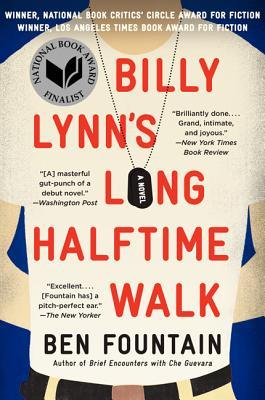
At A Glance: Billy Lynn’s Long Halftime Walk by Ben Fountain

Book Review: Billy Lynn’s Long Halftime Walk by Ben Fountain

Billy Lynn's Long Halftime Walk

Synopsis via Goodreads:

A finalist for the National Book Award!

Three minutes and forty-three seconds of intense warfare with Iraqi insurgents has transformed the eight surviving men of Bravo Squad into America’s most sought-after heroes. Now they’re on a media-intensive nationwide tour to reinvigorate support for the war. On this rainy Thanksgiving, the Bravos are guests of the Dallas Cowboys, slated to be part of the halftime show alongside Destiny’s Child.

Among the Bravos is Specialist Billy Lynn. Surrounded by patriots sporting flag pins on their lapels and Support Our Troops bumper stickers, he is thrust into the company of the Cowboys’ owner and his coterie of wealthy colleagues; a born-again Cowboys cheerleader; a veteran Hollywood producer; and supersized players eager for a vicarious taste of war. Over the course of this day, Billy will drink and brawl, yearn for home and mourn those missing, face a heart-wrenching decision, and discover pure love and a bitter wisdom far beyond his years.

My thoughts:

This is a hard book to sum up or describe. While Billy Lynn takes place over the course of one day, Billy’s reflections take us into his memories of his service in Iraq as well as to the previous two weeks spent touring the US. Billy is smart and surprisingly mature for age 19 — although perhaps not really so surprising, given what he’s been through. The Bravos have survived an intense battle but have suffered terrible loss as well — and thanks to embedded journalists and video footage fresh from the battlefield, they’ve become instant celebrities and poster boys for the American war effort. Everywhere they go, they’re mobbed by grateful citizens who want to shake their hands, praise their courage, and find out if America is really winning the war.

Meanwhile, Billy and his fellow soldiers are a bit shell-shocked by their losses, their battlefield experiences, and their insta-fame. Thrust back into the heart of the US for a two-week whirlwind “Victory Tour”, the guys are bombarded by the sheer absurdity of it all, as the publicity machine moves them forward and a Hollywood producer tries to spin their story into big fat paychecks. And when they’re all done being paraded around like trophies? It’s back to Iraq for another eleven months, and who knows whether any of them will make it home again?

The writing is intense, often aggressive, and high energy, and yet full of moments of beauty as well:

The transect of sky through the open dome is the color and texture of rumbled pewter, an ominous boil of bruised sepias and ditchwater grays that foretells all kinds of weather-related misery.

Or in a scene at a press conference:

He means to say more, but the room erupts in thunderous applause. Billy is stunned, then worried that they have missed the point, then he’s sure they’ve missed the point but is too unconfident of his communication skills to try to force a clarification down their throats. They’re happy, so he will leave it at that. The flash cameras are really going now, and like so much of his nineteen years’ experience of life it has become mainly something to get through, then the applause dies down and he’s asked if he’ll be thinking of his friend Seargeant Breem during the playing of the national anthem today, and he says yes just to to keep it upbeat and on track, Yes, I sure will, which sounds obscene to his ears, and he wonders by what process virtually any discussion about the war seems to profane these ultimate matters of life and death. As if to talk of such things properly we need a mode of speech near the equal of prayer, otherwise just shut, shut your yap and sit on it, silence being truer to the experience than the star-spangled spasm, the bittersweet sob, the redeeming hug, or whatever this fucking closure is that everybody’s always talking about. They want it to be easy and it’s just not going to be.

In various places throughout the book, words may be scattered across the page or repeated until they lose all meaning, and the chapter in which the men of Bravo are in the VIP clubhouse at the stadium during the singing of the national anthem is truly a work of art.

Billy Lynn’s Long Halftime Walk has been nominated for countless awards and has received all sorts of critical praise. Who am I to disagree? This is a moving, clever, and provocative look at what is truly sacrificed when a nation goes to war, and a piercing exploration of so-called American values. This is a book that requires the reader to think, and the thoughts it provokes are not pretty. Seeing these young men being sent overseas to die — and it’s made very clear that their deaths are the most likely outcome — demonstrates all over again that money pulls the strings, that media provides a glossy and inspirational story of heroism, but that the soldiers are thrust into situations in which they can not possibly succeed, and in which their own death or mutilation is a constant but too-real threat.

Sadly, in every war and in every generation, a new crop of books emerges to remind us all over again of the waste and horror of it all. Billy Lynn’s Long Halftime Walk belongs on the shelf right next to Catch-22 by Joseph Heller and The Things They Carried by Tim O’Brien, among others. Billy Lynn is a literary achievement with a powerful punch, and deserves every bit of the attention it has received.

__________________________________________

The details:

Title: Billy Lynn’s Long Halftime Walk
Author: Ben Fountain
Publisher: Ecco
Publication date: 2012
Genre: Contemporary fiction
Source: Purchased

Book Review: The Unlikely Pilgrimage of Harold Fry by Rachel Joyce

Book Review: The Unlikely Pilgrimage of Harold Fry by Rachel Joyce

The Unlikely Pilgrimage of Harold FryIn this sentimental novel, retired brewery salesman Harold Fry lives a quiet life of routine and avoidance in a strained but long-lasting marriage with his wife Maureen — until a letter arrives out of the blue and changes everything. The letter is from a woman named Queenie Hennessy, a former coworker whom Harold has not seen or heard from in twenty years. Queenie writes to inform Harold that she is dying of cancer, and Harold — moved to tears — decides to write back.

But something odd happens along the way to the mailbox. Harold starts to feel that his response is inadequate, and so continues walking to the next mailbox, and then the next, while he thinks about what to say. After a random encounter with a young women working at a gas station, Harold becomes convinced that if he only has faith, he can make Queenie survive. And what better way to demonstrate his faith than to walk to see Queenie — in a town five hundred miles away. Harold sets out in his trousers, shirt, tie, and yachting shoes, with no maps and no cell phone, and starts his unlikely pilgrimage.

Harold is singularly unprepared and unqualified for such an adventure, and yet he perseveres:

Harold’s heel stung and his back ached, and now the soles of his feet were beginning to burn. Even the smallest flint caused him pain; he had to keep stopping to remove a shoe and shake it empty. From time to time, he also found that his legs buckled for no apparent reason, as if they had been jellied, causing him to stumble. His fingers were throbbing but maybe that was because they were not used to being swung back and forth in a downward direction. And yet, despite all this, he felt intensely alive. A lawn mower started up in the distance and he laughed out loud.

As he walks, he contemplates his life. His marriage to Maureen started out full of love and excitement, but the two have by now withered into a pair of cross-tempered people living around each other, not with each other. Harold thinks about his unremarkable career and his failures as a father and husband. At the heart of his problems with Maureen, it seems, is the prickly, uncomfortable relationship between Harold and their only son, David. We receive only hints at first, but over the course of the novel, we piece together more and more bits of information about David’s troubled youth and his ultimate estrangement from his parents, for which Maureen bitterly blames Harold.

Meanwhile, Harold walks, encountering strangers on the road and in the many towns through which he passes. People show him kindness, and in turn, Harold offers what he can, which is mainly his attention and a sympathetic ear. Little by little, he starts to revise his opinion of himself and his interpretation of the key events in his life. Harold starts to realize that he can make a difference, both by giving and by receiving, and his spontaneous, poorly-planned trek to see Queenie becomes more of a spiritual quest, and eventually, a movement that captures the popular imagination of the entire country.

It’s not until the final chapters that we find out why Queenie matters so much and what exactly happened to destroy Harold and Maureen’s previously happy life together. Let me tell you, when the secret of their past is finally revealed, it’s a doozy. (Unfortunately for me, I read this book on a plane — and there may have been some surreptitious wiping of tears going on…)

I found Harold Fry to be a thoroughly readable novel, sweeping me along from chapter to chapter through the various landmarks and roadways of Harold’s journey. Harold and Maureen are both good people who have suffered loss and deprivation, and it’s hard not to root for them. Harold’s pilgrimage is quixotic and seemingly random — after all, what makes him think that his walk can make the slightest bit of difference in a woman’s fight against terminal cancer? Yet, Harold is committed to his sense that he’s made a pledge and that, in seeing it through, he’s keeping Queenie alive.

Here’s my slight quibble with the book: Harold’s walk really makes no sense. If it’s so important for him to see Queenie, why not hop in a car or a train? (In fact, quite a few people suggest this to him along the way.) It does become clear that Harold himself is gaining a tremendous amount from his pilgrim’s journey, finding an inner peace and certainty that he’d lacked all these years. He believes that Queenie will wait for him, but he sure doesn’t make it easy, making detours, getting lost, and refusing comforts that might speed him along his way. It’s almost as if he doesn’t really want to reach his goal — the journey becomes the point, not the arrival. But as the key motivating factor in the main character’s actions, the cause and effect — walking = Queenie lives — doesn’t hold up to much poking. Likewise, Harold’s entire decision to walk is based on one brief (and imperfectly understood) conversation, and his certainty about his quest occurs so quickly that we as readers don’t have the opportunity to fully buy into his mission or even truly understand his rationale for doing it.

Still, logical or not, it’s the pilgrimage itself that matters. It’s part meditation, part atonement for a life full of missed connections and poorly communicated desires and emotions, and a very blatant metaphor for a man embarking on the road to change. Harold is aware that people may not understand, may even mock or think him too old for what he’s trying to do, but what counts is how Harold experiences the journey. Harold Fry is a man who sets out to make a difference, and somehow manages to prove that you’re never too old to start fresh and make a change.

It must be said, too, that for those of a more classical/literary bent, The Unlikely Pilgrimage of Harold Fry can be read as a modern version of the hero’s journey. The plot kicks off with a call to adventure, Harold experiences challenges and temptations, meets helpers and mentors, and goes through stages of revelation, transformation, and atonement before he is able to return to his regular life. If you’re so inclined, it’s an interesting exercise to match up elements of Harold’s pilgrimage with the hero’s journey and see how well it fits.

I had some misgivings, as I’ve said, about the fundamental purpose and thought process behind Harold’s pilgrimage — but that doesn’t mean that I wasn’t moved by it. We see a man doing what should be impossible, and that’s a wonderful thing. The relationship between Harold and Maureen feels very real, and Harold’s encounters along the road are funny and poignant, each offering a snippet of another life touched and perhaps changed by this ordinary man’s choices and actions.

Harold Fry is well-written and quick-paced, so that it was easy to polish it off during one concentrated day of reading. There’s plenty of food for thought here, and I was intrigued especially by the novel’s portrait of a marriage’s deterioration, which seemed spot-on in its depiction of the small hurts, misunderstandings, and judgments that if left uncorrected, can cause permanent damage.

I was afraid that this book would be mawkish or trite, but despite veering dangerously close to Hallmark-card sentiments in a few spots, overall The Unlikely Pilgrimage of Harold Fry is a thought-provoking, sweet but sad look at a life and at second chances.

__________________________________________

The details:

Title: The Unlikely Pilgrimage of Harold Fry
Author: Rachel Joyce
Publisher: Random House
Publication date: 2012
Genre: Contemporary fiction
Source: Purchased

Book Review: Bring Up The Bodies by Hilary Mantel

Book Review: Bring Up The Bodies by Hilary Mantel

Bring Up the Bodies (Thomas Cromwell, #2)Bring Up The Bodies is the second book in Hilary Mantel’s trilogy focusing on Thomas Cromwell, self-made man, advisor to King Henry VIII, and arguably the most powerful man in England during a brief period of the Tudor reign. The first book, Wolf Hall,  covers Cromwell’s rise to power and his role in Henry’s divorce of Katherine of Aragon and marriage to Anne Boleyn. Bring Up The Bodies traces Queen Anne’s fall from favor and her ultimate destruction, as viewed through the lens of Cromwell’s own role in the dramatic and controversial events.

This is ground well-covered through a myriad of history books, historical novels, and dramatizations, yet author Hilary Mantel finds a fresh angle. By using Thomas Cromwell as the point-of-view perspective for the story, we get a peek into the mind of one of England’s most enigmatic historical figures and at the same time see the court machinations through the eyes of someone who wields great power and yet is constantly an outsider due to low birth. As a result, we view Henry and Anne from a distance, and can only marvel at the deceit, treachery, and political maneuvers that form the daily texture of life in the Tudor palace. Bring Up The Bodies captures the events of the time and presents the ups and downs, the legal and political details, and the impact on the kingdom and its people in a way that breathes new life into the drama of these events.

Hilary Mantel’s writing is spectacular, as it was in Wolf Hall, with its own quirky rhythms and phrasings, and a use of language that is unparalleled in most modern fiction. Simple lines like:

The susurration, tapesty-muffled, of polyglot conversation.

… simply take my breath away. Quiet descriptions are powerfully conveyed in language that demands to be noticed:

And now night falls on Austin Friars. Snap of bolts, click of key in lock, rattle of strong chain across wicket, and the great bar fallen across the main gate. The boy Dick Purser lets out the watchdogs. They pounce and race, they snap at the moonlight, they flop under the fruit trees, heads on paws and ears twitching. When the house is quiet — when all his houses are quiet — then dead people walk about on the stairs.

Once again, it took me a few chapters to adapt to the author’s use of pronouns. Throughout the book, the word “he” almost always refers to Cromwell, even if the preceding reference is to someone else. Occasionally, but not always, the author will make it a bit clearer, using phrasing such as “He, Thomas Cromwell, shrugs.”

I could open to any page in this magnificent book and find an example of outstanding writing… so I’ll indulge and quote one more that captures, for me, the author’s unique style:

All summer has been like this, a riot of dismemberment, fur and feather flying; the beating off and the whipping in of hounds, the coddling of tired horses, the nursing, by the gentlemen, of contusions, sprains and blisters. And for a few days at least, the sun has shone on Henry.

I can’t say enough good things about Bring Up The Bodies — which, like its predecessor Wolf Hall, won the Man Booker Prize and many other accolades and awards. I absolutely want to read the third book in the trilogy, which I believe is expected to be published in 2015. Bring Up The Bodies is proof that even familiar subject matter can be new and exciting in the hands of a talented writer with a compelling vision.

I read Bring Up The Bodies all in one day, while enduring about 12 hours of travel time through three airports and two flights. It was an intense reading experience, but I’m glad I had the opportunity to consume this book without interruption. Whether or not you have enough hours to devote to a straight read-through or prefer to enjoy Hilary Mantel’s writing in smaller bites, if you appreciate beautiful language and a compelling plot, I think you’ll find Wolf Hall and Bring Up The Bodies well worth your time.

__________________________________________

The details:

Title: Bring Up The Bodies
Author: Hilary Mantel
Publisher: Picador
Publication date: 2012
Genre: Historical fiction
Source: Purchased

Book Review: Tumble & Fall by Alexandra Coutts

Book Review: Tumble & Fall by Alexandra Coutts

Tumble & Fall

I was pleasantly surprised by this lovely young adult novel, given that the premise sounds like a sure recipe for a depressing, coming-of-the-apocalypse tale.

In Tumble & Fall, the world is heading toward disaster on a global scale. The mile-wide Persephone asteroid is on a collision course with planet Earth, and unless a last-ditch effort to blow it to smithereens is effective, Earth as we know it will be no more.

With a week to go until the asteroid hits, we witness events through the eyes of three teen narrators, all of whom spend what may be their final week on Earth on the island of Martha’s Vineyard. Sienna is newly released from a lengthy stay in mental-health home for teens after a desperate suicide attempt; Caden is edgy and sick of spending his life cleaning up after his alcoholic mother; Zan is mourning the loss of her boyfriend Leo in a tragic accident 10 months earlier. All three find themselves, in this final week, assessing their relationships, their families, and their own sense of purpose and self. As the clock winds down, they test themselves, test their limits, and figure out where they want to be — and by whose side — when the last moments come.

Here’s what the book is NOT about: Politics. Panic. Scientific intervention. Space missions. Global destruction. Building shelters. Selection of a chosen few to survive. In other words, this is not an apocalypse book along the lines of others we’ve seen before. While the basic premise immediately made me think of the two 1990s-era movies about death-by-asteroid, Deep Impact and Armageddon, there are no space cowboys and mad, so-crazy-it-just-might-work missions to (sound the trumpets, please!) SAVE PLANET EARTH!

Instead, Tumble & Fall is a strangely moving, introspective story about people and their connections. Some parts were funny, in a wry sort of way: All three of the characters, for different reasons, spend at least one night away from home without telling anyone, and while they worry about what their parents will think, there’s still a sense of “C’mon, the world is ending in a few days — drop the curfew!” Parents are forced to accept that they can’t protect their children; children are forced to acknowledge that parental love isn’t a one-way street. The characters on this island act out their love and commitment in so many ways — small acts of caring, coming home when they might feel like staying away, letting someone else be nurturing even when they themselves don’t need to be nurtured.

It’s hard to describe the sense of quiet doom lurking in the shadows. All of the characters know that there really isn’t any hope that the asteroid will miss. No one truly expects a miracle. As the clock winds down, the community gathers together, in sorrow and in love, because there really isn’t any other option. The end will come; it’s how they choose to spend the remaining time that matters.

Filled with lovely prose and vivid descriptions of the characters’ inner lives, this book moves at a fast pace and, once started, is really difficult to stop reading before the end. People who pick up Tumble & Fall expecting a big, flashy disaster book may be disappointed. But if you’re someone who appreciates reading about honest emotions, difficult choices, and people figuring out how to be when it really counts, then I strongly recommend Tumble & Fall.