Book Review: Dear Mr. Knightley by Katherine Reay

Book Review: Dear Mr. Knightley by Katherine Reay

Dear Mr. KnightleyThis debut novel combines the wit of Austen with the gritty pluck of Bronte, but with a modern-day setting that adds several unexpected twists and a deeper level of truth and examination than I’d expected.

In Dear Mr. Knightley, main character Samantha (who goes by Sam) is a college grad on the verge of aging out of the support systems available to former foster kids. With the prodding of her mentor, Father John, who runs the group home in which she lives, Sam applies for a grant from an anonymous foundation. This grant will enable her to enroll in graduate school, and will cover all expenses while she pursues her degree. The only catch is that Sam must write a series of letters to her benefactor, who uses the pseudonym George Knightley, knowing it will appeal to Sam’s inner Austen-phile and keep his true identity a secret.

Sam’s life has not been easy, and she is plagued by self-doubt. She’s spent all her life feeling unloved and unwanted, and has hidden herself away in the pages of her beloved books. When anxious or faced with a need to connect with people, she hides behind her characters, quoting Lizzy Bennet or Emma or even Edmond Dantes — which lets her keep her walls intact, and ensures that anyone who tries to reach out to her will run in the opposite direction.

But once Sam receives her grant and starts her graduate program in journalism, she realizes that her walls are crumbling — and that she needs to let them. She can’t succeed as a writer if she keeps her heart hidden away; she can’t connect as a friend if she refuses to let anyone know her. As Sam narrates her tale via letters to Mr. Knightley, we witness her fears, her doubts, her pain, and her glimmers of joy. We delight with her when she sees new possibilities, but we can’t help but want to cry every time poor wounded Sam seems to be making another counter-productive decision based on insecurity and lack of confidence.

I enjoyed the writing style here very much. The entire book is told via Sam’s letters to Mr. Knightley, so it’s all first-person and very immediate. She writes from her heart to her anonymous correspondent, allowing herself the freedom in her letters to reveal herself in all the ways she’d never do with a real person. While occasionally seeming more naive than seems reasonable for a 23-year-old, I could suspend my disbelief based on the facts of Sam’s life. If she seems to have odd ideas about friendship, connection, and relationships, it’s understandable, given that she bounced from foster family to foster family, experienced disastrous encounters with her real parents, and finally ended up at the group home for the remainder of her teen and early adult years.

If you happened to read my blog yesterday (here), then you may have seen my mini-freak-out about finding out that a book I was reading was listed on Amazon as “Christian fiction”. This is the book that triggered all of that. And it’s puzzling to me. Had I not come across that designation on Amazon, I don’t think it would have occurred to me to think of this book as anything other than contemporary fiction. Yes, there were passages, especially toward the end, where Sam is encouraged toward “surrender” and finding joy in faith. But it’s not heavy-handed, I didn’t feel like the book itself was proselytizing in any way, and the references to characters’ faith and beliefs felt organic and reasonable within the context of the story. What I had feared might be a problem for me really wasn’t. So, after much ado about nothing, all’s well that ends well! (Sorry… )

The book is a quick read, but it’s not fluffy. It does seem that things always work out for Sam in a big way. Too sugar-coated, perhaps? Yes, it can seem like a fairy tale at points, the way the grants, the internships, the supportive people always come through just when needed. But that is balanced, for the most part, by a refusal to gloss over the harder parts of Sam’s life, so truly, even if it seems unlikely that things could work out so well in real life, there’s no doubt that Sam has earned all that comes her way by the end.

I mentioned earlier that I liked the writing style — and I really did, except for a certain phrasing oddity that kept jumping out at me: Whenever characters use the work “couple”, it’s phrased as “a couple papers”, “a couple internships”, “a couple days ago”. What happened to the “of”??? Is this a regional quirk, perhaps? I have no idea, but it really bugged me. This is a minor quibble, though; for the most part, I enjoyed Sam’s voice very much. Some epistolary novels seem forced, using the letter format as a gimmick that doesn’t always allow for fully fleshed-out storytelling. This is not the case in Dear Mr. Knightley: Through Sam’s letters, we get insight into her heart and mind in a way that might not have worked otherwise, and because we know that Sam herself is a skilled writer, it makes sense that her letters are so articulate and thoughtful.

If you’ve read the 1912 novel Daddy-Long-Legs by Jean Webster, then the secrets and resolution of Dear Mr. Knightley won’t be a surprise. But even knowing how it would work out, I still enjoyed the author’s skill in weaving the backbone of the older book into this fresh novel, finding a way to take a set of circumstances that might seem old-fashioned and apply them to a modern setting in a way that’s believable.

I’m glad that I didn’t let the genre issue keep me from exploring and enjoying this touching, delightful book. Skillfully weaving together threads of classic literature into a modern-day setting that rings true, Dear Mr. Knightley is a lovely look at the journey of a special young woman. I’m happy to have read it, and I’m happy to recommend it.

_________________________________________

The details:

Title: Dear Mr. Knightley
Author: Katherine Reay
Publisher: Thomas Nelson
Publication date: 2013
Genre: Contemporary fiction
Source: Review copy courtesy of Thomas Nelson via NetGalley

Book Review: The Firebird by Susanna Kearsley

Book Review: The Firebird by Susanna Kearsley

15942636Past and present mingle deliciously in the newest novel from Susanna Kearsley, whose “time-slip” novels such as Mariana, The Winter Sea, and The Rose Garden have amassed quite a devoted following. Her books tend to blend a modern-day storyline with a gripping historical thread, to create a whole that’s emotional, dramatic, and always steeped in meticulously researched historical detail.

In The Firebird, we open with main character Nicola Marter, a specialist in Russian art and artifacts with a very big secret: psychometry, the ability to “read” an object’s past by simply touching it. Nicola was raised from childhood to never reveal her gifts, lest she be branded a freak or subjected to abuse or discrimination. When a dying woman comes to Nicola’s office with a family heirloom, hoping it’s of enough value to enable her to enjoy what time is left to her, Nicola can tell by touching the small carved bird that it was a gift to the woman’s ancestor from Empress Catherine I of Russia — but sadly, there’s no other proof. And without proof, the object has no monetary value. Enlisting the aid of her former love interest and immensely gifted psychic Rob McMorran, Nicola is determined to help the poor woman, even if it means using her gifts to figure out the carving’s origins.

There’s much, much more to the story: As it turns out, the ancestor who received the gift from the Empress was a young woman named Anna, who was raised near Slains Castle in Scotland before ending up in St. Petersburg. Readers of The Winter Sea should now be sitting up and paying close attention: Yes, it’s that Anna! If you, like me, felt saddened and even upset by the resolution of The Winter Sea, fear not! The story isn’t over; in The Firebird, we learn much more about Anna, and it isn’t what you might have expected.

As Nicola and Rob begin to investigate, they use their gifts to sense the past wherever they travel. They start at Slains, and get an immersive view of Anna’s life in the cottage where she spends her early years before encroaching danger forces her to flee. Wherever Anna’s voyage takes her in her own time, Nicola and Rob follow in the present. The Firebird follows two storylines: The first focuses on Nicola and Rob, as they seek answers about Anna and at the same time tiptoe through the landmines of their relationship. The second is the story of Anna herself, following her from childhood through her late teens, as she grows into a young woman among the high-ranking military families of St. Petersburg.

As the narrative shifts between its two threads, it’s hard to say which storyline is the more compelling. I became caught up in Nicola and Rob’s exploration, their quest for hints of the past, and their attempts to bridge the gap in their attitudes towards their gifts. At the same time, whenever the story leaves Anna to return to the present, I kind of groaned a bit and had to grind my teeth in frustration. I didn’t want to leave her! Anna’s story is fraught with tension and danger, and so naturally the overriding drama resides in her part of the tale. Still, the two halves mesh nicely, mirroring and complementing one another very naturally and seamlessly.

Part of what makes Susanna Kearsley’s books so very good is her devotion to historical accuracy and source material. As her extensive (and fascinating) author’s notes make clear, almost all of the characters in Anna’s parts of the story were real people — which I found astounding, to be honest. I had no idea, reading The Firebird, that these people weren’t all completely fictional. It was amazing to me to discover how perfectly the author matched the historical figures’ lives with their fictional counterparts’ actions, motivations, beliefs, and family ties.

Anna’s story is set in the 1710s and 1720s, and the focus, even in St. Petersburg, is on the Jacobite supporters and their tireless work to support and restore their king. The intrigues and conspiracies are at the core of Anna’s story, and yet it’s Anna herself who is the true heart of The Firebird. From the young girl living in hiding to the young woman who yearns to belong, Anna is a character of strength, integrity, and unwavering devotion and loyalty.

Overall, I found The Firebird simply mesmerizing. I loved Anna’s story and how beautifully it ties back to the people and occurrences in The Winter Sea — and I was also completely drawn into Nicola and Rob’s quest, both for the truth about the carving and for the path back into one another’s lives and hearts.

Do you need to have read The Winter Sea in order to appreciate The Firebird? Yes and no. The Firebird is complete in and of itself, and absolutely can be read as a stand-alone novel. However, there is so much connection between the two books that I do feel that the reading experience would be greatly enriched by reading The Winter Sea prior to reading The Firebird. (In fact, I found myself wishing I’d taken the time to re-read The Winter Sea, as it had been several years since I read it and some of the details were quite fuzzy for me, to say the least.)

It should be noted as well that Rob appears as a child in an earlier novel, The Shadowy Horses (which I reviewed here). It’s worth reading The Shadowy Horses first if you want to get a picture of Rob’s early life and experiences, but unlike The Winter Sea, the plot itself does not tie in directly to the events in The Firebird.

I suppose it’s clear by now that I’m a big fan of Susanna Kearsley, and can recommend without hesitation anything that she’s written. The Firebird makes the fifth book by this author that I’ve read, and I’m very much looking forward to adding a sixth to my list when her 1995 novel The Splendour Falls is reissued in the US in January, 2014. What a great way to start the new year!

_________________________________________

The details:

Title: The Firebird
Author: Susanna Kearsley
Publisher: Sourcebooks Landmark
Publication date: 2013
Genre: Conteporary/Historical fiction
Source: Purchased

Gathering Storm: Q&A with author Maggie Craig

I’m thrilled to welcome author Maggie Craig to Bookshelf Fantasies for a Q&A about her newest novel, Gathering Storm.

What’s it all about? Read on…

Synopsis (Goodreads):

Gathering Storm

Jacobite Intrigue and Romance in 18th Century Edinburgh.

Edinburgh, Yuletide 1743, and Redcoat officer Robert Catto would rather be anywhere else on earth than Scotland. Seconded back from the wars in Europe to captain the city’s Town Guard, he fears his covert mission to assess the strength of the Jacobite threat will force him to confront the past he tries so hard to forget.

Christian Rankeillor, her surgeon-apothecary father and his apprentice Jamie Buchan of Balnamoon are committed supporters of the Stuart Cause. They’re hiding a Jacobite agent with a price on his head in Edinburgh Royal Infirmary, a hanging offence.

Meeting as enemies, Robert and Kirsty are thrown together as allies by the mysterious death of a young prostitute and their desire to help fugitive brother and sister Geordie and Alice Smart. They’re on the run from Cosmo Liddell, bored and brutal aristocrat and coal owner.

As they pick their way through a labyrinth of intrigue, Robert and Kirsty are increasingly drawn to each other. She knows their mutual attraction can go nowhere. He know his duty demands that he must betray her.

Bringing to life a time when Scotland stood at a crossroads in her history, Gathering Storm is the first in a suite of Jacobite novels by Scottish writer Maggie Craig, author of the ground-breaking and acclaimed Damn’ Rebel Bitches: The Women of the ’45.

Let’s talk to Maggie and find out more!mcbrolly1

Welcome, Maggie! I know you’ve written novels set in the 1800s and the 1900s, and now Gathering Storm, which opens in 1743. Do you have a favorite period to write about?

My heart belongs to the 18th century, the Jacobites of 1745 in particular. I find it a fascinating period of history. It was the Age of Reason and the beginning of the Enlightenment, yet men still marched out onto battlefields with swords in their hands. Gender politics were changing too. The relationship between 18th century men and women was shifting, allowing female characters more leeway in what they said and, to an extent, in how they acted.

What role does your non-fiction research and writing play in your fiction writing?

A huge one. While the main characters in my fiction are always imaginary – or so I think, I’m not always convinced they don’t tap me on the shoulder and insist I write their stories – I like to have them interact with real historical characters. Over years of research, those have become like friends to me. As anyone who reads Gathering Storm will surmise, I’m particularly fond of Duncan Forbes of Culloden, my hero’s mentor.

What inspired you to write Gathering Storm?

It started with the picture of a man’s face on the cover of a magazine. He was quietly handsome but he looked so sad. I put that picture up beside my computer and looked at it for a while, wondering what had made him unhappy. Then I sat down one day and started to free-write and before I knew where I was I was with Captain Robert Catto of the Town Guard of Edinburgh in pursuit of an illegal dissection.

I’m fascinated by some of the details of life in Edinburgh at that time. Were there really “underground” dissections and secret meetings of anatomists taking place at that time?

Absolutely. There was a strong religious objection to dissection because people believed in the resurrection of the body on the Day of Judgement, so you had to be whole for that. Anatomists were allowed to demonstrate dissection on the bodies of convicted felons who had been hanged, but only on a very limited number and only if the relatives did not claim the body. Edinburgh University was at the forefront of medical education in Europe in the 18th and 19th centuries and desperately needed more bodies for the students to learn from. That’s why Burke and Hare became active in the 1820s, robbing graves to meet the demand and then cutting out the hard work by simply murdering people. Anatomists paid good money for fresh corpses. Burke and Hare were caught when one medical student recognized the body lying on the slab as being the girl he’d been with the previous night, when she’d been fit and healthy.

You seem to have a great deal of sympathy for the terribly hard lives of the lower classes. What do you think readers would be surprised to know about women’s lives at that time?

I think working-class girls and women could be terribly vulnerable to young gentlemen who saw them as fair game. On a more positive note, readers might be surprised by how many women were active in business, running timber yards, shops and taverns. Sometimes that was because they were widows and had taken over the family business when their husbands died but many seemed to relish the opportunity.

Can you tell us a bit about your background — where you grew up, your family life, and how you became a writer?

I grew up in Glasgow, on the banks of the Clyde, the youngest of four children. My dad worked his way up through the railways to become a station master and we lived in the station house where he loved to tend his garden. He was a great story teller, as was my mother. We travelled all over Scotland on the train to visit relatives and my dad knew the history behind every stone. I learned about William Wallace, Robert the Bruce, Bonnie Prince Charlie, the Radicals of 1820 and the Red Clydesiders of the early 20th century at a very early age. One of my forebears on my father’s side was Robert Tannahill, the weaver-poet of Paisley. All my family write. We think it’s just what everybody does. I’ve been writing and publishing books for the past 15 years and now live in the north of Scotland with my Welsh husband Will and two cats. We have two lovely grown-up children and an equally lovely daughter-in-law from North Carolina who all live in Edinburgh so we spend a lot of time there.

What do you read for fun? What writers inspire you?

I love Nora Roberts. There’s nothing better in a snowy Scottish winter than reading about fabulously wealthy and beautiful people sipping cocktails in the Californian sunshine. I’ve always been inspired by Robert Louis Stevenson, Robert Burns, Daphne du Maurier and Dorothy L Sayers. I also love Diana Gabaldon, Barbara Erskine, Susanna Kearsley and Ian Rankin.

I understand that Gathering Storm is the first in a planned Jacobite suite of novels. What are you working on now, and what can we expect in this series?

My next book will be The Captain’s Lady, a time slip set between Glasgow and the West Highlands during the 1745 Jacobite Rising. Its main historical protagonist is Meg Wood, who makes a cameo appearance in Gathering Storm.  It’s a one-off story. I’m then going back to Robert and Kirsty, to continue telling their story.

Can you give us a hint about what lies in store for Robert and Christian (Kirsty)?

Trouble. Moral dilemmas. Physical danger. The entrance of a bad guy. Oh, and he is so bad. They’re going to have to wade their way through hell and high water but there will be tender moments and wee Geordie Smart will be there too.

Thank you, Maggie, for your time and terrific responses!

Other books by Maggie Craig:

Fiction:
The River Flows On
One Sweet Moment
When the Lights Come On Again
The Stationmaster’s Daughter
The Bird Flies High
A Star To Steer By
The Dancing Days

Non-Fiction:
When the Clyde Ran Red
Bare-Arsed Banditti: The Men of the ’45
Damn’ Rebel Bitches : The Women of the ’45

♦♦♦♦♦♦♦♦♦♦♦♦♦♦♦♦♦♦♦

My thoughts on Gathering Storm:

I very much enjoyed this historical novel, which focuses on the build-up  to the Jacobite rising of 1745 through the lens of a small group of people caught up in intrigue and conspiracies in Edinburgh. Taking place over the course of one very eventful week, Gathering Storm introduces us to both sides of the conflict through the individual characters who take center stage in the novel.

Captain Robert Catto is an enigmatic and conflicted main character, noble and full of purpose, yet also tormented by family secrets and a troubled past. He knows his duty and what he must do, but as he becomes more and more fascinated by Christian, it becomes harder for him to stand firm. Robert is also, it must be said, a man who does tend to give into his baser nature from time to time — so for those looking for the typical dashing, upright hero, Robert’s actions may not be at all what is expected.

Christian (Kirsty) is a strong-willed and intelligent young woman, who perhaps doesn’t realize when it might be best to not take a stand. She’s loyal to family and friends, but absolutely can think for herself and make her own decisions.

Because Gathering Storm takes place in a very compressed amount of time, it often has an intense, almost breathless feel to it, and the emotional connections happen quickly and unexpectedly. The action is quite compelling, and I liked the mix of politics, danger, and personal relationships.

Maggie Craig’s in-depth historical knowledge really shines through, giving Gathering Storm a ring of authenticity and a strong anchor in real events. For anyone interested in Scottish history, or for fans of historical fiction in general, I’d recommend giving Gathering Storm a try.

_________________________________________

The details:

Title: Gathering Storm
Author: Maggie Craig
Publisher: Alligin Books
Publication date: 2013
Genre: Historical fiction
Source: Received from the author

Book Review: Roomies by Sara Zarr & Tara Altebrando

Book Review: Roomies by Sara Zarr & Tara Altebrando

Roomies

Before I dig into my review of Roomies, a personal aside. And if you’re not interested in my rambling thoughts of yesteryear, jump ahead two paragraphs! Really, I won’t mind.

It seems like eons ago that I received my freshman roommate assignment from campus housing, way back when as I was graduating from high school and looking forward to the next chapter in my life. My roomie-to-be had a name that made me think of someone upbeat and friendly: Juliet, from somewhere in Pennsylvania. We exchanged brief letters (I found out she preferred to go by Julie), and it seemed like we’d hit it off, or at the very least, like each other enough to live together successfully.

But then, a few weeks later, another letter: Julie and her friend from home had decided to live together after all. Bummer. I was then assigned a new roommate, Joanne from Brooklyn, daughter of a cardiologist, who spent most of her initial letter to me telling me all about her boyfriend Henry (but call him Henri), who was gorgeous and a model. Uh oh. Alarm bells ringing. And for good reason: the term “roommate from hell” could have been coined especially for Joanne. I won’t bore you with the agony of a year’s worth of horrible incidents. And to add insult to injury, I later met my almost-roommate Julie in chemistry class, and she was sweet as could be. Meanwhile, the best thing I can say about Joanne is that she was so despicable that I spent almost zero time in my dorm room, which led to my becoming close with someone in the next dorm, who in turn introduced me to another of her friends… and those two became lifelong friends of mine. So, happy outcome, I suppose, but still… drama! Freshman year turmoil! Dorm dismay!

It’s been a long time since I thought about the saga of Julie and Joanne — but it all came back to me in vivid color as soon as I started reading Roomies.

In this delightful new young adult novel, two girls from opposite worlds meet through the magic of the UC Berkeley housing office. Over the course of the summer between high school and college, Elizabeth and Lauren get to know each other through emails, exchanging greetings tentatively at first and slowly building up trust and connection until they’re practically soulmates — but is it real? How much can you really get to know someone by way of a computer screen? How do you know what someone’s like if you’ve never met them, never even heard their voice?

From the outset, the girls seem too dissimilar to seem likely as friends. Elizabeth is a middle class girl from New Jersey, who loves the beach, loves gardening, has a boyfriend she’s not crazy about, and has lived alone with her mom ever since her dad came out and moved (stereotype of stereotypes) to San Francisco. Now EB, as she’s known to her friends, is left counting the days until she sets off on her big move cross-country, dealing with her unable-to-face-reality mom and wishing she weren’t so alone. Lauren, on the other hand, is never alone. Lauren has five younger siblings, all under the age of six, and this huge mess of a family lives in a cramped house in San Francisco, always tight on money, always chaotic. Lauren works two jobs and got a full scholarship to Berkeley to study biochem, and dreams of having quiet time to herself. She did not want a roommate at all, and is not best pleased to hear from EB (whom she thinks of as Ebb) with a “hi, roomie!” email.

Told in alternating chapters and with alternating voices, Roomies takes us along for the ride as Lauren and Elizabeth slowly open up to one another while dealing with the myriad of challenges, frustrations, joys, and sorrows of the eventful summer between high school and college. Both girls navigate a relationship with a hometown best friend, unsure of how that friendship will change or even if it will last. And both girls find romance when least expected, only further complicating the delicate and difficult business of saying good-bye to home and childhood and moving into the next phase of their lives.

The summer navigated in Roomies is wonderful in many ways, but each girl faces her own set of worries and doubts as the college days loom. Will she be able to stand on her own feet? Will the family left behind manage without her? How will she know she’s ready? And what if she’s not?

He leads me out the other side of the house, and there is something about his pulling me forward that feels so incredible. Because I wish that I were being guided a bit more through life, that I didn’t always feel as if I were drifting, like an untied balloon that someone didn’t even realize was slipping away.

The writing is terrific and genuine. I was completely convinced that I was getting to know two very different girls, and I appreciated how the authors made each voice unique and recognizable. Using the motif of first-person narration punctuated by emails, each chapter gives us a view into the girls’ inner lives and deepest thoughts. The email is a brilliant device for showing just how easy it is to misunderstand, and how imperfect a medium the written word can be. Throughout the summer, each girl misinterprets the emails of the other, so as they take baby steps forward in their relationship, a simple phrase or comment can start a chain reaction of anger or hurt. How could she say that? Why would she rub her happiness in my face? Why doesn’t she sympathize? Why is it all about her? Each girl writes with the best of intentions, but as the move-in date nears, their communication spirals out of control, with hurt layered upon hurt, until each is left to contemplate requesting a rooming reassignment before they even get to Berkeley.

Little details really work. While Lauren and Elizabeth each embark on a new and exciting romance, this isn’t a glossy, fake ultra-swoony story. Even in the midst of describing a romantic moment, we’re reminded that teen moments are often snuck into the most awkward of places:

I snuggle against Keyon, with the emergency brake in my lower ribs, and we’re quiet a long time.

Sweet? Yes. Kind of uncomfortable, too, and isn’t that how it usually works?

Lauren and Elizabeth each work through their personal baggage, their family issues, their expectations, their fears. They correspond, they fight, they reconcile, and by the end of the summer, it’s time. Time to leave home, time to figure out to to hold on while at the same time marching forward. There’s a lovely moment that really encapsulates the conflicting urges to stay where it’s comfortable and familiar and to rush forward into a new exciting chapter:

…[W]e go to a booth for tickets, queue up with some others, and then find two swings side by side, close enough where we can hold hands. I kick off my flip-flops and in a minute we’re spinning. We start slowly, going round and round, but I can feel it, somewhere deep in my gut, when some new force starts to propel us out into the sky. Mark and I hold hands as long as we can but then the force is too strong and he laughs and I scream and we have no choice but to let go.

Roomies succeeds on so many levels — as a story of the beginning of a friendship, a look at family and all the different types of bonds that can exist, and an exploration of that big step from childhood to adulthood. Anyone who has ever left home to embark on a new adventure will be able to relate to the mingled excitement and fear. I’d consider this a great book for young adults approaching their own journeys, as well as for adults who made that transition themselves, whether recently or far in the past — or even from the perspective of a parent trying to support their own children as they find their way.

For myself, reading Roomies made me think of my own semi-disastrous entry into my college life — and remember how even the worst of situations ultimately led to incredibly wonderful experiences. Seeing Lauren and Elizabeth and their messy, sometimes awful and sometimes spectacular journey, I wanted to tell them to just hang in there. It’s all a part of growing up, and as Roomies illustrates so well, endings and beginnings can both contain truly amazing moments.

_________________________________________

The details:

Title: Roomies
Author: Sara Zarr & Tara Altebrando
Publisher: Little, Brown Books for Young Readers
Publication date: To be released December 24, 2013
Genre: Young adult
Source: Review copy courtesy of Little, Brown via NetGalley

Dangerous Women: First Thoughts

Dangerous Women: Edited by George R. R. Martin and Gardner Dozois

Dangerous WomenThis brand new anthology is HUGE (784 pages) and weighs more than a small lapdog, but if you’re feeling strong and want a lot of choice in your reading, this hefty book may be the ticket.
Dangerous Women contains 20 stories from across many different genres, all with a focus — one way or another — on strong, fearless, and yes, dangerous women. Urban fantasy, traditional fantasy, science fiction, historical fiction, and more are represented here. According to the table of contents, here’s what you’ll find in Dangerous Women:

INTRODUCTION, by Gardner Dozois
SOME DESPERADO, by Joe Abercrombie
MY HEART IS EITHER BROKEN, by Megan Abbott
NORA’S SONG, by Cecelia Holland
THE HANDS THAT ARE NOT THERE, by Melinda Snodgrass
BOMBSHELLS, by Jim Butcher
RAISA STEPANOVA, by Carrie Vaughn
WRESTLING JESUS, by Joe R. Lansdale
NEIGHBORS, by Megan Lindholm
I KNOW HOW TO PICK ‘EM, by Lawrence Block
SHADOWS FOR SILENCE IN THE FORESTS OF HELL, by Brandon Sanderson
A QUEEN IN EXILE, by Sharon Kay Penman
THE GIRL IN THE MIRROR, by Lev Grossman
SECOND ARABESQUE, VERY SLOWLY, by Nancy Kress
CITY LAZARUS, by Diana Rowland
VIRGINS, by Diana Gabaldon
HELL HATH NO FURY, by Sherilynn Kenyon
PRONOUNCING DOOM, by S.M. Stirling
NAME THE BEAST, by Sam Sykes
CARETAKERS, by Pat Cadigan
LIES MY MOTHER TOLD ME, by Caroline Spector
THE PRINCESS AND THE QUEEN, by George R.R. Martin

I can’t pretend to have read all or even most of these. For starters, I’m notoriously bad at reading short stories and can only take just so much before I want to run screaming for the hills — no matter how good the stories are. Second of all, as I mentioned, HUGENESS. No way I’ll be able to sit and read this baby all the way through. I can see myself picking and choosing, reading an occasional story here and there over the next month or so, until I’ve read everything that grabs me.

Meanwhile, I did sit right down and read the stories that most interested me, and I thought I’d share my initial thoughts on a handful:

  • “Virgins” by Diana Gabaldon. Yes, this is the reason I couldn’t wait for Dangerous Women! “Virgins” is a prequel to Outlander, set in 1740 and focusing on a young Jamie and Ian in an adventure as mercenaries in France. Fans of Outlander will love it (any Jamie is good Jamie), but I think it will have wider appeal as well. While the main characters’ stories and dilemmas may be less compelling to people not already familiar with them, there’s nothing here that would preclude anyone from enjoying it. The central storyline has a focus that surprised me, which I won’t divulge because I think it’s worth discovering on your own. I was not disappointed: Diana Gabaldon knows her characters and the historical setting, and has done her usual fabulous job of bringing a time and place to life. Highly recommended!
  • “The Princess and the Queen” by George R. R. Martin. Well, if you’re a fan of A Song of Ice and Fire, I’m sure you’ll be checking this one out. This long story (at what point do we call it a novella? 70+ pages? If so, this one qualifies!) is purportedly a report written by a Maester of Westeros relating the history of a war between different factions of Targaryens 200 years before the events that make up the ASoIaF series. And boy, was that some war! According to the story, this war is often referred to as the Dance of the Dragons, and was one of the bloodiest and most spectacular in the history of Westeros. Because dragons! I hesitate to be critical, because devout fans are already proclaiming this story to be brilliant — but for me, less isn’t necessarily more. There’s so much detail here, told in such a dry historical fashion, that I was just wishing throughout that GRRM had devoted an entire novel to these events instead. It’s simply a lot to wade through, filled with name after name, bannerman after bannerman, and I found the factions and alliances very difficult to track. In places, the storyline is breathtaking, with its aerial dragon battles and bloody betrayals and horrors. I’m glad to have read it, but I can’t wholeheartedly recommend it. The written history approach didn’t really work for me — but true GRRM fans will be all over “The Princess and the Queen”, and I’m sure most will absolutely love it.
  • “Bombshell” by Jim Butcher. This one is a goodie for fans of the Dresden Files series.  Featuring Harry Dresden’s apprentice Molly as the main character, “Bombshell” takes place after the events of Changes. Harry is presumed dead, and Molly has to figure out a way to control her magic, follow in Harry’s footsteps, and live up to his legacy, all the while grieving with no real outlet to express her loss. Meanwhile, there are bad guys to confront, and it turns into a dangerous race against time, with evil dudes and magic spells and otherworldly creatures all in the mix. “Bombshell” is a lot of fun (and the title is a terrific pun, as you’ll see by the end of the story). It’s a great urban fantasy pick-me-up, and I don’t see why someone not familiar with the Dresden books couldn’t read and enjoy it, although I’d imagine some of the concepts would lead to serious puzzlement for newbies. As for me, as a fan of the series and of Jim Butcher’s writing in general, “Bombshell” was like getting a box of candy as a present. Yummy, unexpectedly enjoyable, and a real treat.
  • “Raisa Stepanova” by Carrie Vaughn. I’ve never read any of Carrie Vaughn’s books (although I’d like to), but that’s not an issue here. “Raisa Stepanova” is a stand-alone story that’s relatively brief but astoundingly good. Set towards the end of WWII, this historical fiction short story centers on Raisa, a Soviet woman fighter pilot. We go into battle with Raisa, and through her, get a glimpse of the unusual opportunity available to women fighter pilots in the USSR as well as the harshness of life under Stalin in wartime. I think I especially enjoyed this story because of having recently read the incredible Rose Under Fire by Elizabeth Wein — but even without that, I truly enjoyed this portrait of a young woman in a historical setting that probably few of us know about. Just terrific — I really recommend this one!
  • “Name the Beast” by Sam Sykes. OK, I’ll admit it: I didn’t really get this story. Sam Sykes writes straight-up fantasy, and while I haven’t read his novels yet, I’d like to at some point. This story is interesting and has some pretty cool twists, with shifting perspectives and no reliable narrator, but either I was too tired when I read it (quite likely) or it just wasn’t for me. Still, the writing is quite good and the premise was different and intriguing, so if you’re a fantasy fan, give it a try! And then tell me what I missed.

That’s all I’ve read so far, and I think at this point, I’ll leave this massive book on my nightstand in easy reach. I imagine that I’ll keep it handy, and even if I don’t end up reading the whole thing, I’ll certainly return in between other books to dip back in for a fresh sampling of stories.

From what I can tell, the editors have really picked an eclectic and extraordinary mix of writers and genres. Overall, this is one impressive anthology.

In the words of a certain killer cyborg, I’ll be back.

_________________________________________

The details:

Title: Dangerous Women
Author: Anthology edited by George R. R. Martin and Gardner Dozois
Publisher: Tor Books
Publication date: 2013
Genre: Fiction anthology, mixed genres
Source: Purchased

Hoot by Carl Hiaasen: A book & a movie with the kiddo

Book Review: Hoot by Carl Hiaasen

Hoot

Perhaps you’re familiar with Carl Hiaasen’s smart-ass, Florida-centric books for grown-ups — all 22 of them! — that include bestsellers such as Strip Tease, Nature Girl, Star Island, and Skinny Dip. But the way this author found his way into my heart was through his books for kids, now totaling four — and here’s hoping there are many more to come!

Hoot was Carl Hiaasen’s first book for kids, aimed at the middle school crowd and featuring some fun, fearless, and memorable characters with just enough gross-outs and goof-ball mischief to appeal to 10 to 13-year-olds. Hoot certainly appealed to my 11-year-old, who isn’t the easiest kid to please when it comes to books. (Video games are a different matter, but I digress.)

In his younger days — oh, say at age 10 — my kiddo would help me out on my blog from time to time with “Q&A with the Kiddo” posts, where I’d write about books that we’d read together, ask him questions, and then share some thoughts from each of us. Alas, now that he’s reached the ripe old age of 11, he’s no longer willing to indulge me. Luckily, though, he still enjoys a good book, and has not yet decided that he’s too old for a read-aloud at bed time. So for as long as he’ll let me, I continue reading him a chapter or two once he’s tucked in (knowing that our days of reading together are probably numbered, although I’ve told him more than once than I’ll come to college with him if he wants).

Hoot is our most recent reading adventure, and it was a big success. We’d thoroughly enjoyed the author’s most recent kids’ book, Chomp, last year (my review is here), and reading Hoot was actually the kiddo’s idea — he’d seen part of the movie at his after school program recently, and wanted to know the rest of the story.

hoot owlSo what’s it about? In a nutshell: Roy Eberhardt moves to Florida from Montana when his dad gets reassigned for work, and boy, is Roy unhappy about being the new kid all over again. After getting bullied by the meanest kid in school, he encounters a mysterious barefoot boy running down the street, and quickly becomes fascinated by figuring out who the kid is and why he’s running. Meanwhile, Mother Paula’s Pancake House is about to open a new franchise location in Roy’s small town… but someone keeps playing pranks and causing mischief at the construction site, and the Mother Paula’s people are not happy about it. The storylines come together as Roy and his new friends Beatrice Leep and Mullet Fingers try to find a way to save the rare burrowing owls who live at the construction site before the bulldozers start to roll. Hoot is filled with a host of amusing supporting characters, from the well-intentioned but bumbling Officer Delinko to construction manager Curly to the oozily nasty corporate tool Chuck E. Muckle. As the various plotlines and people converge, Carl Hiaasen doesn’t skimp on humor, pranks, or bizarre human behavior.

In both Hoot and Chomp, a dominant theme is the natural wonders of Florida and how greedy humans are encroaching on natural habitats. In both books, the author’s love for nature shines through, and the kids who are heroes are the ones who stand up and fight against the careless, thoughtless, or just plain mean grown-ups who value money over beauty. While the main characters in both books come from homes with supportive and loving parents, the author doesn’t shy away from showcasing kids who come from troubled homes or less wholesome environments. One of the things he does best is dig beneath the surface and show why a kid might be weird, or dressed funny, or be reluctant to trust or share secrets. At the same time, no mercy is shown to the bullies, whether kids or adults: The characters who mistreat others, who are mean and nasty, who like to hurt people for their own glory, or who just don’t care — well, they do tend to get what’s coming to them, and then some.

After reading the book, kiddo and I decided to watch the movie as well — and while I almost never, ever, ever sayhoot this, in this case I’ll admit to liking the movie just a smidge more than the book. The book was great, don’t get me wrong — but the movie just did a better job of showing the natural beauty of the Florida coastlines and waterways, as well as the vulnerability of the little owls (awwwww… baby owls!) being threatened by the big construction machinery. This is one instance where a picture really is worth a thousand words, because the one thing I really didn’t get from the book was enough description of the construction site and the landscape, and that made it harder to visualize the nature of the threat. The movie is mostly faithful to the book, up until the ending — where again, I have to admit that I found the movie ending a bit more exciting and dramatic than the final confrontation and big finale in the book.

The cast was very good, with a young Logan Lerman in the role of Roy, and a nice cameo by Jimmy Buffett as well. Plus, the geek in me and my kiddo (call us Mama Geek and Geek Junior, I suppose) did a little happy dance when Clark Gregg (Agent Coulson!) appeared in the sleazy role of corporate bad guy Chuck Muckle.

Should you read the book or watch the movie?

Yes to both! Why choose?

Meanwhile, I have no hesitation about recommending this author’s books for kids. Carl Hiaasen’s writing is funny and fast-paced, with strong messages about family connections, loyalty, and respect for the environment. I can pretty much guarantee that kids will love these books, and their parents will too.

_________________________________________

The details:

Title: Hoot
Author: Carl Hiaasen
Publisher: Alfred A. Knopf
Publication date: 2002
Genre: Middle grade
Source: Purchased

Book Review: Racing Savannah by Miranda Kenneally

Book Review: Racing Savannah by Miranda Kenneally

Racing Savannah

If you’re looking for a light, upbeat, contemporary young adult novel, Racing Savannah definitely fits the bill.

Two days before the start of her senior year of high school, Savannah moves to a new town with her father and his pregnant girlfriend in order for him to start a promising new job as a groom for a very successful (a.k.a., super wealthy) horse racing farm. Savannah has grown up around horses and is eager to get work as well as one of the exercise “boys” — riders who take the racehorses out for their daily warm-ups and practice runs. But it’s not just her love of horses that drives her: The family has been deeply in debt for years, paying off the medical bills related to Savannah’s mother’s illness and death, and there’s barely enough money to scrape by, much less support a new baby.

Rule number one at Cedar Hill Farms: The staff does not mix with the owners, the Goodwin family. Easier said than done, especially since the owner’s son is also a senior in the same high school, super hot, and — incredibly — attracted to Savannah as well. Jack has a reputation for sleeping around, and Savannah is very conscious of her status as the hired help. Yet the more they work together, the more obvious the attraction is. And it’s not only physical: Jack respects Savannah, believes in her, and wants to give her a chance to break into the male-dominated world of horse racing jockeys.

Racing Savannah is, overall, a feel-good story about love overcoming obstacles. It’s not really a spoiler to say that there’s a happy ending; it’s perfectly obvious that things will work out. The two lead characters are clearly good people — so it’s only a question of how they’ll work past their differences, not if.

Savannah’s economic problems are not sugar-coated. She thinks long and hard about everything she spends money on. She shops at thrift stores, if at all. She uses the same threadbare comforter she’s had since she was a little girl. She knows that if she wants something, she has to work for it. At the same time, she loves her father tremendously, and even though she resents his girlfriend Cindy, Savannah is also concerned enough to cover Cindy’s maid shifts in the manor house when morning sickness gets to be too much, and even makes a secret deal with Jack’s father to cover Cindy’s missed wages out of her own earnings.

The writing is mostly light and breezy, entertaining even when dealing with serious matters. I enjoyed the author’s sense of humor, which is quirky enough to catch me by surprise throughout the book:

One time a horseman told me I have a way with horses. Dad told me not to listen when men say things like that, because they’re just trying to get into my pants. But I do have a way with horses. Dad, however, does not have a way with words.

Much later, getting ready for once of her first races as an apprentice jockey:

“You look good in the Goodwin colors,” he says, scanning my black and green riding silks.

“I look like a damned Slytherin.”

I liked the girl power in Racing Savannah, which is assertive without beating the reader over the head. It’s a given that Savannah is strong and talented; the only question is whether she can get the men who control the racing business, from the owner on down to the stable hands, to recognize her talent and give her a chance to prove herself. Likewise, the message around economic status is quite positive: Financial status doesn’t make Savannah inferior to anyone — she just has to work that much harder to get what she wants. The more determined she becomes, the more she realizes that the doors she believed to be shut for her, such as a college education, just need a few strong nudges to start to swing open. It’s not to say that everything is easily solved, but simply that Savannah is able to chart her own destiny by controlling her fear, respecting herself, and going after her goals.

Another aspect I really enjoyed was the portrayal of the teen friendships in Racing Savannah. Savannah is completely new in town, but she connects with people who are warm and welcoming. She doesn’t immediately become popular, but she finds a place and finds people with whom she can connect. I liked how the author avoids teen cliches such as the mean girl, the nerdy boy, the school princess, etc. There are characters who seem as though they’ll fit these neat compartmentalizations — but they don’t follow the rules of their types, and it’s fun and refreshing to see young people just being themselves and having a good time.

The sexual encounters in this book are a bit more explicit than most I’ve encountered recently in contemporary YA novels — but they’re used sparingly, and if I had to guess, I’d say that they probably ring pretty true for readers in the target demographic. It’s not a problem, but just something to be aware of, for readers who prefer hints rather than a play-by-play description. At the same time, Savannah is thoughtful about her sexuality, and is very clear about needing to be able to respect herself for her decisions, as well as demanding Jack’s respect.

I have not read the author’s previous books, which include several others set in the same town and high school as Racing Savannah.  Characters from the earlier novels show up in background or supporting roles here, which will probably delight those who’ve read Miranda Kenneally’s other books.

All in all, I’m glad to have been introduced to a new-to-me author who takes such a clear-eyed view of life as a teen-aged girl. Miranda Kenneally creates strong, memorable female characters, without skimping on the fun and romance of being young and discovering life.

_________________________________________

The details:

Title: Racing Savannah
Author: Miranda Kenneally
Publisher: Sourcebooks Fire
Publication date: 2013
Genre: Young adult/contemporary
Source: Review copy courtesy of Sourcebooks Fire via NetGalley

Book Review: Rose Under Fire by Elizabeth Wein

Book Review: Rose Under Fire by Elizabeth Wein

17907041In 2012, no new release impressed me more (or made me cry harder) than Elizabeth Wein’s Code Name Verity. The author’s newest book, Rose Under Fire, is also set during World War II, and presents the horrors of war through the eyes of a fresh new heroine, Rose Justice.

When we first meet Rose, she is 18 years old, a feisty pilot from Pennsylvania who has volunteered to serve with the ATA (Air Transport Auxiliary), a civilian division supporting the Royal Air Force in England by ferrying aircraft back and forth between bases, airfields, and repair centers. The ATA was never intended to see action — but as we see in Rose Under Fire, things don’t always work out the way they’re supposed to.

While shielded from combat, the ATA pilots face the danger of flying damaged or faulty equipment — and even deadlier, there’s also the danger of incoming German V-1 rockets, known as flying bombs or “doodlebugs”. When Rose pursues and knocks down a doodlebug, she starts a chain of events that leads to her capture by German pilots — resulting in unimaginable horrors as she eventually finds herself a prisoner in the notorious Ravensbrück concentration camp.

The author doesn’t shy away from presenting the appalling, inhuman suffering of the Ravensbrück prisoners. Worst off of all are the “Rabbits”, Polish prisoners who have been used as human guinea pigs in cruel, pointless medical experiments which killed many and left the rest horribly crippled. Rose is adopted within the camp by a close-knit group of prisoners, among them several Rabbits, and they all swear to tell the world, one way or another, what truly transpired hidden away behind the camp walls.

Rose is an admirable and loveable main character. She’s not naive, but she does come from a nurturing family in the safe and cozy world of the US — so that while her camp mates recount the years of wartime terror they’ve already lived through, Rose can only recall her birthday parties and swimming at the lake on warm summer days. It’s Rose’s good memories and her gift with words that help them all to survive, as Rose creates poems and stories that the other prisoners avidly soak up, her fantasy worlds providing distraction from the unending suffering in the camp as well as a glimpse of what happiness might once have been.

Within Rose’s camp family, bonds are strong and fierce, and Rose and the others display courage and devotion beyond what we might imagine. Those who survive only do so because of the others’ loyalty and sacrifice. Meanwhile, in the midst of starvation, endless roll calls in freezing weather, rampant disease, and the threat of sudden execution or disfiguring punishment, all the prisoners can do is get through each moment, determined above all to never let the names of the lost be forgotten.

Rose Under Fire is powerful, disturbing, sad, and lovely. The writing is unflinching, and yet also contains the beauty of Rose’s poetry, which she creates first in her head in the camp, and later records in the journals she uses to tell her story when she can’t face the idea of actually talking about her experiences with outsiders. Her lengthy poem “The Subtle Briar” speaks to the prisoners’ clinging to life, even in the face of terror and death:

When you cut down the hybrid rose,
its blackened stump below the graft
spreads furtive fingers in the dirt.
It claws at life, weaving a raft
of suckering roots to pierce the earth…

Rose Under Fire is a companion piece to Code Name Verity. Chronologically, it takes place after the events of Code Name Verity and includes a few characters from the earlier book — but I wouldn’t consider it a true sequel, as Rose Under Fire stands perfectly well on its own. Both books are remarkable achievements, taking young heroic women and placing them at the center of war, and endowing them with courage and grace even in the worst of times and circumstances. If you’ve read neither book, start with Code Name Verity, simply because certain outcomes in this book are referenced in Rose Under Fire. Again, both books certainly stand on their own, but I’d recommend reading them in the order written if only to avoid spoilers for the end of Code Name Verity.

Rose Under Fire lacks the intricate plot twists and reversals that make Code Name Verity so breathtaking. Because the book is told from Rose’s point of view, her survival is never truly in doubt. However, her horrifying ordeal and the complex stories of her fellow prisoners make Rose Under Fire a harrowing and emotional reading experience, and I found myself unable to put the book down until I reached the sad but inspiring end.

Author Elizabeth Wein, with these two books, has taken a chapter of history that may not be as immediately familiar to younger readers today and has brought it to life in vibrant, tangible detail. These books deserve all the praise they’ve received, and I have no hesitation about recommending them, for adult and young adult readers alike.

_________________________________________

The details:

Title: Rose Under Fire
Author: Elizabeth Wein
Publisher: Disney Hyperion
Publication date: 2013
Genre: Young adult
Source: Purchased


Book Review: The Lover’s Dictionary by David Levithan

Book Review: The Lover’s Dictionary by David Levithan

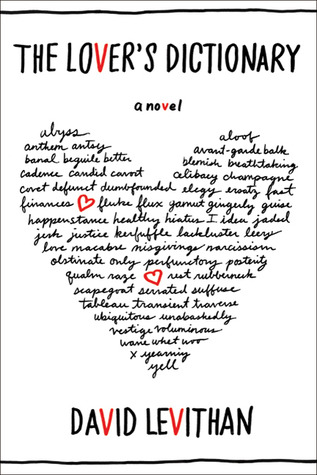
The Lover's DictionaryI’m so glad that I finally picked up a copy of this remarkable book — one of the few remaining books by David Levithan that I had yet to read.

David Levithan is the supremely talented author of incredibly fine works of young adult fiction, as well as an editorial director at Scholastic. But in The Lover’s Dictionary, David Levithan does something completely different: He writes for grown-ups.

To be clear: The Lover’s Dictionary isn’t a YA book that adults will also love. It is a mature look at adult love, and it is astounding.

Am I gushing yet? Because I feel like I’m gushing.

This is a novel, but the title doesn’t lie: It is a novel written in dictionary format. Each page contains an entry — at the least a few lines, at the most a page or two — going from A to Z, offering a word and its part of speech, followed by simply sensational definitions.

From aberrant to zenith, The Lover’s Dictionary tells the story of a relationship, not in chronological order, but in alphabetical order.

The two main characters remained unnamed. All we know is that this man and this woman meet online, begin dating, fall in love, live together, and then deal with what living together and loving together really means.

It’s beautiful and it’s unpredictable. It’s also disturbing and even heartbreaking.

Because the book is written alphabetically, there’s a strange sense of dislocation and confusion throughout. Wait, she cheated? When, exactly? Oh, they had a beautiful day in the park. But was that before or after? When they talk about having hope, are they in the early days, or the days that might possibly be too late?

But isn’t real life full of dislocation and confusion? Real relationships don’t evolve along a timeline, nicely following an outline like the tidy plot of a movie. There are ups and downs, reversals and collapses, leaps forward, near misses. It doesn’t have to go in order to make sense.

What we the readers are left with is a story of two people who seem to love each other intensely, but who also occasionally irritate each other and hurt each other and wish the other person would change, either a lot or a little.

Little snippets of the relationship just feel so real:

belittle, v.

No, I don’t listen to the weather in the morning. No, I don’t keep track of what I spend. No, it hadn’t occurred to me that the Q train would have been much faster. But every time you give me that look, it doesn’t make me want to live up to your standards.

Who hasn’t had these types of highs and lows, even in the same day, in a long-term relationship:

commonplace, adj.

It swings both ways, really.

I’ll see your hat on the table and I’ll feel such longing for you, even if you’re only in the other room. If I know you aren’t looking, I’ll hold the green wool up to my face, inhale that echo of your shampoo and the cold air from outside.

But then I’ll walk into the bathroom and find you’ve forgotten to put the cap back on the toothpaste again, and it will be this splinter that I just keep stepping on.

David Levithan knows words. I’ve admired his use of language in his YA novels as well, and here his verbal flourishes are on full display. He delves into the inner lives of words, twists them apart and finds their hidden selves, finds connections in the most unlikely of places. It’s beautiful to behold, even apart from the story itself, how the author turns the use of everyday language into an elevated art form.

Meanwhile, the story itself is gritty and often sad, yet has moments of real romance, humor and beauty. Interestingly, it’s The Lover’s Dictionary, not The Lovers’ Dictionary. That apostrophe placement makes a big difference. The male narrator is a writer, and this is his record of the relationship. Is he building a case? Is he writing a love letter? Is this a memory or a real-time journal? We don’t know. We don’t see both sides of the story. We just see him, with his devotion and his exasperation, addressing his thoughts to her, with hope and with love.

It’s one of the most unusual books I’ve ever read, but it truly works.

And now I really am gushing.

Clearly, I love this book. It’s not long (211 pages in the hardcover edition), but it’s no more than a reading session of an hour or two, given the white spaces and breathing room around each dictionary entry. Don’t rush, though. Because it’s not chronological, much is open to interpretation. Was this referring to that? Or maybe to that one there? So savor, enjoy the language, puzzle out the connections in time, and then maybe flip back through one more time to see if you still think the same events occurred in the same order, for the same reasons and with the same outcomes. I know I changed my mind a few times along the way.

A final note: If you haven’t had the pleasure, don’t miss out on David Levithan’s young adult novels. His gift for language and his commitment to getting to the essence of communications shine through in everything he writes. If you’re interested, check out my reviews of some of his other books:

Nick & Norah’s Infinite Playlist
(co-authored with Rachel Cohn)
Every Day
Two Boys Kissing

_________________________________________

The details:

Title: The Lover’s Dictionary
Author: David Levithan
Publisher: Farrar, Straus and Giroux
Publication date: 2011
Genre: Adult fiction
Source: Library

Book Review: The Thinking Woman’s Guide To Real Magic Emily Croy Barker

Book Review: The Thinking Woman’s Guide To Real Magic by Emily Croy Barker

16158565I’ll admit right off that I was predisposed to like this book. I mean, is that an awesome title or what?

So what’s it all about? In The Thinking Woman’s Guide to Real Magic, we meet main character Nora, who is a stuck-in-a-rut grad student at the start of the book. Her dissertation is not going well, she’s been dumped by her boyfriend, and to top it all off, he has the nerve to show up at the weekend wedding she’s attending up in the mountains. Peeved and fed up, Nora sets off on an early-morning walk and gets lost. Really lost.

She doesn’t realize it for quite some time, but Nora has wandered into another world. Here, at the beginning at least, everything is beautiful and serene. Nora finds herself within the walls of a glamorous estate owned by the elegant, enigmatic Ilissa, who takes an immediate shine to Nora and convinces her to stay just a bit longer. Everything in Ilissa’s world is beautiful. The people are gorgeous and fashionable, there is a party every night, and Nora is, much to her own surprise, the belle of the ball. Everyone wants to know her, to dance with her, to talk to her. It’s all just too perfect to believe — and yet Nora does believes it all. But before long, an uglier side comes to light, and eventually Nora grasps at the help offered her by a stranger in order to be rescued from Ilissa’s clutches.

Once rescued, Nora finds herself in the castle belonging to Aruendiel, a famed and mysterious magician, who removes layers of enchantments from Nora and heals her physical wounds as well. As it turns out, Nora had been in the clutches of the Faitoren, a powerfully magical people who are imprisoned in their own lands by magical treaties and wards, and whose queen, Ilissa, wants desperately to break free. Nora finds shelter with Aruendiel, and eventually convinces him to begin teaching her magic — real magic, involving working complex spells in harmony with the elements, as opposed to lower-level wizardry, which relies upon calling upon spirits and demons, and carries much less status and power.

From there, we see Nora progress in her magic lessons, accompany Aruendil to court and socialize with the upper crust, and get involved in a daring rescue and a land battle, among other escapades. Along the way, Nora’s relationship with the prickly Aruendil develops beyond pupil/master to something more complex, involving respect, honesty, and perhaps even… love?

Enough with the summary! Let’s get down to business. Here’s what worked especially well for me:

Nora herself is a nice, refreshing main character: a smart woman with a mind of her own, who wants to feel purposeful and respected, and demands to be treated with consideration. It’s disconcerting to see how far from herself Nora ends up while under enchantment; even before she realizes that something is wrong, we can tell simply by how mindless she seems, reflecting only on the sparkly clothes and jewels and adornments of Ilissa’s world, never seeing beyond the surface of the endless fun.

I liked the magic lessons very much, which make it clear that in this world, magic is a science. There are scholarly papers and research to be studied — it’s as much an intellectual pursuit as a question of mysterious powers or tricks.

The author makes nice use of literary references, sprinkling quotes and passages throughout Nora’s thoughts — as is appropriate for an English literature Ph.D. candidate! As Nora works on translating a copy of Pride and Prejudice into the language of her new world, it’s a nice to way to set up the not-too-obvious parallels between P&P and Nora’s own current situation, coming close but not quite crossing the line into heavy-handedness.

A few things worked less well for me:

For one, this is a long book — much longer than necessary, in my opinion. At 563 pages, the book has a lot of what felt like filler to me, particularly the sections focusing on Nora’s daily chores, life in the village, etc. There’s a lot of detail, and a lot happens, but as a whole, it probably should have been leaner and tighter.

Nora stumbles into this new and strange world — but it’s really not so strange for anyone who’s read any other works of fantasy. The world in which Nora finds herself seems like a pretty standard medieval setting. There are lords and manors, negotiated marriages in order to form alliances and control estates, court gossip and shenanigans, knights and battles. It’s entertaining to read about, but there was nothing that felt particularly new. It wasn’t hard to predict the rumors that would surround Nora’s sheltering with Aruendiel, the breaches of protocol that would ensue when Nora felt the need to be entrepreneurial, or the social niceties that must be observed at all times.

Finally — shoot me now! — there was no ending! There was nothing to indicate that this book is the first in a series, but the ending was so entirely open-ended that I can only imagine that a sequel, or several sequels, must be in the works. As I’ve complained many a time, I really can’t stand reading a book that’s to be continued without knowing up front that that’s what I’m getting involved in. This book ends with the closing of a chapter in Nora’s story, but makes it clear that there’s more to come, and much to be revealed and resolved. And honestly, I felt a bit cheated to have read such a big book and then not get closure at the end.

Still, all that being said, I enjoyed The Thinking Woman’s Guide to Real Magic very much. There’s some lovely writing here, with moments of insight as well as humor. A few choice examples:

In all the stories in literature and mythology about women being offered as tribute to beasts or monsters, no one ever spelled out exactly what that meant, or what it might be like for the woman afterward.

Or on a lighter note:

“I worked as a cook, a couple of years ago,” Nora said. “Before I was, um, a fairy princess.”

“Ah,” said Mrs. Toristel, as though this were a well-established career progression.

And finally:

There was her low-grade obsession with Aruendiel. Nora had given up calling it a crush; it had lost some of its urgency, and it seemed indecorous now that he was officially her teacher. (Even across the worlds, she felt the invisible constraints of the sexual harassment policy of the Graduate College of Arts and Sciences.)

Despite my quibbles, I do recommend this book. It’s a treat to read about fantasy worlds from the perspective of a very smart, very strong woman. I very much enjoyed Nora’s fight to find a place for herself and her refusal to accept the subservient role that seems to be all that’s available to her in this new and strange world. Assuming there really is a sequel in the works, I look forward to seeing what happens next, knowing that Nora’s adventures have only just begun.

_________________________________________

The details:

Title: The Thinking Woman’s Guide To Real Magic
Author: Emily Croy Barker
Publisher: Pamela Dorman Books
Publication date: 2013
Genre: Adult/Fantasy
Source: Review copy courtesy of the publisher via NetGalley