Book Review: Summer of Lost and Found by Rebecca Behrens

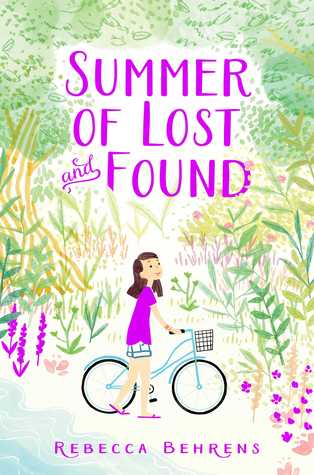
Summer of Lost and FoundSynopsis:

(via Goodreads)

Nell Dare expected to spend her summer vacation hanging out with her friends in New York City. That is, until her botanist mom dragged her all the way to Roanoke Island for a research trip. To make matters worse, her father suddenly and mysteriously leaves town, leaving no explanation or clues as to where he went—or why.

While Nell misses the city—and her dad—a ton, it doesn’t take long for her to become enthralled with the mysteries of Roanoke and its lost colony. And when Nell meets Ambrose—an equally curious historical reenactor—they start exploring for clues as to what really happened to the lost colonists. As Nell and Ambrose’s discoveries of tantalizing evidence mount, mysterious things begin to happen—like artifacts disappearing. And someone—or something—is keeping watch over their quest for answers.

It looks like Nell will get the adventurous summer she was hoping for, and she will discover secrets not only about Roanoke, but about herself.

My thoughts:

Such fun! This is a perfect summer book – particularly if you’re looking for something to tuck into a middle-grade reader’s suitcase on the way to a family vacation. I picture reading this one on a blanket on the beach, in between dips in the ocean, maybe while munching on watermelon slices…

Nell Dare is a terrific main character. She’s a city girl through and through, and can’t think of anything more perfect than spending the summer in Manhattan with her best friend. When her dad takes off and her mother forces her to spend time on a weird island to help with research about an old vine, things are definitely not going as planned.

Nell becomes enthralled by the mysteries of Roanoke Island, famous for its lost colonists — the early settlers in the late 1500s who disappeared without a trace, a mystery unsolved to this day. Nell makes a “frenemy” of another girl her age, Lila, who’s also determined to get to the bottom of the lost colony. The race is on! Nell pursues clues with the help of a charming but slightly odd boy, learning her way around the island — but also learning how to get along without subways or taxis, enjoying the forests and dunes and learning the fine art of traveling by bicycle.

There’s a lot of heart in the story, as Nell’s summer is spent worrying about her father’s disappearance and what it means. Neither parent will tell her straight out, so Nell is left to guess and feel bad. She worries too that her best friend back in New York will replace her while she’s gone, and the speed at which texts are answered become talismans for the state of their friendship.

Finally, Nell learns a lot about finding a direction and charting her own path, asking for answers, and sticking things out.

But that’s true, right? Sometimes it’s the places we think we know the best that hold the most secrets: our streets, our backyards, and even our homes.

Nell’s summer adventure, investigating the mysteries of Roanoke, ultimately allows her to find out more about herself and her family. Along the way, she explores friendship and loneliness, and figures out that she needs to stand up and makes things happen herself.

Summer of Lost and Found is a charming middle-grade novel about a summer of discoveries — discoveries about the past, about things that are lost, and about commitment and family. Highly recommended for moms and daughters — this would make a great summer book to share!

Interested in this author? Check out my review of her previous novel, When Audrey Met Alice.

_________________________________________

The details:

Title: Summer of Lost and Found
Author: Rebecca Behrens
Publisher: Aladdin
Publication date: May 24, 2016
Length: 288 pages
Genre: Middle grade fiction
Source: Review copy courtesy of Simon & Schuster Children’s Publishing

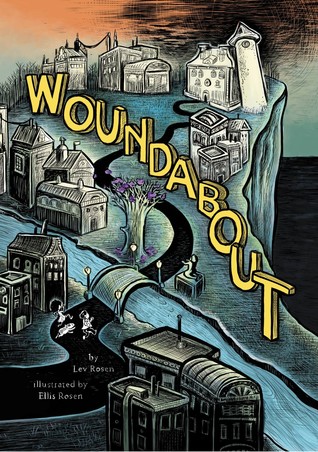
Middle Grade Fiction: Woundabout by Lev Rosen

woundabout


Synopsis:

(via Goodreads)

Welcome to Woundabout, where routine rules and change is feared. But transformation is in the wind….

In the wake of tragedy, siblings Connor and Cordelia and their pet capybara are sent to the precariously perched town of Woundabout to live with their eccentric aunt. Woundabout is a place where the mayor has declared that routine rules above all, and no one is allowed to ask questions–because they should already know the answers.

But Connor and Cordelia can’t help their curiosity when they discover a mysterious crank that fits into certain parts of the town, and by winding the crank, places are transformed into something beautiful. When the townspeople see this transformation, they don’t see beauty–they only see change. And change, the mayor says, is something to fear. With the mayor hot on their trail, can Connor and Cordelia find a way to wind Woundabout back to life?


My Thoughts:

I can’t say enough about this wonderful middle grade novel! Woundabout is the touching — yet not heavy — story of orphaned siblings Connor and Cordelia, who go to live with their aunt Marigold in the very weird town of Woundabout after the death of their parents. Woundabout is a strange, strange place, under the firm control of a dictatorial mayor who hates questions and any deviation from routine. The park is brown and dried up, the river barely flows, and wind constantly buffets the cliffs of the town. Connor and Cordelia, still reeling from their loss, have to adjust to their new lives, and decide to figure out the mysteries of Woundabout, both as diversion and to see if they can somehow find a place for themselves.

The writing is wonderful. There’s humor and a light touch, even on the darkest of subjects. I love the portrayal of Connor and Cordelia (ages 11 and 9), who are tightly bonded, yet each have their own personality and interests. There’s a recurring theme in the writing that takes shared moments and shows how each child sees it:

When the meal was finished, as she had promised, Aunt Marigold took the children into the living room, where they sat on either side of her on a big green sofa and looked at the photos in the album on her lap. It was weird seeing their dad at their age. Connor would have said it was like X-ray vision you couldn’t turn off — seeing through buildings to the beams and metal holding them up; Cordelia would have said it was like uploading your photos to your computer and finding a whole group of pictures you didn’t take. But they both knew it was the same thing.

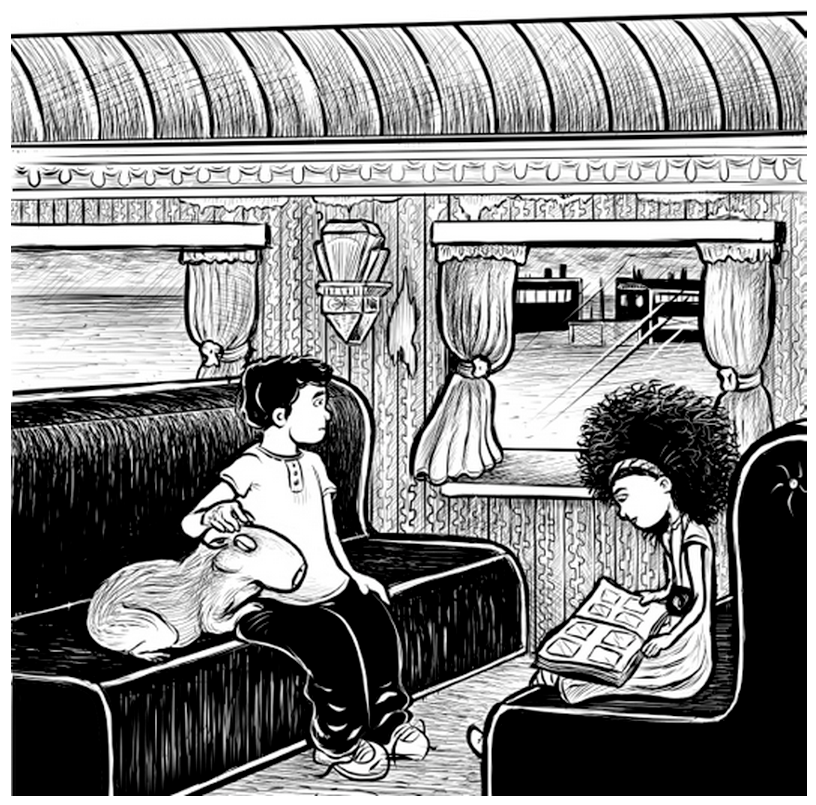
The author and illustrator, who are brothers, are clearly in sync. The marvelous black and white illustrations throughout the book are wonderfully detailed and expressive, and perfectly capture the personalities of the characters and the town.

Woundabout_Siblings_p6

Cordelia and Connor — and Kip, the capybara.

I picked up Woundabout because the author, Lev AC Rosen, has written two excellent books for adults, All Men of Genius and Depth (review), both of which I love and always end up recommending to people. How could I not read his fiction for kids as well?

Woundabout is a terrific read — whether you’re an adult who enjoys reading good children’s books for your own enjoyment, or you’re looking for a book to share with the younger folks in your life, or you want a book to give to a young reader. Woundabout strikes me as a good choice for an adult/child read-aloud, or a great book for an independent reader in the 8 – 12 age range (or so — I hate pinning a label on a book that older and younger kids would enjoy too.)

Check it out… for yourself, or for a kid you’d like to treat to a great read.

_________________________________________

The details:

Title: Woundabout
Author: Lev Rosen
Illustrator: Ellis Rosen
Publisher: Little, Brown Books for Young Readers
Publication date: June 23, 2015
Length: 288 pages
Genre: Middle grade fiction
Source: Library

Thursday Quotables: Woundabout

quotation-marks4

Welcome back to Thursday Quotables! This weekly feature is the place to highlight a great quote, line, or passage discovered during your reading each week.  Whether it’s something funny, startling, gut-wrenching, or just really beautifully written, Thursday Quotables is where my favorite lines of the week will be, and you’re invited to join in!

NEW! Thursday Quotables is now using a Linky tool! Be sure to add your link if you have a Thursday Quotables post to share.

woundabout

Woundabout by Lev AC Rosen
(published June 23, 2015)

When one of your favorite authors writes a children’s book, you read it! Woundabout is charming and a tad eccentric right from the start:

Many stories have happy beginnings. Cordelia King, age nine, and her brother, Connor King, age eleven, knew this because they had often been read those stories by their parents before bed. Stories where little girls run through fields chasing butterflies and stumble on portals to wondrous places. Stories where boys and their fathers go camping in verdant forests. Stories where everyone is happy except that they haven’t fallen in love yet, which never seemed like much to complain about to Connor and Cordelia.

Sadly, this is not one of those stories.

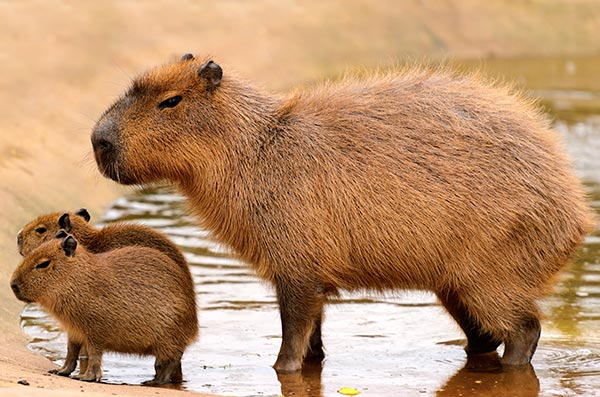
And just to make a good book even better… there are capybaras! It’s a proven fact that anything is better with capybaras in it.

capybara-family_15762686447_f9f8a0684a_o

What lines made you laugh, cry, or gasp this week? Do tell!

If you’d like to participate in Thursday Quotables, it’s really simple:

  • Write a Thursday Quotables post on your blog. Try to pick something from whatever you’re reading now. And please be sure to include a link back to Bookshelf Fantasies in your post (http://www.bookshelffantasies.com), if you’d be so kind!
  • Click on the linky button (look for the cute froggie face) below to add your link.
  • After you link up, I’d love it if you’d leave a comment about my quote for this week.
  • Be sure to visit other linked blogs to view their Thursday Quotables, and have fun!

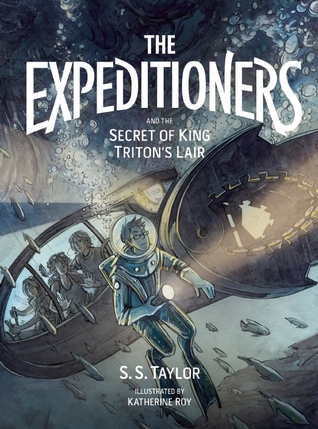
Book Review: The Expeditioners and the Secret of King Triton’s Lair by S. S. Taylor

expedBefore I actually talk about this book, can I just say how exciting it is to finally win a Goodreads First Reads giveaway? Thank you, Goodreads, and thank you, McSweeney’s McMullens! It’s quite a treat to win a book that I would have been eager to read no matter what.

The Expeditioners and the Secret of King Triton’s Lair is the 2nd book in the terrific Expeditioners series, and frankly, I can’t wait for more! Back in 2013, I reviewed the first book, The Expeditioners and the Treasure of Drowned Man’s Canyon, and I was so happy to get book #2 without too huge a wait in between volumes.

The Expeditioners books are set in a steampunk-ish world, where computers have been proven to be failures, travel is steam-driven, and the world that we know turns out to be missing quite a bit — such as all the previously unknown, secret lands. The Bureau of Newly Discovered Lands (BNDL) controls the discoveries and plunders their resources, and the most important people in the new economy may be Explorers of the Realm, who set out on expeditions of all sorts to discover the planet’s secrets, often risking life and limb.

Our main character is Kit West, a teen-aged boy whose father went missing under mysterious circumstances, leaving Kit, older brother Zander, and younger sister M.K. orphans. In the first book, Kit is given a clue left by their father, which propels the siblings on a cross-country adventure to solve the puzzles and cryptic maps strategically hidden by their father.

In the 2nd book, Kit, Zander, and M.K. are students at the Academy, a training ground for the next generation of Explorers. (Think Hogwarts, minus magic, plus gadgets and missions.) Kit is still puzzling over a new map which they found at the end of their first adventure, sure that it contains yet another lead from their father, one that may bring them closer to understanding his secrets and his disappearance. A competition to design and lead the school’s annual expedition leads the three, along with best friend Sukey and arch-nemesis Leo Nackley, to a sea voyage to the equivalent of the Bermuda Triangle. There, Kit believes the unexplainable ocean phenomenon that has led to countless shipwrecks will also reveal their father’s next clue — but Leo Nackley and his powerful father think they’ll discover oil, which in turn will allow the Realm to wage war against other empires by fueling more deadly weapons of destruction.

The Wests and Sukey end up shipwrecked, and that’s not all. The book includes submersibles, pirates, constrictor eels, telepathic turtles, Caribbean islands, and intrigues and conspiracies galore. There’s also a smattering (but not too much) of teen angst, as Kit’s crush on his close friend Sukey turns to hurt and anger when she seems to fall for Zander instead.

One thing I love about the Expeditioners books is how smart and gifted the characters are. Kit is a cartography expert, Zander studies biology and wildlife, M.K., the youngest of the family, is a marvel when it comes to engineering, and Sukey is a talented aviator. Girls are just as strong and competent as the boys, and just as likely to wield a sword against dangerous pirates or fight off a new enemy with an amazing piece of technology. Kit and the gang use their wits to survive and outsmart their opponents, but they never have it easy and nothing comes without new risk.

Black and white illustrations by Katherine Roy enhance the story’s flow and add greatly to the sense of the characters and their world. The inside of the dust cover includes schematics for M.K.’s submersible, and there are maps and old journal pages sprinkled throughout as well.

The action never stops, and while it’s occasionally a chore to keep straight the various government agencies and the geopolitical factions, the main thrust of the story is the West kids and their quest to follow their father’s clues. By the end of this book, there are cracks forming in the siblings’ unwavering commitment to their quest, however, and Kit and his family seem about to be heading off in different directions, scattered by their new assignments and moving forward separately instead of as a team.

Expeditioners #2 (sorry, that’s a lot easier than typing out the full title) has an open-ended conclusion, clearly laying the groundwork for more to come. From what I’ve seen mentioned on a few websites, The Expeditioners is expected to be a six-part series, which means there’s plenty of excitement ahead.

I highly recommend this series for anyone who enjoys kids’ adventure tales — and that includes grown-ups too! My 12-year-old and I made this a joint reading project, and we both loved it. I can see The Expeditioners appealing to Harry Potter fans as well as fans of Philip Pullman’s His Dark Materials trilogy… and as a fan of both, I don’t say that lightly. The Expeditioners has a rich and unusual world for its super-smart and super-engaging characters to explore. I can’t wait to see what’s next!

Want to know more? Check out my review of the first book in the series, and also this great Q&A with author S. S. Taylor.

__________________________________________

The details:

Title: The Expeditioners and the Secret of King Triton’s Lair
Author: S. S. Taylor; illustrated by Katherine Roy
Publisher: McSweeney’s McMullens
Publication date: September 23, 2014
Length: 320 pages
Genre: Children’s fiction (upper middle grade; per Amazon, ages 10 and up)
Source: Goodreads First Reads (I finally won something!)

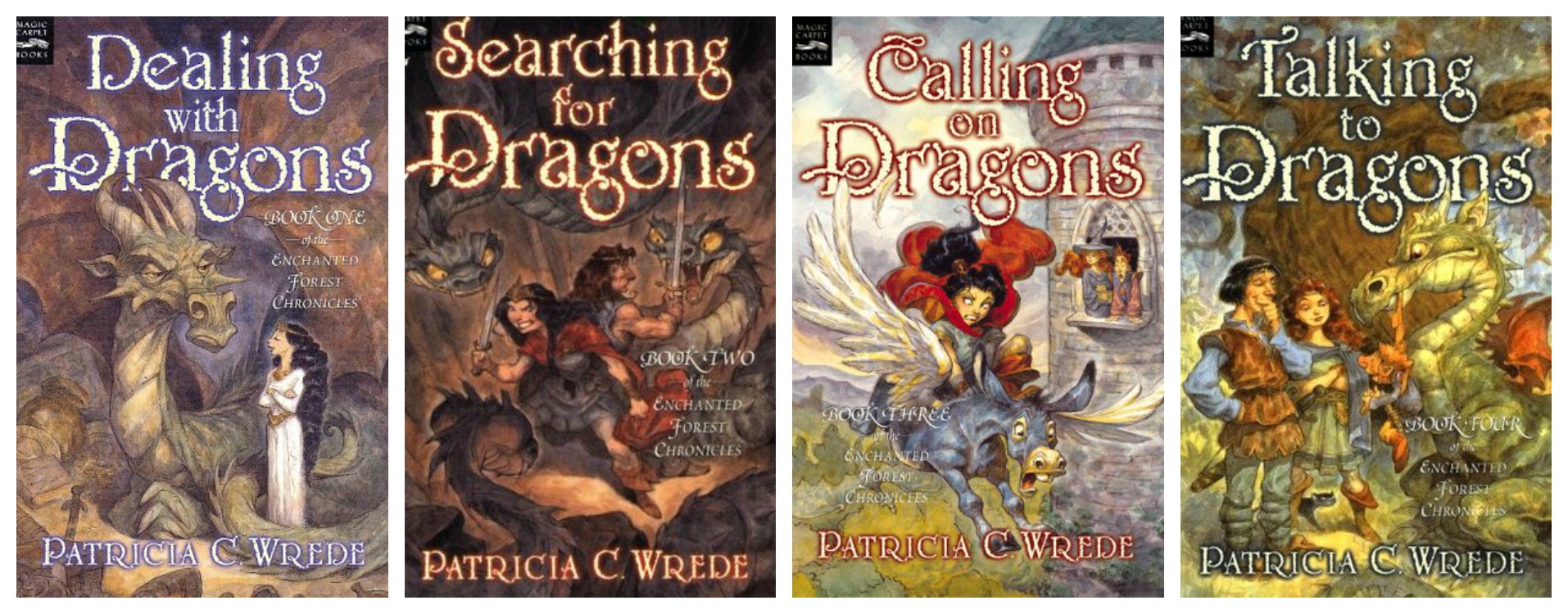
Series Wrap-Up: The Enchanted Forest Chronicles by Patricia C. Wrede

Enchanted Forest collage

The Enchanted Forest Chronicles by Patricia C. Wrede encompasses four novels set in one world — and be warned ahead of time: Your enjoyment of this series is by no means guaranteed just because you liked the first book. Each book is quite different, and that’s not necessarily a good thing.

First things first: If we were only talking about book #1, Dealing with Dragons, my enthusiasm would be much higher. In Dealing with Dragons, we meet Cimorene, a princess who doesn’t want the typical Happily Ever After with a handsome prince, fine gowns, and a kingdom to be pampered in. So Cimorene runs away and finds herself a large dragon, Kazul, who just so happens to need a princess of her own. In this world, princesses serve dragons — some willingly, some not so much — usually until they are rescued by a brave knight who comes to free them from “captivity”. Cimorene has no patience for such nonsense, and soon finds herself an indispensable assistant to Kazul, keeping house, observing dragon politics, learning about magic, and warding off dangerous wizards who want to steal the dragon’s magic. The book breaks gender roles in all sorts of interesting and unusual ways; my favorite is that the leader of the dragons is called King, which denotes a position, not a person. Kazul is a female dragon, but is still able to vie for the position of King…. and woe to anyone who mistakenly refers to her as the Queen.

Unfortunately, in my view, the focus shifts from book to book. Dealing with Dragons is the only book of the series I rated as 5 stars on Goodreads. I loved Cimorene’s courage and brains, the clever wordplay, and the way Cimorene defies expectations to become the person she wants to be. But suddenly, in book #2 (Searching for Dragons), Cimorene is a supporting player, and instead, the story is told from the point of view of Mendanbar, the reluctant king of the Enchanted Forest. Mendanbar’s story intersects with Cimorene’s as they go on a quest together to find out who is draining magic out of the Enchanted Forest and to rescue the kidnapped Kazul. Mendanbar and Cimorene have good chemistry, and Mendanbar is a fine leading man, but unfortunately, the zippiness of Cimorene’s grrrl power is a bit more subdued here.

In Book #3 (Calling on Dragons), we barely see our familiar characters at all, as the focus shifts once again, this time to the witch Morwen, a supporting player in the earlier books. I came close to abandoning the series altogether early on in this book. True confession: I have a dislike for talking animals, particularly when there’s an overabundance of them — and this book has more than enough to go around. Within the first few chapters, we meet all twelve of Morwen’s cats, each of whom has a name and a distinct personality and contributes to conversation, as well as a bewitched bunny named Killer who transforms first into a six-foot-tall bunny and eventually into a blue, winged, flying donkey. Killer is meant to be the comic relief, but is more annoying than funny most of the time. There’s a quest and an adventure that ends up involving Cimorene and Mendanbar, but they’re quite peripheral. The magical adventure aspects of the book become more enjoyable by the end, but there’s a lot of space taken up by new characters, odd magical rules, and never-ending journeying.

And then we come to the final book, Talking to Dragons, in which there’s a brand-new main character, Daystar, who must travel into the Enchanted Forest and figure out for himself what the purpose of his quest is. There he meets a temperamental young fire-witch named Shiara — clearly there as his love interest — and encounters talking lizards, elves, dragons, and dwarves before arriving at a climactic battle scene. I won’t tell you how Daystar’s story intersects with the characters from the earlier books (spoilers!), but they are all connected and come together for an exciting and satisfying conclusion.

As a series, the Enchanted Forest Chronicles feels a bit disjointed. The shift in main characters from book to book didn’t really appeal to  me. I suppose the intent is to broaden the scope of the world of the Enchanted Forest, but in my opinion, Cimorene and Kazul are the most interesting characters — and once they leave center stage, the story loses some of its charm. I was never bored exactly (although I was awfully close during the talking cat chapters), but I did find my attention wandering from time to time, and I found it a challenge to get into each new book, where we readers are required to leave behind the characters we’ve become fond of and start fresh with with a whole bunch of new ones.

All that said, let me now point out that I read this series in partnership with my 12-year-old son — and from that regard, I’d say the series was a success. My kiddo is a very reluctant reader, and so to encourage him, we read these books in tandem. He enjoyed the stories quite a bit, liked the action sequences involving dragons and wizards especially, and liked that there were plenty of funny scenes, humorous dialogue, and even some hints of danger (nothing too life-threatening, but still risky business).

Bottom line: While the Enchanted Forest Chronicles doesn’t strike me as strong enough to really hold adult attention, I do think it’s a great choice for middle grade readers, either to read on their own or as a very fun parent-kiddo reading partnership. And as an alternative for those who aren’t looking for a multi-book series or don’t like the sound of the focus changing from book to book, I think Dealing with Dragons would work perfectly well as a stand-alone. As the best of the bunch, it’s certainly a great read — and maybe if I’d stopped there, I’d have avoided the frustrations I had with the subsequent books.

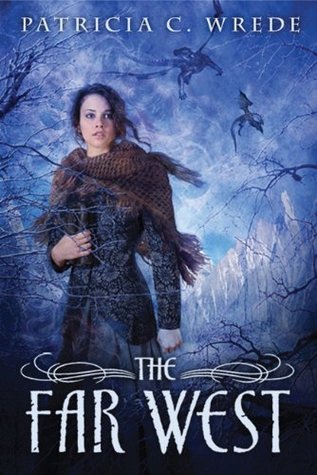
Series Wrap-Up: Frontier Magic by Patricia C. Wrede

Thirteenth Child (Frontier Magic, #1)Across the Great Barrier (Frontier Magic, #2)The Far West (Frontier Magic, #3)

The Frontier Magic trilogy by Patricia C. Wrede presents a puzzling dilemma for me as a reviewer:

On the one hand, I never doubted that I wanted to finish reading the trilogy — and even more importantly, my son remained engaged throughout, which is no small accomplishment.

On the other hand, these books contain certain problematic pieces that remain consistent across all three books.

Is it contradictory to say that I wouldn’t rate this series any higher than three stars, and at the same time state that I mostly enjoyed it all?

In Frontier Magic, we view an alternate America (known here as Columbia) through the eyes of Eff. Eff is one of twins, and is the family’s thirteenth child, in a society which believes that the 13th child will be full of bad magic. Because, yes, in the world of Frontier Magic, magic is part of the every day fabric of life. Magic is an advanced scientific field of study in the academic world, and even mundane tasks are routinely done by means of magic. In this tale of westward exploration and discovery, the civilized world stops at the Mammoth River (think Mississippi), and all land east of the river is protected by the Great Barrier Spell, which keeps out dangerous creatures like steam dragons and medusa lizards. Yet exploration of the West beckons, and expeditions regularly set out across the river, some never to return.

I wrote quite a bit about my reaction to the first book in the series, Thirteenth Child, in my review here. And the same issues that I had with the first book continue into the second. As I wrote on Goodreads about Across the Great Barrier:

Book #2 in the Frontier Magic series continues — for good and for not-so-good — along the same path as the first book, Thirteenth Child.

On the plus side, we continue to explore this alternate history of the United States, in which magic is commonplace and an actual necessity. The challenges and adventure of living life on the frontier are still here, and main character Eff is still pursuing her own non-standard magical skills.

On the negative side, the same problems that detract from the overall success of the first book are still present. The magical systems are overly complicated, so that it’s never quite clear what’s happening, and the solutions and big confrontations are so full of this jargon-heavy magical hoo-ha that it’s hard to tell who did what or why. Eff should be a powerful character, but she never really comes into her own. That is, she clearly has talents that are rare, but she doesn’t get to do a whole lot with them. She’s always just a part of, not the lead actor — she assists a professor, she participates in expeditions, she’s on the team when danger strikes — but she never is out in front, making decisions and standing out. Finally, the plot suffers from odd pacing. Many of the chapters (as in the first book) have time jumps that basically say, well, for the rest of that year, not much happened, or for the next few months, I kept doing my job. There’s a lot of summarizing, with action sequences popping up occasionally, but overall there’s a static feeling, as if the whole plot was being described in synopsis rather than actually taking place.

The Frontier Magic series thus far strikes me as a very interesting idea without the execution to fully back it up.

As for book #3, my feelings are pretty much the same. There’s further adventure, and Eff, now in her early 20s, finally comes into own in terms of flexing her magical powers and being recognized as having unique talents. She’s invited to participate in the most far-reaching expedition yet, and the group’s travels are full of danger and excitement. And yet, the same issues that plague the earlier books show up here as well. Nothing ever feels terribly urgent, despite the fact that a lot does actually happen. Events are described in a way that feels very episodic, and the point-of-view has a distant to feel to it. Eff narrates all that happens, and her voice simply isn’t particularly distinct. We never do really get a full picture of what Eff is capable of, although we do see her pretty much save the day.

The most serious problem, for me, is that the magical systems are fairly incomprehensible. We get long passages describing how Eff uses her magic to save the expedition (and perhaps civilization as a whole) — but it’s practically impossible to envision what she and the others are actually doing or how any of their magic truly works.

There’s quite a bit of outrage expressed in the reviews on Goodreads and elsewhere over the absence of a native population in the world of Frontier Magic. Others have gone into great detail on this issue; I don’t need to repeat them. Suffice it to say that the books are controversial because of this omission, and if you want to know more, there’s quite a lot written elsewhere on the topic.

Approaching these books, then, purely as an adventure tale and leaving aside the social commentary, I find myself back where I started. Unmitigated success? No. But enjoyable and engaging? Yes.

Even when my own attention wandered from time to time, my son remained interested throughout. Neither of us was exactly on the edge of our seats… but we still wanted to see it through and find out more. So all in all, not a bad choice for advanced middle grade readers or for adults who enjoy middle grade fiction featuring magical world-building.

Blog Tour, Guest Post, & Review: When Audrey Met Alice by Rebecca Behrens

Thank you, Sourcebooks, for inviting me to part of the blog tour celebrating the release of When Audrey Met Alice!
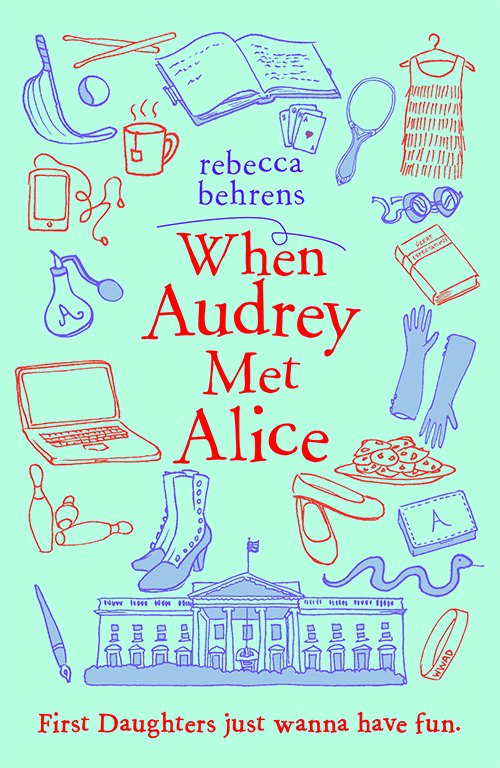
image002

WHEN AUDREY MET ALICE
By Rebecca Behrens
Sourcebooks Jabberwocky
February 2014
Ages 9 -12

First daughters just want to have fun.

Thirteen-year-old First Daughter Audrey Rhodes is convinced that living in the White House is like being permanently grounded. While her parents are off saving the world, Audrey Rhodes spends most of her time pining for friends back home, sulking about security restrictions, and suppressing the crush she’s developing on Quint, her only DC friend. After the Secret Service cancels the party she planned, Audrey is ready to give up and become a White House hermit.  What good is having your own bowling alley if you don’t have anyone to play with?

Audrey is ready to give up and spend the next four years totally friendless—until she discovers Alice Roosevelt’s hidden diary beneath the floorboards and starts asking herself…What Would Alice Do? But not everyone is on board with Audrey’s attempts to be more like Alice—especially not her mother’s super-stern Chief of Staff. Will meeting Alice bring Audrey happiness—like the freedom to attend the school trip and possibly a First Boyfriend—or a host of new problems?

The former First Daughter’s outrageous antics give Audrey a ton of ideas for having fun…and get her into more trouble than she can handle. A fun, smart middle grade debut that brings a fascinating historical character to vibrant life and showcases relatable tween issues like fitting in, first crushes, and finding your own way, the White House hijinks of these First Daughters is a story readers won’t want to miss!

I’m thrilled to be participating in the blog tour for this terrific new book aimed at middle grade readers! Author Rebecca Behrens was kind enough to share her thoughts on a question I posed:

What would Alice find most confusing about the lives of girls in the 21st century?

Here’s Rebecca’s response:

Photo from Wikipedia: Roosevelt family in 1903 with Quentin on the left, TR, Ted, Jr., “Archie”, Alice, Kermit, Edith, and Ethel.

It’s only been a little over a century since Alice Roosevelt moved into the White House and became perhaps the most famous girl of the turn of the century. But how times have changed! What would Alice find most confusing about the lives of girls in the 21st century?

Alice lived at a time when girls weren’t allowed to go out with dates, and they had to have chaperones even at dances. According to Alice, “There were always watchful eyes to check on one. Woe betide the girl who emerged from the conservatory at a dance with her hair slightly disheveled. As one’s hair tended to fall down at the best of times it was frightfully difficult trying to keep up appearances.” Alice would be surprised by the dating girls do today—but I think she’d consider it a great thing. From an early age, Alice was fixated on finding a husband, because that was her ticket out of her parents’ home and into the world. If she watched a show like Girls, I think she’d be amazed (and occasionally shocked) at the romantic lives of young women. But she would love how young women can live independently, and how much agency they have in their romantic lives.

Athletics for young women weren’t common in Alice’s youth. She had fun roughhousing with her siblings, swimming, and she reportedly did some yoga—but girls didn’t play on soccer teams or run track. I think Alice would be shocked by all of the athletic opportunities for girls today. Considering what a vivacious person she was—and competitive—Alice would want to start competing, too.

Alice roosevelt color 3.jpg

Photo from Wikipedia: Alice Lee Roosevelt, hand-tinted photograph taken approximately 1903

Considering how strict and modest social standards for clothing were at the turn of the century, Alice would probably find some recent fashion trends bizarre. “Buttoned-up” was the style, literally—Alice wasn’t allowed to visit a friend’s home anymore after that girl emerged from a car with a couple buttons undone! Jeggings and flip flops would seem very revealing and casual to Alice. Clothes in Alice’s time were meant to be lasting and beautiful. Alice wouldn’t know what to think about ironic fashion choices, like trucker hats or grandpa sweaters—anything that wasn’t meant to last and impress would seem like a waste of money. But I think Alice would always understand when someone uses clothing to make a statement, like Miley Cyrus or Lady Gaga. After all, Alice herself was an early fashion icon—the most popular dress color when she lived in the White House was “Alice Blue,” after the shade of her eyes—and she loved the attention that brought.

Alice once said of her beloved Auntie Bye that if Bye had been a man, she would have been president, not her brother Theodore. At the turn of the century, there were very limited opportunities for women in politics and government—women couldn’t even vote yet! I think Alice would be surprised and thrilled about the number of female lawmakers today.

Finally, when Alice was a teenager, part of her fame came from her sharp wit and her willingness to be outspoken. Most of her peers were seen and not heard. I think Alice would find the many ways that girls can make their voices heard today—online and off—a little confusing, and a lot refreshing.

My thoughts:

When Audrey Met Alice is such a delight! The author does a wonderful job of weaving together a modern girl’s life and the diary of Alice Roosevelt, making both pieces of the story equally engaging and charming. Audrey is a bright, friendly 8th-grader who loves her parents, but she’s isolated from peers and even from her mom and dad once they move into “1600”. Hurray for progress — it’s Audrey’s mom who is President, and her dad — in addition to “First Gent” responsibilities — is a scientist whose research is intense and time-consuming. It’s hard to find time to just chill as a family when you’re busy running the country and trying to cure cancer — but that means that Audrey is left to wander the halls and miss her old life. Sure, the kids at her new school seem friendly at first — but do they like her for herself, or do they just want the glamor of hanging out with the First Daughter?

When Audrey stumbles across a hidden diary belonging to Teddy Roosevelt’s outspoken daughter Alice, Audrey finds inspiration both for improving her own life — and for getting into even further mischief. Alice wants to help her father and be a part of his world, but she also craves adventure and excitement, and she’s not one to listen just because she’s told to behave a certain way. As Audrey reads in Alice’s diary:

… my father simply said, “I can either run the country or I can control Alice, but I can’t possibly do both.”

Audrey’s scrapes may seem tame in comparison to some of Alice’s more out-there escapades (such as wearing a green garter snake around her neck at state dinners or being photographed betting on horses at a time when girls did not do such things), but then again, Alice didn’t have non-stop Secret Service protection, sneaky paparazzi, and ubiquitous social media scrutiny to contend with.

Alice preaches the mantra of “To Thine Own Self Be True”, and proclaims that she is someone who wants to “eat up the world”. As the book progresses, Audrey starts to think in terms of WWAD? — What Would Alice Do? — and becomes determined to find a way to be a good daughter and at the same time make a difference and be true to herself.

My review in short? I loved this book! Audrey is an easy-to-relate-to main character. She has the same hopes, fears, and worries as a typical girl her age — but as the President’s daughter, she has to deal with middle-school drama with Secret Service agents at her side and state protocol officials looking over her shoulder. Audrey narrates with humor and self-awareness; she’s not faultless, and she knows when she messes up — but she means well, and it’s fun to see her apply her WWAD philosophy in ways that are surprising, funny, and with decidedly unpredictable outcomes.

I highly recommend When Audrey Met Alice. I think this would be a terrific read for middle school and young high school students. It’s well-written and a lot of fun — and might even inspire a girl or two to think more about the power of girls to change the world!

____________________________________________

For more information, visit the Sourcebooks page for When Audrey Met Alice, where you’ll find additional resources about the real Alice Roosevelt, including downloadable material for kids and for educators,

About the Author:

Rebecca Behrens grew up in Wisconsin, studied in Chicago, and now lives with her husband in New York City, where she works as a production editor for children’s books. She loves writing and reading about girls full of moxie and places full of history. When Audrey Met Alice is her first book. Visit her online at www.rebeccabehrens.com.
Book Review: Ophelia and the Marvelous Boy by Karen Foxlee

Book Review: Ophelia and the Marvelous Boy by Karen Foxlee

Ophelia and the Marvelous Boy

In this magical story for young independent readers, Ophelia and her sister Alice have accompanied their father to a strange, wintry city where he’s been hired last-minute to curate a sword exhibition at a museum. The girls’ mother has died just months before, and it’s clear that the girls and their father have all been somewhat lost since then.

When Ophelia wanders off to explore the museum, she finds a boy locked in a hidden room, who tells her a tale of a magical mission involving a lost sword, the Winter Queen, herald trees, and a protectorate of wizards. Ophelia is a scientific and logical girl, and can’t bring herself to believe the boy’s story. But her innate compassion, bolstered by her imaginings of her mother’s voice in her ear, bring her to dedicate herself to helping the boy.

Ophelia isn’t a typical heroine. She wears glasses that are always smudgy, and has to stop for quick puffs from her asthma inhaler whenever things get too exciting. Still, she has a big heart and avid curiosity, and so she keeps pushing herself to explore, to collect the clues hidden throughout the museum, and to find a way around the beautiful but menacing museum director.

Ophelia and the Marvelous Boy is a fantasy adventure set in the modern world, with magic embedded in a city full of people going about their business and not prone toward belief in evil queens or sinister spells. There are some wonderful touches: a portrait gallery of glum-looking girls sets an ominous tone, galleries of everything you could imagine which seem to change every time Ophelia passes by, museum guards who sit and knit all day until falling asleep, and an older sister who gives up her jeans and t-shirts for a mysterious beauty treatment.

I’m not sure that the climax and resolution of the book necessarily make sense, but it doesn’t really matter. Ophelia is a lovely main character, showing unexpected strength as she pushes herself beyond her normal limits. As Ophelia and her family finally face the danger in the museum, they also finally come to terms with the loss that they’ve suffered and take the first tentative steps toward healing and finding a way forward without their mother.

There are some wonderful magical scenes, as well as moments of danger and excitement. This book should please middle grade readers who like action mixed with fantasy. The reading level seems appropriate for older elementary school grades, easily accessible for children confident in their independent reading abilities.

_________________________________________

The details:

Title: Ophelia and the Marvelous Boy
Author: Karen Foxlee
Publisher: Knopf Books for Young Readers
Publication date: January 28, 2014
Length: 240 pages
Genre: Children’s/middle grade fiction
Source: Review copy courtesy of Knopf via NetGalley

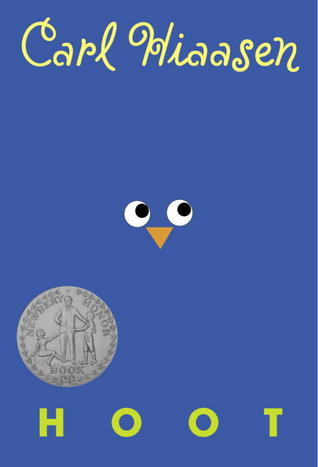
Hoot by Carl Hiaasen: A book & a movie with the kiddo

Book Review: Hoot by Carl Hiaasen

Hoot

Perhaps you’re familiar with Carl Hiaasen’s smart-ass, Florida-centric books for grown-ups — all 22 of them! — that include bestsellers such as Strip Tease, Nature Girl, Star Island, and Skinny Dip. But the way this author found his way into my heart was through his books for kids, now totaling four — and here’s hoping there are many more to come!

Hoot was Carl Hiaasen’s first book for kids, aimed at the middle school crowd and featuring some fun, fearless, and memorable characters with just enough gross-outs and goof-ball mischief to appeal to 10 to 13-year-olds. Hoot certainly appealed to my 11-year-old, who isn’t the easiest kid to please when it comes to books. (Video games are a different matter, but I digress.)

In his younger days — oh, say at age 10 — my kiddo would help me out on my blog from time to time with “Q&A with the Kiddo” posts, where I’d write about books that we’d read together, ask him questions, and then share some thoughts from each of us. Alas, now that he’s reached the ripe old age of 11, he’s no longer willing to indulge me. Luckily, though, he still enjoys a good book, and has not yet decided that he’s too old for a read-aloud at bed time. So for as long as he’ll let me, I continue reading him a chapter or two once he’s tucked in (knowing that our days of reading together are probably numbered, although I’ve told him more than once than I’ll come to college with him if he wants).

Hoot is our most recent reading adventure, and it was a big success. We’d thoroughly enjoyed the author’s most recent kids’ book, Chomp, last year (my review is here), and reading Hoot was actually the kiddo’s idea — he’d seen part of the movie at his after school program recently, and wanted to know the rest of the story.

hoot owlSo what’s it about? In a nutshell: Roy Eberhardt moves to Florida from Montana when his dad gets reassigned for work, and boy, is Roy unhappy about being the new kid all over again. After getting bullied by the meanest kid in school, he encounters a mysterious barefoot boy running down the street, and quickly becomes fascinated by figuring out who the kid is and why he’s running. Meanwhile, Mother Paula’s Pancake House is about to open a new franchise location in Roy’s small town… but someone keeps playing pranks and causing mischief at the construction site, and the Mother Paula’s people are not happy about it. The storylines come together as Roy and his new friends Beatrice Leep and Mullet Fingers try to find a way to save the rare burrowing owls who live at the construction site before the bulldozers start to roll. Hoot is filled with a host of amusing supporting characters, from the well-intentioned but bumbling Officer Delinko to construction manager Curly to the oozily nasty corporate tool Chuck E. Muckle. As the various plotlines and people converge, Carl Hiaasen doesn’t skimp on humor, pranks, or bizarre human behavior.

In both Hoot and Chomp, a dominant theme is the natural wonders of Florida and how greedy humans are encroaching on natural habitats. In both books, the author’s love for nature shines through, and the kids who are heroes are the ones who stand up and fight against the careless, thoughtless, or just plain mean grown-ups who value money over beauty. While the main characters in both books come from homes with supportive and loving parents, the author doesn’t shy away from showcasing kids who come from troubled homes or less wholesome environments. One of the things he does best is dig beneath the surface and show why a kid might be weird, or dressed funny, or be reluctant to trust or share secrets. At the same time, no mercy is shown to the bullies, whether kids or adults: The characters who mistreat others, who are mean and nasty, who like to hurt people for their own glory, or who just don’t care — well, they do tend to get what’s coming to them, and then some.

After reading the book, kiddo and I decided to watch the movie as well — and while I almost never, ever, ever sayhoot this, in this case I’ll admit to liking the movie just a smidge more than the book. The book was great, don’t get me wrong — but the movie just did a better job of showing the natural beauty of the Florida coastlines and waterways, as well as the vulnerability of the little owls (awwwww… baby owls!) being threatened by the big construction machinery. This is one instance where a picture really is worth a thousand words, because the one thing I really didn’t get from the book was enough description of the construction site and the landscape, and that made it harder to visualize the nature of the threat. The movie is mostly faithful to the book, up until the ending — where again, I have to admit that I found the movie ending a bit more exciting and dramatic than the final confrontation and big finale in the book.

The cast was very good, with a young Logan Lerman in the role of Roy, and a nice cameo by Jimmy Buffett as well. Plus, the geek in me and my kiddo (call us Mama Geek and Geek Junior, I suppose) did a little happy dance when Clark Gregg (Agent Coulson!) appeared in the sleazy role of corporate bad guy Chuck Muckle.

Should you read the book or watch the movie?

Yes to both! Why choose?

Meanwhile, I have no hesitation about recommending this author’s books for kids. Carl Hiaasen’s writing is funny and fast-paced, with strong messages about family connections, loyalty, and respect for the environment. I can pretty much guarantee that kids will love these books, and their parents will too.

_________________________________________

The details:

Title: Hoot
Author: Carl Hiaasen
Publisher: Alfred A. Knopf
Publication date: 2002
Genre: Middle grade
Source: Purchased

Book Review: The Expeditioners and the Treasure of Drowned Man’s Canyon by S. S. Taylor

Book Review: The Expeditioners and the Treasure of Drowned Man’s Canyon by S. S. Taylor

The Expeditioners and the Treasure of Drowned Man's CanyonIf you love adventurous kids, mysterious maps, hidden canyons, and steam-powered everything, you won’t want to miss The Expeditioners, the first installment in what promises to be a very exciting middle grade series.

The West kids — Zander, Kit, and MK — are the orphaned children of famous explorer Alexander West, who rose to fame and fortune exploring new lands, then died under mysterious circumstances, leaving the three kids to fend for themselves. And when I say new lands, I really mean New Lands: Several decades earlier, after computers and electricity were proven unreliable and were discarded, explorers discovered New Lands hidden amidst the lands already known. Apparently, all those earlier maps were wrong, and the globes we all rely upon are really just quaint relics. The current world includes places such as the New North Polar Sea, Fazia, and Deloia, and exploring and cartography are among the most esteemed and  sought-after vocations.

Unfortunately, the BNDL (Bureau of Newly Discovered Lands) is in control and is awfully shady. Current policy seems to be to discover resource-rich new worlds and then plunder them for all they’re worth. It’s becoming clear to the West kids that perhaps their dad wasn’t entirely pleased with BNDL’s approach — and it’s starting to seem that the feeling was mutual. The kids are being watched, and when our narrator, Kit, receives a package from a stranger in the market, it sets off a chain of events that will lead the kids into danger as well as excitement.

As The Expeditioners moves forward, Kit and his siblings, along with their new friend Sukey, daughter of a famous explorer herself, set out to solve a puzzle left behind by Alexander. Hidden maps and secret codes lead the gang to a daring escape from BNDL agents and on a mad cross-country dash toward a legendary treasure lost centuries earlier in the canyons of Arizona. The government wants the treasure too, and it’s a race to see who will find it first — if it exists at all.

I read this book with my 11-year-old (who still likes me to read to him at bedtime — hurray!). Let me just cut to the chase here — we both loved The Expeditioners.

The world-building is terrific, as we are introduced to a steampunky society in which the ability to build, tinker, and create is of utmost importance, as are big heaps of courage and a willingness to leap into the unknown. The author takes our own world and technology and spins it into something at once familiar yet completely new. There are no cars, but that’s okay: People travel by steam trains, dirigibles, even steam-powered bicycles and IronSteeds, steam-powered mechanical horses.

The West kids are all talented and honorable. Zander, the oldest at 14, is brave and protective; Kit is a budding cartographer like his dad, and little sister MK can fix anything. Along with their pilot friend Sukey, they demonstrate courage and conviction over and over again, relying on their smarts to get in and out of tight scrapes, with an absolute devotion to one another and to their mission.

A hint of preachiness creeps in when the kids begin to understand the unscrupulous dealings of BNDL and realize how poorly the indigenous populations of the new worlds are being treated. Of course, the PC-lecture tone didn’t faze my son, but I found it a bit heavy-handed.

The storyline is tightly woven and packed with action. After the initial chapters, which seemed about to bog down in exposition, the pace picks up, and we get to truly know the West kids through their adventure, seeing their initiative and daring, as well as their commitment to their father’s memory and to their family as a whole.

Black and white illustrations by Katherine Roy add to the hip feel of the book, bringing the kids to life and adding in details such as gears, clockwork, and goggles that really enhance the story.

The ending makes clear that there is more to come, as the children complete their treasure-seeking adventure and are given a fresh opportunity for new experiences in a new setting. (I’m being intentionally vague here — you won’t get spoilers out of me!) My kiddo and I are both looking forward to seeing how Zander, Kit, and MK fare along their new path, and we really can’t wait for the next Expeditioners book!

Summing it all up: The Expeditioners seems like a perfect choice for middle grade readers, and it’s smart, savvy, and hip enough that parents will enjoy it too. A decidedly different adventure story that’s full of intellectual challenges too, with brave, independent characters of both genders and a range of ages, set in a steampunky American Southwest — this book is one I could see appealing to a wide audience for years to come.

__________________________________________

The details:

Title: The Expeditioners and the Treasure of Drowned Man’s Canyon
Author: S. S. Taylor; illustrated by Katherine Roy
Publisher: McSweeney’s McMullens
Publication date: 2012
Genre: Middle grade fiction
Source: Library