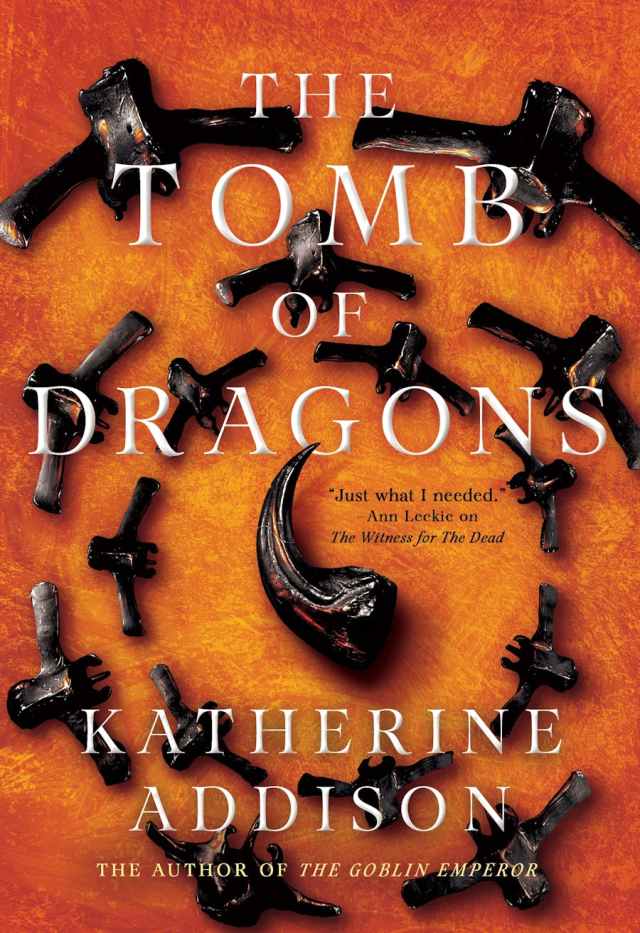
Book Review: The Tomb of Dragons by Katherine Addison

Title: The Tomb of Dragons
Author: Katherine Addison
Publisher: Tor Books
Publication date: March 11, 2025
Length: 352 pages
Genre: Fantasy
Source: Purchased (hardcover); ARC via NetGalley
Rating:

Rating: 4 out of 5.

Thara Celehar has lost his ability to speak with the dead. When that title of Witness for the Dead is gone, what defines him?

While his title may be gone, his duties are not. Celehar contends with a municipal cemetery with fifty years of secrets, the damage of a revethavar he’s terrified to remember, and a group of miners who are more than willing to trade Celehar’s life for a chance at what they feel they’re owed.

Celehar does not have to face these impossible tasks alone. Joining him are his mentee Velhiro Tomasaran, still finding her footing with the investigative nature of their job; Iäna Pel-Thenhior, his beloved opera director friend and avid supporter; and the valiant guard captain Hanu Olgarezh.

Amidst the backdrop of a murder and a brewing political uprising, Celehar must seek justice for those who cannot find it themselves under a tense political system. The repercussions of his quest are never as simple they seem, and Celehar’s own life and happiness hang in the balance.

The Tomb of Dragons is the 3rd book in author Katherine Addison’s Cemeteries of Amalo series (or the 4th book in the Chronicles of Osreth series, depending on how you look at all these inter-related books). The start of it all is the superb book The Goblin Emperor — but the three Cemeteries of Amalo books are set in the same world, which is always a great place to visit.

We first met Thara Celehar in The Goblin Emperor, and have followed him as the main character in The Witness for the Dead and The Grief of Stones. Celehar serves the god Ulis and is a witness for the dead — someone gifted with the ability to speak with the deceased and gain final words, requests, or information from them. His charge then becomes acting on behalf of the deceased, whether to bring peace to their family, settle a dispute, or seek justice for the wrongs committed against them. Celehar is an honest man who’s devoted to his work: As he reminds those who thank him, he follows his calling.

But the end of The Grief of Stones showed Celehar suffering a terrible blow, by which he loses the ability to speak with the dead. Without his calling, he lacks purpose or official status. Still, he has the favor of the top cleric in the empire, who assigns him tasks to carry out on his behalf, and manages to do good for others even when not able to pursue his calling.

The plot becomes complicated when Celehar is kidnapped and forced into a dangerous situation, which soon embroils him in a pursuit of justice that threatens to shake the foundations of the empire. We follow him on his day-to-day tasks and errands, but also on the greater mission that he takes on. The book as a whole is a mix of the mundane with more tension-filled dramatic moments. After a somewhat slow start, the pace picks up quite a bit.

Let’s be clear: You absolutely cannot start with The Tomb of Dragons and hope to get anywhere at all. This series is dense and detailed. The world-building is pretty awe-inspiring, but even the very language is a barrier to getting situated within the books’ world. I don’t think a reader coming to these books without starting with The Goblin Emperor would have the slightest chance of making it past the first page or two.

Don’t believe me?

“We are Thara Celehar, a prelate of Ulis. We have come about the revethmerai of Ulnemenee.”

Got that?

How about…

But that was nonsense. There couldn’t be such a thing as a revethvezvaishor’avar. Could there?

I could go one. From forms of address to official titles to place and ethnicity names, not to mention names of building, families, locations, and religious sects, there is just an overwhelming amount to keep track of. Because it’s been three years since the last book in the series was released, I had a very difficult time readjusting to the language of this world. Fortunately, the addenda to The Goblin Emperor (an explanation of language plus a glossary/guide to people) and a wiki page all helped me through it.

After struggling a bit with the first third or so of The Tomb of Dragons, I found myself pulled back into Celehar’s life and pursuits, and ended up very absorbed by the story. It’s a worthy addition to the series, and for those who’ve read the earlier books, I think it’ll be a hit.

The Tomb of Dragons is apparently the final book in the Cemeteries of Amalo series, and it makes me a bit sad to think that Katherine Addison may be signing off for good from this incredible fantasy world that she’s created. I do hope we’ll see more in the future, perhaps focusing on another character or location within the empire.

Meanwhile, we’ll always have The Goblin Emperor… and although I’ve read it twice already, reading The Tomb of Dragons makes me want to go back to it (at least!) once again.

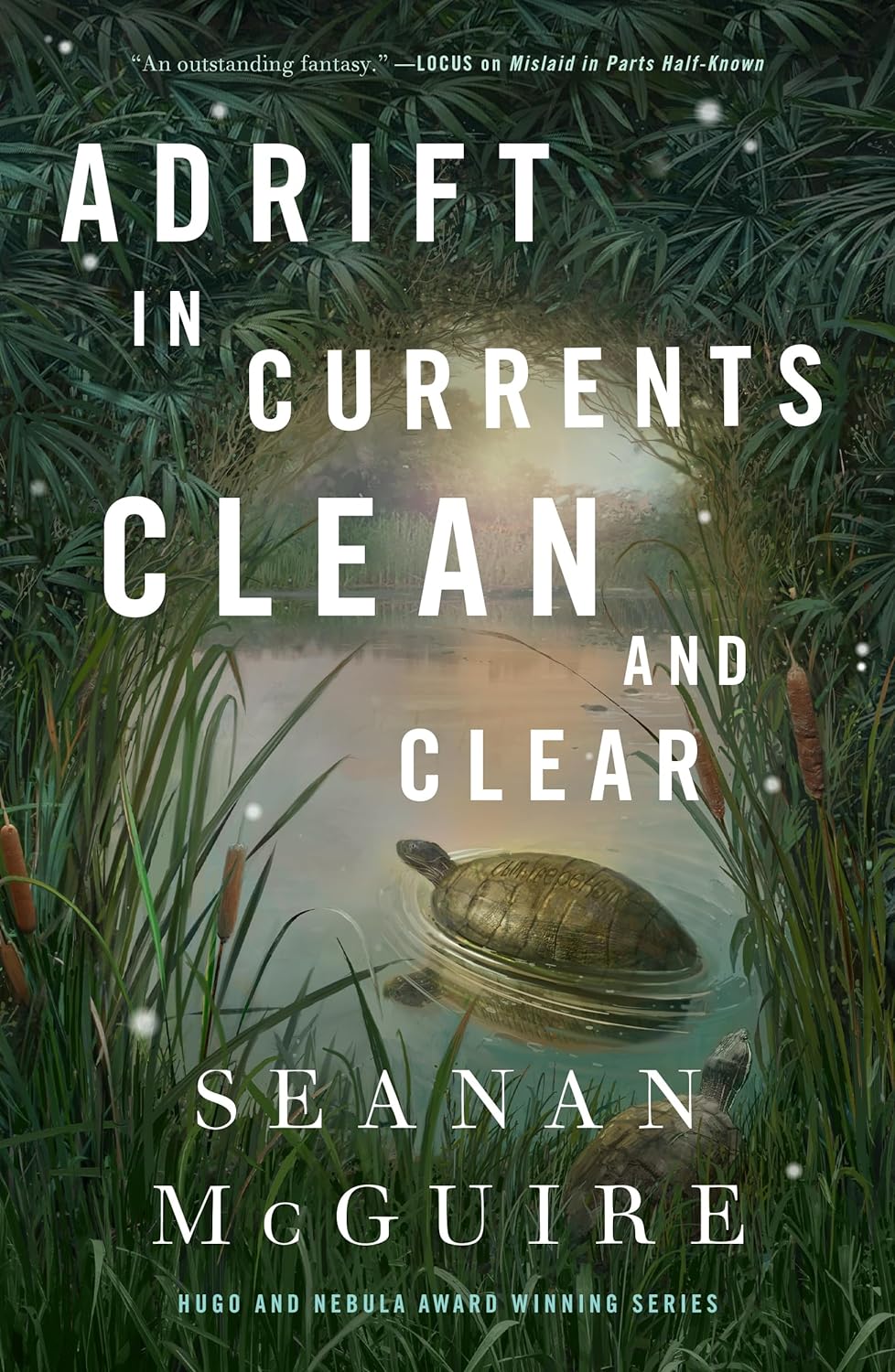
Book Review: Adrift in Currents Clean and Clear (Wayward Children, #10) by Seanan McGuire

Title: Adrift in Currents Clean and Clear
Series: Wayward Children, #10
Author: Seanan McGuire
Publisher: Tor
Publication date: January 7, 2025
Length: 160 pages
Genre: Fantasy
Source: Review copy courtesy of the publisher via NetGalley

Rating: 4.5 out of 5.

Giant turtles, impossible ships, and tidal rivers ridden by a Drowned girl in search of a family in the latest in the bestselling Hugo and Nebula Award-Winning Wayward Children series from Seanan McGuire.

Nadya had three mothers: the one who bore her, the country that poisoned her, and the one who adopted her.

Nadya never considered herself less than whole, not until her adoptive parents fitted her with a prosthetic arm against her will, seeking to replace the one she’d been missing from birth.

It was cumbersome; it was uncomfortable; it was wrong.

It wasn’t her.

Frustrated and unable to express why, Nadya began to wander, until the day she fell through a door into Belyrreka, the Land Beneath the Lake–and found herself in a world of water, filled with child-eating amphibians, majestic giant turtles, and impossible ships that sailed as happily beneath the surface as on top. In Belyrreka, she found herself understood for who she was: a Drowned Girl, who had made her way to her real home, accepted by the river and its people.

But even in Belyrreka, there are dangers, and trials, and Nadya would soon find herself fighting to keep hold of everything she had come to treasure.

Adrift in Currents Clear and Clean is the 10th book in Seanan McGuire’s Wayward Children series, and I’m pleased to say that the series is going strong. In fact, Adrift stands out as one of the best in the series, as far as I’m concerned.

In this 10th book, the story never actually ventures into Eleanor West’s Home for Wayward Children, the setting that anchors the series and creates a connection between all of the books and their characters. Instead, Adrift tells the story of one particular Wayward Child, Nadya, and what happens to her in the world of Belyrreka.

Nadya is not a new character — although, if you’re like me, it might take more than a slight hint to put the pieces together. Readers of the series were introduced to Nadya in the 3rd book, Beneath the Sugar Sky. In that book, Nadya was a student at Eleanor West’s home, having gone through a portal to another world and then been returned to our own. Nadya, like the other characters in the series, was left to yearn for the world that feels like her true home and wait for the day when that world might call her back.

Adrift in Currents Clear and Clean takes us back to Nadya’s origin story. Abandoned at birth, Nadya is raised in a Russian orphanage — a bright child who thrives on caring for the other children and helping them find forever homes.

She was young and sweet and innocent and hard, in the way of children raised in job lots rather than individually; she was doing her best to be a good person, and to figure out what that meant in the context of the world she knew and had and understood.

Born without a right arm below the elbow, Nadya has never felt that she was disabled or missing anything at all; this is who she is, and she manages perfectly well. But at age nine, Nadya is finally adopted herself, by an American missionary couple who see taking in an imperfect child as a good deed. They don’t love her for herself; they love having her as proof of their own goodness.

Nadya’s new life in American is filled with things and luxuries that she wouldn’t have had in the land of her birth, and she knows that she must be compliant and grateful at all times — until the day that her adoptive parents take her to the doctor to receive a prosthetic arm. Nadya doesn’t want it — she’s fine as she is — but her objections don’t matter. She’s forced into wearing the prosthetic, which is clunky and hurts her skin. Now, for the first time, children at school see her as other; she’s not Nadya their playmate any longer, but the girl with the strange fake arm.

Miserable, Nadya goes for a walk to her favorite place, the turtle pond near her home. When she sees a strange shadow on the water that looks almost like a door, she leans in for a closer look, and falls in. Instead of drowning, Nadya wakes on the shores of a strange river in a strange world — and finds a wonderful place where she belongs, finds purpose and connection and true family, and knows that she’s finally home.

Nadya’s life in Belyrreka is wondrous. It’s a world of water — people live beneath the river and the lake, in cities where water has different weights. Some water is for breathing, some for swimming. Heavier water is deeper, and people ride boats and turtles through the lighter water to the dry world above, where they fish and farm and bring back sustenance to the cities. I can understand why Nadya would never want to leave Belyrreka — I would willingly have read much, much more about it.

Of course, if you’ve read Beneath the Sugar Sky, you’ll know that in that book, Nadya is introduced as a girl who returned from a watery world — so Adrift in Currents Clean and Clear is a prequel, of sorts, to that book. We read Adrift knowing that Nadya will inevitably be wrenched away from Belyrreka. Seeing her happiness in this world is a special kind of sadness for the reader; we know that her time is limited, even if she does not.

Beneath the Sugar Sky also provides a coda to Nadya’s story in Adrift. When I finished Adrift — with a lump in my throat — I went back to Beneath the Sugar Sky and read the conclusion of Nadya’s part of that story. Without saying too much, I’ll just note that the payoff made my tears goes away!

Many readers note having uneven experiences with the Wayward Children series. For me, it’s been generally wonderful all the way through, although yes, some books in the series are more memorable or powerful or affecting than others. We all have our favorites — and now that I’ve read Adrift in Currents Clean and Clear, I can say with certainty that it’s one of the best.

As I’ve said with my review of each books in the series, I highly recommend starting at the beginning and continuing from there. Adrift in Currents Clean and Clear is a self-contained story that can be read on its own; there are no other characters or plotlines in it that require knowledge of earlier events in the series. Still, I recommend reading it as part of the whole, in order to get the full impact.

Nadya’s story is incredibly moving, and the world of Belyrreka is a delight. Adrift in Currents Clean and Clear is a terrific addition to an inventive, always-changing series. Don’t miss it.

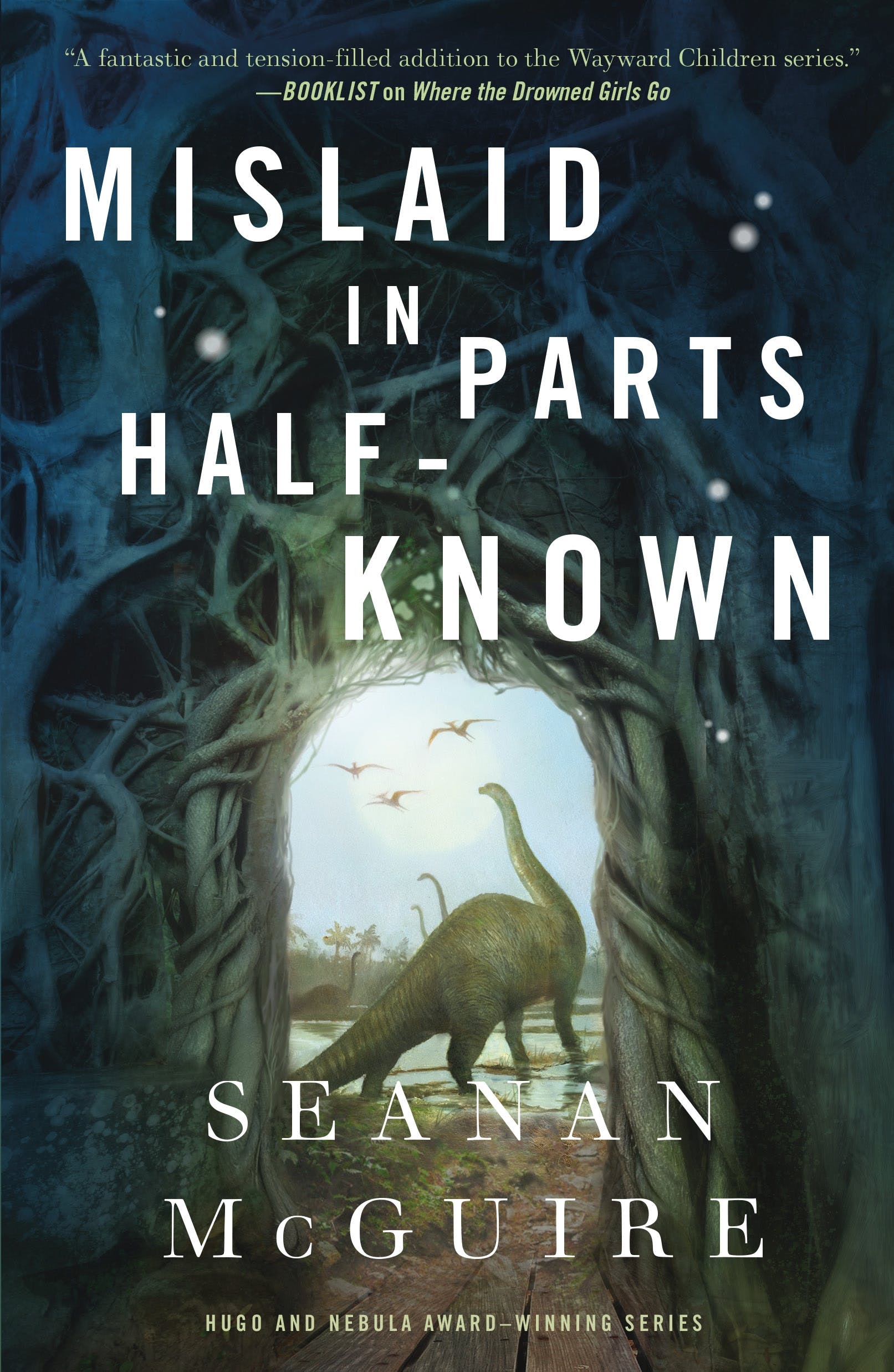
Book Review: Mislaid in Parts Half-Known (Wayward Children, #9) by Seanan McGuire

Title: Mislaid in Parts Half-Known
Series: Wayward Children, #9
Author: Seanan McGuire
Publisher: Tor
Publication date: January 9, 2024
Length: 160 pages
Genre: Fantasy
Source: Review copy courtesy of the publisher

Rating: 4.5 out of 5.

Dinosaurs and portals, and a girl who can find both in the latest book in the Hugo and Nebula Award-Winning series.

Antsy is the latest student to pass through the doors at Eleanor West’s School for Wayward Children.

When her fellow students realize that Antsy’s talent for finding absolutely anything may extend to doors, she’s forced to flee in the company of a small group of friends, looking for a way back to the Shop Where the Lost Things Go to be sure that Vineta and Hudson are keeping their promise.

Along the way, temptations are dangled, decisions are reinforced, and a departure to a world populated by dinosaurs brings untold dangers and one or two other surprises!

A story that reminds us that finding what you want doesn’t always mean finding what you need.

What can you say about the 9th book in a series? Other than that’s it’s terrific, of course! The book opens with a paragraph that beautifully sums up the overarching plot of the series:

Children of the doors know about being mislaid. They are well-acquainted with stepping through an opening or following a passage that should lead from here to there, and finding themselves someplace entirely else, someplace entirely new. It is possibly their only truly unifying experience, the one thing they have so completely in common that there’s no need to even question it: once upon a time, they took an impossible step, opened an impossible portal, and ended up in a terribly, horribly possible place.

As the newest Wayward Children book, Mislaid in Parts Half-Known keeps the overarching storylines of the series moving forward while introducing some new twists, rules, and situations for the characters to deal with. Some of the installments in the series have more of a stand-alone feel, although they’re all connected, but this is not one of those. Mislaid is absolutely a sequel, mainly in regard to book #8 and its main character Antsy, but it also continues the stories of several other characters, and it’s helpful (I’d even say critical) to be familiar with them.

The previous book, Lost in the Moment and Found, focused on a young girl named Antsy, who runs away from a dangerous situation in her home and finds herself in the world of a store that’s actually a nexus point between worlds. Antsy’s new home in the store is mostly delightful — she’s safe, after all, and has the opportunity to visit countless new worlds through the portal doors that appear and disappear. But, as she discovers by the end of the book, there’s a price to be paid, and the book ends with Antsy returning, quite changed, to her home world and finding her way to Eleanor West’s Home for Wayward Children.

In Mislaid in Parts Half-Known, Antsy is settling in at the school, but doesn’t actually quite fit. She’s actually much younger than the other students, and their portal worlds are all so different that she can’t seem to connect with many of them. When a particularly dangerous student threatens Antsy’s safety, she and a handful of others escape through another door and begin a new quest.

Readers of the prior books in the series will be familiar with Antsy’s companions — Sumi, Kade, Christopher, Cora and a few newer faces too. As they flee, they’re also searching for possibilities. Most of the students yearn to return “home” — that is, to their lost worlds beyond the doors — and Antsy has the unique ability to find any door. So if they can actually go home, should they?

There are some interesting discussions about what it means to be sure about a choice, and how they’ll know when or if they’re ready, as well as conversations about whether someone truly still belongs in the place they consider home. These introspective bits are lovely, as the various characters get a chance to shine and express themselves, even in the midst of fleeing from dangerous goblins and dinosaurs.

Yes, dinosaurs. The cover doesn’t lie! The group does visit a primeval world populated by dinosaurs, and it’s amazing. I’m not going into further detail — read it and find out!

The challenge I had with this book, as hinted at earlier, is keeping track of the characters. Yes, I’ve read the entire series so far, but since they’re released at a rate of one per year, it’s been a few years since I’ve thought about some of these characters. Thank goodness there are wikis out there! I definitely had to go look up some backstories. At some point, rereading the whole series from the beginning might be a good idea!

If you’ve been curious about the Wayward Children series, I would recommend against starting with this book. It won’t make any sense! It’s such a great series, though, that I would strongly recommend picking up a copy of Every Heart a Doorway — I bet you’ll want to keep going!

I really enjoyed Mislaid in Parts Half-Known. It ends with certain characters spinning off into new directions, and leaves much still to be discovered in the wider world of the school. I can’t wait to find out where Wayward Children goes next.

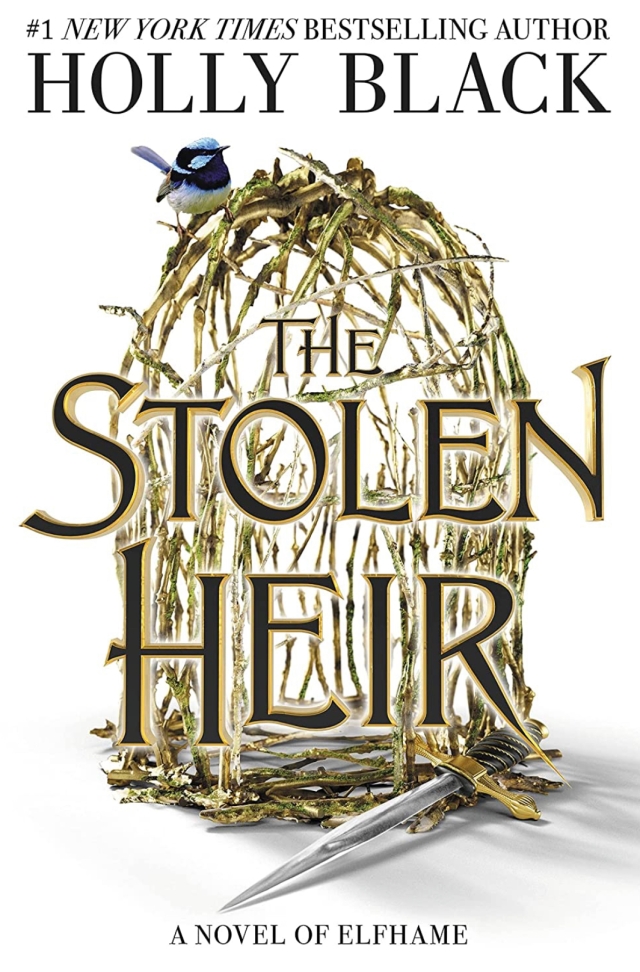
Book Review: The Stolen Heir by Holly Black

Title: The Stolen Heir
Author: Holly Black
Publisher: Little, Brown Books for Young Readers
Publication date: January 3, 2023
Length: 358 pages
Genre: Fantasy
Source: Purchased
Rating:

Rating: 3.5 out of 5.

A runaway queen. A reluctant prince. And a quest that may destroy them both.

Eight years have passed since the Battle of the Serpent. But in the icy north, Lady Nore of the Court of Teeth has reclaimed the Ice Needle Citadel. There, she is using an ancient relic to create monsters of stick and snow who will do her bidding and exact her revenge.

Suren, child queen of the Court of Teeth, and the one person with power over her mother, fled to the human world. There, she lives feral in the woods. Lonely, and still haunted by the merciless torments she endured in the Court of Teeth, she bides her time by releasing mortals from foolish bargains. She believes herself forgotten until the storm hag, Bogdana chases her through the night streets. Suren is saved by none other than Prince Oak, heir to Elfhame, to whom she was once promised in marriage and who she has resented for years.

Now seventeen, Oak is charming, beautiful, and manipulative. He’s on a mission that will lead him into the north, and he wants Suren’s help. But if she agrees, it will mean guarding her heart against the boy she once knew and a prince she cannot trust, as well as confronting all the horrors she thought she left behind.

#1 New York Times bestselling author Holly Black returns to the opulent world of Elfhame in the first book in a thrilling new duology, following Jude’s brother Oak, and the changeling queen, Suren.

I was so excited to hear that Holly Black would be returning to the world of her excellent Folk of the Air trilogy! And a book about Oak — how fun did that sound?

Except… surprise! — Oak isn’t the main character! Nope, it’s Suren, last seen as the pitiable child queen of the Court of Teeth, horribly mistreated and abused by her parents, who want to use Suren as a tool to overthrow the High King and Queen of Elfhame.

In The Stolen Heir, years have passed. Suren has been living wild in the mortal world, a creature who haunts the forests, keeping an eye on her one-time mortal family, from whom she was cruelly ripped away as a child, and staying busy by breaking enchantments on humans. But one day, Prince Oak, a boy who treated her with kindness once and now grown into a mesmerizing young adult, tracks her down and asks for her help. Lady Nore, Suren’s cruel mother, is starting trouble in the north again. With Suren’s aid, Oak is sure he can stop her.

And so begins their quest, a journey of miles and kingdoms, in which they encounter trolls, malevolent queens, a storm hag, and animated stick soldiers. As the danger mounts, Suren realizes that Oak himself perhaps cannot be trusted. What’s his true motivation in seeking her out? And is his kindness and warmth just further manipulation, or are there actual feelings there?

After a somewhat slow start, the pace picks up the further along the quest Suren and Oak manage to travel. There are dangers and betrayals, daring rescues and near misses. As the story progresses, Suren also starts to learn more about her own history, including the possible unraveling of everything she once thought she knew.

While I enjoyed The Stolen Heir once I got further along, it doesn’t quite measure up to the Elfhame books. Suren is hard to get to know, and the quest as it’s presented is confusing and a bit muddled. Eventually, the pieces come together more strongly, and the final third is actually quite good, with breathtaking action sequences, a few horrifying developments, and plenty of big reveals.

The Stolen Heir ends mid-story — we’re left hanging at a crucial moment of change. This book is #1 in a duology, with #2 — The Prisoner’s Throne — scheduled for publication in 2024. Obviously, I’ll have to read it! I can’t just be left hanging after that ending forever…

I recommend The Stolen Heir for fans of the Folk of the Air trilogy. Word to the wise — Jude and Cardan are discussed in this book, but they don’t actually appear at all. Here’s hoping they show up in The Prisoner’s Throne!

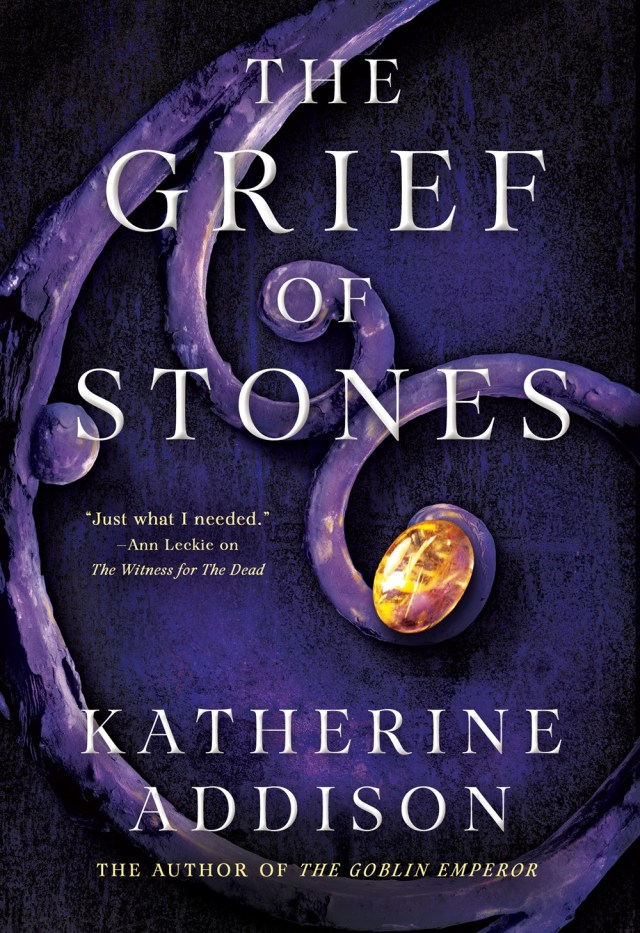
Book Review: The Grief of Stones by Katherine Addison

Title: The Grief of Stones
Author: Katherine Addison
Publisher: Tor Books
Publication date: June 14, 2022
Length: 245 pages
Genre: Fantasy
Source: Purchased
Rating:

Rating: 4 out of 5.

In The Grief of Stones, Katherine Addison returns to the world of The Goblin Emperor with a direct sequel to The Witness For The Dead

Celehar’s life as the Witness for the Dead of Amalo grows less isolated as his circle of friends grows larger. He has been given an apprentice to teach, and he has stumbled over a scandal of the city—the foundling girls. Orphans with no family to claim them and no funds to buy an apprenticeship. Foundling boys go to the Prelacies; foundling girls are sold into service, or worse.

At once touching and shattering, Celehar’s witnessing for one of these girls will lead him into the depths of his own losses. The love of his friends will lead him out again.

I really enjoyed The Grief of Stones, but at the same time, I’m not sure whether there’s any point in posting a review! This book is not a starting point. If you haven’t read The Goblin Emperor and The Witness for the Dead, then there’s absolutely no way to follow what goes on in this book.

Also, side note: If you haven’t read The Goblin Emperor… well, what are you waiting for?? Rush right out and grab a copy! It’s THAT good.

Anyway…

In The Grief of Stones, we continue onward with main character Thara Celehar. Thara is a Witness for the Dead — he can interact with the deceased after death by making contact with the body, gaining access to their final thoughts and experiences. Through his calling, he’s able to ask questions on behalf of family members, and even the police. He offers grace, compassion, and closure, and is very good at what he does. He’s also an essentially lonely man, haunted by events from his past, and is often seen as a person deserving of awe but also fear by ordinary people.

The story opens soon after the events of The Witness for the Dead, in which he solved a murder case involving a talented but greedy opera singer. In this new book, Thara is petitioned by a grieving marquess three months after his wife’s death of an apparent heart attack. The widower believes, without proof, that his wife was actually murdered, and asks Thara to discover the truth.

Thara’s investigation leads him to a shady underground world of pornographers and to the discovery of abuse at a school for foundling girls. The more he learns, the more he realizes that someone needs to give voice to those who are powerless. But his investigations also put him in personal danger.

This is a fascinating story, and Thara remains a wonderfully complex character. In this book, he gains an apprentice, and also develops his growing friendship (and perhaps more?) with the director of one of the city’s opera houses.

Although a bit slow at the start, the story quickly picks up steam, and by the time Thara ends up in a situation of grave peril, it’s particularly breathtaking. I actually found myself very upset and scared on his behalf, and having finished the book, I just wish I had a sequel in my hands already to see how Thara’s situation develops.

As I mentioned earlier, I don’t see this working — at all! — for anyone who hasn’t read the previous books. The language and society would likely be utterly impenetrable.

The passage to the ulimeire was only partly invested with revethmerai…

That’s just one random sample — but if that doesn’t make sense to you, that’s a pretty good sign that you won’t enjoy reading The Grief of Stones.

The naming conventions and language in the world of The Goblin Emperor are complex, and even as someone who’s read the previous two books twice each, I struggled a lot to keep all the various character names straight in The Grief of Stones — for whatever reason, even more than with the other books, which is why I ended up giving this one a 4-star rating.

Goodreads lists a next book, The Tomb of Dragons, but without a release date. I hope it’s not too long a wait! (And I’d love to see one of these books at least visiting Maia (The Goblin Emperor), but I’m guessing that’s unlikely).

Overall, I’m glad to have read The Grief of Stones and to have spent more time with Thara Celehar… but the end result is that I’m now dying for another re-read of The Goblin Emperor!

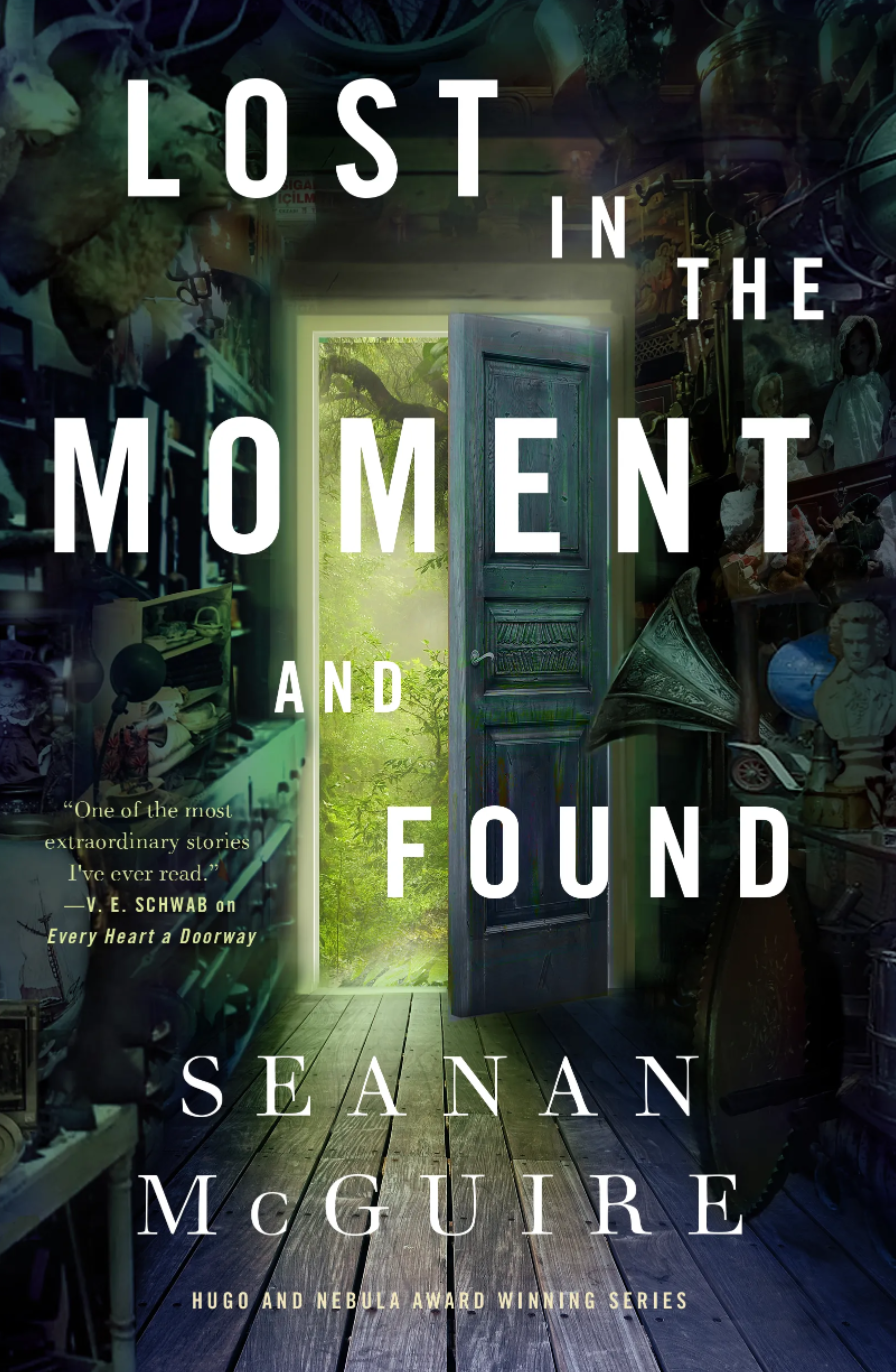
Book Review: Lost in the Moment and Found (Wayward Children, #8) by Seanan McGuire

Title: Lost in the Moment and Found
Series: Wayward Children, #8
Author: Seanan McGuire
Publisher: Tor
Publication date: January 10, 2023
Length: 160 pages
Genre: Fantasy
Source: Review copy courtesy of the publisher

Rating: 4.5 out of 5.

A young girl discovers an infinite variety of worlds in this standalone tale in the Hugo and Nebula Award-winning Wayward Children series from Seanan McGuire, Lost in the Moment and Found.

Welcome to the Shop Where the Lost Things Go.

If you ever lost a sock, you’ll find it here.
If you ever wondered about favorite toy from childhood… it’s probably sitting on a shelf in the back.
And the headphones that you swore that this time you’d keep safe? You guessed it….

Antoinette has lost her father. Metaphorically. He’s not in the shop, and she’ll never see him again. But when Antsy finds herself lost (literally, this time), she finds that however many doors open for her, leaving the Shop for good might not be as simple as it sounds.

And stepping through those doors exacts a price.

Lost in the Moment and Found tells us that childhood and innocence, once lost, can never be found.

You might wonder whether, by the 8th book in a series, an author might run out of fresh stories to tell.

If the author is Seanan McGuire, then the answer is — not a chance! In Lost in the Moment and Found, she puts a fresh spin on the ongoing Wayward Children series, once again moving the focus to a completely new character in a completely new circumstance.

While all the Wayward Children books feature children who’ve had lousy childhoods in one way or another, the circumstances here are particularly awful — enough so that the author includes a note prior to the opening of the story:

While all the Wayward Children books have dealt with heavy themes and childhood traumas, this one addresses an all-too-familiar monster: the one that lives in your own home. Themes of grooming and adult gaslighting are present in the early text. As a survivor of something very similar, I would not want to be surprised by these elements where I didn’t expect them.

I just want to offer you this reassurance: Antsy runs. Before anything can actually happen, Antsy runs.

I have to say, I very much appreciated the warning. While the sense of dread builds in the early part of the book, at least I could proceed without fearing the absolute worst. And as the author promises, the main character, Antsy, does in fact run. When her fear and sense of isolation and lack of support gets to the point that she can no longer stand it, she finds a way out and escapes.

… as she got older, she would come to think that the ability to cry was the third thing she’d lost in a single day.

Antsy, at age six, a year after a terrible loss, gains a stepfather whom she never wanted, but she hopes her mother’s happiness will allow her to feel happy too. It doesn’t work that way. Her sense of wrongness and unease whenever she’s around her stepfather only continues to grow. He’s insidious, undermining Antsy in small ways through lies and contradictions, so that Antsy knows that if she goes to her mother with her big worries, she won’t be believed. It’s utterly heartbreaking.

When Antsy finally does reach her breaking point and runs away, she ends up at a strange little thrift shop that she never noticed before, with the words “Be Sure” written over the door frame. Once inside, the door she entered through disappears, and Antsy finds herself in a new home with an odd elderly woman and a talking magpie as companions.

As she stays in this store, she discovers new doors leading to new worlds, where she meets all sorts of strange and fascinating people and brings back more goods for the infinite shelves of the store she lives in. And for a long time, she forgets that there’s anything else out there and doesn’t think to question certain very odd occurrences…

Eventually, Antsy realizes that there’s a steep price to be paid for all the miraculous new worlds she visits — and that she may run out of options sooner than expected. The ending is moving and fitting, very sad, but with a small sliver of hope too.

Yes, I’m being vague!

As in all the Wayward Children books, the writing is simply gorgeous. These stories are never just straight-forward action — there’s a sense of mythic scope embedded in the descriptions of sad, lost children, and loss permeates so much of the storytelling.

The toll of childhood trauma becomes literal here: Antsy’s loss of safety and innocence leads to her new reality in the strange world of endless doors and lost things:

She should have had a childhood, ice cream and matinees and sunshine and cookies, not working in a dusty shop while she grew up faster than she should have been able to, rocketing toward adulthood, spending hours she’d never be able to recover! She should have had time. It was hers, and she had never agreed to give it away.

Antsy’s story is particularly tragic — obviously, no small child should ever have to doubt whether the one person they count on will actually believe them when they speak up. We can cheer Antsy on as she saves herself, but still, we can’t avoid mourning her shattered childhood and sense of faith in family and love.

The Wayward Children books include beautiful drawings by the very talented Rovina Cai. See more at https://www.rovinacai.com/portfolio/wayward-children-series/

As a whole, the Wayward Children series is beautiful, sad, emotional, and full of heartache and redemption. There’s hope and joy to offset the sorrow, but an undercurrent of sadness never quite leaves the stories or their characters.

I love the series, and I’m so happy that Lost in the Moment and Found lives up to my (very high) expectations. Please do start from the beginning if you haven’t read any of these yet! Each book is novella -length, but don’t rush through them — the lovely writing should be savored.

Shelf Control #326: In Other Lands by Sarah Rees Brennan

Shelves final

Welcome to Shelf Control — an original feature created and hosted by Bookshelf Fantasies.

Shelf Control is a weekly celebration of the unread books on our shelves. Pick a book you own but haven’t read, write a post about it (suggestions: include what it’s about, why you want to read it, and when you got it), and link up! For more info on what Shelf Control is all about, check out my introductory post, here.

Want to join in? Shelf Control posts go up every Wednesday. See the guidelines at the bottom of the post, and jump on board!

Title: In Other Lands
Author: Sarah Rees Brennan
Published: 2019
Length: 487 pages

What it’s about (synopsis via Goodreads):

The Borderlands aren’t like anywhere else. Don’t try to smuggle a phone or any other piece of technology over the wall that marks the Border — unless you enjoy a fireworks display in your backpack. (Ballpoint pens are okay.) There are elves, harpies, and — best of all as far as Elliot is concerned — mermaids.

Elliot? Who’s Elliot? Elliot is thirteen years old. He’s smart and just a tiny bit obnoxious. Sometimes more than a tiny bit. When his class goes on a field trip and he can see a wall that no one else can see, he is given the chance to go to school in the Borderlands.

It turns out that on the other side of the wall, classes involve a lot more weaponry and fitness training and fewer mermaids than he expected. On the other hand, there’s Serene-Heart-in-the-Chaos-of-Battle, an elven warrior who is more beautiful than anyone Elliot has ever seen, and then there’s her human friend Luke: sunny, blond, and annoyingly likeable. There are lots of interesting books. There’s even the chance Elliot might be able to change the world.

In Other Lands is the exhilarating new book from beloved and bestselling author Sarah Rees Brennan. It’s a novel about surviving four years in the most unusual of schools, about friendship, falling in love, diplomacy, and finding your own place in the world — even if it means giving up your phone.

How and when I got it:

I bought the paperback early in 2021.

Why I want to read it:

I’m not sure why, but for several weeks straight in early 2021, my social media feeds kept pushing this book at me. Hey, it’s the power of marketing — it worked! I kept seeing this mermaid cover popping up whenever I went to check up on my friends’ latest updates, and eventually, I gave in to my curiosity. I mean, who doesn’t love a mermaid cover?

The paperback edition is big and chunky, and at first glance, the plot seems to skew younger than what I usually prefer. This sounds very much like middle grade to younger young adult fiction, which I haven’t been gravitating toward much in recent years.

Still, between the magical school setting, the strange new world, and the fantastical beings that the main character meets, it does sound quite charming. I think I initially bought the book without looking very far into the details, which may be why it’s been sitting on my shelf (unread) since I got it.

I’m a little torn. I see a lot of very positive reviews on Goodreads, but I’m not convinced that this is something I want to devote much time to.

What do you think? Would you read this book?

Please share your thoughts!


__________________________________

Want to participate in Shelf Control? Here’s how:

  • Write a blog post about a book that you own that you haven’t read yet.
  • Add your link in the comments or link back from your own post, so I can add you to the participant list.
  • Check out other posts, and…

Have fun!

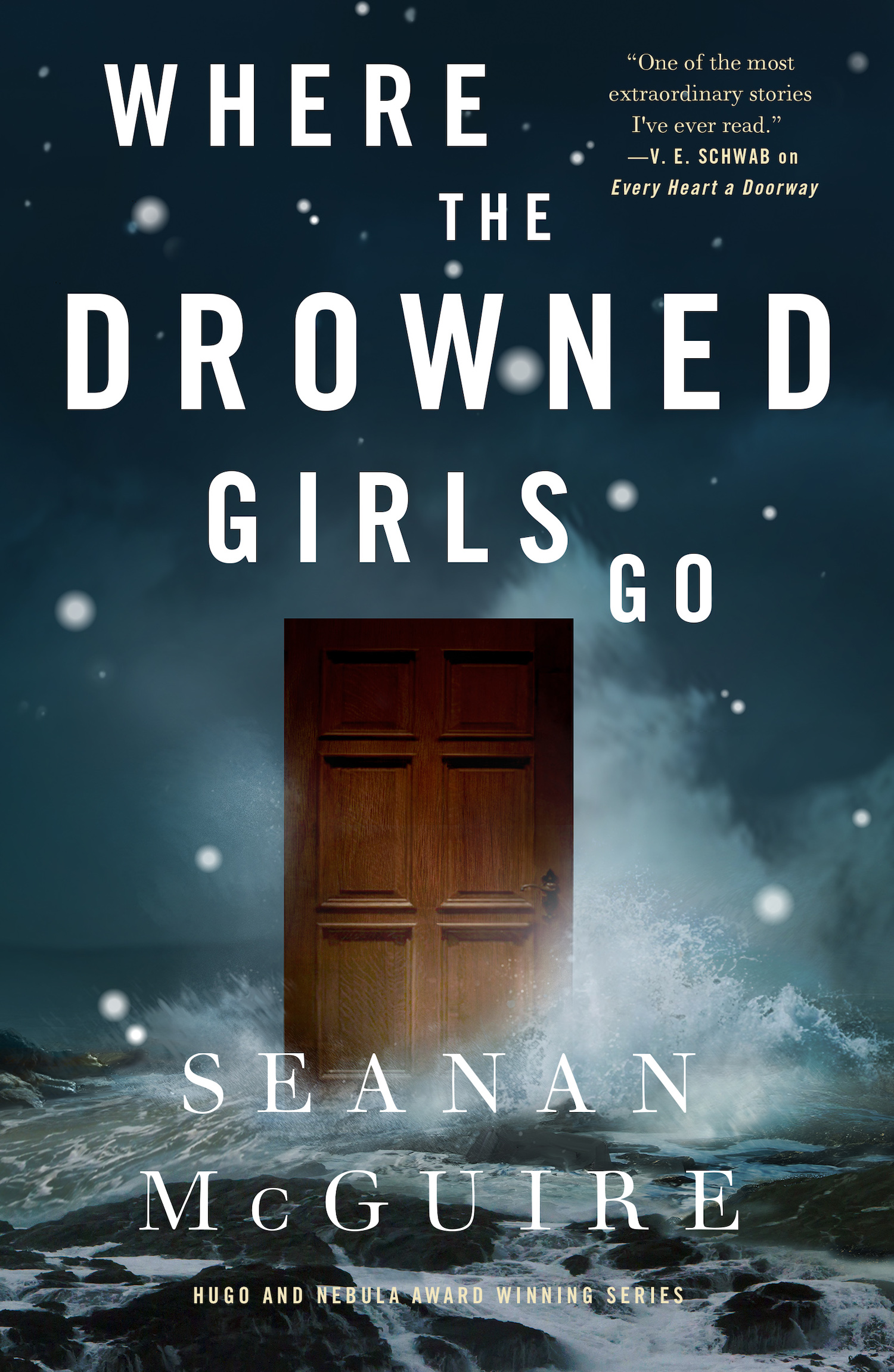
Book Review: Where the Drowned Girls Go (Wayward Children, #7) by Seanan McGuire

Title: Where the Drowned Girls Go
Series: Wayward Children, #7
Author: Seanan McGuire
Publisher: Tor
Publication date: January 4, 2022
Length: 150 pages
Genre: Fantasy
Source: ARC via Netgalley; hardcover purchased

Rating: 4.5 out of 5.

Welcome to the Whitethorn Institute. The first step is always admitting you need help, and you’ve already taken that step by requesting a transfer into our company.

There is another school for children who fall through doors and fall back out again.
It isn’t as friendly as Eleanor West’s Home for Wayward Children.

And it isn’t as safe.

When Eleanor West decided to open her school, her sanctuary, her Home for Wayward Children, she knew from the beginning that there would be children she couldn’t save; when Cora decides she needs a different direction, a different fate, a different prophecy, Miss West reluctantly agrees to transfer her to the other school, where things are run very differently by Whitethorn, the Headmaster.

She will soon discover that not all doors are welcoming…

If it’s January, it must be time for a new Wayward Children book!

Children have always been drawn to the doors.

In the 7th in the series, Where the Drowned Girls Go, the main character is Cora, whom we’ve met in previous installments as a secondary character. Here, she takes center stage.

Cora is a mermaid. That is, she was an ordinary human child until she went through a door to the world of the Trenches, an undersea world where Cora became a hero and a mermaid. Even though she was returned to her “real” world, she knows she belongs back in the Trenches… or she did, until (in book #5, Come Tumbling Down), she accompanies her friends through a door to the Moors, where she has a fateful encounter with the Drowned Gods.

She used to put her head down on the pillow and let the night take her away, off into dreams full of deep, diamond-dappled water, diving down where the currents were warm and the waters were always welcoming.

Since the Moors, though… since the Moors, her dreams were still full of water and waves, but the sea she swam in while she slept was no longer remotely kind. It was filled with teeth, and colder than she would have believed the water could be.

Now, back at Eleanor West’s Home for Wayward Children, Cora can’t shake the memories of the Moors and the awful whispers of the Drowned Gods, who want to drag her back down to their terror-filled realm. Feeling hopeless, Cora requests a transfer to the Whitethorn Institute, the other school for children who journey through portals to strange worlds and come back again. Against Eleanor West’s advice, Cora insists on the transfer, and soon finds herself in a very different type of school.

Days at the Whitethorn Institute always followed the same pattern, as perfect and predictable as a spider’s web.

At Whitethorn, the emphasis in on conformity. The students are urged through behavioral control to abandon any thought of other worlds. They must learn that this is the only world that exists, and give up the fantasies and delusions of other lives. It’s harsh, full of punishments and insistence on obedience, with an overwhelming grayness to it all.

But Cora is still a mermaid at heart, and soon comes to realize what an awful mistake she’s made. And when her friend Sumi shows up at Whitethorn on a rescue mission… well, things really get interesting.

I love the world of the Wayward Children, and despite the bleakness of the new school, there’s still plenty of magic and nonsense to appreciate in Where the Drowned Girls Go.

One of the truly special things about this series is how it celebrates otherness. The children in these books struggle to fit in in their “normal” worlds, and finding their doors is key to discovering who they truly are. What’s clear throughout this series is that the children’s differences aren’t the problem — the problem is a world that has no place for children who don’t conform.

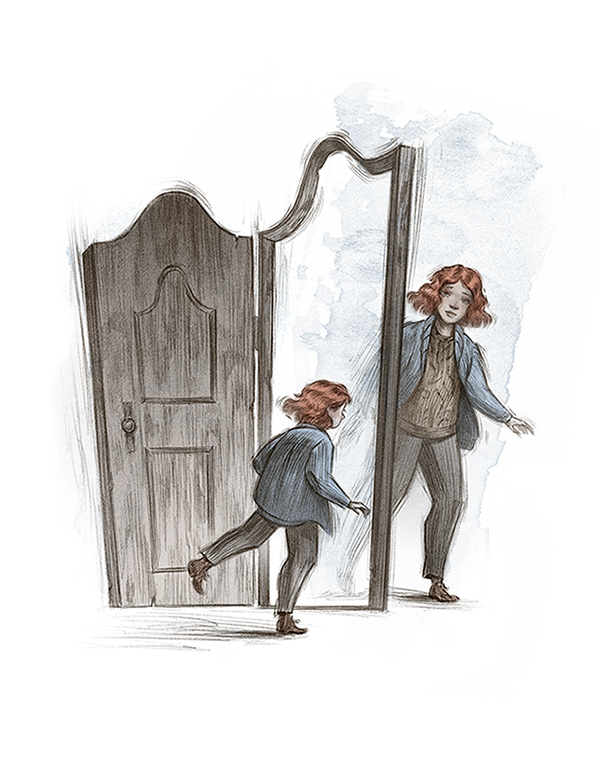
As always, the writing is spectacular. Rovina Cai is back as the illustrator, and her drawings (again, as always) are beautiful and perfectly in tune with the narrative of the story.

Illustration by @RovinaCaiArt

I love this series so, so much. If you haven’t tried these books yet, start at the beginning! I’m thrilled that three more books in the series are listed on Goodreads — here’s hoping the Wayward Children thrive for years to come!

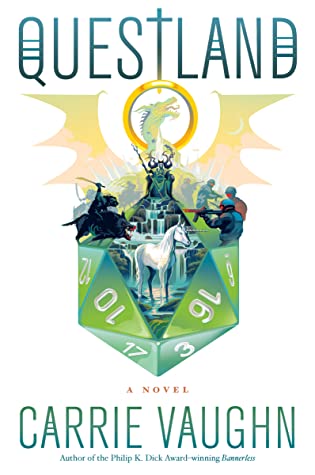
Book Review: Questland by Carrie Vaughn

Title: Questland
Author: Carrie Vaughn
Publisher: John Joseph Adams/Mariner Books
Publication date: June 22, 2021
Length: 304 pages
Genre: Contemporary fiction/fantasy
Source: Review copy courtesy of the publisher via Netgalley
Rating:

Rating: 3.5 out of 5.

YOU FIND YOURSELF IN A MAZE FULL OF TWISTY PASSAGES…


Literature professor Dr. Addie Cox is living a happy, if sheltered, life in her ivory tower when Harris Lang, the famously eccentric billionaire tech genius, offers her an unusual job. He wants her to guide a mercenary strike team sent to infiltrate his island retreat off the northwest coast of the United States. Addie is puzzled by her role on the mission until she understands what Lang has built:  Insula Mirabilis, an isolated resort where tourists will one day pay big bucks for a convincing, high-tech-powered fantasy-world experience, complete with dragons, unicorns, and, yes, magic.


Unfortunately, one of the island’s employees has gone rogue and activated an invisible force shield that has cut off all outside communication. A Coast Guard cutter attempting to pass through the shield has been destroyed. Suspicion rests on Dominic Brand, the project’s head designer— and Addie Cox’s ex-boyfriend. Lang has tasked Addie and the mercenary team with taking back control of the island at any cost.


But Addie is wrestling demons of her own—and not the fantastical kind. Now, she must navigate the deadly traps of Insula Mirabilis as well as her own past trauma. And no d20, however lucky, can help Addie make this saving throw.

To understand the basic premise of Questland, it’s helpful to refer back to Arthur C. Clarke’s famous statement, explicitly referred to in this book:

“Any sufficiently advanced technology is indistinguishable from magic.”

Questland is contemporary fiction, but with technology and fantasy as its underlying themes. In Questland, Professor Addie Cox, an expert in comparative literature with a focus on mythology and fantasy, is approached by tech billionaire Harris Lang with a proposition: Help him reclaim control of his top-secret project, which has been hijacked (supposedly) by his underlings.

The project is a fantasy island in the truest sense of the words: Think Jurassic Park, but instead of T-Rex and velociraptors, insert wizards, goblins, elves, and archers. Insula Mirabilis is conceived of as a fantasy vacation resort, where hardcore gamers and fantasy geeks can immerse themselves in a world in which magic appears to be real. Thanks, of course, to the sufficiently advanced technology to pull it all off.

But Insula Mirabilis seems to have cut off all access and communication with the outside world, and Lang wants it back. Addie is sent to infiltrate the island along with a small band of mercenaries. Addie’s gaming/fantasy brain immediately recognizes her role in all this — their group may have a Cleric and a Ranger, but she’s clearly the Bard.

Her unique knowledge and experience in fantasy worlds quickly becomes important, as the team encounters a Sphinx, a maze, and all sorts of dangerous riddles and traps. Worryingly, the fail-safes for the fantasy elements seem to be turned off — so yes, those arrows and stunners and spider claws can do real damage, and worse.

Addie also carries with her very significant baggage. As a teen, she survived a school shooting, but watched her two closest friends die. Fantasy worlds and gaming became a sort of refuge for Addie:

All I’d ever wanted to do was escape. No, that wasn’t true. All I wanted was for what happened to mean something. Stories meant something, and real life… didn’t.

The plotline of Questland follows Addie and her team’s journey across the island, from the realms of dwarves to the magical and beautiful realm of elves, with random weird encounters with animal villages, Robin Hood and his Merry Men, unicorns, wargs, and more. It’s all so real — but Addie knows it’s not.

My feelings on Questland are mixed. First, delight — who wouldn’t want to inhabit a real-feeling world that incorporates every fantasy element you could possibly desire? It sounds too good to be true, and of course, none of it really is true. For all the mead and antlers and fairy lights, there’s a backroom filled with computers and controllers and transmitters. It may feel like entering a fantasy world, but the ancient stone castle is 3D-printed.

Beyond the delight of the concept, I was often frustrated by the quest itself. The overarching plotline about the corporate takeover veers between being overly complicated and just not very rational. So one faction seizes control of the island — and then everyone there just stays there, wearing costumes and acting as if they live inside the fantasy? To what end, ultimately? If Addie’s team hadn’t arrived, how long would this have gone on?

Still, it’s fun to see Addie use her wits and her geek sensibilities to outsmart the traps and puzzles of the island, getting to be heroic while those around her want to view her as a damsel to be shielded. I wish Addie’s backstory had been even more fleshed out — the pieces dealing with her PTSD and the lingering trauma of her past are sensitively depicted and quite moving.

Never having played D&D or other fantasy-based games or RPGs myself, perhaps I wasn’t quite primed to be the perfect audience for Questland, although I did appreciate how seriously Addie and the island characters take Harry Potter, the Tolkien masterpieces, Narnia, Labyrinth, and more. These aren’t presented in the wink-wink pop culture cool way of many contemporary novels that want to show their characters’ geek cred — instead, in Questland, knowledge of modern fantasy epics is as foundational as a knowledge of Gilgamesh and the Odyssey.

Overall, I enjoyed Questland, but got bored at points with the quest elements. And yet, it’s never a bad thing to see geek culture front and center, being celebrated for all its complexity and wonder. As Addie explains:

I’m not sure any of them really understand — it’s not the stuff. It’s not the magic, the unicorns, the rings. All that’s just things. Fantasy is about what you can’t patent. Honor and heroism and… and… hope.

And as the author says in the end notes:

It’s not just about the sufficiently advanced technology that appears to make magic possible. It’s about a culture hungry for worlds and stories filled with magic. That embraces a sense of wonder instead of being suspicious of it.

If you’re a fan of magical worlds, and especially if you’ve grown up immersing yourself in games and movies that transport you into those worlds, do check out Questland.

**********

Through affiliate programs, I may earn commissions from purchases made when you click through these links, at no cost to you.

Buy now at AmazonBook DepositoryBookshop.org

Book Review: The Witness for the Dead by Katherine Addison

Title: The Witness for the Dead
Author: Katherine Addison
Publisher: Tor Books
Publication date: June 22, 2021
Length: 240 pages
Genre: Fantasy
Source: Purchased
Rating:

Rating: 5 out of 5.

Katherine Addison returns to the glittering world she created for her beloved novel, The Goblin Emperor, in this stand-alone sequel.

When the young half-goblin emperor Maia sought to learn who had set the bombs that killed his father and half-brothers, he turned to an obscure resident of his father’s Court, a Prelate of Ulis and a Witness for the Dead. Thara Celehar found the truth, though it did him no good to discover it. He lost his place as a retainer of his cousin the former Empress, and made far too many enemies among the many factions vying for power in the new Court. The favor of the Emperor is a dangerous coin.

Now Celehar lives in the city of Amalo, far from the Court though not exactly in exile. He has not escaped from politics, but his position gives him the ability to serve the common people of the city, which is his preference. He lives modestly, but his decency and fundamental honestly will not permit him to live quietly. As a Witness for the Dead, he can, sometimes, speak to the recently dead: see the last thing they saw, know the last thought they had, experience the last thing they felt. It is his duty use that ability to resolve disputes, to ascertain the intent of the dead, to find the killers of the murdered.

Now Celehar’s skills lead him out of the quiet and into a morass of treachery, murder, and injustice. No matter his own background with the imperial house, Celehar will stand with the commoners, and possibly find a light in the darkness.

Katherine Addison has created a fantastic world for these books – wide and deep and true.

Thara Celehar is the Witness for the Dead of this book’s title. He’s gifted with the ability to find out the truth of a death by making contact with the deceased’s body. He says a prayer of compassion, then asks the dead to answer questions. Sometimes, it’s too late, and there’s no one left in the body to answer the query. But sometimes, he’s able to get answers or at least an impression of the person’s last moments. He then bears witness for the dead person, testifying to what he’s learned in order to solve a mystery or resolve a dispute. His basic goodness allows him to carry out his duties with dignity.

However, despite being located in a smaller city far from the capitol, Thara is not completely shielded from the backbiting and political striving that characterizes the prelacy of Amalo. There are some who are jealous of Thara’s connection to the emperor; others fear that he might gain power and seek to tear him down. No matter how he tries to stay outside the fray, he’s drawn in repeatedly.

As the book opens, Thara becomes involved in several unsolved cases. In one, a family needs him to discover who their patriarch’s intended heir is, as the will is in dispute. In another, sadder case, a brother seeks his sister’s body, believing that the man she eloped with may have done her harm. And in the story that becomes the overarching plotline of the book, a beautiful young woman’s body is pulled from the canal — was her death an accident, or was she killed? And if it was murder, who did it?

As he investigates, he becomes drawn into the worlds of the opera, the rich patrons, the seedier bars and teahouses, the gambling establishments, and the law enforcement of Amalo. He persists in pursuing the truth, even when his own life and reputation are at stake. Despite his fears and doubts, Thara is always true to his calling, and his intelligence and bravery enable him to see his inquiries through until he can find the truth on behalf of the dead.

The world of The Witness for the Dead is the world of The Goblin Emperor… and I can’t even begin to describe or explain how much I love this world. Author Katherine Addison has meticulously crafted a world with a finely developed culture, religious underpinnings, class stratifications, nobility and commoners, courtiers and princes. There’s a strange beauty to the descriptions of the people and the society, and I am particularly head over heels in love with the language of The Goblin Emperor‘s world.

In her books, the author creates a vocabulary and grammar that is dizzyingly strange and difficult, making the books seem almost impenetrable at first — but if we stick with it (as I encourage everyone to do), the names of the people and places and institutions, as well as the forms of address and the contrasting formal and informal speech patterns, all create a sort of linguistic magic. As I re-read The Goblin Emperor via audiobook, I was enthralled all over again, not just by the story, but by the very sound of it all. Truly an incredible experience.

Back to The Witness for the Dead: I loved this story. It was fascinating seeing Thara Celehar about his work. We see him in action in The Goblin Emperor through his interactions with the Emperor, but here, we’re privy to more of his inner life and learn more about what sort of person he is and what drives him. It’s an engrossing character study, enhanced by clever mysteries for Thara to solve.

I suppose my only complaint about The Witness for the Dead isn’t really about this book at all: I just missed Maia (Emperor Edrehasivar VII) so, so much. I would gladly read a multiple-volume history covering the reign of the emperor… but I’d also happily settle for just one more novel!

I can’t imagine reading The Witness for the Dead without having read The Goblin Emperor. I do know at least one person who’s planning to do just that, and I’ll be interested to hear her thoughts. I don’t think this book would work as a stand-alone, since I can’t see how someone could truly make sense of the world (not to mention all those names!!) without having read the previous novel. But, I’d be happy to be proven wrong!

I highly recommend The Witness for the Dead, but please do yourself a favor and read The Goblin Emperor first. I hope you’ll love it as much as I do!

Note: As part of a preorder sales promotion, I also received a digital copy of a new short story called Lora Selezh. It’s a compact story about Thara witnessing on behalf of a petitioner, and I really liked it. I don’t know if it’s available elsewhere, but if so, don’t miss it.

**********

Through affiliate programs, I may earn commissions from purchases made when you click through these links, at no cost to you.

Buy now at AmazonBook DepositoryBookshop.org