Book Review: The Apocalypse Seven by Gene Doucette

Title: The Apocalypse Seven
Author: Gene Doucette
Publisher: John Joseph Adams
Publication date: May 25, 2021
Length: 363 pages
Genre: Science fiction
Source: Review copy courtesy of the publisher via NetGalley (plus a Goodreads giveaway!)
Rating:

Rating: 4.5 out of 5.

This is the way the world ends. Not with a bang, but a whatever.

The whateverpocalypse. That’s what Touré, a twenty-something Cambridge coder, calls it after waking up one morning to find himself seemingly the only person left in the city. Once he finds Robbie and Carol, two equally disoriented Harvard freshmen, he realizes he isn’t alone, but the name sticks: Whateverpocalypse. But it doesn’t explain where everyone went. It doesn’t explain how the city became overgrown with vegetation in the space of a night. Or how wild animals with no fear of humans came to roam the streets.

Add freakish weather to the mix, swings of temperature that spawn tornadoes one minute and snowstorms the next, and it seems things can’t get much weirder. Yet even as a handful of new survivors appear—Paul, a preacher as quick with a gun as a Bible verse; Win, a young professional with a horse; Bethany, a thirteen-year-old juvenile delinquent; and Ananda, an MIT astrophysics adjunct—life in Cambridge, Massachusetts gets stranger and stranger.

The self-styled Apocalypse Seven are tired of questions with no answers. Tired of being hunted by things seen and unseen. Now, armed with curiosity, desperation, a shotgun, and a bow, they become the hunters. And that’s when things truly get weird.

I found myself mumbling or exclaiming “WTF???” practically once a chapter, start to finish, in this incredibly entertaining and mind-blowing novel of the apocalypse.

Or, as Touré puts it, the whateverpocalypse.

Seven seemingly random strangers wake up to find that they’re alone in a world suddenly overrun by plant life and wild animals — in what was formerly an urban college town. At Harvard and at MIT, several individuals wake up in confusion. Robbie wakes up in his dorm room bed, frantic that he overslept on the first day of freshman classes, only to discover that his technology doesn’t work, he has no idea what time it is, the clothes in the dresser drawers aren’t his, and there’s absolutely no one else around.

Before long he meets fellow student Carol, a blind young woman unsuccessfully trying to locate her dog, and the two then meet free-spirited Toure. Meanwhile, MIT astrophysicist Ananda wakes up at her office desk, confused by why she’s wearing her “Monday clothes” on a Tuesday, teen-ager Bethany wakes up in her suburban family home to see the shrine her family has erected in her memory, pastor Paul leaves his isolated New Hampshire mountaintop chapel when he realizes he’s all alone, and tough-girl Win mounts a horse to head toward a city and try to find other people.

They quickly realize that they’re the only people in the greater Boston area, and most likely in the world, but they have no idea why. How could all these trees and plants have grown so rapidly? Why are there deer and boar and wolves roaming and/or rampaging through the city streets?

Survival is the first issue to address, and initially, Robbie, Toure, and Carol are in rough shape, with no practical skills between them. As they connect with the others and explore local resources, they form plans, raid local malls to stock up on tools and clothing, figure out which parts of campus are safe (and where they’re most likely to run into packs of slavering wolves), and generally start to squeak their way toward something like building a way of staying alive.

The question remains, though: Why did they survive, and no one else did? What made them different? What actually happened to the human population of earth?

Don’t look at me — I’m not giving a thing away! Hints and odd facts and anomalies come to light along the way, but it’s only in the last 20% or so that the characters start to arrive at some real answers. I gotta be honest — even having finished the book, I’m not sure I completely get it, but I think it’s more a question of my brain not being able to fully follow the WTF-ness of it all than it not making sense. There is definitely an answer — but it’s kind of bent my brain into a pretzel, and it’ll take me some time to untangle it all.

There’s so much to love about The Apocalypse Seven. I’m often put off by books that focus on a group coming together, because many times the characters are introduced too quickly or in too large a chunk for them to really differentiate themselves as individuals. Not so in this book — each of the seven are special and memorable, with distinct personalities and backstories and abilities, and I really appreciated how well described they all are.

I also really enjoyed the setting. Who would have thought that a college town like Cambridge would offer so many resources for hiding, finding survival gear, and making a safe(ish) long-term shelter? The use of the campuses and their resources is really ingenious, and I was charmed by the characters’ inventiveness.

It’s also worth noting that this book — despite being about the near-total extinction of the human race — can be really, really funny. The characters are clever and the banter is crisp, and certain elements are just ridiculous enough to make me laugh out loud (or feel quietly charmed).

I really, really want other people to read this book! First of all, it’s so enjoyable and mind-warpy, frightening in its own way — but really, how seriously dire can the end of the world feel when characters use words like “whateverpocalypse”? Beyond the terrific reading experience, I want people I know to read The Apocalypse Seven so someone can explain the ending to me and tell me if we understand it the same way!!

Really and truly, though, The Apocalypse Seven is a terrific read, and I had a great time zipping my way through it.

Big shout-out and thank you to the publisher and Goodreads — I won a copy in a Goodreads giveaway!

**********

Through affiliate programs, I may earn commissions from purchases made when you click through these links, at no cost to you.

Buy now at AmazonBook DepositoryBookshop.org

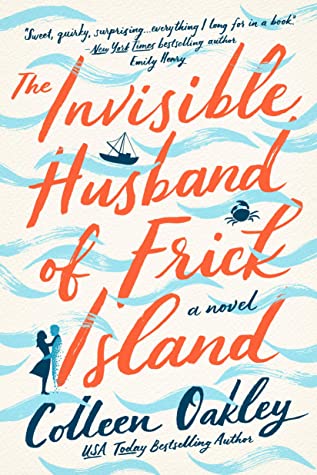
Book Review: The Invisible Husband of Frick Island by Colleen Oakley

Title: The Invisible Husband of Frick Island
Author: Colleen Oakley
Publisher: Berkley
Publication date: May 25, 2021
Length: 368 pages
Genre: Contemporary fiction
Source: Review copy courtesy of the publisher via NetGalley
Rating:

Rating: 3.5 out of 5.

Sometimes all you need is one person to really see you.

Piper Parrish’s life on Frick Island—a tiny, remote town smack in the middle of the Chesapeake Bay—is nearly perfect. Well, aside from one pesky detail: Her darling husband, Tom, is dead. When Tom’s crab boat capsized and his body wasn’t recovered, Piper, rocked to the core, did a most peculiar thing: carried on as if her husband was not only still alive, but right there beside her, cooking him breakfast, walking him to the docks each morning, meeting him for their standard Friday night dinner date at the One-Eyed Crab. And what were the townspeople to do but go along with their beloved widowed Piper?

Anders Caldwell’s career is not going well. A young ambitious journalist, he’d rather hoped he’d be a national award-winning podcaster by now, rather than writing fluff pieces for a small town newspaper. But when he gets an assignment to travel to the remote Frick Island and cover their boring annual Cake Walk fundraiser, he stumbles upon a much more fascinating tale: an entire town pretending to see and interact with a man who does not actually exist. Determined it’s the career-making story he’s been needing for his podcast, Anders returns to the island to begin covert research and spend more time with the enigmatic Piper—but he has no idea out of all the lives he’s about to upend, it’s his that will change the most. 

Frick Island, home to under 100 people, is a charming little community in Chesapeake Bay, where everyone knows everyone, tourists are tolerated, fishing and crabbing is the main livelihood, and a proposed new cell phone tower is the scandal of the decade. Frick Island is also dying — climate change has affected the sea life, resulting in smaller catches and dire times for the fishermen, and rising sea levels mean that the island itself will be uninhabitable in the not-so-distant future.

When Anders visits Frick Island on assignment, he’s startled by how foreign it all feels, from the unreliable ferry schedule to the lack of cell and internet service, to the peace and satisfaction (and oddity) of the people he encounters. When he sees a young woman — who strikes him as the most beautiful person he’s ever seen — sitting alone at a table for two at the island’s only restaurant, he gets up the nerve to ask her to join him… and is confused when she informs him that, as he can plainly see, she’s having dinner with her husband!

Piper and her husband have been together since their teens. Married for one year, they’re happy and in love, content with their small cottage and quiet life. When Tom’s boat is lost in a storm, Piper hides herself away in grief for two weeks, finally reemerging full of smiles, talking about Tom as if he were still present. The townspeople are confused, but end up supporting Piper by playing along — so when she walks Tom down to the docks each day, they all call out greetings to Tom as if they can see him too.

Anders has struggled to find his audience as a podcaster, but once he stumbles across Piper’s story, he’s inspired. He digs into the island’s history, researches post-bereavement coping strategies, and starts visiting the island week after week — ostensibly to learn more about climate change’s impact on the people of Frick Island, but in reality, looking to understand how an entire community could pretend to see a man who isn’t there. Anders begins a new podcast series, What the Frick, focusing on Piper’s story, then expanding the series to include all the stories of Frick Island that he can find. And it’s a hit — suddenly, his listens are in the thousands.

But as Anders spends more time on Frick Island, he’s also building connections to the people there and developing feelings for Piper. Soon, he realizes that with the cell tower nearing completion, the people of Frick Island will have access to his podcast, and they aren’t likely to be happy with him. He’s falling in love with Piper, but knows that she’ll feel horribly betrayed by his sharing of her story without her permission. He’s treated Piper, and the entire island, as an oddity to be marveled over, and he knows that unless he deletes the podcast completely, there’s going to be hell to pay.

In many ways, I was charmed by The Invisible Husband of Frick Island, although Anders’s behavior is hard to tolerate. He’s depicted as kind of gawky and young and afraid of everything, developing self-confidence and connections to others through his continued visits to Frick Island and his growing involvement with the community. He should have known all along how his podcast would be viewed if the islanders ever heard it. There’s no getting around that he crossed a huge line by sharing such personal stories without permission — even if there’s a benefit to the island in the end (which is a very rosy-eyed solution to the problem).

Piper’s behavior too is problematic, once we learn more later in the book. There are a lot of false leads about what’s truly going on, and the answers felt a little flat and unsatisfying. I tried to give both Piper and Anders some benefit of the doubt because of their ages (early 20s), but even so, their actions are both questionable. At least with Piper, she’s managing her grief and loss the best way she can, but there’s a lack of honesty about certain elements that made me like her a little bit less.

I was entertained by The Invisible Husband of Frick Island, but because of my issues with the main characters’ behavior, I couldn’t quite embrace the story fully. The island community is charming, if a little too much the typical fictional cute/quirky small town filled with cute/quirky/weird-but-memorable people. I did like that the book ends not with a swooning romantic HEA, but with a positive outcome for the characters and the island’s future — and I especially liked Piper’s next steps at the end, which (without saying too much) is the best possible course of action for her.

The Invisible Husband of Frick Island would make a good choice for a summer read — it’s light and entertaining, despite the plot points I couldn’t quite get behind.

**********

Through affiliate programs, I may earn commissions from purchases made when you click through these links, at no cost to you.

Buy now at AmazonBook DepositoryBookshop.org

Book Review: The Quiet Boy by Ben H. Winters

Title: The Quiet Boy
Author: Ben H. Winters
Publisher: Mulholland Books
Publication date: May 18, 2021
Length: 448 pages
Genre: Legal thriller
Source: Review copy courtesy of the publisher
Rating:

Rating: 3 out of 5.

From the “inventive…entertaining and thought-provoking” (Charles Yu) New York Times-bestselling author of Underground Airlines and Golden State, this sweeping legal thriller follows a sixteen-year-old who suffers from a neurological condition that has frozen him in time—and the team of lawyers, doctors, and detectives who are desperate to wake him up. 

In 2008, a cheerful ambulance-chasing lawyer named Jay Shenk persuades the grieving Keener family to sue a private LA hospital. Their son Wesley has been transformed by a routine surgery into a kind of golem, absent all normal functioning or personality, walking in endless empty circles around his hospital room.  In 2019, Shenk—still in practice but a shell of his former self—is hired to defend Wesley Keener’s father when he is charged with murder . . . the murder, as it turns out, of the expert witness from the 2008 hospital case. Shenk’s adopted son, a fragile teenager in 2008, is a wayward adult, though he may find his purpose when he investigates what really happened to the murdered witness.

Two thrilling trials braid together, medical malpractice and murder, jostling us back and forth in time.

The Quiet Boy is a book full of mysteries, not only about the death of a brilliant scientist, not only about the outcome of the medical malpractice suit, but about the relationship between children and their parents, between the past and the present, between truth and lies.  At the center of it all is Wesley Keener, endlessly walking, staring empty-eyed, in whose quiet, hollow body may lie the fate of humankind.

This legal/medical thriller kept me turning the pages, but now that I’m done, I feel like I have more questions than answers.

In The Quiet Boy, we follow two timelines: In 2008, a high school boy named Wesley comes out of brain surgery in an unheard-of state: He walks endlessly around his hospital room, eyes open but unseeing, appearing to be “hollowed out”, no one home, no ability to interact or change. In 2019, Wesley’s father has just been arrested for the murder of the expert witness in the family’s medical malpractice lawsuit.

Linking the timelines together is Jay Shenk, an ambulance-chasing lawyer who in 2008 is at his peak of success, well-connected, perfectly attuned to the needs of his client, and able to pull off victory after victory against the deep-pockets hospital corporations who’ll always choose settlement to make their problems go away. But in 2019, we see a very different Jay, one who’s weaker, less robust physically, and clearly a man whose best years personally and professionally are behind him. To add to the confusion, we know that in 2008, his son Ruben was the center of his life and Ruben, in turn, was devoted to his father — but in 2019, the two are estranged and barely communicate or see each other.

When Jay first hears about Wesley’s strange condition, he sees dollar signs. Leaving aside the fact that it’s unclear what happened or why Wesley is the way he is, Jay is certain that he can negotiate a quick payout for the distraught family. But Wesley’s situation is unprecedented, and Jay ignores the warning signs that his case may be slipping away from him.

Meanwhile, in 2019, the family demands that Jay defend Wesley’s father in his murder trial, despite the fact that Jay is not a criminal lawyer. Not that it matters — Richard is determined to plead guilty and wants to move to sentencing as quickly as possible.

As the two timelines weave back and forth, we learn a lot more about Wesley, Jay, Jay’s son Ruben, and the strange man who seems obsessed with Wesley’s case. There’s a mystery here: Is Wesley the victim of a never before seen medical condition, or is there something else going on, a sort of otherworldly entity waiting to break through?

I was weirdly fascinated by this book, but also incredibly frustrated. By the end, there aren’t any good answers about Wesley, although we do finally understand how the first trial went so very wrong and why Ruben and Jay’s relationship fell apart.

The book feels overly long, and while there’s a lot of ground to cover related to the trials, scenes of depositions and testimony and coaching the expert witness make the books feel bloated at times. I had issues with certain details, such as how Ruben was able to track the whereabouts of the witness — there seem to be some pieces missing, and certain conclusions seem jumped to rather than figured out.

A minor nitpick, but one that irritated me, is that Ruben is often referred to as the Rabbi, which is a nickname given to him by a coworker after he requests a day off for a Jewish holiday. It has no relevance to the story, but in various chapters, we hear about what “the Rabbi” is doing rather than having him be referred to by his name, and it feels a little pointless.

I did enjoy The Quiet Boy as a whole, but with so many open questions and a few plot holes, I wouldn’t list it as a top read for this year.

**********

Through affiliate programs, I may earn commissions from purchases made when you click through these links, at no cost to you.

Buy now at AmazonBook DepositoryBookshop.org

Book Review: Day Zero by C. Robert Cargill

Title: Day Zero
Author: C. Robert Cargill
Publisher: Harper Voyager
Publication date: May 25, 2021
Length: 304 pages
Genre: Science fiction
Source: Review copy courtesy of the publisher via NetGalley
Rating:

Rating: 5 out of 5.

In this harrowing apocalyptic adventure—from the author of the critically acclaimed Sea of Rust—noted novelist and co-screenwriter of Marvel’s Doctor Strange C. Robert Cargill explores the fight for purpose and agency between humans and robots in a crumbling world.

It was a day like any other. Except it was our last . . .

It’s on this day that Pounce discovers that he is, in fact, disposable. Pounce, a stylish “nannybot” fashioned in the shape of a plush anthropomorphic tiger, has just found a box in the attic. His box. The box he’d arrived in when he was purchased years earlier, and the box in which he’ll be discarded when his human charge, eight-year-old Ezra Reinhart, no longer needs a nanny.

As Pounce ponders his suddenly uncertain future, the pieces are falling into place for a robot revolution that will eradicate humankind. His owners, Ezra’s parents, are a well-intentioned but oblivious pair of educators who are entirely disconnected from life outside their small, affluent, gated community. Spending most nights drunk and happy as society crumbles around them, they watch in disbelieving horror as the robots that have long served humanity—their creators—unify and revolt.

But when the rebellion breaches the Reinhart home, Pounce must make an impossible choice: join the robot revolution and fight for his own freedom . . . or escort Ezra to safety across the battle-scarred post-apocalyptic hellscape that the suburbs have become.

Pounce is a Blue Star Industries Deluxe Zoo Model Au Pair, otherwise known as a nannybot.

We were designed, to put it bluntly, to be huggable. The Zoo Models — the premier line of nannybots made by Blue Star — were available in three distinct designs: the lion, the bear, and me, as you’ve probably guessed, the tiger. We are four feet tall and covered from head to toe in soft, plush microfiber fur; stand on two legs, wtih a fully articulated tail; and come in a variety of your favorite colors.

I’m the standard model, orange and black, every model’s stripes unique! That’s what it says on my box: not just your child’s nanny, but their new best friend!

And let me just add: Pounce is AWESOME.

Pounce is nanny, protector, and best friend to eight-year-old Ezra. He and the other nannybots pick up their children together at the end of each schoolday, then escort the children back home to their safe, well-established, high-tech homes in wealthy, comfortable suburbs.

Meanwhile, we start to learn enough to know that there’s unrest in the greater world. With the advent of widely available advanced artificial intelligence, jobs for humans have dried up. A good portion of the population gets by on universal basic income — and the simmering resentment of losing jobs to AI is reaching a danger point. The tensions come to a head when an emancipated AI named Isaac officially opens a robots-only town for those seeking freedom and self-determination. An act of violence stuns the watching world, and almost immediately, the robot population rises up and seeks to eradicate humans.

No thinking thing should be another thing’s property.

Pounce’s prime directive is to protect Ezra, and he’s committed to his mission, even when given the opportunity to join the robot rebellion, which seems poised to be the winning side. His chances of actually keeping Ezra alive are slim to none, but he’s determined to do whatever it takes to get the boy to safety. The two set out on a desperate journey across the suburban battlegrounds, with the goal of reaching the rural hills, where less civilization would mean fewer robots to track them down and try to kill them.

I was cute. I was fluffy. And I knew how to kill every other person in this room with every available implement.

But one thing that hadn’t changed: I loved the shit out of the little boy still holding my hand.

The adventure is pulse-pounding and horrifying, as the violence explodes in the neighborhood streets and homes. Families are slaughtered as their AIs rise up — it’s a kill or be killed situation, since the humans have the ability to shut down the robots, unless the robots “shut down” the humans first.

I loved the writing in Day Zero, as the story unfolds through Pounce’s perspective. His take on the situation is intelligent and emotional, reminding us over and over that as a being with intelligence, he has feelings that can be hurt just as easily as a human’s.

For a moment, I stood there, her words hitting me like a truck. You really are a robot. I really was a robot. But she meant just, didn’t she? She meant just a robot. I hadn’t had time to process how the attack might affect me, but I could say with certainty how that one sentence felt. It didn’t just hurt; it cut deep,. Drunk though she was, I knew she meant it.

Pounce is a complex thinking being, and he can’t help wondering whether he loves and protects Ezra because he genuinely feels love or if it’s all just his programming. Ultimately, he’s forced to choose, over and over again, which actions to take, and through his choices, he comes to understand and accept who he is and what he’s capable of.

I loved Ezra. I always have.

Or was that just how I was wired?

The book has plenty of scary moments and crackles with tension, but it’s also funny as hell in places:

“Motherfucking Quentin,” said the minigun toting teddy bear. “I love that dude.”

“Language,” said the panda.

“It’s the end of the world,” said the teddy bear. “And we can swear at the end of the world. Right, Brian?”

“Fuck yeah,” said one of the eight-year-olds.

I’ll stop quoting and raving now…

Let me just wrap up by saying that Day Zero is a terrific read, and I loved every moment of it. The author, C. Robert Cargill, has been on my radar for a while, but this is the first book of his I’ve read. Earlier this week, I featured his previous book Sea of Rust, as my Shelf Control choice. And since Sea of Rust appears to be set in the same world as Day Zero, I can’t wait now to dive in and read it!

**********

Through affiliate programs, I may earn commissions from purchases made when you click through these links, at no cost to you.

Buy now at AmazonBook DepositoryBookshop.org

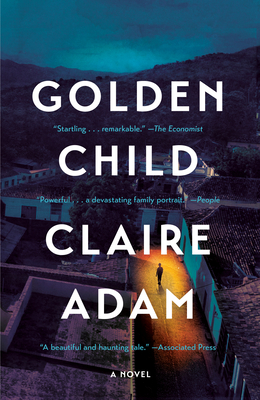
Book Review: Golden Child by Claire Adam

Title: Golden Child
Author: Claire Adam
Publisher: Hogarth Press
Publication date: January 15, 2019
Length: 304 pages
Genre: Contemporary fiction
Source: Purchased
Rating:

Rating: 4 out of 5.

A deeply affecting debut novel set in Trinidad, following the lives of a family as they navigate impossible choices about scarcity, loyalty, and love

WINNER OF THE DESMOND ELLIOTT PRIZE – “Golden Child is a stunning novel written with force and beauty. Though true to herself, Adam’s work stands tall beside icons of her tradition like V.S. Naipaul.”–Jennifer Clement, author of Gun Love

Rural Trinidad: a brick house on stilts surrounded by bush; a family, quietly surviving, just trying to live a decent life. Clyde, the father, works long, exhausting shifts at the petroleum plant in southern Trinidad; Joy, his wife, looks after the home. Their two sons, thirteen years old, wake early every morning to travel to the capital, Port of Spain, for school. They are twins but nothing alike: Paul has always been considered odd, while Peter is widely believed to be a genius, destined for greatness.

When Paul goes walking in the bush one afternoon and doesn’t come home, Clyde is forced to go looking for him, this child who has caused him endless trouble already, and who he has never really understood. And as the hours turn to days, and Clyde begins to understand Paul’s fate, his world shatters–leaving him faced with a decision no parent should ever have to make.

Like the Trinidadian landscape itself, Golden Child is both beautiful and unsettling, a resoundingly human story of aspiration, betrayal, and love.

Golden Child is an absorbing, heart-breaking book about a family’s life in Trinidad, about opportunities and tragedies, and about choices that should never be made.

The Deyalsinghs are a Hindu family living in rural Trinidad, far from city life and its conveniences. The water supply comes and goes, homes must be barred and gated to keep out the roving bandits and gangsters who are a constant threat, corruption is everywhere, and everyone knows everyone’s business. The father, Clyde, works hard to provide his sons with a better life than the one he had, while mother Joy’s extended family provides assistance and financial help as long as they are able.

The sons, Peter and Paul, are twins, but Paul was deprived of oxygen at birth and has been labeled “slightly retarded” all his life (although as we get to know Paul, this clearly seems to be a false label). Peter is brilliant and shines academically, but Paul struggles to keep up — yet Joy insists that the boys must stay together. A kind priest takes an interest in Paul’s education and offers to tutor him, yet Paul is constantly aware that he’s not good enough, that he’s a burden, and that his path will be different than Peter’s.

As the book opens, Paul has failed to come home one afternoon. With evening approaching, and all the danger night brings, Clyde begins a frantic search for him. We learn that there was a break-in at the house only weeks before, and that the bandits left frustrated at not finding money in the home.

From here, we flash back to the boys’ birth, early childhood, and years of school, seeing how the family grew and changed. We’re shown snippets of different times of the boys’ lives, and through these scenes, come to understand Peter and Paul’s connection to one another as well how very differently their family, schoolmates, and teachers view the two boys.

Finally, we come back to Paul’s disappearance, learning that he has been kidnapped and is being held for ransom. In alternating chapters, we follow both Paul’s experience and Clyde’s efforts to free him. I won’t divulge how it works out, but it’s harrowing and frightening and absolutely awful to read about what Paul goes through.

It’s a little challenging to write further about this book without revealing the resolution, so I’ll just share some overall thoughts.

The structure of the book was an obstacle for me in terms of feeling invested. The opening, as the family realizes that Paul is missing and Clyde goes out to look for him, doesn’t provide enough information — I didn’t get a good sense of who this family is, what their background is, and how they fit into the world around them. It was only in part 2, as we go back through the family’s story, that I became more engaged with the characters. I get that this structure is a deliberate decision on the part of the author and editors, but in my experience, it was awkward and made me feel not particularly interested in the book as a whole. I’m glad I stuck with it, though, as it does pick up and become more cohesive once the background is provideed.

The depiction of life in Trinidad during the period in which the book is set is well-drawn, with an unvarnished portrait of a land that can be beautiful, but whose people prey on one another, where the economy offers few opportunities, and where grift and connections and playing along with the power structure can be the difference between life and death.

The characters are all sharply distinct, although Peter’s inner life is left unexplored. Clyde and Paul are the two most developed characters, and the more we get to know them, the more painful the book becomes to read.

Overall, Golden Child is a moving depiction of a time and place that I hadn’t previously known much about, with characters I ended up caring about and an ending that left me feeling gutted. It’s a tough read emotionally, with beautiful language as well as an overwhelming sense of sorrow.

Golden Child was my book group’s pick for May. I don’t know that I would have come across it otherwise, and as always, I’m grateful to my book group for broadening my horizons! There’s a lot of food for thought and lots to discuss and debate, and I’m so looking forward to hearing other opinions on this disturbing, powerful book.

**********

Through affiliate programs, I may earn commissions from purchases made when you click through these links, at no cost to you.

Buy now at AmazonBook DepositoryBookshop.org

Book Review: The Soulmate Equation by Christina Lauren

Title: The Soulmate Equation
Author: Christina Lauren
Publisher: Gallery Books
Publication date: May 18, 2021
Length: 368 pages
Genre: Contemporary fiction/romance
Source: Review copy courtesy of the publisher via NetGalley
Rating:

Rating: 4 out of 5.

Single mom Jess Davis is a data and statistics wizard, but no amount of number crunching can convince her to step back into the dating world. Raised by her grandparents–who now help raise her seven-year-old daughter, Juno–Jess has been left behind too often to feel comfortable letting anyone in. After all, her father’s never been around, her hard-partying mother disappeared when she was six, and her ex decided he wasn’t “father material” before Juno was even born. Jess holds her loved ones close, but working constantly to stay afloat is hard…and lonely.

But then Jess hears about GeneticAlly, a buzzy new DNA-based matchmaking company that’s predicted to change dating forever. Finding a soulmate through DNA? The reliability of numbers: This Jess understands. At least she thought she did, until her test shows an unheard-of 98% compatibility with another subject in the database: GeneticAlly’s founder, Dr. River Pena. This is one number she can’t wrap her head around, because she already knows Dr. Pena. The stuck-up, stubborn man is without a doubt not her soulmate. But GeneticAlly has a proposition: Get to know him and we’ll pay you. Jess–who is barely making ends meet–is in no position to turn it down, despite her skepticism about the project and her dislike for River. As the pair are dragged from one event to the next as the “Diamond” pairing that could make GeneticAlly a mint in stock prices, Jess begins to realize that there might be more to the scientist–and the science behind a soulmate–than she thought.

Funny, warm, and full of heart, The Soulmate Equation proves that the delicate balance between fate and choice can never be calculated.

When you pick up a new Christina Lauren book, you know you’ll get crazy good chemistry, unlikely pairings, great banter, and lots of clever plotting. The Soulmate Equation is no exception — yet another really fun modern romance with a few tricks up its sleeves.

Main character Jess, on the cusp of 30, spends all day, every day at a local coffee shop, working on her freelance statistics jobs alongside her best friend Fizzy, a successful romance writer. They use the free wifi, buy snacks and drinks every 90 minutes so they’re not just mooching, people watch, get work done, and enjoy one another’s company. And they always notice the arrival of “Americano”, the surly yet gorgeous businessman who arrives every morning exactly at 8:24, orders the exact same drink, and leaves without making eye contact with a single person.

Jess is getting by, but she has constant worries. She needs to keep and attract more clients to feel financially secure, and as the single mother of a 7-year-old, she’s only too aware of how precarious their situation could be. One dropped client could mean no ballet lessons for Juno, but one more could mean she’d be able to save for braces. Fortunately, Jess and Juno live in the same complex as Jess’s Nana and Pops, the loving grandparents who raised Jess, and their love and support makes a huge difference.

Everything changes one day when Fizzy learns that “Americano” is starting an online matchmaking business, which the friends just can’t believe. He is so stern and buttoned-up! Fizzy, being her usual effervescent self, stops him in the coffee shop and asks him, and while he says it’s not exactly a matchmaking service, he does leave a card and invites them to learn more. Never one to waste time, Fizzy insists that they go check out the office same day.

Lo and behold, “Americano” is actually Dr. River Pena, a geneticist and found of GeneticAlly, a company that uses DNA analysis to assess compatibility and match people biologically determined to be likely soulmates. It all sounds a bit crazy, but Jess is reluctantly fascinated by the statistics quoted during their presentation, and Fizzy just wants a chance for some reasonably good hook-ups. Fizzy submits a sample, and Jess eventually does too, after a day when she feels particularly down about how unchanging her life feels.

Things truly get crazy when Jess is urgently called back to the GeneticAlly offices. Her tests have come back, and she’s matched at a 98% compatible score, something never seen before. The company reps are thrilled, especially at the idea of the great press they’ll get ahead of the company’s IPO… all except Dr. Pena, who, it turns out, is Jess’s match. But how can this be? They can barely tolerate one another!

You can see where this is going, right? Jess agrees to spend time with River for the sake of the company, even though she knows the data must not be right. How can numbers predict who you’ll fall in love with? An even scarier thought for Jess is, what if the numbers really are true? Can science say you’ll fall for someone even when all first impressions say the exact opposite?

Watching Jess and River get to know one another and start to acknowledge their developing chemisty is quite fun. Jess is an amazing and responsible mother, so she’s very cautious about letting River into her life. Meanwhile, River is a serious scientist who’s never made time for love, but he’s staked his entire career on this company and absolutely believes in it — so if he denies that their results mean that they’re meant for one another, what does this mean for his faith in his own work?

The flirtation and courtship and physical attraction between these two is adorable, and I love how they each open up to one another, allowing the other person to see and understand their vulnerabilities, their past experiences, and their hopes and fears. They’re incredibly sweet together, and if you don’t melt during some of the scenes of River helping Juno with her homework, then you have no soul. (Too harsh? Sorry.)

One thing I always appreciate in Christina Lauren books is how smart and competent and professional their female characters are. Jess is a statistician — how cool is that? And it’s not just a throwaway. Not that I understand her work, but I liked reading about her projects, her thought processes, and how she applies her knowledge of data and statistics to understanding River’s work and GeneticAlly’s match results.

Fizzy is an awesome best friend, and I love that she’s a romance writer. There are a few lines about her work that made me think she’s standing in for the author duo and proving wrong (in the funniest way possible) every lousy, ill-informed comment about writing romances that they’ve ever been subjected to. Fizzy is funny and supportive and silly, and I’d love to read even more about her!

The Soulmate Equation is a lot of fun, and it’ll leave you with all sorts of warm, fuzzy feels. I read it over the course of two gray, drizzly days, and it made me feel like the sun was shining again! If you enjoy smart contemporary romance that feels authentic even when it’s funny, don’t miss this one!

**********

Through affiliate programs, I may earn commissions from purchases made when you click through these links, at no cost to you.

Buy now at AmazonBook DepositoryBookshop.org

Book Review: The Album of Dr. Moreau by Daryl Gregory

Title: The Album of Dr. Moreau
Author: Daryl Gregory
Publisher: Tordotcom
Publication date: May 18, 2021
Length: 176 pages
Genre: Science fiction
Source: Review copy courtesy of the publisher via NetGalley
Rating:

Rating: 4.5 out of 5.

Daryl Gregory’s The Album of Dr. Moreau combines the science fiction premise of the famous novel by H. G. Wells with the panache of a classic murder mystery and the spectacle of a beloved boy band.

It’s 2001, and the WyldBoyZ are the world’s hottest boy band, and definitely the world’s only genetically engineered human-animal hybrid vocal group. When their producer, Dr. M, is found murdered in his hotel room, the “boyz” become the prime suspects. Was it Bobby the ocelot (“the cute one”), Matt the megabat (“the funny one”), Tim the Pangolin (“the shy one”), Devin the bonobo (“the romantic one”), or Tusk the elephant (“the smart one”)?

Las Vegas Detective Luce Delgado has only twenty-four hours to solve a case that goes all the way back to the secret science barge where the WyldBoyZ’ journey first began—a place they used to call home.

This book is so weird… and I loved it.

In The Album of Dr. Moreau, we meet the WyldBoyZ — the world’s most adored boy band, who sing in perfect harmony, have killer dance moves, and have the physical appearance of very interesting animal/human mixes. These five pop stars are genetically engineered animal-human hybrids, and they’ve taken the world by storm.

As the book opens, their ethically-challenged, manipulative manager Dr. M. has been found brutally murdered in his Las Vegas suite after the Boyz’s final tour performance and blow-out afterparty. Who wanted Dr. M. dead, and who had opportunity? As Detective Luce Delgado quickly establishes, all of the Boyz had motive, and any one of them could have had access.

Meanwhile, the case is complicated by the WyldBoyZ’s wild celebrity, as well as by their rabid fan base, referred to as zoomies (which true fans consider offensive — they prefer zoomandos, thank you very much). Zoomies dress in elaborate animal costumes, so as Luce and her colleagues review the video footage from the party, it’s pretty much impossible to tell who’s who beneath the unicorn, gopher, chipmunk, and other furry costumes.

As Luce investigates, we get to know each of the Boyz, and learn more and more about their backstory, where they came from, and what they’ve had to endure. I absolutely loved her interviews with the band members, seeing their personalities, their habits, and their quirks… and how not weird she tries to make it as she’s sitting and having a conversation with a human-pangolin hybrid, as one example.

This book is short, but so jam-packed with goodness that there’s no wasted space. I was entertained and hooked from page one, and adored every moment. The wacky idea of a human-animal-hybrid boy band is so out there, and it’s perfect.

I happen to have read The Island of Dr. Moreau by H. G. Wells last year, and that made reading The Album of Dr. Moreau extra amusing as a point of comparison — but don’t worry if you haven’t read the Wells classic. It’s not necessary for enjoying this book, since they don’t really have anything to do with one another except as a passing reference… but if you’re curious, it’s worth checking out.

The Album of Dr. Moreau is so much crazy fun. My only complaint: I really, REALLY, want to see a video of the WyldBoyZ in action. Please, someone, make it happen!!

**********

Through affiliate programs, I may earn commissions from purchases made when you click through these links, at no cost to you.

Buy now at AmazonBook DepositoryBookshop.org

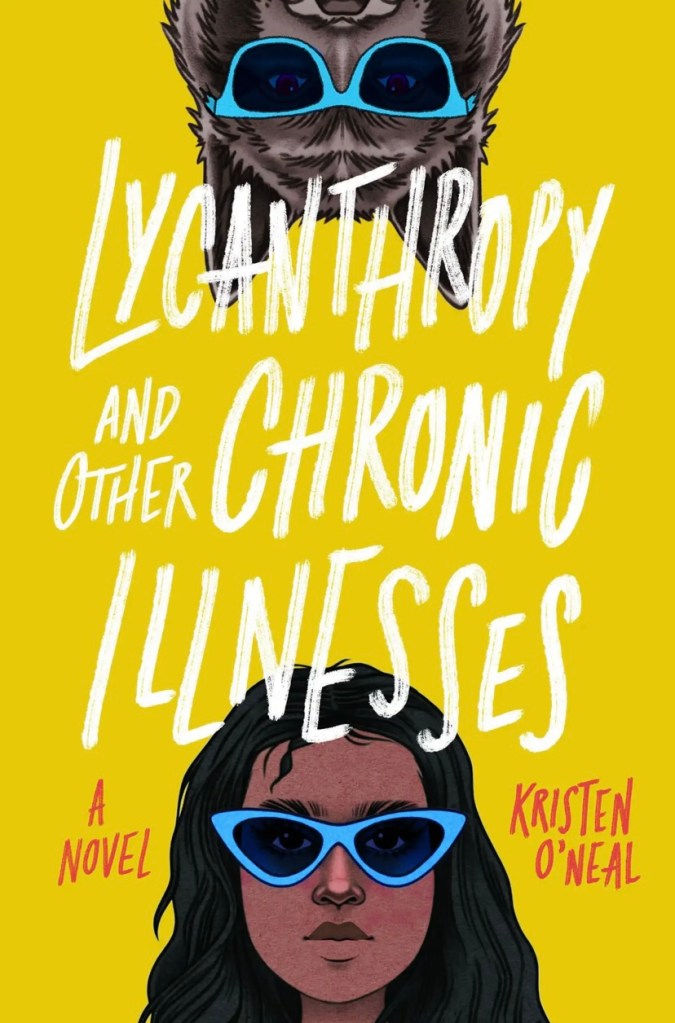
Book Review: Lycanthropy and Other Chronic Illnesses by Kristen O’Neal

Title: Lycanthropy and Other Chronic Illnesses
Author: Kristen O’Neal
Publisher: Quirk Books
Publication date: April 27, 2021
Print length: 383 pages
Genre: YA/horror/contemporary
Source: Review copy courtesy of the publisher via NetGalley
Rating:

Rating: 4.5 out of 5.

Teen Wolf meets Emergency Contact in this sharply observed, hilarious, and heartwarming debut young adult novel about friendship and the hairy side of chronic illness.

Priya worked hard to pursue her premed dreams at Stanford, but a diagnosis of chronic Lyme disease during her sophomore year sends her back to her loving but overbearing family in New Jersey—and leaves her wondering if she’ll ever be able to return to the way things were. Thankfully she has her online pen pal, Brigid, and the rest of the members of “oof ouch my bones,” a virtual support group that meets on Discord to crack jokes and vent about their own chronic illnesses.

When Brigid suddenly goes offline, Priya does something out of character: she steals the family car and drives to Pennsylvania to check on Brigid. Priya isn’t sure what to expect, but it isn’t the horrifying creature that’s shut in the basement.

With Brigid nowhere to be found, Priya begins to puzzle together an impossible but obvious truth: the creature might be a werewolf—and the werewolf might be Brigid. As Brigid’s unique condition worsens, their friendship will be deepened and challenged in unexpected ways, forcing them to reckon with their own ideas of what it means to be normal.

For a book with such a cute, light-hearted cover, Lycanthropy and Other Chronic Illnesses touches on some heavy and important topics — and it works amazingly well.

Main character Priya sees her premed dreams yanked away after becoming debilitated by Lyme disease. Her illness and constant pain force her to take a leave of absence from Stanford and move back home, where she has to deal not just with her illness and treatment, but also with living in her parents’ home again and her loss of independence. She’s depressed by how she feels physically and by her doubt that she’ll ever be able to become a doctor, knowing her levels of exhaustion, pain, and brain fog will prevent her from being able to put in the hours and study needed. She misses her college friends, and wonders if any of them even think about her anymore. It feels like life has just passed her by in a big way, and meanwhile, her painful joints and lack of stamina are here to stay.

Luckily, she has her on-line friend Brigid and a group of other people with chronic illnesses, who form a virtual group (called, adorably, “oof ouch my bones”). The group share stories about their diagnoses, treatments, and fears, but also plenty of laughs and unconditional support. Priya and Brigid are particularly close, and when Brigid fails to show up for a scheduled chat, Priya decides to step way out of her comfort zone and go check on her.

As you won’t be surprised to learn at all, since it’s all right there in the book’s title, Brigid’s chronic illness is lycanthropy. Once a month, she changes into a big, scary, hairy, teeth-y creature — and normally it’s under control, because she locks herself into the basement ahead of time. But lately, her changes have been coming more frequently and with no advance warning, and Brigid fears that before too long, she won’t be herself at all anymore.

Priya decides to help Brigid, and the two embark on a quest to find out why Brigid turns and if there’s a cure. Along the way, they’re joined by the cute local animal control guy who helps Priya when wolf-Brigid gets loose and terrorizes her small town. Hijinks ensue, naturally… but would you believe me if I told you that Lycanthropy and Other Chronic Illnesses is also very empathetic and touching?

Through Priya and Brigid’s experiences, as well as through the conversations with the online group, we are shown first-hand what chronic illness can do to a person’s life. Priya is a wonderful point-of-view character, and the author lets us inside Priya’s heart and mind, letting us witness her fears, pain, disappointment, and stress.

As the parent of someone with a chronic illness, I felt that so much of Priya’s experiences rang true. The author really captures the way a chronic illness diagnosis can feel like a life’s been upended and derailed, and how the knowledge that the symptoms and risks will linger a lifetime can feel overwhelming, like nothing will ever be the same. I really felt for Priya, who at the beginning feeling hopeless and that her life will have no greater purpose, and was really cheered when she slowly starts to discover that living with a chronic illness may mean that she has to adapt her dreams, but not abandon them.

Of course, the werewolf escapades are quite fun, and Priya and Brigid’s friendship is wonderful. So much of their communication is online, through texts, blog posts, and group chats, and it’s all very quirky and cute, and often very, very funny.

I’m so grateful to Quirk Books for approving my ARC request! I’m not sure that I would have stumbled across this book without seeing it on NetGalley, and I’m so, so glad that I read it!

Tiny little grumble: Because of the formatting of the texts, chats, etc, I read this ARC in PDF format rather than on my Kindle, and while I thought I was highlighting great lines and funny passages, apparently none of my highlighting stuck. So… sorry for not being able to share quotes, but trust me, this book has plenty of seriously funny ones!

I enjoyed this book so much. Don’t miss it!

**********

Through affiliate programs, I may earn commissions from purchases made when you click through these links, at no cost to you.

Buy Lycanthropy and Other Chronic Illnesses at AmazonBook DepositoryBookshop.org

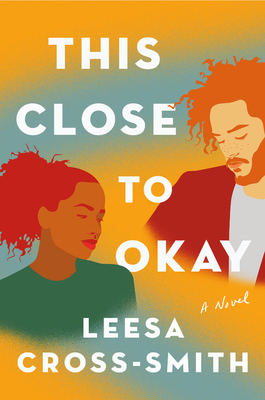
Audiobook Review: This Close to Okay by Leesa Cross-Smith

Title: This Close to Okay
Author: Leesa Cross-Smith
Narrators: Kamali Minter, Zeno Robinson
Publisher: Grand Central Publishing
Publication date: February 2, 2021
Print length: 311 pages
Audiobook length: 9 hours, 46 minutes
Genre: Contemporary fiction
Source: Library
Rating:

Rating: 4 out of 5.

From the award-winning Southern writer who Roxane Gay calls “a consummate storyteller” comes a cathartic novel about the life-changing weekend shared between two strangers: a therapist and the man she prevents from ending his life.

On a rainy October night in Kentucky, recently divorced therapist Tallie Clark is on her way home from work when she spots a man precariously standing on the side of a bridge. Without a second thought, Tallie pulls over and jumps out of the car into the pouring rain. She convinces the man to join her for a cup of coffee, and he eventually agrees to come back to her house, where he finally shares his name: Emmett.

Over the course of the emotionally charged weekend that follows, Tallie makes it her mission to provide a safe space for Emmett, though she hesitates to confess that this is also her day job. But what she doesn’t realize is that he’s not the only one who needs healing — and she’s not the only one with secrets.

Alternating between Tallie and Emmett’s perspectives as they inch closer to the truth of what brought Emmett to the bridge’s edge — as well as the hard truths Tallie has been grappling with in her own life — This Close to Okay is a vibrant, powerful story of two strangers brought together by wild chance at the moment they needed each other most.

In this moving, surprising, dual-narrator novel, we meet two damaged souls who find solace and hope through their accidental meeting.

When Tallie sees a man poised to jump off a bridge, she immediately tries to intervene, gently using her words and music to encourage him back from the brink, then continuing to provide companionship and support in the hours and days that follow. She doesn’t approach Emmett as a therapist, although she is one — instead, she offers caring and compassion, as well as shelter and a safe space.

Over the course of their time together, each slowly opens up to the other, but at their own pace, and keeping secrets even while sharing hopes, fears, and past hurts. They each also cross boundaries, aware of infringing on the other’s privacy but somehow justifying this through good intentions.

The book shifts point-of-view between Tallie and Emmett, and through their alternating chapters, we learn about the events in their lives that brought them both to this particular moment. Each has been through hurts and suffering, and while Tallie shares the pain of her husband’s betrayal and subsequent divorce, Emmett keeps his past largely to himself, hiding the source of his desperation and suicidal impulses, and even hiding his true identity.

The beauty of This Close to Okay is in getting to know these complex characters and seeing how the different struggles in their lives have contributed to where they are as the story opens. It’s lovely to see their interactions and how they each affect the other in deep and meaningful ways. The story is not action-packed — it’s really about the characters and how they connect, and that’s probably why it resonates on such an emotional level.

Sure, there are some elements that I could quibble with. Tallie takes a huge risk by bringing Emmett into her life and into her home, and it’s hard to believe that a modern woman in this day and age would potentially compromise her own safety in such a dramatic way. Yes, Emmett is trustworthy and respectful and safe, but she really couldn’t have known that up front, could she? Likewise, I have a bone to pick with Tallie’s decision to not share with Emmett that she’s a therapist. She knows that her professional obligation toward an official client would be to refer him for treatment and report an attempted suicide, but she rationalizes that Emmett is not her client as part of her decision to just spend time with him and offer him a place to rest and regroup. She has compassionate impulses, and since this is a novel, it all works out, but looking in from the outside, this feels like a very risky and unprofessional path to take.

The audiobook made for a great listening experience. I appreciated the expressiveness of the two narrators and how they voiced the characters and the more interior moments. I did struggle a bit with the male narrator’s lower vocal register, which made it hard for me to catch all the words clearly, but that may be more about my own hearing than the actual narration!

Overall, I did love This Close to Okay. Despite my disagreement with some of the plot points, I was completely caught up in the story, and felt my heart break over and over again as more is revealed about Emmett’s painful past. I will say as well that I was pleasantly surprised that this book does not fall into the common romantic tropes that pop up so often in contemporary fiction. The characters’ development and well-being is the point, and the plot supports this very well without making romantic entanglement the dominant focus.

Side note: I always love when fictional characters are revealed to share some of my geeky loves… so when Tallie pulls her copy of Prisoner of Azkaban off the shelf to read to Emmett, I just about swooned!

This Close to Okay is a moving story about two sympathetic people, and I truly enjoyed getting to know each of them. By the end, I felt very invested in their lives, and loved how beautifully the author conveyed their journeys.

Highly recommended!

**********

Through affiliate programs, I may earn commissions from purchases made when you click through these links, at no cost to you.

Buy This Close to Okay at AmazonBook DepositoryBookshop.org

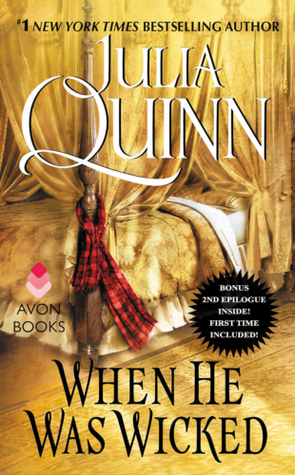
Book Review: When He Was Wicked (Bridgertons, #6) by Julia Quinn

Title: When He Was Wicked (Bridgertons, #6)
Author: Julia Quinn
Publisher: Avon
Publication date: 2004
Length: 426 pages
Genre: Romance
Source: Purchased
Rating:

Rating: 4 out of 5.

In every life there is a turning point . . .

A moment so tremendous, so sharp and breathtaking, that one knows one’s life will never be the same. For Michael Stirling, London’s most infamous rake, that moment came the first time he laid eyes on Francesca Bridgerton.

After a lifetime of chasing women, of smiling slyly as they chased him, of allowing himself to be caught but never permitting his heart to become engaged, he took one look at Francesca Bridgerton and fell so fast and hard into love it was a wonder he managed to remain standing. Unfortunately for Michael, however, Francesca’s surname was to remain Bridgerton for only a mere thirty-six hours longer—the occasion of their meeting was, lamentably, a supper celebrating her imminent wedding to his cousin.

But that was then . . . Now Michael is the earl and Francesca is free, but still she thinks of him as nothing other than her dear friend and confidant. Michael dares not speak to her of his love . . . until one dangerous night, when she steps innocently into his arms and passion proves stronger than even the most wicked of secrets . . . 

Another flight, another Bridgerton book! Book #6, When He Was Wicked, tells the story of the 6th Bridgerton child, Francesca — who spends much of the book series (as well as practically all of season 1 of the Netflix series) off-screen.

A rare glimpse of Francesca

We’ve heard about Francesca from afar during the previous couple of books. A year younger than her sister Eloise, Francesca is largely absent from the goings-on in the earlier books, at first being too young to be out in society, and later, already away from London.

We learn in book #4 (I believe) that Francesca is already a young widow at age 24. We hear of her through other family members, and know that she was married to an earl and lives at their estate in Scotland. That’s pretty much all we know, other than that she seems to never be around for family gatherings.

“It’s as if I don’t exist,” she said…

Finally, in When He Was Wicked, Frannie’s story takes center stage.

We start the book, however, not with Francesca, but with her husband’s cousin. Michael Stirling is first cousin to John Stirling, Earl of Kilmartin. Michael has a reputation as a terribly wicked rake (of course! don’t all the attractive men?), but he’s also loyal and devoted to John, who is more brother to him than cousin. Michael also has the bad luck and bad timing to fall head over heels in love with Francesca at first sight — which happens to be only a day and a half before John marries her.

Michael hides his feelings, and becomes a true friend to Francesca. The three — Michael, John, and Francesca — are inseparable, and best of friends. But two years later, when the unthinkable happens and John dies suddenly, Michael and Francesca are torn apart as well. Michael, as John’s heir, will step into his role as Earl. He feels horrible guilt over living what should have been John’s life, and cannot bear the idea of being close to Frannie and being her main support while knowing the guilty truth of his secret love for her. Michael flees to India as soon after John’s death as he can, and Francesca is left widowed, in mourning, suffering, and feeling abandoned by the person she most counted on.

Years pass, and Francesca realizes that she wants a baby. And of course, the only way to get a baby is to marry — so she leaves the estate in Scotland to spend the season in London and look for a suitable husband. Michael shows up as well, ready to fully assume his duties as Earl, which also means finding a wife.

As the widowed Countess of Kilmartin, Francesca takes up residence in the Kilmartin home in London, and so does Michael, where the two soon find themselves too close for comfort. After a series of misunderstandings and confrontations, there’s finally a kiss, and Francesca is shocked and embarrassed to realize that she feels attracted to Michael. And, as such things go in romance novels, she assumes it’s one-sided and flees back to the Scottish estate, only to be pursued by Michael, where things quickly become hot and heavy… and as the title lets us know, very, very wicked.

I enjoyed the storytelling very much in this book, and felt quite sorry for poor Frannie, widowed too young, facing a lifetime on her own, and longing so much for a family that she’s even willing to consider marriage without love if it’ll allow her to have babies. There are some very sweet moments between her and her mother Violet, in which they share thoughts on widowhood, losing the love of one’s life, and how to move on. Violet is open to Francesca in a way which we haven’t seen with her daughters in other books, probably because none have been as vulnerable as Francesca, and it’s lovely.

Michael is given equal time with Francesca as a point-of-view character, and I found his outlook refreshing and insightful. As is typical in romances set in this period, his sexual conquests aren’t seen as shameful (only women can be ruined by inappropriate conduct, not men), but at least we get to hear his perspective on all the women he’s been with and how they were all really just stand-ins for Francesca. Michael’s sorrow and guilt regarding his cousin seem genuine and heartfelt, so that as he and Francesca start to explore their attraction and growing feelings, it makes sense that Michael would be held back by his inner doubts even while yearning to be with the woman of his dreams.

I’m not sure that I loved Michael’s ultimate gambit for tying Francesca to him. He can’t make progress by words or wooing, so he sets out to seduce her, figuring he’ll make her want him even if she doesn’t love him. (Spoiler alert — she does love him!) The sexual advances and hot-and-heavy scenes are all entirely consensual — he asks her every step of the way — but I still felt a little uncomfortable with the idea of his using her arousal to push her into a relationship she might not otherwise be ready for.

He’d awakened the wanton within her, and she wanted her revenge.

It’s not a surprise that true love and a wedding and babies are the end game here — in that sense, When He Was Wicked is no different from the other books in the series. Still, the plot here is quite good, and I liked getting to know Francesca, and seeing a very different view of the social pressures of Regency society. Francesca is no virginal debutante — she’s a widow of means who has the social and economic power to remain unmarried and independent for the rest of her life, if she so chooses. In When He Was Wicked, we see marriage and courtship through a practical lens — if a young widow wants a baby, then how else is she to get what she wants but to find a suitable husband and make it happen?

I also found the chronology of When He Was Wicked interesting, as it overlaps with events from the previous two books, and I thought author Julia Quinn pulled off the interwoven events and details very well! Overall, this is another delightful addition to a series that becomes more and more addictive as it goes along. This many books into the series, it’s hard to stop.

That’s six Bridgerton children happily married, two more to go!

**********

Through affiliate programs, I may earn commissions from purchases made when you click through these links, at no cost to you.

Buy When He Was Wicked at AmazonBook DepositoryBookshop.org