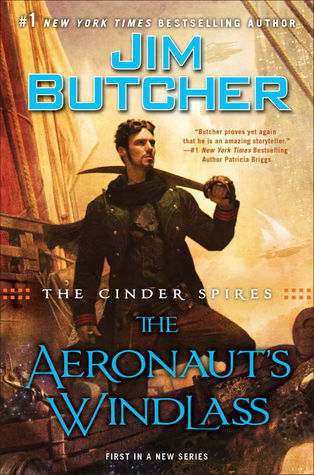
Book Review: The Aeronaut’s Windlass by Jim Butcher

Aeronauts WindlassI’ll admit it up front: I’m a Jim Butcher fan. I’ve read all of the Dresden Files novels (15 so far), and various and sundry related stories, novellas, and graphic novels. Heck, I own the DVD of the (sadly short-lived) Dresden Files TV series. I binge-read the six volumes of the Codex Alera series a few years back. So, I guess you could say there was a decent chance that I’d love The Aeronaut’s Windlass too.

Yup. I did. Loved it a bunch.

The Aeronaut’s Windlass is the first book in a new series (The Cinder Spires), and it’s a remarkable feat of world-building. The book is set in a world in which mankind lives in huge, multi-storied towers (which are miles high and about two miles in diameter) that function as independent countries. The surface of Earth is dangerous and uninhabitable, covered by mists that conceal all sorts of dangers. Commerce is conducted in the air by fleets of airships that use etheric currents and power crystals to swoop, soar, dive, and attack.

Our loyalty is to Spire Albion (which I assume is more or less England, between the name and all the tea-drinking), and we meet a sprawling cast of characters right from the start. The main hero is Captain Grimm, commander of the AMS Predator, a non-military ship that makes its money from privateering. Grimm has a shadowy past that includes a dishonorable discharge from the Fleet, but from the first instant, it’s clear that he’s brave, noble, and a kick-ass air captain.

In addition to Captain Grimm and the crew of the Predator, we meet Gwen, a military recruit who stems from the very upper crust Lancaster family, which basically holds the monopoly on crystal production; Gwen’s cousin Benedict, who is a genetically-mixed warriorborn human; and Bridget, a large, self-conscious girl who finds an inner core of strength and courage.

And let’s not forget my very favorite character (and I suspect he’d resent anyone but himself being considered the hero of the piece): Rowl of the Silent Paws tribe, kit to Maul, chief of the Silent Paws. Rowl is a cat, and the cats in this book absolutely rock. They’re fierce warriors with an elegant and intricate system of power dynamics, clan politics, and etiquette. They mostly look down on clumsy humans, apart from the few (like Bridget, whom Rowl refers to as Littlemouse) who can speak Cat fluently.

Littlemouse was in danger, doubtless a prisoner, and the humans could not be trusted to handle her rescue with appropriate violence. They might be willing to leave someone alive, and Rowl was not prepared to tolerate incompetence where his personal human was concerned. He had just gotten her properly trained.

The action kicks into high gear when Spire Albion is attacked by a Marine contingent from Spire Aurora (Spain, as far as I can figure). The attack is sudden and devastating, and seems to have a sinister mastermind behind it whose motives are unclear. The good guys seems to be constantly outnumbered and outgunned, and the danger is vivid and terrifying — especially when highly venomous icky things called silkweavers seem to be serving the Aurorans, killing and maiming everything in their path.

Our little band of heroes is aided by a master etherealist, who has strange and inexplicable powers that allow him to see the unseen currents all around him, and his apprentice Folly, who’s another amazing and wonderful character. Folly is odd and off-kilter, but is possessed of incredible skill and instinct and comes to the rescue more than once (or twice, or thrice).

It’s all quite thrilling and absorbing. Jim Butcher does many things well, and he truly excels at writing action sequences. The extended airship battles are breathtaking, with booming cannons and swooping maneuvers, and a brave captain who never waivers in the face of enemy attack. (Okay, maybe I have just a teensy crush on Grimm at this point, but can you blame me?)

As always, Butcher knows just how to mix tense drama and high danger with sparkling, witty dialogue. The scenes narrated by Rowl are, of course, my favorites, but you don’t have to turn many pages in a Butcher book to find some clever wordplay or smart-ass retorts to lighten the mood.

Gwen sighed, and fetched another pair of mugs for the etherealist.

“Lovely,” Ferus said, and gulped some more. “Perceptions of etheric energy change from mind to mind, just as you and Sir Benedict demonstrate with your weapons crystals. And if one changes one’s mind, that also changes the nature of those perceptions. This will allow me to perceive those energies in ways in which I would not normally be able to do so.”

“You’re getting drunk,” Gwen said slowly, “so that you can experience etheric energy differently?”

Ferus held up his mug and said solemnly, “Think of it as goggles for one’s mind, instead of one’s eyes.”

The Aeronaut’s Windlass is a BIG book, over 600 pages. That would be huge, in and of itself, but considering this is just the first in a series, reading it feels like a pretty major undertaking. If I didn’t already know and love Jim Butcher’s books, I might be scared off, I suppose. There’s obviously much more yet to come in this series. While the book’s conclusion wraps up the first wave of battle, it’s clear that the war is just getting underway, and there are major questions left unanswered.

I struggled a bit at the beginning to understand the structure of the Spires and some of the fundamentals of the world of this book, but the action and the characters drew me in immediately, and it didn’t really take all that long for the more obscure elements to start to make sense and feel natural. By about the midpoint, I really hated to put the book down. And now that I’ve finished, I can say with certainty that I’m all in. I can’t wait for more of this excellent series, and just wish I could move straight on to the next book, instead of having to wait the year or two it’ll probably take for #2 to be released.

You really can’t go wrong with a Jim Butcher series. Fans will absolutely want to dive into the world of The Cinder Spires, and I think The Aeronaut’s Windlass is a great introduction for people who haven’t read his books too. (Although, if you haven’t read any Butcher, I’d urge you to run right out and find a copy of Storm Front, the first Dresden book).

So there you have it — a lengthy review which all boils down to: I loved this book. Go read it.

I’ll let Rowl have the final word, because he deserves it:

Each creature had something it excelled at, he supposed. Humans could manage knots easily, and cats could do everything else.

_________________________________________

The details:

Title: The Aeronaut’s Windlass (The Cinder Spires, #1)
Author: Jim Butcher
Publisher: Roc
Publication date: September 29, 2015
Length: 630 pages
Genre: Fantasy/steampunk
Source: Purchased
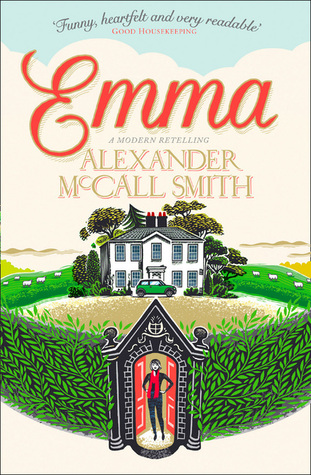
Take A Peek Book Review: Emma by Alexander McCall Smith

“Take a Peek” book reviews are short and (possibly) sweet, keeping the commentary brief and providing a little peek at what the book’s about and what I thought.

Adobe Photoshop PDF

Synopsis:

(via Goodreads)

Prepare to meet a young woman who thinks she knows everything

Fresh from university, Emma Woodhouse arrives home in Norfolk ready to embark on adult life with a splash. Not only has her sister, Isabella, been whisked away on a motorbike to London, but her astute governess, Miss Taylor is at a loose end watching as Mr. Woodhouse worries about his girls. Someone is needed to rule the roost and young Emma is more than happy to oblige.

At the helm of her own dinner parties, and often found either rearranging the furniture at the family home of Hartfield, or instructing her new protégée, Harriet Smith, Emma is in charge. You don’t have to be in London to go to parties, find amusement or make trouble.

Not if you’re Emma, the very big fish in the rather small pond.

But for someone who knows everything, Emma doesn’t know her own heart. And there is only one person who can play with Emma’s indestructible confidence, her friend and inscrutable neighbour George Knightly – this time has Emma finally met her match?

Ever alive to the social comedy of village life, beloved author Alexander McCall Smith’s Emma is the busybody we all know and love, and a true modern delight.


My Thoughts:

Alexander McCall Smith’s Emma is the latest volume related to The Austen Project, which pairs up popular contemporary authors with the classic works of Jane Austen.

Austen’s Emma is one of my favorites. I mean, I truly LOL’d over Emma as I listened to the audiobook earlier this year (which can be rather embarrassing when out in public wearing earphones.)

In this retelling, Emma is a college graduate who is thinking about starting her own interior decorating business, but in reality doesn’t have to do much, as her dear dad, Mr. Woodhouse, is more than happy to support Emma indefinitely — in between worrying about health, weather, and every possible hazard that could come their way. The various village residents are here, mostly true to the original, including the chatty Miss Bates and the snobbish but boring Mr. Elton.

Mr. Woodhouse gets many of the best lines, with his obsessive health worries:

“It will be good for them to get out of London and get some country air. All those people in London breathing the air in and out; just think of it, Emma. Just think of all that breathing going on in London — it’s a wonder there’s any air left for the rest of us.”

Emma gets many wry and silly moments too, such as:

“Look at the moon,” she said. “So bright. So lunar!” She had to say something.

And another gem:

Emma thought that this conversation would be a difficult  one to conduct with anybody other than Harriet, with anybody … less beautiful. Somehow, beauty made a difference; a trite remark uttered by a beautiful person is not quite as trite as the same thing said by one less blessed.

Overall, the book is enjoyable, although the storyline perhaps just doesn’t work all that well in a modern setting. It feels at times as though the author is bending over backwards to figure out how to incorporate the socials calls, dinner parties, and picnics that are so crucial in Jane Austen’s world. This new Emma is certainly less detailed, so I felt that I didn’t get to know the characters particularly well, and even Emma herself doesn’t really hold the center stage position she should. Mr. Knightly is more or less a background character for much of the story, and he just doesn’t seem like a viable romantic interest for Emma, except that that’s the way it has to be in order to retain Austen’s plotlines.

Austen fans will probably enjoy this new telling of Emma, but it’s certainly no replacement for reading the original! But if you’re looking for a light read that takes a familiar story and gives it a new spin, this is a fun diversion, and the language is witty enough to give you a few laughs along the way.

_________________________________________

The details:

Title: Emma
Author: Alexander McCall Smith
Publisher: Pantheon
Publication date: April 7, 2015
Length: 368 pages
Genre: Contemporary fiction/classics retelling
Source: Purchased


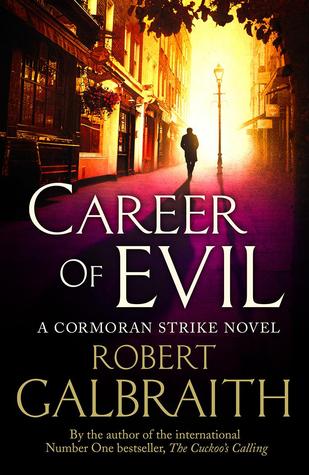
Take A Peek Book Review: Career of Evil by Robert Galbraith

“Take a Peek” book reviews are short and (possibly) sweet, keeping the commentary brief and providing a little peek at what the book’s about and what I thought.

Career of Evil

Synopsis:

(via Goodreads)

When a mysterious package is delivered to Robin Ellacott, she is horrified to discover that it contains a woman’s severed leg.

Her boss, private detective Cormoran Strike, is less surprised but no less alarmed. There are four people from his past who he thinks could be responsible – and Strike knows that any one of them is capable of sustained and unspeakable brutality.

With the police focusing on the one suspect Strike is increasingly sure is not the perpetrator, he and Robin take matters into their own hands, and delve into the dark and twisted worlds of the other three men. But as more horrendous acts occur, time is running out for the two of them…

Career of Evil is the third in the highly acclaimed series featuring private detective Cormoran Strike and his assistant Robin Ellacott. A fiendishly clever mystery with unexpected twists around every corner, it is also a gripping story of a man and a woman at a crossroads in their personal and professional lives.

Cormoran Strike is back, with his assistant Robin Ellacott, in a mystery based around soldiers returning from war.

My Thoughts:

Does it still need to be explained that Robert Galbraith is a pen name for J. K. Rowling? Are we all clear by now?

Good. Moving on.

The Cormoran Strike series keeps getting better and better! In this third installment, the murderer strikes particularly close to home. As Cormoran and Robin sift through the clues, they bring up a host of nightmares from each of their pasts. Meanwhile, all the attention means that their business is on the brink of failure thanks to all the negative publicity, and the threat posed by the unknown murderer is scary and unpredictable. Neither of them are safe, but neither wants to back down.

Meanwhile, we get occasional chapters told from the psycho killer’s point of view, and boy, are they disturbing! His obsession and cold-blooded determination to kill and mutilate is just horrific to read, especially as it’s all so matter of fact.

Beyond the murder mystery, which is complicated to the extreme, one of the delights of this book is seeing the relationship between Cormoran and Robin continue to unfold and deepen. Their trust in one another leads them to open up in ways that they haven’t previously, even as their unacknowledged feelings and fears lead to misunderstandings, anger, and near disaster for their partnership.

In general, I enjoyed Career of Evil very much, perhaps even more than the second book in the series, which just struck me as overdone in some ways. My one quibble is the same quibble I often have with J. K. Rowling’s writing: She seems to take inordinate amounts of pleasure in describing unsavory or sad sack characters as being just completely repulsive physically, with stringy hair or dandruff or body odor or any number of other unattractive qualities:

“The man on the door was squat and neckless… ”

“Tempest, whose black bob had certainly been dyed and who wore thick, square black-rimmed spectacles, was his physical opposite: pale, dumpy and doughy, her small, deep-set eyes like raisins in a bun.”

“He turned his head and Strike saw scalp shining through the thinning roots…”

“Eyebrows as thick and bushy as tiger moth caterpillars overhung her puffy eyes.”

It gets to be too much after a while, in my humble opinion.

Actually, I had one more quibble with Career of Evil: The tiny detail that finally enables Cormoran to have the major breakthrough and solve the mystery is… a tiny detail, so trivial that I find it close to impossible to believe that this man would have noticed and identified this teensy element and have the entire solution hinge upon that discovery. The rest of the mystery’s resolution worked for me, but that one thing — no.

Other than that, though, I’m really having a great time reading the Cormoran Strike books, and hope there are many more to come. This book’s mystery is solved by the end, but the door is still open for more adventures and complications for Cormoran and Robin and their partnership.

Added bonus: It’s so exciting to know that BBC is developing a Cormoran Strike Mysteries TV show!

Finally, a reading tip: This is a big, densely plotted book with (it feels like) a thousand characters and backstories to keep straight. The lives and details of the various suspects can easily blend together, and I found myself constantly having to flip backwards and forwards in the book to keep straight which clue went with which suspect. Keeping it all in order is part of the challenge and the fun — but I’d recommend saving this book for a time when you know you’ll have minimal distractions and plenty of concentration!

_________________________________________

The details:

Title: Career of Evil
Author: Robert Galbraith (J. K. Rowling)
Publisher: Mulholland Books
Publication date: October 20, 2015
Length: 489 pages
Genre: Mystery
Source: Purchased

Book Review: The Cure for Dreaming by Cat Winters

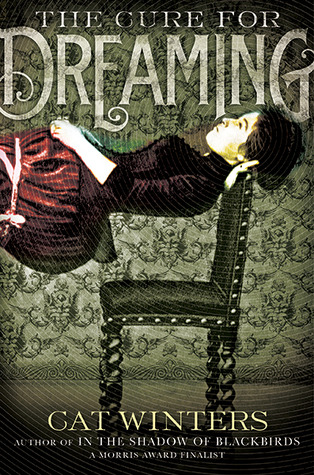
Cure for DreamingIn this YA novel, hypnotism and the suffrage movement are combined in startling ways to give us a portrait of life in 1900 for a young woman who is, pretty much literally, too independent for her own good.

On her 17th birthday, Olivia Mead attends a hypnotism show headlined by the young, talented Henri Reverie, a “mesmerist” whose talents have made him famous across the country. Egged on by her friends, Olivia volunteers to be Henri’s first subject, and astonishes the entire audience by her extreme susceptibility to his hypnotism. She’s so far under that he’s able to make her stiff as a board, suspend her between two chairs (as in the cover photo), and even stand on her torso, all without her knowledge.

Olivia is slightly embarrassed, but also enjoys the newfound attention her moment in the spotlight brings, especially from wealthy, out-of-her-reach Percy, the judge’s son. Olivia’s own father, the local dentist (with a truly horrifying collection of tools), is less than pleased. He wants nothing more than for Olivia to be good and obedient, especially after learning that she’d attended a suffragists’ rally the day before. He arranges for a private hypnotism session with Henri, during which Henri compels Olivia to see the world as it truly is, to understand the roles of men and women, and to be able to say nothing but “all is well” when she becomes angry.

This backfires, of course. Olivia is an avid fan of Bram Stoker’s Dracula, and thanks to the hypnotism, when she looks at her father, she sees him as he truly is — fanged, clawed, and monstrous. She sees the truth of many of the women of her town as well, who fade into invisibility as Olivia watches. Desperate, she tracks down Henri and begs him to fix her — but there’s a reason why he can’t just yet, and the two form a scheme to give Olivia back control of her own mind and voice and to get Henri what he desperately needs.

The Cure For Dreaming is a captivating portrait of the plight of women at the dawn of the 20th century. The author does a wonderful job of weaving together an individual’s personal struggles with the struggles of women at that time. It’s easy for us, sitting here in the comforts of 2015, to take for granted the rights we enjoy, and this book reminds us of the venom and hostility that confronted the women’s suffrage movement. The women who dared to take a public stance and speak out were demonized, ridiculed, accused of being unwomanly or even insane, and were subjected to all sorts of horrible public humiliations. In this book, looking through Olivia’s eyes, we see how far the men — and even many women — were willing to go to silence the voices of women who stood up for equality and the right to speak their minds.

As one character describes to Olivia:

“My father leaned over to me and said, “Now, that’s womanhood perfected, Percy my boy. That’s the type of girl you want. Silent. Alluring. Submissive.”

I can’t say enough about how powerful and engrossing this story is. Olivia is a marvelous lead character — smart, warm-hearted, and unwilling to keep silent when she sees something wrong. Her need to speak out is what gets her into trouble, of course, but at the same time, she makes a difference in all sorts of unexpected ways, even when forced through the power of hypnotic compulsion to be compliant and stifle her anger.

Olivia’s interactions with Henri do not take the anticipated route, and despite the growing feelings between the two, this book does not go down the dreaded path of showing a young woman throwing away her own plans in order to follow a guy. Olivia has a backbone and a commitment to staying true to herself, and that’s a lovely thing to see in a YA heroine.

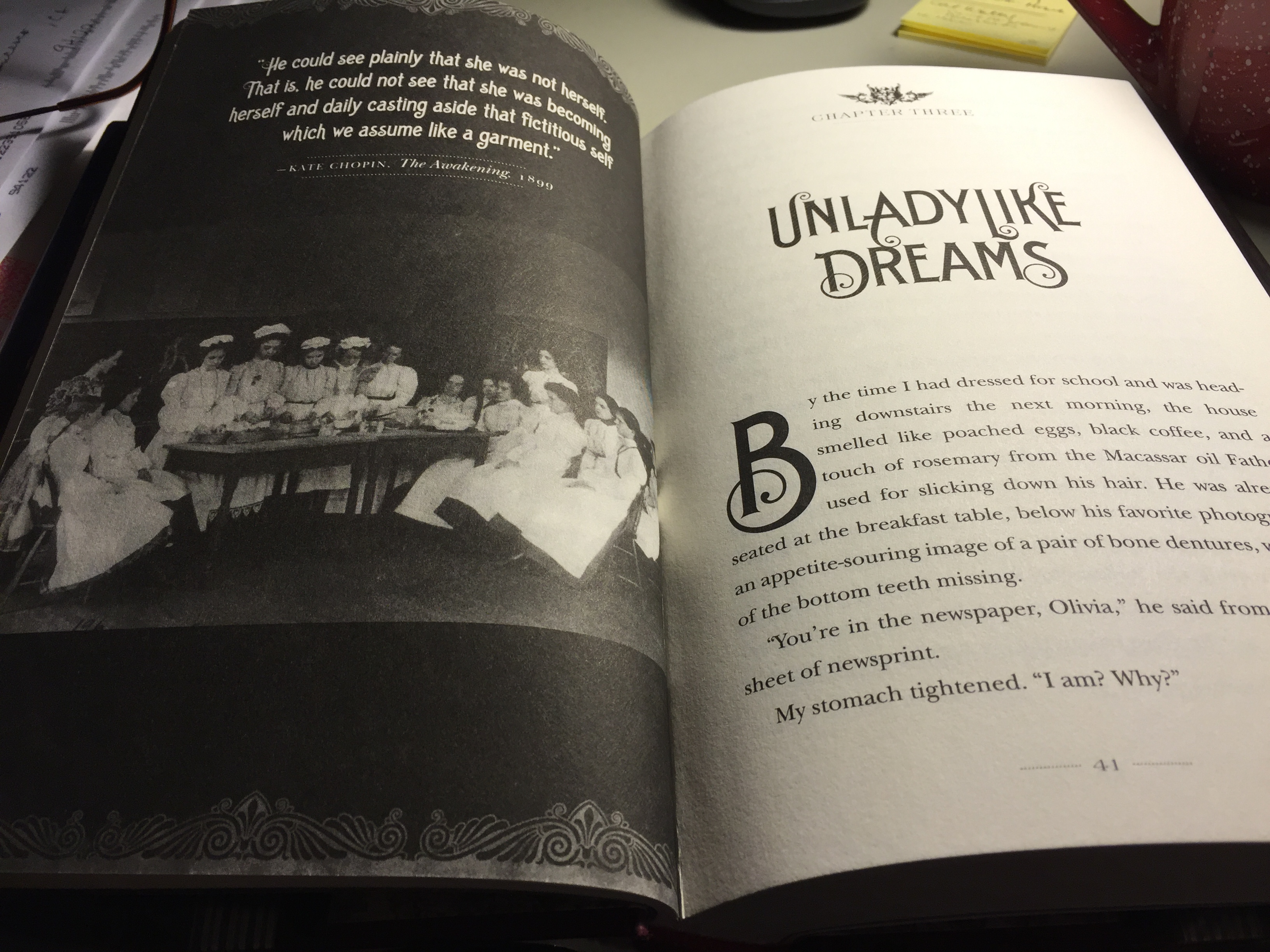
The book itself is wonderful to page through, as chapter breaks are illustrated by historical photos from the book’s era, as well as by a selection of powerful quotes by everyone from Kate Chopin to Mark Twain to Carrie Nation.

image

The Cure for Dreaming is a fast read — I gobbled it up over the course of 24 hours! I was hooked almost instantly, and just couldn’t bear to put the book down. The characters are well-drawn, the subject of hypnotism is fascinating, the relationships between the characters are pitch-perfect, and the context of the fight for women’s votes and the right to one’s own voice is powerfully presented. While written for a young adult audience, the book does not oversimplify or talk down in any way. As an adult reader, I loved the book and was never bored. This would be a great choice for teen girls, and could also provide some great discussion starting points for mothers and daughters who want a book they can share and enjoy together.

_________________________________________

The details:

Title: The Cure for Dreaming
Author: Cat Winters
Publisher: Amulet
Publication date: October 14, 2014
Length: 352 pages
Genre: Young adult fiction
Source: Library

Take a Peek Book Review: Destiny’s Plan by Victoria Saccenti

“Take a Peek” book reviews are short and (possibly) sweet, keeping the commentary brief and providing a little peek at what the book’s about and what I thought.

DestinysPlan72


Synopsis:

(via Goodreads)

When Raquelita Muro and Matthew Buchanan meet by chance on a Greyhound bus between Texas and Tallahassee, neither suspects Fate is about to take over.

Raquelita, a gentle girl under the heel of her abusive mother, finds this kind young man a miracle.  Matthew, an idealistic young soldier, discovers this sweet-natured girl is an angel in need of a guardian.  However, the next stop on Matthew’s journey is Fort Benning to report for deployment to Vietnam, while Raquelita’s destination is set at her mother’s whim.  Regardless of the forces tearing them apart, they discover a way to secretly span the distance, to end up closer than ever.  But Fate is rarely kind.  The vagaries of war—and the unstable tempers of Raquelita’s mother—intervene, leaving both ill-fated lovers feeling there is no hope for their love.

Set in the turbulent era of the Vietnam War, Raquelita’s and Matthew’s story is one of love, loss, lost faith, shattered memories, deferred dreams and broken promises.  Will Fate tear apart these two damaged souls, leaving them desperately alone forever, or will they finally overcome Fate, their bond stronger than they ever thought possible?

My Thoughts:

Debut author Victoria Saccenti has written a complex, heart-wrenching tale of a chance meeting that changes lives, and the intricate ways that bonds of family and obligation can both hurt and heal. The love story here is startlingly sudden, but also quite sweet, as Raquelita and Matthew recognize their connection within moments of meeting and somehow manage to establish a bond so strong that it can withstand physical and emotional trauma.

Destiny’s Plan has a plot that spans eras and continents, as the author weaves in not only the Vietnam War but also goes back to an important family episode during the Spanish Civil War. The author has clearly done her research, as the historical elements are well presented. Not only do we get the facts of a deployment to Vietnam and what that might look like, but we also get the sights and sounds of the late 1960s through the inclusion of the music, fashion, and political and social upheavals of the time.

Raquelita’s life is hard and complicated. One of the pieces of the story that I most enjoyed was getting to know the members of her family, from her damaged and cruel mother Isabel to her mysterious godfather Xavi, her loving father Emilio, and the aunt, uncle and cousin who give Raquelita a chance to experience a normal, loving home life. Raquelita’s younger sister Marité is adorable, and I understand she’ll be the central figure in her own book next.

Another element that really appealed to me in Destiny’s Plan was the fact that love is shown in different ages and stages in this book. Yes, Raquelita and Matthew are the main characters and love story, but we also see several more mature adult relationships as well, and it’s both unusual and refreshing to see true love, emotional and physical, shown as not only the territory of the younger generation.

A slight disclaimer: I’m not usually a romance reader, and so I don’t have much in the way of comparison. I have a feeling that the plot elements that didn’t really work for me in this book are probably things that would appeal to someone who enjoys romances — but as this is not a preferred genre for me, I had to push myself a bit to get over it. Likewise, I was a bit taken aback by the many explicitly intimate scenes, but again, I think I just generally don’t read romances and didn’t know what to expect.

Overall, I’d say the time period gives this book an interesting and unusual flavor, and the characters are well-developed and memorable. If you enjoy swooningly romantic stories with underlying drama and painful obstacles, check out Destiny’s Plan!

To learn more about the author, check out my spotlight post here.

_________________________________________

The details:

Title: Destiny’s Plan
Author: Victoria Saccenti
Publisher: Smashwords Editions
Publication date: September 15, 2015
Length: 435 pages
Genre: Historical romance
Source: Purchased

Take a Peek Book Review: The Brontë Plot by Katherine Reay

“Take a Peek” book reviews are short and (possibly) sweet, keeping the commentary brief and providing a little peek at what the book’s about and what I thought.

Bronte

Synopsis:

(via Goodreads)

Lucy Alling makes a living selling rare books, often taking suspicious measures to reach her goals. When her unorthodox methods are discovered, Lucy’s secret ruins her relationship with her boss and her boyfriend James—leaving Lucy in a heap of hurt, and trouble. Something has to change; she has to change.

In a sudden turn of events, James’s wealthy grandmother Helen hires Lucy as a consultant for a London literary and antiques excursion. Lucy reluctantly agrees and soon discovers Helen holds secrets of her own. In fact, Helen understands Lucy’s predicament better than anyone else.

As the two travel across England, Lucy benefits from Helen’s wisdom, as Helen confronts the ghosts of her own past. Everything comes to a head at Haworth, home of the Brontë sisters, where Lucy is reminded of the sisters’ beloved heroines, who, with tenacity and resolution, endured—even in the midst of change.

Now Lucy must go back into her past in order to move forward. And while it may hold mistakes and regrets, she will prevail—if only she can step into the life that’s been waiting for her all along.


My Thoughts:

I’ve enjoyed author Katherine Reay’s previous two novels, Dear Mr. Knightley and Lizzy & Jane, and I had high hopes for The Brontë Plot as well. Unfortunately, while there are some interesting elements, the overall story just doesn’t hold up.

Lucy is a flawed character, someone with obvious talent and enthusiasm, but who makes questionable choices when it comes to achieving her ends. Her actions eventually catch up to her and cause a rupture with the people she cares most about, but her trip with Helen seems to represent a second chance — even though Lucy goes right on fabricating stories to suit her needs even while trying to start fresh.

Lucy’s relationships with James and with her boss Sid are engaging, and it’s hard not to care while she deals with the fall-out once James discovers her dishonesty. Still, it’s difficult to feel a whole lot of sympathy for a main character who takes such foolish actions, and I felt that the resolution of the various conflicts and disappointments was a bit too easy.

The pacing of the book seems to sag once Lucy sets off for England with Helen, where far too much time is spent on the details of their tourism, their hotel accommodations, and their meals. I was never particularly engaged by the family secrets that Lucy and Helen seek to come to peace with, and the literary theme, walking in the footsteps of the Brontës and their contemporaries, with constant references to Jane Eyre, Heathcliff and Catherine, and more, felt forced and not an organic part of the story.

The author creates interesting, multi-faceted characters in this book, but the plot itself didn’t really go anywhere, in my opinion. While I’ll continue to follow this author and hope to read more by her in the future, I’d say The Brontë Plot is mostly skippable.

_________________________________________

The details:

Title: The Brontë Plot
Author: Katherine Reay
Publisher: Thomas Nelson
Publication date: November 3, 2015
Length: 336 pages
Genre: Contemporary fiction
Source: Review copy courtesy of Thomas Nelson via NetGalley

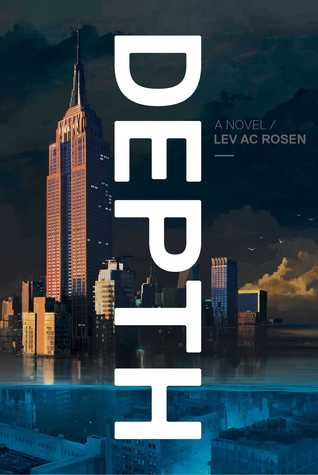
Book Review: Depth by Lev AC Rosen

DepthSome two hundred years from now, the polar ice caps have long since melted. Chicago is on the coastline of mainland United States, which is ruled by a fundamentalist Christian government. Moving east, you’ll find the Appalachian Islands, and then huge expanses of ocean covering the drowned cities, where tips of building occasionally poke up from the waves.

And then there’s New York which, Depth makes clear, can survive anything.

Water levels have risen about 20 stories — so the million or so people who still inhabit New York live on the 21st floor and above, employing newer technologies such as Glassteel to keep the above-water buildings more or less dry and waterproof. The building are connected by an intricate maze of bridges — some well-maintained, some rickety — and permanently moored boats, such as converted cruise ships and military vessels, which form everything from police stations to nursing homes to floating restaurants.

Watch your step! The waves keep churning beneath your feet, and you WILL get wet. Salt water and sea spray are everywhere, and those bridges can get pretty slippery. One big storm or moment of inattention, and you’ll end up in the water… and in general, those who go in only come out as corpses destined for the recycling plant.

Oh, it’s quite a world that author Lev AC Rosen has built here in Depth. The concept alone is worth picking up this futurist, sci-fi, noir detective story (described in the cover blurb as “Heinlein meets Hammett”) — but hey! There’s an actual plot to go with it, and it’s quite a good one.

Private investigator Simone Pierce is a tough, prickly red-head who goes her own way and sticks to her own company for the most part. Her only two trusted friends are Caroline, a highly-placed politician from a powerful family, and Danny, a young man with some unusual talents who masquerades as a psychic. Simone is out on a routine case, trying to get the goods on a client’s possibly cheating husband, when she’s pulled into something far more deadly and complicated. When the husband turns up dead, Simone finds herself embroiled in a web that includes suspicious cops, a potentially crooked pastor, an art-loving power broker, a sexy grad student, and a mysterious woman, whom Simone thinks of as The Blonde, who seems to be at the center of it all.

The author has pulled off quite a balancing act here, creating a fully fleshed-out detective story that keeps powering forward with high-level energy, and at the same time pulling us into a crazily off-balance world that delights with each water-soaked new chapter. The new environment is just fascinating, and I am full of admiration for the way the author slips in little details about the waves or the salt water or the constant dampness while there’s a chase scene underway.

The dialogue has all the wryness, and sarcasm of a traditional noir detective tale, fine-tuned for this new place and time.

“Are you asking me along to watch you interrogate someone I’m angry at in an attempt to repair our friendship?”

“That is exactly what I’m doing.”

“Will you let me hit her?”

“If the opportunity presents itself.”

Even the descriptive passages are full of some wonderful imagery:

Simone tossed what was left of her cigarette into the ocean. It cartwheeled into the water, one end leaving a trail of sparks like blood spatter.

Really, I just can’t say enough about Depth. I’ve been a fan of this talented author since his debut novel, All Men of Genius, was released in 2011. The detective part of the story is fun and engaging, but it’s this concept of New York as a drowned city that somehow has managed to survive, to thrive, and to keep its own sense of independence and defiance that’s truly a treat. I can’t get enough of the world Lev AC Rosen has created in Depth, and I just hope there will be a sequel so I can visit once again!

_________________________________________

The details:

Title: Depth
Author: Lev AC Rosen
Publisher: Regan Arts
Publication date: April 28, 2015
Length: 272 pages
Genre: Science fiction
Source: Purchased


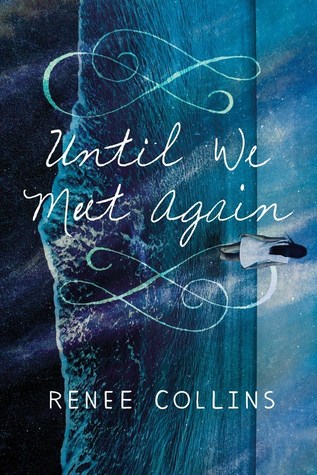
Book Review: Until We Meet Again by Renee Collins

Until We Meet AgainAn upper class seaside retreat is the setting for this YA timeslip novel by Renee Collins. Main character Cassandra, age 17, is spending the summer with her mother, stepfather, and 3-year-old brother at a rented beachfront mansion, and she’s bored to tears. Until one day, she wanders down the path between the property’s bushes and ends up on the private beach, where she meets a (very attractive) young man named Lawrence.

The first meeting is full of suspicion: What are you doing on my family’s private beach? No, what are YOU doing on MY family’s private beach??!! But within the first couple of meetings, it becomes clear: The beach seems to be a place that’s shared by both Cassandra’s world in 2015 and Lawrence’s world… in 1925. Apparently, no one in either time seems to like the beach much, because while anyone can reach it, it’s mostly just Cassandra and Lawrence there, undisturbed for hours and days at a time.

The two connect, quickly, and soon come to realize their deep feelings for one another. But trouble looms: Lawrence is the summer guest of his wealthy uncle Ned, who plans for Lawrence to go to Harvard and then law school, then enter the family business. Ned also seems to be pushing a pretty flapper named Fay at Lawrence, and is quite insistent that Lawrence get involved with her. Something seems shady, all right — and when Cassandra hits the library microfiche to see what she can find out about Lawrence and his family, she stumbles upon a shocking news article, which reveals that Lawrence will be murdered on the beach in only a few weeks. Cassandra vows that she’ll find a way to stop it, and between her modern-day research and Lawrence’s snooping in his own time, the two race the clock to save his life… and hope to find a way to be together afterward.

The novel leaves the timeslip element mostly unexplained, although Cassandra agonizes over whether she can or should influence the events of 1925, for fear that the consequences will be devastating. And yet, she plunges right ahead once she realizes Lawrence’s life is on the line.

In terms of plot, there are pros and cons. Pro-wise, the concept of the beach as a portal between the times is interesting. It’s not that either Lawrence or Cassandra has a special ability, but rather, it’s the place that’s powerful. Anyone who passes through the bushes onto the beach can see whoever’s there, from either time — so the beach isn’t some sort of special protected bubble, it’s just that very few people actually go there and so no one else has discovered the odd time disconnect. Also strong is the portrayal of Cassandra as a girl ready for something to happen, throwing herself headfirst into a crazy, emotion-fueled adventure that really should be beyond her belief. I liked the sense of Cassandra’s drive and devotion, and how determined she became to do whatever she needed to do.

In the middle ground for me are the 1920s-era standards — flappers, mobsters, crooked businessmen, hints of Prohibition-defying smuggling. I suppose this may be newer in the realm of young adult fiction, but lately it seems to be done almost to death. While Lawrence’s side of the story is interesting, it’s a pretty surface-level glide through that world, and I didn’t feel that it really explored the setting in a deep enough way.

I could also go either way on the insta-love aspect of the story. Cassandra and Lawrence seem to fall head over heels in love from one moment to the next, but I know that mainly because I was told that’s how they felt, not because I saw it developing organically. Still, I do give the author some credit on this issue, because a teen romance in an exotic setting really could convincingly blossom from casual acquaintance to love-of-my-life status, given a dramatic or extreme enough set of circumstances.

Pieces that didn’t really work for me related to Cassie’s family life. I didn’t get her mother’s issues with Cassandra: She seemed to always be suspicious, very demanding of Cassandra’s time, and then, weirdly, pretty insistent on Cassandra dating some random boy. Why would she be pushing her to date this guy? It just didn’t make sense to me. Cassandra also had this habit of lying about her trips to the beach by announcing she was going running, but half the time she seemed to be in a sundress when she said this, so again, a little hard to believe.

Still, I don’t want to give the impression that I didn’t enjoy the book as a whole. Once the race-against-the-clock element merges with the intense love story, the plot begins zooming forward, and has a great sense of drama that gives a high-stakes feel to the whole thing.

In a way, this book is a metaphor for the quintessential summer romance. Two teens, dragged by their families to a summer vacation spot, meet and fall in love, but have the awful end-of-summer separation looming over them, giving the romance a super-heightened sense of intensity and passion. They’re from two different worlds, their time together is brief, and not being adults yet, they don’t have the control over their futures or lives to prolong the relationship beyond the summer. Take out the timeslip element, and that’s what we have here: Cassandra and Lawrence are flung into each other’s lives because they just happen to have been brought to the same place; they immediately fall in love, but they know they’ll be forced apart when the vacation ends. How glorious for teens in that extra-dramatic period of life, to get the star-crossed lovers experience!

Until We Meet Again combines the best elements of a summer romance with the dramatic build-up of a tragic, doomed love story. In some ways, the ending of the story reminded me of one of my very favorite Doctor Who episodes… although I won’t go into spoiler territory by saying which one. While some pieces of the plot rang a little hollow for me, overall I’d say that Until We Meet Again is an exciting, engaging, quick read that’s worth checking out. And while the timeslip plotline felt a bit thinly developed in places, I also need to recognize that I’m an adult who’s read a LOT of timey-wimey fiction over the years, and for a reader in the target young adult audience, this may be a first encounter with the concept of time travel and its consequences — which could make it a really new and exciting reading experience.

On a final note, this was a very fun read for a chilly week in November! There’s nothing like reading about sunny beach days to chase the cold away.

_________________________________________

The details:

Title: Until We Meet Again
Author: Renee Collins
Publisher: Sourcebooks Fire
Publication date: November 3, 2015
Length: 336 pages
Genre: Young adult fiction
Source: Review copy courtesy of the publisher via NetGalley

Book Review: After You by Jojo Moyes

After YouI’m normally really diligent about keeping my reviews spoiler-free, but this one will be an exception.

After You is the sequel to the author’s huge bestseller, Me Before You. I don’t think I can talk about After You without referring to the events of the first book.

So — fair warning. IF YOU DO NOT WANT TO SEE SPOILERS FOR ME BEFORE YOU, DO NOT READ THIS REVIEW!

Seriously.

Walk away now.

You’ve been warned.

… end of psychotic spoiler warnings…

Moving on –

After You picks up the story of Louisa Clark two years after the tragic events which conclude Me Before You. In Me Before You, Louisa takes a job as a caregiver/companion to a quadriplegic man named Will Traynor, basically for the sake of a steady paycheck. Will is an angry young man, stuck in a wheelchair after a devastating accident, and he initially treats Louisa abominably.

Eventually, the two crack each others’ tough shells. Will delights in teaching Louisa about life outside the confines of her small town and in showing her how smart and talented she really can be. Louisa is horrified to learn that Will intends to take his own life rather than continue to live as a quadriplegic, and makes it her mission to convince him that life can still be wonderful. The two fall in love — but sadly, it’s just not enough to keep Will from the path he’s determined to take.

(See, I said there’d be spoilers.)

Two years later, Louisa is aimless, sad, and just going through the motions. Thanks to a bequest from Will, she traveled all across Europe, but came home when she realized it all meant nothing to her. Now she lives in a flat in London (also thanks to Will’s generosity), attends a grief support group, and works in a depressingly awful Irish-themed bar (complete with a ringlet-y wig) at the airport.

Louisa’s life takes a surprising turn when one night, in a drunken funk, she slips off the roof of her building, surviving the fall with broken bones and other injuries, none permanent. Two unexpected people enter Louisa’s life due to the fall — a hunky paramedic named Sam and a difficult, prickly teen girl named Lily… who announces to Louisa that she’s Will’s daughter.

Turns out that Will’s college girlfriend never told him she was pregnant, so he never had the chance to be a part of Lily’s life. Would Will have made different decisions if he knew about Lily?

Louisa takes Lily under her wing out of love for Will, both wanting to protect her for Will’s sake and, for her own sake, to hold onto the last little bit of Will left in the world. Lily’s entry into Louisa’s tightly controlled, dull, unfulfilling life basically rocks her world, and changes begin, slowly at first, until Louisa’s outlook and future are completely transformed.

Okay, enough synopsis. That’s the gist of After You. The real question readers will want to have answered is: Does After You live up to Me Before You?

In my opinion, the answer is yes… but adjust your expectations.

After You is a much quieter book than Me Before You. Me Before You was intensely dramatic, with life and death on the line, passionate love with everything at stake, and characters in absolutely extreme circumstances. I don’t know anyone who walked away from Me Before You with dry eyes.

After You is not that book. Instead, it’s thoughtful and serious, examining the life that’s left after the drama and tragedy have already gone by. Will’s dying wish was for Louisa to go out and live life to the fullest, and she really did try. But as we see in After You, the intention isn’t enough. Louisa took off for Paris to escape her grief, but life and grieving don’t work that way. She carried the pain with her wherever she went, so eventually there was no point in continuing to run.

What we see in After You is what loneliness and sorrow look like. There’s nothing sexy or glamorous about it. Louisa is living a very sad life when we first meet her in this book, and her lack of hope and disconnect from anyone who might actually care about her is distressing to see. And yet, I felt like it was all so real. Grief takes time. There’s no magic cure. Even meeting someone new doesn’t fix everything. It was so sad to see vibrant, rambunctious Louisa dressed in dull grey clothing and going through the motions, day after day.

Just as Louisa’s life picks up when Lily and Sam make their entrances, so too the tone of the novel picks up as well. The energy of the narrative reflects the slow return to life and purpose that Louisa goes through, building up steam and gaining more ups and downs, breaking out of the sad sameness of a depressed existence.

I’ve made no secret of the fact that I’m a big fan of Jojo Moyes’s books. I’m happy to find that After You is quite as good as some of her strongest works. It won’t “wow” people the way Me Before You did, but it does carry true emotion within its pages. This is the story of picking up the pieces, and that’s never going to be as stunning as the story of how the pieces broke in the first place (if that makes any sense).

People responded very, very strongly to Me Before You, and rightly so. Many readers cherished the idea of Louisa’s life being enriched by her short time with Will and being able to imagine her going on from there to having a life full of amazing experiences. For some, the realities of Louisa’s life in After You will be a letdown, bursting the bubble of a tragically romantic illusion. Before reading After You, I probably would have had the same vision of Louisa’s life, but I’m so pleased that After You set me straight.

Grief isn’t easy. Money and adventure can’t fix it. Recovery takes time, and a lost love can never be forgotten or replaced. In After You, Louisa gets the time to grieve, to rediscover her inner self and strength, and to finally start moving forward again. I’m so glad that I read this lovely book.

After reading After You, I felt such a strong connection to Louisa and to Lily, and I walked away feeling good, knowing that they’d found not only each other, but also a path pointing the way toward future happiness and hope.

✻✻✻✻✻

Interested in this author? Check out my reviews of other books by Jojo Moyes:
The Girl You Left Behind
One Plus One
The Ship of Brides
The Last Letter From Your Lover
Me Before You
Silver Bay

_________________________________________

The details:

Title: After You
Author: Jojo Moyes
Publisher: Pamela Dorman Books
Publication date: September 29, 2015
Length: 352 pages
Genre: Adult contemporary fiction
Source: Library

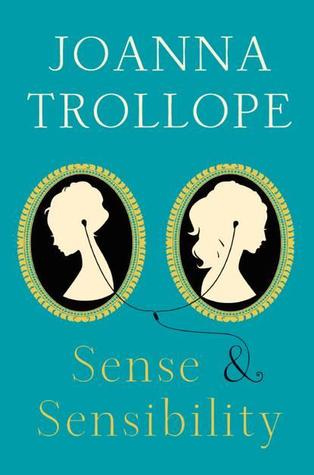
Book Review: Sense & Sensibility by Joanne Trollope

Sense & Sensibility_TAPAnother Austen Project book… read!

As I discussed in my review of Val McDermid’s Northanger Abbey, The Austen Project is a publishing concept that pairs up bestselling contemporary authors with the works of Jane Austen, with the goal of creating six reimagined versions of the classic novels. So far, three have been published, with the next projected for release in 2016.

This new version of Sense and Sensibility is written by bestselling author Joanna Trollope, who imagines the Dashwood family in almost familiar terms — finding themselves displaced from their lovely home by their half-brother and his money-hungry wife, having to rely on the kindness of distant relatives to start fresh, and figuring out the ups and downs of love, infatuation, and everything in between.

But this Sense & Sensibility is set in the 21st century, and of course, there are changes from the original. Elinor, practical as ever, is an architecture student. Marianne, frail and subject to the whims of passionate feeling, is severely asthmatic and must always be looked after. The often overlooked youngest, Margaret (or here, Mags), petulant and whiny, always plugged into her headphones, appreciates any cute boyfriend of her sisters’ —  so long as he drives an awesome car.

The cast of characters is much the same as in the Austen version, with Marianne’s love interest Willoughby portrayed here as gorgeous but shiftless Wills, all too ready to throw Marianne over for the sake of romancing a millionaire’s daughter. We also have Bill Brandon, an utterly good guy running a non-profit home for mentally challenged individuals at his Delaford estate, and hapless Edward Ferrars, whose controlling mother has bullied him into utter dependence. The awful characters — especially Fanny Dashwood and the Steele sisters — are every bit as awful here. After all, selfishness, emotional manipulation, and obsessions with money are timeless!

The essential storyline follows the familiar path, but with elements changed to make more sense in the modern setting. There are hospital visits and interior decorators, school carpools and even a job for Elinor. But the sisters’ defining characteristics are what we know from Austen: Elinor is steady and logical, steering the family through hard times through her practical management when everyone else in her family is busy feeling all the feels — and Marianne, throwing herself headlong into love with no regard for anything but listening to her heart and relying 100% on her emotions to lead the way.

Start to finish, I was pretty charmed by this version of Sense & Sensibility. It’s no replacement for the classic Austen novel, and I’m not convinced that it would  work as a stand-alone. But as a companion piece to the classic, it’s quite endearing. While the rush to marriage may feel a bit forced at times in a modern setting, as framed in the context of status-hungry social climbers and defiantly old school, old money families, it makes a sad sort of sense. Throw in social media, and you have Marianne devastated not just by a broken heart, but by public humiliation via YouTube.

The writing is light in tone, with just enough winking acknowledgement that this is a retelling:

“Hasn’t she got a boyfriend yet? She’s old enough.”

“She’s fourteen. Honestly, Abi, it’s all you ever think about. You’re like those nineteenth-century novels where marriage is the only career option for a middle class girl.”

Joanna Trollope’s Sense & Sensibility is a fun read that’s sure to amuse anyone who loves the Jane Austen classic and is open to seeing the story retold with a modernized twist. It doesn’t require a whole lot of concentration, but it should at least make you smile!

_________________________________________

The details:

Title: Sense & Sensibility
Author: Joanne Trollope
Publisher: Harper
Publication date: January 1, 2013
Length: 362 pages
Genre: Fiction
Source: Purchased