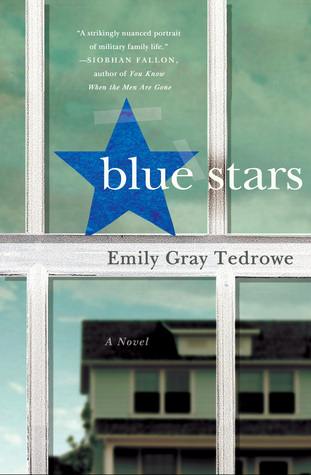
Book Review: Blue Stars by Emily Gray Tedrowe

blue starsThe Blue Star service flag: A simple flag, displayed in a window to indicate a family with a member serving in the US military during wartime. In Blue Stars, author Emily Gray Tedrowe introduces us to two women whose lives are turned upside down and inside out by their experiences dealing with their loved ones’ service and the aftermath of devastating, life-changing injuries.

The two main characters are Ellen and Lacey, and on the surface, they couldn’t be more different. Ellen is a midwestern college professor specializing in the works of Edith Wharton. Widowed many years earlier, Ellen has two children — a daughter in her late teens who is full of rebellion and sarcasm, and a son in graduate school. Ellen also has a ward, having become legal guardian to Mike, a young man befriended by Ellen’s son as a teen, whom Ellen took in, took under her wing, and made part of the family.

Lacey is a working-class mom in New York, married to army reserves officer Eddie, but not particularly happy in her marriage. Lacey married Eddie after a long string of go-nowhere relationships, needing stability and meaning in her life and a father for her son Otis. Lacey thrives in the tight-knit circle of army wives and their non-stop projects and activities, but she also drinks too much and hides her secret dissatisfaction with a husband whom she married in haste.

As the book opens, it’s 2005, and Mike and Eddie are both preparing for a 15-month deployment to Iraq. Mike has just enlisted in the Marines, much to Ellen’s dismay, and Eddie is being sent overseas as well. All too soon, though, Ellen and Lacey each receive the news they dread: Their loved ones have been injured, and will be brought to Walter Reed Medical Center in Washington DC for treatment.

Mike has lost a foot due to a grenade. Eddie has lost an eye, most of the vision in his other eye, and has suffered severe head trauma. Ellen and Lacey uproot their lives and, for months and months, become permanent fixtures at Walter Reed, overseeing their soldiers’ care, dealing with bureaucracy, substandard housing, and the patients’ distressing physical conditions. The horrors of war are driven home by seeing the extent of the damage to these formerly healthy men, as well as by seeing the other patients and their families. And to add one horror upon another, the women and families there are pretty much on their own, fighting for benefits, living on pennies, scrambling to make ends meet, and desperate for any shred of hope.

The relationship between Ellen and Lacey is at the heart of this touching novel. In a “normal” world, these two would never meet, much less become friends. Yet through their shared experiences, each finds in the other something she desperately needs. Ellen represents calm and order to Lacey, instilling the belief in Lacey that she’s worth more than she thinks. And in Lacey, Ellen finds a woman who isn’t afraid to speak out, to confront hard truths, and to bring people together.

I found both women very inspirational, in their own ways. Lacey is a mess in so many ways, and it’s hard to approve of much of her behavior early on, yet she displays a courage and loyalty that are quite remarkable. Ellen, too, has to deal with her own feelings of inadequacy, yet her devotion to Mike never wavers for a moment, despite the often brutal emotional toll taken by dealing with a man traumatized by PTSD and haunted by his war experience.

We all know that war is hell, and there are countless war novels that focus on the front lines. Here, in Blue Stars, it’s the home front that’s the focus, and the book does an outstanding job of showing that the misery and trauma don’t stop just because a soldier’s battle days are over… and that the trauma and pain are felt in myriad ways by the families back home as well. The military families described in Blue Stars aren’t idealized or seen through a rosy filter. They have faults, and we see them, but we also see the dedication, courage, and sheer determination that help them stand by their wounded soldiers.

My only frustration with Blue Stars is that I wished to know more about Mike himself and his experiences, but of course that would have been a different book. We get to know Mike through Ellen’s eyes, and it’s Ellen’s experience of Mike’s war — and by extension, Ellen and her family’s war as well — that’s the essence of this book. Blue Stars is about the ravages of war, on individuals and families, and about what it takes to rebuild a life — the life of the wounded soldier, and the life of the damaged family.

Reading about the badly wounded soldiers, so young and so full of promise, is moving and tragic. I was filled with anger over their pointless suffering, and filled with admiration for the tough parents, spouses, children, girlfriends and boyfriends, who give 110% for the sake of their loved ones’ recovery. Blue Stars is a moving and powerful novel — not always pleasant, but an important and emotionally rich look at the lives of military families, the power of friendship, and the many ways that love and commitment make a difference.

_________________________________________

The details:

Title: Blue Stars
Author: Emily Gray Tedrowe
Publisher: St. Martin’s Press
Publication date: February 17, 2015
Length: 352 pages
Genre: Contemporary fiction
Source: Review copy courtesy of the publisher via NetGalley
 

Wishing & Waiting on Wednesday: Secondhand Souls

There’s nothing like a Wednesday for thinking about the books we want to read! My Wishing & Waiting on Wednesday post is linking up with two fabulous book memes, Wishlist Wednesday (hosted by Pen to Paper) and Waiting on Wednesday (hosted by Breaking the Spine).

I realize that I haven’t done one of these wishlist posts in quite a while… but how could I resist?

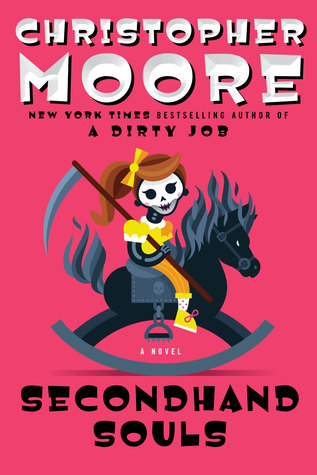
Secondhand Souls

This week’s pick:
Secondhand Souls by Christopher Moore
(to be released August 25, 2015 )

In San Francisco, the souls of the dead are mysteriously disappearing—and you know that can’t be good—in New York Times bestselling author Christopher Moore’s delightfully funny sequel to A Dirty Job.

Something really strange is happening in the City by the Bay. People are dying, but their souls are not being collected. Someone—or something—is stealing them and no one knows where they are going, or why, but it has something to do with that big orange bridge. Death Merchant Charlie Asher is just as flummoxed as everyone else. He’s trapped in the body of a fourteen-inch-tall “meat” waiting for his Buddhist nun girlfriend, Audrey, to find him a suitable new body to play host.

To get to the bottom of this abomination, a motley crew of heroes will band together: the seven-foot-tall death merchant Minty Fresh; retired policeman turned bookseller Alphonse Rivera; the Emperor of San Francisco and his dogs, Bummer and Lazarus; and Lily, the former Goth girl. Now if only they can get little Sophie to stop babbling about the coming battle for the very soul of humankind…

I love Christopher Moore pretty much always, and I’m really looking forward to this sequel to a book that thoroughly entertained me. Now I just need to squeeze in a re-read of A Dirty Job before the end of August!

What are you wishing for this Wednesday?

Looking for some bookish fun on Thursdays? Come join me for my regular weekly feature, Thursday Quotables. You can find out more here — come play!

♥♥♥♥♥♥♥♥

Do you host a book blog meme? Do you participate in a meme that you really, really love? I’m building a Book Blog Meme Directory, and need your help! If you know of a great meme to include — or if you host one yourself — please drop me a note on my Contact page and I’ll be sure to add your info!

Top Ten Tuesday: Top Ten Books on My Summer TBR List – 2015 edition

background-20737_1280

Top Ten Tuesday is a meme hosted by The Broke and the Bookish, featuring a different top 10 theme each week. This week’s topic is about reading plans for summer. What’s on my to-be-read list? As usual, it’s a mix of new releases and books from my shelves…

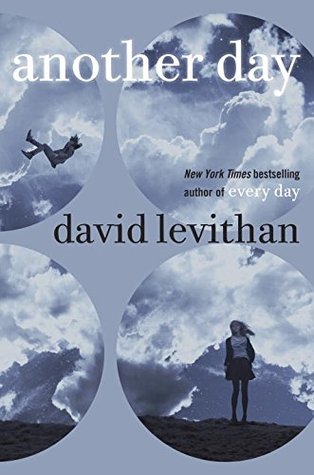
1) Another Day by David Levithan

another day

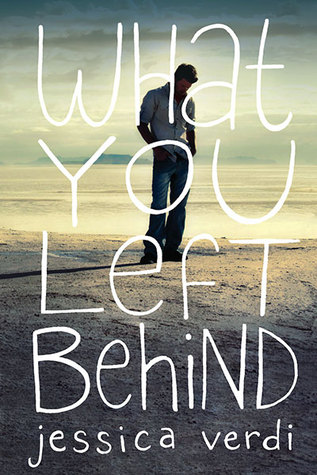
2) What You Left Behind by Jessica Verdi

What You Left Behind

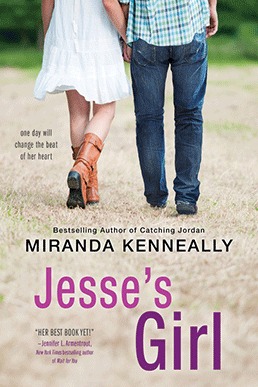
3) Jesse’s Girl by Miranda Kenneally

Jesse's Girl

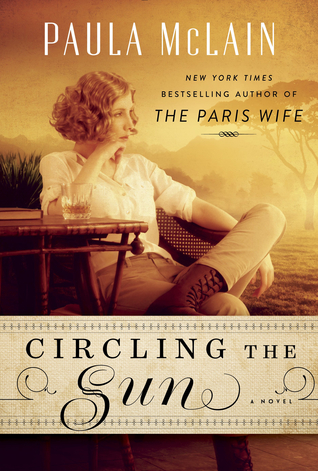
4) Circling the Sun by Paula McLain

Circling the Sun

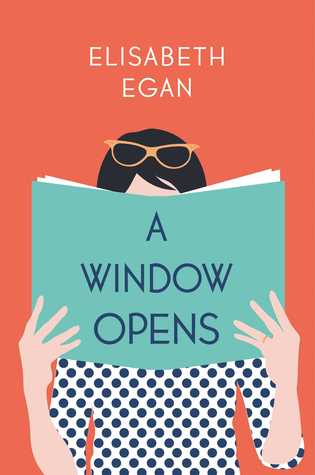
5) A Window Opens by Elizabeth Egan

A Window Opens

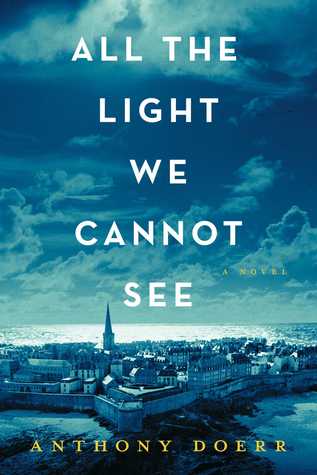
6) All the Light We Cannot See by Anthony Doerr (a book group pick for this summer)

All the Light

7) The Invention of Wings by Sue Monk Kidd (another one for the book group)

invention of wings

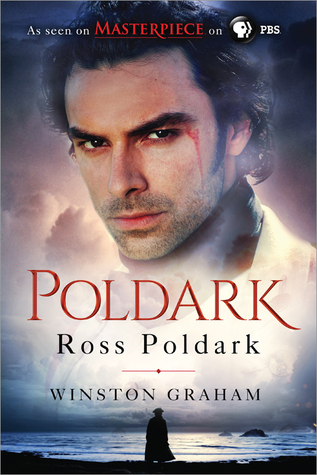
8) Ross Poldark by Winston Graham (because I’m dying to watch the BBC version)

Ross Poldark

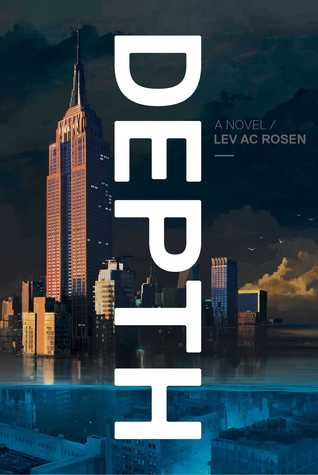
9) Depth by Lev AC Rosen

Depth

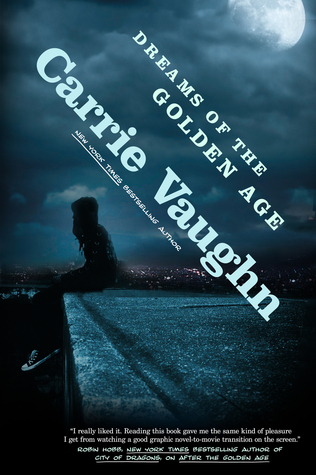
10) Dreams of the Golden Age by Carrie Vaughn (the sequel to After the Golden Age, which I just read and really enjoyed!)

Dreams of the Golden Age

What books are you looking forward to reading this summer?

Share your links, and I’ll come check out your top 10!

If you enjoyed this post, please consider following Bookshelf Fantasies! And don’t forget to check out my regular weekly feature, Thursday Quotables. Happy reading!

♥♥♥♥♥♥♥♥

Do you host a book blog meme? Do you participate in a meme that you really, really love? I’m building a Book Blog Meme Directory, and need your help! If you know of a great meme to include — or if you host one yourself — please drop me a note on my Contact page and I’ll be sure to add your info!

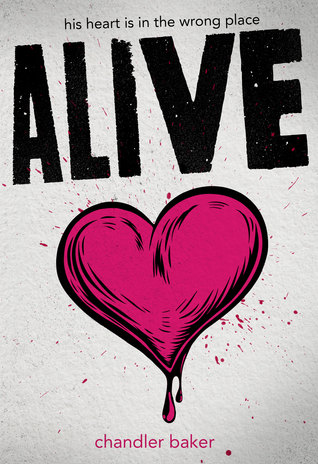
Book Review: Alive by Chandler Baker

Alive Stella Cross is a living, breathing miracle. At age 17, she was barely hanging on to life, waiting for her name to come up on the heart transplant list. Her heart began failing two years earlier, and since then she’s become the sick girl, having to give up her dreams of competitive swimming, surviving from doctor visit to doctor visit. As Alive opens, a donor heart finally becomes available, and Stella is rushed to surgery. Will she make it? Technically, she’ll be dead for a moment as her own heart is removed to make way for the healthy one that will replace it.

The surgery is a success, and Stella starts to reclaim her life, supported by her best friend Brynn and her super-best-friend-but-wants-more, the loyal (and adorable) Henry. But things are not 100% fine. Stella feels an ache in her chest that her doctors can’t explain, and every day at 5:08 exactly, she experiences an attack of blinding, debilitating agony. Is it all in her head? Psychological trauma would be normal after a heart transplant, after all. But no counseling and no medication seem to help, and to Stella, it’s very, very real.

When a new (gorgeous) boy joins the senior class at her high school, Stella is instantly drawn to him. Levi is seemingly perfect (did I mention gorgeous?), and is attracted right away to Stella as well. Weirdly, when Stella is near Levi, the constant aches seem to vanish. Life without pain is quite a temptation (and plus he’s gorgeous), and almost in the blink of an eye, Stella is glued at the hip to her new boyfriend, ditching (and being mean) to Henry and Brynn.

Is Levi really all that perfect? I think not. There’s something suspicious about the connection she feels to him, and he just keeps doing slightly odd things that set my alarm bells a-ringing. Surest sign that Levi is a creep? He pushes Stella to smoke for the first time. She’s a heart transplant patient! For god’s sake, run for the hills, Stella!

Alive is quite a tale. I don’t know why, but I expected something of a supernatural romance (perhaps à la “Return to Me” – did anyone else see that David Duchovny/Minnie Driver movie?). Instead, it quickly becomes clear that this is a horror story. And not just because Stella and Henry have a history of bonding over their shared love of Stephen King.

Stella is plagued by disturbing, bloody hallucinations – bloody handprints on her shirt, seeing a heart oozing blood in the school anatomy lab, and more disturbingly, the drowning death of her baby sister. When a classmate disappears and is later found dead, Stella’s fears grow even more intense, and she finally begins to heed her friends’ warnings about Levi.

And yet my heart still claws for him, storming the prison made from nothing but the bones of my rib cage. It beats so hard that I know it’s trying to fracture my skeleton. I wait for the first shard to puncture my skin or lung.

I really liked the development of the story. Stella just seems like a normal girl at first, a bit of an outsider thanks to her medical condition, trying to fit back into the life she thought she’d never have. And sure, it seems understandable that she basks in the glow of attention from the new boy, even if she is really cruel to cutie-pie Henry along the way. When the story veers off into gushing blood and scary fits, it’s even better. Look, it’s not just a YA love triangle! There’s something icky and scary going on, and my initial guesses about what and why were actually pretty far off.

The author makes great use of heart imagery as Stella contemplates whether she’s falling in love, thinking about what she may have in her heart and what she physically has going on inside her chest at the same time. There are some really stand-out phrases and passages that capture both essences of the heart, and the writing overall flows well and is easy to become lost in. I found myself completely absorbed, only looking up to discover that an hour had gone by!

What didn’t I love? Well, the end seemed a little muddled to me. I wasn’t entirely clear on how the various points came together and why things worked the way they did, although I was satisfied by the ultimate outcome.

Other than that, I had just a few little nitpicks about the plot itself, a major point being how Levi was able to enroll in and attend Stella’s high school without anyone blinking an eye. Without giving away spoilers, I can’t say more about why this point doesn’t really make sense… but there are a few small items like this that seem a bit too convenient or glossed over.

All in all, though, I though Alive was a good scary thrill, with an insta-love plotline that actually supports the overall story in a way that’s justifiable. Alive is tense and hard to put down, and Stella is a really interesting main character. It’s interesting to see inside the mind of a girl who’s gone through what she has, and I enjoyed seeing her growth and development over the arc of the story.

Alive is the debut novel by Chandler Baker, and I look forward to reading more by her in the future.

_________________________________________

The details:

Title: Alive
Author: Chandler Baker
Publisher: Disney-Hyperion
Publication date: June 9, 2015
Length: 368 pages
Genre: YA horror/supernatural
Source: Review copy courtesy of the publisher via NetGalley
Book Review: Eight Hundred Grapes by Laura Dave

Eight Hundred GrapesLife takes a decidedly unexpected turn for main character Georgia Ford in this novel about family, secrets, trust… and wine.

Georgia is a successful lawyer, happily living in LA, about to marry the man of her dreams and start a new life with him in London — when she sees him walking down the street with a gorgeous woman and a five-year-old girl with his eyes who calls him “Daddy”. Problem? The wedding is in one week. Another problem: Ben has never mentioned a daughter, but the woman is his ex-girlfriend — who just happens to be a world-famous movie star. Georgia flees, straight back to the comfort of family and home, but when she arrives, she doesn’t find exactly the peace and calm she’s looking for.

Instead, her family’s Sonoma vineyard is in an uproar. Her parents, who have an ultra-cute meet-cute story, have drifted apart, to the point where her mother is conducting a mostly-platonic affair with an old lover. What’s worse, her father has decided to sell his vineyard, his lifelong passion, to a huge wine company, one of the “evil” mass-market winemakers that he’s always hated. On top of that, Georgia’s twin brothers are feuding on a level that may change lives, and Georgia herself doesn’t know what she wants — for her future marriage or for her career. And then there’s Jacob,  the CEO of the huge wine company, who happens to be attractive, single, and not as evil as Georgia would like to believe him to be.

Do you smell a love triangle coming on? Because I sure did, the second Jacob appeared on the scene.

But in a sense, the love triangle is the least important love story going on here. In Eight Hundred Grapes, the most compelling love story is the story of Georgia’s family’s love for the land. In some of the most moving sections of the book, we learn about her father Dan’s devotion to his soil, his grapes, his winemaking process, his absolute belief in what he’s doing, and what it means to him, his family, and his community. Although Georgia outwardly has done everything she can to distance herself from the vineyards, her actions show how deeply rooted she is in the family acres and the business.

Author Laura Dave lovingly describes the natural beauty of Sonoma , the grace of nature, and a return to a respectful and mutually beneficial relationship to the land. Through the descriptions of Dan’s approach to viticulture, she shows that new possibilities exist, incorporating old traditions but infused with science and organic growth and cultivation.

The characters all have something at stake, and much thought is given to the concepts of what each truly values, what’s been given up in the past, and what each wants to get back or hold onto. There are plenty of missed chances and second chances, and the characters all go through various forms of eye-openings, learning to see each other not just as they always have, but taking a fresh look and understanding what each wants and needs.

It all felt like the same thing: the loss of the vineyard, the coming apart of our family. Finn and Bobby and Margaret. My parents. Ben and Maddie. Michelle. It all felt tied up, like the same thread was running through them. Where there had been trust — to keep each other safe, to make each other feel loved — there was none. Maybe it was tied up. Synchronized to come apart the moment my father turned his back on the vineyard and we were all too busy to stop him.

Back to the love triangle for a minute — at about the mid-point of the novel, I thought that I’d called it wrong and that there wouldn’t really be a love triangle. Okay, so I was right after all, but fortunately, the triangle isn’t the driving factor in this story. What’s more important is that Georgia is forced to take a good hard look at her relationship with her fiancé Ben, not just in light of the revelations about his daughter, but in terms of who she herself is and what she truly wants for her own life.

The writing is insightful, as Georgia analyzes (and perhaps overanalyzes) each family member’s every action and word.

Wasn’t the ultimate form of fidelity who you told your stories to? Ben had stopped telling me his.

Does she believe that her parents’ marriage is truly over? Does her father mean it when he says he’s done with the vineyard? She spends just as much time worrying over her own motivations: Did she choose a law career after seeing how frightening it can be to base everything on something outside of one’s own control? After growing up in a vineyard, she’s well aware of how one or two seasons of bad weather can threaten everything and take away years of hard work. So was she really just looking for a safer path for herself? And what does this say about her relationship with Ben? Does he represent the safe option as well?

Here’s where the more nitpicky part of this review comes along. I didn’t see the value of making Ben’s ex a movie star. It doesn’t add at all to the dynamics of the story, and we didn’t really need the extra element of Georgia feeling insecure or having to deal with the ex’s fame. Georgia’s relationship with Jacob is perhaps the weakest part of the story; again, it just didn’t feel terribly necessary to have a new love interest thrown into the mix of Georgia dealing with her family and her plans for her future.

These small issues aside, I really liked the storytelling in Eight Hundred Grapes, particularly seeing the world through Georgia’s eyes. Her perspective is fresh and funny, even when dealing with serious, momentous decisions. The family members are all well-developed, even those who don’t get a lot of major attention. The author does a great job of showing the family history, the years of love and tension, comfort and affection, that make up a whole. Woven into the entire story is the family’s traditions concerning the grapes — the harvest parties, the family dinners, the final harvesting of the most special grapes from the vines. Working with the vines and the soil is deeply embedded in every family moment, and we see that so clearly that it’s easy to understand why Dan’s decision to sell the vineyard is so much more than just a business decision.

I recommend this book for anyone who enjoys contemporary fiction with a lot of heart. It’s a quick read, but raises some interesting ideas about family, tradition, and the choices we all face about what to keep and what to give up.

PS – The title? Well, did you ever wonder how many grapes it takes to make a single bottle of wine? Now you know.

_________________________________________

The details:

Title: Eight Hundred Grapes
Author: Laura Dave
Publisher: Simon & Schuster
Publication date: June 2, 2015
Length: 272 pages
Genre: Contemporary fiction
Source: Review copy courtesy of the publisher via NetGalley
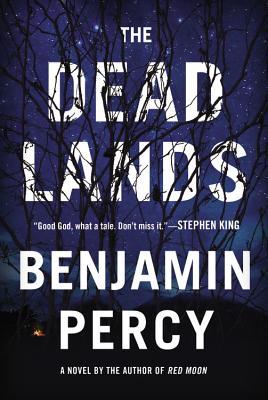
Book Review: The Dead Lands by Benjamin Percy

Dead LandsIf man-sized, blood-sucking albino bats freak you out, The Dead Lands might not be the best book for you.

If you can handle the squickiness and enjoy alternate histories and post-apocalyptic societies, read on!

In The Dead Lands, the action begins in the Sanctuary, formerly known as St. Louis, Missouri, approximately 150 years after a global flu pandemic and subsequent nuclear warhead detonations and reactor meltdowns destroy the world as we know it. The Sanctuary is a parched, cramped little insular world, surrounded by a massive wall that keeps all the bad out — and keeps its residents in. Water is scarce and growing scarcer. Residents of the Sanctuary are convinced that they’re it, all that’s left of humanity in this miserable world. It’s been at least 60 years since an outsider has shown up seeking entry. Meanwhile:

The wall is a constant in Simon’s life, everywhere he looks, impossible to miss. Yet it is as common as dust, as heat, as the sun’s blazing path across the sky, and it is easy to go days, weeks, without noticing it. It is of uneven height but at its tallest point reaches a hundred feet from the ground. In some places it is made from plaster and mortared stone, and in others, heaps of metal, the many-colored cars of another time, crushed and welded together into massive bricks that bleed rust when it rains.

The Sanctuary is ruled with an iron fist by the mayor, an autocratic dictator who suffers no dissent and who has instituted a policy of harsh punishment, including a brutally disgusting death penalty, for anyone who dares to criticize the regime, even by so much as a drunken comment in a bar among friends.

The sole spot of peace and possible civility in this harsh settlement is in the museum, run by Lewis Meriwether, a reclusive, odd, studious man who is both feared and respected by the residents of the Sanctuary. People flock to the museum to bask in the wonders of bygone worlds, despite the curator’s strangeness.

Life in the Sanctuary is disrupted when a rider appears from out of the dust — a girl on horseback, with all black eyes, bearing a message and begging to be heard. She is shot before she can deliver the message and is immediately captured and sentenced to death — but the message gets through all the same. She brings word of another civilization, on the Oregon coast, where there is rain and agriculture and a thriving community. The mayor wants nothing of this and tries to keep it secret, but Meriwether and a guard named Mina Clark agree to join the messenger, Gawea, and together with a few others, carry out a desperate escape from their walled city.

Do the names ring a bell? Lewis and Clark? Gawea… as in Sacagawea? The Dead Lands reimagines the Lewis & Clark expedition in this harsh, dead world, as our band of escapees flees through the barren, dry areas outside of the Sanctuary, following the dried-up bed of the Missouri River in search of water, shelter, and salvation. Along the way, they face untold horrors and dangers. Due to the high post-disaster radiation levels, all sorts of horrible mutations have taken place, so that the albino bats are but one nasty specimen that wants to eat, kill, or maim the travelers. Hazardous landscapes pose endless threats, as the oil fields continue to burn, creating micro nuclear winters, and the few signs of life they do see come with new and strange risks. And as the group travels onward, we see that animals and vegetation aren’t the only forms of life that have evolved in strange ways due to radiation. Lewis exhibits weird, almost magical telekinetic abilities, and Gawea has powers of her own.

The imagery throughout The Dead Lands is horror-novel worthy. (Did I mention the albino bats already?) It’s bleak, dark, and dismal. Very bad things happen. Nightmarish creatures arrive out of nowhere. As soon as one threat is dealt with, another appears to take its place. And as you might expect, people turn out to be the biggest threat of all. Because, of course, a utopian agrarian society in the Pacific Northwest is probably too good to be true, right? The other humans out there are vicious in their own way, and as happens so often in this type of book, those who can seize power do, and everyone else is forced into one form of servitude or another.

There are some very interesting concepts, including the reestablishment of city-states as small empires. The suffering of the people, in the Sanctuary as well as elsewhere, makes you marvel that anyone bothers to survive at all, given how horrible it all is. The people with power are awful and self-aggrandizing and unbelievably decadent, reminding me of the worst of the Roman emperors, perhaps, indulging in wasteful, steamy hot baths while the common folks quench their thirst via animal blood, sucking rocks, and worse.

Setting the story in the future, yet including characters from American history, makes everything feel very circular. Is slavery inevitable in human societies? Is the impulse for the strong to dehumanize the weak somehow hardwired into our DNA? In The Dead Lands, it certainly seems that way. Does a totalitarian society encourage those with sadistic tendencies to rise to power? If the Sheriff of the Sanctuary is any indication, that would be a yes. Society itself has reverted to a bygone time, thanks to the end of technology and industry:

Apothecaries, tinkers, blacksmiths, seers. Old words, old ways. So much about the world has reverted, so that it is not so much the future people once imagined, but a history that already happened, this time like a time long ago.

The descriptions of the ravaged world are horrible yet evocative:

The remains of the St. Louis Arch, collapsed in the middle, appear like a ragged set of mandibles rising out of the earth.

Even a passionate interlude between two illicit lovers is presented as disturbing… and pretty gross:

What they are doing is kissing, though it looks much like eating. Their mouths opening and closing hungrily, their teeth biting down on lips, cheeks. Then they pull apart, their faces are a splotchy red and he is bleeding from the corner of his mouth.

The writing in The Dead Lands is wildly disturbing and imaginative. While the explorers push forward, even when it seems pointless and impossible, it’s not from a true sense of hope, but rather because there simply is no alternative but to keep going.

Not so long ago Lewis believed in the end of the rainbow. A shire. An emerald city. Elysian fields. What his childhood storybooks promised. He believed, back when they first set out from the Sanctuary, that something arcadian awaited them. Not anymore. Now now. Not when he sees the bone-riddled ruins of Bozeman. It is not only the landscape that disappoints. It is humankind. Inside and outside the wall, humans remain the same, capable of wonderful things, yes, but more often excelling in ruin.

The ending felt a little abrupt and puzzling to me, and didn’t quite pull together all of the many story threads in this big, complicated book. Ultimately, I’m not sure what it all meant, and the open-ended nature of the ending makes me wonder if a sequel is in the works.

Do I recommend The Dead Lands? Yes, but only for those with a strong stomach and a willingness to read a book that is terribly unpleasant and often horrific. It’s disturbing and sometimes icky, and I’d be scared to death to read this on a camping trip with only a campfire to ward off all the nightmares waiting in the dark. The world of The Dead Lands is as awful as the title promises, so don’t expect moments of grace or redemption along the way. Most of all, don’t get too attached to any of the characters. Bad things happen. To lots of people.

Have I scared you away from this book yet? I’m glad I read it, really, I am! But it’s heavy and morbid, and you should know that before you start. As for me, I think I’ll track down a copy of the author’s previous novel, Red Moon, which also sounds quite disturbing. (I think I’d better read some books about kitties and unicorns first.)

Side note: I did find some of the similarities to Station Eleven a bit odd — flu pandemic, nuclear meltdowns, scavenging abandoned houses for supplies, even a TV set up like a diorama. I suppose it’s not too far-fetched — seen one crumbling civilization, seen ’em all — but a few of these elements really jumped out at me, having read Station Eleven fairly recently. Just saying.

_________________________________________

The details:

Title: The Dead Lands
Author: Benjamin Percy
Publisher: Grand Central Publishing
Publication date: May 14, 2015
Length: 416 pages
Genre: Adult fiction/post-apocalyptic/horror
Source: Review copy courtesy of the publisher via NetGalley
Thursday Quotables: The Mapmaker’s Children

quotation-marks4

Welcome back to Thursday Quotables! This weekly feature is the place to highlight a great quote, line, or passage discovered during your reading each week.  Whether it’s something funny, startling, gut-wrenching, or just really beautifully written, Thursday Quotables is where my favorite lines of the week will be, and you’re invited to join in!

NEW! Thursday Quotables is now using a Linky tool! Be sure to add your link if you have a Thursday Quotables post to share.

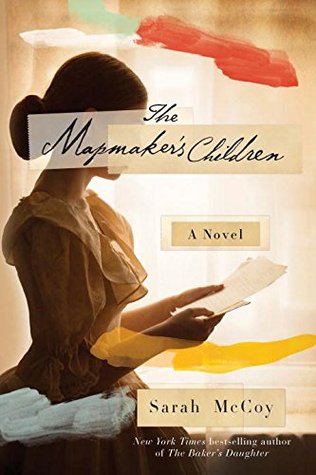
Mapmaker's Children


The Mapmaker’s Children by Sarah McCoy
(published May 5, 2015 )

In this historical novel about the daughter of abolitionist John Brown and their family’s legacy, Sarah Brown experiences a terrible loss and its aftermath:

The grief that had hardened to bitterness in her brothers was purified like boiled water in Sarah. Her father’s death wasn’t an end to his mission but the beginning of something greater.

People were capable of more love and benevolence than they realized. The collective public voice did not always represent the individual heart. Yes, there were terrible men doing terrible deeds to one another. Men in this very town who abused others based on the color of their skin. There were prideful men who thought their marrow was made of more golden stuff than others’. Her father had proven to them all: when a beating heart stopped, there was no black or white, only blood-red. The flesh was equal. It was the character of a man that made him better or worse.

What lines made you laugh, cry, or gasp this week? Do tell!

If you’d like to participate in Thursday Quotables, it’s really simple:

  • Write a Thursday Quotables post on your blog. Try to pick something from whatever you’re reading now. And please be sure to include a link back to Bookshelf Fantasies in your post (http://www.bookshelffantasies.com), if you’d be so kind!
  • Click on the linky button (look for the cute froggie face) below to add your link.
  • After you link up, I’d love it if you’d leave a comment about my quote for this week.
  • Be sure to visit other linked blogs to view their Thursday Quotables, and have fun!

Blog Tour & Book Review: The Bookseller by Cynthia Swanson

The Bookseller (2)I’m delighted to be participating in the blog tour celebrating The Bookseller, a debut novel by Cynthia Swanson. Thank you, TLC Book Tours, for inviting me to participate!

The Bookseller is the touching and intriguing story of one woman living two lives.

As the book opens, we meet Kitty, a single career woman in 1962. 38 years old, she and her best friend Frieda own a small bookshop in a no-longer-thriving neighborhood of Denver. Kitty lives alone with her cat Aslan, enjoys the sister-like company of her friend, and thrives in a loving relationship with her devoted parents. She’s happy, and really doesn’t regret the life choices she made that brought her to this point in her life.

But when Kitty goes to sleep, she wakes up in a strange bedroom in a lovely home, beside a loving man names Lars who refers to her by her full name, Katharyn. It’s 1963, and she appears to be married to her soulmate, living in a comfortable house in a newer Denver neighborhood, a stay-at-home mother to triplets.

Kitty is absolutely confounded by this dream world of hers. When she wakes up again, she’s haunted by how realistic this imaginary world seems, and is struck by the thought that she’s encountered the unusual name Lars before. She remembers that in her real life, she’d almost had a first date with a man named Lars eight years earlier, but he stood her up and so they never met.

Each time Kitty goes to sleep, she crosses from one world to another. Her dream world is vivid and distinct. She discovers an enormous depth of feeling for her husband Lars, and she loves her adorable children, despite being confused and somewhat frustrated by her son Michael, who is, apparently, autistic. Sadly, in this dream world, Katharyn and Frieda have fallen out years earlier, although she has no idea why.

Gradually, the lines begin to blur. Each world feels real and seems to want to claim her. The more time Kitty spends in her dream world, the more memories come back to her… but so much still remains elusive. Finally, Kitty has to sort out which is her real world, where she truly belongs, and which life is the one she must let go.

… And let me just pause here from providing plot summary and say — wow. What a book.

With hints of Sliding Doors as well as certain points that reminded me of The Impossible Lives of Greta Wells by Andrew Sean Greer, The Bookseller asks us to pass from dream world to reality and back to dream world right along with Kitty. Both lives are rich and detailed. Both are filled with people who matter to her. Could she really have forgotten a life in which she’s a wife and mother? But how can all of her memories be about her life in the bookstore with Frieda, if her other life with Lars feels equally real?

I loved the construction of this emotion-packed novel. We flow right alongside the main character as she shifts abruptly, never entirely sure of when or where she’ll wake up in a different life, sometimes in the middle of a scene, so to speak, already under way. The writing is matter-of-fact, yet startling at times, as when Kitty gazes into the face of her dream husband for the first time or is suddenly struck by the knowledge that she has children.

The 1960s setting works magnificently here. The author weaves in all sorts of small details that make the time period seem real, from the admiration of Jackie Kennedy’s fashion sense to the fears of the Cuban Missile Crisis to the simple joys of listening to Patsy Cline and checking out the newest books by J. D. Salinger and Katherine Anne Porter.

It’s also a marvelous tribute to the choices available to a woman at that time and the courage needed to chart her own course. Staying single, owning a business — these are not easy paths, and certainly not common or expected. Likewise, the challenges facing a young mother are daunting. Despite being well-off and with a supportive husband, dealing with three children is all-consuming. The medical world was only just waking up to the meaning of autism at the time, and the only resources Kitty can find on the subject pin the “blame” squarely on the mother, with no guidance available on finding ways to connect with the child or even how to provide him with an education.

The Bookseller had me hooked from the first chapter, and I truly loved the main character. Her two lives, as Kitty and Katharyn, each offer her something special — but each is missing some key element that makes the other life hard to turn away from. Her confusion and pain feel real, as does her love for Lars and her children, her parents, and Frieda.

I highly recommend The Bookseller. Its shifting reality twists will absolutely keep you guessing! With an engaging yet mysterious plot, a well-earned resolution, and emotions that ring true, this book should appeal to anyone who enjoys stories about strong women confronting unusual and unpredictable challenges. Check it out!

Find out more:

Add to Goodreads badge

Purchase Links

Amazon | IndieBound | Barnes & Noble

About the Author:

Cynthia SwansonCynthia Swanson is a writer and a designer of the midcentury modern style. She has published short fiction in 13th MoonKalliopeSojourner, and other periodicals; her story in 13th Moon was a Pushcart Prize nominee. She lives in Denver, Colorado, with her husband and three children. The Bookseller is her first novel.

Find out more about Cynthia at her website and connect with her on Facebook.

_________________________________________

The details:

Title: The Bookseller
Author: Cynthia Swanson
Publisher: Harper
Publication date: March 3, 2015
Length: 352 pages
Genre: Adult fiction
Source: Review copy courtesy of TLC Book Tours

tlc logoFor further information, stop by TLC Book Tours to view other blog tour hosts.

Wishing & Waiting on Wednesday: What You Left Behind

There’s nothing like a Wednesday for thinking about the books we want to read! My Wishing & Waiting on Wednesday post is linking up with two fabulous book memes, Wishlist Wednesday (hosted by Pen to Paper) and Waiting on Wednesday (hosted by Breaking the Spine).

What You Left Behind

This week’s pick:
What You Left Behind by Jessica Verdi
(to be released August 4, 2015 )

It’s all Ryden’s fault. If he hadn’t gotten Meg pregnant, she would have never stopped her chemo treatments and would still be alive. Instead, he’s failing fatherhood one dirty diaper at a time. And it’s not like he’s had time to grieve while struggling to care for their infant daughter, start his senior year, and earn the soccer scholarship he needs to go to college.

The one person who makes Ryden feel like his old self is Joni. She’s fun and energetic—and doesn’t know he has a baby. But the more time they spend together, the harder it becomes to keep his two worlds separate. Finding one of Meg’s journals only stirs up old emotions, and Ryden’s convinced Meg left other notebooks for him to find, some message to help his new life make sense. But how is he going to have a future if he can’t let go of the past?

I read Jessica Verdi’s The Summer I Wasn’t Me last year, and was so impressed by the book’s strong characters and honest emotions. This new book sounds really powerful, and I can’t wait to read it!

What are you wishing for this Wednesday?

Looking for some bookish fun on Thursdays? Come join me for my regular weekly feature, Thursday Quotables. You can find out more here — come play!

♥♥♥♥♥♥♥♥

Do you host a book blog meme? Do you participate in a meme that you really, really love? I’m building a Book Blog Meme Directory, and need your help! If you know of a great meme to include — or if you host one yourself — please drop me a note on my Contact page and I’ll be sure to add your info!

Book Review: The Secrets We Keep by Trisha Leaver

Secrets We KeepMaddy and Ella, identical twin sisters in their senior year of high school, were best friends since birth… right up until the first week of freshman year, when Maddy’s pursuit of popularity led her to dump quiet, artistic Ella and become the belle of the ball. From that moment onward, the two occupied a home together, but had next to nothing in common. Maddy was always at the center of the in-demand social circle, busy with perfect boyfriend Alex, and obsessed with looks, clothes, and status. Ella found a new best friend, Josh, who shared her interests in art and anime and became her constant companion.

That’s all backstory. Early on in The Secrets We Keep, tragedy strikes. On a rainy night, on the way home from a party, Maddy’s car goes off the road and one twin is killed, the other seriously injured. But who survived? As it turns out, Ella had driven Maddy’s car to pick her sister up — and because Maddy’s clothes were soaked from waiting in the rain, Ella gave Maddy her coat and sweatshirt.

The driver is pulled alive from the wreck, while the other sister is dead at the scene. The car is Maddy’s; the driver is presumed to be Maddy — especially since the dead girl is wearing Ella’s clothes.

When Ella wakes up in the hospital, she at first has no recollection of her name or her circumstances. But there’s a boy holding her hand, dozens of flower bouquets in her room from her many friends, and the name “Maddy” written on the board in her room. She assumes she herself is Maddy, and it’s not until she insists on seeing her dead twin in the morgue that her own memories come flooding back.

And here’s where my belief in this story pretty much went out the window: Ella feels tremendously guilty for causing her sister’s death. She sees how happy her parents are when she wakes up and they greet her as “Maddy”, and she hears from Alex and the nurses how many of “her” friends are crammed into the halls and waiting rooms, cheering for her survival. Ella decides on the spot that her parents wouldn’t be happy if they knew the survivor was Ella, not Maddy. Furthermore, she decides that she owes Maddy a debt for killing her, and the way to make it up to her is to live her life. So Ella keeps her own identity a secret and vows to live Maddy’s life, which becomes a bit harder once she has to attend her own funeral and act like her best friend Josh means nothing to her.

Hoo boy. Things unravel from there. Ella uncovers a dark secret about a very not-nice plot of Maddy’s. Ella does a not-very-good job of impersonating Maddy when she goes back to school, breaking all sorts of rules about appearance, bitchiness, and maintaining mean girl status quo. Instead of going to her own honors classes and maintaining her perfect grades, Ella follows Maddy’s undemanding schedule and has to force herself to dumb down her test performance. In short, it’s a mess.

Does any of this make sense? Not really. Ella’s thinking can be chalked up to shock at first, but she’s really much too smart a girl to actually believe that her parents are happy that Maddy survived and she didn’t. And I couldn’t see any logic in the idea of living Maddy’s life as a way to repay her sister. Maddy is still dead, after all. How can pretending to be her make a difference? And then there’s Ella’s belief that Maddy being alive makes so many more people happy — why does this matter to Ella? She doesn’t even like these people.

It’s really a ridiculous situation, and I found it pretty much impossible to buy the premise. As clichéd as the old stand-by amnesia plot is, the whole set-up here would have been much more plausible if Ella hadn’t regained her memories. If she actually believed herself to be Maddy, it would be interesting to see her trying to piece her life back together, when it was never actually hers. But having Ella pretend to be Maddy for the flimsiest of reasons just defies all logic. The piece about her parents really irritated me, to be honest. So they bury Ella and try to rebuild their lives with Maddy — and then when the truth comes out, they’re forced into a brand-new mourning period for the daughter they believed to be alive, yet they’re supposed to now be overjoyed by Ella’s survival? It’s just weird and cruel, and I felt that Ella’s treatment of her parents was especially callous.

I realize this all sounds as though I didn’t like The Secrets We Keep at all, and that’s not entirely the case. On the more positive side, the writing itself is fast-paced and kept my attention, so even though I kept exclaiming over how unbelievable the plot was, I also didn’t want to put the book down. Granted, a part of me wanted to keep reading to see if there was some great twist coming or if the ending would justify it all. And, well, no, that’s not what happened… but still, I did keep reading and I did want to see how it worked out, so there’s that.

Not every book is for every reader, and despite having a premise — at least according to the synopsis — that sounded really intriguing, the final result just didn’t work for me.

_________________________________________

The details:

Title: The Secrets We Keep
Author: Trisha Leaver
Publisher: Macmillan Children’s Publishing Group
Publication date: April 28, 2015
Length: 304 pages
Genre: Young adult contemporary fiction
Source: Review copy courtesy of the publisher via NetGalley