Random book news of the day

I’m having a hard time settling on just one topic today. Maybe I’m just too tired — my ten-year-old woke me up at 3:15 am after a bad dream, asked me to sit with him while he went back to sleep (which he did almost immediately), then I tossed and turned for about an hour or so. Whine, whine, whine… poor me. At any rate, I’ve just been killing time bopping around the web, and here are some cool, random, or unusual tidbits I’ve stumbled across:

  • Did you have any idea that The Time Traveler’s Wife had not already been released as an e-book? This is one of my all-time favorite books, and I know it was a huge bestseller, so I find this rather puzzling. However, according to the Associated Press, the e-book version will finally be released on October 10th — about nine years since the book was first released in hardcover.
  • Carlos Santana is writing a book! Not, thank heavens, a cutesy kids book, like some celebs have done. (“Look, I’m a writer!” Yikes). Santana’s memoir is due out sometime in 2014, and will be published by Little Brown & Co., the same publishing company that brought us Life by Keith Richards.
  • A new study shows that 55% of the people buying YA novels are not, in fact, young adults. Or maybe they are young adults, but not “young adults” as in the target demographic for young adult fiction — which would be teens. Boy, that convoluted sentence makes my teeth hurt. In any case, over half of the buyers of YA fiction are over age 18, and most are in their 30s and 40s. (Guilty!) Does this surprise anyone? Based on wholly unscientific data — which is that lots of my grown-up friends and fellow bloggers adore YA — this doesn’t seem particularly shocking. If you’re interested, you can read more about the study here.
  • The 57th edition of the Guiness Book of World Records has just been released. Because we really, really need to know just how tall the world’s tallest mohawk is. (Answer: 3 feet, and it’s been growing for 15 years).
  • A book returned 78 years past its due date would have cost the borrower over $6,000 in fines, had an amnesty program not been in effect. You can read more about the Chicago Public Library’s amnesty program here; here’s a snippet which I found charming:

The rare edition of Oscar Wilde’s “The Picture of Dorian Gray” had been checked out in 1934. According to Reuters news agency, Harlean Hoffman Vision found the book in her late mother’s possessions and wanted to bring it back, but she wanted to make sure she wouldn’t go to jail for having had it so long. “She kept saying, ‘You’re not going to arrest me?’ and we said, ‘No, we’re so happy you brought it back,’” Ruth Lednicer, the library’s marketing director, said. The library’s fine amnesty – dubbed “Once in a Blue Moon Amnesty” – began on Aug. 20 and ended Sept. 7. The value of the 101,301 items returned was estimated at $2 million. Several of the recovered items were checked out in the 1970s and 1980s, the Chicago Tribune newspaper reported.

  • Oops, maybe I shouldn’t have made fun of celebs who write children’s books. Jessica Lange’s book for kids, It Is About A Little Bird, is due out in 2013. Stop thinking about Constance on American Horror Story! I’m sure the book will be wholesome and lovely and not in the least bit creepy.
  • Apparently reviewers granted the privilege of getting advance copies of J. K. Rowling’s upcoming new release (and guaranteed international bestseller) The Casual Vacancy are subject to restrictions so strict that they’re not even allowed to talk about the fact that restrictions exist. Not exactly shocking, given the uber-security surrounding the Harry Potter releases. I know we’re all going to be reading this book. The question is, will we like it? Check back with me in early October!
  • And finally… according to this LA Times piece, you can get that embarrassing copy of 50 Shades of Grey off your bookshelf! Mail your copy to O/R Publishing, and the first fifty respondents will be sent a copy of 50 Shades of Louisa May as a replacement. Now that’s what I call a good deal! (said with a slight smirk and a just-barely-audible snort)

My web browser has crashed twice, causing me heart palpitations over potentially lost pearls of wisdom. This must be a sign from the gods of sleep that my time at the keyboard has come to a close.

Good night, all… and may your dreams be filled with cushiony armchairs and excellent reading.

Wishlist Wednesday

And now, for this week’s Wishlist Wednesday…

The concept is to post about one book from our wish lists that we can’t wait to read. Want to play? Here’s how:

  • Follow Pen to Paper as host of the meme.
  • Please consider adding the blog hop button to your blog somewhere, so others can find it easily and join in too! Help spread the word! The code will be at the bottom of the post under the linky.
  • Pick a book from your wishlist that you are dying to get to put on your shelves.
  • Do a post telling your readers about the book and why it’s on your wishlist.
  • Add your blog to the linky at the bottom of the post at Pen to Paper.
  • Put a link back to pen to paper (http://vogue-pentopaper.blogspot.com) somewhere in your post.
  • Visit the other blogs and enjoy!

My Wishlist Wednesday book is:

The Brides of Rollrock Island by Margo Lanagan
(published September 2012)

From Amazon:

On remote Rollrock Island, men go to sea to make their livings—and to catch their wives.

The witch Misskaella knows the way of drawing a girl from the heart of a seal, of luring the beauty out of the beast. And for a price a man may buy himself a lovely sea-wife. He may have and hold and keep her. And he will tell himself that he is her master. But from his first look into those wide, questioning, liquid eyes, he will be just as transformed as she. He will be equally ensnared. And the witch will have her true payment.

Margo Lanagan weaves an extraordinary tale of desire, despair, and transformation. With devastatingly beautiful prose, she reveals characters capable of unspeakable cruelty, but also unspoken love.


Why do I want to read this?

Well, just look at that description! Selkies, witches, love… windswept, sea-battered islands… sounds like the perfect mixture of mythology and otherworldly romance, with a very dark undercurrent.

I read Margo Lanagan’s story collection Black Juice a couple of years ago, and — unusual for me with my bad attitude toward short stories — I just couldn’t look away until I’d read the whole thing. “Singing My Sister Down” immediately became one of my favorite short stories ever — it’s crisp, creepy, tragic, and unforgettable.

Since I’m trying to curtail my hardcover book buying, I haven’t given into temptation yet on The Brides of Rollrock Island… but if my local library doesn’t get it PRETTY DARN QUICK, I have a feeling this will be my next purchase.

Quick note to Wishlist Wednesday bloggers: Come on back to Bookshelf Fantasies for Flashback Friday! Join me in celebrating the older gems hidden away on our bookshelves. See last week’s introductory post for more details, and come back this Friday to add your flashback favorites!

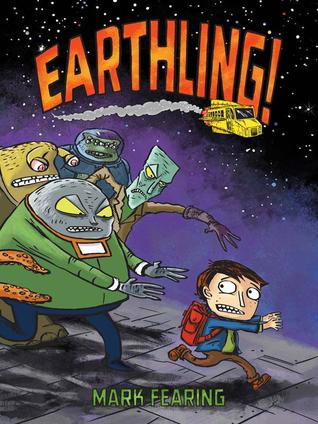
Book Review: Earthling! by Mark Fearing

Book Review: Earthling! by Mark Fearing

Earthling! was “awesome”, according to my 10-year-old, and I’d have to agree. This graphic novel tells the story of average kid Bud, who moves to New Mexico with his dad and, on his first day of school, gets on the wrong school bus. Not just any bus, though — Bud gets on a bus going to Cosmos Academy, an intergalactic school located on a huge space ship. Bud must keep his identity secret, as Earthlings are the most feared species in the universe. Posing as a Tenarian exchange student, he must fit in, make friends, and figure out how in the universe he’s going to get back home. Oh, and also lead his team to victory in ZeroBall — if he can figure out what that is before the championship.

Earthling! is clever and funny, and makes good points about friendship, being the new kid, and being judged based on stereotypes — all without being preachy or talking down. The artwork is bright, humorous, and includes enough weird and gross aliens to delight kids and entice them to read on.

This was a great choice for my middle grade reader, who usually has to be chained down and force-fed his reading material. This one, he read without a struggle… and liked it enough to insist that I read it too.

Guess what? I found myself giggling as well. Earthling! is a winner.

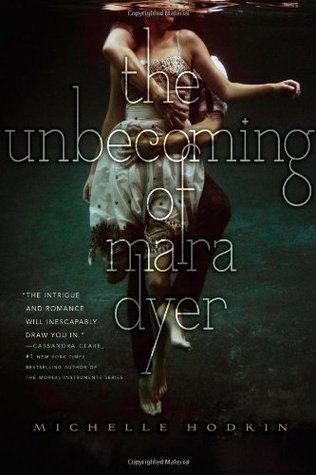
Book Review: The Unbecoming of Mara Dyer by Michelle Hodkin

Book Review: The Unbecoming of Mara Dyer by Michelle Hodkin

16-year-old Mara wakes up in a hospital to some truly horrifying news: She was injured when an abandoned building collapsed with her and three friends trapped inside. Even worse, Mara is the only survivor, yet she has no memory of what happened or why they were there.

Suffering from flashbacks and hallucinations and diagnosed with PTSD, Mara begs her parents to relocate some place new and let her start fresh — a new town and a new school where the daily reminders of her loss won’t confront her everywhere she turns. The family packs up and moves from Rhode Island to Florida, but the trauma for Mara isn’t over.

Mara continues to see things that aren’t there and to have occasional lapses in time that she can’t account for. On top of that, her new private school is not exactly welcoming, and Mara manages to alienate a typical mean girl on her very first day. On the bright side, stunningly attractive Noah seems drawn to Mara, and despite her misgivings, the two eventually develop a strange yet strong connection.

As Mara and Noah’s tension-filled chemistry grows, so too does the mystery. Why can’t Mara remembers some of her actions? Why does she see faces of her dead friends in mirrors? Why do people around her keep ending up dead?

This being the first book in a trilogy, of course there are no quick answers. Unbecoming ends with some insights and revelations, but no major mysteries solved. Clearly, Mara and Noah are involved with forces and powers they don’t understand, and clearly, there are dangers waiting for them in the next installment.

I found this young adult novel addictingly readable, and managed to gobble it all up in the space of 24 hours. The writing is adept and flowing, with snappy dialogue that seems true and authentic for its teen protagonists. Mara is an immensely sympathetic lead character; the reader feels her pain, her confusion, and her sorrow, as well as her more pedestrian worries about fitting into a new school, trying to make friends, and fretting about GPAs and college acceptance letters.

The Unbecoming of Mara Dyer sets out an intriguing set of mysteries, with dynamic characters and relationships, and leaves everything swirling around with enough suspense that I can’t wait to read the next book. Which, luckily for me, won’t be a terribly long wait: The Evolution of Mara Dyer will be released October 23, 2012.

The Monday agenda

Not a lofty, ambitious to-be-read list consisting of 100+ book titles. Just a simple plan for the upcoming week — what I’m reading now, what I plan to read next, and what I’m hoping to squeeze in among the nooks and crannies.

Another Monday morning, another workweek underway… another opportunity to make grandiose, pie-in-the-sky plans to read everything I can get my paws on. Here’s the latest:

From last week:

Hmm, how’d I do?

Frozen by Mary Casanova: Done! My review is here. Short version: Okay, some nice elements, but not a must-read.

The Age of Miracles by Karen Thompson Walker: Done! Here’s my review. Overall, I’d say nicely written but flawed. Still, I’m glad to have read it.

The Unbecoming of Mara Dyer by Michelle Hodkin: Finished late last night, review to follow. Highly readable and hard to put down.

In graphic novels, I finished up the Jack of Fables series. A fun additional to the world of Fables, but not essential reading.

Drums of Autumn by Diana Gabaldon (group re-read): Need I keep saying it? Terrific book, terrific chapter discussions!

And this week’s new agenda:

I may veer off the fiction path (shocking, for me) and delve into a few books I’ve been wanting to try:

A Stolen Life by Jaycee Dugard. Just picked this one up at the library. As a parent, I approach reading this with some trepidation, but I do so admire this young woman’s courage and want to see how she portrays her own experiences.

I really should read one of the Mary Roach books that were my Wishlist Wednesday selections last week, either Stiff or Spook.

In sci-fi/fantasy, I have Jane by Robin Maxwell all queued up on my e-reader. That’s Jane, as in “me, Tarzan”. Sounds like fun!

Drums of Autumn by Diana Gabaldon (group re-read): Chapters 46 and 47 on deck for this week. We’re getting up to some parts that are emotionally difficult. It’s hard when bad things happen to characters you’re so invested in!

So many book, so little time…

That’s my agenda. What’s yours? Add your comments to share your bookish agenda for the week.

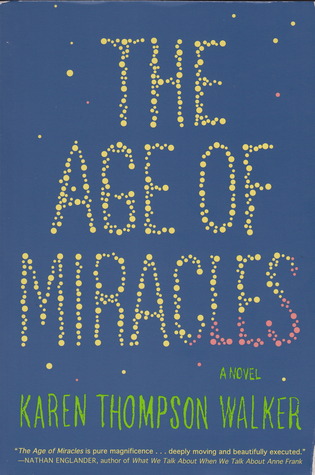
Book Review: The Age of Miracles by Karen Thompson Walker

Book Review: The Age of Miracles by Karen Thompson Walker

ageofmiracles

It’s a little daunting to sit down to write a book review when the book’s jacket is covered with high praise from authors such as Nathan Englander, Aimee Bender, Karen Russell, and Amy Bloom. I have to wonder — did they see something in The Age of Miracles that I missed?

The Age of Miracles is a tale of global catastrophe. For reasons unknown, the earth’s rotation has slowed. The slowing, as people call it, starts as a small thing, as scientists announce that a full rotation of the earth is now 56 minutes longer than it should be. Days lengthen, with the rate of slowing increasing inexorably. The sun sets later and later; longer periods of daylight are followed by longer periods of night. People panic, adapt, panic, adapt some more. And life goes on.

Narrator Julia is 11 years old as these events unfold, but is narrating the story from some time later. The Age of Miracles often reads like a nostalgia piece, in many ways a typical coming of age story, where the young person at its center has her eyes opened to some of the harsh truths of life. Best friends don’t necessarily stay BFFs. Grown-ups aren’t always reliable or honest. Parents disappoint their children and fail to be enough to shelter their children from life’s dangers.

The author makes use of the 2nd person plural throughout, so that Julia is telling not only her own story, but the story of the end of civilization as it was.

In the hours that followed, we would worry and wait. We would guess and wonder and speculate. We would learn new words and new ways from the scientists and officials who paraded in and out of our living room through the television screen and the Internet. We would stalk the sun across our sky as we never had before.

Each new day, each further bit of slowing, brings new changes and challenges. World governments announce a commitment to staying on “clock-time”, continuing to structure human lives around a 24-hour cycle. Soon everyone has black-out curtains so they can sleep while the sun is shining, and school children line up for the bus as the first stars are still appearing in the night sky. A rift in the community forms as some people decide to live in “real-time”, waking and sleeping by the rising and setting of the sun. Real-timers are viewed as anarchists, hippies, throw-backs to a wild past, and are shunned or worse. Suicide cults blossom. People hoard perishables… and then they wait.

To an extent, although The Age of Miracles takes place over the course of a year, we never do see the full impact of the disaster. The effects become more and more dramatic as time passes, but life is still manageable, at least in Julia’s little world. Her mother comes down with slowing syndrome, a common condition caused by changes in gravity, with symptoms such as fainting, dizziness, and nausea. Coastal homes are evacuated and within weeks, are completely flooded, as the slowing causes worldwide changes in currents and tides. There is a massive bird die-out, as the gravitational changes wreak havoc with birds’ internal systems. All agriculture must eventually move into indoor, artificially lit environments, as nothing can grow with the extreme periods of heat and sun followed by long hours of darkness and cold.

And yet, Julia goes to school every day, worries about being friendless and not fitting in, crushes on a cute boy, and tries to figure out what really matters to her. She worries about puberty and growing up, worries about appearing childish next to her make-up and high heel-wearing classmates, and frets about the strain in her parents’ marriage. She begins to see her parents’ flaws, and reflects often on their physical signs of aging — her former-model mother has gray roots, her physician father, always perfectly put together, has wrinkles around his eyes.

The writing is often lovely and lyrical. The author has a keen eye for description of the every day, and evokes a particular time and place with many small details that add up to a complete portrait of life in a small southern California town on the brink of permanent change.

I didn’t quite buy Julia’s voice or perspective in The Age of Miracles. Julia’s experiences, at age 11, seemed out of place. The issues with boys, social status, and cliques, as written, would have felt more authentic to me if the children involved were at least two or three years older. It’s a neat trick to have Julia tell her own story as a 20-something-year-old looking back, but I couldn’t believe many of the observations attributed to 11-year-old Julia as truly coming from a girl that age.

The other flaw with this narrative choice is the diminution of the drama — we know that Julia survives, because she makes it clear that she’s telling us about events from her past. Much has changed, and things look pretty grim, but as a point of fact, Julia’s life has gone on, and so has much of the world’s. Nothing ever feels that immediate or urgent, as it’s all presented as a memory.

This is one of several global disaster/end of the world books that I’ve read lately. In The Age of Miracles, the disaster is almost background, as the main story is about Julia saying good-bye to her childhood and moving forward into a brand new world. An interesting choice, but not entirely convincing or satisying for me.

I would recommend The Age of Miracles, but can’t say that I loved it.

For another take, check out the io9 review here, which questions whether The Age of Miracles works as a science fiction novel.

Flashback Friday: The Sparrow by Mary Doria Russell

Et voila! A new weekly event here at Bookshelf Fantasies!

Flashback Fridays will be a chance to dig deep in the darkest nooks of our bookshelves and pull out the good stuff from way back. As a reader, a blogger, and a consumer, I tend to focus on new, new, new… but what about the old favorites, the hidden gems? On Flashback Fridays, I want to hit the pause button for a moment and concentrate on older books that are deserving of attention.

My rules — since I’m making this up:

  1. Has to be something I’ve read myself
  2. Has to still be available, preferably still in print
  3. Must have been originally published 5 or more years ago

Other than that, the sky’s the limit! As soon as I figure out how**, I’ll open this up to others, so put your thinking caps on: What are the books you’ve read that you always rave about? What books from your past do you wish EVERYONE would read? Pick something from five years ago, or go all the way back to the Canterbury Tales if you want. It’s Flashback Friday time!

**I think I’ve got it! Add your link below — join in for Flashback Friday!

And without further ado, here’s my inaugural pick for Flashback Friday:

The Sparrow by Mary Doria Russell

(published 1996)

From Amazon:

In 2019, humanity finally finds proof of extraterrestrial life when a listening post in Puerto Rico picks up exquisite singing from a planet which will come to be known as Rakhat. While United Nations diplomats endlessly debate a possible first contact mission, the Society of Jesus quietly organizes an eight-person scientific expedition of its own. What the Jesuits find is a world so beyond comprehension that it will lead them to question the meaning of being “human.” When the lone survivor of the expedition, Emilio Sandoz, returns to Earth in 2059, he will try to explain what went wrong… Words like “provocative” and “compelling” will come to mind as you read this shocking novel about first contact with a race that creates music akin to both poetry and prayer.

I can’t overstate just how very much I love this book. It has it all: compelling characters, a science fiction slant, discovery of new worlds, fascinating interpersonal dynamics, and a confounding mystery at its core.

Lead character Emilio is so magnetic, so fascinating, and so wounded that I wanted to jump into the story to protect and defend him. Author Mary Doria Russell, an anthropologist by training, creates a world unto itself, with culture, mores, and languages that are unique and yet fully formed.

Whenever I’m asked to name my favorite books, The Sparrow is right there in the top 5. Over the years, I’ve given copies to friends and family members, and I’ve recommended it to dozens more. If you’ve never read The Sparrow, give it a try! You’ll thank me for it — I promise.

So, what’s your favorite blast for the past? Leave a tip for your fellow booklovers, and share the wealth. Time to dust off our old favorites and get them back into circulation.

Note from your friendly Bookshelf Fantasies host: This is my first attempt at a blog hop! Join in, post a Friday Flashback on your blog, and share your link below. Let’s get this party started!


Book Review: Frozen by Mary Casanova

Book Review: Frozen by Mary Casanova

Sadie Rose was rescued from death at age five when she was pulled from a snowbank in the middle of a cold Minnesota night, and hasn’t said a word since. Raised by the wealthy Worthingtons, a senator and his wife, Sadie Rose lives a comfortable but cheerless life in 1920s-era rural Minnesota, protected from all outside forces and influences, seeking shelter in her piano music and random hobbies, with no knowledge or memory of her origins. Until, that is, the fateful day arrives when Sadie discovers a cache of hidden photos of a glamorous, scandalous woman, and recognizes this stranger as her long-lost mother, Bella Rose.

Bit by bit, Sadie recovers pieces of the past, as she recalls her early years living in the brothel where her mother worked, until her mother’s death on the same night that Sadie was pulled from the snow. Bella Rose’s untimely demise was attributed to drink and wantonness, as she was found frozen to death with an empty bottle in her lifeless hand. As Sadie’s memory returns, she realizes that there is more to the story, and as she uncovers the truth, she also rediscovers her own ability to speak.

Frozen is set in northern Minnesota, in a small town on the banks of the great lake separating Minnesota from Canada. Prohibition is the law of the land, and moonshine and smuggling are a way of life. A powerful lumber baron controls everything and everyone in the area, and to cross him is to risk one’s life. Women’s suffrage is gaining momentum, a small group of environmentalists is trying to stop the clear-cutting practices of the lumber industry, and loose women still find ready employment in the wilds of the frontier towns.

The author does a nice job conveying the atmosphere of the time and place in which the story is set, and yet I was left wishing for a bit more meat in the story. Sadie’s journey from silence to finding a voice of her own is a bit sudden, and the catalyst of her transformation — finding her mother’s pictures — wasn’t as clearly defined as it should have been. Frozen has almost too many plot threads — a love story, a mentally ill friend, the investigation into her mother’s past, the environmental protests, local politics — and it’s really more than can be sustained by such a slim tale. The climax and denouement came a bit too easily, and I found the ending unconvincing.

Frozen is being marketed as a young adult novel, and I would imagine that teens interested in a historical setting would enjoy this. For me, as an adult who often adores YA fiction, Frozen fell a little short — a nice effort, pleasant to read, but not substantial enough to feel satisfying.

Review copy courtesy of University of Minnesota Press via NetGalley.

Wishlist Wednesday

And now, for this week’s Wishlist Wednesday…

The concept is to post about one book from our wish lists that we can’t wait to read. Want to play? Here’s how:

  • Follow Pen to Paper as host of the meme.
  • Please consider adding the blog hop button to your blog somewhere, so others can find it easily and join in too! Help spread the word! The code will be at the bottom of the post under the linky.
  • Pick a book from your wishlist that you are dying to get to put on your shelves.
  • Do a post telling your readers about the book and why it’s on your wishlist.
  • Add your blog to the linky at the bottom of the post at Pen to Paper.
  • Put a link back to pen to paper (http://vogue-pentopaper.blogspot.com) somewhere in your post.
  • Visit the other blogs and enjoy!

My Wishlist Wednesday book is actually a two-fer:

Stiff: The Curious Lives of Human Cadavers (2003)

Spook: Science Tackles the Afterlife (2005)

by Mary Roach


From Amazon, about Stiff:

Stiff is an oddly compelling, often hilarious exploration of the strange lives of our bodies postmortem. For two thousand years, cadavers—some willingly, some unwittingly—have been involved in science’s boldest strides and weirdest undertakings. They’ve tested France’s first guillotines, ridden the NASA Space Shuttle, been crucified in a Parisian laboratory to test the authenticity of the Shroud of Turin, and helped solve the mystery of TWA Flight 800. For every new surgical procedure, from heart transplants to gender reassignment surgery, cadavers have been there alongside surgeons, making history in their quiet way.

In this fascinating, ennobling account, Mary Roach visits the good deeds of cadavers over the centuries—from the anatomy labs and human-sourced pharmacies of medieval and nineteenth-century Europe to a human decay research facility in Tennessee, to a plastic surgery practice lab, to a Scandinavian funeral directors’ conference on human composting. In her droll, inimitable voice, Roach tells the engrossing story of our bodies when we are no longer with them.

Also from Amazon, about Spook:

The best-selling author of Stiff: The Curious Lives of Human Cadavers now trains her considerable wit and curiosity on the human soul. “What happens when we die? Does the light just go out and that’s that—the million-year nap? Or will some part of my personality, my me-ness persist? What will that feel like? What will I do all day? Is there a place to plug in my lap-top?” In an attempt to find out, Mary Roach brings her tireless curiosity to bear on an array of contemporary and historical soul-searchers: scientists, schemers, engineers, mediums, all trying to prove (or disprove) that life goes on after we die. She begins the journey in rural India with a reincarnation researcher and ends up in a University of Virginia operating room where cardiologists have installed equipment near the ceiling to study out-of-body near-death experiences. Along the way, she enrolls in an English medium school, gets electromagnetically haunted at a university in Ontario, and visits a Duke University professor with a plan to weigh the consciousness of a leech. Her historical wanderings unearth soul-seeking philosophers who rummaged through cadavers and calves’ heads, a North Carolina lawsuit that established legal precedence for ghosts, and the last surviving sample of “ectoplasm” in a Cambridge University archive.

Why do I want to read these two books?

Plain and simple, Mary Roach cracks me up. I have never laughed so hard over a science book as I did reading Roach’s Packing for Mars. (Come to think of it, I’m not sure that I’ve ever laughed while reading a science book, but my point remains.)

Mary Roach takes on a subject and then examines it from every possible angle, looking for all the scientific oddities that bring her subject to life. In Bonk, her subject was sex, and while some parts were particularly cringe-inducing (there are certain experiments that I just didn’t need to know about!), it was certainly never boring. Packing for Mars is a look at the science of human space travel, and it was hilarious. Plus, I learned a lot, such as the arduous process of inventing effective space toilets and what position to assume in order to increase the odds of surviving an elevator crash. (Answer: Lie flat on your back. There, maybe I’ve actually saved a life today!)

Stiff and Spook were Mary Roach’s first two books, and they’ve been on my shelf for years now. I don’t deviate from the fiction world very often, but I think these two books are a good reason to veer off a bit.

I leave you with a quote from Stiff: “Death. It doesn’t have to be boring.”


The Monday agenda

Not a lofty, ambitious to-be-read list consisting of 100+ book titles. Just a simple plan for the upcoming week — what I’m reading now, what I plan to read next, and what I’m hoping to squeeze in among the nooks and crannies.

You might think an agenda has no business showing up on Labor Day. What can I say? A reader’s work is never done! It’s time to take stock and plan for the upcoming week.

From last week:

Every Day by David Levithan: Read as fast and furiously as I possibly could. See my review here. The short version? I loved it. Add this one to the list of YA fiction that everyone should read.

Going Bovine by Libba Bray: Finally finished, after several stops and starts. My review is here, but the bottom line is that, despite several laugh-out-loud moments and some truly snazzy writing, I just didn’t enjoy this one nearly as much as I’d hoped.

In graphic novels, I ended up diving into the Jack of Fables series by Bill Willingham (a spin-off from the incredibly wonderful Fables series). I’m on #4 of 9, and so far, I’d say… amusing, but not essential.

My son forced me to read the comic/graphic novel he gobbled up, Giants Beware! by Jorge Aguirre. Quite funny and spirited — definitely a good choice if you’ve got middle-grade readers to entertain.

Drums of Autumn by Diana Gabaldon (group re-read): Need I keep saying it? Terrific book, terrific chapter discussions!

And this week’s new agenda:

I’ve simply got to make some headway with my stack of library books. Next up should be Age of Miracles by Karen Thompson Walker, which I’ve really been looking forward to.

After that:

The Unbecoming of Mara Dyer by Michelle Hodkin

Frozen by Mary Casanova

Plus, I’ll plow on through and finish up the Jack volumes. Must see what that scamp gets up to next!

Drums of Autumn by Diana Gabaldon (group re-read): Chapters 44 and 45 on deck for this week.

So many book, so little time…

That’s my agenda. What’s yours? Add your comments to share your bookish agenda for the week.