Book Review: Unthinkable by Nancy Werlin

Book Review: Unthinkable by Nancy Werlin
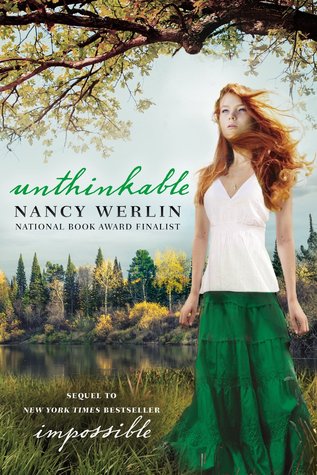
In this young adult novel, faerie curses have a huge impact on the lives of a human family. But will human love triumph over faerie tricks?

Unthinkable takes place in the same world as Nancy Werlin’s previous novels Impossible and Extraordinary. Given how much I loved those two books, I suppose I shouldn’t be surprised to have enjoyed Unthinkable as much as I did.

In Impossible, we meet Lucy, the latest in a long line of women in the Scarborough family, doomed by a faerie curse that’s been passed down over the generations for four hundred years. The Scarborough curse binds each daughter of the family to a cruel faerie lord, Padraig, and each generation repeats the cycle of bearing a daughter, abandoning the daughter in the human world as she is condemned to Faerie, and then witnessing the enslavement of that daughter 18 years later. The curse can be broken only by the completion of three impossible tasks. Is Lucy the one who finally stands a chance at ending her family’s curse?

In Unthinkable, the focus of the story shifts to Fenella, the first of the Scarborough women to be ensnared by the faerie curse. We learn of the curse’s origins, and how the Scarborough women first fell under Padraig’s power. Now, Fenella has yet another challenge in front of her, and in order to succeed and finally eliminate Padraig’s influence for good, she may have to destroy what she values most: her own family.

Fenella is a strong but vulnerable main character. Having lived in Faerie for 400 years, she is human but sensitive to magic, and fated to live in limbo, neither fully a part of the human world nor able to die a normal, mortal death. As Fenella finds her way back to her family, she has to decide what she is willing to do in order to accomplish her goals, and just how much of a sacrifice she’s willing to make. She’s a fascinating character: The author doesn’t portray her as perfect, and we see her struggles with fear, selfishness and doubt battling with her growing urge to protect her family and shield them from pain. The more she experiences life among her human family, the more she realizes that the bargain that she’s made may have been her biggest mistake yet.

Meanwhile, Fenella’s story intersects with Lucy and the other characters we met in Impossible. I’m trying to avoid spoilers for all three books, so I won’t say much about the how or why of Fenella’s involvement with Lucy and her family. Suffice it to say, Fenella has choices to make, and her choices may impact Lucy and the rest of her family — forever.

Short version of a review? I loved Impossible and Extraordinary (which is only obliquely related, but does influence parts of this story), and I definitely was not disappointed by Unthinkable. The plot is emotionally involving and fast-moving, and I was kept guessing throughout as Fenella faces a series of obstacles and tasks to complete. Overall, I’d say Unthinkable is a terrific addition to this loosely-connected series, as well as just a really great young adult book that’s sure to appeal to readers who like a bit of magic and other-worldliness in their family dramas and love stories.

Do you need to read Impossible and Extraordinary before reading Unthinkable? This is one of those rare occasions where I think you could jump right into the most recent book and still have it make sense… but why would you want to? Impossible always makes my lists of most recommended YA fiction, and I’m happy to say that Extraordinary and Unthinkable belong on that list too.  For a haunting, compelling, and magical read, don’t miss any of these three books by Nancy Werlin.

_________________________________________

The details:

Title: Unthinkable
Author: Nancy Werlin
Publisher: Dial
Publication date: 2013
Genre: Young adult
Source: Purchased
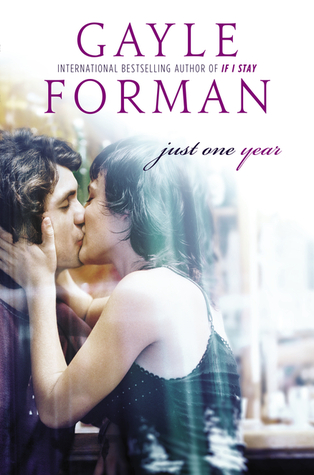
Book Review: Just One Year by Gayle Forman

Book Review: Just One Year by Gayle Forman

Just One Year (Just One Day, #2)In this romantic and introspective young adult novel, we take another look at the events portrayed in the author’s previous novel Just One Day — only this time, we get the other side of the story.
In order to talk about Just One Year, I won’t be able to avoid discussing events from Just One Day (which I reviewed here in January), so consider this your spoiler alert! Look away now! Or better yet — run right out and pick up a copy of Just One Day, read it cover to cover, and then check back here to continue reading this review.

Are you back yet? Ready to go? Okay…

In Just One Day, main character Allyson takes us through the first time in her life when she went off-script — a day when she throws caution to the wind and jumps on a train to Paris with a cute boy to finally experience a day of spontaneous adventure. The cute boy is Willem, a carefree, go-where-the-wind-blows actor (who seems to have girls waiting for him across all of Europe), and he and Allyson (whom he calls Lulu) enjoy one perfect day… until the next morning, when Allyson wakes up alone and abandoned, devastated, and has to find a way to put herself back together. We then spend the rest of Just One Day witnessing Allyson’s journey toward discovering herself, what she stands for, and who she wants to be.

Key to the plot is the fact that Allyson/Lulu and Willem, so caught up in their romantic adventure, never got around to exchanging email addresses, phone numbers, last names… or even real names. Willem only knows Allyson as Lulu. Problem, right?

Allyson’s quest toward self-discovery takes up the last 2/3 of Just One Day, and as part of her process, she finally takes control of her own life and sets out to find Willem. But by the end of the book, we only know Allyson’s story, what she’s been through, and where her journey has taken her.

In Just One Year, we hear about the same events and the same time period, but this time it’s Willem’s experiences that count. We start with Willem waking up in a hospital, realizing that he’s forgotten something or someone… and soon piecing together that he was supposed to be with Lulu, but circumstances prevented him from getting to her before she disappeared from his life.

We soon get a much different picture of Willem than we had from the previous book. In Just One Day, Willem seems like a perfect golden boy, easy-natured, free-spirited, a total chick magnet, a guy who lives by his own rules. That’s not the Willem we get to know in Just One Year. Here, we discover that Willem has been wandering from place to place for three years, ever since his father died unexpectedly. Estranged from his mother and feeling rootless, Willem runs from connection and commitment, keeping everything in his life loose and at arm’s length, and it’s not until he meets Lulu that he starts to reexamine what he wants and how he wants to live his own life.

Willem’s journey takes him from Paris to Amsterdam, from Mexico to India, and back again to Amsterdam, before he manages to finally pull himself together and starts taking steps toward creating his own path. But all along his journey, he can’t shake thoughts of Lulu, the girl he lost before he could fully realize how important she might be. From reading Just One Day, we know more or less the “what” of what will happen at the end of this book. But it’s the “why” and the “how” that matter here, and finding the answers to these questions is what makes Just One Year so compelling.

I really enjoyed the mirrored storytelling here. Willem shows us key events that we only saw from Allyson’s point of view in Just One Day, and we start to realize just how narrow any one person’s perception can be. There’s so much that Allyson could not have known, but seeing events through Willem’s eyes, we finally get to see how intertwined their stories are, and how many near misses (and near collisions) they had over the course of their year apart.

I loved how skillfully the author weaves in elements from Just One Day, so that notes written in one book turn up in another; misunderstood conversations finally make sense; even a dismal family vacation takes on significance in all sorts of ways in Just One Year. It becomes clear as well how easily one person’s certainty can be wrong; something that Allyson believes she sees isn’t as it appears at all — and just may be the pivotal event that determines whether Allyson and Willem will ever manage to reconnect, no matter how close they’ve come.

It’s funny reading a book where you know the ending already. Just One Year follows the same timeline as Just One Day, so we know what the final scene must be. And still, I was on the edge of my seat on and off throughout Just One Year, wanting to stop Willem from giving up or making big mistakes, wanting to push him back a certain way or nudge him toward a different location. How many authors can keep you in suspense when you already know what’s going to happen? Now that really takes a great storyteller, and I’m happy to say that Gayle Forman succeeds.

Of course, I have a couple of minor quibbles. Certain sections of the narrative drag a bit. Willem spends a LOT of time in India, really just killing time, and maybe it’s a necessary part of his journey, but it felt long. Likewise for his Mexican quest that turns into a fiasco: I felt that these chapters just went on and on. Yes, the events ultimately move the story forward, but they could have been tightened up a bit.

On the other hand, I did love the emphasis on self-discovery. Mirroring Allyson’s year, Willem also spends the year learning more about himself and his family, figuring out what he wants, and finding out that he has much more in his life than he might have suspected. In both Allyson and Willem’s stories, the quest for the lost connection between the two is important, but isn’t the only driving factor. For both of them, there comes a realization that they may not succeed in finding the other person. One thing that I really appreciate in both of these stories is that they’re not romantic tragedies. The love story is important, but more as an impetus for growth and change than as a be-all and end-all for these characters. Yes, it will be sad if they don’t reconnect — but it won’t be the end of their lives, and they will go on, one way or the other.

All in all, Just One Year kept me glued and kept me emotionally invested. I wanted so badly for everyone to find happiness! Gayle Forman has created a deeply affecting and ultimately uplifting duo of books, doing a remarkable job of weaving together two parallel stories into one cohesive whole. I hated for it to end… so please, Gayle Forman, how about one more book? Allyson and Willem’s stories each end at the same point… and what I want to know is, what happens next? Even if they do find their HEA, I want to know more!

If you enjoy contemporary young adult fiction that’s smart, thoughtful, and emotionally rich — and not without moments of laughter and delight as well — check out Just One Day and Just One Year.

Oh. One last thing. It’s about the cover. In Just One Day, here’s Allyson seeing Willem for the first time:

I blink a few times. My eyes adjust, and I see that the guy is tall, maybe a full foot taller than I am, and thin. His hair is a hundred shades of blond, and his eyes so brown as to almost be black.

Hmm. Willem is blond. So who’s Allyson kissing on the cover of Just One Year???

_________________________________________

The details:

Title: Just One Year
Author: Gayle Forman
Publisher: Dutton
Publication date: 2013
Genre: Young adult
Source: Purchased

Book Review: The Rosie Project by Graeme Simsion

Book Review: The Rosie Project by Graeme Simsion

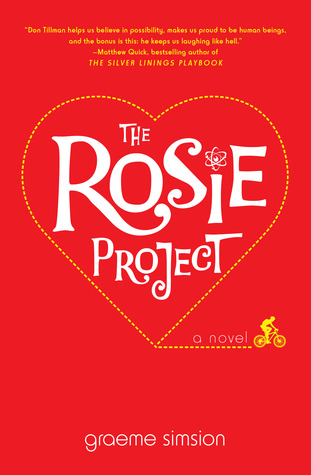
The Rosie ProjectThis charming, funny novel was exactly what I needed after a couple of weeks filled with horror, wartime secrets, and violent crime. And you should hear about the books I’ve read! (Kidding, kidding…)
The Rosie Project is a first novel by Australian writer Graeme Simsion, which he originally wrote as a screenplay and then adapted into a novel. And now apparently a movie is expected as well! I can absolutely see this sweet, romantic story working fabulously on the big screen.

The Rosie Project is narrated in the first person by Don Tillman, a professor of genetics who is more than a bit lacking in the social graces department. As it quickly becomes clear, Don most likely falls somewhere on the autism spectrum, although a possible diagnosis has never occurred to him, despite being an incredibly intelligent scientist whose best (and only) friends are psychologists and despite being a guest lecturer on the subject of Asperger’s syndrome. Don’s days are dictated by his schedule, with every moment accounted for and planned for maximum efficiency. He has a seven-day food schedule (Tuesdays are for lobster), so he never has to waste precious brain resources deciding what to eat. His life is fixed and defined — but he’s 39 years old and feeling the need for a life partner.

To solve his problem, Don devises The Wife Project, a 16-page questionnaire scientifically designed to select only the most compatible women for Don to meet and potentially marry. But when Rosie wanders into his office, she throws Don’s careful plans into a tizzy. She’s clearly unsuitable mate material — but why does he enjoy her company quite so much?

The writing zips along quickly, as we hear — from Don’s perspective — all about his adventures in dating and his everyday challenges in dealing with other humans. The Jacket Incident is but one example, featuring a fancy restaurant, an ambiguously worded dress code, and Don’s aikido skills. And then there’s his approach to a medical student who touts “creation theory” as a viable alternative to “evolution theory”. Let’s just say there’s a dead fish involved and leave it at that.

Don has an eidectic memory, which he uses to his advantage not just in academics, but also in a delightful scene in which he becomes a cocktail expert. He also successfully memorizes an entire manual full of sex positions, but doesn’t quite get why it’s not so appealing to the ladies to show them a book and basically instruct them to pick a page. (Note: he strikes out.)

Quirky and funny, the dialogue really enhances the narration:

“If I find a partner, which seems increasingly unlikely, I wouldn’t want a sexual relationship with anyone else. But I’m not good at understanding what other people want.”

“Tell me something I don’t know,” said Rosie, for no obvious reason.

I quickly searched my mind for an interesting fact. “Ah… the testicles of drone bees and wasp spiders explode during sex.”

All in all, I found The Rosie Project sweet, funny, and romantic, if a tad implausible in parts. I had a hard time believing that Don would be capable of making some of the substantial changes in his own behavior that he enacts by the end, especially considering how quickly he brings about these changes. Still, this book works because it’s a rom-com at heart, and what’s a rom-com without a happy ending? It’s quite clear all along that the boy will get the girl; the fun part is in seeing how it all works out.

A final thought: As someone who binge-watched five seasons of The Big Bang Theory last year, I couldn’t help but hear Sheldon Cooper as the voice of Don Tillman. To me, Don IS Sheldon, although perhaps a bit more flexible and only a drop less socially awkward. If this wasn’t the portrayal that the author was going for, well, what can I say? I think the comparisons are unavoidable. It didn’t detract from my enjoyment a bit, but it certainly made the character instantly identifiable to me and maybe even a little predictable at times.

That said, I do recommend The Rosie Project most enthusiastically. It’s ultimately a happy book, and I had a great time reading it. The characters are warm and interesting and full of life, the scenario is creative and entertaining, and the book is not without emotional weight and depth. If you’re looking for a fun, engaging read that just may move you as well, check out The Rosie Project.

_________________________________________

The details:

Title: The Rosie Project
Author: Graeme Simsion
Publisher: Simon & Schuster
Publication date: 2013
Genre: Adult fiction
Source: Library

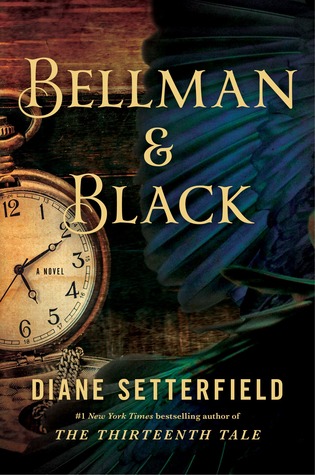
At a Glance: Bellman & Black by Diane Setterfield

Book Review: Bellman & Black by Diane Setterfield

Synopsis:

Caught up in a moment of boyhood competition, William Bellman recklessly aims his slingshot at a rook resting on a branch, killing the bird instantly. It is a small but cruel act, and is soon forgotten. By the time he is grown, with a wife and children of his own, William seems to have put the whole incident behind him. It was as if he never killed the thing at all. But rooks don’t forget . . . Years later, when a stranger mysteriously enters William’s life, his fortunes begin to turn—and the terrible and unforeseen consequences of his past indiscretion take root. In a desperate bid to save the only precious thing he has left, he enters into a rather strange bargain, with an even stranger partner. Together, they found a decidedly macabre business. And Bellman & Black is born.

I’m going to keep this brief (ha! that’ll be a first for me!), largely because I’m just not at all sure what to say.

At a loss for words? Without a ready opinion? This really is a first for me.

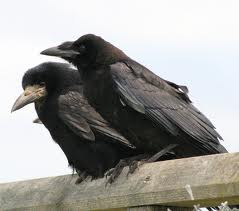
rooks 1I’ve been thinking and thinking and thinking about Bellman & Black, and here are the two main points I’ve come up with so far:

1) I found this to be a quick, engrossing read. It zipped along, and I never had to force myself to continue.

2) Every time I tried to talk to my BBB (best book buddy) about B&B (Bellman & Black), all I could say was, “I’m 25%/50%/75% through this book, and I still have no idea what it’s really about.”

So what IS it all about?

It’s about a talented and beloved boy, William Bellman, who seemingly has everything, and grows up with a magical touch for business. Every endeavor he touches seems to thrive. His ideas are golden, his people skills superb. Nothing could be rooks 2better. Yet after a terrible sickness sweeps through his village (scarlet fever, perhaps?) and kills most of his family, he makes a deal — which he doesn’t actually remember — with a mysterious man, and then turns his business acumen to a new enterpise: Bellman & Black, an enormous retail establishment dedicated to death. Bellman & Black specializes in funerary supplies, and succeeds beyond Bellman’s investors’ wildest dreams.

Much of the book is spent in chronicling William’s business skills and ideas. This is a busy, hard-working man. Work becomes his obsession, and he only remembers the mystery man, Black, in bits and pieces. Yet lurking behind all of William’s triumph’s is the sense of a debt to be paid, and sooner or later he knows there must be a reckoning.

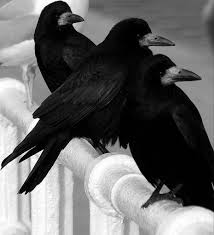
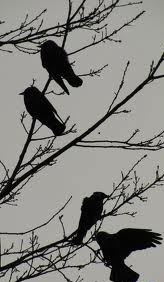
rooks 3Rooks — black birds similar to crows — are constantly in the background of the story, and their presence, along with random facts about rooks, pops up repeatedly.

The official title of this book is Bellman & Black: A Ghost Story. And I’m not sure why. The rooks represent death, and being haunted by memories, and all sorts of other things (I guess), but I never felt that this was an actual ghost story, other than William being haunted by his forgotten past and all that he’d lost.

It’s odd: This book definitely held my interest, and I was full of admiration for the author’s gift with words. The language is often beautiful, with unusually graceful descriptions and turns of phrase. But at the same time, I spent the entire book at a bit of a loss as far as seeing the point, and never felt like the story gelled in any real way.

Maybe it’s me. Or maybe this is a well-written novel that lacks a certain oomph. Certainly, for a ghost story, you’d expect a scare or two, or at the very least, a sense of growing dread or doom. Yes, there’s an ominous undercurrent — but that’s about it. So perhaps I missed the point in some major, glaring way. But if not, then I’d have to say that Bellman & Black, while beautifully written, doesn’t live up to its billing as a ghost story and doesn’t deliver an ending that’s as full of impact as it’s probably intended to be.

I read it. I enjoyed the reading experience. But I don’t feel touched or enlightened by this book. The books that I love stay with me after I close the covers. This one, despite its many lovely passages, isn’t one of those.

rooks 4

For what it’s worth, I’m probably one of the last people on the planet who hasn’t read Diane Setterfield’s The Thirteenth Tale. Even though Bellman & Black wasn’t a peak reading experience for me, I admire the author’s talents enough to want to read her earlier novel, and will probably seek out her books in the future as well.

_________________________________________

The details:

Title: Bellman & Black
Author: Diane Setterfield
Publisher: Atria Books
Publication date: 2013
Genre: Adult fiction
Source: Review copy courtesy of Atria via NetGalley

Book Review: The Tulip Eaters by Antoinette van Heugten

Book Review: The Tulip Eaters by Antoinette van Heugten

The Tulip Eaters

Synopsis (Goodreads):

In a riveting exploration of the power the past wields over the present, critically acclaimed author Antoinette van Heugten writes the story of a woman whose child’s life hangs in the balance, forcing her to confront the roots of her family’s troubled history in the dark days of World War II…

It’s the stuff of nightmares: Nora de Jong returns home from work one ordinary day to find her mother has been murdered. Her infant daughter is missing. And the only clue is the body of an unknown man on the living-room floor, clutching a Luger in his cold, dead hand.

Frantic to find Rose, Nora puts aside her grief and frustration to start her own search. But the contents of a locked metal box she finds in her parents’ attic leave her with as many questions as answers—and suggest the killer was not a stranger. Saving her daughter means delving deeper into her family’s darkest history, leading Nora half a world away to Amsterdam, where her own unsettled past and memories of painful heartbreak rush back to haunt her.

As Nora feverishly pieces together the truth from an old family diary, she’s drawn back to a city under Nazi occupation, where her mother’s alliances may have long ago sealed her own–and Rose’s—fate.

In this novel of family history and secrets, the past is never truly the past. Nora thinks she has finally achieved real happiness in her life, with a fulfilling career, a home shared with her beloved mother, and a perfect little daughter to love and cherish. When the brutal murder and kidnapping take everything Nora loves away from her, she refuses to sit and wait for the police investigation to play itself out, when there are no leads and no substantial clues.

As Nora begins to dig, she starts to realize that there are secrets that her mother never shared, and if she is to have any hope of finding Rose, Nora must understand who her mother’s enemies are and why.

The Tulip Eaters opens in 1980s Houston, but the action and the central drama quickly move to Amsterdam and other points in the Netherlands. It soon becomes apparent that the secrets of Nora’s mother’s identity and actions during the Nazi occupation of the Netherlands in WWII are enormously important to someone — enough to kill for, even 30 years later.

As Nora starts uncovering fragments of clues that may lead to answers, she is increasingly at risk, both physically, as the killer’s associates want to scare her off and perhaps stop her for good, and emotionally, as she is forced to confront the possibility that her mother’s secrets may be uglier than she could have imagined.

The details that emerge about the Dutch experience under Nazi occupation are startling and eye-opening. As one contact points out to Nora, most Americans’ conceptions of what happened start and end with Anne Frank. But the experience of the Dutch Jews was much worse than that might imply, as most were shipped off to concentration camps while their non-Jewish compatriots turned a blind eye, whether out of malice or simply to protect their own families.

The early chapters of The Tulip Eaters felt a bit melodramatic to me, as well as unfocused. When the police detective arrives to view the crime scene, is it necessary to describe the fact that he has “No wedding band, the but the pale ring of flesh on his left hand showed it had not been long since it had been removed”? This, plus a few other descriptions of his looks, gave me the impression (thankfully false) that he would become a love interest or at least play a significant role in the book, but he actually fades into the background after a few chapters. It almost felt as though the author was going to make him more important to the plot, and then changed her mind.

The title itself is a bit of a misnomer. During the war, starvation among the Dutch people was so extreme that they had nothing to eat except tulip bulbs pulled from the fields and boiled into a barely edible soup. Interesting, but this has practically nothing to do with the plot, other than getting a brief mention as background to everything else going on.

Still, despite these minor quibbles, overall The Tulip Eaters is quite good. It provides a window into a chapter of history that is relatively unknown, and as the novel moves farther along and we delve deeper into the clues to Nora’s mother’s past, the tension mounts and the suspense and dread become much more intense. There are elements within the novel that give it a somewhat soapy tone, but the overall mystery centered around the murder and kidnapping was intriguing enough to keep me reading until I got some answers.

As a reminder that the past is never really gone, as well as a lesson on some of the horrors of the Holocaust, The Tulip Eaters is quite effective. That, combined with a crime to be solved and clues to be unraveled, make The Tulip Eaters a fast-paced, moving, and engaging read.

_________________________________________

The details:

Title: The Tulip Eaters
Author: Antoinette van Heugten
Publisher: Harlequin MIRA
Publication date: 2013
Genre: Contemporary adult fiction
Source: Review copy courtesy of Harlequin MIRA via NetGalley

Book Review: The Expeditioners and the Treasure of Drowned Man’s Canyon by S. S. Taylor

Book Review: The Expeditioners and the Treasure of Drowned Man’s Canyon by S. S. Taylor

The Expeditioners and the Treasure of Drowned Man's CanyonIf you love adventurous kids, mysterious maps, hidden canyons, and steam-powered everything, you won’t want to miss The Expeditioners, the first installment in what promises to be a very exciting middle grade series.

The West kids — Zander, Kit, and MK — are the orphaned children of famous explorer Alexander West, who rose to fame and fortune exploring new lands, then died under mysterious circumstances, leaving the three kids to fend for themselves. And when I say new lands, I really mean New Lands: Several decades earlier, after computers and electricity were proven unreliable and were discarded, explorers discovered New Lands hidden amidst the lands already known. Apparently, all those earlier maps were wrong, and the globes we all rely upon are really just quaint relics. The current world includes places such as the New North Polar Sea, Fazia, and Deloia, and exploring and cartography are among the most esteemed and  sought-after vocations.

Unfortunately, the BNDL (Bureau of Newly Discovered Lands) is in control and is awfully shady. Current policy seems to be to discover resource-rich new worlds and then plunder them for all they’re worth. It’s becoming clear to the West kids that perhaps their dad wasn’t entirely pleased with BNDL’s approach — and it’s starting to seem that the feeling was mutual. The kids are being watched, and when our narrator, Kit, receives a package from a stranger in the market, it sets off a chain of events that will lead the kids into danger as well as excitement.

As The Expeditioners moves forward, Kit and his siblings, along with their new friend Sukey, daughter of a famous explorer herself, set out to solve a puzzle left behind by Alexander. Hidden maps and secret codes lead the gang to a daring escape from BNDL agents and on a mad cross-country dash toward a legendary treasure lost centuries earlier in the canyons of Arizona. The government wants the treasure too, and it’s a race to see who will find it first — if it exists at all.

I read this book with my 11-year-old (who still likes me to read to him at bedtime — hurray!). Let me just cut to the chase here — we both loved The Expeditioners.

The world-building is terrific, as we are introduced to a steampunky society in which the ability to build, tinker, and create is of utmost importance, as are big heaps of courage and a willingness to leap into the unknown. The author takes our own world and technology and spins it into something at once familiar yet completely new. There are no cars, but that’s okay: People travel by steam trains, dirigibles, even steam-powered bicycles and IronSteeds, steam-powered mechanical horses.

The West kids are all talented and honorable. Zander, the oldest at 14, is brave and protective; Kit is a budding cartographer like his dad, and little sister MK can fix anything. Along with their pilot friend Sukey, they demonstrate courage and conviction over and over again, relying on their smarts to get in and out of tight scrapes, with an absolute devotion to one another and to their mission.

A hint of preachiness creeps in when the kids begin to understand the unscrupulous dealings of BNDL and realize how poorly the indigenous populations of the new worlds are being treated. Of course, the PC-lecture tone didn’t faze my son, but I found it a bit heavy-handed.

The storyline is tightly woven and packed with action. After the initial chapters, which seemed about to bog down in exposition, the pace picks up, and we get to truly know the West kids through their adventure, seeing their initiative and daring, as well as their commitment to their father’s memory and to their family as a whole.

Black and white illustrations by Katherine Roy add to the hip feel of the book, bringing the kids to life and adding in details such as gears, clockwork, and goggles that really enhance the story.

The ending makes clear that there is more to come, as the children complete their treasure-seeking adventure and are given a fresh opportunity for new experiences in a new setting. (I’m being intentionally vague here — you won’t get spoilers out of me!) My kiddo and I are both looking forward to seeing how Zander, Kit, and MK fare along their new path, and we really can’t wait for the next Expeditioners book!

Summing it all up: The Expeditioners seems like a perfect choice for middle grade readers, and it’s smart, savvy, and hip enough that parents will enjoy it too. A decidedly different adventure story that’s full of intellectual challenges too, with brave, independent characters of both genders and a range of ages, set in a steampunky American Southwest — this book is one I could see appealing to a wide audience for years to come.

__________________________________________

The details:

Title: The Expeditioners and the Treasure of Drowned Man’s Canyon
Author: S. S. Taylor; illustrated by Katherine Roy
Publisher: McSweeney’s McMullens
Publication date: 2012
Genre: Middle grade fiction
Source: Library

Book Review: Parasite by Mira Grant

Book Review: Parasite by Mira Grant

Parasite (Parasitology, #1)In the year 2027, human beings are healthier than ever thanks to the Intestinal Bodyguard™, a leap forward in healthcare brought to us by the biomedical geniuses behind billion-dollar corporation SymboGen. Nearly everyone now has an Intestinal Bodyguard, which is a safe, effective method of providing ongoing medical care, such as effectively eliminating allergies and other medical issues stemming from our society’s over-reliance on anti-bacterial soaps and other sterilizing methods — which, according to the “hygiene hypothesis”, have led to a decrease in our ability to defend ourselves from our own environments.

And, oh yes, did I mention that the Intestinal Bodyguard is a genetically modified tapeworm?

All together now: Ewwwwww.

Our narrator and point-of-view character in this engrossing (and sometimes just gross) novel is Sally Mitchell, a sort of medical miracle herself. Sally was in a devastating car accident six years prior to the beginning of Parasite, as a result of which Sally was declared brain dead and her family was forced to confront the decision to discontinue life support. But… miracle! Sally’s Intestinal Bodyguard implant seems to have jump-started her body’s healing, and she survived with no lasting physical impairment, other than a complete and seemingly permanent case of amnesia.

Sally — now preferring to go by Sal — has had to rebuild herself and her life from the ground up, relearning language, social niceties, and how to read, among other tasks. In some respects, when we meet her, she’s been alive for only six years, as she has no knowledge of the person she was before, and is told repeatedly that she seems like a completely different person. Sal also owes her life to SymboGen, which provides her with all of her ongoing medical care and therapy at no cost, in return for which she is required to submit to regular check-ups and testing.

But this is a medical thriller, and as you might expect, when humans start tinkering, things have a tendency to go very wrong, very quickly. Cases of a bizarre type of sleepwalking start popping up, as people seem to check out suddenly and become completely non-responsive, even as their bodies continue to live and move. And once in the sleepwalking state, people don’t wake up again. As the cases mount and incidents escalate, both the government and SymboGen take an active interest, as it becomes clear that the danger is growing and that an epidemic may be underway.

Conveniently, Sal’s boyfried Nathan is a parasitologist, and as the clues pile up, Sal and Nathan start to realize that SymboGen may not be telling the whole story, and there are secrets to be discovered if they dare to look for them.

Parasite is creepy good, and so hard to look away from! Interspersed within the narrative are interviews, journal entries, and other documentation of the processes behind SymboGen’s discoveries, and these let us know that all is not as it seems. The tension and dread mount, chapter by chapter, as we readers discover well ahead of the characters that something is very, very wrong.

Mira Grant tackles the science head-on, providing a LOT of explanation of parasites in general, the science surrounding genetic engineering, and how biotech companies approach testing and FDA approval. At times, the amount of exposition involved verges on information overload, as it involves page after page of scientists explaining their research methods and innovations. Interesting, yes, but also just a heap of information provided in intensive doses.

Sal is an interesting and sympathetic character — and even in her moments of abject terror and confusion, she shows a certain feistiness and humor that help break the tension. (Want examples? See this week’s Thursday Quotables post!). Many of the secondary characters are quite strong as well, including one who is memorable in a disturbing, slightly psychotic yet endearing sort of way. I liked the San Francisco setting, which the author uses effectively to ground the story in a real place with recognizable social and geographic markers.

Overall, I’d rate Parasite quite highly. It’s definitely disturbing and will give you a big case of the ickies. I mean, if reading about tapeworms makes you happy, then you’ll love this book — but otherwise, you’ll shudder and shiver from start to end. There are sections that I thought went on a bit too long, and at 500+ pages, I did feel that I would have appreciated a little tightening up in general. That said, though, the story is original and compelling, hard to put down, and utterly impossible to get out of your mind after an up-too-late reading session.

I’m hooked, and may have actually squeaked out a “No! Don’t make me wait!” slightly after midnight last night, when I reached the final page and saw those three little words I hate so much: To Be Continued. From what I understand, Parasite is book one in a duology, and while I couldn’t find a release date for book #2, I did see that it has a title, Symbiont. In my opinion, it can’t come soon enough!

Meanwhile, I think I’ll seek out the author’s Newsflesh trilogy, just to make sure I don’t run out of creepy, upsetting, icky things to read before Parasitology #2 is released. Which is worse — zombies or tapeworms? I’ll get back to you on that one.

__________________________________________

The details:

Title: Parasite (Parasitology series, #1)
Author: Mira Grant
Publisher: Orbit Books
Publication date: 2013
Genre: Science fiction
Source: Review copy courtesy of Orbit via NetGalley

Book Review: Reality Boy by A. S. King

Book Review: Reality Boy by A. S. King

Reality Boy

Synopsis (Goodreads):

Gerald Faust knows exactly when he started feeling angry: the day his mother invited a reality television crew into his five-year-old life. Twelve years later, he’s still haunted by his rage-filled youth—which the entire world got to watch from every imaginable angle—and his anger issues have resulted in violent outbursts, zero friends, and clueless adults dumping him in the special education room at school.

Nothing is ever going to change. No one cares that he’s tried to learn to control himself, and the girl he likes has no idea who he really is. Everyone’s just waiting for him to snap…and he’s starting to feel dangerously close to doing just that.

In this fearless portrayal of a boy on the edge, highly acclaimed Printz Honor author A.S. King explores the desperate reality of a former child “star” who finally breaks free of his anger by creating possibilities he never knew he deserved.

I don’t know why, but I picked up this book expecting something a bit on the whimsical side. Maybe shades of The Truman Show, but grittier and without Jim Carrey.

But. Wow. I was wrong. No whimsy to be found in Reality Boy.

This is a hard and upsetting and disturbing book. Not to say that it’s not also powerful and compelling. But boy, did this one knock me for a loop.

For starters, the early chapters are just uncomfortable to read and left me feeling kind of squicked out.

The synopses are all a big vague, but the truth is this: Gerald had a horrific childhood, terrified by an older sister who took every opportunity to torment Gerald and his other sister, even to the point of attempted drownings and suffocations. And Gerald’s parents, instead of protecting him, were either absent or willfully ignored the facts staring them in the face. To deal with it, Gerald’s mother invited Network Nanny into their home, who set above trying to instill proper behavior in Gerald and his sisters via reward charts and 24-hour cameras. Little Gerald, five years old and simply not being heard, acts out in the only ways he can. He gets angry, he punches holes in the walls, and when he still gets no protection against his crazy sister, starts… umm… protesting in a way that earns him the indelible nickname of The Crapper.

Oh, it’s nasty.

What’s worse is that all of this is being filmed and broadcasted, and those scenes of Gerald acting out live on forever on YouTube.

So when the book opens and we first meet Gerald, he’s an angry, angry 17-year-old who has no friends, who’s still referred to by schoolmates as The Crapper, and who’s been relegated to the special ed classroom because of his violent streak. But when he meets Hannah, an equally messed up kid who works at the sports center concession stand with him, Gerald finally starts to envision a life in which he may actually get what he wants. A life in which death or jail are not the only options — and a life where he might actually find friendship and possibly even love.

This book is just painful to read. The amount of suffering Gerald endures is unimaginable, and to then have his humiliations made so public compounds all of his problems to the nth degree. I was just infuriated by Gerald’s parents, who shrugged their shoulders and allowed all of this happen, both during the filming of the TV show and in all the years since, during which the oldest sister continues to demonstrate a huge sadistic streak and still retains her parents’ support and affection.

Author A. S. King draws Gerald as a multi-layered young man. He’s much more than just his anger. Underneath his ready-to-snap facade is a boy who has been deeply wounded and who feels that he needs to wrap himself in an invisible layer of plastic and war paint just to make it through each day. And when life gets too intense, he retreats into the imaginary world inside his head, where the streets are paved with ice cream and marshmallows and he and his nice sister live without fear. The downside of having a girlfriend, Gerald finds out, is that she expects you to actually be present — and being with Hannah is what finally forces Gerald to face his present and start making the demands for himself that someone should have made for him long, long ago.

This is an intense and upsetting book. I’m a peaceful person, but I wanted to punch walls on Gerald’s behalf. The neglectful parenting here is just appalling. Gerald’s family is well-off and lives in a lovely home in a gated community — but that outward security does nothing for a small boy who is terrorized continuously whenever the adults’ backs are turned. I really hated reading parts of this book, seeing how the clueless parents failed to protect their son and then made it so much worse by allowing his most humiliating moments to be preserved forever in the media and Internet.

At the same time, over the course of the novel we see Gerald finally start to emerge from a hopeless, angry existence into a life where he just might have a future, and where happiness might actually be attainable. Watching Gerald discover the possibility of a different way of living is lovely and inspiring. This is a boy who deserves to finally have something good happen to him!

Along the way, the criticism of today’s reality TV culture is unavoidable, and as Gerald points out repeatedly, what you saw on TV isn’t what really happened. Here’s a boy who was forever scarred by, essentially, a bad edit. How many other people’s lives are recorded, edited, and twisted for the benefit of public consumption? How can people allow cameras to follow them 24/7 and then believe that it’s a good thing? How can living under a microscope, with all of one’s mistakes and embarrassing moments preserved forever, possibly be healthy for any child, much less the adults in their lives?

We don’t meet any other child “stars” of reality TV, so the message isn’t necessarily universalized as much as it might be, but the author makes clear just how much damage can be done for the sake of a moment or two in the spotlight. Adults have a choice; children don’t. I’m not a fan of reality TV in any case, but after reading Reality Boy, I don’t think I’ll be able to even think about children on TV without a shudder or two.

A. S. King’s previous works include Ask The Passengers (which I reviewed here) and several other highly acclaimed books for young adults. Her gift for getting inside the heads of troubled, complex teens is remarkable, and her stories flow and demand every bit of your attention. I’ll be looking forward to whatever she writes next.

__________________________________________

The details:

Title: Reality Boy
Author: A. S. King
Publisher: Little, Brown Books for Young Readers
Publication date: 2013
Genre: Young Adult
Source: Review copy courtesy of Little, Brown via NetGalley

Book Review: How To Be A Good Wife by Emma Chapman

Book Review: How To Be A Good Wife by Emma Chapman

How To Be a Good WifeDon’t let the title fool you: This is not a feel-good story, it’s not a happy story about marriage, and it’s certainly not chick lit.

In How To Be A Good Wife, Marta is a sad and lonely middle-aged housewife suffering terribly from empty nest syndrome now that her only child, son Kylan, has grown up and moved to the city. Marta is left behind in her spotlessly clean home in an unnamed small Scandinavian village, where she compulsively keeps an eye on the clock and makes sure everything is perfect for her husband Hector. As a new bride some 25 years earlier, Marta’s mother-in-law gave her a gift of the how-to guide “How To Be A Good Wife”, and Marta follows it to the letter: “Make your home a place of peace and order”, “Your husband belongs in the outside world. The house is your domain, and your responsibility”, and “Never hurry or nag him along. His time is precious, and must be treated as such” are some of the words of wisdom which Marta has memorized and tries to live by.

Marta has been on medication for years — anti-depressants, I initially assumed, although soon enough it becomes clear that there’s more going on here than just depression. Marta decides to go off her meds, just for the sake of making something happen — and something does indeed happen. She starts having flashes, seeing things and hearing things that aren’t there. She begins seeing a young girl in pajamas, who starts appearing more and more frequently, until Marta cannot tell what is real and what is not. As these flashes become more frequent, Marta becomes convinced that they are buried memories coming to the surface — but are they?

Bit by bit, Marta’s rediscovered memories present to her a version of her marriage that doesn’t match at all with what she’s believed all these years. Early on, I found it curious that all of Marta’s memories of her wedding and a vacation are couched in terms of how Hector described the events. Why doesn’t she have her own memories to rely on? As the bits and pieces keep popping up, we see a new twist on what we’ve been told, and the picture shifts dramatically toward terror and nightmares.

But is any of it real? Marta has lived in isolation for so many years; apparently, she has no friends or real connections in the village. Hector and Kylan are her entire world, but if what she remembers is true, then Hector is not what he seems. As Marta becomes desperate to discover what really happened and to escape from what she perceives as a dangerous life, she has to try to convince Kylan of the truth of her memories — but at the same time realizes that if she succeeds, Kylan may very well be the one to suffer the most.

How To Be A Good Wife is a gripping psychological thriller that reminded me in some ways of Before I Go To Sleep by S. J. Watson. Memory is the key here — but in this book, the reliability of Marta’s memories is not at all certain. Her instability and fear could very well stem from the memories that have resurfaced — but they could also be signs of a deep psychosis.

I suppose this book could also be looked at in a more symbolic way, showing how the old-fashioned expectations of a wife’s role completely eat away at a woman’s individuality, until she can’t even be sure of who she really is without guidance from her husband. But for me, I found myself pretty convinced by Marta’s memories, and thus found it especially painful as she is continuously treated as someone with a mental illness needing treatment rather than being listened to and taken seriously.

The writing here flows quickly, and even the detailed descriptions of housework take on an ominous tone as they paint a picture of a woman trapped in a sterile, outwardly beautiful environment that is empty at its core. Marta does exhibit signs of being “off” — her obsession with the time, her desperate clinging to her grown son, her attention to every smudge and mark in her perfect house — so when she also starts acting out based on her flashes of memory, it’s understandable that it might look like crazy to an observer.

How To Be a Good Wife moves quickly and is practically impossible to put down once you get past the mid-point. It’s chilling and disturbing and utterly engrossing. Even when I thought I knew what had happened and what was going on, I kept being surprised by the way things turned out, and found myself getting VERY upset on Marta’s behalf as she struggles to be heard and to be believed.

And really, if a book can upset its reader in such a personal way, then you know the author is doing something right! If you like suspenseful writing and characters with depth, check out How To Be A Good Wife. Just don’t expect a tidy ending with rainbows and sunshine. The ending is bleak and ambiguous, and totally in keeping with the tone of the entire story. I think this is one book that will stay with me and eat away at me for quite a while, and that’s a testament to its power.

Whew. I feel like I’ve really been put through the ringer with this one. If you’ve read it, let me know! You know how some books just beg to be discussed? How To Be a Good Wife definitely is one of those.

Note: After finishing the book, I Googled the title and found out that there really was a small book published in the 1930s called How To Be A Good Wife, which I assume is the same book that Marta receives here. It’s been reprinted and is available from Amazon and other online booksellers — not that I want to buy it, but it might be amusing to read through someday.

__________________________________________

The details:

Title: How To Be a Good Wife
Author: Emma Chapman
Publisher: St. Martin’s Press
Publication date: 2013
Genre: Contemporary fiction
Source: Review copy courtesy of St. Martin’s Press via NetGalley

Recently Read: The Incrementalists by Steven Brust and Skyler White

The Incrementalists by Steven Brust and Skyler White

The Incrementalists

The Incrementalists—a secret society of two hundred people with an unbroken lineage reaching back forty thousand years. They cheat death, share lives and memories, and communicate with one another across nations, races, and time. They have an epic history, an almost magical memory, and a very modest mission: to make the world better, just a little bit at a time. Their ongoing argument about how to do this is older than most of their individual memories.

Phil, whose personality has stayed stable through more incarnations than anyone else’s, has loved Celeste—and argued with her—for most of the last four hundred years. But now Celeste, recently dead, embittered, and very unstable, has changed the rules—not incrementally, and not for the better. Now the heart of the group must gather in Las Vegas to save the Incrementalists, and maybe the world.

My reaction:

I’ve been fascinated by the concept behind The Incrementalists since I first stumbled across a “coming soon” mention of it several months ago. In fact, back in July, this was one of my Wishlist Wednesday selections, and I was really excited to finally get my hands on a copy.

So did it live up to my expectations?

Yes and no.

I’m reminded of the line from Julius Caesar (oh, shush, stop rolling your eyes at me just because I’m quoting Shakespeare!): “The fault, dear Brutus, is not in our stars but in ourselves…”

In the case of The Incrementalists, I think the fact that this book didn’t entirely work for me is less about the book itself than about me.

Me, me, me… and now I sound incredibly self-centered. It’s all about me!

But seriously… I think I expected much more of a paranormal thriller of some sort. Secret societies! Shared memories! Cheating death! But that’s not really what The Incrementalists is.

Instead, it’s a smart, intellectual science fiction brain-teaser centered almost entirely around something called The Garden, an “exo-brain” or virtual world that all Incrementalists can access mentally. It’s a non-material space in which Incrementalists can store (or “seed”) their memories, then invite other members of the group to “graze” their “seeds”. When an Incrementalist’s body dies, the others choose a new “Second” to receive the deceased’s “stub” — his or her essence, which will then basically fight the recipient’s personality for dominance until the weaker personality is integrated into the stronger. In this way, the personalities live on in an unbroken chain for hundreds or even thousands of years, being “spiked” into new bodies whenever needed.

The terminology of the Incrementalists includes terms like “switches”, “pivots”, and “sugar spoons”, and just boggled my mind after a while. While the plot is fast-paced and included some really clever and unusual characters, I often felt that I was missing something.

More about me — I consider myself a fairly smart reader and it’s not often that I feel that I can’t keep up. The Incrementalists made me feel like a cave-dweller at times. As the virtual worlds — and virtual chase scenes — became more and more complex, I increasingly felt like I was losing the plot thread and didn’t understand what was going on.

Which was frustrating. Because I like The Incrementalists quite a bit, and especially liked main characters Phil and Ren. Their story and their growing relationship was marvelous and tricky and intellectual and challenging. And yet, I finished the book feeling like I’d only understood a portion of the details, and while I got the big picture, I couldn’t tell you exactly why it had worked out the way it did, or even what specifically had transpired.

To sum it all up: For someone who enjoys virtual worlds, artificial intelligence and constructs, symbols and multiple realities, this would probably be a great choice. It’s certainly not your run-of-the-mill thriller, and it definitely will send your brain into overdrive. I do think The Incrementalists is quite a good book. I just think that perhaps I wasn’t the right reader for it.

__________________________________________

The details:

Title: The Incrementalists
Author: Steven Brust and Skyler White
Publisher: Tor/Forge
Publication date: 2013
Genre: Science Fiction
Source: Review copy courtesy of Tor/Forge via NetGalley