Book Review: The Martian Contingency (Lady Astronaut, #4) by Mary Robinette Kowal

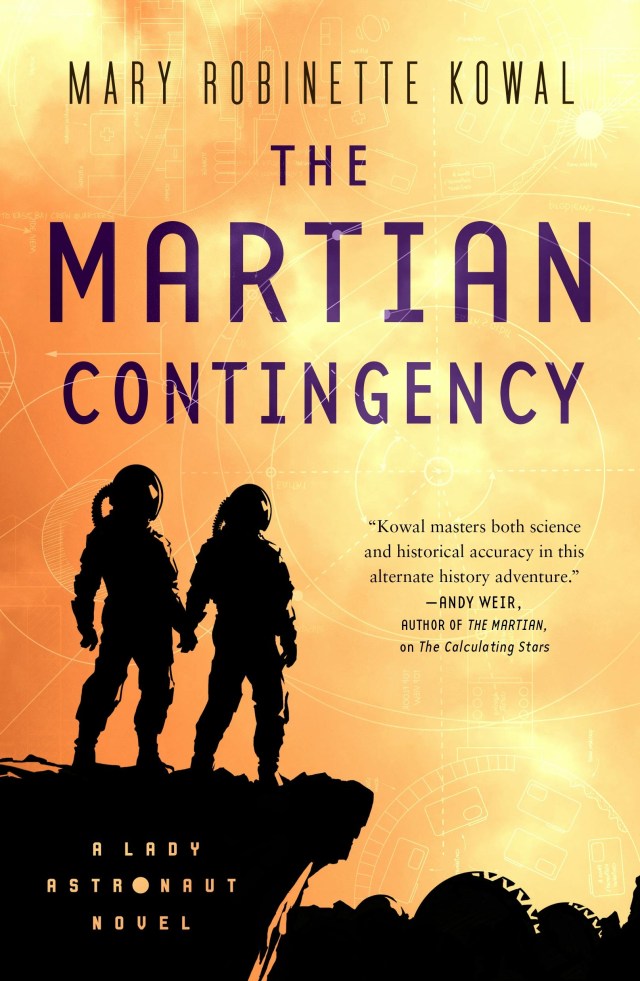
Title: The Martian Contingency
Series: Lady Astronaut, #4
Author: Mary Robinette Kowal
Publisher: Tor Books
Publication date: March 18, 2025
Length: 400 pages
Genre: Science fiction
Source: Review copy courtesy of the publisher via NetGalley
Purchase links: AmazonBookshop.org
Rating:

Rating: 4.5 out of 5.

Years after a meteorite strike obliterated Washington, D.C.—triggering an extinction-level global warming event—Earth’s survivors have started an international effort to establish homes on space stations and the Moon.

The next step – Mars.

Elma York, the Lady Astronaut, lands on the Red Planet, optimistic about preparing for the first true wave of inhabitants. The mission objective is more than just building the infrastructure of a habitat – they are trying to preserve the many cultures and nuances of life on Earth without importing the hate.

But from the moment she arrives, something is off.

Disturbing signs hint at a hidden disaster during the First Mars Expedition that never made it into the official transcript. As Elma and her crew try to investigate, they face a wall of silence and obfuscation. Their attempts to build a thriving Martian community grind to a halt.

What you don’t know CAN harm you. And if the truth doesn’t come to light, the ripple effects could leave humanity stranded on a dying Earth…

The Martian Contingency is an outstanding addition to the excellent Lady Astronaut series — and while my understanding was that this was meant to be the 4th and final book in the series, I can’t actually find anything definitive that says that this is the last book.

The first Lady Astronaut book, The Calculating Stars (published 2018), is one of my all-time favorites. To set the stage for those new to the series: This alternate history version of the space race starts with a catastrophic meteor strike in 1952, which obliterates much of the eastern seaboard of the US and plunges the world into an escalating sequence of climate disasters that will, eventually, lead to planet-wide extinction.

In response to the disaster, there’s an international focus on space exploration. Humanity’s future on Earth is doomed; to survive, people must look beyond the planet for new homes. In this version of history, as envisioned by author Mary Robinette Kowal, the space race begins about ten years ahead of real-world historical events, fueled by an urgent, desperate need find solutions to Earth’s life-threatening problems.

Our point-of-view character throughout much of the series is Dr. Elma York, a scientist, mathematician, and WWII-era pilot who becomes one of the first women astronauts — used by NASA and the IAC (International Aerospace Coalition) for publicity purposes, and gaining fame as the “Lady Astronaut”. (Which, by the way, is better than how some refer to the women in the space program — would you want to be called an “astronette”?)

Elma and her husband Nathaniel (also Dr. York — he’s a brilliant engineer) are vital to the emerging space program. Read the earlier books in the series to find out more! Here in The Martian Contingency, Elma and Nathaniel have finally made it to Mars, as part of the Second Mars Expedition. Their job is to build out the Mars base, expanding it and making it safe for future expeditions, with the ultimate goal of creating a livable, viable, long-term home for humans.

Elma is a gifted pilot, an amazing human “computer”, and an adept leader. She’s appointed to the role of deputy administrator for the Mars base, and is devoted to her colleagues and to the mission. But as she settles in on Mars, she starts noticing some oddities — a patched wall that hadn’t been reported, a mural that clearly been painted to cover up something else, hatch marks etched into an airlock. Something must have happened during the First Expedition — something that didn’t make it into the official reports — but no one is talking. As Elma tries to dig, she’s told clearly that it was nothing, that everything is fine, and that she should leave it alone. But as her time on Mars progresses, the aftereffects of whatever happened show up in shocking ways, and have ripple effects that could imperil the people Elma cares about and the entire mission.

The world of this series is brilliantly depicted, as always. The author’s attention to details is meticulous. Each chapter opens with a news article from the era (most fictitious, although she includes one or two tidbits of real news from the same time period) — and even more amazing, indicates the date. What’s so amazing about the date? She provides both the Earth date and the Mars date — read the afterward of the book to learn more about her approach (and the “massive spreadsheet” she used to figure it all out). Not only does she have to provide both sets of dates, but she also layers in the many different cultural and religious holidays observed by the multicultural crew on Mars — it’s an impressive feat.

The Martian Contingency opens in 1970. In the world of these books, the global disaster has sped up not just science, but also social reckonings that came later in our own history. Because the IAC is truly an international presence, certain social issues come to the fore in startling ways — such as the acceptance of women into male-dominated roles, expedited racial integration at a time when being a racist was more normalized (South Africa is still an apartheid state at this time, which has repercussions for the mission), and the slow recognition that humanity’s future off-planet will by necessity include people of all ethnic, racial, religious, and national identities.

One example that provides a powerful storyline in The Martian Contingency centers on abortion rights and a woman’s right to choose. In the IAC, the norm is for each astronaut to be bound by their country of origin’s laws — so if a woman seeking an abortion is from a country that bans it, it would not be available to her, and likewise, a doctor from a country that bans abortions would not legally be allowed to perform the procedure, even if it were legal for the patient to receive it. It’s complicated, and the dilemmas and political pressures involved are remarkably well portrayed.

The heart of The Martian Contingency is Elma’s marriage with Nathaniel. Theirs is a beautiful love story. They’ve gone through disasters together, and have journeyed into space together, and their love never flags, despite stress, disagreements, and the separations forced upon them by their missions. There’s heartache and despair, but overall, a wonderful, mature, mutually beneficial connection that’s lovely to see.

There are times when the plot in The Martian Contingency doesn’t quite progress as evenly as I’d like, especially as relates to uncovering what happened on the First Mars Expedition. I would have liked some of those events to have surfaced and been explained more clearly, and earlier in the story. That’s a minor quibble — it does all come together eventually, and the story works.

One other truly small quibble: There’s a scene late in the book in which Elma and Nathaniel add to quotes etched into a wall in various languages. Elma (whose Judaism is an important part of her identity) adds a Hebrew phrase — but the Hebrew in the book is printed backwards! (The words themselves are fine; the sentence order is printed left to right, rather than right to left, as it should be.) I’ll note here that I read an e-ARC of the book; I’ll provide an update once my hard copy arrives and I cross-check against the finished book.

UPDATE: I’m pleased to report that the Hebrew issue is fixed in the finished version of the book! It now reads right to left… which is right!

For fans of the series, its been a long wait for The Martian Contingency! The previous book, The Relentless Moon, was published in 2020. As I mentioned, it’s not clear whether The Martian Contingency is the final book in the series — but if it is, it’s not a bad place to stop! The story wraps up with a satisfying ending, and while there could definitely be more stories to tell in the world of the Lady Astronaut, The Martian Contingency provides us with a conclusion to the book itself that resolves the key storylines, makes sense overall, and provides hope for the future.

I highly recommend The Martian Contingency — but do start at the beginning of the series with The Calculating Stars. You won’t want to miss a moment!

Final note: This fictional world all started with the short story Lady Astronaut of Mars — a wonderful work of fiction originally published in 2012. It’s a terrific story — and basically, the entire series of novels is a prequel to this story, which is set much later, when Elma is in her 60s and facing impossible choices. You can read Lady Astronaut of Mars online via Reactor Magazine, download a PDF version via the author’s website here, or find it as an e-book standalone as well as in the story collection Word Puppets through any book retailer.

Purchase links: AmazonBookshop.org
This post contains affiliate links. If you click and buy, we may earn a small commission at no extra cost to you.
Book Review: The Relentless Moon (Lady Astronaut, #3) by Mary Robinette Kowal

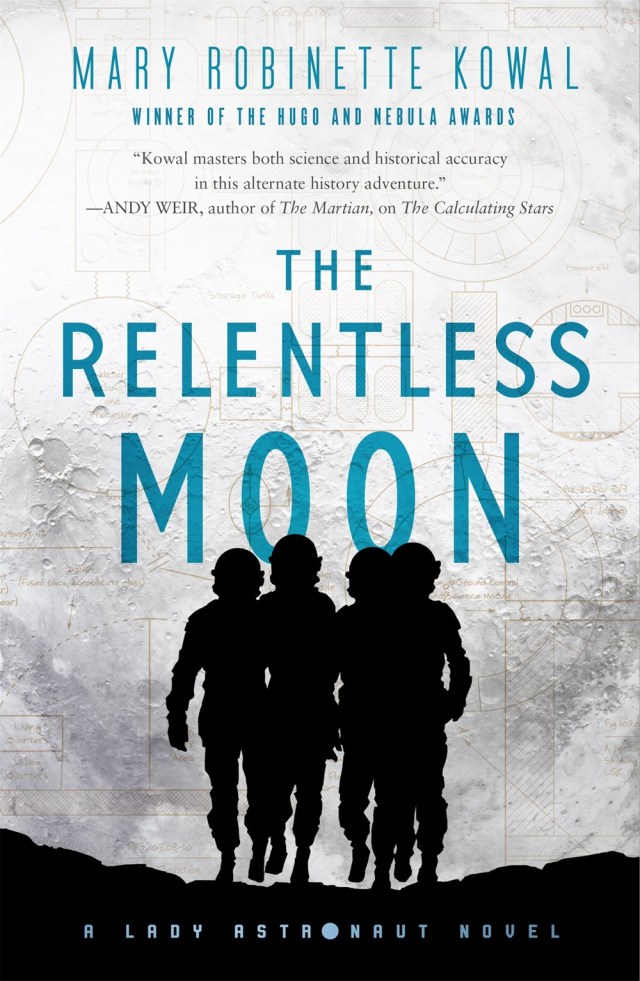
Title: The Relentless Moon
Series: Lady Astronaut, #3
Author: Mary Robinette Kowal
Publisher: Tor Books
Publication date: July 14, 2020
Length: 544 pages
Genre: Science fiction
Source: Purchased
Rating:

Rating: 4.5 out of 5.

Mary Robinette Kowal continues her award-winning Lady Astronaut series, which began with The Calculating Stars and The Fated Sky, with The Relentless Moon.

The Earth is coming to the boiling point as the climate disaster of the Meteor strike becomes more and more clear, but the political situation is already overheated. Riots and sabotage plague the space program. The IAC’s goal of getting as many people as possible off Earth before it becomes uninhabitable is being threatened.

Elma York is on her way to Mars, but the Moon colony is still being established. Her friend and fellow Lady Astronaut Nicole Wargin is thrilled to be one of those pioneer settlers, using her considerable flight and political skills to keep the program on track. But she is less happy that her husband, the Governor of Kansas, is considering a run for President.

The Lady Astronaut series is an absolute favorite, so I’m thrilled that I finally read my copy of The Relentless Moon.

In the first two books in the series (The Calculating Stars and The Fated Sky), we’re introduced into an alternate version of 1950s and 1960s America, in which a catastrophic meteor strike has wreaked havoc on the world. Scientific analysis shows that the planet is on its way to becoming uninhabitable due to the climate change that followed the meteor, and this brings about a global focus on developing a space program. The future of humanity rests on finding a new home for people among the stars.

In books one and two, scientist Elma York is the main character. Here in book #3, The Relentless Moon, a supporting character from the earlier books takes the lead role.

Nicole Wargin is a glamorous politician’s wife. She’s also one hell of a pilot, a former WASP who entered the space program as one of the initial women allowed into astronaut training. Nicole is beautiful, polished, and full of grace, always knowing the right thing to say to the right people. She’s also much more than she appears to be, with secrets from her professional past as well as her own personal struggles that she usually manages to mask.

As the book opens, Nicole is about to join the next launch to the Moon. Her husband Kenneth, governor of Kansas, is poised to announce his candidacy for President. On Earth, protests by the group Earth First are becoming more dangerous and violent day by day — demanding that the space program be abandoned so that government dollars can be focused on helping those who lost so much due to the meteor, and those who — whether for lack of privilege, access, or health — will never be candidates for traveling into space.

Despite the threats, Nicole journeys to the Moon, but things go badly, quickly. The landing mechanisms are damaged, forcing a life-threatening crash landing. It could be an accident… but it could also be sabotage. More problems arise, as small mechanical problems and power outages escalate into situations of increasing danger. Nicole is assigned to help determine if there truly is Earth First sabotage going on, and if so, to stop the perpetrators before the damage becomes catastrophic.

At 500+ pages, The Relentless Moon is a long book, but it flew by. I was completely engrossed in the discussions of life in space and on the Moon, as well as the whodunnit aspects of the hunt to find the saboteurs.

That alone might make for dry reading, but Nicole is a fabulous character with so many layers, and it’s getting to see beneath her surface that makes this a terrific book. She’s smart, sophisticated, and experienced, yet also vulnerable in unexpected ways. Her perspective on the space program, her colleagues and friends, and the pressures of being a public figure are all fascinating, and her personal struggles and tragedies in this book are incredibly moving.

The events of The Relentless Moon happen in the same timeline as those in The Fated Sky, so here, Nicole and her fellow astronauts on the lunar base hear about some of the events from the earlier book as they happen, and we get a different look at what happened and why, as well as information that Elma was not given in The Fated Sky. I love how these two books work together.

A final reveal at the end of The Relentless Moon made me so happy. That’s all I’ll say about it!

The fourth book, The Derivative Base, is due out in 2022, and I don’t want to wait that long! I can’t wait to see how the author wraps up this incredibly masterful and exciting series.

Shelf Control #220: The Last Astronaut by David Wellington

Shelves final

Welcome to Shelf Control — an original feature created and hosted by Bookshelf Fantasies.

Shelf Control is a weekly celebration of the unread books on our shelves. Pick a book you own but haven’t read, write a post about it (suggestions: include what it’s about, why you want to read it, and when you got it), and link up! For more info on what Shelf Control is all about, check out my introductory post, here.

Want to join in? Shelf Control posts go up every Wednesday. See the guidelines at the bottom of the post, and jump on board!

cropped-flourish-31609_1280-e1421474289435.png

Title: The Last Astronaut
Author: David Wellington
Published: 2019
Length: 400 pages

What it’s about (synopsis via Goodreads):

Mission Commander Sally Jansen is Earth’s last astronaut–and last hope–in this gripping near-future thriller where a mission to make first contact becomes a terrifying struggle for survival in the depths of space.

Sally Jansen was NASA’s leading astronaut, until a mission to Mars ended in disaster. Haunted by her failure, she lives in quiet anonymity, convinced her days in space are over.

She’s wrong.

A large alien object has entered the solar system on a straight course toward Earth. It has made no attempt to communicate and is ignoring all incoming transmissions.

Out of time and out of options, NASA turns to Jansen. For all the dangers of the mission, it’s the shot at redemption she always longed for.

But as the object slowly begins to reveal its secrets, one thing becomes horribly clear: the future of humanity lies in Jansen’s hands.

How and when I got it:

I received an ARC from Orbit last summer.

Why I want to read it:

I always love a good space adventure — and throw in women astronauts, especially one trying to save the world — and it all just sounds too perfect for me. My only excuse for not having read this already is that I’ve just had too much else to read, and never got around to it.

What do you think? Would you read this book? 

Please share your thoughts!


__________________________________

Want to participate in Shelf Control? Here’s how:

  • Write a blog post about a book that you own that you haven’t read yet.
  • Add your link in the comments!
  • If you’d be so kind, I’d appreciate a link back from your own post.
  • Check out other posts, and…

Have fun!

Shelf Control #175: SPACE!!

Shelves final

Welcome to Shelf Control — an original feature created and hosted by Bookshelf Fantasies.

Shelf Control is a weekly celebration of the unread books on our shelves. Pick a book you own but haven’t read, write a post about it (suggestions: include what it’s about, why you want to read it, and when you got it), and link up! For more info on what Shelf Control is all about, check out my introductory post, here.

Want to join in? Shelf Control posts go up every Wednesday. See the guidelines at the bottom of the post, and jump on board!

cropped-flourish-31609_1280-e1421474289435.pngSwitching things up a bit this week, I thought I’d include THREE books on one theme: SPACE! I’ve always loved reading about space exploration and the development of the space program (and don’t even get me started on all the variety of fiction — historical, science fiction, contemporary fiction, even horror — set in the context of space). In terms of non-fiction space books, I’ve read a bunch, and I seem to keep accumulating them! Here are three from my shelves that I’ve picked up over the years, but still haven’t read.

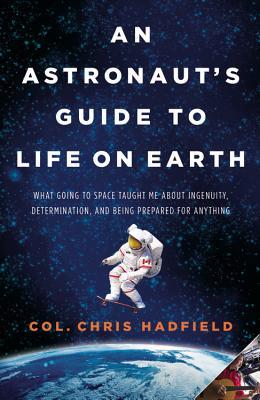
Title: An Astronaut’s Guide to Life on Earth
Author: Chris Hadfield
Published: 2013
Length: 295 pages

What it’s about (synopsis via Goodreads):

Colonel Chris Hadfield has spent decades training as an astronaut and has logged nearly 4000 hours in space. During this time he has broken into a Space Station with a Swiss army knife, disposed of a live snake while piloting a plane, and been temporarily blinded while clinging to the exterior of an orbiting spacecraft. The secret to Col. Hadfield’s success-and survival-is an unconventional philosophy he learned at NASA: prepare for the worst-and enjoy every moment of it.

In An Astronaut’s Guide to Life on Earth, Col. Hadfield takes readers deep into his years of training and space exploration to show how to make the impossible possible. Through eye-opening, entertaining stories filled with the adrenaline of launch, the mesmerizing wonder of spacewalks, and the measured, calm responses mandated by crises, he explains how conventional wisdom can get in the way of achievement-and happiness. His own extraordinary education in space has taught him some counterintuitive lessons: don’t visualize success, do care what others think, and always sweat the small stuff.

You might never be able to build a robot, pilot a spacecraft, make a music video or perform basic surgery in zero gravity like Col. Hadfield. But his vivid and refreshing insights will teach you how to think like an astronaut, and will change, completely, the way you view life on Earth-especially your own.


Title: Riding Rockets: The Outrageous Tales of a Space Shuttle Astronaut
Author: Mike Mullane
Published: 2006
Length: 382 pages

What it’s about (synopsis via Goodreads):

On February 1, 1978, the first group of space shuttle astronauts, twenty-nine men and six women, were introduced to the world. Among them would be history makers, including the first American woman and the first African American in space. This assembly of astronauts would carry NASA through the most tumultuous years of the space shuttle program. Four would die on Challenger.

USAF Colonel Mike Mullane was a member of this astronaut class, and Riding Rockets is his story — told with a candor never before seen in an astronaut’s memoir. Mullane strips the heroic veneer from the astronaut corps and paints them as they are — human. His tales of arrested development among military flyboys working with feminist pioneers and post-doc scientists are sometimes bawdy, often hilarious, and always entertaining.

Mullane vividly portrays every aspect of the astronaut experience — from telling a female technician which urine-collection condom size is a fit; to walking along a Florida beach in a last, tearful goodbye with a spouse; to a wild, intoxicating, terrifying ride into space; to hearing “Taps” played over a friend’s grave. Mullane is brutally honest in his criticism of a NASA leadership whose bungling would precipitate the Challenger disaster.

Riding Rockets is a story of life in all its fateful uncertainty, of the impact of a family tragedy on a nine-year-old boy, of the revelatory effect of a machine called Sputnik, and of the life-steering powers of lust, love, and marriage. It is a story of the human experience that will resonate long after the call of “Wheel stop.”


Title: Rocket Men: The Epic Story of the First Men on the Moon
Author: Craig Nelson
Published: 2009
Length: 404 pages

What it’s about (synopsis via Goodreads):

A richly detailed and dramatic account of one of the greatest achievements of humankind

At 9:32 A.M. on July 16, 1969, the Apollo 11 rocket launched in the presence of more than a million spectators who had gathered to witness a truly historic event. It carried Neil Armstrong, Buzz Aldrin, and Mike Collins to the last frontier of human imagination: the moon.

Rocket Men is the thrilling story of the moon mission, and it restores the mystery and majesty to an event that may have become too familiar for most people to realize what a stunning achievement it represented in planning, technology, and execution.

Through interviews, twenty-three thousand pages of NASA oral histories, and declassified CIA documents on the space race, Craig Nelson re-creates a vivid and detailed account of the Apollo 11 mission. From the quotidian to the scientific to the magical, readers are taken right into the cockpit with Aldrin and Armstrong and behind the scenes at Mission Control.

Rocket Men is the story of a twentieth-century pilgrimage; a voyage into the unknown motivated by politics, faith, science, and wonder that changed the course of history.

Other great space reads:

Since I’m talking space, I thought I’d mention three terrific books I’ve read on the subject, one long ago and two others more recently:

  • The Right Stuff by Tom Wolfe: A modern classic. If you want to know more, check out Barbara’s recent post at Book Club Mom!
  • Packing for Mars by Mary Roach: The science of space travel, presented in (sometimes) gross detail, with tons of hilarity.
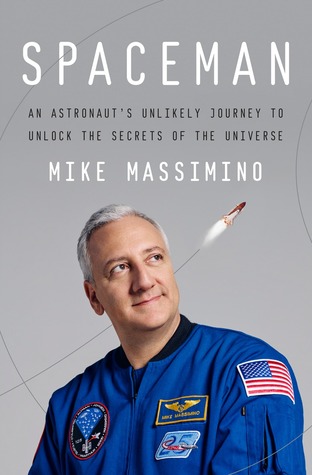
  • Spaceman by Mike Massimino: A terrific memoir, both inspiring and moving.

Do you have any great non-fiction books about space to recommend? Inquiring minds want to know!

__________________________________

Want to participate in Shelf Control? Here’s how:

  • Write a blog post about a book that you own that you haven’t read yet.
  • Add your link in the comments!
  • If you’d be so kind, I’d appreciate a link back from your own post.
  • Check out other posts, and…

Have fun!