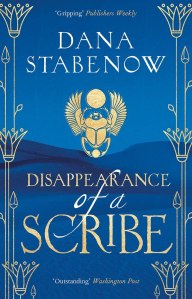

Book Review: Disappearance of a Scribe (Eye of Isis, #2) by Dana Stabenow

Title: Disappearance of a Scribe
Series: Eye of Isis, #2
Author: Dana Stabenow
Publisher: Head of Zeus
Publication date: January 18, 2022
Length: 272 pages
Genre: Historical fiction
Source: Purchased
Rating:

Rating: 4 out of 5.

The second in the trilogy of Ancient Egyptian crime novels that began with 2018’s Death of an Eye.

Two Alexandrian fishermen come across a horrifying sight – the body of a skeleton floating upright at the bottom of the sea, anchored in place by a cement weight around his feet. In Alexandria’s rough-and-tumble construction trade they call that ‘being fitted with a pair of Rhakotis sandals’ and what’s worse, he’s the second such victim in two years.

Queen Cleopatra is busy rebuilding her city after the Alexandrian War and these murders are not to be allowed to interfere with this primary task, so she charges Tetisheri, her new Eye of Isis, with the task of finding out who these men were, when they were murdered, and, above all, why.

Dana Stabenow’s fascinating Eye of Isis historical mystery series continues with Disappearance of a Scribe… and it’s just as intriguing as the first book!

Main character Tetisheri, whom we met in book #1, is the Queen’s Eye, the secret investigator who reports directly to Cleopatra and acts on her behalf. She’s also a member of Alexandria’s upper class, partnering with her uncle in a lucrative import business, and as such, is well connected throughout the tangled layers of Alexandrian society.

The mystery in Disappearance of a Scribe circles around two bodies found at sea, anchored by what we’d consider “cement shoes”. Who these people are, who killed them, and why, are Tetisheri’s focus, and as she digs into this shocking crime, she uncovers corruption among the city’s influential builders and ends up in danger herself.

The mystery is unraveled piece by piece, and it’s quite exciting to see Tetisheri chase down leads in a time and place where modern forensics and detective techniques are unknown. If you’d told me ahead of time that a major piece of the story centers on construction materials, I probably would have responded with a very rude yawn… but actually, the story is very interesting, and I appreciated seeing how differently the priorities and rules of this society work in contrast to our own.

I would have liked to see a little bit more happening on Tetisheri’s home front — I do enjoy the brief glimpses we get of her personal life — as well as more with Cleopatra herself directly involved. Still, the scenes we do get with Cleopatra are wonderful, and I love how her power and charisma shine through with every sentence she utters.

In some ways, I was able to enjoy Disappearance of a Scribe even more than I did Death of an Eye, since this time around, I was already familiar with many of the names and places in the story, and felt more comfortable with the basic structure of the politics and alliances of Alexandria at that time.

Tetisheri is a terrific character, and I can’t wait to see what’s next for her. I shouldn’t be the least bit surprised that I enjoy these books — the author’s Kate Shugak series is an absolute favorite, and I read these Egyptian mysteries secure in the knowledge that as a reader, I’m in very good hands.

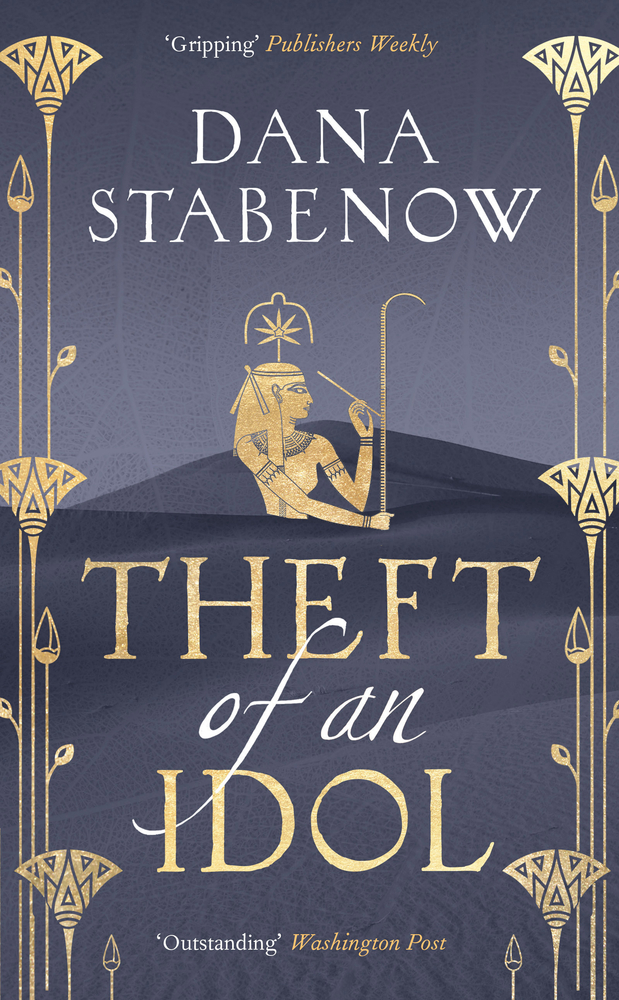
Next up: Book #3, Theft of an Idol:

Book Review: A Grave Robbery (Veronica Speedwell, #9) by Deanna Raybourn

Title: A Grave Robbery
Series: Veronica Speedwell, #9
Author: Deanna Raybourn
Publisher: Berkley
Publication date: March 12, 2024
Length: 336 pages
Genre: Historical fiction
Source: Review copy courtesy of the publisher via NetGalley
Rating:

Rating: 4.5 out of 5.

Veronica and Stoker discover that not all fairy tales have happy endings, and some end in murder, in this latest historical mystery from New York Times bestselling and Edgar Award–nominated author Deanna Raybourn.

Lord Rosemorran has purchased a wax figure of a beautiful reclining woman and asks Stoker to incorporate a clockwork mechanism to give the Rosemorran Collection its own Sleeping Beauty in the style of Madame Tussaud’s. But when Stoker goes to cut the mannequin open to insert the mechanism, he makes a gruesome discovery: this is no wax figure. The mannequin is the beautifully preserved body of a young woman who was once very much alive. But who would do such a dreadful thing, and why?

Sleuthing out the answer to this question sets Veronica and Stoker on their wildest adventure yet. From the underground laboratories of scientists experimenting with electricity to resurrect the dead in the vein of Frankenstein to the traveling show where Stoker once toured as an attraction, the gaslit atmosphere of London in October is the perfect setting for this investigation into the unknown. Through it all, the intrepid pair is always one step behind the latest villain—a man who has killed once and will stop at nothing to recover the body of the woman he loved. Will they unmask him in time to save his next victim? Or will they become the latest figures to be immortalized in his collection of horrors?

Veronica Speedwell is back! This outing — another potentially deadly investigation with her lover and partner Stoker — provides everything fans of this series love: Dastardly deeds, scheming scientists, Victorian scandal, and lots of sexy bantering.

As she and Stoker happily work on their ongoing commission to catalog and restore their patron Lord Rosemorran’s vast collection of natural wonders, a new challenge comes their way. Lord Rosemorran has purchased a waxwork of a lovely young woman, and to entertain his rambunctious youngest daughter, wants Stoker to add a mechanical element to give the illusion of breathing, as seen in a famous attraction at Madame Tussaud’s.

The promise of a new case to investigate becomes apparent once Stoker starts his work and discovers that this is no waxwork, but the meticulously preserved body of a young woman who was once very much alive. But who was she, and how did she come to be in this condition?

The more Veronica and Stoker learn, the more questions arise. It appears that this may be the body of a young woman who was found drowned in a river some fifteen years earlier, but that fact does not provide clues to her identity or shed light on the mystery of how such an impeccable work of preservation was carried out.

The details of their investigation are as delicious as readers can rightfully expect in this series, as we descend into worlds of mortuaries, mad scientists, and questionable examples of *ahem* anatomical study aides.

Through it all, Veronica and Stoker remain as wonderfully intertwined and perfectly in tune as ever, enjoying their restorative bouts of “congress” (as Veronica calls it) while also engaging as equal partners at a time when women are expected to be submissive.

It has been my experience that the male of the species, though often thoroughly illogical, can — when encouraged to sit quietly and think hard — be guided into a position of sense.

Veronica defers to no one and never backs down. She’s a smart, confident woman of science, and demands to be treated as such at all times. She never hesitates to call Stoker out, including his tendency toward anti-social behavior:

“Thanks to you, I speak to entirely too many people, entirely too often.”

“Exactly. You were practically a hermit when I met you.

“I was not a hermit,” he said through gritted teeth. “I was a professional man with work that I was actually permitted to do rather than being dragged into murder investigations because I had not yet met a woman whose very raison d’être seems to be falling over dead bodies.”

Author Deanna Raybourn seems to be having oodles of fun with these stories and characters. Her descriptions sparkle, and the quips, insults, and banter fly with zingy style. Even little throwaway lines are pure delight:

“That is the most preposterous load of plangent poppycock I have ever heard.”

I do hope she’ll continue writing Veronica Speedwell stories for many years to come. Each year’s new installment is something to savor… but sadly, they’re such fast, absorbing reads that I come to the end almost too quickly. And now, it’s another long year of waiting for the next adventure!

I’ll wrap up with words borrowed from my reviews of earlier books in the series:

If you haven’t yet had the pleasure, start with book #1, A Curious Beginning. There’s a very good chance you’ll want to continue!

This series has become one of my favorites. Don’t miss it.

Book Review: Over Sea, Under Stone (The Dark is Rising, #1) by Susan Cooper

Title: Over Sea, Under Stone
Series: The Dark is Rising, #1
Author: Susan Cooper
Publisher: Aladdin
Publication date: 1965
Length: 196 pages
Genre: Middle grade
Source: Library
Rating:

Rating: 3.5 out of 5.

“I DID NOT KNOW THAT YOU CHILDREN WOULD BE THE ONES TO FIND IT. OR WHAT DANGER YOU WOULD BE PUTTING YOURSELVES IN.”

Throughout time, the forces of good and evil have battled continuously, maintaining the balance . Whenever evil forces grow too powerful, a champion of good is called to drive them back. Now, with evil’s power rising and a champion yet to be found, three siblings find themselves at the center of a mystical war.

Jane, Simon, and Barney Drew have discovered an ancient text that reads of a legendary grail lost centuries ago. The grail is an object of great power, buried with a vital secret. As the Drews race against the forces of evil, they must piece together the text’s clues to find the grail — and keep its secret safe until a new champion rises.

And another synopsis from a different edition:

On holiday in Cornwall, the three Drew children discover an ancient map in the attic of the house that they are staying in. They know immediately that it is special. It is even more than that — the key to finding a grail, a source of power to fight the forces of evil known as the Dark. And in searching for it themselves, the Drews put their very lives in peril. This is the first volume of Susan Cooper’s brilliant and absorbing fantasy sequence known as The Dark Is Rising.

The Dark is Rising sequence has been on my to-read list for quite a while now — and I could have sworn that I’d already read the first book, Over Sea, Under Stone. But here’s what actually happened: I started this book over ten years ago with my (then) young son, soon after we finished reading Harry Potter together. We were looking for another adventure/fantasy series to dig into… but apparently, Over Sea, Under Stone didn’t quite catch his attention as a read-aloud. So, while I thought we’d read the whole book, I realized this time around that we actually only read the first few chapters.

In any case…

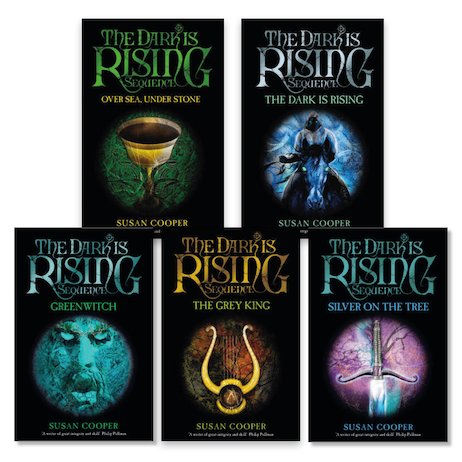
I’ve been curious about this five-book series, which is considered a modern classic in the middle grade/children’s fantasy genre, dealing with Arthurian legends and other elements of Celtic mythology.

Finally, I decided to commit to the first book, and I’m glad I did.

Over Sea, Under Stone is the story of a trio of siblings — Simon, Jane, and Barney Drew — and the quest they find themselves pulled into while on a family holiday in Cornwall. There, staying in a curious old house with their Great-Uncle Merry (who’s not biologically an uncle at all, but has been considered part of the family for as long as anyone can remember), the children find a crumbling old manuscript and map, and decide it has the makings of an exciting adventure.

But as the children seek clues, darker forces seem determined to interfere. A variety of creepy and menacing people take interest in the children’s explorations, and soon begin to actively try to capture the map for themselves.

With Merry’s guidance, the children come to realize that the map likely dates back to the time of King Arthur, and if only they can decipher its clues, they may find a relic of incomparable value and power.

Over Sea, Under Stone is a rollicking good adventure, with moments of danger and menace, great bravery, and funny moments too. Of course, the children and the time period might seem terribly old-fashioned to today’s children, but putting that aside, the book is a fast-paced quest story with high stakes and suspenseful action sequences.

This book was originally envisioned as a stand-alone and works perfectly well as such, with a satisfying ending — but it also leaves the door wide open for more to come.

For me personally, I’m not in a phase where I’m feeling particularly drawn to children’s fiction, so while I enjoyed Over Sea, Under Stone and can wholeheartedly recommend it, I’m not inclined to continue the series at the moment. I think the first book is a great reading experience, and I’m guessing the rest of the series is as well! Maybe I’ll eventually pick up the next book, but for now, I’m happy with having read Over Sea, Under Stone, and will leave it at that.

Book Review: Death of an Eye (Eye of Isis, #1) by Dana Stabenow

Title: Death of an Eye
Series: Eye of Isis, #1
Author: Dana Stabenow
Publisher: Head of Zeus
Publication date: December 6, 2018
Length: 254 pages
Genre: Historical fiction
Source: Purchased
Rating:

Rating: 4 out of 5.

ALEXANDRIA, 47 BC. For three centuries, the House of Ptolemy has governed the Kingdom of Egypt. Cleopatra – seventh of her name – rules from Alexandria, that beacon of commerce and learning that stands between the burning sands of the desert and the dark waters of the Middle Sea. But her realm is beset by ethnic rivalries, aristocratic feuds and courtly intrigues . Not only that, she must contend with the insatiable appetite of Julius Caesar who needs Egyptian grain and Egyptian gold to further his ambitions. The world is watching the young Queen, waiting for a misstep …

And now her most trusted servant – her Eye – has been murdered and a vast shipment of newly minted coin stolen. Cleopatra cannot afford for the coins to go unrecovered or the murderers unpunished, so she asks childhood friend, Tetisheri Nebenteru, to retrace the dead Eye’s footsteps. Tetisheri will find herself plunged into the shadowy heart of Alexandria . As she sifts her way through a tangle of lies and deceit, she will discover that nothing can be taken at face value, that she can’t trust anyone – not even the Queen herself .

As a devoted fan of Dana Stabenow’s Kate Shugak series, I was curious to see what her non-Kate/non-Alaska books were like. Fortunately, my book group selected Death of an Eye as our February read, which was the perfect opportunity for me to finally read a book I’ve had my eye on for quite a while.

In this historical novel, the main character is a young woman named Tetisheri, the niece and business partner of a successful merchant in Alexandria at the time of Cleopatra’s reign. Tetisheri was close to Cleopatra as a child, and when the queen finds herself in need of a trusted ally, she calls on Tetisheri.

Cleopatra’s “eye” — a person unknown to any but the queen herself, authorized by her to carry out investigations on her behalf — has been murdered while investigating a crime that could spell disaster for Cleopatra. The queen asks Tetisheri to take on the role of Eye and track down both the murderer and the solution to the earlier crime. As she does so, Tetisheri is herself subject to danger, and must also contend with the slippery politics of Alexandrian and Roman nobility.

Once I began wrapping my head around the people, places, and culture, I was quickly immersed in both the historical setting and the crime story. I really know next to nothing about this time period or the society of Alexandria, apart from film and TV depictions and classic dramas (yes, I’ve read both Caesar and Cleopatra and Antony and Cleopatra, but both were a very long time ago).

The Cleopatra we meet in Death of an Eye is not the Elizabeth Taylor version. Here, she’s a young, strong-willed, and incredibly intelligent ruler, struggling to maintain her throne despite the machinations of her co-ruler and brother Ptolemy XIV and his minions, while also pregnant with Julius Caesar’s child and making every effort to stay in his favor. Cleopatra is interested in science and logic, and cares for her people, but has very few whom she can actually trust.

Tetisheri is not a historical figure; rather, she’s a citizen of Alexandria who, as a monetarily secure merchant, has access to many levels of society, but doesn’t personally wield much power. Having survived a cruel marriage, she makes it her mission to rescue enslaved women and give them the means to start new lives. Tetisheri is smart and dedicated, and while she’s not entirely happy about her assignment from Cleopatra, she’s loyal to the queen and determined to see the investigation through.

I really enjoyed Death of an Eye. As I mentioned, it’s not a setting or period that I’m very familiar with, so there was a pretty steep learning curve at the beginning, and all the way through I found myself confusing people and place names. (Helpfully, there’s both a map and a cast of characters list at the front of the book — and I used both quite a lot). The plot is intricate but not hard to follow, and I found myself more and more interested in the mystery as the various pieces came together toward the end of the book.

While the central mystery of Death of an Eye is solved by the end, Tetisheri’s involvement with Cleopatra is by no means concluded, and her personal life — including a love interest — is left very much open-ended. Fortunately, there are two more books in the Eye of Isis series currently available, with a 4th book planned for 2025.

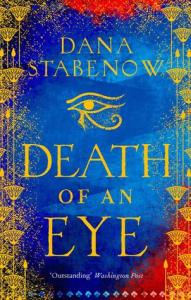
Books 1 – 3; currently available

Book Review: The Bell in the Fog by Lev AC Rosen

Title: The Bell in the Fog
Author: Lev AC Rosen
Publisher: Forge Books
Publication date: October 10, 2023
Length: 261 pages
Genre: Historical fiction/mystery
Source: Review copy courtesy of the publisher via NetGalley
Rating:

Rating: 4 out of 5.

The Bell in the Fog , a dazzling historical mystery by Lev AC Rosen, asks―once you have finally found a family, how far would you go to prove yourself to them?

San Francisco, 1952. Detective Evander “Andy” Mills has started a new life for himself as a private detective―but his business hasn’t exactly taken off. It turns out that word spreads fast when you have a bad reputation, and no one in the queer community trusts him enough to ask an ex-cop for help.

When James, an old flame from the war who had mysteriously disappeared, arrives in his offices above the Ruby, Andy wants to kick him out. But the job seems to be a simple case of blackmail, and Andy’s debts are piling up. He agrees to investigate, despite everything it stirs up.

The case will take him back to the shadowy, closeted world of the Navy, and then out into the gay bars of the city, where the past rises up to meet him, like the swell of the ocean under a warship. Missing people, violent strangers, and scandalous photos that could destroy lives are a whirlpool around him, and Andy better make sense of it all before someone pulls him under for good.

Last year’s Lavender House was an unexpected delight — a taught, page-turning mystery set in the bad old days of 1950s San Francisco, a time especially dangerous for a closeted gay cop whose life is almost destroyed after he’s brutally outed.

In The Bell in the Fog, we continue the story of Andy Mills, now an ex-cop working as a private investigator from his office and apartment located above Ruby’s, a gay nightclub whose owner decides to give Andy a home and a chance at a fresh start. Andy is trying to pay his way and establish himself as a detective, but it’s hard to earn the trust of the wary gay community, which has every reason to mistrust and fear the police.

When Andy’s ex-lover from his Navy days shows up in his office, his life gets even more complicated, as unwelcome memories and feelings bubble up from his past. James is now a naval officer up for promotion, but he’s being blackmailed by a casual lover and has everything to lose. Reluctantly, Andy accepts the case, and is soon immersed in the search for a missing person, the blackmail photos, and the person pulling the strings.

Author Lev AC Rosen once again expertly manages to tell a compelling, intricate mystery story while also painting a picture of a particular time and place in history. Through Andy’s experiences, we see the sharply dangerous life of the underground gay community as well as the joys and love of found family. The mystery itself is well-constructed, with danger, plenty of red herrings, and plot twists galore.

The range of people that Andy interacts with presents yet another view into the time period, as we get to know drag performers, closeted lovers, wannabe stars, and various allies and enemies. Andy himself is a wonderful character, carrying the weight of past persecution and guilt, looking to rebuild a life, and figuring out where he fits in in his new chosen community. I loved seeing the through-lines and connections to Lavender House, and enjoyed Andy’s ongoing soul-searching and journey toward strength and self-acceptance.

Overall, The Bell in the Fog is a terrific mystery as well as a moving portrait of gay life in the 1950s. It’s a page-turner with heart — highly recommended! I hope there will be much more to come in this series.

.

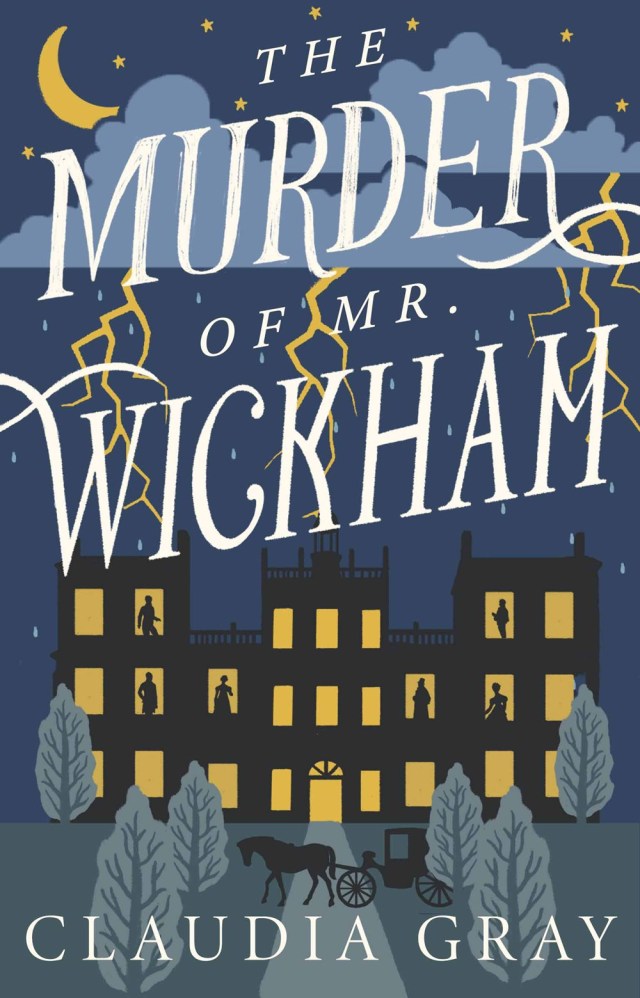
Book Review: The Murder of Mr. Wickham by Claudia Gray

Title: The Murder of Mr. Wickham
Author: Claudia Gray
Publisher: Knopf Doubleday Publishing Group
Publication date: May 3, 2022
Length: 386 pages
Genre: Mystery
Source: Purchased

Rating: 3.5 out of 5.

A summer house party turns into a whodunit when Mr. Wickham, one of literature’s most notorious villains, meets a sudden and suspicious end in this mystery featuring Jane Austen’s leading literary characters.

The happily married Mr. Knightley and Emma are throwing a house party, bringing together distant relatives and new acquaintances—characters beloved by Jane Austen fans. Definitely not invited is Mr. Wickham, whose latest financial scheme has netted him an even broader array of enemies. As tempers flare and secrets are revealed, it’s clear that everyone would be happier if Mr. Wickham got his comeuppance. Yet they’re all shocked when Wickham turns up murdered—except, of course, for the killer hidden in their midst.

Nearly everyone at the house party is a suspect, so it falls to the party’s two youngest guests to solve the mystery: Juliet Tilney, the smart and resourceful daughter of Catherine and Henry, eager for adventure beyond Northanger Abbey; and Jonathan Darcy, the Darcys’ eldest son, whose adherence to propriety makes his father seem almost relaxed. The unlikely pair must put aside their own poor first impressions and uncover the guilty party—before an innocent person is sentenced to hang.

The Murder of Mr. Wickham has a very clever concept as its central premise: Not only does it star Jane Austen’s leading characters, but it creates a society that includes all of these characters at once. Whether as distant cousins, visiting guests, acquaintances from travels, or friends of friends, in this mystery novel, the Darcys, Knightleys, Bertrams, Brandons, and Wentworths all end up in close quarters at a country house party… and things do not go well.

When the Knightleys invite their guests for a month at Donwell Abbey, they absolutely do not expect the notorious George Wickham to make an appearance. It’s been over twenty years since Elizabeth and Darcy were married, but they’ve unfortunately had to deal with Wickham’s wicked ways across the years due to his marriage to Elizabeth’s (now deceased) sister Lydia. But it’s not only the Darcys who have such strongly negative feelings toward Wickham — as it turns out, each visiting couple has at least one reason for hating the man.

As is obvious from the title, Wickham ends up dead, and this happy little country house party turns into a miserable situation of forced companionship, as the guests are unable to leave until the investigation is done, but no one is really in the mood to enjoy card games, walks in the garden, or piano recitals.

The two youngest guests, Jonathan Darcy and Juliet Tilney, find themselves intrigued by the mystery, and begin their own secretive (and highly improper) investigation. Will they discover the true murderer… or will their reputations be destroyed first?

The Murder of Mr. Wickham has such an enticing set-up that I was immediately drawn in. The author gives a rough timeline at the start of the book to explain the sequencing of these characters’ primary stories, so while Elizabeth and Darcy have been together for over twenty years, Marianne and Colonel Brandon are more or less newlyweds. It’s such fun to see the initial gathering and see how the author creates connections between the varying characters and their separate worlds.

I’m not generally much of a mystery reader, so perhaps that’s partially why I felt less engaged as the story progressed. The premise and the intermixing of the characters is great fun, but I found myself less interested in the clues and possible motives the longer the story went on. The pacing is uneven as well — there are some entertaining scenes that feel like Austen set-pieces, but because we get sections visiting with each and every one of the couples, there are just far too many points-of-view and marital challenges to keep track of.

I also found it challenging to accept the character depictions here as compared to what their personalities are really “meant” to be. Granted, they’ve all grown up over the years, but Emma doesn’t come across as very Emma-ish to me, and likewise it was hard to reconcile this portrayal of Anne and Captain Wentworth to the characters I know and love from Persuasion. (As for Fanny and Edmund Bertram, while I’ve read Mansfield Park, it never really stuck with me, so I felt like I had no frame of reference for them at all).

Jonathan and Juliet are engaging new characters. Jonathan is neuro-atypical, and I felt that the author portrayed him sensitively and yet also made him someone to really root for, and I liked how his relationship with his parents was depicted too. Juliet is spunky and adventurous, but felt a bit more cookie-cutter to me, not necessarily distinct from similar young, intelligent women placed into Regency romance tales.

I’m glad I gave this Austen-esque mystery a try. It didn’t entirely work for me, but I appreciated the creativity and the joy of seeing older versions of some favorite characters. A second book in the series, The Late Mrs. Willoughby, was just released this spring. I don’t feel a need to read it any time soon, but I could see returning to it at some point down the road when I feel like revisiting this world.

Book Review: The Poisoner’s Ring (A Rip Through Time, #2) by Kelley Armstrong

Title: The Poisoner’s Ring
Series: A Rip Through Time
Author: Kelley Armstrong
Publisher: Minotaur Books
Publication date: May 23, 2022
Length: 352 pages
Genre: Historical fiction/mystery
Source: Review copy courtesy of the publisher via Netgalley
Rating:

Rating: 4 out of 5.

Edinburgh, 1869: Modern-day homicide detective Mallory Atkinson is adjusting to her new life in Victorian Scotland. Her employers know she’s not housemaid Catriona Mitchell―even though Mallory is in Catriona’s body―and Mallory is now officially an undertaker’s assistant. Dr. Duncan Gray moonlights as a medical examiner, and their latest case hits close to home. Men are dropping dead from a powerful poison, and all signs point to the grieving widows… the latest of which is Gray’s oldest sister.

Poison is said to be a woman’s weapon, though Mallory has to wonder if it’s as simple as that. But she must tread carefully. Every move the household makes is being watched, and who knows where the investigation will lead.

The Poisoner’s Ring is the 2nd book in Kelley Armstrong’s A Rip Through Time series, and while there’s a murder-mystery plot that’s complicated and compelling, I think a reader would be completely lost if they try to start here without reading the first book.

But the first book was great, so why not start at the beginning???

To recap as simply as possible, the plotof A Rip Through Time has to do with a modern-day detective who gets pulled through a rip in time while visiting Edinburgh and ends up in the 19th century. Mallory’s inner self now inhabits the 19-year-old body of housemaid Catriona… and she presumes that Catriona must be stuck inside Mallory’s body in the 21st century. (There’s a lot more to it, so check out my review for more details).

Here in book #2, The Poisoner’s Ring, about a month has passed since the events of the last book. Mallory hasn’t figured out how to get back to her own time, so she’s still stuck in a strange time and a strange body. Fortunately, Catriona’s employer, Dr. Duncan Gray and his widowed sister Isla know the truth about Mallory, and accept her. Even better, they’re both scientists, and they’re fascinated by what Mallory can teach them about advances in forensics and chemistry.

It’s an odd and consistently entertaining juxtaposition. Mallory finds herself about 10 years younger than her true age, in a much more delicate body, stuck wearing petticoats and corsets, yet in full possession of her true skills and knowledge. She has to learn to defend herself in this weaker, daintier body, and must learn to curb her natural instincts in order to fit in, at least on a surface level, in this Victorian setting. Chasing a perp down the streets just isn’t ladylike and is sure to attract unwanted attention… not to mention just how challenging she finds running and fighting in a corset.

The plot of The Poisoner’s Ring centers around a series of deaths that appear to be murder by poison. There are rumors of a poisoner’s ring — basically, an urban myth about unhappy wives referring one another to a source for illegal poison which they then use to kill their husbands. Since none of the victims appear to be connected, it’s a clever scheme… but Mallory isn’t buying it. As she, Duncan, and Isla dig deeper, they discover all sorts of secrets and misdeeds, but unfortunately, Duncan and Isla’s oldest sister ends up implicated as well. As the saying goes… now it’s personal.

This book is a delight, as is the first in the series. There’s something so completely delicious about having this 21st century detective mouthing off to her confidantes, with all of her modern-day attitude and know-how coming out of the mouth of a delicate young (and formerly illiterate and untrustworthy) housemaid.

The murder plot itself is complicated, maybe more so than really suits my reading tastes, but that’s more a matter of my preferred types of fiction than a knock against this book. After a certain point, I stopped trying very hard to keep all the various suspects and conspirators straight, and just enjoyed it for the sake of seeing Mallory in action, as well as the other main characters, who are also quite interesting and fun to spend time with.

I love Mallory’s dialogue and her inner thoughts — so amazingly out of place for where she finds herself. Her wry observations never fail to amuse:

The public house is, like most things in Victorian Edinburgh, both what I expect and not what I expect. My visual renderings of scenes like this all come from Hollywood, where’ I’m going to guess that — unless it’s a mega-budget movie — there’s a standard-issue “Victorian pub” on a soundstage somewhere.

… [T]here’s the boy just ahead of us, who has coming running from a shop a few blocks over, where he is employed to read the paper to the workers. They chip in to buy a newspaper and pay him a small wage to sit at a table and read aloud while they work. The Victorian version of a radio newscast… complete with child labor.

(I won’t give the context for this one, since it’s a bit of a plot spoiler, but I love the idea:)

It’s the Victorian equivalent of a deepfake.

The Poisoner’s Ring is a terrific 2nd book that builds on the promise of the 1st. Our main character continues to be a fish-out-of-water, surviving and thriving on her wits and 21st century know-how, stuck where she doesn’t want to be — but while stuck, making a life for herself. Because Mallory’s circumstances remain unresolved as of the end of this book, I can only assume that there will be more to come in this series, and I am here for it!

Highly recommended, and as I keep saying — starting with book #1 is a must!

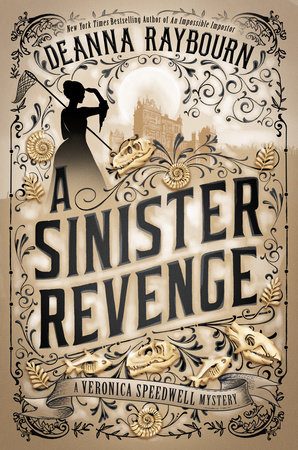
Book Review: A Sinister Revenge (Veronica Speedwell, #8) by Deanna Raybourn

Title: A Sinister Revenge
Series: Veronica Speedwell, #8
Author: Deanna Raybourn
Publisher: Berkley
Publication date: March 7, 2023
Length: 336 pages
Genre: Historical fiction
Source: Review copy courtesy of the publisher via NetGalley
Rating:

Rating: 4.5 out of 5.

Veronica must find and stop a devious killer when a group of old friends is targeted for death in this new adventure from the New York Times bestselling and Edgar Award–nominated author Deanna Raybourn.

Veronica’s natural-historian beau, Stoker, has been away in Bavaria for months and their relationship is at an impasse. But when Veronica shows up before him with his brother, Tiberius, Lord Templeton-Vane, he is lured back home by an intriguing job offer: preparing an iguanodon for a very special dinner party.

Tiberius has received a cryptic message—along with the obituaries of two recently deceased members of his old group of friends, the Seven Sinners—that he too should get his affairs in order. Realizing he is in grave danger but not knowing why, he plans a reunion party for the remaining Sinners at his family estate to lure the killer out while Veronica and Stoker investigate.

As the guests arrive and settle in, the evening’s events turn deadly. More clues come to light, leading Veronica, Stoker, and Tiberius to uncover a shared past among the Sinners that has led to the fatal present. But the truth might be far more sinister than what they were prepared for.

Hurray! A new Veronica Speedwell adventure is here, and it’s deliciously complicated and captivating.

Veronica is a dedicated lepidopterist and natural history enthusiast, with a more-or-less accidental sideline in investigating unsavory crimes such as murder, impersonation, and other deadly pursuits. In partnership with her soulmate Stoker, who is perhaps more obsessed with taxidermy than might be advisable, she pursues solutions to complex conspiracies and usually manages to bring wrong-doers to justice — even if her definition of justice doesn’t always match up exactly with the legal system’s definition.

As A Sinister Revenge opens, Veronica is dealing with the fall-out of a MAJOR complication that came to light in the previous book, An Impossible Impostor. The impact on her relationship with Stoker is severe — he’s removed himself from London to engage in fieldwork, and has quite clearly asked Veronica for space. Yes, he still loves her… but is that enough?

When Stoker’s oldest brother Tiberius requests Veronica’s help, they track down Stoker to the forests of Bavaria, where Tiberius pleads for help. He’s received death threats, and needs Veronica and Stoker to figure out who they’re from — and prevent his own and possibly other people’s demise.

The action moves to Tiberius’s country estate, to which he invites close companions from his youth, all of whom may be either potential murder victims… or the murderer. With our power duo on the case, the house party will hopefully end with the discovery of motive, means, and the guilty party, and not with dead bodies to mourn.

As always, Veronica and Stoker are incredibly fun to spend time with. Veronica, as narrator, is full of snark and sass, highly intelligent, and fully insistent on her right to be her own person, and not give in to societal expectations about a woman’s proper place. Because she and Stoker are semi-estranged for much of the book, some of their usual spicy chemistry and high-octane banter are missing, but they still manage to work together, contradict one another, and focus on the case enough to keep the entertainment value high.

The mystery itself is a good one, combining tropes such as a country-house/isolated setting, a guest list where one person is sure to be the murder, and many, many red herrings. There are plenty of clues scattered throughout, but also quite a bit of misdirection and false leads. I was kept guessing throughout the book, and found the unraveling of secrets and eventual big reveal of the whodunit very clever and very, very well done.

I always love seeing Veronica in action, and adore her independence, risk-taking, and sense of adventure. I also love her whole-hearted embrace of the importance of physical love as well as romantic love (or as she puts it: “Physical congress, I have often observed, is as revivifying to the spirt as to the body”.)

The writing in this series is utterly delightful — this book includes such terrific vocab words as “omnificent”, “rampageous”, “rumbustious” “cicerone”, “thaumatrope”, “vellicate”, and more. The dialogue is quick and witty, and the characters are all quite distinct and entertaining.

Eight volumes in, the Veronica Speedwell mysteries remain energetic, clever, and enchanting. In A Sinister Revenge, we get a captivating mystery plot as well as terrific character dynamics. Once again, I read the newest release much too quickly, and now face the long, long wait for another new book!

I’ll end with the same advice I’ve included in my reviews of every book in this series: If you haven’t yet had the pleasure, start with book #1, A Curious Beginning. There’s a very good chance you’ll want to continue!

This series has become one of my favorites. Don’t miss it.

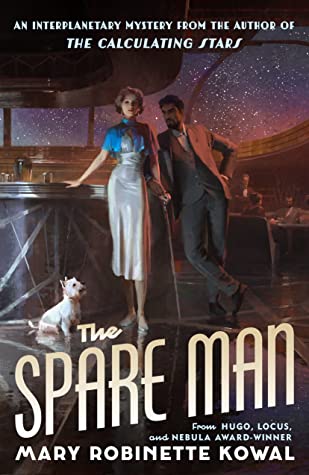
Book Review: The Spare Man by Mary Robinette Kowal

Title: The Spare Man
Author: Mary Robinette Kowal
Publisher: Tor Books
Publication date: October 11, 2022
Length: 384 pages
Genre: Science fiction
Source: Purchased
Rating:

Rating: 5 out of 5.

Tesla Crane, a brilliant inventor and an heiress, is on her honeymoon on an interplanetary space liner, cruising between the Moon and Mars. She’s traveling incognito and is reveling in her anonymity. Then someone is murdered and the festering chowderheads who run security have the audacity to arrest her spouse. Armed with banter, martinis and her small service dog, Tesla is determined to solve the crime so that the newlyweds can get back to canoodling—and keep the real killer from striking again.

It’s always a treat when a favorite author releases a new book, and even more so when it turns out to be exactly the book I needed!

While I treated myself to a signed copy of The Spare Man (and the assorted goodies that came with it) AND watched an excellent online author talk, both several months ago, it wasn’t until this quiet week between Christmas and New Year that I finally dedicated some time to cuddle up and enjoy the book.

My book and goodies!

I’m happy to say that (a) it was well worth the wait! and (b) the mix of humor, a cute dog, a tricksy murder plot, space travel, and cocktail was just what I needed.

A brief aside: The fate of fictional doggos can be really stressful for readers, so let me just start by saying that GIMLET IS THE BEST and that Gimlet is perfectly fine from start to finish. No dog trauma to worry about!!

Back to the book:

The plot centers around Tesla Crane and her new husband Shal Steward, two madly-in-love newlyweds who just want to canoodle in their luxury suite aboard the ISS Lindgren on their cruise to Mars. Tesla is a world-famous, insanely rich inventor/roboticist, and Shal is a retired detective who’s mad about his spouse.

The couple is accompanied by Gimlet, the world’s cutest Westie. Gimlet is not only supremely adorable, but also key to Tesla’s ability to cope and function: Tesla is dealing with severe pain and physical challenges stemming from a terrible accident that left her with spinal injuries and PTSD, and Gimlet is her magnificent service dog. (Yes, I’m raving a lot about Gimlet — you will too, once you meet her!)

Even on-duty, Gimlet was fully aware that she was, indeed, the most adorable and worthy creature ever assembled by nature or laboratory. Her tail was generating its own electrical current of delight.

Unfortunately, Tesla and Shal’s romantic adventure is interrupted almost immediately by a murder. Inconveniently for the continuation of their honeymoon bliss, being first on the scene at a stabbing also makes them prime subjects. Soon, the couple is caught up in nasty handling by the ship’s security team, forced isolation, ongoing suspicion, and (gasp) interference with their expensive luxury gin of choice.

When Shal is detained as a prime suspect, what’s Tesla to do but start an investigation of her own? With complications such as look-alike bartenders, high-profile magicians, competing robotics entrepreneurs, and more, the quest to uncover the truth and exonerate Shal takes nonstop twists and turns, complicated by the strange effects of space travel, centrifugal force, lagged communications, and more.

The plot is complicated, but the heavier moments focusing on Tesla’s past trauma and her ongoing pain and flashbacks are lightened by healthy doses of banter and doggo cuteness. Each chapter starts with a cocktail recipe — some classics, some invented just for this book — all of which make me want to take up mixology as a hobby.

The Spare Man handles gender, racial, and ability diversity very well, never in a preachy way, but with a matter-of-fact approach that keeps the focus on the story while also portraying a future in which inclusion is just a given.

There’s quite a bit of humor in the book, from Tesla’s long-distance, time-lagged calls with her crochet-loving, insult-spraying lawyer to her descriptions of various characters (my favorite being the huge security officer described as the “wall of Bob”).

Tesla and Shal have terrific chemistry — love and passion, intellectual sparring, deep connection, and unmatchable cleverness. I did wish we’d learned more about their background as a couple — how they met, fell in love, got married — but even without that background, it’s easy to love seeing them together and enjoy the hell out of their interactions.

The murder-mystery plot is convoluted but lots of fun, with plenty of red herrings and distractions, quirky characters and suspects, and some bonkers complications that arise from setting what is essentially a closed-circle mystery onboard an interplanetary cruise ship.

(Note: For more on some key types of mysteries, see this reference or this explanation of the difference between a locked-room mystery and a closed-circle mystery.)

I’ve heard the author (and others) refer to this book as “The Thin Man in space”. Never having read the Thin Man books or seen any of the movies, this comparison doesn’t do a whole lot for me — but after checking out a few quick video clips, I can see how people who appreciate The Thin Man might really find The Spare Man a hoot. But even without this element, the book absolutely worked for me.

All in all, I adored The Spare Man. Murder, quippy dialogue, space travel, and an amazing dog — who could ask for more?

Book Review: Lavender House by Lev AC Rosen

Title: Lavender House
Author: Lev AC Rosen
Publisher: Forge Books
Publication date: October 18, 2022
Length: 288 pages
Genre: Historical fiction/mystery
Source: Review copy courtesy of the publisher via NetGalley
Rating:

Rating: 5 out of 5.

A delicious story from a new voice in suspense, Lev AC Rosen’s Lavender House is Knives Out with a queer historical twist.

Lavender House, 1952: the family seat of recently deceased matriarch Irene Lamontaine, head of the famous Lamontaine soap empire. Irene’s recipes for her signature scents are a well guarded secret—but it’s not the only one behind these gates. This estate offers a unique freedom, where none of the residents or staff hide who they are. But to keep their secret, they’ve needed to keep others out. And now they’re worried they’re keeping a murderer in.

Irene’s widow hires Evander Mills to uncover the truth behind her mysterious death. Andy, recently fired from the San Francisco police after being caught in a raid on a gay bar, is happy to accept—his calendar is wide open. And his secret is the kind of secret the Lamontaines understand.

Andy had never imagined a world like Lavender House. He’s seduced by the safety and freedom found behind its gates, where a queer family lives honestly and openly. But that honesty doesn’t extend to everything, and he quickly finds himself a pawn in a family game of old money, subterfuge, and jealousy—and Irene’s death is only the beginning.

When your existence is a crime, everything you do is criminal, and the gates of Lavender House can’t lock out the real world forever. Running a soap empire can be a dirty business.

Lavender House opens with a desperate man in a bar having one last drink while contemplating suicide — before a broad in bright colors walks in.

She has a deep, sharp voice, and it cuts through the fog of drunkenness in my mind. She’s right out of a movie — she could ask me to kill her husband any second now.

In this noir-tinged murder mystery set in 1950s San Francisco, there’s no place to hide if you’re queer, and that’s especially true if you’re a cop. Our main character, Andy Mills, has just been fired from the SFPD after being caught in the act during a police sweep of gay bars. Broken, beaten, and with no hope, he’s having one last drink while considering throwing himself into the Bay, when Pearl walks into the bar.

Pearl is a classy older woman with an aura of money, and as Andy listens to her pitch, he learns something truly shocking: Pearl refers to her long-time companion Irene as her “wife”. How can two women possibly live a domestic, committed life together without persecution? Soon, Andy learns much more: Irene is the head of the Lamontaine family, who own a fabulously successful soap company known for its lush floral scents and secret formulations. With the Lamontaine money, Irene and Pearl are able to live a rich, free life within their secluded, gated estate in Marin, along with their son Henry, Henry’s partner Cliff (who poses publicly as Henry’s secretary), Henry’s wife Margo (again, a public-facing role), and Margo’s lover Elsie, who runs one of the most successful queer clubs in San Francisco, sheltered by generous payoffs to the police.

Henry turns and kisses him on the forehead. And everyone acts like it’s the most natural thing in the world. No one even seems to notice it happen. I’ve seen affection like that in the clubs before, sure. But here, in morning light, at a breakfast table, it’s like they’re so bright it makes my eyes hurt.

The Lamontaine’s idyllic life is devastated, however, by the event that’s brought Pearl to Andy: Irene is dead, and Pearl suspects murder. While the rest of the household believe the death was an unfortunate accident, Pearl thinks there’s something more sinister at play, and she invites Andy back to the mansion to investigate. As he takes up residence in a guest room and gets to know the family, Andy uncovers many secrets, but also sees both the freedoms and limitations of the family’s isolated lives, and considers whether he might ever find a way to live a freer, truer life himself.

There’s so much to love about Lavender House! First, the murder mystery itself is well developed, with an intriguing set-up, plenty of clues and red herrings, and a cast of characters who all seem like good people, until we’re forced to see other sides of them and wonder what lies beneath the friendly surfaces. This is a manor house mystery — an isolated, grand house, with each resident a suspect, and a detective in their midst, who may end up in grave danger himself. It’s quite deliciously built, as we get to know and like the various characters — but like Andy, we need to also look beyond the smiles and sympathetic conversations and to hold ourselves at a bit of a distance while we assess which of these people is a murderer.

Beyond the mystery itself, there’s also the historical setting and the depiction of gay life in the 1950s. The era shines through via the author’s descriptions of the bars and alleys and criminal life, as well as the music, clothing, and cars. But it’s the narration of Andy’s inner turmoil, the constant threat of discovery and the very real danger of beatings and abuse that give this book such a gritty, sad, realistic feel.

Even amidst the seemingly open life of the Lamontaine house, Andy is constantly aware of the redwood trees that line the drives, looking like prison bars, and the heavy gates that must be kept locked to keep the world out — and by extension, to keep the family locked within their private haven, unable to leave without putting on masks to shield them from the world.

As long as the world out there stays the same, a paradise like this keeps you in as much as it keeps you safe.

There’s so much sorrow in Andy’s experiences of living a secret life, his attempts to keep himself safe and his shame at not having done more to help others like him, his knowledge that the camaraderie he once experienced on the police force was erased in an instant the moment his true self was exposed, and the physical danger he faces simply by being spotted by someone who might recognize him. Through Andy’s investigation, we also learn more about the backgrounds of the various other inhabitants of Lavender House, and it’s a sad litany of secrets, shame, family disgrace, and abuse.

The murder is, of course, tied up neatly by the end of the book, and I thought the resolution was quite clever and not at all obvious. Andy’s life seems on the verge of a new beginning, and it’s wonderful to be able to leave him with a sense of hope. Life in the 1950s hasn’t magically changed, but he at least has options and a vision for how his life might be better. It felt as though the ending might be leaving the door open for additional mysteries starring Andy, and that would be amazing! Here’s hoping this is just the first in a continuing series.

I’m not at all surprised that I ended up loving this book. The author, Lev AC Rosen, has written some fabulous books already, including two gems that I think deserved much more attention than they got (All Men of Genius and Depth — go look them up and check them out!!). I haven’t read his YA novels yet, but they’re on my TBR list. In any case, Lavender House seems to be generating lots of buzz and is getting a big, splashy release, so I hope this is the book that will finally provide this talented author with a much bigger audience.

Lavender House is a fast-paced, intriguing mystery with a deep inner core of emotional impact and sensitivity, and I loved the sharp way the characters’ experiences enhanced the murder genre aspects of the story. This is a terrific new release for October — don’t miss it!