Archivist Wasp: My review… and some other opinions too.

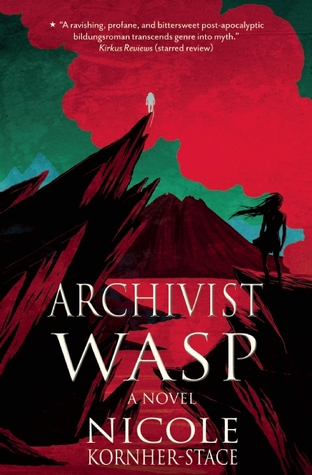
Archivist WaspSynopsis:

(via Goodreads)

Wasp’s job is simple. Hunt ghosts. And every year she has to fight to remain Archivist. Desperate and alone, she strikes a bargain with the ghost of a supersoldier. She will go with him on his underworld hunt for the long-long ghost of his partner and in exchange she will find out more about his pre-apocalyptic world than any Archivist before her. And there is much to know. After all, Archivists are marked from birth to do the holy work of a goddess. They’re chosen. They’re special. Or so they’ve been told for four hundred years.

Archivist Wasp fears she is not the chosen one, that she won’t survive the trip to the underworld, that the brutal life she has escaped might be better than where she is going. There is only one way to find out.

My Thoughts:

I’m at a bit of a loss when it comes to summing up Archivist Wasp. My feelings are really contradictory. There’s quite a bit here that’s interesting and different, but I’m not sure that the plot as a whole holds together convincingly.

The opening chapters place the setting firmly in a primitive type of society, in a poor country village full of superstition and fear. The Archivist is the Chosen One (into every generation…), but each year, she fights upstarts (girls in training to be Archivist — for the Buffy fans out there, think “potentials”) in order to retain her position. The fight is to the death, bloody and terrible, watched and betted on by the townsfolk, all under the watchful eye of the Catchkeep-priest, who controls the upstarts and the Archivist. Catchkeep is the main god of this society, but there are others, such as Carrion Boy and Ember Girl. It’s startling, though, to see certain seemingly anachronistic elements intrude. Weaponry includes not just swords, but guns.

Guns? What’s going on here?

As becomes clear further in the story, this primitive society isn’t from an earlier era, but a later one. Reference is made to the Before, apparently before whatever cataclysmic event hundreds of years earlier erased the modern world as we know it. The world of Archivist Wasp is bleak and dismal — and plagued by a non-stop stream of ghosts. The job of the Archivist, when not fighting for her life, is to capture ghosts in jars, observe them and take field notes on their behavior, and then release them to Catchkeep, severing their links to the world of the living. The ghosts are silvery, small beings, yet some take on a more physical form and wreak havoc. How do you catch a ghost? With blood and salt. Them ghosties love salt, apparently — so much so that villagers are forbidden to keep any in their homes, for fear of attracting unwanted attention.

The action of Archivist Wasp kicks into high gear when Wasp captures a ghost that displays unusual strength, to the point that it can actually communicate with her. It’s the ghost of a soldier, and he wants Wasp’s help in finding the ghost of his former partner. To achieve this, they must travel into the underworld, through hidden portals and against great danger, with Wasp using her special harvesting knife to draw out hidden memories and find out the truth behind what happened to the soldier and his partner.

There’s a lot that’s interesting about this book, but my main stumbling blocks are these:

1 – Uneven pacing. Some chapters were impossible to look away from… but there are parts where the characters seem to just be slogging forward, one journey after another, with not much actually happening.

2 – Confusing world-building. We never do find out what happened to transform the world from what it was to what it is. We can make assumptions, but more details would have been helpful. Likewise, the underworld is a murky dreamscape with rules and properties that seem to change from moment to moment. It was unclear what to expect or why, and this left me with a sense that the stakes were artificial and potentially not really dangerous after all.

3 – Wasp’s community and her motivations. Why do Wasp and the other girls just accept their lot in life? Why does it never occur to them to challenge the system?

4 – The purpose of the Archivist. The actual goal is murky. Are they trying to learn from the ghosts? Banish the ghosts? And what does killing each other achieve? If they’re trying to learn as much as possible, why have only one?

5 – The ghosts. Where do they come from? Why are there so many? What would happen if the Archivist didn’t capture them and just left them to carry on? Why can ghosts wield swords and other weapons, carry physical objects, and inflict harm on living humans?

6 – The religion. I’d like to know more about how the local pantheon came to be and how the belief system was shaped. (I suppose this ties in with #2, the world-building.)

So many unanswered questions.

On the positive side, I liked the story of the super-soldier and his partner, and the tragedy that’s revealed as Wasp uncovers more and more of the ghost’s memories. That story alone would make a great book, and those sections of Archivist Wasp that dealt with this part of the plot are the most compelling.

I also enjoyed the parallels to the myth of Orpheus and Eurydice, although the similarities only go so far. The goal here is to free a ghost who can’t move on, not to return her to the land of the living, but still, the journey to the underworld is full of obstacles and dangers that give the quest a mythic, larger-than-life overtone.

Finally, toward the end of the book, we get more of an explanation about the origin of the Archivist system and the power of the Catchkeep-priest, and it’s a powerful origin story — but for me, it felt like it all came too late. By the time we get some answers, I felt mostly worn out by the story and the inconsistencies, and didn’t have the investment necessary to really care all that much about the outcome.

But Wait! Here are other other opinions:

Rather than just close with what I thought of Archivist Wasp, I thought I’d share some other viewpoints. I read this book because it was my book group’s pick for January, and several members of the group really loved the book. I want to share some of their comments, to give a slightly different take on the book and showcase a little more of the positive. (Comments below are in different colors to denote different commenters; quoted from our book group discussion)

I loved this book. There were some scenes which made me pause. One of my favorite scenes, and there are a number of them, is [spoiler deleted]. It’s so revealing of our own mindsets and how we need to open our minds, perhaps we need to cut the threads that bind us to old, stagnant ideas about our world.

I remember admiring Wasp for her compassion and willingness to help others despite her own awful circumstances. And, for figuring out how to help the other girls in her same situation (or I suppose the same as her past situation before she became the archivist), as well as the townspeople, all of whom were being taken advantage of by the Catchkeep Priest (who was just awful!).

The message of growing up and learning who you are and what you can achieve is important for teen girls to hear.

Wasp’s innate sensibilities and caring for her “charges” despite her own upbringing, or maybe because of it, make her a likable and sympathetic protagonist. She keeps going, trying to do the right thing despite personal consequences and little or no reward. That gives this story great heart; it’s also certainly very creative.

In the end, there did seem to be a message about challenging handed down beliefs and finding your own truth.

And a comment from the author herself:

If Wasp is remembered as a YA heroine, I’d like it to be because she’s a 16-year-old girl protagonist that managed to drive her own story without it hinging on a romance or a love triangle or a prophecy or any of these things that are perceived to be necessary to any and all YA plotlines, howsoever clumsily they have to be shoehorned in because they aren’t necessary. There are teenage girls out there who are a lot like Wasp. I was one. I was friends with others. I want her to do her small part to provide a little representation for them.

Wrapping it all up:

One thing I’ve discovered from my book group discussion (for which the author generously participated in a Q&A) is that Archivist Wasp is in fact the first in a trilogy. I think I might have felt slightly differently about some of the unanswered questions had I known that from the start, as then I might have expected some threads to be left dangling until the next books.

My own reading experience and opinion of the book hasn’t changed, but I do appreciate what I’ve gleaned from the Q&A and my book group friends’ opinions, and can see why this book might strongly appeal to teen readers and to adults who enjoy YA fiction.

_________________________________________

The details:

Title: Archivist Wasp
Author: Nicole Kornher-Stace
Publisher: Big Mouth House
Publication date: April 13, 2015
Length: 268 pages
Genre: Young adult fantasy
Source: Purchased

Shelf Control #15: The Rithmatist

Shelves final

Welcome to the newest weekly feature here at Bookshelf Fantasies… Shelf Control!

Shelf Control is all about the books we want to read — and already own! Consider this a variation of a Wishing & Waiting post… but looking at books already available, and in most cases, sitting right there on our shelves and e-readers.

Want to join in? See the guidelines and linky at the bottom of the post, and jump on board! Let’s take control of our shelves!

cropped-flourish-31609_1280-e1421474289435.png

My Shelf Control pick this week is:

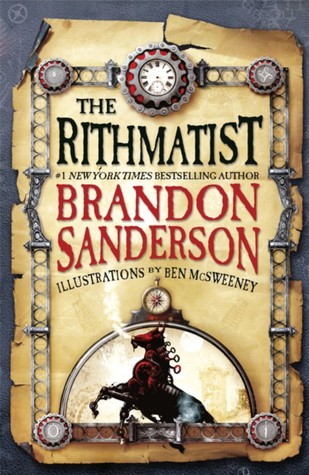
10137823Title: The Rithmatist
Author: Brandon Sanderson
Published: 2013
Length: 378 pages

What it’s about (synopsis via Goodreads):

The Rithmatist, Brandon Sanderson’s New York Times bestselling epic teen adventure is now available in paperback.

More than anything, Joel wants to be a Rithmatist. Rithmatists have the power to infuse life into two-dimensional figures known as Chalklings. Rithmatists are humanity’s only defense against the Wild Chalklings. Having nearly overrun the territory of Nebrask, the Wild Chalklings now threaten all of the American Isles.

As the son of a lowly chalkmaker at Armedius Academy, Joel can only watch as Rithmatist students learn the magical art that he would do anything to practice. Then students start disappearing—kidnapped from their rooms at night, leaving trails of blood. Assigned to help the professor who is investigating the crimes, Joel and his friend Melody find themselves on the trail of an unexpected discovery—one that will change Rithmatics—and their world—forever.

How I got it:

I bought it after reading a bunch of positive reviews, thinking it might be something that would be good to read with my son.

When I got it:

A year or two ago.

Why I want to read it:

It just sounds so clever and different! Plus, by now, I’ve seen some book friends posting enthusiastic reviews, and I feel like I’m missing out. I don’t think my son is particularly interested, but I guess that just means I should go ahead and read it on my own.

__________________________________

Want to participate in Shelf Control? Here’s how:

  • Write a blog post about a book that you own that you haven’t read yet.
  • Add your link below!
  • And if you’d be so kind, I’d appreciate a link back from your own post.
  • Check out other posts, and have fun!

For more on why I’ve started Shelf Control, check out my introductory post here, or read all about my out-of-control book inventory, here.

And if you’d like to post a Shelf Control button on your own blog, here’s an image to download (with my gratitude, of course!):

Shelf Control

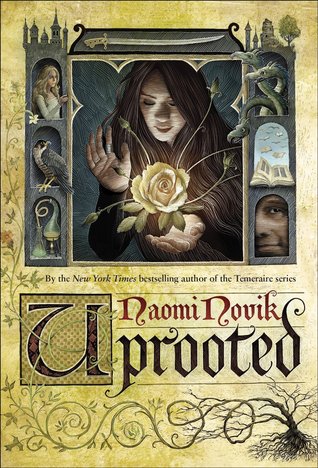
Audiobook Review: Uprooted by Naomi Novik

Uprooted“Our Dragon doesn’t eat the girls he takes, no matter what stories they tell outside our valley. We hear them sometimes, from travelers passing through. They talk as though we were doing human sacrifice, and he were a real dragon. Of course that’s not true: he may be a wizard and immortal, but he’s still a man, and our fathers would band together and kill him if he wanted to eat one of us every ten years. He protects us against the Wood, and we’re grateful, but not that grateful.”

Agnieszka loves her valley home, her quiet village, the forests and the bright shining river. But the corrupted Wood stands on the border, full of malevolent power, and its shadow lies over her life.

Her people rely on the cold, driven wizard known only as the Dragon to keep its powers at bay. But he demands a terrible price for his help: one young woman handed over to serve him for ten years, a fate almost as terrible as falling to the Wood.

The next choosing is fast approaching, and Agnieszka is afraid. She knows—everyone knows—that the Dragon will take Kasia: beautiful, graceful, brave Kasia, all the things Agnieszka isn’t, and her dearest friend in the world. And there is no way to save her.

But Agnieszka fears the wrong things. For when the Dragon comes, it is not Kasia he will choose.


This tale of magic and love is infused with an old-world fairy tale sensibility, and the entire experience is truly special.

Agnieszka is a simple village girl, but she’s well aware of the danger of the Wood. When she is chosen by the Dragon to be the next girl to be kept in his tower, she’s startled and resentful, and feels completely out of place. She’s always messy, unable to get through an hour without ripping her dress, snarling her hair, and coming out stained and mussed. This irks the fastidious Dragon no end. But as she spends time with him, Agnieszka slowly comes to realize that she has magic of her own — not the formal, “scientific” magic of the Dragon, but something uniquely hers, rooted in her beloved Valley and infused with the power of the earth, water, and sky around her, much like her inspiration, the legendary Baba Yaga.

Little by little, Agnieszka and the Dragon discover an ability to work together and combine their magic into something that’s greater than either can do on their own. Before they can get too far with their discovery, though, disaster strikes as Kasia is taken by the Wood, and it’s up to Agnieszka to find a way to reclaim her best friend before she’s consumed by corruption.

The Wood stared back at me out of Kasia’s face: an endless depth of rustling leaves, whispering hatred and longing and rage. But the Dragon paused; my hand had clenched on his. Kasia was there, too. Kasia was there. I could see her, lost and wandering in that dark forest, her hands groping ahead of her, her eyes staring without seeing as she flinched away from branches that slapped in her face, thorns that drank blood from deep scratches on her arms. She didn’t even know she wasn’t in the Wood anymore. She was still trapped, while the Wood tore at her little by little, drinking up her misery.

The stakes build and build throughout the story, as the entire kingdom is plunged into strife and ultimately war as the Wood’s influence extends to the capitol city and threatens the world beyond as well. Agnieszka and the Dragon have to lead the fight against the Wood, but more than that, they have to find a way to get to the source of the Wood’s malignant power if their home and their people are to survive.

Uprooted is a captivating tale, start to finish. Agnieszka is an unusual main character — strong willed, able to stand up for herself, and devoted to those she loves. It’s thrilling to see her develop from a young, unskilled girl full of self-doubt into a talented, capable, strong woman. She thinks on her feet, defies authority when she knows she needs to, and devotes herself to figuring out what’s right and what’s wrong.

The evil of the Wood is terrifying. At times, all seems lost. The descriptions of the Wood’s poisonous intent and seemingly undefeatable power are scary and haunting, creating a mood of despair and horror.

The story culminates with a battle between good and evil, but even there, there are nuances and shades of grey. There’s a deeply affecting story beneath the Wood’s awful terror, and Agnieszka has the wisdom to understand that finding out the past is the only way to see a path toward the future.

The language and imagery of the story is beautiful, especially Agnieszka’s growing magical powers and the descriptions of her spell-weaving and enchantments.

And what’s a good fantasy without a love story? The love story in Uprooted is mostly a quiet thread woven throughout the greater tale of good and evil, malice and redemption — but when it comes to a boiling point, it’s steamy and sexy in all the right ways.

I listened to the audiobook of Uprooted, which was both a great and frustrating experience. The narrator, Julia Emelin, is not (as far as I could tell) a native English speaker. Her Russian accent was an irritant at the beginning, as I found some of her phrasing and rhythm slightly odd and off-putting. But, as I got more into the story, I started to find the narrator’s accent a plus. The people and place names in Uprooted are all Polish and Russian-flavored (Dvernik, Marek, Rosya, Alosha, Marisha), and the voice of the narrator became, for me, yet another piece of the whole, creating a mood that felt magical and outside of the everyday.

As to why the audiobook was frustrating: If I’d had a physical copy of this book in my hands, there’s no doubt that I would have binge-read until all hours of the morning. Uprooted is the kind of story that I’d normally gobble up as quickly as possible. It was so difficult to go at the speed of the recording. I ended up listening in 1.25x speed, because I didn’t have the patience to listen at normal speed, but even so, I was so caught up in the story that I couldn’t wait to keep going. I came close a few times to switching over to a hard copy, but by then, I was under the spell of the narrator’s voice and didn’t want to lose the mood created by the audio, which made me feel as though I was listening to Agnieszka telling her own tale.

Ultimately, listening to Uprooted was a magical experience. The story itself is gorgeous, and the audiobook’s rhythms add to the total effect. I loved the narrative, the characters, and the folktale feel of the book, and know that it’s one I’ll want to read again… and perhaps again after that.

_________________________________________

The details:

Title: Uprooted
Author: Naomi Novik
Narrator: Julia Emelin
Publisher: Del Ray
Publication date: May 19, 2015
Audiobook length: 17 hours, 43 minutes
Printed book length: 435 pages
Genre: Fantasy
Source: Library (Overdrive)

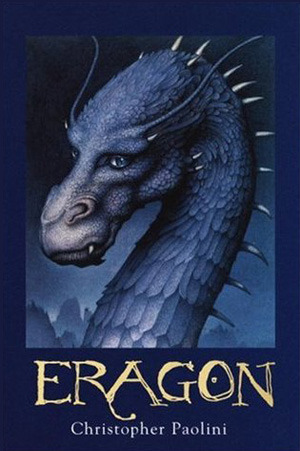
Eragon: A book with the kiddo, & a book review with a twist

EragonThis started out as a straight-forward book review, but I think it’s now turning into more of a “Choose Your Own Adventure” deal. I wrote a review. Then I thought about a completely different angle. And thought I’d include both! So, choose which version you want to read, or read both! Either way, you’ll hear my mouthy opinion, for better or for worse.

Version #1:

Eragon (book #1 of the four-part Inheritance Cycle) is a good old-fashioned epic fantasy quest, filled with dragons, monsters, good guys and bad guys, swords with names, wise old mentors, and one very special young man who spends the book discovering that he may in fact be the Chosen One.

I’ve always enjoyed reading with my son, and now that he’s 12, our reading time has changed. We still hang out and read together, but we’re often looking for books that we can read in parallel, then chat about for a while. Eragon is LONG book, well over 500 pages in our paperback copy, and I’d say it took us close to five months to get through the whole thing. Because I wanted this to be a shared experience, I did not read ahead — and when we had days or even weeks when my kiddo was distracted or just not into it, we both went without.

Consequently, I think, my enjoyment of the story was already a bit lower than it might have been if I’d just read straight through. More on this later.

In terms of plot, Eragon more or less follows along well-trodden paths. We start with 15-year-old Eragon as an ordinary boy, being raised by his uncle on a simple farm. When Eragon finds a dragon egg, it sets in motion a series of life-changing events, some tragic, some full of promise.

When the egg finally hatches, out comes a cute baby dragon with whom Eragon immediately bonds. The two share a psychic link, and Eragon discovers that her name is Saphira, and that they can have full conversations in their heads. But there are dangerous foes who want the dragon too, and when Eragon’s uncle is brutally murdered, Eragon and Saphira flee for their lives, along with the town storyteller, an old man named Brom who has plenty of secrets and wisdom to share with Eragon.

There’s a road trip of sorts, as Ergaon, Saphira and Brom chase the bad guys who killed the uncle. More than that, though, Brom starts to teach Eragon about his true heritage and calling: Eragon is a Dragon Rider, one of an ancient line with magical powers, thought to be more or less extinct. The evil king Galbatorix would surely kill him if he could, and they spend much of the book moving from place to place, pursued by nasty creatures, always in danger, and busy making sure that Eragon is transformed from simple farm boy to magic-wielding powerhouse.

So. What did I think? Well, for starters, this is a tough book to read in small chunks. Eragon is highly detailed, and the telling of the backstory and mythology is uneven and occasionally awkward. Brom tells Eragon about the Riders and how the king became so evil in a single story, about three pages long, early on in the book — and yet this informs almost everything that comes later. Should a reader really be expected to keep all the details straight hundreds of pages later? It seems a bit daunting, especially considering that this is supposedly a kids’ book.

Reading it as I did, no more than a chapter at a time, sometimes with days in between, it was hard to maintain the flow of the story. But even so, I do think I might have felt similarly if I’d read it straight through. The chapters are long, and the entire plot is one episode of danger after another, often with very little natural flow between scenes or locations.

Much has been made of the fact that the author, Christopher Paolini, was only 15 when he wrote this book, which is utterly remarkable in terms of a teen literary phenomenon. It’s pretty mind-boggling to me that someone his age could create such a large, densely packed book. But should a book be judged by the age of its author, or on the merit of its content, plot, characters, and overall effect?

If I ignore what I know about the author, I’m less impressed. Much of the story feels derivative. Young apprentice, old mentor? Check. Newly discovered magical powers? Check. Coming of age due to the death of the hero’s family/support system? Check. Et cetera, et cetera, et cetera. Brom could be any one of a dozen or more wise, old, mysterious magical gurus from fantasy — Gandalf, Dumbledore, Obi-Wan Kenobi. There’s a magical elf girl, because of course there’s a magical elf-girl. Cities full of suspicious or untrustworthy residents. Dwarves, elves, mad kings… it’s like every fantasy epic, put into a blender and poured out into a new glass.

And then there’s the writing. Remember being in high school English classes, writing essays, and trying to use as many SAT-level words as possible in the attempt to impress your teacher with the power of your vocabulary, even if you had nothing much to say? Yeah. It’s like that. I stopped noticing quite so much after a while, but particularly early on, it’s irritating and distracting to be subjected to such overblown language constantly. The author’s approach seems to be: why use a one-syllable word when there’s a longer one that will do?

So did I enjoy Eragon? Yes and no. I enjoyed the experience of sharing it with my son, being able to talk about it with him, and seeing his less-jaded response to the plot and characters. He really liked it, which made me like it too. Left to my own devices, I’d probably say that it was at least a third longer than it needed to be, in dire need of editing, and overall a not terribly original remash of standard fantasy themes and plot elements.

Version #2:

I mentioned Obi-Wan Kenobi before, right? On further thought, a cup of tea and a shower later, I’ve started to think that the entire book of Eragon (and who knows, perhaps the rest of the Inheritance series as well) can be boiled down to “Star Wars with Dragons”.

We’ve got the story of a young man raised on a farm by his uncle. Parentage unknown. He unwittingly comes into possession of something sought after by the Empire. Agents of the Empire slaughter his uncle and destroy the farm. He has to flee. He receives a vision of a beautiful young woman who desperately needs his help. He is guided by an old man with mysterious knowledge and powers, who tells him that he himself has abilities he was unaware of, and that he belongs to a group with special abilities and — can we call magic “the force”? He begins to learn to use his powers and becomes a skilled flyer and fighter. His mentor ultimately dies, after setting the hero on his path. The hero allies himself with a rogue with a heart of gold, whose skills help him avoid capture…

Okay, it gets a bit murkier after that, since there’s no Death Star. But there is an epic battle at the end, and our hero emerges triumphantly, but with the knowledge that he needs further training in order to prepare for the challenges still to come. Which nicely sets us up for the next installment in the series.

So does this mean that Eragon’s father is really the evil king Galbatorix? It would fit. After all, Galbatorix was originally a Rider, before going mad from grief and pursuing total domination and dark powers.

Wow. Mind blown.

But do me a favor! If you’ve read the rest of the Inheritance series, don’t tell me if my Galbatorix theories are correct! I need to leave some mysteries to look forward to.

Wrapping it all up:

I tried to get my kiddo to contribute to this review, but apart from saying “it was good”, he wasn’t willing to play along. He does like my Star Wars theories! The kiddo, for all his middle-school cool, was actually pretty enthusiastic about the story, except for when it bogged down in chapters full of traveling from point A to point B to point C. He enjoyed it enough that he insisted that we start the second book, Eldest, right away… and so we have.

Sigh. We’re one chapter into Eldest so far, and I can tell we’re in for a long haul. 600+ pages! I don’t love this series so far, as you can probably tell, but it also hasn’t turned me off completely, and at this point, thanks to the kiddo, I’m involved enough to keep going. I’ve just got to see how it all works out!

And hey, who knows? Maybe there’ll be some Ewoks along the way.

_________________________________________

The details:

Title: Eragon (The Inheritance Cycle, book #1)
Author: Christopher Paolini
Publisher: Knopf Books for Young Readers
Publication date: 2002
Length: 528 pages
Genre: Fantasy (kids/teens)
Source: Purchased
 

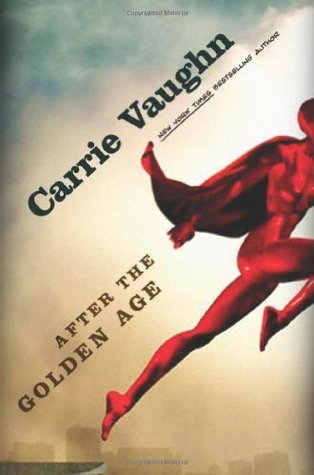
Take A Peek Book Review: After the Golden Age by Carrie Vaughn

“Take a Peek” book reviews are short and (possibly) sweet, keeping the commentary brief and providing a little peek at what the book’s about and what I thought.

After the Golden Age


Synopsis:

(via Goodreads)

Most people dream of having superheroes for parents, but not Celia West. The only daughter of Captain Olympus and Spark, the world’s greatest champions, she has no powers of her own, and the most exciting thing she’s ever done is win a silver medal in a high school swim meet. Meanwhile, she’s the favorite hostage of every crime boss and supervillain in Commerce City. She doesn’t have a code name, but if she did, it would probably be Bait Girl, the Captive Wonder.

Rejecting her famous family and its legacy, Celia has worked hard to create a life for herself beyond the shadow of their capes, becoming a skilled forensic accountant. But when her parents’ archenemy, the Destructor, faces justice in the “Trial of the Century,” Celia finds herself sucked back into the more-than-mortal world of Captain Olympus—and forced to confront a secret that she hoped would stay buried forever.

My Thoughts:

I have been meaning to read this book for over a year now, and I’m so glad that I finally did! How does an ordinary girl grow up when she has superheroes for parents? Not easily, that’s for sure. Now an adult, Celia West is finally reconciling with her parents and figuring out how she fits into their world of crime-fighting, where the city’s needs come first and Celia is always a distant second. Meanwhile, Celia’s secrets from her teen years have resurfaced in a most unpleasant way, and the consequences of this exposure are upsetting, to say the least.

After the Golden Age is much more heart-felt than I’d expected. Despite the urban fantasy setting, Celia deals with real emotions and crises, and her struggle to find her place in the world and figure out how she can possibly make peace with her parents has a universal feel to it. There’s romance, intrigue, and adventure, and despite the often desperate throes, also plenty of snarky humor. I knew I was in for a treat when, in the first chapter, Celia’s response to being kidnapped is:

Damn, not again.

I really enjoyed After the Golden Age. The fantasy elements work well as a framework, but it’s the main character and her friends and family that make the book come alive. I’m looking forward to reading the sequel!

_________________________________________

The details:

Title: After the Golden Age
Author: Carrie Vaughn
Publisher: Tor
Publication date: April 12, 2011
Length: 304 pages
Genre: Fantasy
Source: Purchased

Thursday Quotables: Eragon

quotation-marks4

Welcome back to Thursday Quotables! This weekly feature is the place to highlight a great quote, line, or passage discovered during your reading each week.  Whether it’s something funny, startling, gut-wrenching, or just really beautifully written, Thursday Quotables is where my favorite lines of the week will be, and you’re invited to join in!
Eragon

Eragon by Christopher Paolini
(published 2002)

“Before your grandfathers’ fathers were born, and yea, even before their fathers, the Dragon Riders were formed. To protect and guard was their mission, and for thousands of years they succeeded. Their prowess in battle was unmatched, for each had the strength of ten men. They were immortal unless blade or poison took them. For good only were their powers used, and under their tutelage tall cities and towers were built out of the living stone. While they kept peace, the land flourished. It was a golden time. The elves were our allies, the dwarves our friends. Wealth flowed into our cities, and men prospered. But weep… for it could not last.”

What lines made you laugh, cry, or gasp this week? Do tell!

If you’d like to participate in Thursday Quotables, it’s really simple:

  • Write a Thursday Quotables post on your blog. Try to pick something from whatever you’re reading now. And please be sure to include a link back to Bookshelf Fantasies in your post (http://www.bookshelffantasies.com), if you’d be so kind!
  • Leave your link in the comments — or, if you have a quote to share but not a blog post, you can leave your quote in the comments too!
  • Visit other linked blogs to view their Thursday Quotables, and have fun!

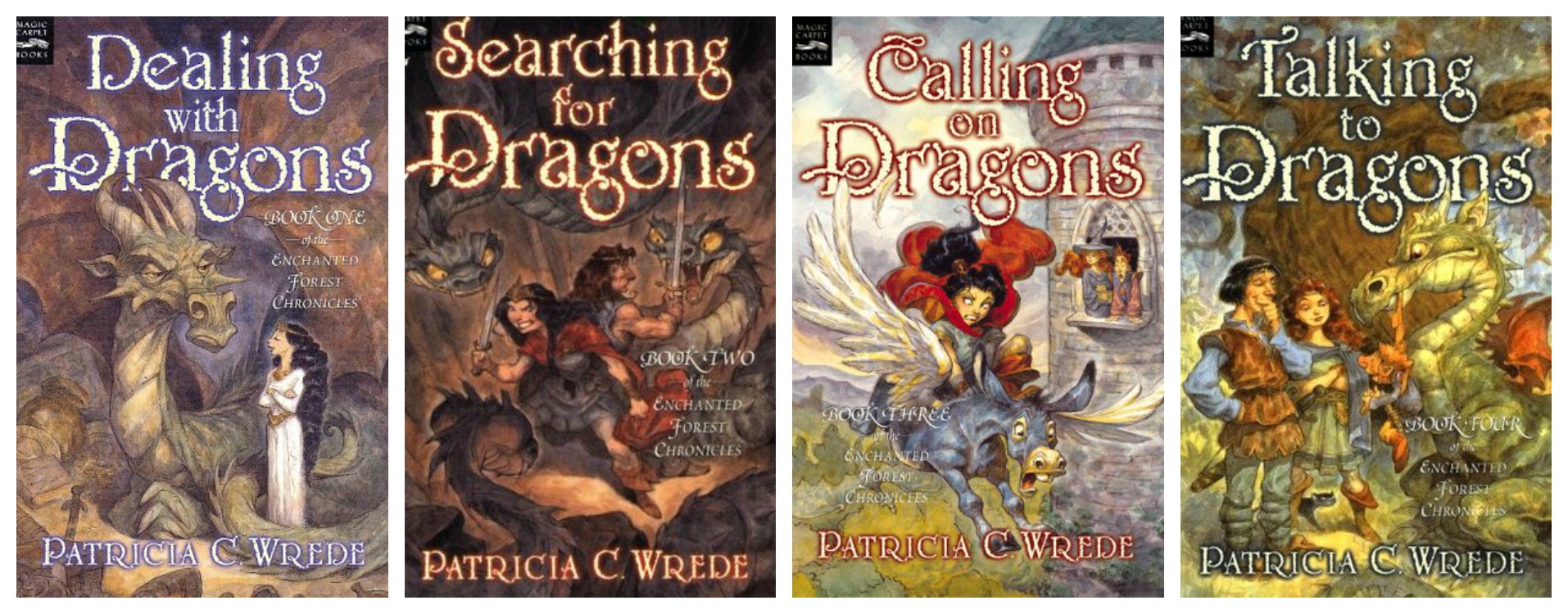
Series Wrap-Up: The Enchanted Forest Chronicles by Patricia C. Wrede

Enchanted Forest collage

The Enchanted Forest Chronicles by Patricia C. Wrede encompasses four novels set in one world — and be warned ahead of time: Your enjoyment of this series is by no means guaranteed just because you liked the first book. Each book is quite different, and that’s not necessarily a good thing.

First things first: If we were only talking about book #1, Dealing with Dragons, my enthusiasm would be much higher. In Dealing with Dragons, we meet Cimorene, a princess who doesn’t want the typical Happily Ever After with a handsome prince, fine gowns, and a kingdom to be pampered in. So Cimorene runs away and finds herself a large dragon, Kazul, who just so happens to need a princess of her own. In this world, princesses serve dragons — some willingly, some not so much — usually until they are rescued by a brave knight who comes to free them from “captivity”. Cimorene has no patience for such nonsense, and soon finds herself an indispensable assistant to Kazul, keeping house, observing dragon politics, learning about magic, and warding off dangerous wizards who want to steal the dragon’s magic. The book breaks gender roles in all sorts of interesting and unusual ways; my favorite is that the leader of the dragons is called King, which denotes a position, not a person. Kazul is a female dragon, but is still able to vie for the position of King…. and woe to anyone who mistakenly refers to her as the Queen.

Unfortunately, in my view, the focus shifts from book to book. Dealing with Dragons is the only book of the series I rated as 5 stars on Goodreads. I loved Cimorene’s courage and brains, the clever wordplay, and the way Cimorene defies expectations to become the person she wants to be. But suddenly, in book #2 (Searching for Dragons), Cimorene is a supporting player, and instead, the story is told from the point of view of Mendanbar, the reluctant king of the Enchanted Forest. Mendanbar’s story intersects with Cimorene’s as they go on a quest together to find out who is draining magic out of the Enchanted Forest and to rescue the kidnapped Kazul. Mendanbar and Cimorene have good chemistry, and Mendanbar is a fine leading man, but unfortunately, the zippiness of Cimorene’s grrrl power is a bit more subdued here.

In Book #3 (Calling on Dragons), we barely see our familiar characters at all, as the focus shifts once again, this time to the witch Morwen, a supporting player in the earlier books. I came close to abandoning the series altogether early on in this book. True confession: I have a dislike for talking animals, particularly when there’s an overabundance of them — and this book has more than enough to go around. Within the first few chapters, we meet all twelve of Morwen’s cats, each of whom has a name and a distinct personality and contributes to conversation, as well as a bewitched bunny named Killer who transforms first into a six-foot-tall bunny and eventually into a blue, winged, flying donkey. Killer is meant to be the comic relief, but is more annoying than funny most of the time. There’s a quest and an adventure that ends up involving Cimorene and Mendanbar, but they’re quite peripheral. The magical adventure aspects of the book become more enjoyable by the end, but there’s a lot of space taken up by new characters, odd magical rules, and never-ending journeying.

And then we come to the final book, Talking to Dragons, in which there’s a brand-new main character, Daystar, who must travel into the Enchanted Forest and figure out for himself what the purpose of his quest is. There he meets a temperamental young fire-witch named Shiara — clearly there as his love interest — and encounters talking lizards, elves, dragons, and dwarves before arriving at a climactic battle scene. I won’t tell you how Daystar’s story intersects with the characters from the earlier books (spoilers!), but they are all connected and come together for an exciting and satisfying conclusion.

As a series, the Enchanted Forest Chronicles feels a bit disjointed. The shift in main characters from book to book didn’t really appeal to  me. I suppose the intent is to broaden the scope of the world of the Enchanted Forest, but in my opinion, Cimorene and Kazul are the most interesting characters — and once they leave center stage, the story loses some of its charm. I was never bored exactly (although I was awfully close during the talking cat chapters), but I did find my attention wandering from time to time, and I found it a challenge to get into each new book, where we readers are required to leave behind the characters we’ve become fond of and start fresh with with a whole bunch of new ones.

All that said, let me now point out that I read this series in partnership with my 12-year-old son — and from that regard, I’d say the series was a success. My kiddo is a very reluctant reader, and so to encourage him, we read these books in tandem. He enjoyed the stories quite a bit, liked the action sequences involving dragons and wizards especially, and liked that there were plenty of funny scenes, humorous dialogue, and even some hints of danger (nothing too life-threatening, but still risky business).

Bottom line: While the Enchanted Forest Chronicles doesn’t strike me as strong enough to really hold adult attention, I do think it’s a great choice for middle grade readers, either to read on their own or as a very fun parent-kiddo reading partnership. And as an alternative for those who aren’t looking for a multi-book series or don’t like the sound of the focus changing from book to book, I think Dealing with Dragons would work perfectly well as a stand-alone. As the best of the bunch, it’s certainly a great read — and maybe if I’d stopped there, I’d have avoided the frustrations I had with the subsequent books.

Wishing & Waiting on Wednesday: The Mermaid’s Child

There’s nothing like a Wednesday for thinking about the books we want to read! My Wishing & Waiting on Wednesday post is linking up with two fabulous book memes, Wishlist Wednesday (hosted by Pen to Paper) and Waiting on Wednesday (hosted by Breaking the Spine).

This week’s pick:

mermaid's child

The Mermaid’s Child by Jo Baker
(to be released March 17, 2015 )

A fairy tale for grown ups—the magical story of a young girl in search of her mermaid mother, from the acclaimed author of Longbourn.

Malin has always felt different. The fact that, according to her father, her absent mother was actually a mermaid only makes matters worse. When Malin’s father dies, leaving her alone in the world, her choice is clear: stay, and never feel at home, or leave and go in search of the fantastical inheritance she is certain awaits her. Apprenticed to a series of strange and wonderful characters, Malin embarks on a picaresque journey that crosses oceans and continents—from the high seas to desert plains, from slavery to the circus—and leads to a discovery that is the last thing Malin ever could have expected. Beautifully written and hauntingly strange, The Mermaid’s Child is a remarkable piece of storytelling, and an utterly unique work of fantasy.

The marketing notes for this book describe it as “Fantasy for adults: The Mermaid’s Child is that rare thing, a work of fantasy writing that is aimed at adults. It is sure to appeal to readers of Philip Pullman, and fans of Susanna Clarke’s Jonathan Strange & Mr. Norrell and Doug Dorst’s S.” Works for me! This book was originally published in the UK in 2004, but following the success of Longbourn, The Mermaid’s Child is getting its first US release.

I really loved Longbourn, and I’m eager to read more by this talented author!

What are you wishing for this Wednesday?

Looking for some bookish fun on Thursdays? Come join me for my regular weekly feature, Thursday Quotables. You can find out more here — come play!

♥♥♥♥♥♥♥♥

Do you host a book blog meme? Do you participate in a meme that you really, really love? I’m building a Book Blog Meme Directory, and need your help! If you know of a great meme to include — or if you host one yourself — please drop me a note on my Contact page and I’ll be sure to add your info!

Flashback Friday REWIND: Nine Princes in Amber

ffbutton2Flashback Friday is a weekly tradition started here at Bookshelf Fantasies, focusing on showing some love for the older books in our lives and on our shelves. If you’d like to join in, just pick a book published at least five years ago, post your Flashback Friday pick on your blog, and let us all know about that special book from your reading past and why it matters to you. Don’t forget to link up!

I’ll be traveling for a few weeks during the month of June, so rather than skipping Flashback Friday,  I thought I’d dig back into my FF archives and revisit some of my very first flashback books.

Going way back for this week’s Flashback Friday:

Nine Princes In Amber by Roger Zelazny

(published 1970)

Roger Zelazny’s Amber Chronicles simply astounded me when I first encountered them quite a while back (no, I will not disclose just how many decades ago that was or how old I was — suffice it to say that I was vibrant and youthful and wore clothes that my children would mock). These books were among my early forays into the world of science fiction and fantasy, an area of my reading history that was sorely lacking during my childhood and youth. I admit it now: I’d never read Narnia, had read The Hobbit but no other Tolkien (horrors! I’m ashamed of my younger self!), and had only recently been introduced to Dune. And then I met Amber, and it rocked my world.

From Goodreads:

Amber, the one real world, wherein all others, including our own Earth, are but Shadows. Amber burns in Corwin’s blood. Exiled on Shadow Earth for centuries, the prince is about to return to Amber to make a mad and desperate rush upon the throne. From Arden to the blood-slippery Stairway into the Sea, the air is electrified with the powers of Eric, Random, Bleys, Caine, and all the princes of Amber whom Corwin must overcome. Yet, his savage path is blocked and guarded by eerie structures beyond imaging impossible realities forged by demonic assassins and staggering horrors to challenge the might of Corwin’s superhuman fury.

I barely remember the details, but I do know that I loved this book and the ones that followed. The Amber Chronicles consist of ten books in all, although I believe I only made it through 6 or 7 of them. (Hey, it was the 80s — I was busy!). Still, I know I fell in love with the concept of the shadow worlds, the battle for the throne, and the labyrinth-like Pattern that the royal family members must walk in order to gain access to other worlds. It was epic and dramatic high fantasy, and I’d never encountered anything quite like it before.

Last year at a book sale, I picked up an all-in-one volume of the entire Amber Chronicles, and it’s been sitting on my shelf ever since. Maybe it’s time to dust it off and give it a whirl. It’s entirely possible that it will feel incredibly dated at this point — but somehow, I have a feeling that I’ll be drawn into Corwin’s story once again and won’t be able to let go until I reach the end.

If you’re a fan of today’s bestselling fantasy series, such as George R. R. Martin’s A Song of Ice and Fire or Patrick Rothfuss’s The Kingkiller Chronicle, why not go back in time and give Amber a try?


Thanks for sticking with me for three weeks of FLASHBACK FRIDAY REWIND! As of next week, I’ll be back with fresh picks for Flashback Friday.

What flashback book is on your mind this week?

Note from your friendly Bookshelf Fantasies host: To join in the Flashback Friday fun:

  • Grab the Flashback Friday button
  • Post your own Flashback Friday entry on your blog (and mention Bookshelf Fantasies as the host of the meme, if you please!)
  • Leave your link in the comments below
  • Check out other FF posts… and discover some terrific hidden gems to add to your TBR piles!

♥♥♥♥♥♥♥♥

Do you host a book blog meme? Do you participate in a meme that you really, really love? I’m building a Book Blog Meme Directory, and need your help! If you know of a great meme to include — or if you host one yourself — please drop me a note on my Contact page and I’ll be sure to add your info!

Book Review: Cruel Beauty by Rosamund Hodge

Book Review: Cruel Beauty by Rosamund Hodge

Cruel BeautyWhat do you get when you put Beauty and the Beast, Bluebeard, and Greek mythology in a blender?

Probably something that looks a lot like Cruel Beauty!

In this new YA fantasy novel, 17-year-old Nyx is doomed to marry the demon who rules her land, as the price due for a bargain her father made before her birth. Nyx has spent her whole life dreading and preparing for her fate, filled with anger at her father for sacrificing her so easily and filled with dismay, knowing that she has no chance of surviving. Nyx’s purpose is not just to wed the ruler, but to bring about his destruction, in order to free her people and avenge her mother’s death.

Easier said than done. When Nyx finally arrives at the ruined castle, she meets her new husband — incredibly handsome, of course — as well as the shadow servant, Shade, who is forced to obey but seems to be on her side. Secrets abound, and Nyx realizes that her task will be even harder than she imagined… especially when her hatred for her husband and captor starts turning into something else.

In Cruel Beauty, there’s a whole mish-mosh of fairy tale and mythology stirred together. The land of Arcadia worships the Greek gods, and their stories and curses inform the actions of Nyx and the rest of the characters. The main tale of the girl promised to the hideous creature and then falling in love is straight out of Beauty and the Beast, although twisted and turned quite a bit along the way. There’s a magical system as well, as Hermetic works (related to the god Hermes) are what allow people to harness the elements of air, earth, fire, and water.

So does it all work? For the most part, I’d say yes. The plot gets overly complicated with so many different fantastical and mythological sources contributing to the mix. The Hermetic concepts take up space and seem to be very important early on — but don’t really matter much by the end of the story. There’s magic and dark spirits and curses and bargains… and the plot ends up practically tying itself into knots to make it all connect and work out in the end.

But, despite the convoluted story line, I enjoyed Cruel Beauty quite a bit. I think it helps that I read it straight through, all in one day. Yes, it’s that compelling — one of those books where you vow to stop after one more chapter… and suddenly an hour or two have slipped by. If I’d read it in smaller chunks or over the course of a week, maybe I would have taken more time to think about the plot developments and poke holes at certain pieces. But gobbling it up all at once, nothing bothered me too much…

Because wow. That’s some love story! Nyx and her captor do a slow burn, gradually moving from mistrust and outright dislike to grudging respect and amusement, and finally, kindness and affection — despite Nyx’s horrible sense that she betrays her family and her people by feeling anything for this strange and seemingly cruel man. Their passion is palpable, and feels like the kind of epic love that can make someone risk eternal suffering for the sake of the other.

Oh, and can we just take a minute to gaze at that cover? Gorgeous.

Overall, Cruel Beauty is probably over-plotted, but it’s a thrilling and oddly moving narrative none the less. If you enjoy fairy tale retellings, magical worlds, and dark secrets, this is one new release that you shouldn’t miss.

_________________________________________

The details:

Title: Cruel Beauty
Author: Rosamund Hodge
Publisher: Balzer + Bray
Publication date: January 28, 2014
Length: 352 pages
Genre: Young adult fantasy
Source: Review copy courtesy of Balzer + Bray via Edelweiss