Armchair BEA: Children’s Literature

Today’s Armchair BEA topic is Children’s Literature:

From picture books to middle grade to young adult novels, this is a category that encompasses books that young and old alike flock to on a daily basis.

As a reader and as a mom, I love children’s books. When my kids were little, we had piles and piles of board books in every nook and cranny of the house. As they got older, we’d hit the library each weekend and come home with armloads of picture books. Older still, we moved on to chapter books and kids’ non-fiction books on topics as varied as jellyfish, how to build a castle, and what life is like on the International Space Station.

Now that my little guy is not so little any more (just graduated from elementary school!), his tastes have matured as well. We still read out loud together at night, although I’m guessing that he’ll tell me he’s too old for it in the not-so-distant future. Meanwhile, I’m enjoying it while I can. I love revisiting old favorites and discovering new and amazing authors and titles, and I love even more seeing my son get excited by a new book or be filled with wonder as we explore magical lands.

I think of all the books we’ve read, the best reading experiences for both of us have involved books about magical worlds. This is just my opinion, of course, but I do believe that children who are exposed to the wonders of fantasy through fiction grow up to appreciate a much broader scope of literary genres and imaginative flights of fancy. My personal favorites include:

  • The Harry Potter series. I’ve read it countless times on my own, and most recently read the entire series out loud (!) to my son over the course of a 10-month period. Amazing experience.
  • Narnia. I missed out on these books as a child, but I’m now reading these with my son and finding so much to love.
  • The Golden Compass (His Dark Materials series) by Philip Pullman.
  • Half Magic and Knight’s Castle by Edward Eager. Or really, anything by Edward Eager.
  • A Wrinkle in Time.
  • The Lioness Quartet by Tamora Pierce. For slightly older girls, especially, a fantastic series with an unbeatable girl power message.

I don’t think I’ll ever get tired of reading good quality children’s literature, even when my son is too old and too cool to have his mom read to him any longer. There’s something so lovely about these books — the ability to dream, to take chances, to imagine, to believe.

So yes, I read children’s books, I review children’s books, and I love children’s books!


Book Review: Twerp by Mark Goldblatt

Book Review: Twerp by Mark Goldblatt

Twerp

In Twerp, a children’s book aimed at middle-grade readers, life is full of friends, fun, hard choices, and consequences. Main character Julian Twerski, age 12, lives in a close-knit Queens neighborhood in 1969. His best buddies are the guys from the block, and their favorite hangout is the vacant lot which they dub Ponzini. Back in Ponzini, they kid around, goof off, and get into all sorts of mischief, big and small. But when a seemingly harmless prank goes wrong, the six boys get a week’s suspension from school. In the aftermath, Julian makes a deal with his English teacher: He’ll write a journal about what happened, and in exchange, he gets out of having to read Julius Caesar.

And boy, does Julian want to get out of reading Julius Caesar:

So when I say I hate Shakespeare, I mean it. Lots of guys say they hate him, and what they mean is they hate the stuff he writes. But I don’t only hate the stuff he writes. I hate Shakespeare for writing the stuff. I hate the guy, William Shakespeare. If I met him on the street, I’d just keep walking. Because you know, you just know, while he was writing the stuff he was writing, he was thinking how clever he was. He was sitting at his desk, writing the words, and he could’ve just said what he  meant, but instead he prettied it up until it could mean everything or it could mean nothing or it could mean whatever the teacher says it means. That just drives me bananas. So if keeping this thing going gets me out of Julius Caesar, then count me in.

Twerp is Julian’s journal, in which he writes with a clear-eyed honesty about friendship, hopes, girls, doing favors, and all the everyday worries that come with being a sixth-grader. In Julian’s world, being loyal to friends is probably the most important thing of all, and his best friend Lonnie is a gem of a guy — totally loyal, incredibly funny, and with a big heart and tons of charisma. The ups and downs of their friendship include a fiasco over a girl (of course), an all-important track and field competition, and a long-delayed reckoning for their misdeeds and suspension.

Through it all, we see Julian contemplate the big picture. Where does he fit in — at school, in the neighborhood, in life? What does it mean to have good intentions? And are good intentions enough, if people end up hurt anyway?

Twerp is both a lovely nostaglic look at a time gone by and an ageless peek into the heart and mind of a boy figuring out what it takes to grow up into a decent sort of person. Author Mark Goldblatt captures the feel of a Queens neighborhood, with the boys hanging out on the stoops, wandering the blocks, knowing all the characters of their own small world. The boys and their parents fully inhabit this time and place, and readers are treated to a sweet-tasting view of boyhood. It’s a time before electronic gadgets and distractions, so fun is found in climbing walls, playing cards, chasing balls, creating diversions.

At the same time, by looking into Julian’s thoughts, we see a boy with a good heart who takes seriously the question of how to be a good person. He makes mistakes, it’s true, but through his journal, he comes to see the how and why of his mistakes and to understand what it takes to do the right thing. Julian is clearly a very smart boy, and his gift with words and his speed on the school track help ensure his success at school, both with teachers and with other kids. As the book progresses, we see Julian work through his guilt over his role in the event that got him suspended and ultimately take ownership for what he did and what he still must do in order to move on.

Perhaps that makes Twerp sound a bit preachy, and that’s not at all the case. Julian’s voice is light and often funny, and it never feels like a stretch to imagine that we’re really reading the words of a 12-year-old. The book flows smoothly, and the writing hits just the right mix of childish obstinance and adolescent insight.

Julian and his friends have an easy camaraderie and a sense of glee, which makes them quite fun to spend time with through the pages of Twerp. Twerp may not fit the popular mold of middle-grade books filled with secret worlds, mythological beings, and superpowers, but it’s a book that I could easily see a smart, eager reader enjoying quite a bit. No gimmicks and nothing flashy here — just a good, honest story of a boy, his friends, and his world. It may be a world that seems old-fashioned to a kid of today, but the underlying messages about friendship and doing what’s right are timeless.

Review copy courtesy of Random House via NetGalley.

Q&A with the kiddo: A kid’s-eye view of The Magician’s Nephew by C. S. Lewis

Book Review: The Magician’s Nephew by C. S. Lewis

The Magician's Nephew (The Chronicles of Narnia, #6)

Proudly presenting Q&A with the kiddo, courtesy of my 10-year-old son, in which I ask my kiddo to describe a book he’s enjoyed recently and he gives his opinions, more or less unfiltered by mom.

Without further ado:

Q: What book do you want to talk about?

A: The Magician’s Nephew

Q: What was it about?

A: It was about these kids . They were friends, and the boy’s uncle was a magician, and they got sent to another world. They went into two different worlds. In one there was an evil queen who took over and then tried to take over Earth. Then they teleported into soon-to-be Narnia. There was a lion that was singing and made Narnia. His name was Aslan. Everything they buried turned into a tree. He gave speech to the chosen animals and the especially chosen of the chosen animals were in the high council. The boy and the girl eventually get back to their own world.

Q: Who was your favorite character?

A: Fledge, who is basically a Pegasus, a horse with wings. And King Frank, because his name is weird.

Q: What was the best part?

A: My favorite part was when they planted toffee candy and it grew into a toffee tree. I wonder if you dropped a part of a refrigerator on the ground, would there be a refrigerator tree?

Q: Would you recommend this book?

A: Yes. I’d recommend it for people who like Harry Potter, adventure stories, and talking animals.

Q: Do you want to read the rest of the series?

A: Yes! I want to read the rest of the  Narnia books.

Mom’s two cents:

Somehow, I made it through childhood without ever reading any of the Narnia books. Even as an adult — and a big fan of fantasy writing — I never got around to Narnia until my daughter was old enough for The Lion, The Witch, and The Wardrobe, which we read together many years ago. Neither of us ended up pursuing the rest of the series, and it wasn’t until last month when my son came up with the idea of checking out Narnia that I came back to these books.*

*Although there have been several Narnia movies released in the last few years, neither of us has seen them, so we approached reading the books from scratch.

I decided that we should read the books not in publication order, but in the order which author C. S. Lewis later said was his preferred reading chronology — which meant starting with The Magician’s Nephew.

So what did I think? This rather slight book was actually quite fun. The story is rather simple: Neighbors Polly and Digory, looking for adventure, stumble upon the secret room of Digory’s uncle Alexander, who has been working to become a skilled magician all his life. Through Alexander, the children come into possession of magical rings which transport them from their own world into other worlds. They have the misfortune of awakening an evil witch, who follows them home to London for starters, then onward to a brand new planet just in time to see the mighty lion Aslan create all life in this beautiful new world. Digory is responsible for bringing evil into this new world, via the witch, and so must make amends by performing a special quest for Aslan in order to prove his worth.

It’s all quite lovely, with bits of humor and silly adventure, as well as much heavier moments of pondering the nature of good and evil. I liked very much how the story lays the foundation for The Lion, The Witch, and The Wardrobe. I think one of the reasons I avoided reading the Narnia series all these years is because of the religious allegory woven into the story. For The Magician’s Nephew, at least, I chose to willfully ignore those parts (the creation myth, the Garden of Eden, the fruit of the tree of knowledge, etc) and just focus on the fantasy — in essence, try to read it from the same perspective as my son.

As a book to read together, The Magician’s Nephew worked very well, and we both enjoyed the story quite a bit. We laughed at the funnier parts, we peeked ahead when a chapter ended with a cliffhanger. I asked my son whether he would have wanted to read this one on his own. His response was that while he liked the story quite a bit, he didn’t think he would have wanted to deal with the “old-fashioned” words that he was unfamiliar with throughout the story (“hansom-cab”, “frockcoat”, and the exclamation, “Well don’t keep on gassing about it!”, for example).

We’re moving right into The Lion, The Witch, and The Wardrobe. Narnia, ho!


A Monster Calls: Review and reflection

Book Review: A Monster Calls by Patrick Ness

What can I say about a book like this? Beautiful and awful are two words that come to mind, but neither do justice to the power of A Monster Calls.

A Monster Calls is the story of Conor O’Malley, a 13-year-old so isolated by suffering that he’s become practically invisible to the world around him. Conor’s mother has cancer, and despite her cheery reassurances, the latest round of chemo does not seem to be going well. Conor’s father departed years ago for a new life with a new wife and baby in America, and Conor lives alone with his mother in a small English town, where he attends school in a fog of despair and loneliness.

At night, though, the nightmares start. Until one night, Conor is visited by a monster — a giant creature formed from the yew tree that Conor can see from his bedroom window. The monster seems like a creature from hell, bent on destruction and threatening to eat Conor — but what it wants is a story. The monster tells Conor its conditions: The monster will tell Conor three different stories, and then it will be Conor’s turn to tell the monster a story, but it must be the truth. Conor knows which story the monster wants from him, and it’s the one thing he absolutely does not want to give voice to.

The monster isn’t all that it seems, and as the story-telling proceeds, the monster becomes the voice of reason and honesty for Conor. Through the monster, Conor is forced to confront his own rage and sorrow, the fact that belief in something — anything — matters, and the subjective nature of terms like “good” and “evil”.

The illustrations in A Monster Calls are stark and glorious. Jim Kay’s black and white inks are stunning — scary and bleak, portraying the monster as otherworldly and frightening, yet also as something natural that seems to belong in the mundane world of garden sheds, grandfather clocks, and schoolyards.

I don’t know that I can really articulate my feelings about this book without going off on a personal tangent. I know that I have certain emotional triggers in books, and A Monster Calls hits all of  the most powerful ones for me.

When I was eleven, my mother was diagnosed with breast cancer. After four years of struggle, illness, and suffering, she died at the young age of forty-four. I was fifteen at the time, and although many years have passed and for the most part I don’t actively think about those years any longer, the emotions still lurk below the surface, never far away. Reading A Monster Calls brought my experiences from those years right back to me.

Conor is overwhelmed by rage — a rage that literally destroys whatever is in its path. All-consuming too is his guilt, a guilt that fuels his nightmares and drives him further and further from the people around him. He goes through the motions of a normal kid’s life, but it’s as if he’s an alien in the midst of humans. His experiences and inner life are so separate, so “other”, that it’s no wonder the kids at his school seem to see right through him. He’s scared for his mother, but he’s also scared for himself. He wants to keep her with him, but he wants her to stop suffering. He’s angry, he’s sad, and he just has no idea what to do with all of the emotions that threaten to engulf him at any second.

I get it. The scariness of watching the parent you count on turn into someone who needs protection. The helplessness of seeing a good and kind person suffer — and seeing that person worry more about her child’s well-being than her own. Being on the receiving end of well-intentioned reassurances that cannot possibly come true. It’s awful and it’s painful and it’s a reminder, especially to a child, of just how little in life can be controlled.

So yes, I read A Monster Calls and could barely breathe by the end. Reading Conor’s story was an instant and visceral reminder of my own experiences during the terrible years of my mother’s illness. The book feels real and true. It’s not a soapy melodrama, but an honest look at the messy emotions that are bundled up in loss and grief.

In spare but lovely prose, Patrick Ness captures all of this and more, and the illustrations are stunningly perfect. A Monster Calls is an award winning children’s book, geared for ages 12 and up, but it’s certainly something that adults should seek out as well.

My 10-year-old, having seen me absorbed by this book all week, has asked if I’d read it to him when I finished. I think he’s mostly fascinated by the artwork — understandably so. I hate to turn down a request for a book. As someone who always read “up” (grabbing whatever books my older sister was reading whenever she wasn’t looking), I don’t usually pay too much attention to recommended age ranges for reading materials. And yet, I don’t think my kiddo is really ready for something like this yet. It’s one thing to read about loss and grief in a fantasy setting such as Harry Potter — quite another to read about a boy going through a horrible loss in a real, recognizable world. I do think I’d like him to read A Monster Calls eventually — but perhaps in a few years, when he’s ready to read it on his own and really be prepared to think and reflect about Conor’s experiences.

According to the Author’s Note, the characters and premise of this story were created by the author Siobhan Dowd, who herself died from cancer before she was able to bring the concept to fruition. Patrick Ness was asked to take her initial concepts and turn them into a book, and he has done so in way that feels like both a beautiful achievement on its own and a lovely tribute to Siobhan Dowd. A Monster Calls is quite an accomplishment on so many levels, and all I can say is that it shouldn’t be missed.

Top Ten Tuesday: Top Ten Childhood Favorites

Top Ten Tuesday is a meme hosted by The Broke and the Bookish, featuring a different top 10 theme each week.

This week’s top ten topic is Top Ten Tuesday REWIND — pick a past topic you missed or one you want to revisit! Looking back at topics from before I found the wonderful world of Top Ten Tuesday, I decided to go with a list of the ten books (or series of books) that I remember loving the best, so long ago in the distant days of my youth…
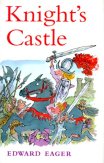
Knight's Castle

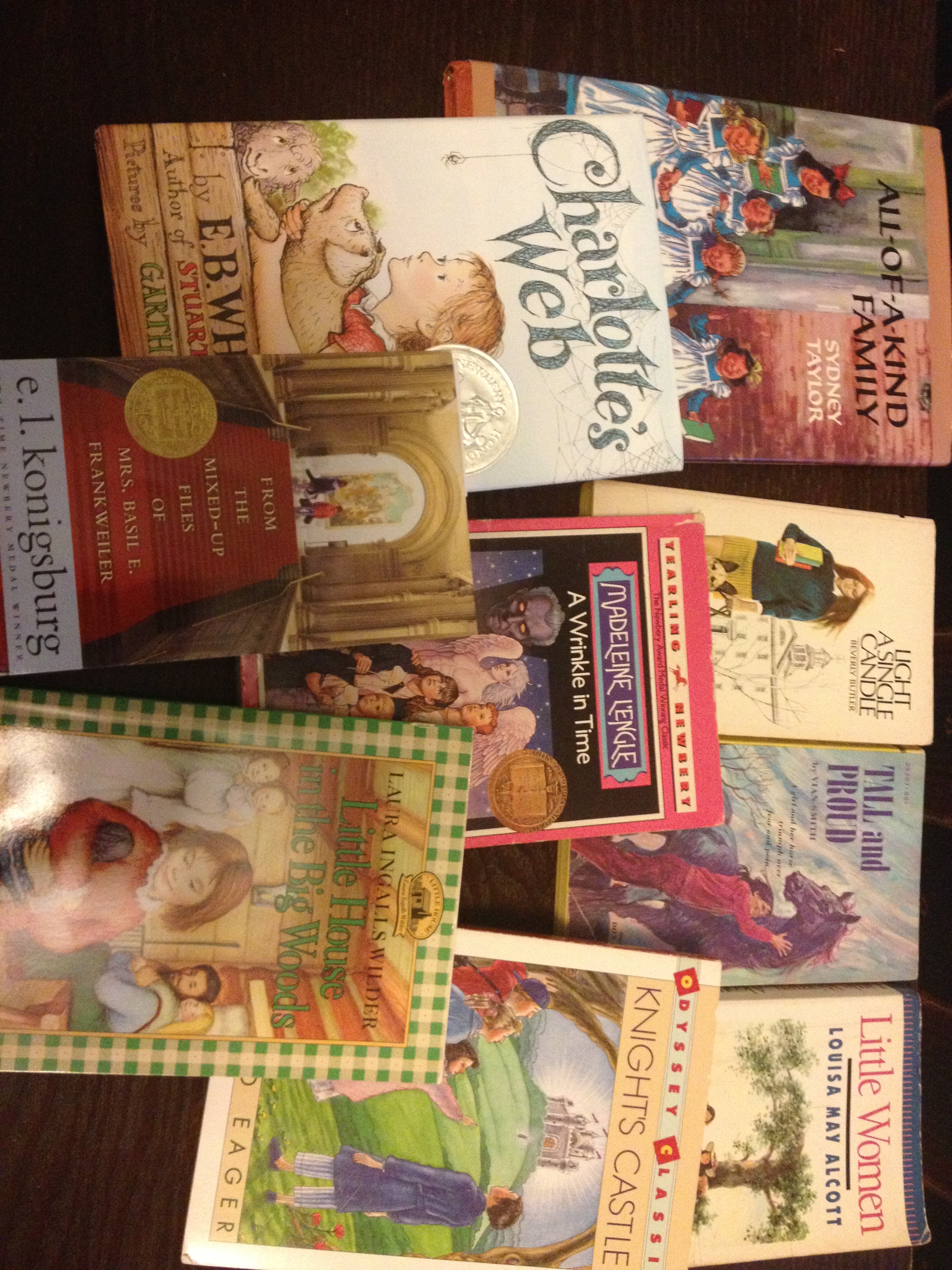
1) Little Women by Louisa May Alcott. In early readings, I wanted to be Beth (go ahead, psychoanalyze me based on that little fact!), then envied Amy her world travels, but finally came to appreciate Jo in all her prickly glory. Pop culture references to Little Women always make me happy — like when Joey read it on Friends. Classic, in so many ways.

2) A Wrinkle in Time by Madeleine L’Engle. It just never gets old. I’m trying to convince my 10-year-old to read it, mostly so I’ll have a good excuse for rereading it myself.

3) From the Mixed-Up Files of Mrs. Basil E. Frankweiler by E. L. Konigsburg. Seriously, wouldn’t you love to run away to live in a museum? This books was responsible for my mad scribblings, throughout my youth, of a whole bunch of half-written stories involving running off to exotic locations and having crazy adventures.

10 kids 1

9 of my top 10 childhood favorites — I can’t believe I still have all of these!

4) Knight’s Castle by Edward Eager. I read this book as a kid and loved it — but years later, all I could remember was that it was about kids entering into an imaginary world throught their toy castle in the playroom. I had no idea about the title or author and was never able to track it down, until my daughter came home with Half Magic by the same author, and something just clicked into place.

5) The Little House books by Laura Ingalls Wilder. I just adored these books as a kid, and didn’t know enough at the time to be bothered by some of the outdated attitudes. I loved Laura and her family, the crazy struggles for survival in harsh circumstances, and of course, the love story between Laura and Almanzo. Whoa, those blizzards! I still get cold thinking about the kids trying to get home from school during a wild snow storm. Brrrrr.

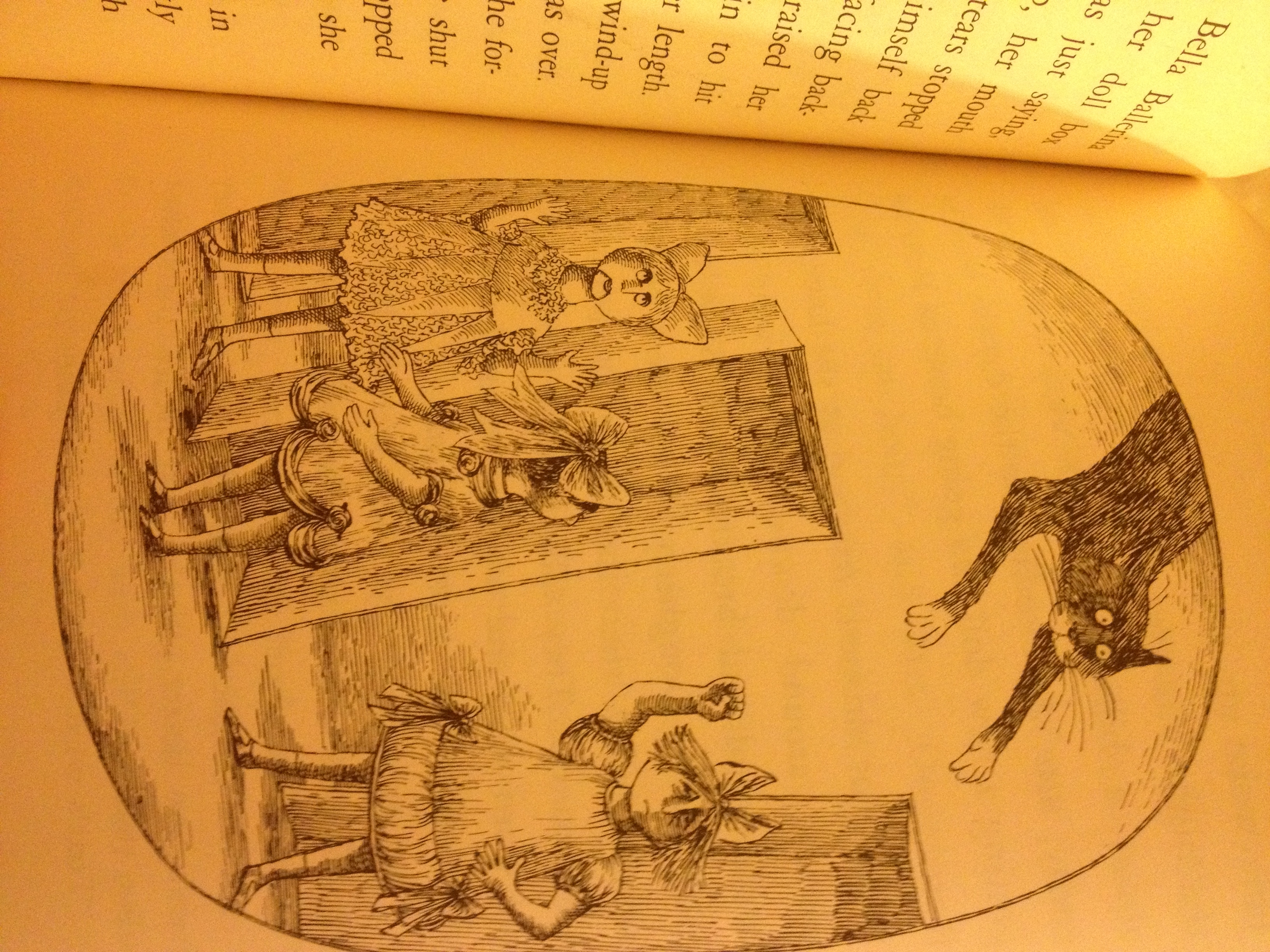
merry rose

Merry, Rose, and Christmas Tree June

6) Merry, Rose and Christmas Tree June by Doris Orgel. This story of a girl and her dolls just really stuck with me, and it wasn’t until a couple of years ago that I finally tracked down a copy. The fact that it’s illustrated by Edward Gorey just makes it even more of a win.

7) The All-of-a-Kind Family series by Sydney Taylor. My sister and I could not get enough of these books about a Jewish family living on the Lower East Side of New York in the 1920s. Inspiration for many a game of make-believe at our house — we even asked to take on dusting chores so we could play the button game. (If you’ve read the books, you’ll understand).

8) Charlotte’s Web by E. B. White. Oh, come on, admit it — you cried when you read this one, right?

9) Tall and Proud by Vian Smith. I went through a phase where I read everything I could get my hands on about horses.* The only thing better than a horse book was a book about a girl fighting a dreadful illness. So what could be better than this terrific book (out of print now, I believe) about a girl with polio who learns to walk again for the sake of her horse?

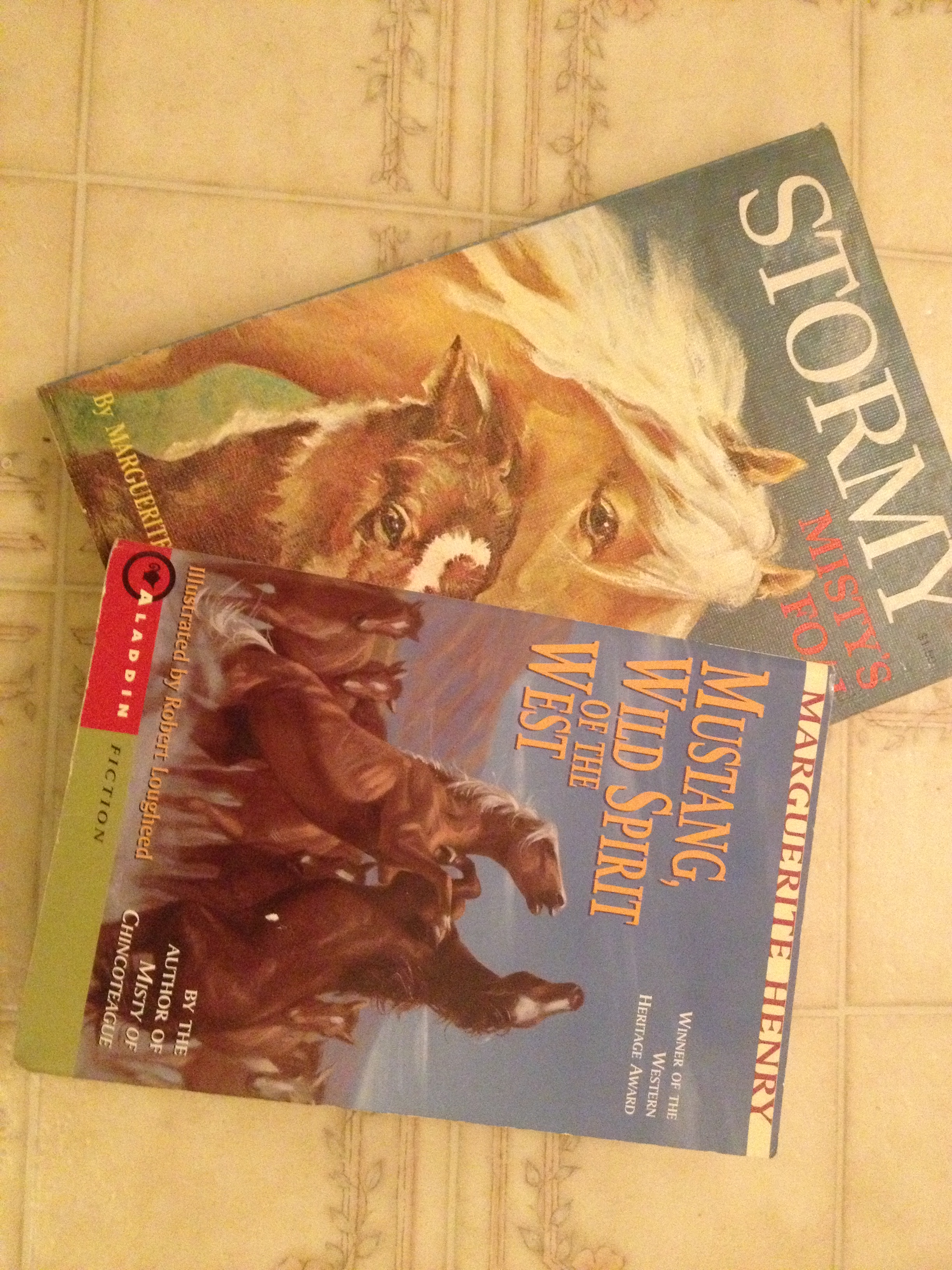
*I felt like I should only include one horse book on this list, but it was a close call — so here’s my special little shout-out to the books of Marguerite Henry, most especially, Misty of Chincoteague, Stormy: Misty’s Foal, and Mustang: Wild Spirit of the West.

mustang

Horse books!

10) Light a Single Candle by Beverly Butler. In the same spirit as #9, this book about a girl dealing with blindness really resonated with my tween-self’s love of fictional heroines bravely battling illness, disability, or some other dramatic/tragic life event.

Light a Single Candle

I didn’t think I’d come up with ten, but now that I’m on a roll, it’s hard to stop!**

**I realize that I excluded Judy Blume’s books, which should certainly be on this list — but since I did a whole post about Are You There God? It’s Me, Margaret last year, I figure I’m covered already.

What are your favorite books from childhood? Share your childhood reading memories in the comments!

Save

Book Review: Down The Mysterly River by Bill Willingham

Book Review: Down The Mysterly River by Bill Willingham; illustrated by Mark Buckingham

Down the Mysterly River is the first children’s book written by storyteller extraordinaire Bill Willingham, the man we can thank for the beyond-words-awesomeness of the Fables comic book series. Joined by illustrator Mark Buckingham, Bill Willingham has created an adventure story that’s also meta-fiction about the world of story creators, their creations, and the naysayers who try to make creative works conform to “modern” ideas of what’s in and what’s out, what’s fashionable in fiction, and what’s too old-school to be tolerated.

The story begins with Max the Wolf:

Max the Wolf was a wolf in exactly the same way that foothills are made up of real feet and a tiger shark is part tiger, which is to say, not at all.

Max is a twelve-year-old Boy Scout of the Wolf Patrol pack, who is always prepared… but is still discombobulated when he wakes up in a strange land with no idea how he got there. Besides his Boy Scout skills, Max is a gifted detective, and so he sets about solving the mystery of where he is, and more importantly, why he’s there in the first place. Max soon encounters three strange traveling companions: Banderbrock the warrior badger, Walden the brown bear, and McTavish the Monster, who is not an actual monster but rather a fiercely feral barn cat. Strangest of all is the fact that these animals can talk to Max. None of them can explain it, and none of them has any memory of how they landed in this particular place.

There’s no time to ponder, because the chase is on! A mysterious group of cloaked fighters, known as the Blue Cutters, is on their tail, and this menacing bunch means business. Their goal is to catch any and all new arrivals and to “cut” them with their powerful blue swords, so as to give them a more pleasing and appropriate shape. Once cut, the new version is unrecognizable to all, and in fact, believes him or herself to always have been as he or she is now. Naturally, Max and his gang want to avoid the Blue Cutters at all costs, and so set out to seek shelter far down the Mysterly River, where they’ve heard a sanctuary for their kind can be found.

Because I’m a Fables fan, I had to grab this book and give it a try. I originally thought it would be a fun read-aloud to share with my 10-year-old, but after reading it in fits and starts, he lost interest and *cough* gave me permission to finish it on my own. As a result, my reaction to this book has two parts:

First, as a book for children, I’m  not sure that I’d consider it a total success. The adventure scenes are exciting and sometimes even frightening, and the writing is funny and engaging. My son liked a lot of it — but the overarching “meta” context eventually became too much for my son, who gave me a blank stare and a big “huh” whenever we came across clues about this aspect of the book. I think he might have ended up liking it quite a bit if he’d stuck with it, but in point of fact, he just got tired of it after a while. I think Down the Mysterly River might be a better choice for slightly older kids. While it’s listed as recommended for ages 10 and up, I think older and more experienced readers might get the bigger story more easily and appreciate it at the higher level, not just as an adventure tale.

My second reaction, though, is that for me, I had a great time reading this book. The cleverness of the dialogue, the funny twists of phrasing, the unique characters — all combine to make a story that’s fun to read, and smart enough to engage adult readers who enjoy fantasy settings, wide brushstrokes of the improbable, and a sly commentary on writers, editors, critics, and the book world at large.

Q&A with the kiddo: A kid’s-eye view of Stranded by Jeff Probst

Book Review: Stranded by Jeff Probst and Chris Tebbetts

From Amazon:

A family vacation becomes a game of survival!
It was supposed to be a vacation–and a chance to get to know each other better. But when a massive storm sets in without warning, four kids are shipwrecked alone on a rocky jungle island in the middle of the South Pacific. No adults. No instructions. Nobody to rely on but themselves. Can they make it home alive?

A week ago, the biggest challenge Vanessa, Buzz, Carter, and Jane had was learning to live as a new blended family. Now the four siblings must find a way to work together if they’re going to make it off the island. But first they’ve got to learn to survive one another.

Proudly presenting Q&A with the kiddo, courtesy of my 10-year-old son, in which I ask my kiddo to describe a book he’s enjoyed recently and he gives his opinions, more or less unfiltered by mom.

Without further ado:

Q: What book do you want to talk about?

A: Stranded

Q: What was it about?

A: It’s about these kids who get stranded on an island. They were on a boat and there was a boat wreck. The adults were gone, so there were just four kids on an island surviving for themselves.

Q: Who was your favorite character?

A: Carter and Jane. They’re the most adventurous and outdoorsy and fun and not scared.

Q: What was the best part?

A: My favorite part is when they get sucked in [by strong currents in] the water. They’re in the water and they finally pop out and Carter catches Jane and they swim back to shore.

Q: Would you recommend this book?

A: Yes. I’d recommend it for adventurous kids and kids who like stories with cliffhangers.

Q: Do you want to read the rest of the series?

A: Yes! I want to read the next book when it comes out.

Q: Do you have anything else to say about this book?

A: It’s funny, it’s fun to read. You should read it or it’s your loss.

Mom’s two cents:

My kiddo and I are big fans of Survivor on TV, and so when I heard that Survivor host Jeff Probst was writing a book series for kids, I knew we had to get it! My son read Stranded on his own, and thought the reading level was perfect. He like the book so much that he pretty much insisted that I read it as soon as he finished. Stranded is really a lot of fun, with a good solid lesson in there as well (although without any preachiness or heavy-handedness). The four children in the book are step-siblings who are being treated to a sailing adventure while their parents are on their honeymoon. While my son mostly focused on the adventure aspects of the story, I liked the portrayal of two sets of brothers and sisters forced to figure out how to redefine their family and accept one another’s quirks, talents, and weaknesses. When the two adults on board are separated from the kids during a sudden storm at sea, they have to rely on themselves, their bonds, and their skills and knowledge to figure out how to survive — and hopefully, how to get themselves rescued.

The blended family aspect provides a nice layer of complication to the high-adrenaline disaster and adventure story. Stranded is the first in a trilogy, and ends — as my son mentions — with a big cliffhanger. We’ll both be back for the next installment!

Stranded is a good choice for middle grade readers, especially those just gaining comfort with reading chapter books on their own. It’s not very long, but it’s certainly engaging and exciting. Any time my kiddo asks for “5 more minutes!!” while he’s reading, I know we have a hit on our hands.

My only complaint? Nowhere in the book does anyone say, “The tribe has spoken.” Maybe in the next book? One can only hope.

Stranded 2: Trial By Fire will be released in June.


Q&A with the kiddo: A kid’s-eye view of Here Be Monsters! by Alan Snow

Book Review: Here Be Monsters! by Alan Snow

https://i0.wp.com/upload.wikimedia.org/wikipedia/en/c/cf/HereBeMonstersCover.jpg

From Goodreads:

Welcome to Ratbridge. But beware — for there is skulduggery afoot. Young Arthur has fallen foul of the appalling outlaw, Snatcher, and is trapped alone in the town with every way home sealed. Meanwhile Snatcher and his men are working tirelessly in secret on a fiendish and dastardly plan to take over — and destroy — the entire town. With the help of Willbury Nibble, QC; some friendly boxtrolls and cabbageheads; Marjorie the frustrated inventor; and the rats and pirates from the Ratbridge Nautical Laundry, can Arthur thwart Snatcher’s evil plans — and find his way home?

Proudly presenting Q&A with the kiddo, courtesy of my 10-year-old son, in which I ask my kiddo to describe a book he’s enjoyed recently and he gives his opinions, more or less unfiltered by mom.

Without further ado:

Q: What book do you want to talk about?

A: Here Be Monsters!

Q: What was it about?

A: [Mom’s note: This is apparently a dumb question, answered only by an eye-roll.]

Q: Who are the main characters?

A: Arthur, Willbury, Fish, Egg, Titus, Tom, Kipper, Grandfather, and Herbert. Arthur is this kid that lives underground and has to come up to steal food every night for him and his grandfather. At the beginning, Arthur comes out of his tunnel to steal food but he gets caught by Snatcher. Willbury helps Arthur.

Q: Wait, who’s Snatcher?

A: Snatcher is an evil guy who wants to take over Ratbridge and then the world

Q: Okay, so what’s Ratbridge?

A: It’s the city where the story takes place. It’s a normal town but with lots of fashion and inventions and evil people and monsters.

Q: What kind of monsters are there?

A: Boxtrolls (trolls that are in boxes) that fix stuff. There are cabbageheads — who have cabbages on their heads. There are trotting badgers that are really vicious. Fresh-water seacows. Also, rabbit women who are really human women who live in rabbit tunnels and knit a lot. There are running cheeses who live in the woods who look like giant marshmallows with legs. There’s also a giant rat.

Q: What else can you tell me about the book?

A: This is an adventure and action story. I liked the whole thing. It was suspenseful and there were tons of cliffhangers. The pictures of the monsters and Ratbridge were really cool.

Q: Who do you think would like the book?

A: I recommend the book for anybody who likes monsters, funny stuff, action, and adventure.

Q: Final words of advice?

A:  It is really funny. Good for all ages.

Mom’s two cents: Here Be Monsters! was another successful read-aloud. The kiddo and I both found it funny and hard to put down. I’d say that it was perhaps a tad confusing at the beginning, as the story just jumps right in with a kid with mechanical wings, a bizarrely run-down town with mean townsfolk, and a group of mysterious men on pretend horses hunting wild cheeses in the woods.  Before long, though, we were hooked. The story is a bit weird and verges on steampunk in some ways, with a strong focus on scientific inventions and contraptions. In the world of Here Be Monsters!, some of the biggest “monsters” are people (such as the evil members of the Cheese Guild), and talking rats — who are also pirates — who also run a “nautical laundry”  — can be heroes. This books is illustrated throughout with amazingly detailed — and often very funny — black-and-white drawings, which add to the fun and were definitely a big draw for my kiddo.  All in all, we both give Here Be Monsters! a big thunbs up and recommend it for kids and parents alike. A sense of humor is required, and a willingness to believe in trolls who wear cardboard boxes definitely helps.

Final word of note: Right when we got to the 75% finished mark, I happened to read that a movie version of this book — working title The Boxtrolls — is being planned. From what I’ve read, the movie makes some key alterations to the plot, but I hope the film will retain the book’s quirky humor and smarts. It’ll be interesting to see how this complicated adventure translates to the big screen. You can read more about the movie here.

So there you have it. We’ll be back with more book opinions from my kiddo, whenever I can get him to talk books again.

Borrowing from the kiddo: 3 graphic novels by Doug TenNapel

Sometimes, you just have to take a break from reading “grown-up” novels and indulge in a bit of what the kid is reading. And that’s what I did last night. I raided my 10-year-old’s bookshelves and had a terrifically enjoyable time reading three graphic novels by the very talented author and illustrator Doug TenNapel.

First off, how great are these titles?

Ghostopolis
Bad Island
Cardboard

Herewith, my mini-reviews:

In Ghostopolis, a boy with a terminal illness is accidentally sent off into the spirit world a bit ahead of schedule by an over-eager ghost wrangler. Once there, Garth befriends a skeleton horse, fights off all sorts of creepy bad guys, meets up with some surprisingly familiar ghosts, and has real insights along the way. There’s plenty of action, some dark and semi-scary dudes to contend with, but also a sense of humor and unexpected rays of hope. My son read this one a few months ago, and has been after me to read it ever since.

Next up, I read Bad Island, in which a family sets out on a boating trip, much to the annoyance of their teen-age son and younger daughter. It’s clear that this is a family that doesn’t spend much time together, and the prospect of being out on the water without all the modern conveniences to distract them does not appeal to the kids at all. When a freak storm destroys their boat, the family is stranded on a mysterious island, where nothing seems exactly normal. Adventure ensues; is this island “bad”, or is there some other explanation for all the weird creatures, hidden passageways, and indecipherable markings? Naturally, in order to survive, the family has to work together, and the kids find themselves saving not only themselves but also their parents as they unravel the secrets of the island.

Finally, the glorious Cardboard! In Cardboard, a down-on-his-luck widowed father who can’t find work comes home with the only birthday present he can afford for his son: a cardboard box. But when Cam and his dad build a cardboard man out of the box, it comes to life, and soon so do all sorts of other creatures. Wrapped up in the wonder of this magical cardboard man, they forget the two rules that came with the box: Return all unused scraps, and don’t ask for any more. When the neighborhood bully catches sight of Cam’s new friend, a cardboard war is on — and gets so out of control that the world may actually come to a cardboard end, unless Cam can figure out a way to save them all.

As you can probably tell, I loved all three of these — probably Cardboard most of all. What’s not to love? In each, the adults are well-intentioned but fallible. The kids and adults end up saving each other and saving the day. Love triumphs, not in a gooey way, but by bringing out the characters’ inner toughness and giving them reason to fight for one another. Even a kid who might not think of himself as brave can end up being a hero. And when things get weird, creativity and a willingness to embrace the weirdness just might be enough to get out of a truly tight spot.

The illustrations are glorious — occasionally dark, always inventive, with grotesque creepy-crawlies, truly funny bad guys, and some lovely images of the different shapes and looks of families.

My son, the ever-reluctant reader, is actually willing to read these books without poking, prodding, or being threatened with the loss of TV/computer/video game access. And if that’s not success, what is? I’d recommend these books for middle grade readers, probably in the 4th – 7th grade range… and for adults who enjoy a good adventure with heart as well.

Happy Hanukkah to me! A celebration – with books.

Earlier this week, I wrote a blog post as part of the Top Ten Tuesday blog hop, about the top 10 books I’d like to receive as gifts this holiday season (or any holiday season, or ever, really). I bemoaned the fact that no one in my family or circle of friends buys me books, for reasons too sad to get into again (but you can read my post here, if you’d like).

But really, it wasn’t entirely fair for me to make this statement, as my wonderful and amazing daughter is the exception to the rule. A brief moment of mommy bragginess: My daughter, age 22, is smart, funny, caring, and a reader; she’s the light of my life, and everything a mother could want in a daughter. We make each other laugh; we share the same taste in books, movies, TV shows… you name it.

And so, darling daughter — currently spending a year in Alaska as an Americorps volunteer — sent the family a package in time for Hanukkah, which we opened tonight after latkes were eaten, candles were lit, songs were sung. And in that package was a book for me! And guess what? It was:

  1. A book that I didn’t already own
  2. A book that I hadn’t already read
  3. A book that I hadn’t even known existed
  4. A BOOK THAT I LOVE!

Success! My girl is amazing. She got me… drumroll, please… the brand-new graphic novel of A Wrinkle In Time! A Wrinkle In Time is only one of my very favorite children’s books, and now THERE’S A GRAPHIC NOVEL! (Please excuse my excessive use of caps lock — I’m a tad overexcited at the moment).

You know when someone gives you a present, and you open it up and it’s not really something you’re all that into, but you smile and say “wow!” and “oh my god” and other inane things intended to show happiness with something you could really do without? This was not one of those times. Darling daughter picked out the perfect something — something that I’ll enjoy, something I’m excited to receive, and most important to me, something that shows that she really knows me.

I can’t wait to read my new book. I love my daughter. Basically, I’m a happy camper.

See? The way to a booklover’s heart is through her bookshelves. ‘Tis the season to give and receive good books. And, oh yeah, one more time: I love my daughter.