Audiobook Review: Better Than Fiction by Alexa Martin

Title: Better Than Fiction
Author: Alexa Martin
Narrators: Nicole Lewis
Publisher: Berkley
Publication date: November 8, 2022
Print length: 384 pages
Audio length: 8 hours 47 minutes
Genre: Contemporary romance
Source: Purchased (paperback); library (audiobook)
Rating:

Rating: 4 out of 5.

Love isn’t always by the books in this charming romantic comedy about a bookseller discovering how to be the main character in her story.

As a self-proclaimed book hater and a firm believer that the movie is always better, Drew Young didn’t anticipate inheriting her grandma’s bookstore, the Book Nook. She’s in way over her head even before the shop’s resident book club, comprising seven of the naughtiest old ladies ever, begin to do what they do best–meddle.

Bestselling author Jasper Williams is a hopeless romantic. When he meets Drew at his Book Nook signing event, he becomes determined to show her the beauty of reading. He curates a book bucket list in exchange for her help exploring the local Denver scene for his current manuscript. From river rafting to local restaurants, Drew begins to connect with Jasper in a way she only thought happened in fiction.

When messy family ties jeopardize the future of the Book Nook, Drew is caught between a bookshelf and a hard place. She’s reminded that real life isn’t always big dreams and sweeping romance. But Jasper is the plot twist she never saw coming and he’s writing a happily ever after just for them.

When I first encountered a recommendation for Better Than Fiction a couple of years ago, my initial reaction was “hard pass”. Why would I want to read about a main character who hates books? No thanks.

But then, on a recent visit to the Strand bookstore in New York, I gave into temptation and picked this up:

I knew I was taking a risk with a “blind date with a book”, but it was just so cute! And naturally, once I opened the wrapping and discovered that it was a book I didn’t think I wanted to read, I was hesitant… but that’s the thing about blind dates: Sometimes, you just see it through and hope for the best!

In this case, my blind date was a surprisingly great time! (Not that I’ve really been on blind dates IRL, but we all hear the horror stories). Better Than Fiction was a joyful, fast-paced read, and I enjoyed it way more than I expected to.

Because I tend to read romances as audiobooks, I borrowed the audio version of this one from the library, then used my paperback to bookmark and add sticky notes to places I wanted to remember. Win-win!

Okay, so the book itself: A year after her beloved grandmother Alice’s death, Drew has put her own plans and dreams on hold to keep Alice’s legacy alive. While some of Drew’s happiest memories are of time spent in the Book Nook, it was because of Alice and the time they spent together — not from a love of the books themselves

Drew herself is not a reader — from her perspective, why spend time on made-up stories when the real world has so much beauty in it? Her passion is the outdoors and nature photography, and she was just starting to make a name for herself and build her professional career when Alice’s death derailed all her plans. Drew feels an immense responsibility to make sure the Book Nook thrives, but she’s completely cut herself off from photography and her sources of joy in order to make it happen. On top of all that, she’s still reeling from Alice’s death and suffering grief that hasn’t eased with time — and her estranged father (who’s absolutely the worst) is making everything harder for her.

Luckily, Drew has a best friend, Elsie, in her corner, and unexpectedly reunites and forms a bond with her younger half-sister Daisy, who is nothing like her father (thank goodness). And then there’s the Dirty Birds — a group of seven older women whose book group focuses on romance novels, and who like nothing more than watching over Drew and trying to “fix” her life.

When the Dirty Birds arrange for bestselling romance author Jasper Williams to stop by the Book Nook for a signing, Drew is unimpressed… until he walks in the door and they get a good look at one another. Sparks fly. And while Drew isn’t looking for love or any sort of relationship, she and Jasper hit it off and seem drawn to one another right away. They make a deal: Drew will act as tour guide for Jasper, showing him some of her favorite outdoor destinations around Colorado as background for the new book he’s working on, and he’ll put together a list of books for Drew to read, paired with outings tied to the books, to help convince her that this reading thing is worth her time.

There are complications, of course, mainly related to the fate of the Book Nook and whether Jasper has been completely honest with Drew. Drew also learns that Alice’s intentions for her may have been different than what she originally thought, throwing her life plans into serious disarray.

As expected, there’s a third act major breakup, followed by the traditional grand gesture. Honestly, for once I’d like a contemporary romance that doesn’t follow this trajectory… but we have what we have. I thought the reasons for the breakup were a bit flimsy, and could have been worked out with some straightforward communication. (Poor communications in romance novels is a big peeve for me). Still, the grand gesture moment is charming, and there’s a very nice resolution to it all.

My only other real quibble with the book (and it’s fairly minor) is the reliance on slang like “obvi” and “def” (for definitely) that pops up throughout the book as part of Drew’s first-person narration. It may work better on the page, but in the audiobook, it sounds like a jarring wrong note. (Also, in one scene, she uses the word “cosign” — twice! — to mean agreeing with something, as in “‘She’s not wrong,’ Daisy cosigns…”, and I was not a fan!)

I really enjoyed the Colorado travel aspects of the story, and only wish there had been more of this. (Drew and Jasper go on three significant outings — more would have been even better!). Ditto re the reading list. Drew describes one or two of the books Jasper gives her to read (the first one sounds a lot like Daisy Jones & The Six), but doesn’t actually name them. I would have loved seeing Drew’s Reading List as an extra at the back of the book!

Narrator Nicole Lewis does a terrific job with the audiobook, really bringing Drew’s personality to life — from her innate sparkle to her grief and struggles, it all feels real and genuine.

Overall, I really enjoyed Better Than Fiction, which just goes to show that some blind dates can defy expectations and lead to good things!

A quartet of beautiful books: Slim volumes to enjoy (or give as gifts)

Over the past couple of weeks, I’ve carved out time to savor some of the slim, gift-worthy hardcovers that I’ve treated myself to recently. All are lovely in their own way. Read on for the details… maybe you’ll find an inspiration for the upcoming holiday season!

Note 1: The physical books themselves are all so gorgeous that I’m including a little gallery at the end, to give a sense — beyond the Goodreads-featured covers — of how special they all are.

Note 2: You may notice that I didn’t provide ratings in my write-ups below… that’s because I’d give each and every one 5 glowing stars!


The Imagination Chamber: Cosmic Rays from Lyra’s Universe by Philip Pullman: The Imagination Chamber is a collection of snippets, little bits and pieces of text from the author’s imagination that float through the worlds of His Dark Materials. Some pages contain just a sentence or two; some, a few paragraphs. There’s no overarching story, just a sampling of ideas. 

A daemon is not an animal, of course; a daemon is a person. A real cat, face to face with a daemon in cat form, would not be puzzled for a moment. She would see a human being.

I’ve seen some complaints from reviewers about what this book is not — it’s not a novel, or novella, or a short story. It truly is simple — just an assortment of bursts of imagination from the author’s mind, all of which tie into the series in some way. I can understand the frustration if these reviewers expected something other than what they got. As for me, I understood what to expect, and loved savoring this sampling of beautiful writing and ideas.

In Lyra’s world people got used to knowing that their daemons talked to other people’s daemons, and could perceive dislike, coldness, attraction, sympathy, etc, without their people saying a word, or while they were talking of something entirely different. Later their people might realize that (for example) they had made a lifelong enemy, or that they’d fallen in love.

Recommended for: Fans of the His Dark Materials series.

Details:
Published: 2019
Pages: 87


The Wood at Midwinter by Susanna Clarke: What a surprising delight! This short, simple story is a fairy tale about a woman who finds true happiness in the forest, among the trees and animals who love her as much as she loves them. It’s odd and lovely, and the book itself is gorgeous, filled with black-and-white illustrations (by Victoria Sawdon) that add to the sense of enchantment.

Recommended for: Readers who enjoy thoughtful fairy tales, beautifully crafted illustrated stories.

Details:
Published: 2024
Pages: 64


A Few Rules for Predicting the Future by Octavia E. Butler: This slim book presents an essay (originally published in 2000) by the late, great Octavia Butler alongside absolutely gorgeous artwork (by Manzel Bowman). It’s short, succinct, and wise, and in relatively few words, conveys the author’s unique outlook.

Apollo 11 reached the moon in July 1969. I had already left home by then, and I believed I was watching humanity leave home. I assumed that we would go on to establish lunar colonies and eventually send people to Mars. We probably will do those things someday but I never imagined that it would take as long as it has. Moral: Wishful thinking is no more help in predicting the future than fear, superstition or depression.

The conclusion is especially powerful:

So why try to predict the future at all if it’s so difficult, so nearly impossible? Because making predictions is one way to give warning when we see ourselves drifting in dangerous directions. Because prediction is a useful way of pointing out safer, wiser, courses. Because, most of all, our tomorrow is the child of our today. Through thought and deed, we exert a great deal of influence over this child, even though we can’t control it absolutely. Best to think about it, though. Best to try to shape it into something good. Best to do that for any child.

Recommended for: Anyone, really — obviously for Butler fans, but more generally, for readers of speculative fiction, and anyone who appreciates smart, sharp writing paired with beautiful artwork.

Details:
Published: 2024
Pages: 56


How To Be Invisible by Kate Bush: A collection of the lyrics of the amazing Kate Bush, curated by the singer/songwriter herself. An introduction by the writer David Mitchell is a deeply personal and highly informative essay on the impact of Kate Bush’s work across the years of her career, and gives context and greater insight into many of her songs.

And if I only could
I’d make a deal with God
And I’d get him to swap our places
Be running up that road
Be running up that hill
Be running up that building
If I only could

The book itself presents song lyrics, organized thematically into different sections. Some of these I knew and loved; many are new to me, and I enjoyed reading the words even while realizing that without the music, I wasn’t getting the full impact. But that’s okay — the words themselves are amazing to read.

I’d actually bought copies for myself and for my daughter a few years ago, but after a quick initial glance, put in on my shelf until “later”… which is finally now. In a wonderful case of serendipity, the author notes at the end of the Susanna Clarke book credit Kate Bush’s music as inspiration**, and that drove me to return to How To Be Invisible and finally take the time to savor it. (I haven’t read every single page yet — after the intro, I paged through and read lyrics randomly, and plan to keep the book on my reading table, to further explore at a leisurely pace.)

Recommended for: Kate Bush fans, of course, but also those who may only know her work in passing and are open to a deeper dive.

Details:
Published: 2018
Pages: 194


A gallery of images of these amazing books:


**She mentions several of my favorites, including Under Ice:

It’s wonderful
Everywhere
So white
The river has frozen over
Not a soul
On the ice
Only me
Skating fast
I’m speeding past trees leaving
Little lines
In the ice
Cutting out
Little lines
In the ice, splitting
Splitting sound
Silver heels spitting
Spitting snow
There’s something moving under
Under the ice
Moving under ice
Through water
Trying to get out of the cold water
It’s me
Something, someone — help them
It’s meSave

Save

Book Review: The Art of Leaving: A Memoir by Ayelet Tsabari

Title: The Art of Leaving: A Memoir
Author: Ayelet Tsabari
Publisher: HarperCollins
Publication date: February 1, 2019
Length: 317 pages
Genre: Memoir
Source: Library
Rating:

Rating: 3.5 out of 5.

An unforgettable memoir about a young woman who tries to outrun loss, but eventually finds a way home.

Ayelet Tsabari was 21 years old the first time she left Tel Aviv with no plans to return. Restless after two turbulent mandatory years in the Israel Defense Forces, Tsabari longed to get away. It was not the never-ending conflict that drove her, but the grief that had shaken the foundations of her home. The loss of Tsabari’s beloved father in years past had left her alienated and exiled within her own large Yemeni family and at odds with her Mizrahi identity. By leaving, she would be free to reinvent herself and to rewrite her own story.

For nearly a decade, Tsabari travelled, through India, Europe, the US and Canada, as though her life might go stagnant without perpetual motion. She moved fast and often because—as in the Intifada—it was safer to keep going than to stand still. Soon the act of leaving—jobs, friends and relationships—came to feel most like home.

But a series of dramatic events forced Tsabari to examine her choices and her feelings of longing and displacement. By periodically returning to Israel, Tsabari began to examine her Jewish-Yemeni background and the Mizrahi identity she had once rejected, as well as unearthing a family history that had been untold for years. What she found resonated deeply with her own immigrant experience and struggles with new motherhood.

Beautifully written, frank and poignant, The Art of Leaving is a courageous coming-of-age story that reflects on identity and belonging and that explores themes of family and home—both inherited and chosen.

I read Ayelet Tsabari’s beautiful first novel, Songs for the Brokenhearted, just a few months ago, and loved it. I haven’t been able to get that book out of my mind, and decided to give the author’s memoir a try as well.

In The Art of Leaving, the author shares moving stories from her life, from the loss of her father when she was just ten years old, through her years of wandering and distance as a young adult, and finally, her reconnecting with her roots, her family origins, and a side of herself that finds peace in staying put.

Leaving is the only thing I know how to do. That seemed to be the one stable thing in my life, the ritual of picking up, throwing out or giving away the little I have, packing and taking off. That was what home had become for me.

After the tragedy of her father’s death, Ayelet seemed to internalize the idea of leaving before being hurt, never truly connecting in relationships, never staying in one place for very long, skimming the surface of her own life. She leaves her family and home in Israel to travel, and spends years away, living on beaches in India and Thailand with whomever she happens to befriend, seeing life through a weed and acid haze, not particularly present or invested in much of anything.

Eventually, she finds a way back to her family, learns more about their shared history than what was known previously, and starts to reinvest in connecting with her Yemenite/Mizrachi heritage — the foods, spices, music, and language of her youth and her family’s past.

Many of the chapters in The Art of Leaving were published as essays elsewhere first; perhaps for that reason, the whole doesn’t necessarily feel cohesive in tone, and the book doesn’t entirely follow a chronological flow. Memories pop up in different times and in different ways; a chapter about life with her newborn daughter may suddenly give way to a story about her parents’ courtship.

I was less interested in the descriptions of her wanderings, the drugs, the beaches, the aimlessness. For me, stories of friendships made and abandoned along the way were much more compelling, and the chapters and scenes set within her family’s homes, showing their traditions and culture, were the best part of the book.

A chapter about cooking with her mother is a stand-out, but throughout the book, I found descriptions of experiences, places, and people that evoked a tangible sense of the author’s life in those moments.

The Art of Leaving is well-written and open-hearted. The author shares her thoughts and feelings on a deep level. I’m glad to have read it, although I have to say that it did not resonate as strongly for me as Songs for the Broken-Hearted (although that may have a lot to do with the fact that I’m a fiction reader through and through, and novels always have the biggest impact on me as a reader).

Readers who enjoy memoirs as a gateway into another person’s life and experiences will find a lot to appreciate in The Art of Leaving.

Novella review: Schemes & Scandals (A Rip Through Time, #3.5) by Kelley Armstrong

Title: Schemes & Scandals
Series: A Rip Through Time, #3.5
Author: Kelley Armstrong
Publisher: Subterranean Press
Publication date: October 31, 2024
Length: 176 pages
Genre: Historical fiction / mystery
Source: Review copy courtesy of the publisher via NetGalley
Rating:

Rating: 4.5 out of 5.

It’s Mallory Atkinson’s first Christmas in Scotland. Victorian Scotland, that is. Also, as the twenty-first-century detective learns, Christmas really isn’t a thing in Victorian Scotland. It’s all about Hogmanay. But her boss, Dr. Duncan Gray, treats her to an early gift of tickets to the event of the season: a Charles Dickens reading. There, they bump into Lady Inglis—the lovely widow who has sent Gray sexy letters trying to entice him back to her bed.

Lady Inglis introduces Mallory to Dickens—the meeting of a lifetime—but in return she wants their help. She’s being blackmailed. Someone stole letters she wrote to another lover and is threatening to publish them.

Mallory isn’t sure what to make of Lady Inglis, but no woman deserves that, so she insists on taking the case with or without Gray’s help. Growing tension between them soon tells Mallory that Gray is hiding a secret of his own. She has until Hogmanay to uncover the blackmailer…and, hopefully, to put things right with Gray so they can enjoy the holiday together.

Schemes & Scandals is a holiday treat that ties in perfectly with the A Rip Through Time series. In the series, 21st century detective Mallory ends up falling through time into Victorian Edinburgh, where she inhabits the body of a beautiful but nasty housemaid. (Trust me, it makes sense if you read the series from the beginning).

Here, following the 3rd full novel in the series, Mallory is well-established within the Gray household, working as an assistant to undertaker/scientist Duncan Gray, who has a side gig consulting with the police force. Duncan and his sister Isla know the truth about Mallory, and value her modern knowledge of forensics and police procedures as they apply science to Victorian crime scenes.

In Schemes & Scandals, Mallory and Duncan agree to help thwart a blackmailer who threatens a former lover of Duncan’s. The case is clever, and provides plenty of opportunities for Mallory to explore new aspects of Edinburgh society.

As a novella, Schemes & Scandals must fit a full detective story into a condensed amount of pages, and it succeeds admirably. The mystery/crime story is lots of fun — and since this novella is holiday-themed, the mood stays mostly upbeat, without endangering our heroes or involving them in anything too sinister.

The Christmas and Hogmanay elements are nice touches, and the encounter with Charles Dickens is a highlight — especially seeing Mallory’s expectations bumping up against the reality of a sold-out Victorian-era author appearance.

I am treated — if that’s the word — to the most gonzo reading a A Christmas Carol ever.

Schemes & Scandals is a great addition to a terrific series. I suppose someone could pick up this novella as a stand-alone and enjoy it, but they’d be missing a ton of context and character development. My recommendation? Start at the very beginning, with A Rip Through Time. Trust me — you won’t want to stop.

Book Review: So Thirsty by Rachel Harrison

Title: So Thirsty
Author: Rachel Harrison
Publisher: Berkley
Publication date: September 10, 2024
Length: 304 pages
Genre: Horror
Source: Purchased
Rating:

Rating: 4 out of 5.

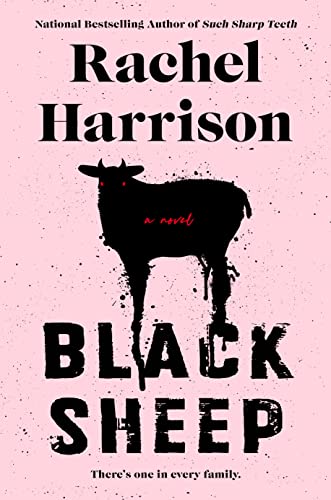
A woman must learn to take life by the throat after a night out leads to irrevocable changes in this juicy, thrilling novel from the USA Today bestselling author of Such Sharp Teeth and Black Sheep.

Sloane Parker is dreading her birthday. She doesn’t need a reminder she’s getting older, or that she’s feeling indifferent about her own life.

Her husband surprises her with a birthday weekend getaway—not with him, but with Sloane’s longtime best friend, troublemaker extraordinaire Naomi.

Sloane anticipates a weekend of wine tastings and cozy robes and strategic avoidance of issues she’d rather not confront, like her husband’s repeated infidelity. But when they arrive at their rental cottage, it becomes clear Naomi has something else in mind. She wants Sloane to stop letting things happen to her, for Sloane to really live. So Naomi orchestrates a wild night out with a group of mysterious strangers, only for it to take a horrifying turn that changes Sloane’s and Naomi’s lives literally forever.

The friends are forced to come to terms with some pretty eternal consequences in this bloody, seductive novel about how it’s never too late to find satisfaction, even though it might taste different than expected.

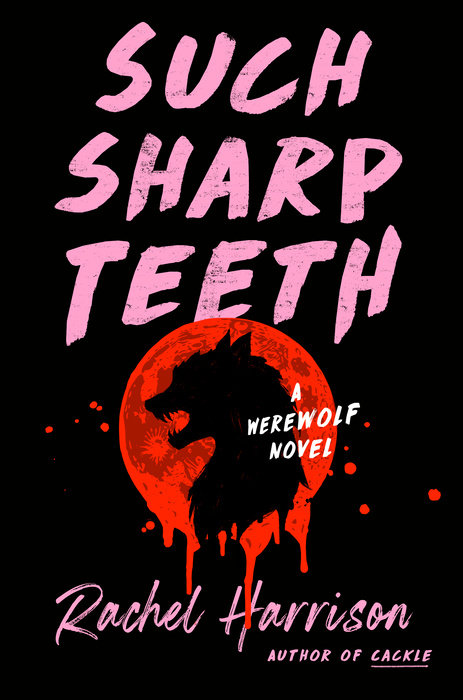
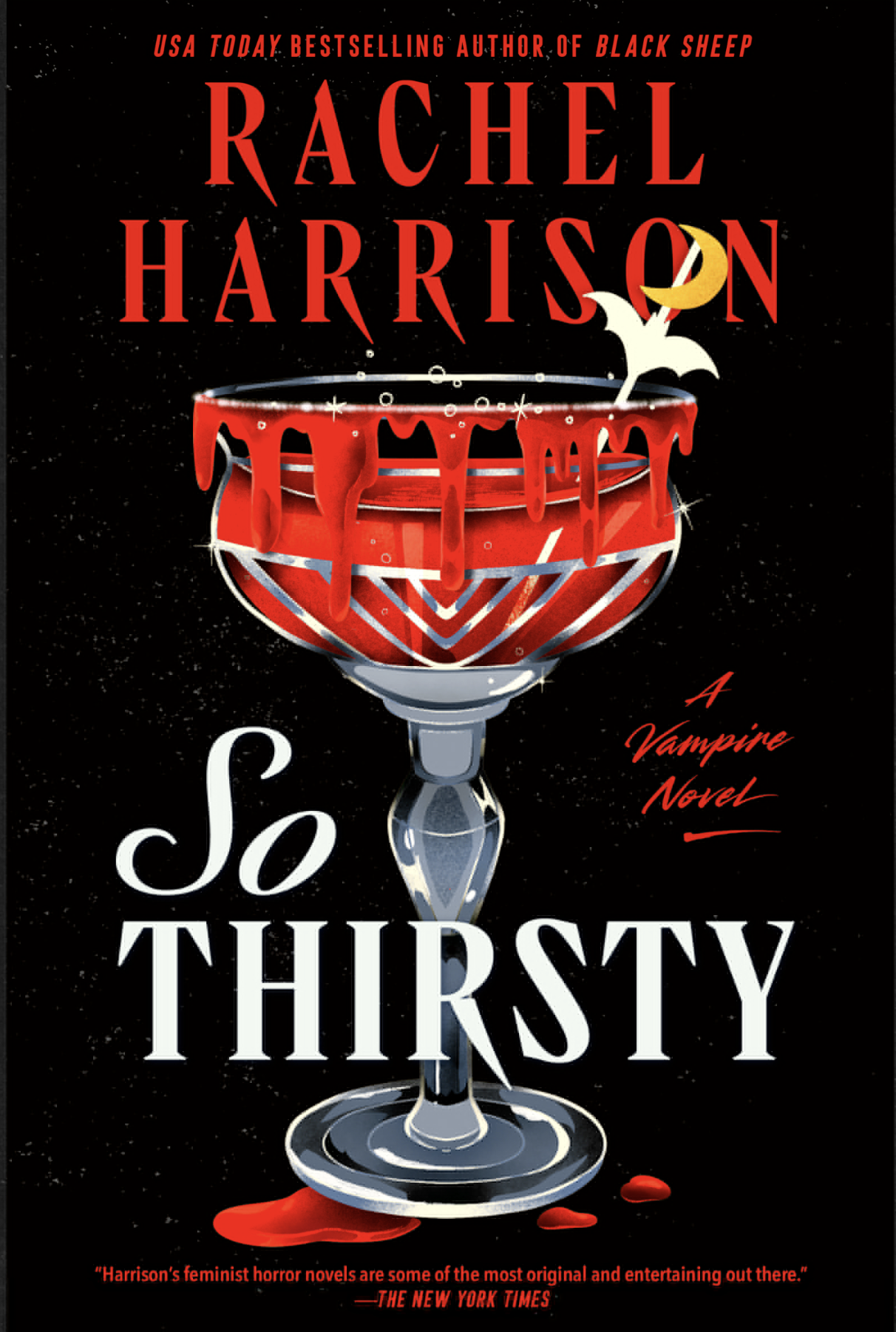
Rachel Harrison’s books are always a (gruesome) treat, and So Thirsty is an absolute gem. This book lets us know right up front — hey, it’s on the cover! — that this is a vampire story. But the how and why of it all are just so perfectly developed that it’s not at all what you’d expect.

If there is a happy medium between being a resigned, mildly depressed thirty-six-year-old woman with a thankless job and cheating husband, and being an immortal vampire indulging her lust for blood and sex and her desire for love and excitement, it sure would be nice to find it.

We start with Sloane, a woman in her mid-30s, whose life is snug, secure, and unsatisfying. She’s committed to her multi-step daily skin routine, but the signs of aging keep creeping in anyway. Her husband Joel is a cheater, but she chooses not to confront him, preferring to avoid having to actually so something about it. When Joel sends her off on a surprise birthday weekend with her best friend Naomi, she’s startled and a bit disconcerted that he planned this for her… and rightfully suspicious that he has ulterior motives. (Note to cheaters: Don’t forget about that doorbell camera!)

Naomi arrives at their ultra-posh lakeside resort and immediately shakes things up. They’ve been best friends since their teens, but their lives have taken very different directions since then. Naomi works for an up-and-coming rockstar — who is also her boyfriend — and she’s impulsive, glamorous, and impatient with Sloane’s safe (boring) life. This is not the Sloane she once knew, and she wants to force her out of her complacency.

She does so by taking Sloane to a party with strangers they’ve just met. Behind the gates of their remote mansion, the strangers are welcoming and wild. Sloane fears they’ve stumbled into an orgy; Naomi urges her to unwind and let things happen. One of the men in particular seems to have an intense, instant connection to Sloane, but she’s skittish and reluctant to risk the safety of her cocooned life, no matter how much temptation is staring her in the face. However, all choice is soon taken from both Sloane and Naomi, as a terrifying moment leads to their transformation and the start of a new life for both women.

As I mentioned earlier, the fact that Sloane and Naomi become vampires isn’t particularly surprising, given the cover and blurb. What makes this interesting is their response and experiences. The need for blood is described as an intense thirst, and the thirst represents not just the literal requirement for blood as a life-sustaining substance, but all the elements missing from Sloane’s former life — the passion for excitement, taking risks, grabbing all that life has to offer. The thirst is what Sloane will need to both embrace and control if she’s to have any sort of future at all, and to do so, she’ll have to break down the careful barriers she’s put up over the years.

I loved the insights into both Sloane and Naomi as individuals, as well as their shared dynamic. Their bond is threatened to the point of almost breaking, but ultimately it’s their love for one another that keeps them going, even in the worst of moments.

My main quibble with So Thirsty is that the vampires they encounter are introduced as a group, and there isn’t all that much to differentiate one from another. Beyond that, a few seem a bit too stereotypically vampire-y — are they intentionally aping a vampire vibe, or is this just who they are? (And also, I could definitely have done without the orgy… )

Quibbles aside, I thought the complicated relationship between Sloane and Naomi was particularly well done. Their shared history means they know each other better than anyone else, but also leads to possibly unreasonable expectations. They each want the other to pursue better options and live their best lives — but their perspectives on what that might look like aren’t actually in sync.

Does that sound less bloody than what you’d expect in a vampire novel? Never fear! Those looking for classic horror elements won’t be disappointed — yes, there’s introspection and a focus on relationships, but there’s also plenty of blood and gore. Really, lots and lots of blood and gore. Violent incidents are used to startling, scary effect, and there are a few characters met along the way who are simply terrifying.

So Thirsty is a totally absorbing read, and such a blast for readers (like me) who’ve read tons of vampire stories already, and are hungry (thirsty?!) for a new twist. So Thirsty is not quite as great as Such Sharp Teeth or Cackle, but I still enjoyed it immensely. A bloody good read for these creepy days of late October!

Audiobook Review: Lil’s Bus Trip by Judy Leigh

Title: Lil’s Bus Trip
Author: Judy Leigh
Narrator: Julie Mullen
Publisher: Boldwood Books
Publication date: August 26, 2021
Print length: 350 pages
Audio length: 10 hours 36 minutes
Genre: Contemporary fiction
Source: Purchased
Rating:

Rating: 4 out of 5.

From the USA Today bestselling author of Five French Hens and The Old Girls’ Network comes a story of the journey of a lifetime across Europe in pursuit of memories, love, and new adventures. It’s always a good time for a road trip…

When 82-year-old Lil decides to book herself, her 65-year-old daughter, Cassie, and her friend Maggie on a bus trip across Europe, she hopes for a little adventure to counteract the monotony of life.

Along with three members of the Salterley Tennis Club and the Jolly Weaver football team, whose ideas of a good time are rather different to Lil’s and strikingly at odds with each other’s, the merry band of travellers set out on their great adventure.

From moving moments on the beaches of Normandy, outrageous adventures in Amsterdam, to the beauty of Bruges and gastronomic delights of France, the holiday is just the tonic Lil, Maggie and Cassie needed.

And as the time approaches for them to head home, Lil makes an unexpected discovery – even in her advancing years, men are like buses – there isn’t one for ages then two come along at once. Is Lil ready to share her golden years, and can the ladies embrace the fresh starts that the trip has given them. Or is it just too late to change…

Judy Leigh’s books can be counted on to provide cheery scenarios, heart-warming encounters, and memorable (and often feisty) older women as the main characters — and Lil’s Bus Trip is yet another terrific listening experience!

Lil’s life is perfectly nice, if not exceptionally exciting. She lives in a pleasant senior community, has good friends, and is very close to her daughter Cassie, whom she’s raised on her own after becoming unexpectedly pregnant as an unwed teen. But couldn’t they both use a little adventure for a change?

When a friend from the local pub decides to organize and lead a European road trip, Lil decides it’s just what she and Cassie need. What’s more, Lil’s best friend and next-door neighbor Maggie is slowly suffocating from neglect, as her husband mainly ignores her and sits watching TV all day, so Lil practically forces her along as well. Joining them on their trip are a group of younger folks from a local football team, the pub owner and his elderly father, and a trio of snobs from the tennis club who insist they’re only interested in culture and intellectual pursuits.

As the trip gets underway, the group gets to experience both serious moments — such as the beaches of Normandy — as well as silly mishaps… like what happens when the three oldest members of the group order a brownie to go with their coffee in an Amsterdam coffeeshop.

There’s actually not a ton of plot to describe, other than the highlights of the road trip itself. And yet, there’s something so warm and delightful about this audiobook. I was apprehensive at the beginning about there being so many characters, but ultimately, the twelve people on the mini-bus are each developed over the course of the story, so that by the end, it feels like we’ve been hanging out with a group of our own friends.

The adventures on the road are lots of fun, and there are more serious moments too, as the various characters have opportunities to rethink their lives back home and come to terms with what they want (or don’t want). For Lil especially, it’s a chance to look back at a life lived on her own terms, but often lived alone, and consider whether it’s too late to take a chance on loving someone new.

The audiobook narrator rises to the challenge of voicing the twelve travelers, and bringing them all to distinct life… along with several other memorable people they meet along the way. For me, a jarring note was that the narrator adds in the vocal effects described… so if it’s stated that a character laughs, the narrator laughs… or coughs… or takes a deep breath. I find this approach a bit annoying, but I’m sure some listeners like that sort of thing. (Also, Cassie is a singer, and when she performs in the book, the narrator sings Cassie’s songs, rather than just reading the words. Again, whether you’ll enjoy this is a matter of taste and preference. She does a perfectly respectable job with the singing, but it’s not my cup of tea.)

Still, audio/narration preferences aside, I did really have a great time with this sweet story. Listening to Lil’s Bus Trip is the audiobook equivalent of a warm blanket and a cup of hot cocoa. It’s comforting and pleasant, not particularly dramatic, but so easy to sink into and enjoy.

This is now my 4th book by Judy Leigh, and it won’t be my last! Fortunately, she has a good-sized backlist for me to dig into while waiting for her next new release!

Book Review: Return to Valetto by Dominic Smith

Title: Return to Valetto
Author: Dominic Smith
Publisher: Farrar, Straus and Giroux
Publication date: June 13, 2023
Print length: 336 pages
Genre: Historical/contemporary fiction
Source: Library
Rating:

Rating: 3 out of 5.

A captivating and moving new novel from the international bestselling author of The Last Painting of Sara de Vos.

A nearly abandoned Italian village, the family that stayed, and long-buried secrets from World War II.

On a hilltop in Umbria sits Valetto. Once a thriving village-and a hub of resistance and refuge during World War II-centuries of earthquakes, landslides and the lure of a better life have left it neglected. Only ten residents remain, including the widows Serafino – three eccentric sisters and their steely centenarian mother – who live quietly in their medieval villa. Then their nephew and grandson, Hugh, a historian, returns.

But someone else has arrived before him, laying claim to the cottage where Hugh spent his childhood summers. The unwelcome guest is the captivating and no-nonsense Elisa Tomassi, who asserts that the family patriarch, Aldo Serafino, a resistance fighter whom her own family harboured, gave the cottage to them in gratitude. Like so many threads of history, this revelation unravels a secret – a betrayal, a disappearance and an unspeakable act of violence – that has impacted Valetto across generations. Who will answer for the crimes of the past?

Dominic Smith’s Return to Valetto is a riveting journey into one family’s long-buried story, a page-turning excavation of the ruins of history and our commitment to justice in a fragile world. For fans of Amor Towles, Anthony Doerr and Jess Walter, it is a deeply human and transporting testament to the possibility of love and understanding across gaps of all kinds – even time.

Return to Valetto is a story of family secrets and promises, set in a nearly abandoned hilltop village in the Umbria region of Italy. Valetto is now empty save for the Serafino villa, inhabited by three elderly sisters and their even older mother.

A fourth sister, the youngest, died years earlier, and as the story opens, her son Hugh — a history professor specializing in abandoned towns — arrives on sabbatical. But his arrival is marred by an unwanted presence: A squatter of sorts has taken up residence in the villa’s cottage, which Hugh’s mother had bequeathed to him. The squatter, Elisa, claims that the long-lost patriarch of the Serafino family had gifted it to her family years earlier, after they saved him in the closing days of the war. The sisters scoff at her claim, but Hugh wonders whether there might be a kernel of truth in Elisa’s tale.

As we learn, Aldo Serafino was a partisan fighter during World War II, and was last seen by his family in 1944. They never learned what became of him, but Elisa is able to fill in the blanks. He found shelter with her family, who hid him while partisans were being hunted down — and later, as he lay dying of an infection, they cared for him in his final days. She has a letter to prove his intentions, instructing his wife to give the cottage to the Tomassi family as repayment for their kindness on his behalf. The letter was never sent — and now more than half a century later, no one is willing to believe its validity.

As Hugh spends time with Elisa, he comes to see her sincerity and her devotion to her aged mother. Through this connection, he also finally starts to take an interest in life again, after spending years mourning his late wife. As Hugh and Elisa come closer to the truth about how their families intersected so many years ago, he becomes caught up in a search for truth and justice, with unexpected consequences.

Return to Valetto was my book group’s book of the month, and I can see that we’ll have lots to discuss. At the same time, I never felt any urgency about this book, and remained emotionally distant from it throughout, even at times of major revelations about traumatic events of the past.

The storytelling is slow-paced, full of descriptions and inner thoughts. It’s contemplative and shows an appreciation of history, geography, and the sense of loss and abandonment that informs the characters’ lives, as well as their town and surroundings. Shocking elements of the family’s wartime experiences gradually come to light, but even there, a lack of true drama keeps the reader at arm’s-length.

As for the conflict over the cottage, it fizzles away by the midpoint of the novel and is replaced by more dramatic conflict concerning the former townspeople of Valetto and the roles they played during the war. There are several key turning points, but somehow the narrative never truly feels compelling.

I enjoyed the depiction of the feisty older characters, as well as the descriptions of life in this empty town, and there’s a feast scene that’s just mouth-watering. The book presents several moral dilemmas to contemplate, which are interesting to think about, even while the storytelling itself feels a bit uneventful for large stretches.

I would likely not have picked up Return to Valetto without my book group — but I don’t regret reading it. I usually enjoy historical fiction, but somehow, the pacing and tone of this book work against the drama I believe it was trying to achieve, and many of the historical elements would have benefited from just a bit more exposition to set the scene.

Return to Valetto has many interesting elements in it, but it’s not a book that earns raves from me.

Book Review: The Love Elixir of Augusta Stern by Lynda Cohen Loigman

Title: The Love Elixir of Augusta Stern
Author: Lynda Cohen Loigman
Publisher: St. Martin’s Press
Publication date: October 8, 2024
Length: 320 pages
Genre: Contemporary/historical fiction
Source: Review copy courtesy of the publisher via NetGalley

Rating: 4 out of 5.

It’s never too late for new beginnings.

On the cusp of turning eighty, newly retired pharmacist Augusta Stern is adrift. When she relocates to Rallentando Springs—an active senior community in southern Florida—she unexpectedly crosses paths with Irving Rivkin, the delivery boy from her father’s old pharmacy—and the man who broke her heart sixty years earlier.

As a teenager growing up in 1920’s Brooklyn, Augusta’s role model was her father, Solomon Stern, the trusted owner of the local pharmacy and the neighborhood expert on every ailment. But when Augusta’s mother dies and Great Aunt Esther moves in, Augusta can’t help but be drawn to Esther’s curious methods. As a healer herself, Esther offers Solomon’s customers her own advice—unconventional remedies ranging from homemade chicken soup to a mysterious array of powders and potions.

As Augusta prepares for pharmacy college, she is torn between loyalty to her father and fascination with her great aunt, all while navigating a budding but complicated relationship with Irving. Desperate for clarity, she impulsively uses Esther’s most potent elixir with disastrous consequences. Disillusioned and alone, Augusta vows to reject Esther’s enchantments forever.

Sixty years later, confronted with Irving, Augusta is still haunted by the mistakes of her past. What happened all those years ago and how did her plan go so spectacularly wrong? Did Irving ever truly love her or was he simply playing a part? And can Augusta reclaim the magic of her youth before it’s too late?

This dual timeline novel tells the story of Augusta Stern, first in her teens and twenties, then nearing age eighty, and shows the turning points of her life in the 1920s and how they affected everything that came after.

Augusta is the daughter of a trusted pharmacist in Brooklyn. She’s drawn to her father’s knowledge and the way he helps the community, and as soon as she’s allowed, begins apprenticing in his store. There, she meets Irving Rivkin, her father’s delivery boy, who admires Augusta’s intelligence and always has a kind word for her.

Augusta’s father provides financially for his two daughters, but their home has been cold and lifeless since the death of Augusta’s mother. When her great-aunt Esther arrives to keep house for the family, Augusta is initially turned off by this older woman, dressed always in drab clothing and with little tolerance for nonsense. But Esther’s incredible soup and other foods soon bring a sense of warmth back to the family — and what’s more, Esther has a secret, old-world knowledge of herbs, plants, and natural remedies. Is she a homeopathic healer, or is there magic behind her powders and potions?

In the 1980s timeline, Augusta has finally retired from her career as a pharmacist and, upon her niece’s urging, has moved into a Florida retirement village. Much to her dismay, she almost immediately runs into Irving — whom she hasn’t seen in sixty years. He broke her heart all those years ago by disappearing suddenly and marrying another woman. He seems to want to reconnect with Augusta now, but how can she forgive him, much less trust him again?

The Love Elixir of Augusta Stern is a charming story on many levels. The chapters focused on Augusta’s younger years bring 1920s Brooklyn to life, as she navigates her way through a society that doesn’t have much patience or respect for women’s knowledge or professionalism. The women of the neighborhood seek out Esther’s help in secret, while getting “official” prescriptions from Augusta’s father. Augusta is torn: She’s eager to follow in her father’s footsteps, but can’t help seeing that Esther’s knowledge and skills provide help, relief, and cures for women who’ve been failed by more modern approaches. Watching Augusta puzzle out how to fit both aspects of healing into her life is fascinating, and her romance with Irving is innocent and lovely before it all falls apart.

The 1980s chapters are lighter in tone, with some comical moments of conflict between the various residents of the retirement village. Still, Augusta is never portrayed as silly, and in fact, it’s quite special to see this vibrant 80-year-old woman as the focal point of a love story.

The two pieces of the story come together well in the end, as the author draws meaningful connections between the events of then and now, and offers hopeful messages about finding love, no matter one’s age or how much time has passed.

The Love Elixir of Augusta Stern is a heart-warming, uplifting story about love, family, and second chances. It’s a fast read, and kept my attention from start to finish. Highly recommended.

Audiobook Review: Life’s Too Short (The Friend Zone, #3) by Abby Jimenez

Title: Life’s Too Short
Series: The Friend Zone, #2
Author: Abby Jimenez
Narrators: Zachary Webber and Christine Lakin
Publisher: Forever
Publication date: April 6, 2021
Print length: 384 pages
Audio length: 9 hours 6 minutes
Genre: Contemporary romance
Source: Library
Rating:

Rating: 3.5 out of 5.

A brilliant and touching romantic comedy about two polar opposites, one adorable dog, and living each day to its fullest.

When Vanessa Price quit her job to pursue her dream of traveling the globe, she wasn’t expecting to gain millions of YouTube followers who shared her joy of seizing every moment. For her, living each day to its fullest isn’t just a motto. Her mother and sister never saw the age of 30, and Vanessa doesn’t want to take anything for granted.

But after her half-sister suddenly leaves Vanessa in custody of her infant daughter, life goes from “daily adventure” to “next-level bad” (now with bonus baby vomit in hair). The last person Vanessa expects to show up offering help is the hot lawyer next door, Adrian Copeland. After all, she barely knows him. No one warned her that he was the Secret Baby Tamer or that she’d be spending a whole lot of time with him and his geriatric Chihuahua.

Now she’s feeling things she’s vowed not to feel. Because the only thing worse than falling for Adrian is finding a little hope for a future she may never see.

In Life’s Too Short, a crying baby brings a pair of strangers together in the middle of the night, changing both of their lives.

Vanessa Price has just been handed temporary custody of her troubled half-sister’s newborn baby, and is handling it fine… until the baby simply won’t stop crying. Her next-door neighbor, Adrian Copeland, shows up at her apartment door at 4 am offering to help. She’s suspicious… but she knows him by reputation, and she’s desperate enough to allow him in, hand him baby Grace, and go take a shower to calm down (and get the spit-up out of her hair). Lo and behold, the nonstop crying jag has ended by the time she gets out of the shower. An instant friendship is born.

Adrian is a successful, hard-driving criminal defense attorney who needs to be in control at all times. Vanessa is a free-wheeling YouTuber with a huge following, who’s spent the last few years sharing her worldwide travels. But Vanessa’s live-for-today approach has a darker underlying motivation — her mother and sister both had ALS and died young, and she’s trying to make the most of her own life before ALS catches up with her as well.

Adrian and Vanessa form an instant connection, and within days, they’re constantly in and out of each other’s apartments, sharing food, watching TV, caring for baby Grace, and become besties. Both are very clear that they’re not interested in dating or relationships… but we know where that’s going, right?

As the pair spend time together, they each develop strong feelings — as well as an intense attraction — but both assume that the other person isn’t interested in them that way. There’s a lot of time spent on false assumptions and faulty communication before they finally realize the truth of the matter.

I enjoyed the audiobook of Life’s Too Short, with narrators alternating to read chapters told from each character’s perspective. Both narrators do a great job conveying delivery and personalities, and they’re also terrific at pacing and providing humor.

Overall, though, I didn’t love Life’s Too Short as much as some of the author’s other books. First, there’s the communication issue, already mentioned. This is such a staple of contemporary romance novels, and honestly, it overdone. Adrian and Vanessa are both smart people who communicate for a living — yet they can’t get past their misinterpretations and inability to say what they mean or what they want. The misunderstanding phase of their relationship drags on way too long — and then there’s a phase two, once they’re together, about whether Adrian actually knows Vanessa’s health history and possible prognosis. This second phase of communication blunders leads to the major breakup phase of the book, but to me, it didn’t make sense that they ended up with this huge misunderstanding in the first place.

Second complaint: this book leans heavily into the trauma/drama that’s prevalent in so many of Abby Jimenez’s books. Not only is Vanessa dealing with the threat of ALS, mourning her deceased sister, and caring for an infant, but she’s also trying to deal with a father who’s a hoarder and push her half-sister (the baby’s mother) into rehab for her drug addiction. As for Adrian, his control issues stem from his father’s abandonment of the family when he was a child and the lingering fears and damage that’s caused him. It feels like these aspects overwhelm the love story at times, and could probably have been dialed back without losing the overarching emotional impact of the plot.

Finally, I felt that there was a level of emotional manipulation regarding Vanessa and whether she has the early symptoms of ALS. I won’t go into details, because that would be too spoilery, but by the end I felt very manipulated as a reader.

This may make it sounds like I didn’t enjoy Life’s Too Short at all, and that’s not actually the case. As in all Abby Jimenez books, the writing is crisp and funny and entertaining, and there are plenty of silly moments to lighten the mood. Sure, the male love interest is too perfect to possibly be a real human being, but that’s okay — it’s a nice fantasy to get to know a man who’s gorgeous, amazing with babies, successful, and always picks the perfect gift/date/adventure.

Life’s Too Short is considered the 3rd book in the Friend Zone trilogy, but apart from a very slight connection, it’s really more of a standalone. Adrian was introduced in a very minor way in The Happy Ever After Playlist, and characters from the other books show up briefly in Life’s Too Short — but someone picking up Life’s Too Short on its own would be perfectly fine and would not feel that they were missing anything.

I discovered Abby Jimenez’s books just this year, and have now read them all! While I may have quibbles about plot points and communication styles, overall, her books are zippy, engaging reads that include romance, humor, and deep emotional connection. She’s an excellent storyteller, and creates characters who feel like fully developed, living, breathing people.

The author’s next book, Say You’ll Remember Me, will be released in April 2025 — and I’ll be ready with grabby hands as soon as it’s available!

Book Review: Cue the Sun! The Invention of Reality TV by Emily Nussbaum

Title: Cue the Sun! The Invention of Reality TV
Author: Emily Nussbaum
Publisher: Random House
Publication date: June 25, 2024
Length: 464 pages
Genre: Non-fiction – pop culture/entertainment
Source: Library
Rating:

Rating: 4 out of 5.

Who invented reality TV, the world’s most dangerous pop-culture genre, and why can’t we look away from it? In this revelatory, deeply reported account of the rise of “dirty documentary,” Emily Nussbaum unearths the surprising origin story of the genre that ate the world, as told through the lively voices of the people who created it. At once gimlet-eyed and empathetic, Cue The Sun! explores the morally charged, funny, and sometimes tragic consequences of the hunt for something real inside something fake.

Nussbaum traces four paths of reality innovation—game shows, prank shows, soap operas, and clip shows—that united in the Survivor format, sparking a tumultuous Hollywood gold-rush. Along the way, we meet tricksters and innovators—from the icy Allen Funt to the shambolic Chuck Barris; Cops auteur John Langley; Bachelor mastermind Mike Fleiss; and Jon Murray, the visionary behind The Real World—along with dozens of crew members and ordinary people whose lives became fodder for the reality revolution. We learn about the tools of the trade—like Candid Camera’s brilliant “reveal” and the notorious Frankenbite, a deceptive editor’s best friend—and the moral outrage that reality shows provoked. But Cue The Sun! also celebrates what made the genre so powerful: a jolt of authentic emotion.

Through broad-ranging reporting, Nussbaum examines seven tumultuous decades, exploring the celebreality boom, reality TV as a strike-breaker, the queer roots of Bravo, and the dark truth behind The Apprentice. A shrewd observer who cares about television, she is the ideal voice for the first substantive cultural history of the genre that has, for better or worse, made America what it is today.

When I first heard about Cue the Sun! (which references a line from The Truman Show, in case you’re wondering), I figured I’d pick it up and just read the chapter about Survivor. But lo and behold, once I had this book in my hands, I couldn’t resist starting at the beginning and reading straight through to the end.

Author Emily Nussbaum masterfully traces the history of reality TV, from its early days catching ordinary people on camera — making real people points of fascination, but also, often mockery or scorn. We may think of shows like Candid Camera as some sweet piece of nostalgic fluff, but what I learned from this book is how subversive — and frequently nasty — these hidden camera pranks could be. Today, we accept that cameras are everywhere, but just imagine how shocking the idea was at the time!

Cue the Sun! covers reality TV history through all its various permutations, from clips shows (like America’s Funniest Home Videos) to game shows (The Newlywed Game), real-life crime (Cops), and talent competitions (The Gong Show).

Survivor was the true game-changer, when reality competitions blew up seemingly overnight. It’s fascinating to read about the creation of Survivor and the evolution of the first season. Now, everyone who plays Survivor knows how to play Survivor… but then, the contestants were largely making it up as they went along.

After Survivor, reality was huger than ever, with mega-hits such as the Bachelor franchise, Real Housewives and Kardashians, American Idol and countless other competitions dominating the airwaves. Cue the Sun! lays out how one phase led to another, and shows the wheeling and dealing, the seediness and invasiveness, as well as the creativity and innovation behind the scenes of it all.

The book also makes plain what anyone who watches reality TV knows — the cameras may catch people in the moment, but the producers manipulate what viewers see, both via editing after the fact and through questions, prompts, coaching and instruction as the action unfolds during filming. Even though it’s obvious that this is how these shows get made, the intensity and pervasiveness of the manipulation, as shown in Cue the Sun!, can feel very unsettling to read about. As the book points out, over and over again, we’re not watching actual reality — what we see is a curated, filtered, carefully assembled product that mimics some form of reality.

The final chapter of Cue the Sun! gets pretty dark, as it focuses on The Apprentice. It’s fascinating and disturbing to read about the creation and development of the show, and how the show is largely responsible for the public platform that led all the way to the Presidential race of 2016 and beyond.

That was the taboo truth about The Apprentice, in the end—the quality that made it more impressive, not less. Anyone could rebrand a mediocre businessman, some small-timer in need of a glow-up. But taking a failed tycoon who was a heavily in hock and too risky for almost any bank to lend to, a crude, impulsive, bigoted, multiply-bankrupt ignoramus, a sexual predator so reckless he openly harassed women on his show, then finding a way to make him look attractive enough to elect as the president of the United States? That was a coup, even if no one could brag about it.

Throughout the book, it’s interesting to see how the participants and players on reality shows have changed. At the genre’s beginning, it spotlighted real people’s lives as captured on camera. As the genre evolved into game play, constant surveillance, confessionals, and more, real people eagerly auditioned for reality TV, knowing that reality TV celebrity is now a career path. The author includes interviews from many reality contestants — some went back to “real” (ordinary, non-Hollywood lives) after their moments in the spotlight, but many pursued either further on-camera reality options, worked behind the scenes on other shows, or spent time on the fan circuit.

Cue the Sun! is a fascinating read. I don’t watch an enormous amount of reality TV (I’ve never watched The Bachelor or any of the “celebreality” shows currently on the air), but as a fan of Survivor and The Amazing Race, I found it so eye-opening to see where this TV trend began and how it’s developed over time.

Reading note: Don’t be put off by the page count! There’s about 50 pages or so of notes, bibliography, and an index at the end. I found Cue the Sun! a fast, absorbing read.

Want to know more? Check out these reviews: