Book Review: The Age of Miracles by Karen Thompson Walker

Book Review: The Age of Miracles by Karen Thompson Walker
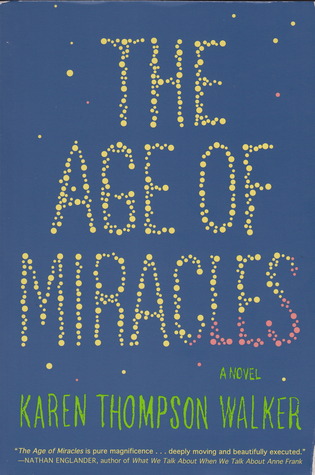
ageofmiracles

It’s a little daunting to sit down to write a book review when the book’s jacket is covered with high praise from authors such as Nathan Englander, Aimee Bender, Karen Russell, and Amy Bloom. I have to wonder — did they see something in The Age of Miracles that I missed?

The Age of Miracles is a tale of global catastrophe. For reasons unknown, the earth’s rotation has slowed. The slowing, as people call it, starts as a small thing, as scientists announce that a full rotation of the earth is now 56 minutes longer than it should be. Days lengthen, with the rate of slowing increasing inexorably. The sun sets later and later; longer periods of daylight are followed by longer periods of night. People panic, adapt, panic, adapt some more. And life goes on.

Narrator Julia is 11 years old as these events unfold, but is narrating the story from some time later. The Age of Miracles often reads like a nostalgia piece, in many ways a typical coming of age story, where the young person at its center has her eyes opened to some of the harsh truths of life. Best friends don’t necessarily stay BFFs. Grown-ups aren’t always reliable or honest. Parents disappoint their children and fail to be enough to shelter their children from life’s dangers.

The author makes use of the 2nd person plural throughout, so that Julia is telling not only her own story, but the story of the end of civilization as it was.

In the hours that followed, we would worry and wait. We would guess and wonder and speculate. We would learn new words and new ways from the scientists and officials who paraded in and out of our living room through the television screen and the Internet. We would stalk the sun across our sky as we never had before.

Each new day, each further bit of slowing, brings new changes and challenges. World governments announce a commitment to staying on “clock-time”, continuing to structure human lives around a 24-hour cycle. Soon everyone has black-out curtains so they can sleep while the sun is shining, and school children line up for the bus as the first stars are still appearing in the night sky. A rift in the community forms as some people decide to live in “real-time”, waking and sleeping by the rising and setting of the sun. Real-timers are viewed as anarchists, hippies, throw-backs to a wild past, and are shunned or worse. Suicide cults blossom. People hoard perishables… and then they wait.

To an extent, although The Age of Miracles takes place over the course of a year, we never do see the full impact of the disaster. The effects become more and more dramatic as time passes, but life is still manageable, at least in Julia’s little world. Her mother comes down with slowing syndrome, a common condition caused by changes in gravity, with symptoms such as fainting, dizziness, and nausea. Coastal homes are evacuated and within weeks, are completely flooded, as the slowing causes worldwide changes in currents and tides. There is a massive bird die-out, as the gravitational changes wreak havoc with birds’ internal systems. All agriculture must eventually move into indoor, artificially lit environments, as nothing can grow with the extreme periods of heat and sun followed by long hours of darkness and cold.

And yet, Julia goes to school every day, worries about being friendless and not fitting in, crushes on a cute boy, and tries to figure out what really matters to her. She worries about puberty and growing up, worries about appearing childish next to her make-up and high heel-wearing classmates, and frets about the strain in her parents’ marriage. She begins to see her parents’ flaws, and reflects often on their physical signs of aging — her former-model mother has gray roots, her physician father, always perfectly put together, has wrinkles around his eyes.

The writing is often lovely and lyrical. The author has a keen eye for description of the every day, and evokes a particular time and place with many small details that add up to a complete portrait of life in a small southern California town on the brink of permanent change.

I didn’t quite buy Julia’s voice or perspective in The Age of Miracles. Julia’s experiences, at age 11, seemed out of place. The issues with boys, social status, and cliques, as written, would have felt more authentic to me if the children involved were at least two or three years older. It’s a neat trick to have Julia tell her own story as a 20-something-year-old looking back, but I couldn’t believe many of the observations attributed to 11-year-old Julia as truly coming from a girl that age.

The other flaw with this narrative choice is the diminution of the drama — we know that Julia survives, because she makes it clear that she’s telling us about events from her past. Much has changed, and things look pretty grim, but as a point of fact, Julia’s life has gone on, and so has much of the world’s. Nothing ever feels that immediate or urgent, as it’s all presented as a memory.

This is one of several global disaster/end of the world books that I’ve read lately. In The Age of Miracles, the disaster is almost background, as the main story is about Julia saying good-bye to her childhood and moving forward into a brand new world. An interesting choice, but not entirely convincing or satisying for me.

I would recommend The Age of Miracles, but can’t say that I loved it.

For another take, check out the io9 review here, which questions whether The Age of Miracles works as a science fiction novel.

Book Review: Frozen by Mary Casanova

Book Review: Frozen by Mary Casanova

Sadie Rose was rescued from death at age five when she was pulled from a snowbank in the middle of a cold Minnesota night, and hasn’t said a word since. Raised by the wealthy Worthingtons, a senator and his wife, Sadie Rose lives a comfortable but cheerless life in 1920s-era rural Minnesota, protected from all outside forces and influences, seeking shelter in her piano music and random hobbies, with no knowledge or memory of her origins. Until, that is, the fateful day arrives when Sadie discovers a cache of hidden photos of a glamorous, scandalous woman, and recognizes this stranger as her long-lost mother, Bella Rose.

Bit by bit, Sadie recovers pieces of the past, as she recalls her early years living in the brothel where her mother worked, until her mother’s death on the same night that Sadie was pulled from the snow. Bella Rose’s untimely demise was attributed to drink and wantonness, as she was found frozen to death with an empty bottle in her lifeless hand. As Sadie’s memory returns, she realizes that there is more to the story, and as she uncovers the truth, she also rediscovers her own ability to speak.

Frozen is set in northern Minnesota, in a small town on the banks of the great lake separating Minnesota from Canada. Prohibition is the law of the land, and moonshine and smuggling are a way of life. A powerful lumber baron controls everything and everyone in the area, and to cross him is to risk one’s life. Women’s suffrage is gaining momentum, a small group of environmentalists is trying to stop the clear-cutting practices of the lumber industry, and loose women still find ready employment in the wilds of the frontier towns.

The author does a nice job conveying the atmosphere of the time and place in which the story is set, and yet I was left wishing for a bit more meat in the story. Sadie’s journey from silence to finding a voice of her own is a bit sudden, and the catalyst of her transformation — finding her mother’s pictures — wasn’t as clearly defined as it should have been. Frozen has almost too many plot threads — a love story, a mentally ill friend, the investigation into her mother’s past, the environmental protests, local politics — and it’s really more than can be sustained by such a slim tale. The climax and denouement came a bit too easily, and I found the ending unconvincing.

Frozen is being marketed as a young adult novel, and I would imagine that teens interested in a historical setting would enjoy this. For me, as an adult who often adores YA fiction, Frozen fell a little short — a nice effort, pleasant to read, but not substantial enough to feel satisfying.

Review copy courtesy of University of Minnesota Press via NetGalley.

Book Review: Every Day by David Levithan

Book Review: Every Day by David Levithan

Every day, main character/narrator A wakes up in a new body with a new life. We never learn how or why; it’s just the simple reality of A’s existence. A can be any ethnicity, gender, identity, or orientation. The only constants are that A is sixteen, and that each visit in a particular body lasts one day, no more, no less.

(I can tell already that this book will be a challenge to discuss, if for no other reason than that pronouns are pretty much off the table. A is neither male nor female; A is whatever the body he/she inhabits for that day is. If I’m confused, I can only imagine how A feels).

A seems to manage this ever-changing life with equanimity. A accepts A’s life; for A, this is normal. A’s modus operandi to to do his/her best with the body of the day, making a good faith effort to get through that body’s normal life as well as possible, whether that means taking history tests, going to a family outing, or playing in a soccer game. Fortunately, A is able to access the memories of whoever’s body he/she is in, so A is more or less able to fake it with teachers, parents, boyfriends, girlfriends. A goes on dates, A hangs out with friends, A does whatever was on the agenda for the day. Each day is something new. Each set of circumstances can be adapted to, and then abandoned for the next.

And then, on day 5994 of A’s existence, A wakes up in the  body of Justin, a rather ordinary, somewhat sullen boy. What’s remarkable about Justin is his girlfriend Rhiannon, whose lack of self-confidence masks an inner and outer beauty that largely goes unappreciated by Justin, but which speaks to A’s heart in a way that’s never happened before. A, as Justin, spends an unforgettable day with Rhiannon, who doesn’t understand why her indifferent boyfriend suddenly seems interested in her soul as well as her body. At the end of the day, A can’t let go, and this is the catalyst for everthing that happens in Every Day. A spends each subsequent day trying to get back to Rhiannon, to convince her that he/she is the same person inside, no matter what’s on the outside, and to try to find a way to make a connection that lasts more than one day.

Even when Rhiannon overcomes her disbelief and allows herself to become involved with A, it’s interesting to see her reaction to A’s physical self vary based on the body he’s in. She holds hands with A without hesitation when he’s in an attractive male body, hangs out with A with a minimum of touching when A is a girl. On a day when A shows up as a morbidly obese boy, Rhiannon can’t hide her discomfort at being out on a date with someone of this appearance, despite knowing that the person she loves is inside.

David Levithan’s writing soars. The author presents with great sympathy and sensitivity the range of experience that represent normal for a 16- year-old. We witness a typical day from the inside of relativity well-adjusted jocks, sensitive girls, hot girls, happy slackers, but too, we see from the inside the misery of suicidal depression, drug addiction, and the desperation of an illegal immigrant forced into domestic servitude. The plot of Every Day is absorbing and compelling, but so too are A’s meditations on identity and belonging. A has been boys and girls, gay and straight, healthy and ill, in a happy family and with a troubled life. Attending a gay pride parade and baffled by some of the protesters, A muses:

In my experience, desire is desire, love is love. I have never fallen in love with a gender. I have fallen for individuals. I know this is hard for people to do, but I don’t understand why it’s so hard, when it’s so obvious.

Of course, I also love A’s thoughts as he browses through a bookstore with Rhiannon:

I show her Feed. I tell her all about The Book Thief. I drag her to find Destroy All Cars and First Days on Earth. I explain to her that these have been my companions all these years, the constants from day to day, the stories I can always return to even if mine is always changing.

Every Day reaches its climax as A faces a moral dilemma: Given an opportunity to find a way to remain in the same body, should A do it? If it means having the ability to have a more or less normal life, does that make it justifiable? Or is it kidnapping, in essence, to poach someone else’s life for the sake of achieving one’s own normalcy?

It’s diffcult to do justice to the glorious writing and thoughtful sentiments of Every Day. I loved this book, and was deeply moved by it. I have no hesitation in recommending Every Day.

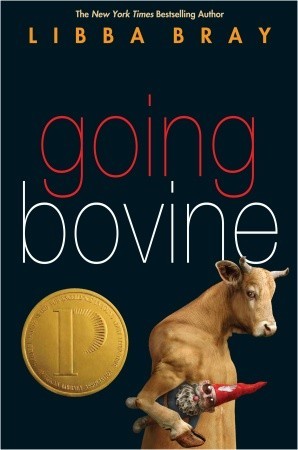
Book Review: Going Bovine by Libba Bray

Book Review: Going Bovine by Libba Bray

Gotta love an author who promotes her book looking this this:

That trailer just cracks me up, and you can get a pretty good sense of just how wacky and weird Libba Bray’s literary creation is by watching her play ukulele in a cow suit.

So… Going Bovine. Big award winner. First published in 2009, it won the 2010 Michael L. Printz Award for young adult fiction. I wanted to love this book, and in parts, I really did.

Going Bovine is the story of Cameron, underachieving nobody shuffling through an underwhelming life: home life unremarkable, school no great shakes, and as for friends — well, they’re more like a group of misfits who tolerate each other because of their common loser/stoner status. Until one day things get weird, Cam starts having seizures and episodes, and ends up in the hospital diagnosed with Creutzfeldt–Jakob disease — that’s mad cow disease to you and me.

Elements of the absurd abound. Cam is below notice in his school until his diagnosis; next day, his school is holding a pep rally in his honor, cheerleaders want to connect with him, and the school faculty seems to think brown and white ribbons (you know, a cow motif) are an appropriate way to show support.

Cam deteriorates rapidly as the out-of-control prions attack his brain, and is soon hospitalized with no hope of recovery. Or is he? In what is either the hallucinations of a slowly dying brain, a journey into a parallel universe, or the craziest buddy road-trip ever, Cam sets out across the South with Gonzo the neurotic dwarf, Dulcie the punk angel, and Balder, the Viking hero/yard gnome. Along the way, they’re chased by fire giants and the sinister United Snow Globe Wholesalers, making pitstops at CESSNAB (The Church of Everlasting Satisfaction and Snack ‘N Bowl), the Daytona Beach Party House, and Putopia (Parallel Universe Travel Office … pia), en route to Disney World, site of Cameron’s happiest childhood memory and the endpoint of Cam’s quest to save the entire world from being sucked into a wormhole.

Libba Bray’s writing crackles with wit, has enough snark and social commentary to delight even the most cynical, and makes the story of a terminally ill teenager pretty fun to read. She sneaks in a lot of insidious little digs, such as the high school teacher prepping his class for the all-important State Prescribed Educational Worthiness standardized test:

Is Don Quixote mad or is it the world that embraces these ideals of the knight-errant that is actually mad? That’s the rhetorical question that Cervantes seems to be posing to us. But for our purposes, there is a right answer, and you need to know that answer when you take the SPEW test.

Or take the CESSNAB sanctuary, where people seek refuge from the harsh world in order to focus on being happy all the time. Everyone bowls a strike, everyone drinks vanilla smoothies, and when they get a hint of stress, they can go bowl some more or maybe buy stuff. As Cam explains:

I take a deep breath; in my head, I list five things I love about myself. “You know what, Gonzo? I want to help you find what I’ve found. Here, have a key chain,” I say, handing him one of the sunny yellow giveaways they hand out whenever you do something even remotely good, like remember to put the toilet seat down. Sometimes they give you a key chain just for showing up.

There’s a lot to love in this book, and ultimately Cam’s journey is both terribly touching and laugh-out-loud funny. And yet, I couldn’t maintain a steady interest throughout. I was completely engrossed for about the first third of the book, and then it just tapered off for me. The road trip elements seem to go on forever, and after a while, it was just all so over the top that it started seeming completely arbitrary. Lots of craziness, lots of hijinks, lots of bursts of insights into the meaning of it all — but as a whole, it was just all a bit too much.

It’s possible that someone in the target demographic for this book might find it profound in ways that I, as an adult, can’t quite get. Maybe I’m not at the right stage of life to fully appreciate all the quirky glories of Going Bovine. In the end, though, I can only assess the book in terms of my own experience, and unfortunately, I just didn’t connect to Going Bovine in the way that I’d hoped.

Save

Save

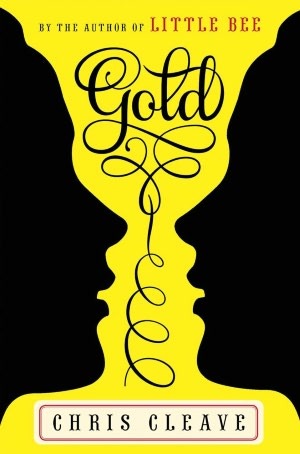
Book Review: Gold by Chris Cleave

gold

When I first read a blurb about Chris Cleave’s new novel, Gold, my initial reaction was basically, “thanks, but no thanks.” A book about athletes? Olympic cycling competitions? Can you actually hear my brain melting?

Luckily, I ended up going with my second, more reasoned reaction, which was more along the lines of “Bicycling? Sounds boring, but… I did like Little Bee, so let’s give it a whirl.” Ha! A whirl! Funny me.

Gold is the story of two British bicycle racers, Zoe and Kate, who have been best friends and arch-rivals since meeting at age nineteen as they joined the elite prospects program of the British national cycling team. Zoe is a damaged soul, who copes with a childhood trauma by pouring everything she has into her competitions. On the track, she’s all power and focus. Off the track, she’s a mess. Kate is kinder and gentler, a fierce competitor but one who also allows herself to feel deeply. Both rise to the top of their sport, competing against each other in the international arena, year after year, to be the one who captures the gold.

Zoe’s extreme need to win is illustrated early on in Gold, when her coach tells her before a race that the worst that can happen is that she wins silver instead of gold, and Zoe responds, “I’d rather fucking die.”

Zoe becomes a superstar after winning four gold medals at the 2004 Athens Olympic Games, while Kate stays home to take care of her infant daughter. Time and again, Kate misses her chance, and as Gold unfolds, the 2012 Olympics represent the final shot for both women – at age 32, Zoe needs to go out with a blaze of glory and Kate is desperate to claim the gold that has narrowly slipped through her fingers throughout her career.

The action in Gold takes place over three pivotal days in the April leading up to the London games. When the IOC makes a sudden rule change, Kate and Zoe’s competition reaches a boiling point, and it becomes clear that only one of them can walk away a winner. As they deal with their hopes, needs, and fears, and their burning thirst for gold, we’re treated to flashbacks that shed crucial light on their tortured past as competitors and friends.

This passage nicely sums up the central internal struggle for Gold‘s characters:

It would be harder for them than they realized, because outside those exalted two minutes of each race, they were condemned to be ordinary people burdened with minds and bodies and human sentimental attachments that were never designed to accelerate to such velocities. They would go through agonies of decompression, like divers returning too quickly from the deep.

Let me stay right up front that I could not put this book down. I started it on Friday night, and finished it on Sunday night right before the stroke of midnight. I stayed up way too late, and even gave up watching some critical TV because I just couldn’t go to bed without knowing how it all ended.

That said, I do have a few minor quibbles about Gold.

Quibble 1: Looming largest is the fact that Zoe is so damaged, so incapable of empathy and compassion, that I had a hard time believing that she and Kate had an actual friendship. Zoe does horrific things to Kate, on and off the track, in order to gain the psychological advantage in competition. Zoe is never “off”; everything she does comes from her need to win. Kate is a feeling, caring woman, and while she takes Zoe in and tries to nurture her, I didn’t quite buy that she would ever trust her.

Quibble 2: Kate is married to Jack, also a gold-medalist in cycling, and their daughter Sophie is an eight-year-old leukemia patient with a Star Wars fixation. I thought the Star Wars elements were a bit overdone; I get that this was supposed to be Sophie’s coping mechanism, but it got in the way of the drama at times and gave Sophie an internal voice that just didn’t ring true for a child her age.

Quibble 3: As an American reader, I wasn’t sure what to make of the superstardom of the British cycling champions. I’m sure I couldn’t name a single American athlete in this sport, and I had to wonder as I read whether cycling really is such a big deal in Britain (note: based on my quick and dirty internet research, the answer would be yes) and whether athletes such as Zoe and Kate really would become faces on billboards, hounded by paparazzi and plastered across tabloids. (This part I couldn’t quite figure out — I’d appreciate enlightenment!)

Quibble 4: The final 10 pages or so seemed a bit tacked on to me, as if the author reached the end and was just trying to tie it all up neatly and quickly. Still, I can’t complain too much. The fact is, I couldn’t stop reading, and once I got to within 50 pages of the end, there was no way I was going to unglue my eyes from this book until I’d read every last word.

Wrapping it all up:

I was concerned that I would be bored by, or at the very least uninterested in, the cycling focus of Gold. Fortunately, I was proven wrong. As a total newbie to the sport of competitive track cycling, I found the descriptions of training regimens, the extreme stress on the body, the physical and psychological strategizing of racing, and the adrenaline-pumping rush of competing in front of a crowd compelling indeed. Being a person whose main form of competition is the annual Goodreads reading challenge, I didn’t think I’d be able to relate to a story about hardcore athletes. Again, I was wrong, and the glimpse into a new world was for me quite fascinating.

I realize I’ve given short shrift in this review to Kate, Jack, and Sophie’s home life and daily struggles. Their family is arguably as much the centerpiece of Gold as the racing is, but I’ve avoided saying too much about this part of the book in order to avoid spoilers and possibly softening the impact of the family’s unfolding calamity for other readers.. Suffice it to say, the relationships were quite lovingly drawn, and I often felt the sorrows of the parents as a punch right to the stomach.

I must say that I wish I’d read Gold when it was released earlier this summer, prior to the London Olympics. I can only imagine how thrilling it would have been to read this book and then watch the real athletes pouring their hearts into their races. Even so, I found myself rushing to Google “Olympic cycling events”  immediately upon finishing this book, and I can tell already that four years from now, when the next Olympics roll around, I’ll be keeping an eye on a new sport.

Save

Q&A with the kiddo: A kid’s-eye view of…

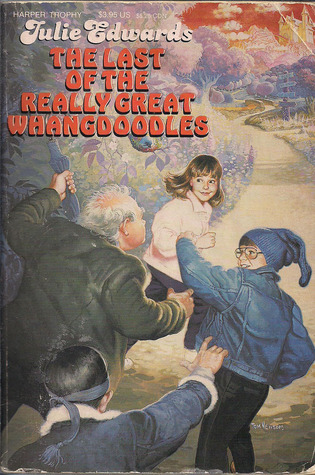
Book Review: The Last of the Really Great Whangdoodles by Julie Edwards

(Mom’s squeal: That’s JULIE ANDREWS, by the way! How can you go wrong with a book written  by Mary Poppins??)

From Amazon:

The Whangdoodle was once the wisest, the kindest, and the most extraordinary creature in the world. Then he disappeared and created a wonderful land for himself and all the other remarkable animals — the ten-legged Sidewinders, the little furry Flukes, the friendly Whiffle Bird, and the treacherous, “oily” Prock. It was an almost perfect place where the last of the really great Whangdoodles could rule his kingdom with “peace, love and a sense of fun”– apart from and forgotten by people.

But not completely forgotten. Professor Savant believed in the Whangdoodle. And when he told the three Potter children of his search for the spectacular creature, Lindy, Tom, and Ben were eager to reach Whangdoodleland.

With the Professor’s help, they discovered the secret way. But waiting for them was the scheming Prock, who would use almost any means to keep them away from his beloved king. Only by skill and determination were the four travelers able to discover the last of the really great Whangdoodles and grant him his heart’s desire.

Proudly presenting this week’s book review, courtesy of my 10-year-old son: Q&A with the kiddo!

In which I ask my kiddo to describe a book he’s enjoyed recently and he gives his opinions, more or less unfiltered by mom. The kiddo’s big sister picked this one out to read to him at bedtime, and it was a huge success. I think he would have liked the book anyway, but certainly the added bonus of quality time with his favorite non-parental person was a big plus.

Without further ado — Q&A with the kiddo:

Q: What book did you read this week?

A: The Last of the Really Great Whangdoodles

Q: What was it about?

A: It’s about these kids who went to the zoo once. They were talking about what’s the most unique animal that they know. This guy came up and said “I think it’s a whangdoodle”. They asked him what a whangdoodle is and he said that it’s sort of like a moose that can change color and has a sweet tooth. The tooth has flowers and stuff on it. They became friends. The children went home and talked about him. One of the kids said, “I don’t believe you.” The scientist said, “Go look it up in the dictionary” and it was there. Then it was Halloween. The kids went to whangdoodle land and met the last whangdoodle. The kids were bragging about the scientist and they brought him back to whangdoodle land and he made another whangdoodle. Then they went back home.

Q: What do the Whangdoodles look like?

Sort of like a moose with giant antlers. They can change colors with their feelings or whenever they want to. They also have a really sweet tooth with flowers on it. They can also take the shapes of other objects.

Q: Did you like the book?

A: Yes. A lot. One of the best books I ever read.

Q: Who are the main characters?

A: Ben, Lindy, Tom, the professor, and the Prock. The Prock is the prime minister. He looks like a human. Also, the whangdoodles.

Q: Can you tell me something funny from the book?

A: The way they say I love you is “umbeldumbeldum”.

Q: Would you want to read more by this author?

A: Depends on what the book is about.

Q: Was this a good reading level for you?

A: My sister read it to me. I didn’t understand everything, but for the words I didn’t understand I asked her. I probably could have read it on my own, but it would have taken me a year.

Q: Who do you think should read this book?

A: You (that means me, good old mom). Kids my age or maybe a year older. Kids who like adventures, intense stories, or stories about creatures would like it.

So there you have it. We’ll be back with more book opinions from my kiddo, whenever I can get him to talk books again.

Book Review: Rape Girl by Alina Klein

Book Review: Rape Girl by Alina Kline

I had some serious reservations about reading a book called Rape Girl. It’s just so… off-putting, I suppose you could say, and almost seemed to imply a trivialization of the subject matter. I’m pleased that that did not turn out to be the case.

Rape Girl is a slim novel which tells the tale of 16-year-old Valerie, a girl who just wants to fit in, but who ends up being referred to as “that rape girl” after she reports a sexual assault. Valerie is relatively new in town, a Catholic living in Mormon Utah, being raised by her mother after the death of her father two years earlier. An outsider in many ways, Valerie throws a party while her mother is away for a weekend, and things quickly get out of hand. Valerie has too much to drink (it’s unclear to me whether she simply had too much alcohol or if something was added to a drink, perhaps) and passes out. The next morning, she wakes to find her clothes being removed by the boy she likes, and is unable to fight him off after saying no.

After admitting what happened to her mother and reporting the rape to the police, Valerie is ostracized at school and dumped by her best friend. She drifts through feelings of depression and worthlessness, and experiences the all-too-familiar tragedy of a rape victim being blamed for her own assault. The in-crowd at school rallies round the attacker, Adam, who remains remarkably clueless throughout, more focused on what Valerie’s accusations might do to his future rather than concerned that he may have hurt someone.

Valerie is repeatedly victimized, by the incessant blaming at school, by the ineffectual school principal who chooses to isolate Valerie as a solution to classroom tensions, and by the legal system that sees her case as unwinnable. It is only by finding new sources of support that Valerie is able to move forward and reclaim her life — not necessarily the life that she thought she’d wanted, but a life that seems promising nonetheless.

Rape Girl is very short, and I think the story ultimately suffers a bit because of the length. There are places throughout where more explanation and more background might have been helpful. Valerie’s family life is outlined, but not explored in any great depth. I had a hard time getting a good sense of the mother’s character, and since she is Valerie’s main adult support, it seemed to me that we should have gotten to know her a bit better. In the aftermath of the rape, Valerie is befriended by a girl from a large Mexican family, and perhaps if there was more time spent on character development, Sandrina and her family might have seemed less like a stereotypical token ethnic element. Valerie’s journey toward healing also seemed unrealistically quick; again, this is an area where more exploration might have benefited the overall quality of the storytelling.

Aside from these areas of weakness — a case where more might have been better than less — I found Rape Girl to be a sad but all-too-believable story, and one that could have an important impact on teen readers, both male and female.

Review copy courtesy of namelos publishing via Netgalley.

Book Review: The Last Survivors series by Susan Beth Pfeffer

Reading Ashfall by Mike Mullin this week brought to mind another powerful young adult series about a global natural disaster and its aftermath. I read The Last Survivors series (by Susan Beth Pfeffer) last year. This trilogy also deals with teens struggling for survival in the wake of a catastrophe. I have no idea if the science of this series makes any sense whatsoever, but despite that, the books are gripping and well-written, and I thought I’d pass along these mini-reviews for any YA fans who missed the books when they came out:

Book 1: Life As We Knew It

This young adult novel starts on familiar ground — the diary of a teen-aged girl, with the not-too-unusual interests of boys, high school, figure skating, and the internet. Miranda’s world quickly changes when an asteroid collides with the moon, knocking its orbit out of whack, and creating worldwide catastrophe. Tsunamis, floods, volcanoes, and earthquakes destroy life as it once existed, and Miranda’s world narrows to the singular focus of survival. Miranda and her family struggle to stretch their meager food supply and to survive the ghastly winter once the sun has been blocked by volcanic ash, and it’s a mesmerizing peek into a life of desperation. The author does a masterful job of portraying the bleakness, the suffering, and the despair of the family as they count the few remaining cans in the pantry and realize how many days they have left before they starve. I could feel the piercing cold in my bones as I read Life As We Knew It, and couldn’t put it down. Well done!

Book 2: The Dead and the Gone

The Dead and The Gone is a companion book rather than a sequel to Life As We Knew It. The same events unfold in this book as in Life As We Knew It, but this time around the story centers on Alex Morales, a 17-year-old boy living in Manhattan with his large, Catholic, Puerto Rican family. As the disaster unfolds in the city, the horror is magnified by the lack of resources and lack of compassion in the metropolitan setting. Alex struggles to care for his two younger sisters, not knowing if their parents have survived, and must barter and “body shop” (stripping sellable goods off the dead) in order to bring home the precious cans of food he needs to keep his sisters fed. Throughout their ordeal, their faith and love sustain them, and Alex’s bravery is quite remarkable. This book does not dwell quite so much on the events involving the moon, so that a reader who hasn’t read Life As We Knew It might find the narrative a bit abrupt. However, reading it as a second book in a series, The Dead and The Gone was a moving story which left me eager for the third.

Book 3: This World We Live In

I was probably least moved by This World We Live In, in which the lives of the main characters from books one and two intersect. I found Miranda and Alex quite compelling on their own in the earlier books, but their mingled story in the third book felt overly contrived to me. In This World We Live In, Miranda’s father and his new family arrive on Miranda’s doorstep with Alex in tow, and the struggle for survival continues. New hope is found, lost, and found. The blended families have to deal with even more tragedy, and must set out in search of long-lasting solutions yet again. I suppose the author felt a need to wrap up the trilogy by bringing the storylines together, but this third book seemed a bit superfluous to me. Am I glad I read it? I suppose so — I’m a “completist”, so it would have irritated me to know there was a third book out there and not read it. Still, I was much more captivated by the stories in the first two books, and I could see reading them as stand-alone novels.

All in all, I think the author did a terrific job of conveying the terror of living through disaster, the overwhelming fear experienced by young people who must grow up too fast and shoulder adult responsibilities, and the helplessness of trying to hold a family together when the world has fallen apart. I recommend this series, either as individual novels or as a trilogy, and look forward to reading more by this author.

Book Review: Ashfall by Mike Mullin

Book Review: Ashfall by Mike Mullin

In the world of young adult fiction, the sub-genre of global natural disasters is one I find particularly intriguing. When life as we know it is suddenly wrenched away from us, what’s left, and how do we survive? In the best of these types of YA novels, we follow a sympathetic main character on a trajectory from childhood to unexpected early adulthood, as physical survival and the struggle to retain human morality force the character to shoulder responsibility and find his or her untapped strengths and determination.

I’m happy to place Ashfall in the “best of” category. Ashfall is the story of 15-year-old Alex, a normal, somewhat sullen suburban teen boy whose world is swept out from under him:

I was home alone on that Friday evening. Those who survived know exactly which Friday I mean. Everyone remembers where they were and what they were doing, in the same way my parents remembered 9/11, but more so. Together we lost the old world, slipping from that cocoon of mechanized comfort into the hellish land we inhabit now. The pre-Friday world of school, cell phones, and refrigerators dissolved into this post-Friday world of ash, darkness, and hunger.

Alex has refused to go on a family visit to cousins in Illinois and is therefore home alone in Cedar Falls, Iowa when all hell breaks loose – more specifically, when the long-inactive supervolcano located under Yellowstone erupts with spectacular and devasting impact. Civilization dissolves practically immediately as the world is inexorably coated with a heavy layer of ash. Scavenging, looting, mistrust, and violence are rampant among the survivors of the initial disaster, and starvation is lurking right around the corner. Within days, Alex begins to shrug off the last vestiges of his childhood, leaving the questionable safety of his neighbors’ protection and striking out cross-country through a ruined, nightmarish landscape on a quest to reunite with his parents and younger sister.

Along the way, Alex is forced, time and again, to choose between self-interest and doing the right thing. He receives help when he expects none, and chooses to help others, even when doing so imperils his own meager supply of food and water and could mean the difference between life and death. What’s interesting here is that Alex is not portrayed as a selfless hero. The author shows us Alex’s internal struggle, his thought processes, and his decision to be a person who tries to do right. It’s not easy for him, but it’s a sign of Alex’s maturation that he realizes that securing food and shelter will not be enough for him if he has to shed his essential goodness; physical survival without the survival of his humanity will not suffice.

We follow Alex along a difficult and sometimes gruesome path. He meets Darla, a strong-willed, feisty, talented farm girl with her own tragedies to confront and accept. Darla becomes Alex’s travel companion and soul mate, and their deepening trust and affection for one another help give Ashfall much of its heart. What could have been merely an exciting adventure story becomes a much more personal journey toward love, family, and adulthood.

When I picked up Ashfall, I had expected to read a story about physical survival in a nightmarish, post-disaster world. I’m pleased to be able to say that Ashfall provides a deeper, more moving experience than expected.

The sequel to Ashfall, Ashen Winter, is due out in October 2012, and I’m very much looking forward to reading it. I’ve become quite fond of Alex and Darla, and I can’t wait to see how their story continues to unfold.

Book Review: Some Kind of Fairy Tale by Graham Joyce

Book Review: Some Kind of Fairy Tale by Graham Joyce

Fifteen-year-old Tara Martin disappeared without a trace on a beautiful spring day when the bluebells were all in bloom. Twenty years later, on Christmas Day, Tara knocks on her parents’ door, still looking like a teenager and with a strange tale to tell. Tara’s reappearance causes relief, joy, and turmoil for the family she left behind, as well as for her former boyfriend Richie, whose life went completely off the rails after he was accused of foul plan in Tara’s disappearance.

Tara’s return is not, perhaps, as she expected:

Twenty years is, after all, a long time. We are not the same people we were. Old friends, lovers, even family members: they are strangers who happen to wear a familiar face.

Tara tells an impossible tale, of a romantic man on horseback, travels to a different world, and what to her was a six-month stay in a land both strange and beautiful. Tara’s brother Peter is determined to figure out the truth of what happened to Tara, and enlists the aid of his wife, his former best friend Richie, and a retired psychiatrist to sift through the conflicting threads of her story.

Graham Joyce is a gifted writer whose words and tempo are lilting and lovely. He has a talent for taking the every day and making it mysterious, adding a rhythm to the routine occurrences within a family that bring in the larger world and its unknowability. Characters are sharply drawn and defined, including Peter, a tired but devoted family man, passionately in love with his wife, hurt by the loss of his friend, joyful yet resentful of Tara’s return; Mrs. Larwood, the elderly neighbor who may in fact have her own tale to tell; and Richie, stuck in the past, alone and loveless, having put his life on hold once Tara disappeared.

I had expected Some Kind of Fairy Tale to be a more or less traditional tale of a mortal crossing over into the land of the fae. As it turns out, it is and it isn’t. The changing points of view within the story heighten the mystery, and make it impossible to come to any one particular conclusion — although the end of the story certainly made one explanation seem more likely than others.

Each chapter begins with a quote, and I found these entirely delightful, so much so that I’d like to collect them all and refer back to them time and again. A favorite: “When I examine myself and my methods of thought, I come to the conclusion that the gift of fantasy has meant more to me than any talent for abstract, positive thinking.” (Albert Einstein)

The author’s previous novel, The Silent Land, is one of the most exquisite pieces of fiction I’ve ever read. Some Kind of Fairy Tale did not have the same impact on me and I wouldn’t rate it quite as highly, but it is quite lovely in its own right and I can recommend it whole-heartedly.

Graham Joyce warns us of the shifting nature of the narrative and the truths contained therein early on:

Of course, everything depends on who is telling the story. It always does.

It’s entirely possible that I don’t entirely understand what really transpired in this haunting tale. Then again, maybe we’ll all understand it differently, and I think that’s as it should be.