Book Review: Nick & Norah’s Infinite Playlist by David Levithan & Rachel Cohn

Book Review: Nick & Norah’s Infinite Playlist by Rachel Cohn and David Levithan

I love being proved wrong about a book, and Nick & Norah’s Infinite Playlist is a good example of a happy surprise for me.

It’s possible that I just picked the wrong time of day to start this book. Perhaps I was simply too tired to give it a chance. I read about 50 pages and jotted down some quick notes before heading off to bed. My notes included phrases such as “no point of entry”, “exclusionary feel”, “impenetrable”, and “can’t relate”. Not a very auspicious beginning, to say the least.

And yet… when I continued the next day, I found my attitude toward this book completely turned around. So how and why did that happen?

For starters, a brief synopsis:

Nick is the 18-year-old bass player in a teen “queercore” punk band, who feels music — and life — deeply and passionately. Nick has been dumped recently by his girlfriend, and when she shows up at his gig, he impulsively asks the flannel-wearing girl at the bar to be his fake girlfriend for five minutes. The flannel-clad girl is Norah, who has just turned down Brown University in order to follow her on-again, off-again boyfriend to a “kibbutz” in South Africa for a year, and who is starting to realize that everything in her life may be a big mistake. Nick and Norah fake-kiss… but boy, it feels good, and thus starts a night of music, clubs, city streets, drunken friends, cab rides, Oreos, and dancing in the rain.

The book is written in alternating chapters, switching between Nick’s narration (written by David Levithan) and Norah’s (written by Rachel Cohn). The pace is quick and sharp, with dialogue that is witty, vulgar, and in-your-face. Nick and Norah are a couple of angst-ridden, deeply introspective teens, who think deeply about life, love, music, friendship, and finding meaning in the world. The beauty of this book is in the inner workings of Nick and Norah’s minds and in seeing the interplay from one chapter to the next, as Nick and Norah reinterpret each other’s actions and words, and we see the chasms of misunderstanding that must be bridged over the course of one night.

I’m always fascinated by the single-night story — they meet, they share an intense moment… but will they part forever when the sun comes up? Of course, the best example, in my mind, is Before Sunrise, a movie I could watch again and again. Nick & Norah ends up fitting nicely into this mode, showing how a chance encounter blossoms into an unexpectedly delicious and slightly dangerous, extremely intense connection. The rising sun feels like a deadline, and the only question is whether to say good-bye or face a new day together. I won’t say which happens here; in Nick & Norah’s Infinite Playlist, it’s the journey that matters.

So why the about-face for me regarding this book? Again, perhaps it was just a matter of starting the book at the wrong time, but I found the early chapters somewhat off-putting due to their setting in the Lower Manhattan punk-rock scene. The club, the people, and the musicians — all seemed to be flashing the words “not for you” at me in big neon letters. I read a lot of young adult fiction. I am definitely not a young adult myself. But as I’ve said many times, the best YA fiction is just good fiction, period. You shouldn’t need to be a teen or twenty-something to read a book about people in that demographic, so long as it’s a good book with well-drawn characters. At the beginning of Nick & Norah, I felt that age would be a barrier to my enjoyment. As the story progressed, however, I began to really enjoy Nick and Norah’s explorations not just of each other but of their own fears and hopes. The more deeply the characters journeyed, the more I came to appreciate the passion and emotion expressed by the gorgeous, full-frontal, no-holds-barred writing.

I was originally drawn to this book after having read the authors’ two other collaborative efforts, Dash & Lily’s Book of Dares and Naomi & Ely’s No Kiss List. Both were lovely, and both featured the pattern of alternating voices that work so well in Nick & Norah. As an added attraction, all three books read as love letters to New York, and it’s great fun to revel in this glorified, gritty version of the city, its people, and its hidden treasures.

A note: I have not seen the movie version of Nick & Norah’s Infinite Playlist, and I’m not sure that I’d want to. For me, the glory of the book is in getting inside the characters’ heads, and I can’t imagine that translating well to the big screen. Plus, from the movie stills I’ve seen, the casting does not at all match the pictures in my head, and I don’t want to replace “my” Nick and Norah with the Hollywood version. (But if you’ve read the book and seen the movie, please do share your thoughts! How do they compare?)

All in all, I’m very glad that I stuck with this book long enough to get past my initial turned-off phase, as I ended up enjoying it very much. This is a short, quick, intense read, but one which really held my interest and touched my emotions as well.
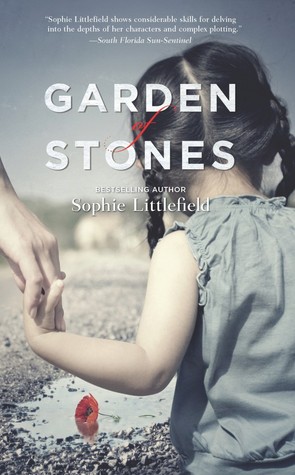
Book Review: Garden of Stones by Sophie Littlefield

Book Review: Garden of Stones by Sophie Littlefield

gardenIn December 1941, 14-year-old Lucy Takeda is the cherished daughter of a well-to-do Japanese-American couple living in Los Angeles. Lucy’s father is a successful businessman. Her mother is an enigmatic beauty who turns heads whenever she walks down the street. Lucy lives a happy life with close friends, a good school, and a bright future, until the Japanese attack on Pearl Harbor spells the end of life as she once knew it.

Before long, Lucy’s father is dead of a heart attack, and she and her mother, as well as all of their friends and neighbors, are forced from their homes as a result of President Roosevelt’s executive order of 1942, which designated the entire Pacific coast as an exclusion zone and forced thousands of Japanese-Americans into internment camps. Lucy and her mother Miyako are sent to Manzanar, the roughly built camp in the Sierra foothills of California, where they are assigned a flimsy wooden barrack in which to live and where their world becomes restricted to one square mile crammed full of their fellow internees.

Compounding the difficulty for Lucy is her mother’s instability. While in today’s world, Miyako might have been treated and medicated, at Manzanar in those times, Miyako was simply viewed as difficult or unlikeable, rather than having her bipolar disorder recognized or accommodated. Miyako’s beauty, however, does not go unnoticed, and she is soon the recipient of unwelcome but unavoidable attention from the powerful men who run the camp. Events soon spiral out of control, and despite their efforts to protect one another, Lucy and Miyako’s time at Manzanar can only end in tragedy for both.

Garden of Stones is a story within a story, framed by events in 1978 in which Lucy’s daughter Patty seeks answers when Lucy’s long-secret past resurfaces unexpectedly. As Patty starts to dig through clues and finally gets her mother to open up, we see the events from the 1940s from Lucy’s perspective, providing an interesting contrast between Lucy’s outlook as a teen and as a middle-aged adult. Lucy’s life has not been easy, and although she has raised Patty to the best of her ability, by keeping her past a secret she has kept her daughter from ever truly knowing who she is and what she’s experienced.

I found myself quite moved by the tragedy of Lucy’s story, in which we witness a life shattered by war and prejudice, a young girl who had everything she cherished ripped away from her, and yet who somehow manages to survive into adulthood and provide a safe and loving home for her child. Garden of Stones presents two very different mother-daughter relationships, and poses some interesting questions: What does it mean for a mother to protect her daughter? Are extreme measures justifiable if taken out of love? Is pain inflicted out of love preferable to pain inflicted through cruelty? How does one survive after enduring loss after loss?

Author Sophie Littlefield explores this shameful chapter from America’s past with an unflinching eye. We see the devastation from Lucy’s perspective, as a child born and raised in the United States, who speaks not a word of Japanese, is suddenly branded as “other”. We witness the terror of the Japanese-American community in the days following Pearl Harbor, as families frantically burn any Japanese goods or relics in their homes so as not to be seen as sympathizers — or worse, as spies or conspirators. We see friends and neighbors close their doors, turn their backs, and otherwise abandon the people they’d lived alongside, as the Japanese-Americans are forced to sell off their belongings for a pittance before being exiled to the internment camps.

But the larger, historical context is not the only source of sorrow and terror in Lucy’s life, and it is her more personal story that truly gives Garden of Stones its emotional richness. Despite the hardships and privations at Manzanar, Lucy seeks out happiness and friendship, but the circumstances of camp life and her mother’s role in Manzanar serve again and again to bring Lucy pain and suffering.

While some of the more dramatic events of the story are fairly well signaled ahead of time, there are several very surprising turns of events that made me go back through the book and reread certain passages with a fresh eye. I found the Manzanar timeline much more compelling than the 1970s storyline, and yet Patty’s exploration of the past served as a very effective means of slowing unearthing the secrets of Lucy’s life and understanding how these secrets continue having an impact even into the next generation.

Sophie Littlefield has crafted a well-written, emotionally intense tale, full of rich detail and with several well-placed, shocking plot twists. Garden of Stones is a moving story of love between mothers and daughters, of the search for meaning despite the cruelties inflicted during a hard life, and of the many different roads toward hope and survival.

Review copy courtesy of Harlequin via Netgalley

Book Review: The Round House by Louise Erdrich

Book Review: The Round House by Louise Erdrich

https://i0.wp.com/d.gr-assets.com/books/1352999408l/13602426.jpg

Main character Joe is 13 years old the summer that his life changes forever. Joe is the devoted, mostly well-behaved son of two loving parents, growing up on an Ojibwe reservation in North Dakota. His father is a judge in the tribal legal system; his mother works in the all-important tribal registry office, handling the complex web of rights and obligations that are tied into a person’s genealogy and ancestry.

At the start of that fateful summer in 1988, Joe’s mother is brutally attacked and raped. Joe’s secure home and safe world is turned upside down, as the hunt for the rapist and the quest for justice consume the family. Ultimately, however, it is the tangled mess of legalities stemming from early tribal treaties and the creation of the reservations that determines the outcome of the arrest and prosecution of the perpetrator. Different laws apply to different jurisdictions, and the case ends up resting on the question of where the attack took place. Was it reservation land? State land? Federal land? Unless the jurisdiction can be determined, there can be no legal process, and so even though the identity and whereabouts of the rapist are pretty quickly determined, it is not at all clear that the man can or will be tried for the crime.

Those are the bare bones of the plot. At a deeper level, The Round House is a meditation on so much more. Some of the most compelling aspects of this book include:

– The sense of family and community present among the people living on the reservation. Joe’s immediate family is small, but his extended family is huge. Everyone is a cousin or an in-law; everyone plays a role in the lives of others. The support and connection is palpable. There is no hiding here — wherever Joe goes, he is known and welcome.

– The depth of the friendships among the boys in this story. Joe’s friends are his brothers. They have adventures, they get up to mischief together — but they have each others’ backs and their bond is one of love and dedication. The relationships among these boys are quite lovely to read about.

– The outrage over the crime that was committed. I think we are all too used to the awful stigma that still attaches itself to rape survivors in our society, but that sense of shame is completely absent here. Joe’s mother suffers deeply, but her suffering is from fear of her attacker and what he may yet do, to her and to others. What is clear here is that Geraldine was the victim of a violent crime, and she is supported by her community without question and without stinting. The house overflows with casseroles; Joe is looked after by not just his aunt and uncle but by everyone. No one hesitates to ask Joe how his mother is or to offers words of kindness. It’s a refreshing attitude that condemns the attacker without in any way blaming or belittling the woman who was attacked.

– The linking of traditional beliefs to the modern occurences. The elders in the family are respected and honored. Joe’s centenarian grandfather tells tales of buffalo women and evil spirits, but these are not just ancient myths — various facets of the stories come into play in the search for justice for Geraldine.

– The reminder that what may seem to many as an unfortunate chapter in US history is still having an impact on real people’s lives to this day. The daily frustrations of living with the outcomes of the tribal treaties is a very real part of the characters’ experiences. An incredibly powerful scene takes place about 2/3 of the way into the book, as Joe asks his father why he bothers — why does he continue trying cases in the tribal courts when nothing seems to make a difference? In response, Joe’s father pulls an old, moldy casserole from the back of the fridge where it had been forgotten, dumps it onto the table, and then begins to pile utensils and kitchen implements on top of it:

That’s it, he said.

I must have looked scared. I was scared. His behavior was that of a madman.

That’s what, Dad? I carefully said. The way you’d address a person in delirium.

He rubbed his sparse gray whiskers.

That’s Indian Law.

I nodded and looked at the edifice of knives and silverware on top of the sagging casserole.

Okay, Dad.

He pointed to the bottom of the composition and lifted his eyebrows at me.

Uh, rotten decisions?

Joe’s father goes on to explain how he and his fellow judges, in case after case, are attempting to overcome the poor foundations of their legal system by creating strong decisions on top of these, hoping to some day create a stronger framework for laws that support their people’s lives. It’s a lovely scene, showing in few words both the depths of the problems facing the tribe and the strength of the connection between Joe and his father.

The plot of The Round House swirls around the traumatic events of that particular summer, but in many ways the story is a coming-of-age tale with the universal characteristics of a boy’s emergence into manhood. Through the attack and its aftermath, Joe for the first time sees his parents as vulnerable. He starts to realize that they have inner lives, fears and hopes, apart from him, and that they can’t always protect themselves or him from the harsher realities of life. Joe and his close friends are on the cusp of their teen years, developing sexually, exploring the boundaries of freedom, reveling in their small conquests and steps toward independence. Much of the climax of the story has to do with Joe, with the assistance of his friends, taking affirmative steps on his own toward what he feels must be done. Joe has gone from the protected child of the family to a young man who wants to be the protector, and while he may stumble along the way, it is this significant summer that propels him forward into the kind of man he will grow up to be.

It’s easy to see why The Round House won the National Book Award in 2012. This beautifully written, powerful story of family and friendship, crime and justice, tradition and history is filled with memorable, well-drawn characters, dramatic plotting, and moral conundrums. There’s a lot to think over, and I’m still mulling through the events and implications of the various plot turns.

The Round House is not light reading, but it’s certainly worthwhile. I recommend it highly, and look forward to exploring more of Louise Erdrich’s work.

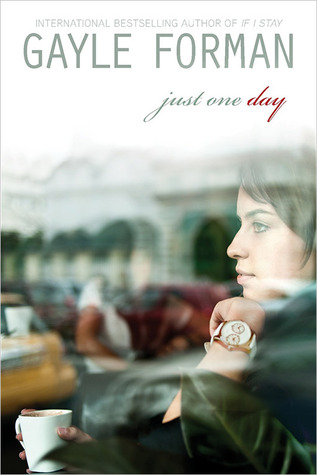
Book Review: Just One Day by Gayle Forman

Just One DayAnother YA novel about “insta-love”? Haven’t we read enough of these already? Those were my thoughts when I picked up a copy of Gayle Forman’s new book, Just One Day. And I’m pleased to be able to report that my expectations about this book were quite wrong.

Main character Allyson is 18, fresh out of high school, and on a whirlwind, parent-sanctioned tour of Europe (“Teen Tours! Cultural Extravaganza” is the too-exuberant-for-words name of the program), along with her bestie Melanie. It’s all a big blur, during which the teens are shuttled from one significant destination to another, chaperoned and dosed with lessons about history and culture. Melanie hits the pubs and suffers hang-overs daily, while Allyson goes along dutifully, always the good girl, doing what’s expected of her.

On the final day of the program, as the group waits for a production of Hamlet in Stratford-upon-Avon, a free-spirited group of actors (whose troupe is called Guerilla Will)  invites the gang to ditch Hamlet and come see their production of Twelfth Night instead. In a rare burst of spontaneity, no doubt helped by the fact that the lead guy is so cute, Allyson decides to take a chance, and she and Melanie head off to the canal basin to see a free-ranging, outdoor, wildly inventive and exhilarating production. A perfect end to a so-so trip, and the girls are ready to catch the train to London and fly back home to their normal lives. Except… on the train, the cute guy appears, starts chatting with good girl Allyson, and in a moment that changes everything, invites (or challenges) her to hop a train to Paris — for just one day.

Cute guy’s name is Willem (he’s Dutch and dreamy), and he christens Allyson Lulu, in honor of Louise Brooks and Allyson’s new hair style. Lulu and Willem spend one fabulous day wandering the streets and alleys of Paris, living free and large, and falling — hard — for one another. Or so Allyson thinks… until she wakes up alone the next morning. Willem has left her without a trace, and Allyson’s heart is broken. Not only that, but our young lovers never got around to exchanging email addresses, cell phone numbers, or proper names (Willem only knows our sweetie as “Lulu”), so when the guy is gone, he’s gone for good.

And here’s where things get really interesting. Up until this point, I was a bit half-hearted about yet another story of a somewhat shy girl meeting the gorgeous guy of her dreams and falling instantly and irrevocably in love. In Just One Day, it’s not so simple. Allyson does fall hard for Willem, and he does seem to fall for her too — but it’s also clear that this is a guy with a girl in every city across Europe. Dude is a player, to put it mildly. So when he abandons Allyson after their one night, is it really so surprising?

Allyson heads home full of shame and self-loathing. She knew he was a chick-magnet. She saw his little black book. What else did she expect? Unfortunately, her one day of love in Paris ruins the start of her freshman year of college, and Allyson spends months in a deep depression, barely getting by academically, distancing herself from her roommates, and realizing that her friendship with Melanie has run its course as well.

The layer of all of this that’s really finely written and well-thought out is that Allyson is an only child, daughter of two parents who have raised her to be dutiful and good and to always aim to please. Allyson’s mother in particular seems to be reliving her own missed opportunities through Allyson. She picks her daughter’s classes, down to the exact time of day, shops for her clothes, and plans every moment of her life. Allyson is pre-med because that’s what her parents have convinced her she wants. She collects antique alarm clocks (weird, right?) because her mother decided it would be fun for her to have a collection. On and on, we see Allyson’s mother controlling her every move. But after Paris, Allyson finally starts to realize that maybe what she’s been told she wants isn’t really what makes her happy.

Over the course of her freshman year, Allyson slowly starts to find her own way, and it’s eye-opening. As she breaks out of her shell, she comes to realize that what she wants for herself may not match what her parents want — and more importantly, that she has the power to make her own decisions and find her own way. What I ended up loving about this book is the gradual, painstaking development of Allyson’s independence and self-esteem. She finally begins to emerge from her mother’s shadow and the sense of what is expected into a strong young woman who is willing and eager to take chances. By doing so, she’s ultimately able to embrace the choice she made to spend “just one day” in Paris, and many months later, to begin to consider the possibility that events may not have been exactly as she’d perceived them to be.

The book asks some interesting questions: Are fate and accidents really the same thing? Is there really only one great love in a person’s life? Is being good enough? How does a person figure out how to be? Through Allyson, we see a young woman’s journey toward individual growth and empowerment, and it’s actually quite lovely to watch her finally take the reins of her own life and start setting her own course.

The writing in Just One Day is fast-paced, a nice mix of introspection and adventure, and the plot zips along from month to month in engaging snippets and snapshots.

I have only two minor quibbles with Just One Day:

First — and perhaps it’s just that I’m not the target demographic and therefore can’t appreciate the underlying urge toward free-spiritedness — I have little to no tolerance for plot points that revolve around leaving important things to the whims of chance. Remember the movie Serendipity (didn’t like it) or even Before Sunrise (loved it), where the characters fall in love at first sight, but leave it up to fate to bring them back together, rather than — oh, I don’t know — exchanging vital information? Willem and Lulu/Allyson do the same thing in Just One Day, and it strains belief. Seriously, at some point it would have made sense to at least get each others’ last names… or phone numbers… or something. It’s the information age, people! Share your information!

Second, as part of my reading resolutions for 2013, I vowed that I would not start any new series. It was not until I was already half-way through the book that I saw the little blurb on the back announcing that “Just One Day is the first in a sweepingly romantic duet of novels.” The follow up novel, Just One Year will be released in the fall of 2013. Gah. Of course, I’ll read the next book, but I’m a little miffed about it all.

That said, Just One Day would work just fine as a stand-alone novel. It does have a very open-ended conclusion, but that’s not necessarily a bad thing. The book’s end leaves a lot of questions unanswered, and it’s certainly not clear what awaits Allyson. But that’s life, isn’t it? By the end, our main character has made choices, taken risks, and gained a willingness to take a chance and see how it turns out. Anything can happen when you’re open to life, and I think that’s more or less the point.

I enjoyed Just One Day very much (had a few bleary-eyed days following a few nights of staying up past midnight because I couldn’t put the book down), and I’m looking forward to reading more by Gayle Forman. The author captures the voice of her young adult characters in a way that is convincing and true, and I found myself enchanted by Allyson’s adventures and discoveries. Also — Paris!

Borrowing from the kiddo: 3 graphic novels by Doug TenNapel

Sometimes, you just have to take a break from reading “grown-up” novels and indulge in a bit of what the kid is reading. And that’s what I did last night. I raided my 10-year-old’s bookshelves and had a terrifically enjoyable time reading three graphic novels by the very talented author and illustrator Doug TenNapel.

First off, how great are these titles?

Ghostopolis
Bad Island
Cardboard

Herewith, my mini-reviews:

In Ghostopolis, a boy with a terminal illness is accidentally sent off into the spirit world a bit ahead of schedule by an over-eager ghost wrangler. Once there, Garth befriends a skeleton horse, fights off all sorts of creepy bad guys, meets up with some surprisingly familiar ghosts, and has real insights along the way. There’s plenty of action, some dark and semi-scary dudes to contend with, but also a sense of humor and unexpected rays of hope. My son read this one a few months ago, and has been after me to read it ever since.

Next up, I read Bad Island, in which a family sets out on a boating trip, much to the annoyance of their teen-age son and younger daughter. It’s clear that this is a family that doesn’t spend much time together, and the prospect of being out on the water without all the modern conveniences to distract them does not appeal to the kids at all. When a freak storm destroys their boat, the family is stranded on a mysterious island, where nothing seems exactly normal. Adventure ensues; is this island “bad”, or is there some other explanation for all the weird creatures, hidden passageways, and indecipherable markings? Naturally, in order to survive, the family has to work together, and the kids find themselves saving not only themselves but also their parents as they unravel the secrets of the island.

Finally, the glorious Cardboard! In Cardboard, a down-on-his-luck widowed father who can’t find work comes home with the only birthday present he can afford for his son: a cardboard box. But when Cam and his dad build a cardboard man out of the box, it comes to life, and soon so do all sorts of other creatures. Wrapped up in the wonder of this magical cardboard man, they forget the two rules that came with the box: Return all unused scraps, and don’t ask for any more. When the neighborhood bully catches sight of Cam’s new friend, a cardboard war is on — and gets so out of control that the world may actually come to a cardboard end, unless Cam can figure out a way to save them all.

As you can probably tell, I loved all three of these — probably Cardboard most of all. What’s not to love? In each, the adults are well-intentioned but fallible. The kids and adults end up saving each other and saving the day. Love triumphs, not in a gooey way, but by bringing out the characters’ inner toughness and giving them reason to fight for one another. Even a kid who might not think of himself as brave can end up being a hero. And when things get weird, creativity and a willingness to embrace the weirdness just might be enough to get out of a truly tight spot.

The illustrations are glorious — occasionally dark, always inventive, with grotesque creepy-crawlies, truly funny bad guys, and some lovely images of the different shapes and looks of families.

My son, the ever-reluctant reader, is actually willing to read these books without poking, prodding, or being threatened with the loss of TV/computer/video game access. And if that’s not success, what is? I’d recommend these books for middle grade readers, probably in the 4th – 7th grade range… and for adults who enjoy a good adventure with heart as well.

Book Review: Mrs. Queen Takes The Train by William Kuhn

Book Review: Mrs. Queen Takes The Train by William Kuhn

In this terrific, warm-hearted novel, life at the palace just isn’t what it used to be, and The Queen seems to have come down with a case of the blahs. Relegated to a role that is mostly ornamental, and still heart-broken over the family disasters of the last decade or so, The Queen goes through her days doing as she ought. She was raised to always follow directions and live up to expectations, and that she does, day in and day out. But what about happiness? What about feeling useful? Mostly, The Queen feels like too much has passed her by, and as she struggles to keep up with her new acquaintances Mr. Google and Miss Twitter, the poor dear mostly winds up out of sorts and at loose ends. When, by chance, The Queen finds herself outside the palace walls, unaccompanied and cleverly (although accidentally) disguised in a borrowed hoodie, she gets an unexpected taste of freedom and makes a mad dash toward a day of adventure.

A cast of supporting characters, all rather isolated in varied ways and yet united in service to The Queen, round out the story nicely. There’s Shirley, long-tenured dresser to the Queen who harbors a lingering resentment toward the upper-class ladies who treat servants of her status with scorn; Lady Anne, hanging onto the title despite having lost all fortune and family, living off her meager allowance as The Queen’s chief lady-in-waiting; Luke, a young military officer who ably serves The Queen but is tormented by lingering traumas from his time in Iraq; William, senior butler, devoted to a life of service but hungry for love as well; Rebecca, the lonely, insecure, but beautiful caretaker of The Queen’s horses; and Rajiv, would-be poet and current shopboy, who just happens to sell The Queen’s very favorite cheddar.

As The Queen sets off on a jaunt toward Scotland to visit a place of happy memories, she encounters the men and women of her kingdom and, for the first time in her life, has conversations with ordinary people, unhindered by social protocol and formalities. As The Queen takes taxis, buses, and trains, she is in her element as her years of official socializing pay off. She meets people, she engages them in conversation, she draws them out, she makes them feel interesting. This is something she is good at! By the end, The Queen has regained a new spring in her step, and though she returns to her regular life without much fuss, it’s clear that she’s going to shaking things up a bit in the days to come.

I loved the writing in Mrs. Queen Takes The Train. Early on, this sentence gave me a good sense of the fun yet to come:

She stalked toward the computer on the other side of the room as if it were game and she meant to shoot it.

An ongoing theme throughout the book is The Queen’s yoga practice — which of course made me wonder, does the real Queen do yoga too? It certainly seems beneficial to the fictional Queen, and I was highly amused picturing her in plank or warrior pose.

I should make clear that this is by no means a silly book, although there’s certainly much warmth and humor here. Yes, it’s kind of funny to think about the Queen of England taking public transportation, running around in borrowed hoodies, and having to dig through her ubiquitous handbag for train fare. But within Mrs. Queen Takes The Train is a deeper thread of inner life. All of the characters, in their own ways, are lonely people, devoted in one way or another to their roles and positions, but missing out on meaningful human connection. The pains and sorrows of growing older, the isolation of never finding love, the ache that can arise from loss that’s kept hidden inside — all are dealt with sensitively and realistically. The characters in this book may live in a castle, but all — even The Queen herself — come across as real people with real crises, and you can’t help but love them all quite a bit by the time the book is through.

As an American reading Mrs. Queen Takes The Train, I was unfamiliar with many of the titles and idioms related to palace life and the monarchy in general. Thank goodness for the internet — I now know what an equerry is! (Do you?)  I know that for many in the US, the British monarchy is viewed as an amusing old token of days gone by, not good for much more than celebrity photo shoots, mildly interesting gossip and scandal, and the occasional big hoopla of a royal wedding. Mrs. Queen Takes The Train does a wonderful job of showing how the royal family influences and is influenced by English modern society, and the role they serve in maintaining tradition and a link to living history.

I enjoyed Mrs. Queen Takes The Train very much, for its gently amusing story line, its warm and lovely characters, and its peek behind the castle walls. We can only wonder whether The Queen’s inner life, as portrayed so richly and movingly here, relates in any way to the experiences of the real Queen of England. Still, I walked away from reading this book with a renewed fondness for Her Majesty — long live The Queen!

Book Review: The Cranes Dance by Meg Howrey

Book Review: The Cranes Dance by Meg Howrey

Reading a book about ballet dancers is a bit like studying anthropology or reading fiction set in an exotic land. Ballet is a world and a culture unto itself, with its own customs, morals, standards, language, costumes, and rituals. Those at the peak of the profession form an insular little society, truly an alien species in the eyes of the non-ballet world — and even more so, the “normal” world, to the ballet elite, is foreign, slightly unpleasant, and unrelentingly ordinary.

So it would seem, in any case, from reading The Cranes Dance, an excellent but disturbing peek into the world of a top New York City ballet company, as told by main character Kate Crane — whose perspective may not be all that reliable. Kate is in her late-ish 20s, and has been with the Company since she was a rising teen ballet student. Kate is a lovely and talented dancer, but her younger sister Gwen is a star. Gwen joins the Company a year after Kate, but is made a principal (a prima ballerina, if you will) at the same time that Kate, with more years of experience, is raised from the corps to soloist (a featured dancer, performing good roles, but definitely not the star of the show). But it’s all okay, because Kate is devoted to Gwen, and from day one sees her as someone to be nurtured and cherished, whose gift must be protected and encouraged above all else.

As The Cranes Dance opens, Kate is on her own in New York for the first time in a decade, after having called her parents in Michigan to report that Gwen has had a nervous breakdown. Gwen has been scooped up and taken away by the parents, and Kate is left to deal with her grief, her guilt, and deep down, her relief at being free for once in her life. Unfortunately, Kate has perfected the skill of not dealing. She’s made a career of keeping everyone at arm’s length, never admitting that she has needs or wants, and finds herself adrift.

Unceremoniously dumped by her boyfriend (she never let him be there for her, apparently), Kate moves into Gwen’s now empty apartment, and more or less into Gwen’s life. She lives amongst Gwen’s things, she wears Gwen’s clothes and uses Gwen’s hair products, and before long, she’s dancing roles meant for Gwen as well. Friends and colleagues tell Kate that she’s never danced better, and the company director comments that it’s been hard “to watch you diminish yourself” — implying, perhaps, that Kate’s devotion to Gwen has kept her from letting herself shine on her own.

But has Kate also taken over Gwen’s mental deterioration? Warning signs abound. After a neck injury, Kate turns to Vicodin to numb the pain — and soon, to numb everything else. Like Gwen, Kate is unable to sleep and loses weight due to lack of appetite. Kate narrates her life for the audience she imagines constantly watching her, as if being on stage is a shield against the dangers and disappointments of actual living. Inhabiting Gwen’s home, all alone, Kate is left to stare at the mysterious and disturbing tape marks and secret notes and symbols that Gwen used as talismans against fear, her secret obsessive-compulsive safety nets. Can Kate be strong where Gwen could not? Can Kate numb the pain indefinitely, or will her world come crashing down as well?

I enjoyed The Cranes Dance a great deal. According to her website, “Meg Howrey is a classically trained dancer who has performed with the Joffrey, Los Angeles Opera, and City Ballet of Los Angeles.” Clearly, this is a writer who knows the world she so keenly describes. The first-person narration gives us a front-row view of the workings of Kate’s mind, and she can be hilariously funny at times, despite the physical and emotional pain that accompany her throughout her days.

Crisp, delicious writing abounds, such as this passage in which Kate must suffer through drinks with a smile:

“Oh, but I love The Nutcracker,” began the [woman], and then launched into the familiar non-dancer girl talking to dancer girl conversation. “Do your toes bleed?” “I had a friend/cousin/neighbor who danced who was really serious about her dancing until she got too tall/hurt her knee/went to college.” “You must not be able to eat anything.” “It must take a lot of discipline, I can’t even imagine doing what you do.” “All the men are gay, right?”

The book opens with Kate describing the plot of Swan Lake, which is the headlining production in the company’s performance season. It’s much too much to quote in full, but this little snippet gives a good sense of the tone as well as Kate’s unique perspective on dance and life in general:

Act I opens in the village green of an unspecified, vaguely German realm. We’re a little hazy on the time period too. It’s Days of Yore, I guess, in the yore when everyone in pseudo Germany wandered around their village green in nearly identical outfits… Anyway A Village Green Scene is standard issue for classical ballet, and if you’ve seen one circlet of peasant-dancing hoo-ha, you’ve seen them all. There’s a garland dance and a Maypole and a lot of people standing around fake clapping or pointing out to each other that other people are dancing in the middle of the stage… So everyone just wanders around greeting each other with head nods if you’re a girl and shoulder thumping if you’re a guy, and then one person will indicate Center Stage like “Hey, did you see? There are people dancing! Isn’t that neat!” And the other person will make a gesture like “Yes! Dancing. It is happening there!”

And so on. It’s fun, it’s funny, it often terribly sad, and it’s frequently disturbing. At the same time, Kate’s voice is engaging — even when she’s being obnoxious — and you can’t help but want to shake her a bit and get her to just, you know, snap out of it! You’re a ballerina! Enjoy yourself!

Go ahead, hum a few bars. Pirouettes are allowed too.

The glimpse into the backstage life of a ballet company is deliciously exotic. The endless classes and rehearsals, the jockeying for positions and good partners, the little slips that can spell disaster, the triumphs of a perfect gesture — all these are brought to life so vividly that you can hear the toe shoes landing after a jump. I dare you to read this book and not spend the next few days humming Swan Lake as you  move, oh so gracefully, down the busy streets, perhaps with visions of tutus dancing in your head.

Whether you read The Cranes Dance as a story of sisters, a narrative of mental illness, a profile of a person shut off from the world, or just for the joy of the behind-the-scenes glamour and excitement, I do believe you’ll be as entranced by the book as I was. You don’t have to be a ballet fan to enjoy The Cranes Dance — but you’ll probably want to dig out those old The Turning Point or White Nights videos by the time you’re done.

Book Review: Mariana by Susanna Kearsley

Book Review: Mariana by Susanna Kearsley

The newest cover. My favorite.

Julia Beckett is an independent woman of 30, living in London and succeeding professionally as an illustrator of children’s books. Since childhood, Julia has felt a strange calling to a house in the rural English town of Exbury, and when she happens to pass by the house once again as an adult, fate intervenes. The house is for sale, Julia’s recent inheritance means that she has the wherewithal to make a spur-of-the-moment purchase, and voila! Julia is now the owner of the lovely but mysterious Greywethers.

Uprooting her London life, Julia settles in and is immediately welcomed by the locals, especially the friendly pub owner Vivien, the lord of the nearby manor, Geoffrey de Mornay, and Geoff’s best friend Iain. As she adjusts to her new surroundings, Julia begins to see a dark man on a gray horse at the edges of her property, and that’s just the beginning of strange occurrences.

Soon, Julia begins to have momentary lapses in which she slips through time.

It is difficult to describe the sensation of sliding backwards in time, of exchanging one reality for another that is just as real, just as tangible, just as familiar. I should not, perhaps, refer to it as “sliding,” since in actual fact I was thrust — abruptly and without warning — from one time to the next, as though I had walked through some shifting, invisible portal dividing the present from the past.

When she enters this alternate world, it is as a young woman named Mariana, and the time is the mid-17th century.  As Mariana, Julia relives key events from the other woman’s life, and during those spells knows no other reality – she is, in fact, Mariana. When she returns to herself, Julia remembers what she has experienced as Mariana, but cannot understand why she slips into the past or how these episodes are relevant to her own life.

With the help of her brother Tom, Julia comes to believe that she is Mariana reincarnated, destined for some as-yet-undiscovered purpose related to Mariana’s life. As Julia digs deeper, she comes to understand the love and sorrows that Mariana experienced, and must find a way to live in the present when the past holds so much that tempts her.

I’ll just come right out and say that I love the writing in Mariana. Lush and romantic, Susanna Kearsley’s writing captures the small moments and glances that build to deeper connections and passions. Rustic village life is conveyed in all its quaint charm, and yet the 1600s version of the same village is dark and mistrustful, full of superstition, plotting, and deception. As Julia explores the town, I could practically see the gardens and streams come to life, and would have liked nothing more than to wander the country lanes with her and explore the old manor house and its magnificent library.

As I read Mariana, I became enthralled by the mystery of Mariana’s past and how it could possibly intersect with Julia’s present. The alternating timeframes were so engaging that I never wanted either one to end. By the end of the book, I was completely hooked on the central romance and (without giving anything away here) felt keenly Mariana’s joys and sorrows.

My only quibble with the book is that Julia and Tom arrive at an explanation for Julia’s time slips almost immediately, never question their explanation, and indeed are proven correct pretty much off the bat, with no alternate theories or trial and error. I understand that investigating the cause of the timeslips isn’t really the point here, but it felt a bit too neat to me.

Other than that, there isn’t much that I would change about Mariana. The pace is lively, but with enough suspense and dramatic timing to keep me coming back for more. There’s a sense of impending tragedy – something must have happened to cause Mariana to need to come back across the centuries to find resolution and peace. I especially loved the main plot twist that occurs in Mariana – but again, not wanting to enter spoiler territory, I won’t say what the twist is or when it occurs.

Mariana was first published in 1994 and has been reissued several times since. Call me shallow, but what originally drew me to Susanna Kearsley’s books was the newest set of covers. I was hooked as soon as I saw The Winter Sea on a bookstore shelf, had to have it, and have since snapped up several others. Although Mariana has had several covers since its original publication, the current cover, with its sense of sensual, moody introspection, is the one that really captures the feel of the book for me.

Really, how could you not fall in love with these covers?

I’ve read two other Susanna Kearsley books, The Winter Sea and The Rose Garden. Each involves some sort of time displacement or time slippage, each for difference reasons or using different mechanisms. In all three books, the heroine experiences something inexplicable in which she is thrust into another life or another timeline; she must figure out why it happens and what is expected of her. And of course, in each of the three books, true love – a deep, abiding love that knows no boundaries of time – is at the center of the plot. The romances at the heart of the author’s writings are desperate, lovely, dangerous affairs, and the passion is palpable.

What I also appreciate and enjoy in these books is the historical element. Without feeling like a history lesson, these books manage to convey a time and place gone by. They present the drama of the day’s events, politics, and social structures in a way that feels current and vibrant, with special emphasis on the role of women in these times and the choices (or lack of choices) available to them.

Mariana is a fine example of this type of journey to the past, combined with a contemporary woman’s search for identity and meaning, and as such, is both engaging as fiction and emotionally compelling as well.

I highly recommend Mariana to anyone who enjoys historical fiction, love stories, strong female characters… and simply gorgeous English countryside. An appreciation for dashing men on horseback wouldn’t hurt either.

I have another Susanna Kearsley book, The Shadowy Horses, all queued up and ready to go on my e-reader. As soon as I get over the emotional ups and downs of Mariana, I’ll be ready to dive right in.

Book Review: Redshirts by John Scalzi

Book Review: Redshirts by John Scalzi

If this book doesn’t bring out your inner nerd, then you clearly lack the nerd gene, end of story. Reading Redshirts, I couldn’t help but wish that I’d watched more Star Trek episodes in my youth — despite clearly recalling that I never did enjoy the original Star Trek all that much.

Redshirts is funny and surprisingly touching, and certainly the most original writing I’ve read all year. (Yes, I know it’s only January 6th; I still mean it as a compliment).

It’s the year 2456, and being a crew member of the Universal Union’s flagship Intrepid is not a career move with a whole lot of job security. Junior crew members seem to die on a regular basis, particularly whenever they accompany senior officers on away missions. Their deaths are gruesome, horrible, bloody, and sadly unavoidable. In fact, the crew have taken to hiding whenever the senior officers are about, in order to avoid encounters that may lead to death, or they rely on unproven ideas such as that only one crew member ever dies in the company of a certain officer — so if one person has already met their death on a given mission, the rest will be safe if only they manage to stick with the officer. Life kind of sucks, and death seems to be lurking right around the corner.

When Ensign Andrew Dahl is assigned to the Intrepid, it seems like a plum assignment — until he and his friends, also new to the ship, notice just how weird thing onboard truly are. People die in ridiculous ways (Borgovian Land Worms! Ice Sharks! Killer robots with harpoons!). At key times, pieces of previously unknown information just seem to appear in their minds. Everyone freaks out about away teams. An elaborate tracking system warns certain crew members when a senior officer is en route, at which point those in the know take convenient coffee breaks. When a scientific problem seems impossible, a mysterious machine called The Box is ready to spit out a solution within the designated time frame, usually only minutes before cataclysmic disaster is sure to strike.

Dahl and his four colleagues are doing their best to avoid away missions, but it’s only a matter of time before they get caught in one of the death-inducing assignments… and really, they’d rather not get blown up or eaten. As they start putting clues together, they encounter Jenkins, a former science team member now hiding out in the ship’s cargo tunnels. Jenkins has a crazy theory — but given events on the Intrepid, his craziness might just be the only explanation that fits.

Jenkins’s theory? The reality of the Intrepid is being warped by events occurring during episodes of a sci-fi television series from the early 21st century. He gives an ominous warning: “Avoid the Narrative.” As Dahl and friends dig deeper, they come up with a desperate plan to rewrite their own reality by changing the TV series they seem to be living. Will it work? I won’t ruin the fun by revealing anything further, but suffice it to say that this wacky space odyssey takes on all the tropes of space opera TV serials and does them up to the nth degree.

John Scalzi’s writing is smart, funny, and full of insider jokes and references sure to warm the hearts of fanboys and fangirls everywhere. As the characters try to make sense of the rudimentary technology and information systems available in 2012, we’re treated to gems such as this:

Kerensky grabbed the phone and read the article sullenly. “This doesn’t prove anything,” he said. “We don’t know how accurate any of this information is. For all we know, this” — he scrolled up on the phone screen to find a label — “this Wikipedia information database here is complied by complete idiots.”

Little moments throughout the book led to irrepressible giggling on my part. The plot itself is so clever and mind-bending that I could only stop and admire how crazily convoluted it had all become, and yet with its own internal logic that literally defies the laws of physics as the heroes figure out a solution to their reality-challenged existence.

Redshirts ends with three codas, and they are a nice touch indeed, adding a human element to the story’s wrap-up that is sweet, sentimental, and completely fitting.

If you enjoy science fiction, have a basement full of Star Trek memorabilia, or ever became hooked on a TV show that features warp speed and space battles, you simply must read Redshirts. I haven’t had this much fun since finishing my Big Bang Theory viewing marathon. Geek heaven!

This book is my first encounter with John Scalzi’s writing, but I’d love to read more. Have you read other books by John Scalzi? Which book do you recommend as a starting place?

Book Review: Lola and the Boy Next Door by Stephanie Perkins

Book Review: Lola and the Boy Next Door by Stephanie Perkins

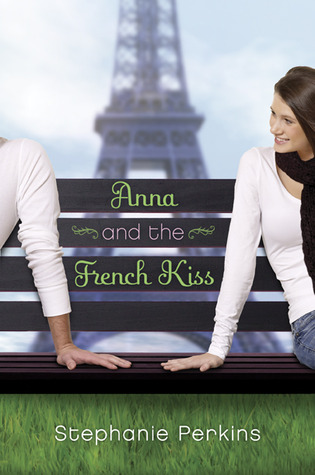
Author Stephanie Perkins has done it again! Her first novel, Anna and the French Kiss (reviewed here), is a refreshingly sunny story of contemporary teens finding their way toward first love. Nothing explodes, the world doesn’t end, there are no technological breakdowns or repressive forms of government. What a nice change for readers of YA fiction! Instead, in Stephanie Perkins’s novels, we’re treated to teens facing real-life problems, negotiating the perils of growing up and finding their way, struggling with big and little decisions, and figuring out what’s really important to them. In other words, characters who feel true and convincing, and who earn the investment a reader feels by the end of the book.

In Lola and the Boy Next Door, we meet the delightfully quirky Lola, a 17-year-old San Francisco native, growing up in the Castro district in the Victorian home she shares with her two dads. Lola believes in self-expression through costuming, and arrays herself in a never-ending rainbow of vintage dresses, multi-hued wigs, glitter and make-up, boots and raincoats, as she tries on different personae and presentations. Lola has learned to tolerate the slings and arrows of her more conformist-minded classmates, and bounces through her life with a couple of close friends and her supportive but very protective parents.

Lola is dating Max, a 22-year-old rock musician whose bad boy outside masks a more sensitive inner core. Max is surprisingly agreeable to the strictures imposed by Lola’s dads: mandatory attendance at the weekly grilling otherwise known as Sunday brunch, non-negotiable hourly phone calls during all dates and outings. This, however, does not prevent Lola from losing her virginity to Max during their supposedly “safe” sanctioned dates. After all, Lola thinks Max is “the one”. She’s in love, and all is well…

… Until the day that Lola’s former neighbors move back into the Victorian next door. The Bells moved away two years earlier in pursuit of daughter Calliope’s figure skating career, taking with them Calliope’s twin brother Cricket (the titular boy next door). Cricket and Lola had been inseparable for one wonderful summer, until a series of miscommunications and the family’s sudden move ripped the two apart and left Lola with a major hole in her heart.

Now Cricket is back, and Lola has to figure out whether she can let him back into her life. (Hint: the title pretty much lets us know that she does.) Lola and Cricket are rather adorable. Their bedroom windows face one another, and they have nightly conversations across the narrow gap between their houses. Cricket is sweet, smart, and head over heels for Lola. Lola wants to be friends… but can she really be happy with Max when Cricket is waiting in the wings?

All this sounds much shallower than it actually is. Both Lola and Cricket have inner doubts and demons to face. Lola’s birth mother Norah was a troubled teen who found herself with an unwanted pregnancy and gave the baby to her brother and his partner to raise. Norah pops back into their lives whenever she’s down and out, which is often, and is an ongoing source of embarrassment and self-questioning for Lola. Cricket has discovered some unsavory truths about his family’s past which make him doubt his own talents. On top of that, Cricket lives in his sister’s shadow, supporting her and cheering for her, but destined to have his life uprooted based on Calliope’s needs.

Lola has to make some big decisions, and I give Stephanie Perkins a lot of credit for not making these decisions easy or free of fall-out. Lola doesn’t want to hurt anyone, but it’s inevitable that she will. She doesn’t want to let down her fathers, but she ends up breaking their rules unintentionally. Even when Lola does what she needs to do, she doesn’t immediately bounce back and move on. We see a real teen dealing with real emotions, and even when it’s hard, it feels true.

As an added bonus, Anna and St. Clair from Anna and the French Kiss are supporting characters in Lola and the Boy Next Door, and it’s quite fun to see them moving forward with their life plans (although they do kind of feel like an “old married couple” in this story, despite only being a year older than they were in their own book). Additionally, I personally got a big kick out of the San Francisco setting. It’s always fun to read fiction set in my town, and I loved the descriptions of the neighborhoods and various landmarks that figured into Lola’s story.

I enjoyed Lola and the Boy Next Door very much. Even though the title pretty much tells you how Lola’s story will end up, it’s the journey that’s so much fun. Lola is a terrific main character — not flawless, but fresh, honest, and individual, with her heart in the right place even if it takes her a bit of trying to figure out her actions. Stephanie Perkins’s writing is lively and the dialogue sparkles. I’m looking forward to reading more by this talented YA author: Her next book, Isla and the Happily Ever After, is due out in May of this year.