Book Review: Midwinterblood by Marcus Sedgwick

Book Review: Midwinterblood by Marcus Sedgwick

Midwinterblood

Synopsis:

Seven stories of passion and love separated by centuries but mysteriously intertwined—this is a tale of horror and beauty, tenderness and sacrifice.

An archaeologist who unearths a mysterious artifact, an airman who finds himself far from home, a painter, a ghost, a vampire, and a Viking: the seven stories in this compelling novel all take place on the remote Scandinavian island of Blessed where a curiously powerful plant that resembles a dragon grows. What binds these stories together? What secrets lurk beneath the surface of this idyllic countryside? And what might be powerful enough to break the cycle of midwinterblood? From award-winning author Marcus Sedgwick comes a book about passion and preservation and ultimately an exploration of the bounds of love.

I first heard about Midwinterblood almost a year ago, when I read Eoin Colfer’s fabulous review of it in the New York Times and just knew I had to read it. I bought myself a copy immediately, and then one thing and another happened… and every time a Top 10 Tuesday topic came along focused on top TBR books, I always had Midwinterblood right at the top… and suddenly, here I am, almost a full year later, and I’ve only now read the book. And could kick myself for waiting so long.

In case you missed the news, Midwinterblood has just been named the winner of the 2014 Michael L. Printz Award for Excellence in Young Adult Literature. And all I can say is, well done, you award givers, you!

In Midwinterblood, seven connected tales moves backward chronologically from 2073 to days too long ago to have a date attached. In each story, the same characters meet — in different bodies and in different relationships — always seeking and finding, always sharing a deep bond that’s both familiar and mysterious. Always, there’s an Eric and a Merle — sometimes in love, sometimes a brother and sister, sometimes unrelated except by an unusual friendship.

The lead story, “Midsummer Sun”, sets the tone, as a reporter named Eric Seven journeys to a remote island to investigate rumors of a strange and powerful plant and its impact upon the lives of the islanders. Upon arrival at the island, Eric meets a young woman named Merle, as well as the island’s elders, and he quickly realizes that things on the island are a bit strange. But just as quickly, that becomes unimportant to Eric, as it’s his meeting with Merle that consumes all of his thoughts:

Eric Seven does not believe in love at first sight.

He corrects himself.

Even in that moment, the moment that it happens, he feels his journalist’s brain make a correction, rubbing out a long-held belief, writing a new one in its place.

He did not believe in love at first sight. He thinks he might do so now.

From the first page, it’s clear that there’s something dark and disturbing under the surface, and by the end of the first story — like a nightmare come to life — an ominous mood, full of loss and sacrifice, has been set that carries through the rest of the book.

Midwinterblood

What a beautiful cover! The paperback will be released in April 2014.

In subsequent stories, we meet an archaeologist uncovering both the remains of a Viking tomb and a remnant of a 20th century war; a painter and the small girl who befriends him; twins who hear a ghost story; a Viking king’s young children; and a king and queen from so long ago that their story feels almost mythical. Through each tale, the two lost souls find each other all over again:

One night, as they parted, Erik whispered something precious to Merle.

“Say that you will never leave me,” he said, holding her hands.

“I shall never leave you,” said Merle.

“Is it so easy to say?” Erik asked, surprised.

“It is, since it is you I speak of,” Merle answered. “I will never leave you. No matter what happens, or where you go, or what you do. I will never leave you.”

“But it might not be so easy,” Erik said. “Our love is forbidden. It might become impossible for us to be together.”

Merle shook her head.

“I will find a way,” she said. “I will always find a way.”

It’s hard to describe the mood that takes hold while reading this book. It’s beautiful and hypnotic, with writing that hints and flows, casting a spell of magic and loss and a love that lasts forever. Midwinterblood is not a long book, but every page and every line is carefully constructed to serve the whole, so that reading this book feels like living inside a dream at times.

I’m puzzled as to why this book is defined as young adult. I certainly can’t see any reason for it. Still, I suppose it’s a good thing, seeing how Midwinterblood just won the Printz Award.

I absolutely recommend Midwinterblood. It’s beautiful and sad, creepy and lovely, and altogether different from anything else I’ve read.

Midvinterblot by Carl Larsson. This painting was an inspiration for the author and figures into some of the stories.

Midvinterblot by Carl Larsson. This painting was an inspiration for the author and figures into some of the stories.

_________________________________________

The details:

Title: Midwinterblood
Author: Marcus Sedgwick
Publisher: Roaring Brook Press
Publication date: February 5, 2013
Length: 272 pages
Genre: Young adult
Source: Purchased


Book Review: The Splendour Falls by Susanna Kearsley

Book Review: The Splendour Falls by Susanna Kearsley

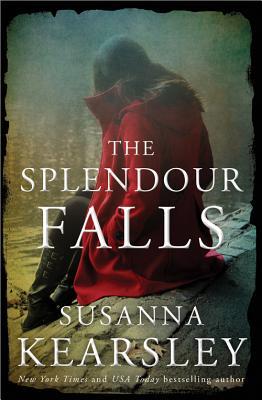
The Splendour FallsEmily Braden has lost her faith in romantic love and fairy tale endings, but she does love a good story. When her cousin Harry, a renowned historian who tends to be a bit flaky when it comes to reliability, invites her to accompany him on a research trip, she’s hesitant to accept. But clearly, everyone else in her family thinks she needs a bit of excitement, so she reluctantly agrees to meet him in Chinon, France — for a trip that turns out to be the opposite of routine or ordinary.

Centuries earlier, young Queen Isabelle was besieged at the Chinon chateau by enemies of her husband King John, and rumor has it that Isabelle’s treasure is still hidden somewhere within the tunnels under the town. Not only that, but in the more recent history of World War II, a second treasure was supposedly hidden after an ill-fated romance ended in tragedy. Now the myths surrounding both treasures impact Chinon’s townspeople as well as the tourists staying at Emily’s hotel — and an accidental death just may turn out to be a clue in some sinister happenings, all of which tie back to the history of Chinon itself.

The Splendour Falls was originally published in 1995, and was just reissued this month with a beautiful new cover to match the author’s most recent books. I’m a big fan of Susanna Kearsley, and I rank her novels The Winter Sea, The Rose Garden, and The Firebird among my favorite books.

Sadly, while interesting, The Splendour Falls just isn’t in the same league as some of these others. The plot of The Splendour Falls has a meandering feel to it. Things happen, and Emily is carried along by plans and events, but it’s not until quite late in the book that the plot takes on any sense of urgency. At that point, the book shifts gears and becomes a mystery, with danger lurking around every corner and Emily’s life possibly on the line. But until then, we just follow Emily on her travels, as she meets other hotel guests, explores Chinon, and wonders about what’s going on in everyone else’s life.

Emily herself is a bit of a cipher. We know she’s 29, that she’s lost her trust in the permanence of love and marriage after her parents’ divorce, and that she’s afraid of caves and enclosed spaces. What does she do for a living? Well, something with her family’s business, but it’s not clear what (and doesn’t seem important). No career interests or passions are ever mentioned.

There’s a love story in The Splendour Falls, but I didn’t find it convincing in the slightest. We know who Emily’s love interest is because she describes her first sight of him in quite epic tones, but she barely spends any time with the guy and I didn’t get a sense of any true chemistry between the two — certainly no more of a connection than Emily has with any of the other hotel residents whom she befriends.

The Splendour Falls does boast a beautiful sense of place. The town of Chinon is intricately described, so that I felt the narrow, winding streets and dramatic views really lived and breathed in the pages of the book. More than anything, reading The Splendour Falls made me desperately want to book a trip to the Loire Valley, stat!

It’s disappointing when a book by a beloved author doesn’t live up to expectations. In this case, I’m reminding myself that The Splendour Falls is actually from much earlier in the author’s career, and perhaps that’s why it doesn’t have the romantic magic or sweeping grandeur of her later books. I’m still glad to have read it — but for anyone looking for a first experience with Susanna Kearsley’s beautiful writing, I’d recommend starting elsewhere.

_________________________________________

The details:

Title: The Splendour Falls
Author: Susanna Kearsley
Publisher: Sourcebooks Landmark
Publication date: January 14, 2014 (originally published 1995)
Length: 384 pages
Genre: Adult contemporary
Source: Purchased

Book Review: Heartbeat by Elizabeth Scott

Book Review: Heartbeat by Elizabeth Scott

Heartbeat

Grief and anger explode off the page in Heartbeat, a young adult novel that fairly sizzles with its main character’s rage. 17-year-old Emma is consumed by pain over the loss of her mother, who is brain-dead but being kept alive by machines for the sake of her unborn baby. Emma’s stepfather Dan brings Emma to the hospital each day to visit her mother, but Emma can barely control her hatred and resentment toward Dan and toward the baby. Once completely devoted to her studies and determined to be top of the class, Emma now goes through the motions and can’t be botheredwith schoolwork. Once happy and in a loving relationship with her kind stepfather, Emma now blames him for her mother’s death, and literally locks him out of her room and her life.

The sole link to her former happy life is Emma’s best friend Olivia, who provides her with daily chitchat and distraction. And then Emma meets Caleb, the only person at her school who’s anywhere near as messed up as she is, and Emma gradually learns that pain and grief come in all different forms — but so does love.

Heartbeat is painfully sad to read, and yet it’s also quite beautiful in many ways. In learning the depths of Emma’s loss, we see her memories of the time before, and just how happy a family full of love can be. By peeling back layer after layer of family memories and experiences, the author shows us how devastating all of this is for Emma — not just the loss of her mother, but the loss of the love and safety she she once felt in her home and with her family.

Emma’s rage is the flip side of that love and is the way that she channels the grief that overwhelms her. Emma’s memories of her relationship with her mother are lovely and wistful, and the suddenness and senselessness of her loss come across with a visceral impact. Emma will never get her mother back, but by the end of Heartbeat, she’s beginning to find glimmers of hope for a future that might still have meaning and even love in it.

Heartbeat shows us the anger of a someone who’s lost the person at the center of her life. I read Heartbeat with tears in my eyes — but despite the pain and loss, there’s an honesty and fierceness in the writing that makes this an important and emotionally compelling book. I recommend Heartbeat for anyone who appreciates young adult fiction that doesn’t shy away from difficult subjects. It is not an easy book to read, but it is strong and memorable, moving and definitely thought-provoking.

_________________________________________

The details:

Title: Heartbeat
Author: Elizabeth Scott
Publisher: Harlequin Teen
Publication date: January 28, 2014
Length: 304 pages
Genre: Young adult contemporary
Source: Review copy courtesy of Harlequin Teen via NetGalley

Book Review: Cruel Beauty by Rosamund Hodge

Book Review: Cruel Beauty by Rosamund Hodge

Cruel BeautyWhat do you get when you put Beauty and the Beast, Bluebeard, and Greek mythology in a blender?

Probably something that looks a lot like Cruel Beauty!

In this new YA fantasy novel, 17-year-old Nyx is doomed to marry the demon who rules her land, as the price due for a bargain her father made before her birth. Nyx has spent her whole life dreading and preparing for her fate, filled with anger at her father for sacrificing her so easily and filled with dismay, knowing that she has no chance of surviving. Nyx’s purpose is not just to wed the ruler, but to bring about his destruction, in order to free her people and avenge her mother’s death.

Easier said than done. When Nyx finally arrives at the ruined castle, she meets her new husband — incredibly handsome, of course — as well as the shadow servant, Shade, who is forced to obey but seems to be on her side. Secrets abound, and Nyx realizes that her task will be even harder than she imagined… especially when her hatred for her husband and captor starts turning into something else.

In Cruel Beauty, there’s a whole mish-mosh of fairy tale and mythology stirred together. The land of Arcadia worships the Greek gods, and their stories and curses inform the actions of Nyx and the rest of the characters. The main tale of the girl promised to the hideous creature and then falling in love is straight out of Beauty and the Beast, although twisted and turned quite a bit along the way. There’s a magical system as well, as Hermetic works (related to the god Hermes) are what allow people to harness the elements of air, earth, fire, and water.

So does it all work? For the most part, I’d say yes. The plot gets overly complicated with so many different fantastical and mythological sources contributing to the mix. The Hermetic concepts take up space and seem to be very important early on — but don’t really matter much by the end of the story. There’s magic and dark spirits and curses and bargains… and the plot ends up practically tying itself into knots to make it all connect and work out in the end.

But, despite the convoluted story line, I enjoyed Cruel Beauty quite a bit. I think it helps that I read it straight through, all in one day. Yes, it’s that compelling — one of those books where you vow to stop after one more chapter… and suddenly an hour or two have slipped by. If I’d read it in smaller chunks or over the course of a week, maybe I would have taken more time to think about the plot developments and poke holes at certain pieces. But gobbling it up all at once, nothing bothered me too much…

Because wow. That’s some love story! Nyx and her captor do a slow burn, gradually moving from mistrust and outright dislike to grudging respect and amusement, and finally, kindness and affection — despite Nyx’s horrible sense that she betrays her family and her people by feeling anything for this strange and seemingly cruel man. Their passion is palpable, and feels like the kind of epic love that can make someone risk eternal suffering for the sake of the other.

Oh, and can we just take a minute to gaze at that cover? Gorgeous.

Overall, Cruel Beauty is probably over-plotted, but it’s a thrilling and oddly moving narrative none the less. If you enjoy fairy tale retellings, magical worlds, and dark secrets, this is one new release that you shouldn’t miss.

_________________________________________

The details:

Title: Cruel Beauty
Author: Rosamund Hodge
Publisher: Balzer + Bray
Publication date: January 28, 2014
Length: 352 pages
Genre: Young adult fantasy
Source: Review copy courtesy of Balzer + Bray via Edelweiss

Book Review: The Vanishing by Wendy Webb

Book Review: The Vanishing by Wendy Webb

The VanishingJulia Bishop is left friendless and penniless after her husband is exposed as the “midwestern Bernie Madoff” and then kills himself. Faced with foreclosure, unpaid bills, stalkers, and death threats, Julia’s life is bleak indeed until a stranger shows up with a bizarre proposal: Adrian Sinclair offers Julia a position as companion to his elderly mother, famous author Amaris Sinclair — who supposedly died ten years earlier. If she accepts, Julia will be given a chance to escape her old life and live at Havenwood, a huge mansion in the wilderness of northern Minnesota. She’ll spend her days with the woman who first inspired her to write, and most importantly, she’ll get a fresh start just when her life seems utterly hopeless.
Havenwood is beautiful, elegant, and mysterious. Isolated in the woods, it’s the perfect hideout, but seems to be hiding secrets of its own. Why does everything seem so familiar? Why does Julia keep hearing strange voices? Whose footprints are in the snow? Why is the family so excited about Julia’s arrival? And who is that hot guy out by the stables?

As days go by, Julia realizes that the the strange occurrences at Havenwood may be sinister, and even dangerous. Despite her fondness for the family (and the hot guy in the stables), she suspects that her job offer may have strings attached that are not in her best interest. As the spookiness mounts, the only answers may lie in uncovering the past…

… and that’s about as much synopsis as you’ll get out of me!

The Vanishing sets a tone of gothic mystery and eerie supernatural goings-on, and at the same time tells the story of a seemingly ordinary woman whose life has gotten completely messed up and out of control. Havenwood is beautifully described, and made me yearn for my own wilderness adventure — in a gorgeous mansion, of course!

It’s hard to suspend disbelief throughout the story, as plot pieces begin to mount that don’t quite make sense. Really, Julia is willing to head off to parts unknown with a complete stranger, no cell phones or outside contact allowed? And really, she believes this stranger has just randomly selected her as a trusted companion for his mother because he feels sorry for her? And the instant sparks that fly between Julia and the hot stable guy? (Okay, his name is Drew, and he’s part of the family whose property it is, but still…) I thought insta-love was just a YA plot device!

Granted, a lot of these issues are ameliorated by the unraveling of the central mystery, but those answers come so late in the book that they don’t really outweigh the sheer lack of believability earlier on. Somehow, even though there are answers, I didn’t find them convincing enough to balance out my impatience and incredulity.

What really drove me crazy, though, was Julia’s insistence on behaving like a doomed female character from a horror movie. Oh, the power’s gone out and there might be an intruder? Gee, the hot guy told me to stay in my room and lock the door… so I think I’ll grab a lantern and explore the pitch-black hallways all by myself instead. Hmm, I’ve seen disturbing visions and heard scary noises in the library and east wing? Let me go back there and poke around some more! Just cut it out, Julia, okay?

Overall, as the story delves deeper into the history of Havenwood and its connection to the Spiritualist movement of the 1800s, it becomes both more interesting and more eerie. I enjoyed the use of historical documents and the recaptured memories of a fateful seance, which we first see in the book’s introduction, as well as the sharp contrast of an elegant manor house set in a dangerous and untamed landscape.

I never felt terribly engaged in the love story and had a hard time accepting many of Julia’s actions or beliefs. Still, while some of the plot elements felt far-fetched and not well grounded, The Vanishing held my attention and still managed to deliver a few good chills along the way.

_________________________________________

The details:

Title: The Vanishing
Author: Wendy Webb
Publisher: Hyperion
Publication date: January 21, 2014
Genre: Gothic fiction
Source: Review copy courtesy of Hyperion via NetGalley

A book with the kiddo: Dinosaur Summer by Greg Bear

Book Review: Dinosaur  Summer by Greg Bear

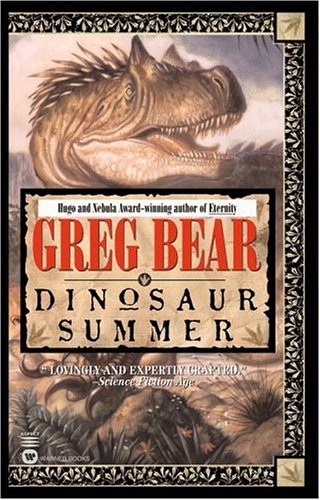
dinosaur summerDinosaur Summer takes the 1912 novel The Lost World (by Sir Arthur Conan Doyle) as its starting point, imagining a world in which The Lost World is not fiction, but rather a history of a real discovery of dinosaurs living in an isolated world on a South American plateau.

It is 1947 when Dinosaur Summer opens, and the world has pretty much lost interest in the marvels of Conan Doyle’s discoveries. Dinosaurs had become so commonplace in the years since 1912 that all circuses had to have them — but in the post-war years, there just isn’t enough public demand to keep the dinosaur circuses running, and finally, the very last one is about to close for good.

15-year-old Peter Belzoni lives with his father Anthony, who is wild, impetuous, and prone to drinking too much. Anthony decides to bring Peter on the adventure of a lifetime by securing gigs for both of them with National Geographic, to photograph and write about an epic undertaking: the return of the last circus dinosaurs to their original homes on the El Grande plateau. Accompanying the expedition are filmmakers, trainers, and various local guides and authorities — and as the team sets sail and then journeys through the jungles and rivers of South America, the trip becomes more and more dangerous.

I read this book with my 11-year-old son, based on the recommendation of an old friend who is a terrifically well-read sci-fi connoisseur. But note: Dinosaur Summer is not a kids’ book! As far as I can tell, this is adult science fiction — but with an angle that definitely appealed to my kiddo.

We enjoyed the action, the drama, the danger, and the humorous dialogue. In Dinosaur Summer, the lost world of El Grande has evolved on its own, in isolation from the rest of the world. Consequently, the animal species are unique (and fictional, for the most part). The author helpfully includes a “What’s Real, and What’s Not” afterword, and the kiddo and I had a good time looking  up illustrations of similar dinosaur, reptile, and mammalian species. Most memorable (and life-threatening) are the death eagles (yikes), and weirdest are communisaurs, mole-like dinosaurs who live in hives serving a queen.

Dinosaur Summer has drawings throughout by illustrator Tony DiTerlizzi. You can see a few from the book on his website.

A few minor quibbles: The story occasionally bogs down in details about political conflicts between the Venezuelan government, the army, the indigenous tribes, and the oil companies. Likewise, much of the catalyst for the expedition has to do with Hollywood interest, and there are a lot of characters introduced connected to the movie studios, to the point that the action drags a bit as we are introduced to producers, cameramen, studio heads, and more. Frankly, the names become overwhelming at times — although it was amusing to see some real-life Hollywood folks included here as characters in the story. (Most notably, special effects pioneer and movie great Ray Harryhausen is featured prominently as both a member of the expedition and a mentor to Peter, and I can only imagine how much he must have enjoyed the tribute when the book was published.)

Of course, it’s entirely possible that the draggy bits mentioned above wouldn’t have been an issue if I’d just sat and read this book on my own. It’s just that in reading it aloud, the passages and chapters that were so crammed with Hollywood names and political drama just didn’t flow. I will say, however, that this didn’t seem to bother my kiddo in the slightest — I think he just ignored the parts that he didn’t get, and focused on the action… of which there is plenty!

Some of the scenes toward the end are on the gory side for a bed-time story, not that my son seemed to mind. Still, I felt a teeny bit like a bad mother reading to him about dinosaurs chomping and eviscerating right before tucking in his blankets and turning off the light!

All in all, both my son and I were fascinated by Dinosaur Summer, which nicely blends high-stakes adventure with a surprisingly touching story of a boy growing up, figuring out who he is, and developing a more adult relationship with his difficult father. I recommend this book for adults looking for an old-school adventure, as well as for middle school to teen readers who don’t mind having to work a bit for a good story.

_________________________________________

The details:

Title: Dinosaur Summer
Author: Greg Bear
Publisher: Warner Books
Publication date: 1998
Genre: Science fiction
Source: Purchased

Book Review: Harrowgate by Kate Maruyama

Book Review: Harrowgate by Kate Maruyama

HarrowgateA horror story that is really a tale of love and loss, Harrowgate surprised me with its deep emotional impact and sheer hypnotic pull.

As Harrowgate opens, geologist Michael is rushing home to his pregnant wife Sarah. He’d been out in the field on a remote assignment, and after receiving a cryptic message about an emergency, it has taken him close to two weeks to navigate the Jeep rides and multiple airplane transfers that finally bring him to his New York apartment building. Unable to reach his wife or anyone else, Michael is unsure what to expect. It’s early for the baby to arrive, but surely not so early as to be dangerous. Or is it? Michael is relieved to arrive home and find his wife and healthy son waiting for him — but his bliss is tempered by the presence of an odd stranger, a doula named Greta, who seems to have some sort of hold over Sarah.

At first, Sarah insists that Michael shouldn’t touch the baby — but soon after, Greta urges Michael to be with Sarah and baby Tim as much as possible, to not leave the apartment for any reason, not even to pick up diapers or groceries. Greta’s encouragement sounds more like a warning or a threat, though, and there’s something not quite right about this person who just keeps showing up.

Questions begin to pile up: Why doesn’t Sarah want Michael to answer the phone or go out? Why does the doorman give him such pitying looks? Is Sarah so exhausted by new motherhood that she hasn’t noticed the refrigerator full of spoiled food?

The answers, as they come, are chilling and awful. Michael uncovers the truth about his family’s tenuous grip on happiness — but knows too that this happiness has a dark side, and that his ability to hold onto his family may be slipping away.

To go into any further plot details would be a huge disservice, as Harrowgate is a book to be explored and savored, best enjoyed without any advance knowledge of what is really going on. Looming dread and dismay permeate the book, and while this isn’t a gore-filled horror novel, it does leave the reader thoroughly spooked.

There’s something so creepy about horror stories revolving around birth and babies. Perhaps it’s the contrast of joy and innocence with the darkness looming on the other side. I’ve heard this book compared to Rosemary’s Baby or Breed, but beyond the New York setting and the strange events around a birth, the storylines have little in common.

What Harrowgate actually put me in mind of the most, while reading, was The Silent Land by Graham Joyce, one of my very favorite books. In both, there’s a central story of love that should be perfect — except the reader can feel the edge of something wrong surrounding everything joyful that happens.

And there is quite a lot of joy in Harrowgate, despite the fact that it’s also very, very sad. At its core, Harrowgate is a love story. The love between Michael and Sarah, and the love they both feel for their baby Tim, creates a power in the little haven inside their apartment that keeps the rest of the world at bay.

While I wish the ending has explained things a little more clearly, I was mostly satisfied with the wrap-up. The emotional depths explored in this book carry such strong notes of tragedy and relentless loss, and yet the journey Michael takes in exploring how very much he loves his wife and child is also quite lovely to read.

You don’t have to be a horror fan to enjoy Harrowgate. For anyone who enjoys a touch of creepy gothic mystery set within a familiar landscape, I’d recommend giving Harrowgate a try. Well-written and compelling, this brief novel sucked me in and made it impossible to quit reading before the end.

_________________________________________

The details:

Title: Harrowgate
Author: Kate Maruyama
Publisher: 47North
Publication date: 2013
Genre: Horror
Source: Borrowed from a friend

Book Review: Snowblind by Christopher Golden

Book Review: Snowblind by Christopher Golden

SnowblindIn the small town of Coventry, Massachusetts, falling snow does not bring a winter wonderland. In a devastating blizzard, eighteen people from Coventry die tragically through accidents or simply getting lost in the blinding storm. Twelve years later, another blizzard is on the way — but heavy snows and winds are not all that’s coming to town. As the storm builds, the dead begin to return. What do they want? And who will survive this time around?

In Christopher Golden’s Snowblind, the darkening skies are ominous, and it quickly becomes clear that no one is safe. For the love of all things great and good, stay inside, people of Coventry! But even staying indoors offers no guarantees against the storm: There are bad things out there in the wind and snow, and all they need is one small crack, one little draft, to slip inside the house and come for you.

Reminiscent of the scope of a Stephen King novel, in the early chapters we meet a sprawling array of characters, including police officers and school teachers, auto mechanics and thrill-seeking teens, and children just old enough to want to hide their fears, but young enough to know that the faces they see out in the storm are real.

The first part of the book, set during the first blizzard, is excellent. We don’t know what’s coming — but it’s clear that whatever it is, it’ll be bad. As we meet the characters and then see them, one after another, head out into the snow, the tension builds. Something is out there, and it’s deadly. Reading these chapters, I was on the edge of my seat — and despite living far away from any hint of winter weather, I couldn’t help jumping a bit whenever I heard the wind blow outside.

About a third of the way in, the action jumps to twelve years later, and here I felt the story sagged a bit. It’s interesting to see what’s become of the survivors of the earlier blizzard and how they’ve moved on — or not — with their lives. Children have grown into damaged young adults; a young woman who’d lost her love is now bitter, middle-aged, and prone toward overindulging on her nightly glasses of wine; a couple has never quite gotten past their guilt and memories from years earlier; and a rookie cop is now a detective who swears he won’t let another kid die on his watch. And yet, there’s quite a lot of build-up before the new storm arrives, and the action grinds more or less to a halt in places in favor of exploring the characters’ emotional states.

The final storm and conclusion isn’t quite as scary as I would have liked. The set-up is terrific, but the explanation of what really happened in the storm and the characters’ struggles to survive don’t convey quite the level of terror that a book like this really needs. Perhaps the climax is too scattered: because we’re tracking so many storylines, there’s no one scene or focus that really shouts “this is it!”

I liked Snowblind very much, and thought the initial set-up and early scenes were excellent — just the right mix of character introduction, impending threat, and disastrous outcome. Because there are no answers at that point, just the sense that something VERY BAD is out in the blizzard, it’s scary indeed to read. Unfortunately, the rest of the book doesn’t quite live up to the earlier section, and the conclusion didn’t feel like a very satisfying pay-off, fright-wise.

Of course, I had the benefit of reading Snowblind from the comfort of my warm home, on a day with clear blue, sunny skies. Had I been reading it with all of this month’s winter storms brewing outside, I might not have maintained quite such a level of calm. If you read Snowblind, stay warm, and watch out for drafts! And if you hear scratching on your roof, don’t worry: It’s PROBABLY just the wind.

_________________________________________

The details:

Title: Snowblind
Author: Christopher Golden
Publisher: St. Martin’s Press
Publication date: January 21, 2014
Genre: Horror
Source: Review copy courtesy of St. Martin’s Press via NetGalley

Book Review: What Nora Knew by Linda Yellin

Book Review: What Nora Knew by Linda Yellin

What Nora KnewFor 39-year-old Molly, romance is something you see in the movies. Still bitter about her divorce five years earlier from her cheating ex-husband, Molly is in a nice, comfortable relationship with a nice, comfortable chiropractor. Working as a features writer for an online magazine, specializing in pieces about zany challenges like skydiving, taking a vibrator through a security checkpoint, or learning to be a Rockette, she excels at being daring in every aspect of her life — except when it comes to love. When Molly’s boss gives her an assignment to write about love, using Nora Ephron as a guidepost, she fails utterly, but finally gets the kick in the pants she needs to take a long, hard look at her life and her attitude toward love. And, as you’d expect, Molly finds herself drawn to the guy she doesn’t want to be drawn to, and finally has to confront what’s stopping her from taking the big leap… and taking a big chance on crazily romantic, head-over-heels, passionate love.

So what did I think? Let’s start with what I liked: What Nora Knew is a fast-paced, frenetically fun look at being single and being in the dating pool, from the vantage point of a woman on the verge of hitting the big 4-0. The main character is savvy and smart, and has been around the block enough times to have learned some very hard truths about the odds of finding “the one”. I liked that she’s a woman with a career that’s important to her, and that she’s willing to fight and take chances to make her writing dreams come true. The taste of New York is upbeat and exciting, and I enjoyed the use of Nora Ephron’s big romantic movies — Sleepless in Seattle, You’ve Got Mail, and When Harry Met Sally — as a template for finding and recognizing the person who makes you want to take a chance.

There are some very quippy, quirky moments that strike a great note of cynicism blended with humor. The tone overall is light and brisk, with many quote-worthy moments — such as this interview between Molly and an older gentleman on the subject of finding true love:

“How did you know she was the one?”

He shrugged. “You marry someone. Wait thirty years. If she’s still there — she’s the one.”

What didn’t I like? Well, let’s face it, in this type of book, you just never see people worrying about their paychecks or their rent. Molly works for a living, but she also comes from a well-off family, gets invited to the Hamptons for summer weekends, and eats in the best restaurants — even if it is on the company expense account. I got a little tired of reading about rich people doing rich people things. A trip to Tiffany’s? Ho hum.

I didn’t really buy the love interest or the chemistry between the two. Molly’s destined guy is pretty much an enigma throughout the book; he’s a bestselling author who speaks in platitudes, and Molly seems to be faulted in the book for not taking him at his word — but honestly, I never knew if he was on the level and could totally get why she’d mistrust him as well.

In this type of book, with romance as the focus, being single pretty much equals being a loser. Even Molly’s hard-nosed businesswoman sister and 80-something-year-old grandmother find romance — clearly, the problem must be Molly. The idea that if you don’t fall into passionate and romantic love, then there’s something wrong with you really is not going to help the self-esteem of any single women reading this book. So if we all try to emulate a fictional character in a Nora Ephron movie, we’ll finally find the true love we’ve been promised? This may work in a novel that aims for madcap, but I’d hate to see someone apply this philosophy in real life.

The humorous tone works on and off throughout the book. It does get to be a bit much at times, and I often felt that the author went overboard with attempts to portray Molly’s escapades as wacky and wild. But who knows? Perhaps I’m just too serious and cynical by nature to be able to throw caution to the wind and just go with it.

It’s a cute premise, and not without a great sense of fun, but overall? I’d have to put What Nora Knew squarely on the chick-lit shelf — and in general, I’m not a fan of chick-lit. It’s a fluffy diversion, and if you like this sort of thing, you’ll have a good time. For me? It’s not the type of book I’d usually seek out, and it won’t make any of my “best of” lists, but it kept me entertained while I was reading it, and that’s something.

_________________________________________

The details:

Title: What Nora Knew
Author: Linda Yellin
Publisher: Gallery Books
Publication date: January 21, 2014
Genre: Adult fiction
Source: Review copy courtesy of Gallery Books via NetGalley

Book Review: The Golem and the Jinni by Helene Wecker

Book Review: The Golem and the Jinni by Helene Wecker

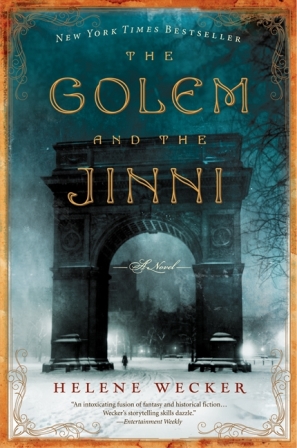
The Golem and the Jinni PBI’m so excited to be a part of the blog tour for the paperback release of The Golem and the Jinni!

The Golem and the Jinni was certainly one of the buzziest books of 2013. Written by a debut author, this book started showing up everywhere! For myself, I sat up and took notice as soon as I read the title (and saw that gorgeous cover) — then paid even more attention as the initial reviews rolled in, all marveling over the originality of the story and the beauty of the writing.

Well, guess what? All that praise? Totally justified.

I finally read The Golem and the Jinni as one of my last books in 2013 — and wanted to kick myself for waiting so long to read it!

In brief, The Golem and the Jinni is the story of two mythical beings from two very different cultures: The Golem is a creature from Jewish mysticism, a human-like creature of clay whose purpose is to obey and protect its master. (Most famously, there is the legend of a golem created by the Rabbi of Prague in the 16th century to defend the Jewish ghetto against attack. Once the golem’s mission was completed, it returned to inanimate clay.) The Jinni is a legendary being from Arabian tales, a desert spirit of fire with the ability to take on different forms — but don’t confuse the Jinni in The Golem and the Jinni with the big blue guy from Disney’s Aladdin!

In this lovely novel, a female golem and a male jinni — both with human appearance — find themselves, accidentally and unwillingly, in New York in 1899, and must find a way to blend in, survive, and adapt to living among humans. Chava, the golem, is taken in by a kindly rabbi and finds a home in the Jewish Lower East Side, by all appearances a modest young widow who keeps to herself while working in a bakery and taking in mending. Ahmad, the jinni, can work wonders with metals of all kinds and finds refuge and employment with a tinsmith in the Little Syria neighborhood, but is filled with rage at his lack of freedom and spends each night wandering the city. When Chava and Ahmad cross paths, they recognize in each other a kindred spirit, and form a bond that’s full of disagreement and polarity, but also a deep understanding of what it means to be trapped, to hide one’s true nature, and to long for freedom and purpose.

I loved everything about The Golem and the Jinni. The writing here is lovely, conveying the feeling of listening to a master storyteller. There’s a sense of mythology and otherworldly power pervading the story, and yet it is most firmly rooted in the day-to-day realities of life in the early days of the 20th century. New York comes alive within the pages, filled with immigrant communities, ethnic loyalties, the sights and smells of a cramped city without modern conveniences; yet it is also a city striving to improve itself and modernize from moment to moment. From the Bowery to Central Park, the characters explore the nooks and crannies of Manhattan, its beauty and its ugliness, as well as the people who call it home.

We come to care deeply about Chava and Ahmad, and yet can also understand the sentiments and superstitions of the people who meet them and, without understanding why, sense innately that these two are different and perhaps dangerous. Embedded within the story is an examination of what it means to have a purpose in life, and whether anyone can truly overcome his or her essential nature and make themselves over into someone new. As Chava and Ahmad struggle to change their destinies and find freedom, they confront their own limitations and must either find a way to start fresh — or admit defeat, and allow themselves to be destroyed.

There are small moments of great beauty — for example, Ahmad’s ability to create delicate silver and gold animals using only his hands — as well as excitement, danger, and even peace. The scenes of bustling New York are set in contrast with Ahmad’s memories of his lost life in the desert, pursuing a Bedouin encampment and ultimately falling victim to its vengeance. In The Golem and the Jinni, the author skillfully weaves together a modern-day tale with something out of legend, and the blending is masterfully done.

I simply can’t recommend this book highly enough! Start to finish, The Golem and the Jinni is captivating and magical, and an absolute treat to read.

About the Author:

Helene WeckerHelene Wecker grew up in Libertyville, Illinois, a small town north of Chicago, and received her Bachelor’s in English from Carleton College in Minnesota. After graduating, she worked a number of marketing and communications jobs in Minneapolis and Seattle before deciding to return to her first love, fiction writing. Accordingly, she moved to New York to pursue a Master’s in fiction at Columbia University.

She now lives near San Francisco with her husband and daughter. The Golem and the Jinni is her first novel.

_________________________________________

The details:

Title: The Golem and the Jinni
Author: Helene Wecker
Publisher: HarperCollins
Publication date: 2013
Genre: Adult fiction
Source: Review copy courtesy of TLC Book Tours.

tlc logoFor further information, visit the author’s website or stop by TLC Book Tours to view other blog tour hosts.