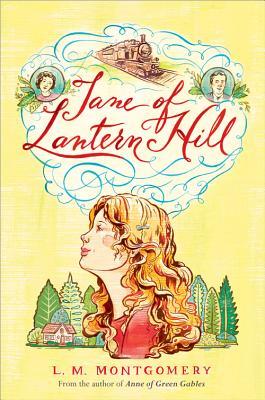
Audiobook Review: Jane of Lantern Hill by L. M. Montgomery

Title: Jane of Lantern Hill
Author: L. M. Montgomery
Narrator:  Lauren Sanders
Publisher: Sourcebooks (edition shown; many editions available)
Publication date: 1937
Print length: 261 pages
Audio length: 8 hours, 1 minutes
Genre: Classic children’s fiction (YA)
Source: Purchased
Rating:

Rating: 4 out of 5.

The story of a girl who must leave her home to discover who she is and reunite her family. A beloved classic from the author of Anne of Green Gables.

Jane Stuart always believed her father was dead–until she accidentally learned he was alive and well and living on Prince Edward Island. When Jane spends the summer at his cottage on Lantern Hill, doing all the wonderful things her grandmother deems completely unladylike, she dares to dream that there could be such a house back in Toronto…a house where she and her parents could live together without Grandmother directing their lives–a house that could be called home.

Jane of Lantern Hill has been on my to-read list for years, ever since I finished both the Anne of Green Gables series and the Emily Starr trilogy. Jane of Lantern Hill is a stand-alone, and the last novel written by L. M. Montgomery.

While many themes are familiar, Jane starts off quite differently from the Anne and Emily books. The story opens in Toronto, where 11-year-old Jane lives in the stifling old mansion owned by her strict, judgmental grandmother, along with her very pretty but somewhat weak-willed mother. Jane’s father died while she was very young, or so she’s always understood. She’s miserable and lonely in her gray world, with the orphan girl living at the boarding house next door as her only friend.

Life changes dramatically for Jane when a letter arrives from her very much alive father, insisting that Jane come spend the summer with him on Prince Edward Island. Jane definitely does not want to go, but has no choice once the family realizes that he could cause legal trouble for them. And so, Jane travels by train and ferry all the way from Toronto to PE Island, filled with dread — but at first glance at her father, she feels a strong connection, and her unhappiness is immediately replace by joy.

On the island, her warm-hearted father devotes himself to creating a home for Jane. They buy a charming little house at Lantern Hill, and Jane is overjoyed to be the “woman” of the house, given free rein to organize, clean, and cook to her heart’s delight. (More on this in a moment…) Lantern Hill is surrounded by a community that welcomes Jane with open arms, and she finds her days filled with friends, animals, beautiful landscapes, and the sounds of the sea.

When summer ends, she must return to the dismal house in Toronto, but now at least she has something to look forward to, and ticks of the months until she can return to her true home at Lantern Hill. Meanwhile, she starts to learn more about her parents’ marriage and separation, and begins to realize that neither may truly have the full picture of what happened and why.

I really enjoyed Jane of Lantern Hill, as I do all L. M. Montgomery books, but with a few hesitations. I understand how freeing it must be for Jane to be given the chance to create a cozy, warm home for herself and her father, after a lifetime under her grandmother’s harsh control — but I disliked how so much of the focus was on Jane cooking meals, cleaning (she loves to polish the silver), and general tasks related to keeping house. Yes, she also goes on adventures with the local children, learns to swim, and loves being outdoors, but there’s just a huge emphasis on the joys of domesticity, and after a while, it really rankled.

I also must note that an antisemitic slur is used in this book. It’s not presented as representative of the author’s point of view, and to be fair, I don’t think she means it as a slur — but it still jarred me to see this particular phrase used in a casual conversation.

Other than these two factors, I enjoyed the book as a whole. It’s always lovely to revisit PEI through the eyes of L. M. Montgomery. The emphasis is wholly on Jane’s experiences, but there’s still an element of intrigue around why her parents separated, and readers learn the truth as Jane does.

Jane is a delightful character, not quite as fanciful and imaginative as Anne Shirley, but with an enthusiasm and abundance of love that have been suppressed all her life, until finally given free expression at Lantern Hill. She’s a lot of fun to spend time with, and the portrayals of her various PEI friends and neighbors, as seen through Jane’s eyes, are funny and entertaining.

The audiobook narrator is very good at capturing Jane’s spirit, as well as the awfulness of her grandmother, her mother’s gentle love, and her father’s exuberance. The audiobook itself (as available through Audible and elsewhere) has 10 – 15 places where phrases repeat, which I believe is an editing issue rather than a narration problem.

My introduction to the world of L. M. Montgomery was much later in my life than it should have been — I read Anne of Green Gables for the first time within the last five years! I do love her writing and the sense of Prince Edward Island’s beauty and community as portrayed in her books. I have two more L. M. Montgomery novels on my shelves (Pat of Silver Bush and Mistress Pat), and I’m eager to check them out.

If you’re interested in L. M. Montgomery’s books, I’d definitely recommend checking out Jane of Lantern Hill. It’s a sweet story of a memorable girl — well worth reading!

For those who are L. M. Montgomery fans, which other books of her do you recommend?

Audiobook Review: Lessons at the School by the Sea (Maggie Adair, #3) by Jenny Colgan

Title: Lessons at the School by the Sea
Series: Maggie Adair / Little School by the Sea
Author: Jenny Colgan
Narrator:  Alex Tregear
Publisher: Avon
Publication date: Originally published 2018; reissued 2023
Print length: 304 pages
Audio length: 7 hours, 6 minutes
Genre: Contemporary fiction
Source: Purchased (audiobook); E-book ARC from the publisher/NetGalley
Rating:

Rating: 4 out of 5.

The summer holiday brings new passion and new challenges in the enchanting third book of Jenny Colgan’s utterly delightful School by the Sea series, set at a girls’ boarding school in Cornwall.

School is out, following a bit of saucy scandal at Downey House…

Beloved high school teacher Maggie Adair had been comfortably, if somewhat ambivalently, engaged to her dependable long-distance boyfriend Stan. But in the heat of summer, Maggie’s attraction to her colleague David McDonald has caught fire. Now both are facing an uncertain future as they try to figure out how to stay committed to their careers–and each other.

Meanwhile, the girls of Downey House–mercurial Fliss, glamorous Alice, and shy, hard-working Simone–have had long summers at home, which weren’t quite the respite they had been hoping for. But the new school year is thankfully here, and it will bring new pupils and lots of fresh challenges for students and teachers alike at the school by the sea.

Welcome back to the School by the Sea! This charming series focuses on Maggie Adair, a dedicated teacher from Glasgow who takes a job teaching English at a posh boarding school in Devon. Three books into the series, we’ve seen Maggie grow into her role and truly make a difference in the lives of her students… as well as struggle to reconcile her engagement to her long-term boyfriend with her growing feelings for the sensitive, handsome English teacher over at the boys’ school.

Book #3, Lessons at the School by the Sea, picks up immediately after the ending of the 2nd book, which ended (spoilers for those who haven’t read it!) with a scandalous scene at a train station, as David attempts to make a grand romantic gesture while Maggie’s train is leaving the station, and Maggie (inadvisably) pulls the emergency brake. Oh dear.

As we return to the scene of their fairly mild crime, both Maggie and David are in quite a bit of trouble, facing possible criminal charges and (even worse!) the shame of bringing embarrassment to Downey House. The only solution is separation — David loses his job, and Maggie is allowed to stay on, but with the stipulation that the two must have no contact.

Needless to say, Maggie is somewhat despondent when the new school term starts in the fall, and she’s not the only one. A new year means new worries and drama among the school girls as well, and even the headmistress has her own personal life complications to sort out.

It’s all quite sweet and lovely, entertaining in a gentle sort of ultra-British way. For American readers, the ins and outs of boarding school life may seem somewhat impenetrable (although at least we have some exposure from other pop culture — it’s like Hogwarts minus magic, but with social media).

Speaking of social media — about ten years elapsed between the publishing of the second and third books, even though the books’ timeline is a seamless continuation. So, it’s a little jarring in book #3 to suddenly see the students obsessed with their phones, wifi access, Snapchat, Insta, and social media gossip. The author does a good job of weaving all this into the ongoing story, but as readers, we do sort of have to pretend that they’ve had this stuff all along.

The series as a whole is quite fun, and I love how well we get to know all the characters, adults and teens. This volume seems to spend a bit less time on the girls’ part of the story, but that’s okay — I was more invested in Maggie and David’s story than the rest, although I did enjoy it all.

Another thing I really appreciate about these books is how lovingly the value of education, and especially literature, is portrayed. Maggie and David both enrich their students’ lives through their commitment and compassion, but also because they so carefully and consciously choose literature that both challenges and enriches their students.

Hmmm — many of Jenny Colgan’s other books include recipes. The School by the Sea books should include reading lists!

The author mentions in her introduction that she’s envisioned this as a six-book series. Yes, please! While I don’t see anything on her website yet that says that there will be more, a reader can always hope.

Audiobook Review: The Highland Hens by Judy Leigh

Title: The Highland Hens
Author: Judy Leigh
Narrator: Phyllida Nash
Publisher: Boldwood Books
Publication date: August 4, 2022
Print length: 352 pages
Audio length: 11 hours 4 minutes
Genre: Contemporary fiction
Source: Library
Rating:

Rating: 3 out of 5.

In the imposing Glen Carrick House overlooking Scotland’s famous Loch Ness, lives eighty-eight-year-old Mimi McKinlay, cared for by her three adult sons. Hamish has inherited his mother’s musical talents, Fin is the responsible brother, and Angus has the complicated and brooding personality to match his dashing good looks.

But what all the brothers share is a concern that their beloved mother is living in her memories of her days on stage, while letting her present days pass her by.

Jess Oliver is at a turning point. Amicably divorced after years of being married, this trip to the Highlands is a first taste of independence. It isn’t long before the beauty and hospitality of Scotland captures her heart.

When Mimi and Jess’s paths cross, a friendship is formed that will change both women’s lives. And as together they find ways to look forward instead of to the past, long forgotten dreams are within reach, and every new day is fresh with possibilities.

I read my first Judy Leigh book last year, after seeing so many bloggers rave about her. That book was Heading Over the Hill, which I found delightful. Quirky, lovable characters, mature love, great friendships — so much fun!

Naturally, I was eager to experience more, so when I saw that her 2022 release was set in the Scottish Highlands, it seemed like a natural choice for me.

In The Highland Hens, while there are many characters, life revolves around Mimi McKinlay (stage name Mimi Solitaire), a spritely, spirited 88-year-old who spends her days glorying in memories of her life on the London stage. Wearing high heels and feathered headdresses, Mimi can still belt out showtunes and kick up her heels for a chorus-line number. But Mimi is getting frailer, and her eccentricities have driven away the family’s housekeeper.

Mimi’s three sons adore their mother, are committed to keeping her safe and comfortable in her own home, and are getting a bit frantic. They advertise for a companion, and that’s where Jess Oliver enters their lives.

Jess, a divorced 59-year-old, is vacationing in the Highlands while her cottage is being renovated. But when she hears that renovations will take much longer than expected, she’s left with no place to live for the next several months. Still, she’s loving her time in the Highlands, and taking a job as a companion to a darling older woman in a gorgeous home seems like a terrific temporary solution to her problems.

Jess and Mimi click instantly, and Jess seems to intuitively know how to give Mimi the attention and affection she needs, while also making sure she eats healthy foods and goes easy on the Chardonnay. Mimi’s sons welcome Jess to the family home eagerly, although middle brother Angus, recovering from a serious motorcycle accident, is initially gruff and off-putting.

The Highland Hens follows most of the plot beats you’d expect. Jess becomes close to everyone in the family, forms a close bond with Mimi, and makes life at Glen Carrick House better for everyone. She’s supposed to be returning to her own little cottage in time for Christmas, but the more involved she becomes with the McKinlays, the harder a separation will be.

This is a pleasant book, but I do have some quibbles. Without getting too spoilery:

  • Pretty much everyone is coupled up by the end, and most of the romances are half-baked and underdeveloped. A book this long could have shown the developing feelings more convincingly.
  • The end of the book, as it relates to Mimi, is NOT okay with me. It was not necessary. Not saying more about it, but just no.
  • There’s a hint of a deep dark secret from Mimi’s life, which ends up revealed very close to the end and really is more or less a big fat nothing.
  • The cover and title imply that the book will be something it isn’t. It isn’t about a bunch of women friends romping around the Highlands. There are friendships and outings, but that cover image doesn’t even come close to depicting Mimi, and I don’t know who the third character is supposed to be.

A major complaint is that this book is much longer than it needs to be. I listened to the audiobook, and the narration was fine — but so little actually happens that I ended up listening at 1.75x speed (which I never do!) just to get through it.

I’m not mad that I read this one, but I did feel let down. I had high hopes after my last book by this author. As I said, The Highland Hens is perfectly pleasant… but not a lot happens, and the romantic entanglements feel more like there was a need to match everyone up rather than true emotional connections.

I learned about this author from seeing her books featured on other blogs, and she does seem to have devoted fans. I’m not ruling out reading more of her books (and would welcome suggestions on which ones to try). The Highland Hens was fine (hence the three stars)… but not something I’d go out of my way to recommend.

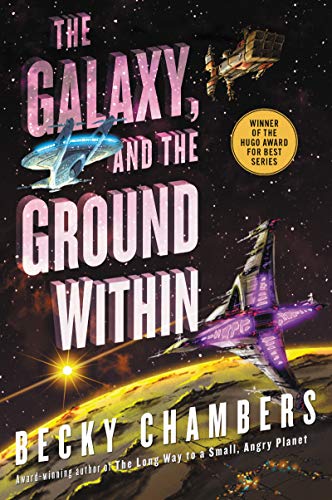
Audiobook Review: The Galaxy, and the Ground Within (Wayfarers, #4) by Becky Chambers

Title: The Galaxy, and the Ground Within
Series: Wayfarers, #4
Author: Becky Chambers
Narrator:  Rachel Dulude
Publisher: Harper Voyager
Publication date: April 20, 2021
Print length: 336 pages
Audio length: 9 hours, 55 minutes
Genre: Science fiction
Source: Library
Rating:

Rating: 4 out of 5.

With no water, no air, and no native life, the planet Gora is unremarkable. The only thing it has going for it is a chance proximity to more popular worlds, making it a decent stopover for ships traveling between the wormholes that keep the Galactic Commons connected. If deep space is a highway, Gora is just your average truck stop.

At the Five-Hop One-Stop, long-haul spacers can stretch their legs (if they have legs, that is), and get fuel, transit permits, and assorted supplies. The Five-Hop is run by an enterprising alien and her sometimes helpful child, who work hard to provide a little piece of home to everyone passing through.

When a freak technological failure halts all traffic to and from Gora, three strangers—all different species with different aims—are thrown together at the Five-Hop. Grounded, with nothing to do but wait, the trio—an exiled artist with an appointment to keep, a cargo runner at a personal crossroads, and a mysterious individual doing her best to help those on the fringes—are compelled to confront where they’ve been, where they might go, and what they are, or could be, to each other.

Reading (or listening to) Becky Chambers’ Wayfarers series is like being immersed in a cultural study, learning traditions, histories, and sociological norms… but here, the cultures are alien rather than human, and the action takes place in far-flung locations within the Galactic Commons.

In fact, in book #4 of the series — the final book — there’s not a human to be found. Instead, we settle in with a group of sapient non-humans from four different species as they wait out a space emergency that leaves then all stuck at a transit point, with only one another for company, support, and distraction.

Ouloo runs the Five-Hop with her exuberant child Tupo. Together, they welcome travelers with snacks, a garden, a bath house, and a place to restock and refuel before continuing on their way. Most visitors only stay for a couple of hours. There’s really nothing of interest on the planet Gora, but it is conveniently located between wormhole tunnels, so Ouloo does a pretty good business at her interplanetary version of a truck stop.

However, an accidental satellite collision leads to explosions and debris, and all travel on and off planet is halted while the emergency is dealt with. This strands the current batch of travelers at the Five-Hop, with no way to leave and no communications with the outside world. With no other options, the visitors settle in and start getting to know one another.

As with the other books in the series, The Galaxy, and the Ground Within is fairly gentle for a science fiction story. In fact, when the first explosions rocked Gora, I thought for a split-second that the planet was under attack… but no. Such violence would not be in keeping with the overall tone of the series. Yes, war and battles and calamities occur, but mostly as background or off the page. Throughout the Wayfarers books, the focus is on the people and their relationships, and the same is true in the 4th book.

One of the characters in this book is familiar from book #1 — Pei, of the Aeluon species, a cargo ship captain who faces a life-changing decision about her own destiny. The others, however, are all new, although most belong to species we’ve at least seen in passing before. As they spend time together, they learn about their lives, their differences and similarities, and find ways to bridge the cultural gaps between them.

In many ways The Galaxy, and the Ground Within feels like an anthropological study (although maybe that’s not the right word for a book about non-human species?). Through the characters, we’re introduced to the different species’ societal norms, traditions, physical features, dietary needs, and more. It’s all quiet fascinating, and a real tribute to the author’s skilled world-building and imagination.

At the same time, there’s not a ton of plot going on, other than strangers are stuck together, forge bonds, then go their separate ways. There are ups and downs, arguments and reconciliations, and even a medical emergency that requires everyone to put aside their differences and work together… but honestly, that’s about it.

That doesn’t mean this book is boring. It’s not! As I said before, for a science fiction novel, it’s very gentle. That’s not a bad thing, just unusual for the genre.

As with the other three books in the series, the audiobook narration by Rachel Delude is very well done. She provides distinct voices and inflections for each of the characters, and it’s quite a wonderful listening experience.

The Wayfarers series has been a reading goal of mine for a while now, and I’m delighted that I finally took the time to make it a priority. It’s a lovely feat of storytelling. Rather than a continuous narrative broken into four books, this series is built on the concept of taking a singular galactic society and examining it through four separate stories. It’s unusual, it’s all rather peaceful and beautiful, and it absolutely works.

Audiobook Review: Spare by Prince Harry

Title: Spare
Author: Prince Harry
Narrator: Prince Harry
Publisher: Random House
Publication date: January 10, 2023
Print length: 410 pages
Audio length: 15 hours, 39 minutes
Genre: Memoir
Source: Audible (hardcover from library)
Rating:

Rating: 4 out of 5.

It was one of the most searing images of the twentieth century: two young boys, two princes, walking behind their mother’s coffin as the world watched in sorrow—and horror. As Princess Diana was laid to rest, billions wondered what Prince William and Prince Harry must be thinking and feeling—and how their lives would play out from that point on.

For Harry, this is that story at last.

Before losing his mother, twelve-year-old Prince Harry was known as the carefree one, the happy-go-lucky Spare to the more serious Heir. Grief changed everything. He struggled at school, struggled with anger, with loneliness—and, because he blamed the press for his mother’s death, he struggled to accept life in the spotlight.

At twenty-one, he joined the British Army. The discipline gave him structure, and two combat tours made him a hero at home. But he soon felt more lost than ever, suffering from post-traumatic stress and prone to crippling panic attacks. Above all, he couldn’t find true love.

Then he met Meghan. The world was swept away by the couple’s cinematic romance and rejoiced in their fairy-tale wedding. But from the beginning, Harry and Meghan were preyed upon by the press, subjected to waves of abuse, racism, and lies. Watching his wife suffer, their safety and mental health at risk, Harry saw no other way to prevent the tragedy of history repeating itself but to flee his mother country. Over the centuries, leaving the Royal Family was an act few had dared. The last to try, in fact, had been his mother. . . .

For the first time, Prince Harry tells his own story, chronicling his journey with raw, unflinching honesty. A landmark publication, Spare is full of insight, revelation, self-examination, and hard-won wisdom about the eternal power of love over grief.

I know there’s been a lot of general chitchat online about Prince Harry basically oversaturating the market with multiple presentations of his story. There was the Oprah interview that more or less kicked things off, the multi-part Netflix series Harry & Meghan, and now, the release of his memoir, Spare. Given how much coverage has already been dedicated to this royal couple, is a book really necessary? Is there anything new that hasn’t already been shared? Yes, and yes.

In Spare, Prince Harry narrates his life (literally, for those listening to the audiobook), essentially starting with the devastation of Princess Diana’s tragic death in 1997. For Harry, a boy of just twelve years old, her death was beyond comprehension. In fact, as we see in Spare, he spent years deeply believing that his mother was actually in hiding, just waiting for the moment when it would be safe to reunite with her boys. Throughout the section of Spare that covers his youth, he refers to his mother’s “disappearance”, never her “death”. It’s chilling, to say the least.

The book is divided roughly into thirds, covering his childhood and youth, his army service, and his relationship with Meghan. The first third, Out of the Night that Covers Me, is the most powerful, and actually brought me to tears several times. Strip away the Royal Family trappings, and what we have is the story of a boy suffering a tremendous loss and not having the support or resources to deal with it. The events, as they unfold through Harry’s memories, are overwhelming, baffling, painful, and isolating.

As the narrative moves into Harry’s teen and young adult years, he covers his growing devotion to working and living in Africa, his search for meaning and purpose, his experiences in the army (in the book’s second section, Bloody, But Unbowed), and the ongoing strains of his family relationships, especially with his father and brother.

And finally, section three of the book, Captain of My Soul, gets into his romance with Meghan, the viciousness of the media attacks on her, and the couple’s departure from official royal life. Most of this is familiar already, but it’s still interesting to hear Harry’s perspective and gain new insights on the internal struggles he experienced and the painful interactions with the family members he should have been able to count on.

I listened to the audiobook, which I think is the way to go. Prince Harry does the narration, and of course, it’s especially moving to hear him tell his own story.

For the most part, I found him sympathetic and straightforward. Yes, I suppose we could scoff at the “poor me” aspect of it all — after all, being royal is the ultimate state of privilege, isn’t it? He acknowledges all of this, and yet also points out the absolute weirdness of suddenly being cut off after a lifetime of trained dependency. His father isn’t just his father, he’s also his boss, his business manager, and the controller of all of his funds. Harry points out that he’s never carried money or placed an order online. What kind of way to live is that? (He does mention that he has an inheritance from his mother that he and Meghan didn’t want to touch, since they wanted it to be for their children… which, okay, that’s a nice goal, but then it’s hard to feel too sorry for them when Harry gets into the extremely high cost of security, then mentions buying their perfect home in Santa Barbara).

Still, there’s a sadness throughout when it comes to telling the story of being part of an emotionally withholding family — a family that’s also a business and an institution, where closest relationships come with heavy strings and expectations and requirements, but not a whole lot of space for difference or grief or nonconformity. It’s hard to imagine the enormous pressure of being under constant scrutiny and harassment — Harry’s harshest stories and commentary are leveled at the corrupt media and the “paps” who show no mercy when it comes to getting a story or a photo, even when these stories and photos put people’s lives at risk.

Overall, I found the storytelling powerful, honest, and unflinching. Harry is open about his own flaws, his emotional struggles, and his doubts and fears. He very clearly explains and illustrates, over and over again, the ongoing impact of his mother’s death and how that informs his worldview, as well as his unending need to keep his wife and children safe at all costs, even if that means breaking with his own family and all that being royal entails.

Of course, media coverage has been focused on the big “reveals” (such as misunderstandings between Kate and Meghan, the fuss over Meghan’s wedding tiara, etc), but in actuality, Spare is at its most affecting as the story of loss, grief, and family.

Well worth reading, and I highly recommend the audio version.

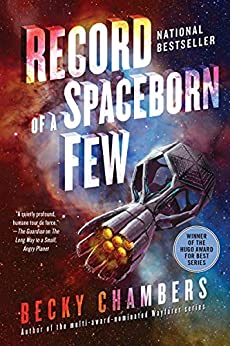
Audiobook Review: Record of a Spaceborn Few (Wayfarers, #3) by Becky Chambers

Title: Record of a Spaceborn Few
Series: Wayfarers, #3
Author: Becky Chambers
Narrator:  Rachel Dulude
Publisher: Harper Voyager
Publication date: July 24, 2018
Print length: 368 pages
Audio length: 11 hours, 36 minutes
Genre: Science fiction
Source: Library
Rating:

Rating: 5 out of 5.

Brimming with Chambers’ signature blend of heart-warming character relationships and dazzling adventure, Record of a Spaceborn few is the third standalone installment of the Wayfarers series, set in the sprawling universe of the Galactic Commons, and following a new motley crew on a journey to another corner corner of the cosmos—one often mentioned, but not yet explored.

Return to the sprawling universe of the Galactic Commons, as humans, artificial intelligence, aliens, and some beings yet undiscovered explore what it means to be a community in this exciting third adventure in the acclaimed and multi-award-nominated science fiction Wayfarers series, brimming with heartwarming characters and dazzling space adventure.

Hundreds of years ago, the last humans on Earth boarded the Exodus Fleet in search of a new home among the stars. After centuries spent wandering empty space, their descendants were eventually accepted by the well-established species that govern the Milky Way.

But that was long ago. Today, the Exodus Fleet is a living relic, the birthplace of many, yet a place few outsiders have ever visited. While the Exodans take great pride in their original community and traditions, their culture has been influenced by others beyond their bulkheads. As many Exodans leave for alien cities or terrestrial colonies, those who remain are left to ponder their own lives and futures: What is the purpose of a ship that has reached its destination? Why remain in space when there are habitable worlds available to live? What is the price of sustaining their carefully balanced way of life—and is it worth saving at all?

A young apprentice, a lifelong spacer with young children, a planet-raised traveler, an alien academic, a caretaker for the dead, and an Archivist whose mission is to ensure no one’s story is forgotten, wrestle with these profound universal questions. The answers may seem small on the galactic scale, but to these individuals, it could mean everything.

Argh… again with a misleading synopsis blurb! Why does whoever writes things keep coming back to a “motley crew”? That is SO not what this book is about! Anyway…

Record of a Spaceborn Few is the 3rd installment in the fabulous Wayfarers series, and it leaves me in absolute awe of author Becky Chambers and her vision of this sprawling fictional world. Here, she moves the story to a place we’ve heard about but not seen — the Exodan Fleet.

Many generations earlier, humans left Earth as it became uninhabitable, creating a fleet of homesteader ships that headed out into the galaxy with no idea of an endpoint or destination. Eventually, the human fleet encountered other sapient species, much more advanced in technology and in the social complexities of cross-species relations. After some time, the humans were accepted into the Galactic Commons (kind of like a UN for alien species), and many of the humans of the fleet sought out new homes on already established worlds or set out to colonize new human habitations on unsettled planets.

Not all, though. Many remained with the fleet, where their ancestors had lived already for centuries. Among the ships of the fleet, a shared community of sustainability, common interest, respect for the past, and well-ordered social expectations had been built over time. For the Exodans who stayed with the fleet, they were no longer on a journey — the fleet was home.

Within this setting, we follow the lives of several very different characters — some lifelong residents of the Asteria homesteader ship, some newcomers, some alien visitors. Through each, we learn more about Exodan life, their rituals, their beliefs, and the reality of their day-to-day.

The action starts with an unprecedented tragedy — one of the Exodan ships is destroyed in a freak accident. For the rest of the fleet, this is not only a human tragedy with countless deaths, but also a stark reminder of the potential danger and precariousness of their own homes. As the story moves forward, we see the ripple effect on the different characters, some of whom question their commitment to the fleet and wonder about other options, and some of whom reinvest in making sure that the fleet society has a future.

It’s all quite fascinating. In some ways, life in the fleet reminds me of a traditional kibbutz — communal life, with all jobs valued, each giving back to the community through labor, with shared communal living spaces balanced with family spaces, and a shared responsibility for daily tasks such as cooking, cleaning, and childcare. I was also intrigued by the deeply ingrained ethos of reusing and repurposing. When resources are scarce and the world is a closed system, everything serves a purpose, and nothing can be wasted.

The characters themselves are unique individuals, each with their own interesting lives and sets of joys and worries. These include an archivist, who tends the collective memories of the fleet; a newcomer seeking new meaning after growing up planetside and without connections; a caregiver whose job is to lovingly tend the dead through carefully established rituals; an alien sociologist spending time on the Asteria to study this example of human society, and a teen who isn’t sure where he’s meant to be or what his purpose is. They’re all wonderful, and I can’t say there was any one storyline I preferred over the others.

Record of a Spaceborn Few is loosely connected to the first book in the series, The Long Way to a Small, Angry Planet, as one of the characters is the sibling of the ship captain from the 1st book. Otherwise, this is a stand-alone story within a shared universe. I love how each book in the series opens up a new aspect of life within this fictional universe, broadening our understanding of what life is like for these future humans — among the stars, on a planet, or on a homesteader ship.

While these books are science fiction, there are no raging space battles or chases or high-tech weaponry. The series is about a society, about what it’s like to live in a galaxy where one’s own species is both a novelty and a minority, dependent on the tolerance and generosity of others species. The characters we meet, the choices they make and the dilemmas they face, are far more important to the overall tone and themes of the books than the details of water recycling, propulsion system, or the mechanics of keeping a spaceship working for centuries.

It’s all fascinating, and a remarkable creation. I’ve been listening to the audiobooks — narrator Rachel Delude gives an incredible performance, voicing so many different characters, keeping them distinct and identifiable, and bringing emotion and humor whenever needed. It’s been a terrific listening experience.

I can’t recommend this series strongly enough! Each book is a delight, and each one adds new dimensions to our understanding of the world of the series.

Next in the series: The Galaxy, and the Ground Within

I have one book left in the series — The Galaxy, and the Ground Within — and can’t wait to keep going (although I’ll be sad to finish). After hearing about this series for so long, I’m so glad that I finally made it a point to dig in! I’m just sorry that it took me so long.

Audiobook Review: Beyond the Wand: The Magic & Mayhem of Growing Up a Wizard by Tom Felton

Title: Beyond the Wand: The Magic & Mayhem of Growing Up a Wizard
Author: Tom Felton
Narrator: Tom Felton
Publisher: Grand Central Publishing
Publication date: October 18, 2022
Print length: 286 pages
Audio length: 6 hours, 36 minutes
Genre: Memoir
Source: Library
Rating:

Rating: 4.5 out of 5.

They called for a break, and Gambon magicked up a cigarette from out of his beard. He and I were often to be found outside the stage door, having ‘a breath of fresh air’, as we referred to it. There would be painters and plasterers and chippies and sparks, and among them all would be me and Dumbledore having a crafty cigarette.

From Borrower to wizard, Tom Felton’s adolescence was anything but ordinary. His early rise to fame saw him catapulted into the limelight aged just twelve when he landed the iconic role of Draco Malfoy in the Harry Potter films.

Speaking with candour and his own trademark humour, Tom shares his experience of growing up on screen and as part of the wizarding world for the very first time. He tells all about his big break, what filming was really like and the lasting friendships he made during ten years as part of the franchise, as well as the highs and lows of fame and the reality of navigating adult life after filming finished.

Prepare to meet a real-life wizard.

Draco speaks!

In Beyond the Wand, actor Tom Felton shares stories from his early childhood, the Potter years, and beyond. Unlike some of the seriously dire and disturbing celebrity memoirs of the past year, Beyond the Wand is a mostly upbeat, light-hearted romp through the life of an actor whose professional work will forever be defined by the sneering Slytherin he portrayed so well.

Significantly younger than his three older brothers, Tom grew up with a healthy dose of love and fun, but also humility — his brothers were always happy to cut him down to size before celebrity could go to his head. After roles in two smaller films, Tom’s life changed forever when he was cast as Draco Malfoy… without ever having read the Harry Potter books. (His description of the audition scene, where he had to fake knowledge of the story — and failed — is very funny).

His descriptions of the early years of filming are sweet, humorous, and eye-opening. There’s nothing scandalous here, don’t worry! Tom shares stories of on-set experiences, filming challenges, and lots of fun little stories — for example, his grandfather, acting as Tom’s required on-set chaperone, had such an impressive white beard that director Chris Columbus ended up casting him as a Hogwarts professor!

Because Draco was a lower-profile character than the big three of Harry, Hermione, and Ron, Tom’s profile as a star was somewhat lower-key as well. And because he had fewer scenes over all, he was able to continue attending his Muggle school in between filming, which he credits with enabling him to have a semi-normal childhood. Yes, he had a lead role in one of the biggest movie franchises ever, but he also had regular school, friends, and older brothers to keep him grounded (and occasionally get him into trouble as well).

The tone of Beyond the Wand is light and funny. Listening to the audiobook is a pleasure — he narrates his own story, and speaks it all as if he were hanging out with you and telling stories. It feels accessible and personal, and he injects a sense of fun into it all.

One of the elements I really appreciated in Beyond the Wand was Tom’s depiction of the older cast of Harry Potter and their influence on him and his child co-stars. As he describes, walking onto set as a 12-year-old, he had no idea of the stature of the adult cast members. And yet, over time, he came to realize just how fortunate he was to act alongside actors such as Richard Harris, Maggie Smith, and Alan Rickman. He shares plenty of lovely anecdotes about their interactions with the children, their influence, and their generosity, and he also pays loving tribute to the cast members no longer with us, which is quite touching.

It’s only in the last couple of chapters that we get to anything darker, as he describes his post-Potter Hollywood years, his sense of loss of direction, a brief period of alcohol abuse, and struggles with mental health. The focus is mostly on the positive, though — on the importance of being able to get help without shame, and the value he’s found in seeking treatment when needed.

Other than those chapters, the tone is very fun and full of larks, and overall, Beyond the Wand is a really enjoyable listen. Even for huge Potter fans, there are plenty of behind-the-scenes tidbits shared here that will be new and fresh. (Nothing scandalous — it’s all good fun, with a sense of Tom’s enjoyment at being a bit of a rascal.)

This would be a great gift for any adult who grew up on Potter. Tom Felton presents his story with humor and modesty, as well as deep appreciation for the experiences he’s had and the people he’s worked with. He comes across as very human and not overly impressed with his own celebrity — it’s a friendly, chummy memoir about a boy who ended up following a very unusual path. Lots of fun — definitely recommended.

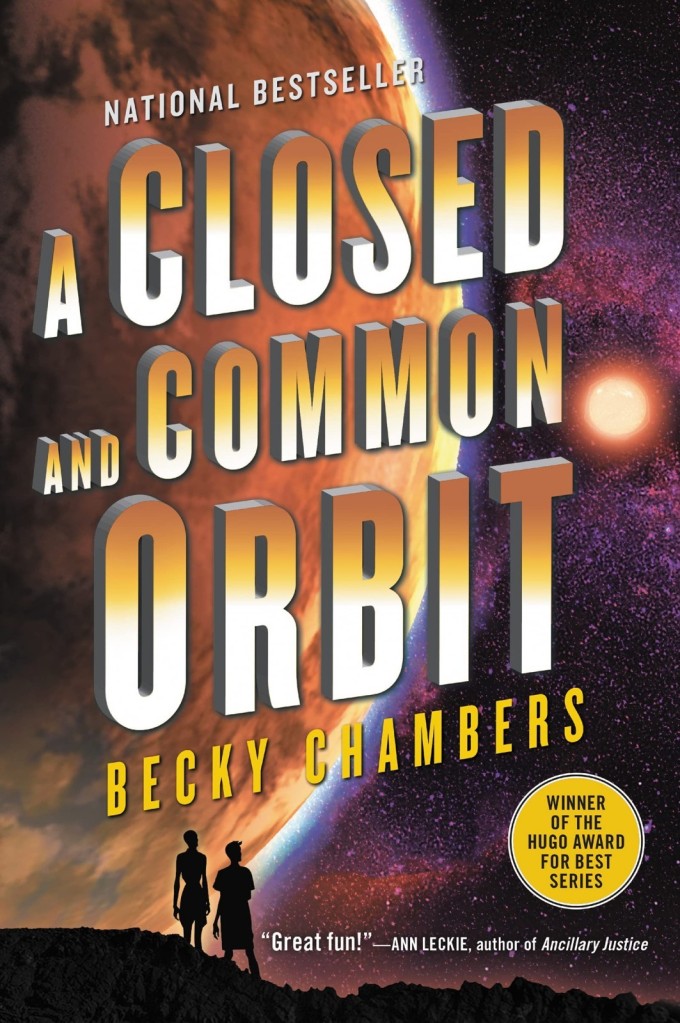
Audiobook Review: A Closed and Common Orbit (Wayfarers, #2) by Becky Chambers

Title: A Closed and Common Orbit
Series: Wayfarers, #2
Author: Becky Chambers
Narrator:  Rachel Dulude
Publisher: Harper Voyager
Publication date: October 20, 2016
Print length: 365 pages
Audio length: 11 hours, 29 minutes
Genre: Science fiction
Source: Library
Rating:

Rating: 4 out of 5.

Embark on an exciting, adventurous, and dangerous journey through the galaxy with the motley crew of the spaceship Wayfarer in this fun and heart-warming space opera—the sequel to the acclaimed The Long Way to a Small, Angry Planet.

Lovelace was once merely a ship’s artificial intelligence. When she wakes up in a new body, following a total system shut-down and reboot, she has no memory of what came before. As Lovelace learns to negotiate the universe and discover who she is, she makes friends with Pepper, an excitable engineer, who’s determined to help her learn and grow.

Together, Pepper and Lovey will discover that no matter how vast space is, two people can fill it together.

The Long Way to a Small, Angry Planet introduced readers to the incredible world of Rosemary Harper, a young woman with a restless soul and secrets to keep. When she joined the crew of the Wayfarer, an intergalactic ship, she got more than she bargained for—and learned to live with, and love, her rag-tag collection of crewmates.

A Closed and Common Orbit is the stand-alone sequel to that beloved debut novel, and is perfect for fans of Firefly, Joss Whedon, Mass Effect, and Star Wars.

Beware the misleading synopsis… this book is definitely not a “journey through the galaxy with the motley crew of the spaceship Wayfarer”. In fact, A Closed and Common Orbit has almost nothing to do with the Wayfarer spaceship or its crew, except as a point of origin and connection for its characters. But that caveat aside, let’s talk about what this book actually is.

A Closed and Common Orbit picks up after the events of The Long Way to a Small, Angry Planet. Spoiler for those who haven’t read book #1 — the Wayfarer’s sentient AI, Lovelace, ends the first book by being transferred to an illegal body kit by the mechanic Pepper, and the two of them depart on their own adventure.

Book #2 picks up soon afterward, as Pepper, her companion Blue, and Lovelace travel back to Pepper’s home in Port Coriol, where Lovelace faces the daunting task of trying to act like a “normal” human. Inhabiting a high-quality artificial body that appears real, Lovelace adopts a new name, Sidra, and settles into life with Pepper and Blue. But Sidra misses the expanded senses and awareness of being a ship’s AI, and despite the unexpected ways she finds to explore and enjoy using her physical senses, she feels out of place and harshly limited by only being able to experience the world using the “kit” (as she refers to her physical manifestation).

In alternating chapters, we also get Pepper’s backstory. Now a tech wizard who can fix just about anything, Pepper got her start as a child slave in a factory policed by robotic “mothers”, a girl whose entire life consisted of sorting scrap on a planet mainly used as a junkyard. After escaping the factory at age 10, Pepper (then known as Jane) survived by finding shelter in an abandoned shuttlecraft, thanks to the guidance and nurturing of that ship’s AI, Owl. Over nine long years, Jane scavenged the nearby junkheaps and slowly repaired the shuttle until it was finally ready to take flight and escape.

For both Sidra and Jane, learning to be a person presents a huge challenge, as each has been denied human companionship and experiences in key ways. Though their sitations are very different, each must learn how to navigate their new realities and to rely on their own sense of self for survival, and each must ultimately figure out their own purpose in the new worlds in which they end up.

When I started this book, I was a little disappointed that the characters from book #1 wouldn’t be part of the story, but ultimately, I did get very caught up in Pepper/Jane and Sidra’s stories. I loved how some of their experiences paralleled one another, and found their explorations of their respective worlds really fascinating.

While the synopsis describes this book as a stand-alone, I wouldn’t recommend reading it without having first read book #1. The worldbuilding is too complex to fully appreciate without the grounding provided by the first book — there are planets and government entities and alien species to sort out and become familiar with, all of which are introduced in The Long Way to a Small, Angry Planet. That said, this feels in some ways more like a bottle episode of a TV show — set in a familiar world, but with a narrow focus on just a few characters. Like good bottle episodes, this story illuminates more intricacies of the Wayfarers universe than previously seen, and at the same time provides a deep and meaningful interlude in the lives of the characters it focuses on.

I’m curious to see where the series goes next, and plan to continue just as soon as my library hold for the next audiobook comes in. (Side now: As I mentioned in my review of the first book, the narrator here is excellent!)

I’m so glad that I finally got around to starting this series — which has been on my TBR for way too many years. Well worth the wait, and highly recommended.

Next in the series: Record of a Spaceborn Few

Audiobook Review: The Long Way to a Small, Angry Planet (Wayfarers, #1) by Becky Chambers

Title: The Long Way to a Small, Angry Planet
Series: Wayfarers, #1
Author: Becky Chambers
Narrator:  Rachel Dulude
Publisher: Harper Voyager
Publication date: July 29, 2014
Print length: 432 pages
Audio length: 14 hours, 23 minutes
Genre: Science fiction
Source: Purchased
Rating:

Rating: 4.5 out of 5.

Follow a motley crew on an exciting journey through space—and one adventurous young explorer who discovers the meaning of family in the far reaches of the universe—in this light-hearted debut space opera from a rising sci-fi star.

Rosemary Harper doesn’t expect much when she joins the crew of the aging Wayfarer. While the patched-up ship has seen better days, it offers her a bed, a chance to explore the far-off corners of the galaxy, and most importantly, some distance from her past. An introspective young woman who learned early to keep to herself, she’s never met anyone remotely like the ship’s diverse crew, including Sissix, the exotic reptilian pilot, chatty engineers Kizzy and Jenks who keep the ship running, and Ashby, their noble captain.

Life aboard the Wayfarer is chaotic and crazy—exactly what Rosemary wants. It’s also about to get extremely dangerous when the crew is offered the job of a lifetime. Tunneling wormholes through space to a distant planet is definitely lucrative and will keep them comfortable for years. But risking her life wasn’t part of the plan. In the far reaches of deep space, the tiny Wayfarer crew will confront a host of unexpected mishaps and thrilling adventures that force them to depend on each other. To survive, Rosemary’s got to learn how to rely on this assortment of oddballs—an experience that teaches her about love and trust, and that having a family isn’t necessarily the worst thing in the universe.

The Wayfarers series has been on my to-read pile for far too long, so I’m thrilled that (a) I finally read book #1, The Long Way to a Small, Angry Planet, and (b) I loved it!

Rosemary Harper is our entry point to the world of this book, although once introduced, she’s just one of many characters whom we follow. The cast here is the crew of the Wayfarer, a tunneling ship that hires out its services to bore tunnels — wormholes — to link far-flung points in space. It’s dangerous, complicated work, but absolutely necessary in an expansive universe in which humans are a minority species without a planet to call home.

Centuries earlier, humans left Earth due to planetary failure — some colonizing Mars, but others, known as Exodans, setting off on generation ships to permanently wander. Eventually, humans were allowed to join the Galactic Commons, the governing body that unites in alliance (sometimes uneasily) the various species who work together to keep the peace and provide structure to the greater world of sapient beings.

The plot of The Long Way takes place on and around the Wayfarer ship, as Rosemary (and we readers) become acquainted with the crew, their personalities, roles, conflicts, and desires, and prepare for the biggest job they’ve ever had. There are romances, secrets, and dangers, but the people are all wonderful (except for one jerky algaeist, but even he gets slightly more tolerable eventually).

The storytelling is very episodic. While there’s an overarching plotline concerning the big, dangerous job the Wayfarer takes on and its aftermath, this is more of a background element for much of the book. Instead, from chapter to chapter, we spend time with the different crew members in different scenarios, learning about each of their backgrounds and what brought them to the Wayfarer, as well as placing them in settings and seeing them go through different experiences.

Because of this episodic approach, there isn’t a lot of building tension throughout the book. Somehow, though, that’s okay. From time to time, there are a few big action sequences or big emotional encounters or high-stakes threats, but the main focus of the book is on the characters themselves and their relationships. The tone overall is, believe it or not for a space adventure, rather cozy… and I liked this approach! We really get to know the characters, so when there are moments of high drama, we understand the stakes and the why and how of different people’s reactions.

I listened to the audiobook, narrated by Rachel Dulude, and thought it was wonderful. I’ve had experiences of struggling with science fiction audiobooks in the past, where I’ve found it challenging to absorb the tech and details of a complicated sci-fi setting and its world-building. Here, though — perhaps because of the focus on the characters themselves — it simply flows. The narrator gives distinct voices to the characters, even the non-human ones, so there’s never any confusion about who is speaking or what they’re feeling. The narration is crisp and dynamic, and I enjoyed it so much that I’ll probably choose audiobooks when I’m ready to continue the series.

Overall, I really and truly enjoyed The Long Way to a Small, Angry Planet. It wasn’t what I expected, but I loved what it was! I’m eager to continue with the series — just waiting for book #2 to come in at the library.

Sometimes when I read a book that I’ve been meaning to get to for a long time, the end result is a let-down. Fortunately, The Long Way surprised me in lovely ways and was worth the anticipation. Highly recommended.

Next in the series: A Closed and Common Orbit

Audiobook Review: Rules at the School by the Sea (Maggie Adair, #2) by Jenny Colgan

Title: Rules at the School by the Sea
Series: Maggie Adair / Little School by the Sea
Author: Jenny Colgan
Narrator: Jilly Bond
Publisher: Avon
Publication date: Originally published 2010; reissued 2022
Print length: 288 pages
Audio length: 7 hours, 32 minutes
Genre: Contemporary fiction
Source: Purchased
Rating:

Rating: 3.5 out of 5.

It’s summer, but school is in session in the delightful second book of New York Times bestselling author Jenny Colgan’s utterly charming School by the Sea series, set at a girls’ boarding school in Cornwall.

For the second year at Downey House, it’s getting harder and harder to stick to the rules . . .

Maggie Adair’s first year as a teacher at Downey House was a surprising success. After making the leap from an inner-city school in Glasgow, she’s learned to appreciate the mellower pace of the girls’ boarding school by the sea.

Now engaged to her longtime boyfriend, sweet and steady Stan, Maggie’s just got to stop thinking about David McDonald, her colleague at the boys’ school down the road. Well, hasn’t she? Can Maggie take a leaf out of the Well Behaved Teacher’s exercise book and stick to her plan for a small but elegant wedding and settled life of matrimony?

Even as Maggie tries to stay within the lines, rules are being broken all around her. Maggie’s boss, headmistress Veronica Deveral, has more to lose than anyone. When Daniel Stapleton joins the faculty, Veronica finds herself forced to confront a scandalous secret she thought she’d carefully buried forever. How long will she be able to keep her past under wraps?

What does a new year of classes, rules, and camaraderie hold for the students and faculty at Downey House?

After listening to the first book in the Little School series, Welcome to the School by the Sea, I thought I’d wait a bit and enjoy the anticipation before listening to the second… but in the end, I just had to see what happens next!

In Rules at the School by the Sea, we start a new school year alongside teacher Maggie, headmistress Veronica, and the rambunctious group of girls — Simone, Fliss, and Alice — we got to know in the first book.

Maggie is much more settled into her life at Downey House. She’s more confident in her teaching abilities, and plans to grab her girls’ attention by focusing on romantic poetry from the World War I era during English lessons. Maggie and her long-time boyfriend Stan have recently become engaged, but Maggie seems to be in a bit of denial: She doesn’t really have any interest in wedding plans, and despite Stan’s urging, really doesn’t want to leave Downey House and look for a teaching job in Glasgow.

For Veronica, she’s both thrilled to have her biological son teaching at the nearby boys’ school, but also worried about whether news of her having once given up a baby for adoption will create a scandal among her staff and the parents. Meanwhile, she and Daniel are cautiously beginning to get to know one another, but Veronica is finding it almost impossible to balance her growing love for her son and his family with her deeply ingrained need for privacy.

And the girls — well, what can we say about a bunch of 14 (almost 15) -year-old girls in all their glorious confusion of hormones and growing up and still being so very young in so many ways? A new girl, Zelda — the daughter of a US army officer temporarily stationed in the UK — shakes up the group of friends with her brashness and American approach to school, while Fliss and Alice fall out over a boy and Simone takes Zelda up on her offer of a total image makeover. There are arguments and rule-breaking and hilarity, and it’s quite fun to see the girls’ petty squabbles as well as their friendship and commitment to one another.

Rules is quite a lot of fun, capturing the excitement of the school year from the perspective of the students as well as that of the teachers. Overall, I quite enjoyed this 2nd book, but I did feel particularly frustrated by Maggie’s romance story line.

Maggie has been with Stan for ages and cares for him, but she’s so clearly in love with (and better suited for) David, the English teacher from the boys’ school. Maggie spends the entire book trying to convince herself that her crush on David is just a passing phase, and that she really does want to marry Stan — but it’s entirely obvious that she and Stan have grown apart and want very different things out of their lives. It seemed as though there were plenty of opportunities for Maggie to face the truth and take responsibility for breaking off the engagement with Stan, but each time, she backtracks and recommits, even though she isn’t actually happy.

I know this back-and-forth love triangle stuff is supposed to add drama and tension, but after a while, it just makes it seem as though Maggie is emotionally unaware, and that doesn’t feel true to her character. There’s a bit of a cliffhanger ending in the final chapter, but it does appear that Maggie has finally had an epiphany and is on the verge of taking action… and I hope that’s really the case! (This is why I’ll probably grab the 3rd book the very first second that I can — I need to know what happens next!!)

On a more serious note, the problematic focus on Simone’s weight from book #1 continues here. Again, there’s nothing wrong with Simone making an effort to adopt healthy eating habits if that’s what feels right to her, but the over-emphasis on being slim in order to gain popularity and attract boys leads to an eating disorder for another of the girls in the group. On the one hand, I’m glad that the darker aspects of this focus on dieting are shown, but there’s still something very uncomfortable about how much weight and appearance matter in the girls’ lives. (Perhaps this is an aftereffect of the fact that this book was originally published in 2010 — if it were written today, I’d hope that the fat-shaming and focus on a specific standard for acceptable bodies would be addressed or eliminated altogether).

My frustration with the romance and the weight/dieting storylines aside, I did find Rules a sweet, entertaining, engaging read. I love how the storyline bounces between the adults and students, and how we get to see each sides’ attitudes and perceptions about the other. The characters are all quite endearing — even the obnoxious spoiled girls have something going for them — and the story as a whole is just such a yummy treat in the way it presents a somewhat idealized yet still modern-day version of life at a lovely boarding school.

This is the 2nd book in a series that was originally published over 10 years ago under a pseudonym, now being reissued with spiffed-up covers, titles, and the actual author’s name! The third reissue, Lessons at the School by the Sea, will be released in March 2023 — although since I have a paperback of the original version, I may have to read it much sooner. (Apparently, I am terrible at waiting.)

The audiobook is very enjoyable — I really liked the narrator’s approach to voicing the different characters. She does a very good job of capturing their personalities, although I found her version of an American/Texan accent for Zelda incredibly grating and overdone. Otherwise, though, it’s a charming listening experience.

And finally, one lovely bit is that the audiobook ends with a collection of Maggie’s poems — the poetry she teaches her class over the course of the school year. It was a sweet treat to get to hear all of these after the main story had concluded, and even though pieces of some of these are included earlier in the story, it was lovely to get to listen to them in their entirety. (My favorite of these is Phenomenal Woman by Maya Angelou — see the full text here).

Another nice little bit at the end — after finishing the audiobook, I picked up my paperback edition and discovered that the final piece included is step-by-step instructions for some of the dances that the girls learn, including The Dashing White Sergeant, Strip the Willow, and Eightsome Reel. (I can’t actually visualize the dances from reading the instructions, but seeing these pages is motivating me to go look for dance videos online.)

Wrapping it all up…

I love when a first book’s promise is delivered on in the second book, and that’s definitely the case with Rules at the School by the Sea. There’s much still unresolved plot-wise, but it’s wonderful to see these likable characters continue to learn and grow, and I can’t wait to see what’s next for all of them!

Book #3, to be released March 2023