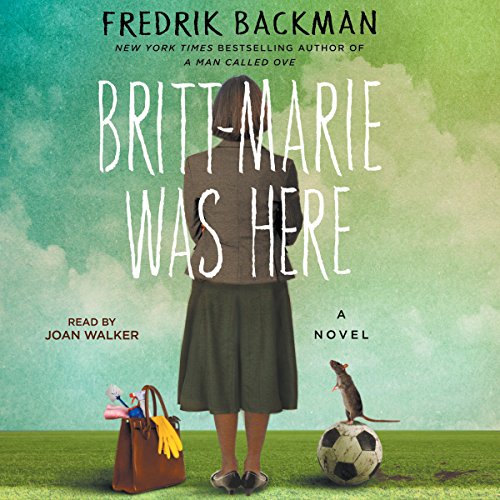
Audiobook Review: Britt-Marie Was Here by Fredrik Backman

Title: Britt-Marie Was Here
Author: Fredrik Backman
Narrator: Joan Walker
Publisher: Atria Books
Publication date: 2016
Print length: 324 pages
Audio length: 9 hours 18 minutes
Genre: Contemporary fiction
Source: Library
Rating:

Rating: 3 out of 5.

From the best-selling author of the “charming debut” (PeopleA Man Called Ove and My Grandmother Asked Me to Tell You She’s Sorry, a heartwarming and hilarious story of a reluctant outsider who transforms a tiny village and a woman who finds love and second chances in the unlikeliest of places.

Britt-Marie can’t stand mess. She eats dinner at precisely the right time and starts her day at six in the morning because only lunatics wake up later than that. And she is not passive-aggressive. Not in the least. It’s just that sometimes people interpret her helpful suggestions as criticisms, which is certainly not her intention.

But at 63, Britt-Marie has had enough. She finally walks out on her loveless 40-year marriage and finds a job in the only place she can: Borg, a small, derelict town devastated by the financial crisis. For the fastidious Britt-Marie, this new world of noisy children, muddy floors, and a roommate who is a rat (literally) is a hard adjustment.

As for the citizens of Borg, with everything that they know crumbling around them, the only thing that they have left to hold on to is something Britt-Marie absolutely loathes: their love of soccer. When the village’s youth team becomes desperate for a coach, they set their sights on her. She’s the least likely candidate, but their need is obvious, and there is no one else to do it.

Thus begins a beautiful and unlikely partnership. In her new role as reluctant mentor to these lost young boys and girls, Britt-Marie soon finds herself becoming increasingly vital to the community. And, even more surprisingly, she is the object of romantic desire for a friendly and handsome local policeman named Sven. In this world of oddballs and misfits, can Britt-Marie finally find a place where she belongs?

Zany and full of heart, Britt-Marie Was Here is a novel about love and second chances and about the unexpected friendships we make that teach us who we really are and the things we are capable of doing.

After finishing Fredrik Backman’s most recent book, My Friends — a true masterpiece — I decided to go back and read the remaining couple of his books that I’d somehow missed. But now that I’ve read Britt-Marie Was Here, I realize that his earlier books may not work for me quite as well as the more recent ones.

In Britt-Marie Was Here, we meet the prickly, socially awkward Britt-Marie who, after 40 years of marriage, leaves her husband and decides to start a life of her own. She’s spent all these year catering to her husband and keeping their home spotless, and has simply taken his word for it when he tells her that she’s not good with people. Now, she’s determined to find her own path, and starts by hounding the poor woman at the unemployment office until she’s finally offered the only available position — acting as caretaker for an abandoned community center slated for closure shortly, in the forgotten, run-down town of Borg.

Borg is miles from nowhere, and seems to mainly consist of a pizzeria that’s also the local grocery store, post office, and car repair shop. The recreation center is just next door, and in just as desperate need of cleaning as the pizzeria, so Britt-Marie gets to work. She’s incredibly awkward and rubs the locals the wrong way right from the start — and yet, she’s not fazed when the curious local kids show up to check her out. Somehow, almost against her will, she gets involved, and soon, she’s formed abrasive yet fond relationships with the adults of Borg while also getting roped into acting as the kids’ soccer coach.

If you like your stories quirky and heart-warming, then there’s a lot you’ll enjoy about Britt-Marie Was Here. Backman’s storytelling is always a delight, and his wordplay and descriptions are just as clever as we’d expect. I especially love how this author captures so much depth about life and emotions in seemingly simple sentences:

She has not run down the stairs like this since she was a teenager, when your heart reaches the front door before your feet.

However… Plotwise, Britt-Marie Was Here feels a little bland. I’ve read plenty of books already about outsiders finding connection and community in a peculiar small town, so this book didn’t especially stand out for me. What’s more, I found the timeline hard to believe: Britt-Marie spends three weeks in Borg, and somehow manages to change everyone’s lives for the better, create new hope for the children and their soccer team, and encourage the townsfolk to become their best selves. In three weeks? As I said, perhaps I’ve just read too many of these outsiders-transform-a-community stories, but I just wasn’t buying it.

On top of my issues with the story, I really struggled with the audiobook narration. The narrator’s delivery was a challenge for me, especially the rhythm and tone of her speaking voice. Something about it just didn’t click, and I often found myself puzzling over what I’d just heard or having to go back and repeat sections — or double-check them against the printed edition.

This is a cute story, and there are some moments I truly enjoyed, but between the narration and the sense of having read too many similar stories already, Britt-Marie Was Here was only a so-so audiobook experience for me.

I do think the author’s style and subject matter have developed spectacularly over the years, and his later books feel much deeper to me. I believe I have just one more of his early novels, and possibly a few shorter pieces, left to read, but after Britt-Marie, I’ll probably hold off for a while before delving further into his backlist.

Purchase linksAmazon – Audible – Bookshop.org – Libro.fm
Disclaimer: When you make a purchase through one of these affiliate links, I may earn a small commission, at no additional cost to you.
Save

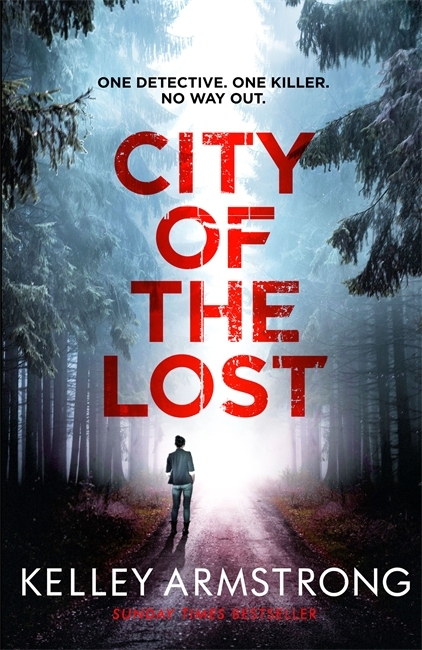
Book Review: City of the Lost (Rockton, #1) by Kelley Armstrong

Title: City of the Lost
Series: Rockton, #1
Author: Kelley Armstrong
Publisher: Minotaur Books
Publication date: May 3, 2016
Length: 412 pages
Genre: Thriller/mystery
Source: Library
Rating:

Rating: 4.5 out of 5.

Casey Duncan is a homicide detective with a secret: when she was in college, she killed a man. She was never caught, but he was the grandson of a mobster and she knows this crime will catch up to her. Casey’s best friend, Diana, is on the run from a violent, abusive ex-husband. When Diana’s husband finds her, and Casey herself is attacked shortly after, Casey knows it’s time for the two of them to disappear again.

Diana has heard of a domestic violence support town made for people like her, a town that takes in people on the run who want to shed their old lives. You must apply to live in Rockton and if you’re accepted, it means walking away entirely from your old life, living off the grid in the wilds of Canada: no cell phones, no Internet, no mail, no computers, very little electricity, and no way of getting in or out without the town council’s approval. As a murderer, Casey isn’t a good candidate, but she has something they want; she’s a homicide detective, and Rockton has just had its first real murder. She and Diana are in. However, soon after arriving, Casey realizes that the identity of a murderer isn’t the only secret Rockton is hiding – in fact, she starts to wonder if she and Diana might be in even more danger in Rockton than they were in their old lives.

An edgy, gripping crime novel from a bestselling urban fantasy writer, City of the Lost boldly announces a major new player in the crime fiction world.

Kelley Armstrong has become an auto-buy author for me, and I’ve been loving her recent series (A Rip Through Time and A Stitch in Time) and stand-alones. I hadn’t had the opportunity to explore her extensive backlist until now… and now that I’ve started, I can’t wait to keep going!

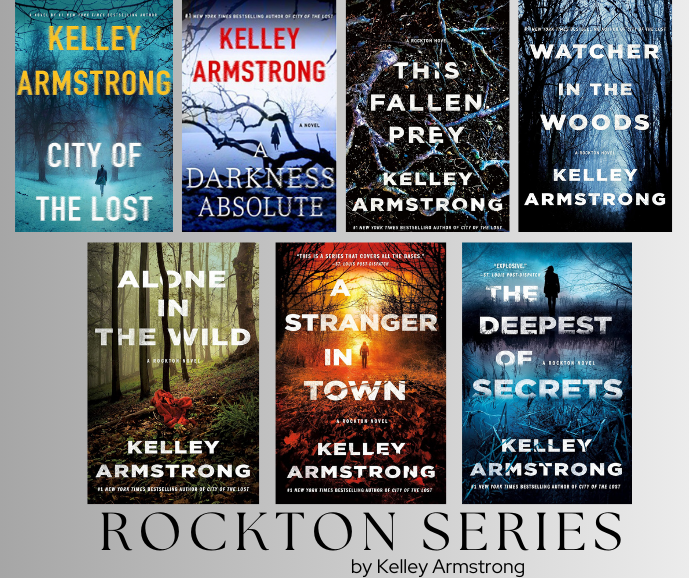
City of the Lost is the first book in the 7-book Rockton series. The premise is certainly unique: There’s a remote town — Rockton, population 200 — located in the wilds of Canada’s Yukon territory. It’s home to those fleeing danger who need complete isolation from the outside world, but it also offers shelter to some with questionable pasts who need a way to hide out and start over. There are no navigable roads in or out — new residents arrive by bush plane, and can only leave the same way. Relocating to Rockton is a serious commitment.

The books opens with a bang:

“I killed a man,” I say to my new therapist.

Detective Casey Duncan has a huge secret that’s been weighing on her for the past twelve years. After a brutally violent attack left Casey with permanent physical and psychological scars, she went to confront the ex-boyfriend whose actions brought about the attack (and who abandoned her to her attackers). During the confrontation, she shot and killed him, although that hadn’t been her intention. While she’s essentially gotten away with the killing, she’s always known that it could catch up to her at any point.

Meanwhile, her best friend Diana has been assaulted yet again by her cruel, abusive ex-husband, and she and Casey fear that they’ll never fully be rid of him. When Diana hears about a town where people can disappear, she proposed that they both go and get the protection they so desperately need. Casey is hesitant, but she realizes that this is the best possible solution for Diana. After an intense screening process, they’re in, but with a catch: The selection process easily unearthed Casey’s secret, but because they need a detective, they’ll let her in — only for a six-month stay.

Casey and Diana’s relocation to Rockton introduces them to a world that’s truly apart from everything they’ve known. And while Diana immediately immerses herself in the social life available to her as one of the small number of women in town, Casey gets right to work under the direction of Sheriff Eric Dalton. Dalton is brusque, demanding, and no-nonsense, and while he initially did not want Casey in his town, he quickly realizes how skilled and valuable she is.

Dalton and the town are in desperate need of Casey’s talents, as dead bodies begin cropping up. At first, it’s assumed that missing Rockton residents have simply wandered off into the woods and perhaps met with accidents, but as gruesome corpses are found, it becomes apparent that a killer is at work. Everyone in town is a potential suspect, and to make matters worse, Casey soon discovers that many of Rockton’s residents are actually more dangerous than she’s been led to believe.

The murder mystery and thriller elements are detailed and complex, with plenty of misleading clues and confusing trails of evidence. For a very small town, Rockton has a lot of characters to introduce, and my one complaint about City of the Lost is that it became difficult at various points to keep all the random people and their backstories straight.

That aside, the drama and tension escalate effectively throughout the story, and I loved seeing the different pieces come together. For me, when I read a mystery series, I enjoy the particular crime to be solved in each book, but what really holds my interest and attention is the character development that connects the books. City of the Lost is only the first book, but I can tell already that the characters are going to keep me coming back for more.

Casey herself is a terrific, imperfect, complex main character, and she has fabulous chemistry with Sheriff Eric Dalton. Even before personal chemistry comes into the mix, they’re amazing as partners, butting heads constantly while also building rock-solid respect for one another as professionals. Seeing them together, for me, is the high point of the story.

Beyond Casey and Eric, there are plenty of side characters who add depth to the story and help create a picture of a full society in this little town. And while the murders do get solved, there is clearly more to uncover in terms of people’s secrets and bigger picture questions about the council that runs Rockton from afar.

City of the Lost is a fantastic way to start a series! After just one book, I can say with certainty that I’m hooked and need more. Fortunately, there are six more books to explore in the main series, and I understand that a spin-off series, Haven’s Rock, includes two books so far, with a third due out in 2025. .

I’m going to try to take my time and not do a series binge… but it’s incredibly tempting to barge straight ahead! I’m looking forward to continuing the Rockton series. Next up: Darkness Absolute.

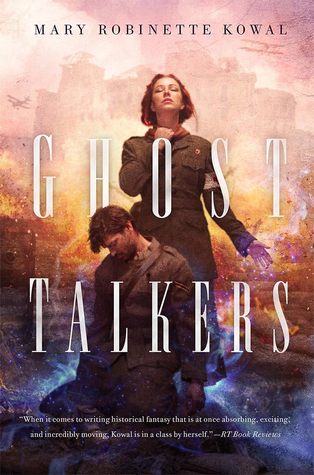
Book Review: Ghost Talkers by Mary Robinette Kowal

Title: Ghost Talkers
Author: Mary Robinette Kowal
Publisher: Tor Books Books
Publication date: August 16, 2016
Length: 304 pages
Genre: Historical fiction / fantasy
Source: Purchased
Rating:

Rating: 3.5 out of 5.

Ginger Stuyvesant, an American heiress living in London during World War I, is engaged to Captain Benjamin Harford, an intelligence officer. Ginger is a medium for the Spirit Corps, a special Spiritualist force.

Each soldier heading for the front is conditioned to report to the mediums of the Spirit Corps when they die so the Corps can pass instant information about troop movements to military intelligence.

Ginger and her fellow mediums contribute a great deal to the war efforts, so long as they pass the information through appropriate channels. While Ben is away at the front, Ginger discovers the presence of a traitor. Without the presence of her fiance to validate her findings, the top brass thinks she’s just imagining things. Even worse, it is clear that the Spirit Corps is now being directly targeted by the German war effort. Left to her own devices, Ginger has to find out how the Germans are targeting the Spirit Corps and stop them. This is a difficult and dangerous task for a woman of that era, but this time both the spirit and the flesh are willing…

How might the Great War have been different if soldiers killed in battle could report back, in real time, on what they saw and experienced?

In Ghost Talkers, the British army employs a top-secret corps of mediums, known as the Spirit Corps, to receive the ghosts of newly dead soldiers and take their final reports. The ghosts appear to the spirit circles and can, in some cases, provide useful information — such as where the German soldiers were firing from, or what they saw immediately before dying. The information gathered is sent directly back to the front, and then the mediums take any final messages before the ghosts move on through the veil to the next plane.

Ginger is one of the lead mediums, working double shifts to take reports — an exhausting process that involves extending her soul beyond her physical body to interact with with ghosts on the spirit plane. This is dangerous for the mediums: Being on the spirit plane is freeing in many ways, and there’s a risk that the medium will lost contact with their body, perhaps never to return. The spirit circle grounds the medium to the physical realm, but the danger is constant.

These spiritual risks are amplified when evidence comes through the reports of the deceased that the Germans are aware of the Spirit Corps and have plans to sabotage them. Ginger finds herself pursuing leads that the top brass choose to ignore, and soon finds both her physical and spiritual self in grave peril.

Ghost Talkers has a fascinating premise, and I mostly enjoyed it. However a couple of small points kept me from fulling engaging. Chief among these is the lack of emotional connection. We’re thrust right into the action, and I did enjoy Ginger and Ben as characters, but because the plot is so in-the-moment, there’s no backstory. I don’t necessarily need every moment of their past to appreciate them in the present, but I would have liked to know more about how Ginger ended up in the war in the first place, what her family life back home was like, and most importantly, at least a little bit more about her romance with Ben.

My other issue is that the plot is rather convoluted, and there are so many soldiers and officers named and involved, some of whom only appear in the briefest of scenes, that it’s difficult to sort them all out. By the time the traitor is revealed, I’d lost track of some of the potential suspects, so the impact was a bit lost on me.

Ghost Talkers has been on my shelf for several years now — it was my last remaining book by Mary Robinette Kowal that I hadn’t read, and now I can say that I’ve read all of her novels! This author is one of my favorites, and I’m glad to have experienced Ghost Talkers, but in terms of total immersion and investment, it doesn’t quite reach the greatness of many of her other books.

Still, I appreciated the interesting premise and the spotlight on women’s roles during a time when their contributions were not valued. If you enjoy historical fiction with a ghostly twist, this is a good one to check out.


Washington Post review
The Guardian review

Audiobook Review: A Closed and Common Orbit (Wayfarers, #2) by Becky Chambers

Title: A Closed and Common Orbit
Series: Wayfarers, #2
Author: Becky Chambers
Narrator:  Rachel Dulude
Publisher: Harper Voyager
Publication date: October 20, 2016
Print length: 365 pages
Audio length: 11 hours, 29 minutes
Genre: Science fiction
Source: Library
Rating:

Rating: 4 out of 5.

Embark on an exciting, adventurous, and dangerous journey through the galaxy with the motley crew of the spaceship Wayfarer in this fun and heart-warming space opera—the sequel to the acclaimed The Long Way to a Small, Angry Planet.

Lovelace was once merely a ship’s artificial intelligence. When she wakes up in a new body, following a total system shut-down and reboot, she has no memory of what came before. As Lovelace learns to negotiate the universe and discover who she is, she makes friends with Pepper, an excitable engineer, who’s determined to help her learn and grow.

Together, Pepper and Lovey will discover that no matter how vast space is, two people can fill it together.

The Long Way to a Small, Angry Planet introduced readers to the incredible world of Rosemary Harper, a young woman with a restless soul and secrets to keep. When she joined the crew of the Wayfarer, an intergalactic ship, she got more than she bargained for—and learned to live with, and love, her rag-tag collection of crewmates.

A Closed and Common Orbit is the stand-alone sequel to that beloved debut novel, and is perfect for fans of Firefly, Joss Whedon, Mass Effect, and Star Wars.

Beware the misleading synopsis… this book is definitely not a “journey through the galaxy with the motley crew of the spaceship Wayfarer”. In fact, A Closed and Common Orbit has almost nothing to do with the Wayfarer spaceship or its crew, except as a point of origin and connection for its characters. But that caveat aside, let’s talk about what this book actually is.

A Closed and Common Orbit picks up after the events of The Long Way to a Small, Angry Planet. Spoiler for those who haven’t read book #1 — the Wayfarer’s sentient AI, Lovelace, ends the first book by being transferred to an illegal body kit by the mechanic Pepper, and the two of them depart on their own adventure.

Book #2 picks up soon afterward, as Pepper, her companion Blue, and Lovelace travel back to Pepper’s home in Port Coriol, where Lovelace faces the daunting task of trying to act like a “normal” human. Inhabiting a high-quality artificial body that appears real, Lovelace adopts a new name, Sidra, and settles into life with Pepper and Blue. But Sidra misses the expanded senses and awareness of being a ship’s AI, and despite the unexpected ways she finds to explore and enjoy using her physical senses, she feels out of place and harshly limited by only being able to experience the world using the “kit” (as she refers to her physical manifestation).

In alternating chapters, we also get Pepper’s backstory. Now a tech wizard who can fix just about anything, Pepper got her start as a child slave in a factory policed by robotic “mothers”, a girl whose entire life consisted of sorting scrap on a planet mainly used as a junkyard. After escaping the factory at age 10, Pepper (then known as Jane) survived by finding shelter in an abandoned shuttlecraft, thanks to the guidance and nurturing of that ship’s AI, Owl. Over nine long years, Jane scavenged the nearby junkheaps and slowly repaired the shuttle until it was finally ready to take flight and escape.

For both Sidra and Jane, learning to be a person presents a huge challenge, as each has been denied human companionship and experiences in key ways. Though their sitations are very different, each must learn how to navigate their new realities and to rely on their own sense of self for survival, and each must ultimately figure out their own purpose in the new worlds in which they end up.

When I started this book, I was a little disappointed that the characters from book #1 wouldn’t be part of the story, but ultimately, I did get very caught up in Pepper/Jane and Sidra’s stories. I loved how some of their experiences paralleled one another, and found their explorations of their respective worlds really fascinating.

While the synopsis describes this book as a stand-alone, I wouldn’t recommend reading it without having first read book #1. The worldbuilding is too complex to fully appreciate without the grounding provided by the first book — there are planets and government entities and alien species to sort out and become familiar with, all of which are introduced in The Long Way to a Small, Angry Planet. That said, this feels in some ways more like a bottle episode of a TV show — set in a familiar world, but with a narrow focus on just a few characters. Like good bottle episodes, this story illuminates more intricacies of the Wayfarers universe than previously seen, and at the same time provides a deep and meaningful interlude in the lives of the characters it focuses on.

I’m curious to see where the series goes next, and plan to continue just as soon as my library hold for the next audiobook comes in. (Side now: As I mentioned in my review of the first book, the narrator here is excellent!)

I’m so glad that I finally got around to starting this series — which has been on my TBR for way too many years. Well worth the wait, and highly recommended.

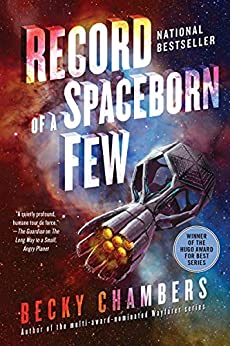
Next in the series: Record of a Spaceborn Few

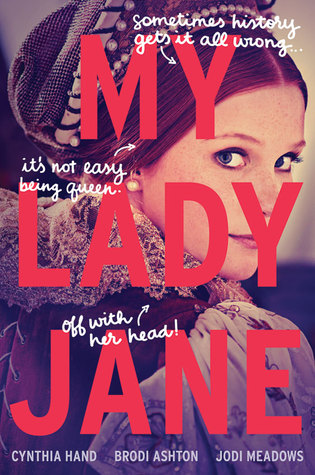
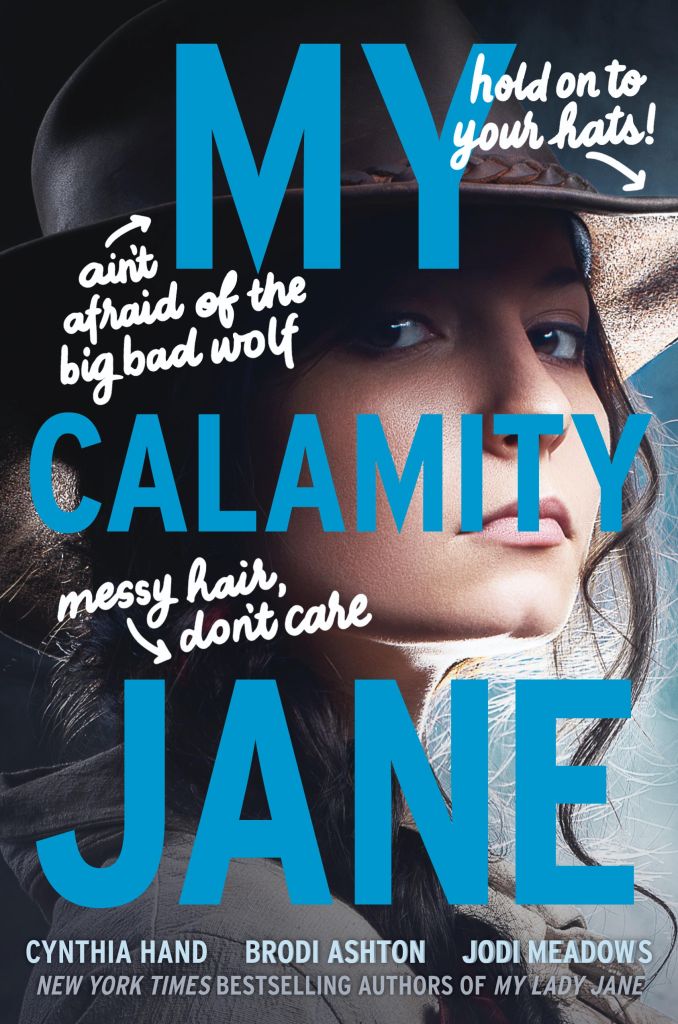
Book Review: My Lady Jane by Cynthia Hand, Brodi Ashton, & Jodi Meadows

Title: My Lady Jane
Series: The Lady Janies, #1
Author: Cynthia Hand, Brodi Ashton, Jodi Meadows
Publisher: HarperTeen
Publication date: June 7, 2016
Length: 512 pages
Genre: Young adult
Source: Purchased
Rating:

Rating: 4.5 out of 5.

Edward (long live the king) is the King of England. He’s also dying, which is inconvenient, as he’s only sixteen and he’d much rather be planning for his first kiss than considering who will inherit his crown…

Jane (reads too many books) is Edward’s cousin, and far more interested in books than romance. Unfortunately for Jane, Edward has arranged to marry her off to secure the line of succession. And there’s something a little odd about her intended…

Gifford (call him G) is a horse. That is, he’s an Eðian (eth-y-un, for the uninitiated). Every day at dawn he becomes a noble chestnut steed—but then he wakes at dusk with a mouthful of hay. It’s all very undignified.

The plot thickens as Edward, Jane, and G are drawn into a dangerous conspiracy. With the fate of the kingdom at stake, our heroes will have to engage in some conspiring of their own. But can they pull off their plan before it’s off with their heads? 

I’ve always been fascinated by the sad story of Lady Jane Grey, the Nine Days Queen — the young woman used as a political pawn following the death of King Edward VI. Put in place as queen despite not actually being next in line to the throne, her brief reign ended with Queen Mary seizing the throne, and shortly thereafter, both Lady Jane and her husband were beheaded.

But good news! In My Lady Jane, her story is revised, rewritten, and turned into an absolutely, adorably engaging romp. Heads DON’T roll in this version of the story. #justiceforjane

In the England of My Lady Jane, the political landscape is divided between Eðians (those who can assume an animal form) and Verities (those who can’t). Verities have persecuted Eðians for years, and the return of Mary to power signals a return of the terror of burnings and purges. King Henry VIII very famously became an Eðian when he turned into a lion in a fit of rage, but Edward doesn’t think he’s an Eðian… or is he?

Meanwhile, Jane — a girl who would rather read a book than do just about anything — is forced into marriage with a boy she doesn’t know, all as a means of securing political power for his father. There’s the inconvenient fact that Gifford (G) is an Eðian who turns into a horse by day… but that’s only one of the many obstacles facing the newlyweds.

Sound silly? You betcha. But SO much fun, and the writing is truly a delight. Here’s a sampling of some favorite passages and conversation. See for yourselves how adorable this is!

Wife #3 (Edward’s mother) had done everything right; namely, she’d produced a child with the correct genitalia to be a future ruler of England, and then, because she was never one to stick around to gloat, she’d promptly died.

So. Her husband-to-be was a philanderer. A smooth operator. A debaucher. A rake. A frisker. (Jane became something of a walking thesaurus when she was upset, a side effect of too much reading.)

“Was that a horse joke?”

“Neigh.”

“Was that a horse joke?”

“You have hay in your hair.”

He smoothed his hand over his hair before he caught her smile. “No horse jokes.”

“Never! But I wanted to ask: are you catching a chill? You sound hoarse.”

At this point, G realized he’d just asked a ferret what the dog said.

“Right. As I was saying, bears are always hungry. Try not to act like food.”

“How does one act like food?”

“…And Bess can stay with Jane to make sure she doesn’t ferret her way out of that cage.”

“Can you use ferret as a verb?” G asked.

She shrugged. “You can now.”

“Right,” G said slowly. He picked up his sword. “We are off, then?”

“Without hesitation,” Edward said.

And for a few moments, they hesitated.

Then they were off.

“Armies aren’t very good about carrying libraries with them. I can’t imagine why. We’d fight so much less if everyone would just sit down and read.”

As if on cue (or maybe a bit late on his cue), a kestrel flew through the window. “Edward!” At least, she hoped the bird was Edward. It’d be embarrassing to just start talking with a strange bird.

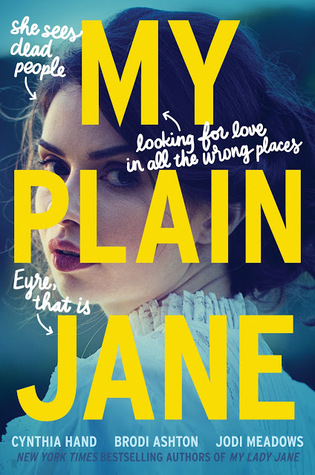
I loved this book, start to finish. I have the next two Lady Janies on my Kindle already, but I’ve saving them for when I feel like I need a reading treat. The next two are:

And after that, there are a couple of Mary books… so I have plenty to look forward to!

Book Review: Nemesis Games (The Expanse, #5) by James S. A. Corey

Title: Nemesis Games (The Expanse, #5)
Author: James S. A. Corey
Publisher: Orbit
Publication date: May 10, 2016
Length: 532 pages
Genre: Science fiction
Source: Purchased
Rating:

Rating: 5 out of 5.

A thousand worlds have opened, and the greatest land rush in human history has begun. As wave after wave of colonists leave, the power structures of the old solar system begin to buckle.

Ships are disappearing without a trace. Private armies are being secretly formed. The sole remaining protomolecule sample is stolen. Terrorist attacks previously considered impossible bring the inner planets to their knees. The sins of the past are returning to exact a terrible price.

And as a new human order is struggling to be born in blood and fire, James Holden and the crew of the Rocinante must struggle to survive and get back to the only home they have left.

Let me just say up front that this is going to be a short review — not because I didn’t love the book, but because I tore through it so quickly that I didn’t pause to take notes or mark amazing passages or terrific dialogue. Yes, I loved the book, and it definitely merits 5 stars!

The fifth book in the fabulous Expanse series, Nemesis Games has a lot going on. The key things to know are (1) the crew of the Rocinante spend most of the book apart, each going off on their own private journeys while their ship is undergoing major repairs, and (2) a massive terrorist attack by a dangerous Belter faction changes the power dynamics of the solar system, perhaps permanently.

Each of our four main characters gets a chance to shine, although Naomi’s saga is clearly the most dramatic and emotionally powerful. I don’t want to get into spoiler territory, so I’ll be vague, but the attack by the Free Navy (the aggressive Belter faction) is shocking in its scope and impact.

The plotline of Nemesis Games is the basis of the excellent fifth season of The Expanse (now streaming on Amazon Prime), with a few changes here and there. While I’m usually a stickler for reading books before watching movie or TV adaptations, in this case, I’m glad I had the visuals of this season to help me while reading the book. So much of the technology, military aspects, etc are really complex, and having seen the depictions on TV really made the book passages feel more alive to me.

As I said, I’m keeping this review short, so I’ll just wrap up by saying that Nemesis Games and the entire series are highly recommended. The books are long, but they speed by. So far, there are 8 books in the series, with the 9th and final book set to be published sometime this year. I don’t think I’ll be able to get through all of the available books right away, but I do want to keep going! The books are exciting, pulse-pounding reading, and I just have to know what happens next!

Audiobook Review: News of the World by Paulette Jiles

Title: News of the World
Author: Paulette Jiles
Narrator: Grover Gardner
Publisher: William Morrow
Publication date: March 29, 2016
Print length: 209 pages
Audio length: 6 hours, 17 minutes
Genre: Historical fiction
Source: Purchased
Rating:

Rating: 5 out of 5.

In the aftermath of the Civil War, an aging itinerant news reader agrees to transport a young captive of the Kiowa back to her people in this exquisitely rendered, morally complex, multilayered novel of historical fiction from the author of Enemy Women that explores the boundaries of family, responsibility, honor, and trust.

In the wake of the Civil War, Captain Jefferson Kyle Kidd travels through northern Texas, giving live readings from newspapers to paying audiences hungry for news of the world. An elderly widower who has lived through three wars and fought in two of them, the captain enjoys his rootless, solitary existence.

In Wichita Falls, he is offered a $50 gold piece to deliver a young orphan to her relatives in San Antonio. Four years earlier, a band of Kiowa raiders killed Johanna’s parents and sister; sparing the little girl, they raised her as one of their own. Recently rescued by the U.S. army, the ten-year-old has once again been torn away from the only home she knows.

Their 400-mile journey south through unsettled territory and unforgiving terrain proves difficult and at times dangerous. Johanna has forgotten the English language, tries to escape at every opportunity, throws away her shoes, and refuses to act “civilized.” Yet as the miles pass, the two lonely survivors tentatively begin to trust each other, forming a bond that marks the difference between life and death in this treacherous land.

Arriving in San Antonio, the reunion is neither happy nor welcome. The captain must hand Johanna over to an aunt and uncle she does not remember—strangers who regard her as an unwanted burden. A respectable man, Captain Kidd is faced with a terrible choice: abandon the girl to her fate or become—in the eyes of the law—a kidnapper himself.

In News of the World, we meet the honorable Captain Kidd, a 71-year-old widower who makes a living these days traveling from town to town in Northern Texas, reading newspaper articles aloud to gathered crowds, at a dime a piece per listener. It’s a pretty good life. Captain Kidd is respected wherever he goes, and his readings, in his authoritative voice, offer his listeners a view of the wider world and a chance to escape day-to-day reality, even if only for an hour.

The Captain’s world is turned upside down when an old friend asks him to take on the task of returning a rescued child to her relatives. At age six, Johanna’s parents were murdered and she was captured by Kiowa raiders. Now ten, Johanna considers the Kiowa her family and remembers nothing of her former life — but her adopted family has sold her back to the local government agents, so she’s truly lost all sense of belonging.

Captain Kidd reluctantly agrees to the task, which involves a very long journey through potentially dangerous territories, all the while accompanied by a hostile, strange girl who absolutely does not want to cooperate. It sounds like a nightmare.

But as the miles unwind, the two reach first a mutual tolerance, then an understanding, and finally true affection. The Captain protects Johanna, placing himself at risk to stand between her and danger, and slowly, she learns to trust him.

Their journey is slow and eventful, and they face obstacles at every turn. Yet this beautiful novel never feels like it lags. It’s lovely to see the affection building between these two complex characters, and each challenge or danger presents yet another opportunity for us to learn more about who they are and what makes them tick.

The writing is just gorgeous. The descriptions of the terrain, the towns, and the people are detailed and lovely. The author truly paints with her words, and I felt like I was there along the dusty roads and by the creeks, riding along in their creaky wagon and looking for cover when there was danger ahead.

The two main characters are both complicated people with harsh pasts to remember and come to terms with. Captain Kidd is a fundamentally loving and kind man, but he’s also fiercely protective and doesn’t have time or patience for fools or wrongdoers. Johanna has a turbulent inner life that we learn about in bits and pieces, and it’s amazing to see how she finds strength to survive.

The audiobook narration is fantastic. The narrator captures the feeling of a fireside story — I felt like I was listening to an old-fashioned tale, almost like I was attending one of Captain Kidd’s readings, if only he were sharing a Western rather than reading a newspaper.

I’ve had this book on my shelf for a couple of years now, and I’m so glad to have finally read it. This was my first book by Paulette Jiles, but it won’t be my last. Highly recommended.

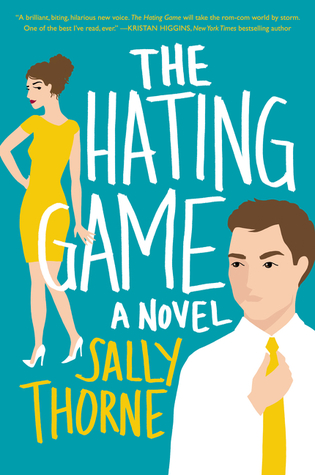
Take A Peek Book Review: The Hating Game by Sally Thorne

“Take a Peek” book reviews are short and (possibly) sweet, keeping the commentary brief and providing a little peek at what the book’s about and what I thought.

Synopsis:

(via Goodreads)

Lucy Hutton and Joshua Templeman hate each other. Not dislike. Not begrudgingly tolerate. Hate. And they have no problem displaying their feelings through a series of ritualistic passive aggressive maneuvers as they sit across from each other, executive assistants to co-CEOs of a publishing company. Lucy can’t understand Joshua’s joyless, uptight, meticulous approach to his job. Joshua is clearly baffled by Lucy’s overly bright clothes, quirkiness, and Pollyanna attitude.

Now up for the same promotion, their battle of wills has come to a head and Lucy refuses to back down when their latest game could cost her her dream job…But the tension between Lucy and Joshua has also reached its boiling point, and Lucy is discovering that maybe she doesn’t hate Joshua. And maybe, he doesn’t hate her either. Or maybe this is just another game.

My Thoughts:

I picked up The Hating Game on a whim while pondering which of the heavier books on my list to tackle next. Sometimes, light and romantic is just the thing, and this book delivered — but also made me alternate between hair-pulling frustration and goofy, grinning swoons.

Office romances are risky, and depicting them in fiction takes some delicacy… which The Hating Game mostly lacked. I spent the first twenty percent or so of this book shrieking at the characters to grow up and act like professionals! (OK, my day job might be leaking through a bit here — as someone who works in HR for a living, I was more than a little horrified by the workplace behavior of the characters and the fact that their bosses were completely hopeless as managers). Add to the office nonsense the fact that Josh and Lucy were up for the same promotion (and just how do executive assistants suddenly get considered for COO jobs?), and much of the story drove me absolutely batty.

BUT… when we get Josh and Lucy away from the office, suddenly their banter, flirtation, and chemistry become adorable, and — I admit it — it was impossible not to be caught up in the steamy scenes of almost-but-not-quite between the two of them. Sure, the plot and romance development were complicated by the usual contemporary romance tropes of poor communications and jumping to wildly off-base conclusion about the other’s intentions, but my grumpiness about these elements was eventually washed away by the sheer cuteness and sexiness of Josh and Lucy together. (With Lucy as the only POV character, we have to take her word for everything — but she does have a tendency to freak out over Josh’s behavior in ways that seem overly exaggerated. For a smart woman, she jumps to some dumb conclusions… repeatedly.)

Oh, and for a book that was supposedly centered around the office competition between the two characters, the ending left the career elements strangely unfinished, at least for Lucy. [SPOILER ahead] The big interview for the COO job has been Lucy’s focus (apart from Josh) for weeks, yet the story ends before the interview, so we don’t find out if Lucy ever got the job. We do know that Josh withdraws his application and takes a job with another company so that he and Lucy can pursue their relationship without professional conflicts of interest, but Lucy isn’t necessarily a lock and there are outside candidates — so why, after all the emphasis on Lucy’s dedication to her career, do we not get to know if she achieved her goal? This piece left me decidedly unsatisfied.

So, I guess you could say that I had a love/hate relationship with The Hating Game. I definitely got caught up in the story and basically dropped everything else until I finished… but so many parts of the story left me snorting with disbelief or rolling my eyes. If I had to come up with a rating, I’d probably give 2 stars for the office romance components, but 4 stars for the out-of-the-office flirtation, chemistry, and sexytimes. And apparently, I’ve turned into a contemporary romance reader this month — who’d have thunk it?

_________________________________________

The details:

Title: The Hating Game
Author: Sally Thorne
Publisher: William Morrow
Publication date: August 9, 2016
Length: 384 pages
Genre: Contemporary romance
Source: Library

**Save

Save

Save

Save

Save

Save

Save

Book Review: Scythe by Neal Shusterman


Thou shalt kill.

A world with no hunger, no disease, no war, no misery. Humanity has conquered all those things, and has even conquered death. Now scythes are the only ones who can end life—and they are commanded to do so, in order to keep the size of the population under control.

Citra and Rowan are chosen to apprentice to a scythe—a role that neither wants. These teens must master the “art” of taking life, knowing that the consequence of failure could mean losing their own.

What a fascinating story! I hadn’t heard of Scythe until my son’s high school picked it for their school-wide summer reading book. Once I picked up a copy (ostensibly for my son), I just had to read it. Utterly compelling and impossible to put down.

In the world of Scythe, modern history dates back to the year 2042:

It’s a year that every schoolchild knows. It was the year when computational power became infinite — or so close to infinite that is could no longer be measured. It was the year we knew… everything. “The cloud” evolved into “the Thunderhead,” and now all there is to know about everything resides in the near-infinite memory of the Thunderhead for anyone who wants to access it.

With the coming of the Thunderhead and infinite knowledge, humankind had the answers to everything — disease, hunger, death. People became immortal, and thus, the need for scythes emerged. Generations later, scythes have rockstar status (there are even trading cards), but are also feared and treated as outside normal society. Scythes bring death as they “glean” people, some with thoughtful process and compassion, others with showy spectacle. Yes, people still have accidents and can be “deadish”, but everyone who dies in any manner can be revived, apart from those who have been gleaned. Gleanings are final, and irrevocable.

As Citra and Rowan have their lives transformed, from humdrum teen life to the world of apprenticeship, they’re thrust into a secret society of laws and infighting and a morality all its own. And as the year of apprentice progresses, they learn that some scythes have embraced a more corrupt, corrosive form of scythedom, and that these scythes seem poised to take over completely.

I was utterly absorbed while reading this book. There are some truly deep notions that I can only imagine would make for fabulous discussions. In Scythe, we learn that with infinite knowledge comes a lack of true meaning. Everything that can be known is already known. All accomplishments have been accomplished. Life stretches on forever, and when a person’s body reaches a more advanced age than desired, he or she can simply “turn a corner” and reset back to an earlier age. Without the fear of death or the sense of a limited time to make one’s mark, life is persistent and pleasant, but there’s no sense of urgency. Art suffers — there are no heights of passion or suffering to scale. Everything is nice… but it kind of sounds like a pretty boring way to live forever.

The power plays of the scythes is scary and upsetting to read about. Scythes are untouchable and answer only to their own governing body — so when corrupt scythes who tow the line of the letter of the law while committing horrific acts start climbing to dominance, there’s no balancing force to keep scythedom pure.

I really just can’t say enough good things about this book! I was completely hooked, and can’t wait to start the sequel, Thunderhead.

_________________________________________

The details:

Title: Scythe
Author: Neal Shusterman
Publisher: Simon & Schuster Books for Young Readers
Publication date: November 22, 2016
Length: 435 pages
Genre: Young adult fiction
Source: Purchased

**Save

Save

Save

Save

Save

Save

Save

Book Review: Feedback (Newsflesh, #4) by Mira Grant


There are two sides to every story…

We had cured cancer. We had beaten the common cold. But in doing so we unleashed something horrifying and unstoppable. The infection spread leaving those afflicted with a single uncontrollable impulse: FEED.

Now, twenty years after the Rising, a team of scrappy underdog reporters relentlessly pursue the facts while competing against the brother-and-sister blog superstars, the Masons.

Surrounded by the infected, and facing more insidious forces working in the shadows, they must hit the presidential campaign trail and uncover dangerous truths. Or die trying.

Feedback is a full-length Newsflesh novel that overlaps the events of the acclaimed first novel in the series, Feed, and offers a new entry point to this thrilling and treacherous world.

Okay, first things first: DO NOT pick up Feedback thinking that you can start the Newsflesh books at this point. I would absolutely not consider Feedback “a new entry point”, as the blurb says. Instead, it’s a story set within the world of Newsflesh, telling a story that parallels the story of Feed (book #1 in the series). A knowledge of the world of Newsflesh is required in order to enjoy Feedback… and Feedback will absolutely spoil the original trilogy for you. So there — we’ve gotten the warnings and disclaimers taken care of right from the start!

So basically, the deal is this: Feedback starts at about the same point in time as Feed, 20 years after the Rising, just as the presidential campaign is kicking off. The Masons — stars of the original Newsflesh trilogy — are the stars of the blogging world, and have just gotten the sweet gig of following the Republican candidate expected to grab the nomination, and maybe even the White House. Meanwhile, in Feedback, we meet Ash North, an Irish expatriate who’s an “Irwin” — a daredevil blogger who goes out in the field and pokes zombies — along with her team. Ash and company would love to be anything close to as successful as the Masons, but they remain in the crowded field of lesser bloggers until they get chosen to accompany one of the Democratic candidates, Governor Susan Kilburn.

Ash is a sassy redhead, married platonically to her partner Ben and in love with her other partner Audrey. Along with their techie/makeup guru Mat, they hit the road with the campaign, and immediately find themselves in all sorts of horrifying and life-threatening disaster situations. With lots of zombies. And death. And zombies. And carnage. And, you know, zombies.

I was a little nervous about starting Feedback after reading some fairly negative reviews… but you know what? I liked it! While Feedback includes enough context to explain the origins of the zombie Rising and what’s happened since, it doesn’t feel like a repeat. It’s pretty cool getting another take on the events of the presidential campaign, as seen from the more limited viewpoint of Ash and friends. Ash, Ben, and Audrey stumble pretty quickly across similar clues to those unearthed by Georgia and Shaun in the first three books, but they don’t get as deeply involved in the ghastly conspiracies at play behind the scenes of the US political system.

The plot moves along quickly, and it was interesting to note the parallel events here, and to line those up with the events we know about from Feed and the later books. I liked Ash well enough to enjoy her company, and thought her relationships with Ben and Audrey were unusual enough to keep things fresh and different.

As a fan of The Walking Dead, I will mention that there was a section toward the end of the book that felt a bit too Negan-ish and Savior-y for me… but I suppose the idea of a strong, well-armed man taking over and setting up his own society, with himself at the center, isn’t that unusual for a post-apocalypse tale.

As always, Mira Grant’s writing is sparkly and shiny, alternating between describing scenes of incredibly disturbing zombie attacks (and yes, there are a few truly gruesome, terrible attacks in this book) and applying humor even to tense situations, so I never had to go too long without a laugh (or a snort or a chuckle)… in between wincing in horror, cringing at the gore, and being struck by the devastation to the characters’ souls.

Some light and not-so-light snippets:

“Hello, and welcome to the Huntsville Convention Center,” said the attendant. “We’re so very sorry that you’ve been exposed to a biohazard. Please, pick your preferred scent profile and drop the tabe into your shower as you enter. Your shampoo and body wash selections will be set to match.”

The all-terrain vehicle trundled through the woods like an armored bear: fast enough to be better than walking, bulky enough to make driving a continuous adventure, and sturdy enough to give no fucks when I overcompensated for the slopes and side-swiped a tree…

(what I pictured while reading those lines… )

I hoped [he] and the others had had a moment — just a moment, because sometimes a moment was everything in the world — to call their loved ones and say they were sorry, that they’d always known it would end like this, but that they’d been hoping it wouldn’t end quite so soon. There were always things left unsaid, undone, and I wanted, desperately, for them to have had the time to say at least a few of them.

Our part in this tale was done, and we were getting the hell out. Leave the lies to the living and the truth to the dead. Nothing ever stays buried for long.


I’m really glad that I read Feedback, and recommend it — but only if you’ve already read the other Newsflesh books. I love the world that Mira Grant has created, and reading Feedback allowed me to stay in it just a little bit longer.

_________________________________________

The details:

Title: Feedback
Author: Mira Grant
Publisher: Orbit
Publication date: October 4, 2016
Length: 560 pages
Genre: Horror/science fiction
Source: Purchased

Save

Save

Save

Save

Save

Save

Save

Save

Save

Save

Save