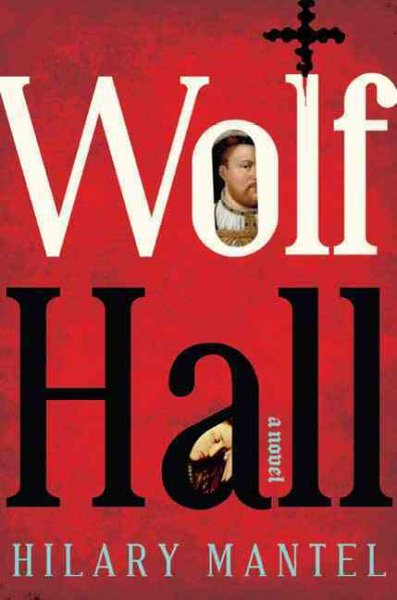
Book Review: Wolf Hall by Hilary Mantel

Winner of countless awards, among them the 2009 Man Booker Prize, Wolf Hall is well-known and highly esteemed. So why did it take me so many years to finally read it?

It’s a daunting book to begin, that’s for sure. In my paperback edition, the two pages of the Table of Contents are followed by five pages of the Cast of Characters, and then by two more pages containing family trees (the Tudors and the Yorkist Claimants, to be exact). Did I need to memorize the ancestries? Was I supposed to already know the paths of descent from Richard Duke of York and Owen Tudor? In general, when I see a book that requires that much supporting information up front, I want to run for the hills. Or pick up something simpler, at the very least.

In this case, I’d already vowed to read Wolf Hall during a vacation, and after committing to it publicly (well, okay, here on my blog), I felt a certain amount of pressure to see it through.

So — worth it? Yes, and here’s why:

Wolf Hall is the story of Thomas Cromwell, a man who rises from an obscure beginning as the son of a blacksmith to become one of the most powerful and influential advisers in the court of King Henry VIII. The entire book is told from Cromwell’s perspective; we see the people and players that he sees; we visit the inner chambers of the castle when he does. As Cromwell’s access increases, so does ours as readers. We only meet Henry when Cromwell does, and we see Anne Boleyn’s ascent at first from a distance, as bewildered by the king’s obsession with Anne as Cromwell is, then become more intimately involved as Cromwell becomes a key participant in the machinations needed to overthrow not just a marriage but an entire religious institution.

The Cromwell we come to know in Wolf Hall may or may not be entirely historically accurate. His rise to power is well-documented, but his early history and his inner life is not. Author Hilary Mantel gives Thomas Cromwell a depth and vibrancy that make him a sympathetic main character. We see him as a devoted family man, albeit as one who is often absent. Still, his devotion to his wife, his children, and his broad collection of wards and adoptees is shown to be his defining virtue. Likewise, he is committed to his patron, Cardinal Wolsey, and he forgets nothing — neither good nor bad — in his endless reckoning of favors owed and granted. Cromwell’s shrewdness and intelligence are clear. He is an intellectually gifted man who had a rough start in life, and so he is both gentleman and ruffian, a man who can out-think anyone he encounters, and at the same time a man to strike fear into the hearts of those who cross him.

Wolf Hall is a complicated book. This is not a bodice-ripper masquerading as history. The details can be overwhelming. There is an enormous number of players to keep straight, and it’s not enough to know who’s who; we readers also need to know the relations, the power dynamics, the titles, and the land holdings. This is not a love story. It’s about power, it’s about politics, it’s about playing a deadly game with the lives of the innocent and not-so-innocent at stake. Hilary Mantel piles detail upon detail, but never in a way that is incomprehensible — although, yes, it is a lot to keep track of.

Mantel’s prose is not straightforward. Sentences break off suddenly. A random example, from early on in the book:

They arrived on a Sunday, two vengeful grandees: the Duke of Norfolk a bright-eyed hawk, the Duke of Suffolk just as keen. They told the cardinal he was dismissed as Lord Chancellor, and demanded he hand over the Great Seal of England. He, Cromwell, touched the cardinal’s arm. A hurried conference. The cardinal turned back to them, gracious: it appears a written request from the king is necessary; have you one? Oh: careless of you. It requires a lot of face to keep so calm; but then the cardinal has face.

The pronouns throughout Wolf Hall are a bear to figure out. Mantel uses “he” throughout the book to refer to Cromwell, even when he is not the person most recently referenced. This drove me crazy at first. I’d have to stop and backtrack, realizing that the sentence I was reading was not about the person I thought it was about! Once I finally got that it’s all about Cromwell, all the time, the “he”s were a bit easier to decipher. But boy, did that throw me for a loop at the beginning.

Wolf Hall will not be for everyone. But I did enjoy it very much, although it was perhaps not the wisest choice for vacation reading. I typically choose books that require little commitment for my vacation reading — books I can easily swoop in and out of at a moment’s notice while doing other things. Wolf Hall is not one of these books. It requires concentration and thought, and while I definitely liked the challenge, it was a bit overwhelming at times.

The title itself is confusing, and only gains meaning toward the end of the book (unless you’re a total Tudor-era enthusiast and know the names of every estate in the realm). The challenge for an author writing about this era is in keeping a sense of suspense or surprise when the major events are so very well known. If you’ve read The Other Boleyn Girl or watched The Tudors, then you already know how the king’s efforts to divorce Katherine and marry Anne will work out. What keeps this book interesting is the writing itself, as well as the use of a lesser-known figure as its point-of-view character. Learning about Cromwell is fascinating; seeing the inner workings of the court through his eyes is enlightening, and keeps the familiar acts and players from seeming worn out or stale. Yes, I do know what happens — but it doesn’t matter. The portrayals of Cromwell, Henry, Anne, and the others are rich and nuanced, and kept me hooked.

Wolf Hall is the first book in a trilogy. Book 2, Bring Up The Bodies, is also a Man Booker Prize recipient. Book 3, The Mirror and The Light, is anticipated for publication in 2015, as far as I could tell. I plan to read Bring Up The Bodies later this summer, and as it covers the fall of Anne Boleyn, I fully expect to be engrossed.

I highly recommend Wolf Hall, although it definitely helps to have some knowledge of the Tudors ahead of time. And if you’ve watched Showtime’s version of The Tudors, I dare you to read this book and not picture Natalie Dormer every time Anne Boleyn is in a scene.


Thursday Quotables: A Small Death in the Great Glen

cooltext1045178755

Welcome back to Thursday Quotables! This weekly feature is the place to highlight a great quote, line, or passage discovered during your reading each week.  Whether it’s something funny, startling, gut-wrenching, or just really beautifully written, Thursday Quotables is where my favorite lines of the week will be, and you’re invited to join in!

If you’d like to participate, it’s really simple:

  • Follow Bookshelf Fantasies, if you please!
  • Write a Thursday Quotables post on your blog. Try to pick something from whatever you’re reading now.
  • Link up via the linky below (look for the cute froggy face).
  • Make sure to include a link back to Bookshelf Fantasies in your post (http://www.bookshelffantasies.com).
  • Have fun!

This week’s Thursday Quotable:

Joanne went into a dwam*, floating with the gull. Floating over the castle braes, over the river, across to the cathedral without a single wing movement, he (for it always seemed a him to her) drifted on toward the infirmary, back over to the war memorial, disappearing into the tangle of the Islands.

She could feel herself nestling into the shoulders of the gull, oily satin-smooth feathers smelling of fish. Up into the thermals they floated, taking in the river, the town, the hills, the mountains, the Great Glen, the faultline that fractured the Highlands. Peaks and scree-strewn ridgelines were mirrored in the ribbon of deep dark lochs. Glens clad in a  faded tartan of heather and bracken with splashes of green outlining abandoned crofts emptied by the Clearances** were cut deep by drunken burns and rivers. A fierce and stunning landscape; it made Joanne want to sing.

*Dwam: Scottish term for “daydream” or “reverie”.

**The Highland Clearances. See Wikipedia for info.

Source:  A Small Death in the Great Glen
Author: A. D. Scott
Atria, 2010

Sigh. I just love this description of the Scottish Highlands — one of my dream destinations!

What lines made you laugh, cry, or gasp this week? Do tell!

Link up, or share your quote of the week in the comments.

I’m baaaaack! Plus, a Wishlist Wednesday post.

Hey, all! Thanks for keeping up with Bookshelf Fantasies while I was away this past week. I’m back, frantically trying to wade through all the emails that have piled up, whilst simultaneously doing mountains of laundry and emptying my suitcases. I had a lovely vacation in Costa Rica (thanks for asking!), and will share some photos — as well as my reviews of the wonderful books I read while away — as soon as I catch my breath a bit more.

Meanwhile, I’m diving back in with a Wishlist Wednesday post!

Wishlist Wednesday: The concept is to post about one book from our wish lists that we can’t wait to read. Want to play? Here’s how:

  • Follow Pen to Paper as host of the meme.
  • Do a post about one book from your wishlist and why you want to read it.
  • Add your blog to the linky at the bottom of the post at Pen to Paper.
  • Put a link back to Pen to Paper somewhere in your post.
  • Visit the other blogs and enjoy!

My Wishlist Wednesday pick this week is:

Openly Straight

Openly Straight by Bill Konigsberg

From Goodreads:

Rafe is a normal teenager from Boulder, Colorado. He plays soccer. He’s won skiing prizes. He likes to write.And, oh yeah, he’s gay. He’s been out since 8th grade, and he isn’t teased, and he goes to other high schools and talks about tolerance and stuff. And while that’s important, all Rafe really wants is to just be a regular guy. Not that GAY guy. To have it be a part of who he is, but not the headline, every single time.

So when he transfers to an all-boys’ boarding school in New England, he decides to keep his sexuality a secret — not so much going back in the closet as starting over with a clean slate. But then he sees a classmate breaking down. He meets a teacher who challenges him to write his story. And most of all, he falls in love with Ben . . . who doesn’t even know that love is possible.

This witty, smart, coming-out-again story will appeal to gay and straight kids alike as they watch Rafe navigate being different, fitting in, and what it means to be himself.

Why do I want to read this?

I have a bit of burn-out when it comes to YA novels of the supernatural, otherworldly, or end-of-the-world, end-of-civilized-society varieties. But… I do love finding a YA novel that deals sensitively with contemporary issues, while at the same time telling the story of memorable individuals facing real-world challenges. Openly Straight sounds like it takes the coming out experience and flips it on its head. Is it possible to be so “out” that that’s all people see? Is it realistic to want to keep such a big part of yourself hidden, not out of shame but from a desire to be known for oneself without labels?

I’m really looking forward to seeing how the author tackles this subject — and how Rafe’s struggle to define himself, for himself, works out.

So what’s on your wishlist this week?

If you enjoyed this post, please consider following Bookshelf Fantasies! And don’t forget to check out our regular weekly features, Thursday Quotables and Flashback Friday. Happy reading!

The Monday Agenda 6/24/2013

MondayAgendaNot a lofty, ambitious to-be-read list consisting of 100+ book titles. Just a simple plan for the upcoming week — what I’m reading now, what I plan to read next, and what I’m hoping to squeeze in among the nooks and crannies.

True fact: I’m away and not actively blogging this week. Oh, the power and beauty of scheduling! Just because I’m off to parts known and unknown, it doesn’t mean I can’t post a Monday Agenda for this week.

How did I do with last week’s agenda?

Sea Change by S. M. Wheeler: DNF. I read about 30 pages or so, but it just never really clicked for me.

Fathomless by Jackson Pearce: Done! My review is here. Warning: Contains rants and spoilers.

The Horse and His Boy by C. S. Lewis: Done! My son and I have now read four Narnia books together, and plan to continue as soon as we’re back home. We loved The Horse and His Boy. We managed to squeeze in a quick Q&A With The Kiddo post on our Narnian adventures — you can see it here.

That’s it! It was a low-volume reading week, thanks to the typical pre-trip frenzy of packing, laundry, and last-minute dashes to the store for insect repellant and other such nonsense.

Fresh Catch:

Neil Gaiman! Plus, two paperbacks — bought cheap! — arrived from the UK this week. I’m so looking forward to reading all of these!

The Ocean at the End of the LaneRose Under FireThe 5th Wave (The Fifth Wave, #1)

Yes, I’ve already read (and loved!) The 5th Wave… and now I have my own copy!

What’s on my reading agenda for the coming week?

Instead of choosing my own vacation reading, I asked my blog visitors to do it for me! Based on my poll results, here’s what I’ll be reading in the next week and a half:

The Eyre Affair by Jasper Fforde

Wolf Hall by Hilary Mantel

A Small Death in the Great Glen by A. D. Scott

… and possibly Me Before You by Jojo Moyes, although I doubt I’ll fit all this into my not-as-long-as-I’d-like vacation.

Thank you to everyone who voted and offered an opinion (or two)! I’ll report back — when I get back!

boy1

So many book, so little time…

That’s my agenda. What’s yours? Add your comments to share your bookish agenda for the week.

Hasta la vista, baby!

Bookshelf Fantasies will be on a tiny break for the next week and a  half.

Happy trails, and happy reading to one and all!

In the immortal words of the Terminator:

I’ll be back.

The votes are in!

Thank you to everyone who voted in my vacation reading poll! I suppose you could consider this the height of indecision — rather than choosing my own books, I let you do it for me. 🙂

There’s a clear winner, and a few runners-up:

The top vote-getter is:

The Eyre Affair (Thursday Next #1)

The Eyre Affair by Jasper Fforde! I’ve been wanting to read this one for years — nice choice, you guys! I’ve already read the first few chapters, and I’ve got a good, good feeling about this one. Plus, the cover blurb compares it to Monty Python, Harry Potter, and Buffy! I mean, they might as well just write my name on an engraved invitation.

The runners-up in my vacation reading poll are:

Wolf Hall by Hilary Mantel
Me Before You by Jojo Moyes
A Small Death in the Great Glen by A. D. Scott

Let’s face it, I’m only going away for ten days — I do not need to pack four books! Although I suspect that I shall…

Thank you, thank you, to all my voters! I’ll let you know how it all works out. Meanwhile, time to go throw the books into ye olde suitcase and get on with my packing…

Q&A with the kiddo: A kid’s-eye view of the books of Narnia

The Lion, the Witch and the Wardrobe (The Chronicles of Narnia, #1)Prince Caspian (The Chronicles of Narnia, #2)The Horse and His Boy (The Chronicles of Narnia, #5)

Proudly presenting Q&A with the kiddo, courtesy of my 10-year-old son, in which I ask my kiddo to describe a book he’s enjoyed recently and he gives his opinions, more or less unfiltered by mom.

Kiddo and I are in the midst of our Narnia read. Neither of us had read these books previously. In fact, I consider my childhood somewhat deficient due to its lack of both Narnia and Anne of Green Gables books. It’s never too late, I say! I read The Lion, The Witch and The Wardrobe for the first time about ten years ago, but it’s a whole different ballgame reading it as part of a greater body of work. So far, we two have read The Magician’s Nephew (discussed earlier, here) and have now finished TLTW&TW, Prince Caspian, and most recently, The Horse and His Boy.

Let’s see what the kiddo has to say. Without further ado:

Q: Of the four Narnia books we’ve read so far, which was your favorite?

A: My favorite was The Horse and His Boy. I like Shasta, the main character, and I like the ending. In the end, everything turned out good. Aslan actually saved them, and Shasta turned out to be Prince Cor. I like how Rabadash (the bad guy) was punished in the end and got turned into a donkey. I like how they (the main characters) traveled through all the places and how Aravis got scratched by the lion to punish her for causing her servant to get whipped. Bree and Hwin (the talking horses) were cool. They should have gotten married, but at least they’re still best friends. I liked Prince Corin because he always knocked people down and later became a champion boxer. I liked King Lune too. The battle scenes were cool. I wish they’d make a movie from this book.

Q: What did you think about the other books? What parts or characters did you like the most?

A:  I liked King Peter, King Edmund, Queen Susan, and Queen Lucy. They brought light into the story. They were the most important in The Lion, The Witch and The Wardrobe and were also important in Prince Caspian. I liked them better in TLTW&TW because they were more active in the fighting and in controlling what happened. In Prince Caspian, Prince Caspian was the most important, and Peter, Edmund, Susan, and Lucy were just there to support him.

Q: What did you think of Prince Caspian?

A: He’s okay. I liked the book. I especially liked all the talking animals and the fight (battle) scenes. I liked how they (the Pevensies) got called back to Narnia by Susan’s horn. Reepicheep (the warrior mouse) was cool with his uncut tail.

Q: Any final thoughts?

A: It’s a good series. I definitely want to continue with the other books. I want to see the movies.

Mom’s two cents:

Well, we’ve managed to mess up the order of the books, but it’s actually all turning out fine anyway. From what I understand, you can either read them in order of publication (starting with The Lion, The Witch and the Wardrobe) or in what is supposed to be C. S. Lewis’s preferred reading order, going by the chronology of the story itself. [Note: In trying to figure out which way is “right”, all I could find was reference to a single letter by the author in which he states that it would work to read the stories chronologically rather than by publication date. It didn’t sound like he was terribly insistent upon it though, which made me think that C. S. Lewis  might not really have had a preference after all. But I digress.]

In any case, we started out going by the story chronology, then inadvertently switched a couple of books, but it doesn’t seem to matter in the slightest in terms of following the story. So far, we’ve read The Magician’s Nephew, then The Lion, The Witch and the Wardrobe, Prince Caspian, and finally The Horse and His Boy.

I’ll agree with my son on this one, and say that we both thought that The Horse and His Boy was the most fun of the lot. Perhaps it’s because it reads like a great adventure story — all about a boy who doesn’t fit in, who runs off with a stolen war horse rather than be sold as a slave, and in seeking his freedom, discovers his own bravery and encounters courage, kindness, treachery, and danger along the way. There are hidden and mistaken identities, twins separated at birth, chases across the desert, royal viziers and high princes, a siege, a great battle, and a variety of odd and interesting creatures, including talking horses and other beasts of Narnia, giants, and the great and noble Lion Aslan.

Not to say that we didn’t enjoy TLTW&TW and Prince Caspian quite a bit as well. We love High King Peter and his brother and sisters, King Edmund, Queen Lucy, and Queen Susan. It was a bit disconcerting at the start of Prince Caspian to see them back in their old lives as English schoolchildren, but quite fascinating once they return to Narnia and realize that centuries have gone by since the time of their reign, despite it only being one year later in their world. The story of Prince Caspian and his rise to power, overthrowing his evil uncle in order to restore the magic and wonder of the kingdom of Narnia, is exciting and action-packed, and introduces us to many memorable magical creatures. There’s quite a bit of humor as well, so the moments of suspense and danger are nicely balanced by laughter and light-heartedness.

All in all, we’re having a great time reading the Narnia books together. The pacing of the story makes for a good read-aloud, and the chapters are just the right length for reading one each night before bed without a) me losing my voice (like I did with Harry Potter) or b) being too short to be satisfying.

At this point, we’re in. We’re definitely planning to read the three remaining books this summer, picking back up with The Voyage of the Dawn Treader as soon as the kiddo gets home from sleepaway camp.

As Bree the horse frequently exclaimed, “Narnia and the North!” Onward we go.

Oh, I’m going to like this book.

My father had a face that could stop a clock. I don’t mean that he was ugly or anything; it was a phrase the ChronoGuard used to describe someone who had the power to reduce time to an ultraslow trickle.

(opening lines of The Eyre Affair by Jasper Fforde)


Flashback Friday: Misery

Flashback Friday is my own little weekly tradition, in which I pick a book from my reading past to highlight — and you’re invited to join in!

Here are the Flashback Friday book selection guidelines:

  1. Has to be something you’ve read yourself
  2. Has to still be available, preferably still in print
  3. Must have been originally published 5 or more years ago

Other than that, the sky’s the limit! Join me, please, and let us all know: what are the books you’ve read that you always rave about? What books from your past do you wish EVERYONE would read? Pick something from five years ago, or go all the way back to the Canterbury Tales if you want. It’s Flashback Friday time!

My pick for this week’s Flashback Friday:

misery

Misery by Stephen King

(first published 1978)

From Goodreads:

Novelist Paul Sheldon has plans to make the difficult transition from writing historical romances featuring heroine Misery Chastain to publishing literary fiction. Annie Wilkes, Sheldon’s number one fan, rescues the author from the scene of a car accident. The former nurse takes care of him in her remote house, but becomes irate when she discovers that the author has killed Misery off in his latest book. Annie keeps Sheldon prisoner while forcing him to write a book that brings Misery back to life.

I was thinking about Stephen King this week. Because, why not? He’s everywhere! Last week, I happened to catch him on The Colbert Report. This week, I received my copy of his newest book, Joyland. I have Doctor Sleep on preorder for the fall. And I just set my DVR to record Under The Dome for the next several weeks. See what I mean? He’s everywhere!

For Flashback Friday, I thought I’d go back to the late 1970s for the super creepy but not at all paranormal thriller Misery — about fandom gone horribly, horribly wrong. Do you think Stephen King was worrying about his legions of devoted fans when he wrote this? I loved the psychological terror of this book, in which an author is forced to do endless rewrites to please his public — as represented in this case by one psycho lady with an axe. Whoa. Just thinking about it gives me the chills. It may be time to dig up a copy and reread Misery. There’s nothing more satisfyingly scary than a really scary Stephen King book.

A brief housekeeping note: Flashback Friday and other weekly features at Bookshelf Fantasies will be on a wee break next week. (Woo hoo, it’s vacation time!) Check back in two weeks for the next Flashback Friday!

Note from your friendly Bookshelf Fantasies host: To join the Flashback Friday fun, write a blog post about a book you love (please mention Bookshelf Fantasies as the Flashback Friday host!) and share your link below. Don’t have a blog post to share? Then share your favorite oldie-but-goodie in the comments section. Jump in!

Book Review: Fathomless by Jackson Pearce — **This review contains spoilers**

Book Review: Fathomless by Jackson Pearce

Fathomless (Fairytale Retellings, #3)I can’t write about Fathomless and express what I thought and felt reading this book without including SPOILERS — so consider this fair warning! This review will include plot spoilers, including the major twist that readers discover toward the end. If you don’t want to know, stop reading now! Seriously, final notice!

Are you still here?

Sure you don’t want to look away?

Really, really sure?

Okay….

Fathomless looks like a mermaid story, right? I mean, look at the cover. That’s a mermaid. Absolutely, without doubt.

Except the girls/creatures in Fathomless aren’t actually mermaids, or at least not the fairy tale and Disney versions of mermaids. For starters — no tails. Not at all. They have legs and feet, just like when they were human. And that’s a key point as well. You know how Ariel is the daughter of King Triton? No mermaid royalty here — these girls were once human, but have somehow been transformed into creatures who live in the ocean, happily swimming with their sisters all day long and bit by bit forgetting their previous lives.

Our main mermaid girl is Lo, who lives under the sea (not in a pineapple…) off the coast of Georgia. She still yearns vaguely for the lights of the human world, but grows more and more content with her underwater life with each passing day. She knows that she was once someone else and had a different name, but can’t remember those details any longer. She and her “sisters” share the belief that they were brought to live in the ocean by an angel, and that someday, when they’ve turned into one of the beautiful but vacant old ones, they’ll leave the ocean and become angels themselves.

There’s another path that the ocean girls believe in, even thought they’ve never seen it happen: Legend says that an ocean girl (sorry, I have a hard time calling them mermaids) can regain a human soul and a human life by getting a human boy to fall in love with her — and then drowning him. At that point, she takes his soul and can go back to living on land as a regular girl again. Okay, yeah, she’ll also have murdered someone to get there, but why quibble?

Celia is our main human point of view. She’s one of triplets — her sisters Jane and Anne are identical, and Celia is the odd girl out. All three have powers of sight: Through touch, Celia can read someone’s past, Jane reads the present, and Anne sees the future. The sisters live in a small Georgia beach town in their prep school dorm, supported by a distant uncle after their mother’s death and their elderly father’s descent into the fog of Alzheimer’s.

Celia and Lo collide one night when guitar-playing cute boy Jude falls off a pier into the ocean. Lo pulls him from the sea, Celia performs CPR, and Jude comes back to life. He falls for Celia, but he remembers hearing a song while he was being rescued — and Celia doesn’t sing. Celia and Jude form a relationship, but at the same time, Celia is drawn back to the beach to seek out the mysterious girl she saw disappear back into the ocean.

Lo is able to leave the water, but each step on land is torture for her, leaving her in agony and with bleeding feet. As Celia and Lo begin to know one another, Celia touches Lo and is able to see her past as a human. As Celia uncovers Lo’s history, Lo begins to remember her life as Naida, a normal human girl with a home and a family. Lo and Naida are presented as two separate personalities struggling for dominance; sometimes we see Lo’s perspective on life in the ocean, and sometimes we get Naida, who considers herself a prisoner and yearns to be free.

So far, so good. In fact, I liked Fathomless quite a bit for about the first 2/3 of the book. And then it took a twist that more or less ruined it for me.

To backtrack a bit, according to Goodreads, Fathomless is book #3 in author Jackson Pearce’s Fairytale Retellings series. I’ve read the previous two books, Sisters Red and Sweetly, although it’s been a few years since then and I’d forgotten a lot of the details. I remembered the vague plot outlines, and remembered that I’d found the books enjoyable, but didn’t remember much more than that.

So… I picked up Fathomless while under the impression that the author had written a series of separate novels, with a common theme of being inspired by different fairy tales. And then 2/3 of the way through Fathomless, I was smacked in the head by how wrong I was. All three of these novels are connected, and let me just say: Weird.

All of a sudden, in the middle of a book about quasi-mermaid-creatures, there are werewolves. Yup. Werewolves. Apparently, werewolves steal girls away and stick them in the ocean as some sort of incubator — and when the girls are done, they come back out of the ocean and join the werewolf pack. Or something. Sisters Red was about a Buffy-ish werewolf slayer fighting hordes of evil monsters. In Sweetly, as I’d completely forgotten until reading a synopsis last night, a Hansel and Gretel retelling ends up having werewolves behind the town’s evil secret as well. And now, here they are again, finding twins, killing one outright and biting the other, then putting her into the sea to cook or stew or whatever it is they’re doing down there. Supposedly, it has to be twins – something about sharing the soul, blah blah blah. To be honest, my eyes had started to glaze over at this point in the story so the twin rationale kind of escaped me. Or was just ridiculous to begin with. One of the two.

I liked the story of Celia and Jude well enough, although the two other triplets, Anne and Jane, seemed a bit amorphous to me. We learn about some of their habits, but their inner workings are a little vague and seem altogether too inconsistent for me to ever to get a true sense of who they are, what they want, and what role Celia plays in their lives. But their story, as interwoven with the story of Lo/Naida and the ocean girls, gets lost somewhere along the way, and the entire thing just falls apart by the end.

The werewolf twist comes out of nowhere and makes no sense. I was kind of enjoying the twist on the Little Mermaid fairy tale up to that point, and found some of the descriptions of the ocean world to be quite lovely. But the entire plot just falls apart when the werewolf element is introduced — at which point, I realized that the pieces that seemed to promise an interesting take on a traditional tale, such as the mermaids being formerly human girls, were all for nothing. If the author is trying to build an entire world in this series, then the connection needs to be stronger to make it work, rather than randomly introducing werewolves into a mermaid story. Better yet, in my opinion, would have been creating these stories as stand-alone fairy tale retellings that provide unique takes on traditional tales, without trying to force a big-picture framework onto them.

I see that book #4 in the Fairytale Retellings series will be published this fall. Called Cold Spell, it’s a retelling of The Snow Queen by Hans Christian Anderson. Which would be great… except I’m guessing there will be werewolves.

No thanks. I think I’m done with this series.