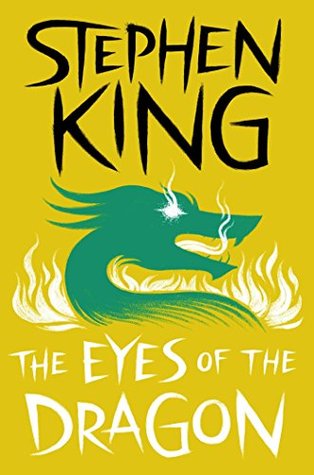
Audiobook Review: The Eyes of the Dragon by Stephen King


“Once, in a kingdom called Delain, there was a king with two sons….”

Thus begins one of the most unique tales that master storyteller Stephen King has ever written—a sprawling fantasy of dark magic and the struggle for absolute power that utterly transforms the destinies of two brothers born into royalty. Through this enthralling masterpiece of mythical adventure, intrigue, and terror, you will thrill to this unforgettable narrative filled with relentless, wicked enchantment, and the most terrible of secrets….

I originally read The Eyes of the Dragon ages ago, probably not long after its release in the late 80s. And honestly, I didn’t remember much about it, other than (a) it was a real departure for Stephen King at that point, and (b) I liked it.

Why did I decide to revisit this story? I’m not really sure what brought it back to my attention — I think maybe it popped up on my Audible recommendation list? In any case, the audiobook caught my eye right when I was in between listens and I decided to give it a try. Great choice!

The Eyes of the Dragon, as far as I can tell, is one of King’s early departures from writing straight-up horror. It’s not a horror story at all — instead, it’s fantasy set in a far-off kingdom, where an evil magician is determined to thrust the land into chaos and bloodshed in order to satisfy his own dark purposes.

King Roland the Good is an okay king, kind but not particularly effective, and perhaps a little too under the sway of his advisor, the magician Flagg. Roland has two sons — his heir, Peter, and a younger son, Thomas, who grows up in his older brother’s shadow, always plagued by feelings of inadequacy and jealousy as he watches Peter grow into a fine, beloved young man. When Flagg’s schemes end with Peter falsely imprisoned on charges of murdering his father, Thomas gains the throne, but he’s guided in all things by Flagg, who uses Thomas’s weakness to destabilize the country. But Peter is strong and smart, and doesn’t give up so easily…

Such a terrific story! I was completely enthralled by this tale of loyalty, royalty, friendship, betrayal, and the evil that threatens to undermine families and kingdoms. The characters are so well drawn, showing shades of personality and motivation, and finding hidden dimensions in characters that might otherwise seem like a stock type.

The audiobook is narrated by actor Bronson Pinchot, and he’s wonderful. He captures the folksy nature of the storytelling (as the book’s narrative voice often interjects the narrator’s own opinions and speaks directly to the reader/listener), and also does an amazing job with the voices, from old King Roland to timid Dennis the butler to upright Peter, and of course, most especially, the insidiously scary Flagg.

The Eyes of the Dragon is an excellent adventure — don’t miss it!

_________________________________________

The details:

Title: The Eyes of the Dragon
Author: Stephen King
Narrator: Bronson Pinchot
Publisher: Scribner
Publication date: February 2, 1987
Print length: 484 pages
Audiobook length: 10 hours, 23 mintues
Genre: Fantasy
Source: Purchased

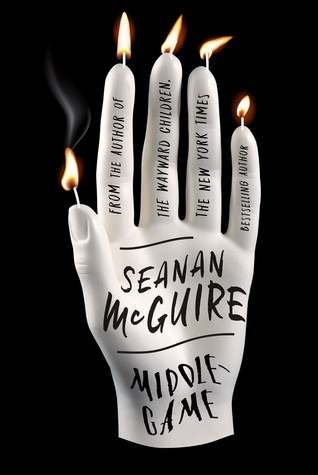
Book Review: Middlegame by Seanan McGuire


Meet Roger. Skilled with words, languages come easily to him. He instinctively understands how the world works through the power of story.

Meet Dodger, his twin. Numbers are her world, her obsession, her everything. All she understands, she does so through the power of math.

Roger and Dodger aren’t exactly human, though they don’t realise it. They aren’t exactly gods, either. Not entirely. Not yet.

Meet Reed, skilled in the alchemical arts like his progenitor before him. Reed created Dodger and her brother. He’s not their father. Not quite. But he has a plan: to raise the twins to the highest power, to ascend with them and claim their authority as his own.

Godhood is attainable. Pray it isn’t attained.

Y’all know how much I love Seanan McGuire, right? I mean, I have gobbled up pretty much everything of hers that’s come my way, and I haven’t been disappointed yet. And I’m not now.

Which is to say… I thought Middlegame was weird and challenging, and I loved it.

Let me start by adding that the synopsis above doesn’t feel very accurate to me. Yes, Roger and Dodger are twins… kind of. But I don’t think the books itself refers to attaining godhood. So I’m glad I didn’t read the synopsis very carefully before starting, because it might have created some bizarre expectations that definitely would have gone unfulfilled.

In Middlegame, Dodger and Roger are creations, but they spend most of their lives not knowing this. They were created by a powerful alchemist, himself a creation of a powerful, game-changing alchemist, and they have a specific purpose in life — to manifest the alchemical concept of the Doctrine of Ethos.

Huh?

Yup, that was my reaction… but the confusion is part of the experience of this book, and I was happy to just go with it. Roger and Dodger each have a gift — language for Roger, math for Dodger. Raised on opposite sides of the country by adoptive parents, they discover a psychic connection as young children, and as they grow up, their bond develops, strengthens, and becomes powerful, dangerous, and more and more inexplicable. Meanwhile, Reed and his allies monitor the pair carefully, charting their progress toward manifestation, making sure to keep them apart when their progress threatens the greater goals of the project.

It’s all just so twisty and timey-wimey and mind-bending and GOOD. And as always, I love Seanan McGuire’s writing. Does she have a bit of Roger’s ability to create reality through her words? All signs point to yes.

I won’t go into a lot of detail, mainly because I just finished this long, complicated book and I’m still sifting through it all in my mind. There’s a lot to puzzle through and unravel. So rather than digging further into plot threads, I’ll share some lines and quotes that jumped out at me as I was reading:

…and she can no more conceive of failure than a butterfly can conceive of calculus.

Roger thinks that’s the trouble with grownups. The more effort they put into deciding what kids are going to do or think or be, the more things so wrong for them.

People who say “sticks and stones may break my bones, but words will never hurt me” don’t understand how words can be stones, hard and sharp-edge and dangerous and capable of doing so much more harm than anything physical. […] Words can be whispered bullet-quick when no one’s looking, and words don’t leave blood or bruises behind. Words disappear without a trace. That’s what makes them so powerful. That’s what makes them so important.

That’s what makes them hurt so much.

You can’t skip to the end of the story just because you’re tired of being in the middle.

Everything is perfect. Everything is doomed.

On and on they go, the shorthand becoming more extreme, the air going hot and heavy around them, like an electric storm rolling in, like another fire getting ready to ignite, a fire that needs no flame but only the constant friction between the two halves of something which has never, in all the long years of their lives, been fully realized.

Roger has never understood the math that calls to her, but he feels it now, thrumming in his veins like a promise of miracles to come. Dodger has never grasped the need to put a name to the things she knows to be true, but she understands it now, and accepts the names he throws her way gladly, transforming them through the alchemy of her observations before she throws them back to him.

Here’s one that makes my brain ache:

She knows that, as surely as she knows that every second takes away more of her slim opportunity to escape becoming the future self of a girl she, as yet, never was.

And on a slightly lighter note:

“Wake up,” he says. “We need to let my terrifying ex-girlfriend tell us how we’re supposed to manifest a primal force of reality before asshole alchemists set us the fuck on fire.”

I really don’t think there’s much I can say or add that will do justice to the headlong rush of tragedy, violence, excitement, and true deep emotion that mixes together in Middlegame. So I’ll just wrap by saying that this is an awesome adventure of a read, and I’m sure I’m going to want to read it again after my mind relaxes.

Oh, and I love the fact that one of the super-powerful alchemists wrote a best-selling children’s fantasy book series, full of magical quests along the lines of a Narnia/Fillory tale — but that these stories really are code for alchemical inquiries into controlling the powers of the universe. Which made me wonder just a bit if there’s more to, I don’t know, Harry Potter? than meets the eye…

Extra gold points for great use of San Francisco landmarks (Sutro Baths!)… and how can you not love a book that includes the phrase killer death alchemists as if it’s a normal thing to say?

Seanan McGuire fans, rest assured — our beloved author strikes again, and it’s fabulous.

_________________________________________

The details:

Title: Middlegame
Author: Seanan McGuire
Publisher: Tor
Publication date: May 7, 2019
Length: 528 pages
Genre: Science fiction/fantasy
Source: Purchased (and also, review copy via NetGalley)

**Save

Save

Save

Save

Save

Save

Save

Take A Peek Book Review: Storm of Locusts (The Sixth World, #2) by Rebecca Roanhorse

“Take a Peek” book reviews are short and (possibly) sweet, keeping the commentary brief and providing a little peek at what the book’s about and what I thought.

Synopsis:

(via Goodreads)

It’s been four weeks since the bloody showdown at Black Mesa, and Maggie Hoskie, Diné monster hunter, is trying to make the best of things. Only her latest bounty hunt has gone sideways, she’s lost her only friend, Kai Arviso, and she’s somehow found herself responsible for a girl with a strange clan power.

Then the Goodacre twins show up at Maggie’s door with the news that Kai and the youngest Goodacre, Caleb, have fallen in with a mysterious cult, led by a figure out of Navajo legend called the White Locust. The Goodacres are convinced that Kai’s a true believer, but Maggie suspects there’s more to Kai’s new faith than meets the eye. She vows to track down the White Locust, then rescue Kai and make things right between them.

Her search leads her beyond the Walls of Dinétah and straight into the horrors of the Big Water world outside. With the aid of a motley collection of allies, Maggie must battle body harvesters, newborn casino gods and, ultimately, the White Locust himself. But the cult leader is nothing like she suspected, and Kai might not need rescuing after all. When the full scope of the White Locust’s plans are revealed, Maggie’s burgeoning trust in her friends, and herself, will be pushed to the breaking point, and not everyone will survive.

My Thoughts:

I loved Trail of Lightning, the first book in Rebecca Roanhorse’s The Sixth World series, and Storm of Locusts is an amazing follow-up! Picking up right from where book #1 left off, the story rejoins Maggie after the big fight at Black Mesa, where she battled a Navajo god and seemingly lost her only friend. Now, mere weeks later, she’s healing emotionally and physically, when she’s called on by a sometimes-ally to help with a bounty hunt that goes badly wrong. After the bloody incident, Maggie has a new responsibility, her ally’s niece Ben, a teen girl with clan powers of her own.

Immediately on the heels of this event comes news that Kai has been kidnapped, and Maggie is soon on the trail of a cult leader whose powers include the ability to summon and control hordes of locusts. Gross. And scary. Storm of Locusts ends up as a road trip/quest kind of book, as Maggie, Ben, and Rissa, sister of the boy kidnapped along with Kai, set out to track their missing friends and get vengeance on the White Locust. For the first time in these books, their search takes them outside the walls of Dinétah and into the greater world beyond the Navajo people’s protected lands, where corruption and extreme danger come in many forms, and where despite the strangeness of the new reality, the gods still have powers too.

I’m really adoring The Sixth World series, its characters, legends, and world-building, the mix of old traditions and a new post-apocalyptic landscape. Author Rebecca Roanhorse has a magical, masterful touch with her storytelling, creating a people and society that feel real and lived-in. Maggie is a terrific, layered, conflicted heroine, a total win as a lead character. I want much more of her story! The book ends with a final scene that makes it clear that Maggie’s troubles are far from over, which is fine with me — more trouble for Maggie means more excellent stories for us to enjoy.

Can’t wait for #3!

_________________________________________

The details:

Title: Storm of Locusts (The Sixth World, #2)
Author: Rebecca Roanhorse
Publisher: Saga Press
Publication date: April 23, 2019
Length: 230 pages
Genre: Speculative/dystopian science fiction
Source: Purchased

**Save

Save

Save

Save

Save

Save

Save

Take A Peek Book Review: The Raven’s Tale by Cat Winters

“Take a Peek” book reviews are short and (possibly) sweet, keeping the commentary brief and providing a little peek at what the book’s about and what I thought.


Synopsis:

(via Goodreads)

Seventeen-year-old Edgar Poe counts down the days until he can escape his foster family—the wealthy Allans of Richmond, Virginia. He hungers for his upcoming life as a student at the prestigious new university, almost as much as he longs to marry his beloved Elmira Royster. However, on the brink of his departure, all his plans go awry when a macabre Muse named Lenore appears to him. Muses are frightful creatures that lead Artists down a path of ruin and disgrace, and no respectable person could possibly understand or accept them. But Lenore steps out of the shadows with one request: “Let them see me!”

My Thoughts:

In The Raven’s Tale, muses are considered dangerous to the soul, yet at the same time, they’re acknowledged to exist. The Sunday sermon exhorts the congregation to “Silence your muses!” lest they lead you into temptation and keep you from pursuing an honest, hardworking, upright life. Such is the world in which we meet young Edgar Allan Poe, a 17-year-old devoted to poetry whose foster father wants to see him settled in the family business as a clerk. It’s all about respectability!

Poor Eddy! He’s consumed by thoughts of a deadly Richmond theater fire from eleven years earlier, and from his obsession with the fire, his muse emerges into life. His attention makes her more and more real, a girl of smoke and ashes who assumes human form and accompanies Edgar through the streets and in his home, leading him to greater and greater devotion to his writing. Edgar’s goal is to escape his awful father and begin his university studies, where he hopes to achieve greatness through his poetry — but the dream is on the verge of slipping away as his financial situation becomes dire and he’s forced into debt and out of control gambling in a futile attempt to pay for his fees.

The idea of personification of muses is an interesting one (and there’s also a secondary muse, who represents Poe’s forays into satire). We see how Edgar becomes consumed by his obsessions with his art, and if we didn’t know that his friends and family are all able to see his muses as well, we might think he’d tumbled into madness.

The concept is unique and inventive. The author weaves together her extensive research into Poe’s youth with her flights of fancy in his interactions with the muse. Sprinkled throughout are both lines from what will become his published work and other rhymes and verses that are written by Cat Winters in the style of Edgar Allan Poe. It’s fun to see the use of his style, and seems credible that his great works could have started in bits and pieces, with all sorts of variations, as they do here.

Overall, I thought The Raven’s Tale mostly (but not totally) successful. It’s an interesting and engaging read, but the reality of the muses was not entirely believable. I’m not sure that the balance between established history and invented fantasy really works well, but as someone not previously familiar with Poe’s early years, I found the parts based on real-life events especially interesting.

The writing takes on all sorts of rhythms and moods that feel true to the Poe of popular imagination, and that makes reading The Raven’s Tale a treat (despite some of the plot bumps).

Whenever I’m not writing, time trudges forward with the maddening, mortifying, miserable, morose, moribund pace of a funeral procession.

Don’t you just love that line?

_________________________________________

The details:

Title: The Raven’s Tale
Author: Cat Winters
Publisher: Amulet Books
Publication date: April 16, 2019
Length: 368 pages
Genre: Historical fiction
Source: Purchased

**Save

Save

Save

Save

Save

Save

Save

Novella Review: Kingdom of Needle and Bone by Mira Grant


We live in an age of wonders.

Modern medicine has conquered or contained many of the diseases that used to carry children away before their time, reducing mortality and improving health. Vaccination and treatment are widely available, not held in reserve for the chosen few. There are still monsters left to fight, but the old ones, the simple ones, trouble us no more.

Or so we thought. For with the reduction in danger comes the erosion of memory, as pandemics fade from memory into story into fairy tale. Those old diseases can’t have been so bad, people say, or we wouldn’t be here to talk about them. They don’t matter. They’re never coming back.

How wrong we could be.

It begins with a fever. By the time the spots appear, it’s too late: Morris’s disease is loose on the world, and the bodies of the dead begin to pile high in the streets. When its terrible side consequences for the survivors become clear, something must be done, or the dying will never stop. For Dr. Isabella Gauley, whose niece was the first confirmed victim, the route forward is neither clear nor strictly ethical, but it may be the only way to save a world already in crisis. It may be the only way to atone for her part in everything that’s happened.

She will never be forgiven, not by herself, and not by anyone else. But she can, perhaps, do the right thing.

We live in an age of monsters.

Mira Grant is indisputably a master of horrifying disease and science run amok. There’s the zombie apocalypse of the Newsflesh trilogy, brought about by an unfortunate mixing of two manufactured viruses. There’s the Parasitology trilogy, featuring tapeworms (ick) genetically engineered for medical use. There’s her short fiction, including Apocalypse Scenario #683: The Box, about a viral outbreak that may or may not be part of a game, and Emergency Landing, a recent release via Seanan McGuire’s Patreon that’s creepy as hell, also about a viral outbreak linked to bioterrorism and basically the end of humankind.

Which brings us to Kingdom of Needle and Bone, which is terrifying in how real and ripped-from-the-headlines it feels. It starts with a measles outbreak, but it’s a deadlier version of the disease that spreads like wildfire and kills its victims within days or even hours of the appearance of symptoms. Not only that, those who survive the disease are left immuno-compromised and their previous vaccinations rendered ineffective. Millions die. And still, the anti-vaxxer movement holds on, strangely allying themselves with the pro-choice movement and claiming bodily autonomy as a legal construct negating mandatory vaccination.

The initial section of the novella deals with Lisa Morris, the 8-year-old who becomes the first fatality of the disease bearing her name. The story of how the disease infected visitors to a theme park is almost enough to make me swear off crowds forever. From there, the focus shifts to Lisa’s aunt Isabella Gauley, a pediatrician who fights to keep the public aware of the importance of vaccination and herd immunity — until she comes up with a different way of making sure at least some people survive the unstoppable epidemics sweeping the planet.

Any story about epidemics and killer viruses creeps me the hell out… but also really fascinates me. Kingdom of Needle and Bone has plenty of creep factor, scary medical scenarios, and slightly off-kilter people who may or may not be mad scientists and/or unhinged survivalists. So yeah… I loved it.

And shuddered extra hard when I picked up this morning’s newspaper and saw a headline about yet another measles outbreak.

Maybe I need to consider a hermetically sealed bug-out shelter… just in case?

_________________________________________

The details:

Title: Kingdom of Needle and Bone
Author: Mira Grant
Publisher: Subterranean Press
Publication date: December 31, 2018
Length: 128 pages
Genre: Horror
Source: Purchased

**Save

Save

Save

Save

Save

Save

Save

Audiobook Review: An American Marriage by Tayari Jones

Newlyweds Celestial and Roy are the embodiment of both the American Dream and the New South. He is a young executive, and she is an artist on the brink of an exciting career. But as they settle into the routine of their life together, they are ripped apart by circumstances neither could have imagined. Roy is arrested and sentenced to 12 years for a crime Celestial knows he didn’t commit.

Though fiercely independent, Celestial finds herself bereft and unmoored, taking comfort in Andre, her childhood friend, and best man at their wedding. As Roy’s time in prison passes, she is unable to hold on to the love that has been her center. After five years, Roy’s conviction is suddenly overturned, and he returns to Atlanta ready to resume their life together.

This stirring love story is a profoundly insightful look into the hearts and minds of three people who are at once bound and separated by forces beyond their control. An American Marriage is a masterpiece of storytelling, an intimate look deep into the souls of people who must reckon with the past while moving forward – with hope and pain – into the future.

Once again, my book group has chosen an emotional, thought-provoking book that’s sure to prompt some passionate discussion. We seem to really know how to pick ’em this year!

In An American Marriage, Celestial and Roy are a devoted couple, but they’re still finding their groove as husband and wife after a year and a half of marriage. Their levels of trust seem to rise and fall, and in some ways, despite the obvious love between them, they’re still learning and growing together and establishing who they want to be together.

When Roy is accused of a violent crime and then convicted, they end up separated by his incarceration, facing a sentence that’s many years longer than their time together as a married couple. At first, Celestial visits regularly and they communicate constantly through letters, but over time, the physical separation becomes emotional separation as well — and when Roy’s conviction is overturned, he no longer knows if he has a wife to return to.

This book contemplates marriage, love, commitment, as well as the role of race in American society and the American justice system. Roy and Celestial are young, upwardly mobile African American professionals, but their run-in with the law in rural Louisiana — while awful and ghastly and unjust — doesn’t seem at all far-fetched in today’s society. Sadly, as shown through the experiences of the characters in this book, the threat of incarceration for African American males is very real and not avoidable simply by living a good and honest life.

Spoilery bits ahead:

I’ve said in other reviews that truly thought-provoking books evoke emotions, then make us question our emotions and get involved in internal debates. An American Marriage definitely had that effect on me.

Here come the spoilers:

While Celestial and Roy seem committed at the beginning of his prison time and determined to stick together no matter what, their relationship is eroded by time, distance, and the simple fact that they no longer share a life and experiences. After a few years, Celestial reaches the point where she stops visiting and finally tells Roy that she can no longer be his wife, even though she does not file for divorce. When Roy is released, he takes the lack of divorce papers as a sign that he has a marriage to return to, although he finds out soon enough that Celestial is in love with another man and planning to remarry.

Part of me was really angry with Celestial. Roy’s innocence is never in doubt. The reader, and Celestial, know absolutely that Roy is innocent of the rape for which he’s convicted. He’s sent away from her through a miscarriage of justice, not through any fault of his own. It made me really upset to see Celestial abandon Roy. BUT, at the same time, every time the narration switched to her point of view, I began to (unwillingly) feel sympathy. Celestial and Roy had only a short time together as husband and wife, and by the time a few years of his sentence passed, they’d been apart longer than they’d ever been together. They never really got to find out what sort of marriage they’d have. Roy is stuck in prison for all those years, but Celestial is out in the world, pursuing her artistic passions and starting to make a name for herself. Maybe if they’d been on this journey together, their marriage would have grown along with their developing talents and careers, but here, every change for Celestial means a change away from the marriage that’s had no chance to be anything other than stagnant.

It’s not at all fair to Roy — nothing that’s happened is fair in any way — but I had to grudgingly admit that Celestial had impossible choices to make and didn’t deserve to face what was supposed to be a 12-year sentence with no life of her own.

So while I was often angry with Celestial, I also made a point of trying to understand her actions and to feel pity for her experiences, not just for Roy’s. It was hard, because he’s the one victimized by a false conviction and my sympathy was naturally drawn to him. As I said, I had a full-fledged internal debate going on, and it was next to impossible to fault one or the other without also immediately feeling sorry for them.

In terms of the plot itself, I did have one minor quibble — Roy was convicted on rape charges, and the woman who accused him was raped by someone, just not by Roy. Why wasn’t there a rape kit done? Shouldn’t a DNA analysis have been able to clear him right away?

Even so, the story is tragic and so, so sad. Roy has a moment when he’s thinking about the trial and how the woman who accused him looked straight at him while describing the attack in the courtroom, telling her terrible story while being 100% sure that Roy was the rapist. Roy remembers feeling shame and guilt, despite knowing that she has the wrong man, simply from realizing how strongly the woman is convinced that this is who Roy is.

The book is told from multiple perspectives, mainly Roy’s and Celestial’s, and the audiobook uses different narrators for their pieces. Both do a very good job conveying their personalities, although it’s sometimes disconcerting hearing the “Roy” narrator doing Celestial’s voice when narrating a conversation between the two of them, and vice versa.

Overall, I’m very happy to have had the experience of listening to An American Marriage, and recommend it highly, whether in print or audio. There’s much to think about and digest, and I think this story will really stick with me. Looking forward to discussing it with my book group!

_________________________________________

The details:

Title: An American Marriage
Author: Tayari Jones
Narrators:  Sean Crisden, Eisa Davis
Publisher: Algonquin Books
Publication date: January 29, 2018
Print length: 308 pages
Audiobook length: 8 hours, 59 mintues
Genre: Contemporary fiction
Source: Purchased
Graphic Reaction: A Fire Story by Brian Fies

Early morning on Monday, October 9, 2017, wildfires burned through Northern California, resulting in 44 fatalities. In addition, 6,200 homes and 8,900 structures were destroyed. Author Brian Fies’s firsthand account of this tragic event is an honest, unflinching depiction of his personal experiences, including losing his house and every possession he and his wife had that didn’t fit into the back of their car. In the days that followed, as the fires continued to burn through the area, Brian hastily pulled together A Fire Story and posted it online—it immediately went viral. He is now expanding his original webcomic to include environmental insight and the fire stories of his neighbors and others in his community. A Fire Story is an honest account of the wildfires that left homes destroyed, families broken, and a community determined to rebuild.

Wow. If you’re looking for a powerful graphic novel to read, this is the one.

The 2017 fires in Northern California were absolutely devastating. I live in San Francisco, and while the fires themselves never came close to our city, the air was full of smoke for weeks — schools ending up closing, people were warned to stay inside and to wear masks while outside, and everyone had headaches and coughs from the lousy air quality. But of course, this is nothing compared to the suffering of those who perished as well as the thousands of people who lost their homes.

Author Brian Fies lived through it. A Fire Story is his memoir of the fire, starting with him and his wife waking up to red skies and the smell of smoke, grabbing a few items on their way out the door, and evacuating along with all of their neighbors — then returning the next morning to find that the entire neighborhood was just gone.

The author initially drew/wrote some of these pages in the moment, using sharpies and a pad of paper, to capture and process the experience as it unfolded. From the book’s notes, I understand that these images were initially shared online and went viral. He’s now expanded from the initial drawings to convey a more encompassing picture of what he and others went through. Sprinkled throughout are the “fire stories” of others who lost their homes, how they dealt with their losses, and how they’re still dealing with rebuilding and recovering. This is incredible stuff, truly.

Brian Fies shares his own experiences with candor and grace, and even some humor, as well as conveying the bigger picture of the reasons for the calamity and the scope of the loss — and manages to keep a focus on the human impact that can be lost when dealing with a disaster of this magnitude. We may hear about thousands of people losing their homes, but as the author points out in this excellent book, each of those thousands has a unique, individual story to tell.

For a taste of the book, check out:

From: A Santa Rosa Cartoonist’s ‘Fire Story’ Comes to Life
Kelly Whalen and Farrin Abbott, Producers for KQED Arts
Video courtesy KQED Arts


The author’s original postings: http://brianfies.blogspot.com/2017/10/a-fire-story-complete.html

_________________________________________

The details:

Title: A Fire Story
Author: Brian Fies
Publisher: Harry N. Abrams
Publication date: March 5, 2019
Length: 160 pages
Genre: Graphic novel
Source: Library

Take A Peek Book Review: The Bookshop of the Broken Hearted by Robert Hillman

“Take a Peek” book reviews are short and (possibly) sweet, keeping the commentary brief and providing a little peek at what the book’s about and what I thought.


Synopsis:

(via Goodreads)

Tom Hope doesn’t think he’s much of a farmer, but he’s doing his best. He can’t have been much of a husband to Trudy, either, judging by her sudden departure. It’s only when she returns, pregnant to someone else, that he discovers his surprising talent as a father. So when Trudy finds Jesus and takes little Peter away with her to join the holy rollers, Tom’s heart breaks all over again.

Enter Hannah Babel, quixotic smalltown bookseller: the second Jew—and the most vivid person—Tom has ever met. He dares to believe they could make each other happy.

But it is 1968: twenty-four years since Hannah and her own little boy arrived at Auschwitz. Tom Hope is taking on a batttle with heartbreak he can barely even begin to imagine.

My Thoughts:

First of all, let’s be clear, while the title refers to a bookshop, this novel isn’t particularly about the bookshop. There’s a whole subgenre of bookstore fiction, sure to warm the hearts of booklovers everywhere. This isn’t one of those books.

Set in Australia, The Bookshop of the Broken Hearted tells the story of Tom, a lonely man who’s been unlucky in love. Tom is a sheep farmer who lives a contented, quiet life, until his wife Trudy deserts him and takes away Peter, the son of his heart if not his body. When Tom meets Hannah, it’s like he gets a new ray of sunshine in his life, and the two form a passionate, unbreakable bond. But Hannah’s past haunts her in ways Tom can’t quite understand, and when Peter reenters their lives, it may be more than Hannah can stand.

The story is truly affecting in parts, and I came to love Tom quite a lot. He’s sweet and good and loving, although he does seem to allow himself to roll with the punches rather than standing up to the people and events that hurt him. Tom’s relationship with Peter is lovely, so when he’s taken away, it is a heart-breaking development. The story of Peter’s experiences at “Jesus Camp” is horrible — he’s essentially trapped there by a mother who’s caught up in pastor’s cult-like community, and I was really upset by Peter’s suffering and the length of time it takes for him to finally be rescued.

We hear about Hannah’s past through chapters scattered throughout the book that show her experiences in the concentration camp and the years afterward. Of course, she’s deserving of great sympathy, but there are times with Tom and Peter that’s it hard to like her.

Overall, this is a quiet and moving book. I loved the descriptions of Tom’s farm and the Australian setting and landscapes. The writing is slow and underspoken, with a brevity that somehow makes the emotion harder to access at times.  The juxtaposition of ranch life in Australia and memories of the Holocaust makes for an unusual mix, but it works. The Bookshop of the Broken Hearted is an unusual work of historical fiction, definitely worth checking out.

_________________________________________

The details:

Title: The Bookshop of the Broken Hearted
Author: Robert Hillman
Publisher: G. P. Putnam’s Sons
Publication date: April 9, 2019
Length: 304 pages
Genre: Historical fiction
Source: Review copy courtesy of the publisher via NetGalley

**Save

Save

Save

Save

Save

Save

Save

Graphic Reaction: The Beauty, volumes 1 – 5


Oh boy, what a crazy bunch of books I just read! The Beauty is an ongoing comic series, available in five volumes (so far) of trade paperbacks. I picked these books up on a total whim while browsing library shelves — and something about the covers made me decide to grab all five at once, instead of trying just one.

From Goodreads, synopsis for volume 1:

Modern society is obsessed with outward beauty. What if there was a way to guarantee you could become more and more beautiful every day? What if it was a sexually transmitted disease?

In the world of The Beauty, physical perfection is only one sexual encounter away. The vast majority of the population has taken advantage of it, but Detectives Vaughn and Foster will soon discover it comes at a terrible cost. Now, they’ll have to find their way past corrupt poiticians, vengeful federal agents, and a terrifying mercenary out to collect the price on their heads.

In The Beauty, some people contract the disease accidentally, and others deliberately seek it out. Either way, more and more people are becoming infected, and the people with the Beauty find themselves in enviable positions within society… until Beauties start dying. And it’s not just the victims of anti-Beauty violence who die — some Beauties are found dead by internal combustion. They literally burn up from the inside out. Gross, right?

Volume one introduces us to Detectives Foster and Vaughn, assigned to the Beauty beat, who become enmeshed in the growing violence and conspiracies regarding the Beauty, as well as having personal stakes in the outcome of their investigation. They’re partners with great chemistry and friendship, nothing romantic at all, which is refreshing in a male/female detective duo.  As the story progresses, we learn that there’s an underground faction of scientists trying to expose big pharma’s role in the perpetuation of the disease, and there also people (government? organized crime?) who’ll stop at nothing to keep their secrets.

One thing I really enjoyed about the series is how the artwork uses color and light to visually cue us in on who has the Beauty. People with it have a radiance that others just don’t, so even when someone as drawn is reasonably attractive, it’s the play of light that let’s us know who has the disease.

Volume 1 ends on a major cliffhanger… and as of the end of volume 5, we never get back to that point. Let me explain…

Volumes 2 – 5 are all backstory, occurring chronologically before volume 1, each showing different views into the development of the Beauty and the vast amount of violence that goes with it. In volume 2, we meet two completely new characters, participants in the world of crime who have a devoted patron and manage to establish a family of sorts. Their little found family is of course caught up in the chaos surrounding the Beauty, and both inflict and suffer tremendous amounts of damage.

Volumes 3 and 4 continue with this story, as well as mixing stories of the scientists and the corporate bad guys who all have some part in the spread of the disease. And in volume 5, we return to Vaughn and Foster in the earlier days of their partnership, as they join the Beauty task force in response to a series of murders.


I suppose I was most enamored of the story in volume 1, although all volumes remain interesting. Still, I wished throughout for some resolution or forward motion from the end of volume 1, rather than the build-up of backstory. I know the series is ongoing, so I’m hoping that whenever the next volume is released, we can finally find out what happens next.


The artwork is a little uneven, especially in volumes 2 and 3, as some pretty different styles are used for parts of the story, and not all work. (It can also be hard to identify characters when their images change so much between chapters and volumes).

Still, I really enjoyed the series overall, and sped my way through all five volumes in about a day and a half. Warning: Not for the squeamish. There’s a lot of violence, lots of weaponry, close-ups of blood and bodily harm… you get the point. If you can handle these elements in your graphic novel reading, then by all means, check out The Beauty!

_________________________________________

The details:

Title: The Beauty, volumes 1 – 5
Author: Jeremy Haun and Jason A. Hurley
Illustrator: Jeremy Haun and John Rauch
Publisher: Image Comics
Publication date: ongoing (started 2016)
Length: varies
Genre: Graphic novel
Source: Library

Book Review: Roar by Cecelia Ahern


From the bestselling author of P.S., I Love You, a fiercely feminist story collection that illuminates–sometimes in fantastical ways–how women of all kinds navigate the world today.

In this singular and imaginative story collection, Cecelia Ahern explores the endless ways in which women blaze through adversity with wit, resourcefulness, and compassion. Ahern takes the familiar aspects of women’s lives–the routines, the embarrassments, the desires–and elevates these moments to the outlandish and hilarious with her astute blend of magical realism and social insight.

One woman is tortured by sinister bite marks that appear on her skin; another is swallowed up by the floor during a mortifying presentation; yet another resolves to return and exchange her boring husband at the store where she originally acquired him. The women at the center of this curious universe learn that their reality is shaped not only by how others perceive them, but also how they perceive the power within themselves.

By turns sly, whimsical, and affecting, these thirty short stories are a dynamic examination of what it means to be a woman in this very moment. Like women themselves, each story can stand alone; yet together, they have a combined power to shift consciousness, inspire others, and create a multi-voiced ROAR that will not be ignored.

Roar is a collection of fantastical stories, rooted in the real world, in which the unnamed women at the heart of the different tales experience life through a series of metaphors that have somehow become reality.

The titles of these 30 stories all begin with the words The Woman Who. Each focuses on a woman experiencing some sort of literal manifestation of the types of issues we all encounter more figuratively in our worlds.

The collection opens strong with The Woman Who Slowly Disappeared. The premise is very reminiscent of the season 1 Buffy episode Out of Mind, Out of Sight, about a high school girl whose peers never seem to notice her, and who ends up becoming invisible. In this story, the main character is a woman in her 50s who has gradually faded, becoming less seen over time as she ages, becoming unnoteworthy to the crowds of people around her:

On the worst days, she would go home feeling completely overwhelmed and desperate. She would look in the mirror just to make sure she was still there, to keep reminding herself of that fact; she even took to carrying a pocket mirror for those moments on the subway when she was sure she had vanished.

After fading away to just a glimmer, the woman finally finds hope in the care of a doctor who provides a diagnosis and treatment plan:

“Women need to see women, too,” Professor Montgomery says. “If we don’t see each other, if we don’t see ourselves, how can we expect anybody else to?”

In The Woman Who Was Kept on a Shelf, a woman’s husband builds her a shelf where he can display and admire her, but over the years of her marriage, she finds the shelf keeps her on the sidelines of the life around her.

She’s spent so many years sitting up here representing an extension of  Ronald, of his achievements, that she no longer has any idea what she represents to herself.

Other favorites of mine are the stories The Woman Who Walked in Her Husband’s Shoes, The Woman Who Was a Featherbrain, and the The Woman Who Was Pigeonholed. But really, they’re all terrific. The tales are simple. You might at first glance find the premise a little obvious, but really, taken as a whole, these fables illustrated different aspects of what it means to be a woman, how we are defined by society, ourselves, and each other, and how perception and awareness can change everything. There’s a lightness and humor in many stories, even as the situations, taken to their logical (or illogical) conclusion can be nightmarish.

In The Woman Who Wore Pink, there’s an actual Gender Police that issues warnings and fines as people step outside their prescribed gender roles, with all of one’s interactions — even down to the daily Starbucks order, being identified as either “penis” or “vagina”. It takes the woman’s six-year-old daughter’s angry argument, “If I”m not me, who else am I supposed to be?” for the woman to open her eyes and consider the pointlessness of separating all habits and options into either penis or vagina categories. There’s a particularly funny episode after the daughter is denied the “penis” Happy Meal that comes with a dinosaur, as the woman starts to question why dinosaurs are considered boy-appropriate only:

“I’m just saying. I mean, there were female dinosaurs, too, you know, and I don’t think any of them were pink.”

I ended up loving this entire collection. The thirty stories are a mix of far-fetched, grounded in the familiar, comedic, and painful. All are told in a straight-forward manner, where we take the fantastical elements as reality and are faced with considering how our world’s definitions of women’s lives and women’s roles might look if all the euphemisms and catchphrases for the assumptions and barriers facing women became literal parts of the everyday world.

Roar is a fun, thought-provoking set of stories with plenty to chew on. I think it would be a great choice for a book club to discuss. Reading this book made me wish for a group of friends with copies in their hands, so we could each pick a favorite story and compare notes — and imagine ourselves literally falling through the floor, unraveling, melting down, or discovering our very own strong suit.

Check it out!

_________________________________________

The details:

Title: Roar
Authors: Cecelia Ahern
Publisher: Grand Central Publishing
Publication date: April 16, 2018
Length: 288 pages
Genre: Short stories
Source: Review copy courtesy of the publisher via NetGalley