Hoot by Carl Hiaasen: A book & a movie with the kiddo

Book Review: Hoot by Carl Hiaasen
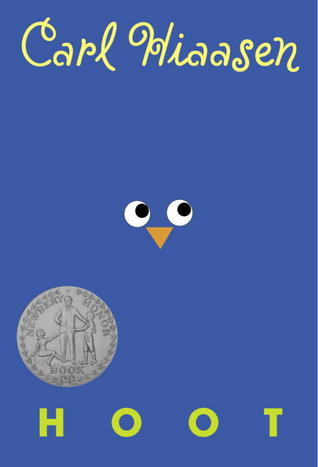
Hoot

Perhaps you’re familiar with Carl Hiaasen’s smart-ass, Florida-centric books for grown-ups — all 22 of them! — that include bestsellers such as Strip Tease, Nature Girl, Star Island, and Skinny Dip. But the way this author found his way into my heart was through his books for kids, now totaling four — and here’s hoping there are many more to come!

Hoot was Carl Hiaasen’s first book for kids, aimed at the middle school crowd and featuring some fun, fearless, and memorable characters with just enough gross-outs and goof-ball mischief to appeal to 10 to 13-year-olds. Hoot certainly appealed to my 11-year-old, who isn’t the easiest kid to please when it comes to books. (Video games are a different matter, but I digress.)

In his younger days — oh, say at age 10 — my kiddo would help me out on my blog from time to time with “Q&A with the Kiddo” posts, where I’d write about books that we’d read together, ask him questions, and then share some thoughts from each of us. Alas, now that he’s reached the ripe old age of 11, he’s no longer willing to indulge me. Luckily, though, he still enjoys a good book, and has not yet decided that he’s too old for a read-aloud at bed time. So for as long as he’ll let me, I continue reading him a chapter or two once he’s tucked in (knowing that our days of reading together are probably numbered, although I’ve told him more than once than I’ll come to college with him if he wants).

Hoot is our most recent reading adventure, and it was a big success. We’d thoroughly enjoyed the author’s most recent kids’ book, Chomp, last year (my review is here), and reading Hoot was actually the kiddo’s idea — he’d seen part of the movie at his after school program recently, and wanted to know the rest of the story.

hoot owlSo what’s it about? In a nutshell: Roy Eberhardt moves to Florida from Montana when his dad gets reassigned for work, and boy, is Roy unhappy about being the new kid all over again. After getting bullied by the meanest kid in school, he encounters a mysterious barefoot boy running down the street, and quickly becomes fascinated by figuring out who the kid is and why he’s running. Meanwhile, Mother Paula’s Pancake House is about to open a new franchise location in Roy’s small town… but someone keeps playing pranks and causing mischief at the construction site, and the Mother Paula’s people are not happy about it. The storylines come together as Roy and his new friends Beatrice Leep and Mullet Fingers try to find a way to save the rare burrowing owls who live at the construction site before the bulldozers start to roll. Hoot is filled with a host of amusing supporting characters, from the well-intentioned but bumbling Officer Delinko to construction manager Curly to the oozily nasty corporate tool Chuck E. Muckle. As the various plotlines and people converge, Carl Hiaasen doesn’t skimp on humor, pranks, or bizarre human behavior.

In both Hoot and Chomp, a dominant theme is the natural wonders of Florida and how greedy humans are encroaching on natural habitats. In both books, the author’s love for nature shines through, and the kids who are heroes are the ones who stand up and fight against the careless, thoughtless, or just plain mean grown-ups who value money over beauty. While the main characters in both books come from homes with supportive and loving parents, the author doesn’t shy away from showcasing kids who come from troubled homes or less wholesome environments. One of the things he does best is dig beneath the surface and show why a kid might be weird, or dressed funny, or be reluctant to trust or share secrets. At the same time, no mercy is shown to the bullies, whether kids or adults: The characters who mistreat others, who are mean and nasty, who like to hurt people for their own glory, or who just don’t care — well, they do tend to get what’s coming to them, and then some.

After reading the book, kiddo and I decided to watch the movie as well — and while I almost never, ever, ever sayhoot this, in this case I’ll admit to liking the movie just a smidge more than the book. The book was great, don’t get me wrong — but the movie just did a better job of showing the natural beauty of the Florida coastlines and waterways, as well as the vulnerability of the little owls (awwwww… baby owls!) being threatened by the big construction machinery. This is one instance where a picture really is worth a thousand words, because the one thing I really didn’t get from the book was enough description of the construction site and the landscape, and that made it harder to visualize the nature of the threat. The movie is mostly faithful to the book, up until the ending — where again, I have to admit that I found the movie ending a bit more exciting and dramatic than the final confrontation and big finale in the book.

The cast was very good, with a young Logan Lerman in the role of Roy, and a nice cameo by Jimmy Buffett as well. Plus, the geek in me and my kiddo (call us Mama Geek and Geek Junior, I suppose) did a little happy dance when Clark Gregg (Agent Coulson!) appeared in the sleazy role of corporate bad guy Chuck Muckle.

Should you read the book or watch the movie?

Yes to both! Why choose?

Meanwhile, I have no hesitation about recommending this author’s books for kids. Carl Hiaasen’s writing is funny and fast-paced, with strong messages about family connections, loyalty, and respect for the environment. I can pretty much guarantee that kids will love these books, and their parents will too.

_________________________________________

The details:

Title: Hoot
Author: Carl Hiaasen
Publisher: Alfred A. Knopf
Publication date: 2002
Genre: Middle grade
Source: Purchased

Book Review: Racing Savannah by Miranda Kenneally

Book Review: Racing Savannah by Miranda Kenneally

Racing Savannah

If you’re looking for a light, upbeat, contemporary young adult novel, Racing Savannah definitely fits the bill.

Two days before the start of her senior year of high school, Savannah moves to a new town with her father and his pregnant girlfriend in order for him to start a promising new job as a groom for a very successful (a.k.a., super wealthy) horse racing farm. Savannah has grown up around horses and is eager to get work as well as one of the exercise “boys” — riders who take the racehorses out for their daily warm-ups and practice runs. But it’s not just her love of horses that drives her: The family has been deeply in debt for years, paying off the medical bills related to Savannah’s mother’s illness and death, and there’s barely enough money to scrape by, much less support a new baby.

Rule number one at Cedar Hill Farms: The staff does not mix with the owners, the Goodwin family. Easier said than done, especially since the owner’s son is also a senior in the same high school, super hot, and — incredibly — attracted to Savannah as well. Jack has a reputation for sleeping around, and Savannah is very conscious of her status as the hired help. Yet the more they work together, the more obvious the attraction is. And it’s not only physical: Jack respects Savannah, believes in her, and wants to give her a chance to break into the male-dominated world of horse racing jockeys.

Racing Savannah is, overall, a feel-good story about love overcoming obstacles. It’s not really a spoiler to say that there’s a happy ending; it’s perfectly obvious that things will work out. The two lead characters are clearly good people — so it’s only a question of how they’ll work past their differences, not if.

Savannah’s economic problems are not sugar-coated. She thinks long and hard about everything she spends money on. She shops at thrift stores, if at all. She uses the same threadbare comforter she’s had since she was a little girl. She knows that if she wants something, she has to work for it. At the same time, she loves her father tremendously, and even though she resents his girlfriend Cindy, Savannah is also concerned enough to cover Cindy’s maid shifts in the manor house when morning sickness gets to be too much, and even makes a secret deal with Jack’s father to cover Cindy’s missed wages out of her own earnings.

The writing is mostly light and breezy, entertaining even when dealing with serious matters. I enjoyed the author’s sense of humor, which is quirky enough to catch me by surprise throughout the book:

One time a horseman told me I have a way with horses. Dad told me not to listen when men say things like that, because they’re just trying to get into my pants. But I do have a way with horses. Dad, however, does not have a way with words.

Much later, getting ready for once of her first races as an apprentice jockey:

“You look good in the Goodwin colors,” he says, scanning my black and green riding silks.

“I look like a damned Slytherin.”

I liked the girl power in Racing Savannah, which is assertive without beating the reader over the head. It’s a given that Savannah is strong and talented; the only question is whether she can get the men who control the racing business, from the owner on down to the stable hands, to recognize her talent and give her a chance to prove herself. Likewise, the message around economic status is quite positive: Financial status doesn’t make Savannah inferior to anyone — she just has to work that much harder to get what she wants. The more determined she becomes, the more she realizes that the doors she believed to be shut for her, such as a college education, just need a few strong nudges to start to swing open. It’s not to say that everything is easily solved, but simply that Savannah is able to chart her own destiny by controlling her fear, respecting herself, and going after her goals.

Another aspect I really enjoyed was the portrayal of the teen friendships in Racing Savannah. Savannah is completely new in town, but she connects with people who are warm and welcoming. She doesn’t immediately become popular, but she finds a place and finds people with whom she can connect. I liked how the author avoids teen cliches such as the mean girl, the nerdy boy, the school princess, etc. There are characters who seem as though they’ll fit these neat compartmentalizations — but they don’t follow the rules of their types, and it’s fun and refreshing to see young people just being themselves and having a good time.

The sexual encounters in this book are a bit more explicit than most I’ve encountered recently in contemporary YA novels — but they’re used sparingly, and if I had to guess, I’d say that they probably ring pretty true for readers in the target demographic. It’s not a problem, but just something to be aware of, for readers who prefer hints rather than a play-by-play description. At the same time, Savannah is thoughtful about her sexuality, and is very clear about needing to be able to respect herself for her decisions, as well as demanding Jack’s respect.

I have not read the author’s previous books, which include several others set in the same town and high school as Racing Savannah.  Characters from the earlier novels show up in background or supporting roles here, which will probably delight those who’ve read Miranda Kenneally’s other books.

All in all, I’m glad to have been introduced to a new-to-me author who takes such a clear-eyed view of life as a teen-aged girl. Miranda Kenneally creates strong, memorable female characters, without skimping on the fun and romance of being young and discovering life.

_________________________________________

The details:

Title: Racing Savannah
Author: Miranda Kenneally
Publisher: Sourcebooks Fire
Publication date: 2013
Genre: Young adult/contemporary
Source: Review copy courtesy of Sourcebooks Fire via NetGalley

Book Review: Rose Under Fire by Elizabeth Wein

Book Review: Rose Under Fire by Elizabeth Wein

17907041In 2012, no new release impressed me more (or made me cry harder) than Elizabeth Wein’s Code Name Verity. The author’s newest book, Rose Under Fire, is also set during World War II, and presents the horrors of war through the eyes of a fresh new heroine, Rose Justice.

When we first meet Rose, she is 18 years old, a feisty pilot from Pennsylvania who has volunteered to serve with the ATA (Air Transport Auxiliary), a civilian division supporting the Royal Air Force in England by ferrying aircraft back and forth between bases, airfields, and repair centers. The ATA was never intended to see action — but as we see in Rose Under Fire, things don’t always work out the way they’re supposed to.

While shielded from combat, the ATA pilots face the danger of flying damaged or faulty equipment — and even deadlier, there’s also the danger of incoming German V-1 rockets, known as flying bombs or “doodlebugs”. When Rose pursues and knocks down a doodlebug, she starts a chain of events that leads to her capture by German pilots — resulting in unimaginable horrors as she eventually finds herself a prisoner in the notorious Ravensbrück concentration camp.

The author doesn’t shy away from presenting the appalling, inhuman suffering of the Ravensbrück prisoners. Worst off of all are the “Rabbits”, Polish prisoners who have been used as human guinea pigs in cruel, pointless medical experiments which killed many and left the rest horribly crippled. Rose is adopted within the camp by a close-knit group of prisoners, among them several Rabbits, and they all swear to tell the world, one way or another, what truly transpired hidden away behind the camp walls.

Rose is an admirable and loveable main character. She’s not naive, but she does come from a nurturing family in the safe and cozy world of the US — so that while her camp mates recount the years of wartime terror they’ve already lived through, Rose can only recall her birthday parties and swimming at the lake on warm summer days. It’s Rose’s good memories and her gift with words that help them all to survive, as Rose creates poems and stories that the other prisoners avidly soak up, her fantasy worlds providing distraction from the unending suffering in the camp as well as a glimpse of what happiness might once have been.

Within Rose’s camp family, bonds are strong and fierce, and Rose and the others display courage and devotion beyond what we might imagine. Those who survive only do so because of the others’ loyalty and sacrifice. Meanwhile, in the midst of starvation, endless roll calls in freezing weather, rampant disease, and the threat of sudden execution or disfiguring punishment, all the prisoners can do is get through each moment, determined above all to never let the names of the lost be forgotten.

Rose Under Fire is powerful, disturbing, sad, and lovely. The writing is unflinching, and yet also contains the beauty of Rose’s poetry, which she creates first in her head in the camp, and later records in the journals she uses to tell her story when she can’t face the idea of actually talking about her experiences with outsiders. Her lengthy poem “The Subtle Briar” speaks to the prisoners’ clinging to life, even in the face of terror and death:

When you cut down the hybrid rose,
its blackened stump below the graft
spreads furtive fingers in the dirt.
It claws at life, weaving a raft
of suckering roots to pierce the earth…

Rose Under Fire is a companion piece to Code Name Verity. Chronologically, it takes place after the events of Code Name Verity and includes a few characters from the earlier book — but I wouldn’t consider it a true sequel, as Rose Under Fire stands perfectly well on its own. Both books are remarkable achievements, taking young heroic women and placing them at the center of war, and endowing them with courage and grace even in the worst of times and circumstances. If you’ve read neither book, start with Code Name Verity, simply because certain outcomes in this book are referenced in Rose Under Fire. Again, both books certainly stand on their own, but I’d recommend reading them in the order written if only to avoid spoilers for the end of Code Name Verity.

Rose Under Fire lacks the intricate plot twists and reversals that make Code Name Verity so breathtaking. Because the book is told from Rose’s point of view, her survival is never truly in doubt. However, her horrifying ordeal and the complex stories of her fellow prisoners make Rose Under Fire a harrowing and emotional reading experience, and I found myself unable to put the book down until I reached the sad but inspiring end.

Author Elizabeth Wein, with these two books, has taken a chapter of history that may not be as immediately familiar to younger readers today and has brought it to life in vibrant, tangible detail. These books deserve all the praise they’ve received, and I have no hesitation about recommending them, for adult and young adult readers alike.

_________________________________________

The details:

Title: Rose Under Fire
Author: Elizabeth Wein
Publisher: Disney Hyperion
Publication date: 2013
Genre: Young adult
Source: Purchased


Book Review: The Lover’s Dictionary by David Levithan

Book Review: The Lover’s Dictionary by David Levithan

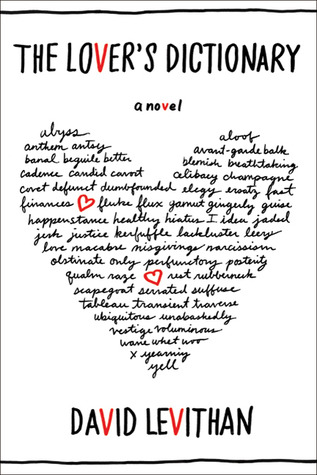
The Lover's DictionaryI’m so glad that I finally picked up a copy of this remarkable book — one of the few remaining books by David Levithan that I had yet to read.

David Levithan is the supremely talented author of incredibly fine works of young adult fiction, as well as an editorial director at Scholastic. But in The Lover’s Dictionary, David Levithan does something completely different: He writes for grown-ups.

To be clear: The Lover’s Dictionary isn’t a YA book that adults will also love. It is a mature look at adult love, and it is astounding.

Am I gushing yet? Because I feel like I’m gushing.

This is a novel, but the title doesn’t lie: It is a novel written in dictionary format. Each page contains an entry — at the least a few lines, at the most a page or two — going from A to Z, offering a word and its part of speech, followed by simply sensational definitions.

From aberrant to zenith, The Lover’s Dictionary tells the story of a relationship, not in chronological order, but in alphabetical order.

The two main characters remained unnamed. All we know is that this man and this woman meet online, begin dating, fall in love, live together, and then deal with what living together and loving together really means.

It’s beautiful and it’s unpredictable. It’s also disturbing and even heartbreaking.

Because the book is written alphabetically, there’s a strange sense of dislocation and confusion throughout. Wait, she cheated? When, exactly? Oh, they had a beautiful day in the park. But was that before or after? When they talk about having hope, are they in the early days, or the days that might possibly be too late?

But isn’t real life full of dislocation and confusion? Real relationships don’t evolve along a timeline, nicely following an outline like the tidy plot of a movie. There are ups and downs, reversals and collapses, leaps forward, near misses. It doesn’t have to go in order to make sense.

What we the readers are left with is a story of two people who seem to love each other intensely, but who also occasionally irritate each other and hurt each other and wish the other person would change, either a lot or a little.

Little snippets of the relationship just feel so real:

belittle, v.

No, I don’t listen to the weather in the morning. No, I don’t keep track of what I spend. No, it hadn’t occurred to me that the Q train would have been much faster. But every time you give me that look, it doesn’t make me want to live up to your standards.

Who hasn’t had these types of highs and lows, even in the same day, in a long-term relationship:

commonplace, adj.

It swings both ways, really.

I’ll see your hat on the table and I’ll feel such longing for you, even if you’re only in the other room. If I know you aren’t looking, I’ll hold the green wool up to my face, inhale that echo of your shampoo and the cold air from outside.

But then I’ll walk into the bathroom and find you’ve forgotten to put the cap back on the toothpaste again, and it will be this splinter that I just keep stepping on.

David Levithan knows words. I’ve admired his use of language in his YA novels as well, and here his verbal flourishes are on full display. He delves into the inner lives of words, twists them apart and finds their hidden selves, finds connections in the most unlikely of places. It’s beautiful to behold, even apart from the story itself, how the author turns the use of everyday language into an elevated art form.

Meanwhile, the story itself is gritty and often sad, yet has moments of real romance, humor and beauty. Interestingly, it’s The Lover’s Dictionary, not The Lovers’ Dictionary. That apostrophe placement makes a big difference. The male narrator is a writer, and this is his record of the relationship. Is he building a case? Is he writing a love letter? Is this a memory or a real-time journal? We don’t know. We don’t see both sides of the story. We just see him, with his devotion and his exasperation, addressing his thoughts to her, with hope and with love.

It’s one of the most unusual books I’ve ever read, but it truly works.

And now I really am gushing.

Clearly, I love this book. It’s not long (211 pages in the hardcover edition), but it’s no more than a reading session of an hour or two, given the white spaces and breathing room around each dictionary entry. Don’t rush, though. Because it’s not chronological, much is open to interpretation. Was this referring to that? Or maybe to that one there? So savor, enjoy the language, puzzle out the connections in time, and then maybe flip back through one more time to see if you still think the same events occurred in the same order, for the same reasons and with the same outcomes. I know I changed my mind a few times along the way.

A final note: If you haven’t had the pleasure, don’t miss out on David Levithan’s young adult novels. His gift for language and his commitment to getting to the essence of communications shine through in everything he writes. If you’re interested, check out my reviews of some of his other books:

Nick & Norah’s Infinite Playlist
(co-authored with Rachel Cohn)
Every Day
Two Boys Kissing

_________________________________________

The details:

Title: The Lover’s Dictionary
Author: David Levithan
Publisher: Farrar, Straus and Giroux
Publication date: 2011
Genre: Adult fiction
Source: Library

Book Review: The Thinking Woman’s Guide To Real Magic Emily Croy Barker

Book Review: The Thinking Woman’s Guide To Real Magic by Emily Croy Barker

16158565I’ll admit right off that I was predisposed to like this book. I mean, is that an awesome title or what?
So what’s it all about? In The Thinking Woman’s Guide to Real Magic, we meet main character Nora, who is a stuck-in-a-rut grad student at the start of the book. Her dissertation is not going well, she’s been dumped by her boyfriend, and to top it all off, he has the nerve to show up at the weekend wedding she’s attending up in the mountains. Peeved and fed up, Nora sets off on an early-morning walk and gets lost. Really lost.

She doesn’t realize it for quite some time, but Nora has wandered into another world. Here, at the beginning at least, everything is beautiful and serene. Nora finds herself within the walls of a glamorous estate owned by the elegant, enigmatic Ilissa, who takes an immediate shine to Nora and convinces her to stay just a bit longer. Everything in Ilissa’s world is beautiful. The people are gorgeous and fashionable, there is a party every night, and Nora is, much to her own surprise, the belle of the ball. Everyone wants to know her, to dance with her, to talk to her. It’s all just too perfect to believe — and yet Nora does believes it all. But before long, an uglier side comes to light, and eventually Nora grasps at the help offered her by a stranger in order to be rescued from Ilissa’s clutches.

Once rescued, Nora finds herself in the castle belonging to Aruendiel, a famed and mysterious magician, who removes layers of enchantments from Nora and heals her physical wounds as well. As it turns out, Nora had been in the clutches of the Faitoren, a powerfully magical people who are imprisoned in their own lands by magical treaties and wards, and whose queen, Ilissa, wants desperately to break free. Nora finds shelter with Aruendiel, and eventually convinces him to begin teaching her magic — real magic, involving working complex spells in harmony with the elements, as opposed to lower-level wizardry, which relies upon calling upon spirits and demons, and carries much less status and power.

From there, we see Nora progress in her magic lessons, accompany Aruendil to court and socialize with the upper crust, and get involved in a daring rescue and a land battle, among other escapades. Along the way, Nora’s relationship with the prickly Aruendil develops beyond pupil/master to something more complex, involving respect, honesty, and perhaps even… love?

Enough with the summary! Let’s get down to business. Here’s what worked especially well for me:

Nora herself is a nice, refreshing main character: a smart woman with a mind of her own, who wants to feel purposeful and respected, and demands to be treated with consideration. It’s disconcerting to see how far from herself Nora ends up while under enchantment; even before she realizes that something is wrong, we can tell simply by how mindless she seems, reflecting only on the sparkly clothes and jewels and adornments of Ilissa’s world, never seeing beyond the surface of the endless fun.

I liked the magic lessons very much, which make it clear that in this world, magic is a science. There are scholarly papers and research to be studied — it’s as much an intellectual pursuit as a question of mysterious powers or tricks.

The author makes nice use of literary references, sprinkling quotes and passages throughout Nora’s thoughts — as is appropriate for an English literature Ph.D. candidate! As Nora works on translating a copy of Pride and Prejudice into the language of her new world, it’s a nice to way to set up the not-too-obvious parallels between P&P and Nora’s own current situation, coming close but not quite crossing the line into heavy-handedness.

A few things worked less well for me:

For one, this is a long book — much longer than necessary, in my opinion. At 563 pages, the book has a lot of what felt like filler to me, particularly the sections focusing on Nora’s daily chores, life in the village, etc. There’s a lot of detail, and a lot happens, but as a whole, it probably should have been leaner and tighter.

Nora stumbles into this new and strange world — but it’s really not so strange for anyone who’s read any other works of fantasy. The world in which Nora finds herself seems like a pretty standard medieval setting. There are lords and manors, negotiated marriages in order to form alliances and control estates, court gossip and shenanigans, knights and battles. It’s entertaining to read about, but there was nothing that felt particularly new. It wasn’t hard to predict the rumors that would surround Nora’s sheltering with Aruendiel, the breaches of protocol that would ensue when Nora felt the need to be entrepreneurial, or the social niceties that must be observed at all times.

Finally — shoot me now! — there was no ending! There was nothing to indicate that this book is the first in a series, but the ending was so entirely open-ended that I can only imagine that a sequel, or several sequels, must be in the works. As I’ve complained many a time, I really can’t stand reading a book that’s to be continued without knowing up front that that’s what I’m getting involved in. This book ends with the closing of a chapter in Nora’s story, but makes it clear that there’s more to come, and much to be revealed and resolved. And honestly, I felt a bit cheated to have read such a big book and then not get closure at the end.

Still, all that being said, I enjoyed The Thinking Woman’s Guide to Real Magic very much. There’s some lovely writing here, with moments of insight as well as humor. A few choice examples:

In all the stories in literature and mythology about women being offered as tribute to beasts or monsters, no one ever spelled out exactly what that meant, or what it might be like for the woman afterward.

Or on a lighter note:

“I worked as a cook, a couple of years ago,” Nora said. “Before I was, um, a fairy princess.”

“Ah,” said Mrs. Toristel, as though this were a well-established career progression.

And finally:

There was her low-grade obsession with Aruendiel. Nora had given up calling it a crush; it had lost some of its urgency, and it seemed indecorous now that he was officially her teacher. (Even across the worlds, she felt the invisible constraints of the sexual harassment policy of the Graduate College of Arts and Sciences.)

Despite my quibbles, I do recommend this book. It’s a treat to read about fantasy worlds from the perspective of a very smart, very strong woman. I very much enjoyed Nora’s fight to find a place for herself and her refusal to accept the subservient role that seems to be all that’s available to her in this new and strange world. Assuming there really is a sequel in the works, I look forward to seeing what happens next, knowing that Nora’s adventures have only just begun.

_________________________________________

The details:

Title: The Thinking Woman’s Guide To Real Magic
Author: Emily Croy Barker
Publisher: Pamela Dorman Books
Publication date: 2013
Genre: Adult/Fantasy
Source: Review copy courtesy of the publisher via NetGalley

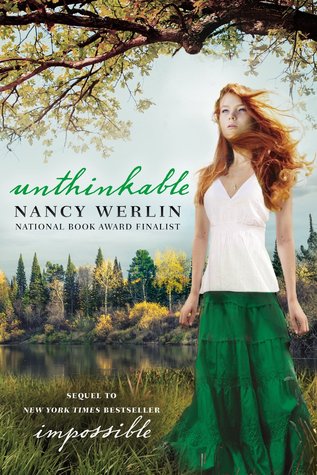
Book Review: Unthinkable by Nancy Werlin

Book Review: Unthinkable by Nancy Werlin

In this young adult novel, faerie curses have a huge impact on the lives of a human family. But will human love triumph over faerie tricks?

Unthinkable takes place in the same world as Nancy Werlin’s previous novels Impossible and Extraordinary. Given how much I loved those two books, I suppose I shouldn’t be surprised to have enjoyed Unthinkable as much as I did.

In Impossible, we meet Lucy, the latest in a long line of women in the Scarborough family, doomed by a faerie curse that’s been passed down over the generations for four hundred years. The Scarborough curse binds each daughter of the family to a cruel faerie lord, Padraig, and each generation repeats the cycle of bearing a daughter, abandoning the daughter in the human world as she is condemned to Faerie, and then witnessing the enslavement of that daughter 18 years later. The curse can be broken only by the completion of three impossible tasks. Is Lucy the one who finally stands a chance at ending her family’s curse?

In Unthinkable, the focus of the story shifts to Fenella, the first of the Scarborough women to be ensnared by the faerie curse. We learn of the curse’s origins, and how the Scarborough women first fell under Padraig’s power. Now, Fenella has yet another challenge in front of her, and in order to succeed and finally eliminate Padraig’s influence for good, she may have to destroy what she values most: her own family.

Fenella is a strong but vulnerable main character. Having lived in Faerie for 400 years, she is human but sensitive to magic, and fated to live in limbo, neither fully a part of the human world nor able to die a normal, mortal death. As Fenella finds her way back to her family, she has to decide what she is willing to do in order to accomplish her goals, and just how much of a sacrifice she’s willing to make. She’s a fascinating character: The author doesn’t portray her as perfect, and we see her struggles with fear, selfishness and doubt battling with her growing urge to protect her family and shield them from pain. The more she experiences life among her human family, the more she realizes that the bargain that she’s made may have been her biggest mistake yet.

Meanwhile, Fenella’s story intersects with Lucy and the other characters we met in Impossible. I’m trying to avoid spoilers for all three books, so I won’t say much about the how or why of Fenella’s involvement with Lucy and her family. Suffice it to say, Fenella has choices to make, and her choices may impact Lucy and the rest of her family — forever.

Short version of a review? I loved Impossible and Extraordinary (which is only obliquely related, but does influence parts of this story), and I definitely was not disappointed by Unthinkable. The plot is emotionally involving and fast-moving, and I was kept guessing throughout as Fenella faces a series of obstacles and tasks to complete. Overall, I’d say Unthinkable is a terrific addition to this loosely-connected series, as well as just a really great young adult book that’s sure to appeal to readers who like a bit of magic and other-worldliness in their family dramas and love stories.

Do you need to read Impossible and Extraordinary before reading Unthinkable? This is one of those rare occasions where I think you could jump right into the most recent book and still have it make sense… but why would you want to? Impossible always makes my lists of most recommended YA fiction, and I’m happy to say that Extraordinary and Unthinkable belong on that list too.  For a haunting, compelling, and magical read, don’t miss any of these three books by Nancy Werlin.

_________________________________________

The details:

Title: Unthinkable
Author: Nancy Werlin
Publisher: Dial
Publication date: 2013
Genre: Young adult
Source: Purchased

Book Review: Just One Year by Gayle Forman

Book Review: Just One Year by Gayle Forman

Just One Year (Just One Day, #2)In this romantic and introspective young adult novel, we take another look at the events portrayed in the author’s previous novel Just One Day — only this time, we get the other side of the story.
In order to talk about Just One Year, I won’t be able to avoid discussing events from Just One Day (which I reviewed here in January), so consider this your spoiler alert! Look away now! Or better yet — run right out and pick up a copy of Just One Day, read it cover to cover, and then check back here to continue reading this review.

Are you back yet? Ready to go? Okay…

In Just One Day, main character Allyson takes us through the first time in her life when she went off-script — a day when she throws caution to the wind and jumps on a train to Paris with a cute boy to finally experience a day of spontaneous adventure. The cute boy is Willem, a carefree, go-where-the-wind-blows actor (who seems to have girls waiting for him across all of Europe), and he and Allyson (whom he calls Lulu) enjoy one perfect day… until the next morning, when Allyson wakes up alone and abandoned, devastated, and has to find a way to put herself back together. We then spend the rest of Just One Day witnessing Allyson’s journey toward discovering herself, what she stands for, and who she wants to be.

Key to the plot is the fact that Allyson/Lulu and Willem, so caught up in their romantic adventure, never got around to exchanging email addresses, phone numbers, last names… or even real names. Willem only knows Allyson as Lulu. Problem, right?

Allyson’s quest toward self-discovery takes up the last 2/3 of Just One Day, and as part of her process, she finally takes control of her own life and sets out to find Willem. But by the end of the book, we only know Allyson’s story, what she’s been through, and where her journey has taken her.

In Just One Year, we hear about the same events and the same time period, but this time it’s Willem’s experiences that count. We start with Willem waking up in a hospital, realizing that he’s forgotten something or someone… and soon piecing together that he was supposed to be with Lulu, but circumstances prevented him from getting to her before she disappeared from his life.

We soon get a much different picture of Willem than we had from the previous book. In Just One Day, Willem seems like a perfect golden boy, easy-natured, free-spirited, a total chick magnet, a guy who lives by his own rules. That’s not the Willem we get to know in Just One Year. Here, we discover that Willem has been wandering from place to place for three years, ever since his father died unexpectedly. Estranged from his mother and feeling rootless, Willem runs from connection and commitment, keeping everything in his life loose and at arm’s length, and it’s not until he meets Lulu that he starts to reexamine what he wants and how he wants to live his own life.

Willem’s journey takes him from Paris to Amsterdam, from Mexico to India, and back again to Amsterdam, before he manages to finally pull himself together and starts taking steps toward creating his own path. But all along his journey, he can’t shake thoughts of Lulu, the girl he lost before he could fully realize how important she might be. From reading Just One Day, we know more or less the “what” of what will happen at the end of this book. But it’s the “why” and the “how” that matter here, and finding the answers to these questions is what makes Just One Year so compelling.

I really enjoyed the mirrored storytelling here. Willem shows us key events that we only saw from Allyson’s point of view in Just One Day, and we start to realize just how narrow any one person’s perception can be. There’s so much that Allyson could not have known, but seeing events through Willem’s eyes, we finally get to see how intertwined their stories are, and how many near misses (and near collisions) they had over the course of their year apart.

I loved how skillfully the author weaves in elements from Just One Day, so that notes written in one book turn up in another; misunderstood conversations finally make sense; even a dismal family vacation takes on significance in all sorts of ways in Just One Year. It becomes clear as well how easily one person’s certainty can be wrong; something that Allyson believes she sees isn’t as it appears at all — and just may be the pivotal event that determines whether Allyson and Willem will ever manage to reconnect, no matter how close they’ve come.

It’s funny reading a book where you know the ending already. Just One Year follows the same timeline as Just One Day, so we know what the final scene must be. And still, I was on the edge of my seat on and off throughout Just One Year, wanting to stop Willem from giving up or making big mistakes, wanting to push him back a certain way or nudge him toward a different location. How many authors can keep you in suspense when you already know what’s going to happen? Now that really takes a great storyteller, and I’m happy to say that Gayle Forman succeeds.

Of course, I have a couple of minor quibbles. Certain sections of the narrative drag a bit. Willem spends a LOT of time in India, really just killing time, and maybe it’s a necessary part of his journey, but it felt long. Likewise for his Mexican quest that turns into a fiasco: I felt that these chapters just went on and on. Yes, the events ultimately move the story forward, but they could have been tightened up a bit.

On the other hand, I did love the emphasis on self-discovery. Mirroring Allyson’s year, Willem also spends the year learning more about himself and his family, figuring out what he wants, and finding out that he has much more in his life than he might have suspected. In both Allyson and Willem’s stories, the quest for the lost connection between the two is important, but isn’t the only driving factor. For both of them, there comes a realization that they may not succeed in finding the other person. One thing that I really appreciate in both of these stories is that they’re not romantic tragedies. The love story is important, but more as an impetus for growth and change than as a be-all and end-all for these characters. Yes, it will be sad if they don’t reconnect — but it won’t be the end of their lives, and they will go on, one way or the other.

All in all, Just One Year kept me glued and kept me emotionally invested. I wanted so badly for everyone to find happiness! Gayle Forman has created a deeply affecting and ultimately uplifting duo of books, doing a remarkable job of weaving together two parallel stories into one cohesive whole. I hated for it to end… so please, Gayle Forman, how about one more book? Allyson and Willem’s stories each end at the same point… and what I want to know is, what happens next? Even if they do find their HEA, I want to know more!

If you enjoy contemporary young adult fiction that’s smart, thoughtful, and emotionally rich — and not without moments of laughter and delight as well — check out Just One Day and Just One Year.

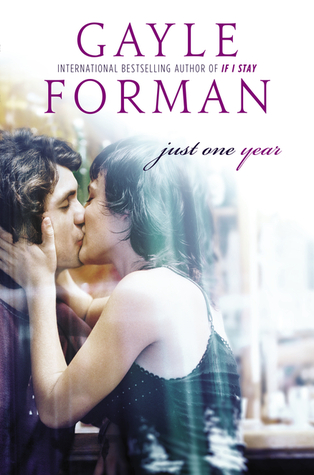
Oh. One last thing. It’s about the cover. In Just One Day, here’s Allyson seeing Willem for the first time:

I blink a few times. My eyes adjust, and I see that the guy is tall, maybe a full foot taller than I am, and thin. His hair is a hundred shades of blond, and his eyes so brown as to almost be black.

Hmm. Willem is blond. So who’s Allyson kissing on the cover of Just One Year???

_________________________________________

The details:

Title: Just One Year
Author: Gayle Forman
Publisher: Dutton
Publication date: 2013
Genre: Young adult
Source: Purchased

Book Review: The Rosie Project by Graeme Simsion

Book Review: The Rosie Project by Graeme Simsion

The Rosie ProjectThis charming, funny novel was exactly what I needed after a couple of weeks filled with horror, wartime secrets, and violent crime. And you should hear about the books I’ve read! (Kidding, kidding…)
The Rosie Project is a first novel by Australian writer Graeme Simsion, which he originally wrote as a screenplay and then adapted into a novel. And now apparently a movie is expected as well! I can absolutely see this sweet, romantic story working fabulously on the big screen.

The Rosie Project is narrated in the first person by Don Tillman, a professor of genetics who is more than a bit lacking in the social graces department. As it quickly becomes clear, Don most likely falls somewhere on the autism spectrum, although a possible diagnosis has never occurred to him, despite being an incredibly intelligent scientist whose best (and only) friends are psychologists and despite being a guest lecturer on the subject of Asperger’s syndrome. Don’s days are dictated by his schedule, with every moment accounted for and planned for maximum efficiency. He has a seven-day food schedule (Tuesdays are for lobster), so he never has to waste precious brain resources deciding what to eat. His life is fixed and defined — but he’s 39 years old and feeling the need for a life partner.

To solve his problem, Don devises The Wife Project, a 16-page questionnaire scientifically designed to select only the most compatible women for Don to meet and potentially marry. But when Rosie wanders into his office, she throws Don’s careful plans into a tizzy. She’s clearly unsuitable mate material — but why does he enjoy her company quite so much?

The writing zips along quickly, as we hear — from Don’s perspective — all about his adventures in dating and his everyday challenges in dealing with other humans. The Jacket Incident is but one example, featuring a fancy restaurant, an ambiguously worded dress code, and Don’s aikido skills. And then there’s his approach to a medical student who touts “creation theory” as a viable alternative to “evolution theory”. Let’s just say there’s a dead fish involved and leave it at that.

Don has an eidectic memory, which he uses to his advantage not just in academics, but also in a delightful scene in which he becomes a cocktail expert. He also successfully memorizes an entire manual full of sex positions, but doesn’t quite get why it’s not so appealing to the ladies to show them a book and basically instruct them to pick a page. (Note: he strikes out.)

Quirky and funny, the dialogue really enhances the narration:

“If I find a partner, which seems increasingly unlikely, I wouldn’t want a sexual relationship with anyone else. But I’m not good at understanding what other people want.”

“Tell me something I don’t know,” said Rosie, for no obvious reason.

I quickly searched my mind for an interesting fact. “Ah… the testicles of drone bees and wasp spiders explode during sex.”

All in all, I found The Rosie Project sweet, funny, and romantic, if a tad implausible in parts. I had a hard time believing that Don would be capable of making some of the substantial changes in his own behavior that he enacts by the end, especially considering how quickly he brings about these changes. Still, this book works because it’s a rom-com at heart, and what’s a rom-com without a happy ending? It’s quite clear all along that the boy will get the girl; the fun part is in seeing how it all works out.

A final thought: As someone who binge-watched five seasons of The Big Bang Theory last year, I couldn’t help but hear Sheldon Cooper as the voice of Don Tillman. To me, Don IS Sheldon, although perhaps a bit more flexible and only a drop less socially awkward. If this wasn’t the portrayal that the author was going for, well, what can I say? I think the comparisons are unavoidable. It didn’t detract from my enjoyment a bit, but it certainly made the character instantly identifiable to me and maybe even a little predictable at times.

That said, I do recommend The Rosie Project most enthusiastically. It’s ultimately a happy book, and I had a great time reading it. The characters are warm and interesting and full of life, the scenario is creative and entertaining, and the book is not without emotional weight and depth. If you’re looking for a fun, engaging read that just may move you as well, check out The Rosie Project.

_________________________________________

The details:

Title: The Rosie Project
Author: Graeme Simsion
Publisher: Simon & Schuster
Publication date: 2013
Genre: Adult fiction
Source: Library

At a Glance: Bellman & Black by Diane Setterfield

Book Review: Bellman & Black by Diane Setterfield

Synopsis:

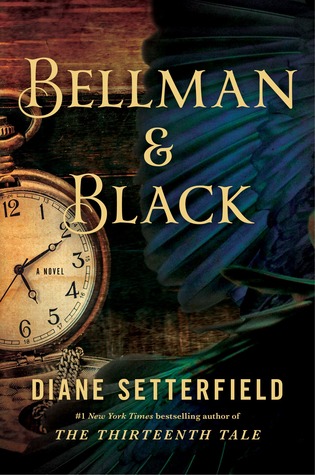
Caught up in a moment of boyhood competition, William Bellman recklessly aims his slingshot at a rook resting on a branch, killing the bird instantly. It is a small but cruel act, and is soon forgotten. By the time he is grown, with a wife and children of his own, William seems to have put the whole incident behind him. It was as if he never killed the thing at all. But rooks don’t forget . . . Years later, when a stranger mysteriously enters William’s life, his fortunes begin to turn—and the terrible and unforeseen consequences of his past indiscretion take root. In a desperate bid to save the only precious thing he has left, he enters into a rather strange bargain, with an even stranger partner. Together, they found a decidedly macabre business. And Bellman & Black is born.

I’m going to keep this brief (ha! that’ll be a first for me!), largely because I’m just not at all sure what to say.

At a loss for words? Without a ready opinion? This really is a first for me.

rooks 1I’ve been thinking and thinking and thinking about Bellman & Black, and here are the two main points I’ve come up with so far:

1) I found this to be a quick, engrossing read. It zipped along, and I never had to force myself to continue.

2) Every time I tried to talk to my BBB (best book buddy) about B&B (Bellman & Black), all I could say was, “I’m 25%/50%/75% through this book, and I still have no idea what it’s really about.”

So what IS it all about?

It’s about a talented and beloved boy, William Bellman, who seemingly has everything, and grows up with a magical touch for business. Every endeavor he touches seems to thrive. His ideas are golden, his people skills superb. Nothing could be rooks 2better. Yet after a terrible sickness sweeps through his village (scarlet fever, perhaps?) and kills most of his family, he makes a deal — which he doesn’t actually remember — with a mysterious man, and then turns his business acumen to a new enterpise: Bellman & Black, an enormous retail establishment dedicated to death. Bellman & Black specializes in funerary supplies, and succeeds beyond Bellman’s investors’ wildest dreams.

Much of the book is spent in chronicling William’s business skills and ideas. This is a busy, hard-working man. Work becomes his obsession, and he only remembers the mystery man, Black, in bits and pieces. Yet lurking behind all of William’s triumph’s is the sense of a debt to be paid, and sooner or later he knows there must be a reckoning.

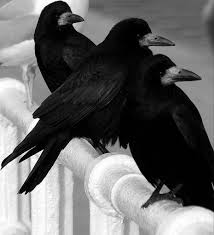
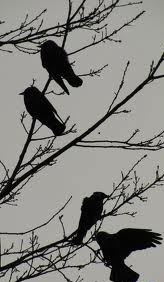
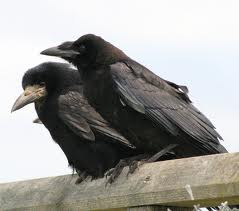
rooks 3Rooks — black birds similar to crows — are constantly in the background of the story, and their presence, along with random facts about rooks, pops up repeatedly.

The official title of this book is Bellman & Black: A Ghost Story. And I’m not sure why. The rooks represent death, and being haunted by memories, and all sorts of other things (I guess), but I never felt that this was an actual ghost story, other than William being haunted by his forgotten past and all that he’d lost.

It’s odd: This book definitely held my interest, and I was full of admiration for the author’s gift with words. The language is often beautiful, with unusually graceful descriptions and turns of phrase. But at the same time, I spent the entire book at a bit of a loss as far as seeing the point, and never felt like the story gelled in any real way.

Maybe it’s me. Or maybe this is a well-written novel that lacks a certain oomph. Certainly, for a ghost story, you’d expect a scare or two, or at the very least, a sense of growing dread or doom. Yes, there’s an ominous undercurrent — but that’s about it. So perhaps I missed the point in some major, glaring way. But if not, then I’d have to say that Bellman & Black, while beautifully written, doesn’t live up to its billing as a ghost story and doesn’t deliver an ending that’s as full of impact as it’s probably intended to be.

I read it. I enjoyed the reading experience. But I don’t feel touched or enlightened by this book. The books that I love stay with me after I close the covers. This one, despite its many lovely passages, isn’t one of those.

rooks 4

For what it’s worth, I’m probably one of the last people on the planet who hasn’t read Diane Setterfield’s The Thirteenth Tale. Even though Bellman & Black wasn’t a peak reading experience for me, I admire the author’s talents enough to want to read her earlier novel, and will probably seek out her books in the future as well.

_________________________________________

The details:

Title: Bellman & Black
Author: Diane Setterfield
Publisher: Atria Books
Publication date: 2013
Genre: Adult fiction
Source: Review copy courtesy of Atria via NetGalley

Book Review: The Tulip Eaters by Antoinette van Heugten

Book Review: The Tulip Eaters by Antoinette van Heugten

The Tulip Eaters

Synopsis (Goodreads):

In a riveting exploration of the power the past wields over the present, critically acclaimed author Antoinette van Heugten writes the story of a woman whose child’s life hangs in the balance, forcing her to confront the roots of her family’s troubled history in the dark days of World War II…

It’s the stuff of nightmares: Nora de Jong returns home from work one ordinary day to find her mother has been murdered. Her infant daughter is missing. And the only clue is the body of an unknown man on the living-room floor, clutching a Luger in his cold, dead hand.

Frantic to find Rose, Nora puts aside her grief and frustration to start her own search. But the contents of a locked metal box she finds in her parents’ attic leave her with as many questions as answers—and suggest the killer was not a stranger. Saving her daughter means delving deeper into her family’s darkest history, leading Nora half a world away to Amsterdam, where her own unsettled past and memories of painful heartbreak rush back to haunt her.

As Nora feverishly pieces together the truth from an old family diary, she’s drawn back to a city under Nazi occupation, where her mother’s alliances may have long ago sealed her own–and Rose’s—fate.

In this novel of family history and secrets, the past is never truly the past. Nora thinks she has finally achieved real happiness in her life, with a fulfilling career, a home shared with her beloved mother, and a perfect little daughter to love and cherish. When the brutal murder and kidnapping take everything Nora loves away from her, she refuses to sit and wait for the police investigation to play itself out, when there are no leads and no substantial clues.

As Nora begins to dig, she starts to realize that there are secrets that her mother never shared, and if she is to have any hope of finding Rose, Nora must understand who her mother’s enemies are and why.

The Tulip Eaters opens in 1980s Houston, but the action and the central drama quickly move to Amsterdam and other points in the Netherlands. It soon becomes apparent that the secrets of Nora’s mother’s identity and actions during the Nazi occupation of the Netherlands in WWII are enormously important to someone — enough to kill for, even 30 years later.

As Nora starts uncovering fragments of clues that may lead to answers, she is increasingly at risk, both physically, as the killer’s associates want to scare her off and perhaps stop her for good, and emotionally, as she is forced to confront the possibility that her mother’s secrets may be uglier than she could have imagined.

The details that emerge about the Dutch experience under Nazi occupation are startling and eye-opening. As one contact points out to Nora, most Americans’ conceptions of what happened start and end with Anne Frank. But the experience of the Dutch Jews was much worse than that might imply, as most were shipped off to concentration camps while their non-Jewish compatriots turned a blind eye, whether out of malice or simply to protect their own families.

The early chapters of The Tulip Eaters felt a bit melodramatic to me, as well as unfocused. When the police detective arrives to view the crime scene, is it necessary to describe the fact that he has “No wedding band, the but the pale ring of flesh on his left hand showed it had not been long since it had been removed”? This, plus a few other descriptions of his looks, gave me the impression (thankfully false) that he would become a love interest or at least play a significant role in the book, but he actually fades into the background after a few chapters. It almost felt as though the author was going to make him more important to the plot, and then changed her mind.

The title itself is a bit of a misnomer. During the war, starvation among the Dutch people was so extreme that they had nothing to eat except tulip bulbs pulled from the fields and boiled into a barely edible soup. Interesting, but this has practically nothing to do with the plot, other than getting a brief mention as background to everything else going on.

Still, despite these minor quibbles, overall The Tulip Eaters is quite good. It provides a window into a chapter of history that is relatively unknown, and as the novel moves farther along and we delve deeper into the clues to Nora’s mother’s past, the tension mounts and the suspense and dread become much more intense. There are elements within the novel that give it a somewhat soapy tone, but the overall mystery centered around the murder and kidnapping was intriguing enough to keep me reading until I got some answers.

As a reminder that the past is never really gone, as well as a lesson on some of the horrors of the Holocaust, The Tulip Eaters is quite effective. That, combined with a crime to be solved and clues to be unraveled, make The Tulip Eaters a fast-paced, moving, and engaging read.

_________________________________________

The details:

Title: The Tulip Eaters
Author: Antoinette van Heugten
Publisher: Harlequin MIRA
Publication date: 2013
Genre: Contemporary adult fiction
Source: Review copy courtesy of Harlequin MIRA via NetGalley