Mini-review: Friends With Boys by Faith Erin Hicks

Book Review: Friends With Boys by Faith Erin Hicks

Friends with BoysIn the young adult graphic novel Friends With Boys, Maggie has been home-schooled her entire life, but all that is about to change. Daughter of the police chief, little sister to three older brothers, it’s time for Maggie to face the real world… by attending public high school. It’s loud, it’s crowded, it’s overwhelming, but soon Maggie finds friends in dare-to-be-different Lucy and her protective big brother Alastair. To complicate matters, Maggie misses her mother, who abandoned the family for reasons left unexplained. And — oh, yeah, there’s a ghost. Maggie is haunted by the ghost of a woman who died of a broken heart years centuries earlier, and even though she doesn’t do much except hover around, Maggie would kind of like to be left alone.

I loved the artwork in Friends With Boys. The characters are well-defined, each with an individual style, and their faces are quite expressive. Maggie is cute, a bit of a non-conformist without being obviously “in your face” about it, definitely a girl who’d like to hang with her brothers rather than hit the mall or paint her toenails. I liked the book very much. Without having to shout about it, Friends With Boys shows the incredible strength that can come from having a supportive family, the importance of staying loyal, and how difficult it can be to be different. In a variety of ways, each character has had to decide whether to choose popular acceptance over individual quirks, and the book does a great job of reinforcing the idea that true friendships can only happen when the people involved value each other as they are, not as they “should” be.

This is listed as a young adult graphic novel. I’d recommend it for adults as well as teens. The story is engaging, the characters are dynamic, the artwork is light-hearted but detailed, and the plot never drags. Check it out!

Book Review: Tempest Reborn by Nicole Peeler

Book Review: Tempest Reborn by Nicole Peeler

Tempest Reborn (Jane True, #6)Question: How do you write a review for the sixth and final book in a series without giving away spoilers for the earlier books?

Answer: Very, very carefully.

Tempest Reborn is the eagerly anticipated final entry in Nicole Peeler’s hip, funny urban fantasy series about small-town girl Jane True, who is definitely a lot more than she appears to be. When we first meet Jane in book one, Tempest Rising, she’s an introverted 20-something living in Rockabill, Maine, where she’s both ostracized and demonized for causing her high school sweetheart’s death — at least, that’s how the most vocal townies see it. Jane worries about her not-so-healthy father and works in the charmingly named Read It and Weep bookstore, has terribly low self-esteem, and escapes to the ocean for a swim whenever she needs a pick-me-up. Jane’s world is completely rocked, and forever altered, when she stumbles upon a murder and gets caught up in the investigation. The biggest revelation? Jane’s mother was a selkie, and Jane herself is considered a halfling — half human, half supernatural, with magical powers and gifts that she could never have imagined.

Over the course of the six books in the series, Jane learns more about the hidden supernatural world, develops her powers, finds deep and meaningful friendships and connections , and at the same time, becomes embroiled in supernatural scheming and politics, has her life endangered countless times — and  finds the love of her life.

Meanwhile, throughout, we get to know Jane, and boy, is she a delight. Jane is a down-to-earth kind of girl, happiest in leggings and a t-shirt, fond of sweets and snacks, and not too shy about her libido. You could say that Jane’s appetite for delicious food is matched (or exceeded) only by her appetite for hot, no-holds-barred sex. (Not that she’s at all slutty, mind you; but when the right guy comes along, wowza, does she have fun.)

Nicole Peeler’s writing is uproariously funny. Like, I laugh out loud when I read these books, and I am not easily prone to fits of LOLing when I read. Jane is hilarious, silly, loyal, blunt, and really rather adorable.  Some delicious little Jane-isms from earlier books:

I wasn’t running now so much as stumbling quickly, panting like a geriatric lion. (Tracking the Tempest)

That hair-pulling thing he did really peeled my bananas. (Eye of the Tempest)

They were paragons of conservative propriety in public, but in private they swung like pinatas. (Tempest’s Legacy)

Some heroes are born. Some are made. And some are bribed with promises of food and sex. (Tempest’s Fury)

In Tempest Reborn, all of Jane’s struggles and triumphs reach a climax, with danger and disaster lurking around every corner. Book #5, Tempest’s Fury, ended in one of the cruelest cliffhangers I’ve ever read — particularly in a series that generally leavens the deadly peril with big doses of hilarity. That ending! I think Jane True fans everywhere let out a collective shriek on the last page… and then we waited… and waited… for Tempest Reborn.

Tempest Reborn picks up immediately after that shocker of an ending, and proceeds to slam readers up and down and off the walls a few times in the first few chapters alone. This is a decidedly much less funny book, simply because Jane is dealing with calamitous events, and there’s precious little to smile about, much less indulge in out-and-out laughs. The stakes are higher than they’ve ever been, Jane is at the center of the ultimate power struggle, and her life and the lives of everyone she loves hang in the balance. And… I really can’t say more about the plot. Read the books, dammit!

Nicole Peeler has a remarkable gift for language, creating a texture and idiom in her narration and dialogue that’s easily identifiable as belonging to Jane’s world. And what a rich world it is! The author’s talents extend to an incredibly creative knack for world-building. The rules and intricacies of this supernatural society are superbly defined, so that we the readers absolutely know by the sixth book what it all means and where our beloved characters fit in.

Plus, it’s all just great fun. Memorable characters include Iris the succubus, Daoud the djinn (who seems to be able to pull any object he needs out of his magical pants), Caleb the satyr (who is pants-challenged), Nell the gnome, Anyan the incredibly hot barghest, and on and on. There’s royalty, there are rebels, and — check out the cover — there are even dragons.

As a fan of the series, I was completely satisfied by the dramatic conclusion to the story — and very appreciative of the epilogue (which, again, I won’t say anything about, because — spoilers!). I’m sad to see it all come to an end, but I’ve enjoyed every moment of reading this uproariously funny, sweetly romantic, and scorchingly sexy series. I can only hope that Nicole Peeler will choose to set more stories in this universe that she’s created — but whatever she writes next, I’m in.

janes2

My Jane True collection. Read ’em all!

Book Review: The 5th Wave by Rick Yancey

Book Review: The 5th Wave by Rick Yancey

The 5th Wave (The Fifth Wave, #1)Quick, what’s the first thing you think of when you think of alien invasions? E.T.? Independence Day? Close Encounters of the Third Kind? 16-year-old Cassie has news for you: When the aliens do arrive, don’t expect sweet and cuddly. Don’t think that a scrappy band of humans will join together to defeat the invaders, with an inspirational soundtrack thumping in the background. As the startling new young adult novel The 5th Wave makes clear, when the aliens do get here, humans won’t stand a chance.

In The 5th Wave, the end of life as we know it is pretty much a foregone conclusion once the mothership shows up. Forget alien fighter drones swooping screaming through our skies. They don’t need all the flash and boom. This invasion is definitely managed hands-off, and it works.

In the first wave, an electro-magnetic pulse takes out all technology — lights, cars, batteries, phones — in one fell swoop. As disabled planes fall from the sky and stalled vehicles crash violently on the highways, humans start waking up to the fact that their world isn’t really theirs any more. In the second wave, strategic detonations along coastal fault lines cause global tsunamis. Goodbye, sea coasts. Goodbye, 50% of Earth’s human population. The third wave is an airborne toxic event, a deadly strain of the Ebola virus transmitted by birds, wiping out 97% of the humans who’d survived waves 1 and 2. And still, the aliens aren’t done. And still, there have been no landing parties, no Terminators, no robot invaders. The cleverness of this invasion, as envisioned by masterful storyteller Rick Yancey, is that the aliens manage to wipe us all out with what’s already here, no intergalactic technology of death needed. It’s like an alien invasion, DIY-style! Kill off the humans using their own infrastructure, natural resources, and diseases. Very efficient.

I don’t want to diminish the impact of the suspense and revelations, the intense sense of doom and dismay that build throughout this book, and so I won’t go into detail about the 4th and 5th waves, which are insidious, unimaginable, and seemingly impossible to survive. Suffice it to say that you’ll be twisting your brain around quite a bit as you figure it all out.

Meanwhile, what about the people in this book?

Main character Cassie is a typical Middle America high school girl before the invasion begins. She has friends, a loving family, and an unrequited crush on the school football star, who really does not know she exists. As her world is turned upside down and she loses everything, she makes one promise: to protect her 5-year-old brother Sammy, no matter what. But when Cassie sees even Sammy taken away from her, she has to decide whether she can keep going. In a world in which she may be the last survivor, is there really any point to continuing the fight? When it’s safer to be alone than to band together with other survivors, is it any wonder that the humans don’t stand a chance?

Much of the book is narrated by Cassie, but not all. We also get powerful sections focusing on Ben — Cassie’s crush — whose experience post-invasion takes a dramatically different turn after he’s brought into a camp of survivors and trained by the military there to become a killing machine, to fight back, to never give in. But is there something more to the command structure than meets the eye? And how can Ben be sure who the enemy is?

We also meet Evan, a farm boy with chocolate brown eyes, who rescues an injured Cassie, nurses her back to health, and seems to be perfect in every way. All he wants to do is protect and provide for Cassie… and she is just not used to trusting anyone at this point. Is Evan for real, or too good to be true? Yes, she’s lost her ability to trust since the invasion began, but is she really being unreasonable here? As Cassie puts it:

That’s my big problem. That’s it! Before the Arrival, guys like Evan Walker never looked twice at me, much less shot wild game for me and washed my hair. They never grabbed me by the back of the neck like the airbrushed model on his mother’s paperback, abs a-clenching, pecs a-popping. My eyes have never been looked deeply into, or my chin raised to bring my lips within an inch of theirs. I was the girl in the background, the just-friend, or — worse — the friend of a just-friend, the you-sit-next-to-her-in-geometry-but-can’t-remember-her-name girl.

Can Cassie believe that this seemingly-perfect boy really cares for her, or is he playing her in some way? And if he is, what’s Evan’s true agenda?

The 5th Wave strikes just the right balance between human drama and life-and-death action sequences. The tension builds, scene by scene, and the sense of inescapable doom grows and deepens as the book progresses. There are twists and turns galore. At so many points, I thought I had something figured out, only to have all my theories and guesses completely thrown out the window by whatever happened next. The characters are introduced in quick but effective strokes; we may not have known them for long, but we do feel that we know them.

While The 5th Wave feels like a pulse-pounding action ride at times, it also captures the feel of a broken world, post-invasion. Earth itself feels like an alien environment after the first three waves have wreaked their destruction:

The creepiest thing, creepier than the abandoned cars and the snarl of crumpled metal and the broken glass sparkling in the October sunlight, creepier than all the trash and discarded crap littering the median, most of it hidden by the knee-high grass so the strip of land looks lumpy, covered in boils, the creepiest thing is the silence.

The Hum is gone.

You remember the Hum.

Unless you grew up on top of a mountain or lived in a cave your whole life, the Hum was always around you. That’s what life was. It was the sea we swam in. The constant sound of all the things we built to make life easy and a little less boring. The mechanical song. The electronic symphony. The Hum of all our things and all of us. Gone.

I can’t say enough good things about The 5th Wave. I could easily seeing this series (yes, this is the first in a series) becoming as big as The Hunger Games. The 5th Wave is a young adult novel, but it doesn’t talk down or avoid the all-too-real tragedies of a world gone deadly. There’s loss, horrific destruction, death of loved ones, cruelty, and despair. But there’s also tenacity, loyalty, love, and determination. The handful of main characters are not cookie-cutter archetypes; instead, we see flawed, identifiable young people, each struggling with choices, each lacking key pieces of information, but having to do the best they can with what they know and what they can figure out. Cassie, Ben, Evan and others are dealing with life and death decisions in a vacuum, with shades of gray and no clear right or wrong. We come to care about these characters deeply, and even when we don’t quite know what’s going on or who to believe, it’s a testament to the strength of the writing in The 5th Wave that we want so badly for them all to be okay.

The 5th Wave is scary, suspenseful, and intense, impossible to put down, and — once finished — really hard to stop thinking about. I broke my “no new series” rule for this book, and I’m not sorry! I just wish we didn’t have to wait (probably until 2014) for the next book. Check this one out — but be prepared to stay up way past bedtime. Once you start, you won’t want to stop.
Book Review: The Dead Fathers Club by Matt Haig

Book Review: The Dead Fathers Club by Matt Haig

The Dead Fathers ClubTake one devoted son, add in a recently deceased father, ghostly visitations, a suspiciously helpful uncle, and a vulnerable mother, and what do you get? In the case of The Dead Fathers Club, the answer is a modern-day Hamlet retelling that is hip, smart, and moving.

11-year-old Philip Noble’s dad was the owner of the Castle and Falcon pub (he wears a “King of the Castle” T-shirt) until his sudden and tragic death in a car accident. Philip’s poor mother is left to deal with the family business and its shaky finances, until garage-owner Uncle Alan (with perpetually black-stained fingers) steps in to save the pub and woo Philip’s mother, much to the poor boy’s chagrin. Making things worse is the appearance of dad’s ghost, who informs Philip that a) he’s been murdered, b) Uncle Alan is the murderer, c) the only way for dad to rest in peace is for his murder to be avenged, and d) Philip is the one who has to make sure it happens. Nothing like a little pressure on an already barely-holding-on kid.

Philip struggles to figure out what to do, but there are no easy answers. His kind-of girlfriend Leah tries to help, as does her brother Dane, but Philip’s plans invariably go awry, ultimately with tragic consequences. Meanwhile, his dad’s ghost begs him for justice, and his mom is desperate for Philip to be normal, move on, and try to be nicer to Uncle Alan, who — as it turns out — will be around quite a bit once they get married.

From the very first pages, in the opening chapter entitled “The First Time I Saw Dad After He Died”, you can just tell that you’re in for quite a ride. The writing is clever without being overly cutesy; the Hamlet references are certainly present, but the story stands on its own as well.

The Dead Fathers Club is written in the first person and told from Philip’s perspective. Philip’s voice is quite distinctive; his narration flows with little or no punctuation*, and he free associates in a way that’s almost poetic. His fears and obsessions seem realistic for an 11-year-old, and the sense of being out of control is conveyed through Philip’s every action and observation.

*Quick note on the punctuation in The Dead Fathers Club: I was quite amused to come across this post (“30 Things To Tell A Grammar Snob”) by Matt Haig, literally on the day I started reading this book. Check out #9 — I assume that this is book he’s referring to.

As a fan of Hamlet, I couldn’t help but be amused by the shout-outs, small and large, to the source material — even little details have meaning, such as Philip’s pet fish being named Gertrude. Likewise, I did a double-take when I got to this passage, once I realized, “oh wait, this is the To Be or Not To Be soliloquy!”:

My heart was doing its funny beating with no stops in it and I thought why am I me why am I not Mum why am I not the ticking clock why am I not a fish why am I not a loaf of bread why am I alive and most people are dead how do I know Im me how do I know Im alive and I thought it must be good to be dead not dead like Dads dead but to be nothing like when you sleep but then I thought it might be a bad sleep with lots of nightmares like the one I had last night when I was trapped in the black box and then my hand started shaking and I was scared why my hand was shaking and I thought I was going to die and I said Mum! Mum! Mum!

The Dead Fathers Club is a quick and engaging read. It’s touching, it’s quirky, and despite telling a well-known story, manages to pack in a few big surprises. The course of this novel does not run exactly as you’d expect, and that’s a good thing. Never predictable, but always a pleasure to read — I recommend The Dead Fathers Club for anyone who enjoys a classic story turned upside-down.

And a further footnote: Matt Haig is the author of the excellent vampires-in-the-suburbs novel The Radleys, and his new novel, The Humans, is due out in July. Can’t wait!

Book Review: Twerp by Mark Goldblatt

Book Review: Twerp by Mark Goldblatt

Twerp

In Twerp, a children’s book aimed at middle-grade readers, life is full of friends, fun, hard choices, and consequences. Main character Julian Twerski, age 12, lives in a close-knit Queens neighborhood in 1969. His best buddies are the guys from the block, and their favorite hangout is the vacant lot which they dub Ponzini. Back in Ponzini, they kid around, goof off, and get into all sorts of mischief, big and small. But when a seemingly harmless prank goes wrong, the six boys get a week’s suspension from school. In the aftermath, Julian makes a deal with his English teacher: He’ll write a journal about what happened, and in exchange, he gets out of having to read Julius Caesar.

And boy, does Julian want to get out of reading Julius Caesar:

So when I say I hate Shakespeare, I mean it. Lots of guys say they hate him, and what they mean is they hate the stuff he writes. But I don’t only hate the stuff he writes. I hate Shakespeare for writing the stuff. I hate the guy, William Shakespeare. If I met him on the street, I’d just keep walking. Because you know, you just know, while he was writing the stuff he was writing, he was thinking how clever he was. He was sitting at his desk, writing the words, and he could’ve just said what he  meant, but instead he prettied it up until it could mean everything or it could mean nothing or it could mean whatever the teacher says it means. That just drives me bananas. So if keeping this thing going gets me out of Julius Caesar, then count me in.

Twerp is Julian’s journal, in which he writes with a clear-eyed honesty about friendship, hopes, girls, doing favors, and all the everyday worries that come with being a sixth-grader. In Julian’s world, being loyal to friends is probably the most important thing of all, and his best friend Lonnie is a gem of a guy — totally loyal, incredibly funny, and with a big heart and tons of charisma. The ups and downs of their friendship include a fiasco over a girl (of course), an all-important track and field competition, and a long-delayed reckoning for their misdeeds and suspension.

Through it all, we see Julian contemplate the big picture. Where does he fit in — at school, in the neighborhood, in life? What does it mean to have good intentions? And are good intentions enough, if people end up hurt anyway?

Twerp is both a lovely nostaglic look at a time gone by and an ageless peek into the heart and mind of a boy figuring out what it takes to grow up into a decent sort of person. Author Mark Goldblatt captures the feel of a Queens neighborhood, with the boys hanging out on the stoops, wandering the blocks, knowing all the characters of their own small world. The boys and their parents fully inhabit this time and place, and readers are treated to a sweet-tasting view of boyhood. It’s a time before electronic gadgets and distractions, so fun is found in climbing walls, playing cards, chasing balls, creating diversions.

At the same time, by looking into Julian’s thoughts, we see a boy with a good heart who takes seriously the question of how to be a good person. He makes mistakes, it’s true, but through his journal, he comes to see the how and why of his mistakes and to understand what it takes to do the right thing. Julian is clearly a very smart boy, and his gift with words and his speed on the school track help ensure his success at school, both with teachers and with other kids. As the book progresses, we see Julian work through his guilt over his role in the event that got him suspended and ultimately take ownership for what he did and what he still must do in order to move on.

Perhaps that makes Twerp sound a bit preachy, and that’s not at all the case. Julian’s voice is light and often funny, and it never feels like a stretch to imagine that we’re really reading the words of a 12-year-old. The book flows smoothly, and the writing hits just the right mix of childish obstinance and adolescent insight.

Julian and his friends have an easy camaraderie and a sense of glee, which makes them quite fun to spend time with through the pages of Twerp. Twerp may not fit the popular mold of middle-grade books filled with secret worlds, mythological beings, and superpowers, but it’s a book that I could easily see a smart, eager reader enjoying quite a bit. No gimmicks and nothing flashy here — just a good, honest story of a boy, his friends, and his world. It may be a world that seems old-fashioned to a kid of today, but the underlying messages about friendship and doing what’s right are timeless.

Review copy courtesy of Random House via NetGalley.

Mini-review: NOS4A2 by Joe Hill. Plus, a photo opp!

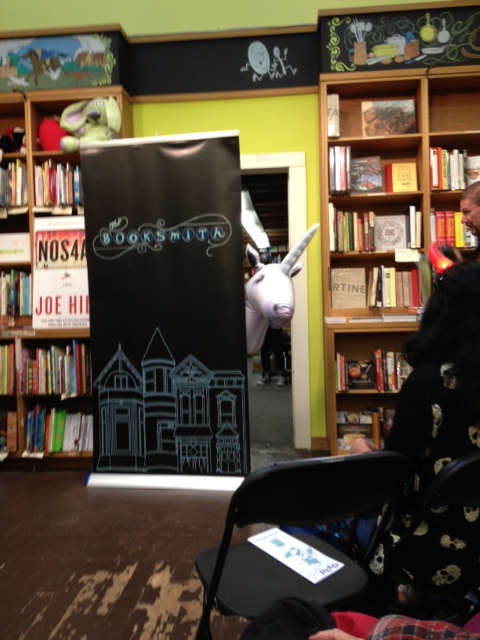
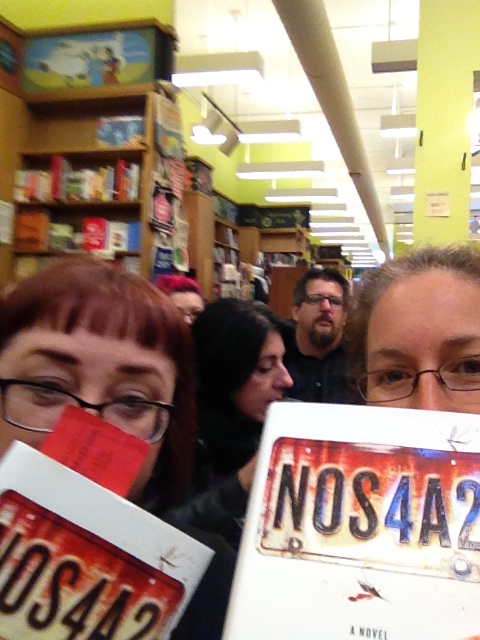
In which I write about NOS4A2 by Joe Hill… and about going to Joe Hill’s book signing in San Francisco this week!

NOS4A2

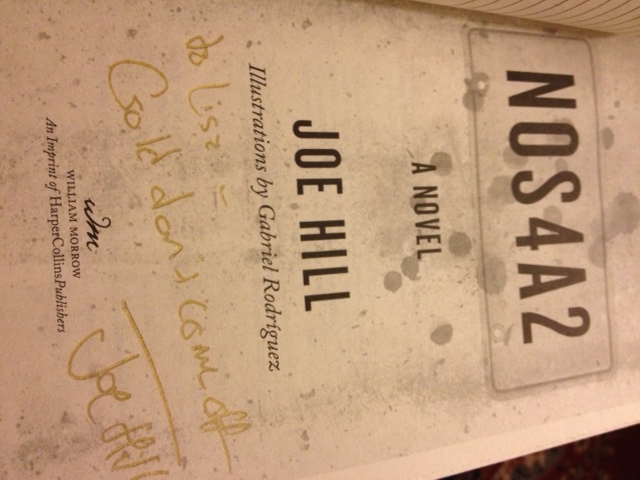
So yeah, I’m not necessarily going to write a thoughtful, carefully worded book review here. I’m still feeling too giddy — the effect that all good book events have on me. I adore going to author appearances. I love hearing authors read from their books. I love when they answer questions (even the kinda dumb ones). And I especially love when they write stuff in my book! Like, with my name, and maybe some other words, and maybe a gold or silver marker or something.

So yeah, first things first:

joehill

My book! It’s signed! In gold pen!

Joe Hill signed my book! It was a terrific event. I’d guess about 50 – 60 people attended, at a great indie book store in the Haight. Joe was funny and friendly, answered lots of questions, did a great reading of the prologue, and was just nice and humble and an all-around decent person. Plus, he did this before he was officially introduced:

photo 2… which was all kinds of adorable.

So, onward to the review section of this love-fest.

NOS4A2 is the story of Victoria (Vic) McQueen, one tough survivor of a woman, who has been through all sorts of hell in her life and still managed to hang on, sometimes just by the skin of her teeth. Vic has a talent, first discovered during childhood, for finding lost objects — by traveling, impossibly, across a dilapidated covered bridge that exists only in her mind to the places where the lost objects await her. Charlie Manx is Vic’s worst nightmare. Charlie is an indescribably old man, a killer and a kidnapper, a vampirish soul-sucker, who has spent countless decades stealing children away from their parents and transporting them in his classic Rolls Royce to Christmasland. Vic and Charlie cross paths, fatefully, during Vic’s teen years, and then again years later, when Vic is a tenuously stable mother to 12-year-old Wayne. When Charlie reenters Vic’s life, she has to risk everything to get her son back by whatever means possible.

And that’s all I’ll say about the plot, a) because it’s incredibly difficult to describe and b) because you really have to experience this book for yourself, with the fewest preconceived notions as possible.

NOS4A2 is, hands-down, the creepiest, most twisted thing I’ve read in years. At almost 700 pages, this big book is full of gasp- and twinge-inducing moments. There’s a lot of yuckiness. There’s a lot of ickiness. There are all sorts of shades of evil and menace. Bad things happen to good people.

Through it all, Joe Hill’s writing soars. His phrasing is funny, idiomatic, descriptive, and even poetic… if you can be poetic while describing maniacal vehicles and gasmask-wearing sadistic serial killers. Never underestimate the scary power of a simple Christmas carol — if it’s playing at the wrong time and in the wrong circumstances:

The radio popped on, playing “Jingle Bell Rock” at top volume — so loud it hurt his ears — a song that had no business playing in the spring. At the sound of it, Demeter’s whole body went rough and cold with chickenflesh. He poked the OFF switch, but his capacity for surprise was running thin, and he felt no special amazement when it wouldn’t turn off. He punched buttons to change the station, but no matter where the tuner leaped, it was “Jingle Bell Rock” on every channel.

The Rolls Royce itself (a 1938 Rolls Royce Wraith, to be precise) is a character on its own, part and parcel of Charlie Manx and practically his familiar. It’s an ominous black hearse of a car, which should attract an outrageous amount of attention on the road — but doesn’t. In one of the book’s rather humorous turns of phrase, Charlie explains:

It is like what they are always saying about Las Vegas: What happens in the Wraith stays in the Wraith.

Vic is a wonderful main character, spiky and difficult and full of fierce love. Her sometimes partner and father of her child is Lou Carmody, who I love insanely. Lou is terribly overweight and not very healthy, but has a heart of gold, the soul of a hero, and is a geeky fanboy through and through, as well as one hell of a mechanic. Lou’s devotion to Vic and to Wayne is all sorts of beautiful.

Joe Hill is — as is well known by now — the very talented son of Stephen King, and in NOS4A2, he pays tribute to his dad’s monumental achievements in ways both subtle and overt. A car that’s a vessel of evil, an enormous St. Bernard dog (although not rabid, thank the gods), nods to Derry and Pennywise the Clown — all add to the depth of the horror without detracting in the slightest from Joe Hill’s own incredible gift for storytelling.

I realize I’m gushing, so I’ll stop. NOS4A2 is a big, scary, un-put-down-able book. Read it!

photo 3

Read this. Wear your seatbelt.

Oh, and make sure you read every single page in the book. Including after the story ends. You’ll thank me later.

Q&A with the kiddo: A kid’s-eye view of The Magician’s Nephew by C. S. Lewis

Book Review: The Magician’s Nephew by C. S. Lewis

The Magician's Nephew (The Chronicles of Narnia, #6)

Proudly presenting Q&A with the kiddo, courtesy of my 10-year-old son, in which I ask my kiddo to describe a book he’s enjoyed recently and he gives his opinions, more or less unfiltered by mom.

Without further ado:

Q: What book do you want to talk about?

A: The Magician’s Nephew

Q: What was it about?

A: It was about these kids . They were friends, and the boy’s uncle was a magician, and they got sent to another world. They went into two different worlds. In one there was an evil queen who took over and then tried to take over Earth. Then they teleported into soon-to-be Narnia. There was a lion that was singing and made Narnia. His name was Aslan. Everything they buried turned into a tree. He gave speech to the chosen animals and the especially chosen of the chosen animals were in the high council. The boy and the girl eventually get back to their own world.

Q: Who was your favorite character?

A: Fledge, who is basically a Pegasus, a horse with wings. And King Frank, because his name is weird.

Q: What was the best part?

A: My favorite part was when they planted toffee candy and it grew into a toffee tree. I wonder if you dropped a part of a refrigerator on the ground, would there be a refrigerator tree?

Q: Would you recommend this book?

A: Yes. I’d recommend it for people who like Harry Potter, adventure stories, and talking animals.

Q: Do you want to read the rest of the series?

A: Yes! I want to read the rest of the  Narnia books.

Mom’s two cents:

Somehow, I made it through childhood without ever reading any of the Narnia books. Even as an adult — and a big fan of fantasy writing — I never got around to Narnia until my daughter was old enough for The Lion, The Witch, and The Wardrobe, which we read together many years ago. Neither of us ended up pursuing the rest of the series, and it wasn’t until last month when my son came up with the idea of checking out Narnia that I came back to these books.*

*Although there have been several Narnia movies released in the last few years, neither of us has seen them, so we approached reading the books from scratch.

I decided that we should read the books not in publication order, but in the order which author C. S. Lewis later said was his preferred reading chronology — which meant starting with The Magician’s Nephew.

So what did I think? This rather slight book was actually quite fun. The story is rather simple: Neighbors Polly and Digory, looking for adventure, stumble upon the secret room of Digory’s uncle Alexander, who has been working to become a skilled magician all his life. Through Alexander, the children come into possession of magical rings which transport them from their own world into other worlds. They have the misfortune of awakening an evil witch, who follows them home to London for starters, then onward to a brand new planet just in time to see the mighty lion Aslan create all life in this beautiful new world. Digory is responsible for bringing evil into this new world, via the witch, and so must make amends by performing a special quest for Aslan in order to prove his worth.

It’s all quite lovely, with bits of humor and silly adventure, as well as much heavier moments of pondering the nature of good and evil. I liked very much how the story lays the foundation for The Lion, The Witch, and The Wardrobe. I think one of the reasons I avoided reading the Narnia series all these years is because of the religious allegory woven into the story. For The Magician’s Nephew, at least, I chose to willfully ignore those parts (the creation myth, the Garden of Eden, the fruit of the tree of knowledge, etc) and just focus on the fantasy — in essence, try to read it from the same perspective as my son.

As a book to read together, The Magician’s Nephew worked very well, and we both enjoyed the story quite a bit. We laughed at the funnier parts, we peeked ahead when a chapter ended with a cliffhanger. I asked my son whether he would have wanted to read this one on his own. His response was that while he liked the story quite a bit, he didn’t think he would have wanted to deal with the “old-fashioned” words that he was unfamiliar with throughout the story (“hansom-cab”, “frockcoat”, and the exclamation, “Well don’t keep on gassing about it!”, for example).

We’re moving right into The Lion, The Witch, and The Wardrobe. Narnia, ho!


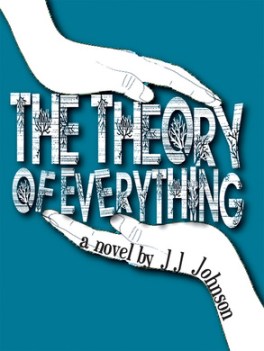
Book Review: The Theory of Everything by J. J. Johnson

Book Review: The Theory of Everything by J. J. Johnson

I stumbled across this sweet, sad young adult novel at my library, quite by chance, and just happened to take a peek inside. Once I saw the Venn diagrams, I was hooked!

The Theory of Everything is narrated by 15-year-old Sarah Jones, a typical teenager in many ways but one: Eight months earlier, her BFF Jamie was killed in a freak accident in the gym at school. Sarah, the only witness, was powerless to help or to save Jamie. Now, months later, it seems as though everyone’s patience with Sarah has worn thin. Shouldn’t she be over it by now? Sarah is lost, consumed by guilt and grief, and has been taken over, as she puts it, by the “snark box” that speaks for her, even when she knows snarkiness will only get her further into trouble.

Sarah’s parents are at wits’ end, her brother thinks she’s a freak, and her boyfriend, sweet and supportive Stenn, just wants her to open up and talk — but that’s the last thing Sarah wants to do. Instead, she skips classes, talks back, makes out with Stenn, and immerses herself in her nerdly pursuit of endless rewatchings of Star Wars and Battlestar Galactica. Sarah’s only true comfort comes from her loyal dog Ruby, but if Sarah doesn’t shape up soon, even Ruby may be taken away from her as her desperate parents search for some sort of leverage.

It may sound rather grim, but Sarah’s voice is honest and clear, and while she’s been through an awful tragedy, it’s hard not to feel a bit cheered by Sarah’s inner dialogue. Her snark box may be fully functional, but so is her wit, and Sarah’s approach to figuring out how to move forward often comes down to charts and diagrams, liberally scattered throughout the book.  We get plotted graphs of “Things Said To Parents & Likely Outcomes” (with outcomes ranging from stink-eye to counseling to jail), a pie chart on “Possibility that ghosts exist”, and a Venn diagram of “Things I Understand” (which includes chaos theory) and “Things I’ll Never Understand” (which includes “why Jamie died”).

photo a

The Theory of Everything does not offer easy solutions, and that’s only fitting. Sarah has a long journey ahead of her, and while she’s making progress, there is no magic wand that will make her all better. What we see in this book is a girl in transition, coping with one of the most awful and unfair situations imaginable, and yet having to find a way to deal, simply because not dealing is not an option.

It’s interesting to me to think about how different readers might be affected by this book in different ways. I would imagine that a teen would completely side with Sarah, and would agree with her that her parents are being pushy and unreasonable. I could sympathize with Sarah and understand why she would feel this way. At the same time, as a parent myself, I can only imagine how terribly helpless Sarah’s parents must feel, watching their daughter go through such horrible turmoil and feeling desperate to reach her at any cost. It’s a tribute to the author’s gifted storytelling that both perspectives feel realistic. A tragedy like this would of course have ripple effects that spread and continue. The Theory of Everything lets us see one girl’s struggle to understand her loss and to find a way to continue a life that’s missing its center.

Book Review: The Shadowy Horses by Susann Kearsley

Book Review: The Shadowy Horses by Susanna Kearsley

The Shadowy HorsesVerity Grey is a 29-year-old freelance archaeologist, newly resigned from the British Museum and ready for a new assignment. When invited to interview for a secret new project in the Scottish Borderlands, Verity is intrigued… and intrigue turns to shock when she finds out the purpose of the dig. Peter Quinnell, considered by many to have detoured from the straight path of sanity in the wake of personal tragedies, is on the hunt for the fabled Ninth Roman Legion, which disappeared without a trace centuries earlier somewhere in the Northern British Isles. Peter thinks he’s found the Ninth at last, and he wants Verity on his team. His evidence? The say-so of a psychic 8-year-old boy, who reports seeing the ghostly figure of “The Sentinel”, a lonely Roman soldier who wanders the moors, beckoning young Robbie to discover his secrets.

Naturally, Verity joins the dig, and we are quickly wrapped up in both the archaeological explorations and the interpersonal dramas of the team. Verity has never put much stock in the supernatural, but she can’t shrug off the strange sounds she hears at night, the unexplained cold breezes that she encounters in warm rooms, or the uncanny ability that Robbie displays in reading her thoughts and predicting events. Also drawing Verity in is local boy turned archaeologist David Fortune, whose brawny good looks and easy charm are awfully hard to ignore. Just wait until that man puts on a kilt!

The premise sounded quite interesting to me, but unfortunately, I have to say that the book as a whole didn’t quite work for me the way I’d hoped. It should have been fascinating: I’ve always been interested in the story of the Ninth Roman Legion, and expected to get much deeper into their story in The Shadowy Horses. Disappointingly, that wasn’t the case. While the fate of the Ninth is explored, the discoveries at the dig didn’t strike me as earth-shattering or definitive, and I wish there had been more time spent on the character of the Sentinel.

Likewise, the relationships among the members of the team, while interesting, didn’t feel particularly high-stakes to me. By the time the climax of the book rolled around, with a dramatic turn of events and a potential calamity, I never really felt that the main characters were truly in peril, and the revelations of secrets and betrayals were not at all surprising.

Still, The Shadowy Horses does have a lot going for it. First of all, Susanna Kearsley is a gorgeous writer, and she is a master when it comes to conveying the mysteries of the British Isles, evoking the wildness of the landscapes and the beauty of the moors and coasts. I also enjoyed the insider’s peek into the world of archaeological digs, learning about the tools and methodologies of the scientists involved and seeing how a project of this nature might unfold. The characters are nicely developed, and I was interested in getting to know them — and truly wished them all their happy endings.

The Shadowy Horses is the fourth book I’ve read by Susanna Kearsley, and while good, I just didn’t feel that it measures up to her other books. Perhaps I simply missed the “time-slip” elements for which she is known, which lend her books their heightened urgency and intense romance. Susanna Kearsley has a new book due out in June — The Firebird — which I understand includes characters from both The Shadowy Horses and her beautiful novel The Winter Sea. While The Shadowy Horses fell a bit flat for me, that does not at all mean that I won’t be checking out this author’s future writing. I really look forward to reading The Firebird as soon as it becomes available in the US — and if you’ve never read anything by this gifted author, I’d suggest starting with The Winter Sea or Marianna.

Book Review: Ask the Passengers by A. S. King

Book Review: Ask the Passengers by  A. S. King

Astrid Jones is a smart, funny girl who you can easily imagine having an amazing life in New York, hanging out in the Village perhaps, exploring the city with quirky and artsy friends. Unfortunately for Astrid, she does not live in the city. Born a New Yorker, Astrid and her family moved to Unity Valley, Pennsylvania — quintessential small-town USA — when she was 10 years old, and has been stuck in a rut ever since.

In Unity Valley, and in Astrid’s own family, the only way to fit in is to fit — no rough edges, nothing to make you stand out, no unusual traits. And if you’re the member of a minority group? Well, may the gods of uniformity help you then. The small-minded gossip of the town regularly calls out the ethnic minorities, the eccentrics, and the generally suspect, and there is no mercy when it comes to the rumor mill and the shunning and humiliations that can result.

Astrid, at age 17, mostly keeps her head down and gets by. She hides a vital secret for her two best friends, Kristina and Justin, the high school’s golden couple, but Astrid has a major secret of her own. On the weekends at her part-time job, Astrid’s friendship with Dee has moved from casual comfort to hot-and-heavy make-out sessions, and Astrid likes it quite a bit. But is she gay? She’s not sure, and she’s tired of all the pressure — pressure from her parents to fit in, pressure from Dee to take a stand and come out, pressure from the high school in-crowd to just be normal, have a boyfriend, and not be so weird.

To clear her head, Astrid has the unusual habit of going out into her backyard, lying down on the picnic table, and watching the airplanes fly overhead. As each one passes, Astrid focuses on sending her love to the passengers — not just to say hi, but to send her own love away from her to a place where it might be safe. Astrid can’t share anything with her controlling parents or her too-perfect sister; she can’t open up to her best friend; and she can’t share her doubts and confusion with Dee without Dee taking it as a statement on their relationship. So Astrid sends her love to the passengers overhead, the only people she can love freely and without consequence, and for a while, it helps her.

The rest of the time, the table just sits here with nothing to do. So I lie on it and I look at the sky. I see shapes in the clouds by day and shooting stars by night. And I send love to the passengers inside the airplanes… [But] it feels good to love a thing and not expect anything back. It feels good to not get an argument or any pushiness or any rumors or any bullshit. It’s love without strings. It’s ideal.

Astrid gets by for a while, but things do reach a crisis point eventually, and finally Astrid is pushed far enough that she has to take big risks and take a stand. When she blows up, she does so rather spectacularly, and it’s particularly wonderful to see the fall-out of her explosion.

Ask the Passengers is a quick-paced story, told in the first-person from Astrid’s perspective, so that we see inside her thoughts and fears, and really get a chance to see a smart girl try to take control of her life and at the same time do the right thing. Astrid is willing to come out when it feels right — but how does she know if she’s really gay? Maybe she doesn’t like girls in general, just Dee? And if she’s not sure, is it cowardice to remain hidden, or is it bravery to be committed to speaking nothing but the truth? Is the pressure from Dee to come out any different from the pressure from Astrid’s family to be “normal”? There are some important questions asked here about tolerance and acceptance. At one point, the high school has a mandatory Tolerance Day, complete with pep rally and inspirational speakers — but the day is so clearly aimed at Astrid and her friends that it really just serves to isolate them even more.

Interspersed throughout Astrid’s tale is snippets from different airplane flights. As Astrid sends her love to the passengers overhead, we get small segments throughout the book of different passengers on different planes, who make life-changing decisions, face up to hard truths, or simply find some inner strength to face their problems. The implication is that Astrid’s love has reached them and affected them in some way. Magical thinking, perhaps, but it’s a nice idea — or perhaps it’s only coincidence, and the magic is simply in drawing lines from one person in crisis to another, so that the author is showing the reader that none of us are alone, that everyone has risks to take and decisions to make, and that owning up to our own thoughts and feelings may be the bravest step a person can take.

I had not heard of Ask the Passengers until last week, when it was announced that this book was the winner of the 2012 Los Angeles Times Book Prize for Young Adult Literature. A well-deserved piece of recognition, in my opinion. Ask the Passengers is an important book that doesn’t feel preachy, with valuable messages for teens struggling to figure out who they are and where they fit in — and an important lesson as well for the adults in teens’ lives about the incalculable value of support and love without judgement or conditions.