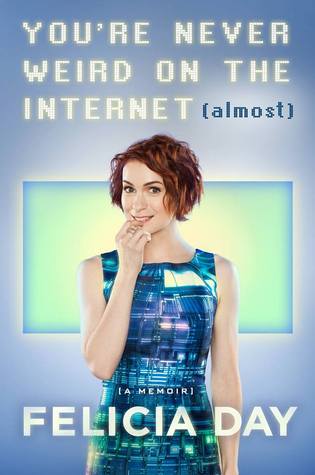
Book Review: You’re Never Weird on the Internet (Almost) by Felicia Day

You're Never WeirdBuffy fan? How about The Guild? Dr. Horrible? Eureka?

No?

Are you a fan of funny, smart writing? Women who are high-achieving but down-to-earth? Famous people who act like real people and seem to genuinely care?

Surely something above rings a bell. And in that case…

I feel perfectly confident that you’ll find something to love about Felicia Day’s memoir, You’re Never Weird on the Internet (almost).

Felicia Day doesn’t shy away from calling herself weird, and credits her weird upbringing for making her who she is today. Moving around from one southern town to another, Felicia never really had to fit in, because after a brief stint in school, she ended up being homeschooled throughout her childhood and teens — although, as she describes:

In retrospect — and not to be mean to anyone who parented me — it doesn’t seem like there was a clear plan going into the whole homeschooling thing.

But Felicia was into it anyway:

Also, homeschooling seemed like something an orphan would do, and I really wanted to be an orphan. Because let’s be real: they have it so good in kids’ literature! They’re sad but special, people love them against all odds, and they’re always guaranteed a destiny of greatness. The Secret Garden, The Wizard of Oz, Harry Potter? Orphanhood was a bucket list item for me!

In funny and honest detail, she describes her college career (double-majoring in music and math, on a violin scholarship!) and her subsequent move to LA to pursue an acting career, as well as an all-consuming obsession with World of Warcraft, generalized unhappiness and anxiety, and her creative breakthrough in writing and starring in the geek-magnet web series The Guild.

Felicia writes beautifully about the power of discovering the internet for the first time, and the awesome experience, especially for a loner, homeschooled girl, of discovering people to truly connect with in a fundamental way through the world of online gaming.

I know the story of my Dragon-hood may sound a little sad and weird and super geeky, but […] for a girl who was lonely and desperate for friends, that group of people was the most important social thing to happen to me growing up. I can’t imagine being as confident about my passion for geeky things today without that opportunity to connect with OTHER people who were saying, “Wow, I love those geeky things, too!”

She shares her self-doubts and her moments of mortification along with her successes and victories, and maintains such an appreciation for people’s investment and connection in her work that you just know she means it all. For example, explaining why she keeps all the fan art and creations that people have given her over the years:

Whether it was by someone volunteering to be an extra in our show, or part of the crew, or someone buying a DVD at a convention, or a superfan who tattooed our characters’ faces on her calf, my career has been built fan by fan. I wouldn’t trade that relationship, or collection of dolls of myself, for all the money and fame in the world.

I was lucky enough to see Felicia speak back in August and got a signed book and everything!
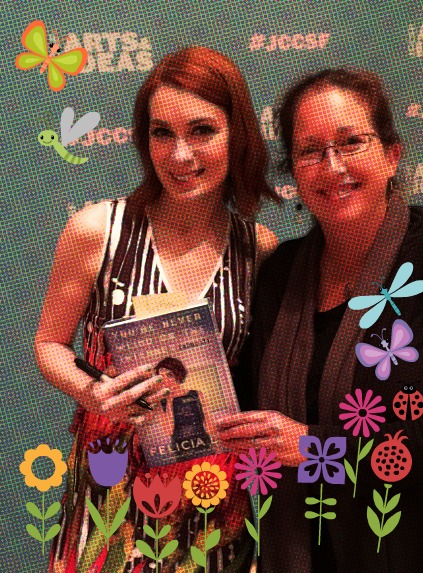
Felicia is adorable, but I didn't like the way I looked in this pic... so I decided to decorate.

Felicia is adorable, but I didn’t like the way I looked in this pic… so I decided to decorate.

It was an amazing event, in a sold-out venue, filled with people of all sorts who all just happen to be big geeky fans. While most came in their street duds or at most, a Supernatural or Guild t-shirt, a few went all out, which was super delightful to see:
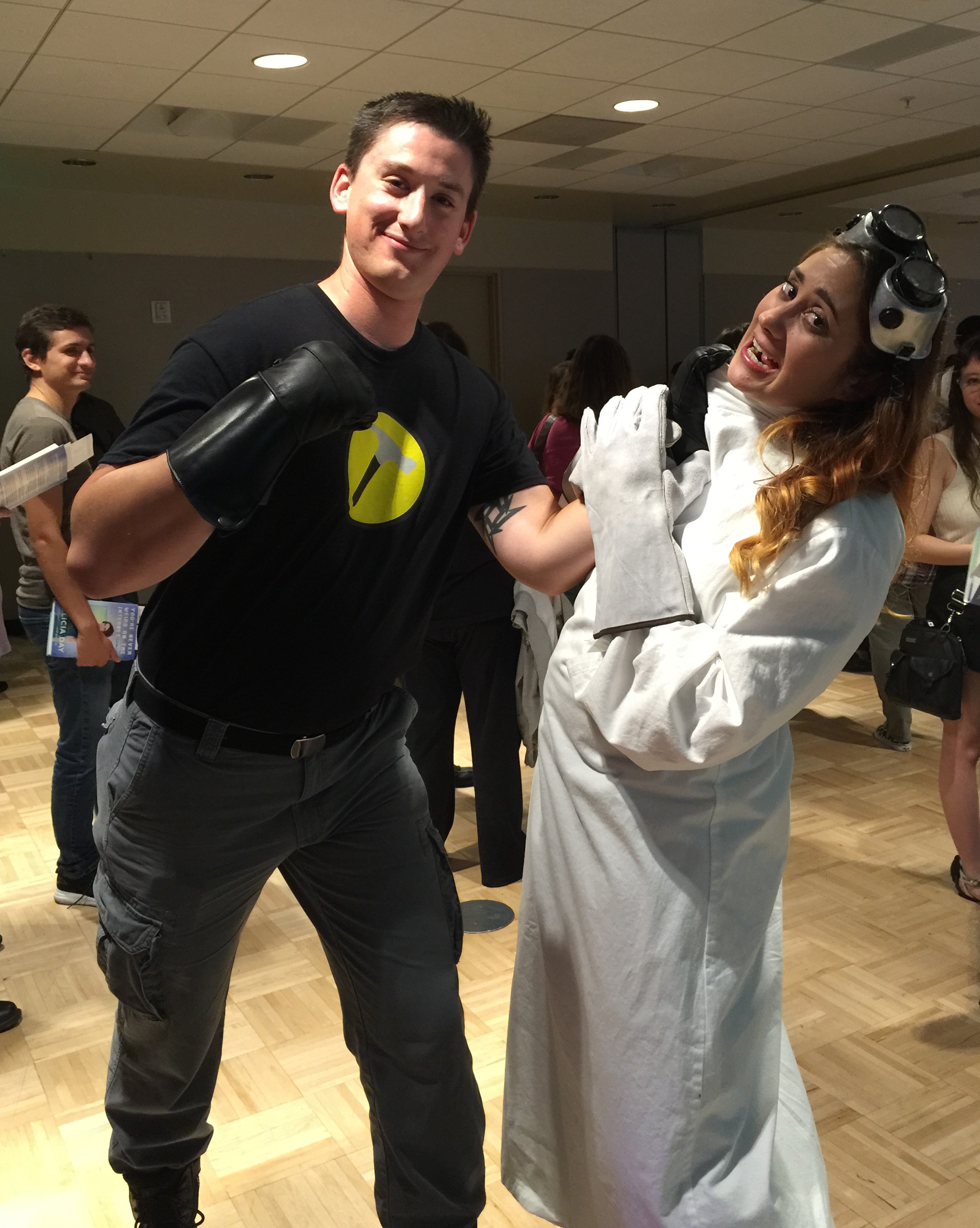
I love me some Dr. Horrible cosplay!

Felicia spent an hour on stage in front of an adoring crowd, and she was just as cute and smart and hilarious as you’d expect. (If you’re a fan, treat yourself by watching the video of her appearance!):

Getting back to the book itself, this isn’t a Hollywood tell-all. There’s no gossip here, no name-dropping, no parties/cocktails/living-the-good-life anecdotes. When Felicia does name names, it’s to thank and acknowledge the people who inspired or helped her.

Besides being a great read about an odd-ball girl making good on her own terms, You’re Never Weird is a message book. Felicia shares her own story not to say “look at me! I’m so great!”, but to share the idea that we’re all different, and we should pursue what excites us and makes us happy, no matter how odd or weird or dorky it might seem. And hey, whoever you are and whatever you’re into, there’s sure to be someone else out there who’s into it too:

It might be extremely dorky to point out, but who you are is singular. It’s science. No one else in existence has your point of view or exact genome (identical twins and clones, look for inspiration elsewhere, please). That is why we need people to share and help us understand one another better. And on a bigger level than just taking a selfie. (Not hating on selfies, but a few is enough. You look good from that angle; we get it.) We need the world to hear more opinions, give glimpses into more diverse subcultures. Are you REALLY into dressing your cat in handcrafted, historically authentic outfits? No problem, there are people out there who want to see that! Probably in excruciating details!

One of the things that makes You’re Never Weird on the Internet (Almost) so great to read is that first and foremost, you feel like you’re reading about a person.  A talented, awesome person, for sure, but still, someone recognizably human. Felicia Day’s writing style is chatty and full of good-natured humor, and she succeeds, I think, by making us all feel as though she’s someone we could hang out with, maybe play some video games or watch movies together. You just know that she’d be chill and awkward and non-judgmental, in all the best ways.
image

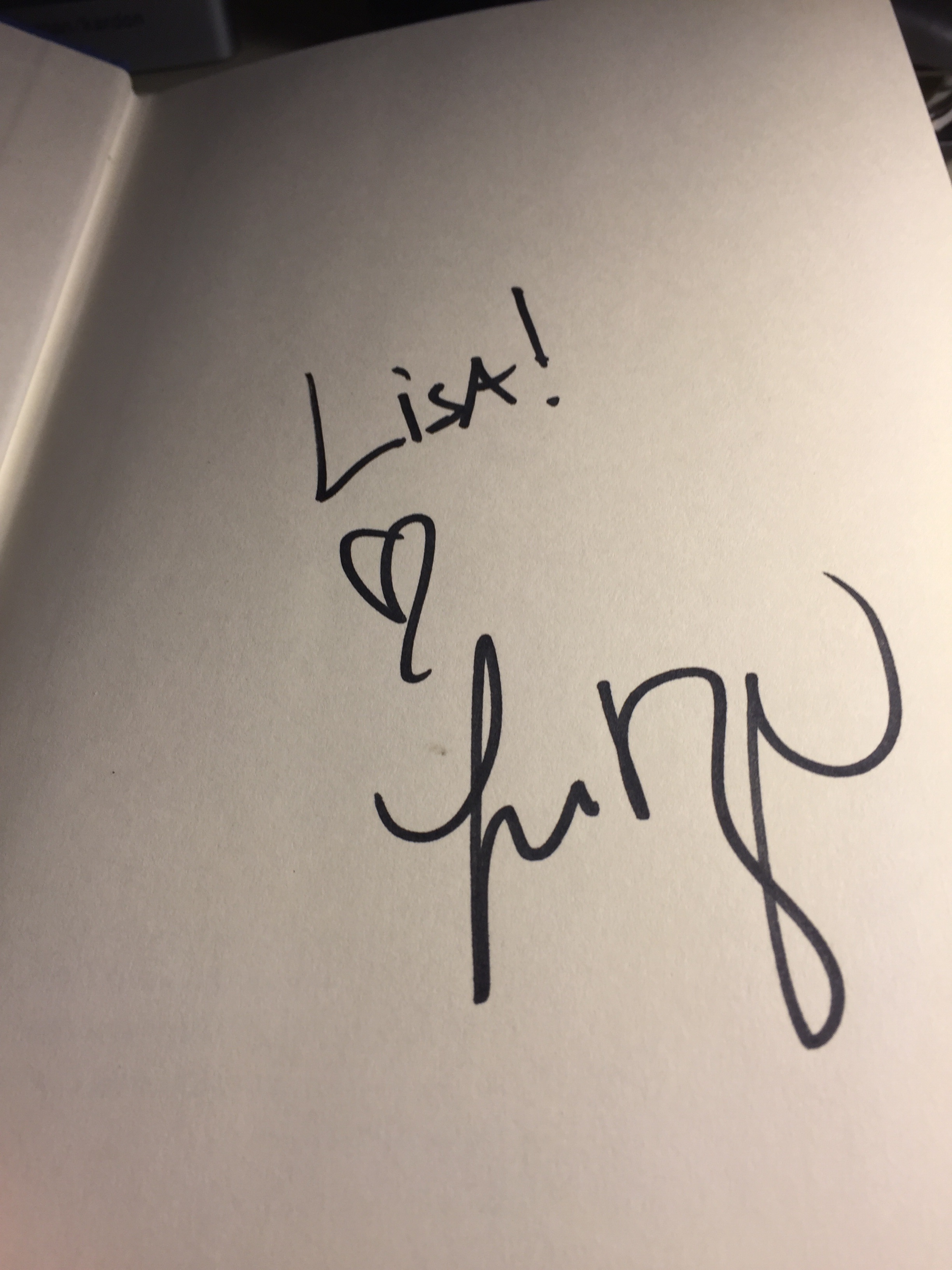
She signed my book! She signed my book!

If you consider yourself a geek, if you’ve ever felt lost in a crowd, if you had weird/unique hobbies, if you’ve ever felt a passion for something completely out there… well, I’m pretty sure you’ll find something in You’re Never Weird that will inspire you, or at the very least, make you smile or even chuckle for a while.

‘Scuse me, but I gotta go binge-watch The Guild right now.

_________________________________________

The details:

Title: You’re Never Weird on the Internet (Almost)
Author: Felicia Day
Publisher: Touchstone
Publication date: August 11, 2015
Length: 262 pages
Genre: Memoir
Source: Purchased
Book Review: The Heart Goes Last by Margaret Atwood

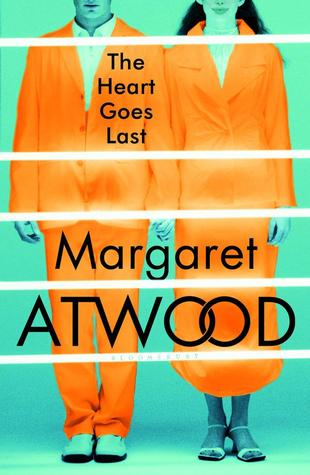
The Heart Goes LastThis is one tough book to describe.

The Heart Goes Last centers on main characters Stan and Charmaine, a married couple who are living in their car as of the beginning of the story. They’ve lost their jobs and their homes as the economy in the US Northeast has completely tanked. Charmaine works at a seedy bar to earn enough for them to buy fast food and gas, but that’s about it. Gas is essential, because even when locked into the car at night, crazy or desperate people may attack, break the windows, and try to rape or kill them, and being able to drive off in case of emergency is what keeps them alive. Life really sucks, and even though they both remember what it was like to be newlyweds in love, it’s getting harder and harder to keep any affection alive when life is just that awful.

Is it any wonder that they sign on, rather blindly, to the promise of a new and better life? Stan and Charmaine are seduced by an advertisement for an experimental town called Consilience. The Consilience project offers a house, safety, security, meaningful life, and the absence of fear and worry. After a quick visit within the gated walls of the town, they’re ready to sign up. The catch is that, once in, it’s permanent, but no worries! Charmaine is too entranced by the idea of a house, her own kitchen, and a cozy couch to even consider walking away, and to Stan, it sure sounds like a great alternative to quick, unsexy sex on the backseat of the car while watching out for attackers.

Once Stan and Charmaine have committed, we start to learn more. There’s a flip side to Consilience: Positron. Positron is a prison, and here’s the deal. For one month, Stan and Charmaine live in their cozy suburban house and go off to work at their pleasant jobs. Then comes switchover day, and the two go over to the Positron Prison, don orange prison garb, and become inmates for a month. Stan goes to the men’s ward, where he tends chickens, and Charmaine goes to the women’s ward, where she’s a medications officer. The prison is safe, filled with other happy Consilience residents, offering delicious food, meaningful work, and even a knitting circle in the evenings to pass the time. Meanwhile, Stan and Charmaine’s house is now occupied by their alternates. Half the town spends each month as residents, half as inmates, and then they switch. This way, the project provides housing and occupation for all, and everyone is happy. Be happy, damn it!

Perhaps picture-perfect suburbia isn’t all it’s cracked up to be:

The hedge trimmer emits a menacing whine, like a wasp’s nest. The sound gives him an illusion of power that dulls his sense of panic. Panic of a rat in a cage, with ample food and drink and even sex, though with no way out and the suspicion that it’s part of an experiment that is sure to be painful.

Things are as weird as they seem, and weirder. There’s sexual obsession and deception, nefarious corporate goons, weird sexual fetishes, secret medical procedures, and a recurring motif of blue knitted teddy bears. Of course this utopian refuge has a dark side, and of course Stan and Charmaine become deeply involved as puppets in the greater scheme of things. When I say things get weird, I really mean it.

By the end of the book, we’re in Vegas. There are hordes of Elvis and Marilyn impersonators, Blue Man Group rip-off artists, brain wipes, and sex/love slaves. And as word of the goings-on in Consilience/Positron is leaked to the greater public:

Instantly the social media sites are ablaze with outrage. Prison abuses! Organ-harvesting! Sex slaves created by neurosurgery! Plans to suck the blood of babies! […] Talk shows roister on into the night — they haven’t had this much fun in decades — and bloggers break out in flames.

I wish I could say that The Heart Goes Last was a great read, but unfortunately, I found it somewhat problematic. I was intrigued at the outset by the set-up, by the collapse of society, and by the way Stan and Charmaine’s marital issues tied into their dilemmas and decision-making about Consilience/Positron. Unfortunately, the book keeps veering off in new and disjointed directions, and by the time the Vegas elements come around, the storyline has passed the line from odd to ridiculous.

There are some truly eerie or disturbing sequences, but eventually, as one after another scenario unfolds, the whole thing loses its power and feels too scattered to be truly affecting. The goofiness of certain plot points (Elvis… Marilyn… the bear) makes the whole story somewhat farcical. While there are some kernels of deeper meaning in there about choice and the illusion of choice, the trade-off between security and free will, and whether unwavering love adds to or subtracts from actual happiness, the lack of overall coherence blunts the impact of all of these.

“Isn’t it better to do something because you’ve decided to? Rather than because you have to.”

“No, it isn’t,” says Charmaine. “Love isn’t like that. With love, you can’t stop yourself.” She wants the helplessness, she wants…

On top of the all-over-the-place plot, the fact is that dystopias are pretty much a dime a dozen these days, and it takes quite a lot to offer something new or startling. The idea of a perfect little town paired with a prison is interesting, especially as the town seems like something out of the movie Pleasantville (the only movies shown on Consilience TV are from the 1950s, and Doris Day is everyone’s darling) — but we’ve all read enough of these new society, perfect world set-ups to know that the people in charge have ulterior motives, there’s surveillance everywhere, and that a controlled world must be intrinsically corrupt at its core. Even though there are some clever and unexpected twists, at its most fundamental level, there isn’t anything all that fresh in the overarching concept.

Sadly, The Heart Goes Last was ultimately a let-down for me. I wouldn’t NOT recommend it, but it’s not Atwood’s best work either. I was never bored, exactly, but at some point, I just kind of rolled my eyes and decided to go with it.

_________________________________________

The details:

Title: The Heart Goes Last
Author: Margaret Atwood
Publisher: Nan A. Talese
Publication date: September 29, 2015
Length: 320 pages
Genre: Science fiction
Source: Review copy courtesy of the publisher via NetGalley

Blog Tour & Book Review: The Hummingbird by Stephen P. Kiernan

The Hummingbird

I’m delighted to be participating in the blog tour celebrating the release of The Hummingbird by Stephen P. Kiernan. Thank you, TLC Book Tours, for including me!

Synopsis:

Deborah Birch is a seasoned hospice nurse who never gives up—not with her patients, not in her life. But her skills and experience are fully tested by the condition her husband, Michael, is in when he returns from his third deployment to Iraq. Tormented by nightmares, anxiety, and rage, Michael has become cold and withdrawn. Still grateful that he is home at last, Deborah is determined to heal him and restore their loving, passionate marriage.

But Michael is not her only challenge. Deborah’s primary patient is Barclay Reed, a retired history professor and fierce curmudgeon. An expert on the Pacific Theater of World War II, Barclay is suffering from terminal kidney cancer and haunted by ghosts from his past, including the academic scandal that ended his career.

Barclay’s last wish is for Deborah to read to him from his final and unfinished book—a little-known story from World War II that may hold the key to helping Michael conquer his demons. Together, nurse, patient, and soldier embark on an unforgettable emotional journey that transforms them all, offering astonishing insights into life and death, suffering and finding peace.

Told with piercing empathy and heartbreaking realism, The Hummingbird is a masterful story of marital commitment, service to country, the battles we fight for those we love, learning to let go, and finding absolution through wisdom and acceptance.

My thoughts:

The Hummingbird is a quiet yet powerful look at love, acceptance, peace, and dignity. With a hospice nurse as its central figure, The Hummingbird has a calmness to it even when dealing with sorrow and anger.

Deborah is a remarkable woman, and it’s hard not to marvel at the peaceful focus and commitment she brings to her work. Deborah doesn’t view her patients as tragedies or medical lost causes. Instead, her job is to focus on each patient as an individual. Death is already a certainty; it’s Deborah’s purpose to make sure that her patients meet death with the comfort and space they need in order to have a dignified end.

At the same time that we witness Deborah’s work with the Professor, we see her struggling to reclaim her warrior husband Michael, a damaged soul who returns from his third tour in Iraq full of violence, rage, and guilt. Through her work with Barclay Reed and her reading of his unpublished manuscript, Deborah begins to find clues that will help her reach Michael. The more she reads about the Japanese soldier who became a man of peace and forged relationships with his former enemies, the more she learns about how to take steps toward her husband and help him truly find his way home again.

I found The Hummingbird incredibly moving. While I’d had certain preconceptions about the concept of hospice, I’ve never actually encountered it in my own life or in my reading until now. Reading about Deborah, her attitude and her approach, and what hospice provides for patients and their families was eye-opening for me. I was so impressed and touched by the degree of caring, the focus, and the compassion on display. Deborah’s interactions with Barclay are beautiful — not sugar-coated or avoiding the messier elements of illness, but simply caring and placing the patient’s total self above any other concerns.

Deborah’s relationship with her husband was quite touching as well. Michael is damaged and seems almost unfixable, but Deborah doesn’t accept that he’s beyond reach. It isn’t easy and it isn’t pretty, but we see scenes that show the rawness of returning veterans, their inability to fit back into society, and how little true help is available without a fight. It’s sad to realize how real this all is, and what’s more — as illustrated by an affecting scene involving Michael and a Vietnam vet — how little has changed or improved for soldiers in terms of how they’re treated when their fighting is done.

I would be remiss not to mention how powerful the third element of this story is. In chapters interspersed with the modern-day story, we read Barclay Reed’s manuscript, titled The Sword, telling the story of a Japanese bomber pilot whose World War II mission was to firebomb Oregon and cause panic and destruction on US soil. Although his mission did not succeed, the impact of his mission was felt by him and by the Oregon community targeted by his mission for decades to come. The story of connection and reconciliation is lovely, and surprised me by not going in the direction I’d expected.

These three threads — Deborah and the Professor, Deborah and Michael, and the story of The Sword — are woven together to create a beautiful story of redemption and forgiveness. The Hummingbird makes clear that it’s human connection that matters above all else, and that it’s never too late to find peace.

I strongly recommend The Hummingbird. The writing is lovely, the subject matter is quite unusual, and the characters will touch your heart.

Links:

Goodreads:
 
Add to Goodreads badge
 
Purchase Links: Amazon | IndieBound | Barnes & Noble


About the Author:

Stephen P. KiernanStephen P. Kiernan is a graduate of Johns Hopkins University and the University of Iowa Writers’ Workshop. During his more than twenty years as a journalist, he has won numerous awards, including the Joseph L. Brechner Freedom of Information Award, the Edward Willis Scripps Award for Distinguished Service to the First Amendment, and the George Polk Award. Kiernan is the author ofThe Curiosity, his first novel, as well as two nonfiction books. He lives in Vermont with his two sons.

Find out more about Stephen at his website and connect with him on Facebook.

_________________________________________

The details:

Title: The Hummingbird
Author: Stephen P. Kiernan
Publisher: William Morrow
Publication date: September 8, 2015
Length: 320 pages
Genre: Adult fiction
Source: Review copy courtesy of TLC Book Tours

tlc logoFor further information, visit the author’s website or stop by TLC Book Tours to view other blog tour hosts.


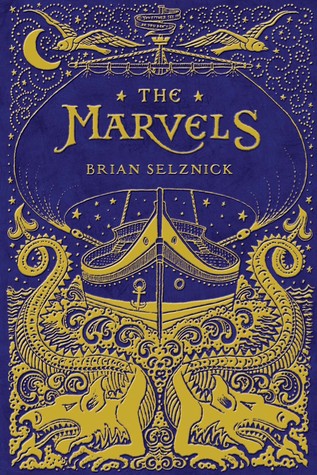
Book Review: The Marvels by Brian Selznick

The MarvelsCan a book review consist of just one word? Because if the answer is yes, then my job here is simple. My one-word review of The Marvels:

Beautiful.

Want two words?

Absolutely beautiful.

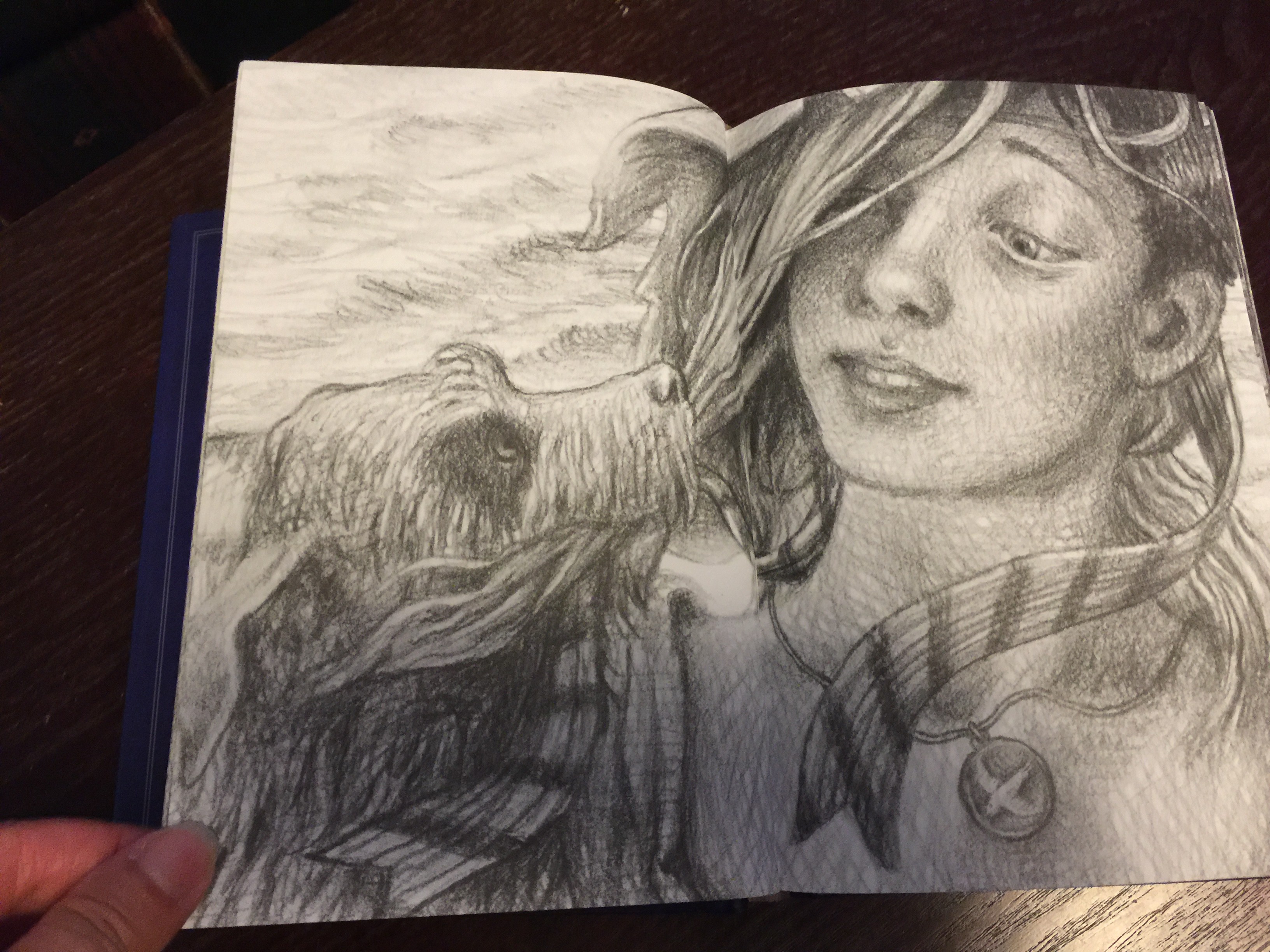
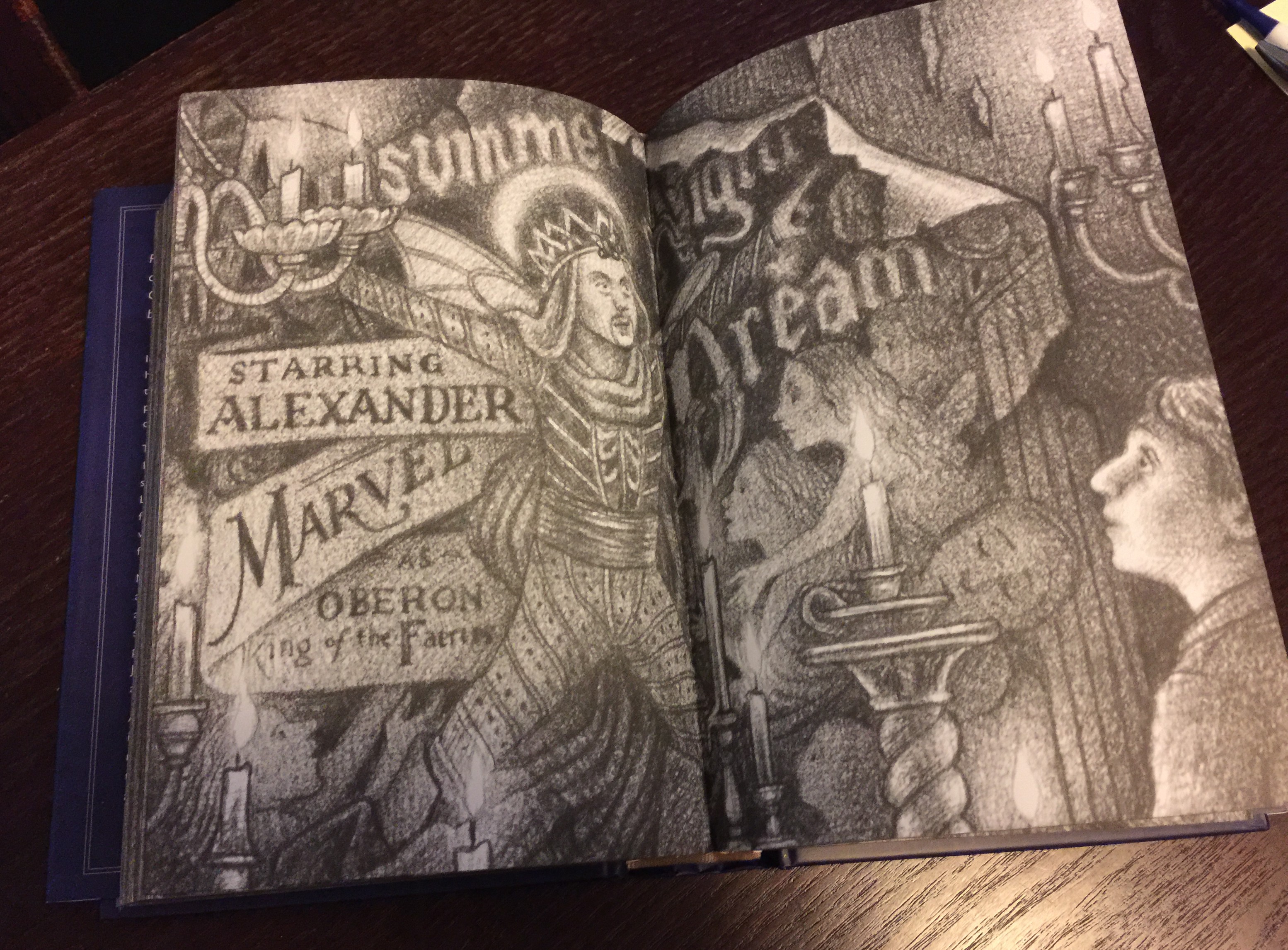
In The Marvels, author (and artist) Brian Selznick applies the technique he’s used previously (and so effectively) in The Invention of Hugo Cabret and Wonderstruck. In these books, the drawings aren’t illustrating the story — they’re telling the story.

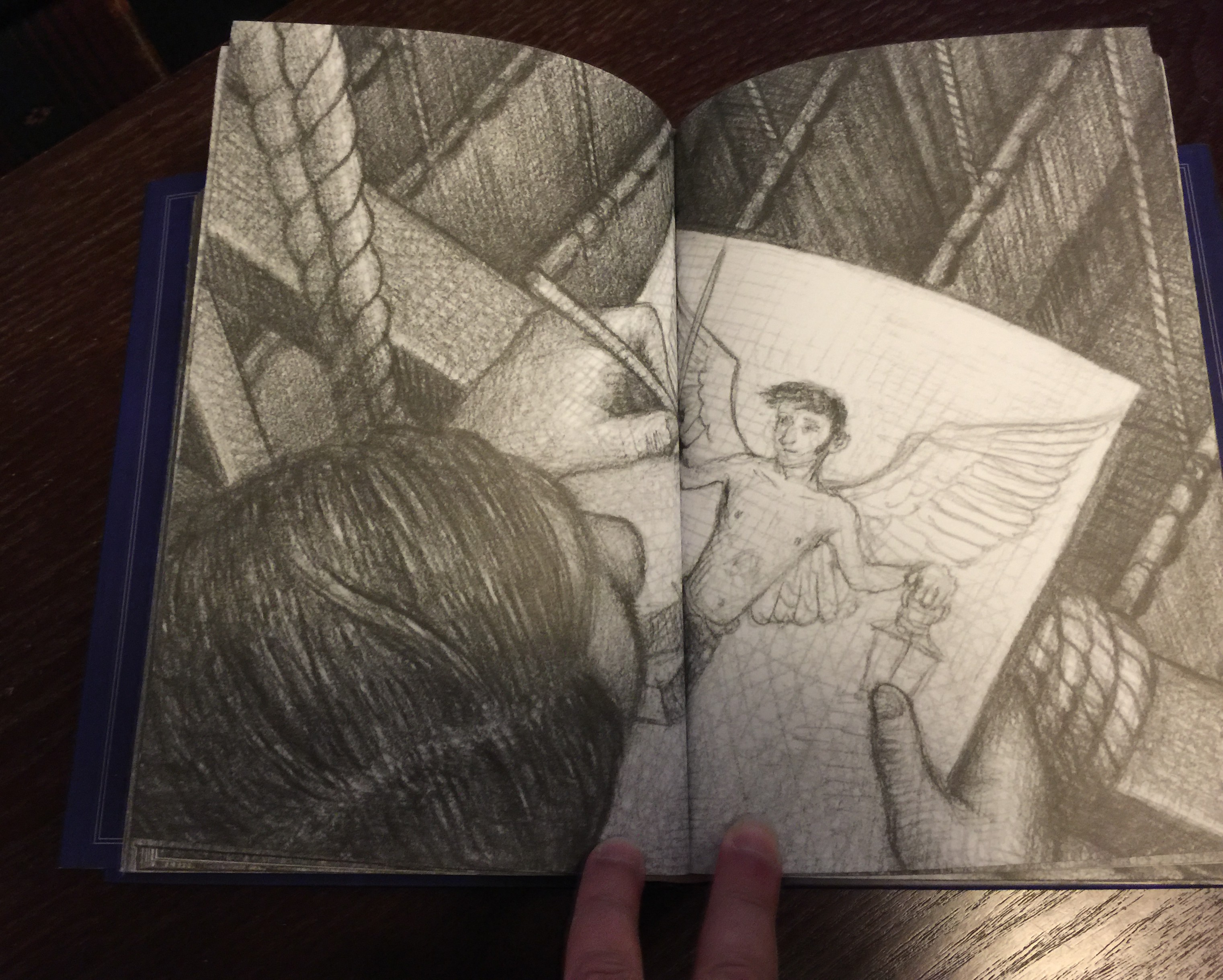
Over 600 pages in length, The Marvels is told purely through illustration for the first 390 pages. And such gorgeous illustrations! Each set of double-facing pages contains a black and white pencil drawing, magnificently detailed, that serves to tell a piece of the story. From page to page, the tale unfolds, and the pictorial story is full of drama and emotion.

image

The story of The Marvels begins in 1766, with two brothers, Billy and Marcus, shipwrecked during a storm at sea. Rescued from the island where he washes up, Billy and his dog Tar find their way to London, where they’re adopted by the crew building the Royal Theater. Billy’s story of his brother’s love inspires the theater’s designers so much that Marcus is immortalized as an angel painted on the theater’s ceiling.

image

From there, the generations follow: Billy grows up and adopts an abandoned baby, who in turn grows up to become a star of the theater, and onward for several more generations. The Marvel family is the world’s most revered family of actors, acquiring world renown, while at the same time dealing with madness and the final disappointment of a descendant who only wants to escape from the family business. The story ends abruptly with a fire in the theater… and we turn the pages to blank whiteness, and then to the story’s continuation, in printed form, in 1990.

The next several hundred pages are told via the narrative of a 12-year-old boy named Joseph, who runs away from his repressive boarding school and seeks shelter with his eccentric uncle Albert, a man whom he’s never met before. Albert lives in a house that seems more like a museum, employing gas lights and candles to illuminate a mansion full of old-world treasures. Joseph is intrigued by the mystery of Albert’s home, and tries to get his uncle to open up about his secrets and share the truth about their family’s past.

How does this connect to the story of the Marvel family? I’m not telling. You’ll want to find out for yourselves. What I will say is that it wasn’t what I expected, but I was enthralled none the less.

At first, I felt impatient with the written part of the story. The illustrations are so beautiful (that word again!) and pulled me into their world so completely that I hated leaving it behind. But, bit by bit, the story of Joseph and Albert pulled me in as well, and teasing apart the hints to try to unravel the secrets was equally engrossing.

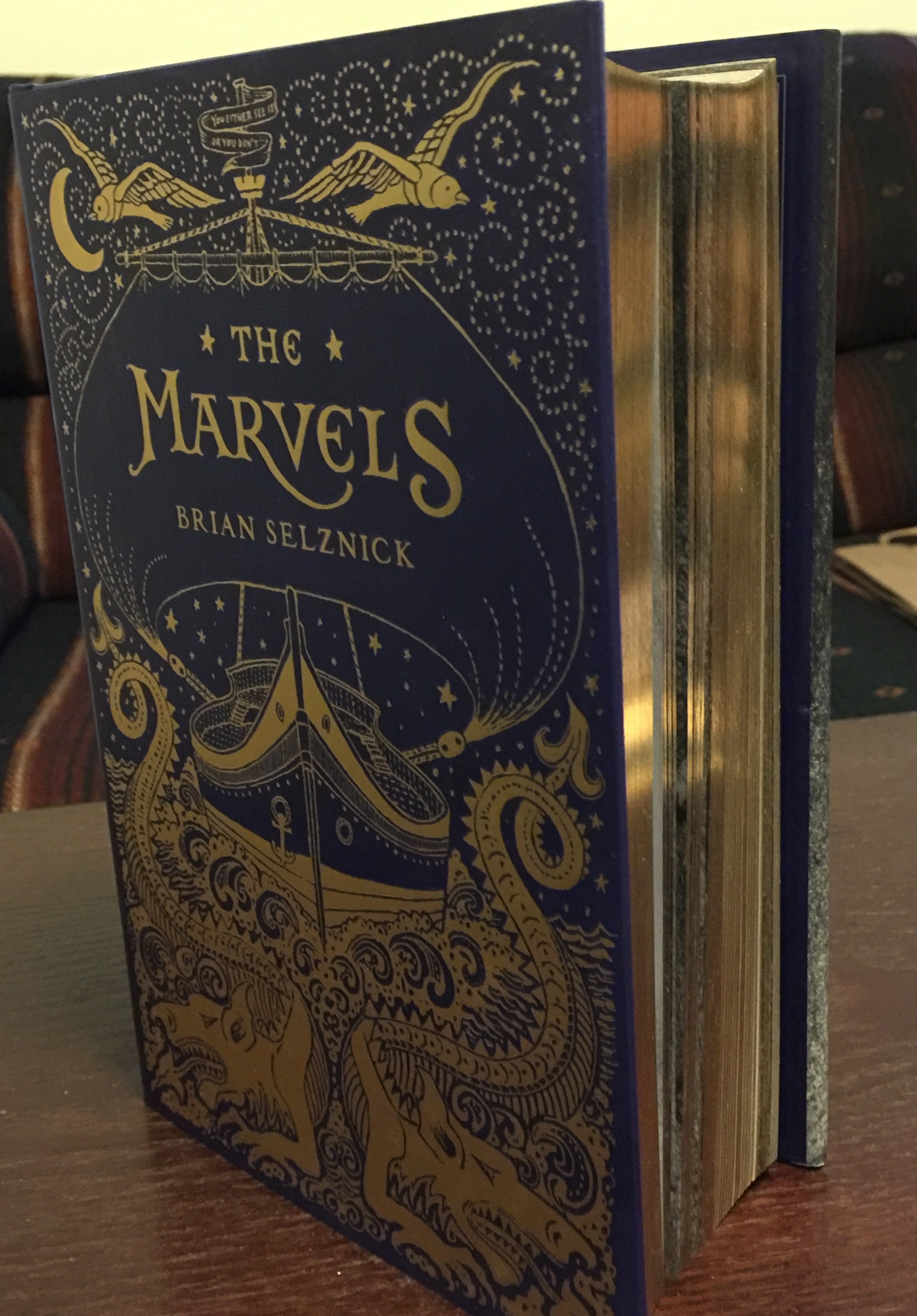
The book itself is hefty and magical to hold:

image

Several inches thick, with gilted edges and a gorgeous cover that feels like a throwback to an old-fashioned library edition, The Marvels is just so lovely to look at. This is one book you’ll want in a physical copy for sure — an e-book just won’t be the same.

The story is powerful in both its parts, with themes of love, devotion, and continuity, family commitment and inheritance, and a sense of wonder that is hard to describe. I found myself so absorbed in the mood created by this book that it was hard to re-enter the real world after finishing.

Wonderstruck may still be my favorite Brian Selznick book, but The Marvels is either a tremendously close second or perhaps right on par with Wonderstruck. For sure, both deserve a permanent place on my shelves, and are books that I’ll return to over the years. Reading these books is an immersive experience, and the power of the illustrations cannot be overstated.

image

So yes, one more time, I’ll return to my one-word review:

Beautiful.

_________________________________________

The details:

Title: The Marvels
Author: Brian Selznick
Publisher: Scholastic
Publication date: September 15, 2015
Length: 665 pages
Genre: Children’s fiction (middle grade/young adult); illustrated
Source: Purchased

Book Review: A Curious Beginning (Veronica Speedwell, #1) by Deanna Raybourn

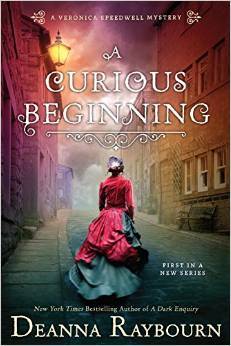
Curious BeginningA Curious Beginning is a delightful Victorian adventure romp that tells an exciting, mostly stand-alone story while setting readers up for an ongoing series. From the talented Deanna Raybourn, a pro at creating period settings that ring true, comes plucky heroine Veronica Speedwell, a no-nonsense young woman who very much knows her own mind.

Veronica is twenty-five years old, and so could be considered a spinster by the standards of that time period, but she truly doesn’t care what anyone else thinks. Veronica has been raised by two elderly aunts who adopted her as a young orphan, and ever since she’s been grown enough to exercise some independence, she has set out to see the world while on expeditions to collect the finest and rarest butterfly specimens. A talented lepidopterist, Veronica doesn’t shrink from adventure, scientific or amorous, and has left a trail of lovers behind as well… but with stipulations:

Over time, I developed a set of rules from which I never deviated. Although I permitted myself dalliances during my travels, I never engaged in flirtations in England — or with Englishmen. I never permitted any liberties to gentlemen either married or betrothed, and I never corresponded with any of them once I returned home. Foreign bachelors were my trophies, collected for their charm and good looks as well as attentive manners. They were holiday romances, light and insubstantial as thistledown, but satisfying all the same.

The action kicks off with the death of the Veronica’s remaining aunt, leaving her on her own with no ties and no obligations. Almost immediately, however, she is thrust into danger, as a strange man ransacks her aunts’ cottage and appears on the verge of kidnapping her — which she escapes thanks to the assistance of yet another stranger, Baron von Stauffenbach, who whisks her off to London for protection and promptly stashes her for safekeeping with an associate, a young, dangerous-looking man by the name of Stoker. Stoker has wild hair and tattoos, wears an eyepatch, and is busy trying to taxidermy an elephant when Veronica is deposited into his care. Neither of the two are thrilled by their enforced companionship — but when the Baron is found murdered, they realize that they’ll be spending a lot more time together as they run from both the police and whichever mysterious villains are responsible for the Baron’s death.

Along the way, of course, the tension and hostility between Stoker and Veronica morph into trust, admiration, and perhaps something deeper too, although they’re too busy trying to outwit a host of pursuers and simply stay alive to have time to explore any feelings, romantic or carnal, that might pop up.

Veronica is a super-smart, nerves-of-steel, take-no-prisoners woman. She has a hatpin and isn’t afraid to use it! In temperament and repartée, she reminded me very much of Gail Carriger’s Alexia Tarabotti — proper, demanding, capable, and unafraid, and prone to the most delicious quips and arguments. Her back and forth with Stoker is quite fun:

He shook his head as if to clear it. “I smoked opium once. It felt like listening to you, only rather more mundane.”

Another example:

“Veronica, are you weeping?” he asked suspiciously.

“Don’t be ludicrous,” I returned tartly. “I do not weep. It is a symptom of the rankest sentimentality, and I am never sentimental.”

By the end of the novel, the two have joined a circus, escaped evil henchmen by jumping into the Thames, and burned down a warehouse, among other more sedate approaches to investigation. The mystery of the Baron’s death is resolved in a way that makes clear that while this chapter is more or less complete, there are plenty of loose ends and further threats to deal with in the future.

A Curious Beginning is a thoroughly enjoyable romp, and should particularly appeal to readers who like Victorian settings with plenty of action thrown in. Veronica is a wonderful main character, and Stoker is intriguing — in that dark, broody, mysterious way that just might win him a spot on the “book boyfriends” list of quite a few readers. Together, the two bounce off one another constantly, making it clear that their surface disagreements and irritation are covers for an attraction and connection that are likely to continue deepening as this series progresses.

I, for one, can’t wait to see what sort of adventures await these two. This is a delightful start to a new series, and I look forward to reading much more.

Want to know about some of Deanna Raybourn’s other novels? Check out my reviews of:
Night of a Thousand Stars
City of Jasmine
A Spear of Summer Grass

_________________________________________

The details:

Title: A Curious Beginning
Author: Deanna Raybourn
Publisher: NAL/Penguin
Publication date: September 1, 2015
Length: 337 pages
Genre: Historical fiction
Source: Review copy courtesy of the publisher via NetGalley

Audiobook Review: Unfamiliar Fishes by Sarah Vowell

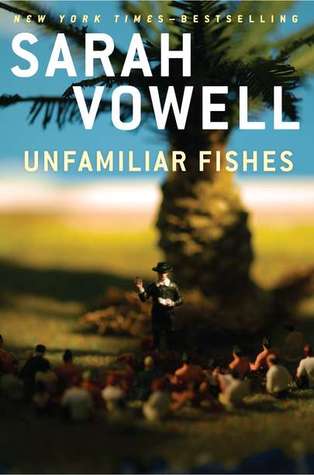
Unfamiliar Fishes

Synopsis:

(via Goodreads)

Many think of 1776 as the defining year of American history, when we became a nation devoted to the pursuit of happiness through self- government. In Unfamiliar Fishes, Sarah Vowell argues that 1898 might be a year just as defining, when, in an orgy of imperialism, the United States annexed Hawaii, Puerto Rico, and Guam, and invaded first Cuba, then the Philippines, becoming an international superpower practically overnight.

Among the developments in these outposts of 1898, Vowell considers the Americanization of Hawaii the most intriguing. From the arrival of New England missionaries in 1820, their goal to Christianize the local heathen, to the coup d’état of the missionaries’ sons in 1893, which overthrew the Hawaiian queen, the events leading up to American annexation feature a cast of beguiling, and often appealing or tragic, characters: whalers who fired cannons at the Bible-thumpers denying them their God-given right to whores, an incestuous princess pulled between her new god and her brother-husband, sugar barons, lepers, con men, Theodore Roosevelt, and the last Hawaiian queen, a songwriter whose sentimental ode “Aloha ‘Oe” serenaded the first Hawaiian president of the United States during his 2009 inaugural parade.

With her trademark smart-alecky insights and reporting, Vowell lights out to discover the off, emblematic, and exceptional history of the fiftieth state, and in so doing finds America, warts and all.

My Thoughts:

Unfamiliar Fishes has been on my to-read list for a few years now. I’m fascinated by Hawaiian history, and have heard all sorts of good things about the author, Sarah Vowell. Since I’m rarely in the mood to sit down with a non-fiction book when there are ALL THE NOVELS to be read, I thought the idea of listening to the audiobook was rather brilliant on my part.

Sadly, the audiobook was a big disappointment, in several ways.

First of all, the content: Unfamiliar Fishes can’t seem to decide whether it wants to be history, social commentary, or personal travelogue. The historical facts and interpretations are there, sure, but mixed in are the author’s narrative of hikes, visits to Hawaii with her nephew, and other random observations. The history is presented chronologically — except when it’s not. So, for example, we may learn about a school founded by missionaries, then jump to President Obama’s school days and quotes from his memoir, before hearing from a modern-day descendant of native Hawaiians on her thoughts about the school, before returning to the historical record.

The narrative jumps from King Kamehameha to the last queen of Hawaii, Queen Liliʻuokalani — a jump of at least 80 years. When a section about the whaling industry and its impact on Hawaii gets underway, we have all sorts of digressions about Herman Melville and Moby Dick, as well as a visit to the Melville museums and tourist attractions in Massachusetts.

The story is all over the place, and particularly in an audiobook, this makes it hard to follow. Without being able to flip back to the last place where the history left off in pursuit of other digressions, it’s practically impossible to keep track of the various missionaries, chiefs, and Hawaiian royalty.

Second, the narration of the audiobook: Most of the audiobook is read by Sarah Vowell herself. To say that she has an odd voice is putting it mildly. Her voice is quirky and sounds as though every line is expected to produce a reaction, so that it’s hard to take it entirely seriously, even when dealing with serious matters. (Of course, some will love this kind of thing. I found it hard to listen to.)

What was even harder for me, and rather puzzling, was the use of some big-name comedians and actors to read sections of the books where there are quotes. According to the audiobook description, narrators include Fred Armisen, Bill Hader, John Hodgman, Catherine Keener, Edward Norton, Keanu Reeves, Paul Rudd, Maya Rudolph, and John Slattery. Impressive? Well, not if their voices are unrecognizable. Listening to the book, it just sounded like random people. Not all quotes were read by these folks — some are just done by Sarah Vowell as part of her narration. But every once in a while, when there’s a quote from a missionary’s memoir or a document written by some other historical feature, one of these random voices pops in to read it. It makes for a very weird and disjointed listening experience, and is distracting too. I found myself losing focus on the context and thinking instead, “Should I know who’s speaking right now?”

Having these people as the voice of the missionaries also seems to imply that we should view everything the missionaries wrote as funny or mock-worthy, and I’m not convinced that the actual content of their writing supports that interpretation. It’s certainly an odd approach to historical documents.

True confession time: I didn’t finish this audiobook. By about the 50% mark, I knew I was struggling. I tried to force myself to continue — I even took the advice of a Twitter friend who suggested listening at 1.5x speed to get through it faster! (Believe me, the higher speed did nothing for the quality of the narration.) Finally, I quit at about 67%. I wasn’t enjoying it, I was fighting to pay attention, and it just wasn’t working.

This was a sad DNF for me. As I mentioned, I do really enjoy learning about Hawaii, but this experience taught me very little except that I should find myself a more traditional history of the islands to read. Unfamiliar Fishes couldn’t seem to decide if it was serious or snarky, and in the end, it ends up somewhere in the muddy middle, not successfully achieving either.

I’ve heard from friends that two other books by Sarah Vowell, The Wordy Shipmates and Assassination Vacation, are worth checking out. Based on my experience with Unfamiliar Fishes, I’m not inclined to read more by this author — but if you’ve have a positive experience with her books, please tell me so!

_________________________________________

The details:

Title: Unfamiliar Fishes
Author: Sarah Vowell
Publisher: Riverhead Books
Publication date: March 22, 2011
Audiobook length: 7 hours, 28 minutes
Printed book length: 258 pages
Genre: History/social commentary (non-fiction)
Source: Library (audio download)

Audiobook Review: Trigger Warning by Neil Gaiman

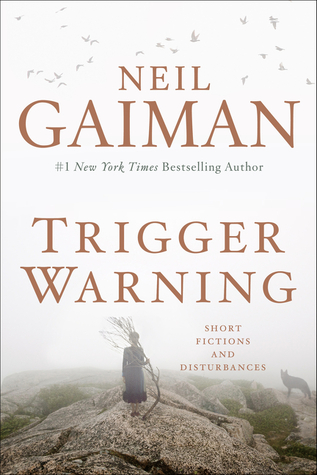
Trigger WarningI’ve said it a bazillion times already on my blog: I suck at short stories. My attention wanders. I get impatient. I feel as though I’m just serving time until I can get back to my “real” reading… meaning reading a full-length novel.

And yet — after attending a talk by Neil Gaiman last spring and coming home with a signed copy of his latest book, I felt compelled to actually READ Trigger Warning, instead of just sticking in on a shelf to be admired for its prettiness.

Trigger Warning is a story collection (or, as the cover states, a collection of “Short Fictions and Disturbances”). While I love Neil Gaiman’s writing, pretty much always and no matter what, my dreaded aversion to short stories was keeping me from starting Trigger Warning, until I finally had the brilliant idea of listening to the audiobook.

Success!

I listened to (almost) the entire audiobook of Trigger Warning during the past week, and I must admit that I really enjoyed it.

Of course, the fact that Neil Himself is the narrator does not hurt. Nope, not one bit.

Neil Gaiman is in fact a terrific, animated, nuanced narrator, and his reading of the stories is never dull. I loved the tiny inflections and emphases, the slight accents for different characters, and the pacing and delivery. And there’s an odd sense of rightness in hearing the author read his own book. He, of all people, should know which parts are meant to be spoken boldly, which to trail off, when to be quiet, and when to practically chant. The eerie stories were read eerily; the funny bits had laughter hiding in the tone of his voice. Simply marvelous.

As for the stories themselves, this is really a very mixed assortment. Most (all?) appeared elsewhere originally, whether in other anthologies or written for special projects or events. I’d read two stories previously, “Orange” and “The Thing About Cassandra”, and enjoyed them immensely here in spoken format.

Other standouts for me are “Down to a Sunless Sea”, a short but entirely chilling tale told by a mysterious woman one rainy day along a wharf. “The Truth Is a Cave in the Black Mountains…” is a long, mythical-feeling piece involving a quest for gold, truth, and revenge, and I loved it. “A Calendar of Tales” grew out of a Twitter project, with a brief story for each month of the year. I especially loved the March tale, about the pirate Anne Bonny, and the wonderful October tale about a genie.

Weird, scary, funny, epic — the stories in Trigger Warning range from fairy tale to science fiction to horror, but all have a twist and a tone that make them surprising, entertaining, and captivating.

The only small irksome thing about the audiobook is that the description of the context for each story appears in the book’s introduction, and with an audiobook, there really isn’t a good, easy way to flip back and forth. I was glad I had the hard copy on hand so I could reference the intro again and again, and would suggest that if you’re going to listen to the audiobook, get your hands on a printed book or e-book so you can follow along.

Even if you’re — like me — not normally into story collections, it’s worth the time to give Trigger Warning a try, especially if you’re a Neil Gaiman fan. The audiobook definitely worked for me, and I’m so glad that I had the idea of listening to the stories rather than trying to force myself to concentrate on reading them in printed book form. An added bonus for me, based on my experience with Trigger Warning, is that I think I can use audiobook listening in the future to enjoy story collections that I might otherwise have skipped.

And even more than that, having now listened to Stardust and Trigger Warning, I’m super motivated to listen to even more by Neil Gaiman. I’ve been wanting to re-read The Graveyard Book for a while now, and I think audio might be just the ticket!

_________________________________________

The details:

Title: Trigger Warning
Author: Neil Gaiman
Publisher: William Morrow
Publication date: February 3, 2015
Audiobook length: 11 hours, 1 minute
Printed book length: 310 pages
Genre: Stories
Source: Purchased (hard copy)/Library (audio download)

YA new releases: A trio of mini-reviews!

I read three new young adult fiction releases this past week, and thought a three-fer review post would be fun! Here’s a quick look at what I read and what I thought.

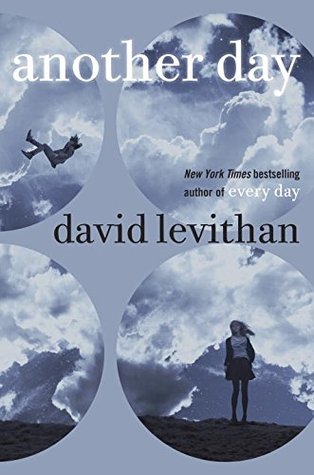
another dayTitle: Another Day
Author: David Levithan
Release date: August 25, 2015
Length: 327 pages

In 2012, David Levithan published his remarkable novel Every Day (review), about a teen named A who awakens each day in a different body. A carries A’s consciousness into each body, but experiences life as a series of “day in the life” moments belonging to whoever the body’s owner is. This is normal for A, until A meets and falls in love with Rhiannon. This seemingly impossible and complicated set-up makes for an amazing read, complete in itself.

But here we are in 2015 with Another Day, which tells the same story and presents the same set of events, but as experienced by Rhiannon. I was skeptical at first: Do we really need another version of the same tale? Short answer: Yes. Another Day is much more engrossing and moving than I would have expected. Rhiannon ponders the dynamics between body and self, questions her own motivations and feelings, her own sense of attraction and repulsion in regard to each of A’s appearances, and finds herself forced into decisions that have no right answer.

I love David Levithan’s writing, pretty much always, and Another Day is no exception. The story is wonderful, and the writing is beautiful in its rhythms and use of language, yet also feels true to teen hearts and minds. The ending seems to beg for a follow up, and I do hope that the author is planning another installment in this fascinating story.

_____________________________________________

Hello GoodbyeTitle: Hello, Goodbye, and Everything in Between
Author: Jennifer E. Smith
Release date: September 1, 2015
Length: 256 pages

If you like your YA light and airy, then Hello, Goodbye, and Everything in Between might be the book for you! This is actually a fitting choice for this time of year, a quintessential back-to-school reading selection. Hello tells the story of Clare and Aidan as a “one magical night” type of tale: We spend the night, from early evening until the next morning, watching Clare and Aidan’s final night together after a two-year high school relationship, as each prepares to leave for college in the morning. Clare and Aidan live near Chicago, but Clare will attend an East Coast college and Aidan will be at UCLA.

All summer long, they’ve been debating whether to stay together or break up before leaving for school, with Aidan wanting option 1 and Clare advocating for option 2. It’s not that they don’t love each other; they do. But neither can be sure that staying together is the right thing to do. Is it better to end things now, on their own terms, than risk a slow fizzling out as they become involved in their own, separate college lives? What if they meet other people? What if they don’t, but miss out on key college experiences because their minds are too wrapped up in their long-distance romance?

Clare and Aidan spend the night visiting old hang-outs, best friends, scenes of memorable firsts, and “everything in between”, looking to both capture memories and come to an agreement before the sun rises and they go their separate ways. Even though the couple is dealing with heart-ache and sadness, there’s still an element of excitement and looking forward — plus family drama, as each character’s relationship with parents has an impact on their choices and how they feel about their chances as a couple.

I liked Hello, but thought it was a little too simplistic in presenting the options available to Clare and Aidan. They’re fun characters with good hearts, but I’m not sure the situation warrants quite as much drama as they infuse into it. This is a nice, light read, super quick and easily digestible. It didn’t make much of a deep impression on me, but it did keep me entertained all the way through.

_____________________________________________

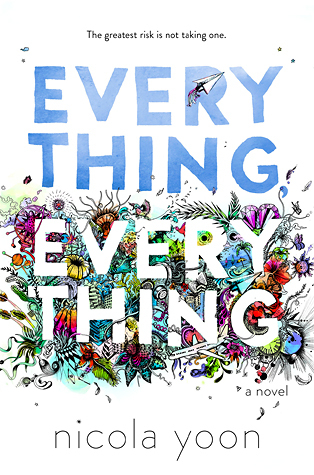
Everything EverythingTitle: Everything, Everything
Author: Nicola Yoon
Release date: September 1, 2015
Length: 320 pages

Wow. This book left me reeling, in ways I didn’t even imagine. Everything, Everything is the story of Maddy, a teen girl with the rare immune disease SCID who’s lived her entire life in the hyper-protected, safe environment of her completely sterilized and filtered home. She never goes out, never sees anyone in person except her mother and her nurse, spends her time attending school via Skype and reading tons of books. And then one day, Olly and his family move next door, and Maddy’s world is rocked. What if she could make a friend? What if she did want something besides what she has? From waving window to window to email and IM chats, Maddy and Olly become friends, and then more, until Maddy feels ready to risk everything, even her life, to really take a chance at living.

I thought I knew what to expect, more or less, when I started this book, but I was wrong. First of all, the narrative voice is completely charming. Told in the first person by Maddy, the narrative strikes the exactly right chord of cleverness, humor, and curiosity tinged with innocence. Maddy has literally done nothing and been nowhere, so everything she sees and experiences is a first for her. The author captures the wonder of all of Maddy’s firsts, as well as the suffocation of being alive without really living her own life. While the Maddy/Olly romance develops quickly, it’s not insta-love. They get to know each other as people first. Each has baggage and fears, but they find a way to connect that’s touching and feels real and deserved.

The ending (or, the last 20%, according to my Kindle) absolutely threw me for a loop and was not what I expected at all. It’s powerful and emotional (okay, yes, there were even tears), and went in unexpected directions. I’m sure readers will have some heated debates about how things turn out, and I have a feeling this will be a love it or hate it situation — but either way, there’s plenty to discuss!

Throughout the book, I thought the writing was terrific, and I loved the little drawings and diagrams that enliven Maddy’s story, as well as all the email exchanges, messages drawn on windows, and other whimsical visual touches. Maddy is a smart and funny character, and I loved seeing her think about her life, her family, and her future. This book pulls off the tricky task of piling on the emotional impact while keeping a sense of quirkiness and laughter. Everything, Everything is a book that should really appeal to teen readers, and adults will love it too!

Book Review: A Little in Love by Susan Fletcher

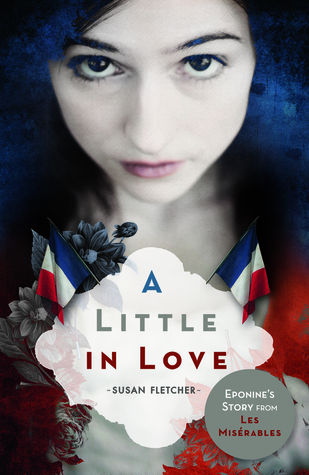
A Little in Love

When a book starts with the main character dying slowly and painfully in the street, you know that you’re going to be in for an emotional ride.

Then again, what do you expect from a book whose essence can be boiled down to Victor Hugo’s Les Miserables as told by Eponine?

I mean, anyone who saw the musical version of Les Miz and didn’t get at least a little misty during this number has a heart of stone:


In A Little in Love, a dying Eponine recounts her sad life story, narrating all that she’s experienced in her young life that led up to this final moment. And so we go back to Eponine’s girlhood, as she lives in a small village at the inn run by her parents, the wicked, thieving Thenardiers. Eponine’s parents raise her and her younger sister to be wonderful thieves, able to pull rings off fingers, lift coins from pockets, take the buckles off a pair of shoes, without ever being seen. To steal is to earn love.

Into their lives comes a small girl named Cosette, deposited into the Thenardier’s keeping by her desperate mother, but the kindness and shelter she’d hope to secure for Cosette is never delivered. Cosette is treated like a dog and a slave, while the money left for her upkeep is spent on food and clothes for the Thenardiers. Eponine sees Cosette as a potential friend, until she is punished for showing any kindess. Eponine’s mother makes clear that only hardness is allowed. She must be cruel. She must be hard. Eponine can only keep what passes for love from her own mother by kicking Cosette and spitting at her, calling her ugly, and making her life miserable.

And so the years pass, until a kind-eyed man comes one Christmas to take little Cosette away into a better life. Eponine realizes just how trapped she is in the misery of her own family… but she herself has no way out, no kind-eyed rescuer to save her from her sad existence. After her father commits a horrible crime, they spend years on the run, eventually landing in Paris, where Eponine’s fate is sealed. She sees a young man, Marius, and falls instantly in love. Eponine is sickened by her family’s evil ways, and determines to be good, to be kind, to make her own way in the world and try to make amends. When Eponine realizes that Marius loves none other than Cosette, Eponine finds a way to unite the lovers, and ultimately… well, if you’ve watched the clip above, you know it doesn’t end well for poor Eponine.

A Little in Love is a lovely little book, not very long and with a nice, quick pace. Eponine’s world view may be limited, but it’s enough to show us the abject poverty of the lower classes in France and the depths to which people must sink in order to survive. Despite her horrible upbringing, Eponine holds onto her own humanity, and it’s through her sense of right and grace that we see that not all people are cruel, and that even poor, downtrodden people are capable of moments of kindess which can change lives.

This was a hard world, I knew that. It was dangerous; it had its knives and lies and cruelties, and Paris felt on the edge of such trouble. but there were small wonders too — everywhere.

Eponine’s voice is simple and genuine. She loves, she aches, she regrets. She despises her parents’ and sister’s actions, but not the people themselves. She would be forgiven for resenting Cosette and standing in her way, but of course she doesn’t: By helping Cosette, she’s doing what little she can to apologize for the years of cruelty, lightening her own burden of guilt even while adding to the pain she suffers knowing Marius will never love her as she loves him.

I would imagine that most readers of A Little in Love will be at least a little familiar with the story from the movie version of Les Miserables. This book is a reimagining of Victor Hugo’s story, so some plot changes may be confusing for those expecting the story they viewed on-screen. It doesn’t matter much, really: Because neither version of the story looks through Eponine’s eyes, the narration of A Little in Love covers new ground even when going over plotlines that may be familiar. It’s a hard balancing act for a retelling to stay faithful to the original while adding enough new elements to make the story fresh and surprising, and author Susan Fletcher achieves this remarkably well in A Little in Love.

Eponine is a tragic character, a small player in the grander story of Les Miserables, and it’s lovely to see her getting the center stage billing she deserves in this new novel.

Two final thoughts:

♦ A Little in Love is being marketed as a young adult novel. I’d just add that younger teen readers (and older middle school aged readers) could easily enjoy this book, especially if they’ve seen the movie version. While the book portrays horrible living conditions, cruelty, starvation, crime, etc, it never gets graphic and there’s no sexual content.

♦ I really wish this book had a better title! It’s not bad, but it’s not memorable or particularly connected to the story itself. I found myself having to double-check the title several times in order to make sure I got it right! It just seems awfully generic, like something you’d paste on a light-hearted high school romance, and I’m afraid it doesn’t do the weightiness of the story true justice.

_________________________________________

The details:

Title: A Little in Love
Author: Susan Fletcher
Publisher: Chicken House Ltd
Publication date: August 25, 2015
Length: 288 pages
Genre: Young adult fiction
Source: Purchased

Take A Peek Book Review: Secondhand Souls by Christopher Moore

“Take a Peek” book reviews are short and (possibly) sweet, keeping the commentary brief and providing a little peek at what the book’s about and what I thought.

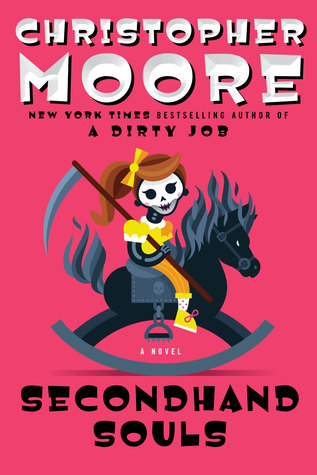
Secondhand Souls

Synopsis:

(via Goodreads)

In San Francisco, the souls of the dead are mysteriously disappearing—and you know that can’t be good—in New York Times bestselling author Christopher Moore’s delightfully funny sequel to A Dirty Job.

Something really strange is happening in the City by the Bay. People are dying, but their souls are not being collected. Someone—or something—is stealing them and no one knows where they are going, or why, but it has something to do with that big orange bridge. Death Merchant Charlie Asher is just as flummoxed as everyone else. He’s trapped in the body of a fourteen-inch-tall “meat” waiting for his Buddhist nun girlfriend, Audrey, to find him a suitable new body to play host.

To get to the bottom of this abomination, a motley crew of heroes will band together: the seven-foot-tall death merchant Minty Fresh; retired policeman turned bookseller Alphonse Rivera; the Emperor of San Francisco and his dogs, Bummer and Lazarus; and Lily, the former Goth girl. Now if only they can get little Sophie to stop babbling about the coming battle for the very soul of humankind…

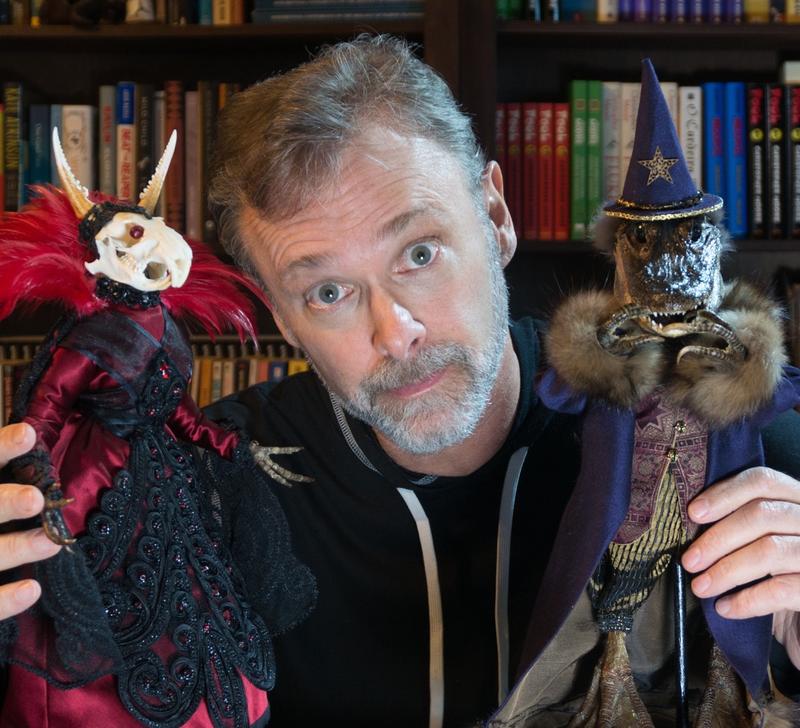
The author with "squirrel people". Image via wunc.org

Christopher Moore with “squirrel people”.
Image via wunc.org

My Thoughts:

Here’s a slightly edited version of what I wrote on Goodreads:

I’ll just say it: Christopher Moore can pretty much do no wrong. Take his earlier books: Enormous lizards? Artificial whales? Stupid angels and Jesus? Shakespeare, Impressionist painters… you get the drift. For ultra-weird but extremely funny (and even touching) stories, you really can’t beat the Author Guy’s books.

Secondhand Souls is a sequel to A Dirty Job, which is an awesomely hilarious, entertaining, occasionally crude, always crazy tale — and Secondhand Souls lives up to it, not quite perfectly, but awfully darn close. The characters we love are back, in different places in their lives (and even in different bodies), but still themselves. Plus, there are some memorable new characters, including a Golden Gate Bridge painter named Mike, a mysterious man dressed all in yellow, a lovesick ghost, and a banshee with a fondness for tasers, among others.

San Francisco itself is a star, and seeing such a crazy adventure unfold in our beloved city is at least half the fun.

Who am I kidding? It’s all fun. The logic of the story gets a little thin at times, and forget about character development: We’re plopped down into the lives of the characters from A Dirty Job, and either you remember them or you don’t. But, it doesn’t really matter. If you’re a Christopher Moore fan, you need to read this. And if you’ve never had the pleasure, I’d say put this one on hold and read (at least) A Dirty Job — and possibly a few others — before picking up Secondhand Souls.


And for a more articulate review, here’s what my friend Heidi had to say about it:

Of all Christopher Moore’s novels, which range from the adolescent and ridiculous (Fluke: Or, I Know Why the Winged Whale Sings) to the pretty much perfect (Lamb: The Gospel According to Biff, Christ’s Childhood Pal), the ones that Charlie Asher lives in are my favorites. Secondhand Souls is of course the sequel to A Dirty Job, which introduced us to Charlie, beta male junk shop owner, and the hidden world of the Death Merchants. (Also: a devastatingly cool record-shop owner called Minty Fresh, a toddler who may-or-may-not be Death and her pet Hellhounds, Lily the PerkyGoth, Audrey the Buddhist nun, The Emperor of San Francisco, The Morrigan and The Squirrel People, among others.) Read that before you read this, or you’ll be really lost. In fact, you probably are already.

With the whole bizarre gang back in play — plus some new additions — Secondhand Souls is not a mere cheesey sequel (though cheez plays a critical role); it’s more like visiting with batshit crazy old friends. Unfortunately for them it turns out, due in large part to the events in A Dirty Job, there’s a dangerous backlog of uncollected souls lurking around San Francisco, and Charlie and friends are once again embroiled in the danger and magical maneuvering that is dealing with the powers of darkness rising. Fortunately, they are more than weird enough to handle the crisis. I don’t want to spoil the plot, so I’ll just say it’s hilarious.

Maybe I love these books because they capture San Francisco’s magic in ways that ring true in my heart. It’s like an idealized version of my hometown — in the topography of Moore’s books I basically live across the street from Minty’s shop, and nobody ever has to step over homeless people sleeping in the vestibule. Crazy people are really helpful geniuses, and even normal folks can afford the rents. (I find all this somehow reassuring, as magic is in short supply around here these days.) Also, the characters have more fun talking to each other than anybody ever has had in the history of ever. (Except maybe “The Gilmore Girls.”) For nutty-but-somehow-deep dialogue, you really can’t beat Christopher Moore. 5 whole-hearted, sunny-yet-deeply-morbid stars.

(With thanks to Heidi, for letting me borrow her review! For more awesome Heidi reviews, you can find her here on Goodreads.)

So hey – if you’re new to Christopher Moore, this is not the place to start! Maybe spend some time with Practical Demonkeeping or The Lust Lizard of Melancholy Cove, or even his first novel set in San Francisco, Bloodsucking Fiends. Bask in the absurd and wacky, soak up his crazy but somehow perfect tricks of language, and just enjoy the WTFness of it all. When you’re ready for true brilliance and lots of heart, read Lamb. Or harken back to Shakespeare as you never knew it with Fool and The Serpent of Venice. Uh oh, I feel a Christopher Moore retrospective post coming on! Stay tuned… and meanwhile, get thee to a copy of A Dirty Job as soon as possible.

Going now.

Need a cheez. (Read Secondhand Souls and this will make sense.)

_________________________________________

The details:

Title: Secondhand Souls
Author: Christopher Moore
Publisher: William Morrow
Publication date: August 25, 2015
Length: 352 pages
Genre: Fiction/Humor/Supernatural
Source: Purchased